
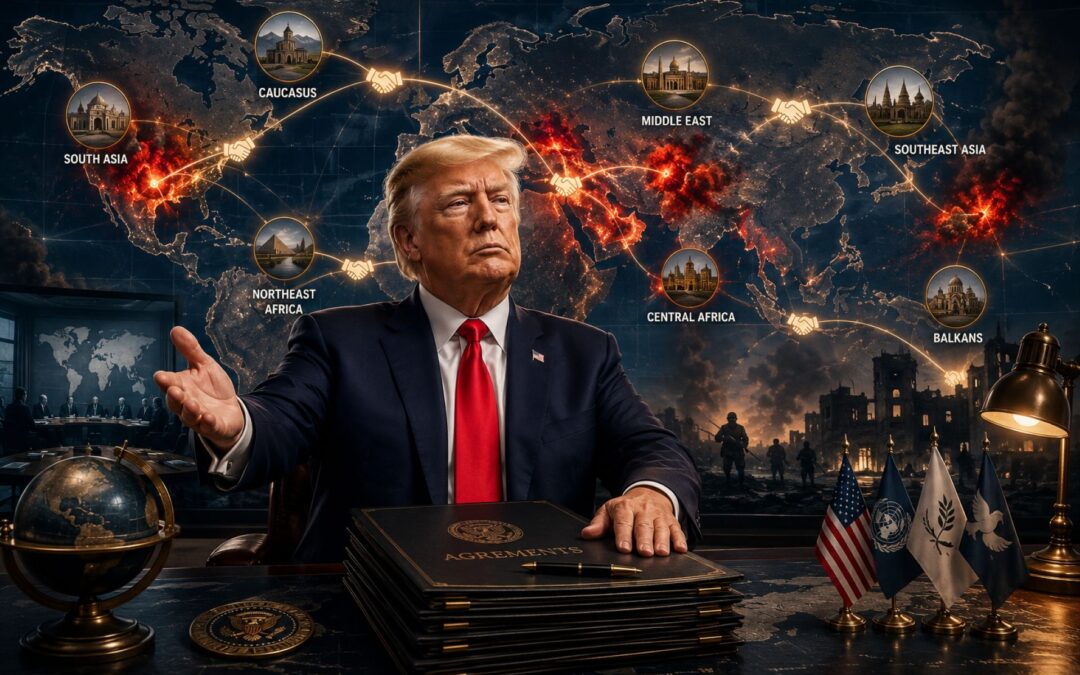
Donald Trump does not simply claim to be a president who prefers peace. He presents himself as a uniquely effective peacemaker: the leader who can enter conflicts that have defeated conventional diplomats, threaten or charm the participants into agreement, and announce a deal before anyone else believes one is possible.
During the first year of his second presidency, Trump repeatedly claimed that he had ended seven “un-endable” wars. The White House later expanded the list to eight, including disputes involving Egypt and Ethiopia, Serbia and Kosovo, Rwanda and the Democratic Republic of the Congo, India and Pakistan, Cambodia and Thailand, Armenia and Azerbaijan, Israel and Iran, and Israel and Hamas.
The boast is easy to dismiss. Some of these countries were not at war. Several agreements did not resolve the disputes behind the fighting. Others collapsed after Trump had already declared peace.
Yet dismissing the entire record would also be inaccurate.
Trump did help stop dangerous escalations. His pressure contributed to ceasefires, hostage releases, diplomatic frameworks, and negotiations that might not otherwise have occurred when they did. In some cases, governments actively sought his involvement because they believed access to the American market, American investment, or Trump himself could change the balance.
The real question is therefore not whether Trump deserves all the credit or none of it.
It is whether he has ended wars—or temporarily interrupted them.
This article evaluates the eight conflicts most closely associated with Trump’s peacemaking claims. The assessment is current through July 14, 2026, an important qualification because several of these agreements are still evolving.
The evidence points to a complicated verdict: Trump has become an unusually forceful broker of short-term de-escalation, but he has not consistently converted those interventions into durable peace.
Trump’s Expanding List of Wars He Claims to Have Ended
Trump’s count has never been completely stable.
In August 2025, he said he had solved six wars in six months. By September, he told the United Nations that he had ended seven wars in seven months. After the October 2025 Gaza agreement, the White House began promoting a list of eight conflicts. The administration incorporated the claim into its broader presentation of Trump as a president who could use American power more effectively than traditional diplomatic institutions. (White House)
There is a political advantage to keeping the claim flexible. Every new ceasefire can be added to the total, while the complicated aftermath of earlier agreements receives much less attention.
The number also depends on what counts as a war.
Egypt and Ethiopia have a dangerous dispute over the Nile, but they have not fought a war over it. Serbia and Kosovo remain bitterly divided, but their last full-scale conflict ended in 1999. Armenia and Azerbaijan fought repeated wars, but the decisive military outcome occurred before Trump returned to office. In eastern Congo, a treaty between governments could not automatically stop a rebellion involving armed actors who had not signed it.
The list combines wars, border clashes, frozen conflicts, diplomatic disputes, interstate tensions, proxy struggles, and one of the most devastating ongoing conflicts of the twenty-first century.
That does not make every American intervention meaningless.
It does mean that the same word—“ended”—cannot honestly describe all of them.
What Does It Actually Mean to End a War?
A ceasefire is not necessarily a peace settlement.
It may stop shooting for a few hours, establish a temporary pause, permit humanitarian aid, create space for negotiations, or freeze a battlefield indefinitely. The United Nations treats ceasefires as essential parts of peace processes, but not as substitutes for the political work needed to resolve an armed conflict. An armistice can suspend hostilities without legally or politically ending the state of war. (UN Peacemaker) (ICRC)
A formal treaty is not enough either. Governments can sign impressive documents while their armies, proxies, or allied militias continue fighting.
The label matters less than what happens afterward.
To judge Trump’s claims fairly, each case needs to pass four tests.
First, was there an active armed conflict to stop?
Second, did Trump or his administration make a material contribution to stopping it?
Third, did the resulting cessation of hostilities survive?
Fourth, did the agreement address the political, territorial, security, or institutional causes of the conflict?
A president can deserve credit for passing the second test even when the agreement later fails. Preventing immediate deaths or stopping escalation between nuclear-armed states is valuable.
But that is different from ending a war.
Trump’s record looks most impressive when judged by his ability to create moments of de-escalation. It looks far weaker when judged by durability, implementation, and political settlement.
Egypt and Ethiopia: A Dangerous Dispute, But Not a War
Egypt and Ethiopia have spent years arguing over the Grand Ethiopian Renaissance Dam, a vast hydroelectric project on the Blue Nile.
Ethiopia sees the dam as essential to electrification, development, and regional energy exports. Egypt depends on the Nile for most of its freshwater and fears that the dam’s operation—particularly during severe droughts—could threaten its water security. Sudan, situated between them, has its own concerns about water management, dam safety, and downstream coordination.
The dispute is serious. Officials have sometimes used threatening language, and the absence of a binding agreement creates a continuing risk of escalation.
But Egypt and Ethiopia were not fighting a war for Trump to end.
During Trump’s first term, the United States hosted negotiations among Egypt, Ethiopia, and Sudan. The talks failed to produce a final agreement. Ethiopia proceeded with filling the reservoir and formally inaugurated the dam in September 2025 despite Egyptian objections. In January 2026, Trump offered to restart American mediation—an offer that itself demonstrated that the dispute had not previously been resolved. (Reuters)
Trump can reasonably say that he attempted to mediate an important dispute.
He cannot reasonably say that he stopped an Egypt–Ethiopia war.
There was no active war, no completed settlement, and no durable water-sharing agreement. This is the weakest claim on his list.
Verdict: an unresolved diplomatic dispute, not a war Trump ended.
Serbia and Kosovo: Economic Normalization Without Political Resolution
Kosovo declared independence from Serbia in 2008, almost a decade after the 1998–1999 Kosovo War and NATO’s bombing campaign against Yugoslavia.
Serbia does not recognize Kosovo as an independent state. Kosovo’s government considers its sovereignty irreversible. Tensions remain especially dangerous in northern Kosovo, where much of the ethnic Serb population rejects the authority of institutions in Pristina.
Those tensions can produce barricades, arrests, violent incidents, military alerts, and fears of escalation.
They do not mean Serbia and Kosovo were fighting a new war when Trump intervened.
In September 2020, Trump hosted Serbian President Aleksandar Vučić and Kosovar Prime Minister Avdullah Hoti at the White House. The parties made commitments on transport, trade, infrastructure, investment, missing persons, and other elements of economic normalization. The United States described the agreement as a breakthrough while explicitly reaffirming support for continuing negotiations toward comprehensive normalization. (U.S. Department of State)
The agreement was meaningful, but it was not a peace treaty.
It did not compel Serbia to recognize Kosovo. It did not create an accepted territorial settlement. It did not permanently resolve the position of Serb-majority municipalities. It did not eliminate the possibility of renewed violence.
The European Union continued leading a separate normalization process and produced another agreement in 2023. Even that framework remains incompletely implemented, with the EU still pressing both sides to fulfil their obligations. (European External Action Service)
Trump therefore deserves some credit for encouraging practical economic cooperation during his first term.
But economic normalization is not the same as ending a war—especially when the war in question had already ended more than two decades earlier.
Verdict: a useful economic agreement that did not resolve the Serbia–Kosovo conflict.
DR Congo and Rwanda: A Peace Agreement That Did Not End the M23 War
Eastern Democratic Republic of the Congo has endured overlapping wars, rebellions, foreign interventions, ethnic tensions, state weakness, and competition over mineral-rich territory for decades.
The conflict Trump confronted was not simply a conventional war between Congo and Rwanda.
The M23 rebel movement had launched a major offensive in eastern Congo, capturing Goma and other strategic territory. Congo, the United Nations, and several Western governments accused Rwanda of supporting M23 with troops, weapons, training, and operational assistance. Rwanda denied controlling the group and argued that its security was threatened by the Democratic Forces for the Liberation of Rwanda, or FDLR, an armed movement with roots in forces responsible for the 1994 Rwandan genocide.
In June 2025, the Congolese and Rwandan governments signed a United States-brokered agreement in Washington. It committed the parties to respect territorial integrity, disengage forces, coordinate on security threats, facilitate refugee returns, and pursue regional economic integration. The agreement also connected peace to Western investment in a region rich in cobalt, copper, lithium, gold, and other critical minerals. (U.S. Department of State)
This was real diplomacy.
The agreement established mechanisms through which Rwanda and Congo could reduce the risk of direct interstate confrontation. Trump’s administration remained involved in oversight meetings, applied pressure, encouraged economic cooperation, and later imposed sanctions on commanders accused of obstructing peace.
The central weakness was evident from the beginning: M23 was not a party to the June agreement.
A separate Qatar-led process eventually produced a framework between Congo and M23, but implementation remained weak. M23 continued consolidating territorial control, seized Uvira shortly after the Washington Accords were reaffirmed in December 2025, and maintained parallel administrative structures in areas under its authority. By June 2026, the United Nations was still reporting that M23 and Rwandan forces were consolidating control in occupied areas. (United Nations) (Reuters)
The agreement may still prove valuable. Interstate security coordination, sustained American involvement, sanctions, and economic incentives could eventually reduce the conflict.
But the fighting did not end.
Trump helped create a diplomatic framework around a real war. He did not resolve that war, disarm its major armed groups, restore Congolese authority across the east, or eliminate the security fears driving Rwandan involvement.
Verdict: a genuine diplomatic initiative that has not ended the conflict.
India and Pakistan: Trump Helped Stop Escalation, Not the Kashmir Conflict
India and Pakistan have fought repeatedly since the partition of British India in 1947.
The most persistent territorial dispute concerns Jammu and Kashmir. The two countries fought over the region in 1947–1948 and 1965, while the 1999 Kargil conflict again brought their forces into direct combat in the mountains of Kashmir. Both now possess nuclear weapons, making every major confrontation potentially catastrophic.
In April 2025, gunmen killed 26 people, mostly Hindu tourists, near Pahalgam in Indian-administered Kashmir. India blamed Pakistan-backed terrorism. Pakistan denied involvement.
India subsequently launched strikes against what it described as terrorist infrastructure in Pakistan. The confrontation expanded through missiles, drones, artillery fire, and attacks on military facilities. For four days, two nuclear-armed states moved rapidly up the escalation ladder.
On May 10, Trump announced that India and Pakistan had agreed to stop military action. The United States described the result as a U.S.-brokered ceasefire, and Pakistan publicly credited Washington with playing an important role. (U.S. Department of State)
India presented a different account.
According to the Indian government, the cessation resulted from direct contact between the directors general of military operations of India and Pakistan. Prime Minister Narendra Modi told Trump that there had been no discussion of American mediation or a trade deal and reiterated India’s longstanding rejection of third-party mediation over Kashmir. (Indian Ministry of External Affairs)
Both accounts can contain part of the truth.
American officials were communicating with both sides during a dangerous confrontation. Trump announced the agreement before either government publicly presented it in detail. U.S. pressure may have reinforced incentives already pushing Indian and Pakistani military leaders toward restraint.
At the same time, there is insufficient public evidence for Trump’s stronger claim that threatening tariffs forced both countries to stop fighting.
What is clear is that the immediate escalation ended.
That matters. Preventing further exchanges between India and Pakistan was not a ceremonial achievement. Even a limited diplomatic contribution to de-escalating a confrontation between nuclear powers deserves recognition.
But the agreement did not settle Kashmir, eliminate terrorism, restore normal diplomatic relations, create a formal peace treaty, or prevent future crises.
Trump may deserve partial credit for stopping one dangerous episode.
He did not end the India–Pakistan conflict.
Verdict: meaningful crisis de-escalation, with the extent of Trump’s role still disputed.
Cambodia and Thailand: When Tariff Diplomacy Worked—Temporarily
Trump’s intervention in the Cambodia–Thailand border conflict initially looked like the clearest demonstration of his preferred diplomatic method.
The two countries have disputed parts of their border for decades, including territory surrounding historic temple complexes. Fighting had occurred before, but tensions rose sharply in 2025 following a deadly clash between soldiers in May.
The crisis became entangled with domestic politics, particularly in Thailand. A leaked telephone conversation between Thai Prime Minister Paetongtarn Shinawatra and former Cambodian leader Hun Sen triggered political outrage and contributed to her removal from office.
In July, the border dispute escalated into sustained fighting involving artillery, rockets, air strikes, and ground forces. Dozens of people were killed, and roughly 300,000 were displaced.
Trump contacted the leaders of both countries and threatened to suspend trade negotiations unless they stopped fighting. The threat carried weight. The United States was a crucial export market for both economies, and Cambodia and Thailand were trying to reduce the severe tariffs Trump had announced earlier that year.
A ceasefire followed on July 28, supported by Malaysian Prime Minister Anwar Ibrahim and regional diplomacy. Trump subsequently reduced planned tariffs on both countries to 19 percent. In October, the two governments signed an expanded declaration in Trump’s presence at an ASEAN summit. (Reuters)
This was not imaginary peacemaking.
Trump possessed leverage, used it visibly, and appears to have helped push both sides toward a ceasefire. His intervention accelerated diplomacy during an active conflict and probably prevented further immediate casualties.
Then the agreement began to unravel.
Thailand suspended parts of the process in November following a landmine explosion. Mutual accusations intensified. In December, major fighting resumed. Thai aircraft struck Cambodian positions, artillery and rockets were exchanged, at least 101 people were killed, and more than half a million were displaced before another ceasefire took effect. (Reuters)
The collapse does not erase Trump’s original contribution.
It does reveal the limitations of tariff diplomacy.
Economic pressure can change the immediate calculation of governments. It can make continued fighting more expensive than attending negotiations. It cannot by itself demarcate a disputed border, reconcile competing historical claims, prevent every military incident, or neutralize domestic nationalism.
Trump helped stop one round of combat.
He did not secure an enduring settlement.
Verdict: one of Trump’s clearest short-term successes, followed by a decisive failure of durability.
Armenia and Azerbaijan: Trump’s Strongest Conventional Diplomatic Breakthrough
For decades, Armenia and Azerbaijan fought over Nagorno-Karabakh, a predominantly Armenian-populated region internationally recognized as part of Azerbaijan.
Armenian forces emerged victorious from the first war in the early 1990s and controlled Nagorno-Karabakh along with surrounding Azerbaijani territory. Hundreds of thousands of people were displaced.
The military balance later shifted.
Oil and gas revenues allowed Azerbaijan to build stronger armed forces. In 2020, it recovered large areas during a six-week war. In September 2023, Azerbaijan launched another offensive and re-established control over the remainder of Nagorno-Karabakh. Almost the entire ethnic Armenian population fled, and the region’s self-declared Armenian administration was dissolved.
By the time Trump returned to office, Azerbaijan had already achieved its principal territorial objective through force.
That does not mean peace automatically followed.
Armenia and Azerbaijan still needed to establish diplomatic relations, recognize borders, address transport routes, exchange prisoners, settle legal claims, and reduce the possibility of another war. Azerbaijan also demanded that Armenia change constitutional language it considered an implicit territorial claim.
In March 2025, the two governments announced that they had completed negotiations on the text of a peace agreement. That progress preceded Trump’s direct intervention.
In August, however, Armenian Prime Minister Nikol Pashinyan and Azerbaijani President Ilham Aliyev met at the White House. They initialed the peace agreement, committed themselves to peaceful relations, and endorsed a new transport project through southern Armenia connecting Azerbaijan with its Nakhchivan exclave.
The project became known as the Trump Route for International Peace and Prosperity, or TRIPP. The United States obtained a major development role while Armenia retained sovereignty over the territory. Subsequent agreements in 2026 moved the transport and infrastructure framework closer to implementation. (U.S. Department of State) (U.S. Department of State)
The agreement has not crossed every finish line.
A final treaty still faces political and constitutional obstacles. Mutual trust remains weak. The status of displaced populations and detainees remains sensitive. Iran and Russia have strategic concerns about an expanding American role in the South Caucasus.
It would nevertheless be unfair to reduce the White House process to a photo opportunity.
Azerbaijan’s 2023 victory ended Armenian control of Nagorno-Karabakh, but military victory is not the same as normalized interstate relations. Trump helped attach American diplomatic weight, economic incentives, infrastructure plans, and continued implementation mechanisms to a settlement that could close a conflict lasting almost four decades.
The achievement should be described accurately.
Trump did not single-handedly end the war. The battlefield outcome and years of bilateral negotiations created the opportunity. But his administration made a substantial contribution to turning that outcome into a broader diplomatic framework. (International Crisis Group)
Verdict: Trump’s strongest conventional diplomatic breakthrough, though not yet a fully completed peace.
Israel and Iran: A War Trump Helped Stop—and Then Failed to Keep Stopped
Israel and Iran had spent decades fighting indirectly before their conflict became an open interstate war.
Iran supported armed groups opposed to Israel, including Hezbollah, Hamas, and the Houthis. Israel conducted covert operations, cyberattacks, assassinations, and air strikes intended to weaken Iran’s nuclear program and regional network.
Direct exchanges intensified during 2024, before Trump returned to office. Israel and Iran attacked each other’s territory, breaking an important barrier that had previously kept much of their confrontation in the shadows.
In June 2025, Israel launched a large-scale campaign against Iranian nuclear facilities, missile infrastructure, military commanders, and scientists. Iran retaliated with missiles and drones.
Trump then brought the United States directly into the war.
On June 22, American bombers struck the Fordow, Natanz, and Isfahan nuclear facilities. Iran retaliated against an American base in Qatar. Soon afterward, Trump announced a ceasefire between Israel and Iran and publicly pressured both sides when the arrangement appeared to be faltering. (Associated Press)
Trump deserves credit for helping stop the twelve-day war.
The fact that the United States had joined the fighting does not make its role in ending that phase meaningless. Presidents can contribute to terminating wars in which their countries are participants.
But it complicates the image of a neutral mediator. Trump did not merely bring two belligerents together. He used American military force to change Iran’s calculations and then attempted to close the confrontation before it expanded further.
The ceasefire stopped the immediate Israel–Iran exchange.
It did not resolve Iran’s nuclear program, Israel’s perception of an existential threat, Iran’s support for armed groups, the regional missile balance, or the absence of diplomatic relations.
The distinction became undeniable in 2026.
The United States and Israel launched a new campaign against Iran on February 28. An April ceasefire produced another period of negotiations, followed by an interim memorandum in June. That arrangement also frayed. On July 8, Trump declared the interim accord “over,” and American and Iranian forces resumed direct attacks. By July 13, Trump had formally notified Congress that U.S. hostilities with Iran had resumed. (Reuters)
The 2025 ceasefire was still an achievement. It halted a dangerous war at a moment when escalation could have drawn in much of the Middle East.
It was not a lasting peace between Israel and Iran.
The return to war transformed a debatable claim into a demonstrably false one.
Verdict: Trump helped stop the 2025 war, but the underlying conflict returned on an even larger scale.
Israel and Hamas: The Biggest Achievement and the Hardest Test
The Gaza agreement is arguably Trump’s most consequential peace initiative.
The war began with the Hamas-led attack on Israel on October 7, 2023, in which approximately 1,200 people were killed and around 250 were taken hostage. Israel’s subsequent campaign devastated Gaza, displaced most of its population, destroyed homes and infrastructure, and killed tens of thousands of Palestinians.
Negotiators from the United States, Egypt, and Qatar spent months attempting to reach agreements over hostages, prisoners, aid, Israeli withdrawals, and a ceasefire.
After returning to office, Trump increasingly pushed for a broader settlement. His relationship with Israeli Prime Minister Benjamin Netanyahu, pressure on Hamas through regional mediators, anger over an Israeli attack targeting Hamas negotiators in Qatar, and interest in expanding Arab–Israeli normalization all contributed to the diplomatic environment.
In September 2025, Trump announced a 20-point plan. It called for a ceasefire, the release of hostages, the freeing of Palestinian prisoners and detainees, staged Israeli withdrawal, increased humanitarian aid, Hamas’s disarmament, transitional governance, an international stabilization force, and the reconstruction of Gaza.
Israel and Hamas agreed to the first phase in October. Hamas released the final 20 living Israeli hostages, while Israel released 250 Palestinian prisoners serving long sentences and approximately 1,700 detainees from Gaza. Israeli forces withdrew to an agreed line, and the intensity of the war declined. (Reuters)
That was a major achievement.
Returning the living hostages and reducing the scale of the fighting were not symbolic gains. Trump and his administration played a central role. Even observers deeply critical of his foreign policy acknowledged that his pressure helped move Netanyahu and the negotiations.
The problem is that the first phase addressed the issues on which a temporary exchange was possible. The most difficult questions were postponed.
Would Hamas disarm?
Would Israel withdraw fully?
Who would govern Gaza?
Would an international stabilization force deploy?
How would security be maintained without indefinite Israeli occupation or restored Hamas control?
Who would finance reconstruction?
Would Palestinians have meaningful authority over their political future?
Trump created a Board of Peace and supported a Palestinian technocratic body known as the National Committee for the Administration of Gaza. The United Nations Security Council endorsed elements of the broader plan, and international actors began discussing reconstruction and transitional security.
Implementation stalled.
The ceasefire was repeatedly violated. Israeli operations continued, and more than 1,000 Palestinians were reportedly killed after the agreement took effect. Israel retained control over most of Gaza. Hamas resisted disarmament, although it announced in July 2026 that it was dissolving its de facto governing body and would transfer civilian authority to the technocratic committee. Israel dismissed the move as inadequate without the surrender of Hamas’s weapons. (Reuters) (Reuters)
The ceasefire therefore exists in an uncomfortable state.
It has not returned to the unrestricted warfare that preceded October 2025, but neither has it delivered the complete cessation of violence promised by its supporters. The hostage breakthrough is real. The political settlement is not.
Trump deserves substantial credit for the first phase.
Whether it becomes the foundation of peace or another extended pause will depend on decisions that have not yet been made.
Verdict: Trump’s most important immediate achievement, but still an unfinished and repeatedly violated settlement.
The Scorecard: Where Trump Deserves Credit
Trump’s record cannot be reduced honestly to either “eight wars ended” or “nothing accomplished.”
The more accurate scorecard is:
| Conflict | Active war to stop? | Trump’s contribution | Did the cessation endure? | Overall verdict |
| Egypt–Ethiopia | No | Hosted unsuccessful talks and later offered new mediation | No settlement exists | Not a war Trump ended |
| Serbia–Kosovo | No new war | Brokered economic commitments in 2020 | Political dispute remains | Useful normalization, not peace |
| DR Congo–Rwanda | Yes, within a wider regional conflict | Brokered an interstate agreement and continued oversight | Fighting and M23 control continued | Real diplomacy, war not ended |
| India–Pakistan | Yes, a four-day military escalation | Likely contributed to de-escalation, although India disputes mediation | Immediate cessation largely endured | Partial credit for crisis management |
| Cambodia–Thailand | Yes | Used trade pressure to help produce a ceasefire | First ceasefire collapsed in December 2025 | Clear short-term success, weak durability |
| Armenia–Azerbaijan | Yes, historically and recently | Helped transform a military outcome into a diplomatic and economic framework | Peace has broadly held, but the final treaty remains incomplete | Strongest conventional diplomatic achievement |
| Israel–Iran | Yes | Helped terminate the 2025 twelve-day war after U.S. intervention | Major war resumed in 2026 | Real ceasefire, not lasting peace |
| Israel–Hamas | Yes | Central role in hostage releases and first-phase ceasefire | Repeated violations and incomplete implementation | Major but unfinished achievement |
Trump has credible claims to meaningful involvement in several cases.
He has much weaker grounds for claiming that he permanently resolved them.
The Art of the Peace Deal
Trump’s approach differs from the patient, institutional model associated with traditional diplomacy.
He prefers visible pressure over quiet preparation. He speaks directly to leaders, imposes compressed deadlines, threatens consequences, offers commercial benefits, and presents negotiations as transactions that rational actors should accept.
The approach has several recurring tools.
The first is access to the American market.
Cambodia and Thailand faced the possibility that continued fighting would damage their trade negotiations with the United States. Whether or not Trump’s precise tariff numbers were economically coherent, the threat was immediate and understandable.
The second is military unpredictability.
Iran could not be certain whether Trump wanted a limited strike, regime change, negotiations, or a much larger war. That uncertainty created risks, but it also gave American threats credibility.
The third is personal diplomacy.
Trump often treats relations among states as relations among leaders. He invites presidents and prime ministers to the White House, offers public praise, creates ceremonies, attaches his name to projects, and gives governments a politically attractive way to declare success.
The fourth is economic integration.
The Armenia–Azerbaijan corridor, Congo’s mineral framework, Gaza reconstruction, and regional trade incentives all reflect Trump’s belief that countries with profitable relationships have stronger reasons not to fight.
The fifth is deliberate simplification.
Long conflicts become problems of incentives: stop fighting and receive investment, trade, recognition, security, or access. Continue fighting and face tariffs, isolation, or military consequences.
This method can work because many peace processes become trapped in procedural caution. Trump is willing to disrupt the stalemate.
A Chatham House discussion of Trump’s approach described a style in which personal pressure, economic deals, strategic interests, and conflict resolution become tightly connected.
That style is not isolationist in the traditional sense.
Trump objects to open-ended American commitments and wars without clear gains. Yet he is willing to insert the United States aggressively into distant conflicts when he sees an opportunity to force an agreement, demonstrate power, secure an economic advantage, or claim a political victory.
He wants fewer permanent obligations, not necessarily less American influence.
Why Trump’s Agreements Struggle to Become Lasting Peace
The same qualities that help Trump produce rapid agreements can undermine their durability.
His first weakness is premature victory.
Once leaders have shaken hands, issued a declaration, or accepted a ceasefire, Trump often speaks as though the political problem has been solved. That creates an incentive to prioritize the announcement over the enforcement mechanism.
Cambodia and Thailand had not resolved their border. Congo and Rwanda had not brought M23 into the original agreement. Israel and Hamas had not resolved governance or disarmament. Armenia and Azerbaijan had not completed every legal and constitutional step.
The ceremonies were real.
So were the unresolved problems.
The second weakness is incomplete participation.
A peace process cannot reliably end a war when major armed actors are missing. Governments may sign an agreement while militias, rebel movements, local commanders, political factions, or foreign sponsors retain both the means and motivation to continue fighting.
The third is weak implementation.
Durable agreements need monitoring, sequencing, verification, dispute-resolution mechanisms, timelines, sanctions for violations, and institutions capable of continuing when political attention moves elsewhere.
Trump’s diplomacy is highly personalized. It is strongest when he is calling leaders, issuing threats, or hosting a summit. It becomes more vulnerable when implementation is delegated to officials and committees after the cameras leave.
The fourth weakness is that economic incentives cannot settle every political question.
Trade and investment can make peace more attractive. They cannot automatically reconcile rival national identities, historical grievances, territorial claims, security fears, displaced populations, or demands for justice.
A railway can connect Armenia and Azerbaijan.
It cannot by itself create trust.
Mineral investment can encourage Rwanda and Congo to cooperate.
It cannot by itself disarm M23 or the FDLR.
Reconstruction funds can help Gaza recover.
They cannot determine who governs, who carries weapons, what security Israel receives, or what political rights Palestinians obtain.
Finally, Trump’s unpredictability can produce compliance without confidence.
Leaders may agree because they fear what he will do next. That can be effective during a crisis. Lasting peace, however, requires parties to believe that the agreement will survive changes in mood, personnel, political incentives, and presidential attention.
Pressure can bring people to the table.
It cannot make them stay there forever.
What Trump’s Diplomacy Reveals About American Power
Trump’s interventions reveal that the United States remains extraordinarily powerful.
It controls access to the world’s largest consumer market. It influences international finance, sanctions, investment, technology, weapons supplies, security guarantees, and diplomatic recognition. Its president can call leaders during a crisis and alter their calculations within hours.
Governments still value the legitimacy of a White House ceremony. Even countries that resent American pressure often want American investment, protection, recognition, or trade.
That is why Trump can insert himself into conflicts far from the United States.
Yet his mixed record also reveals the limits of American power.
Washington could pressure Cambodia and Thailand into a ceasefire but could not erase their border dispute. It could sponsor an agreement between Rwanda and Congo but could not dictate the behaviour of every armed force in eastern Congo. It could broker a Gaza hostage exchange but could not easily design a legitimate and enforceable postwar political order.
The world is no longer organized around the same concentrated blocs that shaped the proxy-war system of the Cold War.
Regional actors now possess more autonomy. Qatar, Egypt, Malaysia, Turkey, the European Union, Gulf states, local armed movements, and middle powers often determine whether American initiatives succeed. China and Russia create alternative economic and security relationships. Governments can resist Washington, seek competing patrons, or accept only the parts of an American proposal that suit them.
Trump’s peace deals therefore demonstrate two truths at once.
The United States remains the only country capable of combining military force, trade access, sanctions, investment, diplomatic prestige, and personal presidential pressure on such a global scale.
But even the United States cannot manufacture durable peace without local legitimacy, regional cooperation, inclusive negotiations, and years of implementation.
America can still create a moment.
It cannot always control what follows.
Does Trump Deserve the Nobel Peace Prize?
Several governments and political figures have publicly said they nominated Trump for the Nobel Peace Prize.
Such announcements should be understood carefully. The Norwegian Nobel Committee does not publicly confirm current nominees. Nominations and deliberations remain confidential for 50 years, and being nominated does not constitute an endorsement by the Nobel institutions. (Nobel Prize)
Trump did not receive the 2025 prize. It was awarded to Venezuelan opposition leader María Corina Machado for her work promoting democratic rights and a peaceful political transition. (Nobel Prize)
Should Trump receive a future prize?
There is a serious affirmative case.
He helped secure the release of living Israeli hostages held in Gaza. He contributed to stopping a dangerous India–Pakistan escalation. He helped halt the 2025 Israel–Iran war. He used American leverage to stop fighting between Cambodia and Thailand. He gave important momentum to an Armenia–Azerbaijan settlement.
Those accomplishments affected real lives.
The case against awarding him the prize is equally serious.
Several conflicts were not wars when he claimed to have ended them. The Congo agreement failed to stop M23. The Cambodia–Thailand ceasefire collapsed. The Israel–Iran conflict returned as a larger war. Violence continued in Gaza, while the most difficult political questions remained unresolved.
Trump’s reliance on American military force also complicates the image of a pure peacemaker. In Iran, he participated in the war before brokering its temporary end. His broader foreign policy contains coercion, threats, blockades, and military campaigns alongside negotiations.
The fairest answer is not “never.”
It is “not on the evidence available yet.”
If Armenia and Azerbaijan sign and implement a lasting peace, if Gaza moves from hostage agreement to sustainable political settlement, and if American pressure creates durable improvements elsewhere, Trump’s historical case will strengthen.
If his agreements continue collapsing after their signing ceremonies, the claim that he ended multiple wars will look increasingly like political branding.
A peace prize should reward peace that survives the announcement.
Conclusion: A Crisis Broker, Not Yet a Builder of Peace
Donald Trump has not ended seven or eight wars in the ordinary meaning of the phrase.
Some of the conflicts on his list were not active wars. Some had already been decided militarily. Some were paused rather than resolved. Some continued almost immediately. Others returned months later.
But Trump’s record is not empty.
He has repeatedly demonstrated an ability to recognize leverage and use it without embarrassment. He threatens tariffs where traditional diplomats offer statements. He pressures allies other presidents might hesitate to confront. He combines military danger with economic opportunity. He gives leaders ceremonies through which compromise can be presented as victory.
That method can stop people from shooting.
Sometimes, that is the most urgent achievement available.
Trump’s problem is that he too often treats the moment when shooting stops as the moment peace begins and ends. He announces the triumph before borders are settled, armed groups are included, monitors are deployed, governments are established, prisoners are returned, weapons are surrendered, or political grievances are addressed.
Peace is not a photograph of leaders shaking hands.
It is what remains when the leaders leave the room.
Trump has proved that he can be an effective crisis broker. He can accelerate negotiations, interrupt escalation, and force actors to reconsider the cost of continued war.
He has not yet proved that he can consistently build the institutions, compromises, enforcement mechanisms, and political legitimacy required to prevent those wars from returning.
That is the difference between making a deal and making peace.
Last Updated on July 14, 2026 by Aseem Gupta