
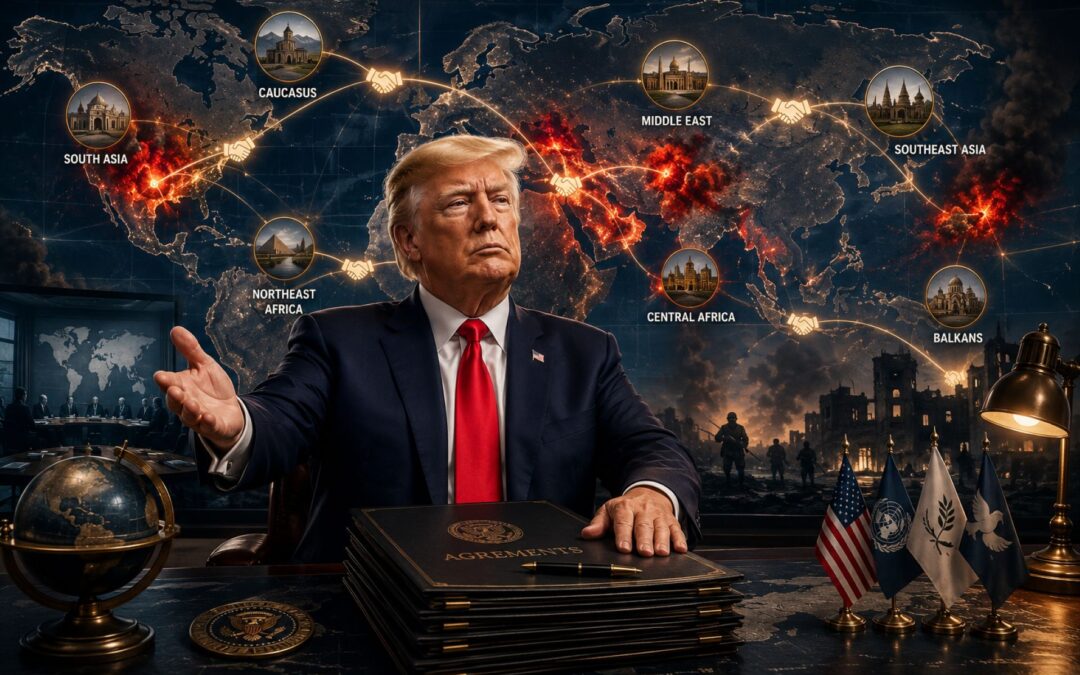
Donald Trump has repeatedly presented himself as a president capable of ending wars that conventional diplomacy could not resolve. During the first year of his second presidency, he claimed to have settled seven conflicts across the world. The White House eventually expanded that number to eight, portraying his willingness to threaten tariffs, apply military pressure, and negotiate directly with foreign leaders as proof of an extraordinary peacemaking record.
Some of those claims are difficult to defend. Egypt and Ethiopia were not fighting a war for Trump to end, while Serbia and Kosovo remained divided by a conflict whose major fighting had ended decades earlier. Other achievements were more substantial, including ceasefires between nuclear-armed rivals, the release of Israeli hostages from Gaza, and progress toward normalizing relations between Armenia and Azerbaijan.
Yet several agreements deteriorated after Trump declared victory. Fighting returned between Cambodia and Thailand, the war in eastern Congo continued, and the 2025 ceasefire between Israel and Iran failed to prevent a much larger confrontation in 2026. These developments expose the difference between stopping an immediate military escalation and establishing peace that survives the pressures that caused the conflict.
Trump’s diplomatic record cannot be fairly described as either eight wars ended or eight imaginary accomplishments. His interventions have sometimes saved lives and created genuine political opportunities, but the durability of those achievements varies enormously. An assessment of the eight conflicts through October 20, 2026, reveals both the strengths of his unconventional approach and the limitations of treating international peace as a succession of deals.
What Does It Mean to End a War?
Trump’s claims have evolved alongside his diplomatic ambitions. In August 2025, he said that he had ended six wars in six months. By September, he was telling the United Nations that he had resolved seven conflicts, a claim incorporated into the White House’s presentation of his address to the General Assembly. Following the October 2025 agreement between Israel and Hamas, his administration began promoting a list of eight.
The changing number raises a fundamental question about what qualifies as an ended war. The administration’s list combines full-scale military confrontations, brief border clashes, longstanding territorial disputes, insurgencies, and diplomatic disagreements that never escalated into organized fighting. These situations require different solutions and cannot reasonably be evaluated as though they represent identical achievements.
A ceasefire suspends hostilities, but it does not necessarily resolve the disagreements that produced them. Governments may stop firing while retaining their military positions, continuing to dispute borders, or preparing for another confrontation. An armistice can similarly suspend military operations without creating a comprehensive political settlement, while economic agreements may improve relations without addressing sovereignty or security.
Even a signed peace treaty does not guarantee that a conflict has ended. Agreements require implementation, monitoring, political cooperation, and sufficient authority over the armed groups involved. A government cannot reliably promise peace on behalf of an insurgency it does not control, and a territorial settlement may remain unstable when displaced populations, disputed borders, or incompatible security demands are left unresolved.
Four questions provide a more consistent way to evaluate Trump’s record: Was there an active armed conflict to stop? Did Trump or his administration materially contribute to ending the fighting? Did the cessation of hostilities endure? And did the resulting agreement address the political, territorial, or security problems responsible for the conflict?
These distinctions are not intended to diminish successful crisis diplomacy. Preventing further deaths during a confrontation between nuclear powers is valuable even when the underlying dispute remains unresolved. However, stopping one episode of violence deserves a different description from permanently ending a decades-long conflict.
Egypt and Ethiopia: A War That Never Happened
The dispute between Egypt and Ethiopia concerns one of Africa’s most important rivers and the enormous Grand Ethiopian Renaissance Dam, constructed on the Blue Nile. Ethiopia regards the hydroelectric project as essential to its economic development, electricity generation, and ability to export energy to neighboring countries. Egypt, which depends heavily on the Nile for freshwater, fears that Ethiopia’s control over upstream water flows could threaten agriculture, drinking-water supplies, and national security.
Sudan, situated between the two countries, also has important interests in the dam’s operation. Coordinated water releases could provide benefits, but disagreements over reservoir management, drought conditions, and safety have prevented the three governments from reaching a comprehensive, binding agreement. The dispute has occasionally produced threatening rhetoric, making the possibility of escalation a legitimate concern.
The critical distinction is that Egypt and Ethiopia were not engaged in an active war over the dam when Trump claimed to have resolved their conflict. As Associated Press reporting on Ethiopia’s regional disputes helps clarify, tensions involving Ethiopia must be distinguished according to the countries, territories, and military actors actually involved.
During Trump’s first presidency, Washington hosted negotiations involving Egypt, Ethiopia, and Sudan in 2019 and 2020. American officials attempted to facilitate an agreement on filling and operating the reservoir, but the talks ended without the binding settlement that Egypt sought. Ethiopia subsequently continued developing the project and formally inaugurated the dam in September 2025.
The disagreement persisted into Trump’s second presidency. In January 2026, he offered to renew American mediation, implicitly acknowledging that the dispute remained unresolved despite his earlier claims of diplomatic success.
American attempts to mediate the Nile dispute were legitimate diplomatic initiatives, and preventing future hostilities would be worthwhile. Nevertheless, there was no active Egypt–Ethiopia war to end, no completed settlement from Trump’s negotiations, and no lasting agreement governing the competing water-security concerns. This remains the least defensible entry on his list of supposedly ended wars.
Serbia and Kosovo: An Economic Deal, Not a Peace Treaty
The dispute between Serbia and Kosovo originates in the violent breakup of Yugoslavia. During the 1998–1999 Kosovo War, Yugoslav security forces fought ethnic Albanian separatists amid widespread violence and displacement. NATO intervened with an air campaign against Yugoslavia, and Serbian forces subsequently withdrew from Kosovo under an internationally supervised arrangement.
Kosovo declared independence in 2008, but Serbia continues to reject its sovereignty. Kosovo’s government maintains that independence is irreversible, while Serbia considers the territory historically and constitutionally important. Relations remain particularly tense in northern Kosovo, where many ethnic Serbs oppose the authority of institutions based in Pristina.
These disagreements have occasionally produced barricades, arrests, violent incidents, military alerts, and fears of renewed conflict. However, they do not establish that Serbia and Kosovo were fighting a new war when Trump negotiated an agreement during his first presidency.
In September 2020, Trump hosted Serbian President Aleksandar Vučić and Kosovo’s Prime Minister Avdullah Hoti at the White House. Their economic normalization commitments addressed transport connections, infrastructure, investment, trade, missing persons, and practical cooperation intended to improve relations between the two economies.
The negotiations represented a meaningful attempt to reduce tensions through shared economic interests. Better transportation links and commercial opportunities could create incentives for cooperation, while a high-profile American intervention could encourage both governments to maintain dialogue.
Nevertheless, the agreement did not require Serbia to recognize Kosovo’s independence, establish a mutually accepted territorial settlement, or permanently resolve the status of Serb-majority municipalities. It was principally an economic agreement rather than a comprehensive peace treaty.
The European Union continued leading a separate normalization process, resulting in additional commitments in 2023. Those efforts also encountered implementation problems, as reflected in an independent assessment of the Kosovo–Serbia normalization process.
Trump deserves credit for encouraging practical cooperation between governments with deeply conflicting political positions. His agreement did not, however, settle Kosovo’s sovereignty or end a war that had already ceased more than twenty years earlier. Economic normalization was a worthwhile diplomatic objective, but presenting it as the conclusion of a military conflict exaggerates what was achieved.
DR Congo and Rwanda: The Peace Deal That Could Not Stop M23
Eastern Democratic Republic of the Congo has experienced decades of overlapping wars, rebellions, foreign military interventions, ethnic tensions, and competition over territory and natural resources. The region contains valuable deposits of copper, cobalt, gold, and other minerals, but its political instability cannot be explained simply as a struggle for mineral wealth. Weak state institutions, unresolved grievances, regional security fears, and armed movements with competing objectives have all sustained the violence.
One of the most powerful rebel organizations is the March 23 Movement, commonly known as M23. In January 2025, the movement captured Goma, a major city in eastern Congo, and expanded its territorial control. The offensive intensified an already severe humanitarian crisis and brought renewed international attention to Rwanda’s alleged involvement.
The Congolese government, United Nations investigators, and several Western governments accused Rwanda of supporting M23 through troops, weapons, training, and operational assistance. Rwanda has challenged accusations about its relationship with the movement and emphasized its concerns about the Democratic Forces for the Liberation of Rwanda, or FDLR, an armed organization whose origins are connected to forces involved in the 1994 Rwandan genocide.
This complicated security environment meant that a peace agreement between Kinshasa and Kigali could not automatically resolve the conflict. Even if the two governments reduced their direct confrontation, armed groups operating inside Congo retained their own objectives, military structures, and territorial interests.
In June 2025, the United States helped broker an agreement between Rwanda and the Democratic Republic of the Congo. The Washington accord included commitments concerning territorial integrity, military disengagement, security cooperation, refugee returns, and regional economic integration.
The negotiations also connected peacebuilding to commercial opportunities involving the region’s valuable mineral resources. American investment and economic cooperation were intended to provide additional incentives for stability, reflecting Trump’s preference for agreements that produce strategic and financial benefits alongside political commitments.
This was genuine diplomacy. The agreement created channels through which Rwanda and Congo could manage their security disagreements, and Washington remained involved in oversight, political pressure, and measures intended to discourage violations. The administration subsequently imposed sanctions on individuals accused of obstructing peace efforts.
However, M23 was not a signatory to the original Washington agreement. The movement’s absence exposed a major weakness in the diplomatic framework because an agreement among national governments could not directly bind rebel commanders controlling significant territory.
Qatar subsequently facilitated a separate negotiation process involving the Congolese government and M23. Although that track produced commitments and frameworks for further talks, implementation remained fragile. The rebels continued maintaining control over important areas, including territory around Goma, and consolidated administrative structures in places under their authority.
The limitations became especially clear after the Washington agreements were reaffirmed in December 2025. M23 captured Uvira shortly afterward, demonstrating that formal diplomatic announcements had not eliminated the movement’s capacity or willingness to conduct major operations. United Nations reporting in June 2026 continued to describe the consolidation of control by M23 and Rwandan forces in occupied areas.
By October 2026, the political situation had become even more complicated. A United Nations Security Council discussion of the Great Lakes region reflected the continuing international concern over insecurity and implementation, while further developments changed the rebellion’s political presentation.
Former Congolese President Joseph Kabila emerged as the leader of a restructured rebel coalition previously associated with the Alliance Fleuve Congo and M23. The movement adopted the name Refoundation of the Nation, apparently seeking a broader national identity rather than remaining identified exclusively with eastern Congo. Reuters reported on the restructuring in October, noting that Kabila’s ability to expand the movement’s influence remained uncertain.
The development did not establish that the rebellion had achieved broader legitimacy or that its leadership changes would transform the military balance. It did, however, underline the persistence and adaptability of armed opposition despite repeated international efforts to secure a settlement.
Trump’s administration helped establish an important diplomatic framework between governments confronting a real conflict. Nevertheless, it did not end M23’s rebellion, disarm the region’s principal armed groups, restore Congolese authority across contested territory, or eliminate the competing security concerns driving the violence. The distinction is between making a credible contribution to peace negotiations and successfully ending the war those negotiations were intended to resolve.
India and Pakistan: A Ceasefire With Disputed Credit
India and Pakistan have experienced repeated military confrontations since the partition of British India in 1947. Partition created two independent countries amid enormous communal violence and displacement, while leaving the future of several princely states contested. Jammu and Kashmir became the most enduring territorial flashpoint after its Hindu ruler, Maharaja Hari Singh, acceded to India during the upheaval following independence.
The countries fought over Kashmir in 1947–1948 and again in 1965, while the 1999 Kargil conflict brought their armies into direct combat in the mountains. Both countries now possess nuclear weapons, making even a limited confrontation potentially dangerous if military or political leaders misjudge their opponent’s intentions.
In April 2025, gunmen attacked tourists near Pahalgam in Indian-administered Kashmir, killing 26 people, most of them Hindu tourists. India attributed the attack to Pakistan-linked terrorism, while Pakistan denied responsibility. The incident triggered a rapid deterioration in relations between the two countries.
India subsequently launched Operation Sindoor, targeting facilities it described as terrorist infrastructure in Pakistan and Pakistan-administered territory. The confrontation escalated into four days of missile strikes, drone attacks, artillery exchanges, and operations involving military installations. International governments expressed concern that the conflict could expand beyond the relatively limited fighting already underway.
On May 10, Trump announced that India and Pakistan had agreed to cease military action. The American administration characterized the result as an achievement of US diplomacy, while Pakistani officials publicly credited Washington with helping secure the cessation of hostilities.
India presented a substantially different explanation. According to the Indian government, the decision to stop fighting emerged from direct communication between the directors general of military operations of the two countries. Prime Minister Narendra Modi subsequently told Trump that no American mediation or trade agreement had been involved, as described in India’s official account of their June 2025 conversation.
These competing accounts make it difficult to assign exclusive credit. American officials were in contact with both governments, and Washington may have helped reinforce incentives to halt the confrontation. However, the public evidence does not conclusively establish Trump’s stronger assertion that threats involving tariffs compelled India and Pakistan to stop fighting.
It is also possible for diplomatic encouragement and direct military communication to operate simultaneously. India and Pakistan may have reached the immediate cessation through their own channels while American engagement supported a wider environment of restraint. Recognizing that possibility does not require dismissing India’s rejection of formal third-party mediation.
The immediate military escalation did stop, and that outcome mattered. Preventing further exchanges between two nuclear-armed states was a meaningful achievement regardless of whether American pressure played a decisive, supporting, or largely incidental role.
But no comprehensive peace treaty emerged. Kashmir remained disputed, the underlying terrorism and security concerns persisted, and the agreement did not establish a lasting mechanism for eliminating future confrontations. Trump can plausibly claim some contribution to crisis de-escalation, but not that he permanently resolved the India–Pakistan conflict.
Cambodia and Thailand: How Trump’s Tariff Diplomacy Unravelled
The border dispute between Cambodia and Thailand initially appeared to provide one of the clearest examples of Trump’s ability to convert economic pressure into a diplomatic breakthrough. Unlike the disagreements involving Egypt and Ethiopia or Serbia and Kosovo, these countries were engaged in active fighting when Trump intervened.
Their territorial disagreements date back generations, involving competing interpretations of border demarcation and sovereignty over historically significant areas, including temple complexes. Previous confrontations had demonstrated how easily local incidents could escalate into national political crises.
Tensions intensified in May 2025 following a deadly military encounter along the border. The disagreement subsequently became entangled with Thailand’s domestic politics when a recorded telephone conversation between Prime Minister Paetongtarn Shinawatra and former Cambodian leader Hun Sen was released publicly.
In the conversation, Paetongtarn appeared unusually deferential to Hun Sen, provoking criticism that she had undermined Thailand’s military and national interests. The controversy contributed to a political crisis and ultimately to her removal as prime minister.
By July, the border confrontation had escalated into sustained fighting involving artillery, rockets, ground forces, and Thai air strikes. Dozens of people were killed, and approximately 300,000 civilians were displaced as both governments blamed the other for the escalation.
Trump entered the dispute with a straightforward threat. He warned the governments that their trade negotiations with the United States would be affected if they continued fighting. The warning was economically significant because both countries depended heavily on exports to the American market.
Cambodia faced especially serious consequences from the tariffs Trump had announced earlier in 2025, while Thailand was also seeking more favorable access to American consumers. Their leaders therefore had strong reasons to avoid worsening their economic relationship with Washington.
The United States was not the only important mediator. Malaysian Prime Minister Anwar Ibrahim hosted negotiations involving the two countries, with American and Chinese engagement also contributing to the diplomatic environment. The July 28 ceasefire emerged through this combined process, as demonstrated by Malaysia’s official announcement of the agreement.
Trump subsequently reduced planned tariffs on both countries to 19 percent, strengthening the impression that economic pressure and diplomatic concessions had been connected. In October 2025, Cambodia and Thailand signed an expanded declaration during an ASEAN summit in Malaysia, with Trump attending the ceremony.
The agreement was a genuine achievement. American market access provided leverage, Malaysian diplomacy offered a negotiating platform, and the resulting ceasefire interrupted fighting that had already killed civilians and displaced large populations.
However, the settlement remained vulnerable because the underlying territorial disagreements had not been resolved. Competing historical claims, domestic nationalist pressures, and uncertainty over border demarcation continued to shape relations between Bangkok and Phnom Penh.
In November, Thailand suspended parts of the agreement following a landmine explosion. Mutual accusations increased, and by December the two countries had returned to major fighting involving air strikes, artillery, and rockets.
The renewed confrontation killed at least 101 people and displaced more than half a million before another cessation of hostilities was negotiated. A second ceasefire agreement announced on December 27 demonstrated both the severity of the relapse and the need for additional diplomacy.
The collapse of the first ceasefire does not erase Trump’s contribution to ending the July fighting. Economic pressure helped make negotiations more attractive, and the intervention plausibly prevented additional immediate casualties.
Nevertheless, tariffs cannot establish an accepted border, reconcile incompatible historical narratives, or guarantee that future military incidents will not provoke another escalation. Trump demonstrated that commercial leverage could help stop an active conflict, but the subsequent return to war showed that economic coercion alone could not secure lasting peace.
Armenia and Azerbaijan: A Real Diplomatic Breakthrough With Unfinished Business
The conflict between Armenia and Azerbaijan provides a more substantial diplomatic achievement than some critics of Trump have acknowledged. However, understanding his contribution requires separating the military outcome of the conflict from the subsequent effort to establish normalized relations between the two countries.
The dispute centered on Nagorno-Karabakh, a predominantly ethnic Armenian region internationally recognized as part of Azerbaijan. Fighting began during the final years of the Soviet Union and escalated into a full-scale war following its collapse.
Armenian forces prevailed in the first war, controlling Nagorno-Karabakh and surrounding Azerbaijani territories. The conflict displaced hundreds of thousands of people and left a territorial settlement that Azerbaijan refused to accept.
The military balance eventually shifted as Azerbaijan used its oil and gas revenues to build increasingly powerful armed forces. During a six-week war in 2020, Azerbaijan recovered large areas of territory. In September 2023, it launched another offensive and re-established control over the remainder of Nagorno-Karabakh.
Almost the entire ethnic Armenian population fled the region, and its self-declared Armenian administration was dissolved. The military outcome was therefore largely settled before Trump returned to the White House in January 2025.
Yet winning control of disputed territory did not automatically produce peaceful relations. Armenia and Azerbaijan still needed to establish diplomatic ties, agree on border arrangements, address detainees and missing persons, manage displaced populations, settle legal disagreements, and determine how transportation connections could operate across their territories.
Azerbaijan also demanded changes to provisions of Armenia’s constitution that it considered implicit territorial claims over Nagorno-Karabakh. These issues remained politically sensitive despite the end of major fighting.
By March 2025, the governments had announced that negotiations over the text of a peace agreement were complete. That milestone resulted from a diplomatic process already underway before Trump’s direct involvement.
The important American contribution came in August 2025, when Armenian Prime Minister Nikol Pashinyan and Azerbaijani President Ilham Aliyev met at the White House. They initialed the negotiated peace agreement, endorsed commitments to peaceful relations, and supported a new transportation framework connecting Azerbaijan with its Nakhchivan exclave through southern Armenia.
The project became known as the Trump Route for International Peace and Prosperity, or TRIPP. Its purpose extended beyond constructing a railway or road: it offered a commercial framework intended to make cooperation economically attractive and connect the South Caucasus to wider regional trade networks.
The arrangement also created a significant American economic and strategic role in the region. Crucially, it did not formally transfer sovereignty over Armenian territory to the United States or Azerbaijan. The May 2026 US–Armenia TRIPP framework explicitly recognized Armenia’s sovereignty and jurisdiction over the project areas while outlining mechanisms for American participation in development and operation.
These commitments gave the diplomatic process practical substance beyond a ceremonial announcement. American participation offered potential investment, infrastructure development, and additional incentives for both countries to maintain peaceful relations.
The arrangement also carried wider geopolitical consequences. Russia had traditionally exercised considerable influence in the South Caucasus, while Iran remained sensitive to changes in transportation routes and foreign strategic involvement near its borders. A greater American role therefore introduced new opportunities and concerns for neighboring powers.
Progress continued during 2026. Armenian and Azerbaijani representatives discussed cooperation over people missing during the wars, including efforts to improve the search for remains and clarify unresolved humanitarian questions. Reporting from October 2026 indicated that this work was advancing even though the final peace treaty had not yet been formally signed.
Important obstacles remain. Constitutional disagreements, border demarcation, the consequences of displacement, detainee issues, and limited mutual trust continue to complicate the settlement. Implementing transport infrastructure will also require sustained political coordination rather than declarations alone.
Trump did not end the military struggle for Nagorno-Karabakh; Azerbaijan’s 2023 victory had already determined territorial control, and the principal treaty text had been negotiated before his White House summit. However, dismissing his involvement as a publicity exercise would overlook the diplomatic momentum, economic framework, and institutional commitments created during his presidency.
His administration helped convert the outcome of a long and bitter military conflict into a more developed process of interstate normalization. Among the cases on his list, Armenia and Azerbaijan represent one of his strongest conventional diplomatic achievements, although the unfinished treaty prevents describing the process as a fully completed peace.
Israel and Iran: The War That Returned After Trump’s Ceasefire
Israel and Iran spent decades confronting each other indirectly before their rivalry became a major interstate military conflict. Following the 1979 Iranian Revolution, relations deteriorated dramatically as Iran’s leadership opposed Israel and supported armed organizations confronting it across the Middle East.
Iran developed close relationships with groups including Hezbollah in Lebanon, Hamas in Gaza, and the Houthis in Yemen. Israel, meanwhile, pursued intelligence operations, covert actions, cyberattacks, assassinations, and military strikes aimed at weakening Iran’s nuclear activities and regional military network.
The confrontation became increasingly direct in 2024, before Trump’s second presidency began. Israeli attacks on Iranian interests and Iranian missile and drone strikes against Israel demonstrated that the previous pattern of largely indirect confrontation was breaking down.
In June 2025, Israel launched a major offensive against Iranian nuclear facilities, missile infrastructure, senior military personnel, and scientists. Iran retaliated with missiles and drones, producing twelve days of direct military conflict.
Trump initially positioned the United States as a supporter of Israel while leaving open the possibility of further American military involvement. On June 22, the United States entered the fighting directly through Operation Midnight Hammer, attacking Iranian nuclear facilities at Fordow, Natanz, and Isfahan.
Iran subsequently launched a retaliatory missile attack against an American military base in Qatar. Soon afterward, Trump announced that Israel and Iran had agreed to a cessation of hostilities, and he applied public pressure when the arrangement appeared at risk of collapsing.
The ceasefire brought the immediate twelve-day confrontation to an end. Trump deserves recognition for helping terminate that phase of fighting, even though the United States had itself participated in the conflict.
Participation in a war does not automatically invalidate a leader’s contribution to ending it. However, it complicates the portrayal of Trump as a neutral mediator who simply brought two hostile governments together. He used American military force to alter the strategic situation and then attempted to stop the confrontation before it escalated further.
The underlying disagreements remained unresolved. Iran’s nuclear program, Israel’s perception of an existential threat, Iranian support for regional armed groups, ballistic missile capabilities, and the absence of diplomatic relations all survived the ceasefire.
The limits of the 2025 agreement became unmistakable in 2026. On February 28, the United States and Israel launched a major new military campaign against Iran, known in American military terminology as Operation Epic Fury. The Congressional Research Service’s assessment of the conflict described an expanding regional war involving American and Israeli air operations, Iranian retaliation, disruption of shipping through the Strait of Hormuz, and serious consequences for regional security and energy markets.
The conflict extended beyond the direct confrontation among the three governments. Iran attacked targets in neighboring Gulf countries, maritime commerce faced major disruption, and armed organizations aligned with Iran became involved in additional fighting. These events illustrated how unresolved conflicts can expand geographically even after an earlier ceasefire has been celebrated as a diplomatic success.
Subsequent attempts to stop the fighting produced further negotiations and temporary arrangements, but neither side established sufficient confidence for a durable settlement. An April ceasefire opened another diplomatic phase, followed by an interim understanding in June. That arrangement deteriorated, and military hostilities resumed in July.
By October 2026, diplomatic efforts remained deeply troubled. Reuters reported on the continuing US–Iran negotiating stalemate, describing Iranian calculations shaped by the economic damage of the war, fears of renewed American or Israeli attacks, disagreements over sanctions and nuclear policy, and political incentives surrounding the approaching US midterm elections.
The situation exposed a fundamental problem with Trump’s earlier claim. The June 2025 ceasefire genuinely stopped an active war, but it did not resolve the strategic hostility that produced it. Within months, the conflict returned on a much larger scale, drawing American forces directly into another campaign and destabilizing much of the surrounding region.
Trump helped end the twelve-day war of 2025. The subsequent events demonstrated that he had not established peace between Israel and Iran, and his involvement in renewed military operations makes the broader image of a successful peacemaker considerably more complicated.
Israel and Hamas: Hostages Freed, but Gaza Still Without Peace
The agreement between Israel and Hamas is arguably Trump’s most consequential immediate diplomatic achievement. Unlike some conflicts on his list, the Gaza war involved prolonged and devastating violence, a large civilian humanitarian crisis, and a hostage situation that had resisted repeated attempts at resolution.
The war began after the Hamas-led attacks on Israel on October 7, 2023, which killed approximately 1,200 people and resulted in around 250 hostages being taken into Gaza. Israel’s subsequent military campaign killed tens of thousands of Palestinians, devastated infrastructure, displaced most of Gaza’s population, and created an enormous humanitarian emergency.
Negotiations involving the United States, Egypt, and Qatar continued through different phases of the conflict. The mediators sought agreements covering Israeli hostages, Palestinian prisoners, humanitarian assistance, military withdrawals, and the terms of a ceasefire.
Following his return to office, Trump increasingly pursued a broader agreement that would also advance his regional diplomatic ambitions. His administration wanted to revive momentum toward normalization between Israel and Arab governments, including the possibility of an eventual agreement involving Saudi Arabia.
Relations between Trump and Israeli Prime Minister Benjamin Netanyahu were particularly important. Trump’s ability to pressure an American ally, combined with diplomatic engagement through regional intermediaries, helped create opportunities that earlier negotiations had failed to secure. Israel’s September 2025 attack targeting Hamas negotiators in Qatar further strained the diplomatic environment and increased American pressure for an agreement.
Trump subsequently announced a twenty-point peace plan. It combined immediate measures involving hostages and prisoners with longer-term proposals for Israeli withdrawal, humanitarian access, Hamas’s disarmament, transitional administration, international security arrangements, and reconstruction.
In October 2025, Israel and Hamas accepted the first phase. Hamas released the final twenty living Israeli hostages, while Israel released approximately 250 Palestinian prisoners serving lengthy sentences and around 1,700 detainees from Gaza. Israeli forces withdrew to an agreed line, and the intensity of the fighting declined substantially.
These were significant achievements. The release of hostages ended a prolonged ordeal for the surviving captives and their families, while reduced military operations created opportunities for humanitarian relief. Trump and his administration played a central role in obtaining the agreement, alongside mediators from Egypt, Qatar, and Türkiye.
However, the most difficult questions were deferred rather than resolved. Hamas’s future role, the surrender of its weapons, the extent of Israeli withdrawal, Israel’s long-term security requirements, the legitimacy of a postwar Palestinian government, and the financing of reconstruction remained contested.
Trump’s administration established a Board of Peace and supported a Palestinian technocratic body, the National Committee for the Administration of Gaza. The United Nations Security Council endorsed elements of the broader framework, while international partners discussed reconstruction and a possible stabilization force.
The implementation process subsequently encountered serious obstacles. Israeli military operations continued despite the agreement, and reported Palestinian deaths after the ceasefire exceeded one thousand. Hamas resisted comprehensive disarmament, while Israel insisted that transferring administrative responsibilities without surrendering weapons would not meet the agreement’s security objectives.
In July 2026, Hamas announced steps toward dissolving its existing governing apparatus and transferring civilian administration to the technocratic committee. Israel regarded those commitments as insufficient without concrete progress on disarmament.
The United Nations’ September 2026 assessment of Gaza’s political and humanitarian situation documented the continuing difficulty of translating the ceasefire framework into functional governance, reconstruction, and sustainable security arrangements.
By October, the problems remained visible. Israel had obstructed construction of a proposed base intended to support the international stabilization force, highlighting disagreements over implementation. Gaza also continued experiencing serious humanitarian deprivation, disrupted aid delivery, and continuing insecurity.
These conditions should not obscure what the agreement accomplished. The hostage releases were real, the reduction in large-scale fighting mattered, and international efforts to develop alternative governance mechanisms represented more than a ceremonial declaration.
At the same time, the agreement did not settle the Israeli–Palestinian conflict or establish an accepted political future for Gaza. An eventual settlement would need to address Palestinian self-government, Israeli security, the role of armed organizations, reconstruction, and the rights of the civilian population.
Trump deserves substantial credit for facilitating the first phase of a major breakthrough. Whether that accomplishment develops into lasting peace depends on unresolved issues that a hostage exchange and temporary reduction in hostilities could not settle on their own.
Why Trump’s Peace Deals Are Easier to Announce Than to Sustain
Trump’s record becomes clearer when the eight conflicts are considered together. Egypt and Ethiopia were not fighting a war, while Serbia and Kosovo received an economic agreement without resolving their political dispute. The Washington agreement between Congo and Rwanda did not end the M23 rebellion, and the cessation of fighting between India and Pakistan left the Kashmir conflict unresolved.
His more substantial contributions also produced mixed outcomes. Cambodia and Thailand stopped fighting after significant economic and diplomatic pressure, but the first agreement collapsed. Armenia and Azerbaijan advanced toward normalization through a meaningful American-backed framework, although their final treaty remains incomplete. Israel and Iran stopped their 2025 war before returning to a larger confrontation in 2026, while the Gaza agreement delivered major hostage releases without establishing a lasting political settlement.
The pattern reflects a diplomatic method based on forceful intervention, economic bargaining, personal relationships, and an unusually public emphasis on reaching agreements quickly.
One of Trump’s most effective instruments is access to the American market. Countries dependent on exports to the United States have strong incentives to avoid damaging relations with Washington. When Trump threatened the trade negotiations involving Cambodia and Thailand, he used commercial leverage to change the immediate cost of continuing their border confrontation.
Military pressure is another important instrument. Trump’s willingness to employ force or threaten unpredictable consequences can create uncertainty for adversaries. Iran’s leadership could not always determine whether American intentions were limited to targeted strikes, broader military degradation, political destabilization, or negotiations under coercive conditions.
Such uncertainty can increase the credibility of threats, but it also raises the risk of miscalculation. An adversary may respond by negotiating, preparing for an attack, or escalating first because it believes war has become unavoidable.
Personal diplomacy is equally central to Trump’s approach. He frequently treats international relations as negotiations among individual leaders, placing considerable importance on direct telephone calls, White House meetings, public praise, compressed deadlines, and ceremonial announcements.
This style gives foreign governments opportunities to present compromise as a political victory. A leader who might struggle to justify concessions domestically can instead portray them as part of a prestigious agreement with the American president.
Economic integration provides a further dimension. The proposed transport corridor connecting Armenia and Azerbaijan, mineral cooperation associated with Congo and Rwanda, and reconstruction proposals for Gaza all reflect the belief that profitable relationships can make peace more attractive than confrontation.
At its strongest, this approach breaks diplomatic stalemates. Trump is willing to apply pressure when negotiations become repetitive, use incentives that conventional diplomatic statements cannot provide, and involve American economic or strategic interests directly in agreements that might otherwise lack momentum.
His record also challenges the conventional description of him as an isolationist. Trump frequently criticizes open-ended American military commitments, foreign wars without clear benefits, and traditional international institutions. Nevertheless, he has repeatedly inserted the United States into distant conflicts, sometimes through military operations and sometimes through aggressive diplomacy. He appears more opposed to permanent obligations than to projecting American influence abroad.
The weaknesses emerge when agreements require long-term implementation. Trump’s diplomatic style concentrates attention on the moment when leaders accept a proposal or sign a declaration. Yet the work necessary to maintain peace often becomes more difficult after the ceremony.
The Cambodia–Thailand agreement could temporarily stop fighting, but it could not settle their border without continuing negotiations and accepted mechanisms for handling incidents. The Washington agreement between Congo and Rwanda could improve interstate security cooperation, but it could not control armed movements excluded from its original negotiations.
The Gaza framework could obtain hostage releases without answering who would govern the territory or how security would function after Israeli withdrawal. Armenia and Azerbaijan could agree on transport connectivity while still requiring legal changes, border demarcation, and measures to rebuild trust.
Durable settlements need detailed provisions for implementation, monitoring, verification, dispute resolution, and enforcement. They must specify what happens when obligations are violated and ensure that institutions remain functional when political attention moves elsewhere.
Economic pressure also has limits. Investment can make cooperation financially attractive, but money alone cannot eliminate historical grievances, national identity disputes, territorial claims, demands for justice, or competing security fears. A railway cannot guarantee mutual trust, mineral agreements cannot disarm insurgents, and reconstruction funds cannot determine legitimate political authority.
The wider international environment makes these challenges more complicated. During the Cold War, much of international competition was organized around rival American and Soviet blocs, although regional governments and movements still exercised considerable independence. Today’s international system contains a wider range of influential regional powers and political actors with their own interests.
Qatar, Egypt, Malaysia, Türkiye, European governments, Gulf states, and local armed movements have all influenced the conflicts Trump has attempted to address. China and Russia provide competing economic and strategic relationships, allowing some governments to resist American pressure or seek alternative partners.
The United States remains exceptionally powerful because it can combine military capabilities, international finance, sanctions, trade access, investment, security guarantees, and diplomatic influence. Its president can alter the calculations of foreign governments during crises, and a White House agreement still carries considerable political weight.
But even American power cannot guarantee that armed groups will obey governments, that territorial disagreements will disappear, or that domestic political factions will accept costly compromises. Washington can create incentives for negotiations, yet the parties themselves must maintain the resulting settlement.
Trump’s diplomacy is often strongest at compelling leaders to reconsider the immediate consequences of continued fighting. It is less consistently effective at creating the political confidence, institutions, and mutual commitments necessary for peace to endure once that pressure diminishes.
Does Trump Deserve the Nobel Peace Prize?
Trump has made his interest in the Nobel Peace Prize unusually public, and several foreign leaders and political figures have announced that they nominated him. These statements require some qualification because the Norwegian Nobel Committee does not publicly verify current nominations, and its records remain confidential for fifty years. A public nomination claim is therefore not the same as confirmation by the Nobel institutions or an endorsement of the nominee’s achievements.
Trump did not receive the 2025 Nobel Peace Prize. It was awarded to Venezuelan opposition leader María Corina Machado for her efforts to promote democratic rights and a peaceful political transition. The following year, the committee awarded the prize to South African jurist Navanethem “Navi” Pillay for her contributions to peace and international law, as explained in its official announcement of the 2026 Nobel Peace Prize.
There is nevertheless a serious case for recognizing Trump’s diplomatic achievements. His administration helped secure the release of living Israeli hostages from Gaza, supported the cessation of a dangerous India–Pakistan confrontation, helped stop the 2025 Israel–Iran war, applied economic pressure during the Cambodia–Thailand crisis, and gave substantial momentum to Armenian–Azerbaijani normalization.
These accomplishments affected real people. Even temporary interruptions in fighting can prevent casualties, permit humanitarian assistance, and create opportunities for negotiations that otherwise might not exist. The absence of a permanent settlement does not make such contributions worthless.
The opposing argument is that several of Trump’s supposed victories were exaggerated from the beginning. Some conflicts were not active wars, the Congo agreement failed to stop M23, the Cambodia–Thailand settlement collapsed, and the 2025 Israel–Iran ceasefire did not prevent a larger war. Gaza remained politically unsettled despite the successful hostage agreement.
Trump’s own military policies further complicate the assessment. His administration participated in military operations against Iran and pursued coercive measures alongside diplomatic negotiations. While military involvement does not eliminate the possibility of later peacemaking, it makes the distinction between conflict resolution and the use of force to obtain concessions particularly important.
The Nobel Peace Prize has previously generated controversy when awarded to leaders associated with military conflicts. Henry Kissinger’s 1973 award remains disputed because of American actions in Southeast Asia, while Barack Obama acknowledged the contradiction of accepting the prize in 2009 while serving as commander-in-chief during ongoing wars.
These precedents demonstrate that the prize does not require an unblemished political career, but they do not automatically justify another controversial award. The more relevant question is whether Trump’s diplomatic achievements amount to contributions to peace substantial and durable enough to merit that recognition.
A completed Armenian–Azerbaijani settlement, meaningful progress toward a sustainable political order in Gaza, and lasting improvements in other conflicts would strengthen his case. Continued violations, renewed wars, and incomplete implementation would weaken the argument that his diplomatic interventions permanently resolved international conflicts.
On the evidence available through October 2026, Trump’s achievements warrant acknowledgment, but the claim that he has ended seven or eight wars remains unsupported. His record demonstrates considerable crisis-management ability without yet establishing a consistent capacity to secure durable peace.
Donald Trump has not ended seven or eight wars in the ordinary meaning of that claim. Some disputes never became wars, others had already been decided militarily, and several agreements interrupted fighting without resolving the conditions that made renewed violence possible. Yet his diplomatic record contains genuine achievements that cannot fairly be dismissed simply because his public descriptions exaggerate them.
His strongest contribution has been the ability to use American leverage to accelerate negotiations and change the immediate calculations of foreign governments. His greatest weakness has been the tendency to treat an agreement as a completed success before its provisions have been implemented and its underlying political disputes resolved.
Ending a confrontation requires leaders to stop fighting, but building peace requires them to accept arrangements that remain credible when the pressure of the moment has passed. Trump has demonstrated that he can be an effective broker during crises. His larger historical claim will depend on whether the agreements he helped create develop into the lasting political settlements that their announcements promised.
Last Updated on October 21, 2026 by Aseem Gupta