
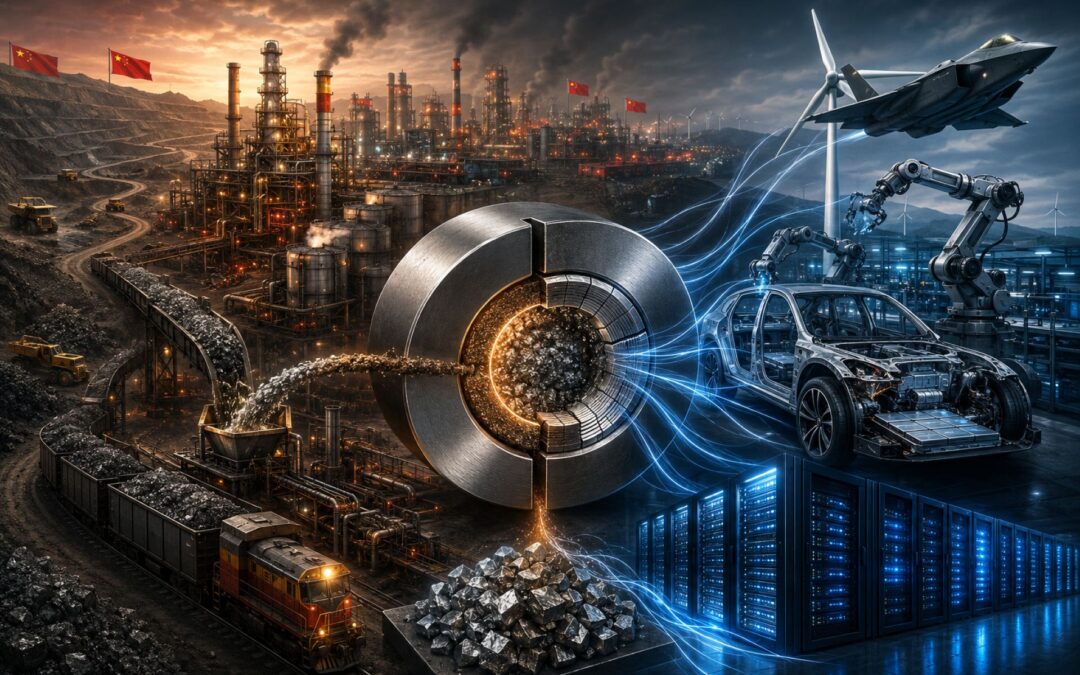
Inside many electric vehicles is a motor capable of turning electrical energy into immediate, almost silent acceleration. Buried inside that motor may be a small collection of permanent magnets containing rare-earth elements such as neodymium and praseodymium.
Compared with the weight of the car, the amount is tiny.
Its importance is not.
These magnets can make motors smaller, lighter, more efficient and capable of producing tremendous torque. Similar materials appear in wind turbines, industrial robots, aircraft, missile-guidance systems, radar equipment and countless machines that sustain the modern economy.
The strategic value of rare earths does not come from how much of them the world consumes. It comes from what they make possible.
China recognised this long before most Western governments treated rare-earth supply chains as a national priority. Over several decades, it built an industrial system connecting mines, chemical separation facilities, metal and alloy producers, magnet manufacturers and the factories that use those magnets.
The result is one of the most concentrated strategic supply chains in the world.
China does not possess every rare-earth deposit. It does not even mine all the rare earths the world consumes. Its real advantage lies further downstream, where raw material is transformed into products that manufacturers can actually use.
Understanding that distinction explains how China came to dominate the industry—and why opening a few mines elsewhere will not be enough to break its hold.
The Tiny Magnets Inside the Modern Economy
Rare earths are a family of 17 metallic elements with similar chemical properties. Despite their name, most are not exceptionally rare in the Earth’s crust. The problem is that they are rarely found in concentrated deposits that can be extracted and processed economically.
Only some rare-earth elements are essential to high-performance magnets.
Neodymium and praseodymium are used to make neodymium-iron-boron magnets, among the strongest permanent magnets commercially available. Dysprosium and terbium may be added when magnets must retain their performance at high temperatures.
The quantities involved can be surprisingly small. Yet the magnets can determine the size, weight, efficiency and power density of the machinery around them.
In an electric vehicle, a permanent-magnet motor can deliver high torque without requiring a separate electrical system to generate the rotor’s magnetic field. Not every electric vehicle uses this design, and rare earths are not the principal materials inside an EV battery. Their importance lies mainly in motors and other specialised components.
Beyond electric vehicles, permanent magnets are used in direct-drive wind turbines, factory automation, medical devices, consumer electronics, pumps, compressors and aerospace systems.
The defence applications are especially sensitive. A U.S. Government Accountability Office assessment identified rare-earth materials in precision-guided weapons, communications equipment, radar, avionics, satellites, lasers and night-vision systems.
Rare earths are therefore not valuable in the same way as oil, iron or copper. They are not consumed in enormous volumes across the entire economy.
They are valuable because a small shortage can interrupt the production of extraordinarily expensive machines.
The Real Chokepoint Is Not Mining
Discussions about critical minerals often begin with maps showing where deposits are located. That creates the impression that whoever owns the most ore controls the industry.
Rare earths do not work that way.
A deposit must first be mined and concentrated. The resulting material then passes through complicated chemical processes that separate elements with remarkably similar properties. Those elements must be refined into oxides, converted into metals, combined into alloys and manufactured into magnets with precise performance characteristics.
Only then can the magnets be shaped, coated, tested and incorporated into motors or other components.
Each step demands different facilities, specialised knowledge, reliable energy, environmental management and customers willing to buy the output. A country can operate a mine and still depend on another country for nearly everything that happens afterwards.
That is exactly where China’s strength becomes overwhelming.
According to the International Energy Agency’s analysis of the rare-earth supply chain, China accounted for roughly 60% of mining for magnet-related rare earths in 2024. Its share rose to approximately 91% of separation and refining and around 94% of sintered permanent-magnet manufacturing.
The numbers reveal the real structure of the industry.
China is not simply the world’s leading miner. It dominates the stages that turn minerals into industrial power.
This is why a new mine in the United States, Australia, Brazil or Africa does not automatically create an alternative supply chain. The material may still be sent to China for separation, metallisation or magnet production.
Ore in the ground is potential.
Processing capacity is power.
When the United States Led the Rare-Earth Industry
China’s position was not inevitable.
For much of the second half of the twentieth century, the centre of the global rare-earth industry was the Mountain Pass mine in California. Its deposits were discovered in the late 1940s, and commercial production expanded as demand grew for colour television phosphors, petroleum refining catalysts, electronics and military equipment.
By the 1960s and 1970s, Mountain Pass had become the world’s leading source of rare earths. The United States possessed mining expertise, processing knowledge and companies capable of turning the materials into useful products.
American officials also understood that rare earths had strategic applications. They were already being used in defence equipment, metallurgy, communications and advanced electronics during the Cold War.
Yet rare earths remained a relatively small market. They did not attract the political attention associated with oil, steel or semiconductors. Most buyers cared primarily about obtaining reliable material at the lowest available price.
As Chinese output increased, prices fell. Manufacturers benefited from cheaper inputs, but the economics of operating Western facilities became increasingly difficult.
Mountain Pass also faced environmental problems. Wastewater leaks containing chemicals and radioactive material contributed to regulatory scrutiny and costly remediation. Mining continued for a time, but separation operations were suspended in the late 1990s.
The United States did not suddenly run out of geological resources.
It gradually lost the industrial system surrounding them.
How China Built a Complete Rare-Earth Ecosystem
China possessed significant rare-earth resources, most famously at Bayan Obo in Inner Mongolia. But geology alone did not produce its dominance.
The country spent decades building the scientific, industrial and commercial capabilities needed to exploit those resources.
Chinese researchers studied mineral deposits, separation techniques, metallurgy and magnet production. Government programmes supported research institutions, state-owned enterprises and industrial experimentation. Producers received incentives to expand output, while China’s broader manufacturing sector created a growing domestic market for the materials.
Foreign knowledge also played a role. Chinese delegations visited overseas mining and processing operations, including Mountain Pass, at a time when scientific exchange and commercial engagement with China were broadly encouraged.
The development was not always centrally coordinated or orderly.
During the industry’s early expansion, numerous small producers entered the market. Local governments welcomed the employment and revenue. Competition was intense, regulation was weak and producers frequently sacrificed environmental standards to reduce costs.
This drove prices downward and helped China capture customers around the world.
China also benefited from something many competitors lacked: an expanding manufacturing economy capable of consuming the materials at home.
Electronics factories, appliance manufacturers, automotive suppliers, machinery producers and later renewable-energy companies created demand for refined rare earths and magnets. Suppliers could operate near customers, technical problems could be solved quickly and knowledge accumulated across industrial clusters.
This created a reinforcing cycle.
Greater production reduced costs. Lower costs attracted manufacturers. More manufacturers generated greater demand. That demand justified further investment in processing, engineering and capacity.
China was not merely exporting minerals.
It was constructing an ecosystem.
The Magnequench Sale and the Loss of Magnet Manufacturing
One episode has come to symbolise the movement of rare-earth manufacturing capability from the United States to China.
In 1995, General Motors sold Magnequench, its rare-earth magnet division, to an investment group that included Chinese partners. Magnequench possessed valuable expertise in producing neodymium-iron-boron magnet materials, including magnets used in automotive and defence-related applications.
Operations initially continued in the United States. Over time, however, production capacity and technical activity increasingly shifted towards China, while American facilities closed.
The sale did not single-handedly create China’s rare-earth dominance. China was already investing in mining, processing and magnet production, and many other commercial decisions contributed to the broader relocation of manufacturing.
Still, Magnequench illustrates an important strategic failure.
Western companies tended to evaluate such businesses primarily according to immediate commercial value. Magnet manufacturing was a specialised, relatively small industry. It did not appear as important as the automotive, aerospace or electronics products in which the magnets would eventually be used.
China viewed the same capability differently.
The magnet was not merely another component. It was a gateway into higher-value manufacturing.
As Reuters later noted while reporting on General Motors’ efforts to secure domestic magnet supplies, the United States found itself trying to rebuild capabilities that had migrated abroad decades earlier.
The lesson was larger than one corporate acquisition.
A country can retain the design of a final product while losing control over the specialised materials and manufacturing knowledge required to build it.
The Dirty Economics Behind China’s Advantage
Rare-earth separation is neither clean nor simple.
The elements occur together and have similar chemical properties, making them difficult to isolate. Processing can require repeated stages of crushing, leaching, solvent extraction, precipitation and purification.
Strong acids and other chemicals may be involved. Tailings can contain toxic substances and naturally occurring radioactive material. Poorly managed facilities can contaminate water, soil and surrounding communities.
These environmental costs shaped the global industry.
Western countries imposed stricter controls as public concern and regulatory enforcement increased. Those protections reduced pollution but also raised the cost of operating mines and processing plants.
China’s early industry often operated under far weaker standards. Illegal mines, informal processors and poorly regulated facilities could sell material at prices that responsible competitors struggled to match.
Communities near production centres paid part of the hidden cost through polluted land and water.
It would be misleading, however, to say that China won only because it was willing to tolerate pollution.
Environmental externalisation mattered, but it worked alongside lower labour costs, cheaper financing, abundant energy, state support, industrial scale, engineering experience and proximity to manufacturers.
Once these advantages combined, a competitor could not catch up merely by purchasing better equipment.
China had developed workers who understood the chemistry, suppliers capable of maintaining the facilities, customers that could test the material and factories that could turn it into magnets at enormous scale.
Its advantage became embedded in the entire production network.
From Mining Free-for-All to State-Controlled Champions
China’s early rare-earth boom created serious problems for its own government.
Numerous companies competed for market share. Illegal mining and smuggling became widespread. Local authorities sometimes protected producers because they depended on mining revenue and employment.
The competition drove prices so low that even Chinese companies struggled to earn sustainable profits. Production quotas were difficult to enforce, environmental destruction intensified and large quantities of material left the country outside official channels.
Beijing responded by tightening control.
Authorities conducted inspections, shut illegal operations, introduced production and export quotas and encouraged consolidation among larger firms. The goal was not simply environmental improvement. Consolidation also made the industry easier to supervise and allowed the state to exert greater influence over supply, investment and pricing.
By the middle of the 2010s, much of the sector had been reorganised around six major groups. Further restructuring later concentrated key operations into even larger state-controlled enterprises.
A fragmented industry selling cheap material had become a strategic oligopoly.
This transformation gave China several advantages. It could monitor production more effectively, reduce smuggling, coordinate investment and prevent uncontrolled competition from destroying prices.
It also became easier to align commercial production with national policy.
The rare-earth industry was no longer just a collection of mines and chemical plants. It was an instrument the state could influence during trade negotiations, diplomatic disputes or national-security crises.
How the West Helped Hollow Out Its Own Supply Chain
China built its position through deliberate investment and industrial development.
Western countries also helped create it through decisions that appeared economically rational at the time.
Manufacturers wanted inexpensive inputs. Investors were reluctant to finance environmentally controversial projects with volatile commodity prices. Governments assumed that global trade would continue delivering whatever specialised materials domestic industries required.
As Chinese producers lowered prices, Western mines and processors closed. Customers shifted to the cheaper suppliers. Skilled workers moved into other industries, equipment aged and technical knowledge dispersed.
The loss of capacity attracted little attention because finished products were still available.
Automakers could buy magnets. Defence contractors could obtain specialised materials. Electronics companies could source components from global suppliers. The supply chain appeared efficient.
What disappeared was redundancy.
A competitive market normally rewards the producer capable of supplying goods at the lowest cost. It does not automatically reward a producer for remaining open as a national emergency backup.
That difference matters when an industry has high capital costs, unpredictable prices and strategic importance.
A domestic processing plant may appear inefficient during ordinary years. During an export restriction, war or diplomatic confrontation, the same plant becomes insurance.
The United States treated much of the rare-earth industry as a commodity business.
China treated it as the foundation of future industries.
Mountain Pass, Molycorp and the Limits of Market Logic
Growing concern about Chinese supply eventually renewed interest in Mountain Pass.
In the late 2000s, Molycorp sought to revive the mine and rebuild an integrated American rare-earth business. The opportunity appeared promising. China had tightened export quotas, prices were rising and governments were becoming increasingly aware of supply risks.
Investors poured money into the company. Molycorp launched an ambitious modernisation programme intended to increase production and restore domestic processing.
Then the market changed.
The United States, European Union and Japan challenged China’s export restrictions at the World Trade Organization. In 2014, the WTO ruled that the measures violated trade rules. China removed the quotas, exports increased and rare-earth prices fell.
That price decline damaged Molycorp, but it was not the company’s only problem.
The revival project suffered from heavy debt, cost overruns, technical difficulties and operational setbacks. The company had expanded during a price boom and was poorly prepared for the collapse that followed.
Molycorp filed for bankruptcy protection in 2015.
Its failure demonstrated why strategic industries cannot always be rebuilt through market enthusiasm alone. Investors are attracted when prices are high, but new supply takes years to develop. By the time production begins, prices may have fallen and the financial case may have disappeared.
Mountain Pass eventually reopened under MP Materials and is producing rare-earth concentrate again. The U.S. Geological Survey’s 2026 mineral summary shows that the United States is once again a meaningful producer of mined material.
Yet the country still depends heavily on foreign processing and manufacturing.
The mine returned.
The complete supply chain did not.
How China Converted Supply Dominance Into Geopolitical Leverage
China’s rare-earth position matters because economic concentration can become political leverage.
The most famous early warning came in 2010, when rare-earth shipments to Japan were reportedly disrupted during a maritime dispute. The precise nature and extent of the restrictions remain debated, but the episode forced governments and manufacturers to confront their dependence on Chinese supply.
More recently, China has built a broader system of export licensing and technology controls covering strategic materials.
In October 2025, two Chinese announcements dramatically expanded the potential reach of those controls.
Announcement No. 61 established licensing requirements that could apply to certain foreign-made products containing Chinese-origin rare-earth materials or technology, including some products in which the controlled content represented as little as 0.1% of the total value.
Announcement No. 62 focused more directly on rare-earth extraction, separation, metallurgy, magnet manufacturing and recycling technologies.
The rules were notable not merely because they restricted material leaving China. They suggested that Beijing wanted influence over products manufactured outside China when those products depended on Chinese inputs or knowledge.
Implementation of the October measures was later suspended until November 10, 2026, following negotiations with the United States. The suspension reduced the immediate pressure but did not remove the underlying capability.
China still possesses the customs systems, licensing authority and industrial visibility needed to regulate crucial parts of the supply chain.
That is the real source of leverage.
A country does not need to prohibit every shipment. Delays, licence reviews, uncertainty and selective approvals may be enough to disrupt manufacturers operating with limited inventories.
When one supplier dominates a critical component, even the possibility of restriction can change negotiations.
Why Rare-Earth Dependence Matters
The rare-earth supply chain sits beneath several industries that governments consider essential to economic growth and national security.
Electric vehicles are the most visible example. Permanent-magnet motors offer high power density and efficiency, making them attractive for many automotive designs. A supply disruption could raise costs, delay production or force manufacturers to redesign motors around alternative technologies.
Wind turbines face a similar problem. Some direct-drive turbines use large permanent magnets to eliminate gearboxes and improve reliability. Rapid expansion of renewable energy therefore increases demand for the same materials required by automotive and defence industries.
Robotics and industrial automation add another layer. Advanced factories depend on precise, efficient motors operating in compact spaces. Rare-earth magnets help power the servomotors used in robotic arms, machine tools, pumps and automated production lines.
Artificial-intelligence infrastructure does not depend on rare earths in the same direct way that it depends on semiconductors. Yet data centres contain cooling systems, power equipment, motors, storage devices and other components that may use rare-earth materials. The broader expansion of digital infrastructure increases pressure on many specialised supply chains simultaneously.
Defence dependence is the most politically sensitive.
Rare-earth elements appear in aircraft, guided weapons, radar, sonar, electronic warfare systems, satellites and communications equipment. These applications may consume far less material than civilian industries, but they cannot easily tolerate interrupted supply or uncertain quality.
A shortage would therefore not affect every sector equally.
Consumer manufacturers might pay more or switch designs. Defence programmes may require materials that meet exact specifications and come from approved suppliers, making substitution slower and more complicated.
The vulnerability lies in the mismatch between physical quantity and strategic consequence.
A few kilograms of missing material can delay equipment worth millions.
Can the United States and Its Allies Catch Up?
The United States and its allies have finally begun treating rare-earth supply chains as a strategic problem rather than an ordinary commodity market.
Mountain Pass is operating again. MP Materials has developed domestic separation capability and is working to manufacture magnets in the United States. The Department of Defense has provided financial support intended to expand separation, refining and magnet production.
A planned facility known as 10X is expected to add substantial American magnet-manufacturing capacity later in the decade. The Department of Defense has described its investments as part of a broader effort to establish an end-to-end domestic supply chain.
The Department of Energy is also financing projects involving extraction, separation, recycling and alternative magnetic materials. In 2025, it announced additional funding for rare-earth supply-chain development.
Other countries are pursuing their own roles.
Australia possesses major deposits and companies with mining experience. Malaysia hosts significant separation capacity operated by Lynas Rare Earths. Japan has invested in recycling, alternative suppliers and technologies that reduce the quantity of rare earths required. European governments are supporting selected extraction and processing projects.
These efforts can reduce dependence.
They cannot reproduce China’s system overnight.
New mines may require a decade or more to permit, finance and build. Processing plants face technical difficulties and environmental opposition. Magnet factories need qualified workers, specialist equipment and customers willing to commit to long-term contracts.
The economics are also dangerous.
A new Western project may look profitable when prices are high. If China increases production and prices fall, the project can become unviable before it recovers its investment.
That creates a strategic dilemma. Governments want private companies to build capacity, but companies know that the market may punish them for doing so.
China’s advantage is therefore not permanent, but it is durable.
Its competitors are not racing against a fixed target. Chinese firms are also investing, improving technology, expanding overseas relationships and developing new production techniques.
Catching up requires more than spending money.
It requires sustaining policy long enough for an industrial ecosystem to form.
What a Real Diversification Strategy Requires
A credible rare-earth strategy cannot depend on finding one replacement for China.
It must create resilience across the entire chain.
Governments can support new mines, but they must also ensure that processing, metal production, alloy making and magnet manufacturing exist outside China. Otherwise, alternative ore will continue flowing into the same downstream bottleneck.
Long-term purchasing agreements can give new producers predictable demand. Price floors, strategic procurement and government-backed loans can protect projects from sudden market collapses. Defence agencies and major manufacturers can commit to buying domestically or from allied suppliers even when Chinese material remains cheaper.
Allied specialisation may be more practical than complete national self-sufficiency.
One country may mine the material, another may separate it, and a third may manufacture magnets. Such a network would still depend on international trade, but it would avoid placing nearly every stage inside one geopolitical rival.
Environmental credibility must also be treated as an advantage rather than a nuisance.
New projects will not maintain public support if they reproduce the pollution that damaged communities around poorly regulated facilities. Higher standards will increase costs, but those costs reflect consequences that were previously hidden.
Recycling offers another important source of supply.
Magnets recovered from vehicles, turbines, electronics and industrial machinery can be processed for reuse. Some emerging methods aim to preserve more of the magnet’s original value rather than breaking it completely into basic chemical elements.
The International Energy Agency estimates that recycling could eventually reduce the need for newly mined material substantially. Its immediate contribution will remain limited, however, because many products containing rare-earth magnets have long operating lives and have not yet reached the waste stream in large quantities.
Manufacturers can also reduce demand through better design.
Some electric vehicles use induction motors or other technologies that require no rare-earth permanent magnets. Researchers are developing magnets that use smaller quantities of critical elements, avoid heavy rare earths or rely on more abundant materials.
None of these measures will eliminate dependence alone.
Together, they can make the supply chain less fragile.
The goal should not be to recreate every Chinese facility in every allied country. It should be to ensure that no single government can interrupt the future of several major industries with one licensing decision.
China’s Advantage Is an Industrial System, Not a Pile of Dirt
China’s rare-earth dominance is often described as a story about natural resources.
It is really a story about industrial capability.
Mineral deposits exist in many countries. What China built was the machinery, knowledge, infrastructure, financing, workforce and manufacturing demand needed to transform those deposits into indispensable components.
The process took decades.
Western companies benefited from the cheaper materials it produced. Consumers benefited from less expensive electronics, vehicles and renewable-energy equipment. Governments avoided the financial and environmental costs of maintaining domestic production.
The savings were real.
So was the dependence.
The challenge now is not simply to dig more rare earths from the ground. It is to rebuild the stages between a mine and a finished motor, turbine, aircraft or weapons system.
That will require governments to think beyond short political cycles, companies to invest beyond the next price movement and allied countries to coordinate instead of duplicating one another.
China did not achieve dominance because it discovered magical dirt that existed nowhere else.
It achieved dominance because it understood that the real value was never in the dirt.
It was in everything that came after.
Last Updated on July 14, 2026 by Aseem Gupta