
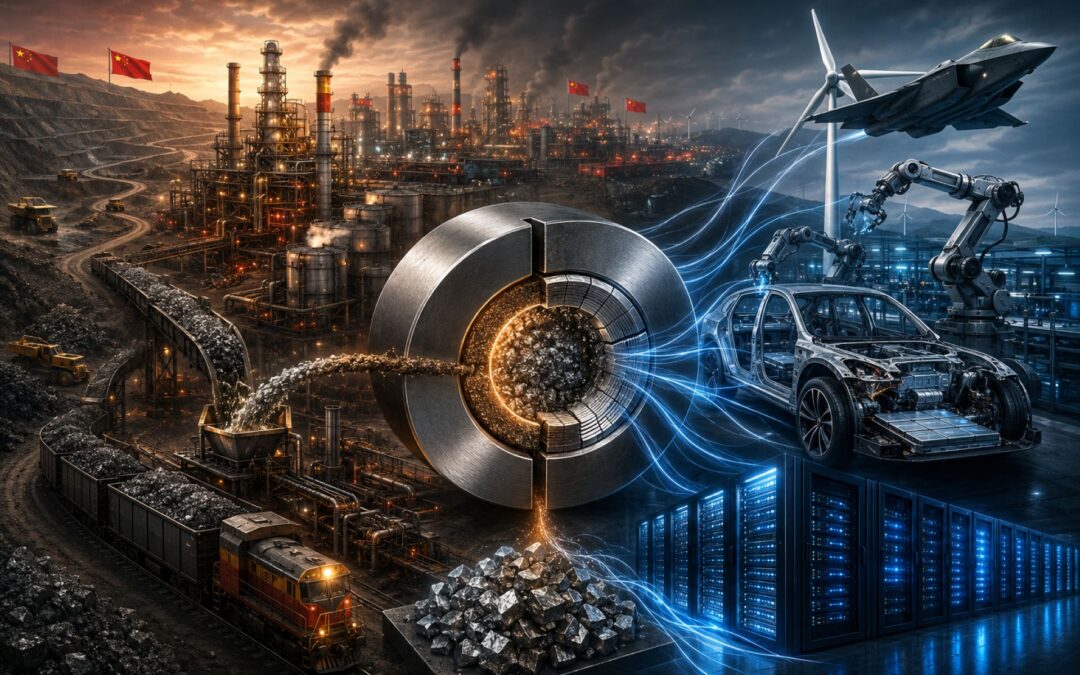
Inside many electric vehicles is a motor that delivers remarkable acceleration with almost no noise. Buried within that motor may be a set of powerful permanent magnets containing rare-earth elements such as neodymium and praseodymium. These materials account for a tiny fraction of the vehicle’s total weight, yet they can have an enormous influence on its performance, efficiency and manufacturing cost.
The same materials help power wind turbines, industrial robots, precision-guided weapons, advanced aircraft and machinery throughout the modern economy. They are not especially valuable because industries consume them in enormous quantities. They are valuable because relatively small amounts can be essential to products worth millions of dollars.
For decades, the United States and other industrialised countries assumed that these specialised materials would remain available through international trade. Meanwhile, China was building an industrial system capable of turning rare-earth deposits into the refined metals, alloys and magnets that manufacturers actually needed. By the time Western governments recognised the extent of their dependence, China had established a commanding position across several critical stages of production.
The remarkable part of this story is that China did not achieve dominance simply because it possessed mineral deposits unavailable elsewhere. Its advantage emerged from decades of industrial investment, intense competition, technological learning and decisions made by both Chinese producers and their Western customers.
Understanding how that happened reveals why rare earths have become an instrument of geopolitical power, and why rebuilding an alternative supply chain is considerably more difficult than opening another mine.
Why Tiny Magnets Carry Outsized Economic Power
Rare earths are a group of 17 metallic elements with similar chemical properties. Despite their name, many are relatively abundant in the Earth’s crust. What makes them difficult to obtain is that economically attractive concentrations are uncommon, and the elements are often mixed together in ores that require complicated processing.
Not all rare-earth elements serve the same purpose. Some are used in petroleum-refining catalysts, glass polishing, specialised lighting, electronics, medical equipment and other industrial applications. The elements that have attracted particular strategic attention are those used to manufacture powerful permanent magnets.
Neodymium and praseodymium are important ingredients in neodymium-iron-boron magnets, among the strongest commercially available permanent magnets. Dysprosium and terbium can help these magnets maintain their performance at elevated temperatures, a valuable property in demanding automotive, aerospace and industrial applications. The precise composition varies depending on the intended operating conditions and the manufacturer’s design.
Consider an electric motor. An ordinary electric motor uses magnetic forces to produce rotation, but engineers have several ways to create those forces. A motor using rare-earth permanent magnets can generate substantial torque while remaining relatively compact and efficient, without needing electrical current to produce the rotor’s magnetic field.
That combination makes permanent-magnet motors attractive for electric vehicles, robotic machinery, pumps, compressors and other applications where weight, space and energy consumption matter. A relatively small magnet can therefore influence the performance of a much larger and more expensive machine.
However, rare earths are not essential to every electric vehicle. Some manufacturers use induction motors or other designs that avoid rare-earth permanent magnets, and the materials should not be confused with the lithium, nickel, cobalt or other substances commonly discussed in relation to EV batteries. Their most strategically important automotive applications are generally in motors and certain specialised components.
The distinction matters because rare earths are not a single material with one universal application. The vulnerability arises when particular industries depend on specific elements that must meet demanding quality and performance requirements.
Unlike oil or copper, which are consumed in enormous quantities throughout the economy, magnet-related rare earths can create disproportionate consequences when supplies are interrupted. A shortage involving a relatively small volume of material may prevent a manufacturer from completing machinery whose value is hundreds or thousands of times greater.
That mismatch between physical quantity and industrial importance is what makes rare-earth magnets strategically significant.
The Mine-to-Magnet Chokepoint
When people discuss China’s rare-earth dominance, they often begin with maps showing where valuable minerals are located. This creates the impression that the country controlling the largest deposits necessarily controls the entire market. In reality, ownership of the ore is only the beginning of a much longer industrial process.
A rare-earth deposit must first be mined and the valuable minerals concentrated. The resulting material then undergoes chemical treatment to separate elements that have remarkably similar properties. This can involve repeated stages of leaching, solvent extraction, precipitation and purification, with each stage designed to isolate particular substances to the required specifications.
The separated material commonly takes the form of rare-earth oxides. For many magnet applications, those oxides must then be converted into metals, combined with other materials to produce suitable alloys, and manufactured into permanent magnets. Magnet production involves its own specialised processes, including powder preparation, shaping, alignment, sintering, finishing and protective coating.
The finished magnets must also meet demanding quality requirements. Manufacturers need consistent magnetic strength, temperature performance, resistance to corrosion and precise physical dimensions. A magnet intended for an automotive motor or military system cannot simply be replaced with an untested material that appears chemically similar.
Consequently, each stage requires different facilities, equipment, expertise and commercial relationships. Mining companies need geologists and extraction engineers, separation plants require specialised chemical knowledge, and magnet manufacturers depend on metallurgists, precision machinery and sophisticated production techniques.
This complexity explains why China dominates the industry much more thoroughly than mining statistics alone suggest.
According to the International Energy Agency’s analysis of the rare-earth supply chain, China accounted for approximately 60% of global mining of magnet-related rare earths in 2024. Its share increased to roughly 91% of separation and refining, and approximately 94% of sintered permanent-magnet manufacturing.
These figures describe different stages of the supply chain for magnet-related rare earths. They should not be confused with estimates covering all rare-earth elements and applications. The United States Geological Survey, for example, estimated that China produced approximately 270,000 tonnes of rare-earth oxides out of global mine production of roughly 390,000 tonnes in 2025, representing about 69% of the total.
Both sets of statistics point to the same underlying concentration, but the differences in their scope and reporting years are important. China’s dominance becomes most pronounced after raw minerals leave the mine and begin moving through the processes required to create high-performance magnets.
This is why developing a mine in the United States, Australia, Brazil or an African country does not automatically establish an independent supply chain. A company might extract valuable material domestically but still need to ship it to China for chemical separation, metal production or magnet manufacturing.
Even countries that develop refining facilities may lack the subsequent capacity to manufacture magnets at commercial scale. Their material can still encounter another bottleneck before reaching the final customer.
China’s strategic advantage therefore lies in controlling a network of interconnected industrial capabilities. A mineral deposit creates the possibility of production, but the ability to transform that deposit into a reliable industrial component is what creates practical economic power.
How China Overtook Mountain Pass
China was not always the world’s dominant rare-earth producer. For much of the second half of the twentieth century, that position belonged to the United States, largely because of the Mountain Pass mine in California.
Rare-earth deposits were discovered at Mountain Pass in the late 1940s. Commercial production expanded as demand grew for materials used in colour television phosphors, petroleum-refining catalysts, electronics, metallurgy and defence equipment. By the 1960s and 1970s, Mountain Pass had become the world’s leading source of rare earths.
The United States possessed substantial expertise in mineral extraction and processing, while American research institutions and companies were developing important applications for rare-earth materials. These included technologies relevant to communications, advanced electronics and military systems during the Cold War.
Yet rare earths remained a comparatively small industrial market. They did not attract anything resembling the political attention devoted to petroleum, steel or major consumer industries. For many commercial buyers, the main concern was obtaining material at a competitive price rather than preserving every stage of the supply chain within the United States.
China approached the industry from a different position. It possessed substantial deposits of its own, particularly at Bayan Obo in Inner Mongolia, which would become one of the world’s most important rare-earth production centres. However, geological abundance was only one part of its eventual success.
Chinese research institutions and industrial enterprises spent decades developing knowledge of mineral deposits, separation chemistry, metallurgy and rare-earth applications. Government support encouraged experimentation and investment, while producers gained practical experience by expanding commercial operations.
International scientific exchange also contributed to this development. Chinese researchers and technical delegations visited overseas operations, including Mountain Pass, to study mining methods and processing techniques. During this period, commercial and scientific engagement with China was frequently welcomed as part of its growing participation in the global economy.
China’s industrial expansion was not simply the result of one carefully coordinated government programme. State support operated alongside intense competition among enterprises, ambitious local governments and a growing manufacturing sector. Different producers experimented with techniques, expanded capacity and competed aggressively for customers.
One particularly revealing episode involved Magnequench, a business originally associated with General Motors.
In 1995, General Motors sold its Magnequench rare-earth magnet division to an investment group that included Chinese partners. The company possessed valuable expertise in neodymium-iron-boron magnetic materials, including technologies relevant to automotive and defence-related applications.
American operations initially continued, but production capacity subsequently shifted increasingly towards China as US facilities closed. The transaction became an important symbol of how specialised manufacturing expertise could migrate overseas through ordinary commercial decisions.
It would be an exaggeration to claim that this single sale created China’s rare-earth dominance. Chinese companies were already investing in production, processing and magnet technology, while numerous other corporate decisions contributed to the relocation of manufacturing. Nevertheless, the Magnequench episode illustrates how the strategic importance of a relatively small component business could be underestimated.
For a Western corporation, moving production to a lower-cost location could improve competitiveness. For China, acquiring production capabilities and accumulated technical knowledge also supported the development of higher-value industries. Those two perspectives were not mutually exclusive, but they produced consequences that extended far beyond one company’s balance sheet.
China also developed an advantage that could not be obtained by purchasing foreign technology alone: an enormous domestic customer base.
As the country’s manufacturing economy expanded, electronics producers, appliance companies, automotive suppliers and machinery manufacturers increasingly required rare-earth materials and magnets. Suppliers could locate near their customers, resolve technical problems directly with manufacturers and accumulate practical production experience.
The emergence of renewable energy and electric vehicles made these relationships even more important. China’s industrial policies increasingly supported electric transportation, including the Ten Cities, Thousand Vehicles programme launched in 2009 to encourage the deployment of electric buses, taxis and other vehicles in selected cities.
These initiatives were not exclusively rare-earth policies. They nevertheless helped develop domestic industries that could benefit from reliable supplies of advanced motors and magnetic materials.
The same broader industrial transformation that supported China’s expansion into clean-energy manufacturing also strengthened demand for the specialised components needed by those industries. Magnet producers were becoming part of manufacturing clusters rather than operating as isolated commodity suppliers.
The economic effects reinforced one another. Greater production helped reduce costs, lower prices attracted customers, expanding demand encouraged further investment, and repeated manufacturing experience improved efficiency and quality.
Over time, China accumulated more than factories and equipment. It developed experienced workers, technical institutions, specialised suppliers, industrial infrastructure and relationships with manufacturers that needed increasingly sophisticated products.
That accumulation of knowledge and production capacity proved much harder for competitors to reproduce than a single mine or processing plant.
Cheap Supply, Dirty Costs, and the Rise of State Champions
China’s rare-earth expansion created enormous industrial advantages, but much of its early growth came with severe economic and environmental consequences.
Separating rare-earth elements is chemically demanding because their properties are so similar. Depending on the ore and processing method, extraction and refining may require large quantities of acids, solvents, water and energy. The resulting waste must be managed carefully to prevent contamination of surrounding land and water.
Some rare-earth deposits also contain naturally occurring radioactive materials, including thorium. These substances can become concentrated in waste streams and tailings during processing. Poor environmental controls may therefore expose nearby communities to hazardous chemicals, contaminated water and potentially radioactive residues.
Such problems were not exclusive to China. Mountain Pass itself experienced wastewater leaks and environmental difficulties that contributed to regulatory scrutiny and expensive remediation. The suspension of its separation operations in the late 1990s reflected, in part, the costs and complications associated with maintaining production.
Nevertheless, China’s early rare-earth industry frequently operated under weaker environmental controls than competing facilities in wealthier countries.
Numerous small mines and processors entered the market, while local governments welcomed the employment, investment and revenue these businesses generated. Enforcement was inconsistent, illegal production became widespread, and some operators reduced costs by neglecting environmental management.
The result was exceptionally aggressive price competition. Low prices benefited international manufacturers purchasing Chinese material, but they also placed pressure on Western producers facing higher operating and compliance costs.
The environmental damage represented a hidden subsidy of sorts: some of the true costs of production were borne by surrounding communities rather than reflected in the selling price of the material.
Yet it would be misleading to explain China’s success entirely through weak environmental protection. Lower labour costs, access to financing, abundant energy, public investment, large-scale production and accumulated engineering experience all contributed to its competitiveness. Proximity to an expanding domestic manufacturing sector provided another advantage that foreign rivals could not easily match.
Over time, the industry’s fragmented structure began creating problems for China itself. Illegal mining and smuggling undermined official production controls, local authorities sometimes resisted enforcement, and intense competition pushed prices so low that even Chinese producers struggled to earn sustainable profits.
Beijing responded with increasingly forceful regulation and consolidation. Authorities strengthened inspections, closed illegal operations, tightened production controls and encouraged mergers among major enterprises. Beginning in the early 2010s, these efforts gradually reorganised the industry around a smaller number of large groups.
By the middle of that decade, six major rare-earth groups had emerged as the industry’s principal organised producers. Subsequent restructuring concentrated important mining and separation activities still further, with China’s quota system increasingly centred on two leading state-controlled groups by 2024.
This evolution changed the government’s relationship with the industry. It became easier to supervise extraction and processing, reduce illegal production, coordinate investment and influence the quantity of material reaching the market.
The restructuring also increased Beijing’s ability to align rare-earth production with industrial policy and strategic objectives. A sprawling collection of competing businesses had become an industry in which a comparatively small number of large enterprises operated under substantial state influence.
China’s advantage was therefore the product of two seemingly contradictory phases. Fierce competition helped expand production, accelerate learning and depress prices, while later consolidation allowed the government to exercise greater control over an industry that had become strategically important.
How America Lost Its Rare-Earth Failsafe
China’s rise explains only part of the story. The other part concerns why countries that had once possessed important rare-earth industries allowed so much of that capacity to disappear.
For manufacturers, purchasing inexpensive materials from China often made excellent commercial sense. Automakers could lower costs, electronics companies could purchase competitively priced components, and defence contractors could obtain specialised materials without maintaining every upstream operation domestically.
Investors faced a different calculation. Rare-earth mines and chemical-processing facilities required substantial capital, involved technical risks and frequently encountered environmental opposition. Their profitability depended on prices that could rise dramatically during shortages and collapse when new supply entered the market.
When Chinese producers offered material at lower prices, many Western facilities could no longer compete. Customers changed suppliers, production equipment aged, experienced workers moved elsewhere and specialised technical knowledge gradually dispersed.
These decisions produced genuine economic benefits. Cheaper materials helped manufacturers and consumers, while governments avoided some of the financial and environmental costs associated with domestic production.
What disappeared was the ability to fall back on alternative suppliers during a crisis.
Ordinary markets reward producers for offering reliable goods at competitive prices. They do not necessarily compensate companies for maintaining spare capacity that society might need during a war, diplomatic confrontation or sudden trade restriction. A domestic separation plant can appear unnecessarily expensive in normal conditions while providing invaluable insurance during an emergency.
The history of Mountain Pass demonstrates that problem particularly clearly.
The mine’s earlier environmental difficulties and declining competitiveness had already weakened American production when Chinese export restrictions began raising concerns about dependence. During the late 2000s, Molycorp pursued an ambitious effort to revive Mountain Pass and restore an integrated American rare-earth business.
At first, the opportunity appeared promising. China had tightened exports, rare-earth prices were rising, and governments were becoming increasingly conscious of supply risks. In 2010, the US Government Accountability Office warned about potential vulnerabilities in defence-related rare-earth supply chains, reflecting the strategic concerns that were beginning to accompany the commercial market.
Molycorp attracted investment and undertook an extensive modernisation programme intended to expand production and restore domestic processing. However, the company was attempting to build expensive industrial capabilities in a notoriously volatile market.
A major international trade dispute added another dimension to the situation.
In 2012, the United States, European Union and Japan challenged China’s restrictions on rare-earth exports at the World Trade Organization. Their argument was that Chinese export duties and quotas violated international trade commitments and unfairly limited access to essential materials.
The WTO’s rare-earth dispute proceedings resulted in rulings against the challenged Chinese measures in 2014. China subsequently removed the export quotas, while international rare-earth prices declined sharply amid broader changes in market conditions.
For manufacturers purchasing rare-earth materials, improved access and lower prices could be beneficial. For companies attempting to establish alternative production, those same price conditions made investment considerably less attractive.
Molycorp was particularly vulnerable, but blaming its bankruptcy entirely on the WTO dispute would distort the history.
The company had accumulated substantial debt and encountered serious technical and operational difficulties during its ambitious expansion. Its 2015 financial disclosures to the US Securities and Exchange Commission documented important financial and operational pressures that existed alongside the decline in rare-earth prices.
Molycorp filed for bankruptcy protection in 2015. Its failure resulted from a combination of market conditions, financing problems and difficulties executing an expensive industrial project, rather than one legal ruling alone.
Nevertheless, the episode exposed a fundamental weakness in relying entirely on private investment to rebuild strategically important industries. When prices rise, investors may be eager to finance new production, but developing mines and processing plants takes years. By the time those facilities become operational, market conditions can change enough to undermine their financial viability.
Mountain Pass eventually reopened under MP Materials, and the United States once again became a significant producer of mined rare-earth material. The country has also begun rebuilding domestic separation and magnet-manufacturing capabilities, although these remain far less developed than China’s overall system.
The essential distinction is that restoring mineral extraction does not immediately restore every stage of industrial production. The United States retained geological resources, but rebuilding the capabilities surrounding them requires a different kind of long-term commitment.
When China Turned Rare Earths Into Geopolitical Leverage
Control over a strategically important supply chain can influence international politics even when the controlling country never completely stops exports.
One of the earliest warnings emerged in 2010 during a maritime dispute between China and Japan. Japanese businesses reportedly experienced disruptions in rare-earth shipments, prompting allegations that Beijing was using its position as a supplier for political pressure.
The exact nature of the episode remains disputed, including whether China formally imposed an embargo. Nevertheless, the incident demonstrated how vulnerable advanced manufacturing industries could become when essential materials were concentrated in one country.
Japan subsequently accelerated efforts to diversify suppliers, reduce rare-earth consumption and develop alternative technologies. Other governments also began paying closer attention to supply-chain vulnerabilities, particularly those affecting defence manufacturing.
China’s control became more consequential as the global economy developed new dependencies on permanent magnets, advanced electronics, renewable energy and industrial automation.
By 2025, rare earths had become a prominent issue in escalating economic tensions between China and the United States.
In April of that year, Beijing introduced licensing restrictions affecting several medium and heavy rare-earth elements and related products. These measures created difficulties for foreign manufacturers that depended on timely shipments of specialised materials.
The effect did not require a permanent prohibition on every export. Manufacturers still needed approvals, and uncertainty over licensing created delays, inventory concerns and pressure to find alternative suppliers.
China went further in October 2025 with announcements intended to expand its control over selected rare-earth materials and technologies.
Announcement No. 61 established requirements potentially affecting certain foreign-made products containing controlled Chinese-origin rare-earth materials or produced using specified Chinese technologies. Under particular conditions, its rules could apply where the controlled Chinese-origin material accounted for as little as 0.1% of a product’s total value.
The significance of this approach was its potential reach beyond China’s own borders. It suggested that Beijing wanted regulatory influence not only over materials exported directly from China but also over selected goods manufactured abroad using Chinese inputs or expertise.
Announcement No. 62 dealt more directly with sensitive rare-earth technologies, including capabilities associated with extraction, separation, metallurgy, magnet manufacturing and recycling. These technological restrictions mattered because industrial knowledge is one of the hardest parts of the supply chain to replicate.
The two announcements addressed related but different forms of control. One focused on specified products and foreign-made goods containing controlled inputs or technology, while the other concerned specialised industrial know-how.
President Donald Trump responded to the October developments by threatening an additional 100% tariff on Chinese goods. The confrontation highlighted how access to critical industrial materials had become intertwined with broader trade negotiations and economic pressure between the two countries.
Following negotiations, China announced a suspension of the October measures. As of October 2026, Announcements 61 and 62 were suspended until 10 November 2026.
That suspension is an important qualification. It would be inaccurate to describe those particular October measures as fully operating throughout the suspension period, just as it would be inaccurate to assume that the suspension eliminated China’s broader rare-earth export-control system. Other restrictions, including the earlier April 2025 licensing measures, remained a separate issue.
The dispute nevertheless revealed the scale of the potential economic consequences.
The International Energy Agency has estimated that the full application of expansive rare-earth export controls could place approximately $6.5 trillion in annual downstream production at risk. This is a scenario illustrating potential exposure, not a claim that the world has already suffered losses of that amount.
It demonstrates how the economic importance of rare earths extends far beyond the market value of the materials themselves. A small component required by an expensive product can affect the functioning of an enormous downstream industry.
China does not need to halt all international shipments to exercise influence. Licensing delays, uncertain approvals, selective restrictions and the possibility of more extensive controls can change how governments negotiate and how businesses plan production.
The strategic advantage lies partly in the credible possibility of interruption. When manufacturers cannot easily replace an essential supplier, even uncertainty about continued access can become a source of geopolitical leverage.
The Industries Most Exposed to a Supply Shock
Rare-earth dependence affects several industries, but the consequences of a disruption would differ according to how each sector uses the materials.
Electric vehicles provide the clearest commercial example. Permanent-magnet motors are attractive because they can combine strong performance with compact size and high efficiency. If magnet supplies became unreliable, manufacturers using those designs might face higher costs, production delays or pressure to redesign their vehicles around alternative motor technologies.
Such changes are possible, but switching motor designs is not always straightforward. A different motor can require changes in electronics, cooling, manufacturing equipment, vehicle packaging and performance optimisation. The costs and compromises depend on the application rather than representing a universal disadvantage.
Wind energy creates another source of demand. Some direct-drive wind turbines use large permanent magnets to generate electricity without relying on conventional gearboxes. These designs can offer engineering and maintenance advantages, although many turbines operate successfully using other arrangements.
Industrial automation adds a further dimension. Robotic arms, machine tools and precision manufacturing systems depend on motors capable of delivering accurate, responsive movement within restricted spaces. Rare-earth magnets are particularly useful in some of these applications because they support high power density and precise control.
Medical technologies and specialised electronic equipment also use rare-earth elements in magnetic, optical and other applications. Certain pumps, compressors and industrial devices rely on permanent-magnet motors, while other systems make use of rare-earth materials for purposes unrelated to magnets.
Artificial-intelligence infrastructure is often mentioned in discussions of rare-earth demand, but the relationship requires qualification. AI computing depends most directly on semiconductors and extensive electricity and cooling infrastructure. Data centres may contain motors, cooling equipment, storage devices and power systems that use rare-earth materials, but this does not mean rare earths are the defining ingredient of AI processors themselves.
Defence applications are particularly sensitive because they often require components meeting exact specifications.
Rare-earth materials are used in applications involving aircraft, guided weapons, radar, sonar, communications, electronic warfare, satellites, lasers and night-vision equipment. Some of these systems use rare-earth permanent magnets, while others depend on different properties of rare-earth elements.
The quantities consumed by defence programmes may be relatively small compared with major civilian industries. However, military procurement frequently requires stringent testing, traceability and supplier certification, making substitution more complicated than simply purchasing a different commercial component.
A consumer manufacturer may sometimes respond to a shortage by accepting higher prices or changing its product design. A defence programme may have fewer acceptable alternatives, especially when equipment must satisfy demanding performance and security requirements.
The broader vulnerability is therefore not that every modern industry needs the same rare-earth material. It is that several strategically important industries depend on specialised products supplied through highly concentrated production networks.
Can the Rest of the World Build a Real Alternative?
The United States and its allies have begun investing more seriously in rare-earth production, processing and magnet manufacturing. The central challenge is that reducing dependence requires rebuilding multiple connected industries, not simply increasing the number of mines outside China.
Mountain Pass offers an important starting point. Under MP Materials, the mine has returned to production, and the company has been developing domestic separation, processing and magnet-manufacturing capabilities. These investments represent a meaningful departure from the period when the United States possessed valuable deposits but had allowed much of its associated industry to disappear.
Government support has become increasingly important to these efforts.
In 2025, the US Department of Defense announced a financing arrangement that included a $150 million loan supporting heavy rare-earth separation capabilities at MP Materials. The arrangement formed part of broader efforts to create a more integrated American supply chain for strategically important magnetic materials.
MP Materials has also pursued domestic magnet manufacturing and a proposed major expansion known as 10X, intended to add substantial capacity later in the decade. These developments are significant, although planned facilities must be distinguished from production lines that are already operating commercially.
The Department of Energy has separately supported research and development involving mineral extraction, processing, recycling and alternative magnetic materials, including additional funding initiatives announced in 2025. Together, these efforts reflect a shift towards treating rare-earth supply chains as strategic industrial infrastructure.
However, American investment alone cannot quickly reproduce China’s accumulated industrial capabilities.
Australia possesses major rare-earth deposits and established mining expertise. Companies such as Lynas Rare Earths have developed substantial operations involving production and separation, including facilities in Malaysia. These provide important sources of supply outside mainland China.
Malaysia’s processing capacity is particularly significant because it demonstrates that rare-earth separation can be developed in other countries. Refined material from Malaysia does not necessarily have to pass through China in every case, although a shortage of downstream metal, alloy and magnet-manufacturing capacity can still leave manufacturers dependent on Chinese facilities.
Japan has pursued a different combination of policies. Following its earlier experience with rare-earth supply concerns, it invested in alternative suppliers, recycling, research and technologies intended to reduce the quantity of scarce elements required by manufacturers.
European countries have also been supporting selected mining, separation and processing projects as concerns about industrial security have intensified. The objective is to establish additional capabilities and prevent essential production stages from remaining concentrated within one country.
There has been measurable progress, but the scale of the remaining challenge is enormous.
The IEA’s Global Critical Minerals Outlook 2026 identifies developing capacity outside China, including advances in American processing and increased Malaysian refining output. Nevertheless, its assessment indicates that the projected supply chain remains heavily concentrated and that non-Chinese refining and magnet-manufacturing capacity will face substantial gaps relative to expected demand.
The agency estimates that developing a more diversified magnet-related rare-earth supply chain would require approximately $60 billion in investment over the following decade. Such investment must support more than extraction: separation facilities, metals and alloys, magnet production, specialised equipment and the industrial relationships needed to connect those activities.
Money alone will not eliminate the problem.
New mines can require many years to secure permits, attract financing and begin production. Chemical-processing facilities must overcome technical challenges, comply with environmental requirements and establish reliable output at commercial scale. Magnet manufacturers need engineers, experienced technicians, consistent feedstock and customers willing to purchase their products.
The economics can be especially difficult because rare-earth prices are volatile. A new project may appear profitable during a period of high prices, only to encounter serious financial problems if global supply increases before the project recovers its investment.
China’s established producers possess scale, infrastructure and extensive technical experience that allow them to compete aggressively on costs. Any alternative producer must therefore consider the possibility that prices will decline just as its expensive facilities begin operating.
This creates a difficult problem for governments. They want private companies to invest in strategic capacity, but investors may be reluctant to commit billions of dollars to facilities that could become commercially uncompetitive before they are fully established.
One response involves long-term purchasing agreements, often called offtake agreements. Rather than relying entirely on unpredictable spot-market prices, producers can negotiate contracts that provide more stable demand and revenue.
Government-backed financing, strategic procurement and carefully designed price-support mechanisms can also help projects survive difficult market conditions. Defence agencies and major manufacturers may be willing to pay a premium for assured supplies if the additional cost provides meaningful industrial resilience.
These policies involve trade-offs. Public support can protect strategically valuable capacity, but poorly designed subsidies can waste money or sustain inefficient operations indefinitely. The challenge is to support capabilities that offer genuine supply security while maintaining incentives for technical improvement and commercial discipline.
International cooperation offers another possible advantage.
Complete national self-sufficiency is not necessarily practical for every country. Australia might supply mined material, Malaysia might perform separation, and manufacturers in the United States, Japan or Europe might convert the resulting products into magnets and finished machinery.
Such an arrangement would still involve international trade, but it would distribute crucial activities across several countries rather than concentrating nearly every production stage inside one geopolitical rival.
Environmental standards must also remain central to diversification.
Rare-earth production can create serious pollution when chemical waste, tailings and radioactive substances are poorly managed. Rebuilding production outside China should not mean repeating the damage associated with the industry’s least regulated operations.
Higher environmental standards can increase costs, but those costs reflect real consequences that earlier producers were sometimes able to pass on to communities and ecosystems. Developing cleaner processing techniques, improving waste management and making facilities more efficient can strengthen the industry’s long-term viability.
Recycling provides another potential source of supply.
Rare-earth magnets can be recovered from discarded electronics, electric motors, industrial machinery and wind turbines. Recycling technologies may separate valuable elements chemically or, in some cases, preserve more of a magnet’s existing material and properties for reuse.
Over time, improved recycling could reduce the need for newly mined material and make manufacturers less vulnerable to disruptions in primary supply.
Its immediate contribution will remain limited, however, because many products containing substantial rare-earth magnets have long operating lives. Electric vehicles, industrial equipment and wind turbines may remain in service for years or decades before their materials become available for recovery.
Manufacturers can also reduce demand by changing technology.
Some electric vehicles use induction motors or other designs that avoid rare-earth permanent magnets. Researchers and companies are developing alternative magnetic materials, more efficient motor designs and manufacturing methods that use smaller amounts of critical elements.
Reducing or eliminating dysprosium and terbium in particular applications can also ease pressure on some of the most strategically sensitive parts of the supply chain. However, substitution can involve compromises in performance, efficiency, size, operating temperature or manufacturing cost, depending on the technology.
No single alternative will resolve the problem. New mines without processing capacity remain vulnerable, processing capacity without magnet factories leaves another bottleneck, and alternative motor technologies will not eliminate every industrial or defence application requiring rare-earth materials.
China is also continuing to develop its capabilities. Its producers are investing in technology, improving processes, expanding commercial relationships and responding to changing market conditions. Competing countries are therefore attempting to close a gap while the industry leader continues moving forward.
The most realistic objective is not to recreate every Chinese facility in every other country. It is to establish enough independent and internationally connected production capacity that manufacturers have credible alternatives when supplies become expensive, uncertain or politically restricted.
That requires sustained investment, commercially viable customers, technical expertise, environmental responsibility and cooperation extending beyond short political cycles.
China’s rare-earth dominance is often presented as a story about a country blessed with unusually valuable mineral resources. In reality, deposits exist across many parts of the world, and several countries possess the geological potential to become important suppliers.
What distinguishes China is the industrial system it constructed around those resources. Over decades, it developed the processing facilities, technical knowledge, skilled workers, financing arrangements and manufacturing relationships required to transform minerals into indispensable components.
Western companies and consumers benefited from the lower costs that system produced. Those benefits were genuine, but so was the dependence that emerged when alternative industrial capabilities disappeared.
The challenge now is not simply to extract more rare earths from the ground. It is to rebuild enough of the production network between a mine and a finished motor, turbine, aircraft or weapons system to prevent an essential supply chain from becoming an instrument of overwhelming political leverage.
China’s lasting advantage was never just the material buried beneath its soil. It was the ability to turn that material into something the rest of the world could not easily manufacture without it.
Last Updated on October 20, 2026 by Aseem Gupta