
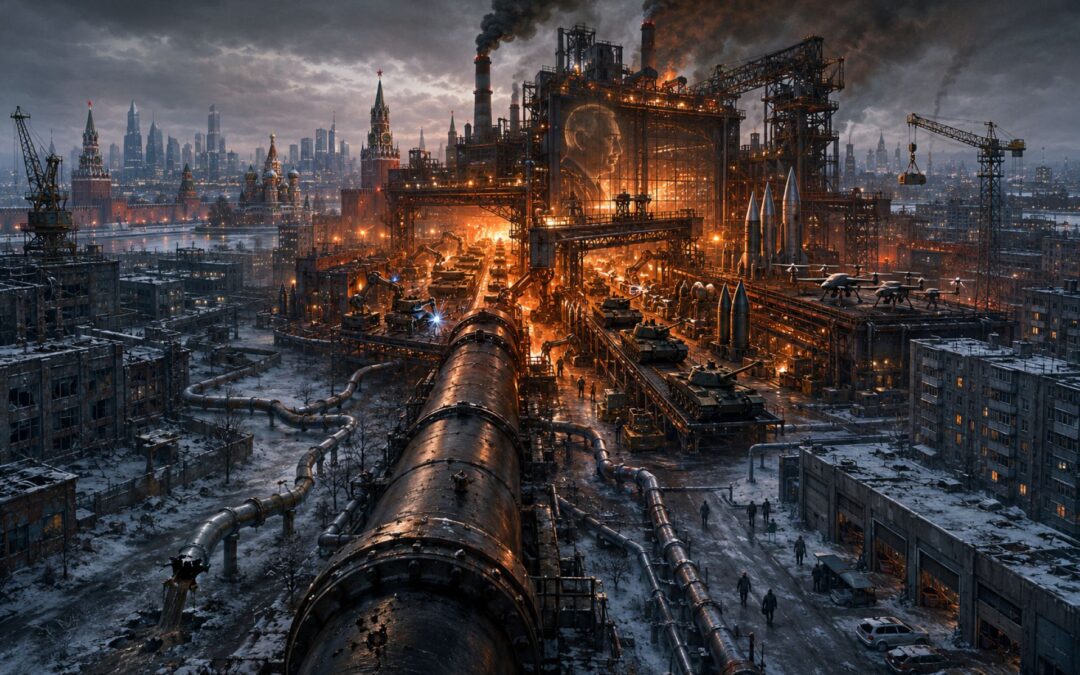
When Russia invaded Ukraine in February 2022, Western governments responded with one of the most ambitious sanctions campaigns ever imposed on a major economy. Russian banks were isolated, foreign reserves were frozen, technology exports were restricted, and Europe began reducing its dependence on Russian energy.
The expectation was clear: without access to Western finance, technology and markets, Russia’s economy would buckle under the cost of war.
That did not happen.
Russia absorbed the initial shock, stabilized the ruble, redirected trade toward China and India, and poured enormous sums into weapons production. Factories expanded, military wages rose and government spending pushed headline GDP growth above that of many European economies.
To some observers, this proved that sanctions had failed and that Russia’s economy was stronger than the West had assumed. To others, the apparent boom was an illusion sustained by oil revenues, deficit spending and the production of weapons destined to be destroyed.
The truth lies between those extremes.
Russia has built an economy capable of sustaining a long war, but it has done so by redirecting workers, capital, credit and industrial capacity away from civilian prosperity. Military production has surged while inflation, labor shortages, high interest rates and technological isolation have placed growing pressure on the rest of the economy.
Russia’s war economy is neither collapsing nor genuinely thriving. It is resilient, distorted and increasingly dependent on the state’s ability to keep spending, exporting energy and forcing the civilian economy to absorb the cost.
The Economic Collapse That Never Came
When Russian troops crossed into Ukraine on February 24, 2022, the West responded with an economic assault of unprecedented scale.
Russian banks were cut off from crucial parts of the international financial system. The country’s central-bank reserves held abroad were immobilized. Technology exports were restricted. Hundreds of foreign companies suspended their Russian operations, while Europe began dismantling an energy relationship that had taken decades to build.
The first reaction appeared to confirm the most dramatic predictions. The ruble plunged. Russians rushed to withdraw cash. Imports collapsed. Inflation surged. Analysts began debating whether Vladimir Putin’s invasion might bring down not only Russia’s economy but also his regime.
That collapse never came.
Russia’s economy contracted in 2022, but far less than many early forecasts suggested. It then returned to rapid growth as the Kremlin poured money into military production, replaced lost Western imports, redirected energy exports and placed the country’s financial system behind a wall of capital controls.
According to the Bank of Russia’s revised figures, GDP grew by 4.9% in 2024 before slowing sharply to around 1% in 2025. Russia was neither economically destroyed nor untouched. It had transformed itself into something different: a heavily managed wartime economy in which the state could generate growth by mobilizing factories, workers, banks and public finances for war.
The result created two competing stories.
One claimed that sanctions had failed because Russia was still exporting oil, producing weapons and recording positive GDP growth. The other insisted that the Kremlin was rapidly exhausting its resources and heading toward an unavoidable economic breakdown.
Both stories missed the more complicated reality.
Russia has proved far more resilient than many Western governments expected. But much of its recent growth has come from producing goods that are consumed or destroyed in war, while inflation, labor shortages, technological isolation and high borrowing costs have increasingly burdened the civilian economy.
Russia has survived the economic war.
That does not mean it has prospered.
How the Post-Soviet Collapse Shaped Putin’s Economic Model
To understand Russia’s wartime economy, it is necessary to understand the national trauma from which Vladimir Putin’s political system emerged.
The collapse of the Soviet Union did not simply replace communism with capitalism. It shattered an economic system in which factories, suppliers, transport networks and entire regions had been organized through central planning across fifteen Soviet republics.
Russia inherited industries that had never operated under market conditions, institutions that were poorly equipped to regulate private enterprise and a state that could no longer reliably collect taxes, control money or enforce contracts.
Under President Boris Yeltsin, Russia attempted to make the transition quickly. Prices were liberalized. State enterprises were privatized. Trade was opened. The ruble was allowed to operate more freely, and the government tried to impose financial discipline on an economy accustomed to state orders and subsidies.
The programme became known as “shock therapy,” but Russia experienced several shocks at once. Soviet supply chains disintegrated. Demand for military and industrial goods collapsed. Inflation destroyed savings. State assets were transferred through deeply contested privatization schemes, while politically connected businessmen accumulated control over natural resources, banks and major industries.
The International Monetary Fund’s examination of Russia’s post-Soviet transition describes an extraordinary decline in production during the decade after 1989. Russia’s experience cannot be attributed to one policy alone: institutional collapse, disrupted trade, monetary instability, inefficient Soviet industry and badly governed privatization all contributed.
For millions of Russians, however, the precise division of blame mattered less than the lived experience.
Wages went unpaid. Savings disappeared. Organized crime expanded. Public services deteriorated. A small number of oligarchs became spectacularly wealthy while large parts of the population experienced insecurity and humiliation.
This history shaped Putin’s most powerful political promise.
He would not necessarily make Russia democratic or equal. He would make it stable.
Oil, Gas and the Political Economy of Putinism
Putin took power at an extraordinarily fortunate moment.
Russia had emerged from its 1998 financial crisis with a devalued currency, unused industrial capacity and low production costs. At the same time, global oil prices began a prolonged rise.
Russia possessed some of the world’s largest reserves of oil, natural gas, coal and strategic minerals. As energy prices climbed, export revenues flooded into the country. The government paid debts, accumulated reserves, raised pensions and public-sector wages, and restored basic state authority.
Living standards improved. A new urban middle class emerged. Moscow became visibly wealthier. After the chaos of the 1990s, the contrast was politically transformative.
Putin did not abolish the oligarchic economy. He changed the relationship between the oligarchs and the state. Businessmen could remain wealthy as long as they did not challenge the Kremlin. Strategic sectors—particularly energy, banking, infrastructure and defence—were brought under tighter state influence.
Oil and gas revenues became the foundation of a political bargain. Citizens received stability, consumption and gradually rising incomes. In return, the Kremlin consolidated power, weakened independent institutions and restricted political competition.
Energy also became a foreign-policy instrument.
Russia built pipelines and signed long-term supply agreements that tied European industries and households to Russian gas. Before the full-scale invasion, Russia provided roughly 45% of the European Union’s gas imports and more than a quarter of its imported oil. That relationship generated revenue for Moscow while encouraging European governments to view economic interdependence as a source of stability.
The assumption was that countries with so much money at stake would avoid a complete confrontation.
For years, the assumption appeared to work.
Why Putin Expected a Short War
Putin did not invade Ukraine in 2022 expecting to finance an indefinite industrial war.
Russia’s previous military interventions had produced relatively limited economic consequences. In 2008, Russian forces entered Georgia and helped consolidate the position of Moscow-backed separatist territories. In 2014, Russia seized Crimea and supported armed separatism in eastern Ukraine.
The West imposed sanctions after Crimea, but they were targeted rather than economically comprehensive. Russia retained its access to global energy markets, international payment systems and European trade. Four years later, the country hosted the football World Cup.
The Kremlin appears to have entered the 2022 invasion with the expectation that Ukraine’s government would collapse quickly, that Russian forces could seize Kyiv and that the West would ultimately accept another fait accompli.
Instead, Ukrainian resistance stopped the initial offensive. Russian forces withdrew from northern Ukraine and became locked into a prolonged war of attrition.
The economic calculation changed with the military one.
Russia no longer needed enough financial resilience to survive a short diplomatic crisis. It needed enough weapons, workers, money and industrial capacity to sustain years of large-scale warfare.
At the same time, the sanctions imposed after 2022 were far broader than those introduced after Crimea. As research published by the Brookings Institution explains, the measures targeted finance, trade, payments, technology and energy simultaneously, creating one of the most extensive economic coercion campaigns ever directed at a major economy.
The West’s Economic Offensive
The sanctions campaign was often described as an attempt to “collapse” Russia’s economy. In practice, it pursued several objectives that were not always clearly distinguished.
Financial sanctions sought to prevent Russian banks and companies from operating normally in Western markets. Several banks were disconnected from SWIFT, the messaging network used to coordinate international payments. Transactions involving the Russian central bank were prohibited, immobilizing a large share of the state’s foreign reserves.
Export controls targeted products that Russia would struggle to replace domestically, including semiconductors, telecommunications equipment, industrial machinery, aircraft parts, lasers, sensors and technologies with military applications.
Western governments also tried to reduce Russia’s energy income. The European Union restricted Russian coal and seaborne oil, while the Group of Seven introduced a price cap covering Russian oil transported using participating countries’ shipping, insurance and financial services.
The purpose of the oil cap was not to stop every Russian barrel from reaching the market. Doing so could have created a global supply shock and sent energy prices sharply higher. Instead, the policy was designed to keep Russian oil flowing while reducing the price Moscow could earn.
The sanctions therefore contained an inherent compromise.
The West wanted to deprive Russia of revenue without depriving the world of Russian commodities.
That gave Moscow room to adapt.
How Russia Stopped the Initial Financial Panic
Russia’s first challenge was preventing fear from destroying the financial system before the longer-term effects of sanctions could even be measured.
On February 28, 2022, the Bank of Russia raised its key interest rate from 9.5% to 20%. The increase made bank deposits more attractive, discouraged borrowing and reduced some of the pressure to convert rubles into foreign currency.
The government and central bank also imposed restrictions on cross-border financial movements. Exporters were initially required to convert a share of their foreign-currency earnings into rubles. Cash withdrawals in foreign currencies were limited. Transfers abroad were restricted, and trading on parts of Moscow’s financial markets was suspended.
Banks received regulatory relief and emergency liquidity. The state made it difficult for foreign investors to sell Russian assets and remove the proceeds.
The Bank of Russia’s own account of its crisis response describes a combination of rapid interest-rate increases, capital controls, suspended trading and emergency support for financial institutions.
These measures worked.
The ruble recovered from its initial fall, bank runs subsided and the central bank began reducing rates within weeks. By September 2022, the key rate had returned to 7.5%.
Yet the ruble’s recovery did not mean that sanctions had caused no damage. A currency can remain strong because people are prevented from moving money abroad, because imports have collapsed or because exporters are required to sell foreign earnings.
The exchange rate had become partly a managed political price.
Russia stabilized the panic not by preserving normal financial openness, but by restricting it.
How Russia Rewired Trade Around Sanctions
Russia could not manufacture every product it had previously imported from Europe, the United States, Japan or South Korea. It therefore rebuilt its trading system around countries that had not joined the sanctions coalition.
China became Russia’s largest source of machinery, electronics, vehicles and consumer goods. Imports also moved through Türkiye, the United Arab Emirates, Kazakhstan, Armenia, Kyrgyzstan and other intermediary economies.
Some products arrived through formal “parallel import” channels, in which branded goods were purchased abroad and resold into Russia without the original manufacturer’s approval. Other transactions were concealed through networks of distributors, shell companies and re-exporters.
A component that could no longer be sold directly from a Western manufacturer to a Russian company might instead travel through several businesses and jurisdictions before reaching its final buyer.
The same process affected payments. Russian firms increasingly used Chinese yuan, local currencies, smaller banks and complex third-country arrangements. These alternatives allowed trade to continue, but they were slower, less reliable and more expensive.
Sanctions evasion should not be confused with sanctions immunity.
Russia has retained access to many goods, including products containing Western technology. But every additional intermediary adds costs, delays and risks. Financial institutions can suddenly refuse transactions. Suppliers may demand higher prices. Components may be older, lower quality or harder to replace consistently.
Research on sanctions enforcement has found that rerouting through third countries initially allowed Russia to preserve access to many controlled goods, although tighter monitoring and pressure on intermediary banks have made some channels more difficult to use.
Russia adapted because the world economy was too large to seal completely.
Adaptation, however, is not free.
Why War Spending Created an Economic Boom
Once the financial panic had been contained, the Kremlin began spending on a scale that transformed the economy.
Factories received enormous orders for missiles, artillery shells, drones, uniforms, vehicles and military electronics. Production lines expanded. Shifts were extended. Defence companies hired hundreds of thousands of additional workers.
The government increased payments to soldiers, offered large enlistment bonuses and compensated the families of those killed or injured. Regions hosting defence plants received new investment, while construction and logistics companies benefited from military contracts.
Russia’s banks also helped transmit the stimulus. State influence over the financial sector allowed credit and subsidies to be directed toward politically important industries even as other borrowers faced increasingly difficult conditions.
By 2025, Russia’s military expenditure had risen to an estimated $190 billion, or around 7.5% of GDP, according to the Stockholm International Peace Research Institute.
This spending produced genuine economic activity.
Workers were employed. Factories made products. Suppliers received orders. Wages were spent in shops, restaurants and housing markets. Tax revenues increased as money circulated through the economy.
GDP records production, not whether that production improves a society’s future welfare.
A refrigerator, a railway and an artillery shell can all add to GDP. But a refrigerator provides years of household use, and a railway can increase productivity for decades. A shell that is fired and destroyed has already exhausted its economic value.
War spending can create a boom.
It cannot create the same kind of prosperity as productive civilian investment.
Russia’s Two-Speed Economy
The headline GDP figures concealed an increasingly divided economy.
On one side stood sectors connected to the war. Arms manufacturers, metal producers, chemical plants, engineering firms and logistics companies benefited from state orders. Regions containing major defence factories experienced rapid wage growth and severe competition for workers.
On the other side stood much of the civilian economy.
Businesses producing consumer goods had to compete with military contractors for labor, materials, credit and government attention. High interest rates made investment expensive. Imported machinery and spare parts became harder to obtain. Weak export demand hurt industries that could no longer sell easily into Western markets.
The distinction is not always clean. A steel plant can serve both civilian and military customers. A vehicle factory may change its production according to state requirements. Construction companies can build ordinary housing as well as military facilities.
The direction of resources is nevertheless clear.
The state has prioritized activities that sustain the war.
The Bank of Finland Institute for Emerging Economies expects the divide to widen, with military-related investment continuing while private firms outside subsidized production chains struggle with weak demand, expensive technology, high taxes, wage costs and restricted credit. It also warns that military investment does little to expand Russia’s future productive capacity when the resulting equipment is consumed on the battlefield.
This is why descriptions of Russia as either “booming” or “in recession” can both appear plausible.
The military economy grew rapidly.
The civilian economy absorbed the cost.
Labor Shortages, Inflation and the 21% Interest Rate
Government spending could expand demand quickly. Russia’s ability to expand supply was far more limited.
Hundreds of thousands of working-age men entered the armed forces or defence industries. Others left the country after the invasion and the partial mobilization announced in September 2022. Russia’s pre-existing demographic problems further reduced the pool of available workers.
Companies began competing aggressively for employees. Defence factories could offer wages backed by state contracts. The military could offer signing bonuses that many civilian employers could not match.
Workers gained bargaining power, and wages rose. That helped households maintain spending, but it also increased production costs. Businesses passed those costs into prices, workers demanded further raises and the cycle added to inflation.
By 2024, Russia’s factories were operating close to their limits. There were too few workers, too little spare capacity and insufficient access to some imported technologies to produce everything demanded by the state and consumers.
The Bank of Russia responded by raising its key rate to 21% in October 2024. Governor Elvira Nabiullina explained that high capacity use, limited labor resources, rapid lending and additional government expenditure were preventing supply from keeping pace with demand.
The policy did not stop the government from purchasing weapons. The Kremlin could continue financing priority programmes, subsidizing strategic borrowers and directing state-controlled banks.
Instead, high rates disproportionately affected the rest of the economy.
Mortgages became more expensive. Consumer credit slowed. Civilian businesses postponed investment. Companies that were not protected by government contracts struggled to borrow profitably.
By June 2026, the central bank had reduced the rate to 14.25%, but that remained extremely restrictive by international standards. Annual inflation stood at 6%, above the bank’s 4% target, and economic growth had slowed to what the central bank described as a moderate pace. (Bank of Russia)
The fall from 21% did not mean the underlying problem had disappeared.
Russia’s economy was still trying to reconcile enormous state demand with limited people, machinery and productive capacity.
Oil Is Still the Kremlin’s Lifeline
Russia could not have sustained the wartime transformation without energy exports.
Oil is particularly important because it can be transported by sea and redirected more easily than pipeline gas. When European buyers reduced Russian purchases, Moscow offered discounted crude to Asian refiners.
India went from being a marginal buyer of Russian oil to one of its largest customers. China also increased purchases and remained a crucial destination for Russian crude.
By 2024, Asia and Oceania received 81% of Russia’s crude-oil and condensate exports. China imported an average of around 2.2 million barrels a day, while India imported approximately 1.7 million, according to the US Energy Information Administration.
Russia also assembled a “shadow fleet” of tankers operating outside conventional Western-controlled shipping and insurance networks. Many of these vessels changed owners, flags and management structures repeatedly, making sanctions enforcement difficult.
The fleet allowed Russia to transport more oil without depending on services covered by the Western price cap. It also created environmental and maritime risks because many vessels were old, poorly insured or managed through opaque corporate structures.
Trading hubs and intermediary economies became increasingly important. Dubai, for example, emerged as one of several centres through which commodities, companies and payments could be reorganized—a broader story explored in how Dubai became a hub for Russian oil trading.
Europe, meanwhile, did not eliminate Russian energy overnight. Some Russian gas continued entering the European market, particularly as liquefied natural gas or through remaining pipeline routes.
Yet the transcript’s implication that Europe barely reduced its dependence would be misleading.
The Council of the European Union reports that Russian gas fell from around 45% of EU gas imports in 2021 to approximately 13% in 2025. Russian oil fell from roughly 27% to below 3%, while Russian coal imports were eliminated.
Russia preserved a large share of its export volumes by finding new buyers.
It did not preserve the same customers, prices, bargaining power or profit margins.
The Fiscal Squeeze
The Kremlin’s ability to finance the war depends not only on how much oil Russia sells, but also on the price it receives, the exchange rate, production costs and the taxes collected from energy companies.
A drop in global oil prices can quickly reduce government revenue. So can a wider discount between Russia’s Urals crude and international benchmarks. Sanctions also raise the cost of tankers, insurance, payments and intermediaries.
Russia’s oil exports therefore can remain physically resilient while becoming fiscally less valuable.
The International Energy Agency reported that Russian oil revenue fell to $11 billion in November 2025, $3.6 billion lower than a year earlier, as weaker prices combined with lower export volumes. (IEA Oil Market Report)
At the same time, military spending has remained exceptionally high. The state must also finance pensions, regional budgets, infrastructure, public-sector salaries and support for industries damaged by sanctions or weak demand.
Russia has several ways to bridge the gap.
It can raise taxes and fees. It can require state-controlled companies to make additional payments. It can borrow from domestic investors and banks. It can cut or delay civilian expenditure. It can also draw from the liquid portion of the National Wealth Fund.
That fund once provided a substantial cushion against lower energy prices. War and recurring deficits have reduced it considerably.
According to BOFIT’s 2026 forecast, liquid National Wealth Fund assets fell from the equivalent of about 6.5% of GDP before the invasion to 1.8% by the end of 2025. By May 2026, the liquid portion had declined further to around 1.5% of GDP.
This does not mean Russia will suddenly become bankrupt when the fund is depleted.
Government debt remains relatively low. Moscow can issue more domestic bonds, pressure banks to purchase them, increase taxes or allow inflation to erode the real value of expenditure.
But each alternative transfers more of the war’s cost to businesses, consumers and future budgets.
The loss of the fund would not switch off Russia’s war machine.
It would remove one of its shock absorbers.
What Sanctions Have Actually Achieved
Whether sanctions have “worked” depends on what they were expected to accomplish.
If success meant producing an immediate economic collapse, forcing Putin from office or ending the invasion within months, they have clearly failed.
If success meant increasing the cost of war, reducing Russia’s access to technology, limiting energy income and weakening the country’s long-term productive potential, the record is more substantial.
Sanctions have not:
- Prevented Russia from exporting oil and gas.
- Forced the Kremlin to end the war.
- Eliminated Russian access to every Western component.
- Destroyed Russia’s financial system.
- Stopped its defence industry from expanding.
- Made the state incapable of paying soldiers or ordering weapons.
Sanctions have:
- Reduced Russia’s access to advanced machinery and technology.
- Forced trade through longer, more expensive and less reliable routes.
- Increased dependence on China and other intermediary economies.
- Reduced European dependence on Russian energy.
- Created discounts on Russian crude and additional transport costs.
- Weakened civilian investment and technological modernization.
- Encouraged the Kremlin to consume reserves, raise taxes and direct more resources through the state.
- Made Russia poorer than it would probably have been without the invasion.
The Brookings study on the economics of sanctions emphasizes that sanctions are not automatically capable of ending wars. Their effectiveness depends on clear objectives, enforcement, international coordination and the target country’s ability to adapt through alternative trading partners.
Russia illustrates the distinction between punishment and compulsion.
Sanctions have punished the Russian economy.
They have not yet compelled Putin to change his central war policy.
Can Russia Keep Financing the War?
Russia’s economic position looks different depending on the time horizon being considered.
A country can face serious long-term decline while still possessing enough immediate resources to continue fighting. It can also maintain military production while steadily reducing the welfare and opportunities available to its civilian population.
That is the central paradox of Russia’s war economy.
Short term
In the near future, Russia retains powerful tools for sustaining the war.
It continues to export large quantities of oil. The state can borrow domestically, raise taxes and direct lending through state-influenced banks. Capital controls restrict the movement of money, while political repression limits the ability of citizens and businesses to resist economic burdens.
The defence industry is already mobilized. Factories have workers, production lines and established government contracts. The Kremlin can continue prioritizing ammunition, weapons and military salaries over civilian consumption or investment.
Russia’s debt remains low compared with that of many major economies, giving the government room to borrow more. Higher oil prices or a weaker ruble can also temporarily improve budget revenues measured in domestic currency.
There is therefore little reason to expect an immediate economic event that suddenly makes continued warfare impossible.
Medium term
Over several years, the trade-offs become more severe.
More government borrowing means higher interest costs. Additional taxes reduce business investment and household purchasing power. Continuing labor shortages raise wages without necessarily raising productivity.
Civilian industries face persistent difficulty obtaining advanced equipment and affordable financing. Russia becomes more dependent on China for machinery, electronics, vehicles, financial channels and export markets.
That dependence carries a strategic cost. China can negotiate from a position of strength because Russia has fewer alternatives. India and other oil buyers can also demand discounts when Moscow urgently needs access to their markets.
The military sector itself eventually encounters capacity limits. Factories cannot expand indefinitely without more skilled workers, imported components, machinery and investment. Once plants are running close to full capacity, additional government spending produces more inflation than output.
Russia can continue spending.
It receives progressively less additional production for every ruble.
Long term
The most serious danger is not necessarily spectacular collapse.
It is stagnation.
Years of restricted technological access, low civilian investment and dependence on commodity exports can weaken productivity. Skilled emigration and an ageing population can intensify labor shortages. Infrastructure and industrial equipment become harder to replace.
The country may emerge from the war with a defence sector that is politically powerful, regionally concentrated and dependent on government orders. Reducing those orders could create unemployment and recession in military towns. Continuing them would consume resources that could otherwise support civilian modernization.
Research from the Carnegie Russia Eurasia Center estimates that employment in the military-industrial complex has risen to approximately 3.8 million people. That scale makes eventual demobilization an economic challenge of its own.
Putin’s political legitimacy was built partly on the contrast between the stability of his rule and the insecurity of the 1990s.
A long period of declining living standards, high taxation and limited opportunity would place that bargain under strain.
It might not bring down the system.
But it would leave the system with fewer rewards to distribute and more coercion required to preserve it.
Resilient Enough to Fight, Weaker Than the Headline Suggests
Russia’s economy did not collapse under Western sanctions because it was never a passive target.
The Bank of Russia contained the initial panic. Capital controls restricted financial flight. Energy exports continued. Trade shifted toward Asia and intermediary countries. The Kremlin used public spending, directed credit and state power to mobilize industry for war.
Those policies worked well enough to prevent the economic disaster predicted in early 2022.
They also changed what economic success meant.
Russia’s recent GDP growth has included missiles, tanks, military construction and payments to soldiers. Defence factories have expanded while many civilian businesses have faced expensive credit, scarce workers and restricted technology.
Oil continues to finance the state, but often at greater cost and through more complicated routes. Fiscal reserves have diminished. Taxes and borrowing are carrying more of the burden. The economy grew rapidly in 2024, then slowed to around 1% in 2025 as the limits of wartime stimulus became harder to ignore.
Sanctions have not delivered a knockout blow.
Nor has Russia defeated economic gravity.
The Kremlin can probably continue financing the war for longer than many early forecasts suggested. It can order banks to lend, factories to produce and budgets to prioritize military power. An authoritarian government can tolerate distortions and impose sacrifices that a more politically accountable system might find difficult to sustain.
But every year of war redirects more workers, capital and technology away from Russia’s civilian future.
The country is resilient enough to fight.
It is far weaker than the boom makes it appear.
Last Updated on July 16, 2026 by Aseem Gupta