
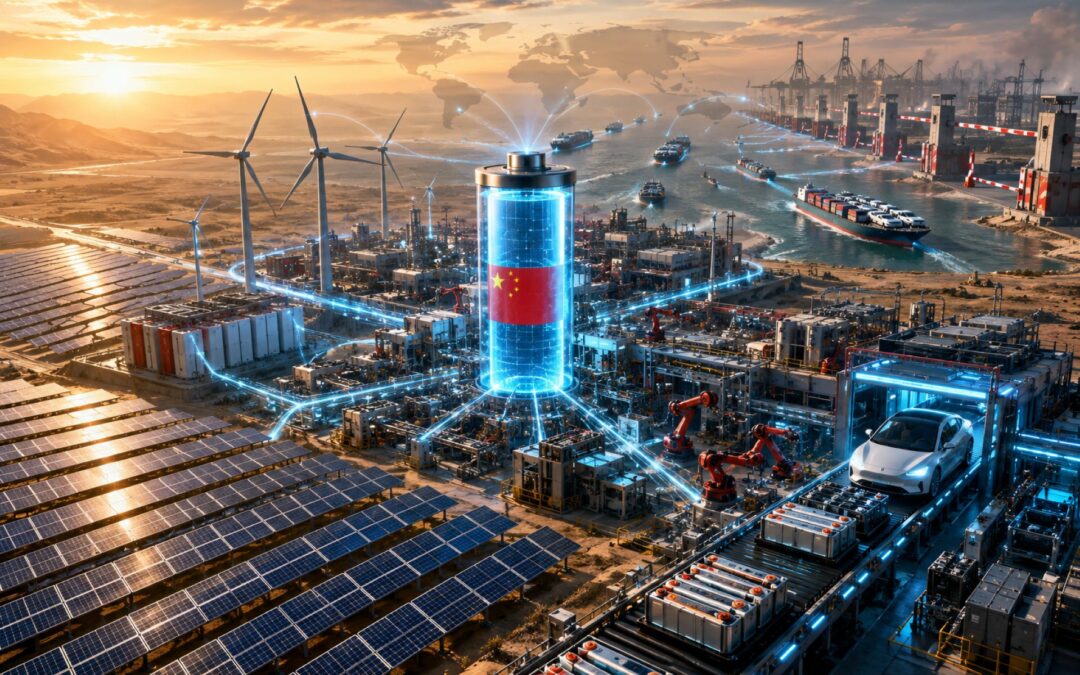
Across the high-altitude landscape of China’s Qinghai Province, rows of solar panels stretch towards the horizon. The Gonghe Talatan solar park is not simply one large power station. It is part of a vast collection of renewable-energy projects that reflects the extraordinary scale at which China now builds.
Similar scenes can be found across the country. Solar farms cover desert terrain. Wind turbines line mountains and coastlines. Battery factories, electric-vehicle plants and component suppliers have clustered around industrial cities.
The numbers are difficult to comprehend.
In 2024, investment in China’s broadly defined clean-energy sectors—including renewable power, electric vehicles, batteries, electricity grids, storage, nuclear power and rail—reached an estimated 6.8 trillion yuan, or approximately $940 billion. These industries contributed more than 10% of China’s economy and accounted for roughly a quarter of its economic growth that year, according to a Carbon Brief analysis based on official figures and industry data.
China is now the leading manufacturer of solar modules, battery cells, electric vehicles and wind equipment. Its clean-technology exports exceeded an estimated $165 billion in 2025, representing half of global trade in the relevant products once trade within the European Union is excluded.
This dominance is often presented as a simple story.
One version says China won because its government subsidised strategic industries on a scale that market-oriented economies could not match. Another says Chinese companies simply became more efficient, innovative and competitive than their foreign rivals. A third claims that China deliberately created excess industrial capacity and dumped the resulting products into foreign markets.
Each explanation contains part of the truth.
None explains the whole transformation.
China’s position was built over more than four decades. Economic liberalisation created factories and export markets. Foreign companies transferred capital, technology and production knowledge. Local governments built roads, ports, industrial parks and power networks. State banks financed favoured sectors. Subsidies created early demand. Dense supplier clusters reduced costs. Intense competition forced companies to improve their products.
The result is a clean-energy industrial system that is simultaneously state-directed and fiercely competitive.
It has produced world-class companies and lowered the global cost of decarbonisation. It has also created financial losses, surplus capacity, trade disputes and deep strategic dependence on a single country.
Understanding how China built that system is essential to understanding the next era of the global economy.
China’s Clean-Technology Dominance in One Snapshot
China’s clean-energy advantage begins with scale, but scale can be measured in several different ways.
A country can dominate domestic installations without dominating manufacturing. It can manufacture enormous quantities without exporting most of them. It can possess factories capable of producing far more than they actually produce. It can assemble finished products while remaining dependent on imported components further up the supply chain.
China is formidable across almost all of these dimensions.
The country accounted for most of the renewable-power capacity added worldwide in 2024. It also became the central manufacturing location for many of the technologies being installed, from solar wafers and modules to batteries, wind components and electric vehicles. The International Renewable Energy Agency’s capacity statistics illustrate the speed at which China’s domestic renewable fleet expanded during the decade to 2024.
In solar manufacturing, China’s position extends through nearly the entire chain: polysilicon, ingots, wafers, cells and finished modules. The International Energy Agency estimated that China supplied around 80% of global solar-module demand in 2024 and approximately 90% of several important upstream stages.
Chinese companies are equally powerful in batteries. They manufacture cells, refine important materials, produce cathodes and anodes, and supply battery-management systems. Companies such as CATL and BYD have become global technology leaders rather than merely inexpensive contract manufacturers.
China is also the world’s largest market for electric vehicles. Its domestic scale allows manufacturers to test models, change designs, pressure suppliers and spread research costs across millions of vehicles before expanding overseas.
Wind power is less concentrated than solar or batteries, but Chinese turbine manufacturers have gained market share through lower prices, domestic deployment and expanding exports.
The important point is not that China holds exactly the same share of every industry.
It does not.
The important point is that no other country possesses a comparable concentration of manufacturing capability across so many connected clean-energy sectors.
The solar panel installed on a roof, the battery inside an electric car and the permanent magnet inside its motor may pass through several companies. Yet many of those companies, processes and inputs are likely to be located in China.
That concentration is the product of a long industrial transformation.
The Industrial Foundations Came Before Made in China 2025
China did not begin its rise with solar panels or electric vehicles.
It began with a crisis.
When Mao Zedong died in 1976, China remained a poor, predominantly rural country. Mao’s attempts to accelerate industrialisation through political mobilisation and central planning had produced devastating results. The Great Leap Forward contributed to one of the deadliest famines in modern history, while the Cultural Revolution disrupted education, government and economic activity.
Deng Xiaoping emerged as China’s paramount leader in the late 1970s with a more pragmatic view of economic organisation.
His approach was captured by the saying that it did not matter whether a cat was black or white, provided it caught mice. The message was clear: policies should be judged by whether they worked, not by whether they conformed perfectly to ideological doctrine.
Under the programme of “reform and opening,” China gradually introduced market mechanisms without abandoning one-party political control.
Farmers received greater freedom over agricultural production. Private businesses began to emerge. Prices became more responsive to supply and demand. Foreign companies were allowed to invest. Local governments gained incentives to pursue economic growth.
The reforms were cautious and uneven, but they changed the direction of the country.
Special economic zones became laboratories for a more open economic model. Shenzhen, then a relatively small settlement beside Hong Kong, became the most famous example.
Foreign investors were offered favourable tax treatment, access to inexpensive labour and fewer restrictions than they faced elsewhere in China. Factories arrived. Migrant workers followed. Ports, roads, housing and industrial parks expanded around them.
The products were not initially glamorous.
Chinese factories manufactured clothes, toys, footwear, household goods, watches, electronic components and countless other labour-intensive products. Their main competitive advantage was cost.
Yet low-cost production created something more valuable than export revenue.
It created experience.
Chinese workers learned modern production methods. Managers learned how to meet foreign quality standards. Suppliers learned how to deliver parts on time. Local governments learned how to build industrial zones. Engineers learned how products could be redesigned for mass manufacturing.
Foreign companies often supplied the original technology, machinery, designs and customer relationships. China supplied labour, land, infrastructure and increasingly capable factories.
Over time, the boundary between foreign knowledge and domestic capability began to blur.
China’s entry into the World Trade Organization in 2001 accelerated the process by giving Chinese manufacturers more secure access to global markets. Exports surged, multinational companies expanded their Chinese supply chains and factories multiplied along the coast.
China became the world’s workshop.
But being the world’s workshop was never meant to be the final destination.
From the World’s Factory to an Advanced Industrial Power
The export model transformed China’s economy, lifted hundreds of millions of people out of poverty and turned coastal cities into manufacturing centres.
It also created vulnerabilities.
Many Chinese factories assembled products designed elsewhere using sophisticated components imported from abroad. A product might carry a “Made in China” label even when the most valuable technologies inside it came from Japan, Germany, South Korea, Taiwan or the United States.
China captured the wages, factory activity and some supplier profits. Foreign companies often retained the intellectual property, premium brands, advanced machinery and highest-value components.
Low wages were also a temporary advantage.
As Chinese incomes rose, producers faced competition from countries where labour remained cheaper. A development model built mainly around low-cost assembly could not indefinitely support China’s economic ambitions.
There were strategic concerns as well.
China depended heavily on foreign companies for advanced semiconductors, precision machinery, aerospace technology, industrial software and specialised materials. A deterioration in international relations could expose these dependencies.
The environmental consequences of the early industrial model were also severe. Coal-powered factories, heavy industry, construction and export production contributed to polluted air, contaminated water and rapidly rising carbon emissions.
By the early 2010s, China had become an industrial giant without yet becoming the strongest technological power.
Its economy was large, but many of its companies were weak at the technological frontier.
Its factories produced enormous volumes, but much of the value remained elsewhere.
Its cities had modern infrastructure, but the country still depended on foreign suppliers for many of the machines and components needed to sustain that infrastructure.
The next phase of development required China to move beyond manufacturing other countries’ products.
It needed to create its own technologies, brands, supply chains and standards.
Made in China 2025 Changed the Goal
When Xi Jinping came to power in 2012, he inherited an economy that was becoming richer but was also slowing, accumulating debt and losing some of its low-wage advantage.
In 2015, the State Council released Made in China 2025, a ten-year industrial strategy intended to turn China into a leading advanced-manufacturing power.
The document was unusually direct about the country’s weaknesses.
It described China’s manufacturing sector as large but insufficiently strong. It acknowledged weak innovation, inefficient resource use, uneven quality and dependence on foreign countries for core technologies and high-end equipment.
The original Made in China 2025 plan declared manufacturing to be the foundation of national power and called for greater competitiveness, domestic innovation and technological independence.
The plan identified ten priority areas, including advanced information technology, robotics, aerospace, marine engineering, railway equipment, energy-saving vehicles, power equipment, agricultural machinery, new materials and medical technology.
Clean-energy industries fitted naturally into this strategy.
Electric vehicles offered China an opportunity to challenge foreign automakers without first defeating them in the internal-combustion technologies they had spent a century perfecting. Solar panels and wind turbines served a rapidly growing domestic energy market. Batteries connected transport, electricity storage, consumer electronics and strategic materials.
Made in China 2025 did not create these industries from nothing.
China had supported renewable power, battery manufacturing and electric vehicles before 2015. Shenzhen was already a major technology centre. BYD had already entered the car industry. Solar companies had already gained global market share.
The plan instead formalised and accelerated a direction that was already visible.
It gave officials, banks, companies and local governments a common signal: advanced manufacturing was a national priority.
The slogan became politically controversial abroad and largely disappeared from official Chinese rhetoric after 2018. The underlying objectives did not.
A ten-year assessment by Rhodium Group found that state support, localisation policies and efforts to reduce foreign dependence continued through other programmes. China achieved strong results in electric vehicles, clean technology, telecommunications equipment, drones, ships and rail, while remaining dependent on foreign firms in areas such as cutting-edge semiconductors, commercial aircraft and high-end machine tools.
Made in China 2025 was therefore neither a complete success nor an empty slogan.
It was most successful where several conditions came together: a large domestic market, extensive state support, capital-intensive production and a relatively new industry without an unbeatable foreign leader.
Clean technology offered all four.
BYD: A Company That Mirrors China’s Transformation
Few companies embody China’s industrial evolution more clearly than BYD.
Wang Chuanfu founded the company in Shenzhen in 1995. He had studied chemistry and worked in battery research before entering the commercial battery industry.
At the time, Japanese companies held strong technological positions in rechargeable batteries. BYD could not initially compete by building more automated or technologically sophisticated production lines.
It competed by redesigning production around China’s labour advantage.
Processes that were automated in Japan could sometimes be divided into steps performed manually by trained workers in Shenzhen. This reduced the amount of expensive imported machinery required and allowed BYD to enter the market with less capital.
The strategy worked.
BYD became a major supplier of rechargeable batteries for mobile phones and other electronics. The business gave the company expertise in chemistry, manufacturing, quality control and supply-chain management.
It also gave Wang Chuanfu a larger ambition.
In 2003, BYD acquired a struggling state-owned automaker and entered the car industry. The decision confused many observers. Making phone batteries and making automobiles appeared to be very different businesses.
Yet the arrival of electric vehicles made battery expertise central to automotive competition.
BYD began producing conventional cars, hybrids and electric vehicles. It invested in battery cells, electronics, motors, semiconductors and vehicle assembly. This vertical integration allowed the company to control more of its costs and reduce dependence on outside suppliers.
Government policy helped create the market.
Chinese EV manufacturers benefited from purchase incentives, tax exemptions, public charging infrastructure and procurement programmes. Cities placed large orders for electric buses and taxis. Licence-plate restrictions in congested urban areas often made electric vehicles more attractive than conventional cars.
The company still had to survive brutal competition.
China’s auto market attracted established state-owned manufacturers, private companies, foreign joint ventures and new EV start-ups. Models appeared rapidly. Price wars intensified. Companies that failed to improve disappeared.
BYD did more than collect subsidies. It developed products that consumers wanted.
Its Blade Battery was designed around lithium iron phosphate chemistry, which sacrifices some energy density in exchange for lower cost, durability and thermal stability. The company expanded its range of plug-in hybrids and electric cars across multiple price categories.
BYD then took the capabilities built in China abroad.
It began selling vehicles across Asia, Europe, Latin America and other markets while investing in assembly and manufacturing facilities outside China. Producing locally can reduce shipping costs, qualify for incentives and help the company navigate tariffs.
BYD’s rise illustrates the larger Chinese model.
The state reduced risk, built infrastructure and created demand. China’s manufacturing ecosystem supplied components and workers. Competition pushed the company to lower costs and improve.
Policy created the opportunity.
Corporate capability converted it into industrial power.
How China Built Markets as Well as Factories
Government support for Chinese clean technology is often discussed as though Beijing simply transferred money to favoured companies.
Direct subsidies mattered, but they were only one part of the system.
China supported both the supply of clean technologies and the demand for them.
Electric-vehicle buyers received purchase incentives and tax advantages. Cities bought electric buses, taxis and municipal vehicles. Charging networks expanded. In some cities, buyers of electric cars could obtain licence plates more easily than buyers of petrol vehicles.
Renewable-energy producers benefited from feed-in tariffs and guaranteed access to the electricity system. Grid construction connected large solar and wind projects in remote regions to population centres.
Manufacturers received tax benefits, research grants and support from local governments. Industrial parks supplied land, roads, power, water and logistics. Provinces competed to attract factories that could create employment and future tax revenue.
Cheap capital was particularly important.
China’s financial system is dominated by state-owned banks, which can be encouraged to direct lending towards strategic industries. Projects that might have been considered too risky or slow to repay under purely commercial lending standards could still obtain financing.
Local-government investment funds provided another source of capital. These funds could take equity stakes in companies, support suppliers or rescue strategically important businesses.
Government procurement offered young industries a customer before private demand was fully established.
An electric-bus company could build experience because a city ordered an entire fleet. A battery maker could expand because automakers knew that government policy would continue encouraging electric vehicles. A solar manufacturer could invest because power companies faced renewable-energy targets.
The CSIS study of Chinese industrial-policy spending attempted to capture direct subsidies, tax incentives, below-market credit and state investment funds. It found that China’s measurable support was unusually large and that several additional policy tools were difficult to quantify.
This model reduced costs at several points simultaneously.
A manufacturer might obtain inexpensive land, borrow from a state bank, buy components from subsidised suppliers, sell into a government-supported domestic market and use infrastructure financed by public investment.
No individual policy fully explains China’s advantage.
The advantage comes from how the policies reinforce one another.
Why Subsidies Alone Do Not Explain China’s Lead
State support can help a company build a factory.
It cannot guarantee that the factory will produce good products.
Governments around the world have financed businesses that failed, protected industries that stagnated and built facilities that never became internationally competitive. China has done the same.
Its clean-energy success therefore requires another explanation.
One factor is the density of its supplier networks.
A manufacturer in a major Chinese industrial cluster may find component makers, machine suppliers, electronics companies, packaging firms, logistics providers and engineering services within the same region.
Physical proximity reduces transport time. It makes design changes easier. Engineers from a final manufacturer can visit a supplier, identify a production problem and test a solution without waiting weeks for parts to cross an ocean.
Scale creates another advantage.
A company producing millions of units can spread research, tooling and factory costs across a larger volume. It can negotiate lower input prices and justify investments that would be uneconomic for a small producer.
Repeated production also creates learning.
Workers become faster. Managers identify bottlenecks. Engineers redesign products around the manufacturing process. Suppliers improve their own components in response to customer demands.
Competition amplifies these effects.
China did not create one protected national champion in every clean-energy industry. It often created many firms backed by different cities, provinces and investors.
These companies fought for market share.
Solar manufacturers expanded capacity, cut prices and adopted new cell technologies. Battery companies experimented with chemistry, pack design and production methods. Automakers released new models at a speed that placed established foreign companies under pressure.
This competition can be destructive, but it also produces innovation.
The IEA’s research on clean-technology manufacturing and trade points to manufacturing experience, scale, supply-chain integration, policy support and lower input costs as mutually reinforcing advantages.
The distinction matters.
A subsidy can lower the price of a poorly designed product temporarily.
China’s strongest companies now produce technology that is competitive on performance, reliability and engineering as well as price.
That does not make the subsidies irrelevant.
It means the subsidies helped build capabilities that eventually became real.
China’s Clean-Energy Dominance by Industry
China’s clean-energy position is not one single monopoly. It is a collection of overlapping industrial advantages.
Solar power is the clearest example.
Chinese companies operate across the supply chain, from purified polysilicon to wafers, cells and modules. Years of investment, production growth and competition pushed prices down while eliminating many foreign competitors.
The result is an industry in which Chinese manufacturing capacity can satisfy most global demand. The IEA estimated that China supplied about 80% of solar modules in 2024 and roughly 90% of important upstream components.
Batteries form another deeply integrated ecosystem.
China has major companies producing battery cells, cathode and anode materials, separators, electrolytes, manufacturing equipment and battery-management systems. It also processes many of the minerals required to turn raw resources into battery-grade inputs.
This industrial concentration connects batteries to the country’s electric-vehicle market.
Domestic automakers can work closely with cell manufacturers. New battery chemistries can be tested in commercial vehicles. Large sales volumes create data and finance further improvement.
Electric vehicles are perhaps the most visible expression of China’s transformation because they combine batteries, electronics, software, motors, materials and mass manufacturing in one product.
Chinese EVs were once dismissed as low-quality imitations.
They are now forcing established automakers to reconsider their prices, development cycles and technology strategies.
Some Chinese companies compete through inexpensive urban vehicles. Others sell sophisticated cars with advanced driver-assistance systems, elaborate digital features and long ranges. Plug-in hybrids have allowed manufacturers to reach consumers who remain concerned about charging infrastructure.
Wind manufacturing is less concentrated, but Chinese companies have become increasingly important through the size of the domestic market and the lower cost of their turbines.
Together, these industries support one another.
Cheap batteries make electric cars and grid storage more affordable. Cheap renewable power can reduce industrial electricity costs. Electric vehicles create demand for batteries, motors, chips and processed minerals. Renewable installations create demand for transmission equipment and storage.
China’s rare-earth processing and magnet ecosystem adds another layer of advantage because permanent magnets are used in many electric motors, wind turbines and industrial machines.
The strength lies not in one factory.
It lies in the system connecting them.
The Overcapacity Trap
The same model that helped China build industrial leadership has also encouraged companies to build more capacity than markets can profitably absorb.
This is the overcapacity problem.
Overcapacity does not necessarily mean that nobody wants the products. Global demand for solar panels, batteries and electric vehicles continues to grow.
It means that factories can produce more than customers will purchase at prices that allow most producers to earn sustainable returns.
The incentives begin at the local level.
A provincial government wants investment, employment and industrial prestige. It offers land, financing or tax support to attract a strategic manufacturer.
A neighbouring province does the same.
The central government encourages clean technology, but it may not control every investment decision made by cities, banks, companies and local funds. Once many regions pursue the same priority, capacity expands rapidly.
Companies also face pressure to keep growing.
A firm that stops investing may lose market share, supplier attention and political support. Even when an industry is already crowded, each company hopes that competitors will fail first.
Banks may continue lending because closing a large factory would create unemployment and financial losses. Local governments may resist consolidation because they do not want production to move elsewhere.
Weak household consumption intensifies the problem.
China directs a large share of national resources towards investment, infrastructure and production. Households receive a smaller share of economic output than they do in many consumer-led economies, while high savings reflect concerns about housing, healthcare, education and retirement.
Factories therefore expand faster than domestic consumption.
Exports become the release valve.
The result can be a price war.
Solar-module prices fell by around half between 2023 and 2025, while battery-pack prices fell by roughly 30%, according to the IEA. These declines help consumers and clean-energy developers, but they place enormous pressure on manufacturers.
The IEA estimated that the ten largest listed solar companies lost a combined $4.5 billion in 2024 as margins collapsed under intense competition. Chinese wind manufacturers also faced pressure from falling prices, while weaker battery firms struggled despite the profitability of the strongest producers.
This reveals the paradox at the centre of China’s model.
Industrial policy can create globally dominant industries without creating healthy profits for every company inside them.
China may win market share while individual Chinese producers lose money.
Foreign consumers receive cheaper technology. Foreign manufacturers face possible closure. Chinese factories operate at low margins. Local governments inherit debt and excess capacity.
The conflict is not simply between China and the rest of the world.
It is built into the structure of the Chinese economy itself.
Why Tariffs Cannot Fully Reverse China’s Advantage
Governments outside China increasingly view clean-energy manufacturing as an economic-security issue.
They do not want the industries of the future to be supplied almost entirely by a strategic competitor. They also fear that domestic companies cannot survive prolonged competition against Chinese producers benefiting from state support, scale and low margins.
Tariffs are the most visible response.
In 2024, the United States raised tariffs on several Chinese clean technologies. The measures included a 100% tariff on electric vehicles, a 50% tariff on solar cells and a 25% tariff on lithium-ion EV batteries and certain other products.
The European Union adopted a more differentiated approach after investigating Chinese EV subsidies. It imposed additional duties of 17% on BYD vehicles, 18.8% on Geely and 35.3% on SAIC, alongside the EU’s standard vehicle import tariff.
Tariffs can change behaviour.
They can reduce imports, improve the commercial case for domestic production and give local companies time to expand. The IEA found that trade barriers and production incentives helped increase the share of American solar-module and battery-cell demand met by domestic manufacturing between 2023 and 2025.
But tariffs cannot instantly reproduce an industrial ecosystem.
A country may protect a module-assembly plant while remaining dependent on imported wafers or cells. It may build battery factories while importing cathode materials, anodes or production equipment.
A new factory may also cost more to operate because it lacks nearby suppliers, trained workers, established infrastructure and the enormous production volumes available in China.
Chinese companies can adapt as well.
Instead of shipping finished products directly from China, they can build factories in Hungary, Brazil, Thailand, Turkey or other markets. Local manufacturing may allow them to avoid tariffs, qualify for incentives and present themselves as domestic employers.
Tariffs can move the final assembly line.
They do not necessarily remove Chinese technology, capital, equipment or components from the product.
There is also a cost to protection.
Higher tariffs can make electric vehicles, solar panels and batteries more expensive. Slower adoption may protect domestic industry while delaying emissions reductions.
The choice is therefore not between free trade and economic security.
It is between different combinations of cost, resilience, industrial capability and political dependence.
Is China Winning, Cheating, or Demonstrating How Industrial Policy Works?
Asking whether China is “winning” or “cheating” turns a complicated industrial transformation into a moral slogan.
China’s government undeniably intervened on a scale that altered competition.
It provided subsidies, tax incentives, procurement, infrastructure, inexpensive capital and political direction. Foreign companies have also faced pressure to localise production and technology. Some industries expanded far beyond what short-term market demand would have justified.
These policies imposed costs on competitors that did not receive equivalent support.
Yet government support for industry is not uniquely Chinese.
The United States has long supported defence, aerospace, agriculture, semiconductors, electric vehicles and energy. European governments subsidise strategic industries and protect important sectors. Japan, South Korea, Taiwan and Germany all used public policy during their industrial development.
The difference is one of scale, coordination, duration and economic structure.
China combined national planning with provincial competition, state finance, infrastructure and a domestic market of extraordinary size. It continued supporting industries through long periods in which returns were uncertain.
Some of that support corrected genuine market failures.
New technologies often require charging networks, transmission lines, research, standards and early customers before they can compete. Private companies may underinvest when the wider social benefits—cleaner air, lower emissions, technological learning and energy security—cannot be captured entirely as profit.
Other interventions created waste.
Factories were duplicated. Companies survived longer than commercial logic justified. Local governments accumulated liabilities. Excess production drove prices below sustainable levels.
The outcome is neither pure central planning nor pure capitalism.
China sets strategic priorities but often allows numerous firms to compete within them. The government shapes the field, finances its development and influences demand. Companies then fight aggressively for survival.
Some fail.
Some become global champions.
This system does not prove that every country can copy China. Many governments lack its banking structure, administrative capacity, domestic market and political willingness to absorb losses.
Nor does it prove that industrial policy always succeeds.
China’s own results under Made in China 2025 were uneven. Clean technology advanced rapidly, while sectors such as cutting-edge semiconductors, commercial aircraft and high-end machinery continued to rely on foreign capabilities.
What China demonstrates is narrower and more important.
Markets do not create industrial power in isolation.
States shape infrastructure, finance, research, demand, trade rules and strategic priorities. The question is not whether governments intervene.
It is whether that intervention develops lasting capability—or merely protects expensive weakness.
What China’s Clean-Technology Dominance Means for the World
China’s rise creates several consequences that cannot be reduced to a single verdict.
The same factories can be economically disruptive, strategically dangerous and environmentally valuable at the same time.
Cheaper Decarbonization
The most obvious benefit of China’s industrial expansion is falling prices.
Solar modules, batteries and electric vehicles became cheaper partly because Chinese companies built enormous factories, improved production and competed relentlessly.
Lower prices make renewable projects viable in countries that could not afford them a decade ago. They allow households to consider electric vehicles and rooftop solar. They reduce the cost of batteries needed to balance electricity grids.
For developing countries, the effect may be particularly significant.
Many governments do not possess the financial resources to subsidise expensive domestic manufacturing. Affordable Chinese equipment allows them to expand electricity access and reduce dependence on imported fossil fuels without first building complete industrial supply chains of their own.
The environmental value is real.
The global energy transition would be slower and more expensive without Chinese manufacturing.
Industrial Displacement
Cheap technology has producers as well as consumers.
When prices collapse, foreign factories may close before they achieve sufficient scale. Domestic investors may avoid entering a market they believe Chinese companies can overwhelm whenever capacity expands.
This creates a difficult sequencing problem.
Consumers benefit immediately from inexpensive imports. The strategic cost of losing domestic capability may appear only years later.
The earlier “China shock” after WTO accession disrupted labour-intensive manufacturing in several advanced economies. The clean-technology version could affect more capital-intensive sectors associated with engineering, research and national climate strategies.
Germany, Japan and South Korea have strong automotive and industrial companies that now face Chinese competition in markets they once expected to lead.
Emerging economies face a different challenge. They want Chinese investment and inexpensive technology, but they also want to build industries rather than remain permanent importers.
The distribution of benefits therefore matters.
Cheap panels may help electricity consumers while hurting domestic panel manufacturers. Cheap cars may help buyers while closing assembly plants. Governments must decide which losses represent ordinary competition and which threaten strategic capabilities that would be difficult to rebuild.
Strategic Dependence
Energy security was once discussed mainly in terms of oil and gas.
The clean-energy transition does not eliminate dependence. It changes its form.
A country that imports oil must keep purchasing fuel. A country that imports solar panels buys much of the capital equipment upfront and then generates power domestically.
That is a meaningful security improvement.
Yet the clean-energy system still depends on replacement components, batteries, software, processed minerals, power electronics and manufacturing equipment.
When one country controls a large share of these supply chains, political risk remains.
China’s position in rare-earth processing, battery materials and solar manufacturing gives it influence over industries that other governments consider essential. Export controls, sanctions, shipping disruptions or diplomatic crises could affect production elsewhere.
Complete self-sufficiency is neither realistic nor necessarily desirable.
Building every component domestically would raise costs and duplicate facilities across countries. It could also slow innovation by reducing trade and competition.
The more practical goal is diversification.
Countries need enough alternative mining, processing, component and manufacturing capacity that no single government can paralyse an entire industry.
A New Industrial-Policy Race
China’s success has already changed economic policy elsewhere.
The United States has subsidised domestic semiconductor, battery and clean-energy manufacturing. The European Union has adopted industrial and trade measures aimed at preserving strategic sectors. India supports solar manufacturing, batteries and electric vehicles. Governments across Asia, Latin America and the Middle East are competing for Chinese factories while trying to develop local suppliers.
The world is not returning to the laissez-faire assumptions that shaped much of the late twentieth century.
Industrial policy is back.
The danger is that every country attempts to build the same subsidised factories regardless of its capabilities. That could create a global version of China’s overcapacity problem, with governments competing to finance production that cannot all operate profitably.
The better approach is selective.
Countries should identify the industries and supply-chain stages that are genuinely strategic, develop areas where they possess comparative advantages and cooperate with trusted partners where complete national production would be uneconomic.
Resilience does not require every country to manufacture everything.
It requires enough alternatives that dependence never becomes submission.
Conclusion
Deng Xiaoping’s famous cat was judged by whether it caught mice.
By that standard, China’s clean-energy industrial strategy has achieved something extraordinary.
It turned a country once known primarily for low-cost assembly into the central manufacturer of many technologies expected to shape the twenty-first century. It created innovative companies, drove down prices and accelerated the global transition towards renewable energy and electric transport.
But the cat has grown larger than anyone expected.
Its success rests on a system that directs enormous resources towards production, tolerates low returns and depends on foreign markets to absorb surplus output. That system creates factories faster than demand, pressure on producers at home and trade conflict abroad.
For the rest of the world, the choice is uncomfortable.
Rejecting Chinese technology would make decarbonisation slower and more expensive. Relying on it without limits would concentrate economic and strategic power in one country.
The answer cannot be blind protectionism.
Nor can it be blind dependence.
Countries will have to decide which technologies can be purchased from the cheapest producer, which supply chains require deliberate diversification and which industrial capabilities are too important to lose.
China has already shown what sustained industrial ambition can build.
The remaining question is whether the rest of the world can respond without destroying the benefits China’s factories have created—or surrendering the future of clean energy to them entirely.
Last Updated on July 16, 2026 by Aseem Gupta