
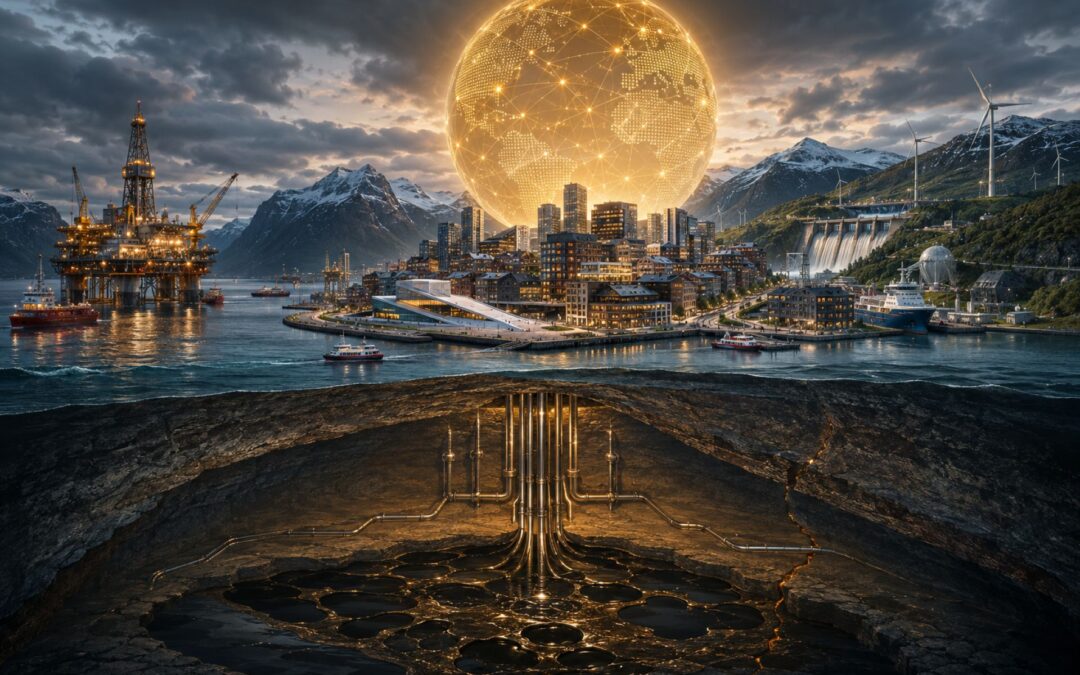
On Christmas Eve in 1969, Norwegian authorities announced that Phillips Petroleum had discovered oil beneath the North Sea.
The field, later named Ekofisk, was enormous. Commercial production began in 1971, followed by a succession of discoveries that transformed Norway from the least affluent Scandinavian economy into one of the wealthiest countries in the world.
The easy explanation is oil.
Norway found a valuable resource, exported it and used the proceeds to build an unusually prosperous society.
That explanation is not wrong.
It is just incomplete.
Many countries have found oil. Some possessed far more than Norway. Yet their windfalls produced corruption, inequality, political repression, unstable public finances or economies dangerously dependent on one commodity.
Norway’s achievement was not simply discovering petroleum.
It was building a system that stopped petroleum from taking control of the country.
Oil was treated as a temporary national inheritance rather than unlimited government income. Foreign companies were invited to provide technology and capital, but the state retained control over the resource. Petroleum profits were heavily taxed. Much of the revenue was invested abroad. Politicians were restrained by rules designed to protect future generations from the appetites of the present.
The result was one of the most successful resource-management systems in modern history.
Yet that success created a second, quieter problem.
Norway avoided the classic resource curse, but it may not have escaped every consequence of extraordinary wealth. Oil and gas remain central to exports, employment and public finances. Productivity growth has slowed. Housing is expensive. Household debt is exceptionally high. The country spends heavily on public services without always achieving better results than its neighbours. The Oil Fund has become so large that it can soften almost every political trade-off.
Norway passed the first test of oil wealth: how to prevent a windfall from destroying a country.
Now it faces the second: how to prevent that same windfall from making reform feel unnecessary.
Norway Was Already Building the Foundations of Prosperity
Norway was not a poor, dysfunctional state waiting for oil to rescue it.
For much of its history, it had been less prosperous than Denmark and Sweden. Its difficult geography limited agriculture, and its economy depended heavily on fishing, timber, shipping and other natural resources. By the middle of the 20th century, however, Norway was already an industrialising European democracy with an educated population, established public institutions and substantial experience in maritime trade and hydropower.
That distinction matters.
Oil did not arrive in a political vacuum. It arrived in a country with democratic accountability, relatively low corruption, a capable bureaucracy and enough social trust to think of offshore petroleum as a national asset.
Norway also had practical strengths that later proved invaluable. It had generations of experience at sea. Its shipping industry understood difficult waters, engineering and international commerce. Its hydropower development had already taught the country how foreign capital and technology could be used without surrendering permanent control over strategic resources.
The welfare state was also taking shape before the petroleum boom. Norway did not invent universal public services after finding oil. Oil expanded the state’s capacity to finance them, but the political commitment to social insurance, public education and economic equality had deeper roots.
This is one reason Norway’s success is difficult to copy.
A resource boom magnifies the political system that receives it. In a country with weak institutions, sudden wealth makes corruption more profitable and control of the state more valuable. Political competition becomes a struggle over the resource tap. Leaders can distribute money without building a productive tax base or becoming accountable to citizens.
Norway entered the oil era with many of the institutions that resource-rich countries often struggle to build after the money arrives.
The country did not become disciplined because it discovered petroleum.
It could manage petroleum because it already possessed a degree of discipline.
The North Sea Discovery That Changed Norway’s Future
For years, the Norwegian continental shelf did not look especially promising.
A major natural-gas discovery in the Netherlands in 1959 encouraged companies and governments to reconsider the geological potential of the North Sea. Britain moved quickly to establish maritime boundaries and open areas for exploration. Norway followed, reaching agreements with Britain and Denmark based largely on the median-line principle, under which offshore territory was divided according to distance from national coastlines.
That diplomatic decision proved enormously valuable. Some of the most important future discoveries would lie close to the lines separating Norwegian, British and Danish waters.
Norway asserted sovereign rights over resources beneath its continental shelf and opened its first licensing round in the 1960s. International companies arrived because Norway lacked the capital, technology and deep-offshore experience to explore the region alone.
Early drilling brought disappointment.
The first exploration well was dry. Esso found the Balder field in 1967, but the discovery was not considered commercially viable with the technology and economics of the time. It would take three more decades before Balder entered production.
Then Phillips Petroleum found Ekofisk.
According to the official history of Norway’s petroleum sector, the company informed Norwegian authorities of the discovery shortly before Christmas in 1969. Production began in June 1971, marking the start of Norway’s petroleum era in earnest.
Ekofisk was followed by fields including Statfjord, Gullfaks, Oseberg and Troll. What had once seemed like an unpromising stretch of seabed became one of the world’s most important offshore energy regions.
Geology had given Norway an extraordinary opportunity.
It had not yet decided what the opportunity would become.
Norway was small. Foreign petroleum companies possessed the expertise required to drill, build platforms, lay pipelines and operate in harsh North Sea conditions. Rejecting them would have delayed development and perhaps prevented it altogether.
But allowing them to dominate the industry would have created another danger.
Norway could have become a passive landlord: allowing foreign companies to extract the resource, collecting royalties and importing almost everything required to operate the fields.
Instead, the country chose to learn.
Foreign companies would participate, make profits and bring technology. At the same time, Norwegian institutions, engineers and companies would gradually acquire the skills needed to manage the industry themselves.
The central question was never only how much oil could be extracted.
It was who would control the knowledge, contracts, infrastructure, profits and political decisions surrounding it.
Norway Made the Rules Before the Money Arrived
One of Norway’s greatest advantages was timing.
The political framework for petroleum was developed before oil revenue became overwhelming. That allowed the government to debate principles while it still had the freedom to think beyond immediate spending demands.
Norway declared that the resources beneath its continental shelf belonged to the state. Petroleum would not be treated merely as private property discovered by whichever company reached it first. It was a finite national asset, and its development had to serve the wider country.
This philosophy was expressed through the principles later called the Ten Oil Commandments, adopted by the Norwegian Parliament in 1971. They called for national supervision, the development of Norwegian industrial competence, public control over important infrastructure and an oil industry that supported wider national interests.
The commandments were not a detailed operating manual. Their importance was directional.
Norway had decided that the petroleum sector would not be allowed to evolve entirely around the preferences of international oil companies.
The state would issue licences, decide where activity could occur, regulate safety and environmental standards, tax profits and influence the pace of development. Foreign participation was welcome, but on Norwegian terms.
This was more sophisticated than simple nationalisation.
Norway did not exclude private capital or assume that government agencies could perform every technical function. International companies retained incentives to explore, innovate and operate efficiently. They could earn significant returns when projects succeeded.
But they were extracting a resource that could never be replaced.
The state therefore claimed a large share of the economic rent: the exceptional profit created not merely by corporate skill, but by access to a scarce public resource.
That distinction is fundamental.
A company should be rewarded for technology, investment and risk. It should not automatically capture most of the value of a resource that belongs to the country beneath whose waters it was found.
Norway constructed its petroleum system around that principle.
How Norway Captured the Value of Its Oil
Norway’s control over petroleum developed through several overlapping institutions rather than one state company owning everything.
Statoil, now Equinor, was established in 1972 as a fully state-owned oil company. Its purpose extended beyond producing petroleum. It allowed Norway to develop its own technical expertise, participate directly in projects and avoid remaining permanently dependent on foreign operators.
Over time, the country built a broader domestic industrial ecosystem around offshore engineering, construction, shipping, subsea technology and petroleum services.
This is why it is misleading to say Norway did nothing with its oil except save the proceeds.
The petroleum sector helped create an internationally competitive offshore industry. Norway’s service and supply sector consists of roughly 2,000 companies, many of which developed technologies that later found applications in offshore wind, carbon capture, aquaculture, satellite sensors and other industries.
The state also participated directly in petroleum licences through the State’s Direct Financial Interest. These holdings, administered by Petoro, give the government ownership stakes in fields and infrastructure. The state pays its share of investment and operating costs and receives the corresponding share of income.
Then there is taxation.
Petroleum companies pay ordinary corporate tax as well as a special tax designed to capture resource rent. The combined marginal petroleum tax rate is 78%.
That figure can sound confiscatory, but the system is intended to tax extraordinary profits while still allowing companies to recover costs and earn returns. Norway’s petroleum framework has remained attractive because high taxation is combined with political stability, predictable rules, strong property rights and access to valuable resources.
Norway therefore captures petroleum wealth through several channels at once:
State ownership in Equinor, direct financial participation in licences, taxes on petroleum profits and ordinary revenue generated by workers and companies throughout the wider supply chain.
This combination matters.
A country that relies only on royalties may capture too little value. A country that relies entirely on a state monopoly may lose efficiency, competition and foreign expertise. Norway built a mixed system in which private firms could succeed without allowing the public to become a spectator.
The country did not choose between the state and the market.
It used the market inside a structure designed by the state.
How the Oil Fund Turned Petroleum into Permanent Wealth
Capturing petroleum revenue solved only one part of the problem.
The next question was what to do with it.
Oil income is not the same as ordinary tax income. Taxes on wages and businesses come from economic activity that can continue year after year. Petroleum revenue comes partly from selling an asset that will eventually be exhausted.
Spending all of it would create an illusion of income while quietly reducing the nation’s underlying wealth.
Norway therefore developed a system for changing the form of that wealth.
Oil and gas beneath the seabed would be converted into financial assets owned on behalf of present and future citizens.
The Government Petroleum Fund was established in 1990, and the first transfer was made in 1996. It later became part of the Government Pension Fund Global, commonly called the Oil Fund.
Despite the name, the fund is not an individual pension account. Its purpose is broader: to manage petroleum revenue, protect the mainland economy from volatile income and preserve public wealth across generations.
The fund invests almost entirely outside Norway.
At first, this seems counterintuitive. A country with trillions of kroner might appear better served by investing the money in Norwegian hospitals, universities, railways, housing and companies.
But Norway is a small economy. Pouring petroleum revenue directly into domestic spending and investment would increase demand faster than the country could expand its productive capacity. Wages and prices would rise. The currency could strengthen. Non-oil exporters would become less competitive. Politicians and businesses would organise themselves around access to government money.
This is the mechanism commonly called Dutch disease.
A natural-resource boom can make a country richer while weakening the industries it will need after the boom is over.
Investing abroad helped Norway reduce that danger. Petroleum revenue was used to buy shares, bonds, property and renewable-energy infrastructure around the world instead of flooding the domestic economy with money.
Norway sold a finite resource and bought a claim on future global production.
By the end of 2025, the fund was worth NOK 21.268 trillion. More than half of its value came from investment returns rather than net government inflows. It owned shares in about 7,200 companies and, on average, held approximately 1.5% of all listed companies worldwide.
That transformation is the real genius of the model.
Oil can be extracted only once.
A diversified financial portfolio can continue generating returns long after the original barrels have been sold.
Norway’s wealth is no longer represented only by pipelines and fields in the North Sea. It is represented by ownership stakes in technology companies, banks, manufacturers, pharmaceutical businesses, governments, property and infrastructure across the global economy.
The petroleum did not simply pay Norway’s bills.
It became a national balance sheet.
The Fiscal Rule—and the Discipline Behind Norway’s Success
Creating an enormous public fund does not automatically produce discipline.
It may produce an even larger temptation.
Every election, recession, public project and social demand creates a plausible reason to spend more. If politicians could withdraw whatever they wanted, the fund would become a prize rather than a safeguard.
Norway therefore introduced the fiscal rule in 2001.
Under the rule, transfers from the fund to the national budget should, over time, follow the expected real return on the fund. That estimate was initially 4% and was reduced to 3% in 2017.
The popular summary is “spend the return, not the principal.”
That captures the spirit but not the full mechanism.
Norway does not withdraw exactly 3% every year. The government can spend more during recessions or exceptional crises and less when the economy is operating near capacity. Changes are meant to be introduced gradually so that sudden market movements do not force equally sudden changes in public spending.
All net state cash flow from petroleum is transferred into the fund. Money can then return to the budget only through a parliamentary decision. The Norwegian fiscal framework is therefore both a financial rule and a democratic procedure.
The rule protects Norway in several ways.
It separates annual spending from current oil prices. A surge in petroleum revenue does not automatically produce an equally large increase in the budget. A collapse in prices does not immediately force the government to dismantle public services.
It also reduces pressure on the domestic economy. The government can use some of the fund’s expected return without releasing the entire accumulated fortune into Norway at once.
Most importantly, it establishes a political norm.
The Oil Fund belongs to future Norwegians as well as current voters.
The state is not forbidden from using it. The fund exists to support society. But each withdrawal is supposed to occur inside a framework that recognises the difference between sustainable income and the liquidation of national wealth.
Norway did not assume that every future government would be wise.
It designed a system in which restraint became the default.
What Oil Wealth Allowed Norway to Build
Norway’s modern standard of living cannot be separated from petroleum.
Oil and gas strengthened public finances, raised wages, supported employment, expanded the country’s capacity to withstand crises and gave the welfare state a financial cushion unavailable to most nations.
Norway can finance universal public services while maintaining a vast stock of national financial wealth. Education is predominantly publicly funded. Healthcare access is broadly universal. Income-support systems protect people against unemployment, sickness, disability and poverty. Local governments can provide extensive services across a large and sparsely populated country.
Petroleum did not single-handedly create these institutions, but it made them easier to expand and defend.
It also gave Norway unusual macroeconomic freedom.
A country carrying enormous public debt must respond to crises by borrowing more, cutting other spending or raising taxes. Norway can draw upon the expected return of a fund worth several times the size of its mainland economy.
That flexibility became visible during financial shocks, the pandemic and Europe’s response to Russia’s invasion of Ukraine. Norway could increase spending without creating the same immediate debt pressure faced by other governments.
The Oil Fund also protects the country from the eventual decline of petroleum production. Even if future oil and gas income falls, Norway will still own a diversified portfolio of global assets.
This is intergenerational policy on a scale almost no other country has achieved.
Yet it would be a mistake to conclude that oil simply pays for Norway’s welfare state.
Most government revenue still comes from the mainland economy: income taxes, consumption taxes, corporate taxes and other recurring sources. The welfare system ultimately depends on people working, producing and paying taxes.
The fund can supplement that economy.
It cannot permanently substitute for it.
That boundary is becoming increasingly important.
Norway Has Not Escaped Petroleum Dependence
Norway transformed petroleum into financial wealth more successfully than almost any other country.
It remains deeply dependent on petroleum.
In 2025, crude oil and natural gas generated about NOK 1 trillion and represented approximately 57% of the total value of Norway’s goods exports.
That does not mean 57% of the entire Norwegian economy is oil and gas. Services, construction, manufacturing, public administration, technology, fishing, aquaculture, shipping and many other activities remain significant.
But export dependence matters.
Petroleum brings foreign income into Norway on a scale that fish, metals, machinery and other exports do not yet match. It supports the currency, trade balance, business activity and public revenue.
The industry’s employment effects also spread well beyond workers standing on platforms. Engineering companies, shipyards, equipment manufacturers, consultants, transport providers, financial services and local businesses benefit from offshore investment.
Official estimates indicate that roughly one in ten private-sector jobs is directly or indirectly connected to petroleum activity. The Norwegian petroleum employment data also reveal how widely those jobs are distributed along the coast and through the service economy.
This creates a problem with claims that Norway’s budget is mostly “non-oil funded.”
In accounting terms, petroleum taxes and state petroleum income are transferred to the Oil Fund, while much of the ordinary budget is financed through mainland taxes.
Economically, the separation is less clean.
A petroleum engineer pays income tax. A supply company pays corporate tax. A restaurant serving oil-sector workers pays taxes. Home purchases, consumer spending and regional employment generate revenue that is classified as part of the mainland economy even when the original income was supported by petroleum.
The wider dependence is therefore larger than the direct petroleum-revenue line suggests.
The fund itself has also become increasingly important to annual spending. The OECD reported that withdrawals financed 24% of total government expenditure in 2025, up from 3% in 2001.
This is not evidence of imminent collapse. The withdrawal rate remained below the long-term 3% guideline, and Norway possesses extraordinary fiscal strength.
But the direction matters.
Norway is gradually moving from being an oil nation to being an oil-fund nation.
The dependence is changing form rather than disappearing.
Has Norway Become Too Comfortable?
Norway’s critics sometimes turn legitimate structural concerns into national insults.
Norwegians are described as lazy. Students are called unintelligent. The country is accused of doing nothing because money from the Oil Fund will solve every problem.
That language is dramatic.
It is not useful.
Norway remains one of the world’s most productive, stable and prosperous societies. It has globally competitive maritime, energy, seafood and engineering industries. Its workers are highly educated. Its institutions remain strong.
The serious concern is not that Norway has stopped functioning.
It is that extraordinary wealth may reduce the urgency to improve.
The OECD’s 2026 economic survey found that productivity growth had slowed and Norway’s advantage over other advanced economies had narrowed over the previous two decades.
Oil complicates productivity comparisons. Petroleum production generates enormous value with relatively few workers, raising output per hour across the economy. Hydropower also gives energy-intensive businesses access to unusually favourable conditions.
Norway remains productive even when petroleum is considered separately. The deeper issue is whether the mainland economy is improving quickly enough to sustain future living standards as the population ages and petroleum becomes less dominant.
Labour participation creates another concern.
Norway historically combined generous benefits with high employment. That balance made the welfare state sustainable: many people worked, wages were high and the tax base was broad.
Prime-age employment has since fallen behind several comparable European countries. Sickness absence is high, and a large share of the working-age population receives disability benefits. These figures do not prove that beneficiaries are dishonest or unwilling to work. Health, workplace design, incentives and administrative systems all matter.
They do show that Norway cannot treat labour supply as an unlimited resource.
The OECD estimated that reforms reducing sickness absence and long-term disability could meaningfully raise employment and per-capita income.
Education raises a similar question.
Norway spends heavily on schools, yet recent international assessments have shown weakening results. Money is clearly necessary for good education, but spending alone does not determine teaching quality, curriculum design, student motivation or classroom outcomes.
Innovation is also uneven.
Norway has produced sophisticated offshore technologies and world-class industrial clusters, but overall research and development intensity remains lower than in some Nordic neighbours. The economy has fewer large new companies than its wealth and technical capacity might suggest.
Part of this reflects economic structure. Norway’s most successful sectors are mature, capital-intensive and closely connected to natural resources. A country built around petroleum, shipping, hydropower, metals and seafood will not necessarily resemble Sweden’s technology and industrial ecosystem.
The concern is not that every country must produce its own Silicon Valley.
It is that an economy with enormous financial wealth still needs mechanisms for turning ideas into companies, technologies, exports and productive employment.
The Oil Fund cannot perform that role by itself because it deliberately invests abroad. It protects Norway from overheating, but it does not automatically create new Norwegian industries.
Financial wealth and productive capacity are related.
They are not the same thing.
Norway’s Housing and Household-Debt Problem
Norway’s wealth has not prevented housing from becoming expensive.
Over the past two decades, Norwegian house prices rose faster than those in other Nordic countries. Household debt, driven mainly by mortgages, remains among the highest in the developed world.
The transcript’s simple explanation is taxation: Norway taxes income, consumption and many forms of investment heavily while giving owner-occupied homes favourable treatment.
There is truth in that argument.
Mortgage interest is deductible. Imputed rent—the value homeowners receive from living in their own property—is not taxed. Capital gains on a qualifying primary residence can be exempt. Owner-occupied homes also receive favourable treatment under the wealth-tax system.
The OECD describes Norway’s housing-tax regime as one of the most generous among its members. These incentives encourage households to hold more wealth in residential property and allow tax advantages to become capitalised into higher prices.
But taxes are only part of the story.
Housing becomes unaffordable when demand is financially supported while supply cannot respond.
Norway’s construction sector has struggled with high costs, falling building activity and slow planning processes. Zoning restrictions, protected land, height limits, lengthy permits and limitations on converting land for development restrict how quickly cities can add homes.
Between 2021 and 2024, household formation exceeded residential construction across Norwegian regions. The imbalance was especially pronounced in major urban areas.
Cheap or accessible mortgage credit can then push prices higher without producing enough additional housing. Existing owners become wealthier on paper, while new buyers must borrow more to enter the market.
The result is a familiar cycle.
Tax advantages encourage property investment. Limited construction keeps supply tight. Rising prices reward existing owners. Political resistance to new development remains strong because scarcity protects those gains.
Norway’s experience fits the broader pattern explored in why housing is so expensive: housing crises are rarely created by one villain. They emerge when credit, taxation, planning, construction constraints and the interests of existing owners reinforce one another.
Oil wealth did not create every part of Norway’s housing problem.
But a rich society can tolerate distorted housing markets for longer because rising property values feel like prosperity to those who already own homes.
The pain is concentrated among younger households, renters and people trying to move to the most productive cities.
That makes reform politically difficult.
The Green Country That Still Sells Fossil Fuels
Norway has one of the strongest environmental reputations in the world.
Its domestic electricity system is dominated by renewable power, especially hydropower. Electric vehicles have reached a level of adoption unmatched by most countries. The state supports climate finance, forest protection, carbon capture and clean-energy research.
At home, Norway can look like a preview of the post-carbon economy.
Abroad, it remains a major oil and gas exporter.
That contradiction is not accidental. It is built into the economic model.
Norway can electrify domestic transport and generate low-carbon electricity while continuing to sell fossil fuels to other countries. The emissions produced when Norwegian petroleum is burned usually appear in the importing countries’ climate accounts, not Norway’s.
Petroleum production itself is also a major source of Norway’s domestic emissions. Offshore installations require power, traditionally supplied partly through gas turbines. Electrifying platforms can reduce production emissions, but it does not eliminate the carbon released when the exported fuel is eventually consumed.
Norway’s defenders argue that European economies will require oil and gas during the energy transition. Norwegian production operates under comparatively strict standards, and gas supplied through pipelines can help countries reduce dependence on less reliable or more politically dangerous suppliers.
After Russia’s invasion of Ukraine, Norway’s role in European energy security became even more important.
Critics respond that every producer claims its own supply is necessary. Continued exploration and investment risk extending fossil-fuel dependence and consuming capital, labour and political attention that could be directed toward cleaner industries.
Both arguments contain truth.
An immediate shutdown would damage Norwegian communities and create energy problems for Europe without guaranteeing that global demand disappears. Other producers might simply fill the gap.
But waiting passively for demand to collapse carries its own danger.
Norway may be financially prepared for declining petroleum revenue while remaining industrially and politically unprepared for the transition.
The Oil Fund can replace income.
It cannot automatically replace companies, skills, regional employment and export industries.
That is the harder part of the climate paradox.
Can Norway Build a Post-Oil Economy?
Norway has not ignored diversification entirely.
Its petroleum era created advanced engineering, maritime and subsea capabilities. Those skills can support offshore wind, carbon capture, hydrogen, ocean industries, aquaculture and other forms of energy infrastructure.
Norway also has major non-petroleum strengths.
It is one of the world’s leading seafood exporters. It possesses clean electricity, metals, shipping expertise, an educated workforce, political stability and deep access to European markets through the European Economic Area.
These are serious advantages.
But diversification must be measured against the scale of what it is meant to replace.
Petroleum generated 57% of the value of goods exports in 2025. Few new industries can replicate that contribution quickly. Even successful sectors such as seafood remain much smaller.
The challenge is also institutional.
Norway’s Oil Fund invests abroad precisely to avoid overheating the domestic economy and turning investment decisions into political patronage. That principle should not be abandoned casually.
Yet it creates an unusual contrast: Norway is one of the largest investors in the world while domestic companies still face ordinary problems of capital, scale, regulation and commercialisation.
The answer is not to raid the fund and direct trillions into politically favoured national champions. That could reproduce the very distortions the fund was designed to prevent.
The stronger strategy is to improve the conditions under which productive industries emerge.
That means research systems connected to commercial application, competitive taxation, faster permitting, access to skilled workers, effective infrastructure and policies that allow unsuccessful projects to fail rather than becoming permanent recipients of public support.
Norway can learn from different models without copying them.
Switzerland became rich without abundant natural resources by building high-value industries around knowledge, precision, finance, pharmaceuticals and institutional trust.
Dubai used a smaller oil window to diversify into logistics, aviation, tourism, trade and services because it never possessed enough petroleum to become permanently comfortable.
Norway’s position is more secure than either model.
That security may also be the problem.
Countries often reform when they have no alternative. Norway has alternatives to almost every immediate crisis because the Oil Fund can buy time.
Time is valuable only when it is used.
A successful post-oil strategy does not require predicting the exact year when petroleum demand peaks. It requires building enough productive options that Norway does not need to know.
Is Phosphate Norway’s Next Resource Windfall?
Just as Norway debates life after petroleum, another extraordinary resource story has emerged.
Exploration in southwest Norway has identified large deposits containing phosphate, titanium and vanadium. These materials have potential uses in fertilisers, batteries, metals and other strategic industries.
The most dramatic claims described Norway as possessing 70 billion tonnes of phosphate-bearing rock worth trillions of dollars.
Those claims require caution.
Geological potential is not the same as a commercially recoverable reserve. A broad estimate of what may exist underground does not establish how much can be economically mined, processed, permitted and sold.
Norge Mineraler’s standards-based estimate for the Storeknuten deposit reached approximately 3.17 billion tonnes of mineral resource. That remains enormous, but it is very different from claiming Norway has 70 billion tonnes of proven, mineable phosphate reserves.
The project must still overcome technical, financial, environmental and political obstacles.
Mining creates land-use conflicts, waste, water risks and local opposition. Processing minerals can require significant energy and infrastructure. Commodity prices may change before full production begins.
The political dispute surrounding the project must also be kept separate from Norway’s debate over deep-sea mining. A decision to delay seabed-mineral licensing does not automatically halt a terrestrial phosphate project in southwest Norway.
The phosphate discovery is therefore best understood as possibility rather than destiny.
It may become a strategically important European mineral project. It may produce valuable industrial opportunities. It may also prove more difficult, expensive or environmentally contentious than promotional estimates suggest.
Norway should know better than most countries that finding a resource is only the beginning.
Geological luck creates an opportunity.
Institutions decide what the opportunity becomes.
Norway Passed the First Oil Test—Now Comes the Second
Norway’s petroleum story is neither a fairy tale nor a fraud.
The country was extraordinarily lucky.
It possessed oil and gas beneath waters that international agreements placed under Norwegian control. It discovered giant fields at a moment when global energy demand was expanding. Its small population meant that petroleum revenue could generate immense wealth per person. Hydropower, fish, shipping and favourable geography added further advantages.
But luck alone cannot explain the outcome.
Norway established national ownership, regulated foreign participation, built domestic expertise, taxed resource rents, created a sovereign wealth fund, invested abroad and restrained the pace at which petroleum income entered the economy.
Those choices prevented many of the disasters associated with resource wealth.
Oil did not capture the state.
The state captured much of the value of oil.
That achievement should not be diminished merely because Norway now faces new problems. Slower productivity growth, expensive housing, high household debt, labour-force pressures and continued petroleum dependence are concerns many countries would gladly exchange for Norway’s balance sheet.
Norway is not approaching national bankruptcy.
Its danger is subtler.
A government that can finance a quarter of its expenditure through transfers from the world’s largest sovereign wealth fund can postpone hard choices. An economy supported by petroleum exports can maintain living standards even when mainland productivity disappoints. A society protected from the consequences of inefficiency may feel less pressure to reform it.
The first resource curse destroys countries through corruption, instability and reckless spending.
The second may emerge through comfort.
Norway’s next challenge is not to preserve every feature of the oil economy forever. Nor is it to abandon a productive industry before alternatives exist.
It is to use the security created by petroleum to build an economy that no longer needs petroleum to feel secure.
The North Sea gave Norway a fortune.
Norway’s institutions turned that fortune into lasting wealth.
Whether that wealth becomes a bridge to the future or a cushion against confronting it will determine the next chapter of the Norwegian story.
Last Updated on July 16, 2026 by Aseem Gupta