
Reading Time: 32 Minutes
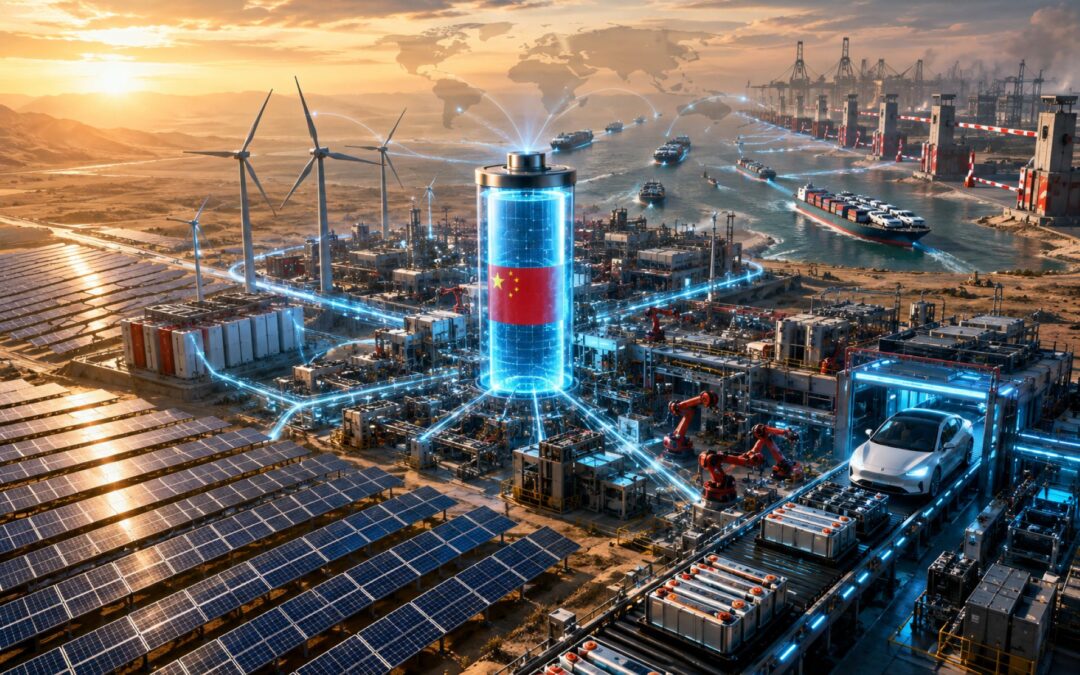
Across the high-altitude plains of China’s Qinghai Province, an extraordinary industrial landscape stretches towards the horizon. At Gonghe Talatan, vast fields of solar panels cover land that was once associated with harsh winds, sparse vegetation and an unforgiving climate. Elsewhere, wind turbines rise above desert terrain, battery factories operate around the clock, and sprawling automotive plants produce vehicles destined for markets around the world. Together, these facilities illustrate the scale of China’s transformation into the world’s leading clean-energy manufacturing power.
The economic consequences are enormous. In 2025, China’s clean-energy industries accounted for more than a third of the country’s economic growth, according to research by the Centre for Research on Energy and Clean Air. Chinese companies now occupy commanding positions in solar panels, lithium-ion batteries, electric vehicles and important components of wind turbines. Technologies that were once expensive alternatives to fossil fuels have become dramatically more affordable, partly because Chinese manufacturers learned to produce them at extraordinary scale.
Yet this industrial achievement has created a difficult contradiction. China’s factories are among the world’s most competitive, but many are struggling to make money. The government has spent decades supporting strategic industries, but the resulting production capacity often exceeds what customers can absorb profitably. Foreign governments accuse Beijing of distorting competition, while their own consumers benefit from cheaper clean technology.
Understanding China’s clean energy dominance requires looking beyond the familiar argument about whether its companies are winning through innovation or government subsidies. The real explanation begins decades before modern electric vehicles and solar factories existed, when China started transforming itself from an impoverished agricultural economy into the manufacturing centre of the world.
From Mao’s China to the World’s Factory
When Mao Zedong died in 1976, China was a fundamentally different country from the industrial superpower it would eventually become. Much of its population lived in rural poverty, its manufacturing capabilities were limited, and decades of political upheaval had disrupted economic development. Mao had sought to transform China into a powerful, self-sufficient socialist economy, but some of his most ambitious policies produced devastating results.
The Great Leap Forward, launched in 1958, attempted to accelerate industrialisation through agricultural collectivisation, mass mobilisation and centrally directed production. Instead, disastrous policies contributed to a famine that killed tens of millions of people. The Cultural Revolution, beginning in 1966, subsequently disrupted education, government institutions and economic activity. By the late 1970s, China possessed considerable political ambitions but lacked the productive capabilities needed to fulfil them.
Deng Xiaoping, who emerged as China’s paramount leader in 1978, approached economic development differently. His philosophy was captured by the famous saying that it did not matter whether a cat was black or white, provided it caught mice. Economic policies, in this view, should be judged by their practical results rather than their ideological purity.
Under the programme known as reform and opening, China gradually introduced market mechanisms while retaining Communist Party political control. Farmers gained greater freedom over agricultural production, private enterprises began to emerge, and prices became increasingly responsive to market conditions. Foreign investment was permitted, and local governments received stronger incentives to encourage economic activity.
One of the most important experiments was the establishment of special economic zones, where businesses enjoyed preferential policies and greater freedom to operate. Shenzhen, located beside Hong Kong, became the most famous example. What had been a relatively modest settlement developed into a rapidly expanding industrial city as foreign manufacturers, domestic entrepreneurs and millions of migrant workers arrived.
In the early years, China’s factories specialised in labour-intensive products such as clothing, toys, footwear, watches, household goods and electronic components. Low wages gave manufacturers a considerable advantage over competitors in wealthier economies, while expanding ports, roads and industrial parks made exporting increasingly efficient.
However, the most important consequence of this early manufacturing boom was not simply that China could produce inexpensive goods. It was the industrial knowledge accumulated through producing them.
Foreign companies frequently supplied the designs, sophisticated machinery, technology and customer relationships, while Chinese businesses provided labour and manufacturing capacity. Over time, workers learned modern production techniques, engineers developed practical problem-solving skills, managers became familiar with international quality standards, and suppliers learned to deliver increasingly complex components reliably.
This accumulated experience made Chinese factories more sophisticated. Manufacturers that initially assembled products designed elsewhere gradually began improving production methods, developing components and building their own engineering capabilities.
China’s admission to the World Trade Organization in 2001 accelerated the process. More secure access to international markets encouraged multinational companies to expand their Chinese operations, while domestic manufacturers benefited from rising exports. Economic growth transformed coastal cities, expanded employment and contributed to an enormous reduction in poverty. By 2010, China had overtaken Japan to become the world’s second-largest economy.
But the export-led model had significant weaknesses.
Many products manufactured in China depended on advanced machinery, semiconductors, specialised materials and intellectual property developed elsewhere. Japanese, German, American, South Korean and Taiwanese companies often retained the most technologically valuable portions of global supply chains, even when final assembly took place in China.
Rising Chinese wages also meant that inexpensive labour could not remain a permanent competitive advantage. At the same time, rapid industrialisation brought severe environmental costs, including air pollution, contaminated water and growing carbon emissions from coal-powered factories and heavy industry.
China had become extraordinarily capable at manufacturing other countries’ products, but it had not achieved comparable strength in developing the most advanced technologies itself. As the country moved from low-cost assembly towards more sophisticated manufacturing, that dependence became an increasingly important economic and strategic concern.
This historical transition forms part of the broader story of China’s reform-era transformation, in which economic liberalisation operated alongside continuing political centralisation.
By the early 2010s, China’s leaders faced a new challenge. The country could no longer rely primarily on inexpensive labour and expanding exports to sustain its economic ambitions. It needed domestic technologies, powerful brands, advanced industrial equipment and manufacturing capabilities that foreign competitors could not easily replace.
Why Made in China 2025 Changed the Industrial Goal
When Xi Jinping assumed leadership of China in 2012, he inherited an economy that had grown dramatically but was becoming increasingly vulnerable. Growth was slowing, debt had accumulated, wages were rising, and much of the country’s most advanced manufacturing still depended on foreign technology.
The government wanted China to move beyond assembling products designed elsewhere and become a leader in the industries expected to define the twenty-first century.
In 2015, the State Council released Made in China 2025, an ambitious industrial development plan. The strategy described manufacturing as a foundation of national power and acknowledged several weaknesses in China’s existing industrial system, including insufficient innovation, uneven product quality, inefficient resource use and dependence on imported core technologies.
Rather than attempting to preserve China’s established position in low-cost manufacturing, the plan aimed to build internationally competitive capabilities in advanced industries.
It identified ten priority areas encompassing next-generation information technology, robotics, aerospace equipment, marine engineering, advanced railway equipment, energy-saving and new-energy vehicles, power equipment, agricultural machinery, new materials, and medical devices and biopharmaceuticals.
Clean-energy technologies fitted naturally into this vision. Electric vehicles offered China an opportunity to challenge established automobile manufacturers without first matching their decades of experience with internal-combustion engines. Renewable electricity equipment supported China’s growing energy requirements, while batteries connected automotive manufacturing with consumer electronics, electricity storage and strategic minerals.
These industries also offered a potential route towards reducing pollution and dependence on imported fossil fuels, although expanding clean-energy manufacturing did not eliminate China’s continuing reliance on coal.
Importantly, Made in China 2025 did not create the Chinese electric-vehicle, solar or battery industries from nothing. Government programmes supporting electric vehicles and renewable electricity already existed, and Chinese manufacturers had been accumulating technological and commercial capabilities for years.
BYD had entered automobile manufacturing in 2003, while domestic solar companies were already becoming important suppliers to international markets. The 2015 strategy therefore formalised and strengthened an industrial direction that had been developing for more than a decade.
Its influence extended beyond individual subsidies. By identifying strategic sectors, the central government provided a signal to local officials, state banks, industrial investors and businesses about which technologies would receive sustained political attention. Provincial governments could then develop their own programmes, finance industrial parks and compete to attract manufacturers in those industries.
This approach allowed Beijing to direct resources towards long-term technological ambitions without personally managing every factory or commercial decision.
Internationally, Made in China 2025 became controversial because foreign governments interpreted its localisation and technological self-sufficiency objectives as threats to their own industrial advantages. The slogan became less prominent in official Chinese rhetoric after 2018, but the underlying policies continued through other programmes.
A ten-year assessment by Rhodium Group found that China’s achievements were substantial but uneven. Chinese businesses made important advances in electric vehicles, clean-energy technologies, telecommunications equipment, drones, shipbuilding and railway equipment. Yet the country continued to face significant difficulties in areas such as cutting-edge semiconductors, commercial aircraft and high-end machine tools.
The distinction matters because industrial policy does not guarantee technological success. Financial support may help a company construct factories or expand research, but developing commercially competitive products requires engineering capability, accumulated experience, reliable suppliers and customers willing to purchase the results.
China’s clean-energy industries benefited from an unusually favourable combination of these conditions. They served an enormous domestic market, received sustained political and financial support, and operated in relatively new technological fields where established foreign companies did not possess insurmountable advantages.
Few businesses illustrate how these forces came together more clearly than BYD.
BYD: The Battery Maker That Became an Automotive Giant
In 1995, Wang Chuanfu founded a rechargeable-battery company in Shenzhen. Born into a relatively poor family in Anhui Province, Wang had studied chemistry and developed experience in battery research before entering the commercial manufacturing industry. His ambition was to compete with established Japanese producers that possessed superior production equipment and considerable technological expertise.
The difficulty was that advanced battery manufacturing required expensive machinery, much of which had to be imported. A young Chinese company could not necessarily afford the highly automated production lines operated by larger international competitors.
Wang’s solution was to redesign parts of the production process around China’s existing advantages.
Rather than attempting to match Japanese automation immediately, BYD organised some manufacturing operations into smaller tasks performed by trained workers. This reduced the amount of capital required for machinery and made it possible to compete on production costs while gradually accumulating technological expertise.
The strategy was more sophisticated than simply employing inexpensive labour. Manufacturing rechargeable batteries required consistent chemical processes, quality control and reliable production standards. As BYD expanded, it developed knowledge of battery chemistry, manufacturing systems, supplier coordination and cost management that would later become critical to its success.
The company grew into a major supplier of rechargeable batteries for mobile phones and other consumer electronics. In 2002, BYD listed shares on the Hong Kong Stock Exchange, gaining access to additional capital for expansion.
According to BYD’s official account of Wang Chuanfu’s career, the business had been established in Shenzhen in 1995 and developed from its battery-manufacturing origins. Its early history is significant because BYD’s later success in automobiles emerged from capabilities accumulated long before electric vehicles became a mainstream industry.
In 2003, BYD acquired the struggling automaker Qinchuan Automobile and entered the vehicle industry. The decision initially appeared unusual because manufacturing phone batteries and building cars required different production systems, supply chains and customer relationships.
However, the growing importance of electric propulsion eventually made battery technology central to automotive competition.
Traditional automobile companies had spent decades developing internal-combustion engines, transmissions and mechanical engineering systems. Electric vehicles created opportunities for companies possessing different strengths, particularly in batteries, electric motors, power electronics and software.
BYD began manufacturing conventional vehicles while gradually expanding its hybrid and electric-vehicle technologies. The company invested in battery cells, electric motors, electronics, vehicle components and increasingly sophisticated production capabilities.
This process of vertical integration allowed BYD to manufacture important components internally rather than purchasing everything from outside suppliers. Controlling more of the production chain could reduce costs, improve coordination and make it easier to introduce new technologies without waiting for external manufacturers to respond.
Government policy helped make these investments commercially viable.
Beginning in 2009, Chinese authorities introduced programmes encouraging electric-vehicle production and purchases. Consumers received financial incentives and tax advantages, while public authorities purchased electric buses, taxis and other municipal vehicles. The development of charging infrastructure also reduced some of the practical disadvantages of electric transport.
In cities where obtaining a registration plate for a conventional car could be expensive or difficult, electric vehicles often received more favourable treatment. These policies created demand before electric vehicles were sufficiently attractive to compete with conventional cars on price and convenience alone.
For BYD, public transport was particularly valuable. Electric-bus orders provided an early market in which the company could develop vehicles, operate them under demanding conditions and improve its technology.
But government support did not eliminate commercial competition.
China’s automobile market attracted state-owned manufacturers, private companies, foreign joint ventures and ambitious new electric-vehicle businesses. As more companies entered the market, manufacturers faced pressure to release better vehicles, improve their technology and reduce prices.
BYD increasingly distinguished itself through its ability to combine battery manufacturing with complete vehicle production.
An important example is the company’s Blade Battery, based on lithium iron phosphate chemistry. Compared with some nickel-rich battery technologies, lithium iron phosphate generally offers lower energy density but advantages involving cost, durability and thermal stability. BYD’s battery-pack design helped make that chemistry attractive for a broader range of electric vehicles.
The company also developed plug-in hybrids for customers who wanted some electric-driving capability without depending entirely on charging infrastructure. This allowed BYD to compete across different vehicle categories and price segments rather than relying exclusively on expensive fully electric cars.
Its international expansion followed the capabilities developed in China. BYD began selling vehicles across Asia, Europe, Latin America and other regions, while investing in manufacturing facilities abroad, including projects in countries such as Brazil, Hungary, Thailand and Turkey.
Producing vehicles closer to overseas customers can reduce transport costs, help companies satisfy local-content requirements and allow them to respond to tariffs. At the same time, those international factories can remain connected to Chinese technologies, equipment, suppliers and engineering expertise.
BYD’s rise therefore cannot be explained entirely by subsidies or by entrepreneurial talent. The company benefited from state-supported demand, industrial infrastructure and China’s manufacturing ecosystem, but it also developed products that customers wanted and survived intense competition.
The government helped create the market in which BYD could grow. The company’s engineering, production capabilities and commercial decisions determined how successfully it could exploit that opportunity.
How the Chinese State Built Entire Industrial Markets
Chinese industrial policy is sometimes described as a government writing enormous cheques to favoured manufacturers. Direct financial subsidies certainly mattered, but that description misses the most important feature of China’s development model: public intervention operated simultaneously across production, financing, infrastructure and demand.
The government did not merely help companies manufacture electric vehicles, batteries and solar panels. It helped create the conditions in which those technologies could be developed, purchased, installed and improved. Different policy instruments reinforced one another, reducing commercial risks that private investors might otherwise have considered excessive.
Create the First Customers
New technologies frequently face a problem before they can achieve commercial scale. Manufacturers need sufficient customers to justify building factories, but consumers are reluctant to purchase expensive products without reliable supporting infrastructure.
Electric vehicles provide a clear example. Early models were comparatively expensive, charging networks were limited, and many potential buyers were uncertain about battery performance and vehicle range. Without enough customers, manufacturers had little incentive to expand production. Without expanding production, prices remained high.
China addressed several parts of this problem together.
National and local governments offered financial incentives for electric-vehicle purchases, while tax exemptions and preferential registration policies made ownership more attractive. National purchase subsidies were gradually reduced and ended after 2022, but other forms of support, including tax preferences and infrastructure investment, continued.
Local authorities also became customers. Public transport agencies purchased electric buses, and municipal fleets began adopting electric taxis and other vehicles. These orders provided manufacturers with demand that did not depend entirely on individual consumers being ready to switch technologies.
Such procurement could have effects beyond the initial sale. A manufacturer supplying an electric-bus fleet gained practical operating experience, feedback on battery performance and opportunities to improve maintenance, reliability and charging systems.
Charging infrastructure was equally important. Consumers were more willing to purchase electric vehicles when charging facilities became widely available, while manufacturers could invest in new models with greater confidence that the supporting network would continue expanding.
Renewable electricity received similar support through government targets, preferential pricing arrangements and grid investment.
Historically, feed-in tariffs helped developers finance solar and wind projects by providing more predictable electricity revenues. Transmission infrastructure connected renewable-generation sites, including projects in remote regions, to major centres of electricity demand.
These arrangements evolved as renewable electricity became cheaper. In 2025, China’s National Development and Reform Commission introduced a reform intended to increase market-based pricing for renewable electricity, while retaining settlement arrangements designed to manage revenue uncertainty for eligible projects.
The shift reflected an important change in the industry’s maturity. Technologies that once required protected prices were increasingly expected to compete in electricity markets, even as the authorities continued shaping the conditions under which that competition occurred.
Lower the Cost of Building and Producing
Government assistance also reduced the cost of manufacturing.
Local governments offered industrial land, favourable tax treatment, supporting infrastructure and access to organised industrial zones. They constructed roads, electricity connections, water systems and logistics facilities, making it easier for manufacturers to establish or expand factories.
For an individual business, these benefits could be economically significant even without a direct cash payment.
A manufacturer operating inside a developed industrial cluster might avoid some of the infrastructure costs faced by a competitor establishing a factory elsewhere. Its suppliers could also benefit from inexpensive land, reliable electricity and efficient transportation, reducing the cost of components used in finished products.
Research grants and tax incentives helped support technological development, while government priorities encouraged investment in production equipment, engineering and new manufacturing processes.
Local competition amplified these incentives.
Provincial and municipal governments wanted factories because they could generate employment, attract suppliers, expand the local economy and eventually increase tax revenue. Hosting an important battery or electric-vehicle manufacturer could also enhance a region’s political and industrial reputation.
Different local governments therefore competed to attract companies operating in strategically favoured sectors.
This competition helped expand manufacturing rapidly, but it also created problems when several regions independently supported factories producing similar products. The same incentives that encouraged industrial development could eventually encourage excessive capacity.
Use Banks and Public Funds to Scale Up
Financing was another central advantage.
China’s banking system is dominated by state-owned institutions that operate within a financial system strongly influenced by government priorities. These banks can direct substantial lending towards industries identified as strategically important, even when projects involve long investment periods or uncertain commercial returns.
Manufacturing advanced batteries, solar cells and electric vehicles often requires major expenditure before a company can generate meaningful revenue. Factories must be constructed, equipment purchased, workers trained and production processes tested.
Access to large amounts of financing can determine whether a company develops sufficient scale to compete internationally.
State-backed investment funds provided another mechanism. Local governments could support enterprises through investment vehicles that acquired ownership stakes, financed expansion or intervened when strategically important businesses encountered financial difficulties.
The city of Hefei’s support for electric-vehicle manufacturer NIO in 2020 illustrated this approach. Local investment vehicles supplied capital to a company facing substantial financial pressure, helping preserve an industrial investment that the municipality considered valuable.
These arrangements were not equivalent to ordinary commercial financing. Public investors could consider employment, technological development and regional industrial ambitions alongside expected financial returns.
The scale of Chinese support was unusually large.
In its Red Ink assessment of China’s industrial-policy spending, the Center for Strategic and International Studies estimated support in 2019 at more than $248 billion using market exchange rates, or approximately $407 billion when calculated using purchasing-power-parity exchange rates. The measured support amounted to at least 1.73% of Chinese GDP, substantially exceeding comparable estimates for several other major industrial economies.
Those figures should not be confused with a single government subsidy budget. The analysis considered multiple forms of support, including direct assistance, tax preferences, advantageous financing and state investment mechanisms. Some interventions were difficult to quantify, meaning the measured total did not necessarily capture every benefit.
China’s industrial policy was distinctive not because other governments never supported manufacturers, but because Beijing combined many instruments over long periods and applied them to interconnected sectors.
A battery producer might receive inexpensive financing, purchase components from firms benefiting from favourable local policies, operate in an industrial park built with public resources and sell to vehicle manufacturers whose customers received government incentives.
The resulting advantage was cumulative. Policies aimed at individual firms also helped create entire markets, industrial clusters and supply chains.
The Competitive Advantage That Subsidies Cannot Buy Alone
If subsidies were sufficient to create globally competitive industries, every government with enough money could become a technological superpower. In reality, public financing has repeatedly supported factories that failed to produce internationally competitive goods.
China itself has experienced costly industrial failures, including companies that depended on continuing support without developing sustainable commercial advantages. Its achievements in clean technology therefore require an explanation that goes beyond government expenditure.
One important factor is the extraordinary concentration of manufacturing capabilities within Chinese industrial regions.
In a mature manufacturing cluster, a company can often obtain components, machinery, packaging, electronics, engineering services and logistics support from nearby suppliers. The proximity of these businesses reduces transport expenses and allows manufacturers to respond quickly when designs change or production problems emerge.
For example, an electric-vehicle company redesigning part of its battery system may need modifications to electronic controls, cooling equipment, wiring and battery packaging. When suppliers operate within the same industrial ecosystem, engineers can coordinate changes, test components and resolve problems without waiting for long international shipping cycles.
These advantages become especially important in industries experiencing rapid technological development.
Manufacturing scale also changes the economics of production. A business producing millions of units can spread expenditure on research, tooling, factory equipment and product development across a much larger volume than a smaller competitor.
Large orders may strengthen its negotiating position with suppliers, while high production volumes justify investments in specialised equipment that would be uneconomic at a smaller factory.
Experience creates additional advantages through learning.
Workers become more efficient, engineers discover ways to reduce material use, managers identify bottlenecks, and suppliers develop components better suited to mass production. Improvements accumulate over successive manufacturing cycles, gradually reducing costs while increasing product quality.
The interaction between these mechanisms is particularly powerful. Large markets support high production volumes, which generate learning and encourage specialised suppliers, whose improvements then make additional production cheaper.
China’s domestic market provided an environment in which companies could repeat this process at tremendous scale.
Competition intensified the effects. Rather than relying on one government-protected champion in every industry, China frequently supported environments in which numerous companies competed for customers, financing and market share.
Solar manufacturers invested in improved cell technologies, battery companies experimented with new chemistries and pack designs, and automakers introduced increasingly sophisticated vehicles across different price categories.
Competition often forced businesses to reduce costs and innovate quickly, even though the same pressure could eventually destroy their profitability.
The International Energy Agency’s assessment of industrial competitiveness highlights how manufacturing concentration and cost differences reinforce China’s position. Labour and energy costs explain important parts of its advantage in some manufacturing stages, but supply-chain integration, experience, capital investment and industrial capabilities also matter.
These advantages extend across several connected industries.
In solar manufacturing, Chinese companies operate throughout the production chain, from purified polysilicon and wafers to solar cells and finished modules. Different stages require specialised equipment, chemical processing and manufacturing expertise, making it difficult for competitors to replicate the entire system by establishing a final assembly plant.
Battery manufacturing is similarly interconnected. Producers depend on refined minerals, cathode and anode materials, separators, electrolytes, cell-manufacturing equipment and sophisticated electronic systems. Companies such as CATL and BYD have become important technological competitors rather than merely low-cost assemblers.
Electric vehicles bring many of these capabilities together, combining batteries, electric motors, semiconductors, software, manufacturing expertise and increasingly sophisticated digital features. Chinese automakers now compete across inexpensive urban vehicles, advanced battery-electric cars and plug-in hybrids.
Wind power has a different industrial structure and is less geographically concentrated than solar manufacturing. Nevertheless, Chinese manufacturers benefit from their enormous domestic market, expanding production experience and increasingly competitive turbine prices.
The industries also support one another. Affordable batteries improve the economics of electric vehicles and grid storage, renewable electricity can reduce the long-term energy costs of industrial activity, and expanding electrification increases demand for motors, electronics and processed materials.
China’s rare-earth processing and permanent-magnet supply chains provide another advantage because powerful permanent magnets are important components of many electric motors, wind turbines and industrial machines.
This interconnected system explains why competitors cannot simply reproduce China’s advantages by matching an individual subsidy. They must develop the industrial capabilities, supporting suppliers, engineering knowledge and commercial scale that those policies helped create.
The strongest Chinese manufacturers now compete on reliability, performance and technological sophistication as well as price. Their government support remains economically important, but it has also helped build genuine capabilities that are difficult to replicate quickly.
China’s Clean-Energy Lead in Numbers
The scale of China’s clean-energy transformation becomes clearer when its different measures of industrial strength are separated.
Investment describes how much money is spent developing or expanding an industry. Manufacturing capacity describes how much a factory could theoretically produce. Actual production measures what it manufactures, while domestic sales, exports and installed renewable-electricity capacity capture different forms of demand.
These distinctions are important because a country can possess enormous manufacturing capacity without operating every factory at full utilisation. It can also dominate domestic installations without producing every component used in those projects.
China is unusual because it holds substantial positions across many of these measures.
According to the Centre for Research on Energy and Clean Air’s analysis for Carbon Brief, China’s broadly defined clean-energy investment reached approximately 7.2 trillion yuan, or about $1 trillion, in 2025.
That estimate includes investment across a wide range of activities, including clean-power generation, electric vehicles, batteries, transmission infrastructure, energy storage and rail transport. It is therefore broader than narrower international definitions of investment in clean-energy technologies, and the resulting totals should not be compared without accounting for those differences.
The same analysis estimated that clean-energy activities contributed approximately 15.4 trillion yuan to China’s economy in 2025, equivalent to 11.4% of GDP. These sectors were responsible for more than a third of the country’s economic growth that year and more than 90% of the net increase in investment.
Investment and economic contribution are not interchangeable figures. The former describes expenditure on assets and infrastructure, while the latter represents a wider assessment of activity associated with the clean-energy economy.
Manufacturing concentration is equally striking.
The International Energy Agency’s 2026 assessment estimated that China accounted for approximately 85% of global solar photovoltaic supply-chain manufacturing capacity and 80% of lithium-ion battery supply-chain capacity. Its position was even stronger in particular production stages, including around 95% of photovoltaic wafer capacity and 97% of anode-material capacity.
These are measures of manufacturing capability rather than evidence that Chinese factories produce exactly the same percentage of every item sold worldwide. Actual output and market shares vary by industry, product and year.
Domestic demand is another major source of strength.
During 2025, China added approximately 315 gigawatts of solar capacity and 119 gigawatts of wind capacity, according to the CREA analysis. These installations expanded the country’s renewable-electricity fleet on an extraordinary scale, although installed capacity should not be confused with electricity actually generated, since output depends on weather, operating conditions and utilisation.
Electric-vehicle manufacturing also expanded rapidly. China produced approximately 16.6 million vehicles classified in the analysis as electric vehicles, including battery-electric vehicles and plug-in hybrids, in 2025. Most were supplied to the domestic market, even as exports grew strongly.
This is an important qualification to the idea that China’s clean-energy economy exists mainly to export excess production. International demand matters enormously, but domestic installations, vehicles and infrastructure also absorb substantial quantities of Chinese technology.
The country’s industrial advantage therefore combines a large home market with powerful export capabilities. Its factories benefit from domestic demand, while international sales provide additional opportunities to expand scale and recover investment.
Nevertheless, there is a fundamental difference between having the capacity to produce enormous quantities of technology and having enough customers willing to purchase those products at profitable prices.
That distinction lies at the centre of China’s overcapacity problem.
The Overcapacity Trap Inside China’s Success
China’s clean-energy industries reveal one of the most unusual contradictions in modern manufacturing. The country has developed globally competitive companies, reduced technology prices and acquired enormous industrial influence, yet parts of the same system struggle with weak profitability and excessive production capacity.
The problem is commonly described as overcapacity.
An industry experiences overcapacity when its productive facilities can supply more goods than the market can sustainably absorb at prices that provide reasonable returns. This does not necessarily mean demand is shrinking or that the products are unwanted. Global demand for solar panels, batteries and electric vehicles can continue increasing even while manufacturers invest in factories capable of producing considerably more than customers will purchase.
The difficulty becomes greater when businesses continue expanding despite already weak prices.
China’s local-government incentive system helps explain how this situation develops.
National leaders may identify clean-energy manufacturing as a strategic priority, but individual provinces and cities also want their own industries to succeed. A local administration may offer land, favourable financing or tax assistance to attract a battery company because the resulting factory promises employment, supplier investment and future economic growth.
A neighbouring region may offer similar incentives to a competing manufacturer.
Each investment can appear defensible when considered from the perspective of its local government. However, when numerous regions pursue the same industrial targets simultaneously, their combined decisions can produce far more factories than the market needs.
Competition between manufacturers reinforces the problem.
A company may continue expanding because it expects higher production volumes to lower its costs or because it believes competitors will eventually close. Reducing output could mean surrendering market share, losing supplier relationships or disappointing lenders and local officials.
Even financially troubled companies may keep operating if closing their factories would impose significant costs on workers, creditors and regional governments. State-backed financing can sometimes allow struggling producers to survive longer than market conditions would otherwise permit.
This creates a difficult collective problem: what looks like a sensible strategy for one company may become damaging when every competitor behaves in the same way.
The problem is also connected to the broader structure of China’s economy.
For decades, China has directed considerable resources towards infrastructure, construction, industrial investment and manufacturing capacity. These priorities helped transform the country economically, but household consumption has remained relatively weak compared with production and investment.
Several factors contribute to this imbalance. Households save substantial portions of their income partly because of concerns about healthcare, education, retirement and financial security. Property-market uncertainty has also affected wealth and confidence, while the distribution of economic resources between households, businesses and government influences domestic spending.
The International Monetary Fund’s 2025 Article IV assessment, published in February 2026, emphasised the importance of addressing structural imbalances and strengthening domestic demand.
This matters because a manufacturing system can expand more rapidly than domestic consumers’ capacity or willingness to purchase its output.
Exports then become an important way to absorb production. A business facing insufficient domestic demand may pursue overseas customers aggressively, even when doing so requires reducing prices and accepting narrow profit margins.
China’s large trade surpluses reflect broader differences between national production, spending, saving and investment, not simply clean-energy manufacturing. Nevertheless, these structural conditions can intensify the pressure on industries already affected by excessive investment.
Solar manufacturing offers a particularly clear example.
Chinese companies expanded solar production capacity rapidly as global demand increased and technological improvements made electricity generation cheaper. However, competing manufacturers frequently invested in new facilities at the same time, creating a market in which prospective production substantially exceeded expected demand.
By late 2025, China’s annual solar manufacturing capacity was estimated at approximately 1,200 gigawatts, considerably greater than global solar-capacity additions that year. Although panel output and installations are not identical measures, the comparison illustrates the extraordinary scale of available manufacturing facilities.
Prices fell sharply as producers competed to sell their output. The International Energy Agency estimated that solar-module prices declined by around half between 2023 and 2025, while battery-pack prices fell by roughly 30% over the same period.
These reductions helped renewable-energy developers and electric-vehicle manufacturers, but they created severe financial pressure for companies supplying the equipment.
The IEA estimated that the ten largest publicly listed solar manufacturers collectively lost approximately $4.5 billion in 2024. Profitability problems also affected parts of China’s wind industry and weaker battery producers, although market conditions varied considerably between companies.
The consequences extended beyond financial statements.
An October 2026 Reuters investigation into employment at major Chinese solar manufacturers reported that five leading companies had approximately 40,589 fewer employees at the end of 2025 than a year earlier. The reductions highlighted the pressure created by persistent overcapacity and intense price competition.
For individual companies, the consequences can include layoffs, factory closures, deteriorating financial conditions and reduced investment in future technology. Local governments may also inherit financial problems when businesses they supported fail to generate expected economic returns.
Yet the picture is not uniformly negative.
Some businesses become more efficient under pressure, weaker manufacturers leave the market, and consumers benefit from lower prices. Successful firms may consolidate their position by continuing to innovate while competitors struggle.
This is why treating China’s economic model as a simple contest between Chinese winners and foreign losers is misleading.
Foreign manufacturers can suffer from Chinese competition, but Chinese producers also experience substantial losses. Foreign consumers benefit from cheaper technologies, while Chinese households may face employment insecurity when domestic factories cut production.
The system can produce genuine industrial leadership without guaranteeing healthy profits for the companies operating within it.
It also raises an important distinction about industrial policy.
Government support may correct genuine market failures by financing infrastructure, research and early demand for technologies that provide wider social benefits. Cleaner air, lower emissions, energy security and technological learning can generate benefits that individual investors cannot fully capture as private profits.
However, intervention can also sustain inefficient businesses, encourage duplicated investment and postpone necessary consolidation.
China’s model combines central strategic direction with intense competition among enterprises and local governments. It is neither conventional central planning nor an entirely independent market economy. The state shapes investment priorities and market conditions, while firms compete aggressively within the resulting environment.
Other governments also subsidise industries, including defence, aerospace, agriculture, semiconductors and clean-energy technologies. China’s approach differs especially in the scale, coordination, duration and economic structure of its support.
Its experience therefore does not prove that industrial policy always succeeds, or that another country could reproduce the same results simply by increasing subsidies. Many governments lack China’s domestic market, financial institutions, accumulated manufacturing capabilities and willingness to sustain losses.
The more meaningful lesson is that public intervention can help develop competitive industries, but it must eventually confront whether the resulting investment produces durable economic value.
When excess production is sold abroad, these domestic contradictions become international trade disputes.
Tariffs, Trade Wars, and the Limits of Protection
China’s clean-energy manufacturing dominance has become one of the most contentious issues in international trade.
Governments in the United States, Europe and other industrial economies worry that their domestic producers cannot compete sustainably against Chinese manufacturers benefiting from government support, enormous production volumes and integrated supply chains.
The concern extends beyond current sales and profits. Electric vehicles, batteries, solar panels and related technologies are widely considered strategically important industries that will shape future employment, innovation and economic security.
If domestic manufacturers disappear under competitive pressure, countries may eventually become dependent on Chinese companies for technologies they consider essential.
Tariffs have therefore become a prominent response.
In 2024, the United States announced substantial increases in tariffs on selected Chinese products. The US Trade Representative’s announcement included measures raising tariffs on Chinese electric vehicles to 100%, solar cells to 50%, and certain lithium-ion batteries to 25%, with implementation schedules differing by product.
These measures were intended to protect strategically important American industries from competition that Washington considered unfairly supported.
The European Union adopted a more differentiated approach after investigating subsidies provided to Chinese electric-vehicle manufacturers.
In October 2024, the European Commission announced additional duties on Chinese battery-electric vehicles, including 17% for BYD, 18.8% for Geely and 35.3% for SAIC, alongside the existing standard import tariff. These figures describe that particular 2024 decision, not every subsequent adjustment or trade arrangement.
Tariffs can serve legitimate economic and strategic purposes. By making imported products more expensive, they can improve the commercial prospects of domestic manufacturers and provide time for local industries to develop.
They may also encourage companies to establish factories within the protected market, creating employment and reducing dependence on imported finished products.
However, tariffs cannot instantly reproduce decades of manufacturing experience.
A government might protect a domestic solar-panel assembly factory while that facility continues importing solar cells, wafers or specialised production equipment from China. A newly established battery plant may still depend on Chinese processing of lithium, graphite or other essential materials.
Even when the final product is manufactured domestically, much of the underlying supply chain may remain concentrated abroad.
Domestic production can also be more expensive in countries lacking China’s supplier clusters, experienced manufacturing workforce or large-scale production networks.
These cost differences matter because tariffs do not automatically make a domestic factory productive or technologically competitive. They change the relative prices facing customers, but the protected industry must still develop the capabilities needed to survive.
Chinese manufacturers can also adapt by investing overseas.
BYD’s manufacturing expansion into markets such as Hungary, Brazil, Thailand and Turkey illustrates how production can move closer to customers. Depending on applicable rules and the origin of components, local production may help companies qualify for incentives or reduce exposure to certain trade barriers.
However, moving final assembly does not necessarily remove Chinese technology, equipment, ownership or supply-chain influence from the finished product.
This creates a problem for governments attempting to reduce strategic dependence through tariffs alone. A policy may successfully encourage domestic assembly while leaving the most technologically important manufacturing stages concentrated elsewhere.
Trade restrictions also impose costs on consumers.
Higher tariffs can increase the price of electric vehicles, batteries and solar equipment, particularly when domestic alternatives remain expensive. Those higher costs may protect local manufacturers, but they can also discourage purchases and slow the adoption of technologies needed to reduce emissions.
The tradeoff is particularly difficult for governments pursuing both ambitious climate policies and domestic industrial development.
There are legitimate disagreements about how to interpret China’s success.
Chinese policymakers argue that their companies have become more competitive through technological progress, efficient manufacturing and intense market competition. Foreign governments counter that China’s large-scale state support, favourable financing and production-oriented economic policies distort competition and place overseas producers at an unfair disadvantage.
Both perspectives capture important parts of the economic reality.
Chinese manufacturers possess real productive advantages that cannot be dismissed as subsidies. At the same time, public intervention has influenced investment decisions, costs and demand in ways that have affected international competition.
The challenge for other countries is therefore not simply whether to impose tariffs. It is whether protective measures are accompanied by the investments, skills, infrastructure and supply-chain development necessary to create competitive domestic industries.
Without those capabilities, trade protection may preserve expensive production temporarily without establishing long-term industrial strength.
What Chinese Dominance Means for the Global Energy Transition
China’s industrial transformation has created consequences that cannot be divided neatly into economic winners and losers. The same factories that threaten competing manufacturers have made clean technologies more affordable, accelerated investment in renewable energy and increased the strategic importance of Chinese supply chains.
The most immediate global benefit is lower technology costs.
Large-scale Chinese production has contributed to sharp reductions in the prices of solar panels, batteries and electric vehicles. These technologies have become commercially viable in markets where they would previously have required much greater government assistance.
For countries attempting to reduce emissions while expanding electricity access, inexpensive equipment can be especially valuable.
Many developing economies lack the financial resources, industrial experience and domestic markets needed to establish complete solar or battery manufacturing supply chains. Importing competitively priced equipment allows them to expand renewable generation without first undertaking decades of industrial development.
Lower-cost solar panels can improve the economics of electricity projects, while cheaper batteries make energy storage more accessible. Affordable electric vehicles can also reduce the cost of moving away from petrol and diesel, although successful adoption still depends on electricity systems, charging infrastructure and purchasing power.
Without Chinese manufacturing, the global transition towards clean energy would almost certainly have been more expensive.
Nevertheless, cheaper products create different consequences for producers and consumers.
A household purchasing an inexpensive electric car may benefit immediately from competition, while employees at a domestic automotive factory may face declining employment opportunities. A utility can reduce project costs by importing solar panels, even as local panel manufacturers struggle to survive.
These consequences are not unique to clean technology. The expansion of Chinese exports after WTO accession disrupted labour-intensive manufacturing in several advanced economies, a development often described as the China shock.
The new competitive pressure affects industries involving sophisticated engineering, high-value components, specialised research and technologies that governments consider strategically important.
Established automobile manufacturers in Germany, Japan and South Korea face increasingly capable Chinese competitors in areas where they once expected to maintain technological leadership.
Emerging economies face another difficult choice. They may welcome Chinese factories and inexpensive equipment while also wanting to develop their own industrial capabilities rather than remaining permanent importers.
The distribution of economic benefits therefore matters as much as the total value created.
Another major consequence is the concentration of strategic supply chains.
For much of the twentieth century, energy security was discussed mainly in terms of access to oil, natural gas and coal. Countries worried about fuel imports, shipping disruptions and the political influence of major energy producers.
The transition towards renewable electricity changes this relationship, but it does not eliminate dependence.
A country importing oil must continually purchase fuel to sustain consumption. A country importing solar panels generally purchases much of its generating equipment upfront and can then produce electricity domestically for many years.
That difference represents a genuine energy-security advantage.
However, clean-energy systems still depend on batteries, replacement components, power electronics, software, processed minerals and specialised industrial machinery. A country may generate its own renewable electricity while remaining reliant on foreign companies for the equipment required to maintain and expand its system.
China’s position in solar manufacturing, battery materials and rare-earth processing therefore creates strategic concerns even for countries benefiting from inexpensive imports.
Supply disruptions can emerge through political disputes, export restrictions, sanctions, industrial accidents or interruptions along important shipping routes. The International Energy Agency has warned that several clean-energy supply chains contain production stages where capacity outside the dominant supplier would be insufficient to meet demand during a major disruption.
Such vulnerabilities do not necessarily justify complete domestic self-sufficiency.
Attempting to manufacture every component within national borders would be extremely expensive for many countries. It could also duplicate factories, reduce the benefits of international specialisation and create additional overcapacity.
A more realistic objective is diversification.
Governments can identify the technologies and supply-chain stages that are genuinely strategic, support domestic capabilities where they possess competitive advantages, and cooperate with trading partners to develop alternative sources of supply.
Some countries may specialise in mineral extraction, others in processing, manufacturing equipment, battery components or finished products. Industrial resilience can emerge from a network of complementary producers rather than a collection of entirely self-sufficient national economies.
China’s success has already encouraged governments to rethink industrial policy.
The United States has supported domestic semiconductor, battery and clean-energy manufacturing. European countries have introduced industrial and trade measures to protect strategic sectors, while India has pursued incentives for solar equipment, batteries and electric vehicles.
Governments across Asia, Latin America and the Middle East are also seeking foreign investment while attempting to develop local suppliers and technological capabilities.
These efforts acknowledge an important reality: markets do not develop advanced industrial systems independently of public institutions.
Governments influence infrastructure, education, research, energy systems, finance, regulation and international trade. Their decisions shape which industries emerge and whether private businesses possess the capabilities required to compete.
But China’s experience also provides a warning.
If every country subsidises the same factories without considering demand, comparative advantages or long-term profitability, the global economy could reproduce the very overcapacity problems that have troubled Chinese manufacturers.
An effective response therefore requires more than copying China’s policies or rejecting its products.
Countries need to decide where domestic manufacturing is economically sustainable, which capabilities are strategically indispensable and where affordable imports provide greater benefits than attempts to establish entirely new industries.
They must also consider whether protection creates time for genuine productivity improvements or merely shelters companies from competition.
The objective should not be to replace dependence on Chinese production with an equally inefficient dependence on permanent government subsidies. It should be to create a more resilient industrial system without sacrificing the advantages that international manufacturing competition has delivered.
China’s clean-energy leadership ultimately demonstrates how powerful sustained industrial ambition can become when government policy, private enterprise, engineering expertise and large markets reinforce one another.
The transformation has produced remarkable technological and economic achievements, but it has also exposed the costs of directing enormous resources towards productive capacity without ensuring that the resulting industries can earn sustainable returns.
Deng Xiaoping’s famous cat was supposed to be judged by whether it caught mice. By that practical standard, China’s industrial strategy has accomplished something extraordinary: it helped transform a country once associated primarily with inexpensive assembly into the leading manufacturer of technologies central to the global energy transition.
Yet the same system that created this success has encouraged investment beyond profitable demand, intensified competition between manufacturers and generated disputes with countries struggling to preserve their own industries. Its achievements and contradictions are inseparable from the economic model that produced them.
The rest of the world cannot ignore these achievements, but neither can it afford unlimited dependence on a single manufacturing centre. Rejecting competitively priced Chinese technology would make decarbonisation more expensive, while relying on it without diversification would concentrate important economic and strategic capabilities in one country.
The central challenge is therefore not to choose between free trade and protectionism, or between Chinese technology and domestic industry. It is to develop enough industrial capability and supply-chain resilience to benefit from affordable clean energy without becoming dangerously dependent on any single supplier.
China has demonstrated what decades of coordinated industrial development can build. The question now is whether other countries can learn from that achievement while avoiding the economic imbalances and strategic vulnerabilities that accompanied it.
Last Updated on October 20, 2026 by Aseem Gupta