
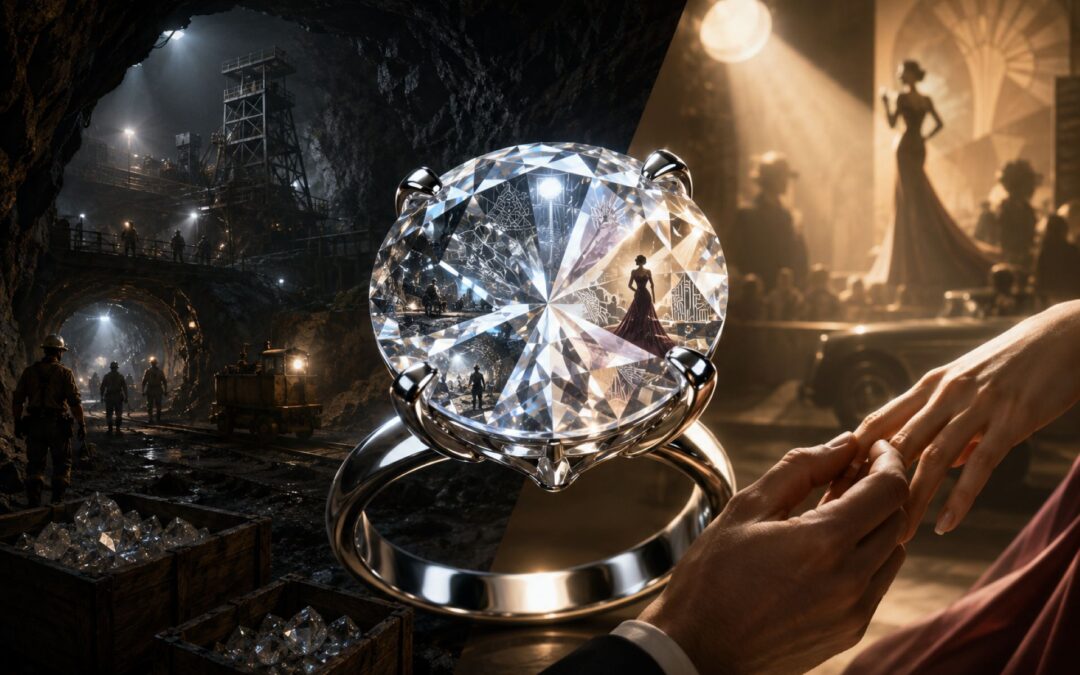
An engagement ring is a remarkably small object on which to place so much weight.
It can represent commitment, security, social status and the promise of a shared future. It can also carry a four-figure price tag, even though the polished diamond at its centre may be smaller than a fingernail.
That creates an obvious question. What exactly are people paying for?
Part of the answer lies beneath the Earth. Natural diamonds take extraordinary geological conditions to form, and only a fraction of the stones that are mined possess the size, clarity, colour and structure required for high-quality jewellery.
But geology alone cannot explain why a diamond became the expected centrepiece of an engagement ring—or why generations of couples came to see that ring as an essential proof of love.
That part of the story was manufactured above ground.
Over more than a century, De Beers consolidated mines, controlled the distribution of rough diamonds and supported one of the most influential advertising campaigns in commercial history. It did not invent diamonds, romance or even the diamond engagement ring. What it helped create was something more valuable: the assumption that a serious marriage proposal naturally required one.
Diamonds Were Rare Long Before De Beers
De Beers did not create the prestige of diamonds from nothing. Long before modern advertising, diamonds were unusual, difficult to obtain and largely reserved for the wealthy.
For centuries, India was the world’s principal known source of diamonds. Stones travelled from Indian mines through royal courts and international trading networks, acquiring associations with power, invincibility and divine favour. Brazil later became an important source after diamonds were discovered there in the eighteenth century.
Supply remained limited. According to the Gemological Institute of America’s history of diamonds, global diamond production was small enough that ownership remained concentrated among monarchs, aristocrats and exceptionally wealthy merchants.
The stones themselves were also difficult to shape. Diamond is the hardest naturally occurring material, which made early cutting and polishing techniques slow and limited. A diamond’s beauty was not immediately obvious in the rough. Its brilliance had to be revealed through increasingly sophisticated craftsmanship.
Diamonds occasionally appeared in jewellery associated with courtship and marriage. The most famous early example came in 1477, when Archduke Maximilian of Austria presented Mary of Burgundy with a ring containing diamonds arranged in the shape of the letter M.
It is often described as the first diamond engagement ring, although the more accurate description is the first well-documented diamond engagement ring. Other betrothal jewellery almost certainly existed, and diamonds had already appeared in elite European ornamentation.
What mattered was that the practice remained exceptional.
For several centuries after Maximilian’s proposal, a diamond ring was not a normal part of engagement. Most people could never have afforded one, and many cultures had no tradition of exchanging engagement rings at all. Even among those who used rings to mark a betrothal, other gemstones and simpler metal bands were common.
Diamonds possessed prestige because they were genuinely difficult to find and concentrated in a limited number of sources. That began to change dramatically in the nineteenth century.
South Africa Transformed the Diamond Market
The modern diamond industry began with discoveries in southern Africa during 1866–67.
The first finds attracted prospectors, merchants and speculators. Further discoveries followed, including the deposits that became the Kimberley and De Beers mines in 1871. What had once been a scattered search for rare stones became an industrial rush.
The scale was unprecedented.
Instead of finding diamonds in tiny quantities through old river deposits, miners began extracting them from enormous volcanic formations known as kimberlite pipes. Production rose rapidly. A gemstone that had once entered the world market in pounds could now be mined in far greater quantities.
The discovery did not make high-quality diamonds abundant in an everyday sense. Mining remained expensive, and much of the material extracted was unsuitable for fine jewellery. But the expansion threatened the old economics of exclusivity. If too many stones reached the market too quickly, prices could fall.
The structure of mining also encouraged consolidation.
Early prospectors divided the fields into numerous small claims. As miners dug deeper, however, the work became more complex and capital-intensive. Individual claim holders struggled with flooding, collapsing walls, machinery costs and the removal of enormous amounts of waste rock.
The history of the Kimberley fields documented by South African History Online shows how these pressures gradually pushed smaller owners to sell. Larger operators acquired their claims, combined adjoining properties and gained the financial power needed for deeper mining.
Among the most successful consolidators was Cecil Rhodes.
Rhodes had arrived in southern Africa from Britain and built his position by purchasing claims and controlling supporting equipment. He eventually became one of the dominant figures in the diamond fields, combining commercial ambition with an explicitly imperial and racial worldview.
His business career cannot be separated from the political system surrounding the mines. The South African mining economy developed through racial inequality, migrant labour and laws that restricted African access to land and economic independence.
Black workers were paid less, subjected to harsh controls and often housed in closed compounds intended partly to prevent diamond theft. Taxation and land policies helped push African men towards wage labour in the mines. The broader system became one foundation of South Africa’s mining economy built on cheap Black labour.
Rhodes’s consolidation accelerated during the 1880s. His greatest rival was Barney Barnato, who had assembled his own collection of mines and claims. Their competing interests were eventually combined, and De Beers Consolidated Mines was formally established in 1888.
The company took its name from Johannes Nicolaas and Diederik Arnoldus de Beer, the brothers whose farm had once stood over one of the major deposits. They had sold their property years earlier and did not become the beneficiaries of the global corporation that inherited their name.
De Beers’s own corporate history dates its formal creation to 1888. By around 1900, the company controlled an estimated 90% of the world’s rough-diamond production.
It had solved the first problem created by the South African discoveries: too many independent producers releasing stones without coordination.
The next challenge was ensuring that control survived beyond Rhodes himself.
How De Beers Controlled the Supply
Cecil Rhodes died in 1902, but the system of diamond control continued to evolve.
The central figure in its next stage was Ernest Oppenheimer, a German-born businessman who built his influence in South African mining through the Anglo American Corporation. Oppenheimer joined the De Beers board in 1926 and later became chairman.
Under the Oppenheimer family, De Beers’s power extended beyond ownership of individual mines. The company helped create a distribution structure through which much of the world’s rough-diamond supply passed before reaching cutters and dealers.
This system eventually centred on the Central Selling Organisation.
Its basic logic was straightforward. De Beers purchased or marketed diamonds from numerous producers, sorted the stones into categories and sold them to a restricted group of approved customers known as sightholders.
At scheduled sales called sights, buyers were presented with parcels of rough diamonds. They did not negotiate over each individual stone or freely select only the most desirable pieces. The parcels were offered at prices determined by the seller, and buyers were generally expected to accept the assortment.
The power of the system came from future access.
A sightholder who rejected parcels or challenged the arrangement too aggressively could risk losing the opportunity to attend future sights. Because De Beers controlled such a large share of available rough diamonds, exclusion could threaten a dealer’s entire business.
This was not the same as setting the final retail price of every ring. Between a rough stone and a jewellery counter stood cutters, polishers, wholesalers, manufacturers, brands and retailers. Each made decisions that affected the final price.
But control over the primary distribution channel gave De Beers enormous influence over how many rough diamonds reached the trade and under what conditions.
When production exceeded immediate demand, diamonds could be withheld rather than released all at once. Stockpiles allowed the organisation to smooth supply, reduce sudden price collapses and preserve the perception that desirable stones remained scarce.
Edward Jay Epstein’s investigation, “Have You Ever Tried to Sell a Diamond?”, documented how this single-channel system shaped the twentieth-century trade. Producers who wanted predictable access to the international market had strong incentives to cooperate with De Beers rather than sell independently.
The company’s influence was never completely effortless. New deposits, political changes and independent producers repeatedly threatened the arrangement. When the Soviet Union became a major source of diamonds, for example, De Beers had to find ways to incorporate a large volume of smaller stones into a market traditionally organised around larger gems.
The industry responded partly by developing new products and new consumer occasions. Eternity rings, anniversary jewellery and multi-stone designs created uses for categories of diamonds that might otherwise have been difficult to absorb.
This revealed an important limit of supply control.
Withholding diamonds could protect prices, but it could not indefinitely solve the problem of growing production. The industry also needed more people to want diamonds, more occasions on which to give them and stronger reasons for consumers to keep them.
That meant De Beers had to influence not only the diamond trade, but also the meaning of marriage itself.
How Advertising Turned Diamonds Into Love
The demand problem became especially urgent during the Great Depression.
Diamond sales in the United States had weakened, and the engagement-ring market was far from universal. Many women received rings without diamonds, while others received no engagement ring at all. Diamonds remained luxuries rather than social requirements.
In 1938, Harry Oppenheimer, Ernest Oppenheimer’s son, approached the American advertising agency N.W. Ayer & Son.
The agency’s assignment was unusually ambitious. It was not simply being asked to advertise one company’s brand. De Beers itself was largely invisible to ordinary consumers, and people did not generally walk into jewellery stores asking for diamonds from a particular mining corporation.
The campaign instead had to promote the entire category.
N.W. Ayer set out to strengthen the association between diamonds and romantic commitment until buying a diamond ring felt less like a discretionary purchase and more like an established social duty.
The strategy operated through culture rather than direct product comparison.
Diamonds appeared in films and were discussed in stories about Hollywood stars, socialites and political families. Publicity emphasised the size and value of the stones worn by admired women. The intended response was aspirational: viewers were encouraged to see a diamond not merely as jewellery, but as evidence that a woman was loved and that a man was successful.
The campaign promoted a particular emotional equation. The greater the diamond, the greater the sacrifice. The greater the sacrifice, the more serious the commitment.
N.W. Ayer also arranged educational lectures about diamonds in American high schools and other institutions. The goal was to shape expectations before young people reached the age of engagement. By the time they began thinking about marriage, the association between proposals and diamonds would already feel familiar.
The campaign worked because it did not present itself as the creation of a new habit. It presented the habit as though it had always existed.
That was only partly true. Diamond betrothal jewellery had a long elite history, but the expectation that ordinary middle-class couples should purchase a diamond engagement ring was distinctly modern.
The campaign’s defining line came from copywriter Frances Gerety in 1947: “A Diamond Is Forever.”
The slogan began appearing consistently in advertising the following year and became one of the most successful phrases in commercial history. It connected the physical durability of a diamond with the hoped-for permanence of marriage.
The connection was emotionally elegant and commercially useful.
A diamond is exceptionally hard and can survive for generations. A marriage was supposed to endure in the same way. The ring therefore became more than a gift exchanged at the beginning of an engagement. It became a miniature symbol of an unbreakable promise.
The campaign transformed an economic purchase into a moral statement. Not buying a diamond could now appear to communicate hesitation, insufficient seriousness or inadequate devotion.
The official De Beers chronology of the campaign credits Gerety with creating the slogan in 1947. Yet the phrase’s importance went far beyond the success of a single advertisement. Through repetition, it came to resemble a proverb rather than a line written for a client.
De Beers did not invent love, commitment or engagement rings. It did not even create the first diamond ring associated with marriage.
Its achievement was to make one particular commercial expression of love appear natural, traditional and nearly compulsory.
Once that association had taken hold in the United States, the industry attempted to export it.
How De Beers Exported the Tradition
Japan became the most striking example of the campaign’s international power.
In the mid-twentieth century, Japan did not possess a widespread tradition of diamond engagement rings. Marriage customs had developed through different social structures, and arranged marriages remained common. Western-style romantic courtship was not the only ideal through which couples understood commitment.
De Beers began advertising diamonds in Japan in 1967.
The campaigns associated diamond rings with modernity, personal choice and Western romantic values. Advertisements often presented stylish couples participating in a cosmopolitan form of courtship that appeared distinct from older family-directed traditions.
The diamond ring became a symbol not only of love, but of a new identity.
At the beginning of the campaign, fewer than 5% of engaged Japanese women reportedly received diamond rings. By 1981, the figure had risen to approximately 60%.
A practice with little established place in Japanese marriage culture had become mainstream within fourteen years.
The transformation demonstrated that consumer traditions do not need centuries to acquire the appearance of permanence. A custom can be deliberately introduced, repeated across media, attached to social aspiration and then inherited by the next generation as though it had always belonged.
Japan became the second-largest market for diamond engagement rings after the United States.
Yet the same formula did not work equally everywhere. Campaigns in countries including Brazil, Germany, Austria and Italy produced more limited results. Existing customs, economic conditions and cultural attitudes affected how easily the diamond engagement ring could be established.
That variation matters.
The rise of diamond rings was not simply the result of an all-powerful company imposing identical behaviour on every population. Advertising succeeded when it connected with broader changes already under way: rising consumer incomes, urbanisation, Hollywood influence, changing gender expectations and the growing ideal of marriage based on individual romantic choice.
De Beers was extraordinarily skilled at identifying those changes and attaching diamonds to them.
The company did not need every person to understand the history of the campaign. Its success depended on the opposite. Once the convention became established, consumers enforced it among themselves.
People expected to see a ring. Friends asked to inspect it. Families compared it. Popular culture treated its appearance as the climax of a proposal.
The diamond had become part of the social language of engagement.
The slogan that helped create this language also shaped what consumers were expected to do with their diamonds after purchase.
They were supposed to keep them forever.
Why a Diamond Ring Is Hard to Resell
Many consumers are surprised to discover that a diamond ring bought for a substantial retail price may attract a much lower offer when they try to sell it.
That gap is sometimes presented as proof that diamonds have no real value. The truth is more complicated.
A jewellery-store price does not represent the value of the loose stone alone. It can include the cost of mining, sorting, cutting, polishing, grading, transporting and setting the diamond. It may also include the value of the metal, the design, the brand, the shop, staff, marketing, warranties, financing and the convenience of buying a finished ring.
A second-hand buyer is not paying for that entire experience.
The stone may need to be removed, inspected and graded again. The setting may be unfashionable or difficult to resell. A dealer must account for the risk that the ring will remain in stock and the cost of finding another customer.
Diamonds are also highly variable.
Two stones of the same weight may differ substantially in cut, colour, clarity, shape, fluorescence, certification and market appeal. That makes them less interchangeable than a standardised commodity such as a publicly traded quantity of gold.
There is no single transparent consumer exchange where every diamond can be sold instantly at a clearly quoted price. The secondary market is fragmented across jewellers, auction houses, specialist buyers, online platforms and private sales.
The owner may therefore be offered something closer to a dealer’s expected wholesale value than the original retail price.
De Beers had another reason to discourage resale. If large numbers of existing diamonds constantly returned to the market, consumers could satisfy demand without purchasing newly mined stones.
“A Diamond Is Forever” addressed that risk beautifully. It encouraged owners to treat the ring as an heirloom that should never be sold, even after a broken engagement, divorce or financial difficulty.
The message protected both the emotional symbolism and the primary market.
None of this means every diamond loses the same percentage of its purchase price. Resale outcomes vary considerably. Rare stones, desirable brands and exceptional pieces may perform differently from ordinary mass-market rings. The route of sale also matters.
But a diamond engagement ring should not automatically be treated as a financial investment.
Its retail value includes the emotional setting in which it is sold: the proposal, the presentation, the social ritual and the promise attached to it. Those things may be deeply meaningful to the buyer, but they cannot easily be recovered from a dealer when the ring returns to the market.
Weak resale value therefore reveals an important distinction.
A diamond can be valuable without being liquid. It can be expensive to buy without being easy to sell. And it can carry enormous sentimental value while remaining a poor store of financial value.
Why Diamonds Are Still Expensive Today
The old De Beers system no longer controls the diamond world as completely as it once did.
Major deposits outside southern Africa weakened the single-channel model. Russia developed into one of the world’s largest producers. Australia’s Argyle mine became an important source before its closure. Botswana, Canada, Angola, South Africa, Zimbabwe and other countries also emerged as substantial producers.
The Kimberley Process’s 2024 global production summary recorded approximately 107.9 million carats of rough-diamond production distributed across numerous countries.
The contemporary industry has multiple producers, sales systems and distribution channels. De Beers remains influential, but the claim that one company controls every diamond moving through the world no longer describes the market.
So why do natural diamonds remain expensive?
The first reason is that the number of diamonds mined is not the same as the number of diamonds suitable for a particular ring.
Most extracted material does not become a large, colourless, flawless centre stone. Individual diamonds vary enormously, and desirable combinations become progressively scarcer as standards rise.
The Gemological Institute of America’s diamond quality factors organise these differences around the 4Cs: colour, clarity, cut and carat weight.
Colourless stones are generally rarer than stones with noticeable yellow or brown colour, except in the separate market for certain fancy-coloured diamonds. High clarity means fewer internal inclusions and external blemishes. Cut determines how effectively a polished diamond reflects light. Carat measures weight, but larger stones do not increase in price through simple multiplication because large gem-quality crystals are disproportionately rare.
A two-carat diamond is therefore not merely twice a one-carat diamond. Its price can be far more than double when its other characteristics are comparable.
Mining and processing add another layer. Diamond deposits can be difficult to locate and expensive to develop. Large volumes of rock must be excavated, transported and processed to recover relatively small amounts of diamond. Rough stones must then be sorted, cut and polished, with each decision affecting how much weight and visual quality survive.
But the price is not purely a calculation of extraction costs and physical properties.
Natural diamonds also carry the value of distinction. Consumers pay partly for the fact that the stone formed naturally over geological time and emerged from a finite deposit. Brands, grading reports, retail environments and the cultural meaning of the engagement ring all reinforce that value.
Laboratory-grown diamonds have made this distinction impossible to ignore.
A lab-grown diamond is not a glass imitation. It has essentially the same crystal structure and core physical properties as a mined diamond. The difference lies in origin, production economics and market perception.
Because laboratory production can expand more readily than the discovery of high-quality natural deposits, lab-grown diamond prices have fallen sharply. Consumers can often purchase a larger stone for substantially less than a comparable natural diamond.
That competition places pressure on the idea that a diamond’s value follows automatically from its appearance.
De Beers itself has acknowledged the changing environment. Its preliminary financial results for 2025 cited excess rough-diamond supply, lower expected prices and consumers shifting between natural and laboratory-grown stones. The company recorded a $2.3 billion impairment and an underlying loss for the year.
An independent Reuters report on the 2026 De Beers writedown and proposed sale also described weak demand, high inventories and production reductions across the natural-diamond market.
These pressures do not mean natural diamonds have suddenly become worthless. They show that their prices are produced by several interacting forces rather than one permanent law.
A particular diamond may be expensive because its combination of size, colour, clarity and cut is genuinely uncommon. Its price may also reflect the cost of bringing it from a mine to a jewellery counter.
But consumers are paying for more than the stone.
They are paying for natural origin, certification, craftsmanship, presentation, status and a romantic tradition that the diamond industry spent decades constructing.
That is why the claim that diamonds are expensive merely “because someone said so” is both revealing and incomplete.
Someone did say that a diamond should represent love. Someone repeated that message through films, advertisements, classrooms, celebrity stories and jewellery counters until it began to feel like common sense.
Yet marketing could not make every stone equally valuable. The market still distinguishes sharply between ordinary diamonds and exceptional ones, just as it now distinguishes between natural and laboratory-grown origins.
De Beers’s greatest achievement was not keeping every diamond physically rare. It was making the diamond engagement ring socially necessary.
That achievement has outlasted the company’s monopoly.
A person can understand this history and still cherish a diamond ring. Symbols do not become emotionally meaningless simply because their traditions were constructed. Most traditions are constructed at some point.
What the history changes is the assumption that the custom was inevitable.
A diamond can represent love because two people decide that it does. Its geological formation may be ancient, but the expectation surrounding the engagement ring is modern—built through mining, monopoly, advertising and repetition.
The stone came from the Earth.
The obligation came from the market.
Last Updated on July 27, 2026 by Aseem Gupta