
Reading Time: 17 Minutes
A diamond engagement ring is a remarkably small object to carry such an enormous price tag. A polished stone smaller than a fingernail can cost thousands of dollars, and that is before accounting for the metal, craftsmanship and retailer’s margin. Yet for generations of couples, buying one has seemed like a natural part of getting engaged.
What makes a diamond worth so much? The conventional answer is that diamonds are rare, beautiful and extraordinarily difficult to obtain. That explanation contains some truth, but it leaves out an important part of the story: the expectation that a serious marriage proposal should involve a diamond ring is far more recent than most people realise.
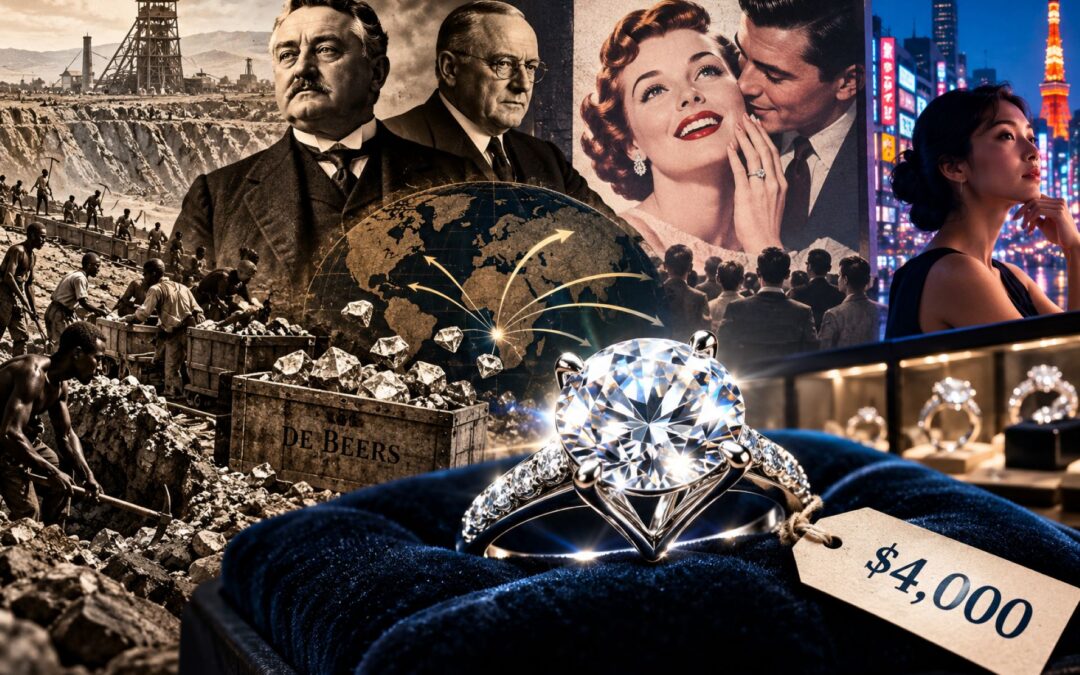
During the twentieth century, a company called De Beers helped transform the diamond industry through an extraordinary combination of mining concentration, control over supply and advertising. It did not invent diamonds, engagement rings or romantic love. Instead, it helped convince consumers that one particular gemstone was the appropriate way to demonstrate commitment.
The result was one of the most successful commercial transformations in history. Understanding it explains not only why diamonds became expensive, but also why their prices, resale values and cultural significance remain so complicated today.
How Diamonds Became a Luxury Long Before Engagement Rings
Diamonds were prestigious long before De Beers existed. For centuries, India was the world’s principal known source of diamonds, with stones travelling from its mines through trading networks to royal courts across Asia, the Middle East and Europe. Their rarity and unusual physical properties made them symbols of wealth, power and status.
Brazil became another important source after diamond discoveries there in the eighteenth century, but global production remained extremely limited by modern standards. Diamonds were generally possessions of monarchs, aristocrats and wealthy merchants rather than ordinary consumers. Their scarcity was genuine, and their association with luxury developed over centuries.
Diamonds were also difficult to work with. As the hardest naturally occurring material, they resisted the cutting and shaping techniques used for other gemstones. Rough diamonds did not necessarily possess the dazzling appearance familiar to modern jewellery buyers; increasingly sophisticated cutting and polishing techniques were needed to reveal their brilliance.
Their association with marriage also predates modern advertising, although it was far from universal. In 1477, Archduke Maximilian of Austria presented Mary of Burgundy with a diamond betrothal ring, reportedly featuring stones arranged in the shape of the letter M. The occasion is commonly described as the first diamond engagement, but it is more accurately one of the earliest well-documented examples.
As the Gemological Institute of America’s history of engagement rings explains, engagement jewellery had existed in various forms for centuries. Diamonds were not the only gemstones associated with betrothal, and marriage traditions differed substantially between societies.
For most people, a diamond engagement ring remained unimaginable. Some couples exchanged simple metal bands, others used different gemstones, and many cultures had no established tradition of engagement rings at all.
Diamonds already possessed an exclusive reputation, but exclusivity did not mean everyone considered them necessary. That distinction would become increasingly important when the supply of diamonds changed dramatically during the nineteenth century.
South Africa’s Diamond Rush and the Rise of De Beers
The modern diamond industry began to take shape in southern Africa during 1866–67, when discoveries attracted prospectors, merchants and speculators. Further finds led to the development of major mining operations around Kimberley, including deposits discovered in 1871.
The scale of production was unlike anything the diamond market had previously experienced. Instead of recovering relatively small quantities from river deposits, miners began extracting diamonds from enormous volcanic formations known as kimberlite pipes. Industrial mining opened access to quantities that would have been difficult to imagine in the earlier gemstone trade.
This created an economic problem. Diamonds had commanded high prices partly because their supply was severely restricted, but increasing production threatened that exclusivity. Although large, high-quality stones remained uncommon and mining was expensive, an uncontrolled flood of newly discovered diamonds could undermine prices.
The mining industry’s structure encouraged a solution through consolidation. Early prospectors worked numerous small claims, but extracting diamonds became increasingly difficult as excavations deepened. Flooding, collapsing walls, waste removal and expensive machinery made individual operations harder to sustain.
Larger investors began purchasing neighbouring claims and combining them into more efficient operations. As the history of southern Africa’s industrial transformation demonstrates, these developments were inseparable from the political and economic inequalities of colonial rule.
One of the most ambitious figures in this consolidation was Cecil Rhodes, an English businessman who acquired mining claims and supporting equipment. His principal rival was Barney Barnato, another entrepreneur who assembled extensive interests in the Kimberley diamond fields.
Their businesses were eventually combined, and De Beers Consolidated Mines was formally established in 1888. The company took its name from Johannes Nicolaas and Diederik Arnoldus de Beer, two brothers whose farm had stood over one of the major diamond deposits. They had sold the property before the corporation bearing their name emerged.
Rhodes was also an outspoken British imperialist who believed in racial hierarchies and the superiority of Anglo-Saxon peoples. His commercial success developed within a mining economy dependent on exploitative racial arrangements. Black African workers received significantly lower wages than white workers, faced harsh controls and were often housed in closed compounds designed partly to prevent diamond theft.
Land restrictions, taxation and other colonial policies helped force African men into wage labour while restricting their ability to build independent livelihoods. The mining industry contributed to patterns of racial inequality that would remain central to South Africa’s economic development and subsequent crisis.
By around 1900, De Beers controlled an estimated 90% of the world’s rough-diamond production. The company’s official corporate history traces its establishment to the consolidation of these South African mining interests.
De Beers had become powerful by concentrating ownership in an industry once divided among competing operators. The next stage would give it influence extending far beyond the mines themselves.
The System That Made Diamond Scarcity Profitable
Cecil Rhodes died in 1902, but the concentration of the diamond industry continued. Ernest Oppenheimer, a German-born mining entrepreneur who established the Anglo American Corporation, became increasingly influential in South African mining. He joined the De Beers board in 1926 and subsequently became chairman.
Under the Oppenheimer family, De Beers expanded its influence over the international diamond trade. Its power depended not simply on owning mines, but on controlling the channels through which rough diamonds reached buyers.
The system eventually centred on the Central Selling Organisation, which helped coordinate the purchase, sorting and distribution of diamonds from participating producers. Rather than allowing large quantities of rough diamonds to compete freely on the market, the organisation channelled much of the supply through a centralised selling structure.
Approved buyers, known as sightholders, received access to scheduled sales called sights. At these events, they were offered assortments of rough diamonds organised into categories. Buyers generally could not select individual stones freely or negotiate each price as they might in an ordinary open market.
The arrangement gave De Beers substantial bargaining power. A sightholder who repeatedly rejected parcels or challenged the conditions risked losing future access to an important source of rough diamonds. When one organisation controlled such a large proportion of the trade, exclusion could threaten a buyer’s business.
This structure helped De Beers influence both the quantity and timing of diamonds entering the market. When production exceeded demand, the company could acquire and hold stones rather than immediately releasing them. Stockpiles helped absorb fluctuations in supply and reduce the risk of sudden price collapses.
The mechanism was particularly important because diamonds were not like perishable products that needed to be sold immediately. A diamond could be stored for years without losing its essential physical characteristics. Holding inventory was costly, but it was possible to delay sales until market conditions became more favourable.
In his influential investigation, Have You Ever Tried to Sell a Diamond?, journalist Edward Jay Epstein examined how the concentrated diamond trade shaped prices, demand and the industry’s relationship with consumers.
De Beers did not literally determine the final price of every diamond ring. Between a mine and a jewellery counter stood cutters, polishers, wholesalers, jewellery manufacturers and retailers, each with their own costs and margins. Nevertheless, its control over the primary distribution system gave it extraordinary influence over rough-diamond supply.
The arrangement also faced recurring challenges. New deposits, independent producers and political changes threatened the single-channel model, forcing De Beers to adapt. When the Soviet Union became an important diamond producer, for example, the industry needed markets for substantial quantities of smaller stones.
Jewellery manufacturers and marketers developed additional uses for diamonds, including eternity rings, anniversary gifts and multi-stone designs. These products expanded the occasions on which diamonds could be purchased and created demand for stones that might otherwise have been difficult to sell.
That revealed the fundamental limitation of controlling supply. A company could withhold diamonds to support prices, but as production expanded, supply restrictions alone could not guarantee long-term profitability. The industry needed consumers to purchase more diamonds, and it needed them to believe those purchases were important.
De Beers therefore turned toward an equally ambitious project: shaping demand itself.
How De Beers Sold Diamonds as Proof of Love
The American diamond market was struggling during the 1930s. The economic collapse associated with the Great Depression had weakened spending on luxury goods, and diamond engagement rings were not yet a universal expectation. Couples could become engaged without diamonds, and many regarded them as expensive optional purchases.
In 1938, Harry Oppenheimer, Ernest Oppenheimer’s son, approached the American advertising agency N.W. Ayer & Son. The resulting campaign, launched in 1939, would become one of the most influential examples of advertising changing consumer behaviour.
The agency faced an unusual assignment. Instead of persuading customers to choose one diamond brand over another, it needed to persuade Americans to buy more diamonds generally. De Beers itself was not a familiar consumer brand, and the mining company’s name was not particularly relevant to people shopping for engagement rings.
The campaign therefore concentrated on what diamonds represented rather than who produced them.
N.W. Ayer sought to make a diamond engagement ring seem like the natural expression of romantic commitment. Its advertising connected diamonds with enduring love, personal sacrifice, social status and the seriousness of marriage. A purchase that had previously been optional was increasingly presented as something that responsible and devoted partners were expected to make.
Celebrity publicity played an important role. Newspapers and magazines discussed the diamonds worn by Hollywood stars, wealthy socialites and prominent political families. The gemstones appeared as symbols of glamour, affection and success.
The intended audience extended beyond the wealthy. By displaying expensive diamonds worn by admired women, the campaign encouraged ordinary consumers to aspire to the same symbols of status. The message suggested that the size and value of a diamond reflected the strength of the giver’s devotion.
This was an especially powerful association because it transformed price into part of the emotional argument. Spending a substantial amount of money could be interpreted as demonstrating sacrifice, and sacrifice was presented as evidence of commitment. The greater the expenditure, the stronger the apparent declaration of love.
De Beers and its advertising agency also sought to influence expectations before consumers began shopping for engagement rings. Educational lectures about diamonds were arranged at American schools and other institutions, introducing young people to the idea that diamonds had a special connection with marriage.
The campaign was not simply teaching consumers about gemstones. It was helping establish a social convention that future consumers would recognise and reinforce.
Its most enduring achievement came in 1947, when copywriter Frances Gerety created the slogan “A Diamond Is Forever.” The phrase entered De Beers advertising the following year and became one of the most recognisable slogans in commercial history.
The wording worked on several levels. Diamonds are exceptionally hard and can endure for generations, although that does not make them indestructible. Their physical durability became a metaphor for the permanence couples hoped to achieve through marriage.
The slogan also made a modern commercial expectation sound timeless. People already associated marriage with lifelong commitment, and the advertising attached diamonds to that existing ideal.
Over time, the distinction between an inherited tradition and a recently popularised consumer habit became increasingly difficult to recognise. Diamond engagement rings acquired the appearance of something that had always accompanied proposals, even though their widespread adoption was comparatively recent.
Advertising had helped create an expectation that consumers could enforce themselves. Friends and relatives admired or compared engagement rings, films treated them as central to romantic proposals, and couples began measuring the significance of the occasion through the jewellery exchanged.
De Beers had not invented the diamond engagement ring. Its accomplishment was making one particular expression of love seem increasingly necessary.
How a New Marriage Custom Spread Around the World
After establishing the diamond engagement ring in American consumer culture, De Beers expanded its marketing efforts internationally. Japan became one of the most striking demonstrations of how quickly advertising could help popularise a new custom.
During the mid-twentieth century, diamond engagement rings were uncommon in Japan. Marriage traditions reflected different social institutions, and family involvement in choosing spouses remained important. Western-style romantic courtship was becoming more influential, but it was not the only accepted model of marriage.
De Beers began advertising diamond engagement rings in Japan in 1967. Its campaigns connected the jewellery with modern lifestyles, personal choice, fashionable couples and Western romantic ideals.
Diamonds became associated not only with love, but also with participation in a contemporary, cosmopolitan culture. As incomes increased and social expectations changed, diamond jewellery offered consumers a visible symbol of modernity.
Historical accounts commonly report that fewer than 5% of engaged Japanese women received diamond rings around the beginning of the campaign. By 1981, the proportion had reportedly increased to approximately 60%.
The transformation was remarkable. Within roughly fourteen years, a custom with limited roots in Japanese marriage culture had become widespread. Japan emerged as the second-largest market for diamond engagement rings after the United States during this period.
Yet advertising should not receive all the credit. Japan was experiencing wider changes in urbanisation, prosperity, consumer spending, gender expectations and attitudes toward marriage. De Beers’ campaigns succeeded partly because they attached diamonds to developments already reshaping Japanese society.
The results were also less dramatic in countries such as Brazil, Germany, Austria and Italy, where established customs and local economic conditions affected the appeal of diamond engagement rings. An advertising campaign could influence culture, but it could not automatically produce identical behaviour everywhere.
Historical examinations of the international diamond trade and its marketing practices provide further context for how the industry’s commercial strategy evolved beyond its original markets.
The broader lesson was that consumer traditions did not necessarily require centuries to become familiar. Once a custom was repeatedly promoted, adopted and passed between generations, later consumers could come to regard it as an established expectation rather than a commercial creation.
The diamond engagement ring had become part of the social language of marriage. De Beers’ next advantage came from encouraging consumers to hold on to those diamonds permanently.
Why a Diamond That Costs Thousands Can Be Hard to Resell
The slogan “A Diamond Is Forever” encouraged consumers to think of engagement rings as permanent possessions. A diamond was supposed to accompany a lifelong marriage and eventually become a family heirloom, rather than something bought and sold whenever market conditions changed.
That message reinforced the emotional meaning of the ring, but it also served a commercial purpose. Every diamond that remained in a jewellery box or on someone’s finger was one fewer existing stone competing directly with newly mined diamonds.
Diamonds are durable enough to survive generations, although they can be damaged, lost or destroyed. Large numbers of stones purchased in earlier decades can therefore remain available for future resale.
If consumers routinely returned their diamond jewellery to the market, those stones could provide an additional source of supply. Encouraging people to treat diamonds as permanent sentimental possessions helped limit the circulation of existing jewellery.
This does not mean De Beers single-handedly eliminated resale. Second-hand diamond markets, specialist dealers and auction houses have long existed. The more revealing question is why a ring purchased at a substantial retail price may attract a much lower offer when its owner attempts to sell it.
Part of the answer is the difference between retail and resale economics. The original purchase price includes considerably more than the loose diamond’s value. Mining, sorting, cutting, polishing, grading, transportation, metalwork, jewellery design, marketing, retail overheads and profit margins can all contribute to the final amount.
When a consumer sells the ring, the buyer is not purchasing the original retail experience. A dealer may need to inspect the stone, confirm its grading, remove or replace the setting, maintain inventory and eventually locate another customer.
The setting itself may have little resale appeal, particularly if its design is unfashionable or highly personalised. Branded jewellery and exceptional pieces can be treated differently, but ordinary rings are often valued primarily for their recoverable materials and stones.
Diamond quality introduces further complications. Two diamonds of identical weight can differ significantly in cut, colour, clarity, shape, fluorescence, certification and market desirability. Unlike a standardised quantity of gold, individual diamonds are not perfectly interchangeable.
There is also no single transparent retail exchange on which every consumer can immediately sell a diamond at a universally quoted market price. Resale occurs through jewellers, specialist buyers, auctions, online marketplaces and private transactions, each offering different prices, fees and risks.
The resulting offers can be disappointing, but no fixed percentage applies to every diamond. An exceptional gemstone, a collectible piece or a ring from a desirable luxury brand may attract a very different valuation from an ordinary mass-market engagement ring.
The distinction is between price, value and liquidity. A diamond may be genuinely valuable while remaining difficult to sell quickly. It may cost a great deal at a jewellery counter without providing the buyer with an equally valuable financial asset.
This is why an engagement ring should not automatically be treated as an investment. The original purchase includes an emotional experience and a cultural ritual that may mean everything to the couple, but those meanings do not necessarily translate into what another buyer will pay.
Why Diamonds Still Command High Prices Without a Monopoly
De Beers no longer dominates the diamond industry as completely as it did during much of the twentieth century. New sources of supply and independent producers weakened the single-channel system, while political changes and competition gradually altered the structure of the international market.
Russia became one of the world’s largest diamond producers, and Australia’s Argyle mine supplied substantial quantities of diamonds before closing in 2020. Botswana, Canada, Angola, Zimbabwe and other countries also became important producers.
The contemporary industry contains multiple mining companies, distribution channels and sources of supply. De Beers remains influential, but the idea that every diamond must pass through its organisation no longer describes the market.
Global production is also substantial. The Kimberley Process recorded approximately 107.9 million carats of rough-diamond production worldwide in 2024, distributed across numerous producing countries.
Nevertheless, the quantity of diamonds extracted from the ground does not directly indicate how many desirable jewellery stones are available. Much of the recovered material is unsuitable for particular gemstone applications, and diamonds vary enormously in their characteristics.
This helps explain why natural diamonds can remain expensive even without the old cartel. A large, high-quality, colourless diamond is not equivalent to a small stone with noticeable inclusions and less desirable colour. Physical differences matter greatly to buyers and to the prices stones can command.
The Gemological Institute of America’s diamond quality factors describe the four characteristics commonly known as the 4Cs: cut, colour, clarity and carat weight.
Cut concerns the quality of a diamond’s proportions, symmetry and finish, affecting how it interacts with light. Colour grading evaluates how close a stone is to being colourless, except in the separate market for fancy-coloured diamonds. Clarity concerns internal inclusions and external blemishes, while carat measures weight.
These factors interact rather than operating independently. A larger diamond is not automatically more valuable than every smaller one, and two stones of equal weight can command very different prices. Large diamonds with exceptional combinations of desirable characteristics are particularly uncommon.
A two-carat diamond may therefore cost substantially more than twice the price of a comparable one-carat stone. Larger gem-quality crystals are disproportionately rare, so price increases are not necessarily proportional to weight.
Production costs also matter. Discovering commercially viable diamond deposits requires extensive geological exploration, and developing a mine involves significant capital investment. Large quantities of rock must be excavated, transported and processed to recover relatively small amounts of diamond.
The recovered stones must then be examined, sorted and carefully cut. Polishing a rough diamond involves decisions about its shape, appearance and how much of its original weight can be preserved. Those choices affect both production costs and eventual value.
Beyond physical characteristics, natural diamonds carry an origin-based premium. Some consumers place special value on possessing a gemstone formed under geological conditions over immense periods of time rather than produced through an industrial process.
Certification, brand reputation, design and retail presentation reinforce these preferences. A diamond’s selling price therefore reflects not just scarcity in nature, but also how its characteristics, origin and cultural meaning are valued by consumers.
The importance of that distinction has become increasingly obvious with the rise of laboratory-grown diamonds.
How Lab-Grown Diamonds Are Rewriting the Price Equation
Laboratory-grown diamonds challenge one of the traditional assumptions behind diamond pricing: that the visual and physical qualities of a diamond necessarily imply the scarcity of a naturally mined gemstone.
A laboratory-grown diamond is a genuine diamond, not a glass imitation or a substitute such as cubic zirconia. It has essentially the same chemical composition, crystal structure and fundamental physical and optical properties as a natural diamond.
As the Gemological Institute of America explains in its comparison of natural and laboratory-grown diamonds, the principal distinction is their origin and formation process. Natural diamonds develop under geological conditions, while laboratory-grown diamonds are manufactured using controlled technological methods.
This difference has major economic consequences. Expanding natural diamond production generally requires discovering and developing suitable deposits, a process constrained by geology and substantial mining costs. Laboratory production can expand through investment in equipment, energy and manufacturing capacity.
As production technology has improved and supply has increased, prices for laboratory-grown diamonds have fallen sharply. Consumers can often purchase a larger laboratory-grown stone for substantially less than a comparable natural diamond.
The difference demonstrates how much value consumers place on natural origin. If two gemstones offer substantially similar visual and physical characteristics but sell at very different prices, appearance alone cannot explain the premium. Scarcity, origin, perceptions of authenticity and the prestige associated with natural stones become central to the buying decision.
Competition has placed pressure on the natural-diamond industry, particularly where consumers prioritise size and appearance over geological origin. It has also challenged an established market in which diamonds were promoted as possessions whose financial value could be expected to endure.
De Beers has acknowledged the difficulties facing natural-diamond producers. Its preliminary financial results for 2025 reported a $511 million underlying EBITDA loss and a $2.3 billion impairment recognised against the carrying value of the business. Weak demand, inventory pressures and lower price expectations contributed to the difficult environment.
The industry’s problems did not end there. In its third-quarter 2026 production report, De Beers described continuing pressure from laboratory-grown diamonds, while also noting signs of improving natural-diamond demand in markets including the United States and India.
For the year to date, the company reported recovering 21.7 million carats of rough diamonds. Its average realised rough-diamond price was $97 per carat, compared with $155 in the corresponding period of 2025, a year-on-year decline of approximately 37%.
These figures describe De Beers’ own rough-diamond business, not the price an individual would pay for a polished diamond in a jewellery store. Differences in the mix and quality of stones sold also affect average realised prices, so the change should not be interpreted as a universal decline in retail diamond values.
The market remains highly differentiated. Exceptional natural stones can command premiums based on rarity, quality, provenance and buyer preferences, while more ordinary stones face stronger competition from increasingly affordable laboratory-grown alternatives.
This changing environment reveals the limitations of the old diamond industry’s model. De Beers helped establish a powerful association between diamonds and enduring love, but that cultural achievement does not guarantee that diamond prices will remain permanently high.
Natural diamonds may continue to carry significant value because of their rarity, characteristics and origin. Laboratory-grown diamonds offer a different economic proposition, making the physical appearance of a diamond more accessible while challenging the premium traditionally attached to mined stones.
The price of a diamond has never depended on just one factor, and the emergence of a major competing source of diamonds has made those differences more visible than ever.
A diamond can be expensive because its combination of physical characteristics is genuinely uncommon, because extracting and preparing it requires substantial resources, and because consumers are willing to pay for its natural origin and cultural significance. Historical supply controls and generations of advertising helped build that willingness to pay, but they cannot fully determine the modern market.
De Beers’ most enduring achievement was not persuading the world that every diamond was physically rare. It was helping turn the diamond engagement ring into an expected demonstration of love.
Understanding that history does not make the emotions attached to a diamond meaningless. A couple can cherish a ring regardless of how the tradition became popular. What changes is the assumption that a costly diamond is an inevitable requirement of commitment, or that its sentimental worth guarantees financial value.
A diamond can represent love because two people choose to give it that meaning. Its geological origins may be ancient, but the obligation to buy one is a much more modern creation.
Last Updated on October 29, 2026 by Aseem Gupta