
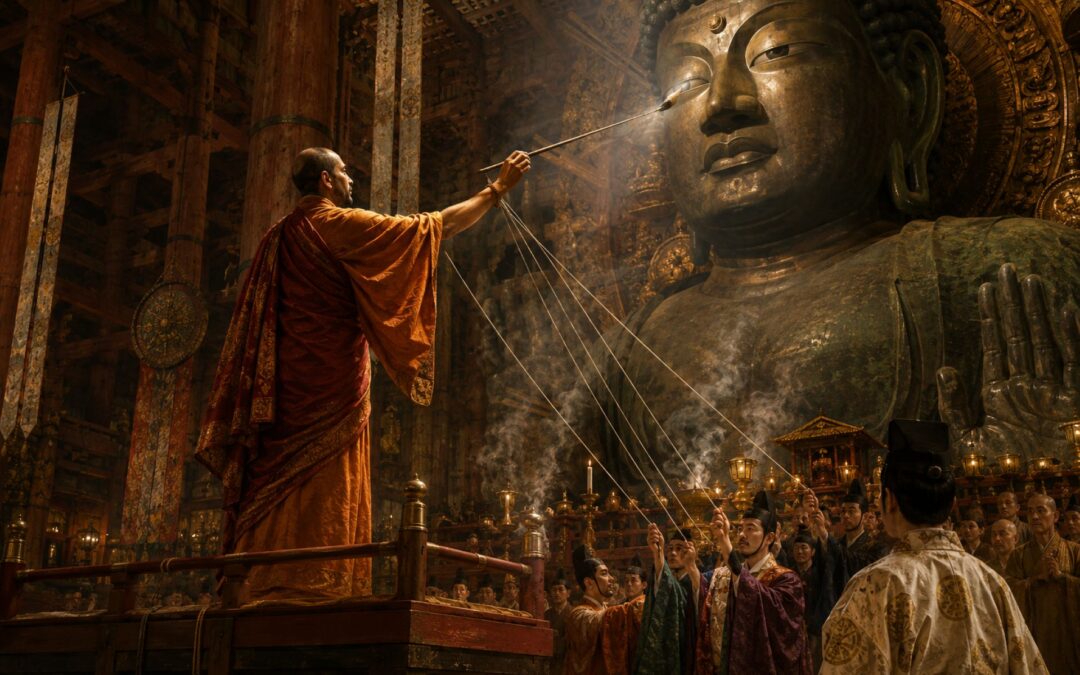
On the ninth day of the fourth lunar month in 752, thousands of monks, courtiers, officials, musicians, dancers and foreign dignitaries gathered at Tōdai-ji in Japan’s imperial capital of Nara. Before them sat an enormous bronze image of Vairocana Buddha, the product of years of labour, repeated casting failures and resources gathered from across the country.
The statue was physically complete, but it was not yet ritually alive.
That final transformation required an eye-opening ceremony. A master would approach the Buddha’s face and paint in its pupils, symbolically awakening the image and converting metal into a sacred presence. The person selected to perform this act was neither the Japanese emperor nor one of the country’s most powerful native monks.
He was Bodhisena, a monk who had travelled to Japan from India by way of Tang China.
Holding the consecration brush, Bodhisena completed one of the grandest religious ceremonies in Japanese history. Silk cords extending from the brush allowed leading participants to share symbolically in the act. Around them, performers presented music and dances carrying influences from across Asia. The ceremony embodied Japan’s imperial ambitions, its search for divine protection and its participation in an international Buddhist world.
Bodhisena’s presence at its centre is remarkable. It is also easy to misunderstand.
Later legends transformed him into a pilgrim guided to Japan by the bodhisattva Mañjuśrī. Popular retellings have credited him with saving the country, founding major religious traditions and reshaping Japanese language and culture. The surviving historical record supports a more restrained story—but not a less interesting one.
Bodhisena mattered because his Indian ancestry, knowledge of Sanskrit and proximity to Buddhism’s sacred homeland gave him extraordinary authority in eighth-century Japan. His journey reveals a society far more connected to the wider world than the familiar image of an isolated Japan suggests.
Who Was Bodhisena?
The most reliable early account of Bodhisena’s life is an epitaph composed after his death by one of his disciples. It identifies him as a member of the Bhāradvāja Brahman lineage and describes him as coming from what its author understood as South India.
Later Japanese records referred to him using titles commonly translated as “Brahman abbot” or “Brahman bishop.” The label did not necessarily mean that Bodhisena remained a practising Brahman after becoming a Buddhist monk. Instead, it preserved his ancestry and marked him as a religious figure whose origins lay in India’s learned social traditions.
Beyond that, much of his early biography is uncertain.
Bodhisena was probably born around 704. He is frequently said to have come from Madurai, then associated with the Pandya country of southern India, but the earliest evidence does not identify his birthplace with that level of precision. As Abigail MacBain explains in her scholarship on Bodhisena’s life and legacy, geographical terms translated as “South India” could be flexible and inconsistent in East Asian Buddhist records.
Some much later traditions even associated Bodhisena with Kapilavastu, the region linked to the historical Buddha. Such claims reveal the desire to place him as close as possible to Buddhism’s sacred origins, but they do not provide dependable information about his birthplace.
There is equally little evidence concerning his childhood, family or decision to enter Buddhist monastic life. It is plausible that he was raised in a Brahman environment and later became a Buddhist monk. It is not possible to reconstruct a dramatic conversion, a conflict with his relatives or a public rejection of Hindu tradition.
Those details belong to modern speculation rather than established biography.
This absence of evidence matters because later storytellers repeatedly filled the gaps in Bodhisena’s life with religious meaning. The less that was known about the young monk, the easier it became to imagine him as a figure whose entire journey had been directed by sacred forces.
The historical Bodhisena begins to appear more clearly only after he left India and entered the international Buddhist world centred on Tang China.
From South India to Tang China—and Then Japan
By the early eighth century, Buddhist ideas, texts and ritual specialists had travelled between South Asia, Central Asia, Southeast Asia and East Asia for centuries. Monks crossed deserts and seas in search of scriptures, teachers, sacred sites and patronage. Imperial capitals attracted translators and scholars from distant regions. Diplomatic missions carried books, religious objects, technologies and people alongside political messages.
Tang China stood near the centre of these networks.
Bodhisena appears to have travelled there as a young monk, although the date and route cannot be reconstructed with certainty. A voyage from the Indian subcontinent could have carried him through the maritime networks linking South Asia with Southeast Asian ports and the Chinese coast. He may also have travelled through more than one monastic centre before reaching the Tang capital.
Later Japanese stories gave his journey a more miraculous purpose.
According to these accounts, Bodhisena longed to meet Mañjuśrī, the bodhisattva associated with wisdom. He travelled to Mount Wutai in China, a sacred mountain believed to be Mañjuśrī’s earthly dwelling, only to learn that the bodhisattva had appeared in Japan. Bodhisena therefore continued eastward, eventually discovering Mañjuśrī in the person of the Japanese monk Gyōki.
It is an elegant story. It connects India, China and Japan through one sacred quest, presents Bodhisena’s arrival as predestined and elevates Gyōki to the status of a living bodhisattva.
It is also a later legend.
The earliest evidence offers a more practical explanation. While in China, Bodhisena encountered members of a Japanese mission returning from the Tang court. The embassy was led by Tajihi no Hironari and included the monk Rikyō. Impressed by Bodhisena’s learning and religious background, they invited him to accompany them to Japan.
That invitation itself was significant. Japanese missions to Tang China were not merely diplomatic errands. Their members studied foreign institutions, collected texts, recruited specialists and observed developments in government, art, religion and scholarship. Returning missions could carry entire packages of cultural knowledge back to the Japanese court.
Bodhisena joined one such international movement of people and ideas.
He was associated with other prominent religious travellers, including the Chinese monk Daoxuan and the monk Phật Triệt, who came from the region known in Chinese and Japanese sources as Lâm Ấp or Champa, in present-day Vietnam. Their journeys overlapped with those of Japanese scholars returning after long periods of study abroad.
The precise passenger arrangement across the mission’s ships is uncertain, and not every famous traveller connected with the embassy should automatically be placed on the same vessel. What matters is the larger pattern: Bodhisena did not arrive as an isolated wanderer. He entered Japan through organised diplomatic and monastic networks.
After a difficult sea voyage, he reached Japan in 736. He was received by court and religious authorities and eventually resided at Daian-ji, one of the great Buddhist institutions of Nara.
His arrival was prestigious, but it did not immediately make him the central figure in Japanese Buddhism. He entered a religious world already filled with influential monks, competing schools, court patrons and political tensions.
What made his presence especially valuable was the condition of Japan itself.
The Japan Bodhisena Entered
The Japan of the 730s and 740s was not merely experiencing a religious transformation. It was enduring a prolonged crisis.
Emperor Shōmu had inherited a state whose rulers were attempting to strengthen central authority through law codes, taxation, provincial administration and an imperial capital modelled partly on Tang China. Nara displayed the ambitions of that system, but its institutions remained vulnerable to court rivalry, environmental hardship and the limits of the government’s reach.
Then came smallpox.
The epidemic that spread across Japan between 735 and 737 was one of the most destructive demographic disasters in the country’s recorded history. Exact numbers cannot be known, but historical reconstructions suggest that it may have killed roughly a quarter to a third of the population. The scale of the catastrophe and its consequences are examined in research on Japan’s devastating eighth-century smallpox epidemic.
The disease disrupted agriculture, taxation and local administration. Villages lost workers. Fields went uncultivated. Households struggled to meet state obligations. Religious communities and court officials interpreted the disaster through a world in which epidemic disease, ritual failure, political disorder and supernatural danger could not be neatly separated.
The imperial elite was struck with particular force.
Four powerful brothers from the Fujiwara clan died during the epidemic. Together, they had occupied commanding positions within the government. Their sudden disappearance disrupted the balance of power at court and created opportunities for other officials, aristocratic families and clerics to rise.
Among the figures who gained influence were Genbō, a monk who had returned from Tang China with a large collection of Buddhist texts, and Kibi no Makibi, a scholar and administrator who had also spent years abroad. Their continental knowledge made them useful to Shōmu’s court, but their growing authority provoked opposition.
Fujiwara no Hirotsugu, a member of a displaced branch of the Fujiwara family, denounced their influence and criticised the government’s response to the country’s suffering. After being sent to Kyushu, he raised a rebellion in 740.
The revolt was defeated, but it revealed the depth of political resentment. Court appointments, regional authority, religious influence and claims about cosmic disorder had become entangled. Hirotsugu’s uprising was not simply a personal quarrel with two returned scholars. It emerged from a society struggling with disease, factional competition and the burdens imposed by an ambitious central state.
Shōmu responded to these crises with repeated movements of the court, administrative changes and increasingly grand Buddhist projects. These policies reflected sincere religious devotion, but they also addressed a political problem: how could an emperor demonstrate that his rule still possessed moral and cosmic legitimacy after years of epidemic, death and rebellion?
Buddhism offered one answer.
In 741, Shōmu ordered the establishment of a network of provincial monasteries and nunneries. These institutions were intended to spread Buddhist protection throughout the realm while tying regional religious life more closely to the imperial state.
In 743, he proclaimed the construction of a colossal bronze image of Vairocana Buddha. The statue would become the spiritual centre of a national Buddhist order, but its creation placed additional demands on a population already suffering from labour shortages and economic strain.
The official eighth-century history of Tōdai-ji presents the project as Shōmu’s response to political conflict, epidemic and social distress. The emperor sought protection through the power of the Buddha, but the project was never solely a private act of faith. It mobilised material, labour and authority on an imperial scale.
This was the world Bodhisena entered: a court fascinated by overseas knowledge, a state attempting to govern through religious institutions and a society searching for meaning after catastrophe.
Why Bodhisena Mattered at the Nara Court
Bodhisena’s importance cannot be understood simply by describing him as a learned foreign monk. Nara hosted monks and scholars from China, Korea and other parts of Asia. Foreign expertise was admired, but it was not unusual.
India occupied a different symbolic position.
For Japanese Buddhists, India was the land where the historical Buddha had lived, taught and attained awakening. Buddhist scriptures and lineages might reach Japan through China and Korea, but their ultimate authority pointed westward towards the religion’s sacred homeland.
A monk identified as both Indian and Brahman therefore carried a kind of cultural capital that other religious specialists could not easily reproduce. Bodhisena appeared to stand closer to the language, geography and inherited learning of Buddhism’s origins.
His knowledge of Sanskrit deepened this prestige. Sanskrit was not the ordinary language of Japanese Buddhist practice, which depended heavily on texts transmitted and interpreted through Chinese. Yet Sanskrit sounds, letters, mantras and ritual formulas carried sacred authority. A monk able to teach elements of that language offered access—however mediated—to an older layer of Buddhist tradition.
At Daian-ji, Bodhisena participated in teaching and religious life among a community of internationally connected monks. He became associated with the Flower Garland tradition, known in Japan as Kegon, whose vision of an interdependent cosmos would later be closely identified with Tōdai-ji and Vairocana Buddha.
He should not, however, be described as the sole founder of Japanese Kegon. Its establishment involved several monks, texts and institutional relationships, including Rōben and other teachers connected to continental traditions. Bodhisena’s role was important, but it belonged to a collective religious development.
His relationship with Gyōki was similarly transformed by later memory.
The historical Gyōki was one of the most influential monks of the period. Earlier governments had viewed his itinerant preaching and organisation of lay followers with suspicion because Buddhist regulations attempted to keep monks under state supervision. Yet Gyōki’s practical work earned him enormous popularity. He and his followers were associated with bridges, reservoirs, roads, charitable activities and projects that directly affected ordinary communities.
By the time Shōmu began seeking wider support for the Great Buddha, Gyōki’s popular authority had become invaluable. He could mobilise donations, labour and religious enthusiasm beyond the court.
Later Buddhist narratives claimed that when Bodhisena met Gyōki, the two immediately recognised one another from a previous life. Gyōki supposedly remembered that they had once studied together before the Buddha at Vulture Peak. Bodhisena, in turn, identified Gyōki as the Mañjuśrī he had crossed Asia to find.
These stories should not be treated as eyewitness history. They were developed and preserved by religious communities interested in presenting Bodhisena’s arrival, Gyōki’s sanctity and the Tōdai-ji project as parts of one divinely ordained plan.
Yet the legends reveal something real about Bodhisena’s authority. His recognition could legitimise others. If an Indian Brahman monk declared that Gyōki was Mañjuśrī, then Gyōki’s local popularity acquired a universal Buddhist meaning.
The relationship worked in both directions. Gyōki’s influence helped integrate Bodhisena into Japan’s religious establishment, while Bodhisena’s foreign prestige elevated the sacred status of Gyōki and the imperial project they both served.
Bodhisena’s standing continued to rise. In 751, shortly before the Great Buddha’s consecration, he was promoted within Japan’s senior clerical administration. His authority was therefore not based solely on personal reputation or legendary charisma. It had been recognised through the institutions of the court.
When the time came to select the master for the eye-opening ceremony, Bodhisena combined everything the occasion required: monastic rank, Sanskrit learning, Brahman ancestry, Indian origin and a place within the network surrounding Tōdai-ji.
The Eye-Opening of the Great Buddha
The creation of the Great Buddha was one of the most demanding projects undertaken by the Nara state.
Shōmu announced his intention to construct the image in 743. Work later shifted to the site of Tōdai-ji in Nara, where casting began in 745. The statue was made in stages because a bronze figure of such scale could not be produced in a single pour. The process required enormous quantities of metal, fuel, skilled labour and logistical organisation.
Repeated difficulties made the project more than an engineering challenge. In a society where material success and ritual correctness were closely linked, casting failures could be interpreted as signs of spiritual as well as technical disorder.
Gyōki helped generate popular support, collecting contributions and encouraging participation. His involvement allowed the project to be presented not only as an imperial command but as a collective religious undertaking. He died in 749, several years before the final ceremony, but by then the statue had largely taken form.
The bronze image was completed in 749, and the great hall surrounding it was finished in 751. The consecration followed in 752.
The ceremony brought together the many worlds that had converged at Nara. Imperial officials, aristocrats, monks and representatives of provincial institutions stood alongside religious specialists with roots across Asia. Music and dance traditions from different regions formed part of the celebration. The event displayed not only Buddhist devotion but the court’s capacity to gather distant cultures and domestic resources around a single sacred centre.
An eye-opening ceremony treated a religious image as more than a work of sculpture. By painting the pupils, the officiant completed the Buddha’s sacred presence. The act did not literally transform bronze into a living organism, but within ritual logic it awakened the image as an object through which devotion, merit and protection could operate.
Shōmu had retired by the time of the ceremony and was reportedly in poor health. Bodhisena performed the central act in his place.
The monk climbed towards the colossal Buddha’s face and applied the brush to its eyes. Silk cords were attached to the brush and extended into the gathered assembly, allowing senior participants to hold them and share symbolically in the consecration. The gesture transformed an action performed by one monk into a collective ritual connection between the Buddha, the imperial household, the clergy and the wider realm.
The importance of the ceremony is preserved not only in written accounts but in surviving material objects. The Nara National Museum’s record of the Great Buddha’s consecration describes brushes, silk cords, costumes, masks and imperial ornaments associated with the event and preserved through the Shōsō-in collection.
These objects make the ceremony unusually tangible. Bodhisena’s presence is not merely a later symbolic association attached to Tōdai-ji. He occupied a documented ritual role at a precisely remembered event.
His selection carried several layers of meaning.
As a senior monk, he possessed institutional authority. As a Sanskrit teacher, he represented specialised sacred knowledge. As a Brahman from India, he embodied proximity to the Buddha’s homeland. In the political imagination of Shōmu’s court, these qualities strengthened the authenticity of a ceremony intended to protect the country and legitimise a vast imperial project.
Bodhisena did not conceive the Great Buddha, supervise its construction or command Japan’s religious policy. Those achievements belonged to a large network involving Shōmu, Empress Kōmyō, Gyōki, Rōben, court administrators, artisans, labourers, provincial communities and other monks.
His role was narrower, but symbolically decisive.
He was the person chosen to open the Buddha’s eyes.
Religion, Power, and the Making of a Buddhist State
The consecration of the Great Buddha has sometimes been described as the moment when Buddhism decisively triumphed over Japan’s indigenous religion. That interpretation imposes a later religious map on a much more complicated world.
Eighth-century Japan did not contain two neatly separated institutions called “Buddhism” and “Shinto” competing in the manner of modern denominations. Buddhist monasteries, court rites, local kami traditions, clan worship and imperial ceremonies overlapped and adapted to one another.
Conflict certainly existed. Monasteries accumulated land, wealth and political influence. Clerics entered court disputes. State projects demanded taxes and labour. Aristocratic factions disagreed over which religious specialists deserved imperial favour.
But the divide was not simply foreign Buddhism against a unified native religious elite.
Shōmu’s Buddhism was both personal and political. He appears to have sincerely believed that Buddhist practice could protect the realm, generate merit and restore order. At the same time, monasteries helped the state project imperial authority into the provinces, organise ritual activity and present the emperor as guardian of the entire country.
The Great Buddha embodied that fusion. Vairocana represented a cosmic Buddha whose presence encompassed all existence. Establishing such an image at the centre of the imperial order allowed the court to imagine Japan as a realm united beneath Buddhist protection.
That vision did not require the disappearance of the kami.
The deity Hachiman became closely associated with the Great Buddha project and was honoured as a protector of Tōdai-ji. This relationship helped establish patterns in which kami could be understood as supporters, manifestations or local expressions of Buddhist sacred power.
Later traditions developed much more elaborate claims. Gyōki was said to have reconciled Vairocana with Amaterasu, the ancestral sun deity of the imperial line. Bodhisena’s recognition of Gyōki as Mañjuśrī further suggested that Japanese sacred figures and Indian bodhisattvas belonged to one integrated religious reality.
Such stories cannot automatically be projected back onto the politics of the 740s. They reflect centuries of Buddhist interpretation and temple memory. Even so, they grew from a real historical process in which imported Buddhist institutions and existing kami traditions became increasingly intertwined.
The Great Buddha ceremony therefore did not prove that Buddhism had defeated Japan’s indigenous religious world. It demonstrated the court’s effort to create an imperial order capacious enough to absorb different sacred authorities.
Nor can the ceremony be said to have “saved” Japan in a measurable sense.
It did not erase the losses caused by smallpox, resolve every political rivalry or lift the economic burdens created by monumental construction. The court continued to face institutional conflict, and the power of Nara’s monasteries would eventually become one factor—among several—in later attempts to establish new political centres.
What the ceremony accomplished was symbolic but substantial. It gave Shōmu’s religious programme a visible centre. It transformed years of material sacrifice into a sacred achievement. It connected imperial authority to a Buddha whose scale suggested universal protection.
Bodhisena’s role strengthened that message. His presence allowed the court to claim not only domestic participation but the blessing of a Buddhist world extending back towards India.
Bodhisena’s Legacy—History, Culture, and Legend
After the consecration, Bodhisena remained in Nara. He continued to live and teach at Daian-ji until his death in 760.
His most defensible cultural legacy lies in the transmission of Buddhist learning. He taught Sanskrit and forms of sacred literacy connected to Buddhist texts, sounds and ritual practices. His presence contributed to Japanese interest in the linguistic traditions underlying scriptures that had generally reached the country through Chinese translations.
That contribution should not be inflated into the claim that Bodhisena invented kana or substantially redesigned Japanese grammar. The development of Japanese writing was a long process involving Chinese characters, phonetic adaptation and the work of many communities over generations. Bodhisena’s teaching formed part of the intellectual environment in which Sanskrit knowledge was valued, but it did not single-handedly determine the Japanese writing system.
His association with Kegon Buddhism requires similar care.
Bodhisena reportedly recited and taught material connected to the Flower Garland tradition, and later Tōdai-ji memory treated him as one of its important founding figures. Yet Japanese Kegon emerged through collective networks of monks, texts, court patrons and continental teachers. Bodhisena belonged to that history without being its sole originator.
The same caution applies to music and dance.
The 752 ceremony included performances reflecting influences from India, China, Korea, Central Asia and Southeast Asia. Bodhisena was part of the cosmopolitan religious group associated with these transmissions, but Phật Triệt is more directly connected to the tradition called Rinyūgaku, which carried elements associated with Champa. The cultural world around Bodhisena was genuinely international; there is no need to assign every part of it to him personally.
Temple traditions also linked him to Mount Tomi, whose landscape was said to resemble Vulture Peak, the Indian mountain where the Buddha was believed to have delivered important teachings. Bodhisena was associated with the establishment or naming of Ryōsen-ji, and later accounts identified the surrounding area with his burial.
These traditions belong to the geography of memory. They show how Japanese communities placed India within their own landscape, transforming local mountains and temples into echoes of Buddhist sacred places. Whether every detail can be historically verified is less important than what the tradition reveals about Bodhisena’s place in Japanese religious imagination.
The legends surrounding him continued to grow after his death.
Medieval storytellers transformed his journey into a sacred mission. His encounter with Gyōki became a reunion between disciples from a previous life. His travel to China became a search for Mañjuśrī. His invitation to Japan became the fulfilment of prophecy. His role at Tōdai-ji appeared not as the result of diplomatic recruitment and court patronage, but as the culmination of a plan extending across lifetimes.
These stories should not replace history, but neither are they meaningless decorations. They reveal how Buddhist communities understood Bodhisena’s importance. A foreign monk had appeared at a decisive moment, recognised Japan’s greatest native religious figure and performed the ritual that awakened the country’s greatest Buddha. Later generations made that sequence cosmically inevitable.
Modern commemorations have given Bodhisena another life. Japanese and Indian institutions have presented him as an early symbol of relations between the two countries. Memorial ceremonies, temple events and diplomatic accounts continue to invoke his journey as evidence of a cultural connection extending back more than twelve centuries.
The survival of objects from the 752 ceremony gives that remembrance unusual force. Bodhisena is not merely a legendary traveller whose name was attached retrospectively to Japan. He stood inside the Great Buddha Hall, held the consecration brush and completed an act witnessed by the political and religious leadership of Nara Japan.
That moment does not prove that one Indian monk rescued a civilisation. It reveals something more valuable.
When Bodhisena opened the Buddha’s eyes, he stood at the meeting point of Indian religious authority, Tang diplomacy, Southeast Asian performance traditions and Japanese imperial ambition. His life shows that eighth-century Japan was not waiting in isolation to be discovered by the wider world. It was already selecting, adapting and incorporating ideas carried across enormous distances.
The eyes painted at Tōdai-ji belonged to a Japanese monument. The world reflected in them stretched across Asia.
Last Updated on July 27, 2026 by Aseem Gupta