
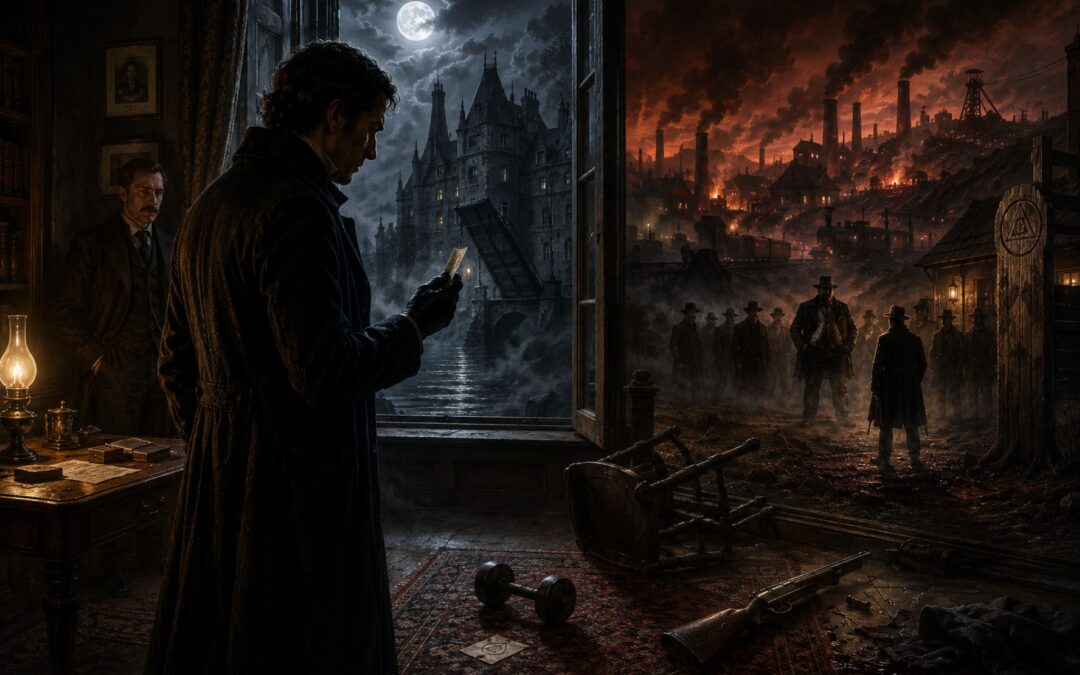
Arthur Conan Doyle’s The Valley of Fear is one of the strangest Sherlock Holmes novels because the mystery that first appears to define the book turns out to be only its outer shell. A man is apparently murdered inside an isolated English manor, his face destroyed by a shotgun blast. The room contains a mysterious card marked “V.V. 341,” the dead man’s wedding ring has vanished, an American-style weapon lies beside the body, and the killer seems to have escaped across a moat from a house whose drawbridge should have made such an escape nearly impossible. Holmes can solve those physical contradictions, but doing so reveals that the real story began decades earlier and thousands of miles away.
The second half of the novel leaves Holmes behind and follows a violent secret society in an American mining district, an undercover detective living under a criminal identity, and a campaign of terror whose survivors continue pursuing one another long after the organization itself has been destroyed. By the end, the phrase “the Valley of Fear” describes more than a place. It becomes a condition in which violence, secrecy, loyalty, and revenge continue operating even after a person has apparently escaped them.
First serialized in 1914 and published in book form in 1915, The Valley of Fear is the fourth and final Sherlock Holmes novel. Publication details and its place within the Holmes canon are documented by the Arthur Conan Doyle Encyclopedia’s publication record for The Valley of Fear, while the complete novel is also available as a public-domain text through Project Gutenberg.
Spoiler warning: This article explains the complete plot, including the identity of the supposed murder victim, the central revelation of the American narrative, and the novel’s final fate for John Douglas.

A Warning from Moriarty and the Murder at Birlstone
The English half of The Valley of Fear is built as a deliberately overdetermined mystery. Nearly every object in the murder room seems to tell a story, yet those stories cannot all be true at once. Holmes’s task is therefore not simply to discover a hidden clue but to determine which pieces of evidence belong to the actual crime and which have been manufactured to create a false narrative.
Porlock’s Cipher and the Shadow of Moriarty
The novel opens at 221B Baker Street with Holmes studying a message from a man who calls himself Fred Porlock. Porlock is not presented as an ordinary client or informant. He occupies a dangerous position somewhere inside Professor Moriarty’s criminal organization and occasionally passes information to Holmes when money, fear, or conscience makes him willing to take the risk.
Porlock has sent a page containing numbers. Before Holmes can make full use of it, another message arrives explaining that Moriarty has become suspicious and that Porlock is abandoning the communication. He does not send the reference book needed to decode the numbers, apparently believing that further action might expose him.
Holmes nevertheless reconstructs the cipher. From the range and structure of the numbers, he reasons that the key must be a widely available book whose page layout would permit the indicated coordinates. After considering the possibilities, he identifies an edition of Whitaker’s Almanack that fits the code. The decoded warning concerns a man named Douglas at a place called Birlstone and indicates that Douglas is in imminent danger.
The timing makes the warning immediately unsettling because Inspector Alec MacDonald of Scotland Yard arrives with news that a John Douglas of Birlstone Manor has already been killed. Porlock’s information was genuine, but it has apparently come too late.
MacDonald is less convinced than Holmes that Moriarty should dominate their thinking. Holmes has been trying to persuade the police that the respectable mathematical professor is not merely connected to crime but stands at the center of a sophisticated criminal system. MacDonald has even visited Moriarty and found a cultivated, outwardly ordinary scholar. To Holmes, however, that respectability is the point. Moriarty’s power depends upon distance between himself and individual crimes.
Holmes describes an organization in which different specialists perform separate functions while the central intelligence remains insulated. He points to Moriarty’s unexplained wealth and expensive possessions as indications that the professor’s legitimate circumstances cannot account for his lifestyle. Holmes sees him not as a thug but as an administrator of crime, comparable to the historical criminal organizer Jonathan Wild.
This conversation gives Moriarty an important but unusual position in the novel. He does not enter Birlstone Manor, fire the shotgun, or direct the investigation’s immediate suspects. Instead, he defines the scale of the world in which the mystery takes place. Holmes knows before reaching Sussex that Douglas’s death may be connected to a system much larger than one murder.
The Impossible Murder at Birlstone Manor
Birlstone is an old Sussex village, and Birlstone Manor is an ancient building surrounded by a moat. A drawbridge connects the house to the outside world and is normally raised at night. That physical arrangement is essential to the mystery because it turns the manor into an apparent fortress. Once the bridge is up, anyone entering or leaving must overcome an obvious obstacle.
John Douglas, the owner, is a wealthy American around fifty years old. He has lived an adventurous life, although the details of his American past are not widely known in England. He is married to a younger second wife, Ivy Douglas. Cecil Barker, an old friend from Douglas’s years in California, visits frequently and is regarded as one of the household’s closest associates.
There is also an emotional tension surrounding Barker. Douglas has sometimes shown jealousy over Barker’s easy friendship with Ivy, although Barker insists that his loyalty to Douglas has always been absolute. That tension becomes important after the murder because it gives the police a ready-made domestic theory when other evidence begins to collapse.
Barker claims that he was nearby when he heard a muffled but unmistakable gunshot from Douglas’s study. He rushed into the room and found Douglas dead. Ivy attempted to enter but Barker stopped her from seeing the mutilated body.
The scene is horrific. The man lying on the floor has been shot at extremely close range with a shortened double-barrelled shotgun. The blast has destroyed his face so completely that visual identification is nearly impossible. The weapon itself appears American, and the barrels have been cut down to make it compact and devastating at close quarters.
Several additional details appear to support the idea that an American enemy has tracked Douglas to England. A card marked “V.V. 341” lies near the corpse. On the victim’s forearm is an old branded mark consisting of a triangle inside a circle. Douglas had apparently carried that scar for years, but no one in England knows exactly what it signifies.
The corpse is wearing Douglas’s clothing and recognizable rings, with one striking exception: his wedding ring is missing. The puzzling detail is that the other rings have not simply been stolen. They appear to have been removed and then deliberately returned to the finger after the wedding ring was taken. Whoever interfered with the hand therefore wanted one particular ring rather than jewelry in general.
The room also seems to contain evidence of an intruder. Muddy footprints behind a curtain suggest that someone waited concealed before the attack. A window stands open above the moat, and a bloody mark on the sill appears to indicate that the killer climbed through it while escaping.
Yet this solution is difficult to reconcile with the manor’s architecture. If an outsider entered before the drawbridge was raised, he would have had to hide inside for some time. If he fled after the shooting, he supposedly chose a noisy weapon that alerted the household and then escaped through a window into cold moat water while surrounded by people who could quickly raise an alarm.
An abandoned bicycle found nearby seems at first to strengthen the outsider theory. A stranger could have ridden to Birlstone and concealed his bicycle before approaching the manor. But abandoning it after the killing makes little sense if rapid escape was necessary.
Another clue looks almost absurdly insignificant. A pair of exercise dumbbells in the room is no longer a pair. One dumbbell is present; the other has disappeared.
Holmes does not yet announce a solution, but the crime scene is already telling him something important. The problem is not a lack of evidence. It is that several clues appear designed to insist too loudly on the same explanation.
The Evidence Turns Against the Obvious Story
As MacDonald, local detective White Mason, Holmes, and Watson question the household, John Douglas’s past becomes more important. Cecil Barker explains that Douglas had made enemies in America and that frightening men had once appeared looking for him. Douglas had lived in California, accumulated wealth, and eventually moved away from the United States, but he never behaved as though geographical distance had made him entirely safe.
Ivy Douglas provides a more intimate version of the same history. Her husband had sometimes spoken, especially during periods of illness or anxiety, about something he called the “Valley of Fear.” He had also mentioned a “Bodymaster McGinty.” Ivy does not know the complete story, but the words clearly belonged to some traumatic earlier period of Douglas’s life.
Her behavior after the supposed murder nevertheless troubles the police. She does not respond in the way MacDonald expects from a newly widowed woman, and she appears to know more than she is willing to disclose. Barker is equally evasive. Given Douglas’s earlier jealousy, MacDonald naturally considers whether Barker and Ivy might have been involved with each other and whether the murder could have grown out of a domestic conspiracy.
Holmes becomes convinced that Barker is indeed lying, but he separates that conclusion from the assumption that Barker is the murderer. One of the decisive discoveries concerns the bloody mark on the window ledge. Holmes compares the impression with Barker’s slipper and finds that it matches. Barker himself created the apparent sign of the killer’s escape.
That changes the nature of the investigation. Someone inside the house has deliberately manufactured evidence. The window no longer proves that an assassin escaped through the moat; it proves that Barker wanted the police to believe one had.
Other timing details also undermine the official story. Testimony from the household suggests that the shot may have been fired earlier than Barker claims. If the fatal struggle occurred roughly half an hour before the alarm was raised, Barker and perhaps others had time to alter the scene.
Holmes also keeps returning to the missing dumbbell. It looks too trivial for an ordinary thief to take and too heavy to disappear accidentally. In a house surrounded by a moat, the obvious question is whether the missing weight has been used to sink something beneath the water.
Watson meanwhile witnesses Barker and Ivy speaking privately. Their behavior is surprisingly calm, even cheerful at moments, given that Douglas is supposed to have been brutally murdered only recently. They test whether Watson might be willing to keep information from Holmes or the police, but Watson refuses to become part of a private arrangement against the investigation.
Their conduct strengthens the sense of conspiracy while simultaneously making the emotional logic of murder less convincing. Barker and Ivy are hiding something, but their secret increasingly looks like a secret about the crime rather than responsibility for it.
The Missing Dumbbell and John Douglas’s Reappearance
Holmes tests his theory about the missing dumbbell by searching the moat. He finds a submerged bundle weighted down by the missing exercise weight, but instead of immediately producing it for the police, he restores the bundle to its hiding place.
He then creates a trap. Barker is made to believe that the moat is about to be drained. If the submerged object contains dangerous evidence, the people who hid it will need to recover it before the water disappears.
That night Holmes, Watson, MacDonald, and White Mason watch the manor. Barker eventually appears at the study window and pulls the wet bundle from the moat. The detectives confront him.
Inside are the missing dumbbell and a set of American clothing, including boots, a knife, and a distinctive yellow overcoat. A label links the clothing to Vermissa in the United States. The objects clearly belonged to the man who arrived at Birlstone intending violence.
Barker still refuses to give the complete explanation because he considers his loyalty to Douglas more important than cooperation with the authorities. Ivy finally ends the deception.
John Douglas walks into the room alive.
He has been hiding in a concealed priest-hole inside the old manor. The murdered man is not Douglas at all. He is Ted Baldwin, the American enemy who had come to kill him.
Douglas explains that he had seen Baldwin shortly before the attack while visiting Tunbridge Wells. The recognition terrified him because Baldwin belonged to the violent past from which Douglas had spent years trying to escape. Knowing that an attempt on his life was likely, Douglas remained unusually alert.
Baldwin entered Birlstone Manor and concealed himself behind the curtain in the study. When Douglas encountered him, the two struggled over the shortened shotgun. The weapon discharged at close range, killing Baldwin and obliterating his face.
Barker arrived almost immediately. In the dead man, Douglas saw something more than a defeated assassin. He saw an opportunity to disappear from the people who had spent years hunting him.
Baldwin and Douglas were similar enough in height and general build that the destruction of Baldwin’s face made substitution possible. More importantly, both men bore the same triangle-inside-circle lodge brand. Anyone who knew Douglas’s body only through clothing, build, and that distinctive mark might accept Baldwin as Douglas.
Douglas and Barker therefore transformed Baldwin’s corpse into a false version of Douglas. They dressed him in Douglas’s clothes and dressing gown. Douglas’s movable rings were transferred to the dead man.
The wedding ring created a problem because it could not be removed easily from Douglas’s own finger. Its absence from the corpse therefore became one of the anomalies in the staged scene. The shaving plaster was another. Douglas had recently cut himself shaving and had been wearing a small dressing on his face. A similar plaster was applied to Baldwin so that anyone familiar with Douglas’s appearance would see another reassuring detail.
Baldwin’s own clothes and belongings had to disappear. Barker and Douglas wrapped them in a bundle, tied them to the missing dumbbell, and threw them into the moat. The bicycle remained outside as misleading evidence of an unknown visitor’s arrival.
Barker then manufactured the bloody mark at the window to create an escape route for the fictional assassin. The delayed alarm allowed Douglas time to conceal himself in the priest-hole while the room was prepared.
Even the mysterious “V.V. 341” card now changes meaning. It was not a cryptic message created by Douglas and Barker. Baldwin had brought it, apparently intending to leave it after killing Douglas. The assassin wanted the murder to be understood as an execution connected to Douglas’s old life.
Holmes has therefore solved the Birlstone mystery. He knows who died, how he died, why the corpse was mistaken for Douglas, why the window evidence was false, why one dumbbell vanished, why the wedding ring was missing, and how Barker and Ivy became involved in the deception.
What remains unanswered is more important than the mechanics. Why did Ted Baldwin cross the Atlantic to kill John Douglas? What did “V.V. 341” mean? Why did both men carry the same brand? Who was Bodymaster McGinty? What was the Valley of Fear?
Douglas possesses a written history that answers those questions. The narrative leaves Birlstone and travels roughly twenty years into the past.
Twenty Years Earlier: Inside the Valley of Fear
The second half of The Valley of Fear is not merely background supplied after the mystery has been solved. It is a complete criminal narrative with its own setting, protagonist, suspense structure, relationships, villains, and reversal. Doyle temporarily removes Holmes from the novel because Holmes can reconstruct what happened in Birlstone, but he cannot deduce an entire twenty-year American history from physical clues alone.
McMurdo Arrives in Vermissa
The scene changes to February 1875. A train moves through an industrial American landscape of mines, ironworks, smoke, snow, furnaces, and rough settlements. The environment feels immediately harsher than Sussex. Men carry weapons openly, labor conflict hangs over the region, and violence appears woven into ordinary social life.
A young Irishman named John McMurdo is traveling toward Vermissa Valley. He is physically strong, confident, aggressive when challenged, and apparently accustomed to danger. He carries a revolver and speaks as though he has already encountered serious trouble in Chicago.
On the train McMurdo meets Mike Scanlan. Through signs and coded language they discover that both belong to the Eminent Order of Freemen, a fraternal organization with lodges in different regions. Scanlan warns him, however, that Vermissa’s Lodge 341 is unlike ordinary branches.
The lodge is ruled by Councillor “Black Jack” McGinty, its Bodymaster. McGinty is both a public political figure and the dominant personality in a violent underground organization known locally as the Scowrers. The distinction between legitimate fraternity and criminal conspiracy has largely disappeared in Vermissa.
McMurdo takes rooms with Jacob Shafter, a German immigrant, and quickly becomes interested in Shafter’s daughter Ettie. Their attraction creates immediate danger because Ted Baldwin, one of McGinty’s most violent followers, already considers Ettie his woman.
Ettie does not truly love Baldwin. She fears him. That distinction is characteristic of Vermissa, where social relationships are frequently governed by the threat of what someone might do rather than by genuine consent.
Baldwin soon confronts McMurdo. The newcomer refuses to be intimidated and proves that he is willing to answer threats with threats of his own. The hostility between them becomes personal, but it also anticipates the future because these two men will eventually meet again at Birlstone.
Jacob Shafter is horrified when he learns that McMurdo belongs to the Freemen. To McMurdo, the organization is a brotherhood whose members recognize one another across cities. To Shafter, Lodge 341 is effectively a criminal state operating inside the valley. He tells McMurdo that he cannot remain under his roof while associating with such men.
McMurdo refuses to give up either the lodge or Ettie. Instead, he seeks out McGinty at the Union House.
McGinty is one of Doyle’s most memorable villains because his power does not depend on secrecy alone. He is physically imposing, socially confident, and accustomed to having both ordinary citizens and hardened criminals defer to him. He holds political office while also controlling men responsible for intimidation and murder.
McMurdo approaches him as one dangerous man approaching another. He claims that he fled Chicago because he was involved in counterfeiting and killed a man named Jonas Pinto. He carries counterfeit money as evidence of his criminal skill and shows no fear when McGinty tests him.
When McGinty becomes threatening, McMurdo calmly reveals that he has a revolver ready. Rather than provoking punishment, the gesture earns respect. McGinty values nerve, and McMurdo has demonstrated that he possesses it.
Baldwin complains that McMurdo is interfering with his claim on Ettie, but McGinty refuses to permit a personal quarrel to disrupt lodge discipline. He orders the two men to accept his ruling. McMurdo is approved for affiliation with Lodge 341.
His path into the Valley of Fear is open.
McGinty, Lodge 341, and the Initiation
McMurdo’s apparent criminal identity becomes increasingly convincing. He leaves the Shafter household, associates more openly with lodge members, and circulates money his companions believe he has counterfeited. Captain Marvin, a police officer connected to the mining district, recognizes him as someone known to the authorities in Chicago, which further strengthens his reputation.
To become fully accepted, McMurdo must undergo Lodge 341’s initiation. He is blindfolded, restrained, questioned, and physically tested. The ritual culminates in a permanent brand: a triangle inside a circle burned into his forearm.
The mark is the same symbol later found on both John Douglas and Ted Baldwin in Birlstone. In Part I it looked like an unexplained clue from the victim’s history. Here the reader watches the mark being created.
The initiation also reveals what Lodge 341 has become. The Scowrers exploit the structure of a fraternal network to commit violence beyond the normal reach of witnesses and local law. One lodge can send men into another district to attack people who do not know them. The killers then return home, while lodge members provide alibis or intimidate anyone who might testify.
The system is therefore stronger than a single gang. It distributes criminal responsibility across branches, making identification difficult and retaliation dangerous. McGinty’s authority is reinforced by the knowledge that resistance to one man may provoke an organization.
McMurdo soon confronts the reality behind the lodge’s language of brotherhood. A newspaper editor named James Stanger has criticized the Scowrers and their violence. Lodge members decide that he must be punished.
A group including Baldwin and McMurdo attacks Stanger. The beating is severe, and Baldwin appears ready to turn punishment into murder. McMurdo intervenes and restrains him.
At first, this looks like a limit within McMurdo’s criminality rather than proof that he is different from the other Scowrers. He is willing to participate in violence, yet he appears to possess a boundary the others do not. Doyle lets that ambiguity remain.
The police make arrests, but Lodge 341 has already built defenses against ordinary prosecution. Witnesses are frightened. Alibis are supplied. Respectable associates interfere. The legal system repeatedly fails to convert obvious violence into punishment.
The Scowrers learn the lesson such failures teach: if the community cannot successfully prosecute them, fear becomes evidence of their strength.
The Reign of Terror
One of the first characters to articulate the moral horror of the lodge from inside is Brother Morris. Unlike McGinty and Baldwin, Morris does not enjoy violence. He joined the Freemen believing that it represented fraternity and mutual support, only to discover that the Vermissa branch had become something else.
Morris privately approaches McMurdo because he senses that the newcomer may not be completely hardened. He describes the guilt he carries from being associated with men who threaten families, beat opponents, and kill anyone who obstructs them. Even lodge members who dislike the crimes feel trapped because leaving can itself make them targets.
In Morris’s account, the title of the novel becomes explicit. Vermissa is the Valley of Fear because terror governs everyone’s calculations. Victims fear the lodge, witnesses fear retaliation, officials fear political consequences, families fear what association with an enemy may bring, and reluctant lodge members fear their own comrades.
McMurdo protects Morris after McGinty becomes suspicious about their private conversation. He invents an explanation rather than exposing the man’s doubts. The action is small compared with the violence surrounding it, but it becomes significant later.
Ettie also becomes increasingly desperate. From her perspective, the man she loves has entered deeper and deeper into a murderous organization. McMurdo’s confidence and rising status make him safer within the lodge but more frightening to the woman who knows him personally.
She begs him to leave Vermissa with her. McMurdo refuses to depart immediately, although he hints that circumstances may eventually change. Because the reader still assumes that his criminal identity is essentially genuine, his refusal can look like ambition overriding love.
Meanwhile, Lodge 341 becomes more violent.
Mine manager Josiah H. Dunn and engineer Menzies are marked for assassination. Killers imported from outside the immediate district attack them in front of numerous workers. The crime is brazen because the Scowrers have learned that public visibility does not guarantee justice when witnesses are terrified.
The lodge celebrates its successful killings rather than hiding them from one another. Men boast about murders, including the death of William Hales, and treat violence as a source of prestige.
McMurdo continues rising in McGinty’s estimation. His apparent toughness, intelligence, and experience make him increasingly valuable, and he learns more about the organization’s operations.
The most extreme assignment he receives involves foreman Chester Wilcox. The lodge decides not merely to kill Wilcox but to destroy his home with explosives, even though his family may be inside. The proposed attack shows how far the Scowrers’ concept of retaliation has expanded. Punishing an individual is no longer enough; terror must spread to anyone connected with him.
McMurdo appears to participate in carrying out the plan. The house is blown apart.
Yet Wilcox and his family are not killed. They had left before the explosion.
At the time, this survival can be explained as chance or a leak somewhere in the Scowrers’ system. Only later does its meaning become clear.
Doyle uses this stage of the narrative to compress a wider pattern of shootings, beatings, bombings, intimidation, and political corruption. The point is not that every victim matters equally to the plot. The accumulation demonstrates that terror has become the valley’s governing institution.
The more McMurdo seems to succeed within that institution, the more troubling his character becomes. He can restrain Baldwin in one attack and still stand beside men planning another. He can protect Morris yet remain close to McGinty. He can promise Ettie that escape is possible while apparently helping the organization become stronger.
The contradictions prepare the revelation that eventually reorganizes the entire American narrative.
Birdy Edwards Springs the Trap
Brother Morris finally arrives with information that threatens the Scowrers more seriously than any ordinary police raid. Powerful mining interests have hired the Pinkerton detective agency, and an undercover detective named Birdy Edwards is believed to have penetrated the valley.
For McGinty, this is an existential threat. The Scowrers can intimidate known policemen and frighten local witnesses, but an unknown operative living inside their own social world could accumulate evidence that cannot easily be erased.
McMurdo takes control of the crisis. He does not reveal that Morris brought him the information, thereby protecting Morris from McGinty’s suspicion. He tells the lodge that he can identify Birdy Edwards by pretending to cooperate with the detective.
His plan appears simple and ruthless. He will lure Edwards to his boarding house on the pretext of selling secret information. McGinty, Baldwin, and a selected group of the lodge’s most dangerous men will wait inside and kill the detective once he enters.
Before the meeting, however, McMurdo behaves in ways the other Scowrers do not see. He destroys incriminating material and tells Ettie to be prepared to leave immediately when he gives the signal. He is clearly preparing for something larger than an ordinary lodge assassination.
On the appointed night, McGinty, Baldwin, and the chosen Scowrers gather at McMurdo’s house. They wait for Birdy Edwards to arrive.
Instead, McMurdo returns to the room in complete command of the situation.
He reveals that there is no outside detective coming through the door because the man they have been planning to kill has been sitting among them all along.
John McMurdo is Birdy Edwards.
Armed officers appear at the windows. Captain Marvin and his men secure the exits. The men who imagined themselves as executioners discover that they have gathered voluntarily inside a trap.
The revelation changes the meaning of almost everything McMurdo has done since arriving in Vermissa. His criminal history was manufactured. The story of Jonas Pinto and the murder in Chicago was part of a cover identity. His supposed counterfeiting was evidence designed to make hardened criminals accept him as one of their own.
He had joined the legitimate Freemen in Chicago because authentic membership credentials gave him a believable path into Lodge 341. To expose the Scowrers, he needed to become convincing enough that McGinty would trust him with information about crimes, assignments, associates, and methods.
The moral difficulty of the operation is that Edwards could not simply stand outside the lodge pretending. He had to live inside it. Maintaining his cover required participation in dangerous situations and association with violent men.
The earlier inconsistencies now become evidence of a covert effort to minimize harm without exposing himself. During the Stanger attack, he restrained Baldwin before the beating became murder. He warned the Wilcox family before their house was destroyed. He protected Morris when doing so was possible.
He could not save everyone. Dunn, Menzies, Hales, and others still died while he remained embedded. The novel ultimately vindicates Edwards because the evidence he collects makes the destruction of the Scowrer leadership possible, but his work depends upon remaining close enough to atrocity that the moral distinction between witnessing, participating, preventing, and permitting cannot be entirely clean.
The arrests extend beyond the men in McMurdo’s room. The authorities act against other lodge members simultaneously, using information Edwards has gathered during his infiltration.
The trials are conducted away from the Scowrers’ strongest local influence. McGinty and several leading figures are convicted and executed. Others receive long prison sentences. The organization that seemed almost sovereign inside Vermissa is shattered.
Edwards leaves with Ettie. They marry, and for a time it appears that the undercover detective has not only defeated the Scowrers but escaped the personal consequences of doing so.
That hope does not last.
Surviving lodge members swear revenge. Ted Baldwin is among those who remain capable of pursuing the man they consider responsible for destroying their world.
Ettie eventually dies, leaving Edwards without the woman who had known him during his Vermissa years. He moves west, lives in California, and adopts the name John Douglas. There he becomes associated with Cecil Barker.
Douglas later remarries. Ivy becomes his second wife, and he eventually leaves America for England, where Birlstone Manor appears to offer the security he could never find in the mining valley.
The American narrative has now caught up with the opening mystery. The man who emerged from the priest-hole in Sussex is the same man who entered Vermissa as McMurdo and exposed Lodge 341 as Birdy Edwards.
Ted Baldwin’s appearance at Birlstone was therefore not an isolated assassination attempt. It was revenge delayed across decades.
The Epilogue: Moriarty’s Final Move
The direct legal consequences of the Birlstone shooting initially favor Douglas. Because Baldwin came to the manor intending to kill him and died during their struggle, Douglas is cleared on the basis of self-defense. His attempt to disguise the death complicates matters, but the central killing does not become the murder conviction his enemies might have wanted.
Holmes nevertheless refuses to treat the matter as finished. He advises Ivy that Douglas remains in extreme danger and should leave England. Baldwin is dead, but Baldwin was never the only surviving product of the Valley of Fear.
Two months later, Holmes receives an apparently meaningless unsigned note containing the ominous wording “Dear me, Mr. Holmes. Dear me!” He recognizes it as a message from the same shadowy world associated with Moriarty.
Cecil Barker soon arrives with news that confirms Holmes’s concern. Douglas and Ivy had sailed toward South Africa. Near St Helena, Douglas disappeared overboard.
No one can explain exactly how he fell. There is no witnessed murder scene equivalent to the study at Birlstone, and no chain of physical clues allows Holmes to reconstruct the event with the same certainty.
Holmes nevertheless believes the death was arranged. Surviving American enemies still wanted Douglas killed, but after Baldwin’s failure they needed a more capable intermediary. Moriarty’s organization could supply the necessary information, personnel, and expertise in England and beyond.
That interpretation connects the novel’s opening warning to its final event. Porlock knew Douglas was in danger because the threat had reached Moriarty’s network. Baldwin’s attempt failed, but the larger machinery did not stop.
Barker asks whether Moriarty can ever be defeated. Holmes says that he can, although doing so will take time.
The murder puzzle is therefore solved while the larger conflict remains open. Douglas defeated Lodge 341, survived Baldwin, deceived his enemies at Birlstone, and escaped prosecution, yet he could not permanently escape the consequences of the world he once entered.
Setting and World-Building: Birlstone and Vermissa
Doyle constructs the novel around two radically different environments, but both are systems of containment. Birlstone Manor is physically enclosed by architecture, while Vermissa Valley is socially enclosed by intimidation. The English setting promises safety through walls and water; the American setting demonstrates how little physical refuge matters when an organization controls human behavior.
Birlstone’s moat is first a practical mystery device. Because the drawbridge is raised at night, the police initially struggle to explain how an outsider could enter, commit a noisy killing, and escape. The open window appears to solve the problem until Holmes proves that the escape evidence was staged.
The manor’s age also gives Douglas resources his enemies do not anticipate. The hidden priest-hole allows him to disappear inside his own home while everyone assumes his mutilated corpse lies in the study. The same building that appears to imprison the killer therefore becomes Douglas’s temporary hiding place.
Yet the manor is not a true fortress. Baldwin enters before the drawbridge can protect Douglas. The window, moat, curtains, and hidden chamber may manipulate perception, but none can erase the fact that the past has already entered the house.
Vermissa is larger and more systemic. Mines, furnaces, railways, taverns, boarding houses, lodge rooms, police stations, and courts form an industrial community in which economic power and physical violence are constantly close to one another. People know who the Scowrers are, but knowledge does not produce resistance because the consequences of resistance may be fatal.
The lodge’s most effective weapon is not any individual assassin. It is the expectation that punishment will follow disobedience. A witness who has seen a murder must consider what will happen after testimony. A newspaper editor must consider what criticism may bring to his door. A worker who resists an order must consider whether strangers from another district will appear.
The lodge’s cross-district organization also gives Doyle’s criminal world a modern quality. Violence is outsourced between branches so that local recognition becomes difficult. A killer can travel into another area, commit an attack, and return to a community prepared to protect him.
McGinty’s dual identity as politician and criminal leader makes that world more believable within the novel. He is dangerous precisely because the criminal order is not fully separate from public life. Political authority, fraternal loyalty, intimidation, and personal violence overlap.
Birlstone and Vermissa therefore embody opposite fantasies of security. Birlstone imagines that a person can defend himself by withdrawing behind a moat. Vermissa demonstrates that when fear becomes institutional, there may be no clean outside.
Character Analysis
Although Sherlock Holmes gives the novel its canonical identity, John Douglas is its deepest character. He occupies the center of both plot halves even when the reader does not initially know that the man called McMurdo is the same person. The supporting characters matter largely according to how they reveal different dimensions of secrecy, loyalty, fear, and power around him.
John Douglas, Jack McMurdo, and Birdy Edwards
John Douglas, Jack McMurdo, and Birdy Edwards are not successive personalities in the sense that one replaces another psychologically. They are strategic identities constructed around a remarkably stable temperament. Across all three names, the character remains courageous, quick-thinking, physically confident, secretive, and unusually willing to live close to danger.
As McMurdo, he appears at first to be exactly the kind of man Vermissa rewards. He refuses intimidation from Baldwin and McGinty, understands criminal codes, carries himself like someone accustomed to violence, and quickly adapts to lodge politics. His performance works because he does not merely memorize criminal language; he understands how dangerous men evaluate one another.
His greatest weapon is nerve. McGinty trusts him partly because McMurdo is willing to behave as an equal rather than a frightened subordinate. That quality later helps him maintain control during the Birdy Edwards revelation and again when Baldwin attacks him at Birlstone.
The undercover identity nevertheless creates an ethical problem. Edwards must appear criminal enough to enter the organization he wants to destroy. If he always refused violence openly, McGinty would expose him. If he fully participated, the distinction between detective and criminal would become meaningless.
Doyle resolves this tension by showing Edwards quietly limiting harm. He restrains Baldwin during the attack on Stanger, protects Morris, and warns the Wilcox family. These actions prove that he retains a moral line beneath the performance.
They do not completely erase the cost of the operation. Men are murdered while Edwards remains undercover. The novel asks the reader to accept that gathering enough evidence to destroy the organization requires allowing some crimes to proceed because premature intervention would destroy the larger investigation.
That argument gives Edwards more complexity than a conventional heroic detective, although Doyle does not subject the method to relentless moral scrutiny. Once the reveal occurs, the narrative strongly reframes McMurdo’s earlier behavior as courageous sacrifice rather than morally ambiguous complicity.
His later life as John Douglas is shaped by the long consequences of that success. The lodge is destroyed, but Douglas never becomes psychologically free of it. He changes names and countries because victory has created enemies who regard revenge as an obligation.
The Valley of Fear therefore survives inside him. His anxiety in England is not cowardice; the novel has already shown that his enemies are persistent enough to justify it. He can respond brilliantly when Baldwin appears, but brilliance is not the same as peace.
The Birlstone body substitution also shows that his instinct for undercover performance never leaves him. Faced with Baldwin’s corpse, Douglas immediately sees how clothing, physical similarity, the lodge brand, and the destroyed face can create a new identity for the dead man. He stages his own death using essentially the same talent for controlled deception that once made McMurdo convincing.
That symmetry is one of the novel’s strongest character ideas. Edwards defeats the Scowrers by becoming someone else. Years later, Douglas tries to defeat their revenge by becoming dead.
Neither identity transformation permanently frees him.
Holmes, Watson, and the Investigators
Holmes dominates Part I through his ability to distinguish contradictory evidence from meaningful evidence. He does not solve Birlstone because he possesses secret information about Douglas’s past. He solves it because the physical story of the crime does not cohere.
The missing dumbbell is characteristic of his method. Other investigators naturally focus on the corpse, shotgun, blood, card, and window because they appear directly connected to murder. Holmes asks why an ordinary piece of exercise equipment has vanished. Once he imagines the missing weight at the bottom of the moat, the concealed clothing becomes discoverable.
His treatment of Barker is equally revealing. Holmes knows Barker fabricated the blood mark, but he resists the easy conclusion that this proves Barker killed Douglas. Deception is evidence of concealment, not automatically evidence of the crime being concealed.
Holmes also solves the case through theatrical manipulation. Rather than simply announcing that he has recovered the bundle, he replaces it and creates the false threat that the moat will be drained. Barker then confirms the theory by retrieving the evidence himself.
Watson performs his familiar role as narrator and moral observer, but The Valley of Fear gives him an interesting moment when Barker and Ivy test whether he will become their private intermediary. Watson may not understand their secret, yet he refuses to cooperate with a concealment that would place him against Holmes and the investigation.
Alec MacDonald and White Mason provide useful contrasts to Holmes without being incompetent caricatures. They observe genuine clues and develop plausible theories, but they are more vulnerable to the apparent emotional logic of the situation, especially the possibility of a Barker-Ivy conspiracy.
The great structural oddity is that Holmes disappears for almost all of Part II. In a conventional Sherlock Holmes novel, that might feel like narrative abandonment. Here it reflects the difference between deduction and history. Holmes can reconstruct Birlstone from evidence, but he cannot be present inside Douglas’s past.
McGinty and Ted Baldwin
Black Jack McGinty represents power that has become comfortable with itself. He does not behave like a fugitive hiding from society because he has successfully embedded criminal authority within public respectability.
His charisma matters as much as brutality. Lodge members obey him because he controls favors, adjudicates rivalries, distributes assignments, and embodies the group’s power. Violence exists inside a political hierarchy rather than as uncontrolled chaos.
That makes McGinty a useful lower-scale parallel to Moriarty. Both men operate through networks, but their methods differ. McGinty rules through visible personal dominance inside a local community. Moriarty protects himself through distance, specialization, and layers of intermediaries.
Ted Baldwin is less sophisticated but more personally persistent. His violence is tied not only to lodge duty but also to jealousy and wounded pride. He treats Ettie as something he is entitled to possess and views McMurdo’s refusal to yield as an insult.
After the Scowrer prosecutions, Baldwin becomes the human thread connecting Vermissa to Birlstone. Institutions may collapse, but individuals carry their grudges forward. His arrival in England proves that the lodge’s destruction did not eliminate its culture of revenge.
His death is therefore both an ending and a failure. Douglas survives the man who directly threatens him, yet killing Baldwin does not destroy the larger network that helped locate him.
Ettie, Ivy, Barker, and Morris
Ettie Shafter provides the clearest connection between McMurdo’s hidden moral identity and his public criminal role. She sees him becoming more powerful inside Lodge 341 but cannot know that his apparent corruption is a performance. Her fear is therefore rational from the information available to her.
Her relationship with McMurdo also increases the danger of his undercover work. Every act necessary to convince McGinty risks convincing Ettie as well. He asks for trust without giving her the truth that would justify it.
Ivy Douglas occupies a different position. She enters Douglas’s life after Ettie’s death and knows that her husband has a dangerous past without initially knowing every detail. At Birlstone, however, she becomes an active participant in preserving his staged death.
Cecil Barker’s loyalty is even more operational. He helps Douglas manipulate the corpse, dispose of Baldwin’s possessions, mislead the investigators, and maintain the deception even after Holmes has exposed parts of it. His willingness to obstruct the police comes from friendship rather than personal gain.
Brother Morris shows what Lodge 341 does to people who neither command violence nor openly resist it. He is not heroic enough to overthrow the organization himself, but he is morally disturbed enough to understand what membership has cost him.
His fear is crucial because it prevents the Scowrers from being understood merely as sadistic individuals terrorizing innocent outsiders. Their system also imprisons compromised insiders who know that withdrawal may be punished as betrayal.
Relationships, Loyalties, and Secrecy
One of the novel’s most persistent questions is not simply who knows the truth but who deserves to know it. Almost every important relationship contains a secret, and characters repeatedly justify concealment as a form of protection or loyalty.
McMurdo’s relationship with Ettie is the clearest example. He loves her, yet the undercover operation depends on preventing her from knowing who he really is. Telling her would relieve her fear but could also expose the investigation. He therefore protects her by forcing her to misjudge him.
The same pattern appears later between Douglas and Ivy. Douglas has shared enough of his past for her to understand that enemies exist, but not enough for her to reconstruct the entire Vermissa history until circumstances make disclosure unavoidable. His marriages are therefore shaped by the belief that intimacy does not always justify complete information.
Douglas and Barker share a different form of trust. Barker knows enough to act decisively when Baldwin dies, and he accepts legal risk to help Douglas disappear. His loyalty is practical, immediate, and tested under pressure.
Lodge loyalty reverses those values. McGinty presents obedience to the Scowrers as fraternity, but the brotherhood requires members to surrender moral independence. Loyalty means protecting killers, accepting punishment orders, and treating dissent as betrayal.
Morris represents the person trapped between institutional loyalty and conscience. He has joined a brotherhood but discovers that belonging can become a form of coercion when leaving or refusing orders creates mortal danger.
Even Holmes uses strategic secrecy. He does not tell MacDonald everything immediately after discovering the bundle in the moat because he wants Barker to expose himself through action. The difference is not that Holmes always tells the truth while criminals deceive. It is that the novel continually asks what secrecy serves and whether the person withholding information can justify the consequences.
Watson’s refusal to become Barker and Ivy’s confidant makes the distinction explicit. Sympathy alone is not enough for him to participate in concealment without understanding what is being concealed.
Themes and Ideas
The novel’s major ideas are not confined to either the English mystery or the American flashback. The second half gives those ideas their social scale, while the first and epilogue show their long personal consequences.
Fear and Social Control
Fear is the central force of Vermissa because it turns violence into something larger than individual attacks. A murder terrifies one family, but an organization known to punish witnesses can influence an entire community without attacking everyone directly.
The Scowrers depend on reputation. Once people believe that criticizing, testifying against, or disobeying them will bring retaliation, the organization gains power even when its members are absent.
That is why the legal system fails repeatedly. The problem is not merely that police cannot identify suspects. People who know enough to help may decide that surviving matters more than proving what they saw.
Morris demonstrates the same mechanism inside the lodge. Fear does not stop at the boundary between criminal and victim. Members who regret their involvement may still remain because the organization treats defection as a threat.
Douglas carries that social reality into later life as private psychology. He leaves Vermissa, changes names, crosses the continent, eventually leaves the United States, and withdraws behind a moated English manor. None of those moves convinces him that the threat is gone.
His fear appears almost prophetic when Baldwin arrives. The novel does not present him as a man irrationally haunted by old trauma. It presents a world in which the old organization has been destroyed but the enemies created by its destruction still remember him.
The final disappearance near St Helena completes the theme. Douglas can leave the geographical valley, but he cannot leave the network of revenge attached to it.
Identity, Disguise, and Divided Selves
Identity in The Valley of Fear is unusually unstable. People are known through names, clothing, codes, scars, habits, reputations, and the assumptions others make about those signs. Nearly every major revelation depends on the difference between a person and the identity being performed.
Porlock is a pseudonym used by someone inside Moriarty’s organization. Moriarty himself appears publicly as a respectable professor while Holmes sees a criminal strategist behind that surface.
Birdy Edwards becomes Jack McMurdo so completely that professional criminals accept him as one of their own. Later, Edwards becomes John Douglas and attempts to build a private life far from the identity that destroyed the Scowrers.
The Birlstone deception takes identity manipulation one step further. Baldwin’s corpse becomes “John Douglas” through clothing, rings, body type, facial destruction, a shaving plaster, and the lodge brand.
The wedding ring exposes the imperfection of the transformation. Clothing and movable jewelry can be transferred, but a ring that will not come off Douglas’s hand refuses to cooperate with the fiction.
The triangle-and-circle brand works similarly. It is supposed to identify lodge membership, yet because both Baldwin and Douglas carry it, the mark makes identity substitution easier rather than harder. A permanent sign of belonging becomes evidence that can point toward the wrong individual.
Doyle repeatedly shows that identity is neither completely fluid nor completely fixed. Names can change, appearances can be staged, and reputations can be invented, but physical traces and old relationships continue to connect people to their pasts.
Law, Justice, and Undercover Methods
The novel distinguishes law from justice without treating the distinction as simple. In Vermissa, formal legal mechanisms repeatedly fail because the Scowrers can intimidate witnesses, manufacture alibis, and exploit local influence.
Birdy Edwards therefore enters the organization through deception. He does not wait for ordinary evidence to emerge. He creates access that would otherwise be impossible.
Within the logic of Doyle’s story, the method succeeds. Edwards accumulates information, coordinates arrests, and makes possible prosecutions that destroy the lodge leadership.
The ethical cost is harder. An undercover operative who must remain convincing cannot prevent every crime without revealing himself. Edwards’s intervention in selected cases demonstrates his moral intentions, but the narrative also acknowledges that deaths occur while he is inside the organization.
That tension becomes more historically complicated when the fictional detective is placed beside the nineteenth-century tradition of private corporate policing. Doyle’s story treats Edwards as an essentially heroic infiltrator, but real labor conflicts involving private detectives, employers, miners, courts, ethnic prejudice, and competing forms of violence were considerably messier.
The Birlstone half produces another law-versus-justice problem. Douglas kills Baldwin in self-defense, yet he and Barker then stage a false murder, manipulate evidence, and deliberately obstruct the police. The deception is understandable because Douglas believes his enemies will stop searching only if they think he is dead, but understandable behavior is not identical to lawful behavior.
Holmes likewise operates beside official policing rather than simply inside it. He shares information selectively, conducts his own experiments, and manipulates Barker into retrieving evidence. Doyle’s detective world repeatedly values results produced by intelligence and initiative when institutions alone cannot reach them.
The Past, Revenge, and Criminal Networks
Douglas’s central tragedy is that victory creates consequences that victory cannot erase. Birdy Edwards destroys Lodge 341, but that success gives surviving Scowrers a lifelong reason to hate him.
Baldwin embodies revenge in personal form. The organization that once gave him authority collapses, but his loyalty to its grievance survives. He carries Vermissa into Birlstone.
Moriarty expands the theme beyond personal vengeance. Holmes understands crime through networks, and Moriarty organizes crime in the same way. Individuals may be arrested or killed, but networks survive by transferring information and tasks between people.
Lodge 341 has already demonstrated that model on a smaller scale through cross-district assassins and coordinated alibis. Moriarty represents a more sophisticated version in which the central organizer can remain detached from the act itself.
Douglas therefore faces enemies at two levels. One is Baldwin, the man who physically enters his study. The other is a system capable of finding new ways to reach him after Baldwin fails.
The epilogue’s bleakness comes from that distinction. Douglas defeats the attacker he can see, but he cannot fight every invisible connection that may carry his name to another killer.
Symbols and Motifs
The title phrase is the novel’s most important symbol because its meaning expands throughout the story. At first, “the Valley of Fear” is a mysterious expression from Douglas’s past. In Part II it becomes a literal description of Vermissa, where organized intimidation controls an industrial community. By the epilogue, it has become psychological and transnational: Douglas leaves the valley but continues living inside the fear it produced.
The triangle-inside-circle brand functions first as a clue. Because the supposed corpse bears the same mark known to belong to Douglas, investigators accept the body as his. Part II then reveals the mark as an initiation scar shared by lodge members.
Its symbolic force comes from permanence. Names, clothing, occupations, and countries can change, but the brand remains physically attached to the body. Yet even that permanence is unreliable as identification because both Douglas and Baldwin carry the same symbol.
“V.V. 341” performs a similar double function. In the murder room it appears cryptic and threatening. After the American narrative, its reference becomes intelligible as a sign tied to Vermissa and Lodge 341.
The moat and drawbridge initially symbolize protection through isolation. Douglas has chosen a home that can literally be separated from the surrounding land at night. Yet Baldwin still enters, and Douglas’s final death occurs far from Birlstone. Physical defenses cannot solve a problem whose true structure is social.
The missing dumbbell is more modest but narratively brilliant. It has no mystical significance. Its importance comes from being too ordinary to attract attention, which allows Holmes to notice the anomaly others dismiss.
The wedding ring is similarly practical before it becomes thematic. Douglas cannot transfer it to Baldwin, so the perfect substitution fails at the level of marriage. The life he is trying to fake includes a relationship that cannot be moved from one body to another as easily as a coat.
Codes, aliases, and secret signs run through the novel because every major organization depends upon controlling who can recognize whom. Porlock’s cipher protects information. Lodge signs identify brothers. McMurdo’s credentials make infiltration possible. Douglas’s aliases create distance from enemies.
Windows, curtains, hidden rooms, and watchers reinforce the same world of concealed observation. Baldwin hides behind a curtain. Holmes watches Barker retrieve the bundle. Douglas hides inside the priest-hole. Detectives infiltrate criminal groups, criminals monitor enemies, and almost everyone important is both seeing and being seen imperfectly.
From the Molly Maguires to the Scowrers
The American half of The Valley of Fear draws unmistakably on nineteenth-century stories surrounding the Molly Maguires and Pinkerton detective infiltration in Pennsylvania’s coal regions. Doyle transforms that historical material into a tightly organized fictional conflict between a terroristic lodge and a heroic undercover detective.
The broad resemblance is clear. Irish immigrant miners and secret fraternal associations occupy a violent industrial environment; powerful employers fear organized attacks; private detectives are used where ordinary policing appears ineffective; an undercover operative penetrates the organization; and prosecutions eventually follow.
Birdy Edwards is therefore best understood as part of the literary tradition created by Pinkerton accounts of undercover detective work rather than as a neutral documentary portrait of how industrial conflict actually occurred.
Modern historical scholarship complicates the older narrative considerably. In his reassessment of the Molly Maguires and the surviving evidence, historian Kevin Kenny emphasizes that the historical record is unusually difficult because the alleged Molly Maguires left little direct documentary evidence of their own, while much surviving material came from employers, prosecutors, newspapers, and detectives hostile to them.
That does not require the opposite conclusion that every accusation was fabricated. Kenny’s work recognizes genuine lethal violence while placing it within a broader landscape of labor conflict, anti-Irish prejudice, employer power, private policing, local politics, and reciprocal violence.
Doyle simplifies that contested environment for fictional purposes. In The Valley of Fear, McGinty’s Scowrers are unmistakably a criminal terror organization, and Birdy Edwards’s mission is morally authorized by the narrative.
That clarity makes for effective suspense. It also means that the American chapters should not be read as neutral social history. Doyle inherits a tradition in which undercover detectives appear as agents of order penetrating a monstrous secret society, whereas modern historical analysis asks harder questions about the interests served by private detectives and the political construction of the “Molly Maguire” image.
The distinction matters because the novel’s fictional achievement does not depend on historical literalism. Vermissa works as a world of organized fear even if its model is recognized as a selective and dramatized interpretation of nineteenth-century industrial violence.
Narrative Structure, Style, and Genre
The most controversial feature of The Valley of Fear is its division into two almost autonomous narratives. Part I is unmistakably a Sherlock Holmes mystery. Part II is closer to an undercover crime thriller or historical gang novel.
Watson narrates the English investigation in the familiar first person. His limited knowledge supports the mystery because the reader generally learns what he sees and what Holmes chooses to explain. The method emphasizes clues, conversations, and the gap between observation and interpretation.
Part II changes both time and narrative perspective. Holmes and Watson disappear while the narrative follows McMurdo inside Vermissa. The reader now knows far more about the ongoing criminal world than an ordinary Watson narrative could permit.
That structural move resembles the broad design Doyle used earlier in A Study in Scarlet, where a Holmes investigation opens into a long historical backstory. In both cases, the detective solves a present crime whose motive cannot be understood without leaving London and entering an earlier narrative.
The risk is obvious. A reader who primarily wants Holmes may experience Part II as an interruption arriving precisely when the Birlstone puzzle has become most compelling.
The benefit is that the novel changes genre without abandoning its central mystery. Once McMurdo enters Lodge 341, the suspense no longer comes from asking which clue Holmes will notice. It comes from watching a dangerous man move deeper into a violent organization.
Doyle then creates a second mystery around McMurdo himself. Why does he sometimes limit violence? Why does Morris trust him? Why does the Wilcox family survive? Why does he seem increasingly powerful while privately preparing Ettie to leave?
The Birdy Edwards revelation solves that character mystery in the same way Holmes solves Birlstone: details that seemed contradictory become coherent once the hidden premise changes.
That parallel gives the two halves more unity than their surface difference suggests. Part I asks the reader to misidentify a corpse. Part II asks the reader to misidentify a protagonist.
Both deceptions depend on convincing outward evidence. Baldwin looks like Douglas because the physical details are arranged to make him look like Douglas. McMurdo looks like a criminal because his biography, money, lodge behavior, reputation, and willingness to participate in dangerous situations are arranged to make him look like one.
The difference is that Part I gives Holmes to the reader as a guide while Part II removes him. The audience must live inside the deception more directly.
Doyle’s prose throughout is energetic rather than psychologically elaborate. He favors striking physical description, confrontational dialogue, rapid scene movement, and melodramatic menace. McGinty’s lodge feels dangerous because its members behave with theatrical confidence in their own impunity.
That melodrama is both effective and limiting. It produces memorable villains and strong suspense, but many secondary Scowrers remain types of brutality rather than fully individualized people.
The final structural move is the epilogue, which prevents either half from closing comfortably. Part I seems solved when Douglas emerges alive. Part II seems victorious when Edwards destroys Lodge 341. The epilogue reveals that both endings were temporary.
The Ending Explained
Literally, the novel ends with John Douglas dead or overwhelmingly presumed dead after disappearing from a ship near St Helena. The event occurs offstage, and the reader receives it through Barker’s report rather than witnessing the killing.
That difference is crucial. Holmes proves the Birlstone solution through physical inconsistencies and a successful trap. He does not prove Moriarty’s responsibility for Douglas’s final death in the same empirical sense.
What he offers is an inference based on the structure of the threat. Porlock’s warning originally placed Douglas inside Moriarty’s criminal information network. Baldwin was the direct American enemy who attempted the Birlstone killing, but his failure did not end the danger.
Holmes believes the surviving Scowrers or their associates still wanted Douglas dead and that Moriarty’s organization provided the professional machinery needed to complete the task. The mysterious message sent to Holmes after Douglas leaves England reinforces that conclusion.
Within the novel, the inference is plausible because Doyle has prepared Moriarty from the first chapter as someone who connects people who need crimes committed with specialists capable of committing them. Douglas’s enemies do not need Moriarty to hate Douglas personally. They need him to facilitate revenge.
The ending therefore expands the concept of causation. Baldwin physically attacks Douglas, but the world that kills Douglas is larger than Baldwin. It includes old lodge loyalties, surviving enemies, information networks, and professional criminal intermediaries.
Douglas’s tragedy is that he succeeds at almost every immediate problem. He infiltrates the Scowrers. He survives Vermissa. He builds a new life. He kills Baldwin in self-defense. He constructs a convincing fake death. Holmes exposes the deception but understands the reason for it. The courts do not condemn him for Baldwin’s death.
Yet none of those victories can guarantee permanent safety.
The title’s meaning changes accordingly. Vermissa was the original Valley of Fear because terror governed the community. Douglas later carries the valley within his expectations and circumstances. Fear becomes a map of relationships rather than geography.
Holmes’s final assurance that Moriarty can eventually be defeated prevents the novel from ending in complete nihilism. Douglas loses his personal struggle for permanent escape, but Holmes still believes the larger criminal system is vulnerable.
The final note therefore points beyond Douglas toward the broader Holmes-Moriarty conflict. In the internal chronology of the Holmes stories, that struggle has not yet reached its famous climax.
Critical Review: How Well Does The Valley of Fear Work?
The Valley of Fear is one of the most structurally ambitious Sherlock Holmes stories because Doyle refuses to let the detective puzzle contain the whole explanation. The result is less seamless than a pure mystery but richer than the initial Birlstone problem alone would have been. Its strongest achievement is the way two apparently different narratives ultimately explain one another.
What Doyle Does Exceptionally Well
The Birlstone investigation is an excellent example of clue construction because the solution depends on details introduced early enough to seem ordinary. The missing dumbbell, wedding ring, window blood, shaving plaster, destroyed face, and lodge brand all become meaningful once the assumption that the corpse is Douglas collapses.
The body substitution is especially effective because it does not require supernatural ingenuity. Douglas and Barker exploit circumstances Baldwin himself created: a close-range weapon has obliterated the face, the men share a lodge mark, their builds are similar, and Baldwin has arrived carrying clothing that can be hidden.
Holmes’s method is satisfying because he does not discover a single magical fact. He notices that the evidence tells incompatible stories and reconstructs a situation in which the contradictions become necessary consequences of staging.
The Vermissa narrative succeeds for a different reason. It gives Doyle room to create sustained criminal atmosphere rather than a sequence of isolated clues. McGinty’s authority, Baldwin’s violence, Morris’s fear, Ettie’s anxiety, the lodge rituals, imported assassins, false alibis, and public killings collectively make the Scowrers feel like a system.
The McMurdo/Birdy Edwards revelation is the best twist in the novel because it has been prepared behaviorally. McMurdo’s occasional interventions make sense before the reveal as signs that he is less vicious than Baldwin, but afterward they become evidence of a concealed mission.
That kind of reversal rewards rereading. The reader is not merely told that an earlier interpretation was wrong; earlier scenes change function.
Doyle also gives the title unusual thematic depth. The “Valley of Fear” begins as a mysterious phrase, becomes a concrete social environment, and finally describes the continuing reach of terror into Douglas’s later life.
Moriarty’s use is similarly restrained. He is not forced into the central crime scene as a conventional mastermind behind every event. Instead, Doyle uses him to enlarge the network after Baldwin’s personal revenge has been exhausted.
The ending is darker than the apparent triumphs that precede it. Douglas has already won the story that would ordinarily constitute the climax of an adventure novel. His later death argues that destroying an organization is not identical to erasing its consequences.
Where the Novel Is Limited
The most obvious weakness is also inseparable from the book’s design: Holmes disappears for nearly half the novel. Readers attracted primarily by the Holmes-Watson partnership may find the Vermissa chapters frustrating no matter how effective the American story is on its own terms.
The transition is abrupt because Part I has built momentum around Birlstone just as the narrative changes country, period, protagonist name, and narrative perspective. Doyle eventually proves that Part II is causally essential, but the reader must accept a long postponement before receiving that payoff.
Character depth is uneven. Douglas/Edwards receives genuine complexity because the entire architecture depends on his multiple identities, but many lodge members are primarily embodiments of menace. McGinty is memorable because his political authority gives his brutality social form, while several lesser Scowrers remain interchangeable violent men.
Ettie is emotionally important but structurally limited. Her relationship with McMurdo gives the undercover operation personal stakes, yet she receives relatively little independent development outside fear for him, fear of Baldwin, and hope of escape.
Ivy Douglas is even more functional. She matters to the Birlstone deception and to Douglas’s later life, but the novel gives her little psychological space compared with the attention devoted to the men surrounding the case.
The historical framing also requires qualification for modern readers. Doyle’s Scowrers belong to a tradition shaped partly by Pinkerton narratives about the Molly Maguires, and that tradition tends toward a clean opposition between murderous secret society and heroic infiltrator.
Modern scholarship complicates that picture by placing the historical violence within labor conflict, anti-Irish prejudice, employer power, private policing, and contested evidence. None of this invalidates Doyle’s fictional gang, but it does mean Vermissa should not be mistaken for neutral labor history.
Birdy Edwards’s moral position is another area where the novel is more comfortable than a modern reader may be. Doyle acknowledges that Edwards cannot prevent every crime without destroying his cover, but the narrative largely treats the operation’s eventual success as sufficient justification.
A more psychologically probing novel might spend longer on what it means to remain embedded while murders continue. Doyle prefers suspense and revelation to sustained ethical interrogation.
Moriarty’s final connection is thematically effective but evidentially weaker than the Birlstone solution. Holmes’s conclusion that Moriarty arranged Douglas’s death makes sense within the criminal-network model established at the beginning, yet the reader never receives the kind of concrete demonstration available in the manor investigation.
That asymmetry may be deliberate. Holmes has solved a crime scene but is still struggling against an organization designed to conceal the relationship between planner and act.
Who Should Read It and Why It Still Matters
Readers who enjoy Sherlock Holmes primarily for elegant clue mechanics will find a great deal to admire in the Birlstone mystery. The false corpse, missing dumbbell, staged escape, wedding-ring anomaly, and submerged clothing form one of Doyle’s more elaborate novel-length constructions.
Readers who enjoy historical crime fiction may find Part II even stronger. Vermissa offers gang politics, undercover infiltration, industrial violence, secret signs, loyalty tests, assassination plots, and a major identity reversal.
The novel is less ideal for someone who wants uninterrupted Holmes-Watson interaction. Holmes dominates the first half and frames the ending, but the American narrative belongs to Douglas.
It is also worth reading with historical caution rather than as a transparent depiction of nineteenth-century American labor violence. The fictional Scowrers are dramatically effective precisely because Doyle simplifies the moral landscape into a form suited to adventure and detection.
Even with those limitations, The Valley of Fear remains worth reading because its unusual construction produces an effect shorter Holmes stories cannot. A local mystery expands into a biography of hidden identity, then into a study of organized fear, and finally into a conflict between criminal networks operating across continents.
Its strongest contribution is not simply another demonstration that Holmes can notice what everyone else misses. It is the idea that solving the visible crime may expose a much larger structure behind it.
That gives the novel a distinctive place among the Holmes books. The detective solves the immediate mystery brilliantly, but the book’s deepest protagonist is the man whose life generated that mystery, and its final antagonist is not merely the assassin who enters his study but the persistence of organized violence itself.
Douglas spends years trying to transform survival into escape. As Birdy Edwards, he enters the Valley of Fear voluntarily because destroying it requires understanding it from within. As John Douglas, he spends the rest of his life discovering that leaving such a world physically does not mean leaving all its consequences behind.
That is why the divided structure ultimately earns its place. The Birlstone investigation tells us how a dead man came to be mistaken for John Douglas. The Vermissa narrative tells us who Douglas really is and why someone wanted him dead. The epilogue reveals that even those two answers are not enough unless we understand the network that continues carrying the old hatred forward.
The Valley of Fear is therefore both an ingenious detective story and a darker novel about the limits of escape. Its architecture can be disruptive, its historical framing requires qualification, and some of its supporting characters never acquire the depth of its central figures. Yet the combination of puzzle, criminal atmosphere, identity reversal, and bleak thematic resolution makes it one of the most unusual and rewarding Sherlock Holmes novels for readers willing to follow Doyle beyond Baker Street.
Last Updated on August 20, 2026 by Aseem Gupta