
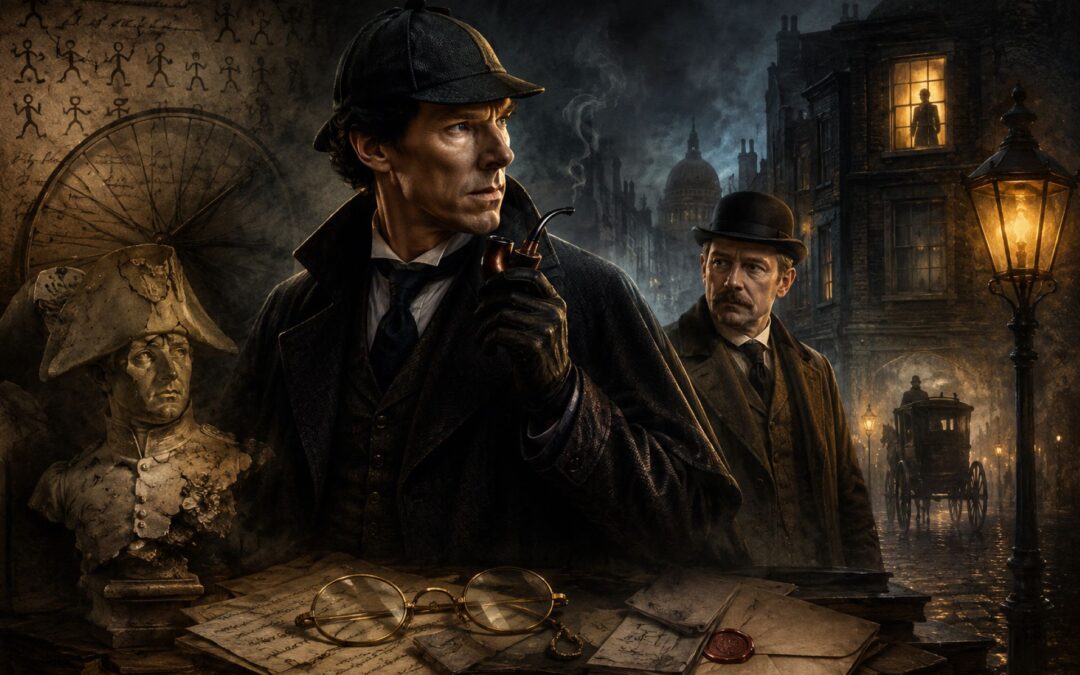
Arthur Conan Doyle had already given Sherlock Holmes one of the most famous exits in popular fiction when the detective apparently plunged to his death with Professor Moriarty at Reichenbach Falls. Doyle subsequently returned to Holmes in The Hound of the Baskervilles, but that novel was set before Reichenbach and therefore did not undo the detective’s death. The Return of Sherlock Holmes performs the more consequential act: it restores Holmes to the living chronology of the series, reunites him with Dr. Watson, and sends the pair through thirteen new investigations ranging from coded threats and blackmail to aristocratic kidnapping, murder, political espionage, and cases in which discovering the truth becomes less important than deciding what to do with it.
The collection appeared in book form in 1905. Its publication history records American and British editions issued that year, while the modern Oxford World’s Classics edition places the stories within Doyle’s reluctant but ultimately enormously successful revival of a character he had once tried to remove from his literary career. The result is not a novel with a continuous plot. It is a sequence of largely independent cases connected by Holmes, Watson, Baker Street, recurring police figures, and an increasingly important question about the detective’s authority: once Holmes knows what happened, is he always obliged to hand that truth over to the law?
This article covers all thirteen stories in full, including their solutions and endings. It therefore contains complete spoilers for the entire collection. The purpose is not merely to identify the culprit in each case, but to reconstruct how the mysteries develop, how Holmes reasons through them, what the stories reveal about Holmes and Watson after Reichenbach, and why several of the collection’s strongest cases complicate the simple idea that detective fiction is only about exposing the truth.

The Return of Sherlock Holmes: Complete Story-by-Story Summary
The collection begins with the explanation readers had been waiting for: how Sherlock Holmes survived Reichenbach Falls. From there Doyle returns to the episodic structure that made the Holmes stories famous, moving between London, country estates, schools, university lodgings, isolated houses, and diplomatic circles while varying the balance among puzzle, pursuit, melodrama, tragedy, and moral dilemma. Each case is self-contained, but taken together they show Holmes gradually becoming something more complicated than a brilliant solver of crimes.
The Adventure of the Empty House
The story opens in the spring of 1894, three years after Watson believes Sherlock Holmes died at Reichenbach Falls. London is preoccupied with the murder of the Honourable Ronald Adair, a respectable young man found dead in a locked room at 427 Park Lane. Adair has been shot in the head, but no weapon is found, no one reports hearing a gunshot, the door has been locked from the inside, and the open window presents no obvious route by which a conventional murderer could have approached. Money remains on the table beside lists of Adair’s winnings and losses at cards, so robbery provides no convincing explanation.
Watson, still deeply affected by Holmes’s death, visits the neighborhood because the case awakens the habits of thought he developed during their partnership. Near the house he collides with an elderly, stooped bookseller carrying volumes under his arm. The stranger later arrives at Watson’s home, ostensibly to apologize and offer books. When Watson turns away for a moment, the old man changes before him: the disguise disappears, and Sherlock Holmes stands alive in the room.
Watson is so overwhelmed that Holmes has to revive him. Once the first shock passes, Holmes finally explains Reichenbach. Moriarty did fall to his death, but Holmes himself never went over the precipice. After the struggle, Holmes realized that the visible tracks leading to the edge could be used to convince Moriarty’s criminal network that both men had died. He climbed away from the path and concealed himself, but one of Moriarty’s surviving associates detected the deception and tried to kill him from above. That attempt confirmed Holmes’s fear that returning openly to London would endanger him and perhaps Watson as well.
Only Mycroft Holmes knew that Sherlock remained alive. Holmes spent the following years traveling under assumed identities and keeping himself outside the reach of Moriarty’s remaining organization. His absence was therefore partly tactical. By allowing the criminal world to believe him dead, he could outlast or observe men who might otherwise have hunted him immediately.
The Adair murder brings him back because Holmes believes the case connects directly to the most dangerous survivor of Moriarty’s circle: Colonel Sebastian Moran. Moran is a former army officer and celebrated big-game hunter whose respectable social position conceals a criminal life. He is also an extraordinary marksman. Holmes believes that Moran has been waiting for an opportunity to kill him and that Ronald Adair’s mysterious death can be explained by the same specialized skill.
Holmes takes Watson to an empty house opposite 221B Baker Street. Across the road, the silhouette of Holmes appears at the familiar Baker Street window, apparently proving that he has openly returned home. In reality, it is a wax model. Mrs. Hudson periodically moves it so that anyone watching from outside will believe the figure is alive.
Holmes and Watson wait in darkness. Eventually Moran enters the empty house carrying a remarkable weapon: an air-gun capable of silently firing a revolver bullet. Moran aims across the street and shoots the wax figure. Holmes immediately attacks him, Watson helps subdue him, and Lestrade arrives with police officers to make the arrest.
The trap also explains Ronald Adair’s death. Holmes reconstructs that Adair had discovered irregularities involving Moran at cards and intended to confront him or expose him. Moran, whose social survival depended on secrecy, killed Adair from outside using the air-gun. The locked-room appearance was misleading because the murderer never needed to enter the room at all.
“The Empty House” accomplishes more than reversing Holmes’s death. Doyle turns the detective’s absence into part of the mystery and then makes Holmes himself the bait in the solution. Watson’s emotional response re-establishes the human center of the partnership, while Moran provides a final living connection to Moriarty. Holmes returns not by resuming ordinary life, but by staging his own second death and catching the man who has been waiting to complete what Reichenbach began.
The Adventure of the Norwood Builder
Some months after Holmes’s return, Watson has sold his medical practice and again shares the Baker Street rooms. Their renewed domestic arrangement is interrupted when a frantic young solicitor, John Hector McFarlane, arrives seeking help. Newspapers are already identifying him as the principal suspect in the disappearance and presumed murder of Jonas Oldacre, a wealthy retired builder living at Norwood.
McFarlane explains that Oldacre had unexpectedly visited his office and produced a handwritten will leaving virtually his entire estate to the young solicitor. McFarlane barely knew the man, though Oldacre had once been connected with his family. Oldacre then invited him to Norwood to complete legal business and insisted that the visit remain secret from McFarlane’s parents until everything was settled.
McFarlane spent the evening reviewing papers at Oldacre’s house. He later departed but accidentally left his walking stick behind. The following morning, Oldacre had vanished. A fire had burned in the woodpile behind the house, apparently reducing a body to fragments, and McFarlane’s stick was found among the incriminating circumstances. To Lestrade, the case appears straightforward: McFarlane learned that he would inherit Oldacre’s fortune and murdered him before the arrangement could be changed.
Holmes is less convinced. He investigates McFarlane’s family and discovers the history Oldacre had omitted. Years earlier Oldacre had wanted to marry McFarlane’s mother. She rejected him after recognizing cruelty and vindictiveness in his character. Oldacre apparently never forgave the humiliation.
The evidence nevertheless grows worse. A bloody thumbprint belonging to McFarlane is found on a wall inside Oldacre’s house. Lestrade regards it as conclusive proof. Holmes, however, knows something the police do not: he examined that wall the previous day, and the thumbprint was not there. McFarlane has been in custody ever since. The new clue therefore cannot prove his guilt. Instead, its appearance proves that somebody with access to his thumb impression is still actively manufacturing evidence.
Holmes also notices a discrepancy in the house’s dimensions. One corridor is shorter than the corresponding space should allow. Suspecting a concealed room, he stages a fire alarm. The supposedly murdered Jonas Oldacre bursts from hiding rather than risk being burned alive.
Oldacre’s plot combines personal revenge with financial fraud. His investments have gone badly, and Holmes believes he has been transferring money through an assumed identity, “Cornelius,” so that he can cheat his creditors, abandon his current identity, and begin again elsewhere. Faking his own murder would help him disappear. Framing McFarlane would simultaneously allow him to take revenge on the son of the woman who rejected him.
Oldacre constructed the scheme carefully. The will gave McFarlane an obvious financial motive. McFarlane’s secret evening visit placed him at the scene. Oldacre retained his walking stick and used blood, animal remains, and personal effects to create the impression that a body had been burned. He had also preserved McFarlane’s thumb impression and later used it to strengthen the case.
That final flourish ruins him. Without the newly planted thumbprint, Holmes admits, the deception might have remained extraordinarily difficult to break. Oldacre’s failure is not insufficient planning but excess: he cannot resist making a supposedly perfect frame-up even more perfect. In doing so, he introduces a piece of evidence that could only have been created after McFarlane was safely imprisoned, thereby revealing that the crime scene itself is lying.
The Adventure of the Dancing Men
Holmes’s next major case begins not with a corpse but with a sheet of paper covered in apparently childish figures. Hilton Cubitt, a Norfolk landowner, has brought Baker Street drawings showing little stick people in different poses. His wife Elsie reacts to these figures with terror, yet Cubitt does not know why.
Elsie is American. Before marrying Cubitt, she told him that there were things in her past of which she was ashamed, though she claimed she had done nothing personally dishonorable. She asked him never to question her about that past. Cubitt, devoted to her, agreed. When the dancing figures begin appearing around their property, he therefore faces a painful conflict: he knows they are connected with Elsie’s old life, but respecting his promise prevents him from demanding an explanation.
Holmes immediately suspects that the drawings constitute a cipher rather than random pictures. Some figures carry small flags, which he eventually recognizes as word separators or terminal marks. By comparing repeated clusters and applying frequency reasoning, Holmes begins identifying letters. As more messages arrive, the code becomes increasingly intelligible.
The process is a classic example of Holmes’s method because no single figure reveals anything. Meaning emerges from recurrence, position, and comparison. Once Holmes identifies a likely common letter and tests words against the context, the system begins to open. The dancing figures become readable messages from somebody attempting to communicate with Elsie.
Unfortunately, solving the code does not mean Holmes controls events. The messages become more threatening, and Holmes realizes that the situation in Norfolk may be approaching violence. He and Watson travel to Cubitt’s home, only to arrive after catastrophe.
Hilton Cubitt has been shot dead. Elsie has also been shot and is gravely wounded. The physical arrangement initially permits the suspicion that Elsie may have killed her husband and then attempted suicide, but Holmes sees evidence of another participant. A third person stood outside the window, shots were exchanged, and the crime cannot be explained as a simple domestic murder-suicide.
Holmes has now deciphered enough of the dancing-men alphabet to exploit it. He writes a message in the same code and sends it in Elsie’s name. The recipient comes to the house willingly because the message appears to be one only someone inside the secret could have written.
The man is Abe Slaney, an American who has followed Elsie from Chicago. He explains the history she concealed from Cubitt. Elsie’s father, Patrick, had been connected with an organized criminal group, and the dancing figures were its private code. Elsie grew up within that world but rejected it. Slaney had considered her effectively promised to him, while she came to fear and despise the life he represented.
Elsie fled America and created a new life in England. Her refusal to explain everything to Cubitt was not evidence that she had secretly remained criminal; it reflected shame, fear, and the desire to separate her marriage from the world she had escaped. Slaney’s arrival destroys that separation. He interprets her former connection to him as a permanent claim that her later choices cannot erase.
Elsie eventually agrees to meet Slaney in an attempt to persuade him to leave. Cubitt interrupts them. A gunfight follows, and Cubitt is killed. Slaney escapes, while Elsie is found wounded after attempting to take her own life in despair.
Holmes’s success is therefore incomplete. He solves the cipher, identifies Slaney, reconstructs the shooting, and prevents Elsie from being wrongly accused of murdering her husband. What he cannot do is solve the code quickly enough to prevent Cubitt’s death. The story’s tragedy depends on this difference between intellectual mastery and practical timeliness: Holmes can understand almost everything, yet understanding arrives after an irreversible human loss.
The Adventure of the Solitary Cyclist
Violet Smith comes to Holmes because of a mystery that initially seems more unsettling than criminal. After her father’s death, she and her mother have limited financial resources. Two men recently returned from South Africa, Bob Carruthers and Jack Woodley, contact them because they knew Violet’s uncle Ralph Smith, who is believed to have accumulated considerable property.
Carruthers employs Violet as a music teacher for his young daughter and pays her remarkably well. Woodley, by contrast, quickly reveals himself as vulgar, violent, and sexually aggressive. He attempts to force his attentions upon Violet until Carruthers intervenes and throws him out.
The more mysterious development occurs during Violet’s regular bicycle journey between Carruthers’s house and the railway station. Along an isolated stretch of road she repeatedly notices a man on another bicycle following her. He keeps his distance, retreats when she attempts to approach him, and appears to be watching rather than attacking her.
Watson is sent to observe the situation. He confirms that the cyclist exists but initially learns little about his identity. Holmes is irritated that Watson’s investigation does not answer the essential question of who the man is and why he follows Violet, but the case develops rapidly when Carruthers himself proposes marriage and Violet refuses. She is already engaged to Cyril Morton.
Woodley then reappears in the neighborhood, and Violet’s employment ends. On what should be one of her final journeys, she disappears. Holmes and Watson discover that the mysterious cyclist is Carruthers himself. He had been following Violet in disguise to protect her without revealing either the danger or his own emotional involvement.
The threat centers on Ralph Smith’s death and Violet’s inheritance. Carruthers and Woodley originally entered her life because they learned that she would become heir to a substantial fortune. Their initial plan was predatory: one of them would marry her and gain control over the money. Woodley was selected as the prospective husband, while Carruthers was supposed to help arrange the opportunity.
Carruthers’s feelings changed. Living with Violet caused him to fall genuinely in love with her, and he could no longer tolerate the original conspiracy. His affection is not entirely selfless—he admits he did not tell Violet the truth partly because he feared losing her—but it nevertheless places him in direct conflict with Woodley.
Woodley and the disgraced former clergyman Williamson abduct Violet and perform a forced marriage ceremony. Holmes points out that coercion does not transform the ceremony into the legal victory Woodley imagines, though the abduction and assault are serious crimes. Carruthers arrives and shoots Woodley, who survives.
The story ends by restoring Violet’s independence. She receives her inheritance and later marries Cyril Morton, the man she had chosen before the conspiracy attempted to turn marriage into a means of controlling her fortune. Woodley and Williamson receive prison sentences. Carruthers’s fate is less clearly emphasized, but Holmes recognizes that whatever his original guilt, he ultimately tried to prevent the crime he once helped set in motion.
The Adventure of the Priory School
Dr. Thorneycroft Huxtable, head of the prestigious Priory School, arrives at Baker Street in a state of near collapse. One of his pupils, Lord Saltire, the young son of the Duke of Holdernesse, has disappeared. A German master named Heidegger vanished on the same night.
The stakes are high not only because the missing child belongs to one of Britain’s great aristocratic families but because the disappearance threatens Huxtable’s institution. The Duke offers an enormous reward for recovering his son and identifying the kidnappers. Holmes and Watson travel to the north of England and begin working outward from the school.
Evidence indicates that Lord Saltire left willingly enough to avoid creating an immediate disturbance. Heidegger appears to have followed him on a bicycle. Holmes tracks bicycle marks across the moor and eventually finds the schoolmaster dead, his skull smashed.
The landscape presents another puzzle. Holmes and Watson repeatedly encounter marks that appear to be cattle tracks, but they never actually see cattle. More strangely, the tracks show patterns corresponding to walking, trotting, and galloping. Holmes realizes that the supposed cow is behaving like a horse.
The explanation lies at the Fighting Cock inn, operated by Reuben Hayes, a former servant of the Duke who hates his old employer. Horses at the inn have specially shaped shoes that create misleading cloven prints. The false cattle tracks allowed the kidnappers to move across the moor while obscuring the real route.
The investigation eventually leads beyond Hayes to James Wilder, the Duke’s secretary. Wilder is not merely an employee. He is the Duke’s illegitimate elder son, born from a relationship the Duke had before his formal marriage. The Duke has kept Wilder close out of affection for Wilder’s mother and guilt about their history, but Wilder has grown resentful of Lord Saltire, the legitimate younger child who can inherit the title and estate.
Wilder uses the Duchess’s name to lure Lord Saltire from the school. He tells the boy that his mother wishes to see him and arranges for Hayes to provide a horse. Heidegger sees enough to pursue them. Hayes kills the schoolmaster during the chase and takes the boy to the Fighting Cock.
Wilder’s motives combine emotional resentment with inheritance. He believes social law has denied him a position that by age and blood should have been his. He hopes to use Lord Saltire’s captivity as leverage to persuade the Duke to break the entail or otherwise rearrange the inheritance in Wilder’s favor.
The scheme changes after Heidegger’s death. Wilder is horrified by the killing, confesses to his father, and begs for enough time to allow Hayes to escape. The Duke agrees, compounding the original crime. He even leaves his legitimate son hidden at the inn for several additional days because revealing the boy’s location to the police would expose Wilder and Hayes.
Holmes reacts with unusual severity. He distinguishes between the Duke’s understandable love for an illegitimate son and the indefensible choice to endanger an innocent child while helping a murderer escape. Hayes is ultimately arrested. Lord Saltire is recovered safely, and Wilder is sent away from England.
The story therefore begins as an elaborate tracking puzzle and ends as an indictment of privilege used to obstruct consequences. Holmes solves the physical riddle of the strange tracks, but the more disturbing discovery is that the Duke’s social power allows him to imagine that scandal can be privately managed even after kidnapping and murder have occurred.
The Adventure of Black Peter
Stanley Hopkins, a young Scotland Yard detective whom Holmes regards as promising, asks for help with the savage murder of Peter Carey. Carey was a former whaling captain nicknamed Black Peter because of his violent temper. He lived with his family but spent much of his time in a detached cabin, where he drank, kept records, and isolated himself.
Carey has been found dead inside the cabin, killed by a harpoon driven through his body with such force that it penetrated the wall behind him. The grotesque violence naturally dominates the scene, but Holmes becomes interested in details that Hopkins has not integrated into a complete theory.
Among the evidence is a notebook bearing initials connected with securities. The trail leads to John Hopley Neligan, a nervous young man whose father disappeared years earlier after a banking failure involving missing assets. Neligan is caught trying to examine Carey’s records and admits that he hoped to learn what happened to his father and the securities.
Hopkins believes Neligan’s presence provides the solution. Holmes objects that it leaves too much unexplained. A man capable of driving a harpoon through Carey’s body and into a wall would need extraordinary strength and familiarity with the weapon. The killer also drank rum even though other alcohol was available, suggesting maritime habit rather than an arbitrary choice.
Holmes conducts his own physical experiments with a harpoon and confirms how difficult the killing would have been. He then places an advertisement offering employment to experienced harpooners. Several men appear at Baker Street, where Holmes identifies the one he wants: Patrick Cairns.
Cairns had served with Carey at sea. His confession reveals the older history behind the murder. Years earlier, Neligan’s father had been picked up by Carey’s ship while carrying a box of securities. Carey eventually disposed of him and kept the valuable papers.
Cairns knew the secret and later confronted Carey. Their meeting became violent. Carey reached for a weapon, and Cairns killed him with the harpoon. He took the box he believed contained something valuable, while Neligan entered the cabin separately in his own attempt to discover the truth about his father. The overlap of these two independent visits created the misleading case against the young man.
Holmes’s achievement lies less in discovering an exotic clue than in refusing an incomplete explanation. Neligan has motive to search the cabin and leaves incriminating evidence, but he does not physically fit the murder. Hopkins’s error is to stop when he finds a plausible suspect; Holmes continues until every major feature of the scene belongs to the same causal story.
The Adventure of Charles Augustus Milverton
Charles Augustus Milverton is not difficult to identify as a criminal. The problem is that much of what he does is designed to remain technically outside the kind of crime Holmes can simply solve and hand to the police.
Milverton is a professional blackmailer. He buys private correspondence, waits until exposure will cause maximum damage, and demands money from people whose marriages, social positions, or families can be destroyed by scandal. Holmes describes him with an intensity of disgust unusual even for a detective accustomed to murderers.
Holmes is representing Lady Eva Blackwell, who is about to marry and is being threatened with letters from an earlier period of her life. Milverton knows she cannot afford public disclosure and sets his price accordingly. Holmes attempts negotiation, but Milverton’s business depends precisely on refusing humane compromise.
Unable to solve the problem legally, Holmes decides to commit burglary. He first spends weeks gathering information about Milverton’s household. In one of the story’s more ethically uncomfortable episodes, he disguises himself as a working man named Escott and becomes engaged to Milverton’s maid Agatha in order to learn the rhythms of the house. Watson objects to the cruelty of misleading the woman; Holmes treats the deception as operational necessity.
Holmes and Watson break into Appledore Towers intending to steal the blackmail material. They hide when Milverton unexpectedly receives a late-night visitor. A veiled woman enters and reveals that Milverton previously destroyed her life by exposing private material.
She has not come to bargain. After confronting him, she shoots Milverton repeatedly and leaves him dead. Holmes and Watson watch from concealment. They do not attempt to capture her.
Holmes then opens Milverton’s safe and burns letters and documents that could ruin his other victims. He and Watson escape as the household awakens.
The next day Lestrade visits Baker Street and asks Holmes to help identify Milverton’s killer. Holmes refuses. He says, in effect, that his sympathies are not with the dead blackmailer. Later, when Holmes recognizes the woman in a society photograph, he still does not reveal her identity.
This is one of the clearest turning points in the collection’s moral conception of Holmes. He is no longer merely solving a puzzle before the police can solve it. He knowingly commits burglary, destroys another man’s property, protects a murderer, and suppresses evidence because he believes formal law would produce an outcome less just than the one he chooses himself.
The story does not make the ethical problem disappear simply because Milverton is monstrous. Holmes has assumed a power that neither Scotland Yard nor any court has given him. What makes the story compelling is precisely that Doyle makes readers understand why he does it while also showing how far the detective has moved beyond the role of neutral investigator.
The Adventure of the Six Napoleons
Lestrade brings Baker Street a case that seems absurd. Someone has been destroying cheap plaster busts of Napoleon Bonaparte. The attacks appear to suggest an irrational fixation on the French emperor, perhaps a case of madness rather than conventional crime.
The pattern changes when one broken bust is connected with the death of Pietro Venucci. Holmes becomes interested not in Napoleon but in the objects themselves. He traces where the busts were manufactured, which businesses sold them, and how six examples from the same batch were distributed.
The apparent obsession is actually a search. The culprit, Beppo, is an Italian craftsman and criminal who had access to the busts while they were still being made. Before an arrest for another offense, he came into possession of the famous black pearl of the Borgias. Needing somewhere to hide it quickly, he pushed the pearl into the soft plaster of one Napoleon bust.
After his release from prison, Beppo knows the jewel lies inside one of six busts but does not know which one. He therefore has to find and smash them individually. What looks like irrational hatred of Napoleon is entirely rational behavior once the hidden object is known.
Holmes predicts the remaining sequence by reconstructing the sales chain. He catches Beppo during one attempted recovery and then purchases the last bust himself. At Baker Street he breaks it open in front of Watson and Lestrade, and the black pearl falls from the plaster.
The mystery is elegant because Doyle makes readers ask the wrong psychological question. Why would anyone hate Napoleon enough to smash his image? Holmes instead asks what all the busts share materially. Their subject is a distraction; their manufacturing history is the clue.
The ending adds an important character moment. Lestrade tells Holmes that Scotland Yard may resent or argue with him at times, but its detectives are proud of him. Holmes, who often treats official praise with indifference, is genuinely affected. Beneath the competitive banter, his relationship with the police has matured into a form of mutual professional recognition.
The Adventure of the Three Students
While Holmes and Watson are temporarily staying in an unnamed university town, a tutor named Hilton Soames arrives with a scandal that could compromise an important examination. Proofs of a Greek translation paper were left briefly unattended in Soames’s rooms, and someone appears to have examined or copied them.
Only three students living nearby are obvious possibilities. Daulat Ras is quiet and diligent. Miles McLaren is intelligent but undisciplined. Gilchrist is a tall, athletic student whose family has suffered financial decline. Soames is desperate to identify the intruder without publicly damaging the college.
The physical evidence is modest: pencil shavings, a cut or scratch on the desk, a small lump of dark clay, and the strange behavior of Soames’s servant Bannister. Holmes studies the arrangement of the rooms rather than beginning with the students’ personalities.
The decisive fact is height. A sufficiently tall person passing the window could glimpse the examination papers and realize that an opportunity existed. Gilchrist, an accomplished jumper, fits that requirement. The marks and clay also connect with his athletic activities.
Gilchrist entered the room and began copying the examination material. When Soames returned unexpectedly, he hid in the bedroom. In his haste he left a glove behind. Bannister, who had once served Gilchrist’s father, recognized the glove and understood what had happened. He sat in a position that concealed the evidence and later allowed Gilchrist to escape.
Bannister’s loyalty is not simply an attempt to help the young man cheat. He also appeals to Gilchrist’s better nature. By the time Holmes exposes him, Gilchrist has already decided not to sit the examination and has accepted a position abroad.
Holmes therefore solves the offense without pushing for the harshest conceivable punishment. The story is small compared with the murders surrounding it, but that scale matters. It reinforces the idea that Holmes’s interest is not always identical with prosecution. Once guilt is known, character and response still matter.
The Adventure of the Golden Pince-Nez
Stanley Hopkins returns with the murder of Willoughby Smith, secretary to the elderly scholar Professor Coram at Yoxley Old Place. Smith has been stabbed with a paper knife. The most striking object at the scene is a pair of golden pince-nez torn from the attacker’s face.
Holmes builds a portrait of the glasses’ owner from the object itself. The lenses imply severe short-sightedness. Their construction and wear offer clues about facial shape and appearance. The deduction is impressive, but the greater mystery is spatial: how did an unknown intruder enter the house, kill Smith, and apparently vanish?
The layout creates a critical constraint. A severely short-sighted person who loses her glasses while fleeing would have difficulty navigating unfamiliar passages. Holmes begins to suspect that the killer never successfully escaped.
Professor Coram appears old, weak, self-absorbed, and heavily dependent on cigarettes and food. Holmes notices small inconsistencies in the household, including signs that more food is being consumed than Coram alone should require. He eventually manipulates the room so that a trail of cigarette ash helps reveal movement toward a concealed space.
The hidden woman is Anna, Professor Coram’s estranged wife. Their history reaches back into Russian revolutionary politics. Coram had once belonged to a political circle but betrayed his associates to protect himself and profit from the situation. Anna was arrested and sent into exile.
Another member of their circle, Alexis, was especially dear to Anna. He opposed violence, and letters and diary entries could have helped establish his position. Coram obtained and retained those documents. Alexis was nevertheless condemned to Siberian punishment.
After Anna regained her freedom, she came to England determined to recover the papers that might help Alexis. She had already placed another agent inside Coram’s household as secretary, but that attempt failed. She eventually entered the house herself.
Willoughby Smith surprised her during the search. A struggle followed, and she stabbed him without having entered the house intending to kill him. In losing her pince-nez she became nearly helpless. Instead of finding the exit, she stumbled into Coram’s room.
Coram, despite their history, concealed her. That explains the apparently impossible disappearance. Anna has been hidden inside the house while Holmes and the police investigated around her.
She eventually secures the documents but has taken poison and is dying. Her confession transforms the case from a country-house murder into a story about betrayal whose consequences have crossed national borders and decades. The pince-nez solves the immediate physical mystery, but the real explanation lies in a past that respectable English domestic space has been hiding.
The Adventure of the Missing Three-Quarter
Cyril Overton, captain of a Cambridge rugby team, arrives at Baker Street shortly before an important match because one of his best players has disappeared. Godfrey Staunton, the team’s right-wing three-quarter, received a message at the hotel and abruptly left.
To Overton, the crisis is partly sporting: losing Staunton may cost Cambridge the match. Holmes, whose interest in rugby is minimal, nevertheless becomes curious because the disappearance appears deliberate but unexplained. Staunton’s wealthy uncle Lord Mount-James also introduces a possible financial motive, though the old aristocrat is notorious for his unwillingness to part with money.
Holmes’s attention eventually turns to Dr. Leslie Armstrong, an accomplished physician and intellectual who clearly knows what has happened. Armstrong refuses to cooperate and proves capable of detecting and defeating Holmes’s attempts at surveillance. Rather than behaving like a guilty criminal, he behaves like a man protecting a confidence.
Holmes eventually overcomes the evasion with Pompey, a tracking dog. Armstrong has deliberately taken circuitous routes to conceal his destination, but the scent trail leads Holmes and Watson to a secluded cottage.
What they find overturns the assumptions created by the word “missing.” Staunton has not been kidnapped, blackmailed, or murdered. He has secretly married a woman of modest social standing, fearing that Lord Mount-James would punish or disinherit him if the marriage became known. His wife has become gravely ill.
Armstrong has been helping the couple keep the marriage secret and care for the dying woman. Staunton abandoned his team because his wife mattered more than the match. When Holmes reaches the cottage, the woman has died, and Staunton is broken by grief.
The story ends without a triumphant exposure. Holmes recognizes that the truth belongs primarily to the bereaved man, not to public curiosity. The case therefore becomes one of the collection’s gentlest examples of discretion: successful detection gives Holmes knowledge, but knowledge does not automatically give him the right to broadcast it.
The Adventure of the Abbey Grange
Stanley Hopkins summons Holmes and Watson to the Abbey Grange in Kent after the death of Sir Eustace Brackenstall. The apparent explanation is immediate. Sir Eustace’s wife, Lady Mary, has been found tied to a chair, while her husband lies dead from a crushing blow. Lady Mary says that the notorious Randall burglary gang attacked the house.
Her account is plausible enough to satisfy Hopkins, but Holmes becomes uneasy. Several details do not fit. The bell-rope used to bind Lady Mary has been cut in a manner inconsistent with the reported sequence. The condition of the wine glasses suggests manipulation. The burglars also seem to have behaved in oddly theatrical ways.
A second line of inquiry concerns the marriage itself. Lady Mary’s maid Theresa reveals that Sir Eustace was a violent alcoholic who abused and humiliated his wife. Lady Mary, who came from Australia, is trapped in a socially prestigious but brutal marriage.
Holmes traces her earlier voyage from Australia and learns about Captain Jack Crocker, a sailor who met Mary when she was still Mary Fraser. Crocker fell deeply in love with her, but she did not then promise herself to him. She later married Sir Eustace.
When Crocker returned to England and learned how Sir Eustace treated her, he renewed contact. Lady Mary eventually refused further meetings because she wanted to preserve the boundaries of her marriage, but Crocker arranged to see her one final time before returning to sea.
Sir Eustace interrupted them. He attacked his wife and confronted Crocker. During the fight Crocker killed him with a heavy object. Theresa then helped Crocker and Lady Mary construct the false burglary narrative, using the Randalls as convenient imaginary culprits.
Holmes finds Crocker and secures a confession. He then deliberately tests him by suggesting that he could simply leave England. Crocker refuses to abandon Lady Mary to face the consequences alone. His willingness to remain confirms Holmes’s favorable judgment of his character.
The detective then turns Baker Street into an improvised court. Holmes declares himself judge and asks Watson to act as jury. Watson pronounces Crocker not guilty, and Holmes allows him to go.
The scene makes explicit what “Charles Augustus Milverton” had already implied. Holmes no longer sees himself as a machine for delivering every offender to the police. He distinguishes homicide from murder in the moral sense, weighs abuse and self-defense, judges the people involved, and substitutes his own conception of justice for formal procedure.
Whether readers admire that decision or find it dangerously presumptuous, Doyle does not hide what Holmes is doing. He knowingly claims authority that belongs to a court.
The Adventure of the Second Stain
Watson introduces the final story with an air of closure. Holmes, he says, has retired from London and turned to bee-farming on the Sussex Downs. Watson had initially intended to end his public accounts elsewhere, but Holmes has permitted him to tell one especially important international case.
The case begins when Prime Minister Lord Bellinger and Trelawney Hope, the Secretary for European Affairs, come privately to Baker Street. A highly sensitive state document has disappeared from Hope’s locked dispatch box. The contents are so dangerous that disclosure could trigger a grave diplomatic crisis and potentially destabilize relations among European powers.
Only a tiny number of people should know the document exists. Hope insists that he did not knowingly leave it unsecured. Holmes therefore faces a theft whose consequences far exceed an ordinary crime.
His initial search intersects with another mystery. Eduardo Lucas, a man connected with international intrigue, has been murdered in his home. Holmes suspects that Lucas may have been an intermediary connected with the stolen paper, but the murder complicates rather than resolves the case.
Lady Hilda Trelawney Hope, the minister’s wife, privately visits Holmes. She urgently wants to know what would happen if the missing paper were not recovered. Her anxiety immediately makes Holmes suspect that she knows far more than she admits.
At Lucas’s house, Holmes discovers a subtle physical contradiction. A bloodstain on a carpet no longer aligns correctly with a corresponding mark underneath. The carpet has been moved after the murder and later put back. Beneath it is a concealed hiding place.
Holmes confronts Lady Hilda. She confesses that Lucas had been blackmailing her with an indiscreet letter from before her marriage. He demanded the government document in exchange for returning the letter. Terrified that disclosure would destroy her husband’s trust and happiness, Lady Hilda made an impression of the dispatch-box key, obtained a duplicate through Lucas, stole the paper, and delivered it to him.
During their meeting at Lucas’s house, another woman arrived. She was connected with Lucas and, in a jealous rage, attacked him. Lady Hilda fled while the struggle occurred. Lucas had already hidden the diplomatic paper beneath the floor covering.
Only afterward did Lady Hilda understand the potential international consequences of her theft. Horrified, she returned to Lucas’s house and recovered the document from its hiding place. In doing so she disturbed the carpet and bloodstain, creating the discrepancy Holmes notices.
Her remaining problem is impossible to solve openly. She possesses the missing paper but cannot return it without admitting that she stole it. Confession would expose the older letter and could destroy her marriage.
Holmes again chooses concealment. He arranges for Lady Hilda to replace the paper inside her husband’s dispatch box. When the ministers return, Holmes encourages them to search again. The supposedly stolen document is found where Hope believes it must somehow have remained all along.
The international danger is removed. Lady Hilda’s marriage is protected. The formal truth is never disclosed.
As the collection’s final case, “The Second Stain” is therefore strikingly appropriate. Holmes begins The Return of Sherlock Holmes by revealing a secret about himself that he has kept for years. He ends the collection by preserving someone else’s secret after solving a case of national importance. Detection has become inseparable from discretion.
Holmes Returns—and the Holmes Legend Changes
Bringing Holmes back from Reichenbach could easily have produced a collection devoted only to restoring a successful formula. Doyle does restore that formula, but the returned Holmes is repeatedly placed in situations that test more than his powers of deduction. The stories also become unusually conscious of Holmes’s fame, Watson’s publication of the cases, and the detective’s uneasy relationship with institutions that admire his abilities but cannot share his freedom.
The Oxford World’s Classics edition emphasizes this self-conscious quality of the revival: Doyle was writing for an audience that already knew exactly who Sherlock Holmes was. The stories therefore do not need to create the detective from scratch. They can instead play with his legend, his methods, his theatrical habits, and the consequences of making one private investigator intellectually superior to almost everyone around him.
Sherlock Holmes After Reichenbach
Holmes’s first act after returning is itself an elaborate piece of detective theater. He appears to Watson in disguise, plants a wax double at Baker Street, predicts Moran’s behavior, and turns his own public resurrection into a trap. The sequence reminds readers that disguise and stage management are as important to Holmes as laboratory analysis. He does not merely observe performances by criminals; he constructs performances of his own.
His appetite for difficult problems also returns immediately. In “The Norwood Builder,” Holmes jokes that eliminating Moriarty has made London less interesting from a criminal specialist’s point of view. The remark is comic but revealing. Holmes’s intellectual life depends on resistance. He needs problems substantial enough to absorb the extraordinary energy Watson repeatedly describes.
That need helps explain Holmes’s selective attitude toward clients. Wealth and social position do not automatically impress him. “The Priory School” offers an enormous reward, but the intellectual challenge and moral stakes matter more than money. “Black Peter” similarly presents Holmes as an artist of detection who may devote immense effort to a case because its structure interests him.
Yet the most important development is ethical rather than intellectual. Holmes increasingly acts on the belief that discovering the truth and delivering it to the authorities are separate decisions. In “The Three Students,” he allows repentance to matter. In “The Missing Three-Quarter,” he respects private grief. In “Charles Augustus Milverton,” he destroys evidence and protects a killer. In “The Abbey Grange,” he openly declares himself judge. In “The Second Stain,” he engineers an official misunderstanding in order to save Lady Hilda’s marriage and avert a political disaster.
These choices make Holmes more humane but also more powerful in a troubling way. He does not simply recognize that law can be imperfect; he assumes that his own judgment is sufficient to decide when law should be bypassed. Doyle often structures the cases so that readers sympathize with him, but the principle remains dangerous. A man brilliant enough to discover hidden truth is not automatically entitled to determine the consequences of that truth.
Holmes is therefore at his most interesting in this collection when he is least machine-like. His celebrated rationality remains intact, yet his solutions increasingly depend on moral evaluation, personal sympathy, and discretion. Reichenbach has not transformed him into another person, but the revived stories allow the detective’s authority to expand beyond deduction.
Watson as Friend, Witness, and Storyteller
Watson’s reaction to Holmes’s return establishes immediately that the partnership is emotional before it is procedural. He has spent years believing his friend dead. When Holmes removes the bookseller disguise, Watson does not respond like a fellow investigator receiving new evidence; he nearly collapses from the shock of recovering someone whose loss has marked his life.
That depth is especially significant when compared with Holmes and Watson’s first case in A Study in Scarlet. Their relationship began as a practical arrangement between two men sharing rooms. By The Return of Sherlock Holmes, Watson’s loyalty is strong enough that Holmes can reappear after years of silence, ask him to enter a dangerous ambush almost immediately, and reasonably expect him to come.
Watson remains less analytically gifted than Holmes, but reducing him to a foolish companion misses his function. He supplies emotional scale. “The Dancing Men” becomes more tragic because Watson registers the human cost of arriving too late. “The Missing Three-Quarter” changes tone because Watson understands Staunton’s grief. “The Abbey Grange” requires Watson not merely as chronicler but as the moral juror Holmes trusts to validate his decision.
He also participates in ethically questionable conduct. Watson helps burglarize Milverton’s house. He watches the blackmailer’s killer escape. He agrees to the private acquittal of Crocker. His loyalty to Holmes repeatedly outweighs instinctive obedience to law.
That complicity matters because Watson’s narration helps recruit the reader into Holmes’s moral universe. Holmes may make the extraordinary judgment, but Watson is often the person who renders it emotionally acceptable. When Watson agrees that Crocker is “not guilty,” the scene gives Holmes something resembling community validation rather than leaving him entirely alone with his authority.
Watson is also conscious that he is writing for a public already fascinated by Holmes. Several stories refer to unpublished cases, restrictions Holmes has placed on publication, or the difficulty of selecting from enormous case records. This self-consciousness turns Watson into more than a transparent narrator. He is the curator of the Holmes legend, deciding which adventures become the version of Sherlock Holmes readers know.
Lestrade, Stanley Hopkins, and the Official Police
The collection’s police officers are not simply incompetent foils. Lestrade in particular has developed a working relationship with Holmes based on accumulated experience. He may still bring cases that puzzle Scotland Yard, but by “The Six Napoleons” the rivalry has softened into genuine professional respect.
Lestrade’s praise after the recovery of the Borgia pearl is unusually important because Holmes values it. The detective is often dismissive of official opinion, yet recognition from someone who has repeatedly witnessed his methods affects him emotionally. Doyle allows competition and respect to coexist.
Stanley Hopkins plays a somewhat different role. Holmes sees him as talented and promising, which makes Hopkins’s errors useful demonstrations of what separates competent investigation from Holmes’s method. In “Black Peter,” Hopkins finds a suspect with a plausible motive and incriminating evidence, but Holmes insists that the theory must also explain the physical nature of the killing. In “The Abbey Grange,” Hopkins accepts an apparently recognizable burglary pattern, while Holmes asks whether the details actually behave as that pattern requires.
The difference is therefore not that the police collect no evidence. It is that they sometimes decide what the evidence means too early. Holmes’s superiority lies in preserving multiple explanations until one account can absorb the contradictions.
There is also an institutional difference. Lestrade and Hopkins are police officers whose discoveries belong to a legal process. Holmes has far greater freedom. That freedom allows him to solve cases the police misunderstand, but it also enables him to withhold offenders and evidence when he dislikes what official justice would do. The same independence that makes him effective makes him impossible to control.
The Social World of the Cases: London, Country Houses, Class, and Empire
Although Sherlock Holmes is associated above all with foggy London streets and 221B Baker Street, much of The Return of Sherlock Holmes takes place in environments where social hierarchy matters as much as geography. Country houses, schools, university rooms, private estates, aristocratic offices, and secluded cottages become crime scenes because they contain systems of dependence: servants know what employers conceal, heirs compete over property, wives have fewer avenues of escape, reputations determine futures, and institutions fear scandal almost as much as crime.
London remains the investigative center. Baker Street functions as Holmes’s laboratory, consulting room, theater, and place of refuge. Clients arrive with fragments of reality that make no sense in their original environments. Holmes receives those fragments, reorganizes them, and then moves outward into the world where the physical evidence can be tested.
The contrast between Baker Street and the country is especially effective in “The Priory School,” “The Abbey Grange,” and “The Golden Pince-Nez.” Large houses initially communicate stability and respectability, yet each conceals dangerous relationships. The Duke of Holdernesse’s estate hides illegitimacy, resentment, and a willingness to obstruct justice. Abbey Grange hides domestic abuse behind wealth and title. Professor Coram’s quiet scholarly household conceals a revolutionary betrayal that began far from England.
Inheritance repeatedly turns family relationships into material conflicts. James Wilder hates Lord Saltire not simply as a younger half-brother but as the legitimate heir whose existence embodies Wilder’s exclusion. Violet Smith becomes vulnerable because men expect marriage to give them access to her future fortune. Oldacre exploits inheritance as part of the false motive he constructs for McFarlane.
Marriage is equally important because it is not treated merely as romance. It is a social institution capable of providing security, money, reputation, or imprisonment. Elsie Cubitt tries to protect her English marriage from an American past. Violet is nearly forced into marriage because of property. Lady Mary Brackenstall’s prestigious marriage becomes a site of violence from which formal respectability offers little protection. Lady Hilda fears that revelation of her past could destroy her husband’s trust even though the political consequences of her theft are objectively enormous.
Servants occupy a particularly revealing position. Bannister knows the truth about Gilchrist because of old family loyalty. Theresa helps Lady Mary construct the Abbey Grange deception because she has witnessed Sir Eustace’s abuse. Oldacre’s housekeeper assists or enables his concealment. Milverton’s maid becomes a source of intelligence because Holmes deliberately exploits her access to the household.
The collection is also much more international than its image of Victorian or Edwardian English domesticity might suggest. “The Solitary Cyclist” begins with men returning from South Africa. “Black Peter” depends on maritime travel and finance. “The Golden Pince-Nez” imports Russian revolutionary politics into an English country house. “The Six Napoleons” involves Italian characters and the Borgia pearl. “The Second Stain” turns a domestic secret into a European diplomatic crisis.
These connections reflect the globally entangled British world in which Doyle was writing, but the representations are not neutral social documentation. Nationality, class, empire, and foreignness are sometimes rendered through assumptions or stereotypes that modern readers should recognize as period constructions rather than objective descriptions. The British Library’s discussion of Sherlock Holmes’s place in literary detective fiction helps situate the stories within a culture fascinated by scientific observation, modern policing, mobility, and the apparently readable traces left by people moving through an increasingly interconnected society.
What makes the social setting important to the mysteries is that Doyle rarely treats crime as something entirely outside respectable life. A blackmailer feeds on aristocratic fear of scandal. An illegitimate son turns inheritance law into motive. A minister’s wife steals a diplomatic document because private reputation seems more immediate to her than geopolitical danger. A violent husband can remain socially protected until an unofficial detective decides his killer does not deserve prosecution.
Holmes’s cases repeatedly reveal that the reassuring surface of order depends on things people have agreed not to say. The detective’s genius is partly the ability to enter those silences and determine what they contain.
Secrecy, Evidence, and the Limits of Detection
The collection constantly distinguishes between possessing a clue and understanding how that clue came into existence. Doyle creates mysteries by making objects appear to say one thing while their histories say another: a thumbprint proves innocence rather than guilt, cattle tracks belong to horses, smashed Napoleon busts indicate not madness but a treasure hunt, and a bloodstain reveals that a room has been rearranged after a murder.
Holmes’s method succeeds because he is suspicious not only of witnesses but of evidence itself. Physical traces are real, but their meaning can be manufactured, misunderstood, or stripped of context. His task is therefore reconstructive: he asks what sequence of actions would have produced the complete pattern.
Clues That Must Be Interpreted, Not Merely Found
“The Norwood Builder” provides the clearest example of deliberately fabricated evidence. McFarlane’s thumbprint is genuine in the narrowest sense: the impression really is his. What is false is the story implied by its location. Because Holmes knows it appeared only after McFarlane’s arrest, the print becomes proof that someone has staged the scene.
That distinction between authenticity and meaning is central to Doyle’s detective craft. A clue need not be forged to deceive. It can be genuine material placed in a false context.
“The Priory School” applies the same principle to tracks. Holmes initially accepts the marks as signs of cattle because that is what their shape suggests. The inconsistency comes from movement: the “cow” appears capable of gaits that expose it as a disguised horse. A clue that seems natural becomes artificial once its behavior is considered over time.
“Black Peter” works through physical plausibility. The notebook and securities draw attention toward Neligan, but Holmes insists that the murder weapon must be taken seriously as more than a dramatic prop. The force required to use the harpoon, combined with the choice of rum, points toward a man formed by maritime experience. Holmes does not discard the documentary evidence; he refuses to let it erase the bodily facts.
“The Six Napoleons” reverses an apparent psychological clue. Repeated destruction of Napoleon busts invites a diagnosis of obsession. Holmes instead reconstructs the supply chain. Once the six busts are understood as members of one manufacturing batch, the destruction becomes a search through containers rather than an attack on symbols.
“The Three Students” is smaller in scale but similarly rigorous. Holmes uses the position of the window, Gilchrist’s unusual height, the desk marks, pencil debris, and clay to establish not only who entered the room but how opportunity became temptation. Bannister’s behavior then supplies the human explanation for why the evidence was partially concealed.
“The Golden Pince-Nez” begins with unusually rich deduction from a single object, but the deeper breakthrough comes from space. A severely short-sighted intruder who loses her glasses should have difficulty finding her way out of an unfamiliar house. If no escape route makes sense, Holmes considers the possibility that there was no escape.
“The Second Stain” compresses the principle into a bloodstain. The stain is genuine; its misalignment is the clue. Somebody moved the carpet after the murder, which means the apparently settled crime scene contains a later intervention. That intervention leads to Lady Hilda.
Across these cases, Holmes’s real advantage is not simply noticing more. He repeatedly asks what must have happened before the clue became visible.
Letters, Ciphers, Disguises, and Hidden Spaces
Information in The Return of Sherlock Holmes is constantly encoded, stored, hidden, stolen, destroyed, or impersonated. The dancing-men cipher makes that process literal. Elsie’s past is inaccessible until Holmes learns to read the figures, and the same system that Slaney uses to exert control becomes the mechanism by which Holmes traps him.
Documents carry enormous power. Milverton’s letters can destroy marriages without proving any conventional criminal charge. Professor Coram’s retained letters and diary determine whether Alexis remains condemned. The examination paper in “The Three Students” can transform a moment of temptation into academic fraud. The diplomatic document in “The Second Stain” could alter international relations.
Because documents are powerful, physical spaces are repeatedly designed to hide them or the people connected with them. Oldacre builds a secret compartment into his house and uses his professional knowledge as a builder to hide himself. Professor Coram conceals Anna within the domestic space investigators believe they have already searched. Lucas uses a hiding place under the carpet for the stolen state paper.
Disguise operates in parallel. Holmes survives partly by making the world think he is dead and then reappears to Watson as a bookseller. He infiltrates Milverton’s household as Escott. Carruthers becomes the mysterious cyclist because he wants to protect Violet without revealing himself. Respectable identities elsewhere conceal criminal pasts, illegitimacy, abuse, betrayal, or secret marriages.
These devices are not interchangeable symbols so much as variations on a practical theme: information is power because people act on what they believe to be true. A disguised person, hidden room, coded message, or concealed letter changes behavior by controlling who knows what.
That idea also explains the limits of detection. Holmes can decode almost anything, but “The Dancing Men” shows that speed matters. A perfect interpretation after violence has occurred cannot undo the violence. “The Missing Three-Quarter” raises another limit: even when Holmes finds the truth, solving the intellectual problem does not mean the truth should be exposed.
The collection gradually turns secrecy from something Holmes defeats into something he sometimes protects.
Law, Justice, Mercy, and Holmes as a Private Judge
Detective fiction normally produces a comforting sequence: disorder occurs, evidence is gathered, guilt is discovered, and the criminal is delivered to authority. Several stories in The Return of Sherlock Holmes interrupt that sequence. Holmes increasingly treats the legal consequence of a discovery as a separate problem requiring its own judgment.
“The Priory School” offers an early version of the distinction. James Wilder is morally responsible for a kidnapping that leads to Heidegger’s death, even though he did not personally strike the fatal blow. The Duke tries to separate legal responsibility from moral causation and uses family loyalty to justify giving Hayes time to escape. Holmes condemns him, particularly for leaving Lord Saltire exposed to further danger.
Here Holmes appears aligned with stricter justice than the aristocrat attempting to contain scandal. Yet his own conduct elsewhere shows that he does not regard the law as inherently authoritative. What matters to him is whether legal action would correspond with his moral understanding of the case.
“The Three Students” is relatively mild. Gilchrist has attempted academic dishonesty but repents before gaining from it. Bannister’s loyalty helps him recover his conscience. Holmes exposes the truth to the people who need to know but does not demand public ruin.
“The Missing Three-Quarter” goes further because there is no meaningful crime to punish. Holmes overcomes Armstrong’s deception and discovers Staunton’s secret marriage, but once the reason becomes clear, continuing to expose the truth would serve curiosity rather than justice. Holmes withdraws.
“Charles Augustus Milverton” moves into openly illegal territory. Holmes decides that lawful negotiation cannot protect Milverton’s victims, so he plans burglary. After witnessing Milverton’s murder, he does not detain the killer. He destroys private papers that technically belong to the dead man and later refuses police assistance.
Readers are encouraged to sympathize because Milverton’s business is predatory and the woman who kills him has already been destroyed by his blackmail. Yet the story’s moral force comes from the fact that Holmes’s choice cannot be reduced to ordinary law enforcement. He actively prevents the law from obtaining information.
“The Abbey Grange” makes the principle explicit. Jack Crocker killed Sir Eustace, and Lady Mary and Theresa fabricated a burglary to conceal what happened. Holmes nevertheless regards the surrounding circumstances as morally decisive: Sir Eustace was violently abusive, the confrontation was not a calculated murder for gain, and Crocker is willing to accept consequences rather than abandon Lady Mary.
Holmes conducts his own private trial. Watson, acting as jury, acquits Crocker. The scene is satisfying because formal law appears incapable of representing the emotional reality of the case as efficiently as Holmes can.
It is also disturbing for exactly the same reason. Holmes has appointed himself investigator, prosecutor, judge, and gatekeeper of evidence. No institution reviews his decision. His intelligence and personal integrity are the only safeguards.
“The Second Stain” extends that authority into politics. Lady Hilda steals a document whose disappearance could have international consequences. Her original motive—protecting herself from blackmail—does not make the act harmless. Once Holmes recovers the truth, however, he does not insist on confession. He restores the paper through deception and allows Trelawney Hope to believe it was never truly lost.
Holmes’s decisions are often merciful, but mercy itself can be a form of power. He decides which guilty people deserve exposure, which secrets deserve protection, and which formal truths society can safely do without.
The collection does not offer a philosophical argument proving that Holmes is always right. Instead, Doyle repeatedly constructs cases in which strict procedure would feel morally inadequate and invites readers to accept the detective’s discretion. That acceptance is one of the pleasures of the stories, but also one of their most revealing fantasies: the hope that there might exist an individual wise enough to know both the truth and the just use of it.
Women, Marriage, Reputation, and Hidden Histories
Many of the most important mysteries in The Return of Sherlock Holmes are driven by women’s vulnerability within systems of marriage and reputation. The pattern can become dated and restrictive because women are often introduced through their relationships to men, but Doyle also gives several of these characters meaningful agency. They flee criminal environments, resist forced marriages, protect loved ones, commit desperate crimes, conceal political histories, and make decisions that Holmes must understand rather than merely observe.
Elsie Cubitt is defined initially by secrecy. From Hilton Cubitt’s perspective, her refusal to explain the dancing men appears frightening because he knows that the symbols connect with the life she has deliberately kept from him. The eventual revelation complicates any easy suspicion of her. Elsie’s secret is not ongoing betrayal of her husband but the history of a criminal world she escaped.
Her tragedy comes partly from an impossible promise. Cubitt’s determination to respect her privacy prevents him from forcing the truth out of her, while Elsie’s refusal to explain prevents him from understanding the danger. Slaney exploits that separation. The past she hoped marriage would allow her to leave behind instead enters the marriage through secrecy.
Violet Smith faces a more overtly material threat. Woodley and Carruthers first approach her because she may inherit money. The original scheme assumes that marrying her can convert her fortune into male control. Woodley’s attempted forced marriage makes the underlying logic brutally visible.
Carruthers complicates the story because his motives change. He becomes protective and genuinely attached to Violet, but even he initially withholds the truth because he cannot bear the possibility that honesty will cause her to leave his household. Watson’s criticism that such love contains selfishness is one of the sharper moral observations in the story.
Milverton’s entire business depends on gendered and class-based vulnerability to reputation. His power does not come from physical violence. He understands that private letters can become weapons because social institutions punish women for exposure in ways that may be disproportionate to anything they actually did.
Holmes’s own behavior in that story is not beyond criticism. He manipulates Agatha, Milverton’s maid, by courting her under a false identity. The narrative treats the deception lightly compared with Milverton’s crimes, but Agatha is still used instrumentally in the service of protecting another woman. That asymmetry is worth noticing.
Anna in “The Golden Pince-Nez” brings a different kind of hidden history. She is neither an innocent domestic victim nor merely a femme fatale. Her life has been shaped by political struggle, imprisonment, betrayal, and loyalty to Alexis. Her crime occurs during a desperate effort to recover documents that could repair the consequences of Coram’s treachery.
Lady Mary Brackenstall is one of the collection’s clearest examples of marriage as imprisonment. Social status does not protect her from Sir Eustace’s drunken violence. Her wealthier environment may actually make the marriage appear respectable to outsiders, helping conceal abuse.
Holmes’s sympathy for her shapes the entire moral conclusion of “The Abbey Grange.” He judges Crocker’s killing partly through an understanding of what Lady Mary has endured. Theresa’s testimony matters because the servant has observed the reality that title and public reputation hide.
Lady Hilda in “The Second Stain” is more ethically ambiguous. She is not simply victimized; she commits a potentially disastrous theft. Yet the mechanism of Lucas’s control is again reputation. She believes a letter from her past could alter her husband’s love for her, and that fear becomes powerful enough to overwhelm her understanding of political consequences.
Doyle therefore repeatedly uses private history as a pressure point. A woman enters a marriage or respectable household carrying a past that cannot safely be disclosed. Men such as Slaney, Milverton, Lucas, or Coram gain power by possessing information that social convention has made dangerous.
Modern readers may reasonably object that the stories repeatedly make women’s marital status, beauty, inheritance, and reputation central to their narrative value. The social assumptions are unmistakably of their period. At the same time, the strongest of these stories do not simply portray women as passive prizes. Elsie tries to resist Slaney, Violet refuses unwanted men, Anna undertakes a dangerous political mission, Lady Mary survives abuse and participates in concealment, and Lady Hilda takes action—disastrous action, but action nonetheless—to control her own fate.
The tension between constraint and agency gives several of the collection’s mysteries their emotional force.
Narrative Structure, Prose, and the Short-Story Formula
Doyle’s greatest technical strength in The Return of Sherlock Holmes is economy. Most stories begin quickly, introduce one disturbing contradiction, allow Holmes to gather a small number of clues, and then expand the original puzzle into a hidden history. The result is a form that can move from a strange surface question—Why is someone smashing Napoleon busts? Who is the cyclist? How did a killer escape without her glasses?—to a complete causal explanation without requiring novel-length development.
Watson’s first-person narration is crucial to that economy. Because he knows Holmes intimately but cannot reproduce Holmes’s reasoning in advance, Doyle can place important clues in front of readers without explaining their significance. Watson reports what Holmes notices, but the detective often withholds the chain connecting observation to conclusion.
That withholding gives the stories their theatrical quality. Holmes rarely merely states an answer. He stages revelations. Oldacre is forced out of hiding by a false fire alarm. Moran shoots a wax dummy. Beppo is allowed to lead Holmes toward the last Napoleon bust. Patrick Cairns is drawn to Baker Street through a job offer. Abe Slaney is summoned by a message written in his own code.
These traps make detection dramatic rather than purely intellectual. Holmes is part logician and part director, creating conditions in which the criminal unknowingly performs the proof.
Doyle also varies the emotional register more than the formula might suggest. “The Six Napoleons” is almost pure puzzle satisfaction. “The Priory School” combines tracking adventure with aristocratic scandal. “Charles Augustus Milverton” resembles a crime thriller in which Holmes himself becomes a burglar. “The Dancing Men” is tragic because the solution arrives too late. “The Missing Three-Quarter” turns an apparent crime story into private grief.
This variation is one reason the collection remains easy to read in sequence. Although clients repeatedly arrive at Baker Street and explanations often end with confession or reconstruction, Doyle changes what kind of satisfaction the solution provides.
The stories are also unusually self-conscious about their existence as published narratives. Watson mentions the large number of cases he has not written, suppresses identifying details, refers to Holmes’s objections to publicity, and chooses stories based partly on what will interest his readers. “The Second Stain” makes the arrangement explicit by framing Holmes as retired and reluctant to allow continued publication.
That self-awareness reinforces the sense that Holmes has become famous inside his own world as well as outside it. Watson is not simply telling adventures; he is managing a public image that Holmes alternately tolerates, benefits from, and resents.
The formula has limitations. Doyle sometimes relies on specialized information that readers cannot realistically infer before Holmes explains it. Certain solutions depend on remarkable coincidence or elaborate criminal schemes. Secondary characters may exist primarily as functions within a mystery rather than as psychologically complete people.
The short form also encourages repetition. A client arrives. Holmes notices more than Watson or the police. A clue that seemed trivial becomes decisive. A confession fills in missing history. Read occasionally, the structure feels elegant; read continuously, its machinery becomes more visible.
Yet the machinery is exceptionally well made. Doyle’s prose is generally direct rather than ornamental, and Watson’s voice moves easily between admiration, humor, suspense, and moral seriousness. Description is concentrated around details that create atmosphere or later become clues.
Holmes himself gives the formula personality. His impatience, vanity, boredom, humor, disguises, violin, professional pride, and sudden flashes of sympathy prevent the stories from becoming abstract logic exercises. Even when a mystery is modest, the pleasure of watching Holmes and Watson inhabit the problem can carry it.
The collection therefore demonstrates why Holmes became a model for later fictional detectives. As the British Library’s discussion of his enduring place in detective fiction suggests, the character helped establish the appeal of treating apparently chaotic human behavior as something that could be reconstructed through observable traces. Doyle’s deeper achievement was to make that reconstruction entertaining as drama, friendship, and performance rather than merely as reasoning.
The Ending Explained: “The Second Stain,” Retirement, and Diplomatic Secrets
“The Second Stain” works as an ending partly because it combines nearly every important element the collection has developed. There is a concealed document, blackmail, a hidden compartment, an apparently separate murder, a socially dangerous secret, a powerful client, physical evidence that has been misread, and a final decision by Holmes to conceal part of the truth.
The literal solution is straightforward once Lady Hilda confesses. Eduardo Lucas blackmailed her with a private letter. She stole the diplomatic document from her husband’s dispatch box and gave it to Lucas. During her visit, another woman entered and killed Lucas in a jealous confrontation. Lucas had hidden the state paper beneath the floor covering, and Lady Hilda later returned to recover it. Her second visit displaced the carpet and created the misaligned bloodstain Holmes notices.
Holmes has therefore solved two different layers of mystery. He understands why the document disappeared, and he understands what happened after Lucas’s death. Yet his final act is not exposure.
He gives Lady Hilda a way to put the paper back. When her husband and the Prime Minister return, the document is discovered in the dispatch box. The official version of reality becomes false but useful: the diplomatic danger disappears, and Lady Hilda’s marriage survives.
That decision would be startling if it appeared in isolation. Coming after “Milverton,” “The Three Students,” “The Missing Three-Quarter,” and “The Abbey Grange,” it feels like the culmination of a pattern. Holmes has become increasingly interested in controlling the consequences of truth.
The title itself acquires an additional resonance. The obvious “second stain” belongs to physical evidence, but the story is filled with doubled forms of contamination: political danger and marital shame, murder and blackmail, the visible bloodstain and the hidden act that moved it. Holmes removes the public crisis without cleansing every private wrong.
Watson frames the case from a later point at which Holmes has retired to Sussex and taken up bee-farming. The collection therefore begins with a detective believed dead and ends with a detective withdrawing voluntarily from London. Resurrection and retirement form loose bookends.
That closing note should not be confused with the actual end of Doyle’s Holmes canon. The Oxford edition notes that “The Second Stain” had the character of a possible culminating case, but Doyle later continued writing Sherlock Holmes stories. The apparent finality belongs to this collection’s framing, not to the complete publication history.
Even so, the ending is thematically satisfying. Holmes’s most important final achievement here is not that he knows something no one else knows. It is that he knows which truths he intends to keep to himself.
Critical Review: How Well Does The Return of Sherlock Holmes Hold Up?
The Return of Sherlock Holmes succeeds first as entertainment: thirteen compact mysteries, a charismatic central detective, one of fiction’s most enduring partnerships, and enough variety to keep the familiar structure from becoming monotonous. Its greater strength emerges when the stories are read together. Doyle’s revived Holmes is not merely better than the police at discovering facts; he is increasingly forced to decide whether factual truth, legal guilt, and moral justice actually point in the same direction.
The collection is not equally strong throughout. Some stories are ingenious machines, others depend more heavily on melodrama, and a few secondary characters exist mainly to serve the solution. Yet the best cases—particularly “The Empty House,” “The Dancing Men,” “Charles Augustus Milverton,” “The Abbey Grange,” and “The Second Stain”—show why the Holmes stories outlived the periodical context for which they were written.
What the Collection Does Best
The most obvious achievement is the return itself. Doyle had created a serious narrative problem by killing Holmes. Simply announcing that the detective somehow survived could have felt cheap, but “The Empty House” converts the reversal into a mystery worthy of the character.
Holmes’s explanation of Reichenbach is followed immediately by the Moran trap, so resurrection becomes action rather than exposition. Watson’s emotional response gives the event weight, while the wax dummy and air-gun provide the kind of theatrical mechanism readers expect from a Holmes case.
The Holmes-Watson partnership remains the collection’s most reliable source of pleasure. Their relationship is comfortable enough for teasing, strong enough for danger, and flexible enough for disagreement. Watson can criticize Carruthers’s selfish conception of love, object to Holmes’s exploitation of Milverton’s maid, and still follow Holmes into burglary.
The mysteries themselves are often beautifully constructed around one conceptual reversal. The thumbprint in “The Norwood Builder” is not false but wrongly timed. The cattle tracks in “The Priory School” are manufactured by horses. The Napoleon busts are not ideological targets but containers. The pince-nez makes escape less plausible rather than identifying a conventional fugitive. The displaced bloodstain reveals an intervention after the murder.
Doyle is especially good at giving readers concrete things to remember. Air-guns, dancing stick figures, harpoons, smashed plaster Napoleons, golden glasses, cut bell-ropes, and bloodstained carpets make the cases visually distinct. Even readers who forget names or dates often remember the object around which a story turns.
The collection also displays more emotional range than its reputation for pure deduction sometimes suggests. “The Dancing Men” ends in tragedy despite Holmes solving the puzzle. “The Missing Three-Quarter” abandons the expected criminal revelation for grief. “The Abbey Grange” asks readers to sympathize with a killer. “Milverton” pushes Holmes himself into criminal conduct.
Those stories deepen the central character because they expose situations in which deduction alone is insufficient. Holmes may know who committed an act, but the human question begins afterward.
“Charles Augustus Milverton” and “The Abbey Grange” are particularly strong because they use Holmes’s exceptional status against the conventions of detective fiction itself. Ordinarily the detective restores legal order by revealing the offender. Here Holmes decides that exposing the offender would produce injustice.
That choice gives the collection ethical tension without requiring Doyle to abandon the fast-moving adventure form. Readers can enjoy the audacity of Holmes’s decisions while still asking whether anyone should possess the authority he claims.
Where It Falls Short
The greatest limitation comes from the same serial structure that makes the stories accessible. Repeated in a short period, the formula becomes visible. Clients arrive at Baker Street, Holmes initially knows more than everyone else, small physical details overturn an obvious theory, and a final explanation fills in a hidden past.
Doyle varies the pattern skillfully, but not completely. Readers consuming the collection straight through may become aware of how often Holmes’s brilliance depends on everyone else adopting a premature interpretation.
Some deductions are also more convincing as literary performance than as genuinely reproducible reasoning. Holmes may infer surprisingly specific characteristics from an object or possess specialized knowledge that Watson and readers had little opportunity to acquire. The stories generally prioritize the delight of revelation over the later “fair-play” ideal that every reader should possess enough information to solve the puzzle independently.
That is not necessarily a defect according to the conventions Doyle was developing. The Holmes stories helped shape detective fiction before many later rules of the genre hardened. Still, readers expecting a puzzle in which they can always compete evenly with the detective may occasionally feel that Holmes is performing with a private set of cards.
Character depth is uneven outside Holmes and Watson. Some one-story characters are vivid, but others function primarily as types: the brutal husband, greedy conspirator, arrogant aristocrat, compromised official, repentant student, or sinister foreign criminal. Short fiction requires compression, but the result sometimes flattens complicated motives.
The period’s social assumptions have also aged unevenly. Foreign characters may be filtered through stereotypes. Class hierarchy is treated as an ordinary feature of the world even when Doyle criticizes the behavior of individual aristocrats. Imperial careers and colonial spaces appear as familiar extensions of British life rather than systems requiring scrutiny.
Gender presents a similarly mixed record. Several women receive meaningful agency, and Doyle is capable of treating domestic abuse, coercion, and blackmail with real moral seriousness. Yet women’s narrative importance is repeatedly tied to beauty, marriageability, inheritance, sexual reputation, or male protection.
Holmes’s own ethical authority is another limitation precisely because the stories often make it so attractive. In “The Abbey Grange,” his private judgment feels humane. In “Milverton,” protecting the killer feels emotionally understandable. In “The Second Stain,” concealing Lady Hilda’s conduct prevents both private and political disaster.
But a system in which Sherlock Holmes decides who deserves the law is only reassuring because readers are encouraged to trust Sherlock Holmes. The stories rarely force him to confront a case in which his moral confidence causes serious harm. His discretion therefore remains a compelling fantasy rather than a fully tested ethical framework.
There are also degrees of plausibility. Some criminal schemes require extraordinary preparation, coincidence, or confidence that other people will behave exactly as expected. Oldacre’s frame-up is delightfully elaborate but precarious. The concealments and timing in several cases work because Doyle controls the universe tightly enough to make them work.
These weaknesses do not destroy the collection because realism is not its only goal. Holmes stories operate in a heightened world where human conduct leaves unusually legible traces and where one exceptional intelligence can organize those traces into narrative order. The relevant question is not whether every case could occur exactly as written but whether Doyle makes the solution satisfying enough to justify the contrivance.
Often, he does.
Who Should Read It Today
Readers new to Sherlock Holmes can enjoy The Return of Sherlock Holmes, but it is not the ideal absolute starting point because “The Empty House” depends on the emotional and narrative consequences of Reichenbach. Knowing the earlier Holmes-Watson relationship and Moriarty conflict gives the opening considerably more force.
For readers continuing through the Holmes canon, the collection is essential. It restores the partnership, introduces some of the most memorable individual cases, develops Holmes’s relationship with Lestrade and Stanley Hopkins, and contains several stories central to understanding the detective’s personal code.
Fans of classical mysteries will find much of the DNA of later detective fiction here: strange clues, locked or apparently impossible spaces, coded messages, hidden motives, misleading evidence, private investigators outperforming official police, and explanations that retrospectively reorganize everything the reader has seen.
Readers seeking deep novelistic psychology may find the short-story form less satisfying. Most clients and suspects receive only the characterization required for their particular case, and long-term development occurs mainly through Holmes, Watson, and the accumulation of moral decisions across the collection.
Modern readers also need some tolerance for historical attitudes that can feel dated or reductive. The collection is best read neither by pretending those assumptions do not exist nor by allowing them to erase everything the stories achieve. Doyle can simultaneously reproduce the prejudices of his environment and produce sophisticated stories about abuse, blackmail, coercion, loyalty, privacy, and moral responsibility.
The fairest recommendation is therefore strong but qualified. The Return of Sherlock Holmes remains worth reading because its best mysteries still work, Holmes and Watson remain enormously engaging, and the collection does more with the detective’s revival than simply resume an old formula. Its most interesting achievement is that the returned Holmes increasingly discovers that solving a mystery does not finish the problem.
Arthur Conan Doyle brought Sherlock Holmes back because readers wanted more cases, and The Return of Sherlock Holmes unquestionably delivers them. There are ingenious puzzles, dramatic pursuits, hidden rooms, ciphers, murders, blackmailers, aristocratic scandals, secret marriages, political documents, and enough disguises and reversals to justify the character’s reputation. Yet the collection becomes more valuable when read as something beyond a sequence of solutions.
Holmes begins the book by revealing that one of the greatest apparent facts of his own history—his death—was false. Again and again afterward, he encounters evidence whose obvious meaning is also false: a thumbprint, hoofmarks, broken statues, a bloodstain, a disappearance, a burglary scene. His method is to reconstruct not merely what can be seen but how it came to be there.
By the final stories, however, Doyle has pushed the problem one step further. Holmes can discover the truth, but truth itself does not tell him what justice requires. He must decide whether to expose, forgive, conceal, protect, or intervene outside the law. Sometimes those decisions are compassionate; sometimes they reveal just how much authority the stories ask readers to entrust to one extraordinary man.
That tension is what makes the collection more than a successful resurrection. The Return of Sherlock Holmes restores the detective’s famous powers, but it also asks what a man with those powers should do once the mystery is over. For readers interested in Sherlock Holmes not only as a solving machine but as a character, friend, performer, and increasingly independent moral judge, this remains one of the indispensable collections in the canon.
Last Updated on August 20, 2026 by Aseem Gupta