
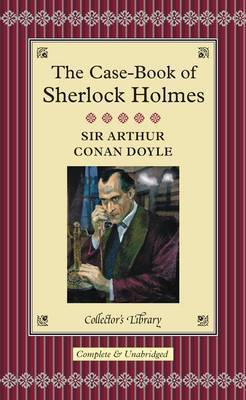
When Arthur Conan Doyle published The Case-Book of Sherlock Holmes in 1927, Sherlock Holmes was no longer merely a successful fictional detective. He had become a cultural institution that Doyle had already tried, failed, and eventually agreed to resurrect. The volume gathered Doyle’s final twelve Holmes short stories, but it did not attempt to manufacture a single grand last adventure. Instead, it offered a varied group of late cases in which Doyle repeatedly altered the formula that had made Holmes famous.
That variation is what makes The Case-Book more interesting than its reputation as an uneven late collection might suggest. Holmes narrates two stories himself, appears in retirement, confronts cases with no conventional murderer, crosses into speculative science, participates in morally questionable schemes, and reveals an unusual degree of personal affection for Watson. At the same time, the collection contains obvious weaknesses: recycled plot devices, implausible science, melodramatic solutions, dated assumptions about gender and empire, and some of the most offensive racial characterization in the Holmes canon.
This article covers the entire book, including every mystery, culprit, solution, and ending. Full spoilers follow for all twelve stories.
Complete Story-by-Story Summary
The Case-Book of Sherlock Holmes is a collection rather than a continuous narrative, so its stories should not be read as twelve consecutive stages of Holmes’s life. The order below follows the 1927 collection, while the fictional chronology of individual cases is more complicated. What unifies them is not a single plot but Doyle’s decision to gather his final Holmes stories under an explicit farewell.
Preface: Doyle’s Final Farewell to Holmes
Doyle’s preface immediately changes the way the collection is read. He compares Holmes to a performer who has taken so many farewell bows that another return would become absurd, acknowledging with some humor that he has already tried more than once to end his association with the detective. Holmes had first appeared in the novels before the enormously popular short-story series began in 1891, and Doyle eventually became frustrated by the degree to which the detective overshadowed other writing he considered more important.
That frustration had previously led Doyle to send Holmes over the Reichenbach Falls in “The Final Problem.” Public demand, however, proved stronger than the author’s desire for closure. Holmes returned, and Doyle continued producing stories for decades. By the time of The Case-Book, the canonical short-story total had reached fifty-six, and Doyle declared that enough was finally enough.
The tone is more affectionate than bitter. Doyle may have resented Holmes’s domination of his literary reputation, but he also recognizes what the detective and Watson have given readers. He hopes their adventures have provided distraction and mental stimulation, and his goodbye feels less like repudiation than a reluctant acknowledgment that a relationship between author, character, and audience has finally run its course. The preface therefore supplies the collection with something its individual cases do not provide on their own: a sense of finality.
The Adventure of the Illustrious Client
The collection opens with one of its darkest cases. Sir James Damery visits Baker Street on behalf of an unnamed “illustrious client,” a person whose identity is so sensitive that it cannot be openly disclosed. The immediate problem concerns Violet de Merville, daughter of the respected General de Merville, who intends to marry Baron Adelbert Gruner.
Gruner is not a conventional criminal whom Holmes can simply expose through physical evidence. He is sophisticated, wealthy, cultured, sexually charismatic, and extremely dangerous. Holmes believes him responsible for the death of his former wife, though the authorities were unable to prove murder. More broadly, Gruner has a history of exploiting women, seducing them, discarding them, and leaving severe emotional damage behind him.
Violet already knows that accusations have been made against Gruner. That is precisely why the case is so difficult. She has interpreted opposition to the marriage as proof that outsiders are persecuting the man she loves, and Gruner has prepared her to dismiss evidence against him. Holmes therefore faces a problem of persuasion: finding facts is not enough if Violet’s psychological dependence causes her to reinterpret those facts in Gruner’s favor.
Holmes turns to Shinwell Johnson, a former criminal who functions as one of his contacts in London’s underworld. Johnson introduces him to Kitty Winter, a woman who once had a relationship with Gruner and now hates him with a mixture of rage and wounded humiliation. Kitty confirms Holmes’s assessment. Gruner does not merely remember his conquests; he keeps a private book recording them in detail, a grotesque trophy of his ability to dominate women.
Holmes and Kitty confront Violet, but the encounter fails. Kitty’s anger makes her understandable as a victim but ineffective as a persuader. Violet sees only bitterness and revenge and remains committed to Gruner. Holmes realizes that the private book itself may be the only evidence capable of piercing the emotional structure Gruner has built around her.
Gruner knows Holmes is working against him and responds violently. Two men attack Holmes in the street and nearly kill him. Reports circulate that the detective is seriously injured, and Holmes deliberately allows Gruner to believe he has been temporarily removed from the case. Watson becomes essential to the next stage of the plan.
Holmes gives Watson a hurried education in Chinese ceramics and sends him to Gruner under a false identity. The Baron is an expert collector, and Watson’s task is not to fool him indefinitely but to hold his attention long enough for Holmes to enter the house unseen. The disguise works only imperfectly. Gruner becomes suspicious, but Watson succeeds in keeping him occupied while Holmes searches for the hidden volume.
Holmes finds and steals the book. His escape, however, does not proceed cleanly. Gruner discovers the deception, and the confrontation draws Kitty Winter back into the action. She throws vitriol into Gruner’s face, permanently disfiguring the man whose beauty and sexual confidence had helped make him so powerful.
Watson’s response is significant. He despises Gruner’s conduct, yet as a doctor he immediately treats his injuries. Doyle allows the scene to separate moral disgust from professional duty: Watson does not need to forgive Gruner in order to keep him alive.
The stolen record finally reaches Violet. Faced not with accusations from enemies but with Gruner’s own private catalogue of cruelty, she ends the engagement. Kitty receives comparatively lenient treatment because the circumstances of her attack are understood, while Holmes’s burglary is effectively insulated by the power of the unnamed client behind the case.
The mystery is therefore solved through methods that are only partly legal. Holmes cannot prosecute Gruner for the conduct that most concerns him, so he breaks into a private home and steals evidence. Kitty goes further by physically maiming him. The story ends with Violet rescued, but the route to that rescue establishes one of the collection’s recurring questions: what happens when Holmes believes justice and law have ceased to coincide?
The Adventure of the Blanched Soldier
“The Blanched Soldier” is unusual before its mystery even begins because Watson is not the narrator. Holmes himself tells the story, implicitly acknowledging that Watson’s absence has forced him to take up a literary role he normally mocks.
James M. Dodd comes to Holmes because he is worried about Godfrey Emsworth, a close friend from the South African War. The two men served together and developed the intense loyalty of soldiers who had depended on each other under dangerous conditions. Godfrey was wounded at the Battle of Diamond Hill and later returned to England, but his correspondence with Dodd suddenly stopped.
Dodd eventually contacts Godfrey’s family. Colonel Emsworth, Godfrey’s father, claims that his son is travelling abroad, but the explanation feels evasive. Dodd visits the Emsworth estate and becomes increasingly convinced that something is wrong.
One night he sees a pale, almost spectral face looking toward him. The face belongs to Godfrey, but his appearance has changed so dramatically that Dodd is horrified. He later discovers that Godfrey is being kept apart from the rest of the household under the supervision of a medical attendant named Mr Kent.
Colonel Emsworth becomes furious when Dodd attempts to uncover the truth. His hostility makes the family secret appear sinister, but Holmes interprets the concealment differently. The combination of Godfrey’s South African history, his physical appearance, the medical supervision, and the family’s desperation suggests disease rather than crime.
Godfrey finally explains what happened. After being wounded in South Africa, he wandered into what he believed was an abandoned building and spent the night there. Only later did he discover that it had been used to house people with leprosy. When disfiguring skin symptoms subsequently appeared, he concluded that he had contracted the disease.
The implication was terrifying by the standards of the period. A confirmed diagnosis would mean not merely illness but social exclusion, stigma, and potentially compulsory isolation. Godfrey and his family therefore hid him while they tried to determine what could be done.
Holmes arrives having already suspected the diagnosis and has brought the dermatologist Sir James Saunders. Saunders examines Godfrey and concludes that he does not have leprosy. Instead, the condition is identified as a form of ichthyosis or “pseudo-leprosy,” a noninfectious disorder whose appearance has produced a catastrophic misunderstanding.
The resolution restores Godfrey to ordinary social life and ends the family’s need for concealment. The story’s medical explanation belongs to its historical period and should not be treated as modern dermatological guidance, particularly where Holmes speculates about the role of fear in producing Godfrey’s condition. Its emotional structure, however, remains clear: friendship overcomes secrecy created by stigma.
The story also demonstrates what Watson normally contributes to the series. Holmes can report facts efficiently, but his narration is more self-conscious and less emotionally mediating than Watson’s. By attempting to replace his chronicler, Holmes inadvertently shows why Watson’s apparently secondary role has always been central to the form.
The Adventure of the Mazarin Stone
“The Mazarin Stone” has an unusually theatrical quality because its origins lie in Doyle’s earlier one-act play The Crown Diamond. Much of the story takes place in or around Baker Street, and Holmes’s strategy depends on entrances, exits, staged appearances, deception, and overheard conversation.
The case concerns the theft of the enormously valuable yellow Mazarin Stone, a Crown jewel whose recovery carries national importance. Holmes has already identified the thieves: Count Negretto Sylvius and the boxer Sam Merton. The difficulty is not determining responsibility but locating the stone itself.
Holmes expects violence. He has constructed a lifelike wax figure of himself and positioned it where an attacker looking through the window might mistake the dummy for the detective. The device works. Sylvius arrives prepared to remove Holmes from the investigation and discovers that the apparent target is only an effigy.
Holmes then confronts Sylvius directly. He makes clear that he knows the Count’s history and understands the role he played in stealing the jewel. He nevertheless offers the criminals a choice: surrender the stone and potentially improve their position, or continue resisting and face the consequences.
Holmes appears to leave Sylvius and Merton alone so they can discuss what to do. The sound of violin music seems to confirm that the detective has withdrawn. Believing themselves safe, the thieves begin speaking openly and reveal where the stone is hidden.
The music is part of Holmes’s deception. He has never truly left them unobserved. Once the jewel appears, Holmes is able to seize it and complete the case.
The story finishes with Lord Cantlemere, who has been skeptical of Holmes’s abilities. Holmes plays a final comic trick on him involving the recovered jewel before revealing that the case is solved.
There is comparatively little classical deduction here. Holmes already knows who committed the crime and wins through stagecraft, intimidation, surveillance, and performance. The story’s pleasures are accordingly closer to theatrical suspense than to the careful clue-based reasoning associated with many of Doyle’s best mysteries.
The Adventure of the Three Gables
“The Three Gables” begins with one of the most uncomfortable scenes in the Holmes canon. Steve Dixie, a Black boxer and criminal intimidator, enters Baker Street to warn Holmes away from a case. Doyle writes Dixie through crude racial stereotypes and gives Holmes explicitly racist insults to use against him. The material cannot be separated from an honest assessment of the story simply because the underlying mystery has other concerns.
The case itself begins with Mrs Mary Maberley, a widow living at a house called Three Gables. She has received an extraordinary offer from someone who wants to buy not just the property but nearly everything inside it. The proposed terms are designed to prevent Mrs Maberley from removing personal possessions before the sale.
Holmes immediately suspects that the buyer does not truly care about the house as real estate. Someone wants an object among Mrs Maberley’s belongings and would rather purchase the entire contents than identify exactly what is being sought.
Suspicion falls on Mrs Maberley’s servant Susan, who has been communicating with people outside the house. Holmes exposes her as an informant, confirming that the household is being watched.
The most important recent change at Three Gables is the arrival of belongings belonging to Mrs Maberley’s late son Douglas. Douglas had served as a diplomat and later died in Rome. Among his possessions are writings that someone desperately wants suppressed.
Before Holmes can fully secure them, intruders break into the house. Mrs Maberley is attacked and papers are stolen, but a fragment remains. From it Holmes infers that Douglas had written a thinly fictionalized account of a romantic relationship with a powerful woman.
That woman is Isadora Klein, a wealthy and socially prominent beauty who had once been involved with Douglas. She is now preparing for a prestigious marriage and fears that Douglas’s manuscript could expose her past and damage her future position.
Isadora first tried to solve the problem with money by purchasing everything at Three Gables. When that failed, she used intermediaries and criminals to steal the manuscript. By the time Holmes confronts her, she has burned it.
Holmes cannot restore Douglas’s work, and he does not pursue an ordinary prosecution. Instead, he uses his knowledge of Isadora’s actions to force her into compensating Mrs Maberley. She signs a cheque for £5,000, which Holmes suggests should finance a journey around the world.
The solution therefore rests less on detective ingenuity than on identifying a hidden manuscript and confronting a wealthy offender. Isadora’s social position allows her to operate with protections unavailable to poorer criminals, while Holmes once again responds by inventing his own form of restitution rather than relying strictly on the legal system.
The story’s racial characterization remains a much more serious flaw than the mechanics of the mystery. Scholarly criticism of the story’s racial characterization has specifically identified Steve Dixie as one of the canon’s most troubling representations, and the problem extends beyond period vocabulary to the way the character is conceived and used.
The Adventure of the Sussex Vampire
“The Sussex Vampire” begins by inviting a supernatural explanation that Holmes almost immediately distrusts. Robert Ferguson comes to Baker Street with a story so disturbing that even its title appears to point toward vampirism.
Ferguson’s wife is Peruvian, and the couple have an infant son together. Ferguson also has an older son, Jack, from a previous marriage. Household members have witnessed Mrs Ferguson bending over the baby’s cot with blood around her mouth, apparently sucking blood from the child.
The scene seems monstrous, but it is only one part of a wider domestic disturbance. Mrs Ferguson has also struck Jack violently, behaviour that has bewildered her husband because she refuses to explain herself.
Ferguson still loves his wife but cannot understand what he has seen. His confusion is intensified by cultural difference, secrecy, and the apparent impossibility of reconciling the woman he knows with the acts being attributed to her.
Holmes travels to the Sussex house and studies the relationships rather than accepting the supernatural framing. He notices South American weapons and a small bow among the household objects. He also learns that the family dog has recently suffered mysterious paralysis.
The crucial psychological fact is Jack’s jealousy. He resents his baby half-brother and harbours hostility toward his stepmother. Holmes concludes that the boy has been attacking the infant with poisoned miniature arrows, probably after experimenting with the poison on the dog.
Mrs Ferguson saw what Jack had done and tried to save her baby by sucking poison from the wound. The blood around her mouth was therefore evidence of rescue, not predation.
Her violence toward Jack also becomes intelligible. She knew he was endangering the infant but refused to expose him to his father because she understood how deeply Ferguson loved his older son. Her silence nearly destroys her marriage, yet it originates in an attempt to protect both children and husband from a truth she believes would shatter the family.
The case is one of Doyle’s clearest examples of rational demystification. Every apparently supernatural fact has a physical explanation, but Holmes solves the mystery only after understanding the emotional structure of the household. The danger comes not from a vampire but from jealousy concealed inside an ordinary family.
The Adventure of the Three Garridebs
Nathan Garrideb is an eccentric London collector whose rooms are crowded with specimens and curiosities. His life has narrowed around acquisition, classification, and the private world created by his collection. That isolation makes him vulnerable when a remarkable opportunity appears.
An American calling himself John Garrideb tells Nathan that a wealthy man of the same unusual surname died leaving a strange will. A large fortune will supposedly be divided among three adult men named Garrideb, but the inheritance cannot be claimed until three such men have been located.
Nathan has little interest in luxury for its own sake, but the money would allow him to expand his collection on a scale he has never imagined. The bizarre promise therefore strikes exactly where he is psychologically weakest.
Holmes quickly doubts the American. Small mistakes in his story and manner suggest that his identity and legal claims are fabricated. The scheme becomes even more suspicious when “John Garrideb” suddenly discovers an advertisement for a third Garrideb in Birmingham and insists that Nathan travel there personally.
Holmes realizes that the inheritance is only a device for getting Nathan out of his rooms. Police information reveals that John Garrideb is actually Killer Evans, an American criminal connected with a counterfeiter named Rodger Prescott.
Prescott once lived in the very rooms Nathan now occupies. Holmes concludes that Evans needs temporary access to something hidden there.
After Nathan leaves for Birmingham, Holmes and Watson conceal themselves inside the premises. Evans enters and opens a hidden trapdoor. Beneath the rooms lies Prescott’s secret counterfeiting operation, including equipment and forged currency.
The trap closes, but Evans is armed. He fires at Watson and hits him in the leg.
The injury proves minor, yet Holmes does not know that immediately. For a moment his professional control disappears. Watson sees genuine fear and fury in him and realizes how much affection has always existed beneath Holmes’s habitual reserve. Holmes makes it clear that if Evans had killed Watson, his own survival would have been doubtful.
Evans is arrested, and the criminal problem is resolved. Nathan’s story ends more sadly. The imagined fortune that had suddenly transformed his life proves entirely fictitious, and the collapse of that hope contributes to a severe mental breakdown.
The story’s inheritance trick resembles earlier Holmes plots in which a victim is lured away so criminals can access a property. What makes “The Three Garridebs” memorable is not the recycled mechanism but the emotional revelation produced by Watson’s wound. In a collection that often experiments with Holmes’s familiar persona, this moment shows the human attachment normally concealed behind the detective’s discipline.
The Problem of Thor Bridge
Neil Gibson is an enormously wealthy American financier whose wife Maria has been found dead near Thor Bridge. She was shot through the head, and the evidence appears to implicate Grace Dunbar, the young governess employed in the Gibson household.
Grace had arranged to meet Maria at the bridge. A revolver belonging to a matched pair owned by Gibson is later discovered in Grace’s wardrobe, and one chamber has been fired. The circumstances seem devastating.
Gibson nevertheless insists that Grace is innocent and asks Holmes to prove it. His initial account of his household is selective, and Holmes refuses to work from a sanitized version of the relationships involved.
The truth is that Gibson’s marriage had become deeply unhappy. He met Maria in Brazil and once loved her passionately, but his feelings faded over time. Maria remained intensely attached to him, while Gibson became emotionally involved with Grace.
Grace refused to become his mistress. She would not accept a relationship with him while he remained married, but Maria nevertheless recognized her husband’s attraction and became consumed by jealousy.
Grace admits that Maria asked her to come to Thor Bridge and that the two women met there. She denies shooting her. The physical evidence, however, seems almost too carefully arranged against her.
Holmes notices something others have overlooked: a small chip on the underside of the bridge parapet. The mark is strange because it lies away from the place where Maria’s body was found and appears to have been caused by an object striking the stone from below.
The clue allows Holmes to reconstruct the entire mechanism. Maria did not intend merely to kill herself. She intended to destroy Grace as well by making her death appear to be murder.
Maria took one of Gibson’s paired revolvers and planted it in Grace’s wardrobe. She arranged the bridge meeting so that Grace’s own correspondence would prove the two women had been together. She then tied the other revolver to a heavy weight by a cord.
After shooting herself, Maria released the gun. The weight pulled it over the parapet and down into the water. As the revolver swung across the structure, it struck the underside of the bridge and produced the unexplained chip.
Holmes demonstrates the mechanism with a revolver and a weighted cord, turning a tiny physical irregularity into the key to the case. The missing murder weapon is not missing because a killer carried it away. Maria engineered its disappearance as part of a posthumous frame-up.
Grace is cleared. The revelation also transforms Maria from apparent victim into the architect of a final act of revenge, although the story does not reduce her simply to villainy. Her destructive jealousy grows within a marriage in which she knows her husband’s love has disappeared and has transferred toward another woman. Doyle’s mechanical puzzle and domestic tragedy therefore reinforce each other unusually well.
The Adventure of the Creeping Man
Professor Presbury is a respected scientist in his early sixties who has become engaged to Alice Morphy, a much younger woman. His daughter Edith and his secretary Jack Bennett, who is himself engaged to Edith, become alarmed by abrupt changes in his behaviour.
Presbury travels secretly to Prague and refuses to explain the purpose of his journey. After returning, he becomes furtive and aggressive, receives mysterious correspondence, guards unusual packages, and experiences recurring periods in which his personality seems transformed.
His wolfhound Roy reacts even more dramatically. A dog that once accepted Presbury begins attacking him violently, as though the professor has somehow become a different creature.
The household eventually reports behaviour that sounds almost impossible. Presbury is seen moving on all fours, displaying unusual physical power, and climbing in a manner more appropriate to an ape than an elderly academic. Edith once sees his distorted face at an upper window under circumstances that make ordinary movement difficult to explain.
Holmes looks for regularity in the apparently irrational episodes. He discovers that the behavioural changes recur according to a cycle, suggesting an administered substance rather than random madness.
Holmes and Watson eventually observe Presbury during one of these episodes. The professor crawls, climbs, and behaves with an exaggerated simian quality. He provokes Roy until the dog attacks him savagely.
Presbury survives, and the contents of his private box explain the transformation. He has been receiving a rejuvenation treatment from a scientist named Lowenstein in Prague. The injections involve material associated with the black-faced langur.
Presbury’s motive is aging. He wants to regain youth and vitality before marrying Alice and has accepted an experimental intervention in the hope of escaping the limitations of his body. Instead, the story imagines the animal material imposing characteristics of the donor species on him.
The science is impossible, but it grew from a recognizable cultural environment. During the 1920s, controversial rejuvenation experiments involving animal tissue attracted widespread attention, and 1920s rejuvenation experiments form part of the historical context in which “The Creeping Man” approaches science fiction more closely than most Holmes stories.
Holmes ends not merely by identifying the serum but by moralizing about it. Human attempts to push beyond natural limits, he suggests, risk releasing something degraded rather than creating genuine renewal. The ending therefore turns the mystery into a warning against scientific hubris.
As biology, the premise has no credibility. As late Holmes fiction, however, the story is revealing precisely because Doyle allows the detective framework to absorb speculative anxieties about aging, evolution, bodily identity, and modern science.
The Adventure of the Lion’s Mane
“The Lion’s Mane” is the second story narrated by Holmes and one of the few canonical tales set after his retirement. He now lives in Sussex near the sea, keeps bees, studies nature, and has largely withdrawn from the urban professional world associated with Baker Street.
Watson is no longer constantly at his side. Holmes must therefore tell the story himself, and the change in narrator accompanies a change in environment. The detective who once interpreted London streets now encounters a mystery emerging from the natural world.
McPherson, a teacher at a nearby school, returns from swimming in terrible pain. His body is covered with strange red, lash-like marks. Before dying, he manages to say the words “the Lion’s Mane.”
At first the phrase sounds metaphorical or cryptic. Human suspicion soon gathers around Ian Murdoch, a difficult but intelligent man who has had an uneasy relationship with McPherson.
The case also contains romantic complications. McPherson had secretly become engaged to Maud Bellamy, and Murdoch had once cared for her as well. That history supplies an apparently plausible motive for jealousy.
Yet the physical evidence refuses to cooperate with a human-murder theory. There are no appropriate tracks, no obvious weapon, and no convincing explanation for the extraordinary pattern of injuries.
Another incident changes Holmes’s thinking. McPherson’s dog dies after exposure to the same area of water. Later Murdoch himself is badly stung while swimming, effectively eliminating him as the supposed murderer.
Holmes remembers a natural-history account describing Cyanea capillata, the lion’s mane jellyfish. McPherson’s dying words were not a coded accusation at all. He was naming what had attacked him.
Holmes finds the jellyfish in the pool and, with Stackhurst, destroys it by crushing it under a rock. The apparent murder therefore has no murderer. Nature has generated the wound pattern that Holmes and everyone around him initially interpreted as evidence of human violence.
The solution has a basis in real marine biology, though Doyle exaggerates the organism’s usual danger. Modern medical reports of lion’s mane jellyfish envenomation describe painful welts and significant local reactions, while the reliably fatal mechanism imagined in the story should not be taken as representative of ordinary encounters.
Holmes also admits that he was slower than he should have been. Once he assumed a human adversary, misleading personal evidence kept his reasoning on the wrong track. For a detective often treated as nearly infallible, the confession matters. Retirement has not destroyed Holmes’s powers, but nature confronts him with a form of mystery less compatible with his habitual expectation that motive points toward a human culprit.
The Adventure of the Veiled Lodger
“The Veiled Lodger” is less a detective story than a confession. Mrs Merrilow asks Holmes to visit a mysterious lodger named Eugenia Ronder, a woman who always covers her face with a veil and has lived in near-total seclusion.
Eugenia was once part of a travelling circus. Her husband, Ronder, was a powerful and brutal man who drank heavily, abused her, and mistreated both people and animals. Their act involved a lion called Sahara King.
Eugenia eventually fell in love with Leonardo, the circus strongman. Their relationship emerged within a situation of sustained abuse, and together they began planning Ronder’s death.
The scheme was designed to imitate an animal attack. Leonardo constructed a weapon whose marks would resemble the wounds made by a lion’s claws. When the opportunity came, he killed Ronder near the animal’s cage, intending to make it appear that Sahara King had escaped or attacked.
The plan succeeded only in its first stage. The smell of blood excited the real lion, which turned on Eugenia and savagely mutilated her face.
Leonardo was strong enough that she believed he might save her. Instead, confronted with genuine danger rather than a planned murder, he panicked and fled. His cowardice became as psychologically devastating as her physical injuries.
Eugenia survived but remained permanently disfigured. She could have exposed Leonardo’s role in Ronder’s death, yet she kept silent. Years passed, and Leonardo eventually died without answering publicly for what he had done.
By the time Eugenia speaks to Holmes, the case no longer requires solving in any practical sense. She wants the truth known because she has carried it alone for too long.
Holmes’s role changes accordingly. He is not primarily an investigator but a moral witness. He realizes that Eugenia is contemplating suicide and urges her not to allow suffering, guilt, betrayal, and disfigurement to define the rest of her life.
Two days later, she sends Holmes a bottle of prussic acid. She had kept it as a means of killing herself but now tells him that she will follow his advice instead.
The ending is unusually compassionate for a Holmes story. Holmes neither prosecutes Eugenia for conspiracy nor reduces her to a criminal category. He sees an abused woman who participated in an attempted extrajudicial escape from violence, suffered catastrophic consequences, and has spent years punishing herself. His intervention is not modern psychological treatment, but it reveals how far the late Holmes can move from solving puzzles toward judging when understanding matters more than punishment.
The Adventure of Shoscombe Old Place
John Mason, a trainer at Shoscombe Old Place, approaches Holmes because he believes his employer Sir Robert Norberton is behaving irrationally. The strange behaviour is tied to money, inheritance, horse racing, and a death that has apparently not occurred.
Sir Robert is financially desperate. He has invested nearly everything in Shoscombe Prince, a racehorse he expects to win the Derby. If the horse succeeds, he can escape crushing debts; if the plan fails, ruin is likely.
His position is complicated by the fact that the estate and much of the financial security around him depend on his sister, Lady Beatrice Falder. Her interest in the property lasts only while she remains alive.
Mason reports a series of unsettling changes. Lady Beatrice, once devoted to Shoscombe Prince, no longer visits the horse. Her beloved spaniel has been given away. She supposedly quarrels with Sir Robert. She appears only in a carriage, heavily covered, while Sir Robert begins making secret visits to the old family crypt.
There are further signs that something macabre is occurring. Human remains in the crypt appear to have been disturbed, and bones have apparently been burned.
Holmes realizes that Lady Beatrice’s dog can provide evidence human observers cannot. When the spaniel is brought near the veiled figure supposedly representing its mistress, the dog reacts with hostility rather than recognition.
The obvious conclusion is that the woman in the carriage is not Lady Beatrice.
Holmes and Watson investigate the crypt and discover Lady Beatrice’s body. Sir Robert is forced to explain the scheme.
Lady Beatrice died from dropsy around a week earlier. If her death had immediately become public, Sir Robert’s financial position would have collapsed. Creditors would have moved against him before Shoscombe Prince could run in the Derby.
Sir Robert therefore concealed the death. Lady Beatrice’s maid Carrie Evans is married to an actor named Norlett, and Norlett impersonates the dead woman during the carriage rides. The disguise preserves the appearance that Lady Beatrice remains alive.
Her corpse is initially hidden and later transferred into an ancestral coffin in the family crypt. In order to make room, older remains are removed and burned.
Holmes does not simply pardon the deception. He turns the matter over to the authorities, allowing formal law to determine how severely Sir Robert should be punished.
Shoscombe Prince goes on to win the Derby. Sir Robert wins £80,000, pays his creditors, and ultimately receives only mild official censure for delaying registration of Lady Beatrice’s death.
No murder has occurred, yet the story produces a macabre mystery by surrounding an actual natural death with fraud, impersonation, concealment, and desecration. It also shows how wealth and class can soften consequences: Sir Robert’s scheme is morally ugly, but successful finances and social position allow him to recover with remarkably little lasting damage.
The Adventure of the Retired Colourman
The final printed story begins with a man who appears to be a victim. Josiah Amberley is a retired colour merchant whose younger wife has supposedly run away with Dr Ray Ernest, a chess companion. According to Amberley, the pair have also taken a substantial amount of cash and securities.
Holmes is occupied and sends Watson to investigate the house in Lewisham. Amberley’s home is called The Haven, an ironically peaceful name for a place that increasingly feels oppressive.
Watson notices that Amberley is obsessively painting parts of the house. The smell of fresh paint is overpowering, but at first it appears to be only another expression of the retired man’s strange temperament.
Amberley also possesses what seems to be a reliable alibi. On the night his wife and Ernest supposedly disappeared, he bought two theatre tickets. His wife declined to accompany him, so he claims he went alone.
Holmes does not accept the story at face value. He checks the people who occupied seats close to Amberley’s alleged theatre seat. Their evidence shows that the seat remained empty.
Amberley bought the tickets in order to create documentary proof of an excursion he never actually made.
Holmes then arranges a deception of his own. A false telegram summons Amberley on an unnecessary journey outside London, and Watson is instructed to accompany him. The true purpose is not the errand but the removal of Amberley from The Haven.
While the supposed client is away, Holmes enters and investigates the property. Another detective, Barker, has independently been working on the case for Dr Ernest’s family, and the two inquiries converge.
When Amberley returns, Holmes asks him directly what he has done with the bodies. The abrupt accusation breaks his composure. Amberley attempts to swallow poison, but the suicide attempt is stopped.
The apparent victim is revealed as the murderer.
Amberley murdered his wife and Dr Ernest inside a strong-room that could be sealed and filled with gas. He then invented the elopement and theft to explain their disappearance and cast himself as the betrayed husband.
The fresh paint was not an eccentric hobby. It was meant to conceal the lingering smell of gas. The sensory clue Watson noticed but did not understand was evidence of murder.
The bodies have been hidden in a concealed well beneath a dog kennel. Once they are recovered, Amberley’s story collapses completely.
The case closes on a typically Holmesian note about credit. The newspapers give much of the public recognition to the official police inspector rather than Holmes. The detective accepts the situation with amused indifference, as though fame matters less than the private satisfaction of having understood the problem.
As the final story in the physical collection, “The Retired Colourman” does not attempt a farewell spectacle. Holmes does not retire on the last page, die, or announce the end of his career. He simply solves another difficult case. The larger goodbye belongs elsewhere.
Sherlock Holmes and Dr Watson in the Late Canon
The twelve cases matter individually, but the collection becomes more revealing when they are read against the established Holmes formula. By 1927, readers knew what a Sherlock Holmes story was supposed to sound like: Watson narrates, a client arrives, Holmes notices what others miss, apparently chaotic facts become coherent, and the detective explains the solution. The Case-Book repeatedly preserves that structure while also testing how much it can be altered.
The most important changes involve Holmes himself. He is still capable of extraordinary observation and manipulation, but he is less easily reduced to the purely cerebral machine of popular caricature. He can be wrong-footed by nature, morally moved by suffering, openly furious when Watson is hurt, and sufficiently self-conscious to try narrating his own adventures.
Holmes as Detective, Narrator, and Retired Observer
Holmes’s greatest constant remains his ability to convert tiny inconsistencies into structural explanations. The chip beneath Thor Bridge, the false American details supplied by Killer Evans, the empty theatre seat in Amberley’s alibi, and the dog’s reaction to the supposed Lady Beatrice all exemplify the same intellectual habit. Holmes rarely solves cases by discovering enormous hidden facts from nowhere. More often, he finds a detail everyone else has seen but interpreted incorrectly.
Yet deduction is only part of his late method. Holmes performs roles as aggressively as the criminals he pursues. He permits Gruner to believe he has been incapacitated, uses Watson as a false ceramic expert, positions a wax double at Baker Street, fabricates a summons to remove Amberley from his house, and engineers conversations so suspects incriminate themselves. His great advantage is not merely superior intelligence but control over what other people think is happening.
The collection also makes Holmes more visibly fallible. In “The Lion’s Mane,” he initially assumes that McPherson’s death must have a human explanation and allows personal relationships to distract him. His eventual admission that he should have recognized the truth sooner is important precisely because Doyle so often structures stories around retrospectively perfect reasoning.
Retirement changes him without transforming his essential temperament. Sussex gives him bees, coastline, and nature rather than London’s streets and criminal networks, yet curiosity still draws him toward unexplained death. The detective vocation survives the end of the profession.
Holmes as narrator is even more revealing. In “The Blanched Soldier” and “The Lion’s Mane,” he attempts to do what Watson has done for decades: turn investigation into story. He can reproduce the sequence of clues and reasoning, but his tone is less naturally dramatic because he already knows too much and admires his own logic differently from the way Watson admires it. The experiment demonstrates that Holmes can replace Watson operationally but not stylistically without changing the experience of the tale.
Watson as Chronicler, Partner, and Emotional Counterweight
Watson is often treated as the less intelligent half of the partnership, but The Case-Book makes clear how misleading that description can be. His narrative function is not to compete with Holmes’s deductions. He provides the human scale by which those deductions become dramatic.
Watson is educated enough to recognize extraordinary circumstances but ordinary enough to be misled by them. When he fails to understand the smell of paint in “The Retired Colourman” or needs Holmes to explain the significance of Thor Bridge, the reader is allowed to experience uncertainty without feeling that the story has artificially hidden everything. Watson’s partial understanding creates mystery.
His medical identity also repeatedly matters. In “The Illustrious Client,” he becomes a participant in Holmes’s burglary scheme but immediately returns to professional duty when Gruner is injured. Watson’s ethical reflexes do not disappear simply because he admires Holmes.
The two Holmes-narrated stories expose what is lost in his absence. Holmes can tell readers what he did, but Watson tells them what Holmes looks like from outside. Much of Holmes’s charisma has always depended on another consciousness observing his silences, sudden excitement, strange habits, disguises, and apparently impossible leaps.
Watson also gives emotional evidence Holmes would be unlikely to volunteer about himself. That becomes decisive in “The Three Garridebs,” where the relationship stops being implicit.
The Friendship Revealed in “The Three Garridebs”
Watson’s gunshot wound is physically minor, but Holmes initially cannot know that. For a few seconds, the possibility that Watson has been seriously or fatally wounded destroys the emotional distance Holmes normally maintains.
Watson sees fear in his friend before relief replaces it. Holmes’s subsequent fury toward Killer Evans is not strategic theatre. The detective’s control has broken because the person beside him matters more deeply than his usual behaviour admits.
The significance of the scene lies partly in its rarity. Holmes and Watson have lived through years of danger, shared rooms, investigations, travel, illness, violence, and extraordinary social situations, yet Doyle rarely gives them sentimental conversations about friendship. Their bond is demonstrated through continued presence.
“The Three Garridebs” temporarily makes that buried structure explicit. Watson understands that the loyalty he has always offered is reciprocated, even if Holmes ordinarily expresses affection through trust, companionship, and reliance rather than confession.
It would be excessive to reorganize the entire collection around this moment. Most stories remain mysteries first, and Holmes quickly returns to his familiar manner. Even so, the scene is one of the late canon’s strongest contributions because it adds emotional confirmation without rewriting the characters into different men.
The World of the Final Cases: Class, Empire, Country Houses, and Modern Britain
The social world of The Case-Book is recognizable as the familiar Holmes landscape but increasingly stretched across historical periods. The stories were published in the 1920s, yet many cases are set earlier, and their institutions, manners, technologies, and class assumptions belong to the long late-Victorian and Edwardian world associated with the detective. Doyle is revisiting a fictional environment that had already become partly historical by the time he finished writing it.
That environment is sharply stratified. Holmes moves effortlessly between aristocrats, industrial millionaires, respectable professionals, servants, boxers, criminals, doctors, schoolmasters, trainers, circus performers, detectives, and people living on the edge of scandal. Wealth often determines not whether wrongdoing occurs but how easily it can be concealed or softened.
“The Illustrious Client” depends on influential people being able to operate unofficially. Gruner’s reputation is known, yet social status and lack of prosecutable evidence protect him. Isadora Klein in “The Three Gables” likewise assumes that money and intermediaries can make an inconvenient manuscript disappear. Sir Robert Norberton commits an elaborate deception involving a corpse and ancestral remains but emerges with comparatively mild consequences after his horse wins the Derby and his debts are paid.
Country houses and respectable domestic spaces repeatedly conceal disorder. Three Gables hides a literary scandal. The Ferguson household conceals attempted infanticide. Presbury’s academic respectability masks secret experimentation. Shoscombe Old Place hides a death beneath ritualized appearances. The Haven conceals a gas chamber.
Doyle’s world is therefore less secure than its social surfaces imply. Respectability repeatedly functions as camouflage, just as disguises do.
Imperial and international references widen the geography but also reveal the assumptions of the period. Godfrey Emsworth’s fear of leprosy emerges from his South African military experience. Mrs Ferguson’s Peruvian background and household objects help produce the apparent “vampire” mystery. Gruner is cosmopolitan and European; Isadora Klein possesses an international social identity; Presbury travels to Prague for forbidden rejuvenation.
These references frequently carry an exoticizing quality. Foreignness can be used to generate danger, mystery, sensuality, disease, unusual weaponry, or moral uncertainty. The pattern does not mean every foreign character is villainous, but it reflects a British imperial imagination in which the wider world often arrives as disruptive material entering domestic space.
“The Three Gables” goes significantly further. Steve Dixie is not merely a character described in language now considered dated. His introduction and confrontation with Holmes rely on degrading racial caricature. Andrew Glazzard’s scholarship on the story treats this as one of the Holmes canon’s most serious racial problems, and the criticism is deserved because the stereotyping operates at the level of voice, description, intelligence, and humour rather than appearing as one isolated term.
The collection’s social limitations therefore need to be understood without either erasing them or pretending they invalidate every other achievement. Doyle’s mysteries remain formally ingenious and psychologically engaging, but they carry assumptions about race, class, gender, and empire that modern readers cannot treat as invisible background.
Justice Beyond the Law: Holmes’s Moral Code
Holmes is often associated with the police, but he has never been merely an auxiliary officer. The Case-Book repeatedly emphasizes that distinction. Solving a mystery and enforcing the law are separate activities, and Holmes sometimes considers his own moral judgment superior to ordinary legal procedure.
“The Illustrious Client” provides the most obvious example. Holmes knows Gruner is dangerous but cannot legally establish the full scale of his wrongdoing. He therefore participates in burglary and theft to obtain the private book capable of breaking Gruner’s psychological control over Violet.
The result is morally understandable because Violet is endangered, but the method remains extralegal. Kitty Winter’s acid attack goes further. Holmes does not cause it, yet the story treats her revenge through the lens of extreme provocation and permits a relatively sympathetic interpretation of an act that permanently mutilates another person.
“The Three Gables” again turns Holmes into an unofficial judge. Isadora Klein has organized a criminal invasion of Mrs Maberley’s home, but Holmes does not build a conventional prosecution. Instead, he coerces her into paying £5,000 as compensation.
The outcome benefits Mrs Maberley, but it also reveals how much discretionary authority Holmes assumes. He decides what punishment fits the offense and uses private knowledge to enforce it.
“The Veiled Lodger” shows the compassionate version of the same independence. Eugenia Ronder participated in a murder plot, yet Holmes sees little value in handing a traumatized, disfigured woman over to punishment years later. His immediate concern is preventing her suicide.
In “Shoscombe Old Place,” however, Holmes does not simply absolve Sir Robert. Once the concealed death and impersonation scheme are understood, he leaves the legal consequences to the authorities. That contrast matters because Holmes is not consistently anti-law. He reserves the right to decide when law deserves deference.
Amberley’s case also demonstrates the difference between formal and informal detection. Holmes deceives the supposed client, enters his home while he is away, coordinates indirectly with the rival detective Barker, and psychologically corners the murderer before official justice takes over. The police complete the prosecution, but Holmes controls the path by which the truth becomes available.
These stories rarely pause to develop a philosophical theory of justice. Their moral logic is practical: official systems are often too slow, too constrained by evidence, too vulnerable to status, or too unimaginative to reach the outcome Holmes considers correct.
That practicality is part of the character’s appeal, but it also creates a genuine problem. Holmes is trustworthy because Doyle normally gives him superior information, intelligence, and motives. Outside fiction, allowing one brilliant private citizen to decide who deserves prosecution, blackmail, deception, forgiveness, or exposure would be alarming.
The late stories are most interesting when they allow that tension to remain. Holmes’s moral authority is often persuasive, but it is not neutral. He does not simply discover truth; he frequently decides what should happen once truth has been discovered.
Reason, Medicine, Science, and the Edge of the Fantastic
Sherlock Holmes is conventionally associated with rationality, but rationality in The Case-Book does not always mean scientific realism. Several stories begin by flirting with the supernatural or impossible, while others rely on medical or biological premises that are themselves questionable. The late collection therefore tests how far Doyle can stretch the authority of Holmes’s rational method without losing the genre entirely.
The differences among these stories are important. “The Sussex Vampire” is a classic rational demystification, “The Lion’s Mane” uses real natural history in exaggerated form, “The Blanched Soldier” relies on period medical assumptions, and “The Creeping Man” crosses into outright speculative science.
The Sussex Vampire and Rational Demystification
“The Sussex Vampire” most closely follows the familiar Holmes principle that apparently supernatural events become ordinary when evidence is interpreted correctly. Nothing impossible actually occurs.
Mrs Ferguson’s blood-covered mouth seems to prove vampirism only because observers assume she caused the baby’s injury. Once Holmes reverses that assumption, every clue changes meaning. She has blood in her mouth because she is removing poison from the wound.
The dog is equally important. Its unexplained paralysis appears to be an unrelated household oddity until Holmes recognizes it as evidence that Jack tested the poisoned weapon before attacking the infant. What looked like several strange incidents becomes one coherent sequence.
The story’s rationalism is therefore interpretive rather than technological. Holmes needs no futuristic science. He needs only the willingness to reject a dramatic label and ask what physical chain of events would produce the observed facts.
Domestic psychology completes the solution. Jack’s jealousy supplies motive, while Mrs Ferguson’s silence explains why the truth remained hidden even after she discovered it. Rational detection does not defeat supernaturalism through contempt alone; it reconstructs both mechanism and emotion.
The Blanched Soldier and Medical Uncertainty
“The Blanched Soldier” also turns an alarming appearance into a medical explanation, but it is less secure scientifically. Godfrey Emsworth and his family believe he has contracted leprosy because he was exposed to a leper hospital during the South African War and later develops disturbing skin symptoms.
The story accurately captures the social terror historically associated with feared contagious disease. Godfrey’s concealment arises because illness threatens not only his body but his place in society. The family is responding to anticipated stigma and isolation.
Sir James Saunders’s diagnosis provides the happy reversal: Godfrey does not have leprosy but a noninfectious skin condition described as pseudo-leprosy or ichthyosis. That basic distinction between a frightening appearance and an incorrect diagnosis works perfectly well as narrative structure.
Holmes’s additional speculation about fear contributing to the condition is more questionable and belongs to the medical imagination of the period rather than to modern dermatological understanding. The story remains effective if its emotional insight is separated from its diagnostic authority.
Its larger rational point is therefore modest. Evidence can look terrifying when interpreted through one hypothesis, and expert diagnosis can overturn a family’s catastrophic assumptions. Doyle’s medicine is historically situated, but the drama of uncertainty remains understandable.
The Lion’s Mane and Nature as Culprit
“The Lion’s Mane” alters the detective structure more radically because the mystery has no human criminal. McPherson’s injuries genuinely come from an organism rather than a weapon or murderer.
Holmes initially fails because he assumes the structure of the genre in which he lives. A dead man usually implies a human adversary, and interpersonal tensions usually imply motive. Murdoch therefore looks important because jealousy and hostility are available explanations.
The dog changes the problem. When an animal suffers similar effects from the same environment, Holmes gains evidence independent of human relationships. Murdoch’s later injury removes him from suspicion and forces Holmes to interpret “the Lion’s Mane” literally.
The story’s jellyfish has a basis in reality. Lion’s mane jellyfish can cause severe pain and characteristic skin reactions, as modern medical reports of lion’s mane jellyfish envenomation confirm. Doyle’s treatment of the encounter as predictably lethal, however, is exaggerated.
That mixture of real natural history and heightened danger suits the story’s purpose. Holmes has not wandered into supernatural fiction. Instead, he confronts a form of causation that looks like murder because human beings instinctively read violent injury as evidence of human intention.
His error is intellectually revealing. Holmes is rational, but even rationality can become habitual. He initially asks which person killed McPherson instead of asking whether a person did so at all.
The Creeping Man and Speculative Rejuvenation
“The Creeping Man” goes far beyond the other scientific cases. Its core transformation cannot be reconciled with real biology. Injecting material associated with a langur cannot periodically turn an elderly professor into an ape-like version of himself.
The premise nevertheless reflects real anxieties circulating when Doyle wrote. The 1920s saw intense publicity around attempts to restore vitality through animal tissue and gland-based interventions. The story’s fictional Lowenstein belongs to the cultural atmosphere of contemporary rejuvenation experiments, even though no real procedure produced anything remotely resembling Presbury’s transformation.
Presbury’s motive is what makes the fantasy meaningful. He does not seek power in the abstract. He fears age because he is engaged to a younger woman and wants his body to match the future he imagines for himself.
The serum therefore externalizes anxiety about aging. Presbury’s attempt to become more youthful makes him less recognizably human. Doyle converts the fantasy of rejuvenation into degeneration.
The evolutionary assumptions behind the transformation are themselves historically dated. The story imagines animal characteristics as if they carry a stable package of behaviour that can invade human personality through biological material. Presbury’s aggression, crawling, climbing, and altered facial expression are treated as manifestations of “ape nature,” a conception closer to popular evolutionary anxiety than modern genetics or endocrinology.
Holmes responds with moral condemnation. His final warning suggests that attempts to force humanity beyond natural boundaries may release degraded impulses rather than transcend limitation.
As science, this is nonsense. As speculative fiction, it is more interesting. Doyle uses the detective format to approach the same questions that science fiction often asks: what happens when technological ambition changes the body, where identity resides, and whether increased capability necessarily constitutes progress.
The collection’s scientific range therefore runs from rational explanation through historical medicine to outright fantasy. Holmes remains a symbol of reason, but Doyle increasingly allows reason to operate inside worlds where the premises themselves are not always scientifically reasonable.
Love, Jealousy, Abuse, and Gendered Power
Many cases in The Case-Book begin as crimes but become stories about damaged relationships. Love is rarely presented as uncomplicated fulfillment. It appears as possession, manipulation, jealousy, rescue, secrecy, dependency, betrayal, or fear of abandonment.
“The Illustrious Client” offers the collection’s clearest portrait of coercive romantic power. Gruner does not simply seduce Violet de Merville. He creates a psychological structure in which warnings against him become evidence that outsiders are hostile.
Violet’s intelligence does not protect her because the problem is not ignorance alone. Gruner has shaped the way she interprets information. That is why testimony from Kitty Winter fails while his private book succeeds: Violet can dismiss an angry former lover, but Gruner’s own record is harder to assimilate into the story he has taught her to believe.
Kitty herself represents another consequence of abusive desire. Her attack with vitriol is not treated as admirable, but it grows from a history of exploitation and humiliation. The story’s moral darkness comes from the fact that legal institutions have not adequately protected either woman.
“The Three Gables” also links sexuality to power, though with less psychological depth. Isadora Klein’s relationship with Douglas Maberley becomes dangerous not because she wants him back but because she wants control over how the past can be represented. Douglas’s manuscript threatens to turn private experience into public narrative, so she uses money and violence to erase it.
“The Sussex Vampire” moves from romantic possession to family jealousy. Jack sees his baby half-brother as a rival for affection and acts with shocking violence. Mrs Ferguson’s response is equally shaped by relationships: she risks being seen as monstrous because she cannot bear to reveal the truth to a husband who loves Jack.
“Thor Bridge” gives jealousy its most elaborate form. Maria Gibson knows that her husband no longer loves her and that his emotional loyalty has shifted toward Grace Dunbar. Her final response is not simply suicide but an attempt to make Grace legally responsible for her death.
The frame-up transforms jealousy into a desire to control other people even after death. Maria cannot restore Gibson’s love, but she can try to destroy the woman who has become the focus of it.
The story complicates blame because Gibson is not an innocent husband. He admits that his feelings toward Maria have disappeared and that he fell in love with Grace while still married. Grace’s refusal to become his mistress gives her a moral boundary he has difficulty accepting.
“The Creeping Man” treats age difference from another direction. Presbury’s engagement to Alice Morphy is not itself framed as criminal, but his fear of being an older man with a young fiancée drives him toward dangerous rejuvenation. Sexual insecurity becomes scientific hubris.
“The Lion’s Mane” uses a gentler romantic triangle. Murdoch’s love for Maud Bellamy initially makes him appear capable of harming McPherson, but the suspicion proves false. Doyle exploits the expected jealousy motive only to overturn it.
“The Veiled Lodger” is much more severe. Eugenia Ronder’s marriage is openly abusive, and her conspiracy with Leonardo emerges from a situation in which ordinary domestic protection has failed. Doyle does not justify murder, but he makes the desperation behind it comprehensible.
Leonardo’s betrayal then repeats the imbalance of power in another form. Eugenia believes she has found a strong man who will help free her from a brutal husband, only to discover that his courage fails when she needs him physically.
“The Retired Colourman” turns possessiveness into murder. Amberley’s younger wife becomes, in his imagination, something he owns and can punish for betrayal. His version of events asks Holmes to see him as humiliated victim, while the truth reveals that his jealousy was lethal.
Across the collection, women occupy multiple positions. Violet is manipulated, Kitty seeks revenge, Isadora victimizes others, Mrs Ferguson protects her children through secrecy, Maria becomes destructive, Grace establishes a moral boundary, Eugenia becomes both conspirator and victim, and Mrs Amberley is murdered.
That variety matters because the collection cannot be reduced to a simple claim that Doyle depicts women only as helpless or dangerous. Yet the stories still emerge from a social world in which women’s reputations, marriages, sexual histories, and economic positions often make them more vulnerable to male power.
The late cases are strongest when Doyle recognizes that crime may be the final expression of relationships already distorted by domination. The mystery then becomes not merely who acted but how affection was converted into ownership, fear, revenge, or concealment.
Clues, Masks, Doubles, and Hidden Spaces
The recurring objects in The Case-Book are often better understood as clue patterns than as elaborate literary symbols. Doyle repeatedly constructs cases around substitution: one person stands in for another, one object represents another, one explanation disguises another, or a visible space hides a second space beneath it.
The wax Holmes in “The Mazarin Stone” is the most literal double. Sylvius believes he is looking at the detective when he is actually looking at a substitute designed to attract violence. The trick works because Holmes understands that criminals react not to reality itself but to what they believe they see.
False identity appears elsewhere. Killer Evans invents “John Garrideb.” Watson temporarily becomes a ceramic collector. Norlett impersonates the dead Lady Beatrice. Amberley plays the role of betrayed husband while actually being a double murderer.
The books and manuscripts scattered across the stories function similarly. Gruner’s private book contains the truth hidden beneath his social persona. Douglas Maberley’s manuscript threatens Isadora because written narrative can expose what wealth has kept private.
Veils literalize concealment in “The Veiled Lodger,” but Eugenia’s covered face carries more than practical secrecy. She has withdrawn not because her identity is unknown but because the visible consequences of her past are unbearable to her. When she finally speaks, removing secrecy matters more than physically removing the veil.
Hidden spaces create another repeating architecture. Prescott’s counterfeiting equipment lies beneath Nathan Garrideb’s rooms. Lady Beatrice’s body is concealed in a crypt. Amberley’s strong-room becomes a murder chamber, while the victims’ bodies are placed in a hidden well.
These environments repeatedly reveal that ordinary domestic or respectable surfaces are incomplete. The detective’s task is to discover the second space beneath the first: the room below the room, the history behind the reputation, the corpse behind the impersonation, or the crime behind the client’s story.
Animals also become unusually important as evidence. Roy recognizes something altered in Presbury before humans understand it. Lady Beatrice’s spaniel exposes the impersonation because a dog cannot be persuaded by costume. The paralysed dog in “The Sussex Vampire” reveals that poison has been tested before being used against the baby.
“The Lion’s Mane” pushes the device furthest by making an animal organism the actual cause of death. Nature is no longer merely a clue to human behaviour but the source of the mystery itself.
What unites these devices is Holmes’s central interpretive principle: appearances are not meaningless, but they are frequently assigned to the wrong category. A woman with blood on her mouth is not necessarily a vampire. An apparent victim is not necessarily innocent. A dead body does not necessarily imply murder, while an apparent elopement may conceal two corpses.
The late Holmes stories continue to derive pleasure from the gap between seeing a fact and understanding what kind of fact it is.
Narrative Experimentation, Style, and the Collection’s Unevenness
The Case-Book does not radically reinvent Doyle’s prose, but it experiments more with the architecture of the Holmes story than a simple list of plots might suggest. The collection contains conventional investigations, theatrical confrontation, first-person Holmes narration, confession, Gothic misdirection, natural causation, speculative science, and a false-client story.
That variety is partly a strength and partly a sign of late-career instability. Doyle still knows how to build suspense quickly, but not every experiment carries the same conviction or plausibility.
Watson’s Familiar Voice—and Its Deliberate Absence
Watson’s normal narration solves several technical problems at once. He admires Holmes but does not fully understand him, which allows the detective to remain mysterious while the reader receives enough information to follow the case.
Watson is also dramatically useful because his mistakes are credible. He sees clues without knowing their importance. His emotional reactions establish danger without requiring Holmes to tell readers that something is frightening.
When Holmes narrates “The Blanched Soldier” and “The Lion’s Mane,” the balance changes. Holmes is both actor and interpreter, which makes it harder to hide his reasoning naturally. He sometimes has to delay information he already possesses or comment directly on the challenge of telling a story.
The result is revealing rather than wholly unsuccessful. Holmes’s voice is drier and more self-aware, and his attempts to explain Watson’s absence quietly acknowledge how dependent the series has always been on its supposed sidekick.
“The Lion’s Mane” works particularly well because the altered voice corresponds to an altered life. Holmes is retired, Watson is no longer constantly present, and the coastal setting removes the case from the familiar Baker Street machinery. The narration therefore feels like part of the story’s late-canon condition rather than an arbitrary experiment.
The Mazarin Stone and the Stage
“The Mazarin Stone” is the collection’s most obviously theatrical story, and its form becomes easier to understand when placed beside Doyle’s earlier one-act play The Crown Diamond.
Much of the action depends on who is visibly present in a room, who appears to have left, who is actually listening, and what an observer thinks he can see. The wax figure works almost like a stage prop. The recorded violin music creates an offstage illusion. Sylvius and Merton reveal themselves through dialogue while believing the scene belongs to them.
Those devices generate entertaining suspense, but they also make the story feel less like prose detection. Characters explain themselves at convenient moments, and Holmes controls the room almost as a dramatist controls actors.
The result is not necessarily a failure. It is better understood as a Holmes story operating through theatrical mechanics. Readers looking for deduction may find it thin; readers enjoying Holmes as performer may find the artificiality part of its charm.
Formula, Repetition, and Late-Career Variation
The collection’s uneven reputation has real foundations. Several plots reuse mechanisms Doyle had employed before. “The Three Garridebs,” for example, relies on the familiar idea of luring someone away from a location so hidden material can be recovered.
Doyle also sometimes builds suspense through highly melodramatic premises. The vitriol attack on Gruner, the ape-like Presbury, Eugenia’s mutilation by the lion, and the corpse impersonation at Shoscombe all push toward Gothic or sensational effects.
At his best, Doyle controls those effects with clear narrative economy. “Thor Bridge” is complicated enough to feel ingenious but simple enough to visualize once explained. “The Retired Colourman” turns the obvious smell of paint into a clue whose significance becomes clear only in retrospect.
“The Illustrious Client” succeeds for a different reason. The identity of the villain is never the mystery; tension comes from figuring out how Holmes can defeat a man whose real power is psychological influence.
“The Three Garridebs” survives a familiar plot mechanism because the emotional revelation concerning Holmes and Watson exceeds the trick itself. “The Veiled Lodger” barely needs detection at all because its interest lies in confession and moral aftermath.
The weaker experiments fail when their premises overwhelm the detective structure. “The Creeping Man” becomes difficult to accept if approached as a realistic Holmes mystery because the biological mechanism is impossible. It works better as speculative fiction about aging.
“The Three Gables” is more seriously damaged. Its mystery is relatively thin, and its racist characterization introduces material far uglier and more memorable than the central puzzle.
Yet calling the whole collection exhausted would be unfair. Doyle’s late variations show an author looking for ways to prevent the established format from becoming entirely mechanical. Sometimes he succeeds by deepening character, sometimes by changing narrator, sometimes by changing the nature of the culprit, and sometimes by allowing the mystery to become something closer to tragedy.
The collection’s inconsistency is therefore tied to its experimentation. A safer final volume might have produced twelve polished imitations of earlier successes. The Case-Book is less uniform but more revealing about the boundaries of the form.
How The Case-Book Ends—and What Doyle’s Farewell Means
A reader expecting a conventional final Sherlock Holmes adventure may find the ending strangely understated. The collection does not culminate in Holmes’s death, retirement, greatest victory, or explicit farewell to Watson. Its three forms of ending occur in different places.
The first and clearest ending comes before the stories begin. In the preface to the 1927 collection, Doyle openly declares that the long series of farewells must finally stop. This is the author’s ending rather than the character’s.
The second appears in “The Lion’s Mane,” where Holmes has already retired to Sussex. Baker Street is no longer the center of his life, Watson is no longer permanently beside him, and beekeeping has replaced professional detection as his daily occupation.
Yet retirement does not function as a climax because “The Lion’s Mane” is not the last story in the volume. Doyle is not arranging the book as a continuous chronology moving toward that moment.
The final printed case is “The Retired Colourman,” and it presents Holmes in his familiar professional role. He exposes Amberley, outmaneuvers the supposed client, and watches the official police receive public credit.
That is precisely why the book’s ending should not be read as a failed attempt at a spectacular finale. Doyle chooses not to create a second “Final Problem.” Holmes does not require another symbolic death.
The farewell belongs to publication. The reader knows that Doyle has decided to stop producing new canonical adventures, even while the fictional world remains spacious enough to imagine unwritten cases before and after those already recorded.
This scattered ending suits Holmes unusually well. The detective had already survived one attempt at absolute closure. By 1927, Doyle no longer needed to destroy him in order to stop writing him.
Holmes can simply remain where fiction leaves him: sometimes at Baker Street, sometimes retired in Sussex, intellectually alive even after the author has finished documenting his cases. The canon ends not because the character’s life has been narratively exhausted but because the storyteller has finally put down the pen.
Critical Review: How Well Does The Case-Book Hold Up?
The Case-Book of Sherlock Holmes is neither the best entry point to the Holmes canon nor the exhausted appendix it is sometimes assumed to be. It is an uneven collection containing several excellent stories, several revealing experiments, and a few serious failures. Its greatest value lies in showing Doyle still modifying a fictional structure that had already become world-famous.
The strongest cases demonstrate that the familiar Holmes method could still produce ingenuity and emotional power. The weakest reveal what happens when sensation, repetition, or dated prejudice overtake the elegance of the mystery.
What the Collection Does Best
“The Illustrious Client” is among the collection’s strongest stories because its central difficulty is not discovering a culprit. Holmes knows who Gruner is. The challenge is breaking the influence of a manipulator whose victim has incorporated every warning into her loyalty to him.
That shift gives the story psychological tension unusual for a simple puzzle. Kitty Winter adds moral complexity because she is simultaneously victim, witness, avenger, and perpetrator of serious violence. Holmes’s burglary further complicates any easy distinction between heroes obeying law and villains breaking it.
“The Three Garridebs” is memorable for almost the opposite reason. Its criminal mechanism is not especially original, but Watson’s wound opens a rare emotional window into Holmes. The scene adds depth to decades of friendship without forcing either character into sentimental confession.
“Thor Bridge” may be the collection’s cleanest example of classical puzzle construction. The paired revolvers, Grace’s letter, the missing weapon, and the small chip beneath the bridge initially point in different directions. Holmes’s reconstruction unites them in one mechanical action that readers can understand after the reveal.
“The Veiled Lodger” demonstrates Doyle’s ability to abandon the conventional puzzle almost entirely. Eugenia’s confession is powerful because the real question is no longer who committed a crime but how years of violence, betrayal, disfigurement, shame, and guilt have shaped one survivor.
Holmes’s response gives the detective unusual moral warmth. He does not merely classify her conduct; he recognizes that saving the living person matters more than reopening a dead criminal case.
“The Retired Colourman” returns to more traditional detection and does it very effectively. Amberley’s false role as victim, the empty theatre seat, the fresh paint, the strong-room, and the hidden bodies form a satisfying chain in which small facts gain new meaning once Holmes reverses the apparent direction of the case.
The volume also benefits from formal range. Holmes narrating himself, Holmes retired by the sea, the stage-like “Mazarin Stone,” the natural culprit of “Lion’s Mane,” and the speculative biology of “Creeping Man” prevent the collection from becoming twelve interchangeable puzzles.
That variety occasionally damages plausibility, but it confirms that Doyle was not simply repeating his earliest template without thought.
Where It Falls Short
The collection’s first major weakness is inconsistency. The best stories possess the compression and clarity associated with Doyle’s strongest detective fiction; weaker ones feel like familiar mechanisms dressed in increasingly sensational circumstances.
“The Three Garridebs” partly recycles a plot structure Doyle had used before, in which someone must be lured away from a property so a criminal can access something concealed there. The emotional Holmes-Watson scene justifies the story’s place in the canon, but the mystery itself is less fresh.
“The Mazarin Stone” is lively but dramatically artificial. Its stage origins help explain the reliance on a dummy, strategic exits, convenient conversation, and performance, but those devices do not provide the same satisfaction as one of Doyle’s carefully layered deduction plots.
“The Creeping Man” is the collection’s most obvious challenge to plausibility. Historical rejuvenation culture makes the premise intelligible as a 1920s fantasy, yet Presbury’s periodic transformation remains scientifically impossible.
The story is more rewarding when treated as speculative fiction about aging and biological anxiety than when judged as realistic detection. Readers expecting Holmes’s science to restore ordinary natural law may instead find that the explanation is stranger than the mystery.
“The Lion’s Mane” occupies a more defensible middle ground. A jellyfish can cause the sort of painful welts Doyle describes, but the story heightens the organism’s danger dramatically. The premise works because the crucial innovation is not medical precision but Holmes’s failure to consider a nonhuman culprit.
“The Blanched Soldier” similarly uses period medicine that requires modern qualification. The fear, stigma, and secrecy remain persuasive; the medical reasoning should not be treated as authoritative outside the story.
The deepest flaw is “The Three Gables.” Its racist treatment of Steve Dixie cannot be excused simply by observing that Doyle wrote in a different period. Historical context explains why certain stereotypes were available to him; it does not make the characterization artistically or ethically neutral.
The problem is especially damaging because Dixie is constructed partly as comic degradation. The story asks the reader to enjoy Holmes humiliating him through racialized language. That choice has aged far worse than an obsolete scientific theory because it concerns the representation of human dignity rather than the correction of factual knowledge.
Gender also requires qualification, though the collection is more varied than a simple accusation of misogyny would suggest. Doyle repeatedly places women inside stories structured by male authority, marriage, sexual reputation, or economic dependence, but he also gives several women significant agency.
Kitty Winter acts, Grace Dunbar refuses Gibson’s terms, Mrs Ferguson protects her child, Maria Gibson engineers a sophisticated frame-up, Isadora Klein manipulates powerful networks, and Eugenia Ronder tells her own story after years of silence. The problem is less that women are always passive than that their social stakes are frequently defined by relationships to male power.
The collection also contains melodramatic excess. Acid attacks, pseudo-vampirism, ape transformations, lion mutilation, concealed corpses, and gas chambers produce memorable images, but they sometimes threaten the clean intellectual pleasure of detection.
At its best, Doyle turns sensational premises into precise mysteries. At its weakest, the sensationalism becomes the primary attraction.
Who Should Read It Today
Readers new to Sherlock Holmes should probably not begin with The Case-Book. Earlier collections establish the Holmes-Watson partnership, Baker Street atmosphere, and classic detective structure more consistently, which makes the late variations here more meaningful when encountered afterward.
For anyone completing the canon, however, the volume is essential. “The Three Garridebs” alone materially deepens the emotional understanding of Holmes and Watson, while “The Lion’s Mane” gives a rare glimpse of retired Holmes without his usual chronicler.
“The Illustrious Client,” “Thor Bridge,” “The Veiled Lodger,” and “The Retired Colourman” demonstrate that Doyle could still write compelling late Holmes fiction in several different modes. Even the less successful experiments help define how flexible the detective had become.
Readers interested in the history of crime fiction will also find the collection valuable because it reveals an established genre character being pushed toward adjacent forms: melodrama, confession, Gothic fiction, natural mystery, psychological crime, and science fiction.
Modern readers should nevertheless approach it without pretending that every element has aged gracefully. The racism of “The Three Gables,” obsolete medicine, implausible biology, and period assumptions about social hierarchy are not incidental details that can be wished away.
The fairest judgment is therefore mixed but positive. The Case-Book of Sherlock Holmes does not represent Doyle at his most consistently brilliant, yet its best stories retain the speed, clarity, imaginative clues, and memorable characterization that made Holmes enduring. Its flaws are substantial, but they do not erase the collection’s achievements or its importance as the last major statement in Doyle’s Sherlockian canon.
The Case-Book of Sherlock Holmes ultimately works best when read not as a single triumphant finale but as a set of late variations by an author who had already spent decades testing the same extraordinary detective. Doyle sometimes repeats himself, sometimes strains credibility, and sometimes reveals prejudices that deserve direct criticism. Yet he also finds fresh ways to expose Holmes’s humanity, alter the role of Watson, complicate the relationship between law and justice, and place rational detection against forms of danger that do not always resemble ordinary crime.
That makes the collection indispensable even when it is not uniformly excellent. Readers seeking the most polished introduction to Holmes should start elsewhere, but readers who want to understand the complete character eventually need The Case-Book. Its finest stories show that Doyle had not exhausted Holmes nearly as completely as his farewell suggests, while the unevenness of the weaker ones explains why the farewell may nevertheless have been necessary.
Last Updated on August 20, 2026 by Aseem Gupta