
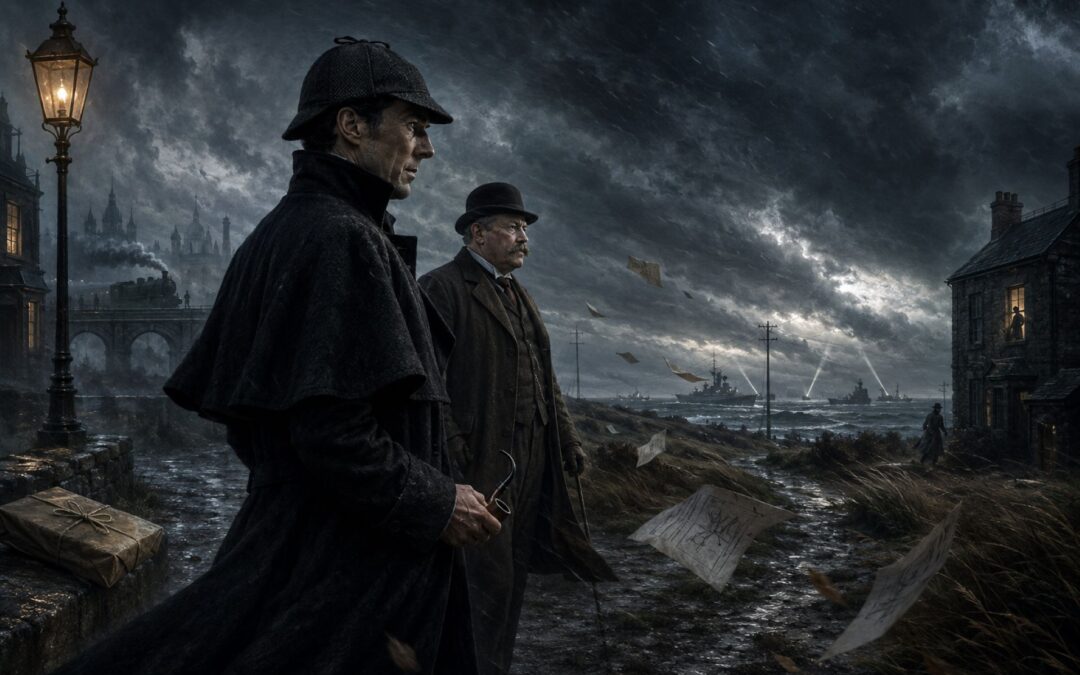
Arthur Conan Doyle’s His Last Bow occupies an unusual place in the Sherlock Holmes canon. It is neither a novel nor a single continuous sequence of adventures, but a collection of eight cases written across different years and retrospectively gathered in 1917. Some resemble the familiar Holmes formula of baffling clues and an elegant solution, while others move into domestic tragedy, Gothic horror, political conspiracy, government espionage and wartime adventure. The result is one of the most varied Holmes collections, and also one of the darkest.
What holds the book together is not a continuous plot but Holmes himself. Across these cases, he confronts crimes that increasingly resist the neat assumption that detection automatically restores order. Murder may be the culmination of years of abuse and jealousy. A killer may technically be guilty but morally sympathetic. Political refugees may have legitimate reasons to distrust legal institutions. Holmes may solve a crime and then decide not to hand the culprit over. By the final story, he has moved beyond private detection altogether and is working undercover for the British government as Europe approaches the First World War.
Spoiler warning: This article reveals every major mystery, culprit, murder, confession, rescue and ending in His Last Bow, including the complete conclusion of the title story.

What Kind of Holmes Collection Is His Last Bow?
The book first appeared in Britain in 1917 under the full title His Last Bow: Some Reminiscences of Sherlock Holmes. The original 1917 collection contained eight stories preceded by a short fictional preface from Dr John Watson. That preface matters because it establishes the retrospective structure of the volume: Holmes has retired to the South Downs, where he devotes himself to philosophy, farming and beekeeping, but the approach of war with Germany eventually draws him back into service.
The British book was issued by John Murray in 1917, although several individual stories had appeared much earlier in magazines. That long composition history explains why the collection should not be read as a chronologically continuous final chapter of Holmes’s career. The stories range across earlier periods of his work, and the title piece functions as a later epilogue rather than as the inevitable culmination of everything that precedes it.
The verified collection consists of “The Adventure of Wisteria Lodge,” “The Adventure of the Cardboard Box,” “The Adventure of the Red Circle,” “The Adventure of the Bruce-Partington Plans,” “The Adventure of the Dying Detective,” “The Disappearance of Lady Frances Carfax,” “The Adventure of the Devil’s Foot” and “His Last Bow.” One edition complication is especially worth noting: “The Cardboard Box” had an unstable publication history and appeared in some versions of The Memoirs of Sherlock Holmes. In the 1917 His Last Bow architecture, however, it belongs here and substantially contributes to the collection’s darker emotional character.
The stories differ considerably in scale. “The Cardboard Box” is essentially a domestic murder tragedy. “Wisteria Lodge” and “The Red Circle” import foreign political violence into apparently quiet English surroundings. “The Bruce-Partington Plans” involves state secrets and international espionage. “The Devil’s Foot” moves toward supernatural horror before restoring a rational explanation, while “His Last Bow” abandons Watson’s normal first-person case-history narration almost entirely and becomes a wartime spy story.
That variety makes the collection less immediately unified than The Adventures of Sherlock Holmes, but it also makes it revealing. Conan Doyle repeatedly tests how far the Holmes formula can stretch without losing the character at its centre. Sometimes Holmes is the scientist of clues, sometimes a manipulator of human psychology, sometimes an investigator who makes mistakes, sometimes an informal judge, and finally an intelligence operative acting in the national interest.
The Complete Story-by-Story Summary
The eight stories are independent cases rather than chapters in a single narrative, so the clearest way to understand the book is to follow them in collection order. Each begins from a different kind of disturbance, but several develop through the same basic movement: an apparently inexplicable detail draws Holmes toward a hidden history, and that history eventually becomes more important than the puzzle that first attracted him.
The Adventure of Wisteria Lodge
The story begins when a respectable Englishman named John Scott Eccles arrives at Baker Street in a state of extreme agitation. He has recently undergone what he calls an extraordinary and grotesque experience involving a man named Aloysius Garcia, whom he had met socially. Garcia, a charming foreign gentleman, invited Eccles to spend several days at his rented house, Wisteria Lodge, near Esher and Oxshott.
The visit quickly became uncomfortable. Garcia appeared nervous and distracted during dinner. A servant brought him a mysterious note that seemed to heighten his anxiety. Later that night Garcia entered Eccles’s bedroom and told him that it was one o’clock, although the actual time was considerably earlier. Eccles eventually went back to sleep. When he awoke in the morning, he discovered that Garcia, the cook and the servant had all disappeared, leaving the house abandoned.
Eccles is still trying to understand why a host would invite him to stay and then vanish when Inspector Gregson of Scotland Yard and Inspector Baynes of the Surrey Constabulary arrive. Garcia has been found murdered. Because Eccles is known to have spent the night at Wisteria Lodge, his bizarre account has suddenly become evidence in a homicide investigation.
Holmes concentrates on the strange note Garcia received during dinner. It contains references to green and white colours, a main staircase, a corridor, the seventh door on the right and green baize, followed by an encouraging farewell. The note clearly functions as instructions for a secret meeting or attack inside a large house. Holmes reasons that Garcia intended to leave Wisteria Lodge during the night and wanted Eccles present as an innocent witness who could later support an alibi. By visiting Eccles’s bedroom and falsely announcing that it was already one o’clock, Garcia hoped to create the impression that he was still at home later than he really was.
That means Garcia was not the passive victim of a random murderer. He was planning some dangerous enterprise of his own.
The investigation at Wisteria Lodge adds further mystery. The servants are missing, and strange objects in the kitchen suggest unfamiliar ritual practices. One of the servants later returns, apparently because he has left behind items of religious importance. These details initially seem sinister, but they prove secondary to the murder itself.
Holmes and Baynes work in parallel rather than in a conventional master-and-incompetent-policeman relationship. Baynes appears to make a serious error when he arrests the foreign cook, but Holmes gradually realizes that Baynes is deliberately creating the impression that the police have solved the case. If the true criminals believe official suspicion has moved elsewhere, they may become careless.
Holmes meanwhile studies the large houses near Wisteria Lodge because Garcia’s note clearly described such a property. High Gable becomes the most suspicious. It belongs to a wealthy man known as Henderson, who lives there with his secretary Lucas, his two daughters and their governess, Miss Burnet. Henderson is secretive, violent-tempered and apparently terrified of being found by enemies. Miss Burnet disappears after Garcia’s death, increasing Holmes’s suspicions.
The breakthrough comes when Holmes’s associate Warner, a former gardener, helps rescue Miss Burnet during an attempt by Henderson’s household to leave the country. She has been drugged and controlled. Once safe, she reveals the true history behind the case.
“Henderson” is actually Don Juan Murillo, the former dictator of the fictional Central American state of San Pedro. Murillo had ruled with exceptional brutality until a revolution overthrew him. He escaped with wealth, his children and trusted associates, eventually concealing himself in England under a false identity. His secretary Lucas is really Lopez, another member of the former regime.
Miss Burnet is actually Signora Victor Durando, widow of a minister whom Murillo summoned back to San Pedro and then executed. Other victims and surviving relatives formed a network dedicated to bringing Murillo to justice. Garcia belonged to this group as the son of another important San Pedro family.
Miss Burnet had deliberately entered Murillo’s household as governess in order to gather information. When she finally found an opportunity for action, she sent Garcia the coded instructions that Holmes had examined. The plan was for Garcia to enter High Gable when Murillo would be especially vulnerable. But Lopez discovered the note and realized that a conspiracy was underway.
Murillo and Lopez captured Miss Burnet, tortured her into revealing Garcia’s location and then allowed her message to continue on its way. Garcia therefore believed the plan remained secret. Instead, Murillo intercepted him before he could reach High Gable and killed him.
The explanation resolves almost every strange detail, including why Garcia needed Eccles as an alibi and why the household at Wisteria Lodge disappeared. The bizarre kitchen objects belong to the cook’s own religious practices rather than to the political conspiracy.
Murillo and Lopez nevertheless avoid immediate punishment. Although Miss Burnet’s evidence should allow the authorities to act, the two men escape English surveillance and disappear. Months later, however, two men travelling under assumed names are murdered in Madrid. Their descriptions match Murillo and Lopez closely enough that Holmes and Baynes infer that the vengeance network finally caught them.
The story ends without the clean satisfaction of formal justice. Garcia dies while attempting revenge, Miss Burnet survives brutal treatment, Murillo escapes the police, and the dictator is apparently murdered by other enemies. Holmes solves the case, but the machinery that determines punishment exists largely outside the law.
The Adventure of the Cardboard Box
“The Cardboard Box” begins with an object that is grotesque even by Holmesian standards. Miss Susan Cushing, a quiet woman living in Croydon, receives a package filled with coarse salt. Buried inside are two recently severed human ears.
Inspector Lestrade initially entertains the possibility that the parcel may be some disgusting practical joke connected to medical students who once lodged with Miss Cushing. Holmes immediately doubts that interpretation. The packaging, knot, salt and physical condition of the ears suggest a real crime rather than a prank.
Most importantly, Holmes studies the ears themselves. Human ears differ considerably in shape, and one of the severed ears resembles Susan Cushing’s own ear strongly enough to suggest a family connection. That observation shifts the entire case away from anonymous mutilation and toward the Cushing family.
Susan has two sisters, Sarah and Mary. Mary married a ship’s steward named James Browner, usually called Jim. Susan describes Jim as a man who was once affectionate and respectable but became dangerously altered by drink. Sarah lived with Mary and Jim for a time, but relations inside the household became increasingly hostile.
Holmes soon suspects that the parcel was never meant for Susan at all. Sarah had previously lived at Susan’s Croydon address, so someone intending to send the ears to Sarah might easily have used an outdated location. That suspicion becomes stronger when Sarah, now living in Wallington, suddenly falls seriously ill after learning about the package. Her reaction implies that she understands its meaning.
Holmes identifies Jim Browner as the likely sender and traces his movements through his work at sea. Browner’s ship, the May Day, travels between Liverpool and London and has recently passed through Belfast, matching the parcel’s postal origin. Lestrade arranges to arrest Browner when the ship arrives.
The mystery itself is solved relatively quickly, but the emotional core of the story comes from Browner’s confession. His account reveals that the severed ears are the final tokens of a domestic catastrophe that developed gradually through jealousy, resentment, alcohol and manipulation.
Browner had once been deeply devoted to Mary. Sarah, however, developed feelings for her brother-in-law. When Jim rejected her, her affection hardened into hostility. She began undermining the marriage, feeding Mary’s suspicions and encouraging conflict. Jim, already vulnerable to drink, returned to heavy drinking as the household atmosphere deteriorated.
Sarah then encouraged Mary’s friendship with Alec Fairbairn, a handsome sailor. Fairbairn’s frequent presence enraged Browner, who eventually forbade him from entering the house. Sarah moved elsewhere, but Mary continued seeing Fairbairn.
One day Browner returns to Liverpool unexpectedly and sees Mary and Fairbairn together in a cab. Suspicion overwhelms him. He follows them by train to New Brighton and continues tracking them when they hire a boat.
The weather and haze create an opportunity for violence away from witnesses. Browner follows in another boat until he catches the couple offshore. In a rage he attacks Fairbairn with a heavy stick and kills him. Mary clings to Fairbairn, and Browner kills her as well.
The brutality does not end there. Browner cuts an ear from each body, sinks the boat and corpses, and later sends the ears to Sarah. His intention is not merely to frighten her. He wants her to see the physical consequences of the jealousy and manipulation that, in his own mind, she helped set in motion.
The package mistakenly reaches Susan because Sarah has changed addresses.
Browner does not present himself as innocent. Nor does the story treat Sarah’s behaviour as legal or moral justification for what he has done. His confession instead reveals a man psychologically destroyed by his own violence. He claims that imprisonment or execution can scarcely worsen his suffering because he continually sees the faces of Mary and Fairbairn before him.
Holmes’s response is unusually bleak. There is no pleasure in having solved the parcel mystery. Instead, he reflects on the repeated cycle of suffering, fear and violence that human beings inflict upon one another. The detective can reconstruct every step of the tragedy, but understanding the crime does not repair anything.
The Adventure of the Red Circle
The next case begins with something much less dramatic: an excessively private lodger. Mrs Warren visits Holmes because a tenant in her house has behaved in an increasingly mysterious fashion. A young, dark, bearded foreign man originally rented a room from her, paying generously and insisting on complete privacy. Soon afterward, however, he stopped allowing anyone to see him.
Food is left outside the door. Requests appear as crude printed notes containing words such as “SOAP,” “MATCH” and “DAILY GAZETTE.” Mrs Warren has never seen the lodger’s face since the first day.
Holmes notices inconsistencies immediately. Cigarette evidence does not fit the bearded man Mrs Warren originally described. The strange printed requests also seem to have been produced by someone whose English is less fluent than that of the original tenant. Holmes concludes that a substitution occurred. The person who rented the room is no longer the person hiding inside it.
The Daily Gazette provides another clue. Its agony column contains apparently personal advertisements addressed to someone identified only by an initial. Holmes realizes that these messages are being used as a covert communication system.
The situation becomes more dangerous when Mrs Warren’s husband is abducted, driven around in a cab and then released unharmed. Holmes interprets the strange kidnapping as reconnaissance. Someone watching the house wants to determine who is entering and leaving but does not know enough to act openly.
Holmes and Watson eventually observe the hidden lodger’s window from another building. A candle begins flashing signals from elsewhere. Holmes identifies the language as Italian and decodes a warning meaning “Beware.” The signalling suddenly stops, suggesting that something has gone wrong at the other end.
Holmes and Watson trace the signal to its source and arrive to find Inspector Gregson and an American Pinkerton detective named Leverton already involved. The two men are pursuing Giuseppe Gorgiano, a notorious criminal associated with an Italian secret society called the Red Circle.
Inside the building lies Gorgiano’s corpse.
Holmes now uses the signalling system to summon the mysterious lodger from Mrs Warren’s house. She turns out to be Emilia Lucca. Her husband, Gennaro Lucca, was the original man who rented the room and then secretly exchanged places with her.
Emilia explains the history behind their flight. She and Gennaro had eloped from Italy and established a new life in New York. There Gennaro became associated with Tito Castalotte, a successful fruit importer whose life he once saved from attackers. Castalotte rewarded him with trust and employment.
Gennaro, however, carried an old danger from Italy. In his angry youth he had joined the Red Circle, an organization from which he believed emigration had freed him. Gorgiano eventually appeared in New York and reminded him that membership was not so easily escaped.
Gorgiano was physically intimidating, violent and increasingly obsessed with Emilia. At the same time, the Red Circle was blackmailing wealthy Italian immigrants. When Castalotte resisted their demands, the organization decided to destroy him and his house with explosives.
Through a supposedly random drawing, Gennaro was assigned the task of killing Castalotte. Emilia and Gennaro believed the drawing had been manipulated to ensure his selection. Instead of obeying, Gennaro warned Castalotte and the authorities. He and Emilia then fled.
In London, Gennaro hid Emilia in Mrs Warren’s house under conditions designed to keep her invisible while he operated separately. The newspaper notices allowed them to communicate without meeting. He hoped both to protect her and to draw Gorgiano away.
Eventually Gorgiano found Gennaro. Their confrontation ended with Gennaro killing him.
Emilia’s testimony radically changes the moral shape of the case. The dead man was hunting the couple, had threatened Emilia, belonged to a violent criminal organization and had attempted to force Gennaro into murdering his benefactor. Gregson and Leverton indicate that, assuming Emilia’s account can be corroborated, Gennaro has strong grounds for defending his actions.
As in “Wisteria Lodge,” an apparently small London mystery opens onto a history of political or organized violence elsewhere. The case also again leaves conventional categories of guilt unstable. Holmes can explain who killed Gorgiano, but that fact alone does not make the killer the morally dominant villain.
The Adventure of the Bruce-Partington Plans
A dense London fog hangs over the opening of “The Bruce-Partington Plans,” and the atmosphere is appropriate. The case concerns hidden movement, invisible agents and information that has slipped out of one of the most secure areas of the British state.
Holmes’s brother Mycroft arrives at Baker Street in person, something so unusual that Holmes immediately understands the gravity of the situation. Mycroft is more than an eccentric civil servant. He functions as an intellectual clearing-house within government, a man whose extraordinary memory and analytical capacity allow him to synthesize information from multiple departments.
The crisis involves the Bruce-Partington submarine, a highly secret military project. Ten plans contain the essential technical information. A young government clerk named Arthur Cadogan West has been found dead near Aldgate station. Seven of the ten plans were discovered on his body, while the three most important sheets are missing.
The obvious conclusion is horrifying: West stole the plans, travelled to London to sell them to a foreign power and died during the operation. Yet almost nothing about the evidence satisfies Holmes.
West was engaged to Violet Westbury and had a reputation for intense patriotism. On the night of his disappearance, he suddenly left Violet during the heavy fog without giving any explanation. No valid Underground ticket is found with his body. His injuries do not clearly match the assumption that he simply fell from a train. Most importantly, the secret papers were stored under controls that should have made unauthorized removal extremely difficult.
Holmes first reconstructs the institutional setting. He examines the Woolwich office where the documents were kept and studies who could access them. He learns that West had previously expressed concern about security weaknesses, which makes simple treason seem increasingly inconsistent with his character.
The scandal destroys the health of Sir James Walter, one of the senior officials responsible for the plans. His death deepens the sense that the theft has become both a personal and national catastrophe.
Mycroft provides Holmes with information about known foreign agents in London. Holmes becomes particularly interested in Hugo Oberstein, a professional spy whose house in Caulfield Gardens has a suspicious relationship to the railway line behind it.
Holmes and Watson break into Oberstein’s deserted property. Their entry is illegal, but Holmes considers the national stakes more important than procedural restraint. Inside, the architecture reveals the solution to one of the strangest clues.
A low window opens directly above the railway line at a point where trains frequently stop at a signal. Marks around the window, soot and blood indicate that Cadogan West’s corpse was placed on top of a railway carriage while the train was stationary. When the train later moved through London, the body eventually fell near Aldgate. West therefore never needed a ticket because he had not travelled as a living passenger.
The house also contains evidence that Oberstein communicated with an accomplice through coded newspaper advertisements. Holmes uses that channel to construct a trap.
He places a false message intended to draw Oberstein’s British collaborator back to the house. The man who arrives is Colonel Valentine Walter, the younger brother of Sir James Walter.
Walter confesses. Financial problems had driven him into betrayal. He secretly obtained an impression of his brother’s keys and used it to gain access to the submarine plans. During the heavy fog, he removed them and carried them to Oberstein.
Cadogan West happened to see enough of Walter’s movements to become suspicious. Because Walter’s connection to the office might conceivably have been legitimate, West did not immediately raise a public alarm. Instead, he followed him to London in hopes of discovering the truth.
At Oberstein’s house, West confronted the traitors. Oberstein killed him with a heavy weapon. The two men then faced a practical problem: how could they dispose of the corpse while also shifting suspicion away from themselves?
Oberstein kept the three most valuable plans. The other seven were placed on West’s body so that, when found, he would appear to be the thief. The corpse was then lowered through the railway window onto the roof of a stationary train.
Holmes turns Walter into an instrument for recovering the remaining documents. He dictates a message to Oberstein claiming that an additional technical detail remains available and can be purchased. The lure succeeds. Oberstein returns and is captured, and the missing plans are recovered from his possessions.
West’s reputation is restored posthumously. Far from being a traitor, he died because he followed the stolen secrets and tried to intervene. Oberstein receives a long prison sentence, while Walter later dies in prison.
Holmes’s own reward is more discreet. After being summoned to Windsor, he returns wearing an emerald tie-pin that strongly implies royal gratitude.
The story is one of the collection’s most elaborate demonstrations of Holmes’s classical method, but its stakes are already larger than an ordinary private case. Mycroft, military secrets, foreign agents and government intervention all anticipate the world of “His Last Bow,” where Holmes will move permanently from investigating espionage to practicing counter-espionage himself.
The Adventure of the Dying Detective
When Watson is summoned to Baker Street in “The Dying Detective,” the crisis appears intensely personal. Mrs Hudson tells him that Holmes is dying.
Holmes has supposedly been sick for three days. He has refused food and drink, looks emaciated and feverish, and appears intermittently delirious. Watson, as both physician and friend, immediately wants to examine him.
Holmes refuses. More painfully, he dismisses Watson’s medical abilities with unusual contempt and insists that he is suffering from an obscure contagious disease beyond Watson’s expertise. He warns Watson not even to come too close.
The hostility seems so out of character that Watson is hurt, but he remains determined to help. When he notices a small ivory box on the mantelpiece and reaches toward it, Holmes reacts with extraordinary panic. He orders Watson to leave it alone.
Eventually Holmes tells Watson that only one man can save him: Culverton Smith, a plantation owner with unusually specialized knowledge of the disease. Holmes has previously investigated Smith because Smith’s nephew, Victor Savage, died under suspicious circumstances.
Watson goes to Smith and describes Holmes’s desperate condition. Smith initially shows little desire to help, but the prospect of seeing Holmes helpless appears to attract him. He agrees to come.
Back at Baker Street, Holmes tells Watson to hide where he can hear the conversation without being seen. Smith arrives believing Holmes is genuinely close to death.
The interview becomes the real trap. With Holmes apparently unable to survive and therefore unable to expose him, Smith grows confident. He admits enough to establish that Victor Savage’s death was deliberate and that Holmes was attacked through the ivory box.
The box contains a hidden mechanism capable of pricking anyone who opens it. Smith had contaminated the sharp point with the disease-producing material and sent it to Holmes, expecting the detective to die in the same apparently mysterious way as Victor.
Holmes asks Smith to turn up the gas. The request is not part of his illness but a signal. Inspector Morton enters and arrests Smith.
The dying man immediately begins recovering. Holmes has never been sick.
He explains to Watson that he deliberately starved himself for three days to produce a convincing physical appearance. He used cosmetics and other theatrical details to intensify the illusion. His delirious remarks were part of the performance.
Watson’s exclusion was equally deliberate. Holmes knew that an actual medical examination would reveal that the objective signs did not support the supposed disease. More importantly, Watson is too honest to perform convincing indifference when someone he loves is in danger. If Watson knew the truth, Smith might detect it from his behaviour.
Holmes therefore trusted Watson in an unusual way: he trusted him enough to know exactly how sincerely he would react if deceived.
The story is shorter and more theatrical than “The Bruce-Partington Plans,” but it develops one of the central features of this collection. Holmes does not always win by analyzing evidence after a crime. Sometimes he creates the conditions in which a guilty person will reveal himself.
The Disappearance of Lady Frances Carfax
“The Disappearance of Lady Frances Carfax” begins with Holmes reflecting on the vulnerability of solitary women who travel with money but without strong social protection. His generalizations reflect the assumptions of his period, but the particular danger he identifies in Lady Frances’s situation proves real.
Lady Frances Carfax is the last direct representative of an aristocratic family. She has limited income but owns valuable old Spanish jewellery. Her former governess, Miss Dobney, becomes alarmed when Lady Frances stops writing.
Holmes cannot leave London, so Watson travels to the Continent and begins tracing her movements.
At Lausanne, Watson learns that Lady Frances had been living comfortably in a hotel before abruptly leaving. A large, rough-looking Englishman had appeared nearby and seemed to frighten her. Her maid, Marie Devine, had also left her service under strained circumstances.
Watson follows the trail to Baden. There Lady Frances had fallen under the influence of a seemingly devout missionary named Dr Shlessinger and the woman presented as his wife. Shlessinger appeared frail, religious and respectable. He won Lady Frances’s confidence by appealing to her faith.
The mysterious large Englishman turns out not to be her enemy. He is Philip Green, a former suitor. Green had behaved badly in earlier years, and Lady Frances rejected him, but he claims to have changed. He still loves her and has been searching for her.
Watson’s encounter with Green becomes physical before Holmes unexpectedly intervenes in disguise. Holmes has been following the investigation independently and is unimpressed by some of Watson’s methods, although Watson has nevertheless uncovered important information.
A physical description of Shlessinger, especially an abnormality of his ear, allows Holmes to identify him as Holy Peters, a practiced criminal. Peters specializes in exploiting lonely religious women. His supposed wife is an accomplice named Fraser.
The danger becomes urgent because Holmes suspects that Peters and Fraser have not merely robbed Lady Frances. They may have imprisoned or killed her.
The criminals begin disposing of pieces of Lady Frances’s jewellery. Philip Green follows Fraser and sees her visit an undertaker. He then traces activity to a house in Brixton where a specially made coffin is delivered.
Holmes and Watson enter the house. Their search initially appears to produce a terrible but irrelevant result: an elderly woman has genuinely died and is being prepared for burial. Lady Frances is nowhere to be found.
Because the dead woman explains the coffin and Holmes lacks enough legal authority to detain the suspects indefinitely, he withdraws.
Then one remark bothers him. The undertaker had mentioned that the coffin was unusually large.
Holmes realizes his mistake. The criminals do not need to create a false death certificate for Lady Frances if they can bury her in the same coffin as a woman whose death is genuine. The oversized coffin can conceal two bodies under one legally documented funeral.
Holmes and Watson race back as the funeral preparations are underway. They force the coffin open and find Lady Frances inside. She is unconscious, having been drugged with chloroform and placed beneath material in the coffin so that she will suffocate or remain insensible until burial.
Watson’s medical knowledge becomes essential. Lady Frances appears almost dead, but he persists until she begins to revive.
Peters and Fraser escape before the police can arrest them. The case therefore ends with the victim saved but the immediate villains temporarily beyond reach.
Holmes freely admits that he missed the coffin solution the first time. That admission matters. His method is powerful because he revises his thinking when the facts refuse to fit, not because he is literally incapable of error.
The Adventure of the Devil’s Foot
“The Devil’s Foot” begins with Holmes weakened by his own compulsive work. Watson, concerned about his health, takes him to Cornwall for rest. Holmes tries to occupy himself with the landscape, local language and prehistoric questions rather than criminal investigation.
The retreat fails almost immediately.
A local clergyman, Mr Roundhay, and his lodger Mortimer Tregennis bring news of a horrifying event involving Mortimer’s siblings. The previous evening, Mortimer had spent time with his brothers George and Owen and his sister Brenda. They were playing cards and appeared normal when he left.
The next morning, Brenda was dead. George and Owen were alive but permanently insane. All three bore expressions of overwhelming terror.
The room itself seems ordinary. There is no obvious sign of physical attack, and the witnesses can offer no conventional explanation. The effect is so grotesque that the incident acquires a supernatural aura.
Another figure soon enters the case: Dr Leon Sterndale, a famous explorer with extensive experience in Africa. Sterndale knows the Tregennis family and reacts intensely to news of the tragedy. He had been preparing to leave the country but unexpectedly returns.
Then Mortimer Tregennis himself dies under almost identical circumstances. His face is fixed in terror, and a lamp had been burning in the room.
Holmes begins reconstructing the mechanism. The repeated conditions suggest that something released into the air created the fatal or maddening effect. Residue near the lamp becomes important.
Holmes decides to test the suspected substance experimentally. It is one of his most reckless actions in the collection. He and Watson deliberately expose themselves to a small quantity in a closed room.
The effect is immediate and almost catastrophic. Both experience an indescribable, primitive terror that overwhelms rational thought. They barely manage to escape into fresh air before the experiment kills or permanently damages them.
Once outside, Holmes is shaken not only by the experience but by what he has done to Watson. His apology is unusually direct. Intellectual curiosity justified risking himself, but he recognizes that he had no right to expose his friend to the same danger.
The experiment confirms the physical mechanism. A mysterious powder produces poisonous fumes when heated.
Holmes then confronts Sterndale, whom he has connected to Mortimer’s death through physical traces around the crime scene.
Sterndale confesses and reveals the hidden history. The substance is a fictional West African poison known as the devil’s-foot root. Sterndale possessed a specimen from his travels. Mortimer once saw it and learned of its effects.
Sterndale had also been secretly in love with Brenda Tregennis for years. He was unable to marry her because he already had a wife from whom he was separated but could not legally free himself under the circumstances described in the story.
Mortimer stole some of the devil’s-foot preparation. He then used it on his own siblings, apparently because their deaths or incapacitation would benefit him financially. Brenda died; George and Owen lost their sanity.
When Sterndale returned and saw the condition of the victims, he recognized the symptoms of his poison. He concluded that Mortimer must have stolen and used it.
Sterndale decided not to rely on the law. He confronted Mortimer and forced him to undergo the same fate he had imposed on Brenda and his brothers. By burning the poison in Mortimer’s room, Sterndale killed him through the very terror-producing method Mortimer had used.
Holmes now faces a choice that deduction alone cannot answer. He knows Sterndale killed Mortimer. He also knows why.
He chooses not to inform the police.
Watson agrees. Holmes even tells Sterndale that if someone he loved had been murdered under comparable circumstances, he cannot be certain he would have acted differently.
The story therefore ends with a solved murder and an intentionally unpunished murderer. Holmes has ceased functioning merely as a mechanism that transfers guilty people into legal custody. He has become a private moral judge.
His Last Bow
The final story changes the rules immediately. It is not narrated in Watson’s usual retrospective first person, and Holmes does not initially appear under his own name.
The date is 2 August 1914. Europe is on the edge of war.
A German agent named Von Bork is preparing to leave England after years of extraordinarily successful espionage. He has cultivated the appearance of an English country gentleman while secretly gathering information on British military and political vulnerabilities.
A German diplomat, Baron von Herling, visits before his departure and congratulates him on his achievements. Their conversation reflects confidence that Britain is divided, unprepared and perhaps unwilling to intervene decisively in the approaching European conflict.
Von Bork has accumulated documents concerning naval matters, aircraft, coastal defences, Ireland, Egypt and other strategic subjects. His greatest material is secured inside a safe. Espionage information is disguised through coded references to motor-car parts.
Before leaving, Von Bork expects one final prize from an informant named Altamont, an embittered Irish-American who has supposedly gained access to important British naval signals.
Most of Von Bork’s household has already departed. His housekeeper Martha remains.
Altamont eventually arrives with an elderly chauffeur. Von Bork prepares to receive the valuable intelligence and complete his work.
Instead, Altamont attacks him.
The chauffeur is Dr Watson. Altamont is Sherlock Holmes.
The reversal reveals that the entire scene has been constructed around a deception deeper than any Holmes has attempted in the other stories. Martha is also working for him.
Holmes explains that he had genuinely retired from detective work. He lived on the South Downs and devoted himself seriously to bees, even producing a handbook on bee culture. He had no intention of returning to ordinary criminal investigation.
National circumstances changed that decision. The Foreign Minister and eventually the Prime Minister asked him to assist because British authorities were struggling to identify the source of serious intelligence leaks.
Holmes created the identity of Altamont and spent roughly two years making it credible. He constructed a background involving Chicago, Irish revolutionary connections in America and encounters with police in Ireland. The identity had to be convincing enough to survive scrutiny from experienced spies.
Once Von Bork’s network accepted him, Holmes began supplying information. Some material was genuine enough to maintain trust. Much of the strategically useful information, however, was false or deliberately distorted.
Holmes was therefore not simply observing Von Bork’s espionage organization. He was poisoning it with bad intelligence while simultaneously identifying German agents for British authorities.
Von Bork realizes that what he regarded as one of Germany’s finest intelligence operations has been compromised from within.
Holmes and Watson seize him and his papers. Von Bork protests that Holmes is acting without the authority of an ordinary police officer and effectively abducting him. Holmes does not seriously dispute the accusation. As elsewhere in the collection, procedural legality matters less to him than the outcome he considers necessary.
The captured spy is taken away.
With the immediate operation complete, Holmes and Watson briefly return to the intimacy of their earlier friendship. Watson is preparing to re-enter military service. Holmes has emerged from retirement for what appears to be one final national duty.
Then Holmes remarks that an east wind is coming.
Watson initially interprets him literally and comments on the pleasant night. Holmes explains that he means something else. The wind represents the approaching war.
He does not imagine it as gentle. It will be cold, destructive and dangerous. Many people may die. Yet he also predicts that the storm will somehow purify the country and that a cleaner, stronger world will lie beyond it.
The collection ends at precisely that uncertain threshold: the old detective and his old companion facing not another private mystery, but a continental catastrophe.
Sherlock Holmes and Dr Watson Across the Collection
Because the stories do not form one continuous plot, Holmes and Watson provide the strongest source of continuity. Their relationship gives even the most structurally different cases a recognizable emotional centre, while the collection also shows that neither man is quite as simple as his popular stereotype suggests.
Holmes: Detective, Performer and Moral Judge
Holmes is famous for observation and deduction, and His Last Bow contains several classic demonstrations of both. He recognizes the familial significance of the severed ear in “The Cardboard Box,” reconstructs Cadogan West’s impossible railway journey from physical traces, interprets encoded communications in “The Red Circle,” and identifies the mechanism of the Cornish deaths through repeated environmental details.
Yet this collection repeatedly emphasizes that analysis alone is not enough. Holmes is also a performer.
“The Dying Detective” makes that quality explicit. He does not simply catch Culverton Smith by discovering evidence of murder; he creates a performance elaborate enough to convince Smith that confession is safe. Holmes transforms his own body into false evidence, starving himself, altering his appearance and manufacturing the impression of fatal disease.
“His Last Bow” takes the same ability to an extreme. Altamont is not a momentary disguise but a long-lived identity maintained over approximately two years. Holmes builds a credible personal history, political associations and criminal reputation so that trained intelligence operatives will trust him. The story therefore turns one of his familiar detective techniques into professional espionage.
His willingness to deceive extends even to Watson. In “The Dying Detective,” Holmes deliberately inflicts emotional distress on his friend because Watson’s genuine fear is essential to convincing Smith. The method works, but the story exposes a recurring imbalance in their partnership: Holmes sometimes treats people closest to him as instruments inside a plan they are not allowed to understand.
Other stories complicate the assumption that Holmes is infallible. In “Lady Frances Carfax,” he initially misses the oversized coffin clue and must revise his thinking after leaving the suspects’ house. His strength lies less in never being wrong than in refusing to defend a failing theory once a neglected fact becomes important.
Even more significant is his moral independence. Holmes does not automatically regard the legal system as the final authority on justice. He breaks into Oberstein’s home in “The Bruce-Partington Plans.” He is sympathetic to Gennaro Lucca after Gorgiano’s death. Most dramatically, he deliberately allows Sterndale to go free after learning that he killed Mortimer Tregennis in revenge for Brenda’s murder.
These decisions make Holmes more interesting but also more ethically difficult. His personal judgment is frequently treated by the stories as superior to rigid procedure, yet that does not mean every action is beyond criticism. A detective who decides when law should be ignored has assumed powers no institution has granted him.
By the final story, however, Holmes’s independence has effectively merged with national service. He remains unconventional, but his deception is now directed against a foreign intelligence network on behalf of the British government. The private detective has become a state asset without becoming a conventional bureaucratic servant.
Watson: Narrator, Doctor, Partner and “Fixed Point”
Watson is sometimes treated as little more than the man who asks the questions that allow Holmes to explain his reasoning. His Last Bow demonstrates why that view is inadequate.
He is first of all the emotional witness through whom most of the collection is experienced. Holmes may register a severed ear as evidence of family resemblance, but Watson registers the human horror around it. That difference gives the stories their balance. The detective’s intellectual distance keeps mysteries solvable; Watson prevents them from becoming purely abstract games.
His medical identity also matters repeatedly. “The Dying Detective” depends on Holmes preventing Watson from examining him because a competent physician would recognize inconsistencies in the supposed illness. In “Lady Frances Carfax,” Watson’s medical ability becomes directly lifesaving when Lady Frances is pulled from the coffin apparently close to death.
Watson also works independently. His Continental investigation into Lady Frances’s disappearance is imperfect, and Holmes criticizes him, but he nevertheless follows witnesses, reconstructs movements and identifies major participants. He is not Holmes’s intellectual equal, yet he is far from useless.
The most revealing scenes concern trust. Holmes deceives Watson in “The Dying Detective” because he knows Watson cannot convincingly simulate indifference to his friend’s death. That is simultaneously an insult to Watson’s theatrical ability and an acknowledgment of his emotional loyalty.
“The Devil’s Foot” reverses the dynamic. Holmes brings Watson into a dangerous experiment and nearly kills him. Once they escape, his apology exposes how much Watson actually matters to him. The usually controlled Holmes recognizes that risking his own life is one thing; risking Watson’s out of scientific excitement is another.
By “His Last Bow,” Watson has become the stable connection between Holmes’s detective past and the wartime present. He may be older, Holmes may have retired, and the scale of events may have shifted from Baker Street to European war, but their partnership survives. Their reunion is therefore more than nostalgic fan service. It is the emotional proof that Holmes’s changing professional world still contains one constant relationship.
Mycroft, Baynes, Lestrade and the Limits of the Lone Genius
The collection also complicates the familiar image of Holmes standing intellectually alone above a landscape of incompetent officials. Several police and government figures are capable in their own right.
Inspector Baynes is the clearest example. In “Wisteria Lodge,” his arrest of the foreign cook initially looks foolish. Holmes eventually recognizes that Baynes is pursuing a deliberate strategy of misdirection while independently approaching the same solution. Holmes respects him precisely because Baynes does not simply wait for Baker Street to solve the case.
Mycroft represents intelligence on an even larger scale. He lacks Sherlock’s energy for field investigation, but “The Bruce-Partington Plans” presents him as a man capable of synthesizing state information at an extraordinary level. Sherlock moves through streets, houses and railway lines; Mycroft surveys institutions.
Lestrade and Gregson remain more conventional policemen, yet they frequently perform necessary practical work. They arrest suspects, coordinate with official systems and convert Holmes’s theories into enforceable outcomes. In “The Red Circle,” Gregson’s investigation converges with Holmes’s rather than merely trailing behind it.
These figures matter because they prevent the collection from becoming a simple celebration of solitary genius. Holmes remains exceptional, but his most important cases increasingly depend on networks of information, institutional authority and collaborators who possess skills he does not.
Law, Revenge and the Morality of Justice
A conventional detective story often promises that discovering the truth will restore moral order. His Last Bow repeatedly weakens that assumption. Holmes can identify what happened with extraordinary precision, yet the question of what should happen afterward is often much harder.
When the Law Cannot Reach the Crime
“Wisteria Lodge” presents the problem through Murillo. As the former dictator of San Pedro, he has committed atrocities that created enemies across borders. Yet after escaping political collapse and hiding under another identity, he exists in a space where the victims do not trust ordinary institutions to punish him.
Garcia and Miss Burnet therefore become part of a private revenge network. Their conspiracy is illegal, but its moral logic grows from the belief that formal law has failed completely. Garcia dies before reaching Murillo, and even after Holmes reveals the case, Murillo escapes prosecution. His eventual death in Madrid apparently comes from other enemies acting outside the law.
“The Red Circle” presents a related but more immediate problem. Gennaro kills Gorgiano, but Gorgiano has followed him across countries, threatened Emilia and attempted to force Gennaro into murder. The authorities therefore confront not a simple murderer but a man whose violence appears inseparable from self-defence and resistance to organized coercion.
These stories do not argue that revenge is automatically just. They show why legal categories become strained when crime itself operates through failed states, secret societies, transnational networks or circumstances in which victims do not believe official protection can reach them.
Holmes and Extra-Legal Justice
Holmes does more than observe this tension. He repeatedly participates in it.
His burglary of Oberstein’s house is a straightforward violation of property law committed in order to recover national secrets. In “His Last Bow,” Von Bork accurately points out that Holmes is acting outside ordinary police procedure when he seizes and transports him. Holmes treats the complaint as essentially irrelevant.
The most important case is Sterndale. There is no ambiguity about what Sterndale did: he deliberately killed Mortimer Tregennis. Holmes nevertheless decides not to expose him.
His reasoning is emotional rather than purely legal. Mortimer murdered Brenda using the stolen devil’s-foot poison and destroyed the minds of his brothers. Sterndale loved Brenda and retaliated using the same method. Holmes does not claim the killing never happened; he decides that formal punishment would not produce a more satisfactory justice.
The moment is revealing because it exposes how much authority Holmes assigns to himself. He is investigator, fact-finder and ultimately judge. The narrative encourages sympathy for his decision, but a modern reader can still question the principle. A system in which one brilliant private citizen decides which killers deserve prosecution is dramatically satisfying only because the fictional Holmes is assumed to possess exceptional judgment.
That assumption itself is part of the Holmes fantasy.
The Circle of Misery, Violence and Fear
“The Cardboard Box” offers the strongest counterweight to stories in which extra-legal violence can be made to feel righteous. Jim Browner also understands his murders through a chain of provocation, jealousy and suffering. Yet nothing in his grievance can morally justify killing Mary and Fairbairn.
The story’s power lies in refusing to convert explanation into excuse. Sarah’s manipulation matters because it helps explain how the marriage deteriorated. Browner’s drinking matters because it helps explain his volatility. Mary’s relationship with Fairbairn matters because it explains his jealousy. None of those facts removes his responsibility for choosing murder.
His punishment begins before the law touches him. The images of the people he killed recur in his mind, and his confession conveys a man already trapped inside the consequences of his own actions.
Holmes’s final reflection on the “circle of misery and violence and fear” therefore reaches beyond the individual case. Detection can identify causes, but causal understanding does not necessarily produce moral consolation. Sometimes every participant emerges damaged, and no elegant solution can undo what happened.
Secrets, Codes, Disguises and Hidden Information
One of the strongest patterns across His Last Bow is the transformation of information into something physical, concealed and dangerous. A note, an advertisement, a candle signal, a military plan or a false identity can be as important as a weapon. Holmes’s genius therefore depends not simply on observing objects but on understanding systems of communication.
Messages, Signals and Documents
In “Wisteria Lodge,” Garcia’s mysterious note initially seems like an isolated clue. Holmes turns it into a map of action by recognizing that its references to colours, corridors and a numbered door are practical instructions inside a large house.
“The Red Circle” multiplies these forms of communication. Newspaper agony columns allow people to exchange messages without meeting, while candle signals transmit immediate warnings across buildings. Holmes solves the mystery partly because he recognizes communication itself as evidence.
“The Bruce-Partington Plans” raises the stakes further. Information is no longer merely a clue to crime; it is the object being stolen. The entire case revolves around the movement of technical knowledge from a secure government office toward a foreign intelligence agent.
Oberstein’s newspaper messages also demonstrate an important principle of espionage: the safest communication may be hidden in plain sight. A public advertisement can be private if only two people understand its meaning.
“His Last Bow” brings the pattern to its logical conclusion. Von Bork’s espionage system uses coded references to ordinary mechanical parts, and Holmes’s greatest victory is not physical capture alone. He has corrupted the enemy’s information supply. Intelligence itself becomes the battlefield.
False Identities and Performance
The same pattern extends from messages to people. Several major characters survive or operate by becoming someone else.
Murillo hides as Henderson. Holy Peters becomes Dr Shlessinger and exploits the social authority of religion. Gennaro and Emilia Lucca use separation and concealment to evade the Red Circle.
Holmes is the greatest performer of all. His supposedly dying body deceives Culverton Smith because Holmes understands that people believe what confirms their hopes. Smith wants Holmes to be dying, so the performance requires relatively little persuasion once it appears convincing.
Altamont is far more ambitious. Holmes must create not just appearance but biography. The identity has a political history, geographic trail and criminal associations. It works because a believable disguise is ultimately a believable explanation of who someone is.
That principle reveals why Holmes’s skill with disguise is more than costume. He understands expectations well enough to inhabit them.
Holmes’s Method: Evidence Before Theory
Despite the theatrical elements, Holmes repeatedly insists on a disciplined relationship between observation and explanation. He resists treating bizarre appearances as supernatural simply because they are frightening. He asks what facts would need to be true for the visible result to exist.
The Cardboard Box ears indicate kinship. The condition of Cadogan West’s body implies movement by train without passenger travel. The repeated terror in Cornwall requires a mechanism capable of acting through the room itself.
“Lady Frances Carfax” is important because it shows what happens when Holmes temporarily fails to interpret an available detail. The oversized coffin is not hidden from him; he simply does not initially understand its significance.
His eventual correction illustrates the stronger version of his method. Rationality does not mean never being mistaken. It means allowing stubborn evidence to overturn a comfortable theory.
Horror, Vulnerability and the Body as Evidence
Several stories in His Last Bow begin not with an intellectual puzzle but with an image designed to disturb the reader. Severed ears arrive through the post. Faces freeze in impossible terror. A living woman is sealed inside a coffin. Holmes himself appears to be physically decaying before Watson’s eyes. Conan Doyle repeatedly borrows the emotional machinery of horror even when the final solution remains rational.
From Severed Ears to the Cornish Horror
“The Cardboard Box” makes horror tactile. The mystery is horrifying before the reader knows anything about Mary Browner, Fairbairn or the marriage. Human remains have entered an ordinary domestic space through the postal system.
“The Devil’s Foot” works differently. Its horror comes from facial expression and mental destruction. Brenda’s corpse and her insane brothers appear to have encountered something so terrible that the mind cannot survive it.
Conan Doyle initially allows the possibility of the supernatural to linger. Cornwall’s ancient landscape, local folklore and the inexplicable condition of the victims create a Gothic atmosphere. Holmes then restores causal order by identifying poison fumes.
Yet the rational explanation does not eliminate the horror. When Holmes and Watson test the substance themselves, they discover that the terror is physically real. The story therefore does not mock supernatural fear so much as replace its cause.
“Lady Frances Carfax” turns burial itself into a mechanism of murder. The oversized coffin is terrifying precisely because it uses ordinary legal and religious ritual as camouflage. A documented funeral can become the perfect way to make a living woman disappear.
“The Dying Detective” reverses the method once more. The diseased body is fake, but Watson’s fear is genuine. Holmes manufactures horror because he needs Culverton Smith to believe he has already won.
Women, Isolation and Predatory Violence
Women in the collection are frequently placed in situations of intense vulnerability, although the stories do not treat them all identically.
Mary Browner becomes the centre of a destructive conflict between marital jealousy, Sarah’s interference and Browner’s violence. Whatever moral judgments the characters make about her relationship with Fairbairn, the essential fact is that Browner chooses to kill her.
Lady Frances is endangered by isolation. She has social status and valuable property but limited day-to-day protection, which makes her an attractive target for professional criminals. Holy Peters exploits trust rather than physical force at first, using the identity of a missionary to gain control over her.
Brenda Tregennis appears primarily through the grief and violence her death produces, but her murder exposes how easily domestic relationships can conceal lethal motives.
Emilia Lucca and Miss Burnet possess greater direct agency. Emilia participates in a complex effort to evade the Red Circle and later tells the story that determines how Gennaro’s actions are understood. Miss Burnet deliberately infiltrates Murillo’s household despite the personal danger because she wants justice for her murdered husband.
The collection therefore contains both active women and repeated structures of male violence against women. What has dated most noticeably is not simply that female characters become victims, but the broad social generalizations sometimes made around that vulnerability. Those claims reflect early twentieth-century assumptions and should not be treated as timeless descriptions of women’s lives.
Fog, Coffins, Boxes and Concealed Truth
Several recurring objects reinforce the book’s fascination with hidden information, although the collection was assembled from independently written stories and should not be forced into a single planned symbolic system.
The fog in “The Bruce-Partington Plans” hides physical movement and mirrors the uncertainty surrounding West’s supposed betrayal. Boxes conceal both evidence and danger: one contains severed ears, another a contaminated mechanism intended to kill Holmes.
The coffin in “Lady Frances Carfax” hides a living victim beneath a legitimate corpse, while safes and valises conceal national secrets in the espionage stories. Across the collection, truth repeatedly exists inside containers, codes or disguises that must be opened correctly before anyone understands what has happened.
The body itself often becomes another container of evidence. Ears reveal kinship. Injuries reveal how a corpse travelled. Faces reveal exposure to terror. Holmes’s deliberately altered appearance produces false medical evidence.
The pattern is simple but effective: what matters most is rarely visible at first glance.
How Conan Doyle Builds the Stories
Conan Doyle’s Holmes stories often appear structurally effortless because Watson tells them with conversational clarity, but many depend on carefully controlled access to information. The reader frequently receives a bizarre result first and the hidden causal history only much later. That allows each story to function both as a puzzle and as a retrospective narrative of how ordinary motives generated extraordinary appearances.
Watson’s Case-History Voice
Watson usually writes as though he is selecting cases from a large personal archive. This retrospective frame gives the stories a peculiar mixture of intimacy and distance. He knows the outcome but narrates his earlier uncertainty as though he were living it again.
His limitations are structurally useful. Watson sees most of what Holmes sees but does not interpret it in the same way. The reader can therefore encounter clues without immediately receiving their meaning.
His emotional responses also establish tone. When Holmes appears ill, Watson’s distress makes the deception believable. When the Cornish poison overwhelms them, Watson communicates terror in a way Holmes’s colder analytical voice could not.
Watson is therefore not merely a device for making Holmes look clever. His perspective determines what kind of stories these are. Holmes supplies explanation; Watson supplies experience.
Confessions, Testimony and the Delayed Explanation
A striking number of stories depend on long retrospective accounts once Holmes has solved the immediate mystery.
Jim Browner’s confession explains the marriage, Sarah’s resentment, Fairbairn and the murders. Emilia Lucca’s testimony reconstructs the Red Circle’s hold over Gennaro and the couple’s flight. Miss Burnet reveals Murillo’s political past. Colonel Walter explains West’s involvement in the stolen submarine plans. Sterndale tells Holmes why Mortimer had to die.
This technique allows Conan Doyle to begin with a compressed mystery and later unfold a much larger story behind it. A pair of severed ears becomes the endpoint of a failed marriage. A hidden lodger becomes part of an international criminal pursuit. A corpse on a railway line becomes evidence of state treason.
The strength of this structure is emotional expansion. Holmes solves the mechanism, but the confession explains the people.
Its weakness is that some stories become heavily expository near the end. Instead of dramatizing the entire hidden history, Conan Doyle often lets a participant narrate it after the central deduction is complete. The method is efficient, but it can produce resolutions that feel more narrated than enacted.
From Detective Story to Spy Thriller
“His Last Bow” deliberately breaks the collection’s usual pattern. As Stanford’s annotated reading of the story emphasizes, the shift away from Watson’s familiar narration contributes to the story’s epilogue-like character.
The opening is largely aligned with Von Bork rather than Holmes. The reader is invited into the German spy’s confidence and sees Altamont as Von Bork sees him. The mystery is therefore not “Who committed the crime?” but “Who is controlling the situation?”
When Altamont becomes Holmes and the chauffeur becomes Watson, the reveal operates almost like a theatrical entrance. The familiar characters have been hidden inside another genre.
The change matters because Holmes no longer spends the story reconstructing a completed crime. He has already spent years constructing the operation. Detection has become counter-intelligence.
That formal change mirrors the change in stakes. Baker Street’s private cases have given way to a European political crisis, and the detective story has become a spy thriller without abandoning Holmes’s essential weapons: disguise, inference, patience and control of information.
The Ending of His Last Bow Explained
The literal ending is straightforward. Von Bork has been exposed, Holmes’s long undercover operation has succeeded, the German intelligence network has been fed misleading information, and Watson has reunited with Holmes as Europe approaches war. What makes the ending memorable is that Conan Doyle does not stop with the arrest. He converts the approaching conflict into a metaphor that transforms the apparent final Holmes adventure into a statement about Britain’s future.
Why Holmes Returns From Retirement
Holmes’s retirement is genuine. He has left ordinary detective work and settled on the South Downs, where he studies bees seriously enough to produce a handbook on the subject.
The point is not that retirement bores him. He has found a new intellectual world.
What changes is the scale of the challenge. The Foreign Minister and then the Prime Minister ask for his help because British authorities believe a major intelligence threat is operating inside the country. Holmes agrees to create Altamont and enter Von Bork’s network.
That decision makes his return different from merely accepting another client. He is not tempted back by money, novelty or private fame. He returns because the story frames national security as an obligation large enough to override retirement.
The operation also reveals how completely his detective abilities can be repurposed. Observation becomes intelligence gathering. Disguise becomes long-term identity construction. Manipulating a criminal becomes manipulating an enemy state’s information system.
Holmes has not stopped being himself. The world requiring his skills has changed.
What the East Wind Means
After Von Bork’s capture, Holmes remarks that an east wind is coming. Watson initially interprets the comment literally because the evening itself does not seem especially unpleasant.
Holmes clarifies that he is speaking metaphorically. The east wind is war.
The direction has obvious geopolitical resonance: the danger approaching Britain is associated with Germany and continental conflict. But Holmes’s metaphor is not limited to invasion or military threat. He imagines the wind as a cleansing force.
That is why the speech is both memorable and uncomfortable. Holmes acknowledges that the storm will be cold and destructive and that many people may die. Yet he also imagines Britain emerging purified after passing through it.
The metaphor therefore contains two ideas at once. War is catastrophe, but it is also imagined as moral testing.
A modern reader knows how dangerous that second idea can be. The belief that national suffering will cleanse or strengthen a society can aestheticize real destruction. Conan Doyle’s language gains historical importance precisely because the optimism cannot be separated from what readers now know about industrialized warfare.
The Ending in Its 1917 Wartime Context
The story takes place in August 1914, but the collection appeared in 1917. That difference matters enormously.
By the time the book reached readers, the war Holmes predicts had already produced years of mass death. The east wind was no longer an abstract future storm.
Andrew Glazzard’s analysis of the east-wind passage emphasizes the tension between Conan Doyle’s optimistic moral vision and the darker cultural memory that later became dominant around the Western Front. The ending now reads differently because later readers bring knowledge to the metaphor that Holmes, speaking inside August 1914, does not possess.
The story also belongs to the broader culture of First World War literary propaganda. That does not reduce it to a government notice disguised as fiction, nor does it require treating every sentence as an official political position. It does mean that its representation of German espionage, British resilience and national purification participates in the wartime rhetoric of its moment.
The final speech is therefore best understood historically rather than either dismissed or celebrated without qualification. Conan Doyle uses Britain’s most famous rational detective to reassure readers that the coming storm, however destructive, will not destroy the moral core of the country.
There is also an irony created by literary history. The title sounds definitive, but “His Last Bow” did not remain Sherlock Holmes’s literal final appearance. Conan Doyle later returned to earlier periods of Holmes’s career in The Case-Book of Sherlock Holmes.
The “last bow” is consequently a dramatic retirement image rather than a strict publication endpoint. Holmes leaves the stage at the edge of war, but Conan Doyle eventually brings him back.
Critical Review: How Well Does His Last Bow Hold Up?
His Last Bow is not the most uniform Sherlock Holmes collection, and that unevenness is inseparable from its strengths. The stories span different periods, styles and ambitions, so the book lacks the concentrated consistency of a collection conceived as a tightly integrated whole. Yet its range reveals how durable Conan Doyle’s central creation had become: Holmes can enter stories of domestic jealousy, international conspiracy, Gothic terror and wartime espionage without becoming unrecognizable.
What the Collection Does Best
The strongest achievement is variety. “The Bruce-Partington Plans” delivers an elaborate high-stakes detective puzzle built around physical evidence, railway logistics and state secrecy. “The Cardboard Box” begins with grotesque evidence but becomes a grim domestic tragedy. “The Devil’s Foot” uses the atmosphere of supernatural horror before pushing Holmes into one of his most morally difficult decisions.
Those stories demonstrate why Holmes survives beyond the ingenuity of individual clues. The appeal lies partly in watching the same mind adapt to radically different environments.
The Holmes-Watson relationship also receives unusually strong material. “The Dying Detective” turns Watson’s loyalty into part of Holmes’s plan, while “The Devil’s Foot” exposes Holmes’s guilt when his intellectual recklessness endangers his friend. “His Last Bow” gives the relationship a final note of continuity after retirement.
The collection’s official investigators are stronger than the popular Holmes-versus-idiot-police stereotype suggests. Baynes is particularly memorable because he independently understands “Wisteria Lodge” and deliberately misleads the criminals with a false arrest. Mycroft broadens the intellectual world even further by representing institutional intelligence rather than street-level detection.
The darker moral tone also helps the book. Several stories refuse the comforting idea that catching a criminal restores what was lost. Mary Browner remains dead. Garcia dies before his revenge succeeds. Brenda’s murder cannot be repaired by Sterndale’s retaliation. Lady Frances survives, but her attackers escape.
Holmes’s own ethics become correspondingly more complicated. He is not simply a neutral solving machine. He evaluates motives and sometimes decides that formal punishment would produce less justice than letting a technically guilty person go.
That ambiguity gives the later Holmes stories greater moral texture than their reputation as puzzle fiction might suggest.
The collection also uses atmosphere effectively. London fog, empty country houses, hidden lodgers, isolated Cornish rooms and sealed coffins give individual stories a strong visual identity. Conan Doyle rarely over-describes settings, but he knows how to establish enough physical detail to make danger immediate.
Finally, the title story is memorable precisely because it is different. It may not be the strongest mystery in the volume because it is hardly a mystery at all. Its value lies in transforming Holmes into a figure capable of leaving detective fiction and entering national myth.
Where the Collection Is Uneven or Dated
The most obvious structural weakness is the dependence on retrospective explanation. Conan Doyle frequently constructs an excellent opening puzzle and then resolves the human history through long testimony or confession.
This works beautifully in “The Cardboard Box,” where Browner’s confession gives emotional depth to an otherwise grotesque clue. In other stories, however, the transition can feel mechanical. Holmes uncovers enough of the solution, a participant speaks at length, and the hidden past arrives in a block of exposition.
Several villains are also larger than life. Murillo, Gorgiano, Holy Peters and Von Bork are effective within melodramatic adventure fiction, but psychological subtlety is not always their defining quality. Conan Doyle often needs the antagonist to embody danger quickly, and caricature becomes an efficient shortcut.
That tendency becomes more problematic when it intersects with nationality, race and empire. The stories contain language and assumptions that have dated badly, including broad generalizations about foreign peoples, secret societies and supposedly exotic forms of violence or disease.
The fictional devil’s-foot poison, the mysterious illness in “The Dying Detective” and some descriptions of non-European cultures draw on an imperial adventure tradition in which distant regions become reservoirs of strange threats brought back into Britain. These devices remain dramatically effective but carry assumptions modern readers should recognize rather than absorb uncritically.
Women also occupy an uneven position. Several female characters have real courage and agency, especially Emilia Lucca and Miss Burnet. Yet the collection repeatedly places women inside narratives of male possession, jealousy, exploitation and rescue.
That reflects the crimes Conan Doyle chooses to dramatize, but it also limits how much interior life some women receive. Lady Frances is the centre of an entire case while spending much of it absent, manipulated or unconscious.
Holmes’s moral authority is another area where modern readers may feel more resistance than the narrative expects. Letting Sterndale go can feel emotionally satisfying because Mortimer is a murderer and Brenda’s death is horrifying. But the story depends heavily on trust in Holmes’s private judgment.
The wartime politics of “His Last Bow” have aged most visibly. Its German villainy and belief in war as a cleansing national storm belong unmistakably to the rhetoric surrounding the First World War. Historical context explains that rhetoric; it does not require endorsing it.
None of these problems makes the collection unreadable. They do mean that a modern reading benefits from two perspectives at once: enjoyment of the narrative craft and awareness of the cultural assumptions embedded within it.
Where His Last Bow Stands in the Holmes Canon
As a collection, His Last Bow is probably less consistently iconic than The Adventures of Sherlock Holmes. It does not contain as many cases that have become universally recognizable outside devoted Holmes readership, and its long composition history makes it feel more assembled than unified.
Yet it may be more interesting than that comparison suggests.
The volume shows Conan Doyle stretching his formula. Holmes investigates crime through family anatomy, coded communication, railway engineering, psychological performance, chemical horror and intelligence operations. The stories ask not only whether he can find the culprit but what he should do after he does.
“The Bruce-Partington Plans” deserves its reputation as one of the major espionage-inflected Holmes cases. “The Cardboard Box” is more emotionally brutal than many famous adventures. “The Devil’s Foot” combines friendship, horror and moral ambiguity with unusual force. “His Last Bow” is historically revealing even where its wartime optimism now feels unsettling.
The collection’s strongest contribution is therefore not a single perfect case. It is the demonstration that Holmes can survive major changes of scale and genre.
The greatest limitation is the baggage that comes with that range. Conan Doyle’s foreign conspirators, colonial exoticism, gender assumptions and wartime nationalism often reveal the period as clearly as the stories reveal their mysteries. Readers who approach the book only as timeless entertainment may find those elements jarring; readers who approach it historically can see how the Holmes phenomenon interacted with the anxieties of the world in which it was written.
His Last Bow remains worth reading, especially for anyone who wants to understand Sherlock Holmes beyond the image of a flawless Victorian puzzle-solver. The collection presents a more complicated figure: brilliant but manipulative, rational but theatrical, committed to truth but not always to legal procedure, capable of error, intensely loyal in his own peculiar way, and increasingly willing to place his abilities in the service of causes larger than an individual client.
Its best stories still work because Conan Doyle understands that a mystery becomes memorable when the solution reveals a human situation rather than merely explaining a clue. The severed ears matter because they belong to a destroyed marriage. The submarine plans matter because Cadogan West dies trying to stop betrayal. The devil’s-foot poison matters because its discovery forces Holmes to decide whether justice and law are the same thing.
The title story then changes the scale one final time. Holmes and Watson, older and apparently near the end of their shared career, look toward a crisis that no detective can solve by identifying one guilty individual. The east wind is historically uncomfortable because the war it imagines as purification became catastrophe on a scale no Holmesian solution could contain.
That tension is precisely why the ending still matters. His Last Bow preserves Sherlock Holmes as both an enduring fictional character and a product of a particular historical moment. Read with both dimensions in view, the collection remains not only entertaining but revealing: about Conan Doyle, about the evolution of detective fiction, and about the kinds of moral authority readers have always been willing to grant the figure at 221B Baker Street.
Last Updated on August 20, 2026 by Aseem Gupta