
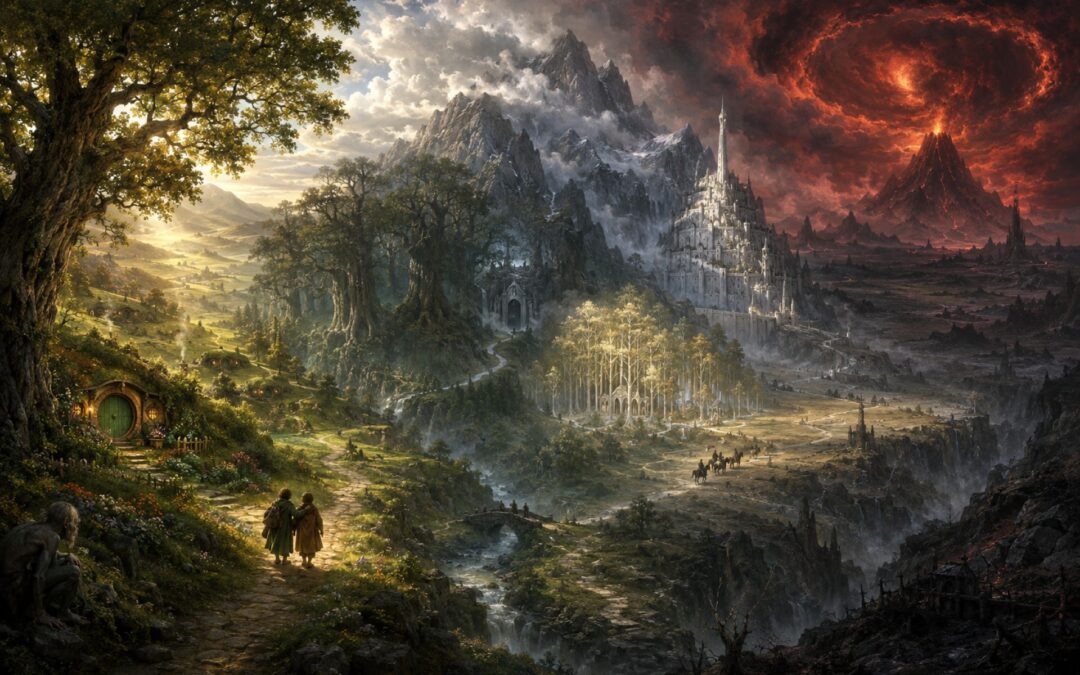
J. R. R. Tolkien’s The Lord of the Rings is often spoken of as a trilogy because it was published in three volumes—The Fellowship of the Ring, The Two Towers, and The Return of the King. That description is convenient but structurally misleading. Tolkien wrote it as one continuous novel divided internally into six Books, and the Tolkien Estate’s account of its publication explains that the three-volume release was largely a practical consequence of the work’s enormous size and the difficulties of post-war publishing.
That distinction matters because the story is designed as a single movement. Frodo’s departure from the Shire, the breaking of the Fellowship, the wars in Rohan and Gondor, the journey through Mordor, the destruction of the One Ring, the restoration of Aragorn’s kingship, the Scouring of the Shire, and Frodo’s final departure all belong to one arc. The famous victory at Mount Doom is not even the novel’s final resolution; Tolkien deliberately continues beyond the defeat of Sauron to ask what victory means for people and places that have already been changed by war.
This article contains complete spoilers for the entire novel, including the fate of the Ring, Gollum, Saruman, Aragorn, and Frodo, as well as the events of “The Scouring of the Shire” and “The Grey Havens.”
At its most visible level, The Lord of the Rings is an epic quest to destroy an object of immense power before Sauron can recover it. Beneath that quest is a more unusual moral argument. The heroes cannot defeat evil by taking its supreme weapon and using it more wisely; their task is to surrender the possibility of possessing that power at all. Around this central problem Tolkien builds a story about mercy, friendship, mortality, legitimate authority, despair, historical loss, and the strange importance of people who seem too small to matter in the struggles of kings and empires.
Before the Quest: Hobbits, the Ring, and the Shape of the Story
Tolkien begins before the main action with a Prologue that explains hobbits and the Shire in the mock-historical manner that characterizes much of the novel. Hobbits are a small people who prefer food, gardens, family history, local gossip, comfortable houses, and predictable routines to heroic adventure. They possess no great military institutions and little interest in the wider politics of Middle-earth, which makes the eventual role of Frodo, Sam, Merry, and Pippin deliberately improbable.
The Shire itself is politically modest. Its Mayor has limited ceremonial functions, the Thain preserves an old title connected with kingship, and officials such as the Bounders perform practical duties without maintaining an elaborate state. This almost casual civic order becomes important much later, because the oppressive regulations introduced during the Scouring are shocking precisely because they violate a culture accustomed to governing itself through habit, neighbourliness, and minimal coercion.
The Prologue also connects The Lord of the Rings to The Hobbit. Bilbo Baggins found a mysterious ring beneath the Misty Mountains after encountering Gollum, a strange creature who had possessed it for centuries. In the earlier version of the story Bilbo initially gave an inaccurate account of how he obtained the Ring, claiming that Gollum had offered it as a gift after losing the riddle contest. Tolkien incorporates that inconsistency into the later story by explaining that the Ring had already begun encouraging Bilbo to justify his ownership.
The Ring is therefore dangerous before anyone fully understands what it is. Bilbo uses it chiefly for invisibility and escape, and compared with Sauron he remains astonishingly resistant to its corruption, yet even he becomes possessive when Gandalf asks him to relinquish it. What once looked like a useful magical object is gradually revealed as the One Ring forged by Sauron to dominate the bearers of the other Rings of Power.
Tolkien presents the novel as though it descends from historical records, particularly the Red Book associated with Bilbo, Frodo, and later hobbit scribes. The “Note on the Shire Records,” genealogies, calendars, linguistic explanations, and appendices extend this fiction of transmission. Instead of presenting Middle-earth simply as an imagined setting created for a modern novel, Tolkien frequently writes as though the modern reader has received a translated document surviving from a remote historical age.
This pseudo-historical method helps explain why the story sometimes pauses for songs, genealogical memories, vanished kingdoms, ruined roads, old names, and tales whose immediate relevance is not obvious. The protagonists are moving through a landscape already crowded with the remains of earlier civilizations. Their war against Sauron is urgent, but it is also only the latest episode in histories that began thousands of years before Frodo was born.
The Fellowship of the Ring: From the Shire to the Breaking of the Company
The first published volume contains Books One and Two. Book One remains close to Frodo and the other hobbits as the familiar world of the Shire becomes increasingly unsafe, while Book Two enlarges the quest into a struggle involving Elves, Dwarves, Men, Wizards, ancient kingdoms, and Sauron himself. By the end of the volume, the Fellowship created to carry the Ring toward Mordor has already broken apart.
Book One: From Bag End to Rivendell
The story begins with Bilbo Baggins preparing an extravagant celebration for his eleventy-first birthday, which coincides with Frodo’s thirty-third. Hobbiton responds with curiosity, gossip, and intense interest in Bilbo’s wealth, while Bilbo quietly prepares to leave the Shire forever. During his birthday speech he astonishes the crowd by placing on the Ring and disappearing.
Back inside Bag End, Bilbo intends to leave most of his possessions to Frodo, but surrendering the Ring proves unexpectedly difficult. He becomes angry and defensive when Gandalf presses him, briefly sounding less like the generous Bilbo of ordinary life and more like someone protecting a possession that has acquired emotional control over him. Gandalf refuses to seize it, instead forcing Bilbo to confront his own behaviour until Bilbo finally leaves the Ring behind and departs.
Frodo inherits Bag End and the Ring, but for years nothing appears to happen. Gandalf periodically visits and investigates the object’s history until he eventually returns with terrible certainty. He throws the Ring into Frodo’s fire and reveals letters that appear on its surface, identifying it as the One Ring of Sauron.
Gandalf explains the larger history. Sauron forged the Ring in the Second Age to dominate the other Rings of Power. When an alliance of Elves and Men defeated him, Isildur cut the Ring from Sauron’s hand but refused to destroy it, claiming it instead as compensation for the deaths of his father and brother. The Ring later betrayed Isildur, slipping from his finger when Orcs attacked him near the Anduin, and disappeared for centuries until Déagol found it and Sméagol murdered him to obtain it.
Sméagol became Gollum after long possession of the Ring twisted his body, habits, and mind. Eventually the Ring abandoned him and was found by Bilbo, but Gollum survived. Gandalf has since learned that Sauron’s servants captured and tortured Gollum, extracting two crucial words from him: “Shire” and “Baggins.”
The danger is therefore no longer remote. Sauron has returned to power in Mordor, the Nazgûl are searching for the Ring, and Frodo’s home may already be known to the Enemy. Frodo wishes that such events had not happened in his lifetime, but Gandalf tells him that people cannot choose the times into which they are born; they can only decide what to do with the time given to them.
Gandalf also introduces an idea that will govern the ending thousands of pages later. Frodo regrets that Bilbo did not kill Gollum when he had the chance, but Gandalf refuses to assume that Gollum deserves death simply because death may seem useful. Bilbo’s pity, he suggests, may have consequences that nobody can yet understand.
Frodo decides that the Ring must leave the Shire. He initially imagines slipping away largely alone, partly to protect those he loves, and disguises his departure by selling Bag End to the Sackville-Bagginses and announcing that he is moving to Crickhollow in Buckland. Gandalf promises to return and accompany him but disappears before the departure date, leaving Frodo uncertain whether to wait.
Frodo finally leaves with Sam and Pippin. Almost immediately they encounter evidence that the danger has reached the Shire. A Black Rider appears on the road, and Frodo feels a powerful temptation to put on the Ring. They hide, evade further pursuit, and eventually encounter a company of wandering Elves led by Gildor Inglorion.
The meeting gives the hobbits their first direct contact with the ancient world beyond the Shire. Gildor is reluctant to make Frodo’s choices for him, but his reaction to the Black Riders confirms how dangerous the situation has become. The Elves shelter the hobbits for the night, and Frodo awakens with a stronger awareness that he must continue.
Trying to avoid the road, the travellers take a shortcut across farmland and end up on the property of Farmer Maggot. Frodo remembers him as a terrifying figure from childhood after being caught stealing mushrooms, but Maggot proves generous and perceptive. He has already been approached by a sinister Black Rider asking about Baggins, and instead of cooperating he has ordered the stranger away.
Maggot feeds the hobbits and personally drives them toward the Brandywine. The episode matters because it shows that courage in Tolkien is not restricted to kings, warriors, or magical beings. Farmer Maggot never joins the quest, yet he refuses intimidation without needing to understand the cosmic significance of what is happening.
At Buckland Frodo discovers that his plans have not been nearly as secret as he imagined. Merry and Pippin, with Sam’s help, have been watching him for some time and know about the Ring and his intention to leave. They have formed what they jokingly call a conspiracy because they refuse to let Frodo isolate himself in the name of protecting them.
Fatty Bolger agrees to remain at Crickhollow and maintain the illusion that Frodo is still living there, while Frodo, Sam, Merry, and Pippin leave through the Old Forest. Their friendship transforms the moral shape of the journey. Frodo repeatedly wants to bear danger alone, but the story keeps answering his instinct for solitary sacrifice with companionship freely offered.
The Old Forest proves that leaving the Shire does not simply mean entering a larger human political world. The trees seem capable of hostility and intention, confusing paths and directing the hobbits toward the Withywindle valley. Old Man Willow eventually traps Merry and Pippin and nearly kills them.
They are rescued by Tom Bombadil, one of the novel’s most enigmatic figures. Tom seems ancient, joyful, and sovereign within his own limited domain, but his sovereignty is not based on possession or domination. At his house the hobbits meet Goldberry, the River-woman’s daughter, and spend a period of almost timeless safety filled with food, song, dreams, and fragments of older history.
Tom’s relationship to the Ring is extraordinary. When Frodo gives it to him, Tom places it on his finger and does not disappear. When Frodo later puts it on, Tom can still see him. The Ring does not tempt Tom in any obvious way, but the novel never converts this mystery into a technical explanation or makes Tom a solution to the quest.
After leaving Bombadil’s house, the hobbits become trapped on the Barrow-downs. Fog separates them, and Frodo awakens inside a burial mound beside the unconscious bodies of his friends. A Barrow-wight prepares them for death while Frodo experiences a crucial temptation: he sees a possible route of escape and briefly considers saving himself.
Instead he resists, cuts at the wight’s hand, and calls for Bombadil. Tom arrives, destroys the wight’s hold over the barrow, and frees the hobbits. From the treasure he gives them blades forged long ago by the Men of Westernesse during the wars against Angmar.
At this stage those swords appear mainly to be useful weapons with historical associations, but Merry’s blade will eventually help make possible the death of the Witch-king of Angmar. Tolkien repeatedly places apparently minor objects and acts into the story long before their importance becomes visible.
The four hobbits next reach Bree, a settlement where Men and hobbits live together. At the Prancing Pony they hope to find Gandalf, but he is absent. Frodo, using the travelling name Underhill, instead attracts attention by joining the inn’s entertainment and accidentally places the Ring on his finger when he falls from a table.
His sudden disappearance exposes exactly the sort of secret he was supposed to protect. A weather-beaten Ranger known as Strider has been watching him and asks for a private conversation. Frodo distrusts him, particularly because local men such as Bill Ferny appear connected to suspicious outsiders.
Strider eventually identifies himself as Aragorn. More importantly, Butterbur the innkeeper finally remembers a letter Gandalf entrusted to him months earlier, which confirms that Strider is an ally. Gandalf’s letter warns Frodo to trust the Ranger and includes enough identifying detail to distinguish Aragorn from an impostor.
Merry, meanwhile, has encountered a Black Rider outside. Aragorn realizes that the Nazgûl have found them and prevents the hobbits from sleeping in their assigned rooms. During the night the Riders attack the inn and slash the empty beds, while an assault is also made on the house at Crickhollow, demonstrating that the Enemy is pursuing multiple possibilities.
Aragorn leads the hobbits away from Bree through the wild. Their dependence on him gradually replaces suspicion with trust because he knows paths, tracks, healing lore, and the history of the land through which they move. When they reach Weathertop, they find signs suggesting that Gandalf may recently have fought there.
That night the Nazgûl attack. Frodo feels their power more fully than ever before and puts on the Ring, entering a perception in which their hidden forms become visible. The Witch-king stabs him with a Morgul blade before Aragorn drives the attackers away with fire.
The wound is far worse than an ordinary injury. A fragment of the blade remains in Frodo and begins working inward toward his heart, threatening to transform him into a wraith under the power of the Nazgûl. Aragorn uses athelas and all the knowledge he has, but he cannot fully heal Frodo in the wilderness.
The journey to Rivendell becomes a race against the wound. Frodo grows weaker and increasingly inhabits a shadowed perception of the world. The company eventually meets the Elf-lord Glorfindel, who places Frodo on his horse Asfaloth and sends him rapidly toward the Ford of Bruinen.
At the Ford, Frodo is cut off from his companions by the pursuing Nine. Though nearly overcome, he refuses their command to surrender. He reaches Rivendell’s boundary, and the river rises against the Nazgûl, a flood shaped through Elrond’s power and Gandalf’s intervention, sweeping away their horses and temporarily neutralizing them.
Frodo collapses having survived the first stage of the journey, but survival has already left a mark. The wound he receives at Weathertop never becomes irrelevant. Even after it is healed physically enough for him to continue, its anniversary and deeper effects will return long after Sauron is defeated.
Book Two: The Fellowship Forms and Breaks
Frodo awakens in Rivendell after Elrond has removed the fragment of the Morgul blade. The change in atmosphere is dramatic: after weeks of pursuit, fear, injury, and uncertainty, Rivendell offers warmth, memory, conversation, music, and the company of people who understand far more about the wider crisis than Frodo does.
He reunites with Gandalf and learns why the wizard failed to meet him. Gandalf had gone to seek the counsel of Saruman, the head of his order, only to discover that Saruman had already fallen into the temptation of power. Saruman argues that the Wise should align themselves with Sauron temporarily or seize the Ring and create a new ruling order of their own.
Gandalf refuses both options. Saruman imprisons him at Orthanc, but Gandalf eventually escapes with the help of the great Eagle Gwaihir. His story establishes that corruption need not begin with an explicit desire to become evil; it can begin with the belief that superior wisdom justifies acquiring power over others.
Frodo also reunites with Bilbo, now visibly older but intellectually alive and still working on songs, translations, and his book. Their meeting carries both affection and unease. When Bilbo asks to see the Ring and briefly appears frightening to Frodo, the moment reveals that the Ring has not ceased to exert a claim on its former bearer.
The central event of Rivendell is the Council of Elrond. Tolkien stages it not as a simple briefing but as the convergence of many independent histories. Representatives of Elves, Dwarves, Men, Wizards, and hobbits arrive carrying pieces of information that only become meaningful when assembled.
Boromir has come from Gondor after a prophetic dream directed him toward Imladris. His city has been holding back Sauron’s forces and he naturally thinks in military terms, looking for weapons that might help defend his people. Legolas brings news concerning Gollum’s escape from Elven custody, while Gimli and Glóin report that agents of Sauron have approached the Dwarves.
Gandalf explains Saruman’s betrayal and the history of the Ring. Aragorn’s identity is clarified: he is not simply a wandering Ranger but the heir of Isildur, descended through the northern royal line. The broken sword that once belonged to Elendil connects his seemingly marginal life in the wilderness to an ancient claim.
The Council considers what can be done with the Ring. Sending it across the Sea is not offered as a practical escape from responsibility. Hiding it is unlikely to work indefinitely, and using it against Sauron risks replacing one tyrant with another because anyone strong enough to wield it would eventually be transformed by the attempt.
The only genuine solution is destruction. Because the Ring was forged in the fires of Orodruin, it must be taken into Mordor and cast into the Crack of Doom. The proposal sounds nearly impossible precisely because Sauron cannot imagine that his enemies would voluntarily destroy the source of supreme power rather than attempt to wield it.
No one immediately volunteers. Frodo, who has spent most of the Council listening to histories larger than himself, finally offers to take the Ring even though he does not know the way. His decision is one of the novel’s most important reversals of conventional heroic scale: the person entrusted with the central task is not the strongest warrior, most learned wizard, or rightful king.
A company of nine is eventually formed to oppose the Nine Riders: Frodo, Sam, Merry, Pippin, Gandalf, Aragorn, Boromir, Legolas, and Gimli. Bilbo gives Frodo Sting and his coat of mithril. Aragorn’s broken sword is reforged and named Andúril, signalling that his own movement toward acknowledged kingship has begun.
The Fellowship leaves Rivendell in winter and attempts to cross the Misty Mountains by the Redhorn Pass. The journey exposes tensions that will later become more serious. Boromir is practical and physically strong, Gandalf and Aragorn carry different kinds of authority, and the hobbits are vulnerable to conditions that the others can better endure.
The mountain Caradhras defeats them through storms and snow. Whether the mountain itself is hostile or whether some external power acts through the storm is left uncertain. What matters practically is that the obvious route south becomes impossible.
Gandalf proposes travelling through Moria, while Aragorn regards that path with dread. The Fellowship eventually has little choice. At the West-gate they are attacked by the Watcher in the Water, and the creature’s destruction of the doors removes the possibility of simply turning back.
Moria embodies the historical depth of Middle-earth in a darker form than Rivendell. The abandoned Dwarven halls are immense, beautiful, and nearly incomprehensible to the hobbits, but they are also empty. Gimli enters hoping for news of Balin’s colony and gradually realizes that the expedition has ended in catastrophe.
In the Chamber of Mazarbul they find Balin’s tomb and a damaged record of the colony’s last days. The Book of Mazarbul describes mounting attacks and ends with the desperate realization that enemies are coming. Almost immediately the living Fellowship is forced into the same situation as Orcs assault the chamber.
Frodo survives a spear thrust because Bilbo’s mithril coat absorbs the blow. The company flees deeper into the mines, but Gandalf senses a far more dangerous presence than the Orcs. At the Bridge of Khazad-dûm, a Balrog appears.
Gandalf stands against it while the others cross the narrow bridge. He breaks the span beneath the creature, but its whip catches his legs and pulls him into the abyss. His final command is for the others to flee.
The Fellowship escapes Moria devastated. Gandalf was not simply their most powerful member; he was their guide and the person most capable of understanding the forces arrayed against them. Aragorn must immediately assume greater responsibility even while grieving.
They enter Lothlórien, where the encounter between Gimli and the Elves initially carries the weight of old distrust. When the Elves propose blindfolding Gimli because he is a Dwarf, Aragorn insists that the whole company share the treatment rather than humiliating one member. The resolution anticipates the growing friendship between Legolas and Gimli.
Lórien is one of the novel’s most important examples of beauty threatened by time. Galadriel and Celeborn preserve a realm that seems almost outside ordinary decay, but its preservation is connected to powers that will diminish if the One Ring is destroyed. Victory against Sauron will therefore also accelerate the passing of things the protagonists love.
Galadriel tests the members of the Fellowship by exposing them to imagined possibilities and private desires. She does not openly command them, which makes the test more revealing. Boromir’s later comments suggest that he resents the experience, while others recognize that they were forced to confront choices already present within themselves.
Sam and Frodo look into the Mirror of Galadriel. They see scenes that may be past, present, future, or possible future, including disturbing images of the Shire. The Mirror gives information without turning the future into something simple or fixed.
Frodo eventually offers Galadriel the Ring. Her response dramatizes the difference between possessing great natural power and accepting the right to dominate. She imagines what she could become as a ruler wielding the Ring, then rejects the possibility and accepts that her own realm may fade.
When the Fellowship leaves, Galadriel and Celeborn provide gifts that later become essential. Frodo receives the Phial containing the light associated with Eärendil’s star; Sam receives soil from Galadriel’s orchard and a mallorn seed; the company receives lembas, cloaks, boats, and rope. Gimli asks for a strand of Galadriel’s hair and receives three, transforming an old history of distrust between Elves and Dwarves into personal reverence and friendship.
The Fellowship then travels down the Anduin. They become increasingly aware that Gollum is following them, though they do not capture him. They pass the immense Argonath, statues of ancient kings that remind Aragorn of the political history toward which he is moving.
As they approach Rauros, the company must decide whether to go east toward Mordor or west toward Minas Tirith. Boromir has long argued that Gondor needs their strength, and the proximity of his homeland intensifies his fixation on the Ring. He imagines using it to save his people and struggles to understand why that desire should be considered corrupt.
Frodo withdraws to think alone, but Boromir follows him. Their conversation turns into pressure and then an attempt to seize the Ring. When Frodo refuses to surrender it, Boromir becomes physically threatening, forcing Frodo to put on the Ring and escape.
Invisible on Amon Hen, Frodo experiences a terrifying expansion of perception. He sees preparations for war across Middle-earth and feels the Eye of Sauron searching for him. Another mental pressure urges him to remove the Ring before he is discovered, and the immediate confrontation passes.
Boromir rapidly recognizes the horror of what he has done, but Frodo’s decision is already made. He concludes that the Ring will continue to endanger the Fellowship and that he must travel toward Mordor alone. His instinct is once again self-isolation.
Sam understands him better than he expects. He realizes that Frodo will try to leave by boat and catches him at the shore. When Frodo rows away, Sam wades after him despite being unable to swim and nearly drowns until Frodo pulls him aboard.
The first volume therefore ends not with the Fellowship intact but with its failure as a travelling company. Frodo and Sam cross the river toward Mordor, Merry and Pippin are elsewhere, Boromir’s fate is unknown to them, and Aragorn, Legolas, and Gimli are left to decide whom to pursue. What survives the breaking is not the original organization of the Fellowship but the loyalty that inspired it.
The Two Towers: A Broken Fellowship and Two Roads Toward War
The second published volume abandons the unified company and divides the story into two large strands. Book Three follows Aragorn, Legolas, Gimli, Merry, Pippin, Gandalf, and the war against Saruman in Rohan, while Book Four returns to Frodo and Sam as they enter increasingly dangerous territory under Gollum’s guidance. The structure means that readers experience long periods without knowing what has happened to the other characters, reproducing something of the uncertainty experienced by the characters themselves.
Book Three: Rohan, Fangorn, Isengard, and the Return of Gandalf
Aragorn races up Amon Hen after the scattered Fellowship and finds Boromir mortally wounded. Boromir has defended Merry and Pippin against a large Orc force, killing many attackers before being overwhelmed by arrows. His final act is therefore radically different from his attempt to take the Ring.
Boromir confesses what happened with Frodo and admits that he tried to seize the Ring. He asks Aragorn to save Minas Tirith and expresses despair that he has failed. Aragorn refuses to let Boromir’s final self-judgment define him, telling him that he has won a victory by returning to himself and defending the hobbits.
After Boromir dies, Aragorn, Legolas, and Gimli place his body in a boat with his weapons and those of his enemies and send him down the Anduin. They then reconstruct the events around the breaking of the Fellowship. Frodo and Sam clearly crossed the river voluntarily, while Merry and Pippin were carried away by Orcs.
Aragorn faces his first major decision after Gandalf’s loss and the Fellowship’s collapse. Pursuing Frodo would mean abandoning the captured hobbits; following Merry and Pippin means trusting Frodo and Sam to continue alone. Aragorn chooses the captives, and the Three Hunters begin a relentless pursuit across Rohan.
The chase transforms Aragorn, Legolas, and Gimli into a smaller fellowship of their own. Legolas’s Elven endurance, Gimli’s stubbornness, and Aragorn’s tracking skill complement one another. Their friendship also develops beyond the initial formal alliance created at Rivendell.
They eventually encounter Éomer and a company of Riders of Rohan. Éomer is suspicious because strangers carrying unusual weapons have crossed a country threatened by Saruman. Aragorn reveals more of his identity than he previously has, naming himself as Isildur’s heir and bearing Andúril openly.
Éomer reports that his riders overtook and destroyed the Orc band during the night. They saw no surviving hobbits. Nevertheless, impressed by Aragorn and constrained by his own judgment rather than simply obeying suspicious orders from court, Éomer lends the strangers horses.
The narrative then rewinds to show what actually happened to Merry and Pippin. They are prisoners among Orcs belonging to several different commands. The factions quarrel because Saruman’s Uruk-hai have orders to bring the hobbits alive to Isengard, while Orcs connected to Mordor have different priorities.
The disagreement reveals that Sauron’s servants are not a perfectly unified machine. Their fear, selfishness, rivalry, and limited information repeatedly create opportunities for the protagonists. Merry and Pippin exploit that disorder as much as their physical weakness allows.
Grishnákh, an Orc from Mordor, suspects that the hobbits may possess the Ring. He separates them from the main company and searches them, but the Rohirrim attack before he can exploit his suspicions. In the confusion Merry and Pippin escape into Fangorn Forest.
Their entrance into Fangorn introduces another ancient people. Treebeard initially mistakes them for Orc-like creatures before trying to determine whether hobbits belong on the traditional lists of speaking peoples. His slowness, enormous age, memory, and identification with trees offer a radically different scale of life from the urgency of human war.
Merry and Pippin tell Treebeard about Saruman. Treebeard already knows that trees have been cut and destroyed around Isengard but has not yet organized a response. The hobbits’ account turns scattered grievance into a political decision.
The Entmoot gathers to decide what to do. Tolkien emphasizes the great length of Entish deliberation, making the slowness comic from the hobbits’ perspective but also morally significant. The Ents are not easily mobilized into war because their relationship with time and consequence differs from that of Men and hobbits.
Once they decide, however, their commitment is overwhelming. Treebeard and the Ents march against Isengard because Saruman’s destruction of the natural world has crossed a boundary that can no longer be tolerated.
Aragorn, Legolas, and Gimli eventually trace the hobbits’ escape into Fangorn. There they encounter an old man in white whom they initially fear may be Saruman. The figure reveals himself as Gandalf.
Gandalf survived his fall with the Balrog but did not simply escape it. Their battle continued beneath the mountains and eventually to the heights above Moria. Gandalf killed the Balrog but died from the struggle and was sent back until his task in Middle-earth could be completed.
His return as Gandalf the White changes the political and spiritual balance. Saruman had been the White Wizard and the head of the order; by betraying his purpose, he has lost that authority. Gandalf now returns with greater clarity and power but still refuses the model of domination represented by Saruman.
He tells Aragorn, Legolas, and Gimli enough to reassure them that Merry and Pippin are safe, then redirects the group toward Rohan. Saruman’s political manipulation has become as dangerous as his armies.
They ride to Edoras and the Golden Hall of Meduseld. King Théoden appears aged, diminished, and psychologically trapped under the influence of his adviser Gríma Wormtongue. Gríma continually frames action as dangerous, hopeless, or unnecessary while undermining Théoden’s confidence and isolating loyal figures such as Éomer.
Gandalf confronts this atmosphere rather than simply performing a magical cure. Théoden is made to stand, choose, and reclaim his role. He casts aside the passivity that has overtaken him, releases Éomer, and prepares to ride with his people.
Éowyn has been caring for Théoden during his decline. She is introduced as beautiful and disciplined but also deeply unhappy. Her position has required service without meaningful agency, and she has watched the man she honours become increasingly powerless while she remains unable to act openly against the forces suffocating the court.
The political situation deteriorates rapidly. Saruman’s armies are attacking Rohan, and Théoden’s forces eventually move toward the fortress of the Hornburg at Helm’s Deep. The battle that follows is one of Tolkien’s largest sustained military scenes.
Saruman’s forces include Orcs, Uruk-hai, and Men. They surround the Hornburg and repeatedly attack the Deeping Wall and the gate. Aragorn, Legolas, and Gimli fight beside the Rohirrim, with Legolas and Gimli turning their friendly competition over enemy kills into one of the lighter strands within the violence.
The defenders initially rely on the strength of the fortifications, but Saruman’s forces use an explosive device to breach the Deeping Wall. The new method of destruction reinforces Saruman’s association with machinery, fire, and the transformation of craft into industrialized domination.
As the situation becomes desperate, Théoden decides not to wait passively for the end. He and Aragorn lead a charge from the Hornburg at dawn. Gandalf arrives with Erkenbrand and additional forces, while a strange forest of Huorns has appeared behind Saruman’s army.
The enemy is trapped between military resistance and the natural world Saruman has abused. Many who flee into the Huorn forest do not emerge. Rohan survives, though the victory does not end the threat until Isengard itself is confronted.
Théoden, Gandalf, Aragorn, Legolas, Gimli, and their companions ride toward Isengard. They find a landscape radically transformed from the industrial fortress Saruman created. Water covers much of the ground, walls have been broken, and the machinery that once scarred the valley has been destroyed.
Merry and Pippin greet them at the gate with almost comic comfort. The contrast between the exhausted warriors and the smoking, eating hobbits restores some of the Shire’s ordinary rhythms amid devastation.
The hobbits explain what happened. The Ents attacked Isengard, tore apart its defensive works, blocked the river, and released water into the fortress. Saruman remains trapped inside Orthanc, but his ability to wage industrial war has been shattered.
Among the debris Merry and Pippin discovered barrels of pipe-weed from the Shire. At first the detail seems merely amusing, but it raises an unsettling question: why has Saruman been importing goods from the Shire? The answer will not become fully visible until the hobbits return home.
Gandalf and the others eventually confront Saruman at Orthanc. Saruman’s principal weapon is now his voice. He can make listeners feel that his proposals are reasonable and that resistance is foolish, encouraging each person to imagine that cooperation will serve personal interests.
Théoden refuses his attempt at reconciliation once the manipulation becomes clear. Gandalf then offers Saruman a genuine opportunity to leave the path he has chosen, but Saruman cannot accept a position in which he no longer controls events. Gandalf breaks his staff and casts him from the order.
Gríma, watching from above, throws a heavy object that narrowly misses the group. It is a palantír, one of the ancient seeing-stones. Pippin becomes fascinated with it.
During the night Pippin steals the palantír from Gandalf and looks into it. He is immediately confronted by Sauron, who assumes that the hobbit is Saruman’s prisoner and interprets what he sees according to his own expectations. The encounter nearly overwhelms Pippin, but because he has not been carefully interrogated, he reveals less than he might have.
The episode accelerates everything. Sauron now believes that events involving a hobbit and the Ring may be unfolding around Isengard. Gandalf recognizes both the danger and the opportunity created by Sauron’s misunderstanding and rides urgently toward Minas Tirith with Pippin.
Book Four: Frodo, Sam, Gollum, and the Road to Cirith Ungol
Book Four returns to Frodo and Sam after they leave the Fellowship. Their journey differs radically from the heroic movement through Rohan. They have almost no military power, little knowledge of the land ahead, and no realistic ability to fight their way into Mordor.
They become lost among the rocky ravines of the Emyn Muil while aware that Gollum is following them. Eventually they trap him using the Elven rope. The encounter forces Frodo into a position of authority he has never sought.
Sam wants Gollum restrained or killed because he sees him as treacherous and dangerous. Frodo recognizes the danger but also sees what the Ring has done to Gollum and understands that his own future may not be entirely different if the burden continues. He therefore treats Gollum with a mixture of firmness, pity, and uneasy identification.
Gollum swears by the Precious to serve Frodo and guide the hobbits. Frodo accepts the oath but warns him that swearing by the Ring is dangerous because the Ring will hold him to his words in ways he may not expect. This relationship is never a simple friendship; it contains coercion, pity, dependence, fear, and the Ring’s increasingly visible ability to alter the dynamics among them.
Gollum leads Frodo and Sam into the Dead Marshes. The landscape preserves memories of ancient battles, and ghostly faces appear beneath the water. Strange lights tempt travellers away from the safe route.
The Nazgûl now move through the air on winged creatures, spreading terror even when they cannot see the hobbits directly. Frodo’s condition worsens under repeated exposure to their presence and the increasing weight of the Ring.
The three eventually reach the Black Gate of Mordor. Frodo sees the fortifications and armies and recognizes that entering there is almost certainly impossible. Yet he initially prepares to attempt it because his sense of obligation has become nearly absolute.
Gollum panics and offers an alternative. He claims to know another route near Minas Morgul that reaches a hidden pass into Mordor. Frodo accepts because he has no better plan, though Sam remains certain that Gollum intends betrayal.
Their route takes them through Ithilien, a region once cultivated by Gondor but now largely abandoned because of war. The beauty of the landscape creates a temporary contrast with the desolation they have crossed. Sam even manages to cook stewed rabbit, briefly recreating something resembling ordinary domestic life.
The smoke helps reveal their presence to Rangers of Gondor commanded by Faramir. Before the encounter fully develops, Frodo and Sam witness a battle between the Rangers and Southron soldiers serving Sauron. Sam sees one of the enemy Men dead and wonders about his name, his home, and whether he truly wanted to come to war.
The brief reflection does not erase the broader limitations in Tolkien’s representation of enemy peoples, but it interrupts any easy assumption that every human being fighting for Sauron is personally identical with the evil he serves. Sam’s perspective recognizes a life outside the role of anonymous enemy.
Faramir’s Rangers take Frodo and Sam to Henneth Annûn. Faramir questions them carefully and gradually realizes that they travelled with his brother Boromir. Frodo tries to avoid revealing the Ring directly, particularly because he does not know how Boromir died.
Faramir eventually learns enough to understand the nature of their burden. His response creates a deliberate contrast with Boromir. He refuses to seize the Ring even if he found it beside the road, because he recognizes that using such a weapon would compromise the very values Gondor is supposed to defend.
This difference does not make Boromir simply bad and Faramir simply good. Boromir had lived under the direct pressure of Gondor’s military crisis and was temperamentally drawn toward immediate action, while Faramir is more reflective and sceptical of glory for its own sake. Their contrast reveals two possible relationships to duty.
Faramir also helps clarify Gondor’s history and decline. He belongs to a culture that venerates the Númenórean past but knows it can no longer fully reproduce it. His admiration for lore and restraint complicates the idea that Gondor is merely a warrior kingdom waiting for Aragorn to restore it.
The Rangers discover Gollum fishing in the Forbidden Pool, where trespass normally carries a death sentence. Frodo is forced to bring Gollum out in a way that saves his life but appears to Gollum as betrayal. The fragile trust between them deteriorates.
Faramir questions Gollum and warns Frodo that the route through Cirith Ungol carries a danger Gollum has not revealed. Frodo nevertheless continues because the warning does not create another path. The quest has reached a stage where characters often choose between terrible options rather than between safety and danger.
They travel to the Cross-roads, where they see a defaced statue of an ancient king. Its stone head has been severed and replaced with a crude mockery, but Frodo and Sam find the original head lying nearby, temporarily crowned by flowers. The image suggests that destruction has not completely erased the older order.
The journey then reaches Minas Morgul, the corrupted city once belonging to Gondor. Frodo feels an almost irresistible pull toward it as the Witch-king leads a great army out to war. The hobbits hide while the force passes toward Minas Tirith.
Gollum leads them onto the stairs of Cirith Ungol. The ascent is exhausting, and the psychological triangle among the travellers becomes increasingly unstable. Frodo is more willing than Sam to imagine that some part of Sméagol can still be recovered, while Sam interprets almost every action through the expectation of betrayal.
At one point Gollum returns and finds Frodo and Sam asleep. Tolkien describes a brief transformation in which the creature appears old, exhausted, and almost peaceful as he reaches toward Frodo. Sam wakes, assumes the worst, and speaks harshly.
The moment is one of the novel’s most painful unrealized possibilities. It does not mean that Sam causes Gollum’s later betrayal, because Gollum has already made dangerous choices and Sam has strong reasons for mistrust. Yet the scene implies that the internal struggle within Gollum was not entirely predetermined and that a narrow opening toward repentance closes.
The travellers enter a tunnel filled with unnatural darkness. Gollum disappears, leaving Frodo and Sam alone. The source of the darkness is Shelob, an ancient monstrous spider who lives near the pass and has an arrangement of convenience with Gollum.
Frodo and Sam initially drive her back using the Phial of Galadriel, whose light becomes more powerful in extreme darkness. They escape the tunnels, but Shelob attacks from outside and stings Frodo.
Sam sees Frodo collapse and believes he has been killed. His grief turns into rage, and he fights Shelob with Sting and the Phial. Though physically tiny beside her, he wounds her severely enough that she retreats.
Sam then faces the most agonizing choice of his journey. If Frodo is dead, staying beside the body means allowing the Ring to remain where the Enemy will find it. Continuing the quest means taking the Ring from the person he has sworn to serve.
He finally takes it and prepares to continue alone. Before he can go far, Orcs arrive and find Frodo. Sam hides and follows them, using the Ring to avoid discovery.
From their conversation he learns that Shelob’s victims are often paralyzed rather than dead. Frodo is alive. The Orcs carry him into the Tower of Cirith Ungol, and the gate closes before Sam can reach him.
The volume therefore ends with apparent disaster rather than resolution. Frodo is imprisoned, Sam possesses the Ring but is shut outside the tower, and neither knows what is happening in the war that now occupies the other half of the novel.
The Return of the King: Gondor, Mount Doom, and the Journey Home
The final published volume brings the military and Ring-quest narratives toward convergence, but Tolkien does not allow them to merge into a conventional battlefield victory. The armies of the West can resist Sauron but cannot defeat him permanently while the Ring survives. Their ultimate military strategy is therefore designed not to conquer Mordor but to give Frodo and Sam a chance to reach Mount Doom unseen.
The destruction of the Ring occurs only partway through Book Six. Tolkien then devotes several chapters to political restoration, separation, the return to the Shire, Saruman’s final defeat, and Frodo’s inability to recover fully from what he has experienced.
Book Five: Minas Tirith and the War of the Ring
Gandalf rides Shadowfax toward Minas Tirith with Pippin after the palantír incident. The scale of the city immediately expands Pippin’s understanding of the conflict. Minas Tirith is not simply a fortress; it is the political centre of Gondor, filled with ordinary citizens preparing for a siege that may destroy their civilization.
Pippin meets Denethor, Steward of Gondor and father of Boromir and Faramir. Denethor is proud, intelligent, perceptive, and difficult to deceive. His severity contrasts with the weakened Théoden whom Gandalf encountered in Rohan, because Denethor has not lost his mental strength so much as allowed strength to harden into despair and possessiveness.
Pippin is moved by Boromir’s death and offers Denethor his service. The gesture creates a strange bond between the small hobbit and the most powerful political figure currently present in Gondor. Denethor accepts and makes him a Guard of the Citadel.
Through Beregond and his son Bergil, Pippin experiences Minas Tirith beyond its rulers. The conversations show a society preparing for catastrophe through evacuation, military organization, and stubborn routine. Tolkien gives the coming battle civilian stakes rather than treating the city as a backdrop for heroic combat.
Elsewhere, Aragorn receives the Grey Company, Rangers from the North accompanied by Elladan and Elrohir, the sons of Elrond. They bring messages, including a reminder that the Paths of the Dead may be essential. Aragorn decides that he must take that road.
His choice marks another stage in his assumption of public kingship. Until now Aragorn has often served under other identities or travelled as a Ranger, but the war requires him to claim the authority associated with his ancestry. He looks into the palantír and deliberately reveals himself to Sauron, challenging the Enemy’s assumption that no heir of Isildur with genuine power remains.
Aragorn travels with Legolas, Gimli, the Grey Company, and others through the Paths of the Dead. The oath-breaking Dead once refused to aid Isildur and remain bound until his heir calls them to fulfil their promise. Aragorn summons them to follow him.
The main narrative does not linger over every detail of what follows because Tolkien later lets Gimli and Legolas recount parts of the journey. Aragorn leads the Dead against the Corsairs at Pelargir, after which he releases them from their oath and uses the captured ships to carry living reinforcements north toward Minas Tirith.
Meanwhile Rohan prepares to ride. Merry has pledged himself to Théoden and wants to accompany the king, but he is ordered to remain behind because the riders cannot spare a horse for him. His sense of inadequacy mirrors Pippin’s earlier frustration at being treated as a child by stronger companions.
A rider named Dernhelm secretly offers Merry a place. Dernhelm is Éowyn in disguise. She has been ordered to remain behind as leader of the people, but her despair, desire for honour, and inability to imagine a satisfying future drive her toward the battlefield.
Back in Gondor, Faramir returns from Ithilien and reports his encounter with Frodo. Denethor reacts bitterly when he learns that Faramir allowed the Ring-bearer to continue instead of bringing the Ring to Minas Tirith. His response exposes both his grief over Boromir and his conviction that great rulers should use available power rather than surrender it.
Faramir is sent back into the defence of the outer positions despite the worsening military situation. The decision is not a simple attempt by Denethor to murder his son, but it is shaped by wounded pride, military necessity, and a profoundly damaged father-son relationship. Faramir obeys.
He is eventually brought back gravely injured while the siege closes around the city. Denethor’s despair deepens as his remaining son appears to be dying. Gandalf must divide his attention between political collapse inside Minas Tirith and military disaster outside.
Sauron’s armies darken the sky and surround the city. Great siege engines attack the walls, heads of fallen Gondorian soldiers are thrown into the city to spread terror, and the enormous battering ram Grond is brought against the Great Gate.
The Witch-king enters after the Gate is broken and confronts Gandalf. Their encounter is interrupted by the sound of horns from the north: Rohan has arrived.
The Rohirrim themselves almost fail to reach the city in time because enemy forces block the expected roads. Ghân-buri-Ghân and the Drúedain guide them through forgotten paths. Their intervention is brief but decisive, another example of the war depending on peoples whom the major powers might overlook.
Théoden leads the Rohirrim onto the Pelennor Fields in a magnificent charge. The king who first appeared bowed and isolated in Meduseld now acts with restored courage and clarity. His renewal reaches its peak at the moment when his life is about to end.
The Witch-king attacks and Théoden is crushed beneath his fallen horse. Dernhelm remains when others recoil. She reveals herself as Éowyn after the Nazgûl declares that no living man can hinder him.
Her victory is not based on a semantic trick alone. Merry, crawling nearby and nearly immobilized by terror, strikes the Witch-king behind the knee with the ancient blade taken from the Barrow-downs. The weapon was forged in wars against Angmar and helps break the supernatural protections surrounding him.
Éowyn then strikes the final blow. The Witch-king falls through the combined actions of a woman whom society expected to remain behind and a hobbit whom warriors considered too small to matter.
Éomer finds Théoden dying and believes Éowyn is also dead. His grief drives him into near-suicidal fury. The battle remains uncertain as more enemy forces arrive.
Ships bearing the black sails of the Corsairs appear on the river, apparently signalling the arrival of additional enemies. Instead Aragorn reveals the royal standard. He has taken the fleet and brought reinforcements from southern Gondor.
Aragorn, Legolas, Gimli, Éomer, and the forces of Gondor and Rohan eventually win the Battle of the Pelennor Fields. The victory saves Minas Tirith from immediate destruction, but the armies of Sauron remain vastly larger.
While the battle unfolds, another crisis develops inside the city. Denethor, convinced that Faramir will die and that Gondor is doomed, orders a funeral pyre prepared for both of them. Pippin realizes that Faramir is still alive and runs to find Gandalf.
Gandalf faces a terrible choice. Helping Denethor means leaving the Gate and the larger battle at a decisive moment. He chooses to save Faramir, making Denethor’s personal despair part of the war’s strategic cost.
In the tombs Denethor reveals that he has been using a palantír. Sauron did not simply control the Steward through it, because Denethor possessed the strength to use the stone, but Sauron influenced what he saw. Denethor received true images selected in ways that encouraged him to conclude that resistance was hopeless.
His tragedy therefore differs from Théoden’s. Théoden accepts help, resumes action, and dies fighting for a future he will not see. Denethor’s intelligence convinces him that he has seen enough of the world to know hope is irrational.
He also refuses the possibility of Aragorn’s return. Denethor sees himself not merely as a temporary steward but as the defender of a political order whose authority he is unwilling to surrender. He chooses death and burns himself.
After the battle, Aragorn does not immediately enter Minas Tirith as king. He first appears most importantly as a healer. In the Houses of Healing, Merry, Éowyn, and Faramir all require more than ordinary medicine.
Aragorn uses athelas to recall them from the shadow. The old saying that the hands of the king are the hands of a healer becomes politically significant, but the scene also defines Tolkien’s ideal of legitimate authority. The future king’s first decisive service within the city is not domination but restoration.
Faramir awakens and recognizes Aragorn’s authority. Éowyn recovers more slowly because her physical injuries are connected with a deeper despair. Her desire for death in battle cannot be reduced to bravery alone.
As Éowyn and Faramir spend time in the Houses of Healing, he sees what her heroic self-image partly concealed. She has felt trapped, useless, and afraid of a life in which she can neither act nor escape. Faramir does not simply persuade her to abandon martial ambition; their relationship gradually gives her a different future she can choose rather than one imposed on her.
The surviving leaders then hold the Last Debate. They know that even after Pelennor they cannot defeat Sauron by conventional force. His remaining armies are too great, and he can replenish losses more easily than they can.
Gandalf and Aragorn therefore propose a strategy based on Frodo. They will march a deliberately inadequate army toward the Black Gate, making Sauron believe that the new Ring-bearer has become overconfident and intends to challenge him directly. If Sauron concentrates on them, he may fail to notice two hobbits inside Mordor.
The decision turns conventional military logic upside down. The great captains become a diversion for the smallest members of the original Fellowship. Their willingness to risk annihilation is an act of trust in a mission whose progress they cannot verify.
At the Morannon, the Mouth of Sauron emerges to negotiate. He displays Frodo’s mithril coat, Sam’s sword, and other possessions captured at Cirith Ungol. For a moment the leaders fear that the Ring-bearer has been taken.
The Mouth offers terms amounting to the political enslavement of the West. Gandalf refuses and takes the captured items. The Host of the West prepares for a battle it expects to lose.
Pippin fights among the defenders and kills a troll, but its falling body traps him. As darkness closes, he hears voices announcing the arrival of Eagles. Book Five ends without revealing whether Frodo is alive or whether the Ring has been destroyed.
Book Six: The Ring Is Destroyed, but the Story Is Not Over
Book Six returns to Sam outside the Tower of Cirith Ungol. He is exhausted, frightened, and carrying the Ring. For the first time he experiences its temptation from the position of a bearer who might continue possessing it rather than merely guarding Frodo.
The Ring adapts its temptation to Sam’s character. It does not simply show him Sauron’s kind of empire. Sam imagines himself as a heroic figure powerful enough to defeat the Enemy and transform Mordor into a vast garden.
The fantasy is attractive because it corrupts something good in him. Sam genuinely loves growing things and hates the desolation of Mordor. What saves him is partly humility and partly accurate self-knowledge: he understands that he does not truly want a gigantic realm or an army of servants, only a small garden in which his own hands remain involved.
Sam enters the Tower and discovers that the Orcs have largely destroyed one another. Fighting between rival factions over Frodo’s possessions has turned the fortress into a slaughterhouse. Once again the enemy’s internal selfishness creates an opening that strength alone could not have produced.
Sam uses the Phial and his reputation as an unseen intruder to terrify surviving Orcs, eventually finding Frodo stripped and imprisoned. The reunion is joyful but strained when the Ring becomes the subject of conversation.
Sam offers to help carry the burden, but Frodo initially interprets the suggestion through the Ring’s influence and reacts with alarming possessiveness. He quickly recovers enough to apologize. The moment demonstrates how far the Ring’s pressure has intensified.
Sam returns the Ring. That act deserves attention because he has now worn it, been tempted by it, and voluntarily given it back. His shorter exposure cannot be compared directly with Frodo’s months of possession, but his surrender nevertheless distinguishes him sharply from nearly every other temporary bearer.
Frodo and Sam disguise themselves using Orc clothing and leave the tower. The journey across Mordor becomes one of the novel’s longest exercises in exhaustion. There is little left that resembles adventurous travel; the task becomes a struggle for water, food, sleep, and the ability to take another step.
They are accidentally swept into an Orc marching company. The danger is particularly absurd because after surviving monsters and battles they may be exposed simply because they cannot maintain the pace of exhausted enemy soldiers. They eventually escape in confusion.
As they move closer to Mount Doom, the burden increasingly consumes Frodo’s perception. He tells Sam that he can barely remember food, grass, or the Shire as realities. His inner world is narrowing until the Ring dominates almost everything he can imagine.
Sam discards unnecessary equipment because carrying anything beyond survival essentials has become impossible. Yet he refuses to abandon Sting and the Phial until absolutely necessary, preserving small connections to earlier parts of the journey.
At one stage Frodo can no longer continue. Sam recognizes that he cannot carry the Ring for Frodo because the Ring’s possession cannot simply be separated from Frodo’s task, but he can carry Frodo himself. He lifts him and continues toward the mountain.
Gollum reappears near the end. The character whom everyone might reasonably have expected to die many chapters earlier has followed them into Mordor. His continued existence is the outcome of multiple acts of restraint and mercy, including Bilbo’s original pity and Frodo’s repeated refusal to let Sam kill him.
Gollum attacks Frodo and Sam, but Sam gets the better of him. Sam now has an opportunity to kill the creature he has distrusted for almost the entire journey. Yet seeing Gollum’s misery while possessing recent experience of the Ring himself gives Sam enough pity to let him live.
Frodo reaches Sammath Naur and stands at the Crack of Doom. Here the novel refuses the simplest heroic resolution. Frodo does not freely throw the Ring into the fire.
At the place where the Ring’s power is strongest, after carrying it across Middle-earth and resisting it for months under conditions almost no other character experiences, Frodo finally claims it. He places it on his finger and declares it his own.
Sauron instantly understands the danger. His attention turns from the battle at the Black Gate toward Mount Doom, and the Nazgûl race toward the mountain. The entire military diversion has achieved its purpose, but Frodo’s mission appears to have failed at the final moment.
Gollum attacks the invisible Frodo. He bites off the finger wearing the Ring and recovers the Precious he has desired throughout the story. His joy destroys whatever caution remains.
While celebrating, Gollum loses his footing and falls into the Crack of Doom with the Ring. The object nobody at the Council could safely use and Frodo could not finally surrender is destroyed through the survival and obsession of the creature whose life was repeatedly spared.
The event should not be reduced to a joke about luck. Tolkien has spent the novel constructing a chain of moral and causal dependence in which mercy preserves an agent who later becomes indispensable. No character could deliberately plan Gollum’s final action, which is why the destruction of the Ring joins free choice, consequence, pity, and providential pattern without turning any single one into a complete explanation.
The effect on Sauron is immediate. The foundations of his power collapse because so much of his strength was invested in the Ring. Barad-dûr falls, his armies lose the will binding them, and the Nazgûl are destroyed in the catastrophe.
At the Black Gate, the apparently doomed army of the West sees the entire political and supernatural situation transform. The Eagles arrive, but the decisive change is not military reinforcement; it is the collapse of Sauron’s power.
Frodo and Sam, meanwhile, are stranded on the slopes of the erupting mountain. They have completed the quest but expect to die. Their final conversation returns emotionally to the Shire and the people they love.
Gandalf and the Eagles rescue them. They later awaken in Ithilien at the Field of Cormallen and are honoured before the gathered host. The celebration reverses the social scale of the whole story: kings, warriors, and armies praise two hobbits whose journey most of them could not see.
Aragorn’s political restoration follows. He enters Minas Tirith as king, bringing together the northern line of Isildur with the southern kingdom of Gondor. Faramir remains Steward under the restored monarchy and is granted continuing honour rather than being displaced as a defeated rival.
The restoration also allows private relationships deferred by the war to become visible. Éowyn and Faramir choose one another after their recovery. Aragorn is reunited with Arwen, who comes to Minas Tirith and marries him.
Aragorn and Arwen’s marriage carries significance beyond romance. He is mortal and she is Elvish, descended through a line connected with the oldest histories of Tolkien’s mythology. Her choice binds her to mortality and repeats, at a later historical scale, patterns associated with earlier unions of Elves and Men.
The surviving companions eventually begin separating. Théoden is taken back to Rohan and buried. Éomer becomes king, while the relationships formed during the war become diplomatic and personal bonds among the restored realms.
Frodo’s return journey already shows that victory has not returned him to his former state. On the anniversary of Weathertop he becomes ill. His wound and the memory of the Ring remain active long after the object itself has ceased to exist.
At Rivendell the hobbits find Bilbo aged and increasingly sleepy. His desire to see the Ring again survives faintly until Frodo tells him it is gone. Bilbo’s ageing emphasizes that the extraordinary preservation associated with possession has ended.
As they travel through Bree, Butterbur reports that the surrounding region has become dangerous. The war has not remained confined to the spectacular battlefields of Gondor and Rohan. Disorder has spread into places that once seemed remote from Sauron.
Gandalf eventually leaves the four hobbits to complete the journey on their own. The decision acknowledges how much they have changed. At the beginning they needed rescue repeatedly; now they are capable of confronting what waits at home.
The Shire they find is not the Shire they left. The Brandywine Bridge is controlled, travel is regulated, possessions are confiscated, food and goods are being collected, and petty officials enforce a growing body of rules. Trees have been cut, ugly buildings erected, and the landscape damaged.
The system has been associated with Lotho Sackville-Baggins, but a larger force stands behind it. Ruffians have entered the Shire, and the local culture of voluntary cooperation has been replaced by intimidation and bureaucracy backed by violence.
Merry, Pippin, Sam, and Frodo react according to the people they have become. Merry and Pippin have military experience and the authority of companions who have stood beside kings. Sam’s anger is intensified by damage to the land he loves. Frodo, despite everything he has endured, remains deeply reluctant to kill.
They organize resistance rather than simply escaping. Hobbits who once knew little of war now plan defence, rally communities, and confront the ruffians. The Battle of Bywater ends the occupation.
The true architect of the Shire’s misery is Saruman, now calling himself Sharkey. After losing Isengard and his former power, he has reduced his desire for domination to petty revenge. Unable to rule nations, he takes satisfaction in ruining the homeland of the people who helped defeat him.
This diminishment makes Saruman no less morally significant. His career traces domination from grand political schemes to the simple pleasure of spoiling what others love. The same impulse that built Isengard’s machinery survives when the machinery is gone.
Frodo refuses to kill him. He restrains the hobbits who want revenge and offers Saruman the opportunity to leave alive. Saruman responds by trying to wound Frodo and then attempting to humiliate Gríma one final time.
Gríma finally turns on his master and kills Saruman. Hobbits immediately shoot Gríma as he tries to flee despite Frodo’s command not to harm him. Saruman’s end is ugly, small, and stripped of the grandeur he desired.
The Shire begins recovering. Sam uses the soil given to him by Galadriel, distributing it carefully and planting the mallorn seed in the Party Field. The following spring produces extraordinary growth, making restoration an active counterpart to Saruman’s destruction.
Sam marries Rosie Cotton and begins the family life he has long imagined. Merry and Pippin flourish in public standing. Frodo, however, cannot return to ordinary life in the same way.
He completes and organizes the Red Book, preserving the story rather than building his future around public authority. He experiences recurring pain on the anniversaries of his wounds and illnesses. The problem is not that the Shire has failed to heal; the Shire heals remarkably well, while Frodo does not.
Eventually Frodo travels with Sam, Merry, and Pippin toward the Grey Havens. Sam does not initially understand what is happening. At the harbour they meet Elrond, Galadriel, Gandalf, and Bilbo.
Frodo has been granted passage into the West. The journey is not presented as ordinary death or simple immortality, and it does not undo his wounds by returning him to the past. It is an exceptional departure offered because Middle-earth no longer contains the kind of healing he needs.
Bilbo sails as well, along with the bearers of the Three Elven Rings and Gandalf. Their departure signifies the end of far more than Frodo’s personal story. The powers that preserved the Elven realms are leaving, the Third Age has ended, and the age increasingly belongs to mortal Men.
Frodo says goodbye to Sam, Merry, and Pippin and boards the ship. Sam eventually returns to the Shire, to Rosie and his children. The novel ends with him coming home and re-entering the ordinary domestic world that the quest made possible.
What the Appendices Add to the Story
The Appendices are easy to dismiss as encyclopedic extras because the main narrative has already ended, but they significantly alter the reader’s understanding of what has just happened. Appendix A, in particular, reveals that Aragorn’s kingship and marriage are the culmination of histories extending far beyond the War of the Ring.
The material on Númenor explains the ancestry of the Dúnedain. Elros, brother of Elrond, chose the fate of Men and became the first king of Númenor, while Elrond remained among the Elves. Númenor eventually fell, and survivors including Elendil and his sons established the realms of Arnor and Gondor in exile.
The histories of Arnor and Gondor explain why Aragorn is both a legitimate heir and a man without a kingdom. The northern realm fragmented and was eventually destroyed, while its royal line survived through the Chieftains of the Dúnedain. Gondor endured separately until its royal line failed and the Stewards assumed government.
This background makes the contrast between Aragorn and Denethor more complicated than a simple conflict between rightful king and temporary official. The Stewards have ruled Gondor for generations and have preserved it through repeated disasters. Denethor’s failure lies not in caring about Gondor too much but in becoming unable to imagine stewardship without possession.
“The Tale of Aragorn and Arwen” supplies emotional material only lightly visible in the main narrative. Aragorn first meets Arwen long before the War of the Ring and later learns that Elrond will not consent to their marriage unless Aragorn achieves the kingship of both Arnor and Gondor. Their relationship therefore develops across decades of separation and deferred fulfilment.
The appendix also continues beyond the main story. Aragorn eventually chooses the time of his own death rather than clinging indefinitely to life. Arwen, having chosen mortality, discovers the full grief contained in that choice and later dies in Lórien after its old glory has passed.
Her fate gives Tolkien’s treatment of mortality greater complexity. Elves experience the world for immensely long periods, but longevity is not represented as an uncomplicated gift. Mortality terrifies those who must face separation, while immortality within the world can become a prolonged experience of memory, weariness, and loss.
The House of Eorl material provides the deeper history of Rohan, clarifying its alliance with Gondor and the political traditions inherited by Théoden and Éomer. “Durin’s Folk” performs a similar function for the Dwarves by connecting Moria, Erebor, Thorin, Balin, Dáin, and Gimli within a much longer history of displacement, restoration, and loss.
Appendix B’s chronology is particularly useful because Tolkien’s divided Books do not always proceed in a single continuous timeline. While readers spend many chapters with one group, events involving another group are occurring simultaneously. The chronology reveals how tightly the apparently separate storylines actually interlock.
The later entries also describe developments after the main ending. They turn the novel’s conclusion into a historical transition rather than a curtain falling immediately after Sam returns home.
The family trees in Appendix C extend the same idea into ordinary hobbit life. Genealogy may look trivial beside the fall of Sauron, but Tolkien’s decision to record marriages, children, and descendants reinforces the value of continuance. The great quest matters partly because ordinary families get to continue having histories.
Appendix D explains the Shire calendar and other methods of reckoning time. Its importance is less narrative than tonal. Tolkien wants Middle-earth to feel like a world whose inhabitants actually count days, maintain traditions, name months, and disagree about chronology.
Appendix E on writing and spelling and Appendix F on languages are more central to Tolkien’s artistic method. The languages are not arbitrary strings invented to make names sound exotic. Quenya, Sindarin, Westron, Rohirric, Khuzdul, and other linguistic systems exist in historical relationships that help define peoples and cultural memory.
Appendix F’s “On Translation” deepens the Red Book fiction by explaining the English text as though Tolkien has translated Westron and represented related languages through corresponding historical relationships in English. The result is one reason different peoples speak in noticeably different registers without the novel simply labelling those differences as accents.
The Appendices therefore perform two jobs. They enrich information that the story only partially explains, and they make the entire narrative feel like one surviving episode inside a history much larger than itself. Their most important effect is not that readers learn more facts; it is that the victory over Sauron acquires a sense of historical finality because so many older stories are ending at the same time.
Middle-earth: History, Peoples, Geography, and the Experience of a Real Past
Middle-earth feels unusually deep because Tolkien rarely treats the landscape as empty space waiting for the protagonists. Almost every major journey passes through the remains of older events: Barrows left by vanished peoples, Weathertop as a ruin of the North-kingdom, Moria as the wreckage of Dwarven greatness, the Argonath as monuments of Gondor’s former reach, Ithilien as a garden-like region abandoned to war, and Mordor as territory reshaped by domination.
The effect is cumulative. Frodo begins in a community where the history of neighbouring families can seem enormously important, then discovers that the road outside his door crosses the remains of kingdoms he has never heard of. Aragorn, by contrast, knows those histories because he is personally connected to them.
Geography determines narrative possibility throughout the book. The Misty Mountains force difficult choices between Caradhras and Moria; the Anduin separates Frodo and Sam from the others; Rohan’s plains make mounted warfare central to its culture; Minas Tirith is built to resist attacks from Mordor; the Ephel Dúath and Ered Lithui turn Mordor into a fortified land whose few entrances become strategically decisive.
The Shire’s small scale is equally important. It is not a childish preliminary setting discarded once the “real” world appears. Its farms, meals, lanes, inns, gardens, pubs, family rivalries, and local humour create the standard by which much of the later destruction is judged.
Sam does not dream of becoming an abstract defender of civilization. He thinks about beer, gardens, food, Rosie Cotton, Bag End, and the Gaffer. Frodo carries memories of the Shire even when those memories become difficult to retrieve. The local and domestic are therefore not alternatives to the epic scale; they provide the reason the epic struggle matters.
Rivendell and Lórien represent two different forms of Elven preservation. Rivendell is a house of lore, refuge, conversation, and memory where multiple traditions meet. Lórien feels more completely removed from ordinary time, preserved partly through Galadriel’s Ring.
The destruction of the One Ring therefore contains a paradox. Defeating Sauron is necessary, but doing so also diminishes the power of the Three Rings and hastens the fading of Elven realms. The protagonists are fighting for a good future that cannot preserve every good thing from the past.
The Dwarves carry a related history of loss but respond differently. Gimli’s relationship with Moria is rooted in ancestral memory, while the fate of Balin’s colony shows the danger of assuming that historical greatness can simply be reclaimed. Gimli’s later friendship with Legolas also challenges inherited hostility between peoples whose memories contain genuine grievances.
Rohan’s identity is shaped by horses, oral memory, loyalty, kinship, and a warrior culture. Tolkien frequently gives the Rohirrim language and imagery associated with Anglo-Saxon heroic traditions, but they are not simply historical Anglo-Saxons transferred into fantasy. Their material culture, geography, political relationship with Gondor, and role within Middle-earth are specific to the invented world.
Gondor is older, more urban, and more burdened by the memory of decline. Its rulers inherit institutions and architecture from Númenórean civilization, but they live among visible signs that the past cannot simply be recreated. Faramir’s reflections reveal a culture aware that military necessity can become a substitute for the higher values it believes it is defending.
Mordor represents the most extreme transformation of landscape by domination. Its environment is not simply naturally ugly; much of its ugliness is connected with exploitation, war, mining, roads, fortification, pollution, and the needs of armies. Even so, Tolkien avoids suggesting that Sauron’s entire realm is an empty supernatural wasteland by referring to agricultural regions and systems supporting his forces beyond the immediate route travelled by Frodo and Sam.
Saruman provides a smaller-scale version of the same impulse. At Isengard he cuts trees, digs pits, builds machinery, breeds armies, and converts a once-gardened circle into an industrial fortress. His power expresses itself by remaking environments according to centralized purpose.
This is why the Ents matter beyond being unusual fantasy creatures. They embody a form of life that Saruman regards as inefficient and expendable. Their counterattack is nature acquiring political agency against someone who assumes that trees exist primarily as raw material.
Patrick Curry’s analysis of Tolkien and nature is useful because the novel’s landscapes are rarely passive decoration. Forests, mountains, rivers, fields, gardens, and cultivated places repeatedly shape action and moral atmosphere. Tolkien does not present “nature” as a simple untouched opposite of civilization; the Shire itself is a cultivated landscape, and Sam is a gardener rather than an advocate of wilderness.
Magic is also integrated into the world differently from many later fantasy systems. Tolkien rarely stops to define universal laws governing supernatural power. Galadriel herself questions what hobbits mean by “magic” because they use the same word for Elven art and Sauron’s devices despite their radically different purposes.
The distinction is often ethical rather than mechanical. The Ring amplifies domination. Galadriel’s preservation of Lórien, Gandalf’s guidance, Elven craftsmanship, Entish life, and Aragorn’s healing belong to different relationships with power, skill, memory, and nature.
Sauron remains physically distant from almost the entire narrative, yet he shapes the world through institutions, fear, surveillance, armies, roads, fortresses, corruption, and the Ring. His relative absence from direct scenes makes him less a psychologically intimate villain than a concentrated will toward control.
The Orcs create one of the world-building’s most difficult problems. They possess speech, social structures, resentment, fear, humour, and individual self-interest, yet they are overwhelmingly represented as servants of evil and are treated by the heroes primarily as enemies to be killed. Tolkien never provides a fully satisfying reconciliation between their evident personhood and the moral implications of a people apparently shaped for corruption.
The human enemies of Gondor present a related but somewhat different issue. Tolkien sometimes describes Southrons and Easterlings from the external perspective of cultures allied against them, which can produce racialized imagery. Yet moments such as Sam’s reflection on the dead Southron complicate the assumption that service to Sauron makes every individual personally monstrous.
Middle-earth’s realism therefore does not come from consistency in the modern simulationist sense alone. It comes from the impression that every place has a past, every culture remembers selectively, and every character knows only part of the world. The reader constantly encounters names and ruins whose full stories lie outside the immediate quest.
The Major Characters and Their Arcs
Tolkien’s characterization moves between different literary modes. The hobbits are often rendered through close behavioural detail, humour, insecurity, appetite, conversation, and gradual psychological change, while figures such as Aragorn, Théoden, Galadriel, and Denethor sometimes operate in a more elevated heroic or legendary register. Judging every character by the standards of the modern psychological realist novel therefore misses part of Tolkien’s method, though it does not eliminate legitimate questions about uneven interior depth.
The most important arcs are built around different relationships to power, duty, fear, mortality, and service. Frodo carries the Ring, Sam carries Frodo, Aragorn accepts authority he has spent years preparing to bear, Gandalf repeatedly refuses domination, Boromir collapses under the pressure to save his city, Faramir rejects the same shortcut, and Gollum embodies what prolonged enslavement to the Ring can make of a person.
Frodo, Sam, and Gollum
Frodo begins as an educated, somewhat unusual hobbit with enough of Bilbo’s curiosity to feel attracted to the world beyond the Shire. He is not initially a warrior, ruler, or saintly figure. His greatness develops through his willingness to continue carrying a burden that becomes progressively less imaginable to everyone around him.
His most important quality is not invulnerability to temptation. The story explicitly disproves that idea at Mount Doom. His strength lies in the extraordinary duration of his resistance, his capacity for pity, and his willingness to continue even after the quest has stripped away almost every ordinary source of motivation.
Frodo’s relationship with Gollum becomes increasingly important because he recognizes a possible version of himself in the creature. Both are Ring-bearers. The difference between them is enormous, but Frodo understands that prolonged possession is not an abstract moral test he can confidently assume he will pass forever.
That recognition explains why his mercy often contains self-knowledge. When Sam sees only a treacherous enemy, Frodo sees a ruined person whose corruption warns him about his own burden. His defence of Gollum is therefore both ethical and psychological.
Frodo’s eventual claim of the Ring should not be interpreted as proof that all his earlier courage was false. In a 1963 letter discussing Frodo’s ordeal, Tolkien argued that Frodo had been pushed beyond the point at which ordinary moral judgment could be applied as though he were making a free choice under normal conditions. He had carried the Ring through terror, starvation, exhaustion, wounds, and increasing supernatural pressure until reaching the place where its power was greatest.
The fact that Frodo does not voluntarily destroy the Ring is thematically crucial. If the hero could simply overcome absolute temptation through sufficient individual willpower, the story would become a celebration of exactly the kind of spiritual self-sufficiency Tolkien repeatedly distrusts. Frodo does everything he can, reaches the limit of what he can do, and the final outcome depends on consequences extending beyond him.
Sam’s arc is different because he begins with a social identity rooted in service. He is Frodo’s gardener, admires Bilbo’s stories, longs to see Elves, and initially participates because of personal loyalty rather than a fully developed understanding of the Ring.
His language and habits remain tied to ordinary life throughout the epic. He notices food, cooking, rope, weather, sleeping arrangements, plants, and whether Frodo has eaten. Those practical concerns repeatedly become heroic because the quest eventually depends less on spectacular combat than on keeping another exhausted person alive.
Sam also changes substantially. His encounter with Shelob reveals physical courage he never imagined possessing. His experience carrying the Ring gives him a direct encounter with temptation, while his time in Mordor forces him to continue without assurance that the story will end well.
His greatest strength is love directed toward concrete people and things. The Ring tries to inflate his love of gardening into a fantasy of transforming Mordor through imperial power, but Sam understands that a garden ceases to be his kind of garden if it requires armies and vast command.
His greatest limitation is connected to the same simplicity. He is often too quick to divide people into trusted and untrusted categories. His hostility toward Gollum is understandable and frequently justified by Gollum’s behaviour, but his inability to respond compassionately during the near-repentance scene may help close one of the few possibilities for Sméagol to turn back.
That tension keeps Sam from becoming merely the morally perfect companion. His loyalty to Frodo is extraordinary, but loyalty can narrow perception. He sees Gollum primarily as a threat to the person he loves.
Gollum is one of the novel’s richest characters because he is simultaneously victim, villain, guide, warning, and indispensable participant in the final victory. The Ring did not create every bad impulse in Sméagol; he murdered Déagol almost immediately after seeing it. Yet centuries of possession magnified his possessiveness until nearly every part of his identity revolved around the Precious.
His divided speech makes the conflict visible. “Sméagol” can seek approval, remember older relationships, and respond to Frodo’s kindness, while “Gollum” voices suspicion, resentment, hunger, and devotion to the Ring. The division is not a clean case of two independent personalities but a dramatic representation of competing tendencies within one damaged person.
Frodo’s treatment temporarily strengthens the Sméagol side. Sam’s contempt often strengthens the Gollum side, though Tolkien never suggests that kindness automatically guarantees redemption. Gollum remains responsible for choices such as leading the hobbits toward Shelob.
His final action is morally ambiguous in the most productive way. Gollum does not intend to save Middle-earth. He intends to reclaim the Ring and succeeds. Yet because he survives long enough to act on that obsession, he does what Frodo cannot do intentionally.
The three characters therefore form a moral system rather than three isolated arcs. Frodo shows endurance and pity under corruption, Sam shows service and practical love, and Gollum shows the long consequences of enslavement to possessive desire. The ending requires all three.
Aragorn, Gandalf, and the Burden of Legitimate Power
Aragorn’s arc is often described simply as the return of the hidden king, but that phrase can make his development sound passive. He has spent decades preparing for a role whose legitimacy depends on ancestry but whose successful exercise depends on character, knowledge, alliances, and service.
When the hobbits first meet him, he looks suspicious and socially marginal. His identity as Strider allows Tolkien to introduce the future king not through ceremony but through competence in the wilderness. Aragorn protects frightened travellers long before anyone sees him wearing a crown.
His transition becomes increasingly public after Rivendell. Andúril is reforged, he reveals his lineage to Éomer, he uses the palantír to challenge Sauron, he summons the Dead through Isildur’s inherited authority, and he arrives at the Pelennor carrying the royal standard.
Yet Tolkien repeatedly restrains the possibility that kingship means mere command. Aragorn does not rush into Minas Tirith after the battle and declare political victory. His most important entrance is into the Houses of Healing.
Healing defines his kingship more clearly than conquest. He restores Faramir, Éowyn, and Merry and later governs in ways intended to renew rather than absorb other peoples. The Shire, for example, is not turned into a directly administered province under royal bureaucracy.
Aragorn is nonetheless one of the characters most distant from modern democratic assumptions. Tolkien presents inherited kingship as capable of possessing genuine legitimacy and symbolic healing power. Readers can recognize the literary force of that model without assuming that the novel provides a transferable argument for monarchy in ordinary political life.
Gandalf embodies authority of another kind. He possesses immense power but has been sent to guide resistance rather than rule Middle-earth directly. His refusal of the Ring is therefore particularly important because he knows he could use it with enormous apparent effectiveness.
His fear is that he would use the Ring from a desire to do good and thereby make good compulsory. The result might initially look benevolent, but domination would remain domination. Gandalf understands that noble intentions do not neutralize the moral structure of the means chosen.
His contrast with Saruman makes this explicit. Both are knowledgeable, powerful, and capable of advising rulers. Saruman gradually concludes that wisdom entitles him to manage others, while Gandalf continues strengthening the agency of people who must make their own choices.
Gandalf’s resurrection as the White does not turn him into an unrestricted supernatural solution. He remains unable to carry the Ring for Frodo, cannot prevent every death, cannot force Denethor to hope, and cannot simply destroy Sauron through personal power. His role is to make faithful action possible without replacing everyone else’s responsibility.
Boromir, Faramir, Théoden, Denethor, and Éowyn
Boromir is central because his fall demonstrates how the Ring works on a person whose motives are not fundamentally selfish. He loves Gondor and has spent his life defending it. The Ring exploits the part of that love that wants guaranteed victory.
His reasoning is compelling enough to be dangerous. If Sauron has a devastating weapon and Gondor is nearing defeat, why should the defenders refuse to use it? Boromir’s tragedy is that he gradually begins evaluating the Ring by the goals he hopes to achieve rather than by the kind of power it embodies.
His attempt to seize it is real betrayal, but Tolkien does not freeze him at his worst moment. Boromir immediately repents, defends Merry and Pippin with his life, and confesses to Aragorn. His final actions transform him from a warning about temptation into an example of moral recovery.
Faramir is designed partly as a contrast. He is no less loyal to Gondor, but he has thought more deeply about what Gondor is supposed to preserve. He refuses the idea that victory automatically justifies possession of an evil instrument.
The contrast can make Faramir appear almost idealized, yet his family situation gives him vulnerability. He knows Denethor preferred Boromir and nevertheless continues serving a father whose approval he cannot win. His restraint is therefore not emotional detachment.
Théoden and Denethor present another deliberate contrast. Both are ageing rulers facing overwhelming war. Théoden initially needs rescue from passivity but ultimately accepts that he cannot control the outcome and chooses courageous action.
Denethor begins from greater strength. His knowledge, strategic intelligence, and will are formidable. What destroys him is the conviction that his insight allows him to see reality more clearly than hope can.
His palantír reinforces this problem. He sees true things but not the whole truth. Sauron does not need to fabricate every image if he can ensure that Denethor repeatedly sees evidence supporting despair.
Denethor’s rejection of Aragorn also shows how stewardship can become possession. The office exists to preserve a realm until a king returns, but generations of actual rule make the theoretical possibility of surrender increasingly difficult. Denethor cannot imagine yielding authority without experiencing it as humiliation.
Éowyn’s arc begins inside this culture of duty. She has been praised for service while being denied the kind of action through which the men around her gain honour. Caring for Théoden during his decline leaves her exposed to fear, confinement, and Gríma’s predatory attention.
Her desire to fight is therefore partly a desire for agency, but it is also connected with despair. She increasingly prefers the possibility of glorious death to a life she experiences as a cage. Her attraction to Aragorn initially reflects both genuine admiration and the symbolic escape he represents.
Killing the Witch-king is her greatest martial achievement but does not solve the psychological problem underneath her desire for battle. In the Houses of Healing she must decide whether she wants a life beyond heroic death.
Her relationship with Faramir works because both are recovering from wounds tied to family, war, and expectations of service. The conclusion presents her movement away from death-seeking not as humiliation but as the recovery of a capacity to choose life.
Merry, Pippin, Legolas, Gimli, Galadriel, Arwen, Saruman, and Sauron
Merry and Pippin begin as younger hobbits whose presence can appear almost accidental beside Frodo and Sam. Separation allows them to develop independently. Their captivity leads them to Treebeard, which in turn helps mobilize the Ents against Isengard.
Pippin’s impulsiveness repeatedly causes danger, especially with the palantír, but curiosity also gives him a distinctive openness to the larger world. His service to Denethor and friendship with Beregond mature him considerably. By the time he returns to the Shire, he has fought at the Black Gate and served in the Guard of the Citadel.
Merry’s growth is quieter but equally substantial. His loyalty to Théoden gives him a place within Rohan, and his intervention against the Witch-king is indispensable. The fact that his old Barrow-blade becomes useful after seeming like an artifact from a disconnected early adventure exemplifies Tolkien’s long narrative memory.
Legolas and Gimli initially carry inherited cultural distrust. Their friendship grows through shared danger, humour, and curiosity about each other’s worlds. Gimli’s reverence for Galadriel and Legolas’s eventual willingness to explore caves with him overturn stereotypes on both sides.
Galadriel possesses enormous authority but is defined at her most important moment by renunciation. Frodo’s offer of the Ring gives her the opportunity to become exactly the sort of irresistible ruler that lesser characters might imagine as benevolent salvation. She refuses.
Her decision contains loss. Refusing the Ring means accepting that the power preserving Lórien will fade. Her moral victory therefore requires consenting to diminishment rather than winning a way to keep everything she loves.
Arwen has surprisingly little direct action in the main narrative compared with her cultural prominence. Much of her depth resides in Appendix A, where the long history of her relationship with Aragorn and her choice of mortality becomes visible. Any analysis that treats her as though she occupies the same narrative space as Éowyn would import assumptions from later adaptations rather than the novel itself.
Saruman begins as a figure of immense knowledge and becomes progressively smaller. His first corruption is intellectual: he persuades himself that understanding power gives him the right to pursue it. He then builds an industrial military system, tries to manipulate kings, and finally ends by taking revenge on hobbits.
His decline demonstrates that domination is not defined by scale. The same desire can organize armies or bully a village. Losing great power does not automatically cure the desire to control.
Sauron is stranger because he rarely appears as an embodied dramatic character. The novel gives the reader the Eye, the Nazgûl, Barad-dûr, armies, orders, fear, and the Ring rather than intimate conversations with the Dark Lord. This distance makes him psychologically thinner than Gollum or Denethor but structurally enormous.
His defining limitation is imaginative. Sauron understands power so thoroughly that he assumes everyone else ultimately wants what he wants. The idea that his enemies might carry the Ring into Mordor specifically to destroy it remains almost incomprehensible to him until Frodo claims it inside Mount Doom.
Fellowship, Loyalty, Love, and the Relationships That Carry the Quest
The word “fellowship” initially names a formal company, but the novel gradually transforms it into a broader principle. The nine walkers do not succeed by remaining physically together. They succeed because the commitments formed among them continue to influence choices after separation.
Frodo and Sam form the emotional centre of the novel. Their relationship begins with social hierarchy—Sam is Frodo’s gardener and calls him “master”—yet prolonged suffering transforms service into something closer to radical mutual dependence. Frodo gives the mission direction, but Sam eventually provides the physical and emotional support without which Frodo cannot continue.
Sam’s loyalty is not passive obedience. He argues with Frodo, distrusts Gollum against Frodo’s wishes, takes the Ring when he thinks Frodo dead, and eventually carries Frodo bodily. The relationship therefore becomes strongest when Sam’s service includes judgment and initiative rather than simple compliance.
Frodo and Gollum share a darker intimacy. Frodo understands Gollum partly because the Ring links their experiences. Gollum can see in Frodo another bearer, while Frodo sees in Gollum a possible endpoint of his own burden.
Sam and Gollum compete for influence around Frodo. Sam’s love produces protectiveness, while Gollum’s attachment mixes dependence with resentment and desire for the Ring. Their hostility becomes one of the novel’s most psychologically credible conflicts because neither character fully understands what the other means to Frodo.
Aragorn and Arwen’s relationship operates on a completely different timescale. It is largely absent from daily narrative action because it has been developing across decades. Aragorn’s quest for kingship is not undertaken only to win Arwen, but Elrond’s condition makes their personal future inseparable from his fulfilment of a public role.
Faramir and Éowyn meet after the great battle rather than before it. Their relationship is built not around shared adventure but around recovery. Both have experienced being secondary within powerful families and both have approached death under the weight of expectations they could not fully satisfy.
Legolas and Gimli demonstrate fellowship across inherited cultural division. The importance of their friendship lies partly in its ordinariness after it develops. They tease one another, exchange interests, make promises to visit each other’s beloved places, and cease treating Elves and Dwarves as abstract categories.
Merry and Pippin remain close despite developing separate allegiances. Their services to Rohan and Gondor mirror one another, and their return to the Shire gives them a confidence neither possessed when they left. Friendship does not prevent individual growth; it provides continuity through it.
Gandalf and Saruman form the novel’s most important broken fellowship. Both belong to the same order and share a mission, yet Saruman’s desire to control events makes genuine cooperation impossible. His persuasive voice imitates fellowship by offering alliances that always place him above the supposed partner.
The larger Fellowship therefore survives not because everyone becomes similar but because difference remains coordinated without being erased. Hobbits, Men, Elves, Dwarves, Ents, Wizards, and Eagles contribute according to their own capacities. No single person possesses all the virtues required for victory.
Power, Mercy, Mortality, Hope, and the Central Ideas of the Novel
The One Ring gives the novel an unusually clear way to dramatize power. It is not dangerous merely because the wrong person might use it. It is dangerous because its fundamental purpose is domination, so even a morally serious user would have to reshape other wills according to his or her own design.
Tolkien discussed domination, mortality, possessiveness, and what he called the “Machine” in his 1951 letter to publisher Milton Waldman. The Ring condenses these concerns into a single object: it promises the power to make intentions effective without accepting the limits imposed by other people, chance, history, or mortality.
This is why the most impressive characters are often those who refuse power they could plausibly wield. Gandalf refuses the Ring because his desire to do good could turn into compulsory goodness. Galadriel refuses it even though the power could preserve things she loves. Faramir rejects it despite the military crisis facing his homeland.
Boromir’s temptation is powerful precisely because he wants to defend others. The novel’s moral argument would be much simpler if the Ring only appealed to selfish people. Instead it asks whether good ends can survive the adoption of means built around domination.
Aragorn complicates the issue because the novel does not oppose all authority. He becomes a king, commands armies, summons the Dead, issues judgments, and establishes law. Tolkien distinguishes legitimate authority from domination by presenting Aragorn’s power as bounded by service, inherited responsibility, consent, tradition, healing, and restraint.
Modern readers need not accept Tolkien’s political ideal in order to understand its internal logic. The novel is not anarchist. It imagines hierarchy as capable of being legitimate while treating the desire to possess other wills as fundamentally corrupting.
Mercy is the second great moral principle. Bilbo spares Gollum before the novel begins. Gandalf refuses Frodo’s wish that Gollum had been killed. Frodo later protects him, Faramir allows him to live, and Sam finally spares him near Mount Doom.
None of these choices guarantees a good result. Gollum lies, betrays, and tries to recover the Ring. Mercy is therefore not validated because its recipient becomes morally worthy.
Instead mercy preserves possibilities that judgment cannot foresee. Gollum’s survival becomes necessary when Frodo reaches the point beyond which he cannot continue resisting the Ring. The novel’s structure makes pity causally effective without turning pity into a calculated strategy.
Providence operates in the same ambiguous space. Characters repeatedly encounter events that seem too meaningful to be pure accident, yet the story rarely removes their freedom. Frodo must decide to take the Ring, Sam must choose to follow, Gollum must make his own choices, and the captains must decide to march to the Black Gate.
The resulting pattern suggests that free actions can acquire meanings the actors could not have planned. The crucial distinction is between providence and control. Sauron tries to control outcomes directly; the good characters often act faithfully without possessing certainty about the result.
Hope therefore differs from optimism. Optimism would mean expecting events to go well because the available evidence supports confidence. Many characters have no such evidence.
Sam continues when he has no reasonable basis for expecting rescue. The captains march toward the Black Gate expecting to die. Frodo moves through Mordor without knowing whether Gondor still exists. Their hope is expressed as action despite the absence of guaranteed success.
Denethor demonstrates the opposite. He is not stupid or cowardly. His despair grows from knowledge selectively interpreted as proof that action has become meaningless.
The novel thus treats despair as morally dangerous not because bad outcomes are impossible but because despair claims a certainty about the future that finite people do not possess. Denethor assumes that because he can see no route to victory, no route exists.
Mortality is another central concern, particularly once the Appendices are considered. Men die and fear death, while Elves remain bound to the life of the world for extraordinarily long periods. Neither condition is presented as uncomplicated.
Númenor’s catastrophic fall grows from the attempt to escape human mortality. The desire to preserve life indefinitely becomes another refusal of limits. Sauron exploits that fear by encouraging the Númenóreans to treat death as something that power should conquer.
The Elves face the inverse problem. Their long lives make them witnesses to repeated loss, and they are tempted by preservation. The Three Rings help sustain realms such as Lórien, but the end of the One Ring means that this preservation cannot continue.
Galadriel’s renunciation therefore joins the themes of power and mortality. She chooses a morally legitimate future even though it means accepting the fading of her own world. Victory contains bereavement.
Aragorn and Arwen bring the two conditions together. Arwen chooses mortality for love, but Appendix A refuses to romanticize the choice as painless. The later death of Aragorn forces her to encounter the grief inherent in the mortal fate she accepted.
Frodo’s departure has a related emotional structure. He helped preserve the Shire but cannot preserve his earlier self. The quest succeeds politically while failing to restore him psychologically and spiritually to the life he expected.
This is why healing matters so strongly. Aragorn’s kingship is associated with healing, Sam restores the Shire through gardening, and the Houses of Healing allow several characters to choose life again. Yet healing in Tolkien does not always mean returning to the previous condition.
The Shire can be repaired because living things grow again. Frodo cannot simply be restored because some experiences permanently alter the person who survives them. His journey West acknowledges a limit to what homecoming can accomplish.
War is treated with similar complexity. Tolkien writes exhilarating heroic scenes, especially the Ride of the Rohirrim, but he rarely presents battle as self-justifying. The heroic charge occurs within a story whose central mission is carried by people trying to avoid direct military confrontation.
Faramir explicitly distrusts the worship of warfare for its own sake. He values the sword for what it protects rather than as an end. The distinction prevents the novel’s admiration for courage from becoming simple militarism.
Nature and domination intersect most clearly through Saruman. He transforms Isengard into a machine-like military complex and treats forests as fuel and obstacles. The Ents resist because the natural world is not inert material existing only for centralized plans.
Sam represents a constructive alternative. He also alters nature—he gardens—but gardening works through attention, cultivation, patience, and growth rather than total control. His use of Galadriel’s soil after the Scouring becomes a form of restoration grounded in care.
Home finally binds many themes together. The quest begins because Frodo wants to protect the Shire from a danger most hobbits cannot imagine. Yet Tolkien refuses to keep the Shire magically innocent while every other people suffers.
The Scouring brings the logic of domination home in reduced form. Rules, confiscation, ugly construction, surveillance, intimidation, and environmental destruction show that evil does not need a Dark Lord or giant armies to become recognizable.
The returning hobbits can now confront it because they have changed. Their adventure matters not only because they participated in world history but because it enables them to defend local life without becoming the same kind of rulers they oppose.
The Ring, Light, Trees, Wounds, and Other Symbols and Motifs
The One Ring is the novel’s dominant symbol because it joins plot function with moral meaning. It is a physical object that grants invisibility to hobbits, preserves possessors unnaturally, connects wearers with the unseen world, and contains a large investment of Sauron’s power. At the same time, its most important symbolic function is to embody the desire to convert will into control over others.
Its plain appearance matters. The Ring is not visually magnificent. Its attractiveness lies in possibility rather than decoration, allowing characters to project their own desires onto it.
Fire surrounds the Ring at both origin and destruction. Sauron forges it in Orodruin, and only the same fire can unmake it. The symmetry reinforces the idea that the power cannot be purified into a benevolent version; the solution is destruction rather than reform.
Light provides a counter-motif. The Phial of Galadriel contains a mediated light connected to the star of Eärendil, itself tied to histories reaching back into the First Age. Its power becomes most visible in Shelob’s darkness and later in Mordor.
The contrast is not simply light equals good and darkness equals evil, though Tolkien frequently uses those associations. The important difference is that the Phial does not dominate. It illuminates, reveals, strengthens courage, and creates space in which characters can act.
Stars frequently connect small present actions to immense historical continuity. Sam’s glimpse of a star above Mordor is particularly important because it reminds him that Sauron’s darkness is temporary relative to realities beyond his reach. The insight does not solve the practical problem, but it changes the scale in which despair appears final.
Trees carry several meanings depending on context. Old Man Willow demonstrates that nature is not automatically benevolent. Fangorn represents ancient non-human life capable of anger. The White Tree of Gondor signifies dynastic continuity and renewal.
The destruction of trees in Isengard and the Shire makes environmental harm a visible sign of domination. Sam’s planting becomes the positive inverse: power used to nurture rather than standardize.
Swords carry historical memory. Sting connects Frodo and Sam to Bilbo. Andúril reconnects Aragorn with Elendil and the broken royal line. Merry’s Barrow-blade preserves an old conflict with Angmar until it finally reaches the Witch-king.
Reforging and rediscovery therefore matter more than weapons as mere instruments. Objects contain continuity between ages, allowing old struggles to acquire new participants.
Crowns and kingship function similarly. Aragorn’s crown is meaningful because he does not seize it merely through military strength. His long preparation, lineage, healing, alliances, and role in the war make the coronation the visible culmination of authority already demonstrated.
Hands recur around service and healing. Sam’s hands garden, cook, fight, carry, and tend Frodo. Aragorn’s hands heal. The contrast with the Ring’s domination is notable: much of the good accomplished in the novel happens through direct acts of care rather than distant command.
Roads structure the entire narrative. Bilbo’s old warning that stepping onto a road can carry a traveller far beyond expectation becomes true on an epic scale. Roads connect the domestic and historical worlds instead of keeping adventure confined to a separate realm.
Thresholds repeatedly test characters: the boundary of the Shire, the Old Forest, the Ford, Moria’s doors, Lórien, the Anduin crossing, the Black Gate, Minas Morgul, Cirith Ungol, the Gate of Minas Tirith, and finally the Grey Havens. Each crossing changes what return can mean.
Wounds provide perhaps the most important bodily motif. Frodo’s Morgul wound, Shelob’s sting, the loss of his finger, Éowyn’s injuries, Merry’s encounter with the Black Breath, and Faramir’s illness all connect heroic action with lasting cost.
Tolkien refuses the fantasy that courage leaves heroes untouched. Scars and anniversaries remain after victory. Frodo’s final departure is intelligible only if these wounds are treated as part of the meaning of the quest rather than inconveniences following its success.
Songs and stories offer another form of preservation. Characters sing about events whose participants are long dead, and the hobbits eventually become subjects of the kind of stories they once heard. The Red Book transforms their experience into memory for future readers.
The effect is quietly self-referential. The Lord of the Rings presents a world in which stories preserve the meaning of lost ages, while the novel itself performs exactly that function for the fictional world Tolkien created.
How Tolkien Tells the Story: Structure, Language, Poetry, and Pace
The most important structural fact is that The Lord of the Rings consists of six Books rather than three internally independent novels. The publication volumes package Books One and Two, Three and Four, and Five and Six together, but the story’s deeper architecture operates through the six-part division.
The first two Books move largely with Frodo until the Fellowship breaks. Books Three and Four then separate the action into long blocks: first Rohan and Isengard, then Frodo and Sam. Books Five and Six repeat the method with Gondor and the military campaign followed by the Ring-bearers and the resolution.
This structure creates deliberate chronological overlap. Readers finish an extended sequence with one group and then move backward in time to discover what another group was doing simultaneously. The technique is often called interlacing because separate narrative threads acquire meaning through their relation to events the characters cannot see.
The result produces suspense of a distinctive kind. Aragorn does not know whether Frodo lives. Frodo does not know whether Minas Tirith survives. Readers temporarily know more than each individual group but are also deprived of updates for long stretches.
Modern adaptations often cross-cut rapidly among storylines because film and television make parallel editing natural. Tolkien instead lets readers inhabit one narrative world for an extended period before switching. That creates deeper local immersion at the price of interrupted momentum.
Tom Shippey’s discussion of Tolkien’s mixed literary modes is useful here because the novel does not behave consistently like a modern realistic novel. It combines heroic romance, fairy-story, war narrative, travel writing, philological invention, comedy, lyric poetry, chronicle, and pseudo-history.
Its prose changes accordingly. Hobbit dialogue can be colloquial, funny, practical, and socially specific. Aragorn, Théoden, and the people of Gondor often speak in more elevated forms when circumstances demand it.
The variation is deliberate rather than a failure to choose one register. Tolkien wants the speech of the Shire to feel culturally different from the speech of Rohan or Gondor. Appendix F makes clear that the language of the published text is imagined as a translation of even more complicated relationships among fictional languages.
This method can nevertheless challenge modern readers. Some experience the elevated speech as powerful because it gives the heroic scenes gravity unavailable to casual contemporary language. Others experience it as archaic or emotionally distancing.
The songs produce a similar division. They carry history, character, mood, memory, and cultural identity, but they interrupt plot progression. A reader approaching the novel primarily as an action narrative may find them excessive.
That reaction is not entirely mistaken about their effect. Tolkien often wants interruption. The characters stop, eat, remember, tell stories, mourn, sing, look at landscapes, and discuss histories rather than racing continuously between plot events.
Vincent Ferré’s discussion of the novel’s contemplative pauses helps explain why reducing The Lord of the Rings to its battles gives a distorted picture. Much of its emotional effect comes from the contrast between urgency and stillness.
The long descriptions of travel create geographical understanding that later gives military movement and homecoming emotional weight. Readers know what distances feel like because the novel makes them spend time crossing those distances.
This is most extreme in Mordor. Frodo and Sam’s final journey is repetitive by design. They are exhausted, thirsty, hungry, frightened, and reduced to measuring survival in steps.
Compressing those chapters into a rapid adventure would eliminate the experiential argument. The reader needs to feel that the heroes are no longer progressing through interesting obstacles but enduring the slow reduction of their bodies and imaginations.
Tolkien’s poetry and linguistic invention serve the world-building in similar ways. Names contain histories. Languages change over time. Characters reveal cultural background through vocabulary, naming practices, forms of address, and remembered verse.
The Red Book frame then makes the novel pretend to be a historical transmission rather than a directly invented fiction. The Prologue, manuscript references, genealogies, chronology, maps, linguistic notes, and translation explanations all reinforce this stance.
The Appendices are therefore formally connected to the narrative rather than merely appended trivia. They ask the reader to imagine that the visible novel is one edited portion of a much larger body of historical material.
Pacing remains the novel’s most obvious stylistic barrier. Book One spends a great deal of time before Rivendell, and sequences such as the Old Forest, Bombadil, and the Barrow-downs delay the apparent main quest. Later, the narrative continues for hundreds of pages after many modern stories would have ended with Sauron’s defeat.
Yet the long ending is one of the clearest cases where pacing and meaning are inseparable. Tolkien wants to show political restoration, personal separation, homecoming, local corruption, incomplete healing, and historical departure. A faster ending would produce a different and much simpler novel.
The Ending Explained: Why Victory Does Not Restore What Was Lost
The ending of The Lord of the Rings is easiest to understand if the destruction of the Ring is treated as the climax rather than the complete resolution. Tolkien gives the novel several successive endings because different dimensions of the conflict require different answers.
At Mount Doom, Frodo reaches the point where his individual strength is no longer sufficient. He claims the Ring rather than destroying it. This does not retroactively erase his endurance; it reveals the ultimate limit of endurance when confronted with a power specifically designed to dominate desire.
Tolkien’s later explanation of Frodo’s ordeal strongly cautions against treating the moment as though Frodo casually commits an ordinary moral failure. He has reached the end after extreme suffering and has been asked to surrender the Ring at the place where its pressure is strongest.
Gollum’s intervention resolves the impossible situation without making Frodo secretly successful at the final voluntary act. The creature attacks, regains the Ring, and falls. The crucial irony is that his role is possible only because so many earlier opportunities to kill him were refused.
Mercy therefore becomes part of causation. Bilbo could not know why Gollum should live. Frodo could not know why Gollum should live. Sam could not know why sparing him on the mountain should matter.
The good characters act mercifully without possessing the information that would turn mercy into calculation. The result supports the novel’s larger distinction between faithful action and control.
Sauron’s defeat then resolves the cosmic and military conflict. The Ring is destroyed, the foundation of his accumulated power collapses, and his armies lose the central will coordinating them. The Shadow is broken.
Aragorn’s coronation resolves the principal political conflict in Gondor. The long-separated histories of Arnor and Gondor are reunited under a king who has spent most of his life outside the ceremonial institutions of monarchy. The change also ends the Stewardship as a substitute for kingship without dishonouring Faramir.
Aragorn and Arwen’s marriage, Faramir and Éowyn’s union, Éomer’s kingship, and the renewed alliances among peoples create the sense that history can begin again. Yet this restoration already contains departure because the Elven age is ending.
The Scouring of the Shire is therefore not an unnecessary second ending. It tests whether the four hobbits’ development has meaning outside the exceptional context of the quest. They return to discover that evil has taken a smaller, more bureaucratic form at home.
There is no Sauron in Hobbiton. Instead there are petty rules, confiscations, bullies, surveillance, tree-cutting, shortages, and people obeying systems they dislike because they have become accustomed to being told that resistance is impossible.
Merry and Pippin know how to organize resistance because of Rohan and Gondor. Sam knows exactly what the destruction means because the Shire’s land is one of the central objects of his love. Frodo brings a different lesson: victory should not become revenge.
His refusal to kill Saruman is one of the final expressions of the pity that shaped his relationship with Gollum. Saruman does not deserve mercy by any ordinary calculation of behaviour, and he responds to it with contempt. Frodo nevertheless refuses to let Saruman determine what kind of person he will become.
The Shire then heals. Sam’s use of Galadriel’s soil produces extraordinary growth, and the community rebuilds. This matters because Tolkien is not arguing that damage makes restoration meaningless.
Yet Frodo cannot participate in the restoration in the same way. His wounds recur, and ordinary Shire life no longer fits him completely. He saved a home in which he can no longer be wholly at home.
His departure from the Grey Havens should therefore not be read as a conventional reward in which he receives eternal life. Passage to the West offers exceptional healing and respite, but Frodo remains mortal. The journey recognizes that his needs have passed beyond what the Shire can provide.
The departure of Elrond, Galadriel, Gandalf, Bilbo, and Frodo also turns a personal farewell into the end of an age. The powers sustaining the old Elven world are passing away. Aragorn’s restored kingdom belongs to the emerging Age of Men.
Sam’s return home gives the final image its significance. He does not follow Frodo immediately because his own life remains rooted in the Shire. He has Rosie, children, work, community, and years still to live.
The novel thus refuses to identify one form of ending as universal. Aragorn becomes king, Arwen accepts mortality, Frodo leaves, Sam stays, the Elves fade, and the Shire grows again. Victory creates futures, but it does not make every future the same.
Critical Review: Does The Lord of the Rings Still Deserve Its Reputation?
The strongest argument for The Lord of the Rings is not simply that it influenced modern fantasy. Influence can make a book historically important without making it continually rewarding to read. Tolkien’s novel remains remarkable because the features later imitated most frequently—quests, invented maps, Dark Lords, magical artifacts, non-human peoples, lost heirs, ancient prophecies—are not actually the deepest sources of its power.
Its greatest achievement is integration. Language, geography, political history, mythology, genealogy, landscape, character, and theme reinforce one another. Moria works as an adventure setting because it is also a historical ruin; Aragorn’s sword matters as a weapon because it also carries dynastic memory; the Ring matters as a plot device because it also embodies the novel’s argument about domination.
The world-building remains extraordinary partly because Tolkien does not explain all of it. Readers repeatedly glimpse histories larger than the immediate plot. The resulting world feels discovered rather than constructed for the convenience of the protagonists.
That method has also aged better than much of the fantasy it inspired. Tolkien’s peoples do not exist merely to provide game-like factions with predefined abilities. Elves, Dwarves, Rohirrim, Gondorians, hobbits, and Ents have distinct relationships to time, memory, land, language, authority, craft, and loss.
The central plot is equally strong because its apparent simplicity hides unusual moral architecture. “Take the Ring to the volcano and destroy it” is straightforward as an objective, but the story repeatedly asks why the obvious alternatives are unacceptable.
Why not give it to Gandalf? Why not use it to save Gondor? Why not let Galadriel rule with it? Why not kill Gollum? Why not keep the Shire isolated from the world? Each tempting shortcut forces the novel to clarify what kind of victory it considers worth having.
Frodo, Sam, and Gollum form the strongest character system in the book. Their relationship carries more psychological complexity than the conventional conflict between Sauron and the West because the Ring becomes intimate rather than geopolitical. The decisive struggle occurs among people walking, starving, arguing, mistrusting, forgiving, and failing.
Sam in particular has become one of Tolkien’s most enduring characters because heroism never erases his ordinary identity. He does extraordinary things without becoming someone who regards ordinary life as beneath him. The quest ultimately returns him to gardening, marriage, parenthood, and civic life rather than rewarding him with separation from the world he defended.
Frodo’s ending is even more impressive. Many heroic narratives treat survival as restoration: once the enemy is defeated, the hero returns and normal life validates the sacrifice. Tolkien refuses that reassurance.
Frodo survives but cannot simply come back. His fate gives the novel an understanding of trauma and irreversible experience that feels strikingly mature, especially beside the celebratory political restoration surrounding Aragorn.
The secondary heroic characters are more uneven. Aragorn is compelling as an ideal of disciplined kingship, but his psychological development is less intimate because much of the struggle that formed him occurred before the novel begins. He enters the story already extraordinarily prepared.
Arwen suffers more from this distribution. Appendix A gives her relationship with Aragorn enormous thematic weight, but the main narrative provides relatively little direct access to her character. Readers familiar with adaptations may be surprised by how much of her most important material exists outside the central chapters.
Éowyn is therefore the novel’s most dynamically developed major woman within the main story. Her frustration, death-wish, heroism, and recovery give her a genuine arc. Galadriel is powerful and memorable, but she functions more as an already-formed figure whose key action is renunciation.
The relative scarcity of women remains a legitimate limitation. Defences of Tolkien can correctly point to the significance of Éowyn, Galadriel, Arwen, Goldberry, Rosie, and several figures in the wider legendarium, but that does not change the fact that the central travelling and military narrative is overwhelmingly male.
The treatment of race and enemy peoples also demands more critical attention now than it once received in popular discussion. The story’s moral sophistication around Gollum, Boromir, Denethor, and Saruman demonstrates Tolkien’s capacity for portraying corruption as complicated, yet Orcs are rarely granted comparable moral possibility.
The problem is not simply that a fantasy story contains monsters. Orcs speak, argue, fear punishment, resent superiors, and demonstrate enough personality that they cannot easily be treated as mindless creatures. The novel never fully resolves the ethical tension between that personhood and their nearly universal representation as legitimate objects of lethal violence.
Descriptions of Southrons and Easterlings can likewise reproduce racialized associations familiar from Tolkien’s cultural environment. Sam’s reflection on the dead Southron is important because it recognizes the possibility that ordinary Men may have been driven or deceived into Sauron’s wars, but the narrative does not explore their societies deeply enough to counterbalance the external viewpoint consistently.
Tolkien’s political imagination may also feel distant from many contemporary readers. The novel idealizes hereditary kingship in Aragorn and often assumes hierarchy as a natural social form. The Shire provides a more decentralized counterexample, but the text does not set out to interrogate monarchy through modern democratic categories.
Yet the novel’s politics are less authoritarian than a surface reading of the returning king might imply. Sauron and Saruman represent centralization taken to extremes, while Aragorn’s legitimacy is repeatedly associated with service, healing, restraint, respect for local customs, and the refusal to control every community directly.
The prose presents another genuine divide. At its best Tolkien can move from comic hobbit conversation to terrifying supernatural imagery and then to heroic elevation without making the book feel entirely disjointed. The Ride of the Rohirrim, the darkness of Moria, Lórien, Mordor, and the Grey Havens achieve effects that would be weakened by flatter contemporary language.
At other times the density of description, long genealogical references, songs, historical allusions, and elevated dialogue can slow readers who primarily want plot momentum. The book makes substantial demands on attention, especially in Book One before Rivendell and in extended travel sequences.
Tom Bombadil remains the most obvious test case. Readers who value the novel’s strangeness often appreciate him because he demonstrates that Middle-earth contains beings and powers that do not reduce neatly to the Ring-quest. Readers focused on causal plot can reasonably feel that the long detour interrupts the urgent pursuit by the Nazgûl.
Both reactions identify something true. Bombadil is narratively detachable from the central war but thematically valuable precisely because not everything in Middle-earth exists to serve that war. His indifference to the Ring’s temptation shows the limits of the Ring’s relevance without giving the protagonists a usable solution.
The pace after Mount Doom is an even more revealing disagreement. By ordinary adventure standards the novel appears to end several times. Sauron falls, Aragorn is crowned, the heroes travel home, the Shire is liberated, and Frodo finally sails.
For readers expecting efficient resolution, this can feel excessive. Yet removing those chapters would destroy much of what distinguishes The Lord of the Rings from a conventional victory narrative. Without the Scouring, the Shire remains an unreal sanctuary protected from history; without the Grey Havens, Frodo’s suffering becomes temporary inconvenience rather than genuine cost.
The novel’s emotional range is therefore broader than its reputation for solemn epic fantasy sometimes suggests. It contains absurdity, meals, baths, inns, gardening, teasing, bureaucratic irritation, grief, terror, wonder, political debate, horror, nostalgia, and domestic affection. The shifts help prevent the elevated material from becoming permanently ceremonial.
Its influence on fantasy is undeniable, but influence has also distorted how later readers encounter it. Countless imitations borrowed visible furniture—maps, quests, races, Dark Lords, medievalized kingdoms—while omitting Tolkien’s philology, ecological attention, moral suspicion of power, melancholy about historical change, and resistance to a completely triumphant ending.
That may explain why reading the original can feel stranger than encountering its descendants. The Lord of the Rings is simultaneously more old-fashioned and more structurally unusual than the standardized epic fantasy tradition it helped create.
The book will not suit everyone. Readers who need rapid pacing, strongly contemporary dialogue, a consistently intimate psychological viewpoint, or equal narrative representation across gender may find major barriers rather than minor quirks. Its digressions are too fundamental to the design to be dismissed as removable excess.
For readers willing to accept its pace, however, those same features create the novel’s exceptional depth. Tolkien makes the journey feel long because distance matters, makes history feel heavy because characters inherit it, and prolongs the ending because consequences matter after the battle is won.
The fairest judgment is therefore stronger than “important for its genre.” The Lord of the Rings remains an extraordinary novel because its enormous imaginative apparatus serves a coherent moral and emotional vision. Its greatest accomplishment is not creating a fantasy world full of lore, but making that world feel worth saving while insisting that saving it requires sacrifice, relinquishment, and acceptance that some losses cannot be reversed.
Its most important limitation is the unevenness produced by the same design. Tolkien’s legendary mode gives history, landscape, language, and heroic action extraordinary weight but sometimes leaves women, enemy cultures, and the interior lives of secondary characters with less space than modern readers may reasonably want. Those limitations deserve acknowledgment without reducing a vast and complicated work to the standards it fails to satisfy.
The novel remains worth reading because its central questions have not become obsolete. What kinds of power can be used without changing the user? What does courage look like when success cannot be guaranteed? When does preservation become possessiveness? What do people owe to enemies, companions, homes, histories, and futures they may never see?
Tolkien answers those questions through a story in which the strongest people repeatedly discover that strength is insufficient. A wizard must refuse mastery, a king must heal before he rules, armies must become a diversion, and the fate of nations ultimately depends on exhausted hobbits and a ruined creature who was spared when killing him seemed reasonable.
That is why the final image belongs not to Aragorn’s throne or Sauron’s destruction but to Sam returning home. The great powers have passed away, Frodo has gone where Sam cannot yet follow, and the heroic age is becoming memory. What remains is a family, a garden, a story preserved in a book, and the ordinary life for which the extraordinary journey was undertaken.
Last Updated on August 26, 2026 by Aseem Gupta