
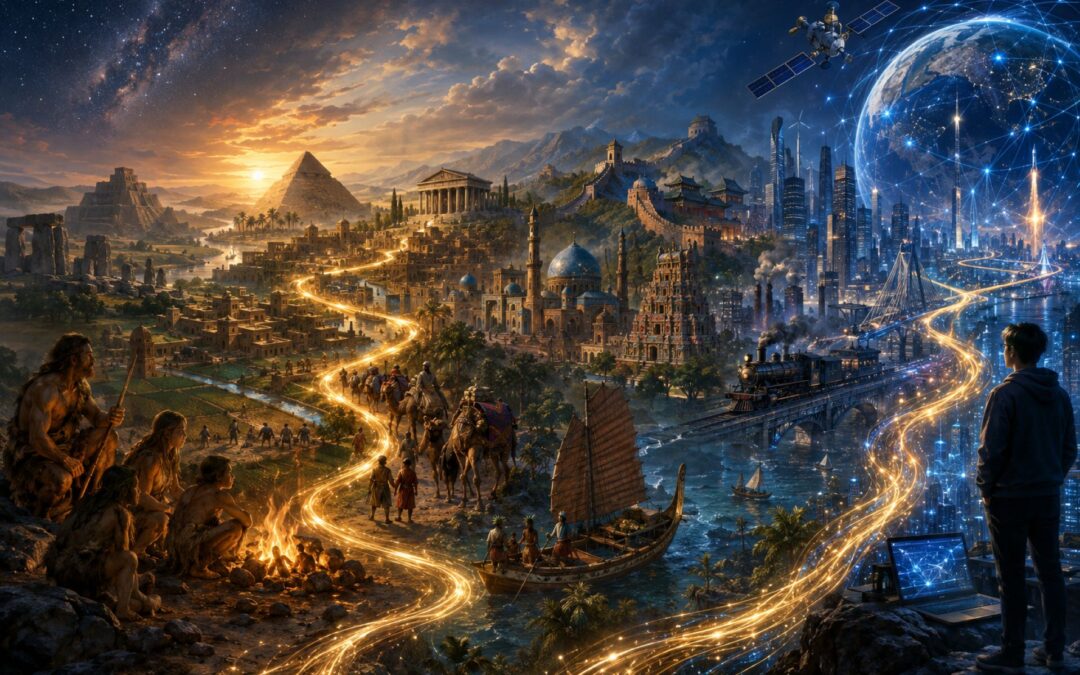
More than eight billion human beings now live within systems of extraordinary scale. Food crosses oceans before reaching supermarket shelves. Governments administer millions of strangers through laws, records, taxes, and public institutions. Financial decisions made in one country can affect livelihoods across the planet. A message can travel between continents in seconds, while satellites, undersea cables, data centres, and smartphones hold much of modern life together.
None of this was inevitable.
For most of our existence, human communities were small, mobile, and locally connected. They had no cities, bureaucracies, factories, nation-states, or digital networks. Yet they possessed the capacities from which all later civilization grew: cooperation, language, memory, experimentation, imagination, and the ability to teach knowledge across generations.
The history of civilization is therefore not simply a parade of kings, empires, wars, monuments, and inventions. It is the story of how human societies learned to organize food, information, labour, belief, energy, and political authority on ever larger scales.
Each expansion made new achievements possible. Agriculture supported cities. Writing supported administration. Trade connected distant cultures. States built infrastructure. Religions and philosophies created shared moral worlds. Fossil fuels transformed production. Computers connected billions of people.
But every gain introduced new costs. Stored food could be taxed or seized. States could coordinate irrigation and also organize conquest. Trade carried knowledge and disease. Industry generated abundance and exploitation. Digital networks widened access to information while creating new forms of surveillance, manipulation, and concentrated power.
Human civilization has never advanced in one straight line. It has been built by many societies, interrupted by collapses, reshaped by migration, and carried forward through countless acts of borrowing, adaptation, resistance, and reinvention.
Before Civilization: The Long Human Age of Foragers
The history of Homo sapiens begins far earlier than the first temples, kingdoms, or written records. According to the Smithsonian Human Origins Program’s account of Homo sapiens, our species emerged in Africa approximately 300,000 years ago.
Cities would not appear until much later. For the overwhelming majority of human history, people lived in relatively small communities sustained through hunting, fishing, gathering, and the careful management of local environments.
To describe these societies as primitive is misleading. They possessed technologies and institutions suited to their circumstances. They made stone, wood, bone, and fibre tools. They controlled fire, prepared food, constructed shelters, navigated unfamiliar terrain, and understood the behaviour of plants and animals with a precision that modern urban populations rarely possess.
Their most important technology may have been culture itself.
Humans could observe, imitate, remember, and improve. A useful technique discovered by one person could be taught to others. Knowledge did not have to die with its inventor. It could accumulate across generations.
Language deepened that capacity. It allowed communities to coordinate hunts, describe distant places, teach social rules, settle disputes, tell stories, preserve memories, and imagine events that had not yet happened. People could discuss obligations, ancestors, dangers, spirits, territories, and plans. They could cooperate around ideas that existed only in shared understanding.
Symbolic culture widened the human world still further. Burial practices, ornaments, pigments, carvings, music, and ritual suggest that early humans did not live only in a material environment. They inhabited moral, social, and spiritual worlds.
They also moved.
Over thousands of generations, humans migrated out of Africa and adapted to deserts, grasslands, forests, coastlines, mountains, islands, and Arctic regions. Different communities developed different diets, tools, dwellings, clothing, kinship systems, and bodies of ecological knowledge. There was no single foraging lifestyle.
Mobility could be an advantage. A group that was not permanently tied to one field or settlement could move when resources declined. Communities could reorganize seasonally, divide or reunite, and adjust their social arrangements to changing conditions.
Nor did small-scale society necessarily mean rigid equality. Age, gender, skill, reputation, kinship, or ritual authority could shape status. Violence existed. Resources could be contested. Yet hierarchy was often harder to institutionalize when people could leave, possessions were limited, and authority depended heavily on personal relationships.
This long human age matters because later developments are often presented as though farming, cities, and states revealed humanity’s natural destination. They did not. Human societies experimented with many ways of living, and some resisted agriculture or centralized rule even after encountering them.
Civilization would emerge not because earlier people lacked society, intelligence, or culture, but because certain communities began concentrating population, food, authority, and information in new ways.
That transformation began with farming.
Farming Changed Human Life—But Not in One Place or One Direction
Agriculture is often described as a single revolution that began in the Middle East and spread outward. The real history was more varied.
As the OpenStax account of the Neolithic Revolution explains, communities in several parts of the world domesticated plants and animals independently. Southwest Asian farmers cultivated wheat and barley. Communities in China developed systems based on millet and rice. African societies domesticated crops suited to local environments. In Mesoamerica, maize became central to settled life. In the Andes, potatoes and other high-altitude crops supported dense populations.
These transitions occurred at different times and under different conditions. Some communities farmed while continuing to hunt and gather. Others combined crop cultivation with pastoralism. Settlement sometimes preceded full agricultural dependence rather than following it.
Farming changed the human relationship with land. Instead of moving primarily through existing ecosystems, agricultural communities invested labour in particular places. They cleared vegetation, prepared soil, saved seeds, managed water, bred animals, protected fields, and waited for harvests.
This could create a surplus: food beyond what was required for immediate consumption.
Surplus was one of the foundations of later civilization. It allowed some people to spend less time producing food. Craftspeople could specialize in pottery, metalwork, construction, weaving, administration, trade, or warfare. Permanent settlements could grow. Stored grain could support communities through lean periods.
Population increased because cultivated landscapes could often support more people per unit of land than mobile foraging. Villages became larger and more permanent. Houses, storage facilities, defensive works, paths, and communal spaces accumulated over generations.
Yet agriculture was not an uncomplicated improvement.
Farming often demanded exhausting and repetitive labour. Communities became vulnerable to droughts, floods, pests, crop disease, and soil depletion. A failed harvest could threaten an entire settlement.
Dense populations living near domesticated animals created conditions in which infectious diseases could spread more easily. Diets sometimes became less varied. Land gained value, making inheritance and territorial control more politically important.
Surplus also invited appropriation.
Stored grain could be redistributed for communal purposes, but it could also be taxed, stolen, monopolized, or controlled by elites. Those who managed granaries, irrigation, defence, ritual, or land allocation could turn temporary authority into permanent privilege.
Agriculture therefore expanded cooperation while making durable inequality easier to build. It enabled larger communities, but it also created new forms of dependence. Farmers tied to fields could be compelled to surrender part of their harvest to rulers, landlords, soldiers, or temples.
Not everyone adopted the same path. Pastoral peoples continued moving with herds. Maritime societies built complex cultures around fishing and trade. Forest and desert communities maintained forms of life poorly suited to intensive agriculture. Some groups moved between farming and foraging depending on environmental or political circumstances.
The significance of agriculture lies not in a simple shift from wandering to settlement. It lies in the new scale of organization that food production made possible.
Once communities could feed thousands of people in concentrated settlements, they faced new problems. Water had to be managed. Property had to be defined. Disputes had to be settled. Labour had to be coordinated. Surplus had to be stored and distributed. Defences had to be organized.
The answers to those problems produced cities and states.
Cities, Writing, and the First States
The earliest cities were not simply large villages. They represented a new social form.
In urban settlements, thousands of people lived among strangers whose occupations, wealth, status, and cultural backgrounds could differ greatly. Food often arrived from surrounding agricultural land. Skilled labour became increasingly specialized. Temples, markets, workshops, storage facilities, walls, roads, and administrative buildings concentrated economic and political activity.
The comparative evidence collected in OpenStax’s account of early civilizations shows that complex societies emerged through different processes in Mesopotamia, Egypt, the Indus Valley, China, Mesoamerica, and the Andes. Civilization had no single birthplace.
Mesopotamia nevertheless provides one of the earliest and clearest examples of urban development. Settlements such as Uruk grew in the fertile but environmentally demanding land between the Tigris and Euphrates rivers. Agricultural production depended heavily on managing water, labour, and seasonal uncertainty.
Temples became important economic institutions. They could own land, receive offerings, employ workers, store goods, and organize redistribution. Political and religious authority were often intertwined because the management of material life was inseparable from the sacred order through which communities understood the world.
Writing emerged partly from these administrative demands.
Early writing was not initially created to produce literature or philosophy. It helped institutions remember. Marks recorded quantities, obligations, commodities, names, deliveries, and transactions. The British Museum’s explanation of cuneiform tablets demonstrates how information became fixed in clay, allowing it to travel beyond the memory and lifespan of an individual.
This transformed power.
A ruler or temple administration could maintain records of land, taxation, labour, tribute, and debt. Orders could be transmitted. Agreements could be preserved. Knowledge could accumulate. Administrative systems could extend authority across greater distances.
Writing did not develop only once. Different societies created distinct systems, including Egyptian hieroglyphs, Chinese writing, and scripts in Mesoamerica. Some early systems remain undeciphered, including the Indus script and Linear A.
Nor did societies without writing lack history or sophisticated thought. Oral traditions could preserve genealogies, law, geography, ritual, ecological knowledge, and collective memory. Writing did, however, give institutions a powerful new capacity to store and standardize information.
That capacity became central to state formation.
States claimed authority over territory and population. They collected taxes, enforced laws, organized armies, sponsored religious institutions, built infrastructure, and defined legitimate rule. Their power depended not only on violence but also on administration, belief, custom, and cooperation.
Hammurabi’s Babylonian law code illustrates the growing importance of codified authority. It was not humanity’s first law, nor did it create equality before the law. Its punishments varied by social status, and many were severe. Yet the inscription projected an important political message: the king was a guardian of order whose judgments could be presented as systematic and divinely authorized.
In Egypt, political consolidation along the Nile supported one of the ancient world’s most durable state traditions. The annual river cycle encouraged agricultural concentration, while royal authority brought labour and resources together on an extraordinary scale.
The pyramids expressed more than engineering skill. They embodied a political and religious system capable of mobilizing workers, food, stone, transport, planning, and specialized knowledge over many years. Monumental construction made hierarchy visible in the landscape.
The Indus Valley cities of Harappa and Mohenjo-daro developed a different urban pattern. Their planned streets, standardized bricks, drainage systems, and widespread material similarities point to sophisticated coordination, even though their political arrangements remain uncertain.
In China, agricultural communities around the Yellow and Yangtze river systems developed into complex Bronze Age states. Later political traditions remembered the Xia as an early dynasty, although its precise historical relationship to the archaeological record remains debated. The Shang left clearer evidence in royal centres, bronze production, warfare, divination, and early Chinese writing.
Across these societies, metalworking changed agriculture, craft production, prestige, and warfare. Bronze required specialized knowledge and access to copper and tin, often connecting production to long-distance trade. Iron eventually became more widely available and transformed tools and weapons, although the transition was gradual rather than a clean break between universal ages.
Urban civilizations varied enormously. Some were ruled by kings; others by councils, priesthoods, aristocracies, or shifting coalitions. Some depended on rivers, others on rainfall, terraces, canals, or raised fields. Some built enormous monuments; others invested more heavily in roads, drainage, storage, or trade.
What united them was not one political model but an increase in scale.
Research comparing historical societies has found that social complexity often grew alongside institutions for administration, infrastructure, information processing, and territorial control. As societies expanded, they required more officials, records, legal distinctions, transport systems, specialists, and layers of authority.
The first states solved real collective problems. They also created new methods of extraction.
Taxes could fund irrigation, defence, temples, and public works. They could also support palaces, wars, and ruling classes. Writing could preserve literature and scientific knowledge. It could also record debts, tribute, and compulsory labour.
Civilization increased what human beings could accomplish together. It also increased the power some people could exercise over others.
Empires, Trade, and the Connected Ancient World
Cities and states did not remain isolated. They fought, traded, migrated, intermarried, exchanged technologies, adopted foreign gods, and copied useful institutions.
Over time, some states expanded into empires: political systems in which a ruling centre governed multiple peoples and territories.
Empires were built through force, but military victory alone could not sustain them. Conquered land had to be administered. Roads, ports, messengers, officials, garrisons, taxes, tribute systems, currencies, and alliances connected the centre to distant regions.
The Hittite and Egyptian kingdoms demonstrated both the possibilities and limits of Bronze Age imperial power. Their armies competed for influence in the eastern Mediterranean and Near East, while royal marriages and treaties provided alternatives to permanent war.
The Battle of Kadesh, fought between the forces of Ramesses II and the Hittite king Muwatalli II, is often presented as a decisive confrontation. In reality, both sides later commemorated events in ways favourable to themselves. Their rivalry eventually produced a diplomatic settlement, showing that ancient powers could institutionalize coexistence when neither could dominate outright.
Maritime societies created a different kind of influence.
The Minoans of Crete participated in far-reaching Mediterranean exchange networks. Their palatial centres and seaborne trade connected the Aegean to Egypt and the Near East. Later Phoenician city-states developed commercial networks that reached across the Mediterranean.
Phoenician merchants did not need to conquer every coast they visited. Ports, colonies, shipbuilding, craft production, and practical writing systems created influence through exchange. The Phoenician alphabet, adapted by other peoples, became one ancestor of later Greek and Latin scripts.
One Phoenician settlement, Carthage, eventually became an imperial power in its own right. Its location in North Africa gave it access to Mediterranean routes linking Iberia, Italy, North Africa, and the western islands. Carthaginian power rested on commerce, naval strength, colonial holdings, and control of strategic resources.
In the eastern Mediterranean and Near East, the Assyrians built a formidable territorial empire supported by military organization, roads, deportation policies, provincial administration, and intimidation. Their violence helped them expand, but it also generated resistance. When central control weakened, subject peoples and rival states moved against them.
The Neo-Babylonian kingdom that followed became an important centre of political power, monumental construction, and astronomical learning. Yet its dominance was overtaken by a still larger imperial system: Persia.
Under Cyrus and his successors, the Achaemenid Empire connected territories from Central Asia and the Indus frontier to Mesopotamia, Egypt, Anatolia, and the Mediterranean. Persian rulers governed diverse populations through provincial administration, local elites, royal roads, tribute, military power, and varying degrees of cultural accommodation.
Cyrus later acquired a reputation for respecting some local religions and restoring displaced communities. The Cyrus Cylinder has sometimes been described as the first charter of human rights, but that modern label imposes a contemporary concept on an ancient royal proclamation. Its importance lies in what it reveals about imperial legitimation: conquest could be presented not merely as domination but as the restoration of justice and order.
Greek political life developed through independent city-states rather than one centralized kingdom. Athens, Sparta, Corinth, Thebes, and others shared language and religious traditions but competed intensely.
Athens developed a form of direct democracy in which male citizens participated in assemblies and public decision-making. It was historically significant but highly limited. Women, enslaved people, and resident foreigners were excluded. Democracy coexisted with empire and slavery.
Sparta organized society around military discipline and the domination of a large unfree population. Its political system was not simply the opposite of Athens, but it did rest on a different balance of monarchy, aristocratic institutions, communal military training, and coercive control.
The Persian wars became central to later Greek memory. The famous defence at Thermopylae involved 300 Spartan citizens, but they fought alongside other Greek contingents. Ancient accounts of Persian army sizes are probably exaggerated. The wider conflict was decided through several land and naval battles, alliances, geography, logistics, and the ability of rival Greek states to cooperate temporarily.
Greek civilization was later transformed by Macedonia. Philip II reorganized military power and subdued much of the Greek world. His son Alexander conquered the Achaemenid Empire with astonishing speed.
Alexander’s campaigns destroyed one imperial order but created new connections among Greek, Egyptian, Persian, Central Asian, and South Asian worlds. After his death, his generals divided the conquered territories into successor kingdoms. Greek-speaking elites ruled diverse populations, but local traditions endured and reshaped Hellenistic culture.
In India, Chandragupta Maurya created an empire that incorporated much of the subcontinent. His grandson Ashoka expanded it through war, most famously in Kalinga. Royal inscriptions later presented Ashoka as deeply affected by the suffering conquest had caused. He patronized Buddhism, promoted moral conduct, and used edicts to communicate imperial principles across a large and diverse realm.
In China, the Qin state ended centuries of warfare by conquering rival kingdoms. Qin Shi Huang centralized authority, standardized measures and writing practices, built roads and defensive works, and weakened hereditary aristocratic power. These achievements came through severe coercion, and the dynasty collapsed soon after his death.
The Han inherited and modified many Qin institutions. Confucian learning became increasingly important to imperial legitimacy and official culture. Agricultural taxation, administrative systems, military expansion, technological development, and long-distance exchange made Han China one of the ancient world’s most powerful political systems.
The routes later called the Silk Roads were not one continuous highway. As UNESCO’s history of the Silk Roads emphasizes, they were overlapping land and maritime networks through which merchants, diplomats, pilgrims, migrants, and soldiers moved goods and ideas.
Silk, horses, metals, glass, spices, textiles, precious stones, and ceramics circulated through many intermediaries. So did artistic styles, religious traditions, scientific knowledge, languages, and disease.
The ancient world was more connected than it often appears. Trade linked India to Mediterranean markets, while political and cultural contacts produced the complex patterns explored in the extensive exchange between India and the Greco-Roman world.
Other societies built networks outside the great Eurasian empires. Austronesian-speaking peoples undertook remarkable ocean voyages, eventually settling islands across vast areas of the Pacific and Indian oceans. Polynesian navigators used stars, winds, swells, birds, clouds, and accumulated environmental knowledge to travel between islands without modern instruments.
In Africa, trade routes connected the Nile, the Red Sea, the Mediterranean, the Sahara, and lands farther south. In the Americas, Olmec, Zapotec, Maya, Andean, and other societies developed urban centres, monumental architecture, trade systems, calendars, agricultural innovations, and political traditions independently of Afro-Eurasia.
Civilization was becoming increasingly networked, but these networks were not peaceful by nature. Trade and conquest frequently operated together. Empires transported commodities and knowledge while moving armies, captives, taxes, and forced labour.
The ancient world’s greatest systems were built through both cooperation and coercion.
Ideas Became Civilizational Infrastructure
Large societies could not survive through physical force alone.
Rulers needed legitimacy. Families needed moral obligations. Communities needed explanations for suffering, death, justice, and the natural world. Strangers needed shared expectations. Laws needed justification. People needed reasons to obey, resist, sacrifice, forgive, or hope.
Religions and philosophies became forms of civilizational infrastructure.
They did not simply occupy private belief. They shaped education, kingship, family life, law, art, architecture, charity, warfare, identity, and the boundaries of community.
In ancient India, Vedic traditions developed over centuries through ritual practice, oral preservation, philosophical speculation, and changing social institutions. Later Hindu traditions drew upon Vedic texts while incorporating a much wider range of beliefs, deities, practices, devotional movements, and regional cultures.
Social hierarchy became associated with concepts of varna and, over time, with far more complex and locally varied caste arrangements. These systems cannot be reduced to one simple four-part pyramid, but they did become deeply influential structures of social identity and inequality.
Buddhism emerged within the religious and philosophical environment of ancient South Asia. Traditional accounts describe Siddhartha Gautama leaving a privileged life after confronting age, illness, and death. The precise details belong partly to sacred biography, but the tradition’s historical importance is clear.
Buddhist teachings focused on suffering, impermanence, ethical conduct, disciplined awareness, and liberation from attachment. Monastic institutions helped preserve and spread these ideas. Merchants, rulers, pilgrims, and missionaries carried Buddhism across Central Asia, China, Korea, Japan, Southeast Asia, and beyond.
Ashoka’s patronage gave Buddhism imperial visibility, but its expansion depended on translation and adaptation. As it entered new regions, it interacted with existing cultures rather than replacing them unchanged.
In ancient Iran, Zoroastrian traditions described existence in moral terms, emphasizing truth, right action, and the struggle against destructive forces. Their exact origins and the dating of Zarathustra remain debated. Under later Iranian empires, Zoroastrian institutions became closely associated with political authority and religious identity.
Greek thought developed through many competing schools. Socrates, Plato, Aristotle, the Stoics, Epicureans, and others asked how people should live, what justice required, what constituted knowledge, and how political communities should be governed.
Greek philosophy did not simply replace superstition with reason. Religious ritual, myth, philosophical inquiry, mathematics, and political debate coexisted. The distinction between rational modernity and an irrational ancient world is too simple.
In China, the political fragmentation of the late Zhou period encouraged intense debate over order and government.
Confucian traditions emphasized ethical cultivation, education, ritual propriety, family responsibility, and the moral obligations of rulers. Political order began with personal conduct but extended outward through relationships and institutions.
Daoist traditions questioned excessive control and celebrated forms of action aligned with natural processes. Their texts explored spontaneity, simplicity, perspective, language, and the limits of rigid social ambition.
Legalist thinkers took a harsher view of politics. They argued that rulers should rely on clear laws, administrative techniques, incentives, and punishments rather than moral persuasion alone. Qin unification demonstrated Legalism’s power, but also the instability of governing primarily through fear.
The Mandate of Heaven offered a political language through which dynastic authority could be justified or challenged. A ruler’s legitimacy was not entirely unconditional. Disaster, disorder, and rebellion could be interpreted as signs that a dynasty had failed in its duties.
Judaism developed around belief in one God, covenant, law, memory, and communal identity. Conquest, exile, imperial rule, and diaspora reshaped Jewish life while sacred texts and institutions preserved continuity.
Christianity emerged from the Jewish world of Roman Judea. Jesus of Nazareth preached within that historical setting, and his followers came to regard him as the Messiah and Son of God. Accounts of miracles and resurrection are matters of religious belief, while his execution under Roman authority is historically central to the tradition.
Christian communities spread through cities and trade routes across the Roman world. They formed networks of worship, charity, teaching, and identity. At times persecuted, Christianity was later legalized and patronized by Constantine. Its transformation into the dominant religion of the empire unfolded over subsequent decades and rulers rather than in one moment.
Islam emerged in seventh-century Arabia through the teachings of Muhammad. Muslims regard the Quran as divine revelation transmitted to him. The early Muslim community combined religious devotion with social and political organization.
After Muhammad’s death, Muslim-ruled states expanded rapidly beyond Arabia into former Byzantine and Sasanian territories. Political disputes over legitimate leadership contributed to divisions that later developed into Sunni and Shia traditions.
Islamic civilization was never culturally uniform. Arabs, Persians, Berbers, Turks, Africans, Central Asians, South Asians, and others shaped its institutions. Religious law, trade, scholarship, urban life, political power, and local customs interacted differently across regions.
Ideas travelled because people travelled. Monks, merchants, teachers, pilgrims, captives, officials, soldiers, and migrants carried beliefs across borders. Translation changed what was transmitted. Rulers adopted religions for conviction, legitimacy, diplomacy, or political unity. Communities resisted, blended, or reinterpreted new teachings.
Religions could inspire compassion, education, art, charity, and moral restraint. They could also legitimize hierarchy, persecution, conquest, and exclusion. Philosophies could challenge power or teach obedience.
Their civilizational importance came from their ability to connect personal conduct to a larger order. They told people what kind of world they inhabited—and what they owed to one another within it.
Civilizations Rose, Collapsed, and Recombined
Civilizations are often described as though they were living organisms with predictable births, golden ages, declines, and deaths.
History is less orderly.
Political systems collapse, but populations remain. Cities shrink, but languages survive. Ruling dynasties disappear, while religious institutions, legal practices, artistic forms, technologies, and local identities continue. Migrants and conquerors do not enter empty landscapes. They inherit, destroy, adopt, and reshape what already exists.
Collapse is usually a process, not an instant.
The eastern Mediterranean crisis around the end of the Bronze Age illustrates the complexity. Several palace-based societies weakened or disappeared within a relatively short period. Older accounts often blamed mysterious Sea Peoples as though a single invasion destroyed civilization.
Current interpretations consider several interacting pressures: drought, food scarcity, political instability, warfare, migration, internal rebellion, and the failure of interdependent trade and palace systems. Different regions experienced the crisis differently. Egypt survived as a state, though weakened. Other centres were destroyed or abandoned. Some populations relocated and formed new political communities.
The lesson is not that one enemy ended the Bronze Age. It is that systems built on specialized production, long-distance exchange, and centralized authority can become vulnerable when several supports fail together.
Assyria collapsed after military overextension, political pressure, revolt, and coordinated attacks by rivals. Babylon rose again, only to be absorbed by Persia. Persia fell to Alexander, but Persian institutions, elites, languages, and cultural traditions continued within successor kingdoms.
The Qin dynasty unified China through extraordinary administrative and military power, yet collapsed rapidly after the first emperor’s death. The Han preserved much of the centralized imperial structure while grounding legitimacy in a different ideological balance.
Centuries later, Han authority broke down amid court conflict, fiscal strain, peasant rebellion, military decentralization, and the growing independence of regional commanders. The resulting struggle is examined in depth through the Han dynasty’s fragmentation into the Three Kingdoms.
China did not cease to exist during this period. Rival states competed for legitimacy, preserved institutions, mobilized populations, and adapted inherited ideas. Reunification under the Jin was another political reconstruction rather than the restoration of an unchanged past.
Rome followed its own trajectory.
The Roman state expanded by incorporating allies, building roads, organizing armies, imposing taxes, distributing citizenship, and linking the Mediterranean through trade. Success created wealth and administrative reach, but also enormous military and fiscal obligations.
As expansion slowed, maintaining the imperial system became more difficult. Civil wars, succession crises, frontier pressure, epidemics, monetary instability, regional inequality, and changes in trade interacted over centuries. The deeper economic mechanisms are explored in the economic foundations of Rome’s decline.
The fall of the Western Roman Empire in 476 did not erase Roman civilization. The eastern empire continued from Constantinople. Latin remained foundational to western European religion, law, and scholarship. Roman roads, cities, administrative ideas, and Christian institutions survived under new rulers.
Germanic kingdoms did not merely replace civilization with barbarism. Their elites adopted Roman titles, laws, religion, taxation practices, and symbols of legitimacy while developing new political orders.
Maya civilization also resists simple collapse narratives. Different Maya cities rose and declined at different times. Environmental pressure, warfare, political instability, and local ecological conditions likely contributed to the abandonment of some urban centres, but Maya peoples and cultures survived.
Similar caution is necessary in the Andes, Mesoamerica, Southeast Asia, Africa, and the Pacific. An abandoned capital does not mean a population vanished. A dynasty’s fall does not end cultural life. Archaeological silence does not justify dramatic stories of mysterious disappearance.
Large societies are powerful partly because they coordinate specialised systems. Farmers, soldiers, merchants, officials, artisans, transport workers, religious institutions, and political elites depend on one another. The same specialization that creates complexity can create fragility.
Comparative historical research into the relationship between social complexity, information systems, institutions, and scale helps explain why large states need increasingly elaborate systems of coordination. When those systems lose legitimacy, resources, information, or enforcement capacity, crises can spread rapidly.
Yet collapse can also open space for innovation. Political fragmentation may weaken centralized oppression. Migrants may carry technologies into new regions. Local institutions may become more autonomous. New religious or political movements may emerge from old structures.
Human history has not advanced because civilizations avoided collapse. It has advanced because knowledge, practices, and communities often survived political breakdown—and because later societies rebuilt from the ruins.
The Medieval World Was a Network, Not a Dark Age
The fall of western Roman imperial rule is often treated as the beginning of a European Dark Age. Applied narrowly to certain changes in western European political and urban life, the phrase can describe disruption. Used as a label for the world between approximately 500 and 1500, it is profoundly misleading.
Civilization did not retreat across the planet. It reorganized.
The eastern Roman, or Byzantine, Empire continued from Constantinople. Its rulers preserved Roman law and imperial identity while governing a Greek-speaking and predominantly Christian society.
Under Justinian, Byzantine armies temporarily reconquered parts of North Africa, Italy, and the western Mediterranean. His government also sponsored a major codification of Roman law. The Hagia Sophia embodied the empire’s ability to combine architecture, engineering, theology, and political symbolism on a monumental scale.
Yet Justinian’s conquests were costly and difficult to sustain. War, taxation, disease, and renewed external pressure weakened the restored territories. The plague associated with his reign caused immense mortality, though estimates remain debated. Climatic disturbances beginning in the 530s added further stress in several regions.
In South Asia, the Gupta period became associated with major developments in mathematics, astronomy, literature, religious thought, art, and architecture. Indian scholars refined the place-value system and mathematical ideas that would later travel across linguistic and political boundaries.
In China, the Tang dynasty governed a large, wealthy, and cosmopolitan empire. Its capital, Chang’an, became one of the world’s great cities, connected to Central Asian trade and populated by diverse communities.
Buddhism flourished, while Confucian institutions remained influential. Wu Zetian rose from the imperial court to rule in her own name, becoming the only woman in Chinese history widely recognized as emperor. Her reign combined expansion, administrative reform, patronage, and political violence.
In Japan, imported writing, Buddhism, political ideas, art, and administrative practices interacted with local traditions. The result was not passive imitation but adaptation. Japanese elites transformed external influences within their own political and cultural environment.
The Islamic world became one of the medieval period’s most important zones of urban, commercial, and intellectual life.
The Abbasid capital of Baghdad drew scholars, administrators, merchants, physicians, astronomers, translators, and craftspeople from across a vast region. Greek, Persian, Indian, and other bodies of knowledge were translated, debated, corrected, and extended.
Algebra developed through this process of accumulation. The numeral system used across much of the world originated in South Asia and was adapted and transmitted through Arabic-language scholarship. Optics, medicine, astronomy, geography, engineering, and philosophy advanced through institutions and communities rather than isolated geniuses.
The House of Wisdom became a symbol of this scholarly culture, although the exact nature and institutional form of the establishment changed over time. What matters is the broader ecosystem of libraries, patrons, courts, schools, observatories, book markets, and translators.
Africa was home to powerful states and trade networks.
Axum connected the Red Sea, the African interior, Arabia, and Mediterranean markets. Its rulers adopted Christianity, and its monumental architecture expressed both political and religious authority.
Farther west, states such as Ghana and later Mali grew wealthy by controlling and taxing trade across the Sahara. Gold moved north. Salt and other goods moved south. Merchants and scholars linked West African cities to the wider Islamic world.
Mansa Musa’s fourteenth-century pilgrimage to Mecca became famous for its display of wealth. The precise quantities of gold associated with the journey are difficult to verify, but the episode reflects Mali’s importance within trans-Saharan commerce. Timbuktu and other cities became centres of trade, scholarship, religious learning, and manuscript culture.
On the East African coast, Swahili-speaking trading communities connected inland African goods to Indian Ocean markets. African, Arab, Persian, Indian, and later Chinese interactions shaped urban cultures without erasing their local foundations.
In Southeast Asia, states profited from maritime trade between the Indian Ocean and South China Sea. The Khmer Empire constructed Angkor, a vast urban and hydraulic landscape whose temples expressed royal power and religious transformation.
Angkor Wat was originally dedicated to Vishnu and later became a major Buddhist site. Its grandeur depended not only on architecture but also on the agricultural and water systems that sustained a large population.
The Chola state in southern India projected naval power into the Bay of Bengal and participated in commercial networks linking South Asia to Southeast Asia and China. Temples such as Brihadisvara concentrated ritual, artistic, economic, and political functions.
In the Americas, Maya cities continued developing sophisticated systems of writing, astronomy, mathematics, political ritual, and architecture. Chichén Itzá became one important centre within a changing Mesoamerican world.
Farther north and south, other societies built trade networks, agricultural systems, ceremonial centres, and political confederations. The medieval Americas were not waiting for European history to arrive.
In the Pacific, Polynesian navigators settled some of the most remote inhabited islands on Earth. Their voyages represented generations of technical, astronomical, environmental, and social knowledge. Māori settlement of New Zealand created new communities adapted to local conditions, though claims of pre-modern voyages to Antarctica remain debated and should be treated cautiously.
Europe itself was not uniformly stagnant.
Agricultural technologies and changing land use supported population growth. Towns revived. Trade expanded. Guilds organized crafts. Castles reflected the political fragmentation of landholding societies. Cathedrals displayed engineering skill, wealth, religious devotion, and civic rivalry.
Universities emerged in cities such as Bologna, Paris, and Oxford. Their curricula were limited by modern standards, but they created durable institutions for debate, legal study, philosophy, theology, and medicine.
The Carolingian court sponsored educational and scribal reform. The script known as Carolingian minuscule improved readability and influenced later European handwriting and type. Monastic and courtly copyists preserved works that might otherwise have disappeared.
Viking expansion brought violence to European coasts, but Norse societies were more than raiding cultures. They traded, settled, farmed, navigated rivers, established political communities, and connected Scandinavia to Britain, Ireland, continental Europe, the Byzantine world, and the North Atlantic.
Norse settlers reached Greenland and established a short-lived presence in Newfoundland centuries before Columbus. This did not create permanent connection between Europe and the Americas, but it disproves the claim that Columbus was the first European to arrive.
The Crusades emerged from a complex combination of religious devotion, Byzantine appeals, papal politics, aristocratic ambition, pilgrimage traditions, and conflict over territory. They cannot be explained as a delayed response to one act of religious destruction.
Crusader armies captured Jerusalem and created states in the eastern Mediterranean. Muslim rulers later reconquered the territory. Figures such as Saladin and Richard the Lionheart became legendary, but the wider history involved shifting alliances, massacres, negotiation, trade, and communities caught between competing powers.
The Mongol conquests transformed much of Eurasia. Genghis Khan unified Mongol groups and created a military-political system of extraordinary mobility and discipline. Mongol armies destroyed cities, killed enormous numbers of people, and shattered states.
The sack of Baghdad in 1258 ended Abbasid political authority in the city and destroyed major institutions and collections. Stories that the Tigris ran black with ink capture the catastrophe symbolically, though they should not be treated as precise eyewitness reporting.
Mongol rule also connected large territories under related political systems. Roads, protected routes, tribute networks, diplomatic exchange, and merchant mobility intensified contacts across Eurasia. The empire’s successor states adopted local religions, administrative practices, and cultural forms.
The medieval world was therefore neither isolated nor static. It was a landscape of expanding networks, competing centres, and continuous exchange.
The West’s later global dominance should not be projected backward as though every earlier society was already moving toward that outcome.
Oceanic Expansion Created the First Truly Global System
By the fifteenth century, Afro-Eurasian trade networks already connected much of Europe, Africa, and Asia. Merchants crossed the Sahara, sailed the Indian Ocean, moved through Central Asia, and linked Mediterranean ports to distant markets.
What changed after 1492 was not the beginning of long-distance exchange. It was the creation of permanent and sustained contact between the Eastern and Western hemispheres.
Several developments made this possible.
European states were becoming more capable of financing expeditions and projecting naval power. Maritime knowledge accumulated through Mediterranean, Atlantic, African, and Asian traditions. Navigational instruments, improved maps, ship designs, and gunpowder weapons expanded the reach of oceanic fleets.
Printing accelerated the circulation of information. Reports of voyages, maps, commercial knowledge, religious arguments, and political propaganda could be reproduced in larger quantities.
The Ottoman conquest of Constantinople did not simply close all trade between Europe and Asia, but competition over routes and profits encouraged European states to seek greater direct access to African and Asian markets.
Portugal took an early lead. Portuguese sailors gradually moved down the African coast, rounded the Cape of Good Hope, and entered the Indian Ocean. They did not discover an empty commercial space. They entered a dense world of Arab, Persian, Gujarati, African, Malay, and other traders.
Portuguese power depended on armed ships, fortified ports, coercive taxation, alliances, and attacks on existing commercial rivals. It was both a trading enterprise and an imperial project.
Christopher Columbus proposed reaching Asian markets by sailing west. Supported by the Spanish Crown, he crossed the Atlantic in 1492 and reached Caribbean islands whose inhabitants had lived there for generations.
Columbus did not understand that he had reached continents unknown to contemporary Europeans. He called local peoples Indians because he believed himself near Asia. His voyages initiated continuing contact, conquest, colonization, and biological exchange between the hemispheres.
The consequences were immense.
Crops, animals, diseases, people, and ecosystems moved across the Atlantic. Maize, potatoes, tomatoes, cassava, and other American crops transformed diets and population patterns elsewhere. Horses, cattle, wheat, sugar, and other Old World species reshaped American environments.
Disease was catastrophic for Indigenous peoples who lacked previous exposure to pathogens such as smallpox. Epidemics weakened communities, disrupted political systems, and caused demographic collapse on an enormous scale.
Yet disease alone did not conquer the Americas.
Hernán Cortés defeated the Mexica-led Aztec Empire with the help of large numbers of Indigenous allies who had their own grievances, ambitions, and rivalries. Spanish steel, horses, firearms, political deception, siege tactics, and epidemic disease mattered, but so did local coalition-building.
Tenochtitlan was not a primitive settlement overwhelmed by civilization. It was one of the world’s great cities, built through causeways, canals, markets, temples, and sophisticated management of a lake environment.
The Inca Empire likewise governed millions of people through roads, storehouses, labour obligations, provincial administration, and communication systems adapted to the Andes.
Francisco Pizarro entered a realm already destabilized by epidemic disease and civil war. Spanish victory depended on capturing the ruler Atahualpa, exploiting political divisions, building Indigenous alliances, and gradually extending control through prolonged violence.
European conquest did not eliminate Indigenous agency. Communities resisted, negotiated, rebelled, adapted, preserved languages, retained religious practices, and reshaped colonial institutions.
The Atlantic world became a system of extraction. European empires demanded precious metals, plantation crops, land, and labour. Indigenous communities were subjected to tribute, forced labour, displacement, and conversion.
When disease and abuse devastated local labour forces, European colonists expanded the enslavement and transportation of Africans.
The Atlantic system of plantation slavery connected European capital, African political economies, American land, and coerced labour. Sugar, tobacco, cotton, coffee, and other commodities generated enormous profits.
Enslaved people were not simply workers. They were legally treated as property, separated from families, subjected to violence, and denied basic autonomy. Yet they resisted through flight, revolt, cultural preservation, negotiation, sabotage, community-building, and the creation of independent settlements.
The best available estimates of the trans-Atlantic slave trade are based on surviving records and statistical reconstruction. They reveal the scale of forced transportation while also reminding us that no database can fully capture the suffering of individuals, families, and societies.
European states used colonial wealth to finance war, expand trade, and strengthen institutions. Private companies sometimes governed territories, maintained armies, collected taxes, and negotiated treaties. The Dutch and British East India companies blurred the boundary between commerce and sovereignty.
In South Asia, European companies initially operated within powerful existing states and markets. British political control expanded gradually through military victories, alliances, revenue collection, legal restructuring, and the weakening or defeat of rival powers.
Colonial rule reorganized economies around imperial priorities. Land systems changed. Local industries faced unequal competition. Cash crops displaced other production. Resources flowed toward imperial centres.
The emerging global system was not controlled by Europeans alone. African rulers, Indian bankers, Chinese merchants, Indigenous intermediaries, sailors, translators, soldiers, and local elites shaped how imperial expansion unfolded.
But power was profoundly unequal.
Oceanic empires created the first enduring planetary system of exchange. They also built that system through conquest, slavery, racial hierarchy, ecological transformation, and the political domination of large populations.
Globalization was born not as peaceful interdependence, but as a struggle over who would control the routes, resources, labour, and rules of an interconnected world.
Revolutions Reorganized Power, Production, and Society
The early modern world changed not through one revolution, but through several overlapping transformations in knowledge, authority, politics, and production.
New astronomical models challenged inherited understandings of the universe. Copernicus argued that Earth moved around the Sun. Kepler described planetary motion mathematically. Galileo used telescopic observations to support a new picture of the heavens.
These developments did not represent a simple war between science and religion. Many early scientists were religious. Churches, courts, universities, and patrons could support inquiry as well as restrict it. The central change was methodological: observation, experiment, mathematical description, and public argument acquired growing authority.
Isaac Newton united the motion of objects on Earth with the movement of celestial bodies through laws of motion and universal gravitation. His achievements were extraordinary, but they depended on earlier astronomy, mathematics, mechanics, and networks of correspondence.
Scientific knowledge increasingly became institutional. Academies, journals, observatories, universities, workshops, and instrument makers created communities capable of testing and circulating ideas.
Printing changed the politics of information. Texts could be reproduced more rapidly and consistently than through hand-copying. Religious reformers, scientists, political critics, and governments all used the technology.
Martin Luther’s objections to the sale of indulgences and other church practices spread through print far beyond an academic dispute. The Protestant Reformation challenged papal authority, fragmented western Christianity, and transformed politics, education, family life, and state power.
Religious conflict intensified across Europe. Rulers attempted to impose confessional unity or manage coexistence. The relationship between conscience, scripture, church, and government became a central political problem.
At the same time, expanding commerce and imperial competition strengthened merchant groups, financial institutions, and states. Wealth increasingly flowed through markets that connected colonial production to European consumption.
Political thinkers questioned inherited authority. What made government legitimate? Did sovereignty belong to monarchs, parliaments, citizens, or the people as a whole? Could rulers violate a social contract? Did individuals possess rights that governments were obligated to respect?
The American Revolution transformed thirteen British colonies into an independent republic. Its leaders drew upon Enlightenment arguments about rights and representation, but the new political order contained profound contradictions.
Enslaved people remained enslaved. Indigenous lands continued to be seized. Women lacked equal political rights. The declaration that all men were created equal did not describe the society that emerged.
Yet the revolution established a durable republic on an unprecedented scale and helped spread the language of written constitutions, representative government, and popular sovereignty.
The French Revolution attacked a more deeply entrenched social and monarchical order. Fiscal crisis, inequality, food insecurity, political conflict, and Enlightenment ideas combined in 1789.
The revolution abolished feudal privileges, declared rights, nationalized church property, and attempted to reconstruct society. It also produced civil war, foreign invasion, political purges, and the Terror.
The guillotine became a symbol of revolutionary violence, but the conflict cannot be reduced to bloodlust or one dictator. Competing factions struggled over war, democracy, religion, property, and the survival of the revolution itself.
Napoleon Bonaparte emerged from this upheaval. His armies conquered much of Europe, and his rule combined authoritarian power with administrative and legal reforms. The Napoleonic Code influenced later legal systems, while French domination provoked resistance and nationalism.
Napoleon’s invasion of Russia in 1812 ended disastrously through logistics, distance, hunger, disease, Russian military resistance, and winter conditions. His fall did not restore Europe to its earlier state. The revolution’s political language had already spread.
The most transformative revolution of the era was industrialization.
Earlier societies depended mainly on human, animal, wind, water, and biological energy. The large-scale use of coal and steam released energy stored over geological time.
The first Industrial Revolution transformed production and labour by mechanizing textile manufacturing, expanding factories, improving transport, and concentrating workers in rapidly growing cities.
The steam engine was not a Renaissance invention. Its decisive development and application belonged to the industrial age. Steam powered mines, factories, locomotives, and ships. Railways compressed distance and connected raw materials, industrial centres, ports, and markets.
Industrialization increased production enormously. Goods that had once been expensive became more widely available. Transport became faster. Agricultural productivity improved. Urban economies created new occupations and forms of consumption.
The costs were severe.
Factory labour could be dangerous, monotonous, and poorly paid. Children worked long hours. Industrial cities suffered pollution, overcrowding, disease, and inadequate sanitation. Traditional crafts were disrupted.
Capital accumulated among factory owners, merchants, financiers, and investors. Workers depended increasingly on wages. Market competition encouraged innovation and efficiency but also insecurity and exploitation.
Industrial capitalism was not created by machines alone. It depended on property law, finance, colonial resources, transportation, state policy, labour discipline, and global markets.
Cotton linked British factories to enslaved labour in the American South and to producers elsewhere. Industrial growth and imperial extraction reinforced one another.
Political movements responded.
Trade unions organized workers. Reformers demanded shorter hours, safer conditions, education, and political representation. Socialists criticized private control of productive wealth.
Karl Marx argued that the history of class society was shaped by conflict between those who controlled production and those whose labour sustained it. He saw capitalism as extraordinarily productive but inherently exploitative and unstable.
Communism promised collective ownership and the end of class domination. Later movements inspired by Marx would take many forms, from parliamentary parties to revolutionary states.
Industrial power also intensified global inequality.
Britain used naval and military strength to defend the opium trade against Qing China. Chinese restrictions on opium were met with war. Defeat forced China to accept unequal treaties, open ports, and surrender Hong Kong.
Internal crisis followed. The Taiping Rebellion drew upon religious visions, social grievances, state weakness, and opposition to the Qing. Its enormous death toll reflected the destructive potential of mass rebellion in a densely populated agrarian empire.
Across the nineteenth century, political and industrial revolutions changed what states could do. Governments collected more information, taxed more efficiently, raised larger armies, expanded education, regulated economies, and built infrastructure.
Citizens demanded rights, but states also became more capable of controlling them.
Industrial Power Produced Global Empire and Total War
Industrialization transformed the balance of global power.
States that possessed factories, railways, steamships, modern weapons, financial systems, and administrative capacity could project force across unprecedented distances. Industrial empires moved soldiers and supplies more quickly, produced weapons in greater quantities, and extracted resources on a larger scale.
Imperial expansion was justified through claims of civilization, racial hierarchy, religious mission, national glory, and economic necessity. These ideologies concealed or rationalized conquest.
By the late nineteenth century, European powers had seized most of Africa. Borders were often drawn according to imperial negotiation rather than local political, cultural, or ecological realities.
In the Congo Free State, the regime associated with Belgium’s King Leopold II imposed brutal systems of forced labour for rubber and ivory. Violence, hunger, disease, displacement, and social breakdown killed millions. Exact totals remain debated, but the catastrophe is beyond dispute.
African societies resisted. Ethiopia defeated an Italian invasion at Adwa in 1896. Samori Touré, the Mahdist state, the Zulu kingdom, and many others fought imperial armies. Resistance also took diplomatic, economic, religious, and cultural forms.
In Asia, Britain consolidated rule over India. France expanded in Indochina. The Netherlands controlled much of Indonesia. Russia moved across Central Asia. Japan industrialized rapidly and became an imperial power itself.
China suffered foreign intervention, unequal treaties, territorial concessions, and internal rebellion. Reformers attempted to strengthen the state, while revolutionaries eventually overthrew the Qing dynasty in 1911.
Nationalism became one of the age’s most powerful political forces.
It could unite populations against foreign rule or fragmented political structures. It could also define nations through exclusion, ethnic superiority, historical grievance, and territorial ambition.
Germany and Italy unified as nation-states. The Ottoman, Russian, and Austro-Hungarian empires struggled to govern diverse populations. Balkan nationalism destabilized southeastern Europe.
By 1914, Europe was divided by rival alliances, military plans, imperial competition, nationalist movements, and mutual fear. The assassination of Archduke Franz Ferdinand triggered the crisis, but it did not single-handedly cause the war.
The deeper path from regional confrontation to global catastrophe is examined in how Europe’s pre-1914 crisis became World War I.
Once war began, industrial states mobilized entire societies. Factories produced shells, rifles, uniforms, vehicles, and chemicals. Railways moved millions of soldiers. Governments rationed food, controlled information, raised debt, and directed economies.
The conflict became industrialized warfare that mobilized entire societies. Machine guns, heavy artillery, submarines, aircraft, poison gas, and barbed wire changed the battlefield.
Colonial troops and resources made it a world war. Soldiers from India, Africa, the Caribbean, Canada, Australia, New Zealand, and elsewhere fought within imperial armies. Campaigns occurred in Europe, the Middle East, Africa, Asia, and the oceans.
The war killed millions and shattered political orders. The Russian, Ottoman, Austro-Hungarian, and German empires collapsed. Revolution brought the Bolsheviks to power in Russia.
The postwar settlement redrew borders but did not create stable peace. New states emerged, while minorities remained trapped within contested boundaries. Colonized peoples who had fought for empires found promises of self-determination applied selectively.
Germany faced territorial losses, military restrictions, political humiliation, and reparations. The settlement alone did not make another world war inevitable, but it contributed to an unstable international order burdened by economic crisis, nationalism, and resentment.
The interwar years brought democracy in some states and authoritarianism in others. Fascist movements glorified violence, hierarchy, racial nationalism, and the subordination of individuals to the state.
Adolf Hitler and the Nazi Party exploited economic hardship, political fragmentation, antisemitism, nationalism, and fear of communism. Once in power, the regime dismantled democratic institutions, persecuted opponents, rearmed Germany, and pursued territorial expansion.
The origins, global theatres, and consequences of the next catastrophe are explained more fully through the broken international order that produced World War II.
World War II surpassed the first in geographic reach and destructive power. Germany invaded Poland in 1939. The conflict expanded across Europe, North Africa, the Atlantic, China, Southeast Asia, and the Pacific.
The Holocaust was not an accidental by-product of war. Nazi Germany and its collaborators deliberately persecuted and murdered six million Jews, alongside Roma, disabled people, Soviet prisoners of war, political opponents, and others targeted by the regime.
Modern bureaucracy, railways, industry, record-keeping, propaganda, and police power were turned toward genocide. Civilization’s administrative capacities became instruments of systematic murder.
Japan’s imperial expansion brought occupation, forced labour, massacre, and exploitation across Asia. The war against Japan ended after Soviet entry into the Pacific conflict and the American atomic bombings of Hiroshima and Nagasaki.
Nuclear weapons changed politics permanently. For the first time, states possessed the capacity to destroy cities almost instantly and potentially threaten civilization on a planetary scale.
The war also weakened European empires and elevated the United States and Soviet Union. The United Nations was established in the hope that diplomacy, law, and collective security might prevent another global conflict.
Its creation did not end war, inequality, or imperial domination. But it reflected a new reality: industrial power had made global cooperation a necessity rather than an idealistic choice.
The Networked Planet: Cold War, Rights Revolutions, and the Digital Age
The world after 1945 was shaped by two simultaneous processes.
Old empires were breaking apart, while two superpowers were constructing a new global rivalry.
Decolonization was not a gift granted by exhausted European rulers. It resulted from anticolonial organizing, political negotiation, strikes, armed struggle, international pressure, wartime disruption, and changing ideas of sovereignty.
India became independent from Britain in 1947 after decades of nationalist mobilization involving many movements and leaders. Gandhi’s commitment to nonviolent resistance became globally influential, but independence also involved constitutional politics, mass protest, revolutionary activity, wartime change, and negotiation.
Partition created India and Pakistan while triggering displacement and communal violence on an enormous scale.
Across Asia, Africa, the Middle East, and the Caribbean, new states emerged. Some gained independence through negotiation. Others fought prolonged wars.
The process unfolded within the global tensions of the Cold War. Anticolonial movements sought sovereignty, but the United States, Soviet Union, former imperial powers, and regional rivals attempted to influence their political direction.
The Cold War was not primarily fought through direct war between the United States and Soviet Union. Nuclear deterrence made such confrontation dangerously costly. Instead, rivalry operated through alliances, proxy wars, arms competition, espionage, propaganda, economic aid, political intervention, and technological prestige.
The complete system is explored in the global rivalry known as the Cold War.
Europe was divided. NATO and the Warsaw Pact institutionalized opposing military blocs. Germany became two states. Berlin became a symbol of confrontation.
In Asia, the Chinese Communist Party defeated the Nationalists in 1949 after decades of conflict. The Korean War ended without reunification. The Vietnam War became both a struggle over Vietnamese sovereignty and a major Cold War confrontation.
In Africa and Latin America, superpower intervention interacted with local conflicts, authoritarian governments, revolutionary movements, racial systems, and struggles over land and resources.
The Soviet Union and United States competed in outer space. The Soviet launch of Sputnik in 1957 demonstrated missile and satellite capabilities. The United States responded with expanded scientific education, research, and the Apollo programme, culminating in the Moon landing in 1969.
Technologies associated with Cold War competition later shaped civilian life. Satellites transformed communication, navigation, weather forecasting, and surveillance. Government-funded research contributed to computing and networking.
The Cold War ended through a combination of Soviet economic weakness, political reform, national movements, institutional crisis, and the loss of communist regimes across Eastern Europe. The Soviet Union dissolved in 1991.
The same decades brought social transformations that cannot be understood only through superpower rivalry.
In the United States, the civil rights movement challenged segregation, disenfranchisement, and racial violence. Activists used boycotts, legal cases, mass protest, community organizing, journalism, and civil disobedience. Martin Luther King Jr. became one of its most internationally recognized leaders, but the movement involved countless local organizers and competing strategies.
In South Africa, resistance to apartheid included peaceful protest, labour action, international pressure, underground organization, and armed struggle. Nelson Mandela became a central figure in the African National Congress and later in the negotiated transition to multiracial democracy. He did not lead South Africa to national independence; he helped dismantle a system of white minority rule.
Women’s movements challenged legal, political, economic, and cultural inequality. Suffrage campaigns had already secured voting rights in many countries, but twentieth-century activism expanded demands to employment, education, property, reproductive autonomy, family law, political representation, and freedom from violence.
These gains were uneven and remain incomplete. Rights written into law do not automatically eliminate social hierarchy or unequal access to power.
Public health and education also transformed human life. Vaccination, sanitation, antibiotics, maternal care, nutrition, and medical knowledge reduced many forms of mortality. Mass schooling expanded literacy and technical capacity.
Yet progress has never been universal. Poverty, war, unequal healthcare, discrimination, state failure, and colonial legacies continue to shape who benefits from modern institutions.
The digital revolution changed civilization’s information systems.
Early computers were large, expensive machines used by governments, universities, and corporations. Advances in semiconductors reduced their size and cost. Personal computers moved computation into homes and workplaces.
The internet connected networks rather than simply creating another broadcasting medium. Information could move between institutions and individuals without one central publisher controlling every exchange.
The World Wide Web made digital information easier to navigate. Search engines, email, online commerce, social media, streaming, and cloud computing reorganized communication, culture, work, and business.
The smartphone concentrated many tools into one portable device: camera, map, telephone, library, marketplace, entertainment centre, payment system, workplace, and social network.
This created extraordinary access. People could communicate across borders, publish without owning a printing press, learn from distant institutions, organize political movements, and maintain relationships across continents.
It also created new concentrations of power.
Digital platforms collect immense quantities of behavioural data. Recommendation systems shape what people see. Governments and companies can monitor communication. False information can spread rapidly. Online systems can intensify polarization, harassment, fraud, and manipulation.
Connectivity remains unequal. The International Telecommunication Union estimated that approximately six billion people were online in 2025, leaving roughly 2.2 billion offline. Even among those connected, speed, affordability, literacy, language, freedom, and practical usefulness differ greatly.
Artificial intelligence represents another stage in the history of information processing. Machine-learning systems can recognize patterns, generate text and images, assist research, automate tasks, and influence decisions.
Their power depends on earlier civilizational systems: electricity, global supply chains, scientific institutions, digital data, specialized labour, capital, telecommunications, and legal frameworks.
AI is therefore not a sudden force arriving from outside history. It is the product of accumulated human institutions and choices.
Its benefits and risks will likewise be political. Who controls the systems? Whose data trains them? Which workers are displaced or empowered? How are errors challenged? What forms of surveillance become possible? Who receives access?
Humanity now exists at a scale no earlier civilization approached. The United Nations’ current global population estimates describe a planet of more than eight billion people embedded in shared ecological, economic, technological, and political systems.
The world is more connected than ever. It is not necessarily more unified.
What the History of Civilization Reveals
Human civilization began long before the first city.
Its foundations were created by mobile communities that learned to cooperate, communicate, remember, teach, adapt, and imagine. Agriculture did not invent society. It changed its scale.
Farming made dense settlement possible. Surplus supported specialists. Cities concentrated exchange. Writing extended institutional memory. States coordinated labour and territory. Religions and philosophies created shared moral worlds. Trade linked distant peoples. Empires expanded administration and violence. Fossil fuels multiplied energy. Digital networks accelerated information.
At each stage, human beings became capable of coordinating with more strangers across greater distances.
That is perhaps civilization’s defining achievement.
A village depended on face-to-face relationships. A city required institutions. An empire required roads, officials, records, and legitimizing ideas. An industrial nation required factories, schools, banks, railways, taxation, and mass politics. A digital civilization requires satellites, servers, software, standards, energy grids, global supply chains, and trust among people who will never meet.
But scale has never guaranteed justice.
The same granary that protected a community from famine could enrich an elite. The same road that moved food could move an army. The same writing that preserved poetry could record tribute and debt. The same bureaucracy that administered public health could organize genocide. The same network that spreads knowledge can spread manipulation.
Civilization should therefore not be measured only by monuments, wealth, military victory, or technological sophistication.
Its deepest test is how power is organized.
Who receives the benefits of cooperation? Who bears the costs? Who controls knowledge, land, labour, energy, and institutions? Who belongs within the moral community, and who is excluded from it?
No civilization created the modern world alone.
Mesopotamian scribes, Egyptian builders, Indian mathematicians, Chinese administrators, African merchants, Greek philosophers, Persian rulers, Polynesian navigators, Indigenous American farmers, Islamic scholars, European printers, enslaved labourers, industrial workers, anticolonial organizers, scientists, teachers, engineers, and countless unnamed communities all shaped the systems we inherited.
History is not a relay race in which one civilization carried progress until another replaced it. It is a dense web of exchange, conflict, borrowing, reinvention, and survival.
Nor is progress automatic.
Civilizations have repeatedly mistaken temporary dominance for permanence. They have expanded beyond what their institutions could sustain. They have exhausted environments, concentrated wealth, silenced criticism, and turned technical power toward destruction.
Yet collapse has rarely erased everything. Knowledge survives in texts, tools, languages, rituals, institutions, landscapes, and human memory. People rebuild, often in forms their predecessors could not have predicted.
The digital age is another transition within that much longer history.
Humanity has acquired an extraordinary ability to organize information and power at planetary scale. It can map genomes, communicate across oceans, monitor climate systems, prevent diseases, automate production, and explore space.
It can also destabilize ecosystems, construct weapons of immense destructive force, manipulate populations, and create institutions whose complexity exceeds public understanding.
The central question is no longer whether humans can build systems larger and more powerful than anything that came before.
We already have.
The question is whether our moral and political institutions can become equal to the power our civilization now possesses.
Human history offers no guarantee that they will.
It does, however, show that civilization has always been a human construction—and can therefore be challenged, repaired, and remade.
Last Updated on July 22, 2026 by Aseem Gupta