
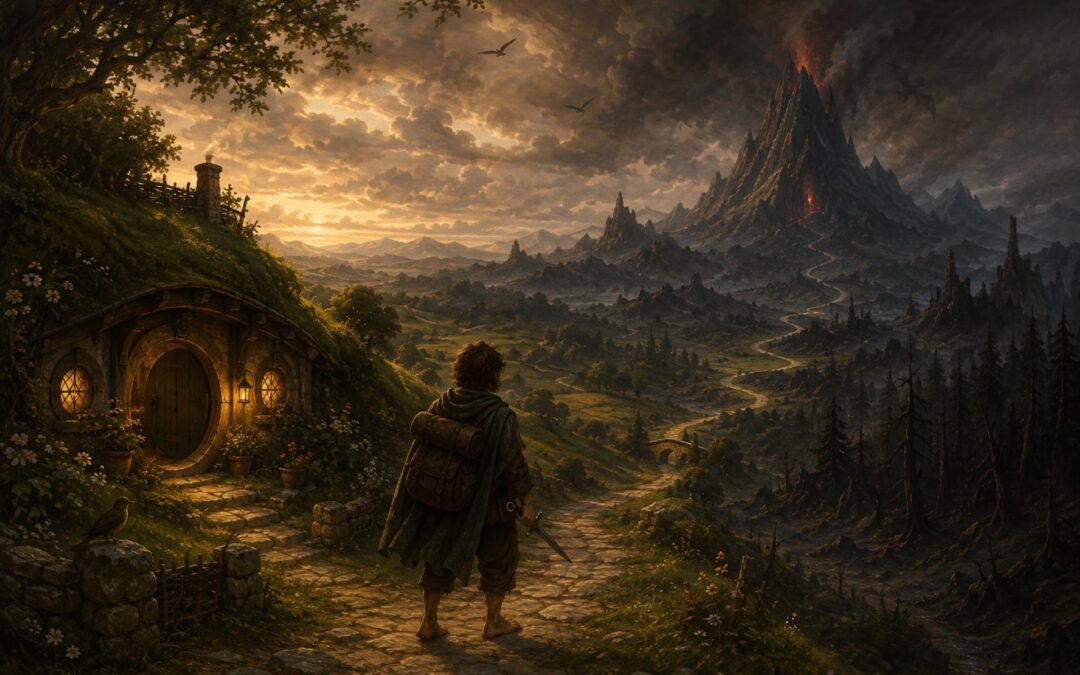
J.R.R. Tolkien’s The Hobbit, or There and Back Again begins with one of fantasy literature’s most comfortable heroes and spends the rest of the novel asking what happens when comfort is interrupted by danger, responsibility, temptation, loss, and unexpected moral choice. Bilbo Baggins is not a warrior, a king, a wizard, or even someone who wants an adventure. He is a respectable hobbit who values meals, routine, a well-furnished home, and the approval of his neighbors, yet he becomes essential to a quest involving goblins, giant spiders, Wood-elves, a dragon, a disputed treasure, and a war between several peoples.
This article contains complete spoilers for the entire novel, including the Ring, Smaug’s death, the Arkenstone dispute, the Battle of Five Armies, Thorin’s death, and Bilbo’s return home.
The novel was first published in 1937, but the story readers usually encounter today is not identical to the original text. Tolkien later revised important material, most famously the encounter with Gollum, as the world of The Hobbit became more closely connected to the mythology that eventually produced The Lord of the Rings. As Tolkien later explained, The Hobbit had not initially been designed as an installment in the mythology of his Elder Days; it gradually became larger and more heroic and was subsequently integrated more tightly into his legendarium. That history matters because The Hobbit works best when read first as its own novel rather than merely as background material for a later epic.
What makes the book endure is not simply Bilbo’s transition from timid homebody to courageous adventurer. Tolkien steadily complicates the very idea of heroism. Bilbo often succeeds through observation, language, mercy, improvisation, patience, secrecy, and moral judgment, while Thorin Oakenshield, the figure who seems most conventionally heroic, nearly ruins his restored kingship through pride and possessiveness. The apparent quest to defeat a dragon eventually becomes a deeper argument about how people behave after they get what they wanted.

From Bag End to Rivendell: The Quest Begins
The opening portion of The Hobbit establishes almost everything that will later be tested: Bilbo’s love of home, the dwarves’ longing for their lost kingdom, Gandalf’s faith in Bilbo, Thorin’s pride, the lure of treasure, and the importance of old maps, inherited claims, and forgotten histories. Tolkien begins in comedy, with Bilbo protecting his domestic routine from increasingly intrusive guests, but behind the comic hospitality lies a story of dispossession and unfinished vengeance.
Chapter I: An Unexpected Party
Bilbo Baggins lives in Bag End, a comfortable hobbit-hole in the Shire. Tolkien immediately defines him through ancestry. The Baggins side of the family is respectable, predictable, and cautious, while Bilbo’s maternal Took ancestry carries rumors of something less conventional and more adventurous. Bilbo himself has spent his adult life identifying with the Baggins side, and when Gandalf appears outside his home asking whether he would like to share in an adventure, Bilbo does his best to end the conversation politely.
The following day destroys his routine. Dwarves begin arriving at Bag End in groups, each expecting food, drink, and hospitality. By the time Thorin Oakenshield arrives, Bilbo’s house has been taken over by thirteen dwarves and Gandalf. The comedy of broken expectations and disappearing provisions gradually gives way to something more serious when the dwarves sing of a lost mountain kingdom, stolen treasure, and a dragon.
Thorin explains that his people once ruled beneath the Lonely Mountain, or Erebor, where they became enormously wealthy. Nearby Dale prospered through trade with the dwarves until Smaug descended from the North, attacked the Mountain, destroyed Dale, drove out the surviving dwarves, and claimed the treasure for himself. Thorin belongs to the royal line that lost its home, and his expedition is not merely a robbery in reverse; he sees it as the restoration of a stolen inheritance and a displaced people.
The history of Thorin’s family deepens the quest. His grandfather Thrór later died in Moria, while his father Thráin vanished. Gandalf reveals that he eventually found Thráin imprisoned by the Necromancer and received from him a key and a map connected to Erebor. These objects become the practical foundation of the quest because the map indicates a secret entrance into the Mountain that may allow the company to reach Smaug without attacking him through the main gate.
Bilbo has been invited because Gandalf has recommended him as a burglar. Nothing in Bilbo’s life supports that description, and Thorin is openly skeptical of his usefulness. Bilbo initially reacts to talk of dragons and death by collapsing, but Thorin’s condescension provokes the Took side of him. His desire to prove that he is not merely the timid little hobbit Thorin imagines becomes one of the forces that sends him out the door.
The chapter therefore establishes a tension that will last through the novel. Thorin enters the story already carrying the burden of history, kingship, inheritance, and heroic identity, while Bilbo enters carrying no public importance at all. Yet Bilbo’s very lack of grand status will eventually allow him to see the treasure, the war, and even Thorin himself more clearly than those whose identities are bound to inherited claims.
Chapter II: Roast Mutton
Bilbo wakes the next morning and initially believes the strange gathering may have been nothing more than an unpleasant interruption. The dwarves have gone, and part of him is relieved. Then he discovers their message telling him where and when to meet them, and he rushes away so quickly that he leaves behind many of the small comforts he would ordinarily consider essential.
The landscape gradually becomes less civilized, the weather worsens, and the company becomes hungry and uncomfortable. Gandalf disappears for a time, leaving the travelers without the person best equipped to handle danger. When they see a distant fire, Bilbo is sent to investigate because the company now expects the supposed burglar to justify his place.
He finds three trolls—Bert, Tom, and William—sitting around the fire. Wanting to prove himself, Bilbo attempts to pick one troll’s pocket. The attempt is disastrous. He is discovered, and the dwarves, arriving separately, are captured one after another until the whole company seems likely to become dinner.
Gandalf returns and saves them without relying primarily on combat. Concealed from the trolls, he imitates their voices and causes them to quarrel until dawn. The sunlight turns the trolls to stone, allowing the travelers to escape. The episode is comic, but it also establishes one of the novel’s recurring patterns: intelligence, delay, confusion, and language can be more effective than straightforward force.
The trolls’ cave contains food, treasure, and old weapons. Gandalf and Thorin take swords that will soon be identified as ancient Elvish blades, while Bilbo receives a smaller sword appropriate to his size. At this stage he has done little to earn heroic equipment, but the sword will later become part of his emerging self-confidence.
Chapter III: A Short Rest
The company eventually reaches Rivendell, where Elrond offers food, shelter, knowledge, and safety. Rivendell functions as more than a pleasant stopping place. It is one of the first locations where the travelers’ immediate quest is connected to a much older world whose history survives in objects, languages, and memories.
Elrond identifies Thorin’s sword as Orcrist and Gandalf’s as Glamdring, both forged long ago in Gondolin. The swords therefore carry a history much older than the current expedition, and their recognition suggests that Bilbo’s journey is moving through a landscape layered with forgotten conflicts and vanished civilizations.
More practically, Elrond examines Thrór’s map and discovers writing that cannot ordinarily be seen. The moon-letters reveal how the secret door may be opened. The travelers must be present on Durin’s Day, near a particular grey stone, when the proper light reveals the keyhole.
The discovery changes the map from a historical relic into a working mechanism. The company now has more than a destination; it has a method and a narrow opportunity. Tolkien repeatedly makes literacy, memory, language, inherited knowledge, and close observation as consequential as physical strength, and Rivendell establishes that pattern early.
Under the Misty Mountains: Goblins, Gollum, and the Ring
The journey through the Misty Mountains marks the point at which Bilbo’s adventure ceases to be a series of uncomfortable inconveniences and becomes a struggle for survival. More importantly, it removes him from the protection of Gandalf and the company, forcing him into the first crisis he must solve entirely alone.
Chapter IV: Over Hill and Under Hill
The company attempts to cross the Misty Mountains and encounters violent weather in the high country. Tolkien intensifies the danger by introducing stone-giants hurling rocks across the peaks, making the landscape itself feel hostile. Seeking shelter, the travelers enter what appears to be an ordinary cave.
The cave contains a hidden entrance used by goblins. During the night the floor opens, and goblins seize Bilbo and the dwarves, carrying them into tunnels beneath the mountains. Gandalf avoids being captured and later follows.
The goblins bring their prisoners before the Great Goblin. When he sees Orcrist, he recognizes it as a famous weapon that has killed goblins before, transforming an ancient sword into an immediate source of danger for Thorin. Gandalf suddenly attacks, kills the Great Goblin, and leads the company through the underground passages.
The escape is chaotic. Dori carries Bilbo for part of the flight, but a pursuing goblin grabs at him. Bilbo falls, strikes his head, and loses consciousness. When he wakes, he is alone in darkness, separated from every person who has protected him so far.
Chapter V: Riddles in the Dark
Bilbo’s experience beneath the mountains is the novel’s first great turning point because Tolkien strips away almost every advantage. Bilbo does not know where he is, cannot see, has no guide, and cannot expect rescue. As he crawls through the dark, his hand finds a small ring lying on the ground, and he puts it in his pocket without understanding what it is.
Eventually he reaches an underground lake inhabited by Gollum. Gollum is strange, isolated, hungry, and dangerous, but he is not presented merely as a monster waiting to be killed. He speaks to himself, remembers fragments of an older life, and possesses enough intelligence and loneliness to make conversation with Bilbo possible.
The two agree to a contest of riddles. If Bilbo wins, Gollum must show him the way out; if Gollum wins, he intends to eat Bilbo. The scene transforms storytelling and traditional wordplay into a life-or-death contest. Bilbo survives by remembering old riddles, improvising under pressure, and maintaining enough composure to continue when fear threatens to overwhelm him.
Bilbo’s final question is accidental. Searching his pocket and touching the ring, he asks what he has there. It is not a proper riddle in the traditional sense, but Gollum accepts it as the last challenge and fails to answer. His failure does not make him willing to honor the agreement. Instead, he returns to his island to retrieve the magical ring he normally uses to become invisible and hunt.
The ring is gone. Gollum gradually realizes that Bilbo must have found it, while Bilbo accidentally discovers its power when he slips it onto his finger and becomes invisible. He follows Gollum toward the exit and reaches a moment when he could kill him from behind.
Bilbo chooses not to. Looking at Gollum’s misery, isolation, and helplessness, he feels pity. The decision does not arise from strategy, and Bilbo has no knowledge of the later consequences associated with the Ring. Within The Hobbit, it is significant because Bilbo, in one of his first moments of genuine power, refuses to turn that advantage into unnecessary killing.
He leaps over Gollum and runs toward the exit. The Ring helps him evade the goblins, although he nearly fails to squeeze through the doorway and loses buttons from his coat in the process. Tolkien refuses to make the escape grander than Bilbo himself; even a crucial act of courage retains a comic physical awkwardness.
The chapter changes Bilbo permanently. He has acquired a powerful secret, survived alone, defeated a dangerous opponent without overpowering him, and chosen mercy when violence would have been easier. The modern version of the chapter also carries a special textual history because Tolkien later revised Gollum’s behavior and the circumstances of the Ring, a revision connected to the larger significance the Ring would acquire after The Hobbit was first written.
Chapter VI: Out of the Frying-Pan into the Fire
Outside the mountains, Bilbo eventually finds Gandalf and the dwarves. Before revealing himself, he uses the Ring to approach unseen and then suddenly appears among them. The trick gives him a new advantage over companions who have often assumed he is incapable, and their opinion of him begins to improve.
Bilbo tells the story of his escape but does not reveal everything. He keeps the Ring secret. That secrecy introduces an important division between Bilbo’s public role and his private resources: he is becoming more useful to the group, but he now possesses knowledge and power that the others do not fully understand.
The reunion does not produce safety for long. Wargs trap the travelers in trees, and Gandalf uses magical fire to keep the wolves at bay. Goblins arrive and begin preparing to burn the trees, creating a situation the company cannot solve for itself.
The Eagles intervene and carry them away. Their rescue prevents Bilbo’s growing competence from turning into a fantasy of complete self-sufficiency. Again and again, the travelers survive through a mixture of courage, assistance, timing, and fortune, and the novel never suggests that personal skill gives anyone complete control over events.
Beorn and Mirkwood: Bilbo Becomes the Company’s Rescuer
The middle movement of the novel transforms Bilbo from a passenger who occasionally surprises his companions into the person on whom the company increasingly depends. Gandalf’s withdrawal before Mirkwood is structurally important because it removes the most obvious source of rescue and forces Bilbo to take responsibility for dangers affecting everyone rather than merely himself.
Chapter VII: Queer Lodgings
After the Eagles leave them near the Carrock, Gandalf decides to seek help from Beorn. Beorn is a powerful and independent figure who can take the form of a great bear, and Gandalf knows that arriving at his home with thirteen dwarves at once may be a poor strategy.
He therefore introduces the company gradually. While telling Beorn the story of their journey, Gandalf allows pairs of dwarves to arrive at carefully timed intervals. Beorn’s irritation is repeatedly interrupted by curiosity, and the comic storytelling becomes a form of diplomacy.
Beorn eventually accepts the travelers, feeds them, shelters them, and verifies enough of their account to trust them. He gives them provisions and advice for crossing Mirkwood, emphasizing two instructions: remain on the path and do not drink from the enchanted stream.
His hospitality is generous but not sentimental. Beorn remains suspicious, powerful, and capable of violence toward enemies. He also secretly follows the travelers for part of the journey, ensuring that the animals he loaned are treated properly.
At the edge of Mirkwood, Gandalf announces that he must leave. The decision frightens the dwarves because their previous disasters have repeatedly ended with Gandalf’s intervention. The company now enters its most oppressive environment without the person who has consistently been able to solve crises beyond Bilbo’s abilities.
Chapter VIII: Flies and Spiders
Mirkwood is dangerous not because every moment contains open violence but because it exhausts judgment. The forest is dark, enclosed, repetitive, and difficult to read. The company cannot see how far it has traveled, cannot estimate how much farther it must go, and gradually loses confidence as food disappears.
The enchanted stream makes the situation worse. During the crossing, a disturbance involving a deer causes Bombur to fall into the water. He enters an unnatural sleep and must be carried, adding physical burden to a company already weakened by hunger.
Their discipline eventually collapses. Seeing lights and signs of feasting away from the path, the travelers abandon Beorn’s warning because hunger has become unbearable. Each attempt to approach the woodland feasts ends with the lights disappearing and the company becoming more disoriented.
During this confusion Thorin is separated from the others and captured by the Wood-elves. The remaining dwarves are later taken by giant spiders, who wrap them in webs and prepare to consume them. Bilbo wakes apart from his companions and confronts a spider attacking him.
He kills it with his sword. The act matters not only because it is a physical victory but because Bilbo experiences it as a change in himself. He has fought alone and survived, and he gives his sword the name Sting, symbolically claiming a more active identity.
Bilbo soon discovers the dwarves hanging in webs. Using the Ring, his sword, stones, songs, and insults, he manipulates the spiders into chasing him while he draws them away from the prisoners. He then returns and begins cutting the dwarves free, repeatedly placing himself at risk to rescue others.
This is a more consequential achievement than his earlier escape from Gollum because Bilbo is no longer merely saving himself. The company survives because he acts decisively while they are helpless. His supposed occupation as burglar has evolved into something much broader: scout, strategist, rescuer, and increasingly the most adaptable member of the expedition.
Thorin, meanwhile, has been brought before the Elvenking. The Elvenking suspects that Thorin’s presence in the forest is connected to treasure but receives little cooperation. Thorin refuses to explain the quest and is imprisoned, preserving information but also reinforcing the distrust between dwarves and Wood-elves that will later become politically important.
Chapter IX: Barrels Out of Bond
The remaining dwarves are eventually captured and imprisoned in the Elvenking’s halls. Bilbo avoids capture because of the Ring, but freedom becomes its own burden. He must survive unnoticed, discover where thirteen prisoners are being held, and find a way to free them from an organized underground stronghold.
Bilbo spends time learning the layout and routines of the palace. This period of patient observation demonstrates how much his behavior has changed. The hobbit who once rushed clumsily toward three trolls now waits, watches, learns, and acts when an opportunity becomes viable.
That opportunity comes through the barrels used to transport goods along the Forest River. When the chief guard and Galion, the butler, fall asleep after drinking, Bilbo steals the prison keys and releases the dwarves. He hides each dwarf in an empty barrel scheduled to be dropped through a trapdoor and sent downstream.
The plan is ingenious but imperfect. Bilbo has created a means of escape for everyone except himself and must improvise by riding outside the barrels. The journey is cold, violent, and uncomfortable, and the dwarves emerge battered and soaked rather than triumphantly liberated.
The imperfect escape is typical of Tolkien’s treatment of Bilbo. Competence never turns him into an effortless hero. His plans work because he thinks quickly and persists through discomfort, not because the narrative suddenly grants him conventional mastery.
Lake-town and the Lonely Mountain: The Burglar Meets the Dragon
Once the company reaches Lake-town, the expedition becomes a public matter. Thorin is no longer merely the leader of a small traveling party; he openly claims royal identity, and the old hope of restoring the King under the Mountain begins affecting communities whose lives were also shaped by Smaug’s conquest.
Chapter X: A Warm Welcome
The barrels eventually reach the open water near Lake-town, or Esgaroth. Bilbo frees the dwarves, and Thorin announces who he is. The declaration electrifies the Lake-men because songs and old traditions have preserved memories of the wealth that once flowed from the Lonely Mountain and Dale.
Many inhabitants welcome the dwarves enthusiastically. Their response is partly romantic and partly economic. If the old kingdom is restored, prosperity may return with it, and Thorin’s quest begins attracting expectations far beyond the original company.
The Master of Lake-town is more cautious. He does not necessarily believe all the old songs, but refusing to welcome Thorin would be politically difficult when the population is excited. He therefore treats the company generously and allows them to recover.
The episode quietly prepares the later conflict. By publicly claiming kingship and accepting support from Lake-town, Thorin connects his private inheritance to a wider regional history. When the expedition later helps provoke Smaug’s attack on the town, the people’s interest in the treasure will not emerge from nowhere.
Chapter XI: On the Doorstep
The travelers eventually leave Lake-town and approach the Lonely Mountain. The surrounding land has been scarred by Smaug, and the Desolation provides material evidence of what the dragon’s conquest meant. The quest is no longer an adventure imagined through songs; the travelers now see the ruins left by the creature they intend to confront.
They locate the place indicated on the map but cannot find a keyhole or obvious way to open the door. Days pass, morale declines, and the possibility of failure becomes more frightening because the travelers have finally reached their destination without knowing how to enter it.
Bilbo continues watching the surroundings closely. On Durin’s Day he notices the thrush connected to the map’s instructions. At the right moment, the last light reveals the hidden keyhole.
Thorin uses the inherited key and opens the secret door. The scene fulfills information established many chapters earlier at Rivendell. Tolkien’s plot repeatedly rewards remembered instructions and patient observation, and the entrance into Erebor depends on exactly those qualities.
Chapter XII: Inside Information
Once the door is open, the dwarves remind Bilbo why he was recruited. They expect the burglar to go inside. Their enthusiasm for recovering the treasure does not translate into enthusiasm for accompanying him into the dragon’s lair, and Bilbo recognizes the imbalance even as he accepts the task.
He descends alone through the tunnel and eventually sees Smaug asleep on the treasure. The sight is overwhelming, but Bilbo forces himself forward and steals a cup from the hoard. Returning successfully gives the dwarves enormous satisfaction because the theft seems to prove both Bilbo’s worth and the reality of their long-imagined recovery.
Smaug’s response reveals something essential about his relationship to the treasure. He notices the missing cup despite the size of the hoard. His rage is not the rational concern of an owner deprived of useful property; it is the fury of a creature whose identity is bound to total possession.
The dragon searches for the thieves and attacks the exterior of the Mountain, forcing the company to hide. Bilbo eventually makes a second descent, this time engaging Smaug in conversation. The encounter is one of the novel’s great verbal confrontations because Bilbo must obtain information without revealing enough to let Smaug identify him or his companions.
Bilbo describes himself through riddling titles rather than giving his name. Smaug responds with charm, suspicion, mockery, and psychological pressure. He suggests that the dwarves may not have treated Bilbo fairly, questions how the hobbit expects to transport his promised share of the treasure home, and attempts to turn Bilbo’s own practical intelligence against his loyalty to Thorin.
Bilbo knows he is being manipulated, yet the dragon’s questions are not entirely foolish. The company has indeed expected Bilbo to take extraordinary risks, and no clear plan exists for removing the treasure. Tolkien allows Smaug to be both deceitful and perceptive, which makes him more dangerous than a purely bestial monster.
Bilbo also manipulates Smaug. By flattering his strength and armor, he encourages the dragon to display his underside. Bilbo notices a patch that lacks the protective covering of gems and scales and later tells the dwarves what he has learned.
A thrush overhears the information. Smaug, meanwhile, pieces together enough of Bilbo’s riddling speech to suspect that the Lake-men have helped the intruders. He leaves the Mountain and flies toward Esgaroth.
Bilbo’s success therefore produces an unintended consequence. He has discovered the dragon’s weakness, but his conversation has also redirected Smaug’s anger toward an entire town. The novel repeatedly complicates success by showing that good decisions made under limited knowledge can create dangers no one intended.
Chapter XIII: Not at Home
The company does not immediately know that Smaug has gone to Lake-town. Trapped near the secret entrance, the dwarves hesitate to enter the treasure hall because the dragon may return. Eventually they move deeper into the Mountain and discover the hoard without its guardian.
Bilbo finds the Arkenstone, the jewel Thorin values above all other objects in the treasure. He recognizes its importance and secretly takes it. Unlike the Ring, which he found accidentally, Bilbo knowingly conceals the Arkenstone from Thorin.
The decision is not yet fully explained, but it gives Bilbo extraordinary leverage. Thorin’s emotional connection to the stone is so intense that possessing it means possessing something more valuable to him than an ordinary share of the treasure.
The dwarves begin equipping themselves from the recovered wealth, and Bilbo receives a small coat of mithril mail. Thorin increasingly focuses on the treasure and the missing Arkenstone. Even before anyone challenges his ownership, the recovery that was supposed to restore his people begins narrowing his judgment.
The company eventually moves away from the vulnerable secret door toward a more defensible position. Outside, the birds behave strangely, signaling that something significant has changed. Bilbo and the dwarves have accomplished the apparently impossible task of entering Smaug’s domain, but the real consequences of that success are now unfolding elsewhere.
Smaug’s Death and the War Over the Treasure
Smaug’s death would be the natural climax of a simpler adventure story, yet Tolkien kills the dragon with five chapters still remaining. The structural choice reveals the novel’s deeper concern: removing the monster does not automatically make the surviving people wise, just, or cooperative.
Chapter XIV: Fire and Water
The narration leaves Bilbo and the dwarves to follow Smaug as he attacks Lake-town. The people respond with courage and organization, but ordinary weapons cannot easily penetrate the dragon’s armored body. Fires spread, panic grows, and the town’s position over the water does not protect it from destruction.
Bard remains at his post. He descends from Girion of Dale, whose city Smaug destroyed generations earlier, giving his confrontation with the dragon both immediate and historical significance. Unlike Thorin, however, Bard’s claim to leadership develops through visible public action rather than inheritance alone.
The thrush that overheard Bilbo carries the crucial information about Smaug’s vulnerable patch. Bard can understand the bird and learns where the dragon can be wounded. With his last arrow, the Black Arrow, he strikes the exposed place.
Smaug dies, but even in death he causes devastation by falling onto Lake-town and destroying much of it. The victory therefore does not erase the cost of the conflict. Thousands of people who never joined Thorin’s quest have lost homes and possessions.
The survivors gather on shore. The Master remains the established political authority, but Bard’s courage gives him a new legitimacy. He helps organize relief and begins thinking not only about rebuilding Lake-town but about restoring Dale.
News of Smaug’s death spreads quickly. The Elvenking initially has reason to think about the unguarded treasure, but when he encounters the displaced Lake-men he turns toward relief before continuing to the Mountain. Tolkien therefore begins differentiating characters according to how they respond to vulnerability and wealth after the dragon is gone.
Chapter XV: The Gathering of the Clouds
At Erebor, ravens bring news of Smaug’s death. Roäc, an old raven, explains that Men and Elves are approaching and advises Thorin to think carefully. Thorin instead sends for his cousin Dáin and a force of armed dwarves from the Iron Hills.
The dwarves fortify the Front Gate and prepare to defend the hoard. Thorin’s position has some logic. The treasure belonged to his people before Smaug stole it, and armed groups are approaching immediately after the dragon’s death. Yet his legitimate concern increasingly hardens into refusal to recognize anyone else’s claims.
Bard approaches and presents a case that cannot be dismissed as simple greed. Lake-town has been destroyed because Smaug attacked in response to Thorin’s expedition. Some of the treasure originally came from Dale, and Bard is the descendant of its old rulers. Most urgently, the surviving Lake-men need resources to live.
Thorin refuses to yield treasure while an armed Elven host stands beside the Men. His mistrust of the Elvenking has historical and personal roots, but he allows resentment to override the distinctions between Bard’s claim, the Lake-men’s suffering, and the Elvenking’s presence.
A siege begins. Thorin waits for Dáin, while Bard and the Elvenking attempt to pressure the dwarves through isolation rather than immediate assault. The quest has reached a strange moral inversion: after escaping trolls, goblins, spiders, and Smaug, the protagonists are now preparing to fight potential allies over the spoils.
Chapter XVI: A Thief in the Night
Bilbo becomes increasingly disturbed by Thorin’s behavior. He has remained loyal through dangers that were never originally his, but loyalty no longer looks simple when Thorin’s insistence on absolute control threatens to produce a battle.
Bilbo decides to act independently. During Bombur’s watch, he uses the Ring to leave the Mountain and enters the camp of Bard and the Elvenking. There he offers them the Arkenstone.
The decision is calculated rather than impulsive. Bilbo knows that Thorin values the stone more than ordinary treasure and believes it can be used to force negotiation. He is effectively using his own promised share of the expedition’s wealth as a bargaining instrument, though Thorin certainly will not see it that way.
Gandalf is unexpectedly present in the camp and approves Bilbo’s action. The approval matters less as permission than as confirmation that Bilbo has become capable of judgment without waiting for Gandalf to tell him what to do.
Bilbo then returns to the Mountain. He could remain safely with Bard and the Elvenking, but doing so would reduce his act to desertion. Instead, he goes back to Thorin and accepts the consequences of what he has done.
The choice is the clearest expression of Bilbo’s moral independence. He is willing to break the expectations of factional loyalty because he believes preventing unnecessary bloodshed matters more than protecting Thorin from embarrassment or losing his own reward.
The Battle of Five Armies and the Road Home
The final three chapters bring the novel’s political conflict, Thorin’s character arc, Bilbo’s transformation, and the broader fate of the region together. The Battle of Five Armies supplies the expected martial climax, but Tolkien deliberately refuses to make Bilbo its conquering hero.
Chapter XVII: The Clouds Burst
Bard returns to negotiate and reveals the Arkenstone. Thorin is shocked, and Bilbo openly admits that he gave it away. The confession produces the most serious rupture between them.
Thorin reacts with fury and nearly throws Bilbo from the wall. Gandalf intervenes before the confrontation becomes fatal. Bilbo defends himself by invoking the agreement that entitled him to a fourteenth share and argues that he was free to use his portion as he judged best.
Thorin reluctantly agrees to exchange a fourteenth share of the silver and gold for the Arkenstone. Even then, he has not genuinely accepted compromise. Dáin is approaching with armed dwarves, and Thorin expects that military strength may allow him to escape the bargain.
Dáin arrives, and open conflict between Dwarves, Men, and Elves appears imminent. At the last possible moment Gandalf interrupts the confrontation with news that changes the scale of the crisis: a large army of goblins and Wargs is approaching.
The enemies have organized after the death of the Great Goblin, and Bolg leads them toward Erebor. The former opponents must now decide whether to continue their quarrel or cooperate against a force that threatens everyone.
The five armies are the Goblins and Wargs on one side and Dwarves, Elves, and Men on the other. Gandalf, Bard, the Elvenking, and Dáin coordinate their defense around the Mountain, setting aside their immediate dispute.
The battle initially seems manageable because the defenders use the geography intelligently, but the goblins exploit the heights and begin overwhelming them. The conflict becomes desperate.
Thorin eventually emerges from the Mountain with his companions and joins the fighting. His courage is real, and Tolkien does not allow his moral failure over the treasure to erase his heroic qualities. Thorin drives toward Bolg but becomes surrounded.
Bilbo does not become a great warrior at the climax. Wearing the Ring, he remains near the Elvenking and Gandalf on Ravenhill, watching events unfold. He eventually sees the Eagles approaching, but before he can do more, a stone strikes him and he loses consciousness.
The narrative choice is deliberate. Bilbo has already performed the action that most defines his heroism when he risked Thorin’s hatred to prevent civil war. His unconsciousness during the decisive martial phase prevents the story from pretending that all forms of courage culminate in battlefield glory.
Chapter XVIII: The Return Journey
Bilbo wakes after the battle and gradually learns what happened while he was unconscious. The Eagles attacked the goblins from above, altering the balance of the fight. Beorn also arrived in bear form, rescued the wounded Thorin, returned in fury, and killed Bolg.
The goblin army eventually collapsed. Victory, however, comes with severe losses. Thorin is dying, and Fili and Kili have been killed while defending him.
Bilbo is brought to Thorin for a final meeting. Their reconciliation is the emotional climax of the novel because Thorin now understands what his obsession with the treasure had done to him. He acknowledges that Bilbo’s values—ordinary pleasures, friendship, food, cheer, and peace—contain a kind of wisdom that his heroic and royal ambitions had obscured.
The reconciliation does not erase Thorin’s earlier behavior, and his repentance cannot restore the lives lost in battle. Its power comes precisely from arriving too late to undo the damage. Thorin recovers moral clarity at the point when he can no longer enjoy the kingdom he spent his life trying to reclaim.
After Thorin’s death, the surviving leaders settle the dispute. Bard places the Arkenstone on Thorin’s breast, and the Elvenking places Orcrist on his tomb. Dáin becomes King under the Mountain.
Dáin honors the substance of the bargain and gives Bard one-fourteenth of the gold and silver. Bard distributes wealth rather than hoarding it, using part of it for rebuilding and compensation. The different treatment of treasure after Thorin’s death demonstrates that wealth itself is not the novel’s villain; the central issue is how people relate to it.
Bilbo could claim an enormous fortune but chooses far less. He takes enough gold and silver to make the return worthwhile without allowing the treasure to become the measure of the adventure. His restraint separates him from both Smaug’s total possession and Thorin’s temporary obsession.
The homeward journey begins. The company that left Bag End has been transformed and, in several cases, permanently broken. The quest has succeeded materially, but its cost prevents the ending from becoming a simple victory celebration.
Chapter XIX: The Last Stage
Bilbo travels back west with Gandalf and spends time again with Beorn. The return reverses the outward journey geographically, but Bilbo no longer experiences familiar places as the same hobbit who passed through them before.
At Rivendell, he learns more about Gandalf’s activities during his absence. Gandalf had participated in a council of white wizards that drove the Necromancer from his stronghold in southern Mirkwood. Within The Hobbit, this remains a secondary development, part of the suggestion that Bilbo’s adventure occurred alongside larger events he only partially understands.
Bilbo and Gandalf later recover the troll treasure they had buried on the outward journey. Even this recovery reflects Bilbo’s changed relationship with wealth. Money is useful and welcome, but it no longer dominates his imagination.
When Bilbo reaches Bag End, he discovers a comic but telling disaster. His possessions are being auctioned because he has been legally presumed dead. Returning from dragons, war, and ancient kingdoms does not restore him instantly to normal life; he must prove who he is and recover his own property.
He succeeds in reclaiming his home but not his former social position. Many hobbits consider him odd, unreliable, and no longer entirely respectable. The Bilbo who once valued respectability intensely now finds that loss much easier to bear.
Years later Balin and Gandalf visit him. They bring news that Dale has been rebuilt under Bard, Lake-town has recovered, and trade and friendship have returned among Men, Elves, and Dwarves. The consequences of the quest therefore extend far beyond Thorin’s personal recovery of treasure.
The old Master of Lake-town provides a final contrast. Rather than becoming a responsible steward, he is corrupted by wealth, flees with gold, and dies. His fate reinforces the distinction between possession and wise use that runs through the final third of the novel.
Gandalf also challenges Bilbo’s interpretation of his own story. Bilbo tends to describe his survival and success as extraordinary luck, but Gandalf reminds him that he is only one person in a much larger pattern of events. The comment does not fully explain what controls that pattern, but it refuses the idea that Bilbo’s adventure can be understood entirely as either personal greatness or random accident.
Bilbo is back where he began, yet “back again” does not mean restored to his former self. Bag End remains valuable, meals remain pleasurable, and domestic life remains worth returning to, but Bilbo no longer confuses comfort with the whole of life or respectability with virtue.
Setting and World-Building: A World That Deepens as Bilbo Travels
Tolkien builds the world of The Hobbit through accumulation rather than systematic explanation. Bilbo rarely receives a textbook account of political institutions, languages, histories, and peoples. Instead, he encounters old swords, ruined cities, songs, names, maps, genealogies, local grudges, fragments of legend, and landscapes shaped by earlier events.
The Shire, the Wild, and the Geography of Danger
The Shire establishes the baseline against which every later place is measured. Bag End is not presented as childish or worthless. Its food, warmth, routine, furniture, and social stability remain genuinely desirable throughout the novel, which is why Bilbo’s departure carries weight and his return matters.
Moving eastward, the landscape becomes progressively less predictable. Rivendell offers safety, but it is a refuge within a wider dangerous world rather than another version of the Shire. The Misty Mountains contain goblin tunnels and ancient histories, while Wilderland introduces Beorn, Wargs, Eagles, and a landscape where political authority is fragmented.
Mirkwood is psychologically distinct from the open dangers of the mountains. Its threat comes from darkness, confusion, hunger, enchantment, and the inability to measure progress. The travelers’ failure to remain on the path literalizes one of the novel’s recurring problems: desperation can make good instructions feel impossible to obey.
Lake-town and Erebor change the scale again. Lake-town is a functioning human settlement with economic interests and political leadership, while the Desolation of Smaug reveals what happens when concentrated destructive power empties a region. Erebor itself is both home and tomb, a place of cultural memory whose recovery promises restoration but also reawakens dangerous possessiveness.
Dwarves, Elves, Men, Goblins, and the Politics of the North
The novel’s peoples are not organized into a simple division between good communities and evil monsters. Goblins and Wargs function largely as enemies, but Dwarves, Elves, and Men have competing histories, economic interests, memories, and suspicions that do not disappear merely because they face common threats.
Thorin’s dwarves embody dispossession. Their desire to recover Erebor is not frivolous greed at the beginning of the novel; they have lost a homeland and an inheritance. Yet the legitimacy of that grievance does not automatically make every later decision just.
The Wood-elves likewise cannot be reduced to villains because they imprison Thorin. The Elvenking is suspicious, proud, and interested in treasure, but he also feeds the starving Lake-men and ultimately participates in a settlement rather than insisting on conquest. Bard, meanwhile, makes the strongest argument for treating recovered wealth as a social resource because his people have directly suffered from the consequences of the expedition.
The confrontation before the Battle of Five Armies is therefore a conflict among parties with partially legitimate interests. Tolkien creates moral complexity by allowing rights to overlap. Thorin can be the rightful heir to Erebor and still owe something to those harmed by Smaug’s final attack.
History, Language, Maps, Runes, and the Sense of a Larger Past
One of Tolkien’s most influential techniques is the suggestion that every visible event stands on top of older stories. Elrond recognizes swords from Gondolin. Thorin’s family history reaches back through generations of exile and violence. Bard’s identity is linked to Dale, while songs preserve memories even when political institutions have vanished.
The map and moon-letters are especially important because they make textual interpretation part of the action. The expedition would fail without the ability to read inherited information correctly. Runes, hidden writing, names, and songs are not decorative additions; they are mechanisms through which history remains active in the present.
The larger mythology behind these details should not be over-read into the novel. As Tolkien’s account of the book’s development helps clarify, the story grew out of several interests at once, including children’s storytelling, philology, fairy-tale motifs, and the older mythic material Tolkien had been developing separately. The Hobbit gains much of its atmosphere from allowing those layers to overlap without explaining every connection.
That partial incompleteness is part of the world-building’s appeal. Places feel old because the narrative does not always pause to make them fully legible. Bilbo experiences history as ordinary people often do: through ruins, inherited objects, stories, names, and customs whose full origins remain beyond his knowledge.
Character Analysis: Bilbo, Thorin, and the People Who Shape the Quest
The novel’s emotional structure depends less on a single villain than on contrasting ways of responding to danger, authority, wealth, and responsibility. Bilbo and Thorin carry the deepest arcs, but Gandalf, Gollum, Smaug, Bard, Beorn, the Elvenking, and the dwarves repeatedly expose different possibilities of power and judgment.
Bilbo Baggins: From Respectable Hobbit to Moral Agent
Bilbo’s development is often summarized as becoming brave, but that description is too narrow. He does become physically courageous, especially against the spiders and in his descents toward Smaug, yet his most important growth involves judgment. By the end, he can decide what is right even when the person he has followed and admired believes the opposite.
The Baggins/Took distinction gives Tolkien a comic psychological shorthand. The Baggins side values security and reputation, while the Took side represents curiosity and risk. Bilbo does not eventually choose one side and destroy the other. His development consists of integrating them.
That is why home remains important after the adventure. Bilbo does not become a restless warrior who despises domestic life. He returns to Bag End, appreciates food and comfort, writes poetry, welcomes visitors, and lives quietly. What changes is his ability to distinguish genuine comfort from social conformity.
His first major independent success beneath the Misty Mountains establishes several traits that later become central. He survives through riddles, observation, and patience; he discovers the Ring; and he spares Gollum. The decision to show mercy becomes more revealing than the mere fact of escape because it demonstrates that Bilbo can possess an advantage without automatically exploiting it to the limit.
Mirkwood develops him from survivor into rescuer. Naming Sting follows a real achievement rather than a fantasy of heroism, and the spider episode teaches him that fear can coexist with action. The barrel escape then shows planning, patience, and responsibility for others.
His confrontation with Smaug adds verbal sophistication. Bilbo must flatter, conceal, listen, and infer. He makes mistakes, especially when his riddling language helps Smaug connect the expedition to Lake-town, but he also discovers the weakness that eventually enables Bard to kill the dragon.
The Arkenstone decision completes the arc. Bilbo is no longer proving himself to Thorin. He is willing to lose Thorin’s approval, his share of the treasure, and possibly his safety because he judges that preventing war matters more than obedience.
In that sense, Bilbo’s heroism becomes almost the opposite of Thorin’s temporary failure. Bilbo can own things without being owned by them, can be loyal without surrendering conscience, and can become courageous without needing to see himself as grand.
Thorin Oakenshield: Exile, Kingship, Pride, and Repentance
Thorin is far more than a cautionary figure about greed. His life has been shaped by exile, inherited loss, and responsibility for a dispossessed people. His desire to reclaim Erebor is legitimate, and his willingness to pursue that goal across enormous danger demonstrates genuine courage.
He also possesses real leadership qualities. The dwarves follow him because his status is not merely ceremonial, and at the Battle of Five Armies he proves capable of extraordinary martial bravery. Tolkien’s criticism of Thorin matters precisely because it applies to someone with virtues worth respecting.
His weakness develops from those same strengths. Because Erebor is tied to family, identity, kingship, and historical injury, recovering the treasure means more to him than acquiring wealth. The Arkenstone becomes a concentrated symbol of everything he believes has been unjustly taken.
Once Smaug is dead, however, Thorin’s sense of restoration becomes possessiveness. He increasingly treats every outside claim as an attack on his rights, even when Bard’s arguments involve destroyed homes, old treasure from Dale, and direct responsibility for killing Smaug.
The tragedy lies in Thorin’s inability to distinguish between defending legitimate inheritance and refusing all moral obligation. His suspicion of the Elvenking is understandable, but he uses it to dismiss the claims of the Lake-men as well. His identity as wronged heir becomes a justification for behavior that begins resembling the dragon’s obsessive relation to the hoard.
His reaction to Bilbo’s surrender of the Arkenstone shows how far he has moved. The person whose company depends repeatedly on Bilbo is ready to harm him because Bilbo has interfered with possession. Yet Thorin’s final battle and deathbed reconciliation prevent the character from ending as a simple moral failure.
He regains perspective when it can no longer benefit him materially. His recognition of Bilbo’s values gives the novel much of its emotional power because it comes from someone who once dismissed precisely those values as softness. Thorin’s tragedy is therefore not that he wanted his home back but that, for a time, he allowed possession of the restored home to narrow the purpose for which restoration mattered.
Gandalf: Catalyst, Guide, and Strategic Absence
Gandalf is the person who sees Bilbo’s possibilities before Bilbo does. He chooses him for the expedition without offering a fully persuasive explanation to either Bilbo or Thorin, and the choice initially appears absurd. The narrative gradually justifies Gandalf’s faith through Bilbo’s actions.
Gandalf’s role is partly that of rescuer. He saves the company from the trolls, helps them escape the goblins, and repeatedly provides knowledge the dwarves lack. If he remained present throughout the journey, however, Bilbo’s development would be impossible.
His departure before Mirkwood is therefore structurally necessary. Bilbo cannot become indispensable while a wizard solves every major problem. Gandalf’s absence creates the conditions in which the hobbit discovers what he can do.
When Gandalf reappears during the Arkenstone crisis, he does not give Bilbo instructions. Bilbo has already made the decision. Gandalf’s approval shows that the relationship has changed from mentor and reluctant recruit to something closer to recognition between two people capable of independent judgment.
Gollum, Smaug, Bard, Beorn, and the Elvenking
Gollum occupies comparatively little space in the novel but has enormous importance. He is dangerous and intends to eat Bilbo, yet Tolkien also makes him pitiable. Bilbo’s refusal to kill him when invisible demonstrates a moral quality that will later distinguish the hobbit from characters overwhelmed by possession.
Smaug is a very different kind of antagonist. His danger lies not only in fire and physical power but in intelligence. He understands desire, suspicion, vanity, and self-interest well enough to manipulate people verbally.
The conversation between Bilbo and Smaug works because both characters are trying to control information. Bilbo uses riddles to conceal his identity, while Smaug probes for weaknesses in his relationship with the dwarves. The dragon’s questions about Bilbo’s compensation are manipulative, but they also expose practical problems Thorin’s company has largely ignored.
Bard provides the strongest contrast to Thorin in the final political conflict. He possesses ancestry connected to Dale, but the novel makes his leadership credible through behavior rather than genealogy alone. He kills Smaug, organizes survivors, presses a concrete claim, and later distributes wealth toward reconstruction.
Beorn represents another model of power. He is physically formidable, suspicious, and not integrated into ordinary political institutions, yet he can be exceptionally generous once trust is established. His arrival at the Battle of Five Armies helps decide the conflict, but his earlier hospitality is equally important because it demonstrates that strength need not be connected to possession or rank.
The Elvenking occupies a morally mixed position. He imprisons Thorin and has an interest in treasure, yet he is not simply a greedy rival. His decision to aid the Lake-men before pursuing the Mountain and his later willingness to settle the dispute reveal a leader capable of practical mercy.
The Dwarf Company: Individuality, Loyalty, and Collective Limitations
The thirteen dwarves are memorable as a group more often than as fully developed individuals. Tolkien differentiates some of them through temperament, physical traits, recurring roles, or relationships, but many remain closer to members of a traveling company than psychologically complex characters.
Balin receives some of the clearest individuality because he develops a warm relationship with Bilbo and often treats him with respect before the others fully do. Bombur is defined largely through size, appetite, sleep, and comic difficulty, though his enchanted sleep in Mirkwood materially affects the journey.
Fili and Kili receive added importance through their youth and relationship to Thorin. Their deaths defending him give the Battle of Five Armies a personal cost that prevents Thorin’s final charge from functioning as uncomplicated heroic redemption.
The group’s most important collective development is its dependence on Bilbo. The dwarves begin by doubting the supposed burglar, yet during Mirkwood and the Elvenking’s imprisonment they become unable to proceed without him. Their changing attitude helps measure Bilbo’s growth, even if the novel does not individualize every dwarf who benefits from it.
Bilbo and Thorin: Trust, Betrayal, and Reconciliation
The relationship between Bilbo and Thorin provides the emotional spine of the book’s final movement. Thorin initially regards Bilbo as a dubious addition chosen by Gandalf. His skepticism helps provoke Bilbo’s desire to prove himself, but it also creates a pattern in which Bilbo’s worth must repeatedly become visible through action.
As Bilbo succeeds, Thorin’s respect grows. The hobbit rescues the dwarves from spiders, frees them from the Elvenking, enters Smaug’s lair, and repeatedly accepts dangers that the dwarves themselves are reluctant to face. Their relationship therefore develops genuine mutual respect before the treasure crisis.
That history makes the Arkenstone conflict painful. Bilbo does not betray an enemy; he acts against a leader whose trust he has earned. Thorin, similarly, does not rage at an outsider but at someone who has repeatedly saved him.
The disagreement exposes fundamentally different ideas of loyalty. Thorin treats loyalty as support for the rightful king’s claim, especially when outsiders appear threatening. Bilbo believes loyalty has limits when obedience would help produce needless bloodshed.
Their deathbed reconciliation does not declare that Bilbo was always right about everything or that Thorin’s claim to Erebor was illegitimate. It recognizes that relationships, peace, food, friendship, and ordinary life can be more valuable than the objects around which heroic identities become organized.
Thorin’s final understanding also validates Bilbo’s development in a way praise for burglary never could. Bilbo has become valuable not because he learned to imitate dwarven heroism but because he retained a different scale of value when Thorin lost his.
Themes and Ideas: What The Hobbit Says About Heroism, Home, and Possession
The major themes of The Hobbit emerge from patterns across the entire journey rather than from a single moral lesson. Tolkien repeatedly puts Bilbo’s ordinary values into environments where they seem inadequate, then reveals that some of those same values become necessary correctives to grander forms of ambition.
Home, Adventure, and Growth
The opposition between home and adventure appears simple at first. Bag End represents safety and routine, while adventure represents uncertainty, discomfort, and danger. Bilbo begins by wanting almost nothing to do with the latter.
The novel does not ultimately argue that home is cowardly. Bilbo’s longing for food, beds, warmth, and familiar surroundings repeatedly reminds readers what danger costs. Thorin’s own quest, after all, is fundamentally a quest for home.
What changes is Bilbo’s understanding of what home can mean. Before leaving, home is connected to predictability and social approval. After returning, it becomes something he values freely rather than something that determines the limits of his imagination.
His loss of respectability therefore completes rather than undermines his development. The neighbors who think him strange still possess the social standards he once obeyed. Bilbo can now live in the same community without allowing its judgment to define him.
Adventure also fails to destroy his ordinary nature. He does not return craving conquest or fame. Tolkien’s model of growth is additive rather than substitutive: Bilbo becomes more courageous, perceptive, and independent while remaining someone who genuinely enjoys tea, poetry, friendship, and a comfortable chair.
Luck, Providence, Mercy, and the Limits of Control
Chance repeatedly shapes the novel. Bilbo finds the Ring by accident, the Eagles arrive when the company faces destruction, the correct light reveals the keyhole at the necessary moment, the thrush transmits information about Smaug, and several apparently unrelated circumstances converge during the final conflict.
The characters often describe such moments as luck. Gandalf’s final conversation with Bilbo, however, complicates the idea that everything can be reduced to random fortune. He suggests that Bilbo has been part of events larger than his own intentions.
That suggestion has encouraged religious and philosophical readings. One recent scholarly interpretation of Bilbo’s luck connects the novel’s pattern of fortune to Boethian ideas in which apparently unstable Fortune operates within a larger providential order. The interpretation is illuminating, especially given Tolkien’s intellectual background, but the novel itself does not offer readers a formal theological system.
Mercy is easier to locate directly in the action. Bilbo’s pity toward Gollum occurs when killing him would be convenient and perhaps defensible as self-protection. The act reveals that Bilbo’s emerging courage is restrained by empathy.
The broader thematic connection is that Bilbo learns to act under uncertainty without pretending he controls every consequence. He makes choices based on limited knowledge, sometimes causes problems unintentionally, and depends on others. Heroism therefore consists partly in judgment without omniscience.
Greed, Ownership, and Dragon-Sickness
Treasure dominates the novel long before anyone reaches Erebor, but Tolkien distinguishes several relationships to wealth. Smaug’s is the clearest form of possession for its own sake. The dragon sleeps on treasure he cannot meaningfully use and notices the loss of a single cup from an enormous hoard.
Thorin initially has a different relationship to the treasure. It represents stolen family property, national memory, and the possibility of restoring a displaced community. His claim therefore begins with genuine moral force.
The problem develops when possession becomes absolute. Once Thorin has the hoard, every competing claim appears to him as theft. Bard’s suffering, the destruction of Lake-town, and the historical connection of Dale to some of the wealth become subordinate to the principle that everything under the Mountain belongs to Thorin.
The Arkenstone intensifies this narrowing of judgment. It is valuable not because Thorin needs it materially but because it concentrates royal identity, inheritance, and prestige into one object. Bilbo’s ability to use it as leverage shows how emotionally dependent Thorin has become upon possession.
The Master of Lake-town offers a final smaller-scale example of corruption by wealth. His later flight with gold shows that Smaug’s relation to treasure is not restricted to dragons. The danger lies in treating accumulated wealth as an end that outweighs obligation to other people.
Bilbo and Bard provide alternatives. Bilbo refuses the maximum wealth available to him, while Bard uses treasure toward rebuilding and social restoration. The novel’s argument is therefore not that wealth is evil but that its moral value depends on whether it serves life or replaces it.
Leadership, Community, and the Ethics of Peace
Leadership in The Hobbit is tested most clearly after Smaug’s death. Thorin has inherited royal legitimacy, Bard earns public legitimacy through action, the Elvenking combines authority with pragmatic mercy, Dáin balances loyalty to kin with eventual settlement, and the Master of Lake-town reveals the weaknesses of office without courage.
Bilbo has no formal authority at all. His influence comes from competence and trust, which makes his intervention in the Arkenstone dispute particularly significant. He acts because none of the recognized leaders can break the deadlock without losing face or power.
His decision raises a difficult ethical problem. From Thorin’s perspective, Bilbo gives an enemy the most important object in the hoard. From Bilbo’s perspective, preserving absolute loyalty would make him complicit in a conflict he believes can be prevented.
The novel ultimately vindicates Bilbo’s judgment, but it does not make the decision painless. Thorin experiences it as genuine betrayal, and Bilbo knows that possibility before acting. Moral courage here involves accepting the loss of approval from someone whose friendship matters.
The arrival of the goblins makes the earlier factional dispute appear tragically small. Dwarves, Elves, and Men can cooperate when an external enemy forces them to recognize shared interests. Tolkien does not suggest that their earlier disagreements were imaginary; he shows instead how easily legitimate claims can become destructive when communities refuse proportion and compromise.
Symbols and Motifs: The Ring, the Arkenstone, and the Objects That Change Meaning
Objects in The Hobbit often carry more than practical value. The Ring, Arkenstone, swords, map, runes, doors, food, songs, and treasure repeatedly reveal how characters understand power, memory, identity, and home.
The Ring: Tool, Secret, and Revised Meaning
Within The Hobbit itself, the Ring first functions as a magical device that makes Bilbo invisible. It gives him practical advantages against Gollum, goblins, spiders, Wood-elves, and eventually during the political crisis around Erebor.
Its importance also lies in secrecy. Bilbo does not immediately tell the dwarves what he has found, which creates a private sphere of power independent of the company. The Ring allows the supposedly least powerful traveler to move unseen among larger and stronger beings.
The object should not be analyzed solely through what readers later learn in The Lord of the Rings. Tolkien had not originally constructed The Hobbit around the later concept of the One Ring, and his later account of the book’s development makes clear that the Ring’s larger significance emerged as the legendarium expanded.
The revision of “Riddles in the Dark” reflects that change. Tolkien altered Gollum’s behavior and Bilbo’s acquisition of the Ring so the episode would fit the more consequential history developed later. The modern text therefore stands at an interesting intersection: the Ring still functions largely as Bilbo’s magical tool within this novel, yet the revised encounter contains a darker sense that its possession matters beyond his immediate adventure.
The Arkenstone, Treasure, and the Dragon Hoard
The Arkenstone operates differently from the Ring. Bilbo discovers both secretly, but he does not accidentally become attached to the Arkenstone. Its importance comes from Thorin’s desire for it.
The jewel condenses several aspects of Thorin’s identity. It belongs to the treasure of his ancestors, symbolizes royal prestige, and becomes the object he wants even when surrounded by immeasurable wealth. Its significance therefore reveals that possessiveness cannot be explained by material need.
Bilbo transforms the stone’s meaning when he gives it to Bard. What Thorin sees as sacred inheritance becomes, in Bilbo’s hands, a bargaining instrument for peace. The same object can therefore symbolize both attachment to rightful history and the danger of allowing that history to dominate present judgment.
Smaug’s hoard is the broader symbolic environment surrounding the Arkenstone. It is accumulated value frozen out of circulation. Under Smaug, treasure serves nobody; after Smaug, the central moral question becomes whether the survivors will repeat that pattern in human, dwarven, or political form.
Doors, Maps, Runes, Songs, Food, and Home
Doors and thresholds recur throughout Bilbo’s journey. He begins at the circular door of Bag End, passes through hidden openings in mountains and goblin tunnels, enters the Elvenking’s underground halls, and finally uses the secret door into Erebor. Each threshold marks movement from known space into a place where different rules apply.
Maps and runes represent inherited knowledge that must be interpreted. Thrór’s Map is valuable not simply because it depicts geography but because it carries concealed instructions available only under the right conditions. The success of the quest depends on reading as much as fighting.
Songs perform a similar function. The dwarves’ early song turns their lost home from historical information into emotional memory, while other songs preserve identity, mock enemies, or record events. Tolkien uses verse to make the world feel as though people live inside inherited traditions rather than merely moving through plot.
Food is equally persistent but easier to underestimate. Meals, hunger, missing provisions, hospitality, and the longing for familiar dishes repeatedly measure the distance from home. Thorin’s final recognition of ordinary pleasures does not introduce a new value at the end; it finally acknowledges something the novel has been treating seriously from the first chapter.
Style and Narrative Structure: From Children’s Tale to Heroic Romance
The distinctive power of The Hobbit comes partly from the way its form changes without abandoning its original storytelling voice. The novel can be playful, frightening, archaic, conversational, comic, and elegiac, sometimes within a relatively short span.
The Intrusive Narrator and Oral Storytelling Voice
The narrator frequently addresses the reader, explains information directly, withholds details for effect, and comments on Bilbo’s limited understanding. The result resembles spoken storytelling more than invisible modern narration.
That voice is especially effective early in the book because it makes the strange world approachable. Trolls, goblins, wizards, dwarves, and dragons enter a narrative environment that remains intimate and conversational. The narrator can make danger frightening without allowing the novel to become relentlessly grim.
The technique also permits tonal flexibility. Bilbo can be described humorously at the very moment he is entering genuine danger, and the narrator can shift away from him when events elsewhere become necessary to the story. Smaug’s attack on Lake-town, for example, requires a perspective Bilbo cannot provide.
Some of the narrator’s child-directed explanations and asides may feel dated to adult readers accustomed to less visible narration. Yet the voice is not merely a relic of children’s fiction. It is central to the book’s identity as a tale being told, with all the elasticity, intimacy, and knowing humor that such a form permits.
Riddles, Songs, Names, and Philological Play
Language is action throughout The Hobbit. Gandalf defeats the trolls partly through manipulated speech. Bilbo survives Gollum through riddles. He survives Smaug’s interrogation by speaking carefully enough to conceal his identity.
Songs carry history and mood. The dwarves’ song in Bag End transforms a comic dinner invasion into a story of exile, while later verse can celebrate, threaten, mourn, or preserve communal memory. Language does not merely describe the world; it helps communities remember who they are.
Names also carry texture. Swords have names, lineages matter, places possess linguistic histories, and the narrative frequently treats words as inherited artifacts rather than neutral labels. Tolkien’s philological interests help make the world feel discovered rather than mechanically invented.
The effect is one reason the story can feel larger than its exposition. Readers repeatedly encounter names and references whose complete backgrounds remain unexplained, and that restraint creates the sense of a world extending beyond Bilbo’s immediate route.
The Shift from Comic Fairy Tale to Epic and Elegiac Stakes
The most striking structural development is tonal. The Hobbit begins with comic domestic invasion, food, plates, an unwilling host, and an adventure that Bilbo barely understands. It ends with ruined cities, competing armies, battlefield deaths, a dying king, and a hero returning home permanently altered.
The change is gradual enough that the book remains recognizably itself. Trolls lead to goblins, goblins to Gollum, Gollum to Mirkwood, Mirkwood to Smaug, and Smaug to political conflict. Each stage increases the scale and seriousness without completely abandoning humor.
Literary scholarship has examined this movement from fairy tale toward epic and more elegiac heroic modes. That description is useful because the novel never fully becomes a formal epic, yet it increasingly borrows the emotional weight of heroic tradition.
Thorin’s arc carries much of that shift. Early dwarven songs make the lost kingdom sound romantic; later chapters reveal the violence, pride, and death involved in trying to recover it. The heroic ideal becomes more complicated the closer the characters come to achieving it.
Bilbo provides continuity across the tonal change. His preferences remain modest even when the story becomes grand, preventing the novel from losing contact with its comic origins. A battle may decide the fate of kingdoms, but Bilbo still values a good meal and would rather avoid unnecessary fighting.
That contrast is not a joke at heroism’s expense. It is Tolkien’s way of widening the category. The novel can admire Thorin’s courage while also suggesting that the ability to value peace, hospitality, and ordinary life may be equally necessary.
The Ending Explained: What Bilbo Gains, What Thorin Loses, and Why Home Is Different
The literal ending resolves several political questions. Thorin dies after reconciling with Bilbo, and Fili and Kili die defending him. Dáin becomes King under the Mountain, Bard receives wealth and rebuilds Dale, Lake-town recovers, the Elvenking departs without seizing Erebor, and trade eventually returns among the communities of the region.
The placement of the Arkenstone on Thorin’s body is especially meaningful. The object he nearly allowed to cause war becomes part of his burial rather than a possession he can enjoy. It returns to him only when possession has become irrelevant.
Bilbo’s small share of the treasure similarly clarifies what he has learned. He does not reject wealth completely, because there is nothing inherently noble about refusing every material benefit. He simply recognizes that an enormous fortune would add little to the life he actually wants.
His homecoming completes the same idea on another level. Bag End still matters, but respectability does not. Before the journey, social approval helps define Bilbo’s sense of self; after the journey, he can tolerate neighbors thinking him strange.
That loss is therefore one of his gains. Bilbo has become less dependent on external definitions of what a proper hobbit should be. His home belongs to him more fully because he no longer needs it to prove that he belongs to everyone else’s idea of respectability.
Thorin’s final insight gives the ending its emotional center. He recognizes too late that ordinary pleasures, friendship, and peace possess a value that treasure cannot replace. The wisdom sounds simple, but the entire final conflict has demonstrated how difficult it becomes to remember once identity and injury attach themselves to possession.
Gandalf’s final challenge to Bilbo’s idea of luck prevents the conclusion from becoming purely individualistic. Bilbo has made decisive choices, yet many events depended on circumstances outside his control: the Ring, the Eagles, Beorn, the thrush, Bard, Dáin, and the timing of larger conflicts.
The final meaning of “there and back again” is therefore paradoxical. Bilbo returns geographically but cannot return psychologically. Home survives, but the person living there has acquired a larger world against which to measure it.
Critical Review: Why The Hobbit Still Works
The Hobbit remains unusually effective because its apparent simplicity conceals a carefully changing structure. It can be read as a children’s adventure, a comic fairy tale, a heroic quest, an introduction to Tolkien’s wider mythology, or a moral story about possession and judgment, yet none of those descriptions fully replaces the others.
Its Greatest Achievements
Bilbo’s character arc is the novel’s strongest achievement. His development is extensive without becoming implausibly total. He does not transform from timid hobbit into warrior king; he becomes a more capable version of himself.
That distinction allows his growth to feel psychologically coherent. His intelligence, curiosity, caution, love of language, attachment to home, and discomfort with grandiosity are present from the beginning. Adventure reveals capacities those traits already contained rather than replacing his personality with a heroic template.
The novel’s handling of Thorin is nearly as important. Tolkien allows readers to sympathize with his grievance, admire his courage, criticize his possessiveness, and mourn his death without forcing those responses into a simple moral category. Thorin’s failure matters because his original goal was worthy.
Smaug is one of the book’s most memorable creations because he is simultaneously a physical monster and a skilled conversational adversary. His dialogue with Bilbo turns what could have been a straightforward reconnaissance scene into a contest of vanity, deception, intelligence, and psychological manipulation.
The decision to continue the novel after Smaug’s death is another major strength. A more conventional version of the story would treat killing the dragon as the culmination of the quest. Tolkien instead asks what happens when the treasure becomes available and everyone must decide what they believe they deserve.
That structural choice turns the final third into the book’s deepest moral material. Thorin’s behavior, Bard’s claims, Bilbo’s Arkenstone intervention, and the Battle of Five Armies transform the dragon hoard from a prize into a test.
The world-building is economical but unusually suggestive. Tolkien does not stop the story to explain every ancient kingdom or linguistic connection. Instead, objects and names imply histories beyond Bilbo’s understanding.
The narrative voice also remains one of the book’s great pleasures. Its conversational quality makes the story accessible without making the world shallow. Humor can coexist with danger because the narrator recognizes the absurdity of Bilbo’s situation without denying its stakes.
The novel’s emotional range is greater than its opening tone initially suggests. The same story that begins with dwarves eating Bilbo’s food ends with Thorin dying after recognizing the limits of the values that drove him home. The transition could easily have failed, yet the growth in seriousness largely mirrors Bilbo’s own widening experience.
Its influence on later fantasy is enormous, but influence is not the primary reason to read it. The novel remains effective because the mechanics of its own story still work: memorable episodes, escalating danger, clear character development, morally complicated success, and a conclusion that changes the meaning of the quest.
Its Real Limitations
The most obvious limitation is the dwarf company. Thirteen companions create scale and comic energy, but Tolkien does not develop all of them as distinct people. Several remain names, colors, instruments, recurring habits, or members of a collective rather than fully realized characters.
That thin characterization reduces the emotional impact of some events. Fili and Kili’s deaths matter because of their relationship to Thorin, but they would matter more if the novel had given them greater psychological individuality. The same applies to several dwarves whose dependence on Bilbo is important structurally but not deeply personal.
The middle of the novel can also feel episodic. Trolls, goblins, Wargs, Beorn, spiders, Wood-elves, and barrels sometimes create the impression of successive adventure modules rather than one continuously tightening plot. Tolkien connects many of them effectively through Bilbo’s development, but the structure remains more picaresque than the later Lord of the Rings.
Repeated rescues can occasionally feel convenient. Gandalf saves the company more than once, the Eagles intervene at crucial moments, and Beorn’s arrival helps decide the final battle. These events fit the book’s fairy-tale logic and larger theme of limited control, yet readers who prefer tightly causal modern plotting may find some solutions externally supplied.
The tonal shift from children’s story to heroic tragedy is powerful but not seamless. The narrator’s whimsical asides and the deaths of Thorin, Fili, and Kili belong to noticeably different registers. For many readers that range is a strength; for others it can feel as though the book gradually becomes a somewhat different kind of story.
The near-total absence of women is another genuine limitation. The narrative is overwhelmingly male, and women have essentially no meaningful direct role in the action. That absence reflects both the story Tolkien chose to tell and aspects of the traditions from which he drew, but it still narrows the social world.
Some readers may also find the visible narrator old-fashioned. Direct explanations to the reader, comic commentary, and child-facing assumptions are integral to the book’s voice, yet they differ sharply from the more immersive narrative style common in much contemporary fantasy.
Finally, the novel’s retrospective integration into Tolkien’s larger mythology can create expectations the book itself was not designed to satisfy. The Ring, the Necromancer, Elvish history, and older names later acquire much greater significance, but The Hobbit does not present all of those elements with the consistency or weight they receive in The Lord of the Rings.
Those limitations do not damage the novel’s central project. Most arise from the exact qualities that make The Hobbit distinctive: its origins in oral storytelling, its episodic fairy-tale form, and its gradual movement toward a larger mythic world.
Who Should Read It and Why It Endures
For younger readers, The Hobbit remains an unusually rich introduction to long-form fantasy because its prose is accessible, its adventures are varied, and its moral questions are serious without becoming abstract. The narrator provides companionship, while Bilbo offers a protagonist whose fear makes courage easier to understand.
Adult readers can find more than nostalgia. Thorin’s relationship to inheritance, Bard’s claim on the treasure, Bilbo’s conflict between loyalty and conscience, and the distinction between recovering wealth and using it wisely all become more interesting when read beyond the surface adventure.
Readers who know only the films should expect a different experience. The novel is smaller, stranger, less militarized, more comic, and much more focused on Bilbo’s perspective. Several major film characters and subplots are absent, while the book’s moral center lies less in epic warfare than in the choices made around the treasure.
Readers coming directly from The Lord of the Rings should also adjust expectations. The Hobbit is lighter, more episodic, more openly narrated, and less systematically mythological. Its virtues lie in speed, wit, fairy-tale elasticity, and the gradual enlargement of a story that begins in a pantry.
The book endures because Bilbo’s journey remains satisfying at two levels at once. He helps alter the fate of kingdoms, but the deepest change occurs in his understanding of courage, loyalty, wealth, and home.
The Hobbit is therefore worth reading as an independent novel, not merely as preparation for Tolkien’s later work. Its world may eventually become part of something much larger, but this story already possesses a complete shape of its own.
Bilbo leaves Bag End believing that security and respectability define a good life. He returns still loving his home but no longer believing that comfort, wealth, reputation, or even loyalty should be treated as absolute values. The adventure has not taught him to despise ordinary life; it has taught him why ordinary life is worth protecting and when protecting it requires courage.
That is also the contrast that gives Thorin’s death its force. Thorin spends his life trying to recover a home and nearly loses sight of the relationships and peace that make a home meaningful. Bilbo, who begins with no heroic claim at all, ultimately understands that distinction before the king does.
The fairest judgment is that The Hobbit remains one of fantasy’s most successful compact adventures because its pleasures do not depend on scale. It offers dragons, riddles, battles, ancient treasure, secret doors, enchanted forests, and lost kingdoms, but its lasting wisdom is more modest: courage matters most when it remains connected to mercy, wealth matters only when it serves life, and coming home means more after a person has learned that home is valuable without being the whole world.
Last Updated on August 26, 2026 by Aseem Gupta