
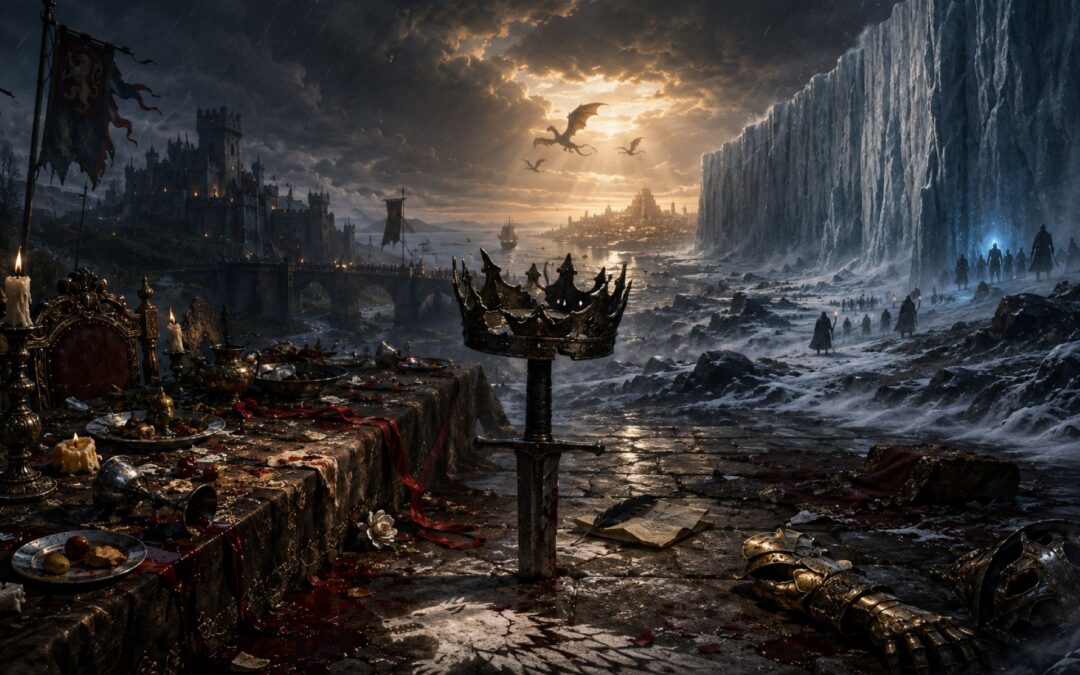
George R. R. Martin’s A Storm of Swords, the third novel in A Song of Ice and Fire, is the volume in which the political and emotional arrangements established across the first two books begin collapsing all at once. Armies still matter, kings still issue commands, and castles still change hands, but many of the novel’s decisive victories come through broken promises, assassination, dynastic marriage, secret agreements, hostage-taking, religious conviction, and personal choices whose consequences become impossible to reverse.
The novel is often remembered primarily for the Red Wedding, yet reducing it to that one event obscures how much else changes. Jaime Lannister loses the physical ability on which his identity has rested. Jon Snow’s false betrayal of the Night’s Watch becomes entangled with a genuine relationship and a deeper understanding of the free folk. Daenerys Targaryen acquires an army, destroys slave regimes, and discovers that liberation and government are different tasks. Tyrion Lannister moves from wounded political survivor to condemned prisoner, fugitive, and patricide. Arya and Sansa Stark both lose the expectation that returning home will restore the lives they once had, while Bran Stark and Samwell Tarly move more deeply into the supernatural conflict that most rulers of Westeros still barely comprehend.
The first chapters also do not begin at a perfectly clean chronological point after A Clash of Kings. Martin notes that some opening events overlap with the ending of the previous novel because the geographically separated viewpoint stories cannot all be synchronized exactly. That matters because A Storm of Swords feels less like a new campaign beginning than like several already-moving crises suddenly accelerating toward each other.
This article covers the complete novel, including its ending. It therefore contains full spoilers for the Red Wedding, the Purple Wedding, major deaths, Tyrion’s trial and escape, Jon Snow’s election, Sansa’s fate in the Vale, and the revelation in the Epilogue.

The Complete Plot of A Storm of Swords
A Storm of Swords is told through rotating close-third-person chapters rather than through one central protagonist. Ten recurring viewpoint characters carry most of the novel, while Chett opens the story in the Prologue and Merrett Frey closes it in the Epilogue. The structure constantly moves between wars, roads, courts, castles, and distant continents, so the most useful way to understand the plot is to preserve the book’s intercut progression rather than separate every character into an isolated mini-story.
The Fist Falls and the Blackwater Aftermath
The novel opens far beyond the Wall with Chett, a bitter member of the Night’s Watch who has joined a conspiracy to murder officers and desert before the ranging can withdraw from the Fist of the First Men. His grievances are petty and human: resentment, fear, humiliation, and the desire to escape an institution in which he has little status. Before the mutiny can begin, however, the Watch hears three horn blasts, the signal reserved for the Others. A plot about desertion is instantly dwarfed by the return of an enemy that most of Westeros still treats as legend.
Far to the south, Jaime Lannister is already on the move because Catelyn Stark has secretly freed him from Riverrun. She hopes that Brienne of Tarth can escort him to King’s Landing and exchange him for Sansa and Arya. Jaime treats Brienne with constant mockery, using her appearance, gender, and ideals of knighthood as targets, but their journey immediately strips away the normal protections of rank. Roads have become dangerous, loyalties are unstable, and Jaime’s value as a hostage makes almost everyone they meet a potential threat.
Catelyn pays for the decision by being confined at Riverrun. She has violated Robb’s military interests to act as a mother, and the tension between those roles is central to her entire story. At the same time, she keeps vigil beside her dying father, Hoster Tully, whose delirious references to “Tansy” suggest an old family secret she cannot yet understand.
Arya Stark is also moving through the Riverlands, but from the opposite end of the social hierarchy. She travels with Gendry and Hot Pie after escaping Harrenhal, passing through a countryside where military campaigns translate into burned farms, ruined villages, abandoned roads, hunger, and fear. Her wolf dreams intensify her connection with Nymeria, suggesting that although Arya is physically separated from her Stark identity, some deeper part of that identity remains active.
Tyrion Lannister wakes from the Battle of the Blackwater into a political world that has moved on without him. His face is permanently scarred, he has lost his position as acting Hand, and Tywin Lannister has returned to govern in the name of the crown. Tyrion receives little public credit for the role he played in saving King’s Landing, and his attempt to claim Casterly Rock as his inheritance produces one of the clearest demonstrations of Tywin’s contempt for him. Tywin refuses outright and makes it equally clear that Tyrion’s private life, especially his attachment to prostitutes, remains one of the father’s deepest sources of shame and anger.
Davos Seaworth, meanwhile, has survived the Blackwater at enormous personal cost. Stranded on a rock in Blackwater Bay, he grieves sons lost in Stannis Baratheon’s defeat and considers surrendering to death. Choosing instead to survive, he eventually attracts the attention of a passing ship and returns to Dragonstone, where defeat has intensified the divide between Stannis’s older followers and those drawn to Melisandre.
Sansa remains trapped at King’s Landing but suddenly sees the possibility of escape. Margaery Tyrell and Olenna Tyrell question her privately about Joffrey, pressing beyond the public image of a charming young king until Sansa admits the truth about his cruelty. The Tyrells are considering marrying Sansa to Willas Tyrell, an arrangement that could take her to Highgarden but would also transfer her claim to Winterfell into Tyrell hands. Even rescue, in Sansa’s world, comes wrapped in dynastic calculation.
North of the Wall, Jon Snow is taken to Mance Rayder. To survive, he must persuade the King-Beyond-the-Wall that his desertion from the Night’s Watch is real. Jon uses the genuine pain of his illegitimacy and outsider status at Winterfell to make the lie convincing, which is important because his cover works precisely by drawing on feelings that are not fabricated. Mance accepts him provisionally, and Jon begins living among people he has been trained to think of primarily as enemies.
Across the Narrow Sea, Daenerys Targaryen is searching for the means to turn dragons and a small following into a force capable of taking a kingdom. Jorah Mormont advises her to sail to Slaver’s Bay and purchase Unsullied, slave soldiers famed for discipline and obedience. His guidance is strategic, but his growing romantic and sexual interest in Daenerys complicates the adviser-protector role he claims to occupy.
Bran Stark’s story moves in a different direction. Traveling with Jojen and Meera Reed and Hodor, Bran increasingly enters the mind of Summer and experiences the strength and mobility that his injured human body no longer possesses. Jojen warns that the freedom of the wolf is dangerous if Bran loses the distinction between animal and human identity, but Bran remains determined to continue north toward the three-eyed crow rather than seek ordinary political safety.
When Davos returns to Dragonstone, he blames Melisandre for Stannis’s disaster and for the deaths of his sons. He attempts to kill her, only to discover that she has anticipated him. Imprisonment forces Davos into a more difficult confrontation with the nature of his loyalty: if he remains Stannis’s man, he must decide whether service means obedience to the king’s current direction or resistance to the forces surrounding him.
Jaime, Brienne, and Cleos Frey continue through a countryside where the ordinary infrastructure of travel has almost disappeared. Inns, ferries, castles, and roads are no longer neutral spaces; every location is entangled with war. Jaime’s exchanges with Brienne remain abrasive, but the practical fact that they need each other slowly begins undermining his instinct to reduce her to a joke.
Tyrion returns to Shae despite Tywin’s explicit threat against women he considers prostitutes. Their meetings are dangerous not only because of Tywin but because Symon Silver Tongue learns enough to threaten Tyrion’s secrecy. When Symon attempts to exploit that knowledge, Tyrion turns to Bronn to remove him. The incident shows how Tyrion’s intelligence, which often functions defensively, can become lethal when his emotional vulnerabilities are threatened.
Arya, Gendry, and Hot Pie are eventually taken by the Brotherhood Without Banners. Harwin, once a Winterfell man, recognizes Arya, ending her anonymity and raising her hopes that she can finally be returned to her family. Yet the Brotherhood is not simply another Stark unit. Its members have developed their own understanding of justice in the ruined Riverlands, and Arya soon discovers that their commitments do not automatically align with her desire to reach Robb and Catelyn as quickly as possible.
Robb returns to Riverrun with a disaster of his own making. He has married Jeyne Westerling, breaking the marriage agreement that helped secure Walder Frey’s support. Robb explains that after learning of Bran and Rickon’s supposed deaths and suffering a wound during his campaign in the west, he slept with Jeyne and then married her because he would not dishonor her by leaving her afterward. The decision is personally understandable within Robb’s conception of honor, but politically ruinous.
Robb also explains the cost of Edmure Tully’s earlier victory. Edmure had defended the river crossings and repelled Tywin’s forces, apparently succeeding militarily. Robb, however, had hoped to draw Tywin farther west and away from King’s Landing; Edmure’s local success helped prevent that larger strategy from unfolding. The episode illustrates one of the novel’s recurring political problems: individuals can act rationally with incomplete information and still produce disastrous collective consequences.
Jon’s position among the free folk becomes more precarious as Mance’s host encounters evidence of what happened at the Fist. Ygritte protects Jon by claiming that the two have become lovers, and what initially serves his cover soon develops into a genuine relationship. The closer Jon gets to her, the harder it becomes to preserve a clean moral division between his vows and the people he is deceiving.
Sansa continues hoping that the Tyrell marriage plan will free her, while Dontos Hollard warns that the Tyrells value Winterfell as much as they value Sansa herself. His warning is not entirely false, but neither is his alternative free from manipulation. Sansa remains surrounded by people who present their own ambitions as rescue.
Traveling with the Brotherhood, Arya sees more of the Riverlands’ devastation. The war is no longer an abstract conflict between Stark justice and Lannister tyranny but a landscape in which soldiers from many factions have preyed upon people without the power to protect themselves. The Brotherhood’s claim to defend those people complicates Arya’s increasingly personal understanding of justice as the destruction of names on her death list.
The supernatural conflict then moves fully into the foreground through Samwell Tarly. The remnants of the Night’s Watch retreat from the Fist under terrible conditions, pursued through cold, hunger, and fear. Sam encounters an Other and kills it with an obsidian dagger, proving by accident and desperate courage that dragonglass can destroy a being most men believed invulnerable.
Broken Oaths, Broken Hands, and New Armies
The political settlement after the Blackwater becomes more explicit when Tywin begins arranging marriages and offices to consolidate Lannister-Tyrell power. With Bran and Rickon believed dead, Sansa’s claim to Winterfell becomes extraordinarily valuable. Tywin therefore orders Tyrion to marry her, turning both of them into instruments of a larger dynastic design.
At Riverrun, Robb faces a crisis produced by revenge within his own ranks. Rickard Karstark murders Lannister prisoners because Jaime remains beyond his reach and because Karstark has already lost sons in the war. Robb knows that executing Karstark will cost him military support, but refusing to punish him would make the king’s justice conditional on political convenience. Robb chooses execution, preserving the moral logic of his kingship while weakening the material position that kingship depends upon.
Jaime’s journey reaches its decisive transformation when Cleos dies and Jaime and Brienne are captured by the Brave Companions. Before that capture, Jaime and Brienne fight physically, each trying to dominate the other, but their rivalry becomes irrelevant once both are in the power of men who do not respect either rank or chivalric convention. Their captors cut off Jaime’s sword hand.
The mutilation destroys the identity Jaime has inhabited since adolescence. He has been an exceptional swordsman, a Kingsguard knight, a feared Lannister, and a man who could always imagine that physical superiority placed him above those who judged him. Without the hand, he is forced to discover whether there is anything left of Jaime Lannister once the talent around which he has organized his entire self is gone.
Arya experiences a quieter interruption at Acorn Hall, where Lady Smallwood offers food, shelter, clean clothing, and a brief form of maternal attention. The scene matters because it shows Arya encountering a version of ordinary domestic life without turning her into someone she is not. Her estrangement from conventional femininity is real, but the deeper wound is that war has deprived her of family, security, and the ability to choose what kind of girl she might have become.
Daenerys reaches Astapor and discovers what producing Unsullied actually means. Boys are mutilated, trained through pain, stripped of individuality, and conditioned to obey without hesitation. The horror is not incidental to the military product; it is the method by which that product is created.
Kraznys mo Nakloz speaks contemptuously in front of Daenerys because he assumes she does not understand High Valyrian. Daenerys allows him to believe it and appears willing to exchange Drogon for the Unsullied. The apparent transaction transforms into revolt when she reveals her understanding, orders the Unsullied against their masters, and turns Drogon loose.
The most important part comes after victory. Daenerys frees the Unsullied and asks them to remain by choice. She is no longer merely purchasing the instrument she needs to reclaim Westeros; she is building political authority around the idea that people who were property can become followers.
Bran’s journey pauses for Meera’s story of the Knight of the Laughing Tree, a tale connected with the Tourney at Harrenhal and the generation of Lyanna Stark, Rhaegar Targaryen, and Eddard Stark. The story does not resolve all the mysteries it evokes. Instead, it demonstrates how Martin’s fictional history operates through memory, partial knowledge, family stories, and accounts that reveal as much by what they leave unclear as by what they explain.
In prison at Dragonstone, Davos meets Alester Florent and learns how defeat has fractured Stannis’s following. Some want accommodation; others have become more committed to Melisandre and the religious interpretation of Stannis as a chosen king. Davos increasingly sees that the danger is not merely Melisandre’s presence but Stannis’s willingness to let abstract destiny displace the ordinary obligations of rule.
Jon’s journey with the free folk becomes personally transformative through Ygritte. Their sexual relationship is real even though Jon entered her world under false pretenses. He learns the free folk’s language, customs, grievances, and fierce attachment to autonomy, while Ygritte forces him to see that the Wall divides not civilized humans from monsters but one human society from another.
The climb over the Wall makes the physical reality of that division unavoidable. The Wall is not just a symbol or military boundary but a vast engineered obstacle that dictates routes, risks, and strategies. Once Jon crosses to the southern side with the raiders, he is physically back in the realm he has sworn to defend while emotionally entangled with people he is supposed to betray.
Sansa’s planned Tyrell escape collapses when Tywin moves first. She is forced into marriage with Tyrion. The wedding humiliates Sansa by reminding her that her body and inheritance are political assets, while Tyrion is also made ridiculous and diminished by Joffrey’s cruelty during the ceremony.
Tyrion refuses to consummate the marriage without Sansa’s willingness. That choice matters morally, but it does not transform the marriage into a free partnership. Sansa has still been compelled into a dynastic union by the family that destroyed her own, and Tyrion remains both more powerful than she is and painfully aware that his desire for her cannot make her desire him.
Arya’s time with the Brotherhood leads to Sandor Clegane. Captured at Stoney Sept, Sandor faces a trial for crimes associated with him and his family. Arya sees the possibility that the Brotherhood’s justice might deliver a man from her death list into death.
Instead, Sandor demands trial by combat. He admits killing Mycah but denies deeds committed by his brother Gregor. Sandor kills Beric Dondarrion in the duel and is released according to the Brotherhood’s rules, only for Arya to discover that Beric has already died before and can be restored to life by Thoros of Myr.
The resurrection changes the supernatural stakes and the moral stakes simultaneously. The Brotherhood possesses something close to miraculous authority, yet that authority does not produce the verdict Arya wants. The episode separates divine-seeming power from the assumption that Arya’s personal vengeance must therefore be righteous.
The surviving Night’s Watch reaches Craster’s Keep in terrible condition. Hunger, resentment, fear, and long-standing disgust with Craster erupt into mutiny. Craster is murdered, and Lord Commander Jeor Mormont is killed by his own men.
Sam escapes with Gilly and her infant son. His decision is not heroic in the conventional martial sense, but it continues the reversal begun when he killed the Other: the man who habitually describes himself as a coward repeatedly acts when vulnerable people depend on him.
At Riverrun, Hoster Tully finally dies. The death closes one generation’s political life while leaving Catelyn with unresolved fragments about “Tansy” and a family history she does not fully know. Robb must now repair the Frey alliance, and the solution appears to be Edmure’s marriage to Roslin Frey.
What looks like a humiliating but workable compromise becomes the mechanism by which the Freys can gather Stark and Tully leadership under their roof. The novel does not yet reveal the trap, but every earlier breach of trust now feeds into it.
Davos eventually receives an extraordinary promotion. When Axell Florent advocates punitive action against Claw Isle, Davos argues that Stannis should distinguish between enemies and subjects instead of treating terror as strength. Stannis recognizes the value of a counselor willing to oppose him and names the former smuggler Hand of the King.
Jaime’s transformation deepens at Harrenhal. Physically weakened and psychologically stripped down, he shares a bath with Brienne and finally explains why he killed King Aerys II. Aerys had prepared to burn King’s Landing with wildfire rather than surrender, and Jaime killed him to prevent mass destruction.
The confession does not erase Jaime’s later crimes, nor does it make all accusations against him unfair. It does, however, change the moral meaning of the name “Kingslayer.” Jaime’s most infamous act was also one of the few moments when he chose the lives of strangers over the oath he had sworn.
Roads Converge on the Twins
Oberyn Martell’s arrival in King’s Landing brings another unresolved crime into Lannister politics. Oberyn has not forgotten the rape and murder of his sister Elia or the deaths of her children during the fall of the Targaryen dynasty. Gregor Clegane becomes the immediate object of that grievance, but Tywin’s responsibility remains the larger question.
Arya continues traveling with the Brotherhood and sees the group pursue members of the Brave Companions and punish men such as Septon Utt. The Brotherhood’s justice can be brutal, but it is directed at crimes committed against people the formal political order has failed to protect. Gendry eventually chooses to remain with them, a decision that Arya experiences less as political principle than as another personal abandonment.
At Queenscrown, Bran, Jojen, Meera, and Hodor hide while wildlings occupy the surrounding area. Under stress Bran enters Hodor’s mind, extending his skinchanging beyond Summer. The act is powerful but ethically disturbing because Hodor’s fear and resistance make clear that Bran is imposing himself on another human consciousness.
Jon is nearby without knowing Bran is there. Ordered by the wildlings to kill an innocent old man and thereby prove his loyalty, Jon refuses. He turns against the raiding party, and the confusion created in part by Summer’s attack gives him the chance to escape toward Castle Black.
The near-convergence of Jon and Bran is characteristic of the novel’s structure. Characters can occupy the same landscape, affect the same event, and remain unaware of each other’s presence. Martin repeatedly brings the possibility of reunion close enough to intensify loss without delivering the simple restoration the characters want.
Daenerys moves from Astapor to Yunkai. She defeats the city’s resistance through a mixture of negotiation, divided loyalties, military deception, and the defection of Daario Naharis. When the freed people of Yunkai hail her as “Mother,” Daenerys acquires an identity that is not inherited from House Targaryen.
The title contains a promise. If Daenerys is the mother of people she has freed, their future becomes part of her responsibility. Her campaign is already beginning to create obligations that cannot be satisfied merely by continuing westward.
Arya’s frustration with the Brotherhood finally leads her to run. Sandor Clegane captures her, but his purpose is less murderous than transactional: he intends to return her to Robb and collect a ransom. Arya hates him, yet the man on her death list now becomes the person most likely to bring her back to her family.
Jaime is allowed to leave Harrenhal, but Brienne is left behind. Once he is physically safe, he learns that she has been thrown into a bear pit for entertainment. Jaime chooses to turn back.
His rescue of Brienne matters precisely because he does not have to perform it. The decision cannot restore his hand or repair his reputation, and it places him in danger he had escaped. It is one of the first significant acts of his new life that emerges from obligation rather than self-preservation.
Robb prepares to move north and confront the strategic disaster around Moat Cailin. Because Bran and Rickon are believed dead and Sansa is married to Tyrion, succession becomes urgent. Robb discusses legitimizing Jon Snow as an alternative heir, and the context strongly indicates that Jon is central to his plan, but the novel never shows the exact wording of the final will.
Sam and Gilly continue toward the Wall while supernatural dangers close around them. They are saved by Coldhands, a mysterious figure who appears dead yet acts with purpose and intelligence. His existence complicates the simple assumption that everything dead beyond the Wall belongs to the same hostile force.
Sandor brings Arya closer to the Twins. The landscape itself resists them through flooding and the continuing disorder of war, but for once the destination appears clear. Robb and Catelyn are gathering for Edmure’s wedding, and Arya believes she may finally reach them.
Jon reaches Castle Black wounded and warns the Night’s Watch about the raiders approaching from the south. He has returned to his sworn brothers, but the emotional cost of that return is visible in his memories of Ygritte. The choice of duty does not erase the relationship that made his loyalties painful.
The Stark-Tully party arrives at the Twins and submits to Walder Frey’s staged humiliation. Robb apologizes for breaking his marriage pact. Edmure meets Roslin and is relieved to discover that she is attractive and seemingly willing, while the rituals of food, shelter, music, and marriage create the appearance that the breach between Stark and Frey has been repaired.
Arya and Sandor reach the outskirts of the gathering. She can see Robb’s army, hear the signs of celebration, and recognize that family is physically near. Martin positions reunion as a plausible event before destroying it.
The Red Wedding and the Shattering of the Stark Cause
The wedding begins with enough ordinary celebration to make the later betrayal function. Catelyn notices details that disturb her: Grey Wind has been excluded, some Freys behave strangely, Roslin appears afraid, and the atmosphere does not fully match the supposed reconciliation. Once the bedding ceremony removes Edmure and Roslin, the structure of the trap closes.
“The Rains of Castamere” begins to play. Armed men appear. Catelyn realizes that some guests have concealed armor beneath their clothes, and the protections associated with hospitality are revealed to have been weaponized.
Robb is wounded and then killed by Roose Bolton. Catelyn attempts desperately to bargain for his life, threatening a Frey hostage, but the political decision has already been made. After Robb dies, Catelyn kills the hostage and is murdered herself, while Stark and northern forces outside are massacred under conditions designed to prevent organized resistance.
The Red Wedding destroys more than a family. Robb’s kingdom loses its king, leading supporters, army cohesion, and claim to momentum in a single operation. It also destroys the expectation that certain social rules survive even war.
Martin later explained in an interview about writing the Red Wedding that he had decided relatively early not to allow Robb simply to become the heroic son who avenges his murdered father. He also connected the event to historical traditions surrounding the protection of guests and to episodes such as the Black Dinner and the Glencoe Massacre. The scene’s horror therefore depends not just on murder but on the deliberate destruction of a rule designed to make social life possible even among enemies.
Outside the castle, Arya encounters the massacre without understanding its full scale. She tries to reach her family and Grey Wind, driven by the belief that physical proximity still means rescue is possible. Sandor knocks her unconscious and carries her away, using violence to save her from entering a killing ground.
In King’s Landing, the political authors of the victory explain themselves more calmly. Tyrion learns that Tywin helped arrange the betrayal and listens to his father’s pragmatic defense: if treachery can end a war while killing fewer people than open battle, why should it be condemned merely because it is treachery? The question is politically serious precisely because the immediate result does look efficient.
Yet the novel also shows what Tywin’s reasoning excludes. A ruler who makes hospitality meaningless and rewards men such as the Freys and Boltons may end one campaign while teaching every subject that law, custom, and trust exist only until power finds them inconvenient. Tactical effectiveness and durable political legitimacy are not the same thing.
At Dragonstone, Davos’s growing literacy allows him to read the Night’s Watch appeal for aid. At the same time, Stannis and Melisandre move closer to sacrificing Edric Storm on the theory that royal blood can power the magic needed to fulfill Stannis’s destiny. Davos recognizes that the moral question cannot be postponed behind prophecy.
Jon, meanwhile, faces the southern raiders at Castle Black. The fighting turns his private conflict into public duty. Ygritte is mortally wounded, and Jon is with her as she dies.
Her death does not prove that Jon was right and she was wrong, or that duty triumphs cleanly over love. It closes a relationship that permanently changed how Jon understands the people beyond the Wall, which will matter when he later gains authority over the Watch itself.
Bran reaches the Nightfort, where his story intersects directly with Sam and Gilly. Sam recognizes Bran and understands that the supposed Stark death is false, but he keeps the secret. Through the supernatural Black Gate beneath the Wall, Sam helps Bran, Jojen, Meera, Hodor, and Summer pass northward toward Coldhands and the unknown destination Bran has chosen.
Daenerys’s campaign reaches Meereen. The city presents a harder problem than Yunkai, and the campaign increasingly exposes the difference between tactical brilliance and political sustainability. During this period the disguised “Arstan Whitebeard” is revealed as Barristan Selmy, while Daenerys also learns that Jorah once informed on her for King Robert’s government.
Both men have served her and concealed major truths. Their deception forces Daenerys to decide not simply who is useful but what kind of confession, repentance, and loyalty she will accept from those around her.
Tyrion continues seeing Shae in secret despite increasing danger. His attachment has become partly a relationship with the idea that Shae loves him in a way his family does not. The secrecy therefore protects not only a woman but the emotional story Tyrion needs to believe.
Sansa lives through the aftermath of the Red Wedding in King’s Landing. Tyrion tries, within the limits of an unwanted marriage, to spare her unnecessary cruelty. Nothing he does can alter the central fact that Sansa’s mother and brother are dead and that the family she was forced to marry has benefited from their destruction.
The next royal wedding produces another collapse. Joffrey marries Margaery Tyrell in a feast designed to display dynastic stability, but the celebration also gives Joffrey new opportunities to humiliate Tyrion. The dwarf joust is especially vicious because it weaponizes Tyrion’s body and social status as entertainment.
Joffrey suddenly begins choking and dies from poison. Cersei immediately blames Tyrion, who has obvious public motives after years of abuse. The political order that seemed secure after the Red Wedding loses its king within weeks of destroying Robb.
Sansa uses the chaos to escape. One of the stones from the hairnet given to her is missing, connecting the object to the poison plot. Dontos delivers her to Petyr Baelish, expecting the reward associated with their plan.
Littlefinger has Dontos killed. Sansa therefore discovers that her rescuer has been managing events for his own purposes and is willing to dispose of intermediaries once they become inconvenient. His later explanation strongly implicates a conspiracy involving the Tyrell interest in removing Joffrey, but the novel filters those details through Littlefinger’s claims and Sansa’s limited observations rather than providing an omniscient reconstruction.
Jaime returns to King’s Landing after Joffrey’s death and reunites with Cersei beside their son’s body. Their encounter is disturbing because Cersei initially resists before the encounter becomes reciprocated. The primary text does not permit the moment to be treated as a simple romantic reunion, and the broader relationship has always been shaped by secrecy, family power, possession, and Jaime’s idealized view of Cersei.
Tywin immediately tries to restore the dynastic future by pressing Jaime to leave the Kingsguard, inherit Casterly Rock, and become the Lannister heir he has long been expected to be. Jaime refuses. The choice is one of his clearest breaks with the identity his father designed for him, and Tywin effectively disowns him.
Davos takes an even greater risk with Stannis. He arranges for Edric Storm to be removed from Dragonstone before the boy can be sacrificed. Davos knows that saving the child may cost him his office and his life.
He then gives Stannis the Night’s Watch letter and argues, in effect, that kingship cannot consist only of claiming obedience. A king who says the realm belongs to him must also respond when the realm is in danger. The idea redirects Stannis from a southern war of claims toward the neglected crisis at the Wall.
That crisis intensifies when the main wildling assault reaches Castle Black. Donal Noye dies defending the tunnel against Mag the Mighty. The depleted Night’s Watch lacks obvious senior leadership, and Maester Aemon pushes Jon into responsibility.
Jon’s authority develops because circumstances have already forced him to make decisions, understand the enemy, and act under pressure. Long before he holds formal office, other people begin treating him as someone capable of command.
Trials, Sieges, and the Cost of Survival
After the Red Wedding, Arya and Sandor move through a world in which almost every remaining Stark destination has failed. Arya’s emotional condition becomes increasingly empty and hostile. Sandor continues to feed and transport her, but his protection does not erase the violence of their earlier history or Arya’s hatred.
Tyrion prepares for a trial in which political narrative matters more than neutral investigation. Oberyn Martell’s presence becomes crucial because his desire for justice for Elia intersects with Tyrion’s need for a champion. Gregor Clegane represents both the immediate enemy and the possibility of forcing the old crimes against Dorne into public acknowledgment.
Jaime, now Lord Commander of the Kingsguard, confronts the White Book in which the deeds of Kingsguard knights are recorded. His page is dominated by events other people have interpreted for him, especially the killing of Aerys. For the first time, the large amount of empty space remaining becomes meaningful: Jaime cannot erase the past, but his future conduct has not yet been written.
His conversation with Loras Tyrell extends the same idea. Both men possess simplified stories about honor and the people they love. Jaime is beginning to understand how easily ideals become excuses when they are never tested against inconvenient facts.
In the Vale, Sansa becomes Alayne Stone, Littlefinger’s supposed bastard daughter. The disguise gives her a new name and removes her from immediate Lannister control, but it does not make her independent. Lysa Arryn’s jealousy and unstable attachment to Littlefinger turn the Eyrie into another environment in which Sansa’s safety depends on managing powerful adults whose desires she cannot control.
At the Wall, Janos Slynt and Alliser Thorne turn Jon’s infiltration of the free folk into an accusation of treason. From their perspective, Jon lived with the enemy, took a wildling lover, and killed Qhorin Halfhand. Jon knows that those facts arose from Qhorin’s command and the requirements of espionage, but knowledge and proof are different things.
The trial against Tyrion becomes equally dependent on presentation. Witness after witness helps construct a coherent public story in which Tyrion hated Joffrey, threatened him repeatedly, possessed access and motive, and finally murdered him. Shae’s testimony is especially devastating because private intimacy is transformed into public humiliation.
Tyrion demands trial by combat. Oberyn volunteers as his champion because defeating Gregor can serve both Tyrion’s survival and Dorne’s demand for acknowledgment. In the duel, Oberyn appears to have won, but victory is not enough for him.
He needs Gregor to confess. That insistence produces the fatal reversal: Gregor kills Oberyn while admitting the rape and murder of Elia. Tyrion receives the truth Oberyn wanted exposed, but the legal consequence is still condemnation.
Daenerys faces a different form of judgment. Barristan admits his deception and places himself at her mercy, while Jorah emphasizes years of service and resists framing his earlier betrayal as something requiring repentance. Daenerys accepts Barristan and banishes Jorah.
The decision also occurs as Daenerys confronts the instability her conquests have created. Freeing slaves and destroying masters can be accomplished through force, but neither action automatically builds institutions, distributes power safely, or prevents old hierarchies from returning. She therefore decides to remain in Meereen and rule rather than rush toward Westeros.
Jaime’s separation from his former self continues. He gives Brienne the Valyrian-steel sword made from Ice and entrusts her with the task of finding and protecting Sansa. The act turns a weapon created through the destruction of Ned Stark’s sword into an instrument of a new promise.
Jaime also revisits the question of who sent the assassin after Bran. His reasoning points toward Joffrey, but the novel never supplies omniscient confirmation. That uncertainty is important because A Storm of Swords repeatedly shows characters reaching conclusions from partial evidence even when those conclusions are plausible.
At the Wall, Jon is sent to meet Mance Rayder under circumstances that may require him to kill the King-Beyond-the-Wall. The meeting clarifies that the free folk are not simply invading to conquer southern territory. They are fleeing the Others and the dead.
Before Jon has to resolve the impossible position, an unexpected army attacks. Stannis Baratheon has answered the Watch’s appeal. His arrival changes both the military situation and the political meaning of his own kingship.
Exiles, Elections, and a New Political Order
Arya and Sandor eventually encounter men associated with Gregor Clegane at an inn. Violence erupts, and Arya recovers Needle, reconnecting with an object that embodies both Winterfell and the identity she has preserved beneath repeated disguises. Sandor is badly wounded.
As his condition deteriorates, Sandor asks Arya to kill him. She refuses. The refusal is not simple mercy: Arya leaves him to suffer, denying him the death he now wants from the girl who once wished to kill him.
At Saltpans, Arya cannot secure the journey north that would once have been her obvious choice. She instead presents Jaqen H’ghar’s Braavosi coin and speaks the words associated with it. The result is a berth on a ship to Braavos.
Arya therefore ends not by recovering home but by entering a new geography and identity. The Stark child who spent much of the book trying to return to family moves eastward alone.
Sam returns to Castle Black and finds the election for a new Lord Commander deadlocked. Several senior candidates possess support, but none can assemble a decisive majority. Sam, who once imagined himself incapable of affecting events, begins manipulating the candidates’ fears of each other.
Jon faces an even more personal choice when Stannis offers to legitimize him as Jon Stark and grant him Winterfell. The offer reaches directly into Jon’s oldest wound. He has wanted the Stark name and the right to belong openly to Winterfell for much of his life.
Accepting, however, would require him to abandon the vows that have become central to another identity. Stannis’s offer therefore forces Jon to choose between the life he imagined as a boy and the institution in which he has actually become a leader.
Tyrion’s escape begins when Jaime frees him with Varys’s help. Before letting him go, Jaime finally tells the truth about Tysha. She was not a prostitute hired as part of a lesson; Tywin had forced Jaime to lie and then subjected Tyrion and Tysha to a grotesque punishment based on that deception.
The revelation breaks one of Tyrion’s foundational memories. His understanding of love, humiliation, women, and his father’s authority has been organized around a lie. In anger he wounds Jaime emotionally in return and then refuses to leave King’s Landing quietly.
Tyrion finds Shae in Tywin’s bed and kills her. He then confronts Tywin, demanding answers about Tysha and refusing the contempt that has shaped their relationship. Tyrion kills his father with a crossbow and escapes.
The episode is both liberation and catastrophe. Tyrion finally acts against the man who has dominated his life, but the freedom is inseparable from murder, rage, and the destruction of relationships he cannot repair.
Sam’s political maneuver succeeds. By convincing rival candidates that continued deadlock may produce a result they dislike even more, he helps make Jon the compromise choice. The transformation in Sam is striking: the frightened steward who began the novel overwhelmed by survival ends it reshaping the leadership of the Night’s Watch.
Jon is elected the 998th Lord Commander. The result gives him authority through a mechanism completely different from the legitimacy Stannis offered. He does not become Lord of Winterfell by royal declaration; he becomes commander because his brothers choose him.
Sansa’s final chapter begins with one of the novel’s most revealing quiet images. At the Eyrie, she builds Winterfell from snow. The castle exists only as memory, reconstructed by a girl who cannot safely use her own name.
Robert Arryn disrupts the snow castle, Littlefinger intervenes, and the scene leads toward Lysa’s eruption of jealousy. Lysa finally reveals the buried history behind Hoster’s dying references to tansy: Hoster forced her to abort a pregnancy by Petyr Baelish. She also admits that she poisoned Jon Arryn at Littlefinger’s direction and sent Catelyn the letter blaming the Lannisters.
That confession reaches back to the beginning of the series. The suspicion that helped draw Ned Stark south and set the initial political crisis in motion was itself manipulated by Littlefinger through Lysa. The revelation does not make him the sole cause of everything that followed, but it shows how effectively he has exploited other people’s desires and grievances.
When Lysa threatens Sansa, Littlefinger tells her that the Tully sister he truly loved was Catelyn. He then pushes Lysa through the Moon Door and prepares to blame the singer Marillion. Sansa survives, but she is now more deeply dependent on a man whose protection, desire, and political ambition cannot be separated.
The Epilogue returns to the Riverlands through Merrett Frey. He goes to ransom a captured relative from the Brotherhood Without Banners and expects the encounter to be criminal or political in familiar terms. Instead, the Brotherhood treats him as accountable for the Red Wedding.
The final revelation is Catelyn Stark. Her corpse has been recovered and restored to a form of life, though death has mutilated both her body and whatever remains of her former personality. She recognizes Merrett and condemns him.
The novel therefore ends by returning one of the Red Wedding’s central victims to the story as an embodiment of vengeance. Beric Dondarrion’s Brotherhood once tried, however imperfectly, to enact justice for the abandoned people of the Riverlands. Under the resurrected Catelyn, its moral center has shifted toward retribution.
Westeros and Slaver’s Bay: A World at War
The political drama of A Storm of Swords depends on its settings functioning as systems rather than scenery. Geography controls military movement, social institutions determine who possesses authority, and the breakdown of those institutions changes what ordinary life means. The novel’s world-building is therefore most effective when landscape, custom, and political power become inseparable.
The Riverlands and the Failure of Feudal Protection
The Riverlands are the clearest demonstration of what noble war looks like from below. Armies move through the region because of its strategic position between major powers, but those movements leave behind burned farms, stolen food, ruined villages, displaced families, outlaw bands, deserters, and people who no longer know which banner represents protection rather than danger.
The feudal system claims, implicitly and explicitly, that hierarchy is justified partly because armed elites protect those beneath them. A Storm of Swords repeatedly shows the system failing that test. Peasants are attacked by men serving kings, rebels, mercenaries, and supposedly legitimate lords, while formal courts are too distant or compromised to matter.
The Brotherhood Without Banners emerges from that vacuum. Its members began with authority from the crown, but the war has transformed them into a mobile alternative to institutions that no longer function. Their rough justice can be arbitrary, yet their existence is itself an indictment of the political order: if peasants had meaningful protection from recognized authorities, men such as Beric Dondarrion would not need to create improvised justice in forests and caves.
Arya’s Riverlands chapters make this social breakdown emotionally visible. To her, the war begins as a family conflict against Lannister enemies. Traveling through devastated communities teaches her, though never completely, that the war cannot be reduced to the intentions of the people who claim to lead it.
The Red Wedding completes the region’s institutional collapse by corrupting the custom that should provide temporary safety even between enemies. Once bread, salt, marriage, and hospitality can be used as camouflage for murder, the political world loses one of the mechanisms by which negotiation remains possible.
King’s Landing and the Politics of Victory
King’s Landing begins the novel as the center of apparent Lannister triumph. Stannis has been defeated, the Tyrell alliance has rescued the capital, Tywin has resumed the office of Hand, and Joffrey remains king. The court appears stronger than at any previous point in the series.
That strength depends on relationships more fragile than the public spectacle suggests. The Tyrells want security for Margaery and influence over the crown. Tywin wants to turn military success into dynastic permanence through marriage. Cersei wants to protect her children and her own position, while Joffrey repeatedly undermines the dignity of his office through cruelty.
Sansa’s forced marriage demonstrates how dynastic politics absorbs private life. Her person is valuable because Winterfell may pass through her. Tyrion’s feelings toward her, Sansa’s fear, and the question of consent all exist inside a political arrangement whose basic purpose is territorial control.
The Purple Wedding exposes the fragility of this victory. Joffrey’s death occurs during the ceremony designed to display continuity. Within moments, the same court that presented itself as stable becomes a place of accusation, imprisonment, factional interest, and competing stories.
Tyrion’s trial reveals how justice functions under these conditions. The legal structure exists, witnesses appear, and procedure is followed, but the surrounding political assumptions determine which narrative can plausibly win. Martin does not need to show a court wholly devoid of law; it is more unsettling that forms of law can operate while power shapes what counts as convincing truth.
The Wall and the Free Folk
The Wall remains one of the series’ strongest pieces of world-building because its physical scale and institutional history produce concrete political problems. The Night’s Watch has too few men, too many abandoned castles, inadequate knowledge of the threat beyond the Wall, and traditions that assume a strategic environment that no longer exists.
The free folk complicate the Watch’s worldview. They are culturally different, politically fragmented, suspicious of hierarchy, and willing to follow Mance largely because an existential threat has made unity necessary. Their desire to pass the Wall is therefore partly an invasion and partly a mass flight from the dead.
Jon’s time among them dismantles the simplistic category “wildling.” He discovers people with families, humor, customs, rivalries, love, courage, cruelty, and fear. None of this makes the free folk harmless, but it makes a policy based entirely on exclusion morally and strategically inadequate.
Mance himself represents an alternative type of authority. He is not a hereditary king in the southern model. His coalition depends more heavily on persuasion and personal legitimacy among groups that value independence.
The arrival of Stannis creates another contrast. The southern kings have spent most of the series fighting over a throne while the Night’s Watch confronts a danger capable of making those disputes irrelevant. By responding to the Wall, Stannis begins acting like a king responsible for the realm rather than merely a claimant demanding recognition from it.
The Vale and the Illusion of Safety
The Vale has largely escaped the direct destruction of the War of the Five Kings. Its mountains and political neutrality have insulated it from many of the military disasters consuming the Riverlands and the north. From outside, it looks like one of the safest major regions in Westeros.
Sansa discovers that geographic safety does not equal personal or political safety. The Eyrie is controlled by Lysa Arryn, whose fears, jealousy, and dependence on Littlefinger make the household unstable. The isolation that protects the Vale from armies also allows private manipulation to unfold behind strong walls.
Littlefinger thrives in precisely this kind of environment. He does not need armies comparable to Tywin’s because he operates through information, desire, debt, identity, and controlled appearances. Sansa’s transformation into Alayne Stone demonstrates that power in Westeros does not always require a crown or battlefield.
Slaver’s Bay and the Economy of Enslavement
Slaver’s Bay expands the series beyond Westerosi feudal politics by presenting societies whose wealth and military systems depend openly on human ownership. Astapor’s Unsullied reveal the logic at its most concentrated: the soldiers’ celebrated discipline is produced through mutilation, terror, emotional destruction, and the elimination of personal autonomy.
Daenerys’s destruction of the Astapori slave market is morally straightforward at the level of immediate abuse. The masters’ practices are monstrous, and freeing the Unsullied is not presented as a morally ambiguous choice merely because it is violent. The difficulty begins after the masters are defeated.
Yunkai and Meereen show that slavery is not only a collection of evil individuals but a social and economic order. Removing one ruling group does not automatically create legitimate institutions, secure livelihoods, or a stable distribution of power. Daenerys’s growing recognition of that distinction is why her decision to remain in Meereen matters so much.
Martin’s eastern world-building is also less socially textured than his treatment of Westeros. Slaver’s Bay is vivid in its cruelty, wealth, military practices, and elite culture, but its societies are often presented through the eyes of outsiders and through institutions designed to generate moral confrontation for Daenerys. That imbalance does not invalidate the arc, but it becomes one of the novel’s limitations when compared with the dense internal differentiation of Westerosi houses, regions, classes, and historical memories.
Character Analysis: Transformation Under Pressure
The major characters in A Storm of Swords do not simply reveal hidden personalities. They are altered by losses, temptations, responsibilities, and political changes that make old identities impossible to maintain. Martin’s strongest character writing comes from allowing people to behave inconsistently without making those inconsistencies meaningless: fear, pride, love, shame, loyalty, and self-deception can coexist within the same person.
Jaime Lannister: Identity After the Sword Hand
Jaime’s missing hand is the most literal identity crisis in the novel. Before his capture, he can tolerate being called dishonorable because he possesses a private counter-story: he knows he is one of the best swordsmen alive, knows why he killed Aerys, and can imagine that everyone else’s moral judgment is too simple to deserve respect. Physical superiority gives him a form of independence from public opinion.
The loss of the hand destroys that refuge. Jaime can no longer assume that force will solve humiliation or danger, and he becomes dependent on people he once considered beneath him. Brienne matters because she possesses many of the ideals associated with knighthood while lacking the social recognition automatically given to men such as Jaime.
Their relationship exposes Jaime’s cynicism as partly defensive. He mocks vows because his own vows became mutually contradictory during Aerys’s reign. He mocks honor because he was condemned for preventing mass murder. Brienne’s presence forces him to confront the possibility that flawed institutions do not make ethical striving meaningless.
The bath confession is central because Jaime finally tells another person the story behind the Kingslayer name. He does not confess to a priest, judge, or family member but to someone whose opinion has begun to matter because she takes knighthood seriously. Her reaction offers him the possibility of being understood without declaring him innocent of everything else.
His rescue of Brienne from the bear pit carries the process from explanation to action. Jaime is already safe when he turns back. That choice cannot erase pushing Bran from the tower or the destructive dimensions of his relationship with Cersei, but it shows that self-understanding is beginning to affect behavior.
The White Book completes the symbolic turn. Jaime sees that much of his official identity has been written by others, while the unwritten portion still belongs to future action. Giving Brienne Oathkeeper is not a completed redemption; it is the beginning of an attempt to make vows meaningful again.
That distinction is essential. Jaime becomes more sympathetic in A Storm of Swords, but sympathy is not absolution. Martin’s achievement is to make the reader revise a moral judgment without requiring the reader to forget why the original judgment existed.
Tyrion Lannister: Intelligence, Shame, and the Collapse of Family Loyalty
Tyrion begins the novel expecting that political achievement will finally earn recognition. He helped organize the defense of King’s Landing, understood threats Joffrey ignored, and risked his life during the battle. Instead, Tywin returns, assumes power, and treats Tyrion’s contribution as secondary.
The rejection of Tyrion’s claim to Casterly Rock makes the family conflict explicit. Tywin does not merely consider Tyrion unsuitable; he experiences his son’s existence as a humiliation attached to the Lannister name. Tyrion’s intelligence therefore develops within an emotional world where competence never secures the acceptance he wants most.
Shae occupies the opposite position in Tyrion’s mind. He wants to believe that her affection exists outside the transactional structures that dominate his family life. The more dangerous the relationship becomes, the more strongly he clings to that interpretation.
His treatment of Symon Silver Tongue reveals the moral cost. Tyrion understands the danger rationally and eliminates it efficiently, but the threat exists because he has chosen to maintain the relationship despite knowing the political consequences. His intelligence solves problems while often leaving the emotional behavior that creates those problems untouched.
The marriage to Sansa brings another contradiction. Tyrion refuses to force sex on her, which establishes a meaningful ethical boundary. Yet he still longs for her attraction and resents circumstances that make it impossible, showing how awareness of injustice does not automatically free him from self-centered desire.
The trial turns Tyrion’s accumulated resentments into public identity. Witnesses construct a version of him that is recognizable enough to seem convincing: sarcastic, threatening, politically ambitious, hostile toward Joffrey. The fact that he did not commit the murder does not mean the prosecution invents every feature of the man being judged.
Shae’s testimony destroys the fantasy that their relationship existed beyond power and money. Whether her betrayal comes from fear, self-preservation, manipulation, anger, or some mixture, Tyrion experiences it as proof that the emotional refuge he built was false.
The revelation about Tysha is even more devastating because it reaches further back. Tyrion had organized his adult sexual life around the belief that the one girl who seemed to love him had been paid to do so. Learning that she genuinely loved him means the original wound was created not by romantic fraud but by Tywin’s cruelty and Jaime’s coerced participation.
Tyrion’s killings of Shae and Tywin are therefore not simple acts of emancipation. He escapes a family structure that has brutalized him, but he also becomes capable of brutal violence himself. His arc ends with freedom stripped of triumph.
Jon Snow, Samwell Tarly, and Bran Stark: Leadership, Courage, and the North
Jon’s central conflict is not simply duty versus love. His mission among the free folk forces him to discover that loyalty becomes ethically difficult when one understands the people on the other side. Ygritte is not merely a temptation pulling him away from the Watch; she becomes part of an alternative social world whose humanity Jon can no longer ignore.
His relationship with Mance similarly complicates authority. Mance leads through a coalition among people who resist centralized hierarchy, while the Night’s Watch derives legitimacy from vows, offices, and institutional continuity. Jon moves between both structures and sees the strengths and failures of each.
Returning to Castle Black does not restore his old certainty. Jon fights the free folk because he believes his vows and the defense of the realm still matter, but he also understands that those approaching the Wall are fleeing something worse. That knowledge becomes crucial when leadership requires decisions more complicated than simply killing whoever comes from the north.
Stannis’s offer of Winterfell tests Jon’s deepest private desire. Becoming Jon Stark would heal the social wound of bastardy and restore the home he has lost. Yet accepting would require abandoning the Watch at precisely the moment when his experiences have made him indispensable to it.
His election as Lord Commander therefore resolves the temptation in an unexpected way. Jon receives status, authority, and belonging, but through earned institutional trust rather than inherited legitimacy. The bastard denied one title gains another that demands more responsibility than the childhood fantasy he once wanted.
Sam’s development is quieter but equally substantial. His self-conception as a coward survives long after his behavior contradicts it. He kills an Other, escapes the mutiny with Gilly, protects a child, helps Bran cross the Wall, and eventually engineers the political compromise that elects Jon.
The important point is not that Sam becomes fearless. He remains frightened. His courage consists increasingly of acting while afraid, which makes his development more psychologically convincing than a transformation into conventional martial boldness.
Bran’s arc concerns power of another kind. Skinchanging gives him physical freedom through Summer, but every expansion of that power raises questions about identity and consent. Entering Hodor’s mind is especially troubling because Hodor’s resistance makes the act an invasion rather than a neutral magical technique.
Bran’s choice to continue north also separates him from ordinary Stark politics. He could seek restoration, protection, or a southern alliance, but instead pursues the three-eyed crow into a supernatural world whose significance exceeds the War of the Five Kings. His story suggests that the conflict most rulers consider central may not be the conflict that ultimately matters.
Arya Stark, Sansa Stark, and Catelyn Stark: Three Forms of Dispossession
Arya’s story is organized around repeated attempts to reach family. Harrenhal, the Brotherhood, Sandor, and the road to the Twins all seem at different moments capable of taking her home. Each route fails, and the cumulative effect changes her understanding of what “home” can mean.
Her death list gives structure to anger that would otherwise be overwhelming. Naming enemies converts grief into a sequence of imagined future actions. Yet the Brotherhood’s trial of Sandor demonstrates that justice cannot be reduced to Arya’s private hatred, while Beric’s repeated resurrection shows that supernatural power does not automatically validate her preferred moral outcome.
Sandor becomes one of the most complicated parts of Arya’s arc because he is simultaneously a killer she hates, a captor, and a protector. He intends to ransom her rather than return her from generosity, and his history includes Mycah’s death. The novel nevertheless allows practical dependence and occasional understanding to develop without requiring Arya or the reader to reinterpret him as secretly innocent.
Her decision to leave Sandor dying is morally ambiguous. She refuses to give him the death he requests, which can be read as punishment, refusal to perform mercy, or a final assertion of independence. The important narrative fact is that she then abandons the route back to northern identity and sails toward Braavos.
Sansa’s dispossession is different because she is repeatedly trapped inside institutions rather than outside them. Court etiquette, marriage, aristocratic femininity, and dynastic value constrain her even when she appears physically safe. She survives not by rejecting those systems openly but by learning to read the people who control them.
The Tyrell proposal teaches her that political interest can resemble kindness. Tyrion’s marriage teaches her that an individual man’s restraint does not erase the coercion of the institution surrounding him. Littlefinger’s rescue teaches her that escape from one captor can become dependence on another.
Her snow model of Winterfell is therefore more than nostalgia. Sansa reconstructs a home from memory because the real castle is inaccessible and the political identity attached to her name is dangerous. The destruction of the model by Robert Arryn leads directly to the confrontation that makes Sansa’s new reality unmistakable: she is living under a false name beside the man who helped set the series’ earliest political catastrophe in motion.
Catelyn begins from the opposite position. She possesses a recognized name, political authority, and deep knowledge of noble society. Yet the war gradually removes every source of security that status should provide.
Her decision to release Jaime is a mother’s act that conflicts with the needs of Robb’s kingship. She sees the strategic danger of Robb’s marriage, understands Walder Frey’s capacity for resentment, and recognizes warning signs at the Twins, but knowledge cannot save her from a conspiracy that has already closed around them.
The Red Wedding reduces Catelyn’s world to Robb’s survival. Once he is killed, her final act is an expression of grief without political purpose. Her resurrection in the Epilogue transforms that moment into a new identity in which grief and vengeance appear to have consumed much of the person who once tried to balance family feeling with political judgment.
Daenerys Targaryen and Davos Seaworth: Learning What Rule Demands
Daenerys begins with the logic of a claimant: she needs soldiers because she intends to take a throne. Astapor changes the moral basis of her power. She does not simply acquire the Unsullied; she destroys the system that owns them and asks them to follow freely.
That move creates a new identity as liberator. Yet liberation expands the number of people whose future she now affects. The more cities Daenerys changes, the less defensible it becomes to treat them merely as stepping stones toward Westeros.
Her conflict with Barristan and Jorah sharpens the same problem at the personal level. A ruler must judge not only usefulness but honesty, remorse, loyalty, and the possibility of forgiveness. Daenerys’s decision to accept Barristan and exile Jorah reflects the different ways the two respond to accountability.
Remaining in Meereen is therefore the decisive maturation of her Book 3 arc. She chooses the harder task over the more glamorous one. Claiming a throne can be imagined as destiny; ruling liberated people requires learning what consequences follow from her own victories.
Davos undergoes a parallel development from follower to counselor. His loyalty to Stannis begins in gratitude and personal devotion, but defeat and Melisandre’s growing influence force him to ask what genuine service requires. His answer is increasingly that loyalty sometimes means preventing a king from doing what the king wants.
Saving Edric Storm is the clearest example. Davos does not deny Stannis’s claim or abandon his service. He risks execution because he believes allowing the sacrifice would corrupt the king he serves.
His argument about the Wall then gives the novel one of its most important ideas about rulership. The crown is not merely a prize that entitles its possessor to obedience. If Stannis claims the realm, the realm’s danger becomes his responsibility.
The Non-POV Characters Who Redirect the Story
Robb Stark is one of the novel’s most important characters despite never receiving a viewpoint chapter. That distance matters. Readers experience him largely through Catelyn, Arya, political reports, and the consequences of his decisions, which preserves some of the separation between king and follower that would disappear inside his own mind.
Robb’s tragedy is not that he lacks virtue. His strongest qualities contribute to his defeat when political circumstances turn them against him. He marries Jeyne because he will not leave her dishonored, executes Karstark because a king’s justice should apply to allies, and tries to repair the Frey alliance because he understands the danger he created. None of those decisions is absurd in isolation, but together they leave him vulnerable to enemies willing to ignore every moral constraint he still respects.
Tywin functions as Robb’s mirror in political method. He is willing to use marriage, terror, proxy violence, and broken custom if those tools secure the Lannister position. His intelligence is real, but the novel increasingly questions whether his methods can produce loyalty that survives his personal authority.
Stannis changes more quietly. Defeat could reduce him to bitterness and prophecy, and for much of the Dragonstone story that danger seems real. Davos’s influence helps redirect him toward a more substantive model of kingship, making his journey to the Wall one of the novel’s most important political shifts.
Brienne embodies the ideals Jaime has spent years mocking. Her strength is not moral simplicity—she can be stubborn, naive, and rigid—but the seriousness with which she treats promises. Because she lacks the social recognition Jaime once took for granted, her commitment to knighthood exposes the difference between possessing the title and living the ethic.
Sandor is almost the reverse. He rejects chivalric language because he sees how often knights use it to conceal brutality. Yet his contempt for hypocrisy does not make him harmless or morally pure. He can perceive false virtue without consistently practicing genuine virtue himself.
Cersei remains central to Jaime’s changing self-perception. Jaime has imagined their bond as unique and absolute, but returning to her after losing his hand forces him to confront how much of the relationship has depended on fantasy, secrecy, physical desire, and shared opposition to everyone outside themselves.
Joffrey represents royal legitimacy emptied of competence. He possesses the crown, public ceremony, and institutional obedience while lacking the judgment required to rule. His death therefore solves one immediate problem for many people while opening a different struggle over who controls the monarchy.
Ygritte’s importance lies in making the free folk emotionally real to Jon. Mance does the same politically. Through them, the northern conflict becomes more than a military encounter between a legitimate institution and faceless invaders.
Melisandre is more difficult because the novel gives enough evidence of genuine supernatural power to prevent easy dismissal while refusing to prove that all her interpretations are correct. That distinction allows her to be both formidable and fallible.
Littlefinger’s influence becomes clearer only near the end. He thrives because he understands how other people’s desires can be directed: Lysa’s love, Sansa’s longing for rescue, court ambition, financial dependence, and dynastic uncertainty. He is dangerous not because he controls the largest army but because he treats relationships themselves as instruments.
Lysa is both perpetrator and victim within that system. Her crimes are real, including Jon Arryn’s murder, but they emerge from a history of coercion, reproductive trauma, family pressure, and obsessive dependence on Petyr. Martin allows explanation without turning explanation into excuse.
Oberyn Martell enters late but leaves an enormous mark. His charisma, intelligence, and vengeance temporarily make him appear capable of overturning Tyrion’s fate. His death demonstrates the danger of needing moral acknowledgment from an enemy who has already been physically defeated.
Jorah and Barristan provide Daenerys with competing models of flawed service. Roose Bolton and Walder Frey provide the opposite lesson about allegiance: nominal loyalty means little when resentment, ambition, and opportunity become stronger than oath or custom.
Relationships, Loyalty, and Betrayal
The novel’s politics often operate through relationships before they operate through formal institutions. Marriage alliances, sibling bonds, sworn service, mentorship, sexual attachment, parent-child conflict, friendship, and hostage relationships repeatedly determine what characters are willing to risk. Betrayal therefore matters not only because alliances change but because characters discover that the meanings they assigned to relationships were incomplete.
Jaime, Brienne, and Cersei
Jaime and Brienne begin with mutual contempt. Jaime sees Brienne as ridiculous because she attempts to inhabit the role of knight without possessing the conventional gender or appearance associated with it. Brienne sees Jaime as the embodiment of corrupted knighthood.
Captivity changes the relationship because both lose the protections that ordinarily define them. Jaime’s aristocratic status cannot preserve his hand, while Brienne’s ideals cannot protect her from sexual threat and humiliation. Their dependence on each other makes abstraction harder.
The bath confession creates intimacy through truth rather than romance. Jaime finally tells someone why he killed Aerys, while Brienne sees that the man she reduced to “Kingslayer” contains a moral history she did not know. Jaime, in turn, discovers how much he wants the judgment of someone whose standards he once mocked.
Cersei occupies the opposite emotional space. Jaime has spent years treating their bond as absolute and exceptional. When he returns physically altered and morally unsettled, he begins seeing differences he had previously submerged beneath desire.
The result is not an immediate rejection of Cersei. It is the beginning of disillusionment. Brienne challenges Jaime because she takes ideals seriously; Cersei increasingly challenges him because the relationship may not embody the ideal he has projected onto it.
Jon, Ygritte, and the Night’s Watch
Jon’s relationship with Ygritte begins inside deception, which prevents it from becoming a simple romance between enemies. He approaches her community because Qhorin ordered him to survive by appearing to defect. Ygritte’s trust is therefore built on a false account of Jon’s allegiance.
Yet the feelings that develop are not false. Jon learns from Ygritte, desires her, shares intimacy with her, and experiences a form of life less constrained by hierarchy than the one he knew at Winterfell and the Wall. Her repeated insistence that he knows nothing is partly teasing and partly accurate: Jon has been educated in a southern understanding of the world that leaves him ignorant of how the free folk understand themselves.
Returning to the Watch is therefore an ethical choice with a personal cost. Jon decides that his oath and the danger posed by the raid matter more than preserving the relationship, but the decision does not invalidate the relationship. Ygritte’s death leaves him with knowledge he cannot retreat from.
His later leadership will be shaped by that contradiction. He belongs to the Watch, yet he understands that the people beyond the Wall are also fleeing an enemy. Loyalty becomes more demanding precisely because experience has made moral simplification impossible.
Tyrion, Sansa, Shae, and Tywin
Tyrion and Sansa’s marriage is defined by coercion even though Tyrion tries to create limits within it. Tywin chooses the marriage for political reasons, and Sansa cannot meaningfully refuse. Tyrion’s refusal to force consummation matters, but it cannot transform the surrounding power structure into consent.
Tyrion’s difficulty is that he wants moral credit and emotional reciprocity from a situation he did not create but still benefits from. He understands Sansa’s fear intellectually while still wanting her to desire him. Martin uses that contradiction to show the limits of individual decency inside an unjust arrangement.
Shae represents the relationship Tyrion wants to believe is freely chosen. Yet money, status, danger, and dependence have always been present. Tyrion’s need to interpret the bond as love makes him vulnerable to evidence that does not fit the story.
Tywin stands behind both relationships because his contempt has shaped Tyrion’s emotional life. By teaching Tyrion that affection is humiliating, purchasable, or fraudulent, Tywin helps create the very secrecy and insecurity he condemns. The truth about Tysha reveals the full extent of that damage.
Catelyn and Robb; Arya and Sandor
Catelyn and Robb love each other deeply, but the novel refuses to make love equivalent to political agreement. Catelyn releases Jaime against Robb’s interests. Robb marries Jeyne against his mother’s strategic understanding. Each recognizes the other’s motive while also seeing the harm created.
Their relationship therefore embodies the book’s broader problem of conflicting duties. Catelyn is both mother and political counselor; Robb is both son and king. Neither role can simply erase the other.
Arya and Sandor form a harsher bond. Sandor captures Arya because she has monetary value, while Arya regards him as an enemy responsible for Mycah’s death. Yet he also repeatedly keeps her alive.
Martin never turns this into sentimental redemption. Sandor’s protection can coexist with past cruelty, and Arya’s dependence can coexist with hatred. Their final separation preserves that unresolved moral complexity.
Sansa, Littlefinger, and Lysa
Littlefinger presents himself as Sansa’s rescuer while steadily increasing her dependence on him. He removes her from King’s Landing, gives her a new identity, and offers knowledge she desperately needs. Each benefit also increases his control.
His attraction to Sansa is inseparable from his history with Catelyn. He treats the daughter as both an individual political asset and a projection of the woman he wanted. That mixture makes the relationship especially dangerous because paternal language, sexual desire, mentorship, and manipulation overlap.
Lysa recognizes part of that danger but interprets it through jealousy. Her obsession with Petyr is connected to a history of lost pregnancy, coercion by Hoster Tully, and decades of emotional fixation. Sansa becomes threatening because she resembles the sister Petyr preferred.
Littlefinger ultimately exploits both women differently. Lysa’s love makes her useful until it becomes inconvenient; Sansa’s isolation makes her trainable. The relationship triangle is one of the novel’s clearest examples of emotional history becoming political machinery.
Daenerys and Her Advisers; Davos and Stannis
Daenerys’s conflict with Jorah and Barristan asks whether service can compensate for deception. Both men hide truths. The difference lies partly in how they respond once exposed.
Barristan acknowledges failure and submits himself to Daenerys’s judgment. Jorah emphasizes everything he has done for her and resists the premise that repentance is required. Daenerys’s different verdicts show an emerging theory of leadership in which loyalty includes accountability.
Davos and Stannis develop the same idea from the opposite direction. Davos is loyal enough to disobey. He stops the sacrifice of Edric because he believes obedience would damage the king’s claim to justice.
Stannis’s willingness to keep Davos after earlier opposition, and eventually to respond to the Wall, suggests that he is capable of recognizing this distinction. The relationship is at its strongest when Davos refuses to become merely an echo of the king’s desires.
Themes and Political Ideas
A Storm of Swords rarely presents its political or ethical ideas through abstract argument alone. Instead, it constructs situations in which values collide. Honor competes with survival, loyalty with conscience, freedom with responsibility, vengeance with justice, and legitimate authority with effective power.
Honor, Oaths, and Guest Right
Robb’s broken marriage promise is the clearest example of honor producing incompatible duties. He believes sleeping with Jeyne creates an obligation to marry her. Fulfilling that obligation requires violating his earlier oath to the Freys.
Jaime’s history provides a more extreme version. As a Kingsguard knight, he was sworn to protect Aerys. As a knight and human being, he also inhabited a moral world in which allowing a king to burn a city would be monstrous. Killing Aerys broke one oath by preventing a greater atrocity.
Brienne responds to the same problem differently. She continues trying to make vows meaningful even in a world that repeatedly punishes idealism. Jaime’s gift of Oathkeeper therefore matters because the sword represents not the recovery of a simple code but the attempt to build a more honest relationship with obligation.
Jon’s vows create similar conflict. His mission requires him to violate the apparent meaning of loyalty in order to preserve the deeper loyalty Qhorin demanded. His relationship with Ygritte then makes return to the Watch feel like betrayal at the personal level even when it fulfills institutional duty.
Davos provides perhaps the novel’s clearest argument that obedience and loyalty are not identical. He saves Edric against Stannis’s immediate wishes because he believes a king who murders an innocent child for power would betray the moral basis of his own claim.
The Red Wedding turns these personal conflicts into a social catastrophe. Guest right exists because even hostile people need circumstances under which trust can temporarily replace violence. Martin’s discussion of the historical traditions behind the Red Wedding emphasizes how seriously such customs could function in societies where hospitality provided essential protection.
Walder Frey and his allies do more than murder enemies. They destroy the credibility of the rule itself. That may be strategically effective in the moment, but the long-term effect is to make every future negotiation less secure.
Kingship, Legitimacy, and the Difference Between Claiming and Ruling
Joffrey possesses formal legitimacy recognized by the institutions controlling King’s Landing, yet he has almost none of the qualities required for responsible kingship. His reign demonstrates that lawful recognition and political competence can diverge completely.
Robb has more personal legitimacy among his followers. He wins battles, inspires loyalty, and attempts to apply justice even when it harms him. His failure shows that virtue and military talent are not enough if alliances, succession, communication, and political calculation collapse.
Tywin represents power without kingship. He controls armies, family strategy, appointments, marriages, and the logic of the regime more effectively than Joffrey does. Yet his model of rule depends heavily on fear, family obedience, and his own capacity to impose order.
Stannis begins from the language of right. He believes the throne belongs to him because the law of succession supports his claim. Davos gradually pushes him toward a different question: what does being the rightful king require him to do for people who may never recognize that right?
His arrival at the Wall marks the most important answer. Stannis finally acts in defense of the realm rather than merely prosecuting his claim against rivals.
Daenerys undergoes a parallel transition. She begins with inherited legitimacy—she is a Targaryen and therefore imagines Westeros as something stolen from her family. Slaver’s Bay teaches her that ruling cannot be reduced to taking possession of what one believes is rightfully one’s own.
Jon’s election adds another model. He receives authority neither through hereditary title nor royal appointment but through institutional choice. The contrast with Stannis’s offer of Winterfell is deliberate: Jon gains the role he did not grow up wanting because experience has made him fit for it.
Littlefinger demonstrates the opposite possibility. He possesses limited traditional legitimacy but accumulates influence through information, manipulation, finance, marriage, and personal dependence. Power in Martin’s world can exist far from the crown.
War, Vengeance, and the Fate of the Smallfolk
The war’s most important moral effect is cumulative. No single army needs to intend the destruction of the Riverlands for the Riverlands to be destroyed. Requisition, retaliation, rape, burning, desertion, and opportunistic violence combine into a social catastrophe.
The Brotherhood emerges as an answer to that failure, but even it cannot escape the gravitational pull of vengeance. Arya wants justice to mean the deaths of particular people. Oberyn wants Gregor’s death, but only after confession gives meaning to Elia’s murder. The Freys turn an insulted marriage pact and battlefield losses into mass betrayal.
Tywin’s politics treats violence instrumentally. If one massacre ends resistance more cheaply than prolonged war, he can defend it as rational. The novel’s broader world asks what happens after subjects learn that the ruler’s rationality recognizes no inviolable limit.
The resurrected Catelyn represents the theme’s darkest endpoint. The woman who once tried to restrain some of Robb’s impulses and navigate competing obligations returns after death with revenge as the dominant surviving purpose. The transformation suggests that violence does not merely eliminate opponents; it can reproduce itself in new forms.
Freedom, Slavery, and Captivity
Slavery in Astapor provides the novel’s clearest literal version of captivity. The Unsullied are owned, mutilated, renamed, disciplined through terror, and treated as military products. Daenerys’s liberation of them therefore carries a direct moral force absent from many of the novel’s more ambiguous political choices.
Yet the rest of the book is filled with less formal kinds of captivity. Sansa possesses aristocratic rank but cannot choose where she lives or whom she marries. Arya spends much of the novel in the custody of groups that claim, with varying degrees of sincerity, to be protecting or returning her.
Jaime begins as a literal prisoner and later discovers that social role can also function as confinement. Tywin expects him to become heir to Casterly Rock; Cersei expects the old relationship to resume; the Kingslayer identity traps him inside a story whose moral meaning he rejects.
The free folk define themselves through refusal of southern hierarchy, which gives their concept of freedom real appeal. Yet their society still contains violence, coercion, gendered danger, and power. Freedom from feudal authority does not produce a morally perfect community.
The Night’s Watch provides the inverse problem. Its vows restrict freedom severely, but those restrictions serve a collective purpose. Jon’s development suggests that chosen obligation can become a meaningful identity rather than merely imprisonment.
Daenerys’s Meereen decision finally brings freedom and responsibility together. Freeing people destroys one form of domination. Governing afterward determines whether freedom can survive.
Family, Identity, and the Names People Inherit
Names carry extraordinary weight throughout the novel. Stark, Lannister, Targaryen, Tully, Frey, and Baratheon are not merely surnames; they determine inheritance, obligation, enemies, marriage value, and public expectation.
Jon’s bastard status shows how a name can be withheld. His longing to become Jon Stark is not vanity alone but a desire to be recognized as belonging to the family whose culture shaped him. His eventual choice of the Watch complicates the idea that identity can be solved simply by receiving the correct surname.
Jaime is trapped by a different name: Kingslayer. The title condenses a complicated act into one accusation and becomes more socially durable than the facts Jaime never bothered to explain. His arc concerns whether he can create a future self that is not controlled by that label.
Tyrion’s “Imp” identity works similarly. Enemies use his body to define him, and Tyrion often adopts mockery before others can weaponize it. The defense gives him wit and psychological control but can also harden bitterness into self-conception.
Sansa becomes Alayne Stone because her true name is dangerous. Arya accumulates disguises across the series and finally sails toward a place where identity itself will become an even larger question. Daenerys acquires titles such as “Mother” that arise from actions rather than ancestry.
The book repeatedly suggests that identity exists between inheritance and choice. People cannot simply discard the names society gives them, but neither are they entirely imprisoned by those names.
Magic, Religion, Prophecy, and the Return of the Dead
Magic in A Storm of Swords is no longer distant enough to treat as rumor. The novel supplies direct evidence of beings, powers, and transformations that challenge the political assumptions governing most of Westeros. At the same time, Martin carefully separates the existence of supernatural phenomena from the interpretations characters build around them.
The Others, Wights, and Dragonglass
The Prologue establishes the Others as an active military danger rather than an isolated mystery. The destruction of the Night’s Watch ranging shows that the conflict beyond the Wall has reached a scale that existing institutions are not prepared to handle.
Sam’s killing of an Other with dragonglass is therefore one of the most consequential discoveries in the book. The enemy is supernatural but not invulnerable. Material knowledge can matter even when the larger phenomenon remains poorly understood.
Wights complicate the threat because death itself becomes militarized. Every human casualty can potentially increase the enemy’s strength. That logic makes ordinary warfare near the Wall especially dangerous: the dead do not necessarily leave the battlefield.
Coldhands prevents the novel from making all undead existence morally uniform. He appears dead but behaves with intelligence and purpose and helps Bran’s party. The supernatural world therefore contains categories the characters do not yet understand.
R’hllor, Resurrection, and Melisandre’s Prophecy
Beric Dondarrion provides the clearest evidence that resurrection is possible. He repeatedly returns through Thoros of Myr’s prayers, but each return appears to cost him something. Memory, bodily integrity, and ordinary life diminish.
That cost matters because resurrection is not presented as a simple reversal of death. Beric survives, yet he is increasingly a continuation rather than a restoration. The Epilogue’s Catelyn intensifies that question.
Melisandre’s powers are similarly real enough to resist easy skepticism. She knows things she should not know, works with forces others cannot explain, and interprets Stannis through a religious framework that appears to correspond to genuine supernatural events.
The danger is assuming that power proves interpretation. A person can possess real prophetic or magical ability and still misunderstand what visions mean. A Storm of Swords deliberately preserves that distinction.
The proposed sacrifice of Edric Storm shows the political consequence. If supernatural claims are accepted as certainty, innocent life can become a resource justified by promised future outcomes. Davos’s resistance therefore operates both as moral judgment and epistemic caution.
Warging, Greendreams, and the Old Gods
Bran’s skinchanging demonstrates a supernatural system built around consciousness rather than fire or resurrection. Entering Summer grants access to another body, senses, and instinct. The power initially appears liberating because Bran’s human body is disabled.
The danger becomes clearer as Bran grows more comfortable remaining inside the wolf. Jojen’s warnings suggest that identity can blur. The move into Hodor’s mind raises the stakes further because another human consciousness is being overridden.
Arya’s wolf dreams show that the Stark connection to direwolves is not limited to Bran. Nymeria remains physically far away, yet Arya experiences the wolf’s life with increasing intensity. The motif keeps Arya connected to Stark identity at the very moment when her human route home disappears.
Greendreams and the three-eyed crow point toward a deeper system connected with memory, nature, and the old powers of the north. The Black Gate beneath the Nightfort makes that world materially present. Bran’s story therefore moves away from politics not because politics is irrelevant but because another layer of reality is becoming impossible to ignore.
Symbols and Motifs
Martin rarely uses symbols as isolated puzzles. Objects and recurring images gain meaning by appearing inside character decisions, political rituals, and changing relationships. Their significance therefore develops as the plot changes rather than remaining fixed.
Wolves, Dragons, Hands, and Swords
The direwolves remain the clearest symbol of Stark identity. Arya’s connection to Nymeria survives separation, Jon’s bond with Ghost remains part of his unresolved connection to Winterfell, and Grey Wind’s exclusion at the Twins becomes one of the event’s ominous details. Wolves represent family and instinct, but also the part of Stark identity that political defeat cannot fully extinguish.
Dragons perform a parallel function for Daenerys. They authenticate Targaryen identity, provide military power, and symbolize a force returning to the world after apparent extinction. Yet they also become increasingly independent, reminding Daenerys that power she possesses is not the same as power she completely controls.
Jaime’s missing hand is both literal wound and symbolic demolition. The hand represented his reputation, livelihood, pride, sexual confidence, and ability to solve conflict physically. Losing it creates the empty space in which another version of Jaime can develop.
Swords carry similar identity. Ice represented Stark authority before being destroyed by the Lannisters. The Valyrian steel forged from it becomes new weapons, one of which Jaime gives Brienne and names Oathkeeper. A symbol of conquest is therefore repurposed into a promise connected with protecting Ned Stark’s daughter.
The transformation is imperfect because the material origin remains. Oathkeeper cannot undo the destruction of Ice. It can only demonstrate how symbols inherited from violence can acquire new meaning through later choices.
Songs, Weddings, Bread and Salt, and the White Book
“The Rains of Castamere” functions as political memory weaponized through song. The story of Tywin’s destruction of rebellious houses becomes a warning embedded in culture. At the Red Wedding, the song stops being background entertainment and becomes part of the machinery of terror.
Weddings throughout the novel expose the gap between the ideal social function of marriage and its political use. Sansa and Tyrion’s wedding turns marriage into dynastic possession. Edmure and Roslin’s wedding turns it into camouflage for massacre. Joffrey and Margaery’s wedding becomes the setting for assassination.
Bread and salt operate as a smaller but even more fundamental symbol. The custom of feeding a guest represents a temporary suspension of violence. Violating it is horrifying because the physical act carries the meaning of a social guarantee.
The White Book offers a different relationship between symbol and identity. Jaime initially sees the sparse account of his life as evidence that others have defined him through a few notorious acts. The blank space becomes an invitation to future conduct.
Sansa’s snow Winterfell belongs to the same symbolic system. She rebuilds home from memory, delicately and privately, because the political world has taken the real place from her. The snow castle is fragile, but the act of making it shows that Winterfell survives inside her even as her public identity changes.
Narrative Structure, Point of View, and Prose Style
A Storm of Swords depends heavily on restricted perspective. Martin rarely gives readers an omniscient explanation of political events when a character can misunderstand them instead. That choice makes the world feel larger than any one mind and allows information itself to become part of the plot.
Robb’s lack of a viewpoint is particularly important. He is central to the war, but readers experience his decisions largely through Catelyn and the consequences visible to other characters. The distance preserves his role as king while also preventing the narrative from converting his campaign into the simple heroic center of the novel.
The rotating structure also creates dramatic irony. Readers may understand threats that individual characters do not, yet they are often denied just enough information to remain uncertain. Littlefinger’s schemes, the Frey betrayal, the Purple Wedding, and the conspiracy around Tyrion’s trial all rely on asymmetries of knowledge.
Geography becomes a structural tool. Arya repeatedly approaches family without reaching it. Bran and Jon occupy the same area without reuniting. Sam crosses directly into Bran’s story for a moment before the narratives separate again.
These near-convergences create a distinctive emotional effect. The reader sees the possibility of connection more clearly than the characters do, which makes missed reunion feel like something the novel almost allowed rather than something that was never available.
Foreshadowing operates through dreams, songs, prophecies, rumor, historical anecdotes, and repeated motifs. Martin often provides images before their meaning becomes clear, but the device works best when it creates unease rather than functioning as a puzzle with one inevitable solution. Prophecy remains useful precisely because interpretation can be wrong.
The prose is often highly sensory. Meals, clothing, mud, blood, cold, wounds, architecture, smells, and bodily discomfort receive enough attention to make political fantasy physically tangible. That material detail prevents war from becoming a clean sequence of strategic moves.
The same density can slow the novel. Travel chapters accumulate, feasts can be elaborate, heraldry can become demanding, and the sheer number of named characters tests memory. The immersive effect and the pacing problem arise from the same technique.
Martin also uses tonal contrast effectively. Brutal violence can be followed by court comedy, romance, political argument, supernatural horror, or quiet memory. Tyrion’s wit, Dolorous Edd’s bleak humor, and Jaime’s sarcasm prevent the enormous accumulation of suffering from becoming tonally uniform.
The late structure is especially unusual because the novel does not build toward one climax and then settle. The Red Wedding would serve as the culminating event of many novels, yet it is followed by Joffrey’s death, Tyrion’s trial, Oberyn’s duel, the Wall battle, Stannis’s arrival, Daenerys’s political turn, Tywin’s death, Jon’s election, Lysa’s revelation, and Catelyn’s return.
That stacking creates extraordinary momentum, but it also contributes to the sense that A Storm of Swords sometimes contains more major reversals than a single volume can comfortably absorb. Martin once explained that the Red Wedding was exceptionally difficult to write and that Robb and Catelyn’s deaths were chosen partly to frustrate the expected pattern of a son simply avenging his father. The larger structure follows the same principle: apparent narrative centers are repeatedly removed, forcing the series to reorganize itself.
The Ending Explained
The ending does not resolve the War of the Five Kings so much as replace the political and narrative configuration with which the book began. By the final pages, several people who appeared central to the existing order are dead, while surviving characters occupy roles none of them held at the start. The significance lies as much in those new positions as in the deaths that created them.
Where the Major Characters End
Jon begins the novel inside an undercover mission and ends as Lord Commander of the Night’s Watch. He turns down, implicitly or explicitly through his final direction, the fantasy of solving his identity by becoming Lord of Winterfell. Instead, he accepts leadership within the institution his choices have already made central to his life.
Sam ends as one of the people responsible for that outcome. His political maneuvering demonstrates that courage and influence are not limited to physical combat. The frightened boy mocked by much of the Watch changes its leadership.
Bran passes beyond the Wall. His story is now increasingly detached from Stark restoration and attached to the supernatural history of the north. The physical journey mirrors his movement into powers that may alter the meaning of human identity itself.
Arya leaves Westeros for Braavos. Every major route back to immediate family has failed, and she chooses a destination connected with Jaqen H’ghar rather than another attempt to reconstruct the past. The decision marks one of the most radical breaks with the life she began in Winterfell.
Sansa remains in Westeros but loses her public identity. As Alayne Stone, she enters Littlefinger’s household and political orbit. She is no longer Joffrey’s hostage, yet she is far from free.
Tyrion escapes the capital after killing Shae and Tywin. His position as a Lannister insider has collapsed completely. Whatever comes next will begin from exile, guilt, anger, and a shattered understanding of his family.
Jaime remains in King’s Landing but has changed direction internally. Refusing Tywin’s plan, giving Oathkeeper to Brienne, and confronting the White Book all point toward an attempt to define himself through future conduct rather than through Cersei, swordsmanship, or the Kingslayer label.
Daenerys remains in Meereen instead of sailing west. That delay is not narrative stalling within the logic of this book; it is the culmination of her central lesson. She has learned that a ruler must take responsibility for what conquest creates.
Davos succeeds in redirecting Stannis toward the Wall. Stannis, in turn, becomes one of the only southern claimants to respond materially to the threat the Night’s Watch has been describing. Their story closes with kingship connected more closely to service than it was at the beginning.
The Return of Catelyn Stark
The Epilogue’s resurrected woman is unmistakably Catelyn, though death has changed her profoundly. Her body bears the violence of the Red Wedding, and her damaged throat limits ordinary speech. The person who returns is physically continuous with Catelyn but psychologically harder to recognize.
That transformation matters because Beric Dondarrion established resurrection as costly. Returning from death does not simply restore the previous person. Memory, identity, purpose, and emotional range may narrow.
Catelyn’s surviving purpose appears dominated by vengeance. The Brotherhood once operated under Beric’s rough commitment to justice for people abandoned by the war. Under the resurrected Catelyn’s influence, it is becoming more punitive and less interested in distinctions among the guilty.
Merrett Frey’s execution demonstrates the new logic. Responsibility for the Red Wedding extends outward from the principal planners to participants and affiliates. The moral question is no longer simply whether the Freys committed an atrocity; that is clear. The question is what kind of justice can exist once vengeance becomes the organizing principle.
The reveal also changes the emotional meaning of Catelyn’s death. The Red Wedding did not end her role in the narrative. It transformed the grieving mother and political actor into an embodiment of the violence that destroyed her family.
What the Ending Changes About Justice, Identity, and Power
The Stark cause no longer exists as a single political project. Robb is dead, Winterfell is lost, Catelyn has become something radically altered, Arya is leaving the continent, Sansa is living under an assumed identity, Bran is moving into the supernatural north, and Jon has chosen the Night’s Watch over conventional Stark restoration.
The Lannister victory is equally unstable. Joffrey dies, Tywin dies, Tyrion becomes a fugitive, Jaime rejects his father’s dynastic plan, and Cersei’s position becomes more isolated. The family wins the war against Robb while losing several of the people and relationships needed to turn that victory into stable rule.
Stannis changes from defeated claimant to protector of the Wall. Jon gains institutional power. Daenerys delays her hereditary claim in order to learn government. Littlefinger expands power from the shadows, while Sansa begins living inside the political system he is constructing.
Justice also becomes less stable. Robb tried to preserve legal consistency by executing Karstark, while the Freys destroyed customary law to win politically. The Brotherhood’s early justice has evolved toward the vengeance embodied by resurrected Catelyn.
The ending therefore makes identity and power more fluid at the same time that consequences become harsher. People lose names, acquire titles, take new roles, abandon old homes, and survive deaths that should have ended their stories. A Storm of Swords destroys much of the old order without supplying a settled replacement.
Critical Review: What A Storm of Swords Achieves—and Where It Falls Short
A Storm of Swords is often treated as the high point of the published A Song of Ice and Fire sequence because of the density of its payoffs. That judgment is understandable, but the book is strongest when evaluated as more than a delivery system for shocking deaths. Its real achievement lies in making character choice, political structure, world-building, and surprise reinforce one another.
A contemporary Publishers Weekly review praised Martin’s complex characters and sensory world while also questioning how completely the series departed from established high-fantasy conventions. That tension remains useful. The novel is revolutionary less because every element is unprecedented than because it combines familiar epic-fantasy materials with unusually sustained political causality, moral ambiguity, and willingness to let major characters suffer irreversible consequences.
What the Novel Does Exceptionally Well
The plotting is the book’s greatest achievement. The Red Wedding feels shocking on first encounter, yet it is not random. Robb breaks his Frey pact, Frey resentment grows, Bolton opportunism develops, Karstark support collapses, the northern military position weakens, Tywin looks for alternatives to battlefield victory, and guest right creates the conditions under which leaders can be gathered in one vulnerable place.
That combination of preparation and surprise is difficult to achieve. If the reader sees the event too clearly, suspense disappears. If the event lacks preparation, shock becomes arbitrary. Martin places enough warning signs for retrospective coherence without removing the possibility of disbelief.
The same method shapes Tyrion’s downfall. His hatred of Joffrey is public, his threats are known, his marriage is politically useful, his relationship with Shae is dangerous, and Tywin’s family structure has spent years accumulating emotional pressure. The Purple Wedding does not come from Tyrion, but the circumstances around him make the false accusation devastatingly plausible.
Jaime’s arc may be the novel’s strongest character work. Martin does not merely reveal that Jaime “was good all along.” He reveals a morally serious fact about Aerys while keeping Jaime responsible for other acts. The result is a character who becomes more understandable without becoming simple.
Jon’s story achieves something similar at the cultural level. The free folk cease to be faceless enemies because Jon lives among them. The novel then refuses the easy opposite conclusion that they are therefore harmless or morally superior. Understanding makes political judgment more complicated rather than unnecessary.
Daenerys’s Slaver’s Bay arc works best when it shifts from liberation to responsibility. Astapor offers the exhilaration of decisive moral action. Meereen asks what follows after the tyrant falls, which is a harder problem and a more mature question for a ruler.
Davos provides the novel’s clearest portrait of principled political counsel. He is valuable not because he is always right but because he understands that a king surrounded only by obedience will become less capable of judging his own actions. Saving Edric and redirecting Stannis toward the Wall make his lowborn perspective more politically important than the status of many nobles.
The world-building remains unusually integrated with plot. The Riverlands’ devastation is not lore. The Wall’s scale is not decoration. Slaver’s Bay’s institutions are not merely exotic background. Each environment constrains what characters can do and changes what political choices mean.
Martin also manages emotional variety despite the violence. Jaime and Brienne produce abrasive humor, Tyrion’s wit remains active under pressure, Sam’s self-deprecation creates warmth, and quiet scenes such as Sansa building Winterfell from snow prevent the book from becoming a continuous escalation of spectacle.
The novel’s use of restricted viewpoint is essential to all of these strengths. Readers know enough to interpret events but rarely enough to become omniscient. Political stories remain unstable because information moves imperfectly through rumor, testimony, letters, memory, and self-interest.
The Main Limitations
The most obvious limitation is scale. The novel’s enormous length allows it to develop consequences with unusual patience, but not every journey or descriptive passage carries equal weight. Some stretches of travel create immersion more successfully than momentum.
The viewpoint structure is also uneven by design. Certain characters undergo radical transformations, while others function more as witnesses or bridges during portions of the book. Readers deeply invested in one storyline can spend long periods elsewhere, and the constant geographic switching can dilute urgency before later convergence restores it.
Martin’s sensory detail is often excellent, but abundance sometimes becomes over-elaboration. Meals, clothing, heraldry, minor retainers, and travel logistics make the world feel inhabited, yet they can also burden scenes whose dramatic function is already clear.
The treatment of sexual violence is another significant issue. Sexual threat is pervasive across the world, often appropriately tied to war, patriarchy, enslavement, and the vulnerability of people without protection. Yet the sheer frequency can produce a point of diminishing returns, and some readers will reasonably question whether every instance deepens the social portrait.
Jaime and Cersei’s encounter beside Joffrey’s body is particularly troubling. The textual progression includes resistance and then reciprocation, but that complexity does not erase the problem of how consent is handled in the scene. The relationship’s broader history of secrecy, possession, dependency, and power makes a simple romantic reading inadequate.
The portrayal of Slaver’s Bay is effective at establishing an institution worth destroying, but its societies receive less internal nuance than Westeros. Westerosi politics contains competing classes, memories, regional cultures, religious systems, local grievances, and family histories that rarely collapse into a single function. The eastern cities more often exist in relation to Daenerys’s moral and political development.
That imbalance matters because the arc asks serious questions about liberation and rule. Those questions would be even stronger if the societies Daenerys is transforming possessed the same density of internal perspective that Martin gives the societies she hopes eventually to rule in Westeros.
The stacked climaxes are both exhilarating and structurally excessive. The Red Wedding, Purple Wedding, Oberyn’s duel, battle at the Wall, Tywin’s death, Jon’s election, Lysa’s fall, and Catelyn’s resurrection arrive in such concentration that later shocks compete with earlier ones for emotional space.
Some readers will experience that as unmatched narrative momentum. Others may feel that the accumulation reduces the time available to absorb one catastrophe before another begins. Both reactions arise from the same structural ambition.
The book also leaves major mysteries unresolved because it belongs to a larger series. Prophecies, Bran’s destination, Coldhands, the Others, Littlefinger’s long-term plan, Daenerys’s future, and the political consequences of many late turns extend beyond the volume. That incompleteness is appropriate for Book 3, but it means the novel cannot be judged entirely like a self-contained fantasy.
Who Should Read It and Why It Still Matters
Anyone who has read A Game of Thrones and A Clash of Kings and wants to continue the series should regard A Storm of Swords as essential rather than optional. It resolves or radically transforms too many storylines for a summary of “major events” to replace the experience of reading it.
It is especially rewarding for readers who enjoy political fantasy in which victory depends on logistics, marriages, information, personality, custom, and social legitimacy rather than only battlefield strength. Readers drawn to morally complicated character development will find Jaime, Tyrion, Jon, Daenerys, Sansa, Arya, Catelyn, Davos, and Sam all substantially changed by the end.
Readers who dislike very long novels, extended travel, graphic violence, sexual violence, large casts, and unfinished-series uncertainty may find the book exhausting. Those are not minor features that can be separated from the experience; they are built into Martin’s method.
The novel’s importance was recognized quickly. A Storm of Swords appeared on the 2001 Hugo Award for Best Novel ballot, finishing behind Harry Potter and the Goblet of Fire in the final placement count. Its longer-term influence has been even broader, particularly in popularizing expectations that epic fantasy could combine large-scale world-building with dynastic politics, restricted perspective, severe consequences, and protagonists who were not protected by conventional narrative status.
Its strongest contribution remains the relationship between causality and surprise. The famous deaths are not important merely because important people die. They matter because Martin builds political and psychological systems in which choices accumulate until catastrophe becomes both shocking and, in retrospect, disturbingly intelligible.
That is also why the novel remains worth reading even for people who already know its major twists. Knowing that the Red Wedding happens does not replace seeing how Robb’s alliances deteriorate, how Catelyn recognizes the trap, how Arya approaches the Twins, how Tywin rationalizes the outcome, or how the violence continues transforming the story after the bodies are removed. The event is a culmination, not a trick.
A Storm of Swords succeeds most completely when it shows that neither honor nor ruthlessness is enough by itself. Robb’s moral instincts cannot compensate for strategic damage, but Tywin’s cold efficiency creates an order dependent on fear, violated custom, and family coercion. Daenerys can free slaves but must still learn to govern. Stannis can possess the stronger legal claim yet still need Davos to teach him what claiming a realm obliges him to do.
The novel’s greatest achievement is therefore not its willingness to kill characters. It is its willingness to let actions change the structure of the story permanently. Jaime cannot recover the hand that defined him, Tyrion cannot return to the family position he occupied, Sansa cannot become the girl who first arrived at court, Arya cannot simply follow the road back to Winterfell, and Catelyn cannot return from death as though death were an interruption.
Its most important limitation is the excess created by the same ambition. The vast cast, relentless violence, prolonged journeys, cultural imbalance in parts of Slaver’s Bay, and concentration of climaxes sometimes make the novel feel overfull. Yet those weaknesses do not overwhelm the central project because the scale is also what allows consequences from hundreds of earlier pages to collide with such force.
For readers comfortable with its violence and length, A Storm of Swords remains one of the strongest volumes of modern epic fantasy. It takes a sprawling war story and turns it into a study of what happens when promises, identities, customs, and institutions are placed under enough pressure to reveal what they are really worth. By the final page, the world has not merely lost kings and gained new leaders; the assumptions by which almost every major character understood power, loyalty, home, and justice have been permanently altered.
Last Updated on August 27, 2026 by Aseem Gupta