
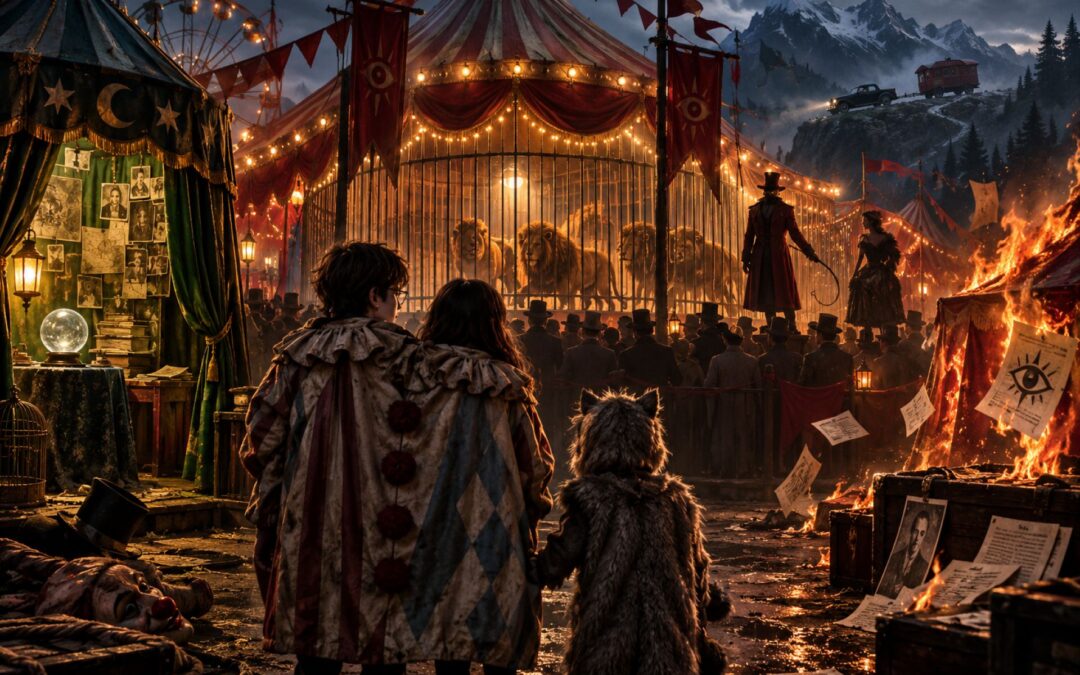
Published in 2002 as the ninth installment of A Series of Unfortunate Events, The Carnivorous Carnival begins at a point when the Baudelaire orphans have lost almost every conventional source of protection. Violet, Klaus, and Sunny are fugitives, Count Olaf remains free, the authorities believe increasingly absurd lies about them, and the mystery surrounding V.F.D. has become more important than ever. Their only immediate advantage is that Olaf does not realize they are hiding in the trunk of his car.
What follows initially resembles another variation on the familiar structure of the series: the Baudelaires enter a strange new environment, adopt disguises, investigate Olaf, and try to outthink the adults around them. Yet The Carnivorous Carnival gradually changes the moral terms of that structure. The central question is no longer simply whether the children can escape a villain. It is whether they can continue fighting people who lie, disguise themselves, manipulate others, destroy evidence, and use violence without beginning to rely on some of those same methods themselves.
That change makes Book 9 one of the decisive turning points in the series. Caligari Carnival becomes a place where cruelty is entertainment, difference is turned into a commodity, belonging can be purchased through complicity, and even apparently neutral skills such as disguise or research can serve either decent or destructive purposes. The novel does not suggest that the Baudelaires have become morally equivalent to Count Olaf, but it does force them to confront a much less comfortable possibility: good intentions do not automatically make every action harmless.
Spoiler warning: This article covers the complete novel, including Madame Lulu’s fate, the destruction of Caligari Carnival, and the separation of the Baudelaire siblings.

The Carnivorous Carnival: Complete Plot Summary
The Carnivorous Carnival continues directly from the escape at the end of The Hostile Hospital. There is almost no breathing room between the two stories. Violet, Klaus, and Sunny are already hiding in Count Olaf’s car when the novel begins, and their decision to remain near him becomes the first of several choices in which survival depends on moving closer to danger rather than farther from it.
The novel then carries the siblings through Caligari Carnival, a decaying attraction in the hinterlands where Count Olaf seeks information from the mysterious Madame Lulu. What begins as an investigation into a supposed fortune-teller develops into a story about false identities, public cruelty, incomplete knowledge, coercion, death, and the destruction of one of the most valuable collections of evidence the Baudelaires have yet encountered.
Chapters 1–3: Hiding in Plain Sight at Caligari Carnival
The Baudelaires begin the novel concealed inside the trunk of Count Olaf’s car after their desperate escape from Heimlich Hospital. They are exhausted, frightened, and increasingly isolated from any institution that might reasonably have been expected to protect them. From the trunk, however, they gain access to something they rarely receive: Olaf speaking freely because he does not know they are listening.
The conversation confirms how badly public reality has been distorted. Newspapers now report that Count Olaf is dead, while the Baudelaires are accused of murdering a man identified as Count Omar. The absurdity is obvious to anyone who knows the truth, but that is precisely the problem. The Daily Punctilio has transformed falsehood into public fact, and the children have little power to correct it. Olaf benefits from the confusion because the world is searching for the wrong villain and blaming the wrong people.
The children also learn why Olaf is traveling into the hinterlands. He intends to visit a fortune-teller named Madame Lulu, whose information has repeatedly helped him locate the Baudelaires. More importantly, Olaf wants Lulu to tell him about the Snicket file and determine whether one of the Baudelaire parents might still be alive. For Violet, Klaus, and Sunny, that possibility is too significant to ignore. Even after everything they have experienced, the idea that their family tragedy may not be as complete as they believed immediately creates a new reason to remain near Olaf.
His car reaches Caligari Carnival, located beside the Rarely Ridden Road in a remote and desolate part of the hinterlands. Once Olaf and his associates move away, Violet uses the remains of one of Olaf’s discarded monocles to manipulate the trunk mechanism and free the siblings. The escape demonstrates the familiar pattern of Violet’s inventiveness: she studies the materials available, understands the immediate mechanical problem, and turns something associated with Olaf’s disguises into a tool for survival.
Their first instinct is not simply to infiltrate the carnival. They attempt to contact Mr. Poe from a telephone booth, hoping that conventional adult assistance might still be possible. The attempt produces nothing useful. By this stage in the series, Mr. Poe’s incompetence has ceased to be merely comic; it has become part of the conditions forcing the children to act independently. With no effective authority to turn to, they decide to stay and investigate Madame Lulu.
They secretly approach Lulu’s caravan and overhear her speaking with Olaf. She presents herself in an exaggerated accent and behaves like a mystical fortune-teller whose crystal ball reveals hidden knowledge. Olaf asks about the Baudelaires, the Snicket file, and the surviving-parent possibility, but Lulu insists that her crystal ball can answer only one question at a time. More information will have to wait.
That delay creates the children’s immediate problem. They need to remain at the carnival long enough to learn what Lulu knows, but Olaf and his associates would recognize them at once. Their solution is disguise.
Violet and Klaus transform themselves into Beverly and Elliot, supposedly a two-headed person sharing one body. Sunny becomes Chabo the Wolf Baby, covered partly by the beard Olaf once used while pretending to be Stephano. The disguises are hardly flawless, yet they succeed because the carnival encourages spectators to see people as categories rather than examine them closely. If someone is introduced as a two-headed person or a wolf baby, the environment itself encourages others to accept the label.
Disguise also begins to work on a more psychological level. Violet, Klaus, and Sunny are not merely hiding their faces. They are performing identities that other people expect them to inhabit, and the longer they remain inside those performances, the more the novel asks what role disguise plays in moral behavior. Earlier in the series, disguises belonged primarily to Count Olaf. Here the Baudelaires begin using them deliberately and effectively.
They approach Madame Lulu and ask for work in the House of Freaks. During the interview, Count Olaf and several of his associates are present, forcing the siblings to maintain their performance under direct pressure. Violet and Klaus must eat as though Beverly and Elliot genuinely share one body, while Sunny bites objects and behaves as ferociously as people expect a “wolf baby” to behave.
Madame Lulu hires them and sends them to live with the other carnival performers. There they meet Hugo, Colette, and Kevin. Hugo has a hunched back, Colette is a contortionist, and Kevin is ambidextrous. None of these characteristics necessarily prevents an ordinary life, yet all three have internalized the belief that they are fundamentally abnormal. Their identities have been built around the insults and expectations of other people.
The Baudelaires are immediately uncomfortable with this way of thinking. They point out that Hugo’s back does not mean he is incapable of useful work, Colette’s flexibility does not make her monstrous, and Kevin’s ability to use both hands equally well is hardly evidence that he cannot live among other people. Yet the performers have spent so long being treated as “freaks” that ridicule has become part of how they understand themselves.
The chapter sequence ends with another development that raises the emotional stakes. Madame Lulu’s latest information suggests that one of the Baudelaire parents may still be alive. The siblings have no way to know whether the claim is true, but they cannot ignore it. Their original goal of learning why Olaf has been able to find them now becomes inseparable from the hope that their family story may contain something other than loss.
Chapters 4–5: The House of Freaks and Olaf’s Lion Pit
The Baudelaires’ first performance in the House of Freaks demonstrates what Caligari Carnival is actually selling. The attraction does not depend on extraordinary abilities. It depends on convincing an audience that certain people are legitimate objects of ridicule.
The hook-handed man serves as a cruel master of ceremonies. Hugo is mocked for his body, Colette twists herself into unusual positions, Kevin performs with both hands, Beverly and Elliot struggle to behave like a single two-headed person, and Chabo growls and bites. Spectators laugh, insult the performers, and throw objects. Humiliation is not an accidental side effect of the show; humiliation is the show.
The scene also exposes how unstable the distinction between “normal” spectators and “freakish” performers really is. Olaf’s hook-handed associate is perfectly willing to help degrade the House of Freaks, yet he resents any suggestion that his own physical difference might place him in the same category. The carnival therefore reveals that the label has little to do with objective abnormality. It exists because some people are allowed to define others.
After the performance, the Baudelaires again try to persuade Hugo, Colette, and Kevin that the traits displayed in the show need not define their lives. Their arguments are reasonable, but reason has limited power against years of shame. The performers do not merely fear the audience; they have learned to see themselves through the audience’s eyes.
Count Olaf then introduces a new attraction that turns ridicule into something much worse. He arrives with a cage containing lions and announces that the animals will be starved. Each day, one performer from the House of Freaks will be selected at random and thrown into their pit. The public can pay to watch the lions eat the chosen victim.
Olaf presents the scheme as entertainment and opportunity. The carnival has been struggling, and a deadly attraction will bring crowds. The language of business and spectacle disguises the reality that he is planning ritualized murder.
His control over the lions also mirrors his method of controlling people. The animals are deprived of food until hunger makes them dangerous, while the promise of flesh and the threat of violence become the “carrot” and “stick” governing their behavior. Later, that structure will echo the way he recruits human beings by alternating rewards with fear.
Madame Lulu, meanwhile, claims that her information points toward the Mortmain Mountains. If a Baudelaire parent survived, the mountains may be connected to that survival through V.F.D.
The possibility creates a painful emotional conflict. The children desperately want the claim to be true, but they have already learned how dangerous false hope can be. Klaus in particular recognizes that believing something because it is comforting is not the same as having evidence.
The tension leads the siblings to a new objective. Instead of waiting for Madame Lulu to make another pronouncement, they decide to investigate how her supposed fortune-telling actually works.
Chapters 6–7: Madame Lulu’s Secret and the V.F.D. Archive
Inside Madame Lulu’s tent, the Baudelaires begin examining the physical machinery behind her performances. Violet recognizes that the supernatural effects surrounding the crystal ball are produced through mechanical tricks rather than magic. Hidden openings, mirrors, light, a motor, and related devices create the mysterious flashes and sounds that convince visitors they are witnessing something beyond ordinary explanation.
The discovery initially seems devastating. If Lulu is a fraud, then perhaps everything she has told Olaf is false, including the possibility that a Baudelaire parent survived.
Klaus notices the flaw in that conclusion. A false explanation for how Lulu gets information does not necessarily mean the information itself is false. Olaf has repeatedly received accurate knowledge from her. The question is therefore not whether Lulu possesses supernatural powers, but how she has been obtaining real information.
Sunny helps provide the answer. The children discover hidden papers and then uncover an extensive archive containing newspapers, photographs, correspondence, lists, files, and other records. Lulu’s real gift is not prophecy. It is research.
The archive explains how she could have followed the Baudelaires’ movements. Newspapers report where they have been. School records and public information reveal pieces of their history. Photographs, correspondence, and files can be compared. While visitors close their eyes and wait for mystical revelation, Lulu consults evidence.
The discovery radically changes the meaning of her crystal ball. The object produces false certainty, but behind it lies a genuine method of gathering knowledge. Lulu has built a fortune-telling career by disguising research as magic.
The archive is especially important because A Series of Unfortunate Events has increasingly become a story about information. The Baudelaires repeatedly suffer not only because people are cruel, but because documents are missing, authorities believe false reports, witnesses disappear, records are destroyed, and pieces of knowledge are separated from one another. Lulu’s collection offers something they desperately need: fragments that can be assembled.
During the investigation, however, the crystal ball is broken, and Madame Lulu catches them.
Confronted with what they have discovered, Lulu gradually abandons her performance. Her exaggerated accent disappears. Her real name is Olivia.
The difference between Madame Lulu and Olivia is more than cosmetic. Madame Lulu is a constructed identity designed to satisfy other people’s expectations of a mysterious fortune-teller. Olivia is a frightened and compromised person whose moral weakness becomes one of the novel’s most important subjects.
She explains that she has tried to live according to a simple principle: “give people what they want.” When visitors want information, she gives it to them. When Count Olaf asks for help, she helps him. When someone wants reassurance, she may provide reassurance. The principle sounds generous until its consequences are examined. People often want things that are selfish, dangerous, cruel, or false.
Olivia’s revelation also qualifies the surviving-parent claim. She does not know with certainty that a Baudelaire parent is alive. What she knows is that the Mortmain Mountains contain the last known V.F.D. headquarters. If someone connected to V.F.D. survived, that would be a logical place to search.
The difference matters. Hope remains possible, but the book refuses to convert possibility into fact.
The Baudelaires reveal their real identities to Olivia. She recognizes elements of their disguises and explains that the disguise methods are associated with V.F.D. What is especially unsettling is that both volunteers and villains appear to possess similar techniques. Wigs, costumes, altered voices, false professions, and codes are not automatically signs of goodness or evil.
Olivia also refers to the schism within V.F.D., confirming that the organization is divided. Yet she does not explain the entire history, and the novel deliberately preserves the mystery. The Baudelaires learn enough to understand that the conflict is larger than Count Olaf alone, but not enough to classify every person they meet with confidence.
The lions reinforce that ambiguity. Olivia explains that they were not always animals trained for murderous spectacle. Like people, they have been shaped by circumstances. Starvation and mistreatment have transformed their behavior, but that does not make their potential violence unreal.
For perhaps the first time, Olivia begins seriously considering whether pleasing people is an inadequate guide to living. The Baudelaires persuade her to help them escape and leave Olaf behind. Violet develops a plan to repair abandoned roller-coaster carts and use them as a vehicle.
Olivia agrees to assist and promises not to betray the children.
The possibility of redemption is real, but fragile. Before Olivia can explain everything she knows, Count Olaf interrupts, and the children must become Beverly, Elliot, and Chabo again.
Chapters 8–11: Esmé’s Offer and the Carnival’s Descent Into Violence
The next stage of the novel turns Caligari Carnival from a place of humiliation into a machine for recruitment and murder. Hugo, Colette, and Kevin remain convinced that their most serious problem is being treated as outsiders. That desire for acceptance makes them vulnerable to someone willing to offer belonging without offering respect.
Esmé Squalor arrives wearing clothing that theatrically imitates the characteristics associated with the carnival performers. She proclaims her enthusiasm for “freaks,” but the supposed solidarity is shallow and manipulative. She is not challenging the system that humiliates them. She is exploiting their desire to escape it.
Esmé offers Hugo, Colette, Kevin, Beverly and Elliot, and Chabo positions in Count Olaf’s troupe. They would be able to travel with him, participate in schemes, wear disguises, and stop being exhibited in the House of Freaks.
She sweetens the offer with objects designed to hide what the performers have been taught to dislike about themselves. Hugo can conceal his hunched back. Colette can suppress the movements that reveal her flexibility. Kevin can restrain one hand so that his ambidexterity will not be visible.
The logic is revealing. Olaf’s group offers acceptance only if the performers become useful to him and hide the qualities for which others have mocked them. They are not being told that there is nothing shameful about their differences. They are being told that those differences can be concealed while they become criminals.
Esmé then attaches a murderous condition. Whichever House of Freaks performer is chosen for the lion pit should avoid death by pushing Madame Lulu into the pit instead.
Her motives are partly personal. Esmé is jealous of Lulu and resents Olaf’s relationship with her. Yet she presents murder as the price of admission into a new community.
Hugo, Colette, and Kevin agree.
The Baudelaires refuse. Their refusal confirms that they still recognize an important moral boundary, but it does not solve their problem. The lion attraction is going ahead, and their escape machine is not ready.
During the night, the siblings work on the abandoned roller-coaster carts. Violet applies her engineering abilities to reconstruct a usable vehicle, while Klaus and Sunny help gather and adapt materials. One crucial component is still missing: a fan belt from the machinery in Madame Lulu’s tent.
Their discussion turns repeatedly to Hugo, Colette, and Kevin. The Baudelaires understand why Olaf’s offer appeals to them without believing that their pain excuses everything they are willing to do. The carnival has taught them that belonging is scarce, and Olaf exploits that lesson.
Crowds begin arriving for the lion show. The Daily Punctilio is among the forces turning the event into public spectacle, linking the carnival’s appetite for cruelty to the newspaper’s appetite for sensational falsehood. Both institutions reward audiences for accepting simplified stories about other people.
Before the Baudelaires can complete their escape preparations, Olaf announces that the lion attraction will begin.
The pit becomes a stage. Names are placed into a container, and Olaf draws out the selection process because suspense makes the spectacle more exciting. People who have paid to see someone die wait eagerly for the result.
The hypocrisy of the normal/freak distinction becomes even clearer. Spectators who happily insult the performers become offended when similar language is directed toward them. “Freakishness” is revealed as a label that gains its power from who gets to apply it.
Olaf finally announces the victims: Beverly and Elliot.
Violet responds by declaring that they are delighted.
The reaction appears absurd, but it is strategic. She realizes that the crowd does not simply want death. It wants entertainment. If she can manipulate the terms of the spectacle, perhaps she can delay the killing long enough to escape.
The plan marks a subtle but important change in how the Baudelaires operate. Violet is no longer only solving a mechanical problem. She is deliberately manipulating an audience by understanding its desires, much as Olaf does.
The children argue that merely jumping into the pit would be disappointing. A better spectacle would involve someone pushing Beverly and Elliot into it.
The crowd embraces the idea.
What begins as an attempt to create delay becomes increasingly uncontrollable. More people are drawn into the argument over who should do the pushing. Olaf encourages the excitement. Rewards are offered. Spectators press forward.
Eventually Olivia agrees to participate.
Her decision is tragic because Chapter Seven seemed to open the possibility that she might finally reject the principle that has governed her behavior. Yet when confronted with a crowd demanding a performance, she again moves toward giving people what they want.
The situation collapses.
People push toward the pit. The distinction between spectators and participants disappears. Individual motives become lost inside collective movement, and the lions—starved specifically to create this outcome—respond to the chaos around them.
The Baudelaires manage to escape, but Olivia and the bald man both fall into the lion pit and die.
The precise sequence is deliberately unclear. The Daily Punctilio provides a version of events, but the newspaper has already established itself as unreliable. Lemony Snicket, functioning as a narrator who often presents himself as reconstructing the Baudelaires’ history from incomplete evidence, refuses to pretend that certainty exists where the evidence does not support it.
That uncertainty is important because it prevents the scene from becoming an easy moral equation. Violet’s strategy contributed to the chaos, Olaf designed the murderous spectacle, Esmé wanted Olivia dead, the crowd demanded violence, the performers made their own choices, and Olivia herself moved back toward accommodation. Responsibility exists, but it is distributed unevenly across people making very different decisions under very different pressures.
Chapters 12–13: The Fire, the Mortmain Mountains, and the Baudelaires’ Separation
After escaping the lion-pit disaster, the Baudelaires are forced to confront the consequences of what happened. Violet worries that their manipulation of the crowd helped create the conditions in which Olivia died. Klaus argues that Olaf bears the primary responsibility because he designed the attraction, starved the lions, and created the entire murderous situation.
Neither position completely resolves the problem. Violet’s guilt is not proof that she intended Olivia’s death, while Klaus’s argument about Olaf’s greater responsibility does not mean their own choices become irrelevant. The novel is beginning to distinguish intention, coercion, responsibility, and consequence instead of treating them as interchangeable.
The siblings return to Madame Lulu’s tent and discover that Olivia had prepared for their escape. She left supplies and a map connected to the Mortmain Mountains.
The map contains several V.F.D.-related clues, including a location called the Valley of Four Drafts. It also contains what initially appears to be an accidental brown stain.
Count Olaf and Esmé arrive before the children can make full use of what they have found. Olaf recognizes the mark as a coded stain, a technique he learned when he was young. The apparent accident therefore becomes another example of how V.F.D. hides information in ordinary-looking forms.
The map strengthens the connection between the Mortmain Mountains and the mysteries the Baudelaires have been pursuing. Yet once again, information arrives without complete explanation. They have a destination but not certainty about what waits there.
Olaf then forces the children into the most explicit moral compromise of the book.
Sunny is under his control. Violet and Klaus are ordered to set fire to Madame Lulu’s tent.
The order is horrifying not only because arson is criminal, but because the tent contains Olivia’s archive. The children have barely begun to examine its newspapers, photographs, letters, and files. Destroying it means destroying evidence that could potentially answer questions about V.F.D., Olaf, their family, and the people who have tried either to help or harm them.
With Sunny threatened and no safe alternative, they obey.
The tent burns.
The act creates a grim reversal in the symbolism of fire. The Baudelaire children began the series as victims of a catastrophic fire that destroyed their home and apparently killed their parents. They are now participating in the destruction of another place containing irreplaceable pieces of the past. The circumstances are radically different, and the novel does not equate them with Olaf, but the emotional boundary has nevertheless shifted.
As Caligari Carnival burns, the Daily Punctilio quickly reshapes the event into another story blaming the Baudelaires. Once again, public narrative moves faster than truth.
Hugo, Colette, and Kevin have meanwhile accepted their new place in Olaf’s troupe. Their decision completes Esmé’s recruitment strategy. People who were once victims of carnival humiliation are now helping the man who turned that carnival into a death spectacle.
Olaf prepares to travel toward the Mortmain Mountains.
Sunny is placed in the car with Olaf and Esmé, effectively becoming a hostage. Violet and Klaus are left in the carnival caravan. Their separation is initially temporary because Violet uses her engineering skills to connect the caravan to Olaf’s car, while Klaus helps interpret the map and guide their direction.
The arrangement creates another disturbing example of the children’s abilities being used on Olaf’s behalf. Violet’s inventiveness and Klaus’s research skills have always helped them resist him. Here those same talents are helping his vehicle travel toward V.F.D. information.
Olaf eventually reveals that he knows Beverly, Elliot, and Chabo are really the Baudelaires.
The final disaster occurs on the mountain road. Hugo, Colette, and Kevin occupy the connection between the vehicles. Kevin uses a rusty knife—and his ability to use either hand effectively—to cut the rope attaching the caravan to Olaf’s car.
The irony is deliberate. An ability Kevin has been taught to regard as shameful becomes extremely useful, but he uses it in the service of someone exploiting him.
Olaf’s car continues upward with Sunny.
The caravan containing Violet and Klaus begins rolling backward down the mountain.
The siblings scream for one another as the distance between them grows.
For the first time in the series, Violet, Klaus, and Sunny are not merely threatened with separation. Their physical unity is actually broken. Sunny travels deeper into Olaf’s control while Violet and Klaus hurtle toward an unknown danger of their own.
Snicket closes by returning to the image of entering the “belly of the beast.” The phrase has accumulated meanings across the book: concealment inside Olaf’s trunk, literal danger from the lions, and finally the different forms of danger confronting the separated children. The novel ends without resolving either path.
Caligari Carnival: A World Built on Spectacle and Exclusion
Caligari Carnival is one of the most thematically concentrated settings in A Series of Unfortunate Events. Its physical isolation matters because there are few external restraints on what happens there, while its economic decline creates pressure to produce increasingly sensational attractions. The carnival survives by turning people into things that can be looked at, judged, mocked, and eventually endangered for money.
The House of Freaks is the clearest example. Hugo, Colette, and Kevin possess unusual characteristics, but none of those characteristics objectively requires them to live as social outcasts. Their marginal status is produced by a relationship between performer and audience. Spectators arrive expecting to encounter “freaks,” the carnival assigns people to that category, and repeated public humiliation teaches the performers to accept the category themselves.
That structure reflects a broader concern in the series with adults and institutions that fail to protect children or vulnerable people. A scholarly study of childhood and fear in A Series of Unfortunate Events argues that institutions which should provide safety repeatedly intensify vulnerability instead. Caligari Carnival fits that pattern precisely: it offers employment and shelter to people who feel excluded, but only on the condition that their exclusion itself becomes the commodity being sold.
The lion attraction is therefore not an unrelated escalation. It is the logical endpoint of the carnival’s existing model. Once spectators have been trained to believe that another person’s humiliation is entertainment, Olaf asks only how far that appetite can be pushed. Laughter at awkward eating becomes mockery of bodies, mockery becomes public dehumanization, and dehumanization creates the conditions in which a crowd can pay to watch someone die.
The carnival also blurs the distinction between performer and spectator. People in the audience become outraged when they themselves are categorized or insulted, demonstrating that they understand perfectly well how humiliating labels work. Their cruelty depends on believing they are exempt from the standards they impose on others.
This is why the carnival is more than a grotesque background. It is a miniature social order organized around the right to define other people. Whoever controls the labels, the stage, and the audience controls which differences become shameful and whose suffering counts as entertainment.
Violet, Klaus, and Sunny: Survival at the Edge of Villainy
The three Baudelaire siblings remain recognizably themselves throughout The Carnivorous Carnival, but their methods change. Earlier books often tested whether their intelligence could overcome adult stupidity or Olaf’s elaborate plots. Book 9 tests whether intelligence itself can remain morally uncomplicated when every available option is compromised.
That development does not occur identically for all three siblings. Violet’s inventiveness becomes entangled with manipulation and destruction, Klaus’s devotion to knowledge becomes inseparable from uncertainty and moral reasoning, and Sunny’s rapidly expanding independence becomes especially important because the novel ends by physically separating her from the older siblings who have protected her.
Violet: Invention, Leadership, and Compromise
Violet remains the sibling most likely to convert immediate danger into a practical problem. She gets them out of Olaf’s trunk, helps construct the Beverly and Elliot disguise, studies Lulu’s machinery, repairs the roller-coaster carts, and later connects the caravan to Olaf’s car. Her inventiveness continues to be a form of leadership because she does not simply understand mechanisms; she determines what the siblings can physically do next.
Yet the novel deliberately changes the moral context in which that inventiveness operates. Her most unsettling invention is not mechanical at all. When Beverly and Elliot are selected for the lion pit, Violet studies the crowd as though it were another system. She recognizes its desire for drama and designs a strategy around that desire.
The plan is clever. It also contributes to chaos in which Olivia dies.
Violet’s later guilt matters because it shows that she understands the difference between intention and consequence without assuming the former cancels the latter. She did not want Olivia dead, and Olaf bears vastly greater responsibility for creating the murderous situation. Nevertheless, Violet cannot pretend that manipulating the crowd had no role in what followed.
The burning of Lulu’s tent pushes the issue further. Violet participates because Sunny is threatened and because refusing Olaf appears impossible. Her coercion is real. So is the fact that she helps destroy an archive filled with knowledge she desperately wanted to preserve.
The importance of this arc is not that Violet has “turned bad.” That interpretation is too crude. She remains protective, thoughtful, and horrified by unnecessary cruelty. What changes is her awareness that being a good person does not guarantee access to a good option.
Klaus: Research, Doubt, and Moral Reasoning
Klaus’s defining skill has always been reading, but The Carnivorous Carnival gives research a new thematic weight. Madame Lulu’s entire fortune-telling operation is revealed as an elaborate disguise for something Klaus understands instinctively: information can be assembled by comparing documents.
His response to Lulu’s fraud is especially characteristic. When the machinery behind the crystal ball is exposed, the immediate temptation is to assume that everything Lulu said must be false. Klaus rejects that leap. A false claim about how someone knows something does not automatically prove that the information itself is wrong.
The distinction becomes crucial to the surviving-parent mystery. Klaus wants the possibility to be true, but he cannot transform desire into evidence. The Mortmain Mountains may contain answers; that is not the same as knowing a parent is alive.
His relationship to evidence therefore mirrors his moral reasoning after Olivia’s death. When Violet fears that their strategy helped kill her, Klaus emphasizes Olaf’s responsibility. He is not merely trying to make Violet feel better. He is attempting to distinguish causal roles and intentions instead of collapsing them into one undifferentiated sense of guilt.
Yet Klaus does not possess a final theory that solves the problem. Like the information in Lulu’s archive, moral responsibility has to be reconstructed from incomplete facts.
The mountain map extends the same pattern. Klaus can interpret clues, recognize the importance of V.F.D., and help determine a destination, but knowledge remains partial. The more he learns, the clearer it becomes that reading is not the same as possessing certainty.
Sunny: Agency, Adaptability, and Separation
Sunny has always been the youngest Baudelaire, but by Book 9 she is far from a passive infant being carried through the plot. Her teeth remain useful, yet her identity is expanding through language, practical judgment, and a growing interest in cooking.
The Chabo disguise initially exploits how outsiders already misunderstand her. People expect a “wolf baby” to bite and growl, and Sunny can perform that expectation convincingly. The comedy depends partly on the absurdity that spectators find the fictional Chabo more believable than Sunny’s actual intelligence.
Her culinary development provides an important counterweight. Small moments such as improving hot chocolate with cinnamon suggest preferences and skills emerging independently of Violet’s inventing and Klaus’s reading. Sunny is gradually becoming someone whose talents cannot be reduced to the physical characteristic that defined her earliest appearances.
That development makes the ending especially effective. Sunny’s capture is not simply a threat to a helpless baby. It separates an increasingly capable character from the siblings who have spent the series making decisions as a unit.
For Violet and Klaus, protecting Sunny has always been part of how they understand their responsibilities. For Sunny, being protected has never meant being incapable. Book 9 breaks the structure before either side is ready, forcing the series to confront what each sibling can do when the familiar family unit is no longer physically intact.
Madame Lulu, the Carnival Workers, and Olaf’s Recruitment Machine
The most important secondary characters in The Carnivorous Carnival are all defined by some form of accommodation. Olivia accommodates whatever people ask of her, while Hugo, Colette, and Kevin accommodate the identities imposed on them by spectators. Count Olaf and Esmé exploit those accommodations rather than inventing them from nothing.
That pattern makes the carnival’s social world more disturbing than a simple division between villains and victims. People may be manipulated without becoming morally innocent of every decision, and people may behave badly because they are desperate for belonging without becoming equivalent to the person exploiting that desperation.
Olivia/Madame Lulu: Complicity Without Simple Villainy
Madame Lulu first appears to be another mysterious adult who possesses knowledge the Baudelaires need. The revelation that she is actually Olivia strips away both the accent and the apparent supernatural power, leaving a more interesting figure: someone whose failures come not from obvious sadism but from an inability to establish moral limits.
Her principle of giving people what they want sounds compassionate because it resembles generosity. The problem is that it treats desire as self-justifying. If Olaf wants information that will help him harm children, Olivia gives him information. If visitors want reassuring answers, she provides reassurance. If a crowd wants spectacle, she has trained herself to accommodate spectacle.
The archive reveals that Olivia is capable of diligence, intelligence, and long-term research. Her problem is therefore not stupidity. She has collected enormous quantities of information and seems to understand far more about V.F.D. than the Baudelaires do. What she lacks is a reliable principle for deciding when information should be withheld, when a request should be refused, or when pleasing someone becomes participation in wrongdoing.
Her conversation with the Baudelaires makes genuine change seem possible. She admits the limitations of her knowledge, identifies herself honestly, reveals aspects of V.F.D., and agrees to help them escape. The preparations later discovered in her tent demonstrate that this was not an empty promise.
That makes her behavior at the lion pit tragic rather than merely inconsistent. Under renewed pressure to satisfy an audience, she slips back into the pattern she was trying to reject.
Her death should not be treated as proof that redemption was impossible. If anything, the opposite is true. The novel makes the loss painful because Olivia had begun moving toward a different set of choices.
Hugo, Colette, and Kevin: Stigma and the Need to Belong
Hugo, Colette, and Kevin are not interchangeable even though the carnival classifies them together. Hugo is physically marked by his hunched back, Colette possesses unusual flexibility, and Kevin can use either hand with equal facility. The absurdity of presenting all three traits as evidence of monstrous abnormality exposes how arbitrary the category is.
What they share is not a body type but a psychological wound. All three have accepted the idea that their differences make ordinary belonging impossible.
The Baudelaires challenge that belief directly. They can imagine Hugo working elsewhere, Colette treating her flexibility as an ability rather than a deformity, and Kevin regarding ambidexterity as useful. Yet the performers have accumulated far more experience of ridicule than of encouragement.
Esmé understands this vulnerability and weaponizes it. Her recruitment pitch does not ask them to reconsider whether they are freaks. It accepts their shame and offers tools for hiding it.
That distinction explains why the offer is so effective. Olaf’s troupe seems to promise a community in which their differences will no longer expose them to public laughter. The price is obedience, disguise, and participation in crime.
Kevin’s final action completes the irony. His ambidexterity, which he has been taught to regard as embarrassing, becomes useful when he cuts the rope connecting Violet and Klaus’s caravan to Olaf’s car. His difference never prevented him from acting effectively. The real question was what kind of action he would choose.
The novel could give the three characters greater psychological individuality; at times they function more as variations on the same argument about shame and belonging than as fully developed people. Even so, their movement toward Olaf makes the series’ moral world more complicated. Victimization explains why they are vulnerable to recruitment, but it does not erase the consequences of helping the recruiter.
Count Olaf and Esmé Squalor: Coercion, Desire, and Predatory Acceptance
Count Olaf’s methods in this novel are unusually revealing because he rarely needs to disguise himself personally. Instead, he controls the environment around other people.
The lion attraction shows his method in its simplest form. He takes creatures, deprives them of what they need, threatens them, and then uses their predictable desperation to produce the behavior he wants. His language about carrots and sticks turns cruelty into management.
His treatment of people follows a similar logic. Hugo, Colette, and Kevin want belonging. Olaf’s group can offer it. The offer is conditional, exploitative, and criminal, but it remains attractive because the carnival has already convinced them that the alternative is permanent humiliation.
Esmé is especially effective as recruiter because she performs acceptance. Her fashionable imitation of the performers’ characteristics looks superficially like solidarity, but her gifts reveal the opposite. She does not teach them to value their differences; she gives them ways to hide those differences while making themselves useful to Olaf.
Her jealousy toward Olivia adds another layer of selfishness to the arrangement. The proposed murder is presented as an initiation into belonging, but it also serves Esmé’s personal desire to remove a rival.
Olaf and Esmé therefore exploit wants rather than create them. Their power comes from identifying hunger—literal or emotional—and offering satisfaction on destructive terms.
“Give People What They Want”: The Book’s Central Moral Problem
Olivia’s phrase “give people what they want” functions almost like an ethical experiment. At first glance, it appears harmless or even kind. Listening to other people and helping them obtain what they desire can sound like generosity.
The novel spends much of its plot demonstrating why desire cannot function as a moral rule.
Count Olaf wants information that will help him pursue the Baudelaires. Giving it to him is not kindness toward the people he intends to harm. Esmé wants Olivia dead. The carnival audience wants to see violence. Hugo, Colette, and Kevin want acceptance badly enough to consider murder. The starving lions want food because they have deliberately been deprived of it.
The fact that a desire is psychologically understandable does not make satisfying it ethically justified.
Olivia’s error is therefore deeper than cowardice. She repeatedly removes judgment from her own decisions. If someone else wants something, responsibility appears to belong to the person doing the wanting rather than to the person helping satisfy the desire.
The Baudelaires begin the novel with a stronger moral framework, yet even they become entangled in a similar problem. When selected for the lion pit, Violet manipulates the audience by giving it a more elaborate version of the spectacle it already wants. The strategy is designed to prevent their deaths, not to produce Olivia’s, but the technique still depends on exploiting desire.
The burning of the tent pushes the issue into coercion. Violet and Klaus do not want to destroy the archive. Olaf forces them by controlling Sunny. Their responsibility is therefore radically different from his, but the action still has consequences that good intentions cannot reverse.
This tension helps explain why scholarly analysis of the series’ complicated ethical framework is so useful for understanding the later books. The series increasingly destabilizes easy categories without concluding that morality is meaningless. The important distinction is between uncertainty and relativism.
The Carnivorous Carnival does not argue that everyone is equally guilty because everyone makes compromises. Olaf engineers suffering deliberately and repeatedly. The Baudelaires are children acting under threat, often with only seconds to choose among terrible options.
What changes is their ability to believe that good people can remain completely untouched by bad circumstances. Survival may require choices with genuine costs, and ethical seriousness begins when those costs are acknowledged rather than explained away.
Freaks, Normality, and the Cruelty of Spectacle
The House of Freaks is built around an obviously unstable concept of normality. Hugo, Colette, and Kevin are treated as though one unusual characteristic defines their entire existence, yet the crowd itself contains countless differences. The distinction survives only because some people are given the power to stare while others are forced to be stared at.
The Baudelaires recognize this quickly because their own disguises make the system absurd. Beverly and Elliot are not genuinely two-headed, while Chabo is not genuinely a wolf baby. Yet the crowd believes in those identities because the carnival has already told them how to look.
This makes the disguise plot particularly effective. The Baudelaires do not need to create convincing biological impossibilities. They need only perform the expectations attached to the category.
The hook-handed man demonstrates the hypocrisy from another direction. He is willing to present Hugo, Colette, Kevin, Beverly, Elliot, and Chabo as abnormal while resisting the idea that his own hook might expose him to similar classification. His objection reveals that he does not believe the label describes an objective category. He understands it as a position in a hierarchy, and he wants to remain on the side that judges.
Esmé’s treatment of the performers is even more revealing. She imitates their appearance as fashion while simultaneously giving them devices to hide the characteristics that supposedly make them freakish. Difference is acceptable when a wealthy, powerful person uses it as style; it becomes shameful when attached to the bodies of people with less social power.
The performers have internalized that hierarchy. Hugo, Colette, and Kevin speak about their own traits using the language of their spectators. Their deepest wish is not initially to transform the social conditions producing humiliation, but to escape being classified as abnormal.
Olaf exploits that wish by offering assimilation rather than dignity.
The novel’s critique is effective, though not without tension. Its carnival imagery relies on the historical language of freak shows, and the supporting characters are often exaggerated for comic effect even while the narrative condemns the reduction of people to their bodies. That creates an unavoidable discomfort: the book criticizes spectators for treating people as caricatures while sometimes presenting Hugo, Colette, and Kevin more schematically than its central characters.
The larger point nevertheless remains clear. Difference is not what produces cruelty in Caligari Carnival. Cruelty comes from a social arrangement in which difference can be packaged, sold, laughed at, and used to determine who deserves ordinary human respect.
Knowledge, Archives, and the Expanding V.F.D. Mystery
Madame Lulu’s fortune-telling tent contains one of the novel’s most important contrasts: fake magic hiding real research.
The crystal ball offers dramatic certainty. Lights flash, mysterious sounds appear, and Lulu announces answers as though they have emerged supernaturally. The performance encourages visitors to believe that knowledge arrives all at once from an unquestionable source.
The archive works in the opposite way. Knowledge has to be gathered from fragments.
Newspapers provide some information, although the Daily Punctilio demonstrates how unreliable newspapers can be. Photographs preserve images but require interpretation. Letters and records contain pieces of larger stories. Files can be incomplete. Different documents must be compared.
Lulu’s real success therefore comes from the patient accumulation of evidence, not mystical vision.
Yet the novel refuses to romanticize the archive. Reliable information can still be used badly. Olivia’s research helps Count Olaf pursue the Baudelaires because she supplies knowledge without judging how it will be used.
That makes the archive one half of a larger information problem. The Daily Punctilio spreads misinformation with great confidence, while Olivia collects genuine information but distributes it irresponsibly. One system has reach without truth; the other has truth without adequate ethics.
The V.F.D. material deepens that ambiguity. The Baudelaires discover that their disguises resemble standardized methods associated with the organization, but the methods themselves do not identify moral allegiance. Olaf and other villains also know how to disguise themselves.
The schism explains why. Whatever V.F.D. once was, it is now divided, and techniques once associated with the organization can exist on opposing sides.
The map toward the Mortmain Mountains gives the children a geographical direction but not a complete explanation. The Valley of Four Drafts appears significant. The coded stain indicates that information can be hidden in ways only trained people recognize. The possibility of a surviving parent remains open.
None of this resolves V.F.D.
That restraint is important. Book 9 expands the mystery without pretending the characters know more than they do.
The destruction of Olivia’s tent therefore has enormous narrative significance. When Violet and Klaus burn it under Olaf’s coercion, they destroy not merely a building but a rare concentration of evidence.
The moment crystallizes one of the series’ recurring tragedies. Answers may exist, but surviving long enough to assemble them is another problem entirely.
Symbols and Motifs: Eyes, Lions, Disguises, Fire, and the Belly of the Beast
The V.F.D. eye symbol continues functioning as an emblem of unstable interpretation. Images that once seemed to represent Count Olaf alone increasingly point toward a wider organization, older histories, and competing affiliations. Familiarity does not necessarily produce understanding; sometimes the same symbol becomes more complicated as the characters learn more about it.
The lions develop a similar ambiguity. They are genuine physical threats, but the novel also makes clear that their behavior has been manipulated. Starvation turns hunger into violence, while human beings place them in a pit and then treat the resulting danger as proof of their savagery.
Their treatment parallels the novel’s concern with people shaped by coercive environments. Hugo, Colette, and Kevin are not lions, and the comparison should not be pushed into equivalence, but both groups demonstrate how behavior can be altered by deprivation, fear, and reward.
Disguise is perhaps the book’s most important recurring object because it loses the clear moral association it possessed earlier in the series. Olaf has always used disguises to deceive guardians and institutions. The Baudelaires now use disguise to investigate him.
Olivia explains that disguise techniques belong to the world of V.F.D. more broadly. The implication is unsettling but precise: the morality of a tool depends on its use.
The crystal ball develops the knowledge theme in miniature. It is a device for producing the appearance of certainty. Behind it sits an archive requiring slow interpretation.
The contrast matters because the Baudelaires repeatedly want definitive answers—about their parents, V.F.D., Olaf, and their own choices—but the world rarely supplies them in crystal-ball form.
Fire carries the heaviest emotional history. The Baudelaire mansion fire defines the series’ opening catastrophe. Fire is something that destroys the children’s home, family security, and previous identity.
In The Carnivorous Carnival, Violet and Klaus become participants in another destructive fire.
The situations are not morally equivalent. They are coerced, Sunny is threatened, and their objective is survival rather than destruction. Even so, the reversal is significant because an element associated with what was done to them becomes something they themselves are forced to use.
The motif of déjà vu and repetition reinforces that shift. Events repeatedly resemble earlier situations, but the repetitions are never exact. Familiar patterns return under worse conditions or with altered moral roles.
The “belly of the beast” gathers these patterns into the ending. Early in the novel, the Baudelaires hide inside Olaf’s trunk, physically enclosed within the machinery carrying them toward danger. The lion pit turns the metaphor horrifyingly literal through the threat of being eaten.
By the final pages, the phrase has broadened again. Sunny is traveling deeper into Olaf’s control while Violet and Klaus race backward toward danger in the caravan. The siblings have entered different forms of the beast, and neither path offers the security of remaining together.
Narrative Style, Metafiction, and the Turn Toward Tragedy
Lemony Snicket’s narrative voice remains one of the defining features of the series. He interrupts the plot to define words, explain phrases, tell apparently unrelated anecdotes, address the reader, provide literary references, and describe his own efforts to reconstruct the Baudelaire story.
In earlier books, many of these interruptions primarily generate comedy. The Carnivorous Carnival retains that comic function but increasingly uses the narrator’s self-consciousness to explore uncertainty.
The lion-pit sequence is the clearest example. A conventional omniscient narrator could simply state exactly who pushed whom and in what order. Snicket instead emphasizes that the available evidence is incomplete.
The Daily Punctilio offers an account, but the newspaper is demonstrably unreliable. The narrator therefore refuses to present a convenient reconstruction as established fact.
That technique fits critical scholarship on the series’ metafictional construction, which identifies metafiction and metalepsis as central to the way the books complicate the border between narrator, story, evidence, and interpretation. Snicket does not behave like an invisible storyteller. He repeatedly reminds readers that stories are transmitted through records, memories, documents, research, and narrators who may not possess every fact.
The method becomes especially appropriate in a novel obsessed with information. Madame Lulu assembles archives. The Daily Punctilio distorts events. V.F.D. hides messages inside codes and stains. Snicket himself claims to be reconstructing the children’s history.
Narrative form and plot therefore converge around the same question: how do you know what happened when information is incomplete, manipulated, or destroyed?
The vocabulary definitions also become more than recurring jokes. Snicket repeatedly pauses to clarify language in a world where characters misunderstand one another, newspapers mislabel people, and social categories such as “freak” operate through careless definition. Words matter because whoever controls a definition can influence how reality is perceived.
At the same time, the novel’s comedy grows darker. The House of Freaks begins with absurd performances and ridiculous audience behavior, but the same appetite for spectacle culminates in two deaths.
Chapter Eleven deliberately invokes tragedy. The book acknowledges that everyone in the scene wants something, yet those desires cannot be simultaneously satisfied without harm.
This movement from comedy toward tragedy marks the larger evolution of the series. The basic machinery remains recognizable—Olaf, disguises, incompetent adults, verbal jokes, improbable danger—but the consequences are becoming more permanent.
Olivia dies. The archive burns. The Baudelaires help create the fire. Hugo, Colette, and Kevin join Olaf. The siblings are separated.
The narrative voice can still joke, but the jokes no longer restore the earlier sense that the children will escape each episode morally and physically intact.
The Ending Explained: Why the Baudelaires Are Separated
The ending follows directly from the destruction of Caligari Carnival and Olaf’s decision to travel toward the Mortmain Mountains. Sunny is kept in Olaf’s car with Olaf and Esmé, while Violet and Klaus travel in the carnival caravan being towed behind it.
The separation begins as a form of coercion. Keeping Sunny with him gives Olaf leverage over Violet and Klaus. If they resist too aggressively, they risk what he might do to their sister.
Violet therefore helps connect the caravan to Olaf’s vehicle. Klaus contributes knowledge from the map.
Their participation illustrates the moral problem that has developed throughout the book. They are using their abilities to help Olaf move toward the very secrets they hope to protect or understand, but they are doing so because Sunny’s safety depends on cooperation.
Hugo, Colette, and Kevin occupy the space between the vehicles as members of Olaf’s expanding troupe. Their recruitment now produces a direct consequence for the Baudelaires.
Kevin cuts the connecting rope with a rusty knife.
Olaf’s car continues uphill with Sunny.
The caravan containing Violet and Klaus loses the force pulling it forward and begins moving backward down the mountain road.
The separation is therefore not symbolic first and physical second. It is a literal mechanical disaster produced by the decisions of characters the Baudelaires met at the carnival.
Yet its symbolic importance is enormous.
For eight previous volumes, the three siblings have functioned as a unit. Their different skills complement one another, and their emotional survival depends heavily on being together. Violet assumes responsibility for Klaus and Sunny; Klaus relies on Violet while supporting Sunny; Sunny increasingly contributes her own abilities while trusting the older two.
Book 9 breaks that structure.
Sunny is now traveling deeper into enemy territory without Violet and Klaus beside her. The older siblings are simultaneously losing control of the caravan and cannot reach her.
The ending also leaves the central mysteries unresolved. The Mortmain Mountains may contain V.F.D. information. The Valley of Four Drafts may matter. The coded stain indicates that trained members of the organization have left hidden guidance. One of the Baudelaire parents may have survived, but Olivia never confirmed it.
The children also lose one of their best potential resources when the archive burns. Even if they survive the immediate crisis, they cannot simply return and inspect the documents they failed to read.
This is why the cliffhanger represents more than the usual promise of another dangerous adventure. The series’ basic family structure has been disrupted at the same time as its moral structure has become less comfortable.
The “belly of the beast” image captures both developments. Sunny is moving deeper into Olaf’s world, while Violet and Klaus are hurtling toward a different unknown. Each path may contain answers, but neither allows the siblings to face what comes next together.
Critical Review: How Well Does The Carnivorous Carnival Work?
The Carnivorous Carnival succeeds most powerfully as a transition novel. It retains enough of the established series formula to feel recognizable, yet it alters that formula in ways that permanently change what the Baudelaires’ struggle means.
Caligari Carnival is an excellent setting for that transformation because almost every element serves more than one function. The House of Freaks generates grotesque comedy, develops the social theme of exclusion, provides the Baudelaires with disguises, introduces potential allies, and creates the psychological conditions Olaf later exploits.
The lions similarly combine plot and theme. They generate immediate danger, attract the crowd, reveal Olaf’s method of coercion, and become part of the book’s broader inquiry into what people or creatures may become when systematically deprived and threatened.
Olivia is arguably the novel’s strongest secondary character. She is useful precisely because she does not fit the simple categories the series initially taught readers to expect.
She helps Count Olaf, but she is not motivated by his sadism. She possesses valuable V.F.D. knowledge, but knowledge does not make her wise. She lies professionally, yet many of the facts behind her performances are genuine. She agrees to help the Baudelaires, but years of accommodation have made moral courage difficult.
Her death therefore carries more weight than the elimination of another villain or incompetent adult. It closes off a possible path toward repentance at the moment when she has only begun to take it.
The Baudelaires also receive more difficult development than in many earlier volumes. Violet’s crowd manipulation and the burning of the tent matter because they cannot be reduced to clever escapes. Klaus must think not only about facts but about how responsibility should be assigned when people act under pressure. Sunny’s growing independence prepares the series for a future in which she cannot remain merely the youngest sibling protected by the other two.
The V.F.D. material is well integrated because it expands the mystery while also serving the novel’s central concerns. Disguise techniques, coded stains, archives, the schism, and the Mortmain Mountains all suggest a larger hidden history, but the most important revelation is ethical rather than informational: methods do not belong exclusively to good people.
That insight makes the book considerably more sophisticated than a simple secret-society installment. A disguise can conceal a volunteer or a villain. Research can rescue children or help track them. A coded message can guide allies or enemies. Intelligence itself has no guaranteed moral direction.
The novel’s treatment of the carnival workers is more mixed. Hugo, Colette, and Kevin serve the argument about stigma and belonging effectively, and their recruitment by Olaf is psychologically plausible at the level of motive. People who have spent years being mocked may be especially susceptible to a group offering acceptance.
Yet they sometimes operate more as demonstrations of that idea than as fully individualized characters. Their similarities in shame, vulnerability, and decision-making can make the trio feel schematic compared with Olivia’s more complicated psychology.
The freak-show framework also creates a genuine tension. The novel clearly condemns the reduction of people to bodily difference and repeatedly demonstrates that the category of “freak” is socially constructed. Nevertheless, it still relies on exaggerated carnival imagery and broad comedy surrounding those differences.
That tension does not invalidate the critique, but it prevents the book from handling the subject with complete subtlety.
The crowd scenes are effective for similar reasons and occasionally risk overextension. Snicket repeatedly shows spectators behaving foolishly, cruelly, or hypocritically, and by the lion-pit climax the satire has become deliberately blunt. The repetition is thematically justified because collective cruelty depends partly on individuals following what everyone else appears to want, but some readers may find the crowd less psychologically interesting than the novel’s central characters.
Where the book is strongest is in refusing to let its protagonists escape the consequences of the spectacle simply because their intentions were better. Violet’s guilt after Olivia’s death gives the climax an emotional residue that earlier narrow escapes often lacked.
The destruction of Lulu’s archive extends that seriousness. The fire is not merely another action scene. It destroys knowledge the Baudelaires—and the reader—want desperately.
That loss also helps prevent the V.F.D. mystery from becoming too mechanically solvable. If the children could simply sit down and read Olivia’s complete files, much of the series’ uncertainty would disappear. Burning the archive preserves the larger mystery, but unlike an arbitrary withholding device, it grows directly from the moral and physical conflict of the plot.
Snicket’s metafictional narration is particularly well suited to this installment. The uncertainty surrounding the lion-pit deaths demonstrates that the narrator’s interruptions are not decorative eccentricities. They affect how truth itself is represented.
The Daily Punctilio confidently prints falsehoods. Snicket sometimes admits uncertainty. The contrast makes the apparently less authoritative narrator more trustworthy precisely because he acknowledges the limits of what can be known.
This willingness to preserve uncertainty is one reason the later series can sustain more complicated moral questions. A simpler book might determine exactly who caused Olivia’s death and assign guilt neatly. The Carnivorous Carnival instead presents overlapping causes and unequal forms of responsibility.
Count Olaf remains unquestionably more culpable than the children. He creates the death attraction, starves the lions, manipulates the crowd, controls Sunny, and forces the fire. Yet acknowledging that difference does not require pretending the Baudelaires’ choices have no moral weight.
The book’s greatest achievement is therefore not a particular V.F.D. clue or carnival set piece. It is the transformation of the protagonists’ relationship to their own goodness.
Earlier installments repeatedly reassure readers that the Baudelaires are intelligent, compassionate children surrounded by foolish or wicked adults. Book 9 retains that fundamental sympathy while removing the reassurance that compassion guarantees clean hands.
That development gives the series greater emotional and philosophical range without requiring it to abandon its comic identity. Snicket can still define words, make absurd literary references, exaggerate adult stupidity, and stage improbable disasters. The humor simply exists alongside consequences that can no longer be reset at the end of each volume.
The cliffhanger is also one of the series’ strongest because it changes something structural rather than merely presenting another threat. If Olaf were simply driving away with all three children pursuing him, the next installment could restore the familiar pattern immediately.
Instead Sunny is taken forward while Violet and Klaus are sent backward. The family unit has been physically split at the exact moment when the children most need one another to interpret what they have become involved in.
As an individual novel, The Carnivorous Carnival remains dependent on the larger series. A reader beginning here would understand the immediate carnival plot but miss the accumulating significance of the Baudelaire fire, V.F.D., Olaf’s disguises, the Snicket file, and the children’s changing relationship to adult authority.
Within the thirteen-book sequence, however, that dependence is a strength more often than a weakness. Book 9 is not designed as a reset. It is where accumulated patterns begin turning into consequences.
Its strongest contribution is the realization that escaping Count Olaf is no longer sufficient. Violet, Klaus, and Sunny must also determine what kind of people they will be while escaping him.
Its most important limitation is that some of the supporting characterization and freak-show satire remain broader than the ethical questions the novel raises. Olivia receives enough complexity to inhabit those questions fully; Hugo, Colette, and Kevin sometimes represent them more than they embody them as individuals.
Even with that limitation, The Carnivorous Carnival is one of the key pivot points in A Series of Unfortunate Events. It takes the series’ familiar ingredients—disguises, incompetent adults, false reports, bizarre settings, wordplay, V.F.D. clues, and Count Olaf’s schemes—and rearranges them around a more unsettling question about complicity.
The novel remains especially rewarding for readers following the series in order. Its mysteries matter because of what came before, and its final separation matters because readers have spent eight books watching the siblings function as a single resilient unit.
For those readers, the ending is not merely another cliffhanger. It is the point at which the Baudelaires enter different dangers carrying the same unresolved burden: they still need to discover what V.F.D. is, whether their family history contains survivors, and whether fighting a corrupt world can be done without allowing that world to reshape them.
That is why The Carnivorous Carnival remains worth reading beyond its carnival grotesquerie and series mythology. The ninth book moves the Baudelaires into the “belly of the beast” not only by placing them closer to Count Olaf, but by making them confront what survival inside his kind of world may demand of them.
Last Updated on September 10, 2026 by Aseem Gupta