
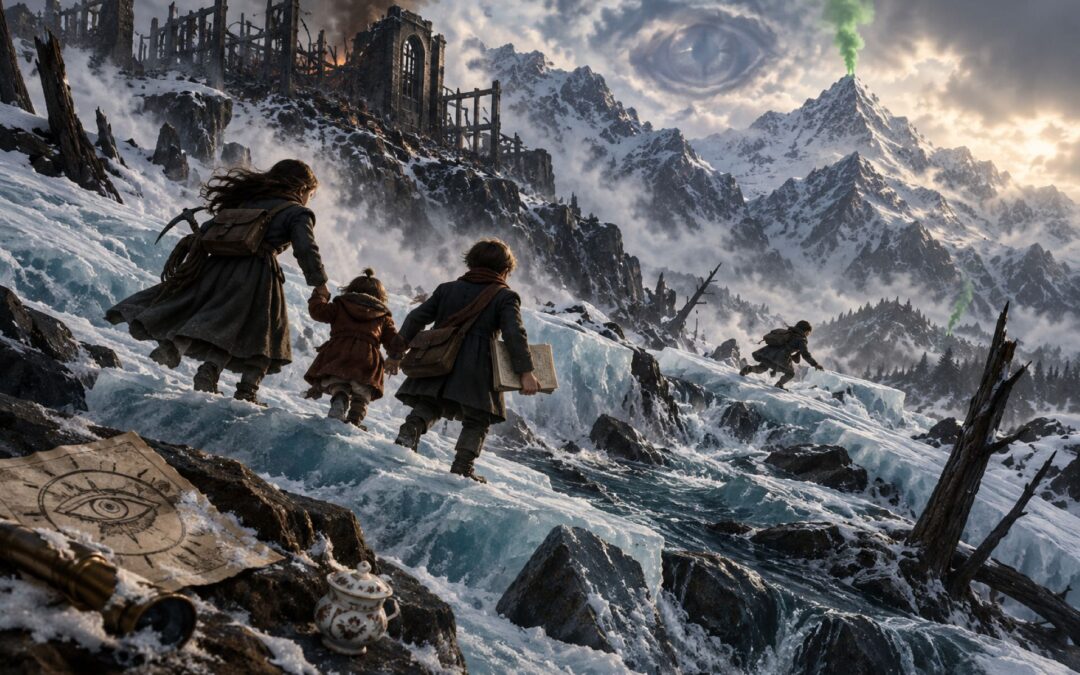
The Slippery Slope, the tenth volume of A Series of Unfortunate Events, begins at a point where the Baudelaire children have already learned that almost every apparent refuge can fail them. Their guardians have died or betrayed them, Count Olaf has repeatedly escaped justice, and the secret organization known as V.F.D. has gradually become more important without becoming much clearer. Book 10 pushes that uncertainty further by separating the siblings, revealing more about the organization they have been trying to understand, and forcing them to confront a harder problem than simply surviving another one of Olaf’s schemes.
The novel is therefore a turning point in the series. Violet and Klaus must survive the Mortmain Mountains while Sunny remains Olaf’s prisoner, but the physical danger soon becomes inseparable from an ethical one: if the Baudelaires begin using the same methods as their enemies, how different are they from the people they oppose? The title refers literally to the unstable mountain terrain, yet it also describes the possibility that one desperate compromise can lead to another until a person no longer recognizes where the descent began.
Spoiler warning: This article discusses the complete plot of The Slippery Slope, including Quigley Quagmire’s survival, major V.F.D. revelations, the sugar-bowl mystery, and the ending.

Detailed Plot Summary: The Runaway Caravan and the Mortmain Mountains
The novel begins directly after the cliffhanger ending of The Carnivorous Carnival. Violet and Klaus have been trapped inside a caravan hurtling down the Mortmain Mountains, while Sunny has been taken away by Count Olaf and his troupe. From the opening pages, the book abandons the old pattern in which all three siblings face danger together and instead creates two parallel stories: Violet and Klaus trying to reach the V.F.D. headquarters, and Sunny surviving inside the enemy camp.
That split allows the novel to show how much the Baudelaires have changed. Violet and Klaus must function without Sunny physically beside them, while Sunny must prove that she is no longer merely the youngest sibling waiting to be rescued. The result is one of the most consequential structural changes in the series so far.
Violet and Klaus Survive the Caravan
Violet and Klaus begin inside the runaway caravan with very little time to think. The vehicle is descending rapidly, and the mountain road offers no safe place to stop. Their immediate challenge is practical rather than mysterious: unless they improvise a braking system, they will be killed before they can even begin searching for Sunny.
Violet instinctively turns to invention, while Klaus uses the caravan’s supplies as a source of information. They discard the disguises that had helped them infiltrate the carnival and begin searching for materials that might slow the vehicle. Violet tries to create drag, while Klaus identifies sticky substances among the supplies that could make the wheels less effective. Their solution is not elegant, but the series has always treated resourcefulness as more important than ideal equipment, and eventually Violet uses a table in a desperate attempt to reduce the caravan’s speed.
The improvised braking works just well enough. Violet and Klaus escape before the damaged caravan resumes moving and finally plunges over the edge of the mountain. They salvage whatever useful material they can carry, but the destruction of the vehicle leaves them stranded in an environment that is both physically hostile and symbolically important. They are now moving toward V.F.D. without any adult escort, institutional protection, or reliable map of whom they should trust.
The sequence also reinforces the complementary nature of their skills. Violet does not simply “invent,” and Klaus does not simply “read.” Each sibling draws on available information, observes the environment, and turns knowledge into action. Their abilities remain distinct, but they increasingly function as overlapping forms of problem-solving rather than as neat labels.
The Stricken Stream and the Snow Scouts
Once they are on foot, Violet and Klaus decide to follow the Stricken Stream toward the Valley of Four Drafts, where they believe V.F.D. maintained a headquarters. The route has emotional significance because of the Snicket File, which had suggested that someone might have survived one of the fires connected with their family. Violet and Klaus cannot be sure who the survivor is, but they allow themselves to hope that one of their parents may still be alive.
The Stricken Stream itself looks wrong. Its water is dark and polluted, but the siblings do not yet understand why. The condition of the stream becomes one of the novel’s most important environmental clues because it connects a distant fire to the mountain landscape, showing how destruction spreads beyond the place where it begins.
Their journey is interrupted by an attack from snow gnats. Fire and smoke prove useful in driving the insects away, establishing early that the same element responsible for the series’ greatest losses can also protect people under different circumstances. Violet and Klaus eventually reach a cave, where they hear the familiar voice of Carmelita Spats, the bullying student they previously encountered at Prufrock Preparatory School.
At the same time, the novel begins showing Sunny’s situation. She is still with Count Olaf, Esmé Squalor, and the larger troupe of villains. Olaf treats her as a prisoner and servant, but Sunny is already behaving differently from the helpless baby the villains imagine they have captured. She watches, listens, interprets unfamiliar information, and begins thinking about ways to communicate with Violet and Klaus.
Inside the cave, Violet and Klaus discover a group called the Snow Scouts. They are led by Bruce, an adult whom the Baudelaires recognize from the aftermath of Dr. Montgomery’s death, although his presence here offers little reassurance. Bruce is less actively malicious than many adults in the series, but he is careless, conventional, and astonishingly ineffective at understanding the danger around him.
Carmelita Spats dominates the scouts’ social world. She is preparing to be celebrated as False Spring Queen and continues behaving with the same mixture of vanity, cruelty, and self-importance that characterized her earlier appearance. The scouts themselves follow elaborate routines and repeat an alphabetic pledge, but their obedience does not make them perceptive. Their rules provide structure without judgment.
Among them is a quieter scout whose face is concealed. He knows more than the others, corrects Bruce’s misinformation, and recognizes phrases connected with V.F.D. He gradually signals to Violet and Klaus that he may understand what they are looking for. After the others are asleep, he offers to guide them through a secret route toward the headquarters.
The V.F.D. Headquarters and Quigley Quagmire
The movement toward V.F.D. initially appears to promise answers. Violet and Klaus have spent several books encountering fragments of the organization through disguises, initials, codes, photographs, eye symbols, volunteers, villains, and references that never quite fit together. In the Mortmain Mountains, they finally reach one of the places where V.F.D. was physically organized, only to discover that proximity to the truth does not necessarily make the truth easier to possess.
The mystery also becomes more institutional. V.F.D. is no longer merely an acronym or a collection of scattered people. The secret passage, headquarters, codes, equipment, educational standards, and communication systems reveal that it once had infrastructure, traditions, and procedures. Yet almost everything the Baudelaires encounter is damaged, compromised, divided, or already too late to save them.
The Vertical Flame Diversion
The mysterious Snow Scout leads Violet and Klaus to a hidden passage concealed within the cave. The route is called the Vertical Flame Diversion, one of the many phrases in the series that produces the initials V.F.D. What once seemed like a single definitive abbreviation has become an entire linguistic system in which the same letters recur across places, devices, techniques, organizations, and jokes.
Violet and Klaus follow the scout through the dark passage because his knowledge gives them more reason to trust him than Bruce’s official authority does. The contrast matters. The novel repeatedly suggests that titles and institutional positions are weak substitutes for competence, while practical knowledge and ethical behavior must be judged through action.
During this portion of the journey, Lemony Snicket’s narration becomes especially intrusive. He interrupts the immediate story with material connected to his own investigation, his sister, the Valley of Four Drafts, a tea set, and the Hotel Denouement. Instead of maintaining the illusion of a conventional omniscient storyteller, Snicket behaves like a researcher assembling evidence after the events have occurred.
This technique makes the novel feel as though the reader is receiving a reconstructed dossier rather than a transparent window into the past. It also reinforces one of the series’ central uncertainties: the narrator may know many things, but even he does not possess every piece of the story in a straightforward way.
Sunny at the Summit and the Burned Headquarters
Sunny, meanwhile, is being forced to work for Olaf’s group. Her captors treat cooking and domestic labor as humiliating chores appropriate for someone they consider powerless, but Sunny turns those circumstances into another form of competence. She learns to work with difficult supplies, improvises meals, listens to conversations, and quietly gathers information about the villains’ plans.
Her situation becomes more dangerous when two figures arrive who intimidate even Olaf: a man with a beard but no hair and a woman with hair but no beard. Their presence immediately changes the scale of the conflict. Olaf has long appeared to be the Baudelaires’ central enemy, but these newcomers reveal that he belongs to a wider network and is not necessarily its most powerful member.
They discuss V.F.D., the destruction surrounding its headquarters, recruitment, and larger schemes that extend beyond obtaining the Baudelaire fortune. The villains also possess Verdant Flammable Devices, another V.F.D. phrase and another example of technology whose moral status depends entirely on the people using it. Sunny notices that such a device might allow her to create a visible signal.
Violet, Klaus, and the masked scout eventually emerge from the Vertical Flame Diversion into the area where the V.F.D. headquarters once stood. To enter, they encounter the Vernacularly Fastened Door, a barrier that cannot be opened with an ordinary key. It tests knowledge instead, demanding answers drawn from science, zoology, and literature.
Klaus is especially suited to the challenge. Among the questions is one involving Anna Karenina, and his ability to remember and apply what he has read becomes literally the means by which the children gain access. The scene turns literacy into physical power, but it also avoids suggesting that intelligence automatically makes anyone virtuous. Throughout the novel, villains use codes, disguises, and knowledge too.
When the children finally pass through, they do not find the refuge they imagined. The headquarters has been destroyed by fire. The ash left behind helps explain why the Stricken Stream has become dark and polluted, linking the devastation of V.F.D. to the landscape they have been following.
The discovery also destroys Violet and Klaus’s hope that the fire survivor mentioned in the Snicket File might be one of their parents. That interpretation had always rested on incomplete information, and the novel forces them to confront the emotional danger of treating possibility as certainty. They have found a survivor, but not the survivor they hoped for.
The masked scout removes his disguise and reveals himself as Quigley Quagmire, the third Quagmire triplet, long believed to have died in the fire that destroyed his family home.
Quigley’s Survival and the V.F.D. Schism
Quigley’s appearance is one of the largest revelations in the series to this point because his presumed death shaped Duncan and Isadora Quagmire’s understanding of their family tragedy. His survival immediately creates another parallel between the Quagmires and the Baudelaires: both families have been devastated by fires, both sets of children have been separated from relatives, and both have become entangled in V.F.D. without initially understanding why.
Quigley explains that he survived the Quagmire fire through a hidden passage. After escaping, he eventually reached the home of Dr. Montgomery Montgomery, another person connected to the secret organization. The path of his survival therefore follows locations that the Baudelaires themselves have already passed through, revealing how many stories have been unfolding around them without their knowledge.
Jacques Snicket later found Quigley and began explaining more about V.F.D. Jacques told him about the organization’s schism, the split that transformed former associates into enemies and helped turn once-safe places into sites of danger. Quigley’s information does not solve the V.F.D. mystery, but it gives Violet and Klaus a stronger historical framework for understanding why the same symbols and techniques keep appearing on both sides of the conflict.
Quigley also followed clues connected with Jacques after becoming separated from him and eventually learned that Jacques had been killed. He traveled through locations tied to the Baudelaires’ recent history before joining the Snow Scouts, hoping the mountain expedition would bring him closer to V.F.D. information. His route makes him less like a miraculous survivor inserted for convenience and more like someone whose unseen story has been running alongside the main narrative.
Violet and Klaus tell him what they know about Duncan and Isadora. The Quagmire siblings had escaped with Hector in the self-sustaining hot-air mobile home, so Quigley learns that the brother and sister who thought him dead are themselves still alive somewhere. The reunion he wants remains impossible, but his situation suddenly contains hope as well as loss.
The three children now share more than information. They all understand what it means to survive a fire, to lose family members, and to continue searching without knowing whether reunion is possible. This shared history quickly creates trust, particularly between Violet and Quigley.
The Green Smoke Signal and Sunny’s Decision
The narrative next brings the separated siblings into indirect contact. Sunny has not escaped Olaf, but she has learned enough about V.F.D. practices to act strategically. Violet, Klaus, and Quigley likewise possess more knowledge than before, yet they cannot be certain that any signal they see belongs to an ally because both sides of the schism use the same methods.
This ambiguity is crucial. The series used to treat secret signs as possible paths toward safety, but Book 10 makes those signs unreliable as moral identifiers. A green flame, an eye symbol, a code, or a V.F.D. phrase can tell someone what system a person knows without telling them what that person intends to do.
Violet and Quigley Climb the Frozen Waterfall
Sunny manages to use a Verdant Flammable Device so that green smoke rises from the summit. She hopes her siblings will recognize the signal, and Violet does. The moment is a powerful demonstration of Sunny’s increasing independence because she is not passively leaving clues by accident; she is deliberately communicating through a system she has observed and understood.
Violet answers the signal, establishing contact without any of the siblings being able to speak directly. The scene briefly reunites all three Baudelaire talents across distance. Sunny generates the information, Violet interprets and answers it, and Klaus continues working to understand the written traces left inside the destroyed headquarters.
To reach Sunny, Violet must solve another physical problem. The route upward includes a frozen waterfall, so she invents climbing equipment using forks and other available materials. The improvised shoes allow a climber to gain purchase on the ice, turning household objects into mountaineering tools.
Violet and Quigley undertake the ascent while Klaus remains behind. His task is equally important: he has discovered that the ruined refrigerator at headquarters contains a coded message and believes it may reveal where V.F.D. volunteers are supposed to gather. Their separation is therefore purposeful rather than accidental. Violet and Quigley pursue the immediate rescue, while Klaus pursues information that may determine where the Baudelaires should go next.
The climb also develops Violet and Quigley’s relationship. They admire each other’s abilities and operate as partners rather than as rescuer and rescued. Quigley’s cartographic knowledge and confidence complement Violet’s engineering, and their shared danger creates a degree of emotional intimacy that the series has rarely allowed Violet with anyone outside her family.
The Reunion—and Why Sunny Stays Behind
When Violet and Quigley finally reach Sunny, the reunion does not unfold as Violet expects. She assumes the obvious next step is to remove her younger sister from Olaf’s camp immediately. Sunny, however, has already decided that escape is not necessarily the most useful thing she can do.
She tells Violet what she has observed about the villains and indicates that she wants to stay long enough to discover more about their plans, particularly the location of V.F.D.’s last safe place. Sunny is no longer simply enduring captivity. She has turned herself into an active intelligence source inside the enemy camp.
Violet initially struggles with this decision because she still thinks of Sunny as someone she must protect. That protective instinct has been reasonable for most of the series, but Sunny now insists that her age should not erase her judgment. Her declaration that she is no longer merely a baby marks one of the clearest maturation points in the entire thirteen-book sequence.
The scene changes the Baudelaire family dynamic. Violet’s responsibility as the eldest sibling has often meant taking charge, but here responsibility requires recognizing that protection can become a form of control if it ignores another person’s growing competence. Sunny does not reject her family; she asks to participate in their danger on more equal terms.
Violet and Quigley therefore leave without forcing her to come with them. Their choice is emotionally difficult precisely because the safer immediate option would be to remove Sunny from Olaf’s reach. Yet respecting her judgment becomes part of treating her as the person she has become.
The ascent also contains one of Snicket’s characteristic acts of narrative withholding. Violet and Quigley share a private moment during the climb, but the narrator refuses to reveal everything that passes between them. The omission both acknowledges their growing romantic attachment and asserts that not every event in a person’s life automatically belongs to the reader.
The Last Safe Place, the Sugar Bowl, and the Moral Trap
While Violet and Quigley have been climbing, Klaus has been working inside the remains of V.F.D. headquarters. His investigation produces some of the most information-dense material in the novel because a seemingly ordinary refrigerator contains a multilayered code. The solution points toward a meeting of volunteers, the mysterious initials “J.S.,” and the sugar bowl, but each answer immediately creates another uncertainty.
At the same time, the Baudelaires begin considering a plan that is more dangerous morally than any of the puzzles they have solved. Their desire to rescue Sunny is entirely understandable, yet the method they contemplate resembles Count Olaf’s own tactics closely enough to force them to ask what kind of people they are becoming.
Klaus Decodes Verbal Fridge Dialogue
The coded system inside the refrigerator is called Verbal Fridge Dialogue. Like many V.F.D. techniques, it hides extraordinary communication inside ordinary domestic objects. Klaus must recognize that food items, ingredients, quantities, and literary references are carrying messages rather than functioning merely as supplies.
Fresh dill indicates that the refrigerator is being used for communication. The darkest jam contains the initials “J.S.,” while five olives signify Thursday. The mustard ingredient list points Klaus toward Algernon Charles Swinburne’s poem “The Garden of Proserpine,” specifically a portion of the poem that contributes to the hidden instructions.
The refrigerator also contains a faint reference to a “sugar bowl.” The object has already appeared at the edges of the wider mystery, particularly around Esmé Squalor, but Book 10 still refuses to explain why it matters so much. What becomes clear is that different villains value different objectives: Olaf remains obsessed with the Baudelaire fortune, whereas Esmé repeatedly treats the sugar bowl as something of enormous importance.
Klaus’s decoding therefore succeeds and fails at the same time. He learns that volunteers are meant to gather on Thursday, and he uncovers additional clues about the people and objects involved. Yet he still does not know the location of the gathering or the complete meaning of the sugar-bowl reference.
This pattern is characteristic of the V.F.D. mystery. Knowledge rarely closes a question completely. Instead, information narrows one uncertainty while revealing the existence of several others.
The immediate problem is still Sunny. Violet, Klaus, and Quigley know that she remains in Olaf’s camp, and their frustration begins pushing them toward a drastic plan. They decide they could dig a pit, lure Esmé Squalor into it, and use her as leverage in an exchange for Sunny.
At first, the plan appears strategically logical. Olaf kidnaps people, threatens them, and uses hostages, so taking someone he values might force him to negotiate. The difficulty is that the reasoning works precisely because the children are copying a method they have spent years condemning.
Why the Children Abandon the Esmé Trap
While the others prepare their trap, Sunny continues spying from the summit. Her patience produces the information they need most: she learns that the “last safe place” is the Hotel Denouement. The name gives the Baudelaires a concrete destination after the mountain, although neither Sunny nor the others yet understands what they will find there.
Esmé eventually notices the green smoke below and heads down the mountain on a toboggan. This creates the moment Violet, Klaus, and Quigley have been preparing for. If they allow her to fall into the pit, they may gain the bargaining power needed to force Olaf to release Sunny.
Yet the closer the moment comes, the more disturbing the plan appears. The children think about V.F.D.’s motto, “The world is quiet here,” and about the idea of fighting fire with fire. If an organization exists partly to prevent fires, then deliberately setting more fires simply because the enemy does so would destroy the principle it claims to defend.
The metaphor applies directly to kidnapping. The Baudelaires can tell themselves that Esmé is wicked, that Sunny is innocent, and that their goal is rescue rather than profit, but those differences do not erase what they are choosing to do. If they make another person helpless and use her suffering as leverage, they will be practicing the same kind of coercion they condemn in Olaf.
When Esmé approaches the trap, they warn her instead of allowing her to fall. She does not reward their restraint with gratitude. She mocks them, as if refusing villainous behavior merely proves that they lack the ruthlessness necessary to win.
The children’s decision matters precisely because it produces no immediate advantage. They do not spare Esmé because kindness is strategically useful. They spare her because they have decided that some methods remain wrong even when the intended outcome is good.
They then use their improvised equipment to bring Esmé back uphill. Near the summit, Violet, Klaus, and Quigley conceal their identities and attempt a different kind of deception. They claim to know where the sugar bowl is, hoping this information will be valuable enough to force the villains to release Sunny.
This tactic is still morally complicated, but it is fundamentally different from deliberately injuring or imprisoning Esmé. The novel does not demand purity from the children. It asks them to recognize boundaries even while survival requires secrecy, bluffing, trespassing, and deception.
False Spring and the Ending
The summit brings almost every major element of the novel together: the Snow Scouts, Olaf’s troupe, the senior villains, Sunny, the sugar-bowl mystery, V.F.D.’s recruitment crisis, and the changing moral choices of people who have been participating in the conflict. The weather itself also becomes part of the climax because the apparently welcome warmth of False Spring makes the frozen mountain less stable rather than safer.
What follows is not a simple rescue victory. The Baudelaires regain Sunny, but other children are endangered; some villains leave Olaf, while another child willingly moves closer to him; and Quigley is separated from the siblings almost as soon as they escape together. The series continues to treat moral progress and physical safety as different things.
The Recruitment Scheme and the White-Faced Women
Count Olaf and Esmé do not even agree completely about their priorities. Olaf remains focused on obtaining the Baudelaire fortune, while Esmé is much more interested in the sugar bowl. Their disagreement suggests that the villainous side of the V.F.D. schism is not a unified machine but a collection of people with overlapping ambitions.
The senior villains, however, have a broader plan. They intend to capture the Snow Scouts using trained eagles and a large net. The children can then be recruited into the villains’ organization or held in ways that allow their families to be threatened and manipulated.
The scheme reveals a more systematic form of villainy than Olaf’s usual frauds. Olaf repeatedly targets specific fortunes and specific children, but the senior villains are thinking institutionally. They want replacement members, leverage over families, and a continuing supply of people who can be shaped into participants in the conflict.
Violet, Klaus, and Quigley reveal themselves and try to warn the Snow Scouts. Their task is difficult because the scouts have been taught to trust their routines and leaders. Bruce fails to grasp the danger with the urgency required, demonstrating again that adult authority without judgment can become another kind of vulnerability.
The White-Faced Women then make one of the most important moral choices in the novel. They have served Olaf for a long time, but during the confrontation they refuse to continue obeying him. Their own history of family loss has made the endless cycle of fires and retaliation impossible for them to ignore.
Their departure mirrors the Baudelaires’ decision not to trap Esmé. Both moments suggest that complicity is not necessarily permanent. A person can recognize that a line has been crossed and decide not to continue simply because previous choices have already been bad.
Carmelita Spats responds in the opposite direction. Instead of becoming alarmed by Olaf and Esmé, she is attracted to the attention and indulgence they offer. Her vanity and cruelty make her especially susceptible to a structure in which flattery replaces moral judgment.
The contrast between the White-Faced Women and Carmelita is deliberate. One set of characters leaves a destructive group despite years of participation, while another moves toward it because it rewards qualities she already enjoys expressing.
The Escape Down the Slippery Slope
Sunny finally escapes the villains’ immediate control and reunites with Violet and Klaus. The siblings are together again, and Quigley is with them, but the summit remains dangerous. The senior villains’ plan involving the Snow Scouts and eagles has already transformed the gathering into chaos.
Violet locates the toboggan, and the Baudelaires and Quigley begin descending the mountain. What initially appears to be an escape route becomes increasingly unstable because False Spring has raised the temperature enough to weaken the ice. The mountain is no longer frozen in the reliable way that allowed Violet and Quigley to climb it earlier.
The toboggan carries the children rapidly downward. The frozen waterfall begins breaking apart, and the Stricken Stream becomes a violent force separating people rather than merely a route they can follow. Their physical movement through the environment now literalizes the title: they are not simply on a slippery slope but trapped within a landscape where stability can disappear beneath them.
Quigley is separated from Violet, Klaus, and Sunny as the water divides into different paths. The reunion that seemed possible only moments earlier ends abruptly. Violet cannot rescue him without endangering the entire group, and the Baudelaires are carried onward by the current.
They now know that Hotel Denouement is the last safe place, giving them a destination even though they do not know whether any place associated with V.F.D. can genuinely remain safe. The novel therefore ends not with shelter but with movement toward another uncertain location.
Snicket also reveals that the sugar bowl had entered the Stricken Stream after a volunteer fleeing the headquarters fire sent it into the water. The object is therefore physically moving through the same environment as the Baudelaires. The revelation links one of the series’ largest mysteries to the novel’s geography without explaining what the bowl contains or why so many people want it.
The ending provides answers, but none of them restore certainty. Quigley is alive but separated again. Sunny is rescued but the Snow Scouts are endangered. The last safe place has a name but remains untested. The sugar bowl has a path but not an explanation.
The Mortmain Mountains and the Expanding V.F.D. World
The Mortmain Mountains are among the most integrated settings in the series because nearly every major feature of the landscape serves both a practical and thematic function. The Stricken Stream guides Violet and Klaus toward headquarters, the frozen waterfall becomes an engineering challenge, the cave conceals a V.F.D. passage, the summit allows Sunny to signal her siblings, and False Spring transforms a route that once seemed stable into a dangerous current.
Vertical movement dominates the book. Characters climb toward information, descend toward danger, fall through unstable terrain, and repeatedly discover that physical elevation does not correspond to moral superiority. The V.F.D. headquarters is hidden high in the mountains, yet reaching it does not produce enlightenment. It has already been destroyed.
The headquarters is nevertheless important because it makes V.F.D. tangible. Earlier installments offered codes, people, tattoos, disguises, initials, and fragments of institutional memory. Here the Baudelaires encounter a secret passage, specialized doors, communication systems, equipment, maps, meeting procedures, and evidence that volunteers once trained themselves across multiple fields of knowledge.
The ruins also reveal how thoroughly the schism has damaged the organization. V.F.D. may once have imagined itself as a coherent force against destructive behavior, but by the time the Baudelaires arrive, its safe places can be burned, its codes can be used by both sides, and its former members can no longer be identified reliably through shared symbols.
That breakdown explains why the novel increasingly separates institutional identity from ethical conduct. Knowing V.F.D. terminology tells the children that someone belongs to the same historical system, but it does not tell them whether that person is trustworthy. A phrase such as “Vertical Flame Diversion” can describe a useful escape route, while “Verdant Flammable Device” can be used by either captives or villains.
The mountain environment reinforces the same principle. Ice may be useful for climbing at one moment and deadly when it melts. Fire may destroy a headquarters but also drive away snow gnats or create a rescue signal. The physical world does not carry fixed moral labels, and neither do the tools created within V.F.D.
The destroyed headquarters therefore becomes a warning against nostalgia. Violet, Klaus, and Quigley are tempted to imagine that if they could simply reach the correct place or recover the correct organization, someone would tell them what to do. Instead, they arrive at the ruins of a system and must decide for themselves what its principles mean.
Character Analysis: The Baudelaires, Quigley, and the Villains
Character development becomes unusually important in The Slippery Slope because the children are no longer simply accumulating experiences. Those experiences are changing the balance of responsibility within the Baudelaire family and altering the way they respond to danger. Sunny becomes more independent, Violet learns that protecting someone can require respecting choices she dislikes, Klaus moves from gathering information to judging its limits, and Quigley introduces a companion who understands their losses without being another dependent.
The villains also become more differentiated. Olaf remains dangerous, but his position within a larger hierarchy reveals that villainy exists at different scales, from individual greed to systematic recruitment and indoctrination.
Sunny Baudelaire: “I’m Not a Baby”
Sunny undergoes the most dramatic character development in the novel. Earlier books established that she was unusually capable for her age, particularly through her teeth, improvised language, and increasing interest in cooking. Book 10 turns those abilities into something closer to independent judgment.
Her captivity initially appears to place her in the weakest possible position. She is physically smaller than everyone around her, separated from Violet and Klaus, and surrounded by adults who consider her useful only as a servant. Yet those adults’ contempt becomes one of her advantages because they underestimate how much she can understand.
Sunny observes their conversations, learns details about V.F.D., recognizes the importance of signaling, and adapts the materials available to her. Cooking becomes more than an amusing reversal in which a baby prepares meals for adults. It demonstrates organization, creativity, and the ability to solve problems under constraint.
Her green smoke signal is especially important because it shows strategic planning. She does not merely leave evidence that her siblings happen to interpret. She identifies a V.F.D. method, understands that the mountain summit creates visibility, and deliberately communicates across distance.
The defining moment arrives when Violet reaches her. Sunny could leave immediately, and Violet assumes she will want to do so. Instead, Sunny chooses to remain because continuing to spy may reveal the last safe place.
Her insistence that she is no longer a baby is partly literal but more importantly relational. She is telling Violet that the family hierarchy must change. The eldest sibling cannot continue making every decision for the youngest simply because that arrangement was once necessary.
Sunny’s choice remains dangerous, and the novel does not pretend that maturity means invulnerability. What changes is her claim to participate in deciding which dangers she is willing to face. That distinction gives her development unusual emotional weight for a character whose early role in the series was heavily comic.
Violet and Klaus: Skill, Responsibility, and Change
Violet remains one of the series’ most effective problem-solvers because she can turn almost any material into a tool. In this novel she brakes the runaway caravan, creates climbing equipment from forks, interprets smoke signals, and repeatedly adapts to an environment designed to kill the people moving through it. Her inventiveness is not presented as magical genius; it depends on observation, risk, failed possibilities, and available materials.
Her deeper development concerns responsibility. Violet has long understood herself as the sibling who must protect Klaus and Sunny, but Sunny’s growth makes that identity more complicated. When Sunny refuses immediate rescue, Violet must decide whether protecting her means overriding her choice or trusting her judgment.
That dilemma prepares Violet for the later Esmé crisis. In both cases, responsibility cannot be reduced to control. Violet has to distinguish between acting decisively and assuming that her own fear automatically gives her the right to determine what happens to someone else.
Klaus’s development is quieter but equally important. His reading has always helped the siblings survive, yet Book 10 places him inside a world where information itself is unstable. He can solve the Vernacularly Fastened Door and decode Verbal Fridge Dialogue, but correct interpretation often reveals uncertainty rather than eliminating it.
This is an important shift for a character whose greatest strength is knowledge. Klaus begins recognizing that facts must still be situated, weighed, and interpreted. The initials “J.S.” are real information, but they do not identify one person with certainty. The sugar-bowl clue is real, but it does not explain why the object matters.
Both older siblings also participate in the plan to trap Esmé. Their intelligence does not immunize them against moral error. In fact, their ability to devise a workable plan makes the danger greater because competence can make an unethical action easier to rationalize.
Their ultimate decision to abandon the trap therefore matters more than a simple refusal to become “bad.” Violet and Klaus have reached a stage where they can cause significant harm if they choose to. Moral maturity means recognizing that power creates responsibility rather than permission.
Quigley Quagmire: Survivor and New Ally
Quigley enters the novel as a mystery and becomes one of its most important emotional additions. His survival changes the known history of the Quagmire family, but his role extends beyond surprise. He offers the Baudelaires something unusual: a companion whose experiences resemble their own closely enough that he does not need every loss explained.
Like Violet, Klaus, and Sunny, Quigley is a survivor of a catastrophic fire. Like them, he has moved through secret passages, dangerous institutions, uncertain allies, and V.F.D. information without possessing a complete map of what happened to his family. His knowledge therefore comes from experience rather than authority.
His cartographic skill also distinguishes him from the Baudelaires without duplicating their talents. He thinks spatially, records information, and treats maps and commonplace books as tools for connecting fragments. This makes him especially well suited to a mountain novel organized around hidden routes, changing geography, and uncertain destinations.
His relationship with Jacques Snicket gives him a direct connection to the organization the Baudelaires have been pursuing. Jacques provides part of the context for the schism and helps Quigley navigate the V.F.D. world, although Jacques’s death prevents him from becoming another convenient adult guide.
Quigley’s relationship with Violet is deliberately understated. Their attraction grows through cooperation and shared danger rather than through a sudden romantic declaration. Snicket’s refusal to narrate every detail of their private moment preserves the emotional reality while preventing the relationship from becoming spectacle.
His separation at the ending is painful partly because it repeats the fundamental pattern of his life. He survives, finds people he cares about, and is separated again before stability can take hold. The novel does not erase hope—he knows Duncan and Isadora are alive, and the Baudelaires know he survived the mountain—but it refuses to convert survival into security.
Olaf, Esmé, and the Senior Villains
Count Olaf remains dangerous, cruel, and opportunistic, but The Slippery Slope changes the reader’s perspective on him by introducing people who frighten him. This does not make Olaf sympathetic. Instead, it reveals that his personal schemes are part of a larger structure of villainy.
Olaf’s central motivation remains the Baudelaire fortune. He is willing to kidnap, disguise himself, murder, manipulate legal systems, and exploit children in pursuit of wealth. His priorities are therefore concrete and selfish, even when he participates in V.F.D.’s larger conflict.
Esmé Squalor is driven by different desires. She remains obsessed with fashion and status, but the sugar bowl matters to her in a way the Baudelaire fortune does not. Her fixation indicates that the history of the V.F.D. schism contains stakes separate from Olaf’s financial motives.
Her role in the Baudelaires’ moral crisis is particularly effective because she is genuinely cruel. The children are not forced to decide whether to harm an innocent person; they are tempted to harm someone who has repeatedly endangered them. That makes the ethical test harder rather than easier because revenge and rescue can be disguised as justice.
The man with a beard but no hair and the woman with hair but no beard broaden the scale again. They command enough authority to make Olaf nervous and appear more interested in the continuation of the villainous organization than in any single fortune. Their recruitment scheme treats children as future assets who can be captured, conditioned, or used against their families.
This creates a distinction between personal and institutional villainy. Olaf is terrifying because he is relentless and intimate; he repeatedly invades the Baudelaires’ lives. The senior villains are frightening because they treat destruction as a system that should reproduce itself.
Bruce, Carmelita, the Snow Scouts, and the White-Faced Women
Bruce represents one of the series’ recurring forms of adult failure: not active cruelty but complacent incompetence. He has an official role and presides over an organized group, yet he does not perceive danger accurately or protect the children under his authority. His adherence to routine becomes dangerous because he mistakes procedure for judgment.
Carmelita is a more active problem. She delights in humiliating other children, expects constant admiration, and responds enthusiastically when adults reward her worst qualities. Her movement toward Olaf and Esmé suggests that villainy can recruit not only through fear but also through flattery.
The Snow Scouts illustrate the vulnerability of highly structured groups when obedience outruns understanding. Their pledge and rituals appear wholesome from a distance, but the children have not been trained to evaluate authority critically. That weakness makes the senior villains’ recruitment plan especially disturbing.
The White-Faced Women offer a counterexample to the idea that anyone who has participated in evil is permanently fixed in that role. They have assisted Olaf repeatedly, yet they eventually refuse to continue. Their decision does not erase previous harm, but it proves that recognizing complicity can still produce a meaningful change in behavior.
This broader concern with children, fear, and failing institutions is consistent with scholarship examining how A Series of Unfortunate Events portrays childhood vulnerability alongside adults who perpetuate or exploit insecurity. Book 10 sharpens that pattern by contrasting Sunny’s genuine competence with adults who possess formal authority but little moral or practical judgment.
Themes: What It Means to Be a Volunteer
The word “volunteer” gradually becomes more important than the initials V.F.D. themselves. The Baudelaires initially want to know who belongs to the organization, what the letters mean, and which side their parents occupied. The Slippery Slope pushes them toward a harder question: even if they know the history of the organization, what does it actually mean to behave like the kind of volunteer they hope their parents were?
The novel’s thematic answer is deliberately incomplete. It does not provide a code that can substitute for judgment. Instead, it places characters in situations where they must choose under uncertainty and then asks what those choices reveal.
The Ethical Slippery Slope
The clearest expression of the title’s moral meaning is the plan to trap Esmé. Violet, Klaus, and Quigley are not motivated by greed or sadism. They want Sunny back, and Esmé has helped imprison her.
That makes the kidnapping plan easy to defend at first. If Olaf uses hostages, taking one of his allies hostage may seem like the only language he understands. Yet this reasoning contains the same logic that often begins moral descent: the action would normally be wrong, but the circumstances appear exceptional enough to justify it.
The children’s eventual refusal becomes the book’s central ethical decision. They recognize that “fighting fire with fire” can transform opposition into imitation. If stopping destructive people requires reproducing their methods without limit, then the distinction between the two sides becomes increasingly difficult to maintain.
This concern aligns with literary scholarship on the series’ unstable ethical categories, which emphasizes that Snicket repeatedly resists simple moral classification. Book 10 embodies that instability by forcing the Baudelaires to practice ethical judgment without access to a perfectly reliable authority.
The scene does not claim that morally good people never deceive, break rules, or cause harm. The Baudelaires have already used disguises, stolen access, trespassed, lied, and manipulated situations because conventional systems have failed them. The novel instead asks whether they can distinguish desperate survival tactics from deliberate cruelty and coercion.
Their decision to warn Esmé is therefore meaningful because it costs them something. A morality that applies only when goodness is convenient would not answer the problem the novel has created. The children choose restraint even when restraint may make rescuing Sunny more difficult.
The White-Faced Women later reinforce the same idea from the opposite direction. They have already traveled much farther down their own moral slope, but they still choose to stop. Their departure suggests that the metaphor does not have to imply irreversible descent.
Childhood, Agency, and Failed Adults
The series has always placed unusually capable children inside systems run by adults who misunderstand or ignore them. The Slippery Slope intensifies this pattern because Sunny becomes more independent just as the Snow Scouts reveal how easily children can be organized without being protected.
Bruce is technically responsible for the scouts, but his leadership does not equip them to recognize the danger around them. His confidence is not matched by competence. The novel repeatedly treats this gap as more dangerous than simple ignorance because people often obey someone who appears officially responsible.
Sunny represents the reverse. She possesses almost no institutional authority, yet she evaluates danger accurately and acts intelligently. Her age causes adults to underestimate her, but the narrative increasingly treats her judgment as worthy of respect.
The senior villains’ recruitment plan exposes a darker version of adult influence. They do not merely fail children; they intend to convert them into participants in a destructive system. Their strategy recognizes that identity can be shaped through fear, captivity, reward, and manipulation.
Carmelita demonstrates how such recruitment might work without physical coercion. She enjoys praise and status, so Olaf and Esmé can attract her by validating qualities that other people find intolerable. Her movement toward them shows how a child may enter an immoral system because it appears to celebrate rather than restrict the self.
The Baudelaires’ own development therefore involves becoming more autonomous without simply rejecting adulthood as a category. They are learning to judge people and institutions case by case. Competence, honesty, and ethical behavior matter more than age, title, uniform, or membership.
Knowledge, Literacy, and Codes
Reading has always been one of the Baudelaire children’s greatest sources of power, and Book 10 turns literacy into part of the physical machinery of the plot. Klaus’s knowledge opens the Vernacularly Fastened Door, decodes the refrigerator, interprets literary references, and helps transform scattered information into possible routes forward.
The novel celebrates broad reading without making it decorative. Literature, science, zoology, maps, ingredient lists, and poetry all become practical forms of knowledge. Anna Karenina and Swinburne are not merely references designed to amuse adult readers; they function inside puzzles that characters must solve.
At the same time, the novel places limits on what knowledge can accomplish. Klaus can decode the message accurately and still remain uncertain about “J.S.” or the sugar bowl. Information can tell the children that volunteers are gathering without telling them whether every person at the gathering will be trustworthy.
The same problem applies to V.F.D. vocabulary. Both sides of the schism understand the same codes and technologies. Knowing the language of an institution does not prove that someone shares its ethical aims.
This distinction gives the novel a more sophisticated relationship with literacy than a simple “books make you good” message. Reading expands what people can perceive and do, but moral judgment remains a separate task. Intelligent villains are still villains, and educated children can still rationalize harmful plans.
Secrets, Schism, and Uncertain Truth
The deeper the Baudelaires move into V.F.D., the less useful it becomes to think of the organization as a hidden club divided neatly into good and bad outsiders. The schism means that enemies often share histories, techniques, symbols, and vocabulary. The children cannot simply identify a code and assume they have found safety.
Quigley’s story demonstrates this clearly. Jacques Snicket helps him understand V.F.D., but Jacques is killed before he can provide a complete account. The organization’s knowledge is transmitted through fragments because the people who possess it keep disappearing, dying, defecting, or becoming separated.
The fire-survivor mystery follows the same pattern. Violet and Klaus correctly recognize that the Snicket File contains evidence of survival, but they interpret that possibility through hope. When Quigley turns out to be the survivor they encounter, the novel shows how emotional need can influence even careful readers.
The “J.S.” initials create another form of uncertainty. Klaus can prove that the initials are part of the message, but not necessarily which person they identify. The sugar bowl operates similarly: its importance is undeniable because multiple people risk so much for it, yet its significance remains withheld.
This structure can frustrate readers who want mysteries to close as soon as clues accumulate. Yet it also serves the book’s thematic purpose. The Baudelaires are being trained not merely to acquire information but to live responsibly when information remains incomplete.
Family, Trust, and Chosen Allies
Family remains the emotional center of the novel even while the Baudelaires become more deeply involved in V.F.D. Violet and Klaus’s determination to reach Sunny drives nearly every early decision, but Sunny’s growth forces the family relationship itself to evolve. Love no longer means making every choice on someone else’s behalf.
Quigley expands the idea of family through parallel experience. His search for Duncan and Isadora mirrors the Baudelaires’ repeated separations, and his survival gives both families reason to resist assuming that absence always means death. The children understand one another partly because loss has taught them the same habits of caution.
Trust becomes especially important because none of them can verify everything the others say through an institution. Violet and Klaus trust Quigley because his actions, knowledge, vulnerability, and history cohere. Quigley trusts them for similar reasons.
This kind of trust differs from blind faith. It remains provisional and responsive to evidence. The novel increasingly suggests that under conditions of uncertainty, ethical relationships depend less on absolute certainty than on accumulated patterns of behavior.
Violet and Quigley’s growing affection fits naturally into this framework. Their attraction is not detached from the larger themes of the book. It emerges through mutual competence, shared danger, loss, and the recognition that another person understands a world most people cannot even see.
Symbols and Motifs: Fire, Water, Masks, and the Sugar Bowl
The Slippery Slope relies heavily on recurring objects and natural elements, but their meanings are rarely fixed. Fire can destroy or protect, smoke can obscure or communicate, water can guide or separate, and V.F.D. symbols can identify a shared history without identifying a shared morality. This instability makes the novel’s imagery work in the same way as its ethical argument.
The central motifs also connect the local mountain story to the larger series. The Baudelaires are not merely encountering new scenery; they are moving through physical traces left by the same conflict that destroyed homes, families, and institutions elsewhere.
Fire, Smoke, Ash, and Water
Fire is the most obvious recurring element because nearly every major family tragedy in the series is associated with one. The V.F.D. headquarters has also burned, turning a place intended to preserve knowledge and safety into ruins. The aftermath literally enters the Stricken Stream as ash and pollution.
Yet the novel refuses to make fire purely evil. Violet and Klaus use smoke to repel snow gnats, and Sunny uses green smoke as a signal to her siblings. The same physical phenomenon can destroy a building or save a life depending on how and why it is used.
This duality supports the book’s argument about methods. “Fighting fire with fire” is dangerous as a moral principle because it can become an excuse for imitation, but the literal element itself remains neutral. What matters is intention, context, consequence, and restraint.
Water behaves similarly. The Stricken Stream first acts as a guide leading Violet and Klaus toward headquarters. Its pollution becomes evidence of the earlier fire, allowing the landscape to carry historical information.
By the ending, however, the stream becomes uncontrollable. Melting ice transforms the route into a force that separates Quigley from the Baudelaires and carries the siblings away from the summit. Water preserves movement but destroys the possibility of immediate reunion.
The sugar bowl’s entry into that same stream makes the element even more significant. The children and the object are both being carried through a network larger than any individual can control. Geography becomes part of the mystery itself.
The Sugar Bowl, Masks, and V.F.D. Signs
The sugar bowl is important partly because the novel refuses to define its value. Olaf and Esmé’s disagreement reveals that not every villain wants the same thing. Esmé’s obsession suggests that the bowl belongs to a deeper history of the schism, but Book 10 does not provide enough information to explain that history completely.
Its power therefore comes from contested significance. People alter their behavior because of it even when the reader cannot yet judge whether the object deserves that level of attention. The sugar bowl becomes a symbol of how secrets can organize entire conflicts through the belief that they matter.
Masks and disguises create a related uncertainty around identity. Quigley first appears as an anonymous scout, while the Baudelaires have repeatedly used disguises themselves. Olaf’s career has depended on false identities, yet disguise is not inherently villainous because the children sometimes need it simply to survive.
V.F.D.’s initials and eye imagery function similarly. They suggest connection but cannot establish ethical character. The schism has made the same visual language available to competing sides.
The result is a world in which recognition must move beyond appearances. A badge, uniform, mask, tattoo, phrase, or acronym can provide information, but none can substitute for judging what a person actually does.
False Spring and the Slippery Slope
False Spring is one of the novel’s clearest examples of physical setting becoming metaphor. The warmer weather appears pleasant after the severe cold, but its comfort is deceptive because it weakens the ice supporting the mountain routes. What feels safer actually creates a new form of danger.
This reversal mirrors the Baudelaires’ moral situation. The plan to trap Esmé feels like a shortcut toward Sunny’s rescue. It offers apparent control in a situation defined by helplessness, but acting on that plan would destabilize something more important: the children’s understanding of the kind of people they want to be.
The slippery slope itself therefore has multiple meanings. It is the literal terrain down which the characters travel, the unstable ice created by changing weather, and the possibility that ethical compromise can become progressively easier once someone accepts the first harmful exception.
The metaphor is not completely deterministic. The Baudelaires stop themselves, and the White-Faced Women abandon Olaf. People can notice that they are sliding and choose another direction, even if reversing previous damage remains difficult.
Narration, Structure, and Style
Lemony Snicket’s narration is one of the defining features of A Series of Unfortunate Events, but Book 10 makes the narrator’s relationship to the story especially important. Snicket does not behave like an invisible voice reporting events objectively. He claims to investigate the Baudelaires’ lives, interrupts the story with material from his own history, withholds information deliberately, defines words, comments on evidence, and repeatedly reminds the reader that storytelling itself is an act of selection.
That approach makes the book stranger than a conventional children’s adventure. It invites readers to follow the plot while simultaneously questioning how the plot has been recovered, who controls the information, and which absences may be meaningful.
Lemony Snicket as Narrator and Investigator
Snicket often presents himself as someone reconstructing the Baudelaires’ experiences after the fact. He refers to documents, locations, people connected with his own life, and the difficulty of determining exactly what happened. The narrator therefore occupies an unstable position between storyteller, researcher, participant, and mourner.
The Chapter Five interruption makes this especially visible. Rather than keeping attention entirely on Violet, Klaus, and Quigley’s movement through the Vertical Flame Diversion, Snicket inserts details connected to his sister, a tea set, the Valley of Four Drafts, and Hotel Denouement. These fragments make the larger world feel historically interconnected even when the immediate protagonists do not understand those connections.
Studies of the series’ metafictional and metaleptic techniques help explain why this narrative strategy matters. Snicket repeatedly crosses boundaries that a more conventional narrator would maintain, drawing attention to the process of telling the story and preserving ambiguity about the relationship between the narrator’s world and the Baudelaires’ world.
His decision to withhold part of Violet and Quigley’s private encounter is another important technique. A narrator who constantly claims access to tragedy suddenly insists that some intimate information should remain private. The omission becomes an ethical gesture about storytelling itself.
This choice also complicates the series’ repeated warnings that readers should stop reading because the story is unpleasant. Snicket simultaneously reveals terrible details and claims that some things should not be exposed. The tension makes narration part of the same ethical landscape as the plot: possession of information does not automatically create a right to use it.
Literary References, Definitions, and Codes
The series’ vocabulary lessons and literary references can appear at first like comic interruptions, but Book 10 integrates them deeply into the action. Words must be interpreted correctly, books contain practical knowledge, and literary works become pieces of communication systems.
Klaus’s ability to answer the Vernacularly Fastened Door proves that cultural knowledge can have immediate consequences. The reference to Anna Karenina is not decorative trivia; it becomes part of a test designed to identify people capable of passing through the headquarters.
The Swinburne clue works in a similar way. A poem becomes a component of Verbal Fridge Dialogue because V.F.D. assumes its members can recognize and use shared texts. Literature therefore becomes part of institutional infrastructure.
Snicket’s definitions also contribute to the humor and tone. He often explains ordinary words in unnecessarily elaborate ways or gives examples that reveal more about his melancholy worldview than about the vocabulary itself. The joke works for younger readers learning unfamiliar terms and for older readers who recognize the narrator’s manipulation of the dictionary-definition convention.
The repeated V.F.D. phrases intensify the linguistic play. Vertical Flame Diversion, Vernacularly Fastened Door, Verdant Flammable Device, and Verbal Fridge Dialogue make language itself feel unstable and generative. The initials cease to point toward one secret meaning and instead become a system through which the series can repeatedly hide and reveal information.
Parallel Plots and a Series in Transition
The separation of Sunny from Violet and Klaus gives the novel a more complex structure than many earlier installments. Instead of keeping all three siblings in the same location, the narrative alternates between people who possess different pieces of information. The reader often understands more than any individual Baudelaire because Sunny hears things her siblings do not, while Violet and Klaus discover things Sunny cannot see.
The green smoke signal becomes the point where those separate plots begin converging. The siblings communicate without reuniting, and the narrative demonstrates how their different abilities can operate across distance. Their eventual physical reunion therefore feels earned rather than inevitable.
Book 10 also marks a larger transition in the series’ formula. Earlier novels often introduce a new guardian or institution, place Olaf inside that setting under a disguise, and build toward the Baudelaires proving what the adults refuse to recognize. By the Mortmain Mountains, that structure has largely collapsed.
There is no conventional guardian to save or disappoint them. The Baudelaires are traveling deliberately toward the mystery, choosing allies, investigating codes, planning rescues, and deciding where to go next. Olaf still pursues them, but the narrative is no longer organized around exposing one disguise.
This shift makes the later series more serialized and less episodic. Readers are expected to remember Jacques Snicket, the Quagmires, earlier fires, the Snicket File, V.F.D. vocabulary, the sugar bowl, and unresolved clues from previous books. The increased complexity can make Book 10 harder to read in isolation, but it also allows character and thematic developments to accumulate more powerfully.
The Ending Explained: Quigley, the Stricken Stream, and the Last Safe Place
The literal ending leaves Violet, Klaus, and Sunny together but far from safe. They escape Mount Fraught on the toboggan with Quigley, only for False Spring to weaken the frozen waterfall and transform their path into a collapsing network of water and ice. The Stricken Stream separates Quigley from the Baudelaires, carrying them along different tributaries before anyone can restore the reunion.
The separation is not caused by betrayal or moral failure. Quigley does not abandon Violet, and the Baudelaires do not choose to leave him. The geography simply becomes uncontrollable, reinforcing one of the series’ harsher principles: making a good decision does not guarantee a good immediate outcome.
This matters because the children have just refused to become kidnappers. A simpler moral story might reward that choice with a clean victory in which Sunny is rescued, Quigley remains with them, the scouts escape, and the villains are defeated. Snicket offers no such bargain.
Instead, ethical conduct is presented as worthwhile independently of reward. The Baudelaires did not spare Esmé because the universe promised to compensate them. They spared her because they decided that deliberately trapping and using another person violated a boundary they did not want to cross.
Hotel Denouement becomes important because it gives the siblings direction after the mountain. Sunny has learned that it is the last safe place, and the name suggests that the next stage may bring the scattered V.F.D. story closer to some kind of convergence. Yet the destroyed headquarters has already taught them that “safe place” is a phrase to treat cautiously.
The final sugar-bowl revelation expands the same uncertainty. Readers learn that a volunteer fleeing the headquarters fire sent the bowl into the Stricken Stream, meaning that the object’s journey overlaps physically with the Baudelaires’ own route. What remains unexplained is why the bowl matters enough to shape so much behavior.
That partial revelation is characteristic of the novel’s ending. The children know more than they did at the beginning: Quigley is alive, V.F.D. suffered a schism, headquarters has burned, Hotel Denouement is the last safe place, and the sugar bowl traveled through the stream. Yet each piece of information opens another problem rather than closing the mystery.
Quigley’s separation also deepens Violet’s emotional development. She has found someone outside her immediate family who understands her and toward whom she feels a clear attachment, only for that relationship to be interrupted almost immediately. The loss does not erase what happened between them, but it prevents the novel from using romance as a substitute for the instability surrounding every other relationship.
The Stricken Stream becomes the perfect final image because it carries both knowledge and uncertainty. It contains traces of burned headquarters, the path of the sugar bowl, and the children themselves. Everything is moving toward an unknown destination, shaped by events that began before the Baudelaires understood the conflict.
Critical Review: What The Slippery Slope Achieves—and Where It Falters
The Slippery Slope is one of the strongest transitional volumes in A Series of Unfortunate Events because it finally makes the V.F.D. mystery alter the children’s moral development rather than merely expanding the conspiracy around them. Earlier books repeatedly suggested that the Baudelaire parents belonged to something larger and that Count Olaf’s crimes connected with a hidden history. Book 10 turns that background into an immediate question about what Violet, Klaus, and Sunny will do with the inheritance of that history.
Its greatest achievement is Sunny. The series has always insisted that she is intelligent, but previous novels often expressed that intelligence through jokes about biting objects, unusual vocabulary, and precocious culinary interests. Here those traits become the foundation of genuine autonomy.
Her decision to remain at the summit after Violet arrives is especially effective because it changes an emotional pattern readers have accepted for nine books. The older siblings have always been responsible for keeping Sunny safe. The book does not declare that responsibility obsolete; it shows that caring for someone must evolve as that person becomes more capable.
Quigley is another major success. His survival could easily have felt like a cheap reversal, particularly in a series already filled with mysterious fires and uncertain deaths. Instead, his backstory is integrated into locations and people the reader already knows, making his unseen journey feel connected to the architecture of the series.
His relationship with Violet also adds emotional texture without overwhelming the plot. Their attraction grows out of mutual competence, shared loss, and cooperation, which fits the series better than a conventional romantic subplot would. The narrator’s decision to leave part of their interaction private makes the relationship more rather than less meaningful.
The Mortmain Mountains are among the series’ best-designed settings. Their verticality, ice, waterfall, caves, smoke, stream, and False Spring all participate in the plot while also supporting the book’s themes. The title is therefore unusually successful because “the slippery slope” is simultaneously a literal environment and a moral structure.
The V.F.D. material becomes richer too. The destroyed headquarters, secret passage, coded door, refrigerator communication system, green signals, schism, and last-safe-place information finally make the organization feel like something that once functioned in the world. Readers can begin imagining how volunteers communicated and trained rather than simply collecting unexplained initials.
The cost of this expansion is density. Verbal Fridge Dialogue, multiple V.F.D. phrases, literary references, “J.S.,” the sugar bowl, Hotel Denouement, Quigley’s backstory, the senior villains, the Snow Scouts, the recruitment scheme, and the schism all compete for attention. Readers who prefer the cleaner plots of earlier volumes may feel that the mystery is accumulating information faster than it is resolving it.
This is especially noticeable because some clues lead directly into later books rather than producing satisfaction within this one. The sugar bowl becomes more important without becoming more comprehensible. Hotel Denouement gains a name and function but remains a future destination. The mysterious senior villains enlarge the conspiracy without yet receiving the depth necessary to make them as memorable as Olaf.
The novel is also highly dependent on the previous nine books. Someone beginning the series here would be asked to care about the Quagmires, Jacques Snicket, V.F.D., Esmé, Carmelita, earlier fires, the Snicket File, Olaf’s troupe, the sugar bowl, and the Baudelaire family history with little opportunity for the book to rebuild every connection. That dependence is a real limitation if the novel is judged as a standalone work.
Within a thirteen-book sequence, however, the same dependence becomes one of its strengths. Book 10 feels like accumulated history finally exerting pressure on the protagonists. Events from earlier volumes no longer function as disposable adventures but as pieces of a larger moral and institutional world.
The novel’s treatment of adults remains deliberately exaggerated. Bruce is almost absurdly ineffective, Carmelita is broadly monstrous, and the senior villains have qualities closer to gothic archetypes than psychological realism. Readers who want subtle adult characterization may find the caricature limiting.
Yet those exaggerations belong to Snicket’s established mode. The series uses grotesque adults partly to reproduce the emotional scale of childhood, where an incompetent teacher, cruel guardian, or arbitrary rule can seem overwhelmingly powerful because children lack the authority to escape easily. Book 10 becomes more interesting when it complicates that pattern with adults such as the White-Faced Women, whose decision to leave Olaf proves that people are not entirely trapped by their roles.
The pacing is strongest when action and interpretation reinforce each other. The runaway caravan, frozen-waterfall climb, Sunny’s signaling, Esmé trap, and final descent all work as physical set pieces that simultaneously develop character or theme. The pace slows more noticeably during dense V.F.D. exposition, particularly when several codes and references accumulate before producing a clear immediate consequence.
Snicket’s metafiction remains one of the book’s greatest pleasures for readers who enjoy his style and one of its most obvious barriers for those who do not. Definitions, digressions, literary jokes, warnings, documentary interruptions, and narrator self-reference constantly prevent the story from becoming a straightforward adventure novel. The technique can slow suspense, but it also gives the series its distinctive combination of comedy, melancholy, and uncertainty.
The most important improvement over some earlier installments is that the mystery now affects ethical choice. V.F.D. is no longer valuable merely because readers want to know what the letters stand for or whether the Baudelaire parents were members. The organization’s schism becomes a warning that belonging to the right group does not automatically make a person right.
The Esmé trap crystallizes that development. Violet, Klaus, and Quigley devise a plan that may work, realize that success would require them to imitate a method they condemn, and stop before carrying it out. The scene gives the series a more mature moral vocabulary without turning into a lecture because the children’s decision arises from an urgent practical problem.
The book also avoids an easy reward for that choice. The Baudelaires do not become safe because they behave ethically. Quigley is separated from them, the larger villainous organization survives, the Snow Scouts remain vulnerable, and the mysteries continue.
That refusal strengthens the novel’s argument. Goodness is not presented as a bargain in which the universe guarantees favorable consequences. It is presented as a discipline of deciding which actions one is willing to become responsible for.
The book’s greatest limitation is therefore closely connected to its greatest strength. By transforming the series into a denser serialized mystery, The Slippery Slope sacrifices some of the clean self-contained momentum of earlier installments. It asks readers to tolerate deferred answers and remember an increasing number of names, objects, locations, and codes.
For readers already invested in the series, that trade is largely worthwhile. Book 10 deepens Sunny, introduces Quigley effectively, expands the V.F.D. world, and turns a recurring question about villains into a harder question about how victims avoid reproducing villainy themselves. Its mysteries may remain incomplete, but its character development and moral conflict produce a genuine sense that the series has entered a new stage.
Is The Slippery Slope Worth Reading?
The Slippery Slope is not the right place to begin A Series of Unfortunate Events. Too much of its emotional force depends on what readers already know about the Baudelaire and Quagmire fires, Jacques Snicket, Esmé Squalor, Carmelita Spats, V.F.D., the Snicket File, and the long pattern of Count Olaf’s pursuit. Read without that history, the book would feel less like a turning point and more like the middle of a conversation already in progress.
For readers following the series in order, however, Book 10 is essential. It advances the central mystery substantially, gives Quigley Quagmire an important role, develops Sunny more decisively than any earlier installment, and begins shifting the Baudelaires from children who want to discover which adults are good into people who must decide what goodness requires when no trustworthy authority remains.
Its most important achievement is that it does not allow moral identity to depend on labels. V.F.D. membership, intelligence, literacy, shared history, and good intentions are all insufficient by themselves. What matters is what people choose to do when fear, anger, loyalty, and necessity make harmful behavior seem reasonable.
That is why the abandoned plan to trap Esmé matters more than any acronym the children decode. Violet, Klaus, and Sunny are getting closer to the secrets of their parents’ world, but the deeper question is whether they can inherit that world without inheriting its worst methods. The Slippery Slope leaves them without safety, without complete answers, and once again separated from someone they care about, yet it gives them something more durable than another temporary refuge: a clearer sense that becoming volunteers depends on the choices they make when the world around them offers no simple way to remain innocent.
Last Updated on September 10, 2026 by Aseem Gupta