
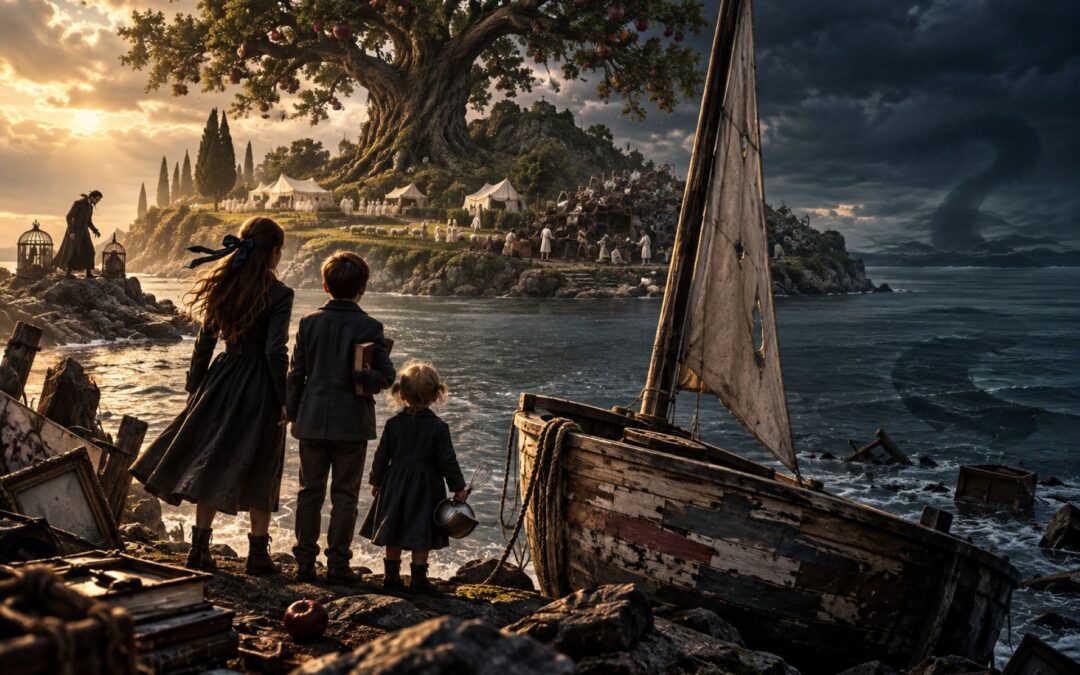
Published in 2006 as the thirteenth and final installment of A Series of Unfortunate Events, The End begins where The Penultimate Peril leaves Violet, Klaus, and Sunny Baudelaire: fugitives from a burning hotel, adrift at sea with Count Olaf, uncertain whether anyone they care about survived. After twelve books built around guardians, disguises, secret codes, fires, conspiracies, and the divided organization known as V.F.D., the finale radically contracts the world. The Baudelaires are deposited on an isolated island where Count Olaf is almost immediately neutralized and where, for the first time since losing their parents, the children appear to have found a place that can genuinely keep them safe.
That apparent refuge becomes the final moral test of the series. The island’s leader, Ishmael, has created a peaceful community by suppressing dangerous objects, discouraging curiosity, concealing history, intoxicating the inhabitants with coconut cordial, and persuading everyone that obedience is voluntary. The Baudelaires must therefore confront a question more difficult than simply defeating Olaf: whether a safe life is worth living if safety requires ignorance, conformity, and surrendering the abilities that make them themselves.
Spoiler warning: this article explains the complete plot and ending of The End, including the deaths of Count Olaf and Kit Snicket, the birth of Beatrice, Chapter Fourteen, and the mysteries the series deliberately leaves unresolved.
The End ultimately provides emotional and philosophical closure rather than a complete solution to the mythology accumulated across thirteen books. Violet, Klaus, and Sunny do not learn everything about V.F.D., their parents, the sugar bowl, their missing friends, or even what happens to themselves after the final page. What they gain instead is the ability to live responsibly without complete knowledge, to recognize the difference between protection and control, and to become guardians of another child rather than children endlessly searching for guardians of their own.

What Happens in The End: Complete Plot Summary
The novel begins immediately after the destruction of the Hotel Denouement and follows the Baudelaires through fourteen numbered chapters, the last of which takes place a year after the principal action. Although the island setting makes the finale appear smaller than the books that precede it, the story gathers together almost every major concern of the series: Count Olaf, V.F.D., the Baudelaire parents, the Medusoid Mycelium, the Quagmires, moral compromise, incomplete information, unreliable institutions, and the question of what it actually means for a story to end.
Adrift with Count Olaf: The Storm and the Island
Violet, Klaus, Sunny, and Count Olaf are adrift in the large wooden boat they used to escape the burning Hotel Denouement. They have little food besides a jar of white beans, no clear destination, and no reliable way to control the boat without wind. The gray weather reminds the children of Briny Beach, where they first learned that their parents had died in a fire, creating a deliberate echo between the beginning of the series and its approaching conclusion.
The children are also forced to reckon with what they themselves have become. Olaf brags about destroying the hotel, but Klaus records that the Baudelaires, not Olaf, actually started the fire in the laundry room. They are wanted for arson and murder, Dewey Denouement is dead after an accident involving the harpoon gun they were holding, and their attempt to expose the villains gathered at the hotel has ended in chaos. The distinction between the Baudelaire orphans and Count Olaf remains profound, but it is no longer as comforting or uncomplicated as it once seemed.
Sunny even suggests that they could push Olaf overboard. The idea forces the siblings to confront whether deliberately killing their enemy would make them more secure or simply bring them closer to the methods they despise. They have spent much of the series insisting that being noble means behaving differently from Olaf, yet recent events have taught them that moral choices often occur under pressure, with inadequate information and no clean alternative.
The boat itself offers another small mystery. It has carried different names, including Carmelita and Count Olaf, each nameplate covering another identity underneath. This layering anticipates one of the finale’s central ideas: every apparent beginning conceals an earlier story, every person carries histories others do not know, and every answer tends to reveal another unanswered question.
Before the Baudelaires can decide what to do with Olaf, a violent storm overtakes them. The boat is wrecked, and the children awaken on a broad coastal shelf surrounding an island. Objects from the wreck and from other shipwrecks are scattered across the shallow shore, immediately suggesting that isolation has never truly prevented the outside world from reaching this place.
The children meet Friday, a young islander who treats them with kindness and curiosity. Olaf attempts to assert authority as usual, but the pattern the Baudelaires have endured for twelve books suddenly fails. Friday recognizes him as unpleasant and threatening almost immediately and refuses to accept his claims of kingship or superiority.
For the Baudelaires, the reversal is startling. Again and again, supposedly responsible adults have dismissed their warnings about Olaf, fallen for transparently ridiculous disguises, or treated the children themselves as the problem. On the island, Olaf is initially the outsider whom no one trusts, while the children are invited into the community.
Friday explains that the islanders live according to customs overseen by a man named Ishmael, usually called Ish. Every year, when the sea rises and covers the coastal shelf, the community observes Decision Day. Anyone who wants to leave can eat a bitter apple and depart in a large outrigger; if everyone chooses to remain, the boat is destroyed and rebuilt for the next year’s decision.
The islanders wear simple white robes, drink coconut cordial, bathe in salt water, and collect objects that wash ashore after storms. Anything deemed troublesome or potentially divisive is carried away by wild sheep to an area called the arboretum. The system initially sounds peaceful, communal, and practical, especially after the Baudelaires’ exhausting encounters with corrupt schools, hospitals, villages, carnivals, mountains, submarines, and hotels.
Ishmael welcomes the children warmly but immediately introduces a contradiction that will define his leadership. He insists that he never forces anyone to do anything, yet his suggestions are treated as commands. When he indicates that Friday’s sunglasses are unnecessary, she gives them up; when he suggests that the Baudelaires wear robes and surrender objects associated with the outside world, the colony assumes that they will comply.
The Baudelaires conceal three possessions rather than surrendering them completely. Violet keeps the ribbon she uses to tie back her hair while inventing, Klaus keeps his commonplace book, and Sunny keeps a whisk Friday has secretly given her. Their decision mirrors the secret behavior Ishmael claims to be preventing: even before understanding the island, they learn that surviving within its peaceful social order requires private resistance.
Ishmael also appears to know more than he should. He recognizes the Baudelaire name and knows the children are orphans without being told their history. That knowledge disturbs them, but the possibility of belonging somewhere safe is powerful enough that they do not press the issue immediately.
Life Under Ishmael and the Return of Kit Snicket
For a time, island life genuinely improves the Baudelaires’ circumstances. They sleep safely, eat regularly, belong to a community, and do not have to spend every hour anticipating Count Olaf’s next scheme. They even give in to social pressure and drink some coconut cordial, despite finding both the beverage and the island’s bland food unpleasant.
Yet safety gradually begins to resemble stagnation. Violet would like to repair equipment, build a better water system, or work on the outrigger, but Ishmael directs her toward ordinary laundry work. Klaus wants books and hopes to record the island’s history, but Ishmael discourages the creation of a written record that might contain upsetting stories. Sunny, whose culinary skill has developed dramatically over the series, is given little opportunity to prepare anything beyond the colony’s standardized, unseasoned meals.
The problem is not simply boredom. The Baudelaires’ abilities have always been more than hobbies: Violet invents solutions when others are trapped, Klaus researches what others refuse to understand, and Sunny turns apparently inadequate ingredients into something useful. Ishmael’s version of safety deprives them of precisely the capacities that have allowed them to survive.
The island’s storm-scavenging ritual further reveals how conformity operates. When useful, interesting, pleasurable, or complex objects wash ashore, Ishmael usually finds reasons to discourage them. He rarely issues direct prohibitions; instead, he frames his preference as common sense, waits for the community to agree, and lets peer pressure complete the process.
Anything rejected is sent with the sheep to the arboretum. The result is that the colony looks simple not because simplicity has arisen naturally but because complexity is systematically removed from sight.
After several quiet days, another storm arrives. When the weather clears, the Baudelaires discover an extraordinary cube-shaped raft constructed from books. Lying unconscious on top is Kit Snicket, heavily pregnant, injured in both feet, and still recognizable by the V.F.D. eye tattoo on her ankle.
Kit’s arrival immediately reconnects the island with everything the Baudelaires thought they had escaped. She is Lemony Snicket’s sister, a V.F.D. volunteer, and one of the few adults the children have met who knows something about the larger organization and their friends. Her pregnancy also introduces a new life at the precise moment when the series appears to be approaching its end.
Another figure approaches from the sea wearing a tattered orange-and-yellow dress, seaweed arranged like long hair, and an absurdly swollen stomach. Count Olaf is attempting one last familiar tactic: disguise. He pretends to be a pregnant woman and tries to conceal the diving helmet containing Medusoid Mycelium beneath the false belly.
This time the deception collapses instantly. Friday recognizes Olaf, and Ishmael does not pretend to be fooled. He removes the seaweed wig, orders the harpoon gun taken away, and has Olaf locked inside a large bird cage that washed ashore in an earlier storm.
The Baudelaires experience an uncomfortable mixture of satisfaction and unease. They have wanted Olaf stopped for years, but imprisonment in a cage without any recognizable legal process does not resemble the justice they once imagined. Sunny herself was imprisoned in a bird cage during Olaf’s first scheme against them, and the symmetry forces the children to ask whether punishment becomes acceptable simply because the victim deserves punishment.
Olaf then retaliates by exposing the Baudelaires’ own secret possessions. Sunny’s whisk, Klaus’s commonplace book, and Violet’s ribbon become evidence that the children have violated island customs. Their neighbors initially defend them, but the appearance of the Incredibly Deadly Viper makes the atmosphere even more suspicious.
The snake’s frightening name is enough to alarm the colonists, although the Baudelaires know from The Reptile Room that the animal is harmless and affectionate. The episode repeats a pattern found throughout the series: labels often carry more social power than evidence.
Kit creates a similar problem. Her V.F.D. tattoo resembles Olaf’s, and Ishmael insists that another tattooed stranger should not automatically be welcomed. Olaf claims Kit as his girlfriend, which makes her seem even more suspicious to the colony.
Ishmael finally recommends abandoning Kit on the coastal shelf. The Baudelaires are told that they may remain part of the safe island community only if they leave their unconscious, pregnant friend behind.
The decision is decisive for their moral development. Violet, Klaus, and Sunny refuse. Whatever compromises they have made elsewhere, they will not purchase their own security with another person’s abandonment.
Ishmael again insists that he is forcing no one. He simply allows the rest of the colony to leave the Baudelaires, Kit, Olaf, the snake, and the raft of books on the shelf as the tide moves toward Decision Day.
As Ishmael departs, a small object drops from his robe. The Baudelaires later discover that it is an apple core. Something apparently trivial becomes the first concrete proof that the facilitator’s relationship to his own rules is not what it seems.
Exile, Mutiny, and the Secrets Beneath the Apple Tree
Stranded on the coastal shelf, the Baudelaires face a practical crisis. Once the water rises, they may have nowhere safe to stand, Kit cannot walk, and Olaf remains nearby in his cage. The children must decide whether to seek help from the colony, bargain with Olaf, or discover some other means of surviving.
The apple core immediately raises questions. The island’s apples are connected with Decision Day, and Ishmael does not publicly live according to the same customs he asks everyone else to follow. His secret eating resembles the very hidden possessions for which the Baudelaires were condemned.
Olaf recognizes an opportunity. He offers information if the children free him, promising that he knows things about the island, their parents, and V.F.D. that they desperately want to learn. He also reveals the threat hidden inside his costume: the diving helmet containing spores of the Medusoid Mycelium, the deadly fungus the Baudelaires encountered during their underwater journey.
His plan is simple and monstrous. He intends to use the fungus as a weapon, terrorize the islanders, seize control of the outrigger, and turn the colony into his own kingdom. The Baudelaires refuse to cooperate even though Olaf’s knowledge tempts them.
Their refusal matters because The End repeatedly distinguishes between valuing truth and believing that every means of obtaining truth is acceptable. Klaus especially wants complete explanations, but the siblings understand that knowledge purchased through mass poisoning would reproduce the moral logic they are trying to escape.
Kit eventually regains consciousness. She has heard stories of the island from other V.F.D. associates, but those stories describe a very different place: mechanical wonders, an enormous library, sophisticated food, and a culture far richer than the austere colony the Baudelaires have experienced. She has also heard of an island schism, suggesting that the apparent simplicity around them is the result of historical conflict rather than timeless custom.
Kit does not yet know what happened at the Hotel Denouement. She believes the Baudelaires successfully warned the volunteers away and assumes Dewey may still be alive. The children cannot bring themselves to correct her.
Their silence is another sign of how far they have moved from the moral simplicity of the early books. They are not lying to steal a fortune or exploit anyone, but they are withholding painful truth because they cannot bear to tell it. The distinction between noble and wicked behavior has not vanished, yet their experiences have made it increasingly difficult to judge actions without considering motives and circumstances.
That night, two islanders secretly approach: Finn and Erewhon. They bring food, use a forbidden flashlight, and ask that their visit remain hidden from Ishmael.
Their conversation reveals that private disobedience is widespread. Islanders secretly retain possessions, learn prohibited skills, eat food they prefer, and trade favors outside the official customs. The colony is therefore not a harmonious society whose members genuinely agree with Ishmael; it is a society in which disagreement has been driven underground.
Kit also learns that Miranda Caliban and her daughter Friday live on the island. When the colonists claim Miranda’s husband Thursday died long ago, Kit insists that she has recently shared coffee with him. The contradiction exposes another protective falsehood embedded in island life.
Finn and Erewhon finally reveal why they have come. A mutiny is planned for Decision Day. Many islanders are tired of Ishmael’s control and intend to force him onto the outrigger and remove him from the colony.
The rebels want the Baudelaires’ help. Specifically, they want Violet, Klaus, and Sunny to enter the arboretum, find or construct weapons, and prepare for the possibility that Ishmael and his supporters will resist.
Kit objects immediately. She does not want the children’s abilities used for violence, but the situation is deliberately difficult. Finn and Erewhon promise to help Kit if the Baudelaires help the rebellion, and the children know that remaining passive may leave their injured friend in mortal danger.
The rebels’ language also begins to resemble Ishmael’s. They say the Baudelaires have a choice, yet the available alternatives leave almost no meaningful freedom. A movement formed to resist coercion is already using its own form of pressure.
The siblings reluctantly agree to enter the arboretum. Once there, they discover the physical evidence of everything Ishmael has removed from island life.
The arboretum is filled with detritus: books, machinery, tools, culinary ingredients, theatrical objects, scientific equipment, furniture, and the accumulated remains of countless shipwrecks. The place initially appears chaotic, but to Violet, Klaus, and Sunny it is almost a restoration of identity.
Violet sees materials from which she could build. Klaus finds books and records. Sunny discovers ingredients and cooking equipment. The talents Ishmael discouraged awaken immediately when the children are placed again in a world containing possibility.
The Incredibly Deadly Viper leads them toward a gap beneath the roots of the island’s enormous apple tree. Following footprints marked by the clay supposedly covering Ishmael’s injured feet, they descend into a concealed room.
The chamber exposes the full scale of Ishmael’s hypocrisy. It contains a sophisticated library, a well-equipped kitchen, tools, comfortable reading chairs, and an enormous periscope. Ishmael has privately retained access to precisely the kind of knowledge, technology, pleasure, and complexity he asks everyone else to abandon.
The periscope also explains his supposed ability to predict storms. What the islanders treat as extraordinary insight is partly information monopolized by their leader.
The greatest discovery is an enormous commonplace book containing the island’s history. Recent entries prove that Ishmael knew about Kit and Olaf even when he claimed ignorance. Older entries reveal handwriting the Baudelaires recognize as their mother’s.
Ishmael arrives and finally begins explaining the history he has kept from them. Years earlier, the Baudelaire parents themselves lived on the island and served as facilitators while Violet’s mother was pregnant with her.
Their version of island life was radically different. They helped build or improve a freshwater system, established the library, expanded the underground space, encouraged better food, used the periscope to monitor storms, and contributed to the written record. They wanted to connect the island with other places, including Anwhistle Aquatics, rather than permanently seal it away.
Their ambitions divided the colony. Some residents wanted knowledge, technology, and continued engagement with the world; others wanted complete isolation from the dangers associated with those things. The disagreement became another schism.
Ishmael arrived during this crisis and eventually helped persuade the islanders to expel the Baudelaire parents. They left with several companions, abandoning much of what they had created behind them.
Afterward, Ishmael reorganized island society around the prevention of future conflict. Objects capable of producing disagreement were removed. Food and clothing became standardized. Complicated histories were suppressed, technology disappeared from ordinary use, and the colony was encouraged to forget the world beyond the sea.
His most disturbing confession concerns the coconut cordial. The fermented drink has an opiate-like effect, making the colonists drowsier, less active, more forgetful, and less inclined to question what they are missing. What appears to be cheerful communal custom is therefore reinforced chemically.
Ishmael also confirms that people have left the island. Thursday did not simply die as Friday has been led to believe; he departed with others. The lie has been preserved because Miranda believes the simplified story protects her daughter from painful complications.
The Baudelaires also receive an ornate ring marked with the letter R. Ishmael traces its movement through the Duchess of Winnipeg, the Snicket family, the Baudelaire parents, Captain Widdershins, and eventually the island. The exact object matters less than what its history demonstrates: the children’s parents possessed entire networks of relationships and experiences that they never explained to their children.
Ishmael uses this secrecy to defend himself. If the Baudelaire parents truly wanted Violet, Klaus, and Sunny to know everything, he argues, they would have told them everything. Their silence becomes evidence, in his interpretation, that loving parents protect children by limiting what children know.
He offers the Baudelaires a place under his care. They can forget Olaf, V.F.D., crimes, fires, mysteries, dangerous inventions, complicated books, and gourmet cooking. They can stop asking questions and remain somewhere safe.
The offer is not absurd. That is why it is dangerous. After everything the Baudelaires have endured, a simple life without villains or investigations has genuine emotional appeal.
Yet the children now understand its price. To remain permanently would mean accepting someone else’s decision about what they are allowed to know, remember, create, and become.
The Schism, the Medusoid Mycelium, and the Bitter Apples
When the Baudelaires return from the arboretum, the island’s hidden conflicts are exploding into the open. The planned mutiny has drawn out years of concealed grievances, and islanders begin admitting to the hobbies, possessions, preferences, and disagreements they have hidden under white robes and polite conformity.
The speed with which the community fractures exposes a fundamental weakness in Ishmael’s system. He has prevented open disagreement without resolving any of the disagreements themselves. Suppression has produced secrecy, resentment, and eventually another schism very much like the ones he hoped to prevent.
Friends and relatives begin choosing sides. Coconut cordial remains available, but the drink cannot restore unity once the colonists recognize how thoroughly they have been controlled.
Count Olaf then enters the conflict. The mutineers have freed him from the bird cage, believing he can help remove Ishmael, and Olaf immediately attempts to place himself above everyone else.
He reveals that he and Ishmael have a history. Olaf also points out that beneath the clay covering Ishmael’s feet is the familiar V.F.D. eye tattoo, proving that the facilitator has concealed his own connection to the organization while condemning or distrusting others for the same mark.
Ishmael’s response destroys one of his remaining claims to moral superiority. He has presented himself as a man who rejected violence, but when confronted with Olaf he rises from his chair, revealing that his feet are not incapacitated, obtains the confiscated harpoon gun, and announces his intention to kill him.
Olaf still has the Medusoid Mycelium hidden beneath the bulging dress. When Ishmael fires, the harpoon strikes the false pregnancy and shatters the glass helmet.
The spores are released into the air.
At that instant, the schism becomes irrelevant. Supporters of Ishmael, mutineers, Baudelaires, villains, adults, and children have inhaled the same poison. An ideological struggle over who should control the island is replaced by a biological emergency that does not care which side anyone chose.
The symptoms begin rapidly. The fungus grows inside the victims’ respiratory systems and will soon prevent them from breathing.
The Baudelaires remember the coded rhyme they learned during their previous encounter with the Medusoid Mycelium. The poison can be counteracted by the “root of horse,” meaning horseradish.
Ishmael continues urging the islanders toward coconut cordial and away from the Baudelaires. Even during a crisis created partly by his own violence, he treats dissent as the primary danger.
The children reveal that the arboretum contains the hidden resources Ishmael denied existed. They tell the colonists about the kitchen and the library and insist that there may be an antidote among the accumulated detritus. Ishmael rejects their account and the community once again follows his authority.
Violet, Klaus, and Sunny retreat to the secret space beneath the apple tree while their breathing becomes increasingly difficult. They search the kitchen desperately but cannot find usable horseradish.
Klaus turns to the historical records. The answer is not an ingredient sitting conveniently on a shelf but a piece of knowledge preserved by their parents.
Years earlier, the Baudelaire parents anticipated the possibility that the Medusoid Mycelium might reach the island. They hybridized horseradish into the roots of the bitter apple tree so that the apples themselves would contain the antidote.
The revelation brings together the children’s defining abilities and their parents’ legacy. Klaus’s research locates the information, Violet and Sunny understand how it can be used, and a preparation made before the children knew they were in danger becomes the means of saving them.
As the fungus approaches a fatal stage, the Incredibly Deadly Viper appears carrying one of the apples. Violet, Klaus, and Sunny eat it.
The antidote works.
The bitter fruit contains enough horseradish to destroy the fungus growing inside them, and the Baudelaires can breathe again. Their parents have not returned, but knowledge their parents left behind has reached them exactly when they need it.
Deaths, Birth, and the End of Chapter Thirteen
Once cured, the Baudelaires immediately think of everyone else. They collect apples for the islanders and prepare to distribute them before the poison becomes fatal.
Using the hidden periscope, however, Violet sees that the colonists are already leaving. Ishmael has persuaded them to board the outrigger and seek a horseradish source elsewhere rather than trust the Baudelaires’ forbidden apples.
The children rush toward the coastal shelf carrying a stockpot filled with fruit. Kit is still on her raft of books and has begun going into labor, while the poisoned islanders push their boat toward open water.
The Baudelaires try to explain the cure. Ishmael refuses to accept it publicly and maintains that the colony will travel to a place where horseradish can be obtained in a more acceptable way.
The hypocrisy becomes almost complete when the children realize that Ishmael himself has eaten an apple. He has privately accepted the cure while denying it to the people who trust him.
Friday is torn between the Baudelaires and her family. Klaus begins to reveal that her father Thursday is alive, but Miranda stops him. Friday chooses the boat because she cannot bear the possibility of losing more of her family.
The Baudelaires face another impossible decision. They could attempt to pursue the islanders, but Kit is in labor and urgently needs all three of them. Eventually they allow the outrigger to depart.
The Incredibly Deadly Viper soon disappears. Snicket cannot establish what happens next, but the circumstances suggest a possible path to survival: the snake could carry a bitter apple to the boat, allowing the colonists to share the antidote. The novel deliberately refuses to confirm whether this happens.
The uncertainty is characteristic of the finale. The islanders are neither definitely saved nor definitely killed. Their story simply moves beyond the narrator’s knowledge.
Kit’s situation is more immediate. The Baudelaires offer her an apple, but she refuses because something in the hybrid could harm her unborn child. Violet then understands why her mother, pregnant with Violet while helping develop the antidote, never ate the apples herself.
Kit’s pregnancy therefore turns the cure into another morally complicated choice. What saves one life may endanger another.
As the children maneuver Kit’s raft toward shore, she finally tells them what happened after she separated from them. Quigley Quagmire reached the self-sustaining hot-air mobile home and reunited with his siblings Duncan and Isadora and with Hector. Together they fought the treacherous eagles.
Kit meanwhile encountered Captain Widdershins and his stepchildren, Fiona and Fernald. Despite Fiona and Fernald’s earlier choices, Widdershins had forgiven them, and the group attempted to repair the submarine Queequeg and reach the Quagmires.
Their rescue effort ended disastrously. The eagles punctured the balloons supporting the mobile home, which fell into the sea and collided with the Queequeg. The survivors were left among the wreckage.
Then something enormous approached from beneath the water. Its shape resembled a question mark.
Kit identifies it as the Great Unknown, a name her brother used for the mysterious phenomenon. She has no explanation of whether it is a creature, machine, danger, rescue, or something else entirely.
Terrified, she constructed a Vaporetto of Favorite Detritus from books she valued. She invited the others to join her, but they chose to take their chances with the Great Unknown. Only the Viper, whom Kit calls Ink, reached the raft.
The others vanished. Kit cannot tell the Baudelaires whether the Great Unknown swallowed them, rescued them, or carried them somewhere else.
She heard one of the Quagmire brothers call Violet’s name but cannot determine whether it was Quigley or Duncan. The uncertainty is especially painful because the series has repeatedly encouraged readers, like the Baudelaires, to expect that enough investigation will eventually transform missing information into answers.
Kit believes the children succeeded at the Hotel Denouement and expects someday to see Dewey again. The Baudelaires can no longer maintain their silence.
They confess that they started the hotel fire and do not know who escaped. They tell Kit that Dewey is dead.
The disclosure releases grief the characters have postponed for much of the book. Kit mourns her failures, the Baudelaires mourn theirs, and together they cry not only for Dewey but for the Quagmires, their lost guardians, their friends, their associates, and finally the Baudelaire parents.
Kit’s story makes the children accept something they have resisted throughout their travels. Their parents are not secretly waiting at the end of a clue trail. Whatever secrets remain about them, Violet, Klaus, and Sunny will remain orphans.
Kit is also exhausted by loss. She speaks of her parents, her brothers, her true love, and everyone who has disappeared from her life.
Violet shows her the ornate R ring, demonstrating that objects and relationships thought lost sometimes return in unexpected ways. Kit asks that the ring eventually go to her child, allowing another inherited history to continue.
She also asks the Baudelaires to name the baby for one of their dead parents. The children promise that if Kit dies, they will raise the child themselves.
The reversal is profound. For thirteen books, Violet, Klaus, and Sunny have moved from one failed guardian to another, repeatedly asking adults to believe them, protect them, or take responsibility. On the island, still legally and emotionally children themselves, they agree to become responsible for someone even more vulnerable.
Yet Kit still has to survive the birth long enough for the baby to be delivered, and she cannot move safely without help. The only other adult nearby who might be physically strong enough to carry her is Count Olaf.
The Baudelaires find him gravely wounded by Ishmael’s harpoon and suffering from the fungus. Even in this condition Olaf remains bitter, selfish, and obsessed with the Baudelaire fortune.
The children confront him with the question they have carried since the beginning: whether he caused the fire that killed their parents. Olaf does not give them the clean confession or denial that would resolve the mystery.
Instead, he tells them they still do not understand everything and compares them to their parents. He appears ready simply to die where he lies until he hears that Kit is in labor.
At the sound of Kit’s name, something changes. Olaf takes one of the apples, curing the fungal infection even though the harpoon wound remains fatal, and staggers into the water.
He lifts Kit from the raft and carries her onto the beach. Then, to the Baudelaires’ astonishment, he kisses her.
Their exchange reveals a past intimacy that the series has only partially exposed. Kit calls Olaf wicked and makes clear that one kind act does not erase his failures. Olaf, equally importantly, does not apologize or claim redemption.
They recite remembered poetry to one another, suggesting a shared intellectual and emotional history beneath years of schism and violence. Olaf’s final moments reveal that he has lost parents, people he loved, associates, status, money, and whatever version of himself existed before he became the villain the Baudelaires knew.
None of this excuses what he has done. The novel refuses both easy condemnation that denies his humanity and easy redemption that would erase his crimes.
Olaf dies from his wound on the beach.
His death does not immediately become the center of the scene because Kit’s labor is continuing. The Baudelaires turn from the end of one life toward the arrival of another.
After a difficult night, Kit gives birth to a girl. Kit herself dies shortly afterward.
The baby is named after the Baudelaires’ mother: Beatrice.
The series that began with Violet, Klaus, and Sunny becoming orphans now places another orphan in their arms. Their history has not led them back to childhood security; it has pushed them into responsibility.
During the following year, the Baudelaires remain on the island and raise Beatrice. Violet designs equipment for caring for her and maintains the island’s systems. Klaus researches childcare and continues studying the records beneath the apple tree. Sunny milks the sheep, prepares food, and applies the culinary skills Ishmael once suppressed.
Together they plant bitter-apple seeds around the island to guard against any remaining Medusoid Mycelium. They read from the enormous island history and add entries of their own.
The siblings find many answers in the book their parents helped create. Yet every answer produces further questions, and this no longer torments them as intensely as it once would have. Their year with Beatrice teaches them that responsibility cannot wait until everything is known.
They also visit the graves of Kit and Count Olaf. Their treatment of the two graves is different, but both remain part of the landscape of their lives.
One Year Later: Chapter Fourteen and the Final “Beatrice”
Chapter Fourteen takes place nearly a year after Beatrice’s birth and functions as the true coda of both the novel and the series. Its most important revelation comes from the last surviving entry written by the Baudelaire parents in the island’s commonplace book.
The parents explain why they chose to leave. Other islanders believed the colony should remain separated from the treachery of the world, but the Baudelaire parents concluded that this supposedly safe place had become dangerous precisely because it demanded such separation.
They recognized that no parent can permanently shelter a child. Instead of hiding their children from the world forever, they decided to immerse themselves in it.
The entry also contains an intimate piece of family history. While expecting their first child, the parents planned to name a daughter Violet and a son Lemony. Violet, Klaus, and Sunny laugh at the thought of “Lemony Baudelaire,” but the detail reinforces how much of their parents’ personal world they never knew.
More importantly, the entry changes how the children interpret Ishmael. He had claimed their parents’ secrecy proved that they would have wanted the children protected through ignorance. Their own words reveal a different conclusion.
The Baudelaire parents did withhold many things, but they ultimately rejected permanent isolation. They believed growing children needed to enter the world rather than remain protected from all risk.
Violet, Klaus, and Sunny now face the same decision on behalf of Beatrice. The island contains food, books, tools, shelter, clean water, and almost everything they might need physically. After everything they have suffered, they could remain there indefinitely.
But Beatrice is already exploring, learning, and becoming curious. The siblings recognize that keeping her safe forever would eventually require imposing the same limits Ishmael imposed on the islanders.
They decide to leave.
The preparation for departure demonstrates how completely their talents have returned. Sunny packs provisions and even includes luxuries. Klaus gathers maps and useful books. Violet repairs and equips a boat.
The vessel she chooses is the same one that originally carried the Baudelaires and Olaf to the island. When Violet removes the Count Olaf nameplate, she discovers an older name beneath it.
The precise discovery is initially withheld from the reader. Another mystery has been answered for the characters, but another history has opened underneath the answer.
Before departing, the Baudelaires leave the island’s commonplace book behind. Another castaway may someday arrive and continue the record. History belongs to whoever comes next as much as to the people who wrote the previous pages.
The children load the boat while the coastal shelf begins to flood. Beatrice crawls toward them after saying goodbye to her mother’s grave.
Snicket then acknowledges that his investigation can no longer follow them. Rumors claim that the Baudelaires later rejoined V.F.D. under other names, while other rumors say that they died at sea. Neither possibility is confirmed.
The narrator therefore ends his chronicle not because the Baudelaires’ lives objectively stop but because his access to their lives stops.
As Beatrice reaches the boat, she looks at the uncovered nameplate. She says a single word.
“Beatrice.”
The Baudelaires cannot determine whether she has read the boat’s name or merely spoken her own. The reader cannot determine it either.
That uncertainty is the final secret of the series. A single word simultaneously points backward toward the Baudelaire mother, outward toward another hidden chapter of the parents’ history, and forward toward the child carrying the name into a life the narrator will not chronicle.
The Island: Setting, Society, and the Illusion of Safety
The island is the most important setting in The End because it functions simultaneously as refuge, trap, social experiment, archive, and miniature version of the larger V.F.D. conflict. Unlike most earlier locations in the series, it does not depend on Count Olaf for its danger. The island already contains its own history of schism, secrecy, authority, exclusion, and fear long before he arrives.
Physically, it is designed around recurring cycles. A broad coastal shelf is exposed for most of the year but floods on Decision Day, creating a natural deadline for anyone who wants to leave. Storms continuously wash objects and occasional castaways onto the shore, while the islanders gather the debris and decide what can remain.
This geography undermines Ishmael’s entire political project. He wants the island to stand apart from the treacherous world, yet the sea continually delivers pieces of that world to him. Books, weapons, inventions, clothing, food, people, news, histories, and dangerous substances all arrive whether the colonists want them or not.
The islanders respond by sorting complexity rather than eliminating it. Objects judged harmless are incorporated into daily life, while potentially disruptive objects are carried by sheep to the arboretum. The simplicity visible in the colony is therefore manufactured by hiding complexity somewhere else.
The arboretum is the island’s repressed memory made physical. Everything officially unnecessary still exists there: books, machinery, art, tools, ingredients, furniture, records, and the accumulated remains of other lives. It resembles a junkyard until the Baudelaires enter it, at which point each child immediately recognizes possibility.
The hidden room beneath the apple tree makes the contradiction even sharper. Ishmael privately maintains a library, cooking facilities, tools, and the periscope he uses to forecast weather while publicly encouraging everyone else to live without such things. Knowledge is not abolished; it is centralized.
The social system operates the same way. Ishmael rarely issues a direct order and repeatedly insists that he will not force anyone to obey him. Yet his position, language, control of information, and ability to define what counts as sensible create powerful pressure to conform.
This makes his authority more interesting than a simple dictatorship. The islanders participate in their own control. They repeat Ishmael’s phrases, discourage one another from dissent, surrender possessions voluntarily in the narrowest sense, and police behavior through collective expectations.
The coconut cordial strengthens the system. Once Ishmael reveals that the fermented drink functions as an opiate, the colony’s tranquility becomes impossible to treat as purely social consensus. Residents are being made drowsier, more passive, more forgetful, and less likely to dwell on what they have lost.
Yet the novel avoids making the island completely sinister. The Baudelaires really are safer there for a time. People feed them, give them shelter, recognize Olaf as dangerous, and include them in communal life. After everything they have endured, the appeal of the place is entirely understandable.
That genuine appeal is essential to the book’s argument. If the island were merely an obvious prison, rejecting it would require no growth. The Baudelaires have to reject something they legitimately desire because they eventually understand that physical safety cannot compensate for permanent intellectual and moral dependence.
The colony’s earlier history reinforces the point. Under the Baudelaire parents and other facilitators, the island had books, technology, better food, freshwater systems, and greater engagement with the outside world. Those very possibilities created disagreements about how much contact the island should maintain.
The ensuing schism persuaded Ishmael that difference itself was the problem. His solution was to eliminate the conditions under which people might disagree.
The result is an apparent peace that cannot survive exposure to honest differences. Finn and Erewhon secretly retain forbidden preferences. Miranda hides the truth about Thursday from Friday. Other residents conceal possessions and interests. Once the mutiny begins, the colony fractures almost instantly.
The island therefore repeats the wider pattern of V.F.D. in compressed form. An organization or community begins with some ideal of service and cooperation, factions disagree over methods, fear deepens division, and eventually each side justifies increasingly questionable behavior as necessary protection against the other.
Olaf is part of this pattern, but he is not its sole cause. Removing him from the island would not repair the political structure that produced the mutiny.
That distinction is one of the finale’s most mature departures from the earliest books. The Baudelaires’ world cannot be made safe simply by identifying one villain and defeating him. People who sincerely want to protect others can also create dangerous institutions when fear becomes the organizing principle of their decisions.
Character Analysis
By stripping away much of the series’ sprawling cast, The End concentrates attention on what its central characters have become after thirteen books. The island places Violet, Klaus, Sunny, Count Olaf, Kit Snicket, and Ishmael inside a much smaller moral arena, making their choices more important than elaborate disguises or puzzle-solving alone.
Violet, Klaus, and Sunny Baudelaire
Violet, Klaus, and Sunny remain distinct characters, but the finale increasingly treats their greatest strength as the way their abilities complement one another. They begin the series as children with specialized talents and end it as a functioning family capable not only of surviving but of caring for someone else.
Violet’s inventiveness has always been the most visibly practical of the three gifts. When circumstances become desperate, she can examine apparently useless materials and imagine machines, structures, or tools that do not yet exist.
The island demonstrates what happens when that capacity is denied. Ishmael gives Violet routine work and discourages invention because new devices could create differences in comfort, power, or opinion. She is safer but diminished.
The arboretum reverses this condition. Surrounded by discarded machinery and tools, Violet immediately begins imagining what she could build. Later, once Beatrice is born, she uses the same talent to construct childcare equipment, maintain the island, repair the departing boat, and create life jackets.
Her final development therefore does not consist of abandoning invention for maturity. She learns to use invention in the service of sustained responsibility rather than emergency escape alone.
Klaus has spent the series believing that information can solve problems. Books repeatedly allow him to decode clues, identify poisons, challenge fraudulent adults, expose disguises, and understand institutions that would otherwise overpower the children.
The End tests that faith more severely than any previous volume. The island contains an enormous book of history, but even that book does not explain everything. Kit’s account of the Great Unknown likewise ends in uncertainty, and Snicket’s narration openly admits that many stories continue beyond his research.
Klaus’s growth lies not in giving up his love of knowledge but in abandoning the expectation that knowledge will ever become total. He still researches the Medusoid Mycelium cure, childcare, navigation, and the island’s past. What changes is his relationship to unanswered questions.
By the final chapter, uncertainty no longer prevents action. Klaus can gather the best available information, acknowledge what he does not know, and still leave the island.
Sunny undergoes perhaps the largest visible development across the series. She began as an infant whose unusual teeth were treated almost as a comic trait, but by The End she is a capable cook, perceptive conversationalist, and increasingly independent moral participant.
Her cooking becomes especially important on the island because Ishmael’s bland cuisine is another form of enforced sameness. Sunny understands food as creativity, pleasure, culture, and care. The difference between repetitive island meals and the elaborate kitchen hidden beneath the apple tree represents a difference between mere survival and a richer human life.
After Beatrice’s birth, Sunny’s culinary abilities become caregiving skills. She milks sheep, prepares food for the baby, and later provisions the family’s journey away from the island.
The siblings’ collective arc is even more significant than their individual development. At the beginning of The Bad Beginning, they are children waiting for adults to determine where they will live and who will care for them. Every subsequent book gives them another reason to distrust that arrangement.
Some guardians are kind but powerless. Others are foolish, frightened, corrupt, self-absorbed, or dead before they can offer lasting safety. Institutions repeatedly fail them because adults value procedure, reputation, convenience, prejudice, or fear more than the children’s testimony.
In The End, that pattern finally changes. Violet, Klaus, and Sunny still need help, but the arrival of Beatrice places another person in a condition more dependent than their own.
When they promise Kit they will raise her child, they stop waiting for a perfect guardian to appear. They become guardians themselves.
The transition does not magically make them adults. The novel repeatedly reminds us that they are still children, and there is something deliberately unsettling about how much responsibility has been forced upon them.
Yet their competence has been earned across the entire series. They know how to improvise, research, cook, protect one another, recognize manipulation, admit failure, mourn loss, and continue making decisions without certainty.
Beatrice’s survival becomes the final demonstration that these skills have matured from tools of escape into tools of care.
Ishmael
Ishmael is an effective final antagonist because he is almost the inverse of Count Olaf. Olaf openly wants power, wealth, revenge, and obedience. Ishmael describes his own authority as protection, common sense, community harmony, and voluntary agreement.
He is therefore more difficult to dismiss. Much of what he fears is real.
The world outside the island truly is dangerous. The Baudelaires have been hunted, framed, kidnapped, betrayed, nearly murdered, and repeatedly failed by institutions. V.F.D. really did suffer destructive schisms, and technological or intellectual sophistication has not made its members morally wise.
Ishmael’s error is not recognizing danger. It is concluding that the answer to danger is to eliminate meaningful choice.
His repeated insistence that he does not force people is central to his characterization. He understands coercion so narrowly that he can sincerely deny using it while designing an entire culture around social pressure.
When everyone dresses alike, eats alike, drinks the same opiate-laced cordial, lacks access to books and tools, receives history through one gatekeeper, and risks communal rejection for dissent, formal freedom means very little. Ishmael’s leadership demonstrates how control can operate without obvious commands.
His hidden chamber makes the hypocrisy undeniable. He knows books are useful because he reads them. He knows tools are useful because he keeps them. He knows the periscope is useful because it gives him information. He knows the bitter apples are useful because he eats them.
What he denies is not the value of knowledge but other people’s right to possess it.
The Medusoid Mycelium crisis exposes the final contradiction. Ishmael built his identity around preventing violence and schism, but when Olaf challenges him he uses the hidden harpoon gun and attempts to kill him. His act accidentally releases the fungus and endangers the entire colony.
The episode does not prove that Ishmael was secretly identical to Olaf all along. That would flatten the character and the novel’s argument.
Ishmael genuinely wants people to be safe. He also becomes willing to manipulate, drug, deceive, exile, and eventually kill in order to maintain the social order he believes safety requires.
His tragedy is that he becomes dangerous by treating fear of danger as the highest political principle.
Count Olaf
Count Olaf enters The End diminished. He still boasts, threatens, disguises himself, and plots domination, but the world no longer bends around his theatrical performances as easily as it once did.
Friday recognizes him. Ishmael recognizes him. His pregnancy disguise is ridiculous even by the standards of his earlier disguises, and much of his power has been reduced to one dangerous object hidden under a dress.
The island therefore strips away some of Olaf’s mythology. For twelve books he has often seemed almost supernaturally capable of reappearing wherever the Baudelaires go. Here he is increasingly revealed as a wounded, aging man whose history with V.F.D. predates the children’s understanding of him.
That history matters because it complicates without excusing him. Olaf knew Ishmael before the Baudelaires reached the island. He knew Kit Snicket intimately. His references to lost parents, lost love, dead associates, and V.F.D. suggest that he too was shaped by the schism that destroyed so many relationships around him.
The Baudelaires’ question about their parents’ fire represents the kind of answer readers might expect from a conventional finale. Olaf is dying; surely he can finally confess everything.
Instead, he refuses to provide the clean resolution. The children’s belief that he caused the fire may be reasonable, but The End does not transform it into an explicit confession.
His last significant action is helping Kit. When the Baudelaires tell him she is giving birth, Olaf takes the antidote, carries her from the raft, and kisses her.
The gesture is kind. It is also insufficient.
Kit immediately refuses the logic of redemption through one dramatic act. She does not deny that Olaf has done something good, but neither does she allow that good act to cancel his crimes.
Olaf himself does not apologize. His death therefore avoids one of the easiest sentimental endings available to the novel.
He is not revealed to have secretly been noble. He does not reconcile with the Baudelaires. He does not return their losses or repair the people he harmed.
What the scene restores is his humanity, not his innocence. Olaf dies as a person capable of both cruelty and tenderness, shaped by losses he never learned to transform into anything better.
That complexity fits the moral direction of the final books. The Baudelaires have learned that people are not divided neatly into noble volunteers and wicked villains, but the collapse of simple categories does not mean judgment becomes impossible.
Olaf has suffered. Olaf has loved. Olaf can do one good thing.
He is still responsible for the terrible things he chose to do.
Kit Snicket, Friday, and the Island Community
Kit Snicket acts as the final bridge between the Baudelaires’ immediate story and the immense world beyond the island. She brings knowledge of V.F.D., the Quagmires, Widdershins, Fiona, Fernald, the Great Unknown, and the island’s earlier history, but almost every piece of information she provides remains incomplete.
Her condition makes that incompleteness emotionally powerful rather than merely frustrating. Kit is injured, pregnant, exhausted, grieving, and convinced that she has failed people she wanted to protect. She cannot deliver an omniscient explanation because she herself has lived through confusion and loss.
Her relationship with Olaf provides one of the novel’s most striking glimpses into the unseen prehistory of the series. Their final kiss makes clear that their lives were once connected intimately, perhaps before schism and accumulated betrayal made them enemies.
Kit nevertheless refuses to rewrite Olaf’s history simply because he helps her. Her ability to recognize one act of kindness without confusing it with absolution reflects the moral sophistication the Baudelaires themselves are learning.
Her death also completes the transfer between generations. Kit brings Beatrice into the world but cannot remain to raise her. The responsibility passes to Violet, Klaus, and Sunny.
Friday represents the island’s dilemma from a child’s perspective. She is kind to the Baudelaires from the beginning, secretly helps Sunny retain the whisk, and is willing to question certain customs, yet she also loves her mother and belongs to the only community she has known.
Her belief that Thursday died demonstrates how protective lies can shape a child’s entire understanding of family history. Miranda apparently believes concealment has spared Friday pain, but the result is that Friday makes major choices without access to relevant truth.
When the islanders leave, Friday cannot simply abandon her mother because the Baudelaires possess better information. Her decision is emotionally understandable even though it may be dangerous.
The wider island community is similarly important because the residents are not presented as uniformly foolish or malicious. Many secretly resist Ishmael. Others value peace because they have experienced disasters before reaching the island.
Their weakness is collective rather than individually villainous. Peer pressure allows people who privately disagree with a system to reproduce it publicly.
Once enough inhabitants break that pattern, however, they do not automatically become wise. The mutiny creates its own pressure, threatens violence, and demands that the Baudelaires choose sides.
The islanders therefore embody one of the book’s hardest ideas: escaping one form of conformity does not guarantee moral clarity. People can oppose a coercive system and still imitate its methods.
Major Themes and Ideas
The End condenses themes scattered throughout the previous twelve books into a single conflict between the island’s promise of safety and the larger world’s unavoidable complexity. Rather than solving the V.F.D. mythology piece by piece, the finale asks what kind of person can live ethically in a world where knowledge is incomplete, institutions fail, people contain contradictions, and danger cannot be abolished.
Safety vs Freedom, Knowledge, and Complexity
Safety is not treated as foolish or cowardly in The End. The Baudelaires have spent the entire series needing it, and the island initially gives them something no previous guardian or institution managed to provide: several uninterrupted days in which nobody is actively trying to exploit or kill them.
This makes Ishmael’s offer psychologically credible. Violet, Klaus, and Sunny are exhausted.
Their rejection of the island cannot therefore mean that danger is preferable to safety. What they reject is a version of safety that requires them to surrender autonomy.
Violet must stop inventing. Klaus must stop reading and recording. Sunny must stop experimenting with food. Everyone must accept a simplified history, wear similar clothing, drink the same cordial, and treat the facilitator’s preferences as collective wisdom.
The hidden arboretum demonstrates why this system is unsustainable. Complexity has not disappeared; it has merely been relocated.
Books are still useful. Machines are still useful. Spices still taste good. History still happened. Storms still arrive, and wreckage still washes ashore.
Ishmael’s strategy is therefore less a successful escape from the world than a prolonged attempt not to look at it.
The Baudelaires’ final choice in Chapter Fourteen is the clearest response. They spend a year enjoying genuine safety on the abandoned island and then voluntarily leave despite knowing how dangerous the world can be.
Their choice is not reckless. They prepare food, maps, equipment, blueprints, and life jackets. The opposite of Ishmael’s protective ignorance is not careless exposure to danger; it is informed preparation.
That distinction captures much of the book’s final ethical position. A meaningful life requires accepting some uncertainty while developing the skills needed to navigate it.
Parents, Protection, and Preparing Children for the World
The entire series begins with the sudden destruction of the protective world created by the Baudelaire parents. From that point forward, Violet, Klaus, and Sunny are repeatedly placed under adults who are supposed to replace that protection and repeatedly fail.
The End complicates the original family as well. The children discover that their parents were deeply involved in V.F.D., lived on the island, participated in disputes, knew people the children later encountered, and concealed enormous portions of their history.
Ishmael interprets this secrecy as proof that the Baudelaire parents agreed with his philosophy. Loving adults, in his view, keep frightening information away from children.
His interpretation is plausible enough to disturb Violet, Klaus, and Sunny because their parents undeniably withheld the truth.
Chapter Fourteen provides the corrective. The parents’ own final island entry acknowledges the desire to shelter their children but rejects the fantasy that permanent shelter is possible.
They decide to leave because the safe island has become dangerous in another sense. Children who never encounter complexity cannot learn how to function within it.
The Baudelaires repeat this realization when raising Beatrice. They could keep her on an isolated island containing almost everything necessary for physical survival, but doing so would eventually require choosing which truths, dangers, histories, and experiences she was allowed to encounter.
They refuse to reproduce Ishmael’s system.
This does not mean they tell Beatrice everything immediately. Chapter Fourteen explicitly shows that the child does not know all their secrets and may never know some of them.
The novel therefore does not endorse indiscriminate disclosure. Adults make judgments about what children are ready to understand.
The moral distinction lies in purpose. Information can be delayed to help a child grow, but it should not be suppressed permanently to preserve adult control.
The Baudelaires’ final model of guardianship is therefore neither total exposure nor total protection. It is preparation: provide knowledge, skills, care, and companionship, then accept that the person you love must eventually encounter a world you cannot control.
Secrets, Incomplete Knowledge, and the Impossibility of the Whole Story
Few children’s series have spent as much time making readers care about hidden information as A Series of Unfortunate Events. V.F.D., the schism, the sugar bowl, the Baudelaire fire, the Snicket family, the eye symbol, missing allies, coded messages, secret passageways, disguises, and recurring objects all encourage the assumption that enough investigation will eventually produce a complete explanation.
The End deliberately challenges that assumption.
The opening onion metaphor establishes the idea immediately. Peel away one layer and another appears. What looks like an answer becomes another question because every person’s history intersects with histories that began earlier.
The island commonplace book dramatizes the same structure. Klaus finally possesses an enormous archive containing information his parents themselves recorded, yet it still does not provide a complete story.
The ornate R ring has passed through so many hands that its history extends across generations. The boat’s nameplates cover previous names. Kit knows what happened to the Quagmires only until the moment when the Great Unknown appears.
Even Count Olaf dies without supplying a definitive answer about the Baudelaire fire.
Snicket eventually turns the problem onto narration itself. Chapter Thirteen argues that beginnings and endings are inventions imposed on stories that are always already in progress.
The Baudelaire story did not truly begin at Briny Beach. Their parents had histories before they were born; those histories depended on still earlier people; those people were shaped by other events. Following every connection backward would never reach an absolute beginning.
The same is true of endings. Olaf’s story ends because he dies, but Beatrice’s begins. Kit’s ends, the Baudelaires’ continues, the islanders disappear into uncertainty, and the Great Unknown remains unresolved.
This does not mean truth is impossible or investigation useless. The antidote to the Medusoid Mycelium is found precisely because Klaus researches the historical record.
The book repeatedly shows that individual facts can matter enormously. The problem is imagining that enough facts will someday eliminate uncertainty altogether.
Klaus’s maturation is therefore intellectual as much as emotional. He does not stop reading. He stops requiring total knowledge before life can continue.
The finale asks readers to make the same adjustment. We can know what happens within the boundaries of Snicket’s investigation while accepting that some connected stories remain unavailable.
Whether that move is completely satisfying after thirteen books is a separate critical question. The theme explains the unresolved mysteries; it does not automatically prove that every unresolved mystery was wise to leave unresolved.
Schisms, Peer Pressure, and Moral Responsibility
The word “schism” becomes one of the most important concepts in the later series because it destroys the comforting idea that V.F.D. can be divided permanently into good volunteers and wicked villains. The End brings the same pattern to the island.
Ishmael believes disagreement itself is dangerous. His response is to create uniformity.
Everyone wears white. Everyone drinks cordial. Everyone consumes similar food. Disruptive objects disappear. Difficult history is withheld.
For a while, the strategy works externally. People stop arguing because many of the subjects they might argue about are removed from communal life.
Internally, however, the differences remain. Finn wants a flashlight. Miranda wants swimming lessons. Other colonists retain secret preferences. The islanders have not become identical; they have learned to hide the ways they differ.
This is why the mutiny arrives so quickly once dissent becomes speakable. Years of disagreement that had no legitimate outlet erupt all at once.
The rebels are not automatically morally superior. They plan to force Ishmael onto the outrigger and seek weapons in case resistance occurs. Their language begins echoing the manipulative structure they oppose.
Count Olaf goes further and offers the Medusoid Mycelium as an instrument of control. Ishmael answers by firing the harpoon.
The escalation shows how schisms become self-perpetuating. Each faction can point to genuine wrongdoing by the other, and that wrongdoing becomes justification for harsher measures.
The Baudelaires have spent the series inside exactly this dynamic. They have seen villains exploit noble rules and volunteers justify questionable actions because villains are dangerous.
Their growing moral awareness comes from refusing to believe that circumstances erase responsibility. A desperate action may be understandable without becoming good.
This principle applies to themselves as well. They burned the Hotel Denouement for reasons they believed necessary, but they still tell Kit they failed. They do not hide behind noble intentions.
The series’ moral world is therefore ambiguous without being nihilistic. Categories become complicated, but actions still matter.
People are responsible not for being perfectly pure but for continuing to ask what their choices do to others.
Grief, Forgiveness, and Beginning Again
The emotional structure of The End depends less on solving mysteries than on allowing characters to stop postponing grief. Throughout the series, the Baudelaires have continually moved from one emergency to another. Survival rarely gives them enough time to process what has happened.
Kit’s arrival finally brings many losses into the same conversation. She has lost parents, brothers, a lover, friends, and confidence in her own ability to protect people.
The Baudelaires have lost guardians, allies, homes, reputations, friends, and the hope that their parents might somehow still be reachable.
When Kit describes the Great Unknown and the disappearance of the people she was trying to rescue, the children finally admit that their parents belong to the irrecoverable past. The specific unanswered questions about them remain, but the emotional fantasy of reunion ends.
Forgiveness enters the novel through several relationships but is never treated as forgetting. Widdershins has forgiven Fiona and Fernald. Kit asks the Baudelaires to forgive her failures. The Baudelaires ask her to forgive theirs.
These exchanges define forgiveness as continuing to recognize someone’s humanity despite harm, failure, or disappointment. They do not erase consequences.
Olaf’s death pushes the idea to its limit. His help with Kit is meaningful precisely because it is unexpected and because it does not cancel what came before.
Kit refuses to pretend otherwise. The Baudelaires do not suddenly mourn him as they mourn her.
Yet they bury him. His grave remains on the island beside the history that produced him.
Beatrice’s birth provides hope without denying grief. Kit dies at almost the same moment her daughter enters the world, creating one of the series’ clearest examples of endings and beginnings occupying the same event.
The Baudelaires do not recover what they lost. Their parents stay dead, Kit stays dead, and Olaf’s victims are not restored.
Hope comes from responsibility rather than reversal. The children continue because another person needs them.
That is why the final year on the island matters so much. It shows that continuing is not a single triumphant decision but a collection of ordinary tasks: feeding a baby, researching childcare, repairing equipment, planting trees, reading, writing, waking during the night, remembering the dead, and preparing eventually to leave.
The series ends not by making suffering meaningful in some cosmic sense but by showing that suffering does not eliminate the possibility of care.
Symbols and Motifs: Apples, Cordial, Sheep, Detritus, and the Great Unknown
The symbols in The End are unusually integrated with the plot. They are not decorative images placed on top of the story’s themes; many are physical objects that determine whether characters live, remain free, understand their history, or make consequential choices.
The bitter apples are the clearest example. Ishmael associates them with leaving the island, and their unpleasant taste initially fits the colony’s suspicion of anything that complicates a comfortable life. Yet the apples contain the horseradish hybrid that cures the Medusoid Mycelium.
Their bitterness becomes part of their meaning. What saves the Baudelaires is not the pleasant cordial everyone willingly drinks but the difficult fruit produced by knowledge, preparation, and previous generations’ work.
The roots matter just as much as the apples. The cure is hidden underground, just as the island’s history is hidden beneath the tree and just as the causes of the present conflict are buried in older schisms.
The repeated search for the “root” of trouble becomes literal. The Baudelaires discover that problems rarely have one simple root, but understanding buried histories still helps them survive.
Coconut cordial is the apple’s symbolic opposite. It is sweet, socially encouraged, relaxing, and apparently harmless. Its danger lies precisely in those qualities.
The cordial helps people forget what they have lost and lose interest in what has been denied them. Ishmael’s social system therefore runs on a comforting substance that reduces the desire to question.
The contrast should not be reduced to “bitter truth versus sweet lies” in an overly mechanical way, but the pattern is unmistakable. The novel repeatedly favors difficult knowledge that supports agency over pleasant ignorance that supports control.
The wild sheep extend the idea of conformity. They physically carry rejected objects away, becoming instruments through which the colony removes difference.
Their herd behavior also echoes the islanders’ social behavior. The colonists often follow one another because everyone else appears to be doing the same.
Detritus appears chaotic and useless from Ishmael’s perspective but becomes invaluable to the Baudelaires. Violet sees machinery, Klaus sees texts, Sunny sees ingredients, Kit constructs a raft from beloved books, and the family’s final boat is itself part of the accumulated wreckage.
The arboretum therefore represents more than discarded material. It is a repository of unwanted possibilities.
The island’s commonplace book performs a similar function for history. It contains crimes, failures, inventions, relationships, storms, arguments, and memories that Ishmael would rather the ordinary colonists forget.
Its existence demonstrates that preserving history is inherently disruptive. Once people know that the present order was deliberately constructed, it becomes harder to treat that order as natural or inevitable.
The periscope symbolizes informational inequality even more directly. Ishmael appears to possess extraordinary intuition because he can predict storms, but his foresight comes from a technological tool hidden from everyone else.
He has not transcended knowledge; he has monopolized it.
The V.F.D. eye tattoo continues its series-long ambiguity. It can suggest watching, secrecy, membership, hidden identity, and the difficulty of knowing whether the person bearing it is trustworthy.
Olaf has the tattoo. Kit has it. Ishmael has it. The shared symbol refuses to function as a simple moral label.
The ornate R ring similarly accumulates meaning through circulation. Its importance comes from how many lives have touched it.
Each owner knows only part of its history, just as every person knows only part of the larger V.F.D. story. When Kit asks that it eventually pass to her child, the ring becomes an emblem of inheritance rather than possession.
The layered boat names make the same idea almost comically literal. “Count Olaf” covers an earlier name; earlier identities lie underneath present ones. When Violet removes the final visible layer in Chapter Fourteen and discovers the name Beatrice beneath it, one answer reveals another unexplored story.
The onion metaphor at the beginning of the novel provides the broadest version of this pattern. Peel away one layer and another appears.
Stories are not puzzles with a clean surface hiding one final answer. They are accumulations.
The sea and tides continually reinforce the impossibility of absolute separation. Ishmael wants an island far from the world, but storms wash the world onto its shores.
The coastal shelf itself disappears and returns. A boundary that looks solid at one moment becomes submerged at another.
The Great Unknown is the most openly ambiguous symbol in the book. It appears like a question mark rising from the sea and may represent literal danger, salvation, death, mystery, or simply the limit of what Kit knows.
Its power comes from the refusal to clarify it. When the Quagmires, Hector, Widdershins, Fiona, and Fernald choose to face it, their stories leave the territory available to the narrator.
Finally, Beatrice is both person and name. The baby’s name preserves the Baudelaire mother, links the Snicket and Baudelaire families, and becomes the last word of the series.
The final ambiguity—whether the child is reading the boat’s name or simply saying her own—turns identity itself into a layered story. Beatrice is named for someone who died, standing beside an object named for another history, about to enter a future no narrator can fully document.
Narrative Style, Metafiction, and the Structure of the Finale
The End retains the distinctive narrative voice that defines the entire series, but it uses that voice more philosophically than most earlier volumes. Lemony Snicket continues to interrupt the story with definitions, warnings, literary references, personal grief, suspicious research claims, and digressions that blur the boundary between narrator and character.
The familiar definitions still generate comedy. Ordinary expressions are explained with exaggerated seriousness, and elaborate vocabulary is repeatedly translated for readers who may or may not need the help. By Book 13, however, the device also reflects the series’ larger obsession with language.
Words are never perfectly stable. The same phrase can describe something differently depending on context, names can conceal identities, and apparently simple terms such as “noble,” “villain,” “safe,” or “end” become difficult to define once the characters have experienced enough contradictions.
Snicket’s warnings to stop reading also acquire new significance. In earlier books, they are comic promises of misery. In The End, they increasingly become reflections on whether knowing more is always desirable.
The narrator cannot stop investigating even when every discovery causes further pain. Klaus behaves similarly. Ishmael offers the opposite temptation: stop investigating and become comfortable.
The narrative never fully endorses either extreme.
The literary allusions also become especially dense. Character names, books, poems, philosophical references, and borrowed lines connect the Baudelaires’ fictional history with a vast library of other stories. This makes the world itself feel like the arboretum: apparently unrelated fragments accumulate into new meaning when placed beside one another.
The island’s commonplace book produces one of the finale’s most explicit metafictional jokes because it carries the same title as the series itself. The Baudelaires can therefore read A Series of Unfortunate Events inside A Series of Unfortunate Events and even add their own entries.
The device turns authorship into participation. No single writer possesses the whole history. Each person contributes another chapter.
Chapter Thirteen takes this idea further by interrupting the climax with an extended reflection on beginnings and endings. A conventional adventure story would accelerate toward Olaf’s defeat and the rescue of the islanders. Snicket instead slows the narrative and asks whether “the end” can ever be more than a convenient boundary imposed by a storyteller.
The argument is not merely philosophical decoration. It prepares the reader for everything that follows.
Olaf’s story can end while Kit’s continues briefly. Kit’s story can end as Beatrice’s begins. The Baudelaires can leave the narrator without their lives ending at all.
Chapter Fourteen then embodies the argument structurally. Chapter Thirteen appears to provide the expected final numbered chapter in a book obsessed with the number thirteen, but another chapter waits beyond it.
The supposedly final chapter is not final.
That surprise also allows the novel to separate catastrophe from aftermath. If the book ended with Kit’s death and Beatrice’s birth, the Baudelaires’ transformation into guardians would remain largely symbolic. Chapter Fourteen proves that they actually perform the work.
A year passes. They feed Beatrice, protect her, teach her, maintain the island, read their parents’ history, and gradually make a decision about the future.
The coda therefore converts a dramatic promise into lived responsibility.
The title The End is equally deliberate. Earlier books use elaborate alliterative titles such as The Bad Beginning, The Reptile Room, The Ersatz Elevator, and The Penultimate Peril. The final title abandons that pattern for two blunt words.
Yet the content immediately complicates the apparent certainty. The end is never simply the end.
The circular structure of the series reinforces that idea. The Bad Beginning starts with the Baudelaires losing their parents and being placed under guardianship. The End concludes with them becoming guardians of a child who has lost her mother.
Both stories involve fire, grief, adults with hidden pasts, uncertain futures, and children who do not understand the world they have entered. The difference is that Violet, Klaus, and Sunny now possess the experience to guide someone else through uncertainty.
Snicket’s narrator also reaches a personal limit. He has spent thirteen books claiming to follow documents, witnesses, artifacts, rumors, and traces of the Baudelaires’ lives. At the end, he admits that the trail stops.
That admission is important because it transforms narrative incompleteness into a question of perspective rather than simple neglect. A historian can only write from available evidence. A narrator can only describe the part of a person’s life that falls within the boundaries of the story being told.
Of course, metafictional justification does not automatically satisfy readers who want answers. The technique is artistically coherent, but coherence and satisfaction are different criteria.
That tension becomes the defining question of the ending.
The Ending Explained: What The End Resolves—and What It Refuses to Resolve
The literal ending of The End is clear even though many surrounding mysteries are not. Count Olaf dies from the wound inflicted by Ishmael’s harpoon. Kit Snicket gives birth to a daughter and dies shortly afterward. Violet, Klaus, and Sunny adopt the baby, name her Beatrice after their mother, raise her on the island for approximately a year, and then choose to return to the wider world.
Those events provide substantial closure to the characters’ immediate situation. Olaf’s long pursuit of the Baudelaire fortune ends because Olaf himself is dead. Kit’s pregnancy reaches its conclusion. The Baudelaires finally possess a home in which nobody is chasing them, but they consciously decide not to remain there forever.
Their deepest series-long problem also changes form. They no longer need to find a guardian.
They are guardians.
The fate of the islanders is intentionally less definite. They sail away while infected with Medusoid Mycelium because Ishmael refuses the Baudelaires’ cure. The Baudelaires later notice that the Incredibly Deadly Viper has disappeared, and the narrator describes a plausible way the snake could reach the outrigger carrying an apple.
This strongly suggests a possible rescue but does not confirm one. The novel leaves the colonists in the same condition as many other characters: beyond the narrator’s verified knowledge.
Kit’s account leaves the Quagmires and their companions even more uncertain. Quigley successfully reunited with Duncan, Isadora, and Hector, but their mobile home crashed into the damaged Queequeg. Captain Widdershins, Fiona, and Fernald were there as well.
The Great Unknown then approached.
Kit escaped with Ink while the others chose to face the mysterious shape. Whether they were killed, rescued, swallowed, transported, or otherwise transformed by that encounter is never revealed.
The same is true of many elements of V.F.D. The organization remains only partially understood. Readers know that it suffered a major schism and that numerous characters on both sides share earlier relationships, but The End does not provide an exhaustive institutional history.
The sugar bowl is especially emblematic of the unresolved mystery problem. Earlier books repeatedly invest it with significance, but the final novel does not transform it into the central revelation around which everything else becomes clear.
Likewise, the precise origins of the Baudelaire fire remain incomplete. The children suspect Olaf and confront him, but he dies without delivering a definitive confession.
This distinction matters because some summaries overstate what the book resolves. Olaf’s death does not prove every suspicion about his past.
The Baudelaire parents themselves become better understood but not fully known. The children learn that their parents lived on the island, served as facilitators, developed its systems, participated in V.F.D., knew the Snickets, hid important objects and relationships, and eventually rejected permanent isolation.
Yet those answers reveal additional mysteries. Their mother writes that she had been heartbroken before. The parents considered naming a son Lemony. The boat was named Beatrice before later nameplates covered it.
Each revelation points toward a story beyond the one currently available.
Chapter Fourteen provides the philosophical key. The Baudelaire parents wrote that they could not truly shelter their children and therefore chose to “immerse” themselves in the world. Violet, Klaus, and Sunny repeat that decision with Beatrice.
Their departure is not a return to innocence. They know the world contains corrupt judges, careless journalists, villains, fires, poisonous fungi, unreliable authorities, and unresolved conflicts.
They go anyway.
This is the central meaning of the ending. The Baudelaires have stopped treating complete knowledge and complete safety as prerequisites for living.
They prepare carefully, bring food, books, maps, equipment, and life jackets, and accept that preparation cannot guarantee what comes next.
The final boat revelation condenses the entire idea into one object. Violet removes the Count Olaf nameplate and finds Beatrice underneath.
Olaf’s name, which has dominated so much of their lives, literally covered an older history connected with their family.
The discovery answers one question—what the boat was called before Olaf claimed it—while producing another. Who named it Beatrice, and what complete story links the boat with the Baudelaire mother?
Chapter Fourteen offers enough information to suggest that one of the Baudelaire parents built and named the boat in connection with the other, but the narrative still refuses to exhaust the history.
Then baby Beatrice arrives at the stern and speaks the word herself.
There are two immediate possibilities. She may be reading the nameplate, an extraordinary but not impossible development in a series populated by unusually capable children. She may simply be saying her own name.
The Baudelaires never determine which interpretation is correct, and neither does Snicket.
The uncertainty matters because the final word is allowed to carry several histories at once. Beatrice is Kit’s daughter. She bears the name of the Baudelaire mother. The name appears on the boat associated with the parents’ past. It is also the final word of a chronicle narrated by Lemony Snicket, whose own relationship with a Beatrice has haunted the series from its dedications onward.
The novel does not collapse those layers into a single explanatory statement.
This is where the difference between narrative closure and informational closure becomes crucial. Narratively, the book resolves the Baudelaires’ central developmental arc. They move from dependence toward responsibility, from desperately seeking safety toward choosing informed risk, and from believing that every mystery must be solved toward accepting limits without abandoning curiosity.
Informationally, the series remains radically incomplete. V.F.D., the sugar bowl, numerous relationships, several character fates, the fire, the Great Unknown, and the Baudelaires’ later lives remain uncertain.
The title is therefore both accurate and misleading. This is the end of Snicket’s available chronicle and the end of Count Olaf’s pursuit.
It is not the end of the world, V.F.D., the Baudelaires, or Beatrice.
The finale’s central claim is that no satisfying life waits beyond uncertainty. Uncertainty is the condition under which life continues.
Whether this philosophical answer fully compensates for the unanswered plot mysteries is exactly what makes The End so divisive.
Critical Review: Does The End Work as a Series Finale?
As a standalone novel, The End is one of the most conceptually ambitious books in A Series of Unfortunate Events. It abandons the repeating chase structure of much of the series and transforms the final confrontation into a struggle over knowledge, freedom, authority, responsibility, and the desire to retreat from a dangerous world.
The island is an excellent final setting because it forces the Baudelaires to choose between two forms of danger. Count Olaf represents the danger they already understand: exploitation, violence, deception, vengeance, and domination.
Ishmael represents something subtler. He wants to protect people and has created a community that genuinely offers comfort, but his method turns protection into paternalism and peace into enforced passivity.
That makes him a stronger final foil for the Baudelaires than another conventional showdown with Olaf would have been. The children already know Olaf is wrong. What they have to learn is why Ishmael’s apparently kinder alternative is also insufficient.
The novel also handles the Baudelaires’ growth exceptionally well. Their talents remain recognizable from the first book, yet each talent has acquired deeper significance.
Violet does not merely invent gadgets; she builds a life-support system for a family. Klaus does not merely find answers in books; he learns how to act when books cannot contain every answer. Sunny does not merely bite things or produce comic speech; she becomes a skilled cook and caregiver whose work sustains another child.
Their transformation into Beatrice’s guardians is therefore not a sudden symbolic gesture. It is the logical culmination of everything the series has forced them to learn.
Count Olaf’s ending is equally effective. A simpler book might reveal him as secretly misunderstood or force a final confession and apology. The End does neither.
His act of helping Kit matters because it demonstrates that even a person responsible for immense suffering is not reducible to a single trait. Yet Kit’s refusal to treat one kindness as absolution protects the story from sentimental revisionism.
Olaf dies complicated but culpable.
The Kit-Beatrice sequence is perhaps the finale’s strongest emotional construction. Birth and death occur together without either canceling the other.
The baby does not replace Kit, and caring for Beatrice does not make the Baudelaires’ grief disappear. Hope takes the form of having someone to care for while carrying grief forward.
The symbols are also unusually well integrated. The apple is simultaneously plot mechanism, parental inheritance, antidote, and argument about difficult knowledge. Coconut cordial performs the opposite function without needing extensive abstract explanation.
The arboretum, periscope, sheep, commonplace book, ring, boat names, tides, and Great Unknown all operate within the action before becoming objects of interpretation.
Structurally, the surprise of Chapter Fourteen is particularly successful. Ending the principal catastrophe in Chapter Thirteen satisfies the series’ obsession with thirteen, while continuing beyond that apparent end dramatizes the book’s claim that no ending is absolute.
The additional year also gives the Baudelaires’ new responsibility weight. Readers see that becoming guardians means daily labor rather than merely promising a dying woman that they will help.
The prose retains Snicket’s distinctive balance of macabre comedy, literary reference, wordplay, and melancholy. Even near deaths, poisoning, grief, and childbirth, absurdity remains present.
That consistency prevents the finale from becoming a different genre simply because the stakes are philosophical.
Contemporary critics recognized many of these strengths. A Los Angeles Times review published when the book appeared emphasized the finale’s imaginative language and understood its frustrating refusal of neat resolution as part of the distinctive experience Snicket had been constructing from the beginning.
Yet the strongest criticism of The End is equally legitimate: the series spent years teaching readers to expect answers.
Mysteries were not merely atmospheric decoration. Characters searched for codes, secret messages, files, passageways, identities, objects, and institutional histories. The sugar bowl in particular accumulated importance across several volumes.
Readers were therefore reasonable to assume that the final installment would resolve more of this machinery than it does.
A sharply negative contemporary Washington Post assessment focused precisely on that problem: after so much buildup, too many questions remain unanswered. That criticism cannot simply be dismissed by saying that readers have misunderstood the theme.
The theme itself depends on frustrating the expectation of complete knowledge. The artistic intention and the reader’s disappointment can both be valid.
A Christian Science Monitor review occupied a more intermediate position, treating the finale as comparatively satisfying while still acknowledging the abundance of unresolved material. That middle position probably captures the fairest assessment.
The End succeeds brilliantly at explaining why complete closure is impossible within its moral and narrative worldview. It is less successful at proving that every mystery left open needed to remain open.
There is an important difference between ambiguity that deepens meaning and withheld information that simply remains withheld. The Great Unknown works well as ambiguity because its unknown nature is the point.
The precise future of the Baudelaires works for similar reasons. Once they sail beyond Snicket’s knowledge, the continuation of their lives supports the book’s argument about the artificial boundaries of storytelling.
Other unresolved details are harder to defend. Readers who followed the mechanics of V.F.D. and the sugar bowl can reasonably feel that the series encouraged forms of attention it ultimately declines to reward conventionally.
The island’s pacing may also disappoint readers expecting a spectacular final confrontation involving the larger cast. After The Penultimate Peril gathers volunteers and villains at the Hotel Denouement, The End almost immediately removes nearly everyone from the stage.
Instead of a sprawling V.F.D. resolution, readers receive discussions under an apple tree, island customs, hidden histories, and a philosophical argument about protection.
As a choice, this is daring and coherent. As spectacle, it is deliberately anticlimactic.
Some members of the island colony are also more functional than psychologically developed. Finn, Erewhon, Miranda, Friday, and various colonists embody meaningful positions in the conflict, but the large community sometimes operates primarily as a mechanism for exploring conformity and schism.
That limitation matters less because the book is centered on the Baudelaires and Ishmael, but it contributes to the sense that the island is partly an ethical model rather than a fully textured society.
The book’s metafiction can likewise test patience. Snicket’s digressions about beginnings, endings, language, literary texts, and research are integral to the finale, but they often interrupt moments that another adventure novel would allow to accelerate.
Readers who love the narrator’s voice are likely to regard this as one of the book’s greatest strengths. Readers primarily invested in the plot may experience the same passages as evasions.
The fairest overall judgment is therefore that The End is stronger as a literary and philosophical finale than as a conventional mystery-resolution finale.
Its central achievements are substantial. It gives Violet, Klaus, and Sunny meaningful maturation without pretending that suffering has made them invulnerable. It gives Count Olaf a final human dimension without forgiving him cheaply. It creates an island whose political structure transforms the series’ recurring conflicts into a coherent final moral problem.
Most importantly, it finds an ending appropriate to children whose entire lives have been shaped by adults withholding, distorting, or mishandling information. The Baudelaires do not become omniscient at the moment they grow up.
They become capable of acting responsibly while knowing that they are not omniscient.
For readers who have followed A Series of Unfortunate Events primarily for the strange humor, moral ambiguity, literary play, and development of the Baudelaire children, that conclusion is unusually fitting. For readers who approached the later volumes primarily as an elaborate V.F.D. puzzle demanding a comprehensive solution, it is understandable that the finale feels incomplete.
Those reactions are not mutually exclusive. The End can be artistically coherent and still leave legitimate narrative debts unpaid.
That tension may be the most appropriate final judgment of a series built around things that refuse to fit cleanly into categories.
The title The End promises finality, but the novel spends its last pages dismantling the idea that finality can ever be complete. Olaf dies, Kit dies, the island empties, and Snicket’s investigation stops; those endings are real. At the same time, Beatrice is born, the Baudelaires become guardians, a boat is restored, another buried name appears, and four children head back toward a world whose dangers they understand far better than they did at Briny Beach.
What the Baudelaires finally gain is therefore neither the fortune that motivated Olaf nor the complete explanation Klaus once hoped research might provide. They gain the ability to continue without either perfect safety or perfect knowledge. Their parents cannot protect them, no flawless institution will take responsibility for them, and no final document will tell them everything they need to know.
The difference is that these truths no longer leave them helpless. Violet can build, Klaus can investigate, Sunny can sustain the family, and all three can care for Beatrice while admitting that some questions remain unanswered. They leave the island not because the world has become less treacherous, but because they have learned that life cannot be reduced to avoiding treachery.
That is why Chapter Fourteen matters more than any final revelation about V.F.D. could have mattered to the Baudelaires’ character arc. They have already reached the safest place available and consciously decide that safety alone is not enough. They choose maps, books, provisions, inventions, stories, responsibility, uncertainty, and the open sea.
For anyone who has read the preceding twelve books, The End remains essential. It should not be approached as a solution manual promising to decode every symbol and resolve every missing character. It is instead the story of three children discovering that growing up does not mean finally knowing the whole story.
The last word is “Beatrice,” but the meaning of that word is deliberately not exhausted. It belongs to a dead mother, a living child, a hidden history, a boat, and whatever happens after the Baudelaires disappear beyond the limits of the narrator’s investigation. The series ends there because the book must end somewhere, while the people inside it continue into the great unknown.
Last Updated on September 10, 2026 by Aseem Gupta