
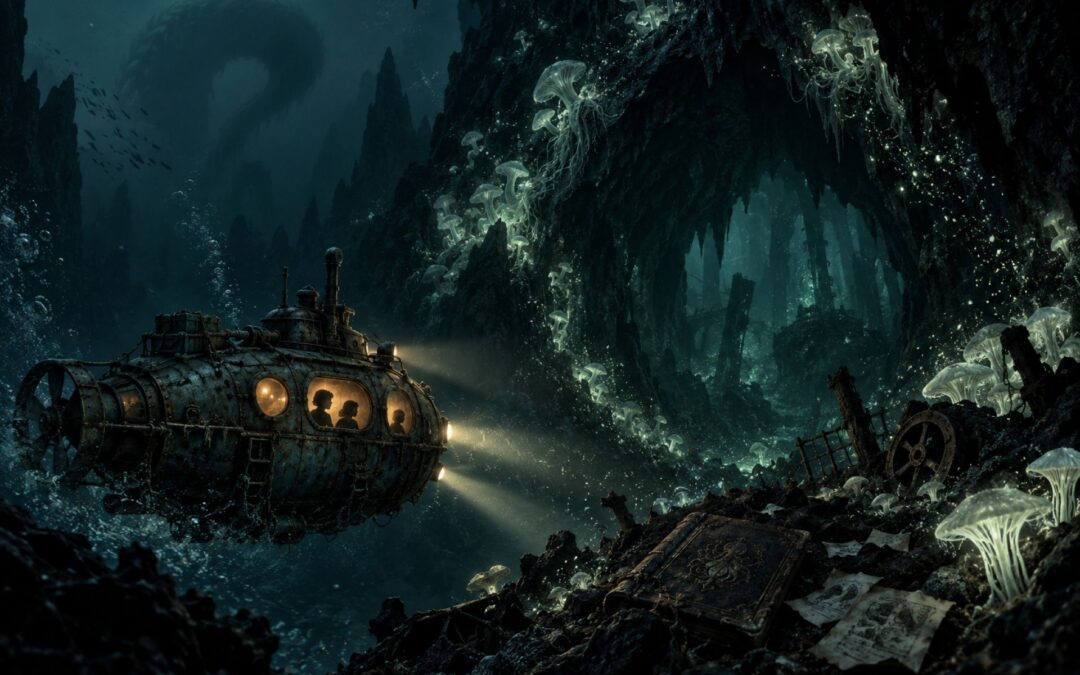
The Grim Grotto is the eleventh book in Lemony Snicket’s A Series of Unfortunate Events, and it arrives at a point when the Baudelaire children’s story has become much larger than their struggle to escape Count Olaf. By now, Violet, Klaus, and Sunny are entangled in the history of V.F.D., the mysterious organization connected to their parents, the schism that divided it, the elusive sugar bowl, and an increasingly difficult question: if supposedly noble people can commit terrible acts and supposedly wicked people can sometimes make humane choices, how should anyone decide whom to trust? First published by HarperCollins in 2004 as the eleventh volume in the series, the novel uses an underwater adventure to push that moral uncertainty to the foreground.
The immediate story is still recognizably a Snicket adventure. The Baudelaires are swept down a freezing stream, rescued by a battered submarine, sent into a poisonous underwater grotto, captured by Count Olaf, and forced to save Sunny from a lethal fungus before escaping yet again. What distinguishes the book is the way those dangers alter the meaning of the larger series. The children encounter evidence that members of V.F.D. have considered using biological weapons, Fiona discovers that the Hook-Handed Man is her brother Fernald, and the Baudelaires are repeatedly forced to judge actions by circumstances rather than labels.
Spoiler warning: this article covers the entire novel, including Fiona and Fernald’s relationship, Sunny’s poisoning, the fate of the Queequeg, the return to Briny Beach, and Kit Snicket’s appearance at the end.

Detailed Plot Summary of The Grim Grotto
The Grim Grotto begins immediately after The Slippery Slope, so its opening assumes that the Baudelaires are already deep inside the V.F.D. mystery. Their journey through the novel can be understood as a series of changing environments—stream, submarine, grotto, enemy submarine, and finally Briny Beach—but every movement also changes what they understand about the people around them. The plot therefore advances both physically and morally: each escape brings new information, and that information makes the next choice harder.
From the Stricken Stream to the Queequeg
The novel opens with Lemony Snicket discussing the water cycle, a subject he presents as more pleasant than the miserable history of the Baudelaire children. Water evaporates, condenses, falls, gathers, and begins the process again. At first this is another of Snicket’s apparently irrelevant digressions, but it quietly establishes the formal shape of the book, which will eventually bring the children back to one of the most important locations from the beginning of the series.
Violet, Klaus, and Sunny are being carried down the Stricken Stream on a toboggan. They have been separated from Quigley Quagmire after the waterfall in The Slippery Slope, and they do not know whether he survived. Before the separation, however, Quigley managed to tell them that V.F.D. volunteers are supposed to gather on Thursday at the Hotel Denouement, described as the “last safe place.” The children know that this meeting may finally bring them closer to understanding the organization, their parents’ involvement in it, and the conflict that has shaped so much of their lives, but they do not know where the hotel is.
Their situation illustrates a recurring problem in the novel: they possess fragments of information without the larger system needed to interpret them. They know the initials V.F.D. can refer to several things. They know the sugar bowl is important without knowing why. They know there are people associated with the organization who may be trying to help them, but they also know that adults who appear trustworthy have repeatedly failed them.
For the moment, the children let the current carry them. Violet considers whether she can improvise a steering system from the toboggan’s runners, but the river becomes increasingly violent before she can solve the problem. Their apparently reasonable decision to wait becomes dangerous, introducing the book’s recurring tension between thoughtful delay and the need to act.
A submarine unexpectedly surfaces near them. Its periscope bears a symbol resembling the familiar V.F.D. eye, but the children cannot assume that every sign connected to the organization belongs to the same side of the schism. A voice challenges them to identify themselves and asks whether they are friends or foes. When Violet gives the V.F.D. password, “The world is quiet here,” the children are admitted aboard.
The submarine is the Queequeg, an aging and somewhat battered vessel commanded by Captain Widdershins. Widdershins is enormous, energetic, loud, and almost incapable of expressing a thought without turning it into an instruction. His favorite principle is that “he who hesitates is lost,” a maxim he applies with such certainty that it becomes both comic and increasingly questionable.
Widdershins knows who the Baudelaires are. V.F.D. communications, newspaper reports, and the network of volunteers have allowed him to follow at least part of their journey. He explains that the Queequeg has been searching not only for them but also for the mysterious sugar bowl. The bowl has become one of the central objects in the conflict between the two factions of V.F.D., yet Widdershins refuses to tell the children exactly what it contains.
The Baudelaires also meet Fiona, Widdershins’s stepdaughter. She is slightly older than Violet, wears triangular glasses, and specializes in mycology, the study of fungi. Fiona is intelligent, capable, and more cautious than Widdershins. She is trying to repair the submarine’s telegram system, although the nature of the problem is uncertain.
The third familiar person aboard is Phil, whom the Baudelaires previously knew from Lucky Smells Lumbermill. Phil’s extreme optimism has survived everything that has happened to him. On the Queequeg he works as the cook, which brings him into immediate contact with Sunny, whose growing interest in cooking has become a serious talent rather than merely another comic feature of her unusual infancy.
Widdershins quickly gives everyone a role. Klaus is to study tidal charts and determine where the sugar bowl might have traveled. Violet is to investigate the telegram equipment. Sunny will assist Phil in the kitchen. For once, the Baudelaire children are not merely being hidden or transported by an adult; they are being treated as people whose abilities can contribute directly to an important mission.
Fiona explains how Widdershins and his allies have been following the Baudelaires despite the Daily Punctilio publishing false reports about them. Because the newspaper is so consistently inaccurate, its errors can sometimes be used as clues. If the paper confidently reports that the children are in one place, a careful reader familiar with the newspaper’s unreliability may suspect that they are somewhere else.
The conversation introduces the Baudelaires to more of V.F.D.’s information culture. Volunteers exchange Volunteer Factual Dispatches, and many keep commonplace books in which they collect useful facts, quotations, observations, and coded material. Information is dispersed rather than held in a single central archive, partly because the organization has been repeatedly attacked.
A dispatch suggests that the sugar bowl was at the V.F.D. headquarters when the headquarters burned. Widdershins and Fiona believe someone may have thrown the bowl from a kitchen window to keep it from falling into enemy hands. If it entered the Stricken Stream, it could have traveled with the water toward the sea.
That possibility transforms the sugar-bowl mystery into a problem Klaus can investigate. He begins working with Fiona on the tides, and the two quickly develop intellectual rapport. Klaus is used to being the primary researcher among the Baudelaires, while Fiona has knowledge he does not possess. Their attraction grows from collaboration rather than simple admiration.
Widdershins nevertheless continues withholding the most important piece of information: what the sugar bowl actually contains. His justification is familiar within the world of V.F.D. Certain facts are considered too dangerous to disclose, especially to children. Yet the contradiction is obvious. The same adults who claim the Baudelaires are too young to know crucial information are willing to place them in situations where ignorance may make them more vulnerable.
Tracking the Sugar Bowl to the Gorgonian Grotto
Life aboard the Queequeg gives the Baudelaires a temporary feeling of belonging. Their V.F.D. uniforms are adjusted to accommodate their individual skills and habits, making them feel less like unwanted children moving from guardian to guardian and more like recognized members of a working community. The feeling is important precisely because it does not last.
The Queequeg itself is hardly a secure refuge. It scrapes against underwater rocks, its communication system appears unreliable, and Widdershins frequently responds to danger by giving several contradictory commands in rapid succession. He is genuinely committed to fighting the enemies of V.F.D., but his leadership depends heavily on speed, confidence, and secrecy.
Violet examines the telegram equipment and reaches an unsettling conclusion. The machine may not be broken at all. The absence of messages could mean that no one remains at the other end to send them. In a series where locations associated with V.F.D. have repeatedly burned or disappeared, silence can be more frightening than mechanical failure.
Klaus and Fiona continue tracing the likely path of the sugar bowl. Their investigation points toward Anwhistle Aquatics, an underwater research facility founded by Gregor Anwhistle, who was connected to the Baudelaire family through Aunt Josephine. The facility has been destroyed by fire, adding another site to the long chain of suspicious fires associated with V.F.D. and its schism.
The initials G.G. appear in the surviving information, but their meaning is initially unclear. Before the children can resolve it, another danger interrupts the investigation. The Queequeg’s sonar detects Count Olaf’s submarine approaching.
Olaf’s vessel is enormous and shaped like an octopus, a grotesque extension of the theatrical villainy that has always defined him. The Queequeg must remain quiet to avoid detection. Yet as Olaf approaches, the sonar registers something even stranger: an enormous shape that resembles a question mark.
Captain Widdershins is clearly more frightened of this object than of Count Olaf. He refuses to explain what it is, referring only vaguely to something unknown and terrifying. His response deepens the book’s central pattern: the children continually encounter people who possess more knowledge than they will share.
The mysterious object departs without attacking them, and the immediate danger passes. Klaus then succeeds in narrowing down the sugar bowl’s likely destination. Fiona consults her mycological materials and identifies G.G. as the Gorgonian Grotto.
The grotto is dangerous because it contains the Medusoid Mycelium, a poisonous fungus that operates in cycles. When the fungus waxes, it releases airborne spores. Inhaling those spores can be fatal. When it wanes, the danger temporarily recedes.
The existence of the fungus changes the nature of the mission. The sugar bowl may have been carried into the grotto, but entering the area could kill whoever searches for it. Widdershins nevertheless believes the mission must continue because the sugar bowl is too important to abandon.
The Queequeg can travel only so far. The channels leading into the grotto become too narrow for the submarine, meaning the search party must proceed without it. The Baudelaires and Fiona are small enough to make the journey in diving suits, so the responsibility falls to them.
Widdershins still refuses to reveal the sugar bowl’s contents. The children therefore prepare to risk their lives in pursuit of an object whose value they are expected to accept on trust.
The Grotto, the Medusoid Mycelium, and Sunny’s Poisoning
The expedition into Gorgonian Grotto brings Violet, Klaus, Sunny, and Fiona together as a four-person team. There is some question over whether Sunny should be exposed to the danger, but the Baudelaires insist on remaining together. Their history has taught them that separating the siblings rarely protects them and often deprives them of the combined inventiveness, research, and practical skill that repeatedly saves their lives.
They leave the Queequeg in diving suits and allow the tide to carry them through narrow underwater passages. Eventually they reach an air-filled section of the grotto where objects have accumulated after being washed in by the water. The place resembles a physical archive assembled by accident: books, food, debris, and traces of V.F.D. history have all been deposited together.
The children begin searching for the sugar bowl. They find many objects that could have been carried from other locations, but the bowl itself is not there. Sunny takes note of the available food, including noodles, pesto ingredients, and wasabi. The detail appears to be another example of Snicket’s culinary humor, yet it becomes essential later.
Their search is interrupted when Fiona recognizes the Medusoid Mycelium beginning to spread. The fungus has waxed, cutting them off from the passage by which they entered. They cannot safely swim through clouds of spores, so they have no choice but to wait for the cycle to change.
The delay creates space for one of the book’s most important conversations. Fiona and the Baudelaires talk about their parents and about the temptation to remember dead or absent family members as perfect. The Baudelaires’ parents loved them, but Violet, Klaus, and Sunny can remember moments when their mother and father became angry or behaved imperfectly. Fiona likewise remembers conflict within her own family.
The conversation matters because the series has increasingly forced the Baudelaires to reconsider the adults connected to V.F.D. Their parents were clearly involved in the organization, yet the organization itself has made questionable decisions. The children’s love for their parents does not require believing that every action their parents or their allies took must therefore have been right.
While waiting for the fungus to wane, the group continues examining material scattered through the grotto. Klaus learns more about a V.F.D. coding system called Verse Fluctuation Declaration, in which familiar poetry can be altered so that the substituted words conceal information. The technique turns literature into a practical communication system, continuing the series’ habit of making reading a survival skill rather than merely an academic accomplishment.
Fiona then finds a letter from Kit Snicket to Gregor Anwhistle, and the contents transform their understanding of V.F.D. Gregor had been cultivating the Medusoid Mycelium and apparently contemplated using it against the organization’s enemies. What had seemed like a scientific research project had become a potential biological weapon.
Kit strongly objected. Her argument was not that the enemies of V.F.D. were harmless but that adopting their methods threatened to erase the moral distinction the volunteers claimed to represent. If people fighting wickedness become willing to spread deadly poison, the fact that they consider themselves noble cannot by itself make their behavior noble.
This discovery is one of the decisive moments in the series. Until now the Baudelaires have learned that supposedly respectable adults can be foolish, selfish, corrupt, or ineffective. The Gregor Anwhistle revelation is different because it suggests that the conflict inside V.F.D. includes serious moral disagreements among people who may all believe they are acting for the right reasons.
Sunny prepares food from what they have found, including pesto lo mein. Violet keeps the wasabi rather than using it. The choice seems trivial, but it establishes the substance that will later save Sunny’s life.
The children also discover an old Daily Punctilio clipping. Violet notices information concerning Fiona’s brother and is disturbed by it, but she does not immediately tell Fiona or Klaus. Her decision introduces a small version of the same secrecy she has criticized in adults. Violet believes she has reasons to withhold painful information, yet her silence will complicate the group’s trust later.
Eventually the Medusoid Mycelium wanes. The four children hurry back through the underwater passage and make their way toward the Queequeg. They do not realize that one of the fungal spores has entered Sunny’s diving helmet.
When they return, the submarine is strangely quiet. Captain Widdershins and Phil have disappeared. Their diving helmets are missing, but there is no clear explanation for where they went or why. Three blue balloons remain behind, associated with Violet’s approaching fifteenth birthday.
The disappearance forces Fiona into a new position. She has criticized Widdershins’s certainty and his habit of shouting commands, but under pressure she begins speaking like him. She gives rapid orders and invokes his belief that hesitation is dangerous, showing how deeply his behavior has shaped her even when she questions it.
The more immediate crisis becomes apparent when the children discover that Sunny has inhaled spores from the Medusoid Mycelium. She begins coughing, and the fungus spreads inside her helmet. Fiona believes they have less than an hour to find an antidote.
Violet and Klaus are torn between helping Fiona search and following her command that they get the Queequeg moving. Their anxiety is intensified by Violet’s secret knowledge about Fiona’s brother. The disagreement slows them down at exactly the wrong moment.
The sonar shows Count Olaf’s submarine approaching, but the children are too distracted to react in time. The enormous vessel captures the Queequeg.
Count Olaf’s Submarine, Fernald, and the Search for an Antidote
Count Olaf cuts his way into the Queequeg and confronts the Baudelaires and Fiona. His appearance immediately clarifies one important limit to the novel’s growing interest in moral ambiguity. The story may complicate the categories of “volunteer” and “villain,” but Olaf himself remains deliberately cruel. He sees Sunny’s poisoning as an inconvenience rather than an emergency and has no interest in helping her unless doing so benefits him.
Olaf’s submarine, the Carmelita, is vastly larger than the Queequeg and embodies the accumulation of power that has accompanied his pursuit of the children. It is filled with stolen machinery and weaponry. Its name honors Carmelita Spats, the aggressively self-centered girl from Prufrock Preparatory School who has become one of Olaf and Esmé Squalor’s companions.
The Baudelaires also discover that Olaf’s operation depends on exploited children. Snow Scouts and children associated with Prufrock have been forced to work inside the submarine. The absurdity of the setting therefore exists beside a genuinely grim image of power: Olaf does not merely deceive or threaten children individually but turns them into labor for his own plans.
Carmelita remains almost comically absorbed in herself. She performs as a “tap-dancing ballerina fairy princess veterinarian” and expects an audience of coerced children to applaud. Esmé encourages her vanity, while Olaf tolerates it as long as the spectacle does not interfere with his objectives.
The prisoners are placed in the brig and given a guard they already know: the Hook-Handed Man, one of the longest-serving members of Olaf’s troupe. Fiona immediately recognizes him.
His real name is Fernald, and he is her brother.
The revelation changes him from a familiar henchman into one of the book’s most important characters. Fiona has believed Fernald was lost to her, while Fernald has built a life among the people the Baudelaires consider enemies. Their reunion is affectionate, angry, defensive, and morally uncomfortable at the same time.
Fernald explains that he ran away after growing unhappy with Widdershins’s controlling behavior. He describes the captain as constantly shouting and imposing his will. Joining Count Olaf initially offered an escape from that environment, but Fernald does not pretend that life with Olaf has been good. He has participated in arson, murder, blackmail, and other crimes and recognizes that he has become involved in acts far worse than the family conflict he originally fled.
Fiona wants him to help them return to the Queequeg so they can save Sunny. Fernald counters by challenging the language Fiona uses to separate noble people from wicked ones. He knows about the Medusoid Mycelium project and points out that supposedly noble volunteers were willing to cultivate something capable of killing large numbers of people.
His most memorable image is that people resemble a chef’s salad. A salad contains many different ingredients rather than a single substance, and Fernald argues that human beings similarly contain mixtures of good and bad qualities. One act does not automatically reveal everything about a person.
The metaphor is deliberately imperfect but important. Fernald is not arguing that nothing matters or that cruelty should be excused. His own history forces the Baudelaires to confront the problem of how motives, circumstances, patterns of behavior, and consequences interact when judging someone.
Violet finally reveals the newspaper clipping she found in the grotto. It contains a report by Jacques Snicket connecting Fernald with the fire that destroyed Anwhistle Aquatics and killed Gregor Anwhistle. The report appears to make Fernald responsible for a major act of destruction.
Fernald objects that the report is incomplete and inaccurate. He describes the fire as the worst day of his life and points to the fact that he lost his hands around that period. Yet the novel never supplies a complete alternate account proving that he was innocent. The uncertainty is essential. Fernald has genuine reasons to distrust the Daily Punctilio, but unreliability in the newspaper does not automatically establish the opposite of everything it reports.
He also forces the Baudelaires to consider their own behavior. Violet, Klaus, and Sunny have themselves started a fire. They had reasons for doing so, but to an outside observer who knew only the act, they might appear similar to the people they condemn. Context matters, even if context does not erase responsibility.
The debate extends to the strange uniforms used by the opposing V.F.D. factions. Members associated with the Queequeg wear portraits connected to Herman Melville, while Olaf’s side favors Edgar Guest. The literary distinction may signal allegiance, but clothing cannot determine morality any more reliably than a label can.
Fernald eventually agrees to help the Baudelaires escape, on the condition that he can go with them. Fiona is willing to accept him. Her decision is driven partly by love and partly by the belief that people can change.
The escape must be timed around one of Carmelita’s performances. While the enslaved children are being forced to watch her, Fernald escorts Fiona and the Baudelaires through the submarine under the pretense that he is taking them to be tortured. The deception nearly works.
When Carmelita notices them, Fiona supports Fernald’s story and appears to align herself with Olaf’s side. The Baudelaires manage to reach the Queequeg, but Fiona and Fernald remain behind.
Back aboard the smaller submarine, Violet and Klaus face the immediate problem of Sunny’s poisoning. They consult Fiona’s copy of Mushroom Minutiae and discover that the antidote is encoded as “root of horse,” meaning horseradish.
That clue connects the fungal research to other pieces of V.F.D. history, including the horseradish-related odors near Lousy Lane. Unfortunately, there is no horseradish in the Queequeg’s kitchen.
Instead, Violet and Klaus find a coconut cream cake that had been prepared for Violet’s fifteenth birthday. In the crisis, almost everyone has forgotten the occasion, including Violet herself. The discovery is emotionally devastating because it represents an ordinary milestone that the Baudelaires have been denied the chance to celebrate normally.
Violet has spent much of the series acting as a substitute parent to Klaus and Sunny, inventing devices, making plans, and carrying responsibilities that should never have fallen on a child. Becoming fifteen therefore feels less like a simple birthday than another reminder that her childhood is disappearing amid danger.
There is no time to dwell on it. Sunny’s condition is worsening, and the fungus has spread around her mouth. Violet and Klaus must open the helmet despite the possibility that they too could be exposed.
Asked what a cook could use in place of horseradish, Sunny manages to answer: wasabi.
The ingredient collected in Gorgonian Grotto suddenly becomes lifesaving. Violet and Klaus give Sunny the wasabi, and the antidote works. A comic culinary detail becomes the solution to the novel’s most frightening crisis, but the moment is also the culmination of Sunny’s character development. Her cooking knowledge saves her because it has become an expertise equal in practical importance to Violet’s inventing and Klaus’s reading.
Quigley’s Coded Message and the Escape to Briny Beach
Sunny begins recovering, while Violet and Klaus also take the antidote as a precaution. With the immediate danger under control, the Baudelaires can once again turn to the larger V.F.D. mystery.
A Volunteer Factual Dispatch reaches the Queequeg. It comes from Quigley Quagmire and contains instructions involving three volunteers who must be delivered to a particular destination on Tuesday. The message has also been sent to someone identified only as J.S.
The destination is hidden through Verse Fluctuation Declaration. The children compare altered poetic passages with the original texts and identify substitutions involving Lewis Carroll and T. S. Eliot. The process is not decorative literary trivia. Their ability to read closely and notice textual differences determines where they must go.
The encoded destination is Briny Beach.
The name carries enormous significance for the Baudelaires, although there is little time to process it. As they work, they continue wondering what happened to Fiona and whether she can still be trusted. Their earlier confidence in her has been shaken by her apparent decision to remain aboard Olaf’s submarine.
Olaf, Esmé, Carmelita, Fernald, and Fiona eventually return to the Queequeg. Fiona is now dressed in the literary uniform associated with Olaf’s faction, making it appear that she has switched sides completely.
Her explanation is more complicated. Olaf has promised that after completing his plans involving the last safe place, he will help Fiona search for Widdershins. More importantly, Fiona refuses to abandon Fernald again. Whatever he has done, he remains her brother, and she believes staying near him may give him a chance to become someone different.
The Baudelaires try to persuade her to leave with them. Klaus in particular has reason to hope she will choose them. Yet Fiona’s loyalty to Fernald is stronger than her newly formed attachment to the Baudelaires.
Meanwhile, Olaf searches the Queequeg and discovers the remaining sealed Medusoid Mycelium. He immediately understands how useful it could be as a weapon. The danger Gregor Anwhistle once represented theoretically has now passed into the hands of someone who has far fewer moral reservations about using it.
Esmé’s interest in the Baudelaire fortune helps prevent Olaf from simply killing the children, but the balance of power has clearly worsened. The fungus gives him a new means of threatening the people connected to the Hotel Denouement.
The sonar question mark then reappears. Even Olaf is terrified by the Great Unknown, which makes clear that whatever it represents exists outside the ordinary conflict between the two V.F.D. factions. The object remains unidentified, and the novel deliberately refuses to resolve it.
Fiona’s final actions show why calling her a straightforward traitor would be inadequate. She does not imprison the Baudelaires or deliver them helplessly to Olaf. Instead, she allows them to escape, takes Mushroom Minutiae with her, and says goodbye to Klaus.
Before she leaves, Fiona kisses him.
The gesture confirms that her affection for Klaus was genuine even though she has chosen to remain with Fernald. Their relationship does not end because one of them suddenly discovers the other was secretly false. It ends because competing loyalties have become impossible to reconcile.
The Baudelaires are left to operate the Queequeg without Widdershins, Phil, Fiona, or any other adult. Sunny notices that the porthole Olaf removed still needs to be dealt with. Violet takes responsibility for steering, Klaus handles navigation, and Sunny contributes to the practical repairs.
Their familiar division of skills now functions without an adult directing them. This is one of the most important developments in the novel. Earlier books repeatedly placed the children under the nominal authority of guardians, teachers, administrators, or officials. Here, they simply have to take control.
They pass the Great Unknown and eventually reach Briny Beach.
The return is extraordinary because Briny Beach is where the entire series effectively began. It was there that Mr. Poe approached Violet, Klaus, and Sunny in The Bad Beginning and told them their parents had died in a fire. The location therefore carries the memory of the moment when the Baudelaires’ old life ended.
Mr. Poe appears again, summoned in connection with the mysterious J.S. message. His presence seems to offer a restoration of the old arrangement. He expects the children to come with him and once again submit to the legal and institutional system he represents.
This time they refuse.
The decision shows how far they have moved from the children who once had little practical choice but to follow whichever adult the authorities designated as responsible for them. Mr. Poe has repeatedly failed to understand the dangers they face, dismissed their warnings, and delivered them into situations that almost killed them. The Baudelaires are no longer willing to treat his official position as evidence that he knows what is best for them.
Violet finishes interpreting the message. A taxi is waiting nearby.
Inside is Kit Snicket, a member of the same family whose history has been threaded through V.F.D. and someone already connected to the Queequeg. She is reading material associated with the literary code the Baudelaires have just solved.
Violet, Klaus, and Sunny enter the taxi and leave Mr. Poe behind.
The local adventure is over, but almost none of the larger mysteries have been resolved. The sugar bowl remains missing. Widdershins and Phil are still gone. Olaf now has the Medusoid Mycelium. Fiona and Fernald have left with him. The Great Unknown remains unidentified. The Hotel Denouement gathering is still ahead.
Yet something fundamental has changed. The children have returned to a place associated with the moment when adults first began deciding their future, and they have chosen their own direction.
Setting and World-Building: The Underwater Side of V.F.D.
The underwater setting gives The Grim Grotto a strong visual identity, but its deeper purpose is to expand the machinery of V.F.D. beyond the hidden headquarters, coded buildings, schools, villages, and mountain locations of earlier books. The sea becomes a new frontier in the organization’s history, full of abandoned research facilities, coded routes, submarines, and physical remnants carried by currents from one part of the world to another.
The Queequeg functions as a moving V.F.D. outpost. Its battered condition reflects the weakened state of the volunteer network. It still possesses books, uniforms, navigational equipment, specialized knowledge, and coded procedures, but it is under-resourced and vulnerable. Widdershins’s repeated references to missing or dead volunteers reinforce the sense that the organization is operating through remnants rather than from a secure center.
The submarine also gives the Baudelaires a temporary experience of institutional belonging. Their abilities are not treated as strange inconveniences. Violet’s mechanical skill, Klaus’s research, and Sunny’s culinary knowledge all have defined uses. That brief sense of recognition makes the disappearance of Widdershins and Phil more significant because the children lose another possible home almost as soon as they begin adapting to it.
Gorgonian Grotto is the most distinctive physical setting in the novel. It is simultaneously a natural space, a quarantine zone, and an accidental archive. Objects drift into it through the water and remain there, creating a collection of fragments that mirrors the way the Baudelaires encounter V.F.D. history throughout the series. They rarely receive a coherent explanation; instead they find letters, newspapers, codes, abandoned buildings, objects, and memories that must be assembled into meaning.
Anwhistle Aquatics extends the same idea into scientific history. Gregor Anwhistle’s research demonstrates that V.F.D. was not merely an organization of book-loving firefighters and rescuers. It contained specialists capable of scientific experimentation with potentially catastrophic consequences. The facility’s destruction by fire also links the underwater world back to the series’ recurring history of burned places.
The Carmelita provides a deliberate contrast to the Queequeg. Olaf’s submarine is larger, more powerful, and better armed, but its apparent strength depends on theft, coercion, and exploitation. Children are forced to work for it. Carmelita’s self-centered performances are staged under conditions in which applause is compulsory.
The difference between the vessels therefore involves more than aesthetics. The Queequeg is disorganized and imperfect but organized around voluntary cooperation. The Carmelita is efficient in certain ways because Olaf is willing to use force. This distinction helps preserve moral judgment even as the novel questions simplistic labels.
V.F.D.’s communication infrastructure becomes especially important in this setting. Volunteer Factual Dispatches, commonplace books, coded poetry, telegram systems, uniforms, passwords, and literary references all allow people to identify one another and move information through a damaged network. The arrangement is ingenious, but it is also fragile. A code is useful only if the recipient possesses the necessary books. A telegram network is useless when everyone at the other end has vanished.
The Hotel Denouement, though never visited in this volume, exerts pressure on the entire plot because it is described as the “last safe place.” The phrase suggests that V.F.D.’s remaining spaces of refuge are disappearing. Reaching the hotel becomes more urgent precisely because so much of the organization has already been destroyed.
The Great Unknown stands outside this network of understandable signs. Almost everything else in the novel can potentially be decoded: tides can be studied, fungal behavior can be researched, newspaper reports can be questioned, poems can be compared. The question-mark shape on sonar resists that process. Widdershins fears it, Olaf fears it, and the Baudelaires never learn enough to classify it.
That refusal to explain everything is central to the world-building of late-series V.F.D. The children are becoming more informed, but increased knowledge does not produce complete certainty. It often reveals how much remains inaccessible.
Character Analysis
The Grim Grotto gives its characters more psychological and ethical room than many earlier volumes because it no longer depends primarily on the pattern of arriving at a new guardian’s home and attempting to expose Count Olaf’s latest disguise. The Baudelaires are operating more independently, while Fiona and Fernald introduce a family relationship that cannot be sorted cleanly according to V.F.D. allegiance. Character development therefore emerges through decisions under pressure rather than through simple revelations of who belongs to which side.
Violet, Klaus, and Sunny Baudelaire
Violet Baudelaire enters the novel on the verge of fifteen, and her birthday gives her arc an unusually explicit connection to growing up. She remains the inventor of the family, automatically looking at mechanisms and asking how they can be altered or repaired. Her examination of the telegram system and later attempt to operate the Queequeg show that her engineering instinct is no longer limited to small improvised devices.
Her development is also moral. Violet hides the newspaper clipping about Fernald because she fears what the information may do to Fiona. That decision resembles the adult secrecy she has often resented. Her motive is protective rather than controlling, but the result shows that the Baudelaires themselves are beginning to confront the kinds of choices adults around them have repeatedly made.
The forgotten birthday cake intensifies this transition. Violet has spent so long surviving that an event usually associated with celebration becomes almost alien. The scene works because the novel does not suddenly turn her fifteenth birthday into a conventional coming-of-age ceremony. Instead, growing older means realizing that ordinary milestones can pass while more urgent responsibilities consume everything else.
By the end, Violet takes command of the Queequeg and refuses Mr. Poe’s authority. She is not simply older in years. She is acting on the understanding that official adults are not automatically more competent or morally reliable than she is.
Klaus Baudelaire remains the sibling most closely associated with books, but The Grim Grotto expands what reading means for him. He does not merely recall facts after consulting a library. He interprets tidal charts, deciphers coded verse, investigates mycology, connects seemingly unrelated clues, and uses textual comparison as a navigational tool.
His relationship with Fiona is equally important. Klaus is attracted to someone because she shares his intellectual curiosity and can challenge him. Fiona possesses knowledge he lacks, and their collaboration feels reciprocal rather than based on rescue or admiration from a distance.
That makes her final decision especially painful. Klaus cannot solve it the way he solves a code because there is no single correct interpretation that will make Fiona choose him over Fernald. The relationship confronts him with a problem that information cannot resolve: two people can care about each other and still make incompatible choices.
Sunny Baudelaire undergoes perhaps the most visible transformation. In the early series she was literally an infant whose biting ability was often treated as both talent and joke. By Book 11 she speaks more clearly, participates in complicated discussions, and has developed cooking into a genuine specialization.
Her poisoning temporarily places her back in the role of vulnerable youngest sibling, but the resolution refuses to leave her passive. Violet and Klaus find the book containing the antidote, yet Sunny provides the crucial substitution. Her knowledge that wasabi can stand in for horseradish saves her life.
The moment confirms a pattern the series has gradually established. Violet invents, Klaus researches, and Sunny cooks, but none of these abilities is inherently more intellectual or important than the others. Survival repeatedly depends on combining different kinds of knowledge.
As a trio, the Baudelaires have also changed. Earlier books often showed them trying to persuade adults to recognize a threat. The Grim Grotto increasingly shows them deciding what to do after adult structures disappear. Their strongest resource is not any individual talent but their habit of combining observations and trusting one another enough to act on the resulting plan.
Fiona and Fernald
Fiona is one of the most important late-series additions because she initially appears to be exactly the kind of person the Baudelaires want V.F.D. to contain. She is intelligent, scientifically trained, knowledgeable about the organization, and capable of working beside them rather than merely supervising them. Her attraction to Klaus further encourages the idea that she may become a lasting ally.
Yet Fiona is never simply a model volunteer. She criticizes Widdershins’s absolutism but has absorbed much of his behavior. When he disappears and Sunny becomes ill, Fiona begins giving orders in the same rapid, commanding style she had previously questioned. Pressure reveals that people often inherit habits even when they consciously reject them.
Her relationship with Fernald is the decisive complication. Fiona does not discover that her brother has been secretly innocent all along. She learns that he has participated in terrible things while also hearing reasons for how he entered Olaf’s world and why he feels trapped there.
Her choice to remain with him is therefore morally mixed. She is motivated by family loyalty and the hope that he can change, but she also knowingly returns to a group that kidnaps, exploits, and murders people. The novel does not require the reader to approve of the decision in order to understand it.
Fiona’s final treatment of the Baudelaires preserves that complexity. She helps them escape instead of surrendering them to Olaf. Her kiss with Klaus confirms that her affection was genuine. She leaves because she prioritizes Fernald, not because everything she previously felt has become false.
Fernald gains depth because the book finally allows him to exist outside his role as the Hook-Handed Man. His history with Olaf contains real culpability. He has assisted a villain for years and admits involvement in serious crimes. The fact that he regrets some of them does not erase the harm.
At the same time, Fernald refuses the idea that a single label explains a whole person. His chef’s-salad metaphor is intentionally homely, but it captures the novel’s increasingly complicated moral position. People contain mixtures of loyalties, motives, habits, strengths, and failures.
The Anwhistle Aquatics fire prevents that argument from becoming easy absolution. Jacques Snicket’s report links Fernald to the destruction, while Fernald insists that the account is incomplete. The novel never provides enough evidence to settle the matter fully. Readers are therefore placed in the same position as the Baudelaires: judgment remains necessary even when certainty is unavailable.
Together, Fiona and Fernald demonstrate the danger of treating family as either morally sacred or morally irrelevant. Fiona’s loyalty to Fernald is understandable because family matters deeply, but family loyalty can also pull someone toward destructive choices. Fernald’s love for Fiona does not automatically make him safe, just as his crimes do not prove every feeling he has is fraudulent.
Captain Widdershins, Count Olaf, Esmé Squalor, Carmelita Spats, and Phil
Captain Widdershins is simultaneously admirable and exhausting. He has devoted himself to V.F.D., risks his life searching for the sugar bowl, recognizes the Baudelaire children’s abilities, and gives them work that matters. Yet he is secretive, domineering, and overly committed to a philosophy of immediate action.
His maxim that hesitation means being lost has practical force in dangerous situations. A person who freezes while a submarine is sinking may indeed die. The problem is that Widdershins treats a situational truth as a universal principle, leaving too little room for reflection, investigation, or uncertainty.
His relationship with Fiona suggests the personal cost of that style. She cares about him but remembers his conflicts with Fernald and has internalized his habits more deeply than she realizes. His unexplained disappearance is therefore narratively useful as well as mysterious: once he is gone, Fiona has to decide how much of him she will reproduce.
Count Olaf remains the necessary limit on the book’s moral complication. He is not simply “another mixed person” in the same way as Fiona or Fernald. His behavior across the novel is consistently exploitative, cruel, and self-interested. He uses kidnapped children for labor, treats Sunny’s possible death with indifference, and immediately sees the Medusoid Mycelium as an opportunity for greater power.
This distinction matters because the novel’s argument is not that everyone is equally good and bad. It is that labels are insufficient and actions must be judged with attention to motives, patterns, circumstances, and consequences. Olaf’s repeated choices still make a strong moral judgment possible.
Esmé Squalor reinforces Olaf’s selfishness through her obsession with wealth, status, and whatever she finds “in.” Her concern with the Baudelaire fortune sometimes alters Olaf’s immediate decisions, but she is not a moral restraint. She merely has competing forms of greed.
Carmelita Spats turns entitlement into grotesque comedy. Her elaborate self-description and compulsory performances would be merely ridiculous if they were not supported by coercion. She expects other children to celebrate her while those same children are being exploited, making her a miniature example of how vanity can become cruel when backed by power.
Phil has a much smaller role, but his optimism remains recognizable. He provides continuity with an earlier Baudelaire episode and contributes to the temporary domestic atmosphere aboard the Queequeg. His disappearance with Widdershins remains unresolved in this volume, so the novel deliberately denies the children another reassuring adult presence before the final act.
Relationships, Loyalty, and Trust
Relationships in The Grim Grotto are shaped less by simple affection than by the problem of deciding what affection requires. The Baudelaire siblings remain the book’s most stable relationship, but nearly every relationship around them involves divided loyalties, missing information, or a conflict between love and judgment.
Violet, Klaus, and Sunny trust one another because that trust has been tested repeatedly. They can disagree sharply, as Violet and Klaus do over Fiona, but the disagreement does not destroy the underlying assumption that each sibling is trying to protect the others. Their bond is therefore different from blind loyalty. They argue, exchange information, change plans, and rely on different kinds of expertise.
Klaus and Fiona begin with intellectual compatibility. Their conversations about tides, fungi, books, and codes allow affection to emerge through shared work. Yet the relationship cannot survive as a simple romance because Fiona’s history exists outside Klaus’s desires. Her brother matters more to her than a new attachment, even when remaining with Fernald means accepting serious risk.
Fiona and Fernald represent the most difficult form of loyalty in the novel. Fiona knows that Fernald has done harmful things, but she also remembers him as family and believes abandonment may only push him further into Olaf’s world. Her decision to stay with him can therefore be read as hopeful, reckless, compassionate, or all three at once.
The relationship between Fiona and Widdershins adds another layer. He is her stepfather and clearly cares about her, but his loud certainty has damaged his relationship with Fernald and shaped Fiona’s behavior in ways she does not fully control. The book refuses the easy equation of parental authority with wisdom.
Violet’s concern for Quigley operates mostly through absence. She does not know whether he is safe for much of the book, yet information he provided about Hotel Denouement keeps influencing the Baudelaires’ decisions. When his coded message finally arrives, the relationship becomes part of the wider V.F.D. network rather than only a personal attachment.
The Baudelaires’ relationship with Mr. Poe provides the clearest measure of how their understanding of trust has changed. In The Bad Beginning, they had little option but to accept his decisions. By the end of The Grim Grotto, they have accumulated overwhelming evidence that institutional authority does not make him reliable.
Their refusal to go with him is therefore not adolescent rebellion for its own sake. It is a reasoned withdrawal of trust after repeated failures.
V.F.D. itself functions like a possible substitute family, but the book makes clear that communities are not automatically safer than individuals. The organization contains disagreements, secrets, damaged relationships, and members who have considered terrible methods. Belonging still matters, but belonging cannot replace judgment.
Major Themes
The underwater adventure gives The Grim Grotto a distinctive setting, but its central themes emerge from the way characters interpret one another. Almost every major conflict involves incomplete knowledge: people know enough to act but not enough to be completely certain. The resulting moral uncertainty becomes the defining feature of the book.
Moral Ambiguity and the V.F.D. Schism
The most important thematic development is the weakening of the simple volunteer-versus-villain division. Earlier installments increasingly suggested that V.F.D. had split into opposing factions, encouraging the Baudelaires to imagine that one side might finally provide the reliable moral community they had been seeking.
Gregor Anwhistle’s work with the Medusoid Mycelium destroys that hope of simplicity. A person associated with the supposedly noble side considered using a deadly fungus as a weapon. Kit Snicket’s opposition proves that the organization contained an internal ethical debate rather than a single unquestioned policy.
Her objection identifies the central problem. Fighting people who commit terrible acts does not automatically justify using every available method against them. Means matter because methods can reshape the people who adopt them.
Fernald turns that institutional question into a personal one. He has committed crimes, yet his history is not reducible to a single description. His departure from Widdershins, his life with Olaf, the Anwhistle fire, his loss of his hands, his affection for Fiona, and his willingness to help the Baudelaires all belong to the same person.
The Baudelaires’ own history intensifies the problem. They too have started a fire. Their reasons were different from Olaf’s typical motives, but someone who knew only the act might classify them as arsonists. The novel therefore asks readers to consider context without suggesting that context makes every act acceptable.
Fiona provides the most difficult case because she crosses the visible factional boundary. She chooses Fernald and dresses in the opposing side’s uniform, yet she also protects the Baudelaires. Her choice shows that factional membership cannot automatically reveal moral character.
Olaf prevents this theme from collapsing into relativism. His repeated actions demonstrate that sustained cruelty, exploitation, and self-interest still justify strong judgments. The Grim Grotto does not argue that nobody is good or bad; it argues that people cannot be understood responsibly by applying a label before examining what they actually do.
Knowledge, Secrecy, and Unreliable Information
Knowledge in The Grim Grotto is both protection and danger. The Baudelaires survive because they can gather information, but the adults surrounding them repeatedly insist that certain information should remain hidden. This creates a persistent conflict between secrecy as protection and secrecy as control.
Captain Widdershins refuses to explain the contents of the sugar bowl even while asking the Baudelaires to risk their lives finding it. His position reflects a V.F.D. culture in which dangerous information is compartmentalized. There may be good reasons for that practice, but from the children’s perspective it means they are expected to act without understanding the stakes.
The Daily Punctilio represents a different failure of information. Its reports are so inaccurate that volunteers learn to interpret falsehoods as clues. Fernald later uses that unreliability to challenge the report about Anwhistle Aquatics, but the book carefully avoids assuming that an unreliable newspaper must be wrong in every specific case.
The telegram system presents absence itself as information. Violet realizes that the equipment may function perfectly and that the silence may come from the destruction or disappearance of people who once communicated through it. Her technical diagnosis therefore becomes an emotional revelation.
Commonplace books and Volunteer Factual Dispatches offer an alternative model. Rather than depending on one official authority, volunteers collect, compare, preserve, and transmit information across a decentralized network. The system is fragile, but it encourages active interpretation.
Kit Snicket’s letter shows why records matter. Without it, the Baudelaires might continue imagining Anwhistle Aquatics as simply another V.F.D. site destroyed by enemies. The letter reveals conflict within the organization itself and preserves an argument that would otherwise disappear.
The Great Unknown marks the limit of all these systems. Sonar can show a shape, but the shape does not explain itself. Widdershins’s fear provides evidence that the object matters, yet the children cannot convert that evidence into certainty.
The book’s approach to knowledge is therefore neither optimistic nor cynical. Information can save lives, as the antidote research proves, but possessing fragments does not guarantee understanding. Good judgment depends on continuing to question what those fragments mean.
Hesitation, Choice, and Action
Captain Widdershins’s belief that a person who hesitates is lost functions almost like a philosophical slogan for the novel. He treats speed as a moral and practical virtue. In his world, danger rewards decisive action.
The plot repeatedly proves that hesitation can indeed be dangerous. The Baudelaires nearly miss Count Olaf’s approach because they are distracted by disagreement. Sunny’s poisoning gives them only a short period in which to identify and administer an antidote. An underwater vessel cannot always wait while everyone reaches perfect certainty.
Yet the same plot also demonstrates the danger of acting without thought. Klaus saves Sunny by researching the fungus rather than simply trying a random cure. The children reach Briny Beach by carefully comparing poetry. Violet’s engineering depends on observing a mechanism before changing it.
Fiona’s behavior after Widdershins disappears exposes the weakness of turning his maxim into an absolute rule. Under stress she starts issuing commands in his style, as if decisiveness itself can replace uncertainty. The effect is understandable but not always helpful.
The novel therefore makes a distinction between hesitation and deliberation. Fearful paralysis can be dangerous, but thoughtful examination is often essential. The Baudelaires’ strongest decisions usually combine both elements: they gather enough information to understand the immediate problem and then act before circumstances make action impossible.
Family, Grief, and Growing Up
The Baudelaires’ parents remain absent from the physical story, but grief shapes how the children understand almost every new relationship. For much of the series, the memory of their parents has offered one of the few stable moral reference points in a world full of incompetent or dangerous adults.
The conversation in Gorgonian Grotto complicates that memory. Violet, Klaus, and Sunny acknowledge that their parents were not always patient or perfect. Remembering flaws does not reduce their love; it makes that love less dependent on idealization.
This matters because the children are learning more about the world their parents inhabited. If their parents belonged to V.F.D., then understanding them may eventually require confronting decisions made by the organization as well as the personal memories of family life.
Fiona and Fernald offer a parallel form of family grief. Fiona has effectively lost her brother to Olaf’s world and suddenly receives him back in morally compromised form. Her choice to remain with him reflects the enormous power of recovering someone believed lost.
Violet’s fifteenth birthday brings the theme into the children’s present lives. She is growing older whether circumstances allow her to celebrate or not. The cake reminds her of the ordinary childhood from which the Baudelaires have been repeatedly excluded.
Sunny’s development points in the same direction. She is no longer simply the baby of the family. Her increasingly complex speech and culinary knowledge make her a more independent participant in decisions.
The return to Briny Beach brings all of this growth into focus. The Baudelaires return to the place where Mr. Poe first informed them of their parents’ deaths, but they are no longer the same children. Grief has not ended, yet it has become part of a broader process of becoming capable of judging the world for themselves.
Communication, Interpretation, and the Value of Reading
Books in A Series of Unfortunate Events have always been useful, but The Grim Grotto makes reading one of the central mechanisms of survival. The novel repeatedly places the children in situations where the correct action depends on interpreting a text, chart, signal, or report.
Klaus’s tidal work is an example of reading the physical world through recorded information. A sugar bowl dropped into a stream cannot be followed by intuition alone. Charts allow him to reconstruct how currents might carry it.
Mycological books become even more directly practical. Fiona identifies the Medusoid Mycelium because she has studied fungi, and Klaus later finds the antidote through written knowledge. The sequence rejects any sharp distinction between “book learning” and real-world action.
Verse Fluctuation Declaration turns literary knowledge into cryptography. The code works because sender and recipient share access to the same poems and can recognize alterations. Reading closely becomes a means of secret coordination.
The Daily Punctilio provides the negative version of the same theme. Reading is not enough if the reader simply accepts every printed sentence. Interpretation requires evaluating the reliability of the institution producing the information.
Sonar extends the theme beyond words. It provides an image that must be interpreted, but the question-mark shape refuses a complete answer. Even technology produces signs rather than certainty.
The novel ultimately treats reading as a form of active judgment. Texts, objects, signals, and memories all require comparison. The Baudelaires survive not because books contain automatic solutions but because they have learned how to ask what information means in context.
Symbols, Motifs, and Literary Allusions
Snicket’s symbolism rarely operates through solemn declarations. Objects and references often begin as jokes, props, or bits of narrative machinery before acquiring larger significance through repetition. The Grim Grotto uses that method especially effectively with water, fungi, literary texts, uniforms, and the enormous question mark beneath the sea.
The Water Cycle, Fire, and Repeating Misfortune
The water-cycle digression at the beginning appears to be a typical Snicket attempt to avoid telling a miserable story. By the end, however, it becomes the structural metaphor of the novel. Water moves through repeated states and eventually collects again, just as the Baudelaires are carried through a sequence of environments before returning to Briny Beach.
The circular structure could suggest that nothing changes. The children began their orphaned life at Briny Beach and end Book 11 in the same place, still pursued by Count Olaf and still surrounded by mysteries.
Yet the return reveals the opposite. Recurrence allows comparison. Because the physical location is familiar, the reader can see how different the Baudelaires have become.
Fire remains the great counter-element even though most of the novel takes place underwater. The V.F.D. headquarters burned. Anwhistle Aquatics burned. The Baudelaire home burned. The schism itself is repeatedly associated with arson.
The persistence of fire in an underwater novel suggests that changing environments cannot escape the moral history carried into them. The Baudelaires may descend beneath the sea, but the consequences of previous fires follow them through letters, ruins, accusations, and memories.
Water and fire therefore create an unusual thematic pair. Fire destroys archives and homes, while water carries remnants somewhere else. Gorgonian Grotto becomes a place where pieces of destroyed histories collect rather than disappear completely.
The Medusoid Mycelium and the Sugar Bowl
The Medusoid Mycelium is the most powerful object in the novel because its meaning changes depending on who possesses it and what they intend to do. As a fungus, it is a scientific phenomenon. As a source of spores, it is a lethal threat. As an object of research, it can produce knowledge about antidotes. As a weapon, it becomes an ethical catastrophe.
Gregor Anwhistle’s project demonstrates that knowledge itself is not morally fixed. Understanding a dangerous organism can save lives, as Fiona’s book later helps save Sunny, but the same expertise can be redirected toward mass harm.
The fungus also spreads through almost invisible contamination. A single spore in Sunny’s helmet is enough to create a crisis. This gives the Medusoid Mycelium symbolic force within a series obsessed with how destructive actions travel beyond their original setting.
The sugar bowl works very differently. It is important precisely because its contents remain unknown. Characters risk their lives, burn locations, exchange codes, and pursue one another over an object whose meaning the reader is not yet permitted to understand fully.
At this stage of the series, the sugar bowl functions as a powerful MacGuffin and a symbol of withheld knowledge. Its secrecy creates action even when explanation is absent.
The contrast between the bowl and the fungus is revealing. The fungus is terrifying because everyone eventually understands what it can do. The sugar bowl is compelling because almost nobody will explain what it does.
Uniforms, Literary Portraits, and the Great Unknown
The uniforms associated with opposing V.F.D. factions turn literary taste into a visible sign of belonging. The Queequeg’s connection to Herman Melville and its very name evoke Moby-Dick, while Olaf’s side uses Edgar Guest. These references operate partly as jokes, but they also dramatize how organizations create identity through symbols.
The limitation is obvious once Fiona changes clothes. A uniform can communicate allegiance, but it cannot explain why a person made a choice or what that person will do next. Fiona can wear Olaf’s factional imagery while still allowing the Baudelaires to escape.
The recurring V.F.D. eye creates a similar tension. It can signal the organization, but the symbol does not immediately tell the children which faction they are dealing with. A mark that once looked like proof of danger or belonging becomes increasingly ambiguous.
The Great Unknown pushes the problem further. Its sonar image resembles a question mark, turning uncertainty itself into a physical presence. Widdershins fears it. Olaf fears it. The Baudelaires encounter it but never understand it.
Unlike the coded poems, the Great Unknown cannot be solved through careful reading within this novel. It represents the boundary beyond which interpretation fails. The children are becoming skilled investigators, but the world remains larger than their current knowledge.
Literary allusions throughout the book reinforce this larger pattern. Melville, Carroll, Eliot, commonplace books, poetry, and specialized scientific texts all show characters living inside a world already full of language produced by other people. Meaning comes from learning how to use that inherited material rather than pretending one can begin with complete understanding.
Style, Narration, and Structure
Lemony Snicket’s narrative voice remains one of the series’ defining features. He is not a neutral storyteller standing invisibly outside the events. He addresses readers directly, interrupts the plot, defines familiar words in strange ways, warns people not to continue reading, and repeatedly reminds them that the story will be miserable.
The effect creates distance around events that would otherwise be unusually dark for middle-grade fiction. Daniel Handler has discussed the gothic narrative approach and the use of the Snicket persona as part of the way the series frames terrible things through an eccentric storyteller. In The Grim Grotto, that distance allows poisoning, child exploitation, family estrangement, biological weapons, and possible murder to coexist with linguistic jokes and absurd performances.
Snicket’s definitions remain a major comic technique. He often pauses to explain a word, phrase, or expression in a way that begins conventionally and then veers toward the Baudelaires’ immediate situation. The joke depends on repetition, but it also reinforces the series’ preoccupation with language. Words are never merely labels; their meaning depends on context.
The same is true of Widdershins’s “Aye!” and his repeated warnings against hesitation. Catchphrases make characters recognizable quickly, which is useful in a long serial narrative. Yet The Grim Grotto also begins interrogating the ideas behind those repetitions rather than treating them as harmless quirks.
Structurally, the book resembles a compressed adventure voyage. The opening carries the Baudelaires from the mountains into the submarine. The middle sends them on an expedition into a hostile environment. The capture by Olaf produces a prison-and-escape sequence. The final chapters convert the escape into a return journey toward Briny Beach.
Within that broad movement, the novel alternates between discovery and danger. A clue about the sugar bowl leads to the grotto. The grotto produces information about V.F.D. but also infects Sunny. The attempt to cure Sunny leads to capture. Fernald supplies moral information but creates a new emotional conflict. Quigley’s code provides a destination but brings the children back to the origin point of their orphaned life.
This structure prevents the mythology from becoming purely expository. Most information arrives because the characters are trying to accomplish something immediate. Readers learn about Gregor Anwhistle because the children are trapped beside the fungus he cultivated, and they learn Verse Fluctuation Declaration because they need to interpret a message.
The literary allusions function similarly. The Queequeg reference rewards readers who recognize Melville, but the submarine remains understandable without that knowledge. Carroll and Eliot become more directly functional because their texts provide the basis of the code.
Snicket’s irony also allows the narrative to operate at more than one age level. Younger readers can follow the pursuit, poison, submarines, disguises, and escapes. Older readers can notice the parody of bureaucratic authority, the ethical debate over ends and means, and the tension between moral labels and actual conduct.
The technique does have costs. Digressions can interrupt urgent scenes, and repeated verbal habits may feel more conspicuous this late in the series. The joke structure is intentionally familiar, which means its effectiveness depends heavily on whether a reader still enjoys the rhythm established over ten previous books.
More significantly, The Grim Grotto demonstrates how far the series has moved from its early formula. Count Olaf is no longer spending the entire book disguised as a new local authority figure whom only the Baudelaires can recognize. The children are not primarily trying to persuade a guardian that Olaf is present.
Instead, they operate inside the larger V.F.D. conflict, possess specialized information, form alliances with morally complicated characters, and make strategic decisions without expecting conventional adults to solve anything. The style remains recognizably Snicket, but the narrative machinery has evolved.
The Ending Explained
The ending of The Grim Grotto resolves the immediate survival plot while deliberately leaving the larger V.F.D. story unsettled. Sunny lives, the Baudelaires escape the Carmelita, and they reach the destination hidden in Quigley’s code. At the same time, almost every major serial mystery becomes more dangerous rather than clearer.
Fiona’s choice is the first major unresolved element. She remains with Fernald and therefore with Count Olaf’s group, but her actions resist the idea that she has simply become a villain. She protects the Baudelaires’ escape and parts from Klaus with genuine affection.
Her decision is better understood as the culmination of the book’s argument about divided loyalty. Fiona believes that abandoning Fernald would repeat the loss that already fractured her family. She accepts the risk of staying near Olaf because she values the possibility of helping her brother more than maintaining a clean factional identity.
That does not make the choice automatically wise. Fernald has participated in serious crimes, and remaining with Olaf exposes Fiona to further corruption and danger. The novel leaves room for both sympathy and criticism.
Olaf’s acquisition of the Medusoid Mycelium raises the stakes immediately. Gregor Anwhistle’s plan had been disturbing because supposedly noble people considered using the fungus as a weapon. In Olaf’s possession, the moral hesitation surrounding that possibility largely disappears.
The Great Unknown remains unresolved as well. Its appearance near the end reminds readers that the V.F.D. conflict is not necessarily the only force operating in the world. Both Widdershins and Olaf fear it, but the Baudelaires never receive an explanation sufficient to classify it.
The children’s operation of the Queequeg is therefore the more important form of resolution. Without Widdershins, Fiona, Phil, or another adult commander, they navigate themselves toward Briny Beach. Their three specialties work together exactly as they have throughout the series, but the social context has changed: no guardian is nominally responsible for them.
Arriving at Briny Beach creates the novel’s strongest structural moment. In the first book, the beach was where Mr. Poe told them that their parents were dead. That announcement transferred the children from family life into a system of guardianship over which they had almost no control.
Mr. Poe’s reappearance seems to recreate the original arrangement. He approaches them as the adult representative of banks, legal arrangements, and conventional authority and expects them to come with him.
The Baudelaires refuse because experience has changed what authority means to them. Mr. Poe’s intentions may not be malicious, but intentions have repeatedly failed to protect them. He has ignored evidence, dismissed warnings, misunderstood Count Olaf, and delivered the children into disastrous situations.
Rejecting him does not mean the Baudelaires have concluded that all adults are useless. They are about to enter a taxi driven by Kit Snicket, another adult connected to V.F.D. The difference is that they now make the decision based on evidence and judgment rather than simply obeying whoever holds an official title.
Kit’s appearance turns the apparent circle into forward motion. The children have returned to the physical point where their orphaned story began, but they do not repeat their original response. Instead of being carried away by Mr. Poe’s decisions, they choose the next person they will follow.
This is where the opening water-cycle metaphor achieves its full purpose. Water returns, but recurrence is not sameness. The Baudelaires can arrive at the same place after being transformed by everything that happened between departures and returns.
The unresolved mysteries reinforce rather than weaken that developmental conclusion. The sugar bowl remains missing. Widdershins and Phil remain unaccounted for. Fiona and Fernald have gone with Olaf. The Hotel Denouement is still ahead. Olaf possesses the fungus.
The children therefore end the book without security, complete information, or a guaranteed trustworthy guide. What they possess instead is a more mature way of responding to uncertainty. They know how to gather evidence, compare interpretations, recognize moral complexity, and make a choice even when no option is perfectly safe.
Critical Review: How Well The Grim Grotto Works
As the eleventh installment of a thirteen-book series, The Grim Grotto has a difficult job. It must function as a satisfying adventure while also advancing mysteries that cannot yet be resolved, deepening characters who have already endured ten volumes of development, and preparing the movement toward the final two books. Its success comes largely from turning those serial obligations into the subject of the novel rather than treating them as background exposition.
What the Novel Does Best
The underwater setting immediately gives the book a strong identity. After mountains, schools, villages, hospitals, carnivals, and other environments, the Queequeg and Gorgonian Grotto feel genuinely different without requiring the series to abandon its gothic absurdity.
The Medusoid Mycelium is especially effective because it works at several levels simultaneously. It creates a concrete survival threat, supports a suspenseful race for an antidote, expands V.F.D.’s scientific history, and becomes the basis of the novel’s most important ethical revelation.
Fiona and Fernald provide the strongest character material. Their relationship takes a previously comic henchman and forces both the Baudelaires and the reader to consider him as a person with family ties, regrets, excuses, affection, and culpability. The book never requires complete forgiveness to make that complexity meaningful.
Fiona’s arc is equally strong because her final choice is painful without being arbitrary. Her loyalty to Fernald has been established as part of her history, and her willingness to protect the Baudelaires while remaining with her brother prevents the narrative from reducing her to a sudden betrayal.
Sunny receives some of the most satisfying development she has had in the series. Cooking has moved from a personality detail into a form of expertise. The wasabi solution rewards information planted earlier and gives Sunny an active role in saving herself.
Klaus’s literary and scientific research is also integrated unusually well into the action. The novel repeatedly demonstrates that reading is something characters do in order to survive, navigate, decode, and decide. Books are neither magical sources of automatic truth nor irrelevant academic objects.
Violet’s fifteenth birthday adds emotional weight without forcing a conventional coming-of-age story into the novel. The forgotten cake captures how completely crisis has consumed the siblings’ ordinary childhood. Her later control of the Queequeg and refusal of Mr. Poe make the birthday meaningful through behavior rather than ceremony.
The return to Briny Beach is arguably the book’s strongest structural achievement. Late installments in long series often struggle to create a sense of progression without resolving the entire story. Snicket solves the problem by returning the children to an old location and letting the contrast in their behavior demonstrate change.
The moral complication of V.F.D. is also essential to the late series. If the volunteers had simply turned out to be an entirely noble secret society waiting to rescue the Baudelaires, much of the uncertainty built across previous books would collapse. Gregor Anwhistle, Kit’s objections, Fernald’s history, and Fiona’s choices make the organization more interesting because belonging to it does not relieve anyone of moral responsibility.
Contemporary reaction also recognized The Grim Grotto as an important late-series installment. Cory Doctorow, for example, argued in his 2004 assessment of the novel that it revitalized the series after a middle stretch he found less effective. Whether or not every reader shares that view, the book clearly does accelerate the mythology and move the Baudelaires toward the final phase of the story.
Where the Book Can Frustrate
The same stylistic repetition that gives A Series of Unfortunate Events its distinctive voice can become tiring by Book 11. Snicket’s definitions, warnings, running phrases, literary jokes, and deliberate digressions are fundamental to the series, but their familiarity means some readers will anticipate the shape of the joke before it arrives.
Captain Widdershins intensifies this problem because repetition is also built into his dialogue. His constant “Aye!” and warnings about hesitation are purposeful character devices, yet the frequency can become intrusive during long exchanges.
The digressive narration sometimes competes with suspense. A reader invested primarily in Sunny’s poisoning or the submarine pursuit may find an extended linguistic aside frustrating when the characters appear to have only minutes to act. This tension has always been part of Snicket’s method, but the more urgent late-series plot makes it especially visible here.
The continued deferral of the sugar bowl mystery may also test patience. Eleven books into the series, the bowl is important enough to motivate submarines, fires, codes, and dangerous missions, while its exact significance remains withheld. The secrecy is thematically appropriate because the series is about fragmented knowledge, but thematic justification does not completely remove the frustration.
The Great Unknown presents a similar challenge. Its sonar shape is memorable, and the fact that both Widdershins and Olaf fear it gives the object real presence. Yet this volume provides almost no explanatory payoff, so readers hoping for each new mystery to replace an older unanswered one with clarity may feel the series is accumulating questions faster than answers.
Fiona’s decision can appear abrupt when the plot is read quickly. She moves from working intimately with the Baudelaires to remaining with Olaf’s faction over a relatively short period. The development is more convincing when understood through her family history, her longing for Fernald, and her conflicted relationship with Widdershins, but the pace of the change still asks readers to infer a great deal.
The book is also deeply dependent on prior volumes. A new reader can understand the immediate fungal and submarine adventure, but the emotional weight of Quigley, Briny Beach, Mr. Poe, V.F.D., Jacques Snicket, the sugar bowl, the schism, and the Hotel Denouement all depend on earlier knowledge. As Book 11, that dependency is reasonable. As a standalone novel, it inevitably limits accessibility.
Finally, the novel occasionally risks making its ethical argument sound cleaner than its examples are. Fernald’s chef’s-salad metaphor is useful as a rejection of binary labeling, but complex people can still develop stable patterns of harmful behavior. Count Olaf demonstrates that complexity should not become an excuse to suspend judgment indefinitely.
The strongest reading therefore treats moral ambiguity as a demand for better judgment, not as evidence that judgment is impossible.
Its Place in the Series and Who Should Read It
The Grim Grotto is a poor entry point for A Series of Unfortunate Events but an important book for readers who have followed the series this far. Nearly every major development depends on accumulated knowledge, and its most powerful ending only works because Briny Beach already carries the memory of The Bad Beginning.
Within the series, the novel acts as a bridge between discovery and endgame. The Baudelaires no longer need to learn merely that V.F.D. exists. They must now decide what belonging to such an organization would mean when the organization itself has a compromised history.
The book is particularly rewarding for readers interested in the V.F.D. mythology. It supplies meaningful information about the schism, Anwhistle Aquatics, commonplace books, volunteer communications, codes, and the Snicket family while deliberately preserving the central mysteries needed for the final volumes.
Readers more interested in the self-contained guardian plots of the early series may find the growing conspiracy less satisfying. By this point, Snicket expects considerable investment in names, initials, objects, fires, coded messages, and connections stretching across several books.
Younger readers can still enjoy the immediate adventure: submarines, dangerous fungi, villains, escapes, strange food, and coded poetry provide constant movement. Adult readers are more likely to notice how the novel questions moral identity, institutional loyalty, unreliable media, inherited beliefs, and the ethics of using dangerous methods for supposedly good purposes.
The fairest judgment is that The Grim Grotto succeeds because it does not merely add another layer of mystery. Its best revelations force the Baudelaires to reinterpret knowledge they already possessed. V.F.D. becomes less comforting but more interesting, Fernald becomes less simple without becoming innocent, and Fiona becomes less predictable without becoming incoherent.
Its most important limitation is the same quality that makes it effective as Book 11: it refuses full closure. Readers receive substantial movement without the satisfaction of final answers. The sugar bowl remains elusive, the Great Unknown stays unknown, and the Hotel Denouement still waits beyond the final page.
Yet the book does provide one form of resolution that matters more than another clue. The Baudelaire children are no longer simply being carried from one catastrophe to another by adults, institutions, or currents. They are learning to decide which information deserves belief, which loyalties deserve trust, and which direction they will take when certainty is impossible.
That development makes the return to Briny Beach the right ending. The same place where Mr. Poe once arrived to determine their future becomes the place where Violet, Klaus, and Sunny decline his authority and choose another path. Their misfortunes have not ended, and the larger mystery remains open, but recurrence no longer means helpless repetition.
For readers following A Series of Unfortunate Events in order, The Grim Grotto remains essential. It combines one of the series’ most distinctive adventure settings with some of its clearest thinking about morality, loyalty, knowledge, and growing up. Its unanswered questions can be frustrating, but the novel earns its place in the final stretch by making the Baudelaires themselves more capable of living with questions that no trustworthy adult can answer for them.
Last Updated on September 10, 2026 by Aseem Gupta