
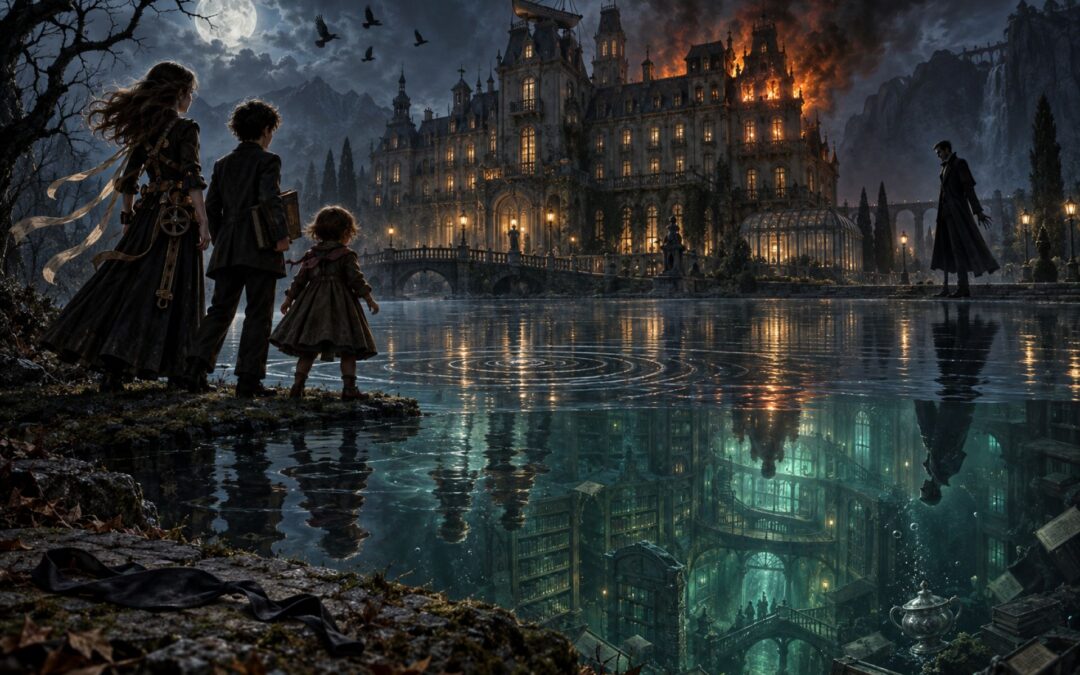
By the twelfth book of A Series of Unfortunate Events, Violet, Klaus, and Sunny Baudelaire have survived murderous guardians, corrupt institutions, disastrous schools, burning hospitals, treacherous mountains, and a long pursuit by Count Olaf. They have also changed. They are no longer merely children waiting for trustworthy adults to recognize the obvious truth. They have learned to disguise themselves, conceal information, break rules, manipulate enemies, and make decisions whose consequences cannot always be controlled.
That change is what gives The Penultimate Peril, published by HarperCollins in 2005, its unusually serious weight within the series. Hotel Denouement brings together people, clues, grievances, institutions, and mysteries from nearly every earlier stage of the Baudelaires’ journey, but the resulting convergence does not simplify the conflict between volunteers and villains. Instead, the closer the children come to understanding V.F.D., the harder it becomes to decide what a noble person should actually do.
Spoiler warning: This article discusses the entire novel, including Dewey Denouement’s death, the High Court trial, the destruction of Hotel Denouement, and the Baudelaires’ final escape with Count Olaf.

The Penultimate Peril: Complete Plot Summary
The novel takes place largely within and around Hotel Denouement, where the Baudelaires are sent to gather information before an important V.F.D. meeting. Its plot becomes deliberately complicated because Violet, Klaus, and Sunny are separated for three simultaneous assignments, each of which gives them only one portion of a much larger scheme. Once those fragments are reunited, they lead toward the discovery of Dewey Denouement, the exposure of a hidden V.F.D. archive, an attempted legal reckoning with Count Olaf, and finally a catastrophe in which the Baudelaires themselves become responsible for dangerous choices.
Kit Snicket’s Mission and the Last Safe Place
The story begins with Kit Snicket transporting Violet, Klaus, and Sunny through the city. Kit is one of the Baudelaires’ strongest remaining connections to the volunteer side of V.F.D., but even she cannot offer them the clear explanations they have spent much of the series seeking. She is pregnant, burdened by several urgent responsibilities, and operating within an organization that has been damaged by years of secrecy, conflict, and the schism between volunteers and villains.
As they travel, Kit talks about the Baudelaires’ parents and the wider history of V.F.D. One important strand of the conversation concerns Verdi’s opera La Forza del Destino, or The Force of Destiny. Snicket summarizes enough of the opera to emphasize the relationship between intention, accident, and fate, particularly an accidental shooting that kills someone even though the death was not consciously planned. What seems at first like one of the narrator’s literary digressions will become grimly relevant when Dewey Denouement dies in a similarly accidental act of violence.
Kit takes the children toward Hotel Denouement, a massive building that is supposed to function as the “last safe place” where V.F.D. volunteers can gather. The hotel immediately appears strange. It stands beside a reflecting pond, and its sign is written backward so that it appears properly when viewed in the water. That reversal introduces the book’s obsession with reflections, appearances, inverted meanings, and the difficulty of determining which version of something is the real one.
The Baudelaires are given another V.F.D. assignment. They will disguise themselves as hotel concierges and act as flaneurs, moving through the building, observing its guests, collecting information, and trying to determine what is happening before the planned gathering. Their most important questions concern someone identified only by the initials J.S., the arrival of the mysterious sugar bowl, and the identities of Hotel Denouement’s managers.
Those managers are Frank and Ernest Denouement, identical brothers who occupy opposite sides of the V.F.D. schism. One is a volunteer and one is a villain, but the Baudelaires cannot reliably distinguish them. Appearance therefore becomes useless as a guide to morality. Even when a Denouement gives them an instruction, they cannot know whether following it serves the noble side or helps the villains.
The hotel itself is organized according to the Dewey Decimal System, turning library classification into architecture. Guests and rooms are placed according to subject categories, so information is not merely stored inside Hotel Denouement; the building itself functions like an enormous catalog. For Klaus especially, who has spent his life trusting books, indexes, and research, the arrangement feels both familiar and unsettling because information has become inseparable from secrecy.
Soon three requests arrive almost at once. One comes from the rooftop sunbathing salon, another from Room 674, and another from Room 371. Since all three guests apparently require attention simultaneously, the Baudelaires divide their work. Violet takes the rooftop call, Klaus goes to Room 674, and Sunny heads toward Room 371.
At this point Snicket interrupts the normal chapter sequence. He explicitly tells the reader that the next three chapters occur at roughly the same time. The interruption is not merely playful formatting. It means that Violet, Klaus, and Sunny are each experiencing one-third of a larger event while being unable to see what their siblings are seeing elsewhere in the hotel.
Three Simultaneous Errands at Hotel Denouement
Violet’s errand takes her to the rooftop sunbathing salon, where she encounters several figures from the Baudelaires’ past. Esmé Squalor is there with Geraldine Julienne and Carmelita Spats, who has become increasingly entangled with Olaf’s world. Esmé appears to be sunbathing and birdwatching with special binocular-like “sunoculars,” although her attention to the sky suggests she is waiting for something rather than enjoying the view.
Carmelita demands a harpoon gun for use in the rooftop pool. It is exactly the kind of dangerous request that should make a responsible concierge refuse, but Violet is not operating in a normal hotel. She is undercover, trying to gather intelligence, and uncertain whether the Denouement manager who assists her is Frank or Ernest.
The manager raises doubts about placing such a weapon in Carmelita’s hands, but his ambiguous comments do not tell Violet whether he is warning her as a volunteer, manipulating her as a villain, or testing whether she can make an independent moral decision. Violet ultimately completes the errand. The harpoon gun enters the hotel’s network of danger because she follows instructions under conditions she does not understand.
Afterward the hotel clock gives one of its ominous recurring verdicts: “Wrong!” The word seems absolute, yet the novel increasingly makes absolute judgments difficult. Violet may indeed have done something dangerous, but she cannot yet know what alternative would have been right.
At almost exactly the same time, Klaus answers the call from Room 674 and finds Sir and Charles, his former employers from the Lucky Smells Lumbermill. Their presence is one of the clearest signs that Hotel Denouement is functioning as a convergence point for the entire series. People connected to the Baudelaires’ previous misfortunes are being drawn toward the same location.
Sir and Charles have also received communications connected to the initials J.S. Their information does not solve the mystery. Instead, it reveals that the invitations and messages circulating through the hotel have been designed to appeal to different people for different reasons. Someone is assembling a crowd, but Klaus cannot yet determine whether that gathering is being organized by volunteers, villains, or both.
Klaus is eventually instructed to hang birdpaper outside the sauna. The task appears trivial until it is considered alongside what Violet is seeing on the roof. Esmé is watching the sky, birds are expected to play some role in the events surrounding the sugar bowl, and the birdpaper may intercept those birds before they can complete whatever delivery they are supposed to make.
Again, Klaus does not know whether he is helping Frank or Ernest. Again, he obeys because the larger situation is unclear. Again, the hotel clock answers with “Wrong!”
Sunny’s assignment takes her to another collection of returning characters: Vice Principal Nero, Mr. Remora, and Mrs. Bass from Prufrock Preparatory School. Mrs. Bass has gone from teaching students through ridiculous measurements to participating in bank robbery, while Nero and Remora remain recognizable embodiments of the foolishness and self-importance that often characterize adult authority in the series.
Sunny escorts them toward an Indian restaurant run by Hal, the former records keeper from Heimlich Hospital. Hal is important because he represents one of the better forms of institutional memory in the series. Like Klaus, he believes in records, archives, documentation, and the possibility that carefully preserved information can protect people from lies.
Through the people she meets and the instructions she receives, Sunny learns more fragments concerning the sugar bowl, the sky, the hotel’s ventilation system, and the movement of objects through the building. She is ultimately given responsibility for securing the hotel laundry room, Room 025, with a Vernacularly Fastened Door. The door can only be opened by solving coded verbal clues, turning language itself into a lock.
The location matters because the laundry system appears capable of receiving something arriving from above. If a delivery involving birds is expected, the rooftop, the birdpaper outside Klaus’s room, and the laundry room may all be parts of the same chain. Sunny cannot yet know exactly how they fit together.
As with her siblings, her actions receive the clock’s verdict: “Wrong!”
Snicket then inserts another interruption, announcing that the simultaneous sequence is over and chronological narration can resume. The three children have each performed apparently minor duties, but taken together those duties have altered the hotel’s entire situation. A harpoon gun is now available, birdpaper has been placed where birds may be trapped, and the laundry room through which the sugar bowl may arrive has been secured.
The point is not that the Baudelaires were secretly malicious. It is that a person can act intelligently and in good faith while possessing only part of the relevant information, and those actions can still contribute to disaster.
Dewey Denouement and the Hidden Catalog
Once Violet, Klaus, and Sunny reunite, they compare what they have learned. Their conversations allow three isolated information streams to become one larger pattern. Esmé’s attention to the sky, Carmelita’s harpoon gun, Klaus’s birdpaper, the crows, Sunny’s locked laundry room, and the expected sugar bowl begin to look like parts of a coordinated operation.
Sunny recalls the parable of the blind men and the elephant, associated with John Godfrey Saxe. In the story, several blind men touch different parts of an elephant and each concludes that the entire animal resembles the small portion he has felt. One touches the trunk and imagines something like a snake, another touches the side and imagines something like a wall, and so on. Each interpretation is based on real evidence, yet each is incomplete.
The parable gives the Baudelaires a model for their own predicament. None of them was foolish during the simultaneous assignments; each simply had access to a different part of the whole. The same pattern extends beyond the three siblings. Nearly everyone in Hotel Denouement knows something, but few people know enough.
The children then encounter a man who cannot simply be categorized as Frank or Ernest. He is Dewey Denouement, the hidden third Denouement brother. His existence immediately alters the structure the Baudelaires thought they understood. Even the apparent binary of the two identical managers was incomplete.
Dewey explains more about V.F.D. than the children have previously learned from any single person. He describes an organization that was once more open, cooperative, and intellectually connected, almost like a great public library whose members shared knowledge for common purposes. The schism destroyed that model. Volunteers and villains divided, safe places burned, archives disappeared, and information became scattered among private collections, coded messages, commonplace books, and individuals who could be killed.
The Denouement family was itself damaged by the same conflict. Dewey, Frank, and Ernest were separated by the destruction surrounding V.F.D., and the triplets came to occupy different places within the fractured organization. Dewey devoted himself to recovering what the schism had scattered.
His life’s work is a vast catalog recording information about V.F.D., its members, crimes, mysteries, fires, failed safe places, and accumulated observations. The most remarkable revelation is that this archive is hidden under the reflecting pond beside Hotel Denouement. The hotel above water is not the true last safe place. The real repository of V.F.D.’s knowledge lies concealed beneath its reflection.
The design gives physical form to the novel’s central idea. The visible world is incomplete. Important truth exists beneath appearances, and reaching it requires more than simply looking at what stands in front of you.
Dewey trusts the Baudelaires enough to invite them into this intellectual tradition. He sees them not as perfectly innocent children but as people who have survived morally difficult circumstances and are still trying to act decently. When they confess actions that trouble them, including lies, theft, disguise, and other choices they would once have associated only with villains, Dewey does not declare them morally pure. He judges them “noble enough.”
The phrase matters because it changes the moral standard. Nobility is no longer imagined as permanent spotless innocence. It is something practiced imperfectly by people who may make mistakes, cause harm, and still choose what they believe to be right.
The J.S. mystery also begins to untangle. Justice Strauss, the judge who once tried to help the Baudelaires in The Bad Beginning, arrives at Hotel Denouement. So does Jerome Squalor, who abandoned the children rather than confront Esmé directly. Both have the initials J.S., meaning that the repeated references to J.S. did not necessarily point toward a single mysterious mastermind.
Dewey and the returning adults hope that the gathering can finally bring Count Olaf to justice. The accumulated evidence against him, combined with V.F.D.’s records and the authority of the High Court, appears to create a route toward something the Baudelaires have never experienced: a legitimate institutional resolution.
For a moment, the novel allows the possibility that information might finally defeat deception. If evidence can be gathered, preserved, interpreted, and presented to an honest court, perhaps all the disguises and lies can end.
That hope lasts only briefly.
Count Olaf’s Confrontation and Dewey’s Death
Count Olaf appears before the plan can be carried out. His arrival transforms Dewey’s revelations into an immediate confrontation over the sugar bowl, the V.F.D. schism, the Baudelaires’ history, and the meaning of villainy itself.
Olaf is accompanied or surrounded by people whose loyalties have repeatedly shifted. Esmé Squalor, Carmelita Spats, and the former carnival freaks Hugo, Colette, and Kevin illustrate how unstable the supposed sides have become. Even Olaf’s own network of followers is no longer unified, and his alliance with Esmé has deteriorated into resentment and conflict.
The argument that follows is one of the most important in the series because Olaf does not merely threaten the Baudelaires physically. He attacks the distinction they have tried to preserve between themselves and him.
He reminds them that supposedly noble people have abandoned them, failed them, lied to them, or protected institutions rather than children. He also points to things the Baudelaires themselves have done. They have used disguises, stolen property, broken rules, concealed evidence, helped dangerous people, and participated in events that caused destruction. Olaf’s conclusion is that these acts expose the moral categories of volunteer and villain as meaningless.
The children reject that conclusion, but the novel does not let them dismiss every part of his argument. They really have done morally troubling things. Their challenge is to explain why acknowledging those things does not mean accepting Olaf’s belief that everyone is therefore equally villainous.
Dewey offers one version of the answer. Hugo’s hunchback, Kevin’s ambidexterity, and Colette’s physical flexibility do not force them into villainy, despite the shame they once attached to those characteristics. Their actions are choices. Circumstances matter, history matters, and people can be manipulated, but none of those facts means morality is simply destiny.
That argument applies to Olaf as well. The Baudelaires have learned enough about his past to understand that he too was shaped by violence, grievance, and V.F.D.’s history. During the confrontation, the weapon said to have orphaned him is identified as poison darts. This revelation gives context to his rage without excusing the deliberate cruelty he has inflicted on others.
The argument over the sugar bowl intensifies. Olaf seizes the harpoon gun that Violet helped make available earlier. The apparently minor rooftop errand has now returned in a form no one can ignore.
Olaf demands information from Dewey about the secured laundry room and the sugar bowl. Dewey does not simply surrender. He gives cryptic clues connected to the phrases necessary for opening the Vernacularly Fastened Door, forcing anyone who wants access to interpret rather than merely possess information.
Justice Strauss and Jerome Squalor are present, yet their presence does not prevent the crisis. Once again, adults who want to help cannot or will not exercise enough power to protect the children or stop Olaf.
The Baudelaires place themselves between Olaf and Dewey. They try to persuade Olaf not to shoot, arguing that he can still choose differently. In one unusually revealing moment, Olaf asks what else he can do. The question is easy to interpret as manipulation, but it also exposes the moral trap he has built around himself. He behaves as though his history has eliminated alternatives.
Sunny invokes La Forza del Destino, bringing the novel back to its opening discussion of fate. The Baudelaires insist that destiny does not make every action inevitable.
Then Mr. Poe arrives.
His chronic coughing interrupts the confrontation. In the confusion, Olaf reacts, the harpoon gun passes into the Baudelaires’ control, falls, and fires. Dewey is struck.
The sequence is tragic precisely because it does not fit neatly into ordinary categories of guilt. Olaf created the confrontation and brought the weapon into use. Violet had earlier helped provide the weapon to Carmelita. The Baudelaires tried to prevent Dewey from being shot. Mr. Poe’s arrival contributed to the sudden movement. The discharge itself is accidental.
Dewey staggers into the reflecting pond, directly above the hidden catalog he devoted his life to creating. The children desperately try to save him and tell him they have failed him. Dewey refuses that interpretation. His judgment of them does not collapse because something terrible has happened.
His final utterance is Kit’s name.
The moment echoes the earlier description of La Forza del Destino: an accidental firing produces an irreversible death. Yet Snicket does not use that parallel to argue that fate absolves everyone. The accident exists within a chain of human decisions. The tragedy lies in the fact that intention and consequence no longer match cleanly.
The Blindfolded Trial, the Fire, and the Escape
Dewey’s death does not produce clarity. Instead, it produces competing narratives.
Hotel guests gather around the scene, and different people immediately interpret the Baudelaires through their own histories and assumptions. Some remember the children as victims. Others remember accusations against them. Some know pieces of what Count Olaf has done. Others have trusted newspapers, institutions, rumors, or personal impressions that were misleading from the beginning.
The Baudelaires cannot simply reveal everything. Dewey’s underwater catalog remains secret, and disclosing it might expose one of V.F.D.’s most important surviving archives. Their attempt to protect the truth therefore forces them to withhold part of the truth while they are being accused.
A mysterious taxi driver offers the children a way to flee. They do not know whether the driver is trustworthy, and the novel does not provide them with enough evidence to settle the question. After a book built around partial knowledge, even an apparent escape route becomes another moral gamble.
Mr. Poe sees Dewey’s body and the surrounding chaos and gravitates toward the simplest explanation: the Baudelaires appear responsible. His instinct reflects one of the series’ recurring failures. He prefers a recognizable procedural category to the difficult work of understanding what actually happened.
Justice Strauss proposes a formal solution. The High Court can conduct a trial, hear evidence, and determine guilt. After years of incompetent guardians and failed institutions, the idea is deeply appealing. The Baudelaires still want to believe that a sufficiently legitimate authority can finally recognize the truth.
The trial quickly turns that hope into satire. Everyone except the judges is required to wear a blindfold because “justice is blind.” A metaphor about impartiality is interpreted as a literal instruction to stop seeing.
The absurdity is comic, but the implications are serious. People submit to a procedure that actively prevents them from observing what is happening in front of them. A system supposedly designed to discover truth demands blindness as proof of fairness.
Evidence from throughout the Baudelaires’ history is assembled. Jerome Squalor has documented many of the injustices surrounding them, and the sheer volume of information suggests that their case might finally be understood in context rather than reduced to one accusation.
Count Olaf pleads complete innocence.
The Baudelaires do not.
They call themselves “relatively innocent.” The phrase captures the moral distance the series has traveled. In the earliest books, they could reasonably have described themselves as innocent victims of an obvious villain. By Book 12, they still reject the charge that they are equivalent to Olaf, but they can no longer pretend that every one of their own actions was blameless.
They begin telling their story from the beginning, attempting to place years of events before a court that can finally judge the whole pattern.
Then the court itself collapses.
The two judges sitting beside Justice Strauss are revealed as the sinister man with a beard but no hair and the woman with hair but no beard, long-associated villains within the V.F.D. conflict. The institution that was supposed to settle the dispute has been infiltrated at its highest level.
Justice Strauss is isolated, and Count Olaf uses the chaos to take her hostage. The Baudelaires’ hope that proper procedure might finally rescue them ends almost immediately. The failure is not simply that the law makes a mistake. The people entrusted with administering justice are themselves part of the conspiracy.
Olaf leads the children and Justice Strauss toward the hotel’s lower levels. He has a plan involving the sugar bowl and the Medusoid Mycelium, the deadly fungus introduced in The Grim Grotto. He intends to use the fungus against the people in Hotel Denouement and escape before the consequences reach him.
The locked laundry room becomes the next obstacle. The Vernacularly Fastened Door can only be opened by solving three verbal riddles.
One clue asks for a medical condition shared by the Baudelaires. The answer is their allergy to peppermints.
Another asks for the weapon that orphaned Olaf. The answer is poison darts.
The final clue requires information associated with Richard Wright’s Native Son. Klaus uses Jerome’s book and his research skills to identify the necessary response.
The children therefore help Olaf open the door.
On the surface, the act appears treacherous. They have just escaped a corrupt trial and are now assisting their enemy. Klaus, however, has reasoned that the sugar bowl may not actually be inside. His decision demonstrates how far the series has moved beyond rules such as “never help a villain.” He is choosing according to a broader prediction of consequences rather than the moral appearance of the immediate act.
The door opens, and the laundry room is empty.
The sugar bowl is not there.
Olaf simply shifts to his next atrocity. Even without the sugar bowl, he plans to release the Medusoid Mycelium and destroy the people in the hotel.
Violet then makes another apparently shocking proposal. She offers to help Olaf escape by adapting an invention she used earlier, a drag chute capable of slowing a fall from the rooftop. Her siblings initially struggle to understand why she would volunteer her inventive talent to someone who has pursued them for years.
Violet’s reasoning is strategic. Olaf cannot easily escape alone, and if his escape system can also carry the Baudelaires away from the hotel, helping him may create a route out for them.
Then Sunny proposes the most morally disturbing plan of all: burn down Hotel Denouement.
The decision is intentional. Unlike Dewey’s death, the fire cannot be classified as an accident.
The children gather flammable material and use dirty laundry and chemicals to help spread the blaze. Olaf burns Jerome Squalor’s book about injustice as kindling, an act rich with irony. A record created to document wrongdoing is literally destroyed during another wrongdoing.
Yet Sunny’s plan is not simply an act of revenge or nihilistic destruction. The Baudelaires use the hotel elevator in a way that gives the fire multiple purposes.
They press the buttons for many floors, slowing Olaf’s progress and making it harder for him to carry out his fungus plan quickly. At the same time, the elevator stops repeatedly, allowing the Baudelaires to warn guests that the hotel is on fire.
The warnings do not produce a unified response. Some people believe them. Others believe Count Olaf. Others remain uncertain. Even with danger spreading through the building, the hotel remains a world in which people must decide whom to trust from incomplete evidence.
The fire also creates smoke, and Sunny recognizes that the smoke can function as a V.F.D. signal. Volunteers approaching the last safe place will see that it is no longer safe. An act of destruction therefore becomes a warning intended to prevent further disaster.
None of these purposes erase the danger. The Baudelaires know people may be injured. They understand that starting a hotel fire is not transformed into a harmless act simply because they have reasons.
When they reach the roof, they prepare the boat and Violet’s drag chute. Klaus works out how the wind and sail can be used to control their descent, while Sunny identifies improvised oars. Their familiar abilities—Violet’s inventing, Klaus’s research and calculation, Sunny’s resourcefulness—come together one more time.
Klaus also reaches an important conclusion about the sugar bowl. Dewey may have allowed people to believe that it was destined for the laundry room when its real destination was the reflecting pond. If so, the sugar bowl may have fallen into the same water that conceals the hidden catalog.
Even at this late stage, the novel offers inference rather than full disclosure. The Baudelaires understand more than before, but the mystery is not completely solved.
As they prepare to leave, the children return to the question that has haunted the entire book: what kind of people are they becoming? Dewey’s death was accidental, but the fire was deliberate. Their plan is meant to warn people, stop Olaf, and survive, yet it may still cause terrible harm.
Sunny recalls Dewey’s standard. They may not be perfectly noble, but perhaps they can still be noble enough.
Justice Strauss refuses to accept their escape as the right answer. She urges them to remain, explain themselves to the proper authorities, and trust that justice can still be pursued. Her position is not foolish in the same way as Mr. Poe’s habitual incompetence. Strauss sincerely believes that abandoning the law entirely means allowing injustice to determine their future.
The Baudelaires no longer share her confidence.
They have already watched the High Court become a trap. They have spent eleven earlier books trying to convince authorities of truths those authorities refused to see. Remaining at the hotel may mean being arrested, separated, manipulated, or placed once again into the hands of institutions that have failed them.
When Justice Strauss tries to prevent the boat from leaving, Sunny bites her hand. Snicket makes the symbolism unmistakable: Sunny literally bites the hand of justice. The image is cruel because Strauss genuinely cares for the children, but it also expresses how thoroughly their trust in formal authority has broken down.
The boat falls from Hotel Denouement.
Violet’s drag chute slows the descent, and Klaus’s handling of the sail helps convert disaster into escape. The boat reaches the sea rather than smashing immediately below.
Count Olaf is aboard.
The children have escaped one danger only by placing themselves beside the man who caused so many of the others. They are literally in the same boat as their enemy, a phrase that becomes both plot fact and moral image.
The book closes without deciding that the Baudelaires are now villains. It also refuses to restore the simpler innocence of the earlier volumes. Snicket returns to the idea of small disturbances spreading into larger consequences, drawing on Richard Wright’s imagery of imbalance and social pressure. The Baudelaires have made choices, and those choices will continue producing effects they cannot fully predict.
They leave Hotel Denouement with their identities unresolved, their alliances unstable, their knowledge incomplete, and their destination uncertain.
The novel has reached a denouement, but it has not reached the end.
Hotel Denouement and the V.F.D. World of Smoke and Mirrors
Hotel Denouement is one of the most carefully constructed settings in A Series of Unfortunate Events because nearly every part of its architecture participates in the novel’s intellectual design. It is a hotel, a catalog, a meeting place, a decoy, a surveillance system, a trap, and a visible shell concealing a more important institution underneath it. The Baudelaires enter believing they have reached V.F.D.’s last safe place, only to discover that even the meaning of “safe place” depends on which level of the structure they understand.
The Dewey Decimal organization turns the building into a physical library. Rooms do not simply contain people; their positions classify them. Klaus’s familiar world of books and indexes has become spatial, allowing the hotel to function like a body of knowledge through which the children move.
That structure initially suggests order. If everything has a category, perhaps everything can be found and understood. Yet the novel repeatedly demonstrates the weakness of classification. Frank and Ernest cannot be distinguished by appearance. J.S. turns out not to refer to a single person. Volunteers have done harmful things, and villains may possess understandable grievances. Categories organize information without guaranteeing correct interpretation.
The reflecting pond deepens the idea. The hotel sign makes sense only in reflection, meaning that the reversed version and the readable version depend on one another. The same pattern governs the plot. What appears to be the last safe place above water is not the true archive at all. Dewey’s catalog lies underneath, concealed by the reflection.
The hidden catalog is more than a secret room full of information. It represents the ideal V.F.D. once claimed to value: observation, documentation, shared knowledge, memory, and the preservation of evidence against deception. Dewey has tried to reconstruct what the schism destroyed by gathering fragments that other people left behind.
His work also exposes the vulnerability of knowledge. Archives can burn. Librarians can die. Books can be stolen or used as kindling. Newspapers can spread lies. Catalogs can contain enormous amounts of information and still remain inaccessible to the people who most need them.
The hotel therefore becomes a miniature version of V.F.D. itself. Many people occupy one structure while believing different stories about what the structure means. Volunteers, villains, former guardians, teachers, criminals, judges, journalists, and confused bystanders all share the same space without sharing the same understanding.
The phrase “smoke and mirrors” is particularly appropriate because both elements become literal. Mirrors conceal the true organization of the hotel, while smoke ultimately announces that the last safe place has failed. The book repeatedly converts figures of speech into physical events, then uses those physical events to challenge the assumptions hidden inside ordinary language.
Hotel Denouement is finally destroyed because it cannot perform the function people have assigned to it. It cannot simply keep goodness inside and villainy outside. The schism already exists within the building, within its management, within its legal institutions, and eventually within the morally compromised choices of the Baudelaires themselves.
Character Analysis: The Baudelaires, Olaf, Dewey, and the Returning Cast
The moral complexity of The Penultimate Peril works because its characters embody different responses to uncertainty rather than simply representing fixed moral labels. The Baudelaires have become capable enough to make consequential choices of their own, while the adults surrounding them range from courageous to cowardly, sincere to corrupt, and knowledgeable to dangerously passive. Count Olaf remains a villain, but his role changes because the children can no longer define themselves merely as his opposite.
Violet, Klaus, and Sunny
Violet enters the novel as the eldest Baudelaire and the sibling most accustomed to turning physical problems into mechanical solutions. Earlier books often allow her inventions to function as straightforward expressions of ingenuity: ropes, devices, repairs, and improvised machines help the children escape problems created by adults. In The Penultimate Peril, invention itself becomes morally complicated because the question is no longer only whether a device works but what purpose it serves.
Her rooftop errand demonstrates the change. Violet knows that giving Carmelita access to a harpoon gun is dangerous, yet she lacks enough information to understand the larger consequences of refusing. Her technical action becomes part of the chain leading to Dewey’s death.
Later she voluntarily offers her abilities to Count Olaf. She proposes adapting the drag chute so they can all escape. The decision is not submission to Olaf’s worldview. It is an acknowledgement that tools do not belong permanently to good or evil. An invention can save someone dangerous while also saving the children who made it.
Violet’s growth therefore lies in moving from technical competence toward ethical judgment. She has always known how to build things. The harder question is deciding what should be built when every available option carries risk.
Klaus faces a parallel development through knowledge rather than machinery. Research has long been his most reliable power. When adults refuse to investigate, Klaus reads. When disguises create confusion, he remembers details. When mysteries appear, he searches for patterns.
Hotel Denouement initially seems built for him because its architecture is literally classificatory. Yet the book repeatedly demonstrates that possessing facts is not enough. Klaus can hang birdpaper correctly without understanding its ultimate function. He can identify the clues in the Vernacularly Fastened Door while knowing that solving them will help Olaf. He can understand a system and still face uncertainty about how that understanding should be used.
His decision to help open the laundry room shows his maturation most clearly. He does not obey Olaf blindly, nor does he refuse merely because cooperation with a villain looks wrong. He forms a hypothesis that the sugar bowl is not there and acts on a larger interpretation of the situation. He is willing to perform an apparently treacherous act because he believes its actual consequences may undermine Olaf.
That is a more demanding form of intelligence than simply finding the correct answer in a book. Klaus is learning that knowledge becomes ethical only through judgment.
Sunny has perhaps the most dramatic transformation because she began the series as an infant whose biting was often treated as comic assistance. By Book 12 she speaks, reasons, plans, interprets codes, and makes independent strategic decisions. Her role is no longer secondary to Violet and Klaus.
Her proposal to burn Hotel Denouement is the clearest evidence of that independence. Neither elder sibling gives her the idea. Sunny identifies a solution that is simultaneously horrifying and purposeful. Fire can warn V.F.D., disrupt Olaf, force evacuation, and help prevent the fungus plan, but it also endangers innocent people.
The decision forces Violet and Klaus to confront Sunny as a moral agent rather than a younger sibling who must merely be protected. She is now capable of choosing something they themselves find frightening.
Sunny’s final bite of Justice Strauss’s hand completes the development. In the first book, Sunny’s teeth are part of her infant identity. In the twelfth, the same physical action becomes a conscious refusal to submit to an institution she no longer trusts. The child who once bit because biting was one of the few things she could do now bites because she has decided what she will not allow to happen.
Together the siblings form a stronger ethical unit than any one of them could alone. Their repeated habit of comparing information, questioning one another, and revising interpretations protects them from the certainty that traps many adults. They do not always choose correctly, but they continue asking whether their choices are defensible.
That willingness to question themselves is one of the strongest distinctions between them and Olaf.
Count Olaf and the Question of Choice
Count Olaf remains responsible for extraordinary cruelty. The novel never erases his attempts to steal the Baudelaire fortune, his murders, manipulations, threats, disguises, and willingness to sacrifice other people. Moral complexity does not require pretending that every character is equally guilty.
What changes is that Olaf becomes more useful as a philosophical opponent. He argues that the Baudelaires’ compromises prove the entire distinction between volunteers and villains is fraudulent. If the children have lied, stolen, disguised themselves, assisted criminals, caused destruction, and participated in a fatal accident, why should they imagine themselves morally different from him?
The argument is seductive because it begins from something true. The Baudelaires are not perfectly innocent anymore.
Olaf’s error lies in turning imperfection into equivalence. He treats the existence of wrongdoing as proof that motives, patterns, remorse, restraint, alternatives, and responsibility no longer matter. Once everyone is compromised, he wants every form of compromise to count the same.
The novel refuses that conclusion. Olaf repeatedly chooses cruelty when other options exist. Even when his history explains some of his bitterness, explanation does not become absolution. His question about what else he can do is answered by the very existence of people who have suffered without responding as he does.
The poison-dart revelation makes this distinction especially important. Olaf may have been shaped by a violent past connected to V.F.D., but the Baudelaires have also been orphaned, hunted, betrayed, and traumatized. Their suffering has not predetermined identical behavior.
The question is therefore not whether choice is free from circumstance. It clearly is not. The novel’s argument is that circumstance does not eliminate choice altogether.
Dewey Denouement, Justice Strauss, and Jerome Squalor
Dewey, Justice Strauss, and Jerome Squalor represent three different forms of adult goodness, each with different strengths and limitations. None is a perfect rescuer, which is precisely why they matter in a book suspicious of clean moral categories.
Dewey is the most active. He does not merely regret V.F.D.’s collapse; he spends his life reconstructing what has been lost. His catalog is an attempt to preserve institutional memory when institutions themselves can no longer be trusted.
His work requires secrecy, patience, research, and considerable personal risk. Unlike many adults in the series, he takes the Baudelaires seriously. He does not demand proof that they are flawless before considering them worthy of trust.
His phrase “noble enough” is therefore not sentimental approval. It comes from someone who has spent years documenting how complicated the V.F.D. conflict became. Dewey knows that morally serious people may still be compromised.
Justice Strauss represents a different model. She sincerely wants justice and genuinely cares for the Baudelaires. Her failure is not lack of compassion but excessive confidence in legal procedure.
She believes truth can be recognized if it is properly presented before legitimate authority. That belief is admirable in principle, and the novel does not mock her in the same way it mocks Mr. Poe. Yet Hotel Denouement demonstrates how vulnerable procedure becomes when the institution administering it is corrupt.
Strauss’s final refusal to flee is therefore ethically serious. She does not want the children to normalize crime and flight as their permanent way of life. Her mistake is underestimating how completely the system around them has failed.
Jerome Squalor occupies a weaker position. He has a conscience and later attempts to document injustice, but his defining limitation has always been passivity. He left the Baudelaires rather than confront Esmé directly, and his later moral concern cannot erase the consequences of that earlier retreat.
The three adults show that “good intentions” describe too broad a category to guarantee useful action. Dewey acts, Strauss trusts institutions, and Jerome records injustice after failing to resist it effectively. Their differences matter because the Baudelaires have learned that an adult can be kind yet still fail them.
Frank, Ernest, Esmé, and the Returning Cast
Frank and Ernest turn moral ambiguity into a visual joke with serious consequences. They are physically indistinguishable while belonging to opposite sides of the schism. The Baudelaires repeatedly try to infer moral identity from tone, instruction, or behavior, but certainty remains elusive.
The brothers expose how much moral judgment normally depends on contextual clues. If appearance is useless and information is incomplete, the children must judge actions rather than labels. Even that becomes difficult because the same instruction may have different meanings depending on what the person giving it knows.
Esmé Squalor represents a more recognizable form of opportunism. Her earlier obsession with what is “in” and “out” evolves naturally into a morality governed by appetite, status, and advantage. Her alliance with Olaf survives only while it serves her interests.
Their rupture demonstrates that villainous cooperation is not stable simply because the participants share enemies. The villain side of V.F.D. contains its own resentments, betrayals, and competing desires.
The rest of the returning cast functions almost like a moral chorus. Sir, Charles, Nero, Remora, Mrs. Bass, Hal, Carmelita, Geraldine, the former carnival performers, Mr. Poe, and others carry pieces of the Baudelaires’ history into one location. Each person remembers a different version of the children.
That device allows the novel to dramatize reputation itself as fragmented knowledge. The Baudelaires are not the same people to everyone in the hotel. To some they are victims, to some suspicious fugitives, to some former employees or students, and to some participants in earlier disasters.
Their identity therefore becomes another elephant assembled from partial encounters.
Nobility, Villainy, Destiny, and Moral Responsibility
The central moral achievement of The Penultimate Peril is that it rejects moral purity without rejecting morality. This distinction is essential. The novel does not argue that everyone is secretly a villain, nor does it rescue the Baudelaires by pretending their intentions automatically make every action good.
The children begin the series in a position where innocence is relatively easy to identify. Count Olaf wants their fortune and repeatedly tries to exploit or kill them. The Baudelaires resist him. Adults refuse to believe them. The moral distinction seems almost absurdly obvious.
By Book 12, the children have lived too long within dangerous systems for that simplicity to survive. They have learned that sometimes escape requires deception, survival requires rule-breaking, and protecting one person may endanger another.
The simultaneous concierge errands are an early version of the problem. Violet, Klaus, and Sunny perform tasks while uncertain whether the instructions come from Frank or Ernest. Each decision looks small, but each enters a chain of consequences no child can fully see.
Dewey’s phrase “noble enough” offers the novel’s alternative to purity. A noble person need not be someone who has never lied, stolen, harmed, or made a disastrous mistake. Nobility instead describes a continued effort to choose well, recognize harm, take responsibility, and resist becoming indifferent to other people.
That interpretation closely matches scholarship on the series’ ethical uncertainty, which has emphasized how Snicket destabilizes fixed moral categories and treats ethical conduct as something practiced under unstable conditions rather than guaranteed by certainty.
Olaf’s position is different. He treats moral compromise as proof that moral distinctions are fraudulent. Once the Baudelaires have done something wrong, he wants the word “villain” to become universal and therefore meaningless.
The phrase “relatively innocent” rejects that logic without pretending to perfect innocence. The Baudelaires recognize degrees, contexts, patterns, and responsibility. They are not claiming that mistakes disappear because they suffered first. They are claiming that moral evaluation must account for more than the fact that harm occurred.
Dewey’s death provides the hardest test. The children do not intend to shoot him. They try to stop Olaf. Yet their earlier decisions helped bring the weapon into the situation, and the fatal shot emerges from a chain in which they participated.
The novel neither calls them murderers nor allows them to treat the death as meaningless because it was accidental. The children grieve, blame themselves, reconsider earlier choices, and confront the possibility that intention cannot control consequence.
The hotel fire makes the problem even sharper because it is deliberate. Sunny proposes it consciously, and Violet and Klaus agree.
Their reasons are substantial. The fire becomes a warning to approaching volunteers, gives hotel guests a reason to evacuate, slows Olaf’s plan, and helps prevent him from releasing the Medusoid Mycelium without interference. Yet the children cannot guarantee that every guest will escape.
A lesser children’s adventure might resolve the problem by proving that nobody innocent was endangered. Snicket refuses that comfort. The moral difficulty exists because the action may be both strategically defensible and genuinely harmful.
This is why the final uncertainty matters. The Baudelaires are not asking whether they still qualify for an imaginary category of people who have never done anything wrong. They are asking whether continued moral seriousness is possible after wrongdoing.
The answer the novel offers is cautious but not nihilistic. They remain capable of guilt, reflection, restraint, loyalty, and concern for others. Olaf’s worldview would require them to stop caring about those distinctions.
The Baudelaires have not done that.
Choice versus destiny operates alongside the same problem. La Forza del Destino repeatedly suggests a world in which actions become entangled with accidents and inherited histories. Olaf has a traumatic past. The Baudelaires have one too. V.F.D.’s schism began before they could influence it.
Yet the novel consistently resists the idea that biography determines morality. Hugo, Colette, and Kevin are not destined to become villains because of their bodies. Olaf is not destined to continue cruelty simply because others harmed him. The Baudelaires are not destined to become criminals simply because institutions label them that way.
Circumstances constrain choices, sometimes brutally, but they do not eliminate all alternatives. That is why responsibility remains meaningful.
Justice, Authority, and Adults Who Fail Children
Institutional failure has been part of A Series of Unfortunate Events from the beginning. Mr. Poe repeatedly refuses to recognize obvious danger, schools reward absurd authority, hospitals become sites of menace, courts misunderstand evidence, newspapers distribute lies, and guardians frequently prioritize comfort or social convention over the children’s testimony.
In The Penultimate Peril, those failures culminate in the High Court. Academic work on the series has examined how adult institutions intensify childhood vulnerability even while claiming to provide protection, and Hotel Denouement provides one of the clearest examples. The children finally reach the place where evidence, judges, witnesses, and procedure should matter, only to discover that the institution itself has been compromised.
The blindfold rule is Snicket’s sharpest satire of this problem. “Justice is blind” traditionally suggests impartiality, but the court turns metaphor into literal blindness. Everyone obeys because the procedure sounds official.
The result is a system that prevents people from seeing what should be obvious. The judges cannot be properly observed, Count Olaf can exploit confusion, and the ordinary participants surrender common sense to ritual.
This does not mean the novel believes law itself is worthless. Justice Strauss is too sympathetic a character for that conclusion. She genuinely believes that without lawful procedure, people like Olaf can define reality through force.
Her final disagreement with the Baudelaires therefore deserves to be taken seriously. She wants them to remain and defend themselves rather than normalize flight and arson. From her perspective, abandoning the legal order risks making Olaf’s lawlessness contagious.
The Baudelaires’ refusal comes from experience rather than abstract rebellion. They have already tried obedience. They have reported crimes, trusted guardians, submitted to authorities, attended institutions, and sought adult recognition. Repeatedly, those systems have failed.
The High Court is not simply another disappointing experience. It is the moment when the ideal of institutional rescue becomes almost impossible for them to believe.
Mr. Poe represents the weaker form of authority. His failures usually come from bureaucratic habits rather than intentional cruelty. He prefers recognizable procedures because they spare him the burden of difficult judgment.
That tendency becomes dangerous because rules are only useful when someone is willing to notice when reality no longer fits them. Poe’s instinct after Dewey’s death is to classify rather than understand.
Jerome illustrates another failure: passive goodness. He knows injustice exists and later attempts to document it, but recording wrongs after the fact cannot replace intervention when intervention is needed.
The adults surrounding the Baudelaires therefore fail in several different ways. Some are corrupt. Some are foolish. Some are cowardly. Some are good but institutionally naive.
The children’s growing agency emerges partly because no adult system has reliably protected them. That agency is empowering, but Snicket does not romanticize it. Children forced to make adult decisions also inherit adult responsibility before they are ready.
Knowledge, Partial Truth, and the Limits of Observation
If morality is the novel’s largest question, knowledge is the mechanism through which that question becomes difficult. Nearly every major crisis in The Penultimate Peril arises because someone knows something true without knowing enough.
The Baudelaires’ role as flaneurs makes observation their official assignment. They are supposed to move through the hotel, notice details, and gather information without immediately intervening. Yet observation itself proves unreliable when every observation is partial.
The three simultaneous errands make that limitation formal. Violet sees the rooftop, Klaus sees the sauna, and Sunny sees the restaurant and laundry system. Each chapter contains information that would alter how the other siblings interpreted their own task, but none of them has access to the others until afterward.
The blind-men-and-elephant parable then explains exactly what has happened. Partial knowledge is not false knowledge. Each person has encountered something real. The error occurs when a fragment is mistaken for a whole.
The same principle governs the J.S. mystery. The initials are accurate, but the assumption that they identify one person is not. Justice Strauss and Jerome Squalor can both be J.S. without either clue being fraudulent.
Frank and Ernest create the opposite problem. The Baudelaires can observe someone directly yet remain unable to identify the person accurately. Visual access does not guarantee interpretive certainty.
Disguises throughout the series work similarly. The joke has always been that Olaf’s disguises fool adults despite being obvious to the Baudelaires. In Book 12, the joke becomes more complicated because even the children begin confronting people whose identities genuinely cannot be determined from appearance alone.
The Daily Punctilio represents institutionalized bad knowledge. Its reports gain authority through publication rather than accuracy. Once misinformation enters a system that people trust, false interpretation becomes self-reinforcing.
Dewey’s catalog is the noblest counter-project. He tries to gather fragments, compare them, preserve them, and build a more complete picture. His work recognizes that no single witness or document is sufficient.
Yet even the catalog cannot solve everything. It is hidden, vulnerable, incomplete, and inaccessible to most people. Knowledge can be preserved without being distributed, and secret information cannot automatically correct public falsehood.
The sugar bowl becomes a particularly effective mystery because everyone acts as though it matters while the children do not fully understand why. People pursue it, kill for it, protect it, signal for it, and design plans around it, but the object’s meaning remains partly withheld.
The result is not simply reader frustration. It places the reader in the same epistemic condition as the children. We know enough to understand that the sugar bowl matters, but not enough to reduce it to one clean explanation.
By the end of the novel, Klaus’s most important act of reasoning is not discovering a final answer but rejecting an apparent one. He concludes that the laundry room is probably a decoy and later suspects the pond is the real destination.
That is an important form of intellectual maturity. Knowledge is not only the ability to state what is true. It is also the ability to recognize when the available evidence does not justify certainty.
Symbols and Motifs: Mirrors, Ripples, Fire, Blindfolds, and the Clock
The novel’s symbols are tightly connected because most of them concern distorted perception, accumulating consequence, and the unstable boundary between literal and figurative meaning.
Mirrors and reflections dominate Hotel Denouement. The backward sign becomes readable only in the pond, while the visible hotel conceals an underwater counterpart containing the true archive. Reflection initially appears secondary, yet it reveals what the direct view cannot.
The image also applies morally. The Baudelaires repeatedly see themselves reflected in accusations that they resemble Olaf. Some of those comparisons are distorted, but they are not completely meaningless. The children have performed actions they once associated with villainy, forcing them to examine what the resemblance does and does not prove.
The pond carries the associated motif of ripples. A small disturbance spreads outward, affecting areas far from the point of impact. This is an ideal image for the book’s causal structure.
Violet’s delivery of the harpoon gun seems minor when it happens. Klaus’s birdpaper seems minor. Sunny’s lock seems minor. Mr. Poe’s cough seems minor. Together they participate in consequences nobody intended.
Fire is the series’ most persistent destructive image, but Book 12 complicates it more than ever. Fire has destroyed V.F.D. safe places, killed or displaced people, and haunted the Baudelaires since their own home burned.
When the children deliberately start the fire at Hotel Denouement, they use the symbol historically associated with villainy. Yet their smoke also becomes a warning signal to volunteers. The same element can destroy a safe place and communicate that the place is no longer safe.
That double function prevents the symbol from remaining morally simple.
The blindfolds convert an abstraction into absurd physical reality. Blind justice is supposed to mean neutrality, but enforced blindness becomes stupidity. The image therefore criticizes people who confuse the appearance of impartial procedure with actual fairness.
The hotel clock’s repeated “Wrong!” performs a similar function. It offers exactly the kind of certainty the characters want. After each ambiguous errand, the clock seems to announce a moral verdict.
Yet the reader increasingly understands that the situation is more complicated than the word allows. Was Violet wrong to deliver the harpoon gun? The later consequences make the act look disastrous. But would refusing have exposed her disguise or changed the outcome? The book does not provide enough information to turn the clock into a perfect judge.
Its certainty becomes almost comic precisely because the human situation does not support certainty.
Books and catalogs form another recurring motif. Klaus trusts books because they preserve information across time, while Dewey’s catalog represents the most ambitious attempt to preserve V.F.D.’s collective memory.
But books are not automatically powerful. They can be ignored, censored, hidden, misunderstood, or burned. Jerome’s record of injustice becomes kindling during the hotel fire, converting documented wrongs into literal fuel for another morally compromised action.
The sugar bowl operates differently because it symbolizes the power of withheld information. Its importance is obvious while its explanation remains incomplete. People organize their lives around something whose significance the reader cannot fully access.
The harpoon gun embodies consequences moving through a chain of custody. It passes from a request, through Violet’s errand, into Olaf’s confrontation, into the Baudelaires’ hands, and finally into an accidental discharge. No single stage explains the entire tragedy.
The boat brings the imagery together at the end. A boat is usually a vehicle of escape, but this one contains the Baudelaires and Olaf together. Physical proximity does not erase moral difference, yet it makes separation impossible.
Being “in the same boat” becomes the novel’s final metaphor for shared circumstances without moral equivalence.
Structure, Allusion, Metafiction, and Snicket’s Style
Lemony Snicket’s narrative voice has always been one of the series’ defining features. He interrupts scenes to define words, explain literary references, warn readers about unpleasant events, describe apparently unrelated anecdotes, and comment on the difficulties of telling the Baudelaires’ story. In The Penultimate Peril, those habits become especially important because the novel itself is about interpretation.
The narrator’s definitions often pretend to clarify language while revealing that language can become unstable. Terms that seem simple—justice, villainy, destiny, wrong, denouement—turn out to contain complications once the story forces characters to act under pressure.
The Chapters 4–6 experiment is one of Snicket’s most effective structural devices. Rather than merely telling the reader that the siblings separate, the book changes the temporal logic of the narrative. Three chapters occupy roughly the same span of time.
The two interstitial passages labeled as not being chapters make the reader consciously aware of narrative organization. Snicket does not hide the machinery. He points directly at it.
That metafictional gesture serves a thematic purpose. The reader must remember that sequence on the page is not always sequence in time, just as appearance in the hotel is not always reality.
The novel also explicitly explains what a denouement is. A denouement untangles the major complications of a story, but it is not identical to the ending. This distinction is crucial because Book 12 performs exactly that function within the series.
Many long-running threads converge. V.F.D.’s history becomes clearer. The Denouement brothers are revealed more fully. Returning characters gather. The children confront the meaning of their own actions. The legal and organizational structures behind the conflict become more visible.
Yet the story continues. The sugar bowl remains partly mysterious, Kit’s future is unresolved, Olaf survives, the children remain fugitives, and the final destination lies beyond the book.
The title therefore describes both the hotel’s owners and the novel’s structural function.
Literary allusion is equally central. The series has been widely examined for its dense intertextuality, and analysis of Snicket’s literary allusions helps explain why references to opera, poetry, novels, philosophy, and library systems operate on more than one level. Younger readers can follow the immediate adventure without recognizing every source, while older or returning readers can see the narrative being built out of a larger literary archive.
La Forza del Destino is among the most important allusions because it provides a model of accidental violence inside a story concerned with destiny. Its relevance only becomes fully apparent when the harpoon gun fires.
The blind-men-and-elephant poem provides an epistemological model. It does not merely decorate the plot with a literary reference; it explains why the three simultaneous errands create misunderstanding without stupidity.
Richard Wright’s Native Son enters first as part of the coded door and later returns in the ending’s meditation on pressure, imbalance, and social forces. The allusion broadens the Baudelaires’ immediate situation into a question about how individual action interacts with structures already under strain.
Snicket’s comedy remains deliberately strange beside these serious ideas. The absurd teachers, literal blindfolds, elaborate vocabulary jokes, and repeated linguistic games prevent the novel from becoming solemn.
That tonal mixture can produce discomfort, especially around death. Dewey’s killing occurs in a book still full of comic interruptions. The contrast is intentional. The series has always presented terrible events through a narrator who insists on language, humor, and storytelling as ways of continuing to look at them.
The returning cast also gives the novel an unusual structural density. People from widely separated earlier books appear within one hotel, sometimes only briefly.
That can make the novel overwhelming for a reader who does not remember the series, but it also turns Hotel Denouement into an archive populated by living entries. Each returning character is another piece of the Baudelaires’ past, now gathered before the series reaches its conclusion.
The Ending Explained: Why the Baudelaires Burn the Hotel and Leave with Olaf
The ending is deliberately troubling because the Baudelaires do something that would have been almost unthinkable near the beginning of the series: they knowingly start a fire in a crowded building and then escape with Count Olaf.
Understanding the ending requires separating the literal sequence from the moral interpretation. Sunny’s proposal is not a sudden conversion to villainy. It is a plan designed to solve several immediate problems at once.
Olaf intends to use the Medusoid Mycelium. The hotel’s guests are in danger. Approaching V.F.D. volunteers still believe the hotel is a safe meeting point. The Baudelaires themselves are trapped between a corrupt court and Olaf.
Fire gives them a way to disrupt all of those conditions. It forces people to move, delays Olaf’s plan, creates a reason to evacuate, and generates a smoke signal visible to volunteers outside the hotel.
The children also use the elevator to warn people on multiple floors. That detail matters because it shows that their goal is not indiscriminate destruction. They actively try to reduce the danger they themselves are creating.
Yet intention cannot guarantee outcome. People may ignore the warnings. Some may be trapped. The building may burn faster than expected.
This is why the fire functions as the culmination of the novel’s moral problem. The Baudelaires choose it because they believe the alternatives are worse, not because they believe fire has somehow become harmless.
Violet’s and Klaus’s cooperation with Olaf belongs to the same logic. Helping him prepare the boat and escape route looks treacherous only if moral evaluation stops at immediate appearance. Their larger aim is to survive while preventing him from using the fungus freely.
Their choices are consequentialist in the ordinary sense that they are comparing expected outcomes rather than obeying simple prohibitions. Yet the book refuses to assure them that their calculations are correct.
Justice Strauss provides the strongest alternative. She believes they should stay. They should explain Dewey’s death, expose the corrupt judges, and insist that lawful justice be restored rather than abandon the system.
Her argument is morally important because the Baudelaires’ growing distrust could easily harden into Olaf’s view that institutions are meaningless and personal survival justifies anything. Strauss asks them to resist that conclusion.
The children reject her advice because their experience has taught them that good institutions in theory may be lethal in practice. The High Court was infiltrated. Their history of seeking adult help has repeatedly placed them in danger. They no longer believe submission guarantees a fair hearing.
Sunny’s bite of Strauss’s hand captures the tragedy of the separation. Strauss is not their enemy. She is trying to stop them because she loves them and believes she is protecting them.
Sunny nevertheless forces her to let go. The “hand of justice” cannot hold them any longer.
The escape itself brings each sibling’s abilities together. Violet’s drag chute controls the fall, Klaus calculates how the wind and sail can help, and Sunny contributes to the practical work of turning the rooftop boat into a viable escape craft. Their talents remain recognizably heroic even while the circumstances surrounding their use are morally compromised.
Olaf’s presence aboard the boat produces the final irony. The children have spent almost the entire series trying to get away from him. Now survival requires physical proximity.
They are in the same boat.
The phrase does not mean they have become morally identical. Sharing circumstances is not the same as sharing values. The entire novel has argued against that kind of simplistic equivalence.
What the image does mean is that the Baudelaires can no longer define goodness by distance from Olaf. They are beside him. They have used deception, violence, dangerous strategy, and fire. Their lives now contain some of the same outward features as his.
The difference must therefore lie elsewhere—in intention, pattern, restraint, remorse, responsibility, and the continuing possibility of choosing differently next time.
The book’s closing meditation on disturbance and imbalance reinforces that idea. Small actions can spread outward like ripples. Individuals act within systems already under pressure. Consequences may exceed intention.
That does not make choice meaningless. It makes choice frightening.
This is why The Penultimate Peril ends with unresolved moral identity rather than a declaration that the Baudelaires have become villains. They have lost the luxury of believing that goodness is identical to innocence. What remains is the harder task of trying to be noble enough after innocence has become impossible.
Critical Review: How Well Does The Penultimate Peril Work?
As the twelfth book in a thirteen-volume series, The Penultimate Peril carries an unusually difficult structural burden. It must reward years of accumulated mysteries, bring back significant people from earlier installments, deepen V.F.D. without fully resolving it, prepare the final volume, and still function as a compelling novel rather than an extended piece of setup.
Its greatest success is Hotel Denouement itself. The setting allows Snicket to gather the series’ scattered history into one physical space without abandoning his preference for codes, linguistic jokes, hidden structures, and absurd institutions. The Dewey Decimal arrangement, reflecting pond, backward sign, underwater archive, rooftop, laundry room, and elevator all become useful parts of the plot rather than decorative oddities.
The simultaneous chapter structure is another strong achievement. Separating Violet, Klaus, and Sunny could have produced three ordinary side adventures, but Snicket uses the division to make incomplete knowledge part of the form. The reader experiences the same delay in synthesis as the characters.
Dewey’s arrival gives the novel its strongest emotional and intellectual center. He provides enough information about V.F.D. to make the larger conflict feel more coherent without turning the book into an exposition dump. More importantly, his “noble enough” standard gives the series a mature ethical language that its earlier good-versus-evil framework lacked.
His death works because the book has carefully prepared the chain leading to it. The harpoon gun does not suddenly appear. Violet’s earlier action matters. Olaf’s aggression matters. Mr. Poe’s interruption matters. The Baudelaires’ attempt to intervene matters.
No single explanation is sufficient.
That construction allows the novel to treat accidental harm seriously without collapsing into a simplistic guilt verdict. It is probably the point at which the series most clearly demonstrates that moral responsibility can be distributed across a sequence of decisions.
The High Court episode is less subtle but equally memorable. Literal blindfolds, corrupt judges, and absurd obedience transform the long-running joke about incompetent adults into a broader criticism of institutional ritual.
The sequence risks caricature because the satire is extremely broad. A realistic court would obviously not function this way, but realism is not the point. Snicket is attacking the habit of treating official procedure as evidence of justice.
The novel’s use of returning characters is both one of its pleasures and one of its limitations. Readers who remember the earlier books receive a strong sense of convergence. Sir, Charles, Nero, Remora, Bass, Hal, Jerome, Strauss, Esmé, Carmelita, the carnival performers, and others make the hotel feel like a place where the Baudelaires’ entire past has gathered.
For readers with weaker recall, the same device can become exhausting. Several figures appear primarily because their presence adds continuity or creates another perspective on the children. Not every returning character develops significantly.
That limitation is difficult to separate from the book’s function as a penultimate volume. The Penultimate Peril is not intended to introduce the series. It assumes the reader already understands why these people matter.
The V.F.D. mythology creates a similar tension. The novel reveals more than many earlier installments, especially through Dewey, but it still withholds definitive answers about the sugar bowl and other long-running mysteries.
For some readers, that withholding preserves the series’ central atmosphere. V.F.D. is supposed to feel like an organization reconstructed from ruins, unreliable testimony, coded messages, and partial archives.
For others, the refusal to resolve more after twelve books may feel less like sophisticated ambiguity and more like prolonged teasing. The criticism is fair. Snicket sometimes relies on mystery itself as a source of momentum even when readers have earned clearer answers.
The book compensates by shifting its real focus away from solving every V.F.D. puzzle. Once Dewey appears, the deeper question becomes what knowledge would actually change. Even if the Baudelaires understood the entire schism, they would still have to decide what to do next.
That shift is one reason the moral ambiguity feels earned rather than artificially imposed. The children have spent eleven books accumulating experiences that make simple rules increasingly difficult to apply. Their final decisions are extreme because the circumstances have become extreme, but the ethical progression has been developing for a long time.
Sunny’s fire proposal is perhaps the boldest example. A series that began with children traumatized by a house fire eventually places one of those children in the position of deliberately starting another. The symmetry could have been merely provocative.
Instead, Snicket makes the act complicated enough to resist a simple verdict. The children warn guests, signal volunteers, disrupt Olaf, and know the fire is dangerous. Their moral discomfort survives alongside the action.
The prose remains unmistakably Snicket. Vocabulary jokes, definitions, allusions, narrative warnings, digressions, and verbal absurdity continue even while the emotional stakes become much darker. Readers who find the narrator’s interruptions charming will find some of the book’s strongest examples here; readers who find them repetitive are unlikely to be converted in Book 12.
The literary allusions are unusually well integrated. La Forza del Destino becomes foreshadowing, the blind men and elephant becomes a model of incomplete knowledge, and Native Son becomes part of both a literal code and a final meditation on individual action within unstable systems.
The ending is among the series’ most effective because it refuses the wrong kind of closure. The Baudelaires do not defeat Olaf, restore V.F.D., vindicate themselves legally, or recover a stable home. Instead, they burn the supposed last safe place and depart beside their enemy.
That failure to provide resolution might seem frustrating in another book. Here it fulfills the title’s meaning. A denouement untangles the structure of the conflict without ending the lives of the people inside it.
The novel’s most important limitation remains its dependence on the rest of the series. A newcomer could follow the immediate mechanics, but much of the emotional weight would be lost. Dewey’s catalog, Justice Strauss’s return, Jerome’s remorse, Olaf’s accusations, the former teachers, the carnival performers, and the legal evidence all depend on memories accumulated elsewhere.
For that reason, The Penultimate Peril is not a good entry point to A Series of Unfortunate Events. It is, however, one of the strongest rewards for readers who have followed the Baudelaires this far.
Its greatest contribution is not a new V.F.D. fact. It is the series’ decision to make its protagonists morally responsible without making them morally hopeless.
The early novels repeatedly ask why adults cannot see that Count Olaf is evil. Book 12 asks a much harder question: what happens when the Baudelaires can no longer prove they are good merely by pointing at someone worse?
The answer is imperfect and unsettling. They have made serious mistakes. They have caused harm. They have chosen dangerous means.
Yet they continue to worry about what their actions mean, try to protect other people, question themselves, and reject Olaf’s belief that compromise makes all morality meaningless.
That is why Dewey’s phrase remains the fairest description of them. They are not perfectly noble, and the book no longer asks them to be. They are trying to remain noble enough in a world where knowledge is incomplete, institutions are unreliable, and every choice leaves ripples.
That makes The Penultimate Peril one of the most thematically ambitious books in the series. It is best read exactly where it belongs, after the preceding eleven volumes and immediately before The End, because its power depends on watching the Baudelaires arrive at the point where innocence can no longer guide them and choice must take its place.
Last Updated on September 10, 2026 by Aseem Gupta