
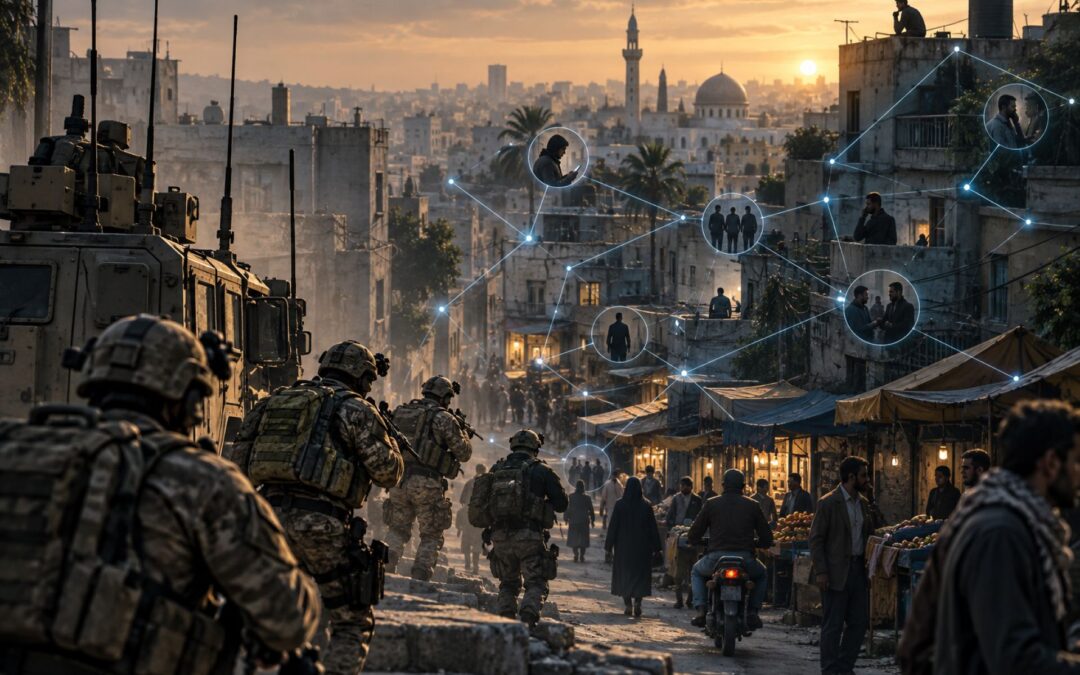
William S. Lind and Gregory A. Thiele’s 4th Generation Warfare Handbook begins with a puzzle that has troubled military thinkers for decades: why can a state possess overwhelming advantages in technology, firepower, logistics, professional training, intelligence, and money yet still struggle against opponents who possess comparatively little of any of them? The book’s answer is that conventional measures of military strength capture only part of what determines victory. A force can dominate the physical battlefield while damaging its political position, strengthening its enemy’s cause, alienating the population, and ultimately losing the war it appears to be winning.
Published by Castalia House in 2015, the handbook grows out of a much older intellectual project. Lind and several military co-authors had introduced the idea in “The Changing Face of War: Into the Fourth Generation”, published in the Marine Corps Gazette in October 1989. The handbook develops that theory into something more ambitious than a taxonomy of military history. Its first half tries to explain what fourth-generation warfare, or 4GW, is and how state forces should respond to it. Its second half makes the far more specific argument that genuine light infantry, trained for decentralization, patience, fieldcraft, adaptability, and independent judgment, is the most suitable conventional counterforce.
That dual structure is essential to understanding the book. Readers who encounter 4GW only as a sequence—First Generation, Second Generation, Third Generation, Fourth Generation—can miss how much of the handbook is really about organizational culture. Lind and Thiele are interested not only in who fights wars but in how military institutions think, train, command, gather intelligence, relate to civilians, use violence, and learn under pressure. Their recurring concern is that a force designed for centralized control and physical destruction may repeatedly produce the wrong effects in conflicts whose decisive terrain is political and moral.
The handbook is therefore strongest when it asks how military action changes the environment in which it occurs. Its most useful warning is that tactical effectiveness and strategic effectiveness are not the same thing. Its larger theory—that modern war has entered a distinct fourth generation driven by the decline of state legitimacy—is much more contestable. The book is best read with both of those facts in view: it contains a coherent and often perceptive doctrine of adaptation, but that doctrine rests on a historical model that is cleaner and more universal than the evidence permits.

From State-Centric War to Fourth Generation War
The book’s introduction and first chapter construct the conceptual world in which everything else operates. Lind and Thiele argue that modern militaries are confronting not merely new weapons or tactics but a transformation in the identity of belligerents, the sources of political loyalty, and the relationship between battlefield action and strategic effect. Their theory begins with the state and ends with the proposition that the most important consequences of military action may occur far beyond the immediate physical encounter.
The authors do not deny that traditional military concepts remain relevant. Strategy, operations, tactics, weapons, training, and combat power still matter. Their claim is that these must now be understood within a wider framework in which political legitimacy, perception, culture, identity, and the moral consequences of violence can outweigh apparently decisive battlefield results.
The Crisis of State Legitimacy and the Six Levels of War
Lind and Thiele locate the origin of modern state-centric warfare in the Peace of Westphalia of 1648. In their framework, the settlement symbolizes the establishment of the state’s monopoly on legitimate organized warfare. Before that transformation, they argue, families, clans, tribes, religions, commercial organizations, mercenaries, cities, and other political or social entities could wage war. Modernity narrowed that diversity by making war primarily an activity conducted by states through state-controlled armed forces.
Fourth-generation warfare is presented as a reversal of that historical movement. As the authority and legitimacy of states decline, people transfer their primary loyalties to religious communities, ethnic identities, tribes, ideological movements, criminal organizations, causes, and other non-state entities. Those loyalties can produce armed groups that do not resemble conventional national militaries but can nevertheless sustain political violence and challenge states.
The authors therefore insist that the root of 4GW is political rather than merely military. A state may possess stronger weapons and better trained forces while confronting an adversary whose real source of power lies in identity, legitimacy, local knowledge, social networks, or a population’s willingness to tolerate and support resistance. Military force cannot by itself restore the legitimacy that a state has lost, and a foreign force attempting to strengthen a weak government may actually make the legitimacy problem worse by associating that government with outside occupation.
This is the book’s central dilemma. State armed forces will be ordered to fight enemies produced by political and social conditions that armed force is poorly equipped to repair. The handbook therefore seeks ways for military action to avoid making the underlying problem worse.
To explain how that can happen, Lind and Thiele retain the classic tactical, operational, and strategic levels of war but argue that fourth-generation conflict compresses the distance among them. A relatively junior soldier may take an action whose consequences travel almost instantly from the tactical level to national or global politics. Mistreatment of civilians, destruction of a religious site, or the killing of the wrong person may be locally minor in conventional military terms yet strategically devastating if it delegitimizes the force responsible.
The authors then add another set of levels drawn heavily from the thinking of U.S. Air Force Colonel John Boyd: the physical, mental, and moral levels. The physical level concerns direct material effects—destroying forces, occupying ground, seizing weapons, or surviving combat. The mental level concerns perception, confusion, understanding, confidence, and the ability of opposing organizations to interpret what is happening. The moral level concerns legitimacy, identification, justice, loyalty, and whether people believe a cause or institution deserves their support.
Lind and Thiele place these in a hierarchy. Physical effects are the least powerful, mental effects are stronger, and moral effects are strongest. That hierarchy becomes one of the most important propositions in the book. A state force can win physically while losing mentally and morally, producing a strategic defeat from a sequence of tactical successes.
The handbook combines the two sets of categories into a conceptual grid: tactical, operational, and strategic on one axis; physical, mental, and moral on the other. Its purpose is not mathematical precision but disciplined questioning. Before acting, commanders should ask not only what an operation will accomplish physically at the tactical level but what it may communicate mentally and morally at higher levels.
That framework explains why the authors emphasize the “strategic corporal.” In a conventional hierarchy, the strategic level appears far removed from a patrol or checkpoint. In 4GW, a corporal’s conduct toward a civilian may alter local attitudes, generate media attention, feed an adversary’s narrative, and eventually influence national policy. The smallest visible action can therefore carry strategic weight.
The framework also changes the idea of a center of gravity. A conventional army may have headquarters, logistics hubs, armored formations, air bases, or other identifiable physical concentrations. A non-state movement can be far less centralized. Its decisive source of strength may be a story, an identity, religious commitment, popular anger, a family network, or the perception that it represents resistance to humiliation. Destroying fighters may leave those sources untouched or even strengthen them.
For Lind and Thiele, this is one reason fourth-generation warfare is unusually difficult. The conflict may involve multiple armed groups with different motivations, constantly shifting alliances, overlapping criminal and political activity, and boundaries between civilian and combatant life that are difficult to interpret. The result resembles the fragmented political environments that existed before the rise of centralized modern states more than it resembles an interstate war fought by identifiable national armies.
Operation Goliath and Operation David
The handbook dramatizes its theory through two long fictional scenarios. They are not presented as historical case studies but as teaching devices designed to show how different military behaviors can create radically different political effects.
“Operation Goliath” takes place after a conventional victory in the fictional country of Inshallahland. The 13th Armored Division is assigned to pacify the town of Akaba. It possesses all the conventional advantages expected of a modern state force: vehicles, heavy weapons, communications, aviation, intelligence systems, disciplined troops, and the ability to dominate any direct firefight.
The operation nevertheless becomes strategically self-defeating. Searches and security measures are conducted with little sensitivity to the social environment. Houses are entered aggressively, residents are humiliated, property is damaged, religious and cultural sensitivities are ignored, and the population experiences the occupying force primarily through coercion. The division sees these actions as methods of imposing order and protecting its troops, but the authors ask readers to view them from the perspective of those who must live under them.
The central character in this demonstration is Mohammed, a tea-shop owner who initially has no commitment to armed resistance. He is not introduced as an ideological insurgent waiting for an opportunity to fight. Rather, military behavior transforms his position. His home and livelihood are damaged, his dignity is attacked, and what begins as resentment develops into a willingness to support the insurgency. His son follows the same path.
The point is deliberately causal. Operation Goliath does not simply fail to eliminate an existing enemy; it helps manufacture new enemies. Actions intended to increase immediate physical security produce long-term political insecurity because they supply civilians with personal reasons to fight.
The second scenario, “Operation David,” begins when General Forrest considers a different approach developed by Lieutenant Colonel Ed Burke in the town of Hattin. Burke’s model seeks to reverse the logic of Goliath. Rather than establishing maximum physical separation between soldiers and civilians, his forces try to become familiar parts of local life. Rather than reacting automatically to every threat with escalation, they attempt to reduce confrontation and understand the political relationships surrounding it.
The changes are practical and cultural. Soldiers learn basic language and courtesies, work through interpreters, interact regularly with residents, buy goods locally, cultivate personal relationships, and treat local customs and religious practices as strategically important rather than peripheral matters. Intelligence becomes a product of sustained human contact instead of something expected mainly from centralized technical systems.
Burke’s troops also treat captured and wounded opponents with deliberate respect. The book’s logic is that violence has social consequences beyond the person directly affected. Killing one fighter in a society organized around family, clan, tribe, or honor may produce additional enemies through obligations of revenge. The objective is therefore not to maximize enemy casualties but to remove threats while minimizing the number of people who acquire a new motivation to fight.
Specialized forces called the “Nighthunters” are used for particularly sensitive operations. The scenario depicts them as a low-visibility instrument intended to avoid turning every local encounter into a confrontation between the wider population and conventional troops. The larger principle is that different missions should have different signatures: a soldier performing routine community-facing duties should not automatically look and behave like an assault force.
Operation David also contains some of the book’s most controversial fictional prescriptions. Burke describes exploiting divisions among hostile factions, using financial incentives, conducting deception, and employing covert methods intended to disrupt adversary activity without visible large-scale violence. The scenario even imagines disguised personnel and covert technical tricks. These examples illustrate the authors’ preference for indirectness and manipulation over overt destructive force, but they should be read as elements of the handbook’s imagined doctrine rather than as evidence that such methods are universally effective or legally uncomplicated.
Media relations form another contrast with Goliath. Burke favors substantial openness because he believes credibility is itself a strategic asset. Rather than treating every critical report as hostile action, his command attempts to give journalists access and let competing media organizations challenge one another’s errors. The logic again operates at the mental and moral levels: a force that develops a reputation for telling the truth has something valuable to spend when it needs the public to believe it.
Human intelligence works the same way. Burke tells his superiors that useful information comes from the bottom up. Local soldiers and junior leaders know neighborhoods, routines, personalities, and rumors that a distant intelligence bureaucracy cannot easily interpret. Technology remains useful, especially for observation, but only when it supports rather than replaces understanding of the human environment.
The “Hot Wash” that follows extracts the handbook’s main lessons from the paired scenarios. Units must focus outward on the situation rather than inward on their own procedures. Authority and information should move downward and laterally as well as upward. Local culture and politics matter. Human intelligence matters. Empathy has strategic value because commanders must understand what their actions look like to people who experience them.
Above all, the scenarios illustrate what Lind and Thiele call the power of weakness. Conventional military superiority can become a disadvantage when the stronger party appears to be using overwhelming force against someone visibly weaker. The stronger force may win the immediate encounter but lose sympathy, legitimacy, and political support. Operation David is the authors’ attempt to design a military posture that remains capable of force without constantly presenting itself as Goliath.
How the Handbook Says Fourth Generation War Should Be Fought
Chapter 2 converts the first chapter’s conceptual framework into a general operating philosophy. The authors begin with preparation because they believe no set of techniques can compensate for an organization whose officers cannot adapt or whose political strategy gives the enemy a compelling reason to fight. The chapter therefore moves repeatedly between military conduct and the political conditions that make military conduct meaningful.
Its preferred model is de-escalatory rather than annihilatory. Lind and Thiele nevertheless introduce an extreme alternative to clarify what they think state forces must avoid: a prolonged middle ground in which overwhelming power is used repeatedly but without either quickly destroying resistance or reducing the reasons for resistance.
De-escalation, Small Footprints, and Preserving the State
The first prerequisite is adaptive leadership. Officer education, in the authors’ view, should expose students to unexpected problems, time pressure, incomplete information, free-play exercises, war games, and situations in which there is no approved procedural answer. Military schooling should cultivate judgment rather than reward mastery of checklists.
The second prerequisite is strategic coherence. A tactically excellent military cannot compensate for a political objective that is impossible or self-defeating. The authors repeatedly warn against entering a conflict with goals that require remaking another society according to an outside model. Even more importantly, a state’s strategy should not provide the very motivation that keeps an enemy militia fighting.
Lind and Thiele then introduce two models for using force. The first is the de-escalation model that dominates the handbook. The second is what they call the “Hama model,” named after the Syrian government’s destruction of an uprising in Hama in 1982 under Hafez al-Assad.
The authors’ purpose is not to disguise the Hama model as restrained warfare. They define it precisely by massive, concentrated violence intended to end resistance quickly enough that prolonged political reaction never has time to develop. The historical episode itself was catastrophic for civilians: Human Rights Watch has described the 1982 Hama repression as killing roughly 10,000 people and destroying entire neighborhoods. The handbook’s use of Hama is consequently one of its most disturbing analytical choices, because it treats a large-scale atrocity primarily as an illustration of coercive effectiveness.
Lind and Thiele nevertheless believe the more common danger for Western militaries lies between Hama and de-escalation. A state may use enough force to keep generating anger but not enough to eliminate armed opposition, producing a cycle in which an obviously stronger military kills weaker opponents and civilians over an extended period. In their moral-level framework, this strengthens identification with the weaker side and progressively delegitimizes the stronger one.
Their preferred response is therefore to reduce confrontation whenever possible. A fourth-generation force should seek to prevent tense situations from becoming violent, lower the intensity of violence once it begins, and avoid making military escalation automatic. De-escalation is intended to operate tactically, operationally, and strategically.
The principle “less is more” follows directly. A foreign intervention should leave as small a footprint as possible because every additional visible element of occupation creates opportunities for friction and resentment. When a foreign military presence is unavoidable, Lind and Thiele prefer limiting its duration and avoiding indefinite occupation.
The next principle is more important than its brief treatment sometimes suggests: preserve the enemy state. A conventional military may defeat another state’s armed forces so completely that it destroys the institutions capable of maintaining order. Lind and Thiele regard that as a strategic disaster in fourth-generation conditions because the resulting vacuum creates precisely the environment in which non-state armed groups can flourish.
The implication is that regime defeat and state destruction are not the same thing. Bureaucracies, local government, policing structures, military organizations, utilities, administrative systems, and other institutions may need to survive political change. The argument anticipates a recurring lesson of stabilization and counterinsurgency: dismantling functioning institutions can create a security problem far harder than defeating the original armed opponent.
The book then identifies light infantry as the preferred military counterforce. The logic is straightforward. If most non-state fighters operate as dispersed irregular infantry, a heavily centralized force dependent on vehicles, bases, predictable logistics, and distant supporting arms will repeatedly struggle to find and engage them. State troops should instead acquire the adaptability and fieldcraft of irregular fighters while retaining the advantages of professional training.
Local Politics, Intelligence, Cash, Media, and the Moral Level
Lind and Thiele want state militaries to “out-G the G”: to study guerrilla behavior and become better at the useful parts of it than guerrillas themselves. That does not mean simply copying insurgents. It means understanding why dispersed opponents can surprise, hide, move through difficult terrain, exploit civilians’ knowledge, and act without waiting for detailed instructions from headquarters.
Integration with the local population is therefore one of the handbook’s central prescriptions. Conventional force protection often encourages troops to isolate themselves behind fortified compounds, armored vehicles, barriers, and rigid routines. Lind and Thiele argue that these measures can protect individuals physically while making the force strategically blind. Soldiers who live apart from the population know less about local relationships and increasingly encounter residents only in coercive situations.
The authors instead want military personnel to acquire the social knowledge of good local police officers. They should understand neighborhoods, personalities, family relationships, religious authorities, commercial networks, longstanding disputes, informal power, and the difference between actors who may look similar to outsiders but have different motives. The phrase “all politics is local” becomes literal doctrine.
Money functions as a supporting arm in this model. Commanders need access to discretionary funds because small payments can purchase information, compensate damage, solve immediate local problems, hire services, and build relationships faster than large bureaucratic programs. The larger point is not simply that cash buys cooperation. It is that political influence in fragmented environments often works through specific personal relationships rather than through abstract nationwide programs.
The handbook’s discussion of “codes of honor” tries to solve another problem: how to encourage restraint when the adversary is a non-state organization rather than a conventional state military. Lind and Thiele suggest negotiating locally understandable rules that govern treatment of captives, the dead, civilians, and other sensitive matters. The practical insight—that locally legitimate norms can influence behavior—is valuable, but the book’s legal framing is incomplete. Non-state status does not automatically place an armed group outside the law of armed conflict, a problem the article will return to later.
The so-called “Mafia model” expresses the authors’ preference for incentives, networks, and negotiated self-interest. Rather than imagining a conflict as a simple contest between two unified sides, they treat local society as a field of overlapping interests. Stability may depend on arrangements in which influential groups believe they gain more from the existing order than from destroying it.
This way of thinking also shapes intelligence. The handbook attacks intelligence systems designed primarily to identify conventional formations through centralized collection and analysis. In a fragmented conflict, a company may know more about its immediate environment than a headquarters many levels above it. Information should therefore move upward, downward, and sideways, while trained analytical capability should be pushed closer to the units actually encountering the population.
The authors contrast quantitative and qualitative understanding. Counting weapons, fighters, vehicles, or incidents can matter, but it cannot substitute for knowing history, culture, personalities, loyalties, grievances, and relationships. The ideal intelligence officer develops an interpretive sense of the environment rather than merely completing a standardized process.
The press is another battlefield at the mental and moral levels. Lind and Thiele favor openness because credibility is difficult to create and easy to lose. If military organizations hide every mistake, journalists will devote greater effort to discovering failures and will become skeptical when the same organizations later make accurate claims. Admitting errors, by contrast, can preserve the trust needed to communicate successfully when events genuinely support the military’s position.
The chapter culminates in the moral level. State forces cannot expect people to identify with them while simultaneously humiliating them, threatening their culture, damaging their livelihoods, or treating them collectively as enemies. Lind and Thiele’s practical standard is simple: before taking an action, imagine whether being treated the same way would create a desire for resistance.
This does not lead them to advocate passivity. They believe a force must be visibly capable and confident, because weakness can also destroy credibility. The challenge is to appear strong without creating gratuitous humiliation and to use force in ways that do not continuously manufacture new enemies. In that sense, almost everything a military does becomes communication whether or not it was intended as such.
Why Light Infantry Becomes the Book’s Counterforce
Having established the political and moral logic of its preferred approach, the handbook makes a sharper institutional argument. State forces need units that can operate among dispersed enemies without depending on the enormous physical signatures associated with conventional heavy warfare. Lind and Thiele find their answer in an idealized tradition of genuine light infantry.
For the authors, “light” is not primarily a description of how little equipment a soldier carries. It describes a way of thinking and operating. A lightly equipped conventional formation can remain bureaucratic, predictable, and dependent on higher headquarters; a true light-infantry force is defined by agility, independence, fieldcraft, initiative, and a willingness to operate with relatively little support.
The Light-Infantry Mentality and Tactical Model
The handbook traces light infantry back to ancient armies whose main bodies fought in dense formations while more dispersed troops screened flanks, skirmished, scouted, harassed, and exploited terrain. Greek light troops differed from the phalanx not only in equipment but in the freedom of individual movement their missions demanded. Roman auxiliaries performed related functions around heavier formations.
The authors then move through early modern European examples. French chasseurs, Prussian Jägers, Austrian Grenzers, British light units in North America, and later specialized formations become part of an intellectual lineage. Their common characteristics are less important as precise institutional history than as an archetype: troops expected to disperse, think locally, exploit difficult terrain, operate with reduced logistical dependence, and use surprise rather than formation discipline as their protection.
The handbook treats the British experience in North America as especially instructive because conventional forces repeatedly confronted opponents who used concealment, ambush, terrain, and loose formations. Similar adaptations appear again in later European warfare, where dedicated light formations support larger conventional armies by screening, raiding, scouting, and operating in terrain unsuitable for line infantry.
Technology eventually forced ordinary infantry to disperse as well. Rifles, machine guns, and modern firepower made dense linear formations untenable. Yet Lind and Thiele argue that true light infantry retained a distinct identity because its advantage was mental rather than merely structural.
The light infantryman in their model is resourceful, physically durable, self-reliant, and psychologically comfortable when isolated from conventional support. He does not interpret encirclement, disrupted communications, sparse logistics, darkness, difficult terrain, or unexpected orders as evidence that the mission has collapsed. The unit assumes uncertainty rather than regarding uncertainty as an emergency.
This independence allows a high tempo in decision-making even when physical movement is deliberately slow. Light infantry may spend long periods observing, stalking, infiltrating, and waiting for favorable conditions. Once action begins, however, it seeks to decide quickly and disappear before a stronger opponent can bring superior firepower to bear.
Lind and Thiele call this an “ambush mentality.” The phrase is broader than a single tactical technique. It means refusing predictable confrontation whenever surprise, deception, dispersion, concealment, maneuver, or indirect approach can create a better opportunity.
Chapter 4 summarizes light-infantry operations through the cycle Dispersion, Orientation, Concentration, and Action, or DOCA. Units disperse for survival and concealment, orient through observation and reconnaissance, concentrate only where a vulnerability has been identified, act rapidly, and then disperse again before the enemy can organize an effective response.
The defensive model follows the same logic. Instead of treating defense as holding a fixed line, the handbook imagines dispersed elements presenting uncertainty to an attacker, conducting successive local actions, moving before the opponent can fix them, and making the battlefield difficult to map mentally. The authors prefer mobility and unpredictability to static fortification.
Population support is important even here. A force that depends on field movement, local knowledge, concealment, and reduced logistical infrastructure cannot afford to make the surrounding population uniformly hostile. Light-infantry doctrine therefore connects directly back to the political argument of the first chapters.
Against non-state opponents, state light infantry should aim to become better at the same broad categories of skill. Irregular fighters may begin with advantages in terrain knowledge, social support, concealment, and informal information. Professional soldiers can potentially compensate through better training, technical proficiency, medical capability, organization, and disciplined adaptation.
The book’s confidence in this proposition leads to some of its more questionable specific prescriptions. It warns against excessive loads, dependence on communications networks, overuse of supporting arms, static duties, and heavy protective equipment. These recommendations express a coherent concern about mobility and institutional dependence, but they are much more context-sensitive than the handbook sometimes acknowledges. What preserves agility in one operating environment may create unacceptable vulnerability in another.
Training Objectives
Chapter 5 asks what qualities training must produce before Chapter 7 explains how to train units and Chapter 8 gives a conversion schedule. The first pair of qualities is deliberately paradoxical: patience and speed.
Light infantry needs patience because stealth takes time. Finding a target, studying terrain, understanding patterns, moving without detection, and waiting for favorable conditions cannot be rushed to satisfy a timetable. Training should therefore avoid teaching soldiers that every problem must resolve before a scheduled end point.
Speed becomes essential once circumstances change or action begins. Junior leaders may have seconds to recognize an opportunity or a danger and cannot always wait for permission. Lind and Thiele want personnel who can move from patient observation to rapid decision without becoming mentally frozen by surprise.
Self-discipline is even more important. The authors repeatedly contrast externally imposed discipline with the internal standards required by decentralized command. If a commander tells a subordinate only what result is required, the subordinate must have enough professional discipline to choose methods responsibly without constant supervision.
Physical conditioning is built around endurance rather than display strength. The light infantryman should be capable of moving for long periods across difficult terrain with a controlled load. The handbook’s specific numerical recommendations reflect the authors’ doctrine and experience, but the larger principle is that equipment should serve mobility rather than gradually consume it.
The Jäger, or hunter, becomes the central metaphor. Light infantry is supposed to observe, stalk, understand terrain, wait, recognize patterns, and exploit fleeting opportunity. Fieldcraft is therefore not treated as an old-fashioned supplement to modern technology but as a core professional competence.
Cross-training reinforces independence. Personnel should understand more than their assigned weapon or narrow specialty because small dispersed elements cannot assume that every expert will always be present. The authors extend the same logic to medical skills, navigation, communications, survival, and other capabilities.
The final training objective is conceptual breadth. Junior leaders must understand that their actions can affect levels of war far above their formal rank. Tactical competence without strategic awareness is dangerous in a conflict where the treatment of one family, prisoner, neighborhood, or religious site can influence the moral contest.
Operation Pandur: The Theory Turned into a Training Story
Chapter 6 returns to fiction, this time not to compare two approaches to occupation but to dramatize an institutional conversion. The setting is the imaginary K.u.K. Austro-Hungarian Marine Corps, a deliberately playful device inherited from the seminars that helped generate the handbook.
The story begins with failure. K.u.K. Marine Battalion 3, Company 2 has again been ambushed by fighters its Marines call “ghosts.” The company’s superior conventional capabilities have not prevented casualties or repeated tactical frustration. Its enemies appear suddenly, strike under favorable conditions, and disappear before the Marines can exploit their greater firepower.
Captain Trapp eventually accepts that the problem is conceptual. His company has been described as light infantry because it is not mechanized, but it does not possess the mentality or methods that Lind and Thiele associate with true light infantry. Its opponent does.
Trapp therefore asks his battalion commander for permission to remove the company from normal operations and retrain it. The request has an immediate institutional cost. Every unit is needed, and taking an entire company offline makes the short-term operational problem worse. The commander nevertheless agrees because continuing to use a failing method more efficiently will not solve the underlying problem.
The first task is psychological. Trapp explains that the company must stop thinking of itself as prey moving predictably through an environment controlled by an unseen enemy. It must become the hunter. That metaphor changes the purpose of movement, observation, equipment, discipline, and time.
Comfort is deliberately stripped away. The familiar company environment disappears, unnecessary belongings are removed from immediate use, and Marines are told that what they keep they must carry. The purpose is not hardship for its own sake but breaking dependence on infrastructure that limits movement.
Trapp also refuses to publish a predictable training schedule. Surprise becomes part of the curriculum because the company must learn that the plan can change without the organization psychologically collapsing. This principle later becomes explicit in the formal training program.
Weapons training broadens so that individuals can perform outside narrow specialties. Field exercises emphasize observation, movement, navigation, survival, medical competence, and decision-making under uncertainty. The unit is repeatedly denied the assumption that a known procedure or distant supporting arm will solve every problem.
Another important element is evaluation. Trapp expects that not every Marine will adapt equally well. Some people reveal initiative when given freedom; others reveal dependence on checklists and supervision. The fictional transformation therefore includes a personnel dimension: a decentralized organization requires people who can tolerate responsibility.
When the company eventually returns to operations, it does not resume its old pattern with better marksmanship. Its basic relationship to the battlefield changes. Squads move covertly, observe for long periods, and try to choose when and where contact occurs rather than simply accepting the enemy’s terms.
The narrative follows a patrol led by Lance Corporal Hummel, accompanied by Trapp. The patrol spends days moving, watching, and learning rather than rushing toward a predetermined firefight. This extended period of apparent inactivity is important to the authors because it demonstrates the patience required by their doctrine.
Eventually, the Marines identify an opportunity and conduct a successful action against enemy fighters. They recover useful information, deal with a wounded survivor, and resist the temptation to assume that the first engagement ends the mission. Continued observation reveals further enemy movement, which the unit is able to exploit.
Reports from other squads suggest that the transformation is working across the company rather than only for Hummel’s patrol. The battalion commander consequently considers extending the approach to the rest of the battalion.
The story does not end with permanent superiority. Trapp warns that the enemy will adapt. This is one of the handbook’s more important acknowledgements because it prevents Operation Pandur from becoming a fantasy of a final tactical solution. Any successful technique will eventually become familiar, and once it becomes predictable, an intelligent opponent will search for ways around it.
Operation Pandur therefore serves three purposes at once. It illustrates the light-infantry mentality, demonstrates how organizational retraining might work, and prepares the reader for the explicit training principles of Chapter 7 and the twenty-week schedule of Chapter 8. It also reveals the handbook’s preferred method of teaching: rather than argue abstractly that institutional culture matters, Lind and Thiele construct a story in which changing culture changes outcomes.
Building a Light-Infantry Unit
Chapters 7 and 8 move from fictional demonstration to program design. The authors now assume that a commander has accepted their diagnosis and wants to convert a conventional infantry unit into the kind of light infantry described in the previous chapters. The problem becomes educational: how do you systematically produce adaptability rather than merely instruct people to “be adaptive”?
Their answer is deliberately cumulative. Individuals first acquire broader field skills and a new mentality, then integrate those skills at squad level, then at platoon level, and finally as a company. Throughout the process, uncertainty is treated not as noise interfering with training but as the thing training is supposed to prepare people for.
Training Principles and Unit Culture
Flexibility is the first requirement. Lind and Thiele recommend tactical decision games, field problems, sand-table exercises, leader challenges, and changes to expected plans because soldiers should repeatedly encounter situations for which no memorized sequence provides a complete answer. The instructor’s role is not merely to teach the approved technique but to expose judgment.
Free play follows naturally. An exercise opponent must have an independent will. If the “enemy” is only an actor following a script written to make the training unit succeed, participants learn the wrong lesson: that reality will cooperate with their plan. A thinking opponent creates genuine uncertainty because both sides adapt to one another.
Weapons proficiency remains important, but the philosophy differs from narrow specialization. Light-infantry units operate in dispersed small groups where the loss or absence of one specialist cannot be allowed to paralyze the team. Personnel should therefore understand the weapons available throughout the unit and be familiar with equipment they may encounter from an adversary.
Patience must be trained because normal institutional schedules reward visible activity. A commander may feel pressure to keep troops constantly moving, firing, or completing events that can be reported upward. Lind and Thiele instead want exercises that sometimes require long observation and do not automatically end simply because the scheduled hour has arrived.
Stealth and stalking receive unusual emphasis. The authors even suggest drawing instruction from experienced civilian hunters where useful, because the relevant skill is not inherently military rank knowledge. The broader lesson is that organizations should look outside their formal hierarchy for expertise when that expertise contributes directly to the mission.
Survival training supports independence. Troops who cannot function without frequent resupply remain tied to predictable logistical patterns, which restricts where they can go and how long they can remain concealed. The handbook wants personnel psychologically comfortable with austere conditions rather than treating every interruption of normal support as an operational crisis.
Physical training serves the same goal. Long-duration endurance matters because the unit’s mobility comes largely from its own ability to move through terrain. Lind and Thiele are skeptical of conditioning programs that reward easily measured athletic performance without reproducing the demands of sustained field movement.
The authors also advocate competence in demolitions, navigation without complete reliance on electronics, surveillance, tactical site exploitation, and medical care. The common principle is resilience. A small unit should retain usefulness when specialized support, digital systems, or conventional infrastructure are unavailable.
Supporting arms are deliberately placed late in the hierarchy. The handbook does not reject mortars, aviation, or other external fire support, and later phases of the training program explicitly practice integrating them. What it rejects is dependence. A unit should be able to operate effectively before additional firepower is added rather than becoming helpless whenever that support is unavailable.
This entire program reflects the deeper cultural preference that runs through the book. Lind and Thiele value organizations that trust subordinates, tolerate responsible mistakes, and measure people by whether they achieve the commander’s purpose rather than whether they comply perfectly with a prescribed method. Light-infantry training is therefore also maneuver-warfare training.
The Twenty-Week Conversion Plan
Chapter 8 turns these principles into a twenty-week program divided into six broad phases. It assumes that personnel have already completed basic military occupational training and that the conversion will occur largely with existing equipment and limited additional resources. The purpose is not to build a new military from nothing but to alter how an existing unit thinks and operates.
The first three weeks concentrate on individual skills. Week 1 introduces the light-infantry concept, tactical decision-making, leadership problem-solving, land navigation, surveillance, and basic survival. Week 2 deepens tracking and survival while introducing conditioning movement and another tactical decision problem. Week 3 is devoted largely to medical training and practical evaluation.
This opening phase matters because the authors want independence before collective maneuver. A unit cannot decentralize effectively if individuals lack the competence to function without constant assistance. Land navigation, survival, observation, and medical ability reduce the number of situations in which a subordinate must stop and ask a higher headquarters to solve the problem.
Weeks 4 through 7 form the first major weapons-skills phase. Training moves from advanced field firing and communications into familiarity with adversary weapons, grenade employment, and demolitions. Long movements between training areas reinforce endurance and integrate physical conditioning with field activity rather than treating fitness as a separate institutional ritual.
The emphasis here is breadth rather than exotic specialization. The light infantryman should not become useless because equipment differs from what he normally carries or because another member of the team is unavailable. The unit is gradually being trained to see capability as distributed across the group rather than concentrated in formal specialties.
Weeks 8 through 10 move into unit skills. Ambush fundamentals, tactical decision games, navigation, leader exercises, field preparation, and a multi-day field exercise force squads to combine individual competencies. The training cycle emphasizes receiving a mission, reconnoitering, acting, reassessing, and receiving another mission rather than executing one carefully scripted event and returning immediately to routine.
The field exercise also introduces a rhythm important to the authors’ theory. Reconnaissance precedes action. Decisions are based on what the unit actually discovers rather than on the assumption that the pre-exercise plan will remain valid. Success therefore depends on observation and adaptation.
Weeks 11 through 13 constitute a second weapons-skills phase, now focused on crew-served weapons and their relationship to light-infantry operations. Machine guns, light mortars, calls for fire, and aviation integration are introduced alongside continued navigation and tactical decision-making.
The placement is deliberate. Supporting arms arrive after the unit has developed a stronger independent identity. Lind and Thiele want soldiers who can employ additional combat power intelligently without reorganizing their entire behavior around access to that power.
The phase culminates in squad exercises and live-fire applications, bringing together movement, observation, weapons proficiency, and small-unit coordination. By this point, the training plan is no longer simply teaching isolated competencies. It is testing whether squads can make them function simultaneously under uncertainty.
Weeks 14 through 17 form the platoon phase. Medical sustainment, navigation, squad competitions, and preparation lead into platoon-level exercises. Live-fire activity is followed by an extended field period in which the platoon must operate continuously rather than demonstrating one skill at a time.
This is where command culture becomes especially important. A platoon leader cannot personally control every squad in a dispersed light-infantry formation. Subordinates must understand intent, maintain awareness of the broader mission, and exercise judgment without waiting for detailed instructions.
The authors therefore recommend a parallel educational track for officers and senior noncommissioned officers, particularly once training reaches platoon and company level. The organization cannot become decentralized merely because junior troops learn fieldcraft. Leaders must learn to relinquish forms of control that prevent initiative.
Weeks 18 through 20 make up the company phase. Tactical decision games continue, while supporting arms, intelligence, weapons competence, medical skills, survival, company offense, and company defense are integrated into the largest exercises in the schedule. The final field exercise stretches across much of the last two weeks.
The program’s notes are as important as the timetable. Lind and Thiele explicitly recommend giving subordinates incomplete information and changing training plans with little warning. Units should sometimes receive new tasks after they have already planned for something else. Field exercises should be allowed to develop according to the pace of the situation rather than automatically stopping because the published calendar says they are over.
That feature ties the entire schedule together. The twenty-week plan is not really a sequence of technical classes. It is an attempt to change expectations. Soldiers accustomed to predictability gradually learn that incomplete information, altered missions, fatigue, missing resources, unfamiliar problems, and an independently thinking opponent are normal features of military life rather than failures of the training system.
The Book’s Final Strategic Argument
After devoting much of the handbook to small-unit tactics and training, Chapter 9 returns abruptly to military institutions and political legitimacy. The movement is deliberate. Lind and Thiele do not believe light infantry can solve 4GW if the wider military remains culturally incapable of decentralization or if the political system the military supports has lost legitimacy.
Their first argument is institutional. A Second Generation military must become a Third Generation military before it can respond intelligently to fourth-generation opponents. An organization built around centralized synchronization, procedure, imposed discipline, detailed orders, and inward bureaucratic requirements cannot simply add 4GW techniques while leaving its underlying culture unchanged.
Third Generation maneuver warfare provides the bridge. Its emphasis on mission-type orders, initiative, self-discipline, tempo, judgment, and outward orientation creates the organizational habits necessary for adaptation. The authors therefore see 4GW not as a rejection of maneuver warfare but as a new environment in which maneuver-warfare culture becomes even more important.
The second argument concerns foreign intervention. Outside forces begin with severe disadvantages because they often lack language, cultural knowledge, historical memory, and local legitimacy. Even when they support a government recognized internationally as lawful, their visible presence may allow opponents to portray that government as dependent on foreigners.
This is why Lind and Thiele repeatedly call foreign intervention a poisoned chalice. The military force sent to save a state’s authority can contribute to the perception that the state no longer possesses authority of its own. No tactical technique fully resolves that contradiction.
Chapter 9 then enters the book’s most politically contentious territory. The authors extend their theory of declining state legitimacy into Western societies and speculate that immigration, refugee movements, gangs, ideological communities, religious affiliations, and failures of assimilation may create competing loyalties capable of generating future fourth-generation conflict.
These claims should be understood as Lind and Thiele’s interpretation rather than as established predictions. The chapter moves from military analysis into broad social diagnosis without providing evidence proportional to the scale of its conclusions. It also tends to treat strong non-state identity as a potential precursor to armed conflict even though most religious, ethnic, immigrant, ideological, and subcultural communities never become belligerents.
The chapter is stronger when it returns to the narrower relationship between governance and military power. A functioning political order requires institutions people regard as legitimate enough to obey, an economy that permits ordinary life, public administration that works tolerably well, and corruption that remains within survivable bounds. Soldiers cannot manufacture these conditions through tactical excellence.
The handbook thus ends where it began. Fourth-generation war is ultimately a crisis of political legitimacy in the authors’ model. Military forces may avoid worsening that crisis, protect institutions, reduce violence, and help create space for politics, but they cannot substitute military competence for a political order that people are willing to accept.
The Appendices and the Book’s Intellectual Genealogy
The three appendices are short but important because they reveal the larger system behind the handbook. Appendix A explains the first three generations of modern war, Appendix B gives a seven-book “4GW Canon,” and Appendix C lists works the authors regard as essential reading for light-infantry leaders.
The generational scheme begins with First Generation warfare, associated with the rise of the modern state and line-and-column tactics. Armies seek battlefield order through drill, formation, hierarchy, and obedience. Military culture mirrors the tactical desire for visible order.
Second Generation warfare emerges from industrial firepower, especially the lessons the authors associate with the French Army during and after the First World War. War becomes a centrally synchronized process in which artillery and other fires are carefully coordinated, obedience is prized, and initiative can appear dangerous because unplanned action threatens the schedule.
Lind and Thiele argue that American military institutions absorbed much of this culture through their First World War experience with France. Their criticism is not that modern American forces literally fight exactly as French armies did a century ago. It is that proceduralism, centralization, inward focus, detailed control, and preference for synchronization continue to reflect Second Generation habits.
Third Generation warfare, in the handbook’s model, develops in the German Army during the First World War and later becomes associated with maneuver warfare and Blitzkrieg. Rather than impose order on the battlefield, Third Generation forces accept disorder and exploit it. Initiative matters more than obedience, mission-type orders replace detailed instructions, and tempo is used to confront the enemy with situations faster than he can understand and respond to them.
The authors use the German defeat of France in 1940 as their clearest contrast between Second and Third Generation cultures. They stress that France possessed powerful forces and competitive technology, including substantial armored strength, yet German organizations repeatedly exploited initiative and speed while French decision-making remained too centralized and slow. For Lind and Thiele, the decisive difference is institutional mentality more than equipment.
Appendix B’s reading canon shows where this interpretation comes from. C. E. White’s The Enlightened Soldier introduces Prussian military reform and the importance of military education. Robert Doughty’s The Seeds of Disaster explains the development of the French doctrine Lind associates with Second Generation warfare.
Bruce Gudmundsson’s Stormtroop Tactics describes German tactical adaptation during the First World War, while Martin Samuels’s Command or Control? contrasts British and German approaches to command. Doughty’s The Breaking Point then shows Second and Third Generation methods colliding during the 1940 campaign.
Martin van Creveld’s Fighting Power shifts from battlefield tactics to institutional comparison, examining differences between German and American military organizations. Finally, van Creveld’s The Transformation of War supplies much of the conceptual basis for the handbook’s move into Fourth Generation warfare, particularly the idea that the state’s monopoly on war is weakening. Lind and Thiele additionally recommend van Creveld’s The Rise and Decline of the State for the political history behind that claim.
The sequence is revealing. The handbook’s 4GW theory is not an isolated hypothesis about terrorism or insurgency. It grows out of a sustained critique of centralized military institutions. Fourth Generation warfare becomes the latest reason why armed forces must adopt the outward focus, decentralization, initiative, and adaptability the authors already valued in maneuver warfare.
Appendix C performs a similar function for light infantry. Its recommended works range from Johann von Ewald’s writing on partisan warfare to historical studies, Marine Corps articles, technological critiques, and Donald Vandergriff’s work on adaptability. The list shows that Lind and Thiele do not regard their light-infantry doctrine as newly invented for twenty-first-century insurgencies. They see it as the recovery and modernization of an older military tradition.
The Core 4GW Framework: What the Book Is Really Arguing
The generational labels are the most famous part of Lind’s theory, but they are not the most important part of this handbook. The deeper argument concerns a mismatch between military institutions and the political environments in which they operate. State forces tend to measure strength in physical resources, while many of the opponents they confront derive resilience from legitimacy, identity, decentralization, social embeddedness, and willingness to endure.
That observation remains useful even if the generational history is disputed. Armies can destroy visible enemy capabilities while leaving the political system that produces new fighters intact. Worse, the methods used to destroy those capabilities can increase recruitment, deepen resentment, or damage the legitimacy of the government being defended.
The physical-mental-moral framework is therefore more durable than the historical sequence around it. It forces commanders to consider multiple kinds of consequences at once. A raid can succeed physically by capturing a target, succeed mentally by surprising an enemy network, and fail morally if the method of execution alienates an entire community. Conversely, a tactical compromise may look inefficient physically while producing a political gain by reducing hostility.
The framework is especially valuable because it challenges the assumption that physical outcomes automatically aggregate upward. Destroying more enemy fighters does not necessarily produce more strategic success. Holding more ground does not necessarily produce more political control. Increasing force protection does not necessarily increase overall security if separation from civilians destroys intelligence and legitimacy.
The “power of weakness” makes the same point in a different form. An asymmetric conflict is judged not only by what each side does but by what observers expect from parties of unequal strength. A state with overwhelming power may be held to a higher standard, while a weaker opponent can gain politically merely by surviving. This creates a structural challenge that cannot be solved by improving firepower alone.
Yet the historical concept of four successive generations is far less secure. In a major U.S. Army War College critique, Antulio J. Echevarria II argues in “Fourth-Generation War and Other Myths” that the generational framework overstates novelty, blurs different historical developments, and treats insurgency, terrorism, and networked conflict as evidence of a new generation when many of their fundamental characteristics are much older.
That criticism matters because Lind and Thiele sometimes move too easily from “these phenomena are important” to “these phenomena define a distinct Fourth Generation.” The first proposition can be true without the second. Non-state armed organizations, decentralized networks, moral narratives, terrorism, guerrilla warfare, and conflicts over identity have appeared in many historical periods.
The generational model also implies cleaner succession than warfare actually displays. First Generation habits did not vanish when Second Generation methods appeared, and centralized firepower did not disappear when maneuver warfare developed. Military institutions frequently combine several styles at once.
The most productive way to read the framework is therefore as a heuristic rather than a literal law of military history. Its categories draw attention to genuine contrasts: order versus adaptability, centralization versus initiative, physical destruction versus political effect, state actors versus non-state actors. Problems arise when those contrasts are turned into a single universal chronology.
The 3×3 grid is similarly useful as a question generator rather than a predictive instrument. It cannot tell commanders in advance exactly how an action will affect the moral-strategic level because political environments are too complicated for that. What it can do is prevent a narrow definition of success from becoming automatic.
That is arguably the handbook’s most enduring conceptual achievement. It asks military organizations to judge themselves by the political consequences of their actions rather than by the internal metrics they find easiest to count.
De-escalation, Legitimacy, and Population Integration
The book’s strongest operational argument is that armed force can become counterproductive when the way it is employed creates the motivation that sustains resistance. Operation Goliath is fictional, but the causal mechanism it illustrates is plausible and familiar: coercive security measures can produce humiliation, personal loss, fear, grievance, and social obligations that transform neutral civilians into supporters of armed opposition.
This is why Lind and Thiele emphasize de-escalation rather than simply lower levels of violence. De-escalation is a political method. The objective is to interrupt cycles in which each confrontation generates the next one and in which force protection gradually turns an entire population into a perceived threat.
The argument also explains the authors’ hostility to physical isolation. Fortified bases can reduce some immediate risks, but they also reduce routine contact with local society. The military begins seeing the environment through formal reporting systems, sensors, raids, and checkpoints instead of through ordinary relationships.
For the authors, intelligence and legitimacy therefore reinforce one another. A force that behaves respectfully is more likely to receive voluntary information; better information permits more discriminating operations; more discriminating operations create fewer unnecessary enemies; and fewer unnecessary enemies make the population easier to understand. The opposite feedback loop is equally possible.
This basic logic overlaps with broader counterinsurgency thinking and is not unique to 4GW. The U.S. Army’s history of FM 3-24 and modern counterinsurgency doctrine describes a doctrine concerned with political context, legitimacy, populations, and the relationship between military operations and larger governance problems. That overlap is important because it shows that some of the handbook’s practical insights do not depend on accepting the full four-generation theory.
Preserving institutions is a particularly strong extension of this logic. If the strategic problem is weak political order, destroying administrative structures after defeating an opposing regime can be self-defeating. Military victory may remove the very systems needed to maintain policing, basic services, bureaucratic continuity, and social predictability.
The handbook is also perceptive about humiliation. Military organizations tend to evaluate actions in terms of legality, tactical necessity, efficiency, and force protection. Populations may interpret the same actions through honor, dignity, religious respect, family obligations, and personal memory. Strategic communication therefore cannot be separated from behavior.
Lind and Thiele sometimes romanticize the possibility of integration, however. Soldiers living among civilians do not automatically become trusted, and personal relationships do not dissolve deeper political conflicts. Local actors may cooperate for money, protection, factional advantage, or temporary convenience without accepting the legitimacy of the state.
Similarly, restraint does not always produce reciprocity. Some opponents may interpret moderation as weakness, exploit civilian proximity, or deliberately provoke disproportionate responses for political effect. The handbook recognizes parts of this problem but remains more confident than the evidence warrants that culturally informed light forces can usually navigate it successfully.
The correct lesson is narrower and stronger. Military action takes place inside a political system of interpretation. If commanders ignore that system, technically competent operations can repeatedly create effects opposite to those intended.
Light Infantry as the Universal Counterforce: Strengths and Limits
The case for light infantry follows logically from the handbook’s premises. If the enemy is dispersed, locally embedded, difficult to identify, and capable of avoiding heavy formations, then a state force needs mobility, patience, reconnaissance, fieldcraft, decentralization, and the ability to operate without constantly producing a massive physical footprint. Light infantry appears almost custom-built for that problem.
The doctrine also solves several institutional problems at once. Small-unit independence reduces the delay created by centralized command. Fieldcraft reduces dependence on vehicles and bases. Physical presence among the population can improve human intelligence. Dispersed units can cover terrain in ways large formations cannot.
The emphasis on professional skill is equally sensible. State soldiers should have advantages over part-time fighters in marksmanship, medicine, communications, logistics, and training. If they can acquire comparable adaptability and local awareness without surrendering those professional strengths, they may indeed become more capable opponents.
The difficulty lies in the word “the.” Lind and Thiele often move from arguing that light infantry is well suited to many 4GW situations to treating it as the principal counterforce. Modern conflict is too varied for that confidence.
Non-state organizations can possess precision weapons, drones, sophisticated communications, electronic-warfare capability, armored vehicles, missiles, extensive fortifications, international logistics, and external state sponsorship. They may fight as guerrillas in one phase, defend territory conventionally in another, and combine information operations, terrorism, cyber capabilities, and organized military units simultaneously.
A state confronting such an opponent may need light infantry, engineers, armor, artillery, air defense, electronic warfare, aviation, intelligence specialists, police capabilities, and political institutions at the same time. The relevant question becomes how to combine them without allowing supporting systems to suffocate local initiative.
The handbook’s own doctrine contains an implicit answer better than some of its rhetoric. Chapters 7 and 8 do not actually eliminate supporting arms. They train personnel to use mortars, machine guns, aviation, intelligence, and other capabilities after developing independent field competence. The stronger principle is therefore not “light infantry instead of everything else” but “an adaptive infantry base that can integrate other capabilities without becoming dependent on them.”
Some equipment prescriptions have also aged poorly as universal rules. Lind and Thiele strongly favor reducing loads and question routine protective equipment because mobility is central to their model. The tradeoff is real, but it depends on threat, terrain, mission, medical evacuation, weapon effects, and many other variables. A doctrine that treats mobility as an absolute can become as inflexible as one that treats protection as an absolute.
The same applies to living off the land and minimizing logistics. Independence is valuable, but modern professional forces operate under ethical, legal, medical, and technological constraints that make complete logistical autonomy neither possible nor necessarily desirable. Reduced dependence and no dependence are different goals.
What survives these qualifications is the mentality the authors associate with light infantry. Organizations should be capable of operating when plans fail, communications are degraded, support is delayed, terrain is difficult, and junior leaders face problems nobody predicted. That is not merely a light-infantry requirement; it is a general requirement of resilient military organizations.
Training Philosophy: Adaptability, Mission Command, and Free Play
The training chapters may be the most practically coherent part of the book because they confront a problem many institutions recognize but struggle to solve: everyone says they want adaptable people, yet highly standardized organizations often train adaptability out of them.
Lind and Thiele understand that adaptability cannot be created by a lecture about adaptability. If every exercise has a predetermined solution, every schedule remains stable, every opponent follows a script, and every subordinate waits for permission, the organization teaches predictability regardless of what its doctrine says.
Free play is therefore fundamental. A real opponent changes behavior in response to what the other side does. Training becomes more realistic when the adversary is allowed to make independent decisions because participants must observe, interpret, and revise their plans rather than merely execute choreography.
The authors also recognize that uncertainty must be emotional as well as intellectual. People who understand mission command conceptually may still freeze when a superior stops telling them exactly what to do. Repeated exposure to incomplete information and changed instructions builds confidence that uncertainty can be managed.
Mission-type orders fit this philosophy because they separate purpose from method. A subordinate needs to understand the result the commander requires, the larger intent, and relevant constraints. Within that framework, the subordinate is expected to choose methods appropriate to local conditions.
That system necessarily requires tolerance for mistakes. An organization cannot sincerely reward initiative if every unsuccessful decision produces punishment while passive compliance remains institutionally safe. Lind and Thiele therefore prefer errors produced by active judgment to timidity produced by fear.
The Field Leader’s Reaction Course in the twenty-week plan serves this larger purpose. Problems reveal not only technical knowledge but imagination, leadership, teamwork, and the ability to improvise with limited resources. The commander observes how people think when a familiar solution is unavailable.
Tactical decision games perform a related function more cheaply and repeatedly. A scenario forces participants to make decisions before all information is available and then defend their reasoning. The specific answer matters less than whether the decision reflects coherent judgment.
The progressive structure of the twenty-week plan is another strength. Skills are not taught once and forgotten. Navigation, medical ability, weapons competence, intelligence, survival, leadership, and physical endurance reappear while organizational scale expands from individual to squad, platoon, and company.
This is educationally more sophisticated than a checklist in which each subject is completed and never revisited. Real performance requires simultaneous competence. A soldier who can navigate only during a navigation test but loses that skill during fatigue, tactical pressure, or medical emergencies is not genuinely proficient.
The handbook’s weakness is that some of its specific training prescriptions are presented with the same confidence as its broader educational principles. Exact load expectations, long-distance movement standards, austere resupply assumptions, or equipment preferences may be appropriate in some circumstances and counterproductive in others.
The enduring principle is not the exact schedule. It is the design logic: expose people repeatedly to uncertainty, integrate skills progressively, give opponents independent agency, push responsibility downward, force leaders to make decisions, and evaluate whether the organization continues functioning when its expectations are disrupted.
Historical, Legal, and Evidentiary Assumptions That Need Qualification
The handbook’s practical doctrine often rests on observations that remain useful even when its historical explanation is weak. That distinction matters because readers can otherwise fall into an all-or-nothing judgment: either accept the complete 4GW theory or reject every recommendation associated with it. The stronger approach is to separate claims and test them individually.
Several parts of the book need substantial qualification. Its use of Westphalia is historically simplified, its discussion of non-state actors and international humanitarian law is incomplete, its treatment of Hama raises serious ethical problems, and its fictional scenarios demonstrate concepts without proving them.
Westphalia and the Generational Story
The Peace of Westphalia performs enormous conceptual work in Lind and Thiele’s theory. It marks the beginning of a period in which the state supposedly establishes a monopoly on war, making interstate conflict the defining form of modern warfare until fourth-generation forces begin breaking that monopoly.
The difficulty is that the familiar story of Westphalia as the clean birth certificate of modern sovereignty has been heavily challenged. Andreas Osiander’s influential study of “Sovereignty, International Relations, and the Westphalian Myth” argues that later international-relations theory has attributed a revolutionary meaning to the 1648 treaties that the historical settlements themselves do not straightforwardly support.
This does not mean states did not become dramatically more important in European political and military organization. They did. Nor does it mean the relationship between states and warfare remained unchanged. The problem is treating 1648 as a precise switch after which non-state war largely disappears until returning in the late twentieth century.
Mercenaries, colonial companies, rebels, pirates, tribes, partisan formations, religious movements, revolutionary organizations, and other non-state or quasi-state actors continued participating in organized violence long after Westphalia. States themselves often used such actors.
The first-generation starting point is therefore better understood as a simplifying model of military institutional development than a literal description of all warfare after 1648. Once read that way, the framework becomes more defensible: it describes tendencies in dominant state military systems rather than claiming every conflict belonged neatly to one generation.
The same qualification applies to later transitions. Firepower did not replace linear military culture everywhere at once, maneuver warfare did not replace firepower, and Fourth Generation conflict has not eliminated the previous forms. Generations overlap, combine, reappear, and coexist.
Non-State Armed Groups and International Humanitarian Law
The handbook’s discussion of “codes of honor” contains an important practical intuition but an incomplete legal premise. Lind and Thiele are interested in situations where state forces confront armed groups that are not governments and cannot simply be treated as conventional state parties to international agreements.
From that starting point, they suggest developing mutually understandable local rules that constrain behavior. Informal norms can indeed matter in practice, especially when they connect with religious, tribal, customary, or community standards that belligerents regard as legitimate.
But non-state status does not mean an armed group operates outside international humanitarian law. Common Article 3 of the Geneva Conventions establishes minimum humanitarian requirements applicable to each party in qualifying armed conflicts not of an international character, including protections for people not actively taking part in hostilities and rules concerning humane treatment.
The legal basis by which obligations apply to non-state armed groups is more complicated than ordinary treaty ratification by states, but it is not absent. The ICRC’s current commentary on Common Article 3 discusses how organized non-state armed groups can be bound by international humanitarian law even though they are not states signing treaties in the conventional manner.
The distinction matters because the handbook sometimes moves too quickly between two different statements: a non-state organization is not a sovereign state party to international treaties, and a non-state organization has no international humanitarian-law obligations. The first may describe formal treaty status; the second does not follow from it.
Local codes can therefore supplement legal obligations but cannot simply replace them. They may help create compliance where abstract legal rules possess little immediate legitimacy, yet state forces remain bound by applicable law regardless of whether an opponent agrees to an informal code.
The Hama Model and the Problem of Instrumentalizing Repression
The “Hama model” is analytically provocative because Lind and Thiele use it to identify a brutal logic they think militaries sometimes prefer not to discuss openly: overwhelming violence can suppress resistance when a regime is willing to accept catastrophic human costs and political isolation.
The problem is not that the handbook mentions this. Serious analysis of warfare sometimes has to examine effective actions that are morally abhorrent. The problem is that its framework risks reducing Hama to a tactical variable—speed plus overwhelming force—rather than adequately confronting what the model means for the people subjected to it.
The 1982 destruction of Hama was not merely a cleaner alternative to a badly managed counterinsurgency campaign. Human Rights Watch’s account describes mass killing and widespread destruction. Any analysis of its “effectiveness” therefore has to specify what standard is being used and what ethical and legal costs are being excluded from that standard.
Lind and Thiele do acknowledge that Western states would normally face domestic and international constraints preventing this approach. Yet the chapter sometimes treats those constraints primarily as political limitations on available methods instead of as manifestations of legal and moral obligations that are themselves relevant to legitimacy.
The Hama discussion nevertheless clarifies something important about the rest of the book. De-escalation is not presented as pacifism. The authors favor it because they believe prolonged disproportionate violence is strategically self-defeating for states that cannot or will not adopt the extreme coercion of regimes unconstrained by similar political standards.
That conclusion is useful even if the binary choice is too stark. Real conflicts contain many possibilities between mass repression and the specific de-escalatory model Lind and Thiele advocate. The danger lies in allowing a dramatic contrast to make a complex policy space appear simpler than it is.
Thought Experiments, Historical Examples, and Evidence
Operation Goliath, Operation David, and Operation Pandur are excellent teaching devices because they make abstract principles memorable. Readers can see how humiliation generates opposition, how decentralized intelligence might work, and how retraining changes organizational behavior.
They are not empirical tests. The authors control every variable, every decision, and every outcome because the scenarios are fictional. Operation David works because Lind and Thiele design a world in which the political assumptions behind Operation David are correct.
The same issue appears in some historical examples. The book often uses an episode to illuminate a principle, but illumination is not the same as demonstrating a general causal law. German initiative in 1940 can show the potential importance of organizational culture without proving that maneuver-war doctrine alone explains the French collapse.
This matters most when the handbook makes universal claims. The more general the proposition, the more evidence it requires. “Junior initiative can improve adaptation” is easier to support than “light infantry is generally the best force for fourth-generation war.” “Tactical violence can have strategic political effects” is easier to defend than “modern warfare has entered a distinct fourth generation caused by the decline of the state.”
The book’s form encourages confident compression. It is a handbook, not a scholarly monograph, and it wants to give practitioners memorable principles they can use. That makes it accessible, but it also means readers must separate persuasive illustration from systematic evidence.
What Later Warfare Complicates in the 4GW Thesis
The world since the handbook’s publication has offered abundant evidence that non-state organizations, insurgencies, militias, proxy forces, terrorist networks, private military actors, and irregular methods remain important. In that sense, Lind and Thiele were plainly concerned with a real and enduring dimension of warfare.
What later developments do not support is a simple story in which state-on-state war is fading as a new generation replaces it. Contemporary conflict is better described as an accumulation of forms. Conventional interstate war, civil war, insurgency, foreign intervention, proxy warfare, irregular operations, terrorism, drone warfare, cyber operations, and information campaigns can all coexist and interact.
Frank Hoffman’s work on “hybrid threats” offers one influential alternative to generational succession. Rather than assuming distinct forms replace one another, hybrid-war thinking emphasizes opponents that combine conventional capabilities, irregular tactics, terrorism, criminal activity, and other methods according to circumstance.
That model fits many conflicts better than a clean transition from one generation to the next. A non-state force can behave like guerrillas in one region while defending territory through conventional formations elsewhere. A state can use regular troops, proxies, cyber capabilities, economic coercion, information operations, and covert action simultaneously.
Current conflict data also caution against assuming interstate warfare is becoming historically marginal. In June 2026, Uppsala University’s Conflict Data Program reported that 2025 saw eight interstate conflicts and 65 conflicts involving states on at least one side, with the latter total the highest in the dataset beginning in 1946.
Those figures do not “disprove” fourth-generation warfare. A dataset counting state involvement cannot determine whether Lind and Thiele’s moral-level theory is useful, and interstate conflict can itself contain irregular, proxy, informational, and decentralized elements.
What the data do challenge is the strongest version of a one-way historical narrative. The state has not simply left the stage. Governments and state militaries remain central actors in organized violence even while non-state actors have become highly significant in many conflicts.
The most accurate contemporary synthesis is therefore plural rather than generational. Warfare can involve powerful states and fragmented non-state movements, industrial firepower and decentralized cells, armored formations and social-media narratives, precision missiles and improvised tactics, all within the same strategic system.
Seen this way, the handbook’s categories retain value as dimensions of analysis. The mistake is treating them as exclusive historical boxes. Modern forces need the ability to fight conventional opponents while also understanding legitimacy, decentralization, adaptation, networks, and political narratives.
That conclusion actually strengthens some of Lind and Thiele’s institutional advice. Organizations built around one expected form of war are fragile. Military education should prepare leaders to recognize the kind of conflict they are actually facing rather than forcing every problem into whichever doctrine they already know best.
Style, Structure, and Rhetorical Method
4th Generation Warfare Handbook is written to persuade practitioners rather than satisfy academic conventions. Its prose is direct, compressed, opinionated, and often intentionally provocative. The authors prefer clear distinctions because they want readers to remember the framework under pressure.
That style gives the book unusual energy for military theory. Operation Goliath, Operation David, and Operation Pandur turn abstractions into situations that are easy to visualize. A reader may forget a formal definition of moral-level warfare but remember Mohammed becoming an insurgent after being humiliated by forces supposedly trying to stabilize his town.
The fictional K.u.K. Austro-Hungarian Marine Corps gives the authors freedom to dramatize doctrine without pretending the scenario is a real campaign. It also introduces humor and distance into otherwise serious material. The device allows them to criticize familiar military practices indirectly by placing them in an invented organization.
The movement from theory to story to doctrine to curriculum is structurally effective. Chapter 1 tells readers what 4GW means, Chapter 2 explains how it should be fought, Chapters 3 through 5 define the preferred force, Operation Pandur shows transformation in action, and Chapters 7 and 8 turn that transformation into a program. Chapter 9 then returns to the larger political level.
This creates a feeling of completeness. By the end, Lind and Thiele have not merely told readers that adaptation matters. They have tried to show what to teach on Monday morning.
The same rhetorical confidence creates weaknesses. Complex historical debates are often compressed into declarative claims. The transitions from example to principle can be too fast, especially when an illustrative scenario is treated as though it establishes the effectiveness of the method it was written to illustrate.
Binary contrasts also simplify reality. Goliath versus David, Second Generation versus Third Generation, heavy institutional dependence versus true light infantry, Hama versus de-escalation: these oppositions are memorable because they reduce ambiguity. They are also less reliable when transferred from teaching models to actual conflicts, where organizations often occupy intermediate positions.
The prose occasionally carries ideological assumptions without stopping to defend them. This becomes most visible in Chapter 9, where observations about legitimacy expand into broad claims about Western societies, immigration, identity, and internal conflict. The handbook’s brevity that works well for tactical principles becomes a liability when applied to large social predictions.
Yet the book is rarely vague about what it believes. Readers can disagree with Lind and Thiele, but they seldom have to guess what the authors are trying to say. That clarity is a real strength, especially in a field where jargon can conceal rather than sharpen disagreement.
Critical Review: What the Handbook Achieves and Where It Falls Short
The fairest evaluation of 4th Generation Warfare Handbook begins by separating its most famous claim from its best work. The argument that modern warfare has entered a distinct fourth generation is the book’s organizing theory, but the strongest parts of the handbook do not actually require that theory to be completely correct.
The physical-mental-moral framework is one of its most useful contributions. Militaries naturally measure what they can observe: territory, weapons destroyed, enemies killed or captured, missions completed, bases protected, and units supplied. Lind and Thiele repeatedly ask whether those measures correlate with the political result the war is supposed to produce.
That question remains essential. A military can perform magnificently according to its internal metrics while eroding the legitimacy of its partner government, encouraging recruitment by armed opposition, or generating political costs greater than the value of its tactical gains. The handbook gives readers a vocabulary for recognizing that possibility.
Operation Goliath and Operation David make the argument memorable. The simplification is obvious, but the scenarios demonstrate cause and effect more successfully than many pages of abstract theory would. Mohammed’s transformation from civilian to insurgent embodies the core warning that the way security is imposed can create insecurity.
The book is also unusually strong on the institutional consequences of its ideas. Many works on irregular warfare end with recommendations such as “be culturally aware,” “adapt,” or “decentralize.” Lind and Thiele ask what kind of training and command system would actually make those behaviors possible.
The resulting emphasis on free play, mission-type orders, tactical decision games, changing conditions, broad individual competence, and tolerance for responsible initiative is persuasive. The exact twenty-week schedule is not universally transferable, but the educational philosophy underneath it is far more durable.
Operation Pandur is particularly effective because it portrays transformation as uncomfortable. The company cannot become light infantry merely by changing terminology. It has to abandon habits, remove familiar supports, identify people who cannot adapt, and accept reduced short-term availability while retraining. Institutional reform has costs before it produces benefits.
The discussion of intelligence is similarly strong. Centralized technical collection can become detached from the social reality small units actually encounter. Pushing analytical ability downward and treating local personnel as active interpreters of their environment is a sensible response to highly granular conflicts.
The authors also understand that legitimacy is behavioral. A propaganda campaign cannot permanently compensate for conduct that contradicts its message. If a military publicly claims respect for a population while routinely humiliating members of that population, the behavior will eventually define the message.
Preserving state institutions is another important insight. The book correctly recognizes that defeating a hostile government and destroying the administrative order sustaining ordinary life can produce very different outcomes. Political authority is easier to damage than rebuild.
The handbook becomes less convincing when it moves from these observations to universal historical claims. Echevarria’s critique of fourth-generation warfare as a generational model identifies the central problem: many characteristics presented as evidence of a new era—insurgency, terrorism, decentralization, networked organization, political warfare, and non-state violence—have deep historical precedents.
The response cannot simply be that 4GW combines them in a new way, because nearly every period of warfare combines inherited methods under new political and technological conditions. A generational theory needs clearer criteria for distinguishing genuine transformation from variation within recurring forms of conflict.
The Westphalian narrative compounds the problem. The handbook needs a clean moment when the state monopolizes war because the Fourth Generation is defined partly as the collapse of that monopoly. Historical reality is too messy to support such a sharp dividing line.
The light-infantry thesis is more persuasive as force-design advice than as universal doctrine. Many of its principles—mobility, initiative, fieldcraft, decentralized decision-making, reduced logistical dependence, and small-unit competence—are valuable. But a modern adversary may combine irregular methods with heavy weapons, drones, electronic warfare, air defenses, fortified positions, precision fires, or conventional formations.
The best state force is therefore unlikely to be a pure realization of one historical archetype. It will need the adaptability Lind and Thiele admire in light infantry while remaining capable of integrating technologies and supporting capabilities that their rhetoric sometimes treats too suspiciously.
The handbook’s legal treatment has also aged poorly. The suggestion that non-state actors require an alternative to the Geneva framework because they are not treaty-signing states obscures the applicability of international humanitarian law to qualifying non-international armed conflicts. That weakness does not destroy the practical idea of negotiating locally meaningful restraints, but it does require correction.
The Hama model is a more serious moral limitation. It is reasonable for military theory to examine why brutal regimes sometimes suppress rebellion successfully. It is much less satisfactory to present mass repression mainly as one endpoint in a strategic choice between fast overwhelming violence and de-escalation.
The human cost is not incidental to the analysis. If legitimacy is truly the most powerful level of war, then legal and moral constraints cannot appear only as restrictions preventing states from using militarily effective methods. They are part of the political order whose legitimacy the book claims to defend.
Chapter 9’s broader social claims are another weakness. The authors move from a defensible proposition—that state legitimacy can decline and that armed groups can organize around non-state identities—to much wider speculation about immigration, refugees, ideology, religion, gangs, and future internal conflict.
The scale of the evidence does not match the scale of the prediction. Strong identities outside the state are normal features of plural societies, and their existence does not by itself imply movement toward organized warfare. The book would be stronger if it distinguished more rigorously among social pluralism, declining governmental trust, criminal organization, political extremism, insurgency, and actual civil conflict.
Later warfare has also made the idea of simple generational succession harder to sustain. Contemporary conflict demonstrates the continued importance of the state, including direct interstate warfare, while also validating the handbook’s interest in proxies, non-state actors, legitimacy, information, and irregular methods.
That mixed picture favors hybrid and multidimensional approaches over a theory in which one generation displaces another. It does not make the handbook irrelevant. It changes what kind of value the book can reasonably claim.
Its strongest contribution is therefore methodological rather than prophetic. Lind and Thiele teach readers to ask whether a military organization is producing the political effects it intends, whether its command culture can adapt, whether its training develops judgment, whether its force-protection methods create strategic isolation, and whether a tactical victory may contain the causes of later defeat.
Its most important limitation is that it often treats a valuable lens as a complete theory. The physical, mental, and moral dimensions are real, but they do not make physical military power secondary in every war. Non-state actors matter, but states remain central. Light infantry can be extremely useful, but it is not a universal answer. Decentralization can create initiative, but some capabilities require synchronization and centralized control.
The book has also aged unevenly technologically. Its emphasis on human understanding remains relevant precisely because technology cannot eliminate political complexity. At the same time, the capabilities available to state and non-state forces have changed significantly, making any rigid opposition between high-technology conventional forces and lightly equipped irregulars less reliable.
Its training philosophy has aged better. Teaching people to function with incomplete information, to understand intent, to make decisions without waiting for permission, to adapt when an opponent changes, and to integrate multiple skills under stress remains valuable well beyond the specific 4GW framework.
The handbook is also accessible in a way many military-theory books are not. Its scenarios, strong claims, practical orientation, and relatively compact conceptual vocabulary make it easy to remember. That accessibility increases its influence but also increases the need for critical reading because the most memorable formulations are not necessarily the most historically secure.
For military professionals, the book is most useful as a challenge to institutional complacency. It asks whether procedures that work beautifully inside the organization still make sense when confronted with an enemy who refuses to behave according to the organization’s expectations.
For readers of counterinsurgency and political violence, it offers a vivid account of how legitimacy, humiliation, local relationships, intelligence, and force can interact. These ideas should be compared with broader counterinsurgency scholarship rather than treated as unique discoveries of 4GW theory.
For students of military history, the generational model is useful as a starting hypothesis rather than a settled chronology. Reading the handbook alongside its critics reveals more than accepting or rejecting it wholesale.
For readers interested primarily in a predictive theory of twenty-first-century war, the book is less satisfactory. The persistence of interstate war, the rise of hybrid combinations, rapid technological change, and the variety of contemporary non-state actors all resist its cleanest categories.
The result is a book whose practical observations often exceed the theory built to contain them. 4th Generation Warfare Handbook remains valuable because it understands a central truth of political violence: the immediate destruction of an opponent is not identical to strategic success. Military action changes loyalties, expectations, institutions, stories, and perceptions as surely as it changes physical conditions.
Its light-infantry doctrine extends that insight into organizational form. A force operating in a politically complex environment must be capable of seeing, learning, adapting, and deciding close to the point of contact rather than expecting distant headquarters and superior firepower to solve every problem. Its training system is an attempt to produce exactly that kind of organization.
The reader does not need to accept the claim that warfare has entered a universal “Fourth Generation” to take that lesson seriously. In fact, the handbook is more useful when its historical categories are treated skeptically and its institutional questions are treated seriously.
The enduring question it leaves is not whether Lind and Thiele correctly named the era. It is whether a military can recognize when the methods that make it powerful on the physical battlefield are simultaneously making it weaker in the political struggle that gives the battlefield meaning. Read as a provocative doctrine of adaptation rather than settled military history, 4th Generation Warfare Handbook still offers a demanding and worthwhile answer.
Last Updated on September 21, 2026 by Aseem Gupta