
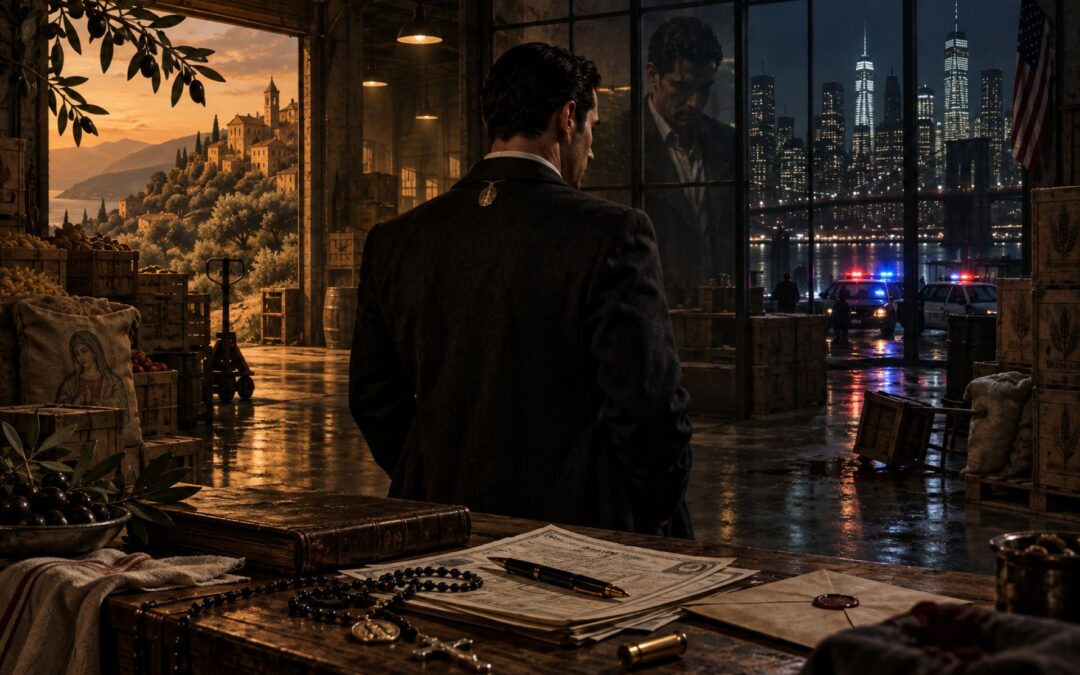
Published in 2000 by Random House, Omerta was Mario Puzo’s final completed Mafia novel and appeared after his death in 1999. Penguin Random House still lists the novel under its original Random House line, while contemporary accounts of Puzo’s final years describe Omerta as the concluding work in the loose thematic Mafia trilogy he associated with The Godfather and The Last Don. Penguin Random House’s publication page for Omerta The Los Angeles Times retrospective on Puzo and Omerta It is not a sequel to the Corleone story, however. Its characters and plot stand independently, and its real connection to Puzo’s earlier Mafia fiction lies in its recurring questions about family, loyalty, power, legitimacy, and the price of living by a private code.
At the center of the novel is Astorre Viola, a seemingly harmless macaroni importer whose life has been shaped for a purpose he only gradually understands. After the murder of his guardian, Don Raymonde Aprile, Astorre inherits responsibility for protecting the Aprile family and its banks. That duty draws him into a conflict involving professional assassins, corrupt police officers, an ambitious international criminal syndicate, the FBI, compromised public institutions, and his own buried inheritance from Sicily.
Spoiler warning: This article covers the complete novel, including Don Aprile’s murder, Astorre’s hidden identity, the Macaroni Massacre, and the entire epilogue.

Complete Plot Summary of Omerta
Omerta unfolds through a deliberately layered structure. Puzo begins with Astorre’s infancy in Sicily, jumps forward to the conspiracy against Don Aprile, and then repeatedly uses flashbacks to reveal that the apparently unserious Astorre has been trained for decades to become exactly the man the crisis requires. The murder mystery therefore develops at the same time as a hidden-biography mystery: readers are not merely discovering who ordered Aprile’s death, but who Astorre really is.
Prologue — Don Zeno Entrusts Astorre to Aprile
The novel opens in Sicily in 1967 with Don Vincenzo Zeno preparing for death. Zeno’s much younger wife has died after giving birth to their son, Astorre, leaving the child without a mother and soon without a father. Because Zeno knows that a vulnerable heir to a powerful Sicilian name can become a target, he summons three men he trusts: Don Raymonde Aprile from New York, Octavius Bianco from Palermo, and Benito Craxxi from Chicago.
Zeno must decide which of them should raise and protect the boy. He chooses Aprile because Aprile combines strength with caution and possesses the resources necessary to give Astorre a future beyond the immediate dangers of Sicily. Zeno also senses that Aprile, despite already having children, will understand the obligation more deeply than the others.
When Zeno dies, his funeral becomes both a public display of his status and a symbolic transfer of authority. The little boy rides prominently in the procession before leaving Sicily with Aprile. Astorre himself does not yet understand what has happened, but the novel has established the central inheritance that will not be fully explained to him until much later: he is not simply a dependent child. He is the son of a Sicilian don whose surviving allies regard his life as an obligation.
Chapters 1–2 — Don Aprile’s Retirement, Astorre’s Childhood, and the Murder
The main plot begins decades later with identical twins Franky and Stace Sturzo visiting John Heskow, a well-connected intermediary who arranges criminal work. The brothers are accomplished killers, but Puzo introduces them as men with an almost ordinary public existence, emphasizing the gap between appearance and profession that will recur throughout the novel.
Heskow offers them an extraordinary contract: one million dollars to murder Don Raymonde Aprile. The twins know Aprile’s reputation and initially hesitate because killing a retired Mafia chief would normally bring devastating retaliation. Heskow reassures them that the usual protections have already been neutralized. The police will not interfere, federal authorities will not interfere, and Aprile’s former criminal allies supposedly will not retaliate. That assurance makes the contract more disturbing than a simple assassination order. Somebody has not merely hired gunmen; somebody has created an environment in which one of the most feared men in America can be killed without consequences.
Don Aprile is now sixty-two and has deliberately dismantled much of his former criminal organization. Federal prosecutions, especially the aggressive use of racketeering law, have devastated traditional Mafia structures, and Aprile has concluded that the old way of operating is dying. Instead of trying to preserve an empire indefinitely, he has converted power into legitimacy and ensured that his children occupy respectable positions.
His eldest son, Valerius, has become a decorated Army officer and West Point graduate. Marcantonio has built a career in television. Nicole is a formidable corporate attorney whose moral commitments include strong opposition to capital punishment. Aprile has therefore succeeded at something many Mafia patriarchs merely claim to want: his biological children are not criminals.
Astorre Viola appears to be the exception, although not in the obvious sense. He has returned from years abroad and runs the Viola Macaroni Company, sings enthusiastically, rides horses, dresses distinctively, and cultivates the manner of a charming eccentric. He seems less impressive than Aprile’s accomplished children, and almost no one outside the family understands why Aprile trusts him so completely.
The novel gradually fills in the history between them. Astorre was initially raised in America by Frank Viola, a man presented to the boy as his father. When Viola later betrayed Aprile and was killed, Astorre entered Aprile’s household more directly. Aprile never told him that his biological father was Don Vincenzo Zeno, allowing the boy to grow up without understanding the full weight of his Sicilian inheritance.
One of Astorre’s formative experiences occurs during a visit to Sicily when he and Aprile are kidnapped by the bandit Pietro Fissolini. Octavius Bianco rescues them, and Aprile intends to impose the usual punishment for such an offense. Astorre, still young, pleads for mercy.
Aprile does not dismiss the boy’s compassion, but neither does he accept mercy as a sentimental act. He converts it into a binding agreement. Fissolini and his men may live, but only if they swear loyalty and understand that betrayal will bring destruction. The episode becomes one of the novel’s earliest demonstrations of Puzo’s distinctive moral system: mercy is valuable, but mercy without power is fragile. Aprile believes kindness must be reinforced by consequences.
As Astorre grows older, he and Nicole become lovers. Their relationship is genuine, but Aprile does not allow it to determine Astorre’s future. He sends Astorre to England, separating the young pair without openly forbidding the romance. There Astorre lives under the supervision of Mr. Pryor and begins learning about banking and finance.
The apparent aim is respectable education, but Aprile is preparing something more complicated. Eventually he gives Astorre 51 percent control of the Aprile banks, leaving his three biological children to divide the remaining 49 percent. He orders Astorre never to sell the institutions. The decision astonishes everyone because it gives the apparently frivolous cousin effective control over the family’s most valuable financial asset.
The banks are not merely investments. Aprile understands that his enemies may disappear from street corners only to reappear in boardrooms, international finance, government offices, and narcotics networks. By placing the banks under Astorre’s control, he gives the family a defensive structure that cannot easily be divided among his children.
The ethical differences within the family also become explicit. Nicole opposes the death penalty because she believes the state should not deliberately take human life. Aprile respects her seriousness but does not share the principle. For him, certain acts create obligations of vengeance that cannot be dissolved by legal abstractions. Their disagreement is not a decorative political argument. It establishes a moral conflict that will return after almost everyone responsible for Aprile’s death has been killed.
The assassination comes during a family celebration connected with a grandson’s confirmation at St. Patrick’s Cathedral. Franky and Stace Sturzo execute the operation with professional precision. Stace shoots Don Aprile while Franky unleashes automatic fire to create panic and confusion. Heskow serves as the escape driver.
Astorre sees enough to retain useful details about the gunmen but cannot save Aprile. The old Don, who spent years making his biological children legitimate and his hidden heir dangerous, is killed in the public heart of respectable New York life. His death activates the structure he created precisely because he expected that one day his family might need protection after he was gone.
Chapters 3–5 — Astorre Investigates and the Bank Conspiracy Emerges
The official response to Aprile’s murder is strangely muted. The absence of overwhelming police and federal pressure becomes suspicious because a killing of this magnitude should normally attract enormous investigative attention. FBI official Kurt Cilke and his colleague Bill Boxton begin questioning members of the family, former associates, and possible enemies, but Cilke’s role will prove far more complicated than that of a conventional investigator.
Aprile’s will reveals Astorre’s controlling interest in the banks. Nicole, Valerius, and Marcantonio are understandably unsettled by the arrangement because Astorre appears less qualified than any of them to control a major financial institution. Yet the more they examine their father’s decisions, the clearer it becomes that Aprile did not act casually.
Astorre, meanwhile, performs incompetence brilliantly. He sings, discusses macaroni, appears confused about finance, and allows Cilke to treat him as a harmless relative who has accidentally inherited extraordinary responsibility. His wide gold collar bearing an image of the Madonna adds to the eccentric impression. Cilke notices details but cannot yet connect them to a coherent picture.
The Aprile children also begin learning how extensively their father influenced their supposedly independent successes. He had not simply withdrawn from their lives after leaving organized crime. He used contacts and power quietly, ensuring that doors opened without revealing the source of the assistance. That discovery complicates their relationship with his legacy. Their respectability was real, but it was not entirely detached from the system they believed they had escaped.
Astorre secretly consults Benito Craxxi. The description of the assassins as identical, left-handed shooters allows Craxxi to identify the Sturzo twins as plausible killers. The more troubling clue is still the absence of meaningful protection around Aprile. Someone powerful enough to influence both local and federal behavior must have helped create the opening.
Astorre then begins recruiting the three Aprile siblings into his own information network. Valerius has access to military and intelligence contacts. Marcantonio can use television and journalistic resources to investigate Cilke. Nicole, as an attorney, can obtain and evaluate records relating to the FBI’s long campaign against their father.
The family dynamic shifts as they realize that the man they thought of as an unserious cousin has been preparing for exactly this sort of crisis. Astorre still refuses to tell them everything, but he no longer needs to pretend quite so completely.
Cilke approaches Astorre with a proposal concerning Timmona Portella, an ambitious criminal figure who wants access to the Aprile banks. The FBI hopes Astorre will cooperate in a controlled operation that lets Portella believe he can use the banks for illicit purposes. Nicole objects to aspects of the arrangement, but Astorre signs the necessary documents.
Nicole secretly records part of the encounter. That recording will later become one of Astorre’s most effective weapons because it can be presented selectively to make Cilke appear corrupt.
The conspiracy widens through Marriano Rubio, Peru’s consul general and Nicole’s lover. Rubio is connected to a multinational criminal network whose leaders include Portella, South American narcotics magnate Inzio Tulippa, and Sicilian power Michael Grazziella. Their interests have moved far beyond the older neighborhood Mafia. They are concerned with international narcotics, money laundering, finance, diplomatic immunity, and political protection.
Tulippa’s ambitions are particularly extreme. His wealth and influence support plans reaching beyond drug trafficking into military technology and a secret defensive weapons program. Whether plausible or extravagant, the scheme signals the scale of the transformation Puzo wants readers to see: the successors to the traditional Mafia are not merely men collecting protection money from shopkeepers. They think globally and use the mechanisms of states, banks, corporations, and diplomacy.
The Aprile banks would give them a crucial laundering and financial infrastructure. They therefore make an offer to purchase the institutions. Nicole, Valerius, and Marcantonio are willing to perform cooperation, but Astorre refuses to sell.
Grazziella immediately takes Astorre more seriously than Portella and Tulippa do. He remembers him from Sicily and knows that the macaroni importer’s manner conceals a “Qualified Man,” someone trained to operate within the old criminal world. The warning is ignored because Astorre’s disguise is psychologically effective: people prefer to believe the harmless version because it makes their plans easier.
An assassination attempt follows while Astorre is riding. He survives partly because he is wearing concealed body armor. At that point the Aprile siblings can no longer pretend the dispute is merely financial. Their father’s killers or their allies are prepared to eliminate Astorre as well.
At the same time, the novel reveals that Cilke’s relationship with Portella is not straightforward corruption. The FBI is running Operation Omerta, a sting designed to draw Portella into using the Aprile banks for laundering so that federal authorities can eventually seize the institutions and destroy his organization. Payments from Portella to Cilke are monitored components of the operation rather than ordinary bribes.
That does not make the federal side morally clean. Cilke increasingly encounters situations in which senior officials tolerate crimes, make strategic bargains, or ignore wrongdoing because a larger operation seems more important. The distinction between legal authorization and personal corruption remains real, but it becomes less comforting.
The conflict turns personal when Cilke’s German shepherds are killed and their hearts left as a warning. The threat signals that the syndicate no longer regards him simply as an investigator. Like Astorre, he is becoming a target in a struggle whose boundaries between public duty and private vengeance are beginning to disappear.
Chapters 6–8 — Rosie, the Sturzo Trap, and Astorre’s Hidden Education
The narrative shifts to California, where Franky and Stace Sturzo have relaxed after the successful murder. They encounter Rosie, an attractive, socially adaptable woman who begins relationships with both brothers. The twins believe they have found pleasure without danger, but Rosie is not part of their lives by accident.
Franky becomes especially attached to her, and that emotional attachment makes the professional killer careless. Eventually Rosie persuades the brothers to accompany her to what they believe is a family destination around Christmas. Armed men are waiting there.
Before the outcome is fully explained, Puzo returns to Astorre’s past and reveals how Don Aprile actually prepared him.
At sixteen, Astorre was sent to England under the care of Mr. and Mrs. Pryor. He learned finance and banking while also pursuing music, acting, riding, and other interests that seemed unrelated to criminal life. In England he became involved with Rosie Conner, establishing the relationship that would much later allow her to help trap the Sturzos.
Aprile subsequently sent Astorre to Sicily to study under Octavius Bianco. There the education became explicit. Astorre learned weapons, explosives, tactics, surveillance, political influence, social codes, and the psychological rules through which Mafia authority operates. Bianco’s training was not simply technical. It aimed to remove hesitation from a young man who had grown up capable of sympathy.
Conflict with Corleonesi boss Tosci Limona becomes one such lesson. Bianco teaches Astorre that once a killing has been judged necessary, prolonged conversation with the victim creates dangerous emotional uncertainty. The code assumes that survival depends on making certain decisions irreversible before sentiment can weaken resolve.
Rosie produces another kind of lesson. During their time in England, a married professor dies while having sex with her. Rosie calls Astorre rather than immediately summoning the authorities and remains remarkably composed. Pryor makes the scandal disappear and recognizes something in Rosie that Astorre has not yet fully understood: she does not think according to conventional respectability. She adapts quickly, protects herself, and accepts morally ambiguous solutions without collapsing under guilt.
Astorre’s Sicilian training eventually turns him into a genuine operative. The earlier mercy shown to Pietro Fissolini also comes back into the story through later betrayal and vengeance, demonstrating how unreliable permanent reconciliation can be in a culture where family injuries are remembered across years.
Astorre is nearly killed during this period. An assassin attacks him while he is swimming, and a bullet tears through his throat. He survives after months of treatment, but his singing voice is permanently damaged. The golden Madonna collar he later wears hides the scar.
That detail changes the meaning of his public persona. Astorre’s singing and theatricality are not simply comic eccentricities. His body carries evidence of the violent education behind the act, while the decorative religious collar literally covers the wound.
Rosie’s relationship with Astorre also becomes more complicated. He discovers that she has other wealthy lovers and does not understand fidelity in conventional terms. She seeks pleasure, affection, luxury, and security without automatically connecting those desires to exclusivity.
Astorre does not idealize her after learning this. Nor does he stop caring about her. Years later he recruits her precisely because he understands both her strengths and her appetites. Rosie is therefore able to attract Franky and Stace without pretending to be someone entirely different from the woman Astorre knew.
Once the twins are captured, Astorre interrogates them about Don Aprile’s murder. Stace eventually identifies Heskow as the intermediary and confirms the crucial detail that the assassins were assured neither the police nor federal authorities would create serious problems after the killing.
The information gives Astorre the next link in the chain. He intends the brothers to die without unnecessary suffering, but Aldo Monza imposes his own harder conception of vengeance and strangles them. The episode establishes an important distinction between Astorre and some of the men who serve him: he accepts killing as necessary within his code, but he is not automatically attracted to cruelty.
Chapters 9–10 — Heskow Turns and Astorre Sets Portella Against Cilke
Astorre now goes after John Heskow. He penetrates the intermediary’s elaborate security and presents evidence taken from the Sturzo brothers, making denial pointless. Heskow understands that Astorre already knows enough to kill him and that survival depends on becoming useful.
He identifies Portella as the principal force behind Don Aprile’s assassination and names two New York police officers who were bought to help neutralize official interference: Di Benedetto and Aspinella Washington. Most dangerously, Heskow believes Kurt Cilke was also part of the arrangement.
That allegation reinforces Astorre’s existing suspicion of the FBI. Because he does not yet understand Operation Omerta, the monitored payments between Portella and Cilke appear to confirm corruption.
Heskow then reveals a more immediate threat. Di Benedetto and Aspinella have accepted money to murder Astorre during what will look like a legitimate police encounter. Astorre turns the information back against them.
The detectives receive their payoff, but their vehicle is later bombed. Di Benedetto is killed, while Aspinella survives with catastrophic injuries, including the loss of an eye. The money remains as evidence of their corruption.
Aspinella’s survival is crucial. Until this point she is primarily part of the corrupt machinery surrounding Portella. After the bombing, the conflict becomes intensely personal. She will eventually become one of the most dangerous figures in the climax because institutional corruption and private vengeance have fused inside her.
Portella soon escalates further by kidnapping Marcantonio Aprile. The message is direct: Astorre can surrender control of the banks or watch members of the family suffer.
Heskow again gives Astorre advance information, including a crucial vulnerability. Portella’s brother Bruno can be reached. Astorre therefore answers the kidnapping with a kidnapping of his own.
Bruno is taken, and Astorre proposes a hostage exchange. The strategy works because Portella’s public ruthlessness does not eliminate private attachment. He values his brother enough to negotiate, just as Astorre values Marcantonio enough to risk widening the conflict.
Before the exchange, Astorre obtains Nicole’s secret recording of Cilke discussing the FBI plan involving the Aprile banks. He recognizes that the recording can be stripped of context and used to manipulate Portella.
Marcantonio and Bruno are exchanged safely. Astorre then meets Portella and presents himself not as an enemy but as someone who has protected him.
He plays the recording and claims that Cilke’s plan proves the FBI intends to use any purchase of the Aprile banks as a trap. Astorre frames his own refusal to sell as an act of prudence on Portella’s behalf. If Astorre had agreed immediately, he suggests, Portella would have walked directly into federal destruction.
The deception works because it combines truth and falsehood. Cilke really does want to use the bank transaction against Portella, but Astorre conceals his own knowledge, motives, and position.
Astorre then attacks Portella at the level of Mafia identity. Portella’s dealings with Cilke already amount to a violation of omerta because he has entered a relationship with federal authorities. Astorre tells him that the obstacle to the bank deal is no longer Astorre himself but Cilke.
Once Cilke disappears, Astorre implies, business can proceed.
Portella believes him. At a meeting of the larger syndicate, Michael Grazziella advises retreat because he recognizes that the conflict is becoming strategically disastrous. Portella and Tulippa instead decide to have Cilke killed.
Astorre has achieved one of the most sophisticated victories in the novel. Rather than personally attacking the FBI official he suspects of complicity, he persuades his enemies to eliminate him.
Chapters 11–12 — The Attack on Cilke and the Last Alliances
Astorre’s strategy becomes morally uncomfortable when Heskow reveals the details of the syndicate’s plan. Portella and Tulippa will not merely target Cilke. Their assault on his home is intended to kill Georgette and the couple’s daughter as well.
From a purely strategic perspective, Astorre has exactly what he wanted. His enemies are about to destroy the federal official he believes helped enable Aprile’s assassination, and the violence will appear to come entirely from Portella’s organization.
Yet Astorre cannot accept the killing of Cilke’s family.
The decision reveals a limit inside his code. He is willing to manipulate people toward violence and has personally killed men he considers responsible for grave wrongs, but he does not regard every person connected to an enemy as legitimate collateral.
A story from his childhood reinforces the distinction. Caterina once killed a corrupt priest whom she blamed for the destruction of her husband. The priest was Don Aprile’s own brother, yet Aprile protected Caterina because he judged the moral substance of the case more important than simple blood loyalty. The memory reminds Astorre that a code based only on retaliation can become indistinguishable from indiscriminate cruelty.
Astorre therefore goes to Cilke with Nicole and warns him that an assault is coming. Because revealing Heskow would destroy a crucial information source, Astorre cannot explain where the intelligence originated. Cilke understandably distrusts him and briefly treats the warning as another manipulation.
The FBI nevertheless prepares an ambush and moves Georgette and the daughter to safety.
Meanwhile Aspinella Washington recovers enough from the bombing to resume her own hunt. She traces the attack back to Heskow and intercepts him at an airport before he can flee the country. Under threat, Heskow identifies Astorre and Portella.
Aspinella then kills him and builds a story around the corpse that presents the shooting as justified. Heskow, the intermediary who repeatedly survived by selling one side to another, finally runs out of sides to sell.
The attack on Cilke’s house takes place as planned, but the gunmen enter a prepared FBI killing zone. Official procedure requires an opportunity for surrender, yet the situation disintegrates almost instantly. After a firebomb is thrown, tactical commander Sestak opens fire, return fire follows, and the operation becomes a massacre in which all twenty attackers are killed.
Boxton recognizes that the reality does not match the clean institutional story that can later be told. Sestak treats the result as practical necessity.
The scene matters because Puzo does not simply show corruption within the law. Di Benedetto and Aspinella are conventionally corrupt officers who sell police authority for money. The Cilke-house massacre is more unsettling because the agents are acting under legitimate authority and still produce overwhelming violence that strains the official rules governing their conduct.
Cilke survives, but the experience does not produce gratitude toward Astorre. Instead he becomes more determined to understand and prosecute him.
During a confrontation Cilke tells Astorre that Don Aprile murdered Astorre’s father. Nicole admits that she had concealed related material from the FBI file because she feared what it would do to him.
The accusation destabilizes Astorre because Aprile is the central father figure of his life. If Aprile killed his biological father, then Astorre’s identity has been built on an enormous deception.
Craxxi finally gives him the truth. Frank Viola, the man Astorre had regarded as his father, was actually his foster father and was killed after betraying Aprile. Astorre’s biological father was Don Vincenzo Zeno, the Sicilian leader seen in the Prologue.
The revelation reorganizes Astorre’s understanding of his entire life. Aprile did not simply take in the child of a man he had killed. He honored a promise to Zeno, protected the boy, recognized Zeno’s qualities in him, and deliberately shaped him into the person who could one day defend both families.
The syndicate, meanwhile, decides to kidnap Nicole. Astorre has anticipated danger and keeps her under observation, but the attack still costs the life of her bodyguard, Helene. Nicole witnesses Astorre kill one of the attackers at close range.
The moment strips away the last psychological distance between Nicole and the world that produced Astorre. She already knows intellectually that he is dangerous. Now she sees him act.
Astorre then travels secretly to Sicily, where alliances are changing. Grazziella has lost faith in Portella and Tulippa. Their ambitions are reckless, their finances are entangled with his interests, and their campaign against Astorre has produced escalating losses rather than control.
Grazziella agrees to provide intelligence about an upcoming syndicate gathering. The old Sicilian criminal structure is therefore not united against Astorre. The conflict has become a struggle among rival ideas of survival.
A quieter but revealing dispute occurs over Rosie. Mr. Pryor considers her a security risk and arranges for her to be sent permanently to Sicily under circumstances suggesting that she may eventually be eliminated. From the viewpoint of strict operational security, the logic is understandable: Rosie knows too much and lives too unpredictably.
Astorre refuses. His affection for her overrides the cleaner strategic solution.
Once again, sentiment is presented as both vulnerability and evidence that Astorre has not become the purely instrumental killer his education might have produced. He orders that Rosie be protected and allowed a comfortable life rather than sacrificed for convenience.
Chapter 13 — The Macaroni Massacre
The final convergence begins with Nicole taking an active role in Astorre’s strategy. She meets Rubio and deliberately encourages him to believe that the legitimate Aprile siblings are tired of Astorre’s control over the banks. She gives him information suggesting that Astorre regularly works late at the macaroni warehouse.
The information is bait. Nicole has crossed an important threshold: she remains a lawyer and opponent of execution, but she is now participating knowingly in the family’s covert war.
She then visits Georgette Cilke and tells her about Cilke’s dealings with Portella, including the money that appears to have passed between them. Nicole also predicts that serious violence may occur at the warehouse.
Georgette confronts her husband. Their marriage has always rested partly on the belief that they can trust one another morally, yet Cilke cannot fully explain Operation Omerta without violating professional secrecy. He also cannot honestly deny that the operation has required ugly compromises.
He leaves without restoring her confidence and decides to confront Astorre himself.
At the macaroni warehouse, Astorre prepares with Aldo Monza and armed supporters. Portella and Tulippa arrive with their own men, expecting to resolve the bank conflict and eliminate the obstacle Astorre represents.
Before Astorre can control the encounter as planned, Aspinella enters violently and begins killing members of his force. Her motives are now an unstable mixture of police authority, corruption, self-preservation, and revenge for the bombing that mutilated her.
She shoots Portella in the stomach, fatally wounding him.
Cilke has independently staked out the location and enters during the chaos. He orders Aspinella to surrender, bringing the legal conflict that began with Don Aprile’s investigation into direct confrontation with one of the officers who helped corrupt the system around it.
A gunfight follows. Cilke wounds Aspinella, but she shoots him repeatedly in the head and kills him.
Tulippa then attacks the already wounded Aspinella. Astorre intervenes and maneuvers events toward one final confrontation captured by the warehouse surveillance system. He allows Tulippa access to a knife and appears to surrender his own weapon.
Tulippa attacks.
Astorre disarms him and breaks his neck.
The camera records the crucial sequence without sound. What matters legally is visible: Astorre puts down his own weapon, Tulippa arms himself, and Astorre responds to an apparent lethal attack. The FBI eventually concludes that Astorre acted in self-defense.
The climax therefore gives Astorre revenge without leaving him legally responsible for the broader massacre. Portella dies from Aspinella’s gunfire, Cilke dies fighting Aspinella, Aspinella is wounded, Tulippa attacks Astorre on camera, and the syndicate effectively destroys itself inside the very warehouse associated with Astorre’s harmless public persona.
Epilogue — Sicily and the Next Generation
Two years later, the violence has receded and the surviving characters have moved into new forms of power.
Nicole has taken operational control of the Aprile banks and proves exceptionally successful. The inheritance that once created suspicion between her and Astorre now functions without conflict because the crisis for which Astorre’s majority ownership was designed has passed.
She also takes revenge on Rubio without ordering his death. By using financial and political pressure associated with Peruvian obligations, she helps produce circumstances that destroy his diplomatic career and leave him facing bankruptcy and litigation.
Her method is significant. Nicole has learned to use power aggressively, but she continues trying to distinguish coercion from killing.
Aspinella survives the warehouse battle, is convicted, and ends up facing execution. She then asks Nicole to assist with her appeal.
Nicole initially resists. Aspinella was corrupt, helped create the conditions around Don Aprile’s murder, participated in the warehouse killings, and personally murdered Kurt Cilke. Representing her would therefore test Nicole’s beliefs in the most difficult possible case.
Nicole goes to Georgette.
Georgette’s response resolves the capital-punishment argument that began much earlier in the novel. If opposition to execution means anything, she argues, it cannot depend on whether the condemned person deserves sympathy. A principle that applies only to innocent or attractive defendants is not much of a principle.
The fact that Aspinella killed Georgette’s husband makes the choice especially powerful. Georgette does not excuse her. She simply refuses to let vengeance determine whether the state should kill.
Nicole accepts the case.
Cilke, meanwhile, receives an official hero’s burial. The FBI protects his public reputation, and the complexities of Operation Omerta do not become part of the simple institutional story surrounding his death. Georgette understands that she will never possess every truth about her husband’s work, but she preserves the memory of the man she loved rather than reducing him to either hero or hypocrite.
Astorre is finally free of the obligations Don Aprile placed upon him. Craxxi and Bianco reveal the full extent of the inheritance left by Don Zeno, including substantial wealth and property centered on Castellammare del Golfo.
Returning to Sicily allows Astorre to enter the landscape that has haunted his imagination since childhood. He visits the graves of his parents and encounters villagers for whom Don Zeno remains part of local memory. The father he barely knew becomes real through place, inheritance, and other people’s recollections.
Rosie returns to his life as well. Their unconventional relationship eventually leads to marriage and the birth of a son.
They name the boy Raymonde Zeno, uniting Astorre’s two fathers in the next generation: Raymonde for the man who raised and trained him, Zeno for the biological father whose legacy he finally understands.
At Villa Grazia, Astorre finds an olive tree that grew from pits he planted as a boy. He takes a branch for his own garden, turning the tree into a living connection among memory, Sicily, Aprile’s guardianship, and the family he is now creating.
The old Mafia world appears to be passing away, but the ending does not suggest that power, corruption, violence, or ambition have disappeared. Astorre imagines that his son will one day experience America as he did: a country capable of cruelty, vengeance, mercy, reinvention, and extraordinary possibility.
The World of Omerta: Mafia, Law, Money, and Global Power
Puzo builds Omerta around several overlapping systems of authority rather than one criminal underworld separated cleanly from respectable society. The oldest system is represented by Don Zeno, Don Aprile, Bianco, Craxxi, Pryor, and eventually Astorre. Its language is family, reciprocity, honor, protection, secrecy, and vengeance. Violence is essential to that world, but its practitioners understand themselves as enforcing relationships rather than merely accumulating money.
Don Aprile’s career illustrates why that older structure is disappearing. Federal prosecutions have made the traditional American Mafia increasingly vulnerable, so Aprile does not try to preserve every old institution. He converts influence into legitimate careers for his children and financial assets that can survive even if neighborhood criminal organizations cannot. His retreat is therefore not simple surrender. It is adaptation.
Portella, Tulippa, Rubio, and their associates represent a newer criminal economy. Their power is international, financial, diplomatic, and bureaucratic. Tulippa’s narcotics fortune and extreme military ambitions show how far Puzo wants the scale to expand. Rubio can move between diplomacy and criminal conspiracy because respectable status itself provides protection.
The banks are the point at which these worlds meet. To Portella and Tulippa, they are potential laundering mechanisms. To the FBI, they are bait that can be used to destroy Portella. To Don Aprile, they are legitimate wealth and a defensive inheritance. To Nicole, they eventually become instruments through which a member of the family can exercise enormous power without belonging to the Mafia at all.
This is why Omerta does not treat modernization as the disappearance of organized power. What changes is its surface. The old Mafia family may lose influence, yet banks, governments, corporations, police organizations, diplomatic networks, and multinational crime can all concentrate power just as effectively.
The distinction between these institutions still matters. Di Benedetto and Aspinella are not morally equivalent to honest police officers merely because they wear the same badge, and Cilke’s monitored relationship with Portella is not the same thing as accepting a private bribe. Puzo nevertheless keeps asking what happens when legal institutions adopt secrecy, deception, tolerated criminality, and overwhelming violence in order to defeat criminals.
The FBI ambush at Cilke’s house concentrates that unease. The agents have lawful authority and a genuine need to protect Cilke’s family, yet the operation ends with twenty attackers dead after tactical discipline collapses into a fusillade. The scene does not prove that the FBI and Mafia are equivalent institutions. It does, however, refuse to let legality settle every moral question automatically.
Puzo’s world is therefore less interested in the line between “crime” and “respectability” than in the relationship among power, legitimacy, and accountability. Astorre belongs to the criminal tradition, but the men who want the banks use diplomats and international finance. Cilke belongs to the state, yet his own operation requires deception and morally compromising relationships. Nicole belongs to corporate law, but by the end she can destroy Rubio through financial pressure more efficiently than a gunman could.
The novel’s argument is not that every form of power is identical. It is that power repeatedly learns to disguise itself in the language most acceptable to its era.
Character Analysis
The plot of Omerta depends on disguise, but its characters are interesting precisely because the disguises rarely conceal a completely different person. Astorre’s gentleness is real even though it coexists with lethal training. Cilke’s commitment to law is real even though his methods become compromised. Nicole’s idealism survives even after she learns how to use family power ruthlessly. Puzo’s strongest characters are therefore built around contradictions rather than simple reversals.
Astorre Viola
Astorre is introduced as a man other people underestimate, and much of the novel’s pleasure comes from watching that judgment collapse. His macaroni business, singing, riding, romantic manner, decorative collar, and apparent lack of financial sophistication create an image of harmless eccentricity. The image is useful because enemies who believe it reveal more than they should.
Yet the performance works because it is not entirely false. Astorre really does love music. He really does care about Rosie. He really does possess the capacity for mercy first demonstrated when he asks Aprile to spare Fissolini. Puzo does not reveal that the sentimental Astorre was secretly a cold killer all along. He reveals that sentiment and violence have been trained to coexist inside him.
That tension is the central achievement of the character. Astorre’s Sicilian education teaches him that hesitation can kill, that betrayal must have consequences, and that survival depends upon reading motives without being paralyzed by moral discomfort. His damaged throat becomes the physical cost of that education. The wide Madonna collar then turns his scar into a concealed biography: strangers see decoration where the reader eventually sees evidence of attempted murder.
Astorre’s relationship with Don Aprile is equally complicated. Aprile protects him, educates him, separates him from Nicole, controls his future, and gives him responsibility that he does not fully understand. Astorre can therefore love Aprile genuinely while also being the product of a highly manipulative upbringing.
The revelation that Don Zeno was his biological father resolves one apparent contradiction while deepening another. Aprile did not murder Astorre’s true father; he honored Zeno’s request. But Aprile still shaped a child into a weapon whose purpose was partly to protect the legitimate children Aprile preferred not to expose to violence.
Astorre eventually accepts that purpose rather than rebelling against it. His revenge campaign is therefore both personal choice and fulfillment of a role designed before he could consent to it.
His most revealing decisions occur when strategic efficiency conflicts with attachment. Warning Cilke about the planned attack risks Astorre’s position because he refuses to allow Georgette and her daughter to be murdered. Saving Rosie from Pryor’s solution likewise rejects the pure logic of security. He repeatedly proves that the very sentiment Mafia training treats as dangerous is also what prevents him from becoming indiscriminately brutal.
That does not make Astorre morally innocent. He abducts people, manipulates enemies toward death, arranges retaliatory violence, and kills Tulippa. The novel invites admiration for his intelligence and loyalty, but his actions should not be confused with conventional heroism.
Astorre is better understood as Puzo’s idealized private-law protagonist: a man who believes institutions cannot reliably protect the people he loves and therefore accepts the burden of judgment himself. The attraction of the character comes from his competence and loyalty. The danger of the character comes from exactly the same source, because anyone who claims the right to decide privately who deserves death also places himself beyond ordinary accountability.
Don Raymonde Aprile
Don Aprile dies relatively early, but almost everything in the novel is an aftereffect of choices he made while alive. He is therefore less a supporting character than the absent architect of the story.
His most important achievement is the separation of his biological children from the criminal profession that gave him power. Valerius, Marcantonio, and Nicole genuinely inhabit respectable institutions. Aprile wants them to inherit advantages without inheriting the violence required to create those advantages.
Astorre makes that arrangement possible. By giving the adopted heir majority control of the banks and the responsibility of protecting the family, Aprile concentrates the dangerous part of his legacy in the one child he has prepared to bear it.
That decision can look selfless because it protects his three children, but it is also morally troubling. Aprile offers Astorre love and opportunity while simultaneously making him the family’s designated shield. The boy from Sicily is allowed to become powerful, but his power comes with obligations the legitimate children are spared.
Aprile’s philosophy of mercy reveals a similar mixture of humanity and coercion. When young Astorre asks him to spare Fissolini, Aprile agrees, yet he transforms the act into a contract reinforced by the possibility of annihilation. His mercy always assumes the continued presence of power.
The same is true of his view of justice. Aprile does not enjoy pointless cruelty, but he believes some betrayals and murders create debts that cannot be settled through forgiveness alone. His disagreement with Nicole over capital punishment therefore represents two genuinely different ethical systems: she distrusts the deliberate taking of life as a principle, while he distrusts a system that can demand restraint from victims without guaranteeing justice.
The novel often grants Aprile an aura of wisdom, but his contradictions should remain visible. He builds security for his family through fear. He rescues Astorre while training him for violence. He gives his children legitimate lives financed and protected by influence they do not initially understand. His greatness within Puzo’s fictional universe is inseparable from the coercive power that makes that greatness possible.
Kurt Cilke
Cilke begins as the apparent institutional opposite of Astorre. He belongs to the FBI, has devoted his career to destroying Mafia organizations, and believes legal authority distinguishes his work from the violence he investigates.
Over time, the symmetry between the two men becomes more important than the difference.
Cilke operates through deception, secret relationships, controlled criminality, surveillance, strategic bribery, and the manipulation of competing factions. Astorre uses many of the same tools. The legal status of their methods differs, but the psychological skill set increasingly overlaps.
Operation Omerta makes that parallel explicit. Cilke allows Portella to believe he can be corrupted because the apparent corruption is part of a federal sting. From an institutional perspective, that distinction is essential. From the perspective of Georgette, who knows her husband primarily through the moral promises inside their marriage, the distinction becomes harder to communicate when secrecy prevents explanation.
Cilke’s private life therefore matters as much as his professional one. Georgette represents the moral world in which he wants to see himself reflected. Her anti-death-penalty work and ethical seriousness create standards he respects, which is why he cannot simply lie to her when Nicole reveals apparently compromising information.
The tragedy of Cilke is that he becomes trapped between institutional secrecy and personal honesty. He can tell Georgette the full truth only by violating professional obligations, yet withholding that truth damages the marriage that gives his public work much of its personal meaning.
Astorre’s warning about the attack deepens the conflict. Cilke owes his family’s survival partly to a man he is trying to investigate. Rather than resolving their opposition, the debt makes Cilke more determined to establish who Astorre really is.
His final appearance at the warehouse grows out of pride as well as duty. Cilke could remain inside the institutional machinery, but he wants direct answers. That decision puts him into the same physical arena as the criminals and corrupt officers whose behavior his organization is supposed to contain.
His death at Aspinella’s hands is therefore more than a plot twist. Cilke enters the novel as a representative of legitimate power and dies in a confused, personal gunfight against a corrupt representative of local law. The state later simplifies him into a hero, while Georgette is left with a more complicated truth.
Nicole Aprile
Nicole initially seems the member of the Aprile family furthest from her father’s worldview. She is a corporate attorney, a strong opponent of capital punishment, and a believer in institutional forms of justice. Her early discomfort with Astorre’s control of the banks reflects both practical skepticism and a deeper reluctance to accept the logic behind her father’s arrangement.
Her development does not consist of abandoning those principles. Instead, she learns that principle alone does not remove her from systems of power.
Nicole becomes increasingly active in Astorre’s campaign. She supplies information, records Cilke, manipulates Rubio, helps create the conditions for the warehouse trap, and eventually uses the banks to destroy Rubio financially. By the end, she is capable of strategic ruthlessness that the younger Nicole might have associated with her father.
The crucial difference is that she continues drawing a line at execution.
That conviction is tested by Aspinella’s appeal. Nicole does not have to imagine an abstract murderer when deciding whether she opposes capital punishment. She must confront a corrupt officer who helped destroy her family’s world and killed Kurt Cilke.
Georgette forces the principle to become universal. If a person opposes execution only when the condemned prisoner is sympathetic, the position is conditional mercy rather than a general moral claim. Nicole’s decision to assist Aspinella therefore completes her development more meaningfully than taking over the banks does.
She ends the novel closer to her father in her willingness to use power but still separated from him by what she refuses to do with that power.
The Criminal Network and Astorre’s Allies
Puzo surrounds the principal characters with a large supporting cast whose functions are often more archetypal than psychologically detailed. Portella embodies aggressive American criminal ambition, Tulippa magnifies that ambition into an international scale, and Rubio demonstrates how diplomacy and respectability can coexist with organized crime. Grazziella differs because he retains enough of the older Mafia instinct to recognize when expansion has become suicidal.
Aspinella is the most volatile secondary antagonist. Her corruption begins conventionally, with money and abuse of police authority, but the bombing transforms her into a personal avenger. Her later actions can no longer be explained simply as bribery. She becomes a figure of institutional power stripped of institutional restraint.
Rosie occupies an unusual position because she belongs neither to respectable morality nor to Mafia discipline. She is sexually independent, materially motivated, affectionate, opportunistic, and remarkably difficult to shame. Puzo sometimes writes her through broad sexual comedy, yet her refusal to fit conventional categories also gives her freedom that more formally respectable characters lack.
Pryor, Craxxi, Bianco, and Monza represent different faces of Astorre’s inherited criminal world. Pryor thinks in terms of long-term security, Craxxi supplies information and continuity, Bianco provides the philosophy of hard decisions, and Monza represents a more brutal appetite for vengeance than Astorre himself consistently displays.
Valerius and Marcantonio are less psychologically central than Nicole, but their existence is crucial to Don Aprile’s design. They demonstrate the success of his attempt to move the next generation into legitimate institutions, while Astorre remains the concealed mechanism that protects that success when violence returns.
Relationships, Family, and Competing Loyalties
The deepest organizing principle in Omerta is not crime but obligation. Characters repeatedly decide what is right by asking whom they owe rather than which abstract rule applies. That makes family relationships more than emotional background; they become the novel’s moral machinery.
Astorre belongs to two fathers. Don Zeno gives him blood, name, inheritance, and Sicily. Don Aprile gives him upbringing, education, discipline, and purpose. The final revelation does not force Astorre to choose one father over the other. Instead, his identity expands until both lineages can coexist.
That dual inheritance explains the name Raymonde Zeno given to Astorre’s son. The child carries both men forward, transforming what could have been a rivalry between biological and chosen family into a single line of succession.
Astorre’s relationship with Nicole is more complicated because it moves through several forms: childhood intimacy, youthful romance, separation, adult distrust, strategic partnership, and finally familial solidarity. Their early romantic history explains why each can wound the other more deeply than an ordinary cousin could. Yet the novel ultimately refuses to revive them as lovers, allowing Rosie to occupy that role while Nicole becomes Astorre’s most important partner within the Aprile family.
Rosie and Astorre operate by rules neither conventional romance nor Mafia discipline entirely explains. Rosie is not faithful in the traditional sense, and Astorre does not transform her into a respectable partner by controlling her. He learns who she is and continues loving her.
That tolerance distinguishes his relationship with Rosie from his operational relationships. Astorre constantly manages other people through secrets and strategic information, but with Rosie he eventually accepts uncertainty he cannot fully control.
Cilke and Georgette form the novel’s most important legitimate marriage because their relationship depends on moral transparency. Cilke’s work makes complete transparency impossible, creating a conflict neither partner can resolve without sacrificing something genuine. His secrecy protects the operation but damages the marriage; telling her everything would protect the marriage but violate his obligations as an agent.
Georgette’s later response to Aspinella proves that her principles were never simply an extension of her love for Cilke. She opposes execution even when the condemned woman murdered her husband. That moral consistency gives her a form of integrity the more strategically minded characters rarely achieve.
The Aprile siblings, meanwhile, discover that their father’s greatest act of protection was also an act of concealment. They were allowed to believe they had escaped his world because Astorre was prepared to reenter it on their behalf. Their eventual cooperation therefore becomes a belated acceptance that family security was never as separate from criminal power as they imagined.
Even Portella’s attachment to Bruno matters. The villain who uses kidnapping as a weapon can still be controlled because his brother’s life matters to him. Puzo repeatedly shows that loyalty is both a source of meaning and a vulnerability. The people who care about nothing are dangerous, but the people who care deeply can be manipulated through what they love.
Major Themes and Ideas
The title suggests that silence is the novel’s central concern, but Omerta treats the Mafia code more broadly as a question of loyalty under pressure. Nearly every important character violates one form of secrecy while honoring another. The result is a story in which loyalty cannot be reduced to refusing to speak.
Omerta, Loyalty, and Betrayal
Traditional omerta demands silence before outside authority, particularly law enforcement. Puzo invokes that meaning repeatedly, but the plot depends on characters constantly trading information.
The Sturzo brothers identify Heskow under pressure. Heskow survives by informing on almost everyone. Portella maintains a relationship with Cilke because he believes he is buying federal protection. Nicole supplies confidential information when it serves the family. Grazziella abandons Portella and Tulippa when he judges their leadership suicidal.
Most revealingly, Astorre himself warns Cilke about the planned attack.
If omerta meant absolute silence regardless of circumstance, Astorre would fail its test. Puzo instead gives the code a deeper hierarchy. Silence matters because loyalty matters, but loyalty can shift when another obligation becomes more important.
Astorre will not expose Heskow casually because Heskow remains useful and has entered an implicit bargain for survival. Yet he will give the FBI enough information to save Georgette and her daughter because he does not consider them legitimate targets.
Portella is condemned not merely because he talks to Cilke but because he tries to use federal power opportunistically while continuing to demand loyalty from others. His violation of omerta is therefore part hypocrisy, part strategic weakness, and part betrayal of the social order he claims to inhabit.
The title eventually becomes ironic. A novel called Omerta is full of informants, recordings, surveillance, leaks, betrayals, confessions, and secret deals. Puzo’s deeper question is what remains of a code when modern power depends upon information moving constantly among institutions.
The answer is not silence. It is selective loyalty.
Mercy, Vengeance, and the Meaning of Justice
The novel begins its ethical argument long before Don Aprile is murdered. When young Astorre asks for mercy for Fissolini, Aprile does not ridicule him. He grants the request but transforms mercy into an enforceable bargain.
That scene establishes two different philosophies that remain entangled for the rest of the book. Astorre instinctively believes some enemies can be spared. Aprile believes mercy is sustainable only when the spared person knows betrayal will have consequences.
After Aprile’s assassination, Astorre becomes the executor of the harsher side of that lesson. The Sturzos are captured and killed. The corrupt detectives are attacked. Portella and Tulippa are maneuvered toward destruction. Astorre does not pursue legal prosecution as his primary objective because he does not believe the legal system can adequately resolve what has happened.
Nicole represents the opposing tradition. Her resistance to capital punishment assumes that even people who have committed terrible crimes remain subject to moral limits on what society may do to them.
The difference between Nicole and Astorre is therefore not simply that one is gentle and the other violent. Nicole uses power ruthlessly by the end of the book. She helps ruin Rubio and participates in deception. What she rejects is deliberate execution as an acceptable final instrument.
Georgette pushes that principle further than Nicole initially can. Aspinella is the hardest possible defendant because there is no need to invent mitigating innocence. She is corrupt and violent, and she killed Cilke.
Yet Georgette insists that opposition to execution must survive precisely such a case. Mercy that applies only to people one loves is simply preference.
The contrast with Astorre is illuminating. He also shows mercy selectively. He saves Cilke’s family, protects Rosie, and often avoids unnecessary cruelty, but his code still permits killing people he judges responsible for serious betrayal or violence.
The novel therefore never fully resolves its argument. Its plot rewards Astorre’s vengeance by allowing him to survive and defeat his enemies, while its epilogue gives the final explicit moral victory to Georgette and Nicole’s refusal of execution.
That tension is one of Omerta’s most interesting features. Puzo romanticizes the decisive avenger while simultaneously giving the last word on punishment to characters who reject vengeance as a universal principle.
Legality, Corruption, and Institutional Power
Puzo repeatedly separates legality from moral legitimacy. Sometimes the distinction is obvious: Di Benedetto and Aspinella are police officers who sell authority for money, so their badges do not make their corruption legitimate.
Operation Omerta is harder. Cilke’s relationship with Portella looks corrupt from the outside, but the payments and apparent cooperation are part of a sanctioned federal sting. Legally and institutionally, that difference is enormous.
Morally, the novel keeps asking whether authorization solves every problem.
Cilke works within rules, but the operation requires deception and selective tolerance. Senior officials make compromises in pursuit of larger goals. The attack on Cilke’s home ends with every attacker dead even though the formal plan was not simply to execute them.
Astorre operates outside law entirely, yet he sometimes imposes stricter personal limits than institutional actors do. He refuses to sacrifice Georgette and her daughter when doing so would be strategically convenient.
None of this proves that Astorre and the FBI are equivalent. The FBI remains accountable to laws and institutions in ways Astorre is not, while Astorre claims private authority to judge and kill.
The importance of the comparison lies elsewhere. Puzo wants legality to be part of moral evaluation without allowing it to end the evaluation.
Banks deepen the argument because they show how power can become respectable without becoming gentle. Nicole does not need gunmen to destroy Rubio’s career and finances. Financial leverage, contracts, government obligations, and institutional connections accomplish the result.
By the epilogue, the traditional Mafia may be fading, but coercive power has not vanished. It has moved into forms that leave fewer bodies on the floor and produce more paperwork.
Family, Inheritance, Sicily, and America
Family in Omerta is both biological fact and deliberately constructed institution. Astorre is Don Zeno’s son by blood but Don Aprile’s son by formation. The Aprile children are legitimate professionals whose careers were quietly supported by a criminal patriarch. Rosie becomes part of Astorre’s future despite violating the behavior expected of a conventional Mafia wife.
Inheritance therefore means more than money.
Astorre inherits Zeno’s name and property, Aprile’s obligations, Bianco’s training, Pryor’s financial discipline, and the responsibility of deciding which parts of that inheritance deserve continuation.
The olive tree captures this idea most clearly. Astorre planted the pits as a child. The mature tree survives his absence and the violence that shaped his adulthood. Taking a branch for his own garden does not erase the past; it makes the past capable of producing something new.
Sicily functions throughout the novel as a landscape of origins. It contains graves, memories, teachers, vendettas, traditional authority, and the hidden truth about Astorre’s identity. America represents something different: mobility, institutional complexity, reinvention, wealth, and opportunity.
Puzo does not make Sicily pure and America corrupt. Sicily contains brutal killings and ancient grudges. America contains corruption but also Nicole’s law, Georgette’s moral clarity, Cilke’s genuine public service, and the opportunity for Astorre’s family to exist outside the old village order.
The ending keeps both worlds. Astorre chooses Sicily for himself but imagines America for his son.
That final movement matters because Omerta is not ultimately a fantasy of returning permanently to an untouched ancestral past. The next generation will inherit Sicily’s memory but still need the freedom and danger of America.
Symbols and Motifs
Puzo is more interested in narrative and character than elaborate literary symbolism, but several recurring objects gather meaning as the novel progresses. The strongest symbols work because they belong naturally to Astorre’s life rather than appearing as separate decorative devices.
The Madonna collar is the clearest example. At first it contributes to Astorre’s eccentric appearance. Later the reader learns that it conceals the scar left by the bullet that tore through his throat during his Sicilian training.
The object therefore combines religion, disguise, injury, and identity. A sacred image covers evidence of violence. Public ornament conceals private history.
The scar itself also marks the loss of Astorre’s earlier self. Singing is one of the characteristics that makes him seem unserious, but the damaged throat reminds us that music and violence are physically connected in his body. The harmless singer survived an attempted assassination and built his adult persona around the wound.
The olive tree works in the opposite direction. Instead of hiding violence, it represents continuity beyond violence. Astorre planted the pits as a boy, then returned as an adult after the wars surrounding Aprile and the banks had ended.
Taking a branch for his own garden transforms inheritance into cultivation rather than vengeance. Astorre cannot undo what Zeno, Aprile, or he himself did, but he can decide what the next generation receives from that history.
The banks function almost as a character because everyone assigns them a different meaning. Portella sees an instrument for criminal finance. Cilke sees an opportunity for a federal trap. Don Aprile sees protection for his descendants. Nicole eventually turns them into a successful legitimate enterprise.
Their changing meaning reflects the novel’s larger fascination with respectable power. The same institution can protect a family, enable crime, attract government intervention, and destroy an enemy through lawful financial pressure.
The macaroni warehouse performs a more ironic symbolic role. Astorre’s macaroni business is the public proof that he is supposedly unserious. The warehouse therefore becomes the perfect location for the final confrontation.
The novel’s bloodiest scene occurs inside the physical center of Astorre’s harmless disguise.
Catholic imagery also appears repeatedly around moments of violence and family continuity: confirmations, funerals, Madonna imagery, priests, cemeteries, and inherited ritual. Puzo does not construct a systematic theological argument from these elements, but their presence reinforces a recurring contrast between sacred forms and the private moral codes characters practice alongside them.
Narrative Style and Structure
Omerta uses a mobile third-person narration that shifts easily among Astorre, Don Aprile, Cilke, Nicole, the assassins, criminal conspirators, police officers, and supporting characters. That breadth gives Puzo the freedom to build suspense through unequal knowledge: readers may know that Astorre is more dangerous than Cilke realizes while still knowing less than Astorre about his own past.
The novel’s chronology is heavily dependent on flashback. Instead of explaining Astorre’s entire upbringing before Aprile’s murder, Puzo first allows the reader to see the harmless public persona and then reconstructs the training behind it. The effect turns biography into revelation.
Astorre’s character would be far less interesting if the book opened by announcing that he was a highly trained Mafia operative. By delaying that information, Puzo lets the reader participate in the mistake made by Astorre’s enemies.
The same technique operates with Cilke. His apparent corruption becomes more complicated only after Operation Omerta is explained. Puzo repeatedly gives readers a suspicious surface and later discloses the structure beneath it.
That architecture helps the novel maintain momentum despite a substantial amount of exposition. Puzo has to explain banking, criminal alliances, family history, law-enforcement operations, Sicilian customs, and decades of Astorre’s development. The cost is that some chapters pause the thriller for long explanatory passages.
Contemporary critics disagreed sharply about how successful the balance was. Publishers Weekly praised the book’s unpredictability, atmosphere, plotting, and late Puzo narrative voice, treating it as a highly absorbing thriller. Publishers Weekly’s contemporary review of Omerta Kirkus Reviews was much less impressed by the exposition, dialogue, familiar situations, and broad characterization, even while acknowledging that the book remained entertaining. Kirkus Reviews’ assessment of Omerta
Both reactions make sense because Puzo’s strengths and weaknesses are closely connected. He writes with the confidence of a storyteller who assumes readers will tolerate long explanations if those explanations later pay off in reversals. When the mechanism works, seemingly minor information suddenly becomes crucial.
The Nicole recording is an example. What initially looks like defensive caution becomes the tool Astorre uses to convince Portella that Cilke intends to destroy him. The earlier scene gains new meaning retrospectively.
Puzo is also fond of aphoristic statements about loyalty, death, women, institutions, courage, and power. At their best, these lines give the narrative the feeling of an oral criminal mythology in which experienced men reduce dangerous lives to memorable rules.
At their weakest, the aphorisms simplify complicated people into types and can make the novel sound as though every character exists to deliver another lesson about how the world works.
The dialogue shares that unevenness. Strategic confrontations are often effective because every participant has something to conceal, but romantic and comic conversations can become broad or dated. Several secondary figures speak more as embodiments of attitudes than as distinct psychological personalities.
Puzo’s Sicily remains one of the novel’s strongest imaginative spaces. He writes the landscape, rituals, food, memory, hierarchy, and village reputation with a different emotional texture from the American criminal scenes. Sicily feels less like background than inherited memory made physical.
The violence, by contrast, is frequently cinematic. Car bombs, kidnappings, ambushes, throat wounds, assassinations, and the warehouse massacre push Omerta firmly toward thriller melodrama rather than realistic procedural fiction.
That is especially true of the final third, where several independent plots converge with almost theatrical precision. Heskow informs, Grazziella defects, Nicole manipulates Rubio, Georgette confronts Cilke, Aspinella arrives at the warehouse, Cilke independently appears, Portella is shot, Tulippa attacks, and surveillance happens to preserve the sequence that protects Astorre.
The construction is satisfying as crime fiction because the pieces interlock. It is less convincing if judged by strict realism.
Dark comedy helps Puzo keep the heightened machinery from becoming oppressively solemn. Astorre’s singing, Rosie’s sexual pragmatism, institutional vanity, bureaucratic maneuvering, and the absurd contrast between respectable appearances and murderous occupations often produce a deliberately comic distance.
The novel therefore works best when approached as a late Puzo crime saga rather than a naturalistic study of organized crime. Its world is heightened, ironic, violent, and built around moral archetypes, but the strongest archetypes are complicated enough to resist becoming entirely predictable.
The Ending of Omerta Explained
The warehouse massacre appears to conclude the plot, but the epilogue contains the novel’s real resolution. Puzo uses the final pages to answer a question the climax cannot: once vengeance has been completed, what kind of life can the survivors build from what remains?
Astorre has fulfilled the purpose Don Aprile created for him. The family is safe, the bank conspiracy has collapsed, Portella and Tulippa are dead, the corrupt detectives have been neutralized, and the major external threat has disappeared.
That makes his return to Sicily possible. He is no longer staying in America because someone else’s design requires him to stand guard.
Learning that Don Zeno was his biological father also releases him from the false story that had destabilized his loyalty to Aprile. The two paternal identities can coexist rather than cancel one another.
The inheritance at Castellammare therefore means more than wealth. Astorre has spent much of the novel living inside obligations created before he knew who he was. Sicily finally gives him a history that belongs to him rather than merely a mission assigned by Aprile.
Nicole’s ending performs the opposite movement. Astorre withdraws from the banks while Nicole steps fully into them.
She becomes the legitimate successor to one part of her father’s power, proving that the institutions did not need permanent Mafia protection once the immediate war was over. Her success also shows that Aprile’s biological children were never inherently weak. He simply chose to keep them outside the violent role Astorre occupied.
Her treatment of Rubio demonstrates how much she has changed. She does not forgive him, but she destroys him through financial and political mechanisms rather than killing him.
That distinction prepares the final moral test with Aspinella.
Aspinella deserves little conventional sympathy. She is corrupt, violent, and personally responsible for Cilke’s death. By asking Nicole to challenge her execution, the novel deliberately chooses the least comfortable defendant for its argument against capital punishment.
Georgette’s response gives the argument its moral force. Because Aspinella murdered her husband, Georgette cannot be accused of advocating mercy only when mercy costs nothing. She separates opposition to state execution from forgiveness of the person being executed.
Nicole’s decision to accept the case does not erase her father’s philosophy or Astorre’s vengeance. Instead, it leaves the novel with two competing models of justice still alive.
Astorre’s world says that some obligations demand lethal retaliation. Nicole and Georgette insist that even justified anger does not give the state moral permission to kill.
Puzo does not reconcile those views neatly. The plot itself rewards Astorre’s model because his enemies are defeated through violence, while the epilogue gives ethical dignity to the opposing principle.
That unresolved contradiction is more interesting than a simple verdict would have been.
Cilke’s posthumous reputation adds another layer. The FBI presents him publicly as a heroic agent. That story is not entirely false; Cilke genuinely fought organized crime and died confronting a corrupt officer.
Yet the clean public narrative cannot contain Operation Omerta, his compromised relationships, Georgette’s doubts, or the moral ambiguity of the world in which he worked.
Institutional memory simplifies the same way Mafia legend simplifies Don Zeno and Don Aprile. Heroes become cleaner after death.
Rosie’s marriage to Astorre is equally important because she represents the part of his life that never fit perfectly into the Mafia rules he inherited. Pryor considered her dangerous because she was unpredictable. Astorre chose attachment over perfect operational security.
Their marriage therefore does not symbolize Astorre’s transformation into conventional respectability. Rosie remains Rosie. What changes is Astorre’s willingness to build a future around a person he cannot completely control.
The naming of their son, Raymonde Zeno, brings the two fathers together. Raymonde represents chosen family, education, and obligation. Zeno represents blood, Sicily, and origins.
Astorre does not have to decide which father was “real.” Both made him.
The olive branch carries that reconciliation into the physical world. The tree grew from something Astorre planted before he understood the violence surrounding his life. It survived.
By taking a branch into his own garden, he chooses continuity without simply reproducing everything that came before.
The final thought about America prevents the ending from becoming a romantic retreat into Sicily. Astorre values the rootedness he finds there, but he still imagines America as necessary to his son’s future.
America in Omerta is not innocent. It contains corrupt police, compromised institutions, enormous financial power, murder, and manipulation. It also contains reinvention, legal principle, mobility, ambition, and opportunity.
Astorre’s son will inherit Sicily, but he should also experience the country where Astorre became more than the identity he was born into.
The ending therefore does not announce the triumph of the Mafia code. It shows an old code becoming one component of a larger inheritance.
Critical Review
Omerta is easiest to underestimate for the same reason its villains underestimate Astorre: its familiar surface can make its more interesting structure look simpler than it is. Puzo returns to recognizable material—Mafia patriarchs, codes of honor, Sicilian memory, corrupt institutions, revenge, and family succession—but arranges those elements around a genuinely effective conflict between private loyalty and public legitimacy.
The novel is not as psychologically rich or culturally monumental as The Godfather. It also does not need to be treated as a failed attempt to recreate that achievement. Its real strengths lie in plot architecture, delayed revelation, moral contradiction, and the pleasure of watching different systems of power collide.
What Omerta Does Well
The most impressive achievement is the way Puzo constructs Astorre. The character begins as a joke in the eyes of almost everyone around him, but each new piece of biography changes the meaning of what readers have already seen. His singing, collar, banking education, romance with Rosie, knowledge of Sicily, and control of the banks all acquire new significance as the hidden design becomes visible.
That development is more satisfying than a conventional transformation narrative because Astorre does not suddenly become capable after Don Aprile dies. He has already been prepared. The murder reveals the purpose of the preparation.
The plot similarly rewards attention. Nicole’s recording, Heskow’s information, Portella’s brother, Cilke’s apparent corruption, the damaged throat, Rosie’s history, and Don Zeno’s opening appearance all return later with altered significance.
Puzo is especially good at turning information into action. Characters rarely learn secrets merely so readers can receive exposition. Secrets become leverage, and leverage changes alliances.
The Astorre-Cilke parallel is another major strength. A weaker version of the novel would make Cilke either an honorable federal hero or a secretly corrupt villain. Instead, he is legitimately pursuing organized crime while participating in an operation that looks corrupt and requires moral compromise.
Astorre occupies the opposite side of the law while sometimes exercising more personal restraint. Their conflict therefore becomes more interesting than “criminal versus agent.”
The mercy-and-vengeance theme is also unusually well distributed across the narrative. It begins with Fissolini, continues through Aprile and Nicole’s disagreement, appears in Astorre’s treatment of enemies, becomes practical when he saves Cilke’s family, and finally culminates in the decision to defend Aspinella from execution.
Because the theme changes context repeatedly, it feels integrated into the story rather than appended as commentary.
The novel’s large-scale structure works well despite its complexity. The California Sturzo sequence, English flashbacks, Sicilian training, FBI operation, banking conspiracy, international syndicate, and family drama ultimately converge on one coherent conflict.
The Macaroni Massacre is deliberately excessive, but it is dramatically satisfying because almost every major faction has a reason to be there or to influence what happens.
Puzo also retains a talent for making systems of power entertaining to read about. Banking, federal operations, diplomatic protection, Mafia hierarchy, and family succession can become dry subjects, but he translates each one into personal stakes.
The Sicily material remains particularly effective. Those passages give the novel a sense of historical depth that the more cartoonish international conspiracy sometimes lacks.
Humor is another underrated strength. Puzo understands that a story populated entirely by solemn criminals would become monotonous. Astorre’s cultivated foolishness, Rosie’s refusal to behave according to respectable expectations, bureaucratic vanity, and the contrast between public appearance and private occupation create an undercurrent of comedy that keeps the book lively.
Where the Novel Falls Short
The same narrative confidence that makes Omerta entertaining also creates its most obvious weakness: Puzo often explains too much. Characters, institutions, past events, and codes of behavior can receive long blocks of exposition before the immediate action resumes.
Because the eventual payoffs are often real, the exposition is not pointless. It nevertheless slows the first half and sometimes makes the reader feel that the narrator is briefing them rather than allowing the world to emerge naturally through scenes.
Characterization is similarly uneven. Astorre, Cilke, Nicole, Don Aprile, and Georgette contain genuine contradictions. Several secondary figures are much broader.
Portella and Tulippa often function primarily as embodiments of arrogant modern criminality. Rubio is more useful to the conspiracy than psychologically memorable. Some allies exist largely to demonstrate a particular Mafia virtue or flaw.
That unevenness becomes especially visible in the dialogue. Strategic conversations can be sharp because hidden motives generate tension, but romantic, sexual, and comic exchanges occasionally drift into caricature.
The treatment of women is one of the areas that has aged most noticeably. Nicole and Georgette are morally substantial characters with genuine agency, yet Rosie is frequently filtered through sexual comedy and male judgment even when she is more independent than the men evaluating her understand.
Other passages rely on gender assumptions that feel rooted in an older style of popular crime writing rather than in carefully observed individual psychology.
Some racial characterization and shorthand also reads as dated. These elements do not define the novel, but they are part of its late-twentieth-century genre sensibility and can be jarring for contemporary readers.
The largest problem of plausibility concerns the scale of the conspiracy. Tulippa’s international narcotics power, diplomatic connections, financial ambitions, and weapons program push the story toward pulp grandeur. The further the novel moves from the family-centered struggle around Don Aprile, the less convincing its political world can become.
The climax compounds that tendency. Too many independent trajectories arrive at the warehouse with nearly perfect timing. Aspinella, Cilke, Portella, Tulippa, Astorre, Nicole’s manipulation, the surveillance system, and the legal self-defense outcome fit together elegantly as plotting but not always persuasively as reality.
The book also romanticizes the older Mafia code more than its own evidence fully supports. Puzo repeatedly distinguishes disciplined men like Aprile, Bianco, or Astorre from greedy modern criminals and corrupt officials. That contrast gives the novel emotional structure but risks turning selective restraint into moral nobility.
Astorre may avoid pointless cruelty, yet his world still depends on intimidation, murder, kidnapping, secrecy, and inherited obligation.
The novel is at its strongest when it allows that contradiction to remain visible. It becomes less convincing when old-style Mafia violence is framed as fundamentally honorable while modern institutional power is treated with greater suspicion.
A related limitation is that many of the institutional questions raised by the novel are resolved through thriller mechanics rather than sustained examination. Operation Omerta creates a serious question about when legitimate agencies may imitate criminal behavior in order to defeat criminals. The FBI massacre raises a serious question about authorized violence.
Yet the story soon moves back toward revenge, revelation, and the warehouse showdown.
That is appropriate for the genre, but it means Omerta sometimes introduces richer political and ethical problems than it intends to solve.
What Has Aged Well, What Has Not, and Who Should Read It
What has aged best is the novel’s understanding that organized power rarely disappears simply because one institution declines. Don Aprile’s traditional Mafia world weakens, but international finance, narcotics, diplomacy, law enforcement, banking, television, and government all become alternative arenas for influence.
That idea remains more interesting than any specific claim the novel makes about real criminal organizations. Puzo understands power as adaptive.
The conflict between private loyalty and institutional procedure has also aged well. Astorre is compelling because readers can understand why someone who distrusts institutions might rely on personal obligation instead. Cilke is compelling because institutions cannot function if every official substitutes private judgment for law.
The novel never completely resolves that tension, and the lack of resolution gives it durability.
Its treatment of capital punishment remains similarly effective because Puzo eventually removes the easy cases. Nicole’s belief is tested not by an innocent prisoner but by Aspinella. Georgette’s position is tested by the woman who killed her husband.
Readers do not have to share their conclusion for the ethical structure to work.
The elements that have aged less well are mostly familiar features of older crime fiction: broad ethnic and gender shorthand, sexualized treatment of women, romantic ideas about Mafia honor, and the assumption that a charismatic private avenger can possess unusually reliable moral judgment.
The international conspiracy can also feel more extravagant now than the intimate family conflict around Astorre and Aprile.
Readers seeking the psychological density of literary fiction may find many supporting characters too archetypal. Readers looking for documentary realism about the Mafia, the FBI, international banking, or law enforcement should not use the novel as factual evidence.
But readers who enjoy large, intricate crime sagas are likely to find a great deal to appreciate. Omerta offers assassinations, hidden identities, family intrigue, institutional conspiracy, betrayal, international crime, Sicily, financial maneuvering, moral argument, dark humor, and a heavily engineered but satisfying climax.
It is particularly rewarding for readers interested in Puzo’s recurring question of what happens when family loyalty becomes its own political system.
Omerta is not simply another version of The Godfather. It is a later and more self-conscious book about what remains after the old Mafia order begins to disappear.
Don Aprile tries to solve succession by dividing his legacy. His biological children receive respectable lives, while Astorre receives the burden of protecting those lives. The arrangement works, but only because Astorre becomes capable of doing the things Aprile wanted his other children never to need to do.
That contradiction gives the book its strongest meaning. The family escapes the Mafia partly by preserving one man who can still act according to its logic.
Yet the epilogue refuses to let vengeance provide the last moral answer. Nicole and Georgette defend a principle of mercy precisely when mercy is hardest. Astorre returns to Sicily not to begin another war but to marry, raise a child, and transplant an olive branch. His son carries the names of two fathers but is imagined as having a future beyond either man’s world.
That is why the novel’s final idea is broader than omerta itself. Silence, loyalty, vengeance, law, family, and legitimacy are all inherited codes, but inheritance does not require perfect repetition. Astorre survives because he learns the code he was given, and he becomes more interesting because he occasionally refuses to obey it completely.
As Puzo’s final completed Mafia novel, Omerta is uneven, melodramatic, sometimes dated, and occasionally implausible. It is also absorbing, structurally clever, morally more contradictory than its pulp surface initially suggests, and unusually clear about one enduring truth of Puzo’s fictional universe: power changes its clothing more easily than it changes its nature.
Last Updated on September 21, 2026 by Aseem Gupta