
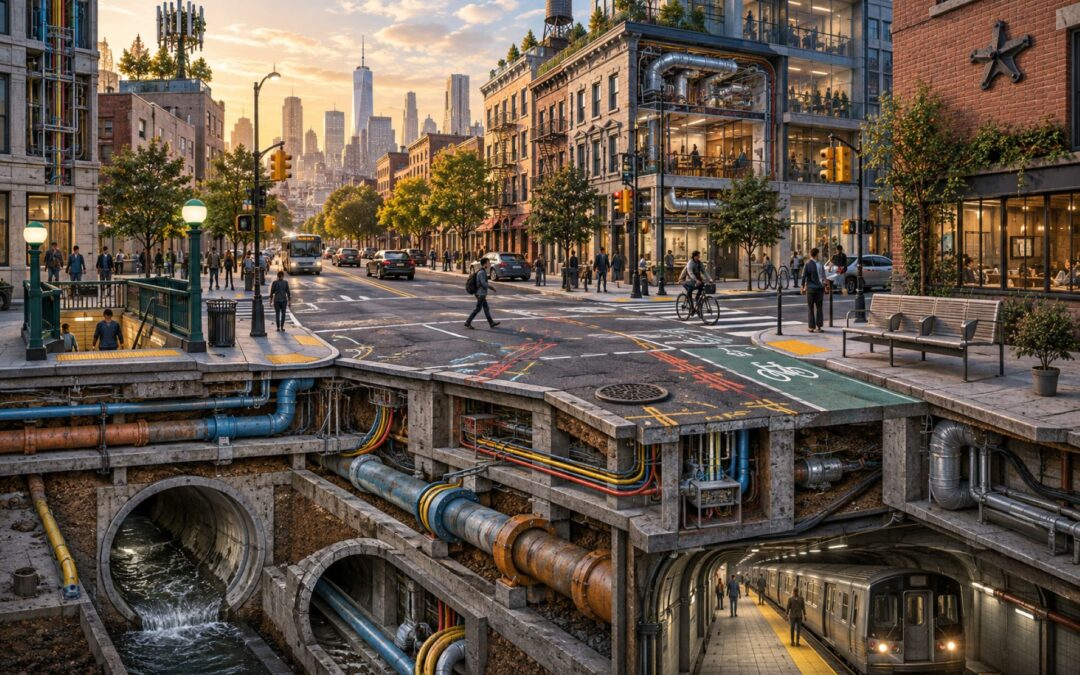
Cities are full of things designed not to attract attention. Paint sprayed onto pavement, oddly placed doors, utility poles, grates, plaques, traffic islands, fake trees, strange rooflines, leftover walls, peculiar street names, and uncomfortable benches all become so familiar that most people stop asking why they look the way they do. The 99% Invisible City: A Field Guide to the Hidden World of Everyday Design is built around the proposition that these overlooked details are often more revealing than a city’s famous landmarks.
Roman Mars and Kurt Kohlstedt, both closely associated with the 99% Invisible world of design storytelling, turn ordinary urban features into short histories of engineering, politics, regulation, improvisation, commerce, ecology, and human behavior. The official description of the book presents it as an illustrated guide to the hidden world of everyday design, and that is an accurate description so long as “guide” is understood broadly. The book is less interested in telling readers exactly what object they are looking at than in teaching them how to recognize that almost every urban object has a story.
Its 125 short entries initially resemble a collection of fascinating curiosities. Taken together, however, they develop a much larger argument. Cities are layered records of previous problems and attempted solutions: some brilliant, some misguided, some obsolete, some repurposed, and many so deeply embedded in daily life that their origins have disappeared from view.

How The 99% Invisible City Teaches You to Read the Built World
The introduction establishes the book’s most important distinction. Monumental architecture is already designed to demand attention, but Mars and Kohlstedt are more interested in infrastructure and everyday objects whose significance is easy to miss. Their subject is not primarily what is beautiful or prestigious; it is what reveals how cities actually work.
That requires a particular way of looking. A strange metal plate attached to an old brick wall may be structural rather than decorative. A suburban-looking house may contain an electrical substation. A row of spikes may be a deliberate attempt to prevent people from sitting or sleeping somewhere. A line on a map may seem abstract until it determines property ownership, transportation, neighborhood identity, or political control.
The book therefore treats design as a record of problem-solving. Each object becomes an entry point into a larger process: a problem appeared, someone tried to solve it, institutions adopted or rejected a solution, people adapted to it, and the city accumulated another layer. Some solutions work so well that their history becomes invisible. Others remain visible precisely because they failed, became obsolete, or produced unexpected consequences.
The form reinforces this method. Patrick Vale’s drawings help isolate objects from the visual noise surrounding them, while the text supplies the hidden systems and histories that cannot be seen directly. Mars and Kohlstedt also resist pretending that the book is encyclopedic. They openly encourage readers to follow intellectual “desire paths,” moving through the material according to curiosity rather than treating the book like a mandatory linear course.
There is nevertheless a meaningful order. The book begins with nearly invisible details, moves through things designed to be noticed, expands into infrastructure and architecture, pulls farther back to geography, and finally asks who has the power to shape urban space. The movement is from observation toward interpretation and, eventually, toward agency.
Chapter 1 — Inconspicuous: The Hidden Systems Hiding in Plain Sight
The first chapter trains the reader’s eye. Its objects are easy to overlook because they have faded into the background, been deliberately disguised, or outlived the systems that originally gave them meaning. Together, the three sections establish the book’s foundational habit: treat apparently meaningless urban details as evidence.
Ubiquitous
“Official Graffiti” begins with the bright lines, arrows, letters, and symbols sprayed onto pavement before excavation. To an uninformed passerby they can resemble random markings, but they are a temporary language used to identify buried water, gas, electricity, telecommunications, and other utilities. The marks make an otherwise invisible underground city briefly legible so workers do not cut into something dangerous or essential.
That example establishes one of the book’s recurring pleasures: a surface that seemed meaningless becomes readable once its code is known. “Initialed Impressions” performs a similar trick with concrete. Sidewalks may retain contractor stamps, dates, inspection marks, property indicators, and other small inscriptions that outlast the people or administrative systems that produced them, turning ordinary pavement into an accidental historical archive.
“Planned Failure” shifts from markings to hardware. Roadside signs and other objects must be strong enough to survive weather and normal use, yet some are deliberately engineered to break away when struck by a vehicle. What appears to be structural weakness is actually a safety strategy: in a collision, controlled failure can prevent a rigid object from becoming an even greater hazard.
“A Little Safer” examines another form of controlled access. Emergency key boxes installed outside buildings allow firefighters or other authorized responders to enter quickly without smashing doors or waiting for property owners. The design exists because two legitimate needs—security during ordinary life and rapid access during emergencies—conflict, so the city requires a mechanism that can satisfy both.
The section’s examples are modest, but their collective effect is important. Urban design is already revealed as a world of compromises. Good design does not always mean stronger, more visible, or more secure; sometimes it means breakable, temporary, encoded, or selectively accessible.
Camouflage
The next section examines infrastructure that cities need but often prefer not to see. Sydney’s Hyde Park provides an especially theatrical example in “Thornton’s Scent Bottle.” A tall nineteenth-century obelisk appears to be a conventional civic monument, yet its underlying purpose is connected to sewer ventilation. Ornament and sanitation occupy the same structure, converting an unpleasant infrastructural necessity into something compatible with a prestigious public park.
“Exhaustive Outlets” extends the idea to transit systems. Underground railways must breathe: heat, smoke, stale air, and later the effects of electrification and mechanical systems require ventilation. Rather than leaving every opening visually raw, cities have sometimes incorporated vents into sculptures, facades, or architecture that hides their functional role.
This concealment reaches architectural scale in “Fake Facades.” A building front can look inhabited while actually screening railway or utility infrastructure. The technique illustrates a recurring urban impulse: when infrastructure is necessary but considered visually disruptive, cities often do not eliminate the system; they redesign its appearance so that it participates in the surrounding streetscape.
“Catalytic Diverters” shows that some hidden infrastructure is essential to making an entire technological system possible. The Holland Tunnel required engineers not merely to bore beneath the Hudson River but to solve the accumulation of poisonous automobile exhaust in a long enclosed space. Testing, ventilation engineering, and large ventilation buildings transformed an apparently impossible vehicular tunnel into a workable system, demonstrating that the spectacular object—the tunnel—is dependent on less celebrated support systems.
“Neighborhood Transformers” moves to Toronto’s electrical substations, some designed to resemble ordinary houses. Their domestic exteriors conceal equipment needed to distribute and transform electrical power. The disguise reflects a bargain between technical necessity and neighborhood expectations: electricity can be welcomed even when the machinery producing its local presence is not.
“Cellular Biology” brings the same logic into telecommunications. Cellular networks depend on antennas and towers, yet communities frequently resist the visual appearance of new towers. The result is a strange manufactured ecology of monopines, palm-tree towers, and other structures attempting to mimic nature while carrying wireless equipment.
“Resourceful Artifice” goes further by examining oil extraction hidden within apparently unrelated structures in Los Angeles. Rather than removing industrial activity from an urban landscape, camouflage can make it socially and visually less conspicuous. The example also exposes the limits of concealment: disguising infrastructure does not make its environmental, economic, or political implications disappear.
The section therefore treats camouflage as more than an architectural joke. It is a negotiation between what cities require and what residents want to acknowledge. A fake house, false facade, ornamental tower, or artificial tree records a moment when infrastructure could not simply occupy space openly.
Accretions
If “Camouflage” concerns systems made deliberately hard to see, “Accretions” concerns evidence left behind by time. “Seeing Stars” explains the decorative-looking metal plates that appear on the facades of old masonry buildings. Many are anchor plates connected to structural rods, helping hold walls together; ornamental stars or other shapes turn visible structural reinforcement into facade detail.
“Scarchitecture” broadens the idea from hardware to whole buildings. Oddly shaped walls, narrow structures, blank facades, angled property lines, and other architectural anomalies often preserve traces of streets, railways, neighboring buildings, or property arrangements that no longer exist. The contemporary city contains negative impressions of previous cities.
“Lines of Sight” looks at obsolete communications infrastructure, including relics of microwave relay systems that once depended on unobstructed paths between towers. Technologies can disappear faster than their physical support structures, leaving apparently purposeless objects whose original meaning belongs to an earlier communications network.
That idea reaches its purest form in “Thomassons,” named for artist Genpei Akasegawa’s category of architectural remnants that have lost their function but continue to be maintained. A stairway may lead nowhere, a door may open onto a wall, or a railing may protect a place where protection is no longer necessary. Such objects are funny because they reveal the inertia of the built environment: cities rarely reset themselves cleanly when a purpose disappears.
“Accumulative Controversy” turns to love locks attached to bridges. One lock is trivial, but thousands become a maintenance and structural problem. The story demonstrates the difference between an individual action and its collective effect, a theme that returns throughout the book whenever cities must manage behaviors whose consequences emerge only at scale.
“Spolia of War” closes the section with reuse. Cannons, stones, rails, and other materials associated with conflict or obsolete systems can be incorporated into buildings, fences, street furniture, or monuments. Unlike a Thomasson, which remains after function has disappeared, spolia acquires a new function while retaining traces of its former life.
By the end of the first chapter, the city has become legible as a palimpsest. Its surfaces contain codes, disguises, repairs, obsolete systems, reused materials, and physical memories of structures that no longer exist. Learning to see a city therefore means learning to ask not only what something is, but what it used to be and what problem once made it necessary.
Chapter 2 — Conspicuous: When Design Has to Be Seen
The second chapter reverses the premise. Some urban objects fail unless people notice and understand them: flags must be recognizable, warning symbols must communicate danger, signs must guide or persuade, and civic monuments must project identity. Visibility is therefore not merely aesthetic; it can be functional, political, commercial, and cultural.
Identity
“Vexillology Rules” begins with municipal flags. A successful civic flag has to work at distance, in motion, at different sizes, and often without explanatory text. Good examples rely on simple geometry, limited visual complexity, recognizable symbolism, and the ability to become part of ordinary civic life rather than functioning only as bureaucratic insignia.
“Public Bodies” looks at civic sculpture through Audrey Munson, whose body became extraordinarily visible in early twentieth-century American public art even as her personal identity remained obscure to many viewers. She modeled for numerous allegorical figures in monuments and architectural sculpture. The paradox is revealing: a city can repeatedly reproduce a person’s image while severing that image from the individual life behind it.
“Fonts of Knowledge” turns to historical plaques. Plaques are designed to make history visible, directing attention toward people, buildings, events, and sites that might otherwise go unnoticed. Yet every plaque is also an editorial decision about what deserves commemoration, how much complexity can fit on a small surface, and which version of an event becomes publicly authoritative.
“Distinguished Features” considers recurring decorative forms such as the quatrefoil. Shapes acquire meanings through repetition and association, becoming shorthand for prestige, tradition, religion, luxury, or institutional identity. The form itself may be simple, but cultural memory gives it social weight.
The larger point is that identity is designed through selection. Flags choose symbols, plaques choose histories, architecture borrows forms, and monuments transform individual bodies into civic imagery. Public identity looks natural only after repetition has made its visual language familiar.
Safety
Safety design succeeds when recognition becomes nearly automatic. “Mixed Signals” uses unusual traffic-light arrangements to demonstrate how standardized systems can collide with local identity. The famous Syracuse signal with green above red emerged from a specific local context, but its oddity also demonstrates why consistent conventions matter: road users should not have to relearn the meaning or position of safety signals every time they enter another city.
“Visibility Aids” explores retroreflective road studs, often called cat’s eyes. Their ingenuity lies in returning light toward its source, making lane boundaries visible to drivers at night without requiring active illumination from every marker. The device is modest, but it changes the road by extending visual guidance into darkness and poor weather.
“Checkered Past” examines high-visibility patterns used on emergency vehicles and other safety equipment. The challenge is not simply to make something bright; designers must make it recognizable quickly under difficult conditions. Visibility, contrast, scale, and pattern all become part of an applied science of attention.
“Memorable but Meaningless” examines the biohazard symbol, whose designers faced a different problem. A warning symbol must be easy to recognize but ideally should not carry preexisting meanings that could confuse people. The now-familiar emblem demonstrates how an initially arbitrary graphic can acquire powerful meaning through standardization and repeated use.
“Signs of Times” considers fallout-shelter markers. Once part of an urgent Cold War safety system, many survived after the system’s practical relevance faded. The signs therefore changed category: from instructions for an anticipated emergency into historical artifacts whose continued presence records an earlier regime of fear and preparedness.
The section shows that safety design depends on learned conventions. Symbols work because institutions standardize them and people internalize them. Once the underlying danger or system changes, however, the object can remain behind as a visible fossil of former priorities.
Signage
“Broad Strokes” celebrates hand-painted signs and the sign painters who produce them. Their work combines typography, scale, color, material knowledge, commercial communication, and craft. A good sign must be attractive, but its primary success lies in being readable and appropriate to the physical setting where it will be seen.
“Tube Benders” traces neon from technological novelty into one of the defining visual languages of twentieth-century cities. Bending glass tubes, creating letterforms, managing gases and electrical systems, and installing the finished work made neon both a technical craft and a commercial art. When older neon later became threatened by replacement, preservationists increasingly treated what had once been advertising as cultural heritage.
“Sky Dancers” follows another migration from art to advertising. Inflatable tube figures derived from performance ideas became ubiquitous outside car dealerships and commercial businesses. Their constant movement makes them difficult to ignore, which is precisely what advertising requires.
“Outstanding Directors” examines the temporary placards used to guide film crews around Los Angeles. They form a kind of unofficial-looking but tolerated navigational system layered over ordinary streets. Their existence reflects the unusual relationship between city regulation and an industry important enough to receive specialized accommodation.
“Minded Businesses” considers São Paulo’s restrictions on outdoor advertising. Removing billboards and commercial signs dramatically changed the visual environment, but it also revealed surfaces, deterioration, and urban conditions that advertisements had concealed. The example demonstrates that signage is not simply added to a city; once it becomes pervasive, it helps constitute what the city looks like.
Across the chapter, Mars and Kohlstedt show that conspicuous design is rarely merely decorative. Flags establish belonging, safety graphics direct behavior, commercial signs compete for attention, and plaques select memory. To understand what a city chooses to make visible is also to understand what it wants people to recognize.
Chapter 3 — Infrastructure: The Systems That Make Urban Life Possible
Infrastructure expands the book’s field of vision. The focus is no longer primarily on isolated objects but on networks—water, electricity, transportation, communications, postal service, and public space—that function only because large numbers of people, agencies, machines, standards, and physical components work together. These systems are often most noticeable when they fail.
Civic
“Bureaucracy Inaction” examines a notoriously low railway bridge in Durham, North Carolina, repeatedly struck by trucks too tall to pass beneath it. The apparent absurdity of the situation invites a simple question: why not just raise the bridge or lower the road? The answer involves divided ownership, engineering constraints, costs, roadway management, railway operations, driver behavior, and institutional responsibility.
The example is funny, but its deeper lesson is about governance. Cities contain problems that are technically obvious but institutionally difficult because no single actor controls all the relevant variables. An infrastructure failure can persist not because nobody notices it, but because responsibility is fragmented.
“Good Delivery” turns to postal service. Delivering letters and parcels seems less physically imposing than building a bridge, yet reliable postal networks have historically helped connect distant settlements, encourage transportation links, organize addressing, and extend civic infrastructure. Communication systems do not merely use cities; they help structure them.
The two entries frame infrastructure as coordination. Pipes and roads matter, but so do institutions capable of maintaining shared systems over large territories and long periods.
Water
“Rounding Down” begins with manhole covers, objects so ordinary that their design seems inevitable. Their shapes serve practical purposes, but some cities—most famously in Japan—have transformed covers into elaborate pieces of local graphic identity. Infrastructure can be standardized functionally while remaining expressive at the surface.
“Upwardly Potable” follows public drinking fountains. Their history connects urban water access with sanitation, public health, temperance, philanthropy, and ideas about who deserves free access to clean water. A small fixture therefore sits at the intersection of engineering and public provision.
“Reversing Course” turns to Chicago’s extraordinary response to waterborne disease and sewage. The city engineered a reversal of the Chicago River’s flow so waste would move away from Lake Michigan, its drinking-water source, rather than toward it. The project solved an immediate public-health problem on a metropolitan scale, but it also redirected pollution and altered hydrology, demonstrating how large technical fixes can export consequences elsewhere.
“Circling Back” examines San Francisco’s emergency water infrastructure developed in response to the vulnerability exposed by major fires and earthquakes. Cisterns and redundant systems matter precisely because ordinary infrastructure can fail during disaster. Resilience requires planning for conditions in which the normal network cannot be trusted.
“Apples to Oysters” brings ecology into engineering through projects designed to restore oyster reefs around New York. Instead of treating protection against flooding and wave energy solely as a matter of concrete barriers, such efforts explore whether living systems can contribute to coastal resilience. The example anticipates the book’s later refusal to separate cities neatly from nature.
Water infrastructure demonstrates the temporal complexity of design. A sewer or river intervention can solve an urgent nineteenth-century problem and create a twenty-first-century ecological challenge. Infrastructure is therefore not a finished solution but a continuing relationship between a city and changing conditions.
Technology
“Fine Lines” looks at wooden utility poles, an old technology carrying layers of newer ones. Electricity, telephone, cable, fiber, and other services accumulate on shared vertical infrastructure. The persistence of the pole shows that technological change often occurs by adding onto existing systems rather than replacing them wholesale.
“Alternated Currents” uses electrical grids to illustrate path dependence. Standards that become embedded across enormous networks are extraordinarily difficult to change because every connected device, institution, building, and investment assumes their continuation. A decision that once represented one option among several eventually begins to look inevitable.
“Moonlight Towers” examines large nineteenth-century lighting towers, some of which survive in Austin. A technology that once represented modern urban illumination can become obsolete and then acquire heritage value. The object remains, but its meaning shifts from practical infrastructure to historical identity.
“Dialed Back” considers electricity meters and the challenge created by distributed generation such as rooftop solar. Traditional power systems were built largely around one-way flows from centralized producers to consumers. When households begin generating electricity themselves, meters, pricing rules, and grid management must adapt to a system whose underlying assumptions have changed.
“Network Effects” punctures the language of immaterial digital technology. Internet traffic depends heavily on physical cables, including massive undersea networks connecting continents. Terms such as “wireless” and “cloud” can make communication feel placeless, but the digital world remains dependent on geography, landing points, maintenance, ownership, and vulnerable pieces of physical infrastructure.
The section’s unifying insight is that new technologies inhabit old cities. They must fit into inherited corridors, standards, buildings, legal systems, and networks. Technological progress therefore arrives less like a clean replacement than another layer added to the urban stack.
Roadways
Roads may appear to be simple strips of pavement, but this section shows how thoroughly they are designed to discipline movement. “Accelerating Change” traces the adoption of painted centerlines and related markings as automobiles became faster and more numerous. Once traffic volumes made informal negotiation dangerous, painted lines created an inexpensive visual system for coordinating behavior.
“Shifting Responsibility” examines the invention and popularization of the concept of jaywalking. Streets had long been mixed public environments, but the rise of motor vehicles generated conflict over who had priority. Campaigns, laws, and changing norms increasingly framed pedestrians who crossed outside designated locations as the problem, helping redefine streets around automobile movement.
“Key Indicators” turns to crash testing. Safety design becomes more sophisticated when collisions are treated not merely as moral failures by individual drivers but as predictable events that can be studied. Testing allows designers to examine how vehicles and bodies behave under impact and to redesign around failure rather than assuming perfect behavior.
“Cemented Divisions” considers physical lane separators and barriers. Paint can communicate a rule, but concrete or other physical infrastructure can make certain movements difficult or impossible. The progression from markings to barriers illustrates a broad design principle: when voluntary compliance proves insufficient, cities often turn instructions into geometry.
“Extra Turns” examines intersection arrangements that sacrifice directness in exchange for reducing dangerous conflicts. A slightly longer route can be safer if vehicles encounter fewer crossing movements or make them under more controlled conditions. Efficient design therefore cannot be measured only by shortest distance.
“Circulating Logic” focuses on roundabouts and rotary junctions. Their geometry changes behavior by forcing vehicles to slow, merge, and circulate rather than meeting at high-speed right angles. The design makes safety partly spatial: instead of relying entirely on signs or signals, the road itself influences what drivers can comfortably do.
“Incomplete Stops” explores traffic calming, including narrowing, bumps, visual cues, and other interventions designed to reduce speed. These techniques accept that posted speed limits alone may be weak if a broad, straight roadway visually encourages fast driving. The physical environment can communicate more effectively than a number on a sign.
“Reversing Gears” culminates with Sweden’s switch from driving on the left to driving on the right. Changing a convention followed by an entire country required extraordinary coordination, preparation, signage, education, infrastructure modification, and carefully timed implementation. The story demonstrates how arbitrary conventions can become deeply embedded systems whose alteration demands enormous collective effort.
Taken together, these entries challenge the idea that roads simply accommodate natural human movement. Roads create categories of legitimate behavior, distribute priority, encourage particular speeds, and decide how much risk different users bear. Their design is social engineering in the literal sense: physical space changes behavior.
Public
“On Verges” examines the strips between roads, sidewalks, and private property. They may contain grass, trees, utilities, stormwater features, snow storage, signs, or nothing obvious at all. These seemingly leftover spaces reveal how many competing functions must fit into a narrow public-right-of-way.
“Crossing Over” looks at pedestrian signals such as East Germany’s Ampelmännchen. A functional traffic symbol can become a cultural icon, surviving political transformation because users develop emotional attachment to a design initially intended for basic communication. Standardized systems do not always erase local identity; sometimes local identity attaches itself to the standard.
“Sharrowed Routes” examines painted bicycle sharrows. Their low cost and visibility make them attractive to municipalities, but they can also illustrate the limits of symbolic accommodation. A painted icon does not create physical protection, so the presence of “bike infrastructure” on a map may exaggerate the degree to which cyclists actually receive a safer space.
“Congestion Costs” questions the assumption that more urban road space must always be devoted to cars. Pedestrianized streets, car-free zones, and reallocations can initially appear to threaten access or traffic flow, yet they also reveal how much valuable urban land is consumed by the movement and storage of automobiles. The question becomes not simply how to move cars efficiently, but what public streets are for.
“Extravehicular Activities” examines shared-space or “naked street” ideas in which signs, curbs, barriers, and conventional separations are reduced. Advocates argue that uncertainty can make users pay greater attention to one another rather than mechanically obeying signals. Yet the approach also raises serious questions about accessibility and whether environments dependent on subtle visual or social negotiation work equally well for people with different abilities.
The chapter ends with infrastructure becoming openly political. Once street space is recognized as scarce, every curb, lane, crossing, parking space, verge, and cycle facility represents an allocation. Design determines not only movement but whose movement receives priority.
Chapter 4 — Architecture: Buildings as Layers of Constraint, Innovation, and Memory
The architecture chapter continues the book’s resistance to “great building” narratives. Buildings are treated not as isolated artistic statements but as products of security requirements, materials, fire codes, taxation, engineering, property law, commercial communication, historical preservation, and technological change. Architecture becomes another surface on which invisible systems become visible.
Liminal
“Imperfect Security” begins with locks. Locks create barriers, but no mechanical lock makes a building absolutely secure; every system involves tradeoffs among cost, convenience, complexity, and resistance to intrusion. Lock-picking culture makes that limitation visible by treating security devices as designed mechanisms whose assumptions can be understood and defeated.
“Open and Shut” considers revolving doors. Their continuous rotating chambers help reduce exchanges of conditioned indoor air with outdoor air while permitting people to enter and exit. Yet emergency situations expose their limitations, which is why buildings typically provide conventional doors or other compliant exit routes alongside them.
“Improved Egress” expands the theme to fire escapes and emergency exits. Exterior metal fire escapes became iconic features of dense cities because buildings needed ways for occupants to escape when interior routes were unsafe. Later building codes increasingly favored protected internal stairs and more systematic egress requirements, showing how catastrophe can become codified into architecture.
Thresholds therefore embody conflicting needs. Doors must admit and exclude, conserve energy and permit evacuation, provide security and allow emergency access. The apparently simple act of getting into or out of a building contains a remarkable amount of design history.
Materials
“Stolen Facades” follows brick through changing construction systems. Older masonry buildings depended on thick load-bearing walls, while later structures could use structural frames with brick as veneer or cladding. Reclaimed bricks became valuable, and their reuse reveals how a material can migrate from structural necessity to aesthetic surface.
“Aggregate Effects” focuses on concrete, one of the modern world’s most consequential building materials. Its compressive strength, moldability, affordability, and compatibility with reinforcement helped transform construction, but cracking, repair, raw-material demand, and carbon-intensive cement production complicate its ubiquity. A material can be technically extraordinary and environmentally burdensome at the same time.
“Hybrid Solutions” turns to mass timber. Engineered wood products make it possible to construct larger and taller buildings using timber systems very different from traditional light-frame construction. The case involves changes in engineering, fire testing, building codes, forestry, and environmental accounting, illustrating how “old” materials can return through new technologies.
The section refuses to treat materials as neutral. Brick, concrete, and timber each carry histories of labor, regulation, structural possibility, resource extraction, and cultural perception. Changing a material can therefore change much more than a facade.
Regulations
“Secular Orders” demonstrates that architectural forms sometimes originate in financial rules rather than aesthetics. Taxes imposed according to windows, materials, dimensions, or other features can influence what owners build and what later generations mistake for a purely stylistic tradition. Economic incentives become architecture.
“Formative Setbacks” applies the same principle to building envelopes. Rules governing height, setbacks, roof forms, light, and streets can produce distinctive silhouettes. A skyline can therefore emerge partly from regulation rather than from architects independently converging on the same aesthetic.
“Heaven to Hell” examines property rights extending upward and the market in air rights. Where development capacity can be transferred, the apparently empty volume above a low building becomes economically valuable. Such systems can help preserve some buildings while allowing greater height elsewhere, making the skyline a product of legal abstractions as much as steel and concrete.
These stories reveal a central idea of the chapter: laws are not external to design. Once rules affect what may be built, how high it may rise, how much light must reach the street, or where development rights may move, regulation literally changes physical form.
Towers
“Braking Good” begins with the elevator. Tall buildings were limited not only by structural engineering but by the practical difficulty of moving people vertically. Safer elevators—and especially mechanisms designed to prevent catastrophic falls—helped make upper floors convenient enough to transform the economics and social organization of multistory buildings.
“Cladding Skeletons” follows the structural frame. When a building’s skeleton rather than its exterior masonry walls carries loads, the facade can become a lighter curtain. Curtain walls make vast areas of glass and other non-load-bearing materials possible and fundamentally change what a tall building can look like.
“Topping Out” turns to the skyscraper race surrounding the Chrysler Building. William Van Alen’s concealed spire allowed the tower to surpass a rival unexpectedly, making height itself part of architectural competition and corporate identity. Engineering becomes intertwined with publicity, prestige, and urban spectacle.
“Unanticipated Loads” examines the structural crisis at Citicorp Center in New York. Concerns about how the building would respond to certain wind conditions revealed potentially serious weaknesses and led to urgent reinforcement work. The story is powerful because it is not merely about a design mistake; it is about professional responsibility, uncertainty, communication, and the invisible labor required to correct a dangerous problem before disaster occurs.
“Perspective Matters” considers San Francisco’s Transamerica Pyramid. Buildings that initially provoke intense opposition can later become symbols of the very city whose character critics once accused them of damaging. Architectural meaning therefore changes as a structure moves from disruption to familiarity.
“Beyond Above” examines contemporary towers competing through form, viewing experiences, engineering feats, and iconic imagery rather than simply through raw height. Once height records become increasingly difficult or economically irrational to chase, distinctive identity becomes another field of competition.
“Grouped Dynamics” pulls back from individual towers to the collective effects of tall buildings. Groups of towers influence wind, light, heat, and the experience of streets below. A building can satisfy its own internal goals while contributing to undesirable conditions at urban scale, which means architectural evaluation cannot stop at the property line.
The section dismantles the myth of the skyscraper as the work of a lone visionary. Elevators, structural systems, facade technology, regulation, engineering ethics, real-estate economics, environmental effects, and public perception all participate in making a tower. The architect may give form to the object, but the city makes its existence possible.
Foundations
“Vernacular Enclaves” examines the architectural language of Chinatowns. Some features that viewers interpret as straightforward expressions of Chinese tradition emerged within diasporic communities responding to discrimination, tourism, commerce, municipal politics, and American expectations of what “Chinese” architecture should look like. Built identity becomes hybrid rather than pure.
“Reality Checks” turns to check-cashing businesses and other service centers. Their architecture often emphasizes immediate visibility, direct access, signage, security, and functional clarity rather than the monumental solidity historically associated with banks. Different institutions communicate trust and accessibility to different publics using different visual languages.
“Approachable Ducks” revisits the distinction between buildings whose form literally advertises their function and ordinary structures decorated with signs. A shop shaped like the thing it sells is a “duck” in architectural terminology, while a conventional box whose identity comes from attached graphics is closer to a decorated shed. Both approaches show architecture acting as communication.
“Competitive Starchitecture” examines visually aggressive additions and signature buildings designed to stand apart from their surroundings. A single dramatic contrast can energize a setting, but if every institution demands an iconic object, the exceptional becomes ordinary. The story raises a broader question about whether architecture designed to attract attention can overwhelm the urban relationships around it.
Architecture here becomes a language of identity. Communities, businesses, cultural institutions, and developers all use form to communicate, but the meaning of that form depends on history, audience, repetition, and context.
Heritage
“Heathen’s Gate” introduces the basic problem of restoration: buildings accumulate multiple legitimate histories. Restoring a site therefore requires deciding which moment to privilege. Returning something to an imagined original condition may destroy evidence of later periods that are historically meaningful in their own right.
“Landmark Ruling” turns to the demolition of New York’s Pennsylvania Station and the preservation movement it helped energize. The loss of the original station became a powerful symbol of what unrestrained redevelopment could destroy, contributing to a stronger preservation framework that later helped protect Grand Central Terminal.
“Recrowned Jewel” examines restoration projects in which experts face several plausible versions of the past. Materials may have changed, decorations may have been added or removed, and documentation may be incomplete. Restoration is therefore not simply reversing decay; it is an interpretive act based on evidence and judgment.
“Architectural License” looks at reconstructions that present themselves as historical even when they contain substantial invention. Recreated districts can satisfy nostalgia, tourism, national identity, or commercial goals without precisely reproducing the past. A place may feel old while actually embodying a modern idea of what the past ought to have looked like.
“Unnatural Selection” asks whether vegetation growing on ruins should be considered damage or heritage. Removing plants can stabilize masonry or restore a preferred appearance, but ecosystems may also become part of a site’s long history. Preservation is forced to decide whether its object is a building, a landscape, a historical moment, or the layered coexistence of all three.
“Faded Attraction” considers abandoned sites whose deterioration generates new cultural value. Ruins attract photographers, explorers, artists, wildlife, and tourists precisely because they have ceased to perform their original function. Decay itself becomes meaningful, complicating the instinct to restore or demolish.
“Runed Landscapes” moves from buildings to traces visible in fields and terrain. Crop marks and other subtle patterns can reveal vanished structures beneath the ground because buried foundations, ditches, and disturbances affect vegetation differently. Once again, absence creates a visible clue.
“Unbuilding Codes” closes the section with Japan’s Ise Shrine, where sacred buildings are periodically reconstructed. The example challenges a preservation philosophy centered entirely on original material. If craft knowledge, ritual, proportions, techniques, and continuity of practice survive through rebuilding, authenticity may reside in process rather than untouched fabric.
Heritage is therefore not passive conservation. Every preservation decision chooses what kind of continuity matters: material, appearance, use, memory, ecology, craftsmanship, or historical layering. The past survives only through decisions made in the present.
Chapter 5 — Geography: The City at the Scale of Maps, Landscapes, and Ecosystems
The geography chapter zooms outward again. Buildings sit inside parcels, parcels inside grids, grids inside named districts, and cities inside landscapes that contain plants, animals, waterways, borders, and administrative conventions. What seems natural at this scale often proves to be designed too.
Delineations
“Points of Origin” examines zero markers from which distances are officially measured. A physical marker can transform an abstract coordinate into a civic origin, establishing a symbolic center from which roads and distances are understood.
“Edge Cases” looks at boundary stones such as those marking the historic limits of Washington, D.C. Surveying devices become heritage objects once the administrative boundary they defined becomes familiar enough that the original work of establishing it disappears from consciousness.
“Defining Moments” explores standardized time. Before modern transportation and communications required synchronization, local time could vary according to the sun. Railways and other networked systems made such variation increasingly impractical, helping push societies toward standardized time zones.
“Road Boosters” considers campaigns for national roads and highways. Better connections can unite markets and regions, but later highway systems also cut through neighborhoods, displaced residents, and reorganized cities around automobiles. Infrastructure that increases mobility at one scale can fragment communities at another.
The section’s common subject is coordination. Distance, boundaries, time, and national road networks all appear objective once standardized, yet each required institutions to define a common system. Geography becomes administratively legible only after someone decides where the lines and reference points should go.
Configurations
“Rounding Errors” examines the Jeffersonian land grid. Imposing rectangular survey systems across enormous territories promised administrative simplicity, but the earth is curved, terrain is irregular, and human histories already occupy the supposedly empty space being measured. Survey logic therefore encounters both geometry and politics.
“Unassigned Lands” looks at patchworks produced by unusual settlement histories in Oklahoma. Land rushes, administrative divisions, and successive development patterns leave irregularities that persist in later city form. The present map becomes a record of earlier rules and conflicts.
“Rectilinear Revelations” examines Salt Lake City’s unusually large blocks and broad streets, products of a distinctive planned urban vision. The original dimensions made sense within one set of assumptions about settlement and movement, but later transportation and pedestrian needs expose the difficulty of adapting inherited scale.
“Good Eixamples” turns to Barcelona. Ildefons Cerdà’s Eixample created a highly recognizable grid with chamfered corners, but later superblock experiments demonstrate that the same inherited geometry can be reinterpreted. Instead of treating the grid as fixed, planners can change how traffic and public space function inside it.
“Standard Deviations” considers Detroit’s overlapping street systems. Grids arriving from different directions, transport routes, and development periods intersect imperfectly, producing distinctive angles and irregular spaces. What looks like disorder may actually be the physical meeting point of several historical orders.
Urban geometry is therefore never only geometry. Grids encode property regimes, planning ideals, settlement histories, transport priorities, religious visions, and political power. A map of streets is also a map of inherited decisions.
Designations
This section examines the power of naming. Names may seem like labels applied after places already exist, but Mars and Kohlstedt show that labels can affect identity, reputation, administration, commerce, and even what people believe exists.
“Citations Needed” introduces informal geonyms through the tongue-in-cheek naming of a small feature as “Busta Rhymes Island.” A place can acquire a socially meaningful name without going through formal geographic authorities, especially when online maps, local usage, and media repetition reinforce it.
“Hybrid Acronames” examines neighborhood names such as SoMa. Compressed names can emerge from practical shorthand, branding, real-estate marketing, or attempts to remake an area’s reputation. Once successful, a manufactured label can feel as natural as one inherited over centuries.
“Calculated Omissions” turns to buildings that skip supposedly unlucky floor numbers. Elevators may jump from 12 to 14 or omit other culturally sensitive numbers even though the physical floor obviously remains. Administrative naming bends to superstition, demonstrating that numerical systems are cultural artifacts rather than purely rational devices.
“Deliberated Errors” explores fictitious map entries inserted to detect copying. A fabricated place or feature can function as a copyright trap, but the famous case of Agloe shows that fiction can feed back into reality when people begin using the invented name. Maps do not always merely describe the territory; sometimes the territory starts conforming to the map.
“Misplaced Locations” examines Null Island, the notional location at zero degrees latitude and zero degrees longitude where badly encoded geographic data can accumulate. A database error creates an imaginary geographic destination because computers require invalid information to resolve somewhere.
“Paved Ways” celebrates Tucson’s unusual “stravenues,” a local street-category term blending street and avenue. The odd label preserves the fact that naming conventions are locally constructed even when modern navigation systems encourage standardization.
“Accessible Voids” considers unnamed leftover spaces. Once a space receives a usable name, it becomes easier to discuss, study, contest, and redesign. Naming can therefore be the first step toward making an overlooked urban condition socially visible.
The section makes one of the book’s strongest conceptual points. Geographic language is performative: it does not simply attach words to neutral territory. It changes how places are understood, valued, navigated, marketed, remembered, and governed.
Landscapes
“Graveyard Shifts” explores landscapes whose pastoral calm conceals displaced histories. Parks in San Francisco and elsewhere can occupy land once used for cemeteries, while gravestones and other materials may have been removed, relocated, or repurposed. A green public landscape can therefore conceal an earlier city of the dead.
“Trailing Spaces” turns to rail corridors converted into walking paths and greenways. Projects such as the High Line show how infrastructure that has lost its original transport function can become public landscape. Adaptive reuse at this scale preserves spatial continuity even while changing use dramatically.
“Courting Palms” examines the palm trees associated with Los Angeles. Their powerful visual identity can obscure the fact that iconic landscaping may be poorly suited to future environmental conditions or municipal maintenance goals. A city’s brand and its ecological needs do not always align.
“Lawn Enforcement” treats the lawn as designed nature. Private lawns appear ordinary and natural only because social expectations, property rules, landscaping industries, irrigation systems, and cultural ideals reproduce them continuously. Their ecological costs reveal how much work is required to maintain a supposedly effortless landscape.
“Lofty Treescrapers” considers heavily planted towers and the seductiveness of green architectural imagery. Vegetation on a facade can offer real benefits in some contexts, but visual greenery is not automatically evidence of ecological performance. The book warns against confusing the appearance of nature with environmental effectiveness.
The section destabilizes the boundary between city and landscape. Parks, lawns, palms, greenways, and planted buildings are as designed as roads and towers. “Natural-looking” environments may be among the city’s most labor-intensive constructions.
Synanthropes
“Naturalized Denizens” begins with urban squirrels. Their present familiarity makes them seem like inevitable city residents, but in many places squirrels were deliberately introduced, encouraged, or accommodated before becoming ordinary components of urban ecology. What later appears wild may have begun as a human project.
“Ghost Streams” examines waterways buried beneath streets and development. Even when covered, redirected, or incorporated into sewer systems, older hydrology continues to shape drainage and flooding. Daylighting projects sometimes uncover these streams again, restoring ecological and public functions to water that had been engineered out of sight.
“Home to Roost” reevaluates pigeons. Their reputation as unwanted urban pests obscures their long association with humans through domestication, communication, food, sport, and selective breeding. Their global urban success is partly a consequence of human history.
“Raccoon Resistance” follows an animal exceptionally capable of exploiting human-built environments. Garbage containers, roofs, attics, drainage systems, and other city features become habitats and food sources. Attempts to exclude raccoons often demonstrate how quickly adaptable species learn to defeat human-designed barriers.
“Unmanned Lands” looks at landscapes from which human activity has been restricted, including political buffer zones and corridors. Such spaces can unexpectedly support wildlife because continuity and reduced development matter more than whether the landscape was established for conservation. Human political geography can accidentally create ecological infrastructure.
Synanthropes complete the chapter’s expansion of the urban frame. A city is not a purely human artifact surrounded by “nature.” It is an ecosystem in which species adapt to infrastructure, food, waste, waterways, abandoned land, landscaping, and one another.
Chapter 6 — Urbanism: Who Gets to Shape the City?
The final chapter turns observation into a question of power. Earlier chapters have already shown that design allocates safety, mobility, visibility, access, and resources, but “Urbanism” makes those consequences explicit. Its sequence is carefully chosen: first design used to exclude, then unsanctioned interventions that challenge or reproduce power, and finally interventions capable of becoming broader civic change.
Hostilities
“Loved Park” examines Philadelphia’s LOVE Park and conflicts over skateboarders. A public space celebrated by one group can be treated by authorities as misused by another. Anti-skate devices make the conflict physical by altering architecture so that certain movements become difficult or destructive to equipment.
“Urine Trouble” expands to spikes and other obvious deterrents. Objects installed to prevent sitting, sleeping, loitering, or approaching certain surfaces demonstrate that architecture can enforce behavioral rules without requiring a police officer to stand nearby.
“Obstinate Objects” considers benches whose armrests, slopes, divisions, or dimensions make prolonged lying down difficult. The design may be described as comfort, circulation, or order, but its effects can fall especially heavily on homeless people. A seat therefore becomes a mechanism for determining what kinds of occupation are legitimate.
“Cities of Light” examines lighting and color used to influence behavior. Certain lighting schemes have been intended to discourage particular activities or demographics from lingering. These strategies also demonstrate a recurring limitation of behavioral design: effects may be uncertain, temporary, or accompanied by unintended consequences.
“Targeting Demographics” covers sound, from classical music played to make spaces unattractive to some young people to high-frequency devices aimed at listeners within particular age ranges. The technique makes exclusion almost literally invisible to people outside the targeted group.
“Exterior Motives” examines designs whose exclusionary purposes are not immediately obvious. Ordinary-looking objects can be positioned or altered so that certain people cannot sleep, gather, or remain in a place. The less visible the mechanism, the easier it is for a coercive design choice to appear neutral.
This section exposes a moral dimension implicit throughout the book. Design does not merely solve technical problems; it can define an unwanted person or behavior as the problem to be solved. The built environment can therefore relocate social conflict without addressing its underlying causes.
Interventions
“Guerrilla Fixation” tells the story of Richard Ankrom, who noticed a confusing Los Angeles freeway sign and, after failing to see the problem corrected through official channels, fabricated a remarkably convincing sign panel and installed it himself. The unauthorized alteration was designed so professionally that it blended into the existing system, and the story became an example of a citizen intervening directly in dysfunctional infrastructure.
“Drawing Attention” considers other unofficial signs used to identify hazards or confusing conditions. Viral imitation can turn a small act of corrective communication into a distributed form of public pressure. Yet such actions also depend on an individual’s judgment that intervention is justified.
“Asking Permission” examines New York fire hydrants opened during hot weather. Uncontrolled hydrant use can reduce water pressure and create hazards, but authorities developed spray caps that allow residents to access cooling water while limiting flow. Rather than treating informal behavior only as a violation to suppress, the city found a compromise that acknowledged the underlying desire.
“Seeking Forgiveness” complicates the romance of citizen action. Residents in San Francisco placed large boulders in public space partly to prevent homeless encampments, provoking backlash and counteraction. Bottom-up intervention can therefore reproduce the same exclusionary logic criticized in “Hostilities.”
“Legitimizing Action” turns to an Oakland resident’s decision to place a Buddha statue in an area plagued by illegal dumping. What began as an unofficial intervention developed into a neighborhood shrine and gathering point, accompanied by community attention and changed patterns of use. Informal design gained legitimacy through social adoption rather than through its original authorization.
The section deliberately refuses a simple top-down/bottom-up morality. Bureaucracies can be unresponsive, and citizens can be imaginative, but unofficial action is not automatically just. The relevant question is what an intervention does, whom it affects, and whether broader communities accept or contest it.
Catalysts
“Ramping Up” begins with curb cuts and the disability-rights movement in Berkeley. Ed Roberts and other activists confronted a built environment in which a few inches of curb could make independent wheelchair travel impossible. Early curb cuts, some created through activism before accessibility was broadly institutionalized, transformed intersections by making continuous movement possible.
The effects extended beyond wheelchair users. Parents pushing strollers, workers moving carts, travelers pulling luggage, cyclists, and many others benefited from the same ramps, making the curb cut a classic example of how accessibility improvements can create broader public value. The case is powerful precisely because it begins with the needs of people whom conventional design had excluded rather than with a generic search for convenience.
“Cycling Through” moves to Bogotá and Jaime Ortiz Mariño, who helped organize an early temporary street closure for cyclists and pedestrians. The idea developed into Ciclovía, the recurring opening of major streets to people rather than ordinary motor traffic. A temporary experiment became a civic institution by allowing residents to experience familiar streets under radically different rules.
“Driving Away” traces a similar progression from the San Francisco design group Rebar. By feeding a parking meter and temporarily converting the paid space into a tiny patch of grass and seating, the group exposed an assumption hidden in curb design: a parking stall is public land temporarily allocated to storing a private vehicle. If the same space can legally be rented, why could it not temporarily serve another use?
That experiment helped inspire PARK(ing) Day and more formal parklets. The transition matters because a provocative one-off gesture became a replicable urban idea. At the same time, parklets raise legitimate questions about maintenance, commercial benefit, public access, and which neighborhoods receive improvements, reminding readers that institutionalization does not eliminate politics.
“Grafting On” examines guerrilla grafters who attach fruit-bearing branches to ornamental street trees. Their work grows from a larger tradition of guerrilla gardening in which neglected or controlled urban landscapes become sites for unauthorized cultivation. The intervention turns decorative greenery toward food production, but also collides with concerns about maintenance, falling fruit, liability, and public-land management.
“Bumping Out” closes the chapter with “sneckdowns,” the snowy areas left untouched by car tires at intersections after storms. Those traces reveal how much asphalt vehicles actually use compared with how much has been allocated to them. Activists and planners can treat the pattern as a temporary full-scale diagram for possible curb extensions, pedestrian space, or traffic-calming changes.
The final section therefore turns observation into experimentation. Curb cuts, Ciclovía, parklets, guerrilla gardening, and sneckdowns all begin by revealing that an existing arrangement is not inevitable. Some remain contested; others become formal policy. The city changes when people can first see that it could work differently.
Why the Book Ends by Admitting It Is Incomplete
After 125 entries, Mars and Kohlstedt could have ended by presenting their field guide as a completed decoding of the city. Instead, the outro makes fun of that possibility. The authors point toward stories they left out—more camouflage, unusual plaques, infrastructure, traffic devices, training environments, pothole interventions, survey markers, and other oddities—and emphasize that a guide to urban design can never actually be finished.
That admission is not simply modesty. It explains why the book has the shape it does. A city contains an effectively inexhaustible number of designed objects, and every object can lead outward into engineering, law, history, culture, economics, ecology, or politics. Completeness in the literal sense would destroy the coherence that makes any individual story understandable.
The authors therefore describe selection as part of design. Stories have been cut, combined, or left for other media because the book itself needs form rather than infinite accumulation. The continuing 99% Invisible project can keep expanding the archive, while the book performs a more bounded task.
Its real ending is consequently methodological. The reader is not supposed to close the final page believing that the invisible city has now been catalogued. The desired change is that the next utility mark, plaque, disguised tower, odd intersection, remnant wall, uncomfortable bench, or unexplained void produces a question.
That ending also protects the book from one of its own obvious limitations without making the limitation disappear. The authors know their examples cannot represent every city or every urban problem. Their answer is not to claim comprehensiveness, but to offer a habit of curiosity that can be carried into places the book never mentions.
The Book’s Central Idea: A City Is a Record of Human Choices
The book never pauses to announce a single grand theory, yet its examples repeatedly converge on the same understanding: the city is an accumulation of choices. Some were made by famous architects or governments, but many came from engineers, utility companies, activists, businesses, maintenance crews, property owners, regulators, craftspeople, and anonymous residents. Even apparently natural features often exist because people planted, named, protected, redirected, tolerated, or excluded them.
Roman Mars makes this worldview especially clear in his description of the city as both an expression of values and an adaptive ecosystem. That metaphor captures why the book resists simple authorship. Cities are planned, but they also evolve through feedback, conflict, improvisation, inherited constraints, and countless small adaptations.
The City as Palimpsest and Ecosystem
The city in The 99% Invisible City is best understood as a palimpsest: new systems are written over older ones without fully erasing them. Anchor plates strengthen old walls, microwave towers outlive the communications systems that required them, abandoned railways become parks, ruins become habitats, and old grids constrain new mobility schemes. The past survives as geometry, hardware, names, property lines, materials, and habits.
The ecosystem metaphor adds another dimension. Urban systems interact rather than remaining isolated. A new road changes development; development alters water runoff; landscaping changes habitat; public-space rules alter behavior; technological networks reuse older infrastructure; transportation systems influence street design and land value.
These interactions explain why apparently straightforward interventions produce surprises. Reversing a river can improve drinking water while moving pollution downstream. Removing advertising can reveal neglected buildings. Building infrastructure for cars changes pedestrian behavior and social norms. Planting “green” towers can look ecological without addressing broader material impacts.
The city therefore has no final state. It is continually being repaired, reinterpreted, repurposed, and contested. Design can impose order, but the order immediately becomes part of a larger system that people and nonhuman species adapt around.
Design as Problem-Solving, Path Dependence, and Unintended Consequence
Mars and Kohlstedt repeatedly begin with a practical problem. Tunnel exhaust must be removed, buildings must be evacuated, road users must be separated, drinking water must remain uncontaminated, electricity must be distributed, and tall buildings must resist wind. Design emerges because something has to work.
The solution then creates a new environment. Electrical standards spread until changing them becomes prohibitively difficult. Road conventions become so familiar that reversing them requires national coordination. Building codes produce architectural forms, which later generations may perceive as style rather than regulation.
This is path dependence in concrete form. Early choices constrain later options because infrastructure is expensive, interconnected, and socially normalized. An arbitrary or merely convenient standard can eventually become almost impossible to replace because entire systems have grown around it.
Unintended consequences accompany that process. Love locks become too heavy, highway networks divide neighborhoods, rivers redirected for sanitation create ecological effects, and apparently minor design decisions change who can occupy a public space. The book’s best stories resist neat endings because urban problem-solving continually generates new problems.
Power, Access, and the Politics Hidden Inside Ordinary Design
The book begins with visually neutral objects, but by its final chapters neutrality becomes difficult to sustain. A curb without a ramp may not have been designed to make wheelchair users dependent, yet that is one of its effects. A bench divided by armrests can be described formally as seating design while simultaneously preventing someone from lying down.
Roads illustrate this especially well. Lane markings, pedestrian rules, parking allocations, cycling facilities, and intersection geometry distribute convenience and danger among different users. Treating the resulting arrangement as natural hides the decisions that produced it.
Property and preservation carry similar questions. Air rights decide where development capacity can move. Heritage rules determine which past deserves protection. Neighborhood names can affect reputation and real-estate value. Highway construction can increase regional connectivity while imposing displacement on particular communities.
The book is not a systematic political theory of urbanism, and it should not be mistaken for one. Its contribution is more basic but still important: once design becomes visible, readers can ask who made a decision, what problem they defined, who benefited, who absorbed the cost, and whether the resulting arrangement should remain.
Top-Down Systems and Bottom-Up Adaptation
Large cities cannot function without centralized systems. Water networks, electrical grids, building codes, postal systems, traffic standards, and emergency infrastructure require coordination beyond what individual residents can provide. The 99% Invisible City never romanticizes a city built only through spontaneous action.
At the same time, formal systems regularly encounter behaviors they did not anticipate. Desire paths reveal where people prefer to walk. Open hydrants reveal a demand for cooling. Skateboarders reinterpret plazas. Informal names gain currency. Snow reveals oversized road space.
The most productive responses often emerge when institutions learn from those adaptations instead of treating every deviation as disorder. Spray caps make hydrant play safer, curb cuts become standard infrastructure, parklets formalize an illegal or temporary experiment, and tactical street redesign can become permanent.
Yet the book also shows why “bottom-up” should not automatically mean democratic or beneficial. Anti-homeless boulders may be installed by residents rather than government, and unofficial changes can impose costs on people who did not choose them. Good urbanism depends not merely on the origin of an intervention but on its consequences and legitimacy.
The Book’s Most Important Recurring Themes
The episodic structure means the book rarely stops for a long theoretical synthesis. Its themes instead recur across distant stories, gradually becoming visible through repetition. Reading the examples together reveals several consistent preoccupations.
Visibility and Invisibility
The title’s central metaphor operates on several levels. Infrastructure is physically hidden beneath streets, inside fake buildings, behind facades, or under digital metaphors such as “the cloud.” Other systems are visible but conceptually invisible because familiarity has made people stop noticing them.
The book’s method is therefore an act of revelation. Utility paint makes buried systems readable, plaques direct attention toward history, illustrations isolate overlooked objects, and hostile architecture becomes ethically legible once readers understand what its geometry does.
But visibility is not automatically virtuous. Camouflage may help infrastructure coexist with valued streetscapes, while conspicuous signage can become oppressive visual clutter. The real question is what visibility allows people to understand and what invisibility allows systems to conceal.
Standardization Versus Local Difference
Cities depend on standards. Traffic signals, warning symbols, electrical grids, postal addresses, road rules, time zones, and utility codes become powerful precisely because users can rely on shared meanings.
Yet local variations continually resist or reinterpret standardization. Syracuse reverses the expected traffic-light arrangement, Ampelmännchen becomes a regional icon, Tucson develops stravenues, neighborhood names evolve informally, and civic flags distinguish one place from another.
The tension is productive because both sides serve real needs. Standardization enables coordination and safety, while difference allows cities to preserve identity and adapt systems to local history. Problems arise when local eccentricity undermines universal comprehension or when standardized systems erase meaningful context.
Preservation, Reuse, and Urban Memory
The book repeatedly asks what should happen when a thing outlives its original purpose. Some objects become Thomassons, some become monuments, some are converted, some decay into ruins, and some are periodically rebuilt.
Adaptive reuse appears at multiple scales. Bricks move between buildings, rail corridors become greenways, infrastructure towers become heritage objects, and obsolete materials find new functions. Preservation therefore need not mean freezing an artifact at one historical moment.
The heritage section makes the philosophical problem explicit. An “authentic” building may contain several eras of alteration, while a periodically rebuilt shrine may preserve knowledge and ritual more faithfully than untouched decaying material would. Memory is always mediated through present choices.
Public Space, Mobility, and Who the City Is For
Few themes recur as consistently as the allocation of shared space. Streets can prioritize motorists, cyclists, pedestrians, transit users, businesses, deliveries, parking, trees, drainage, or public gathering, but they cannot maximize every use simultaneously.
The automobile stories show how easily one allocation becomes invisible once entrenched. When streets are designed around cars for decades, alternatives can appear to be disruptions rather than competing choices. Ciclovía and parklets are powerful because they temporarily reverse that presumption and let people experience the same asphalt under different rules.
Hostile architecture brings the issue into sharper moral focus. A public place is never genuinely public if design makes certain bodies or activities impossible. The difficult question is not whether public spaces should have rules—they inevitably do—but how those rules distribute dignity, access, safety, and belonging.
Nature Inside the City
Waterways, lawns, palms, squirrels, pigeons, oysters, raccoons, and wildlife corridors make it impossible to maintain a clean division between the built and natural worlds. Cities redirect rivers and bury streams, but water continues to follow topography. Humans introduce species that later seem native to urban life.
Even greenery can be deceptive. Lawns are carefully maintained cultural artifacts, palms can function more as visual identity than ecological infrastructure, and a facade covered in plants may advertise environmental virtue without delivering equivalent performance.
The strongest environmental insight is therefore not that cities should “bring nature back,” as if nature had disappeared. Nature is already present, but it is entangled with infrastructure, maintenance, waste, political boundaries, architecture, and human preference. Better ecological design begins by recognizing that entanglement.
Participation, Experimentation, and the Possibility of Change
The book ends optimistically without becoming utopian. Many urban arrangements are deeply entrenched, but they are not natural laws. The fact that they were designed means they can sometimes be redesigned.
Temporary experiments are particularly important because they lower the cost of imagining alternatives. A street closure can demonstrate what a car-free corridor feels like before permanent reconstruction. Snow can reveal where a curb could extend. A parking space can become a park for the price of a meter.
The lesson is not that every tactical intervention should be made permanent. The boulder controversy and other examples show that citizen action can create exclusion as easily as inclusion. Experimentation is valuable because it produces evidence and experience that can inform a broader public decision.
How the Field-Guide Form Works
The book’s form is inseparable from its subject. A conventional urbanism textbook might begin with concepts and then supply examples, but Mars and Kohlstedt largely reverse that order. They begin with objects, anecdotes, and puzzles, allowing ideas about power, systems, history, and adaptation to accumulate from concrete cases.
That structure makes the book unusually accessible, but it also creates the central critical question: can more than a hundred short stories add up to something greater than trivia? The answer is mostly yes, because the six chapters supply enough conceptual scaffolding to make distant examples echo one another.
Structure and Nonlinear Reading
The six-part movement is carefully designed even though individual entries can be read independently. Inconspicuous objects teach noticing; conspicuous ones teach visual communication; infrastructure reveals systems; architecture demonstrates material and regulatory constraints; geography expands the scale; urbanism exposes power and agency.
Within that order, however, the reader can wander. The desire-path metaphor in the introduction legitimizes browsing, skipping, and returning. The result resembles a city itself: there is a planned network, but users construct their own routes through it.
Oliver Wang’s assessment of the field-guide form in the Los Angeles Review of Books identifies both the advantage and limitation. The book invokes the tradition of field guides but is not primarily a manual for identifying objects on sight. Its greater strength lies in freeing numerous short entries from the burden of a single continuous narrative.
That distinction matters. A reader expecting a pocket reference organized around “what is this object?” may find the label imprecise. A reader treating it as a curated atlas of urban curiosity will find the looseness productive.
Voice, Humor, and Microhistory
The prose inherits the conversational instincts of 99% Invisible. Entries frequently begin with a puzzle or peculiar object and then widen into history, engineering, politics, or culture. Technical subjects are explained through causal stories rather than through formal theory.
Humor helps keep the density manageable. Punning entry titles, strange artifacts, bureaucratic absurdities, fake buildings, unusual signs, and unsuccessful attempts to control human behavior give the book a playful surface. That playfulness rarely trivializes the deeper issue because the authors often use a funny object as the doorway into a serious system.
Microhistory is the ideal vehicle for this approach. The authors do not need to explain the full history of electricity to make a utility pole interesting or the complete history of American transportation to explain jaywalking. They select a manageable episode that opens onto a much larger subject.
The risk is compression. A few pages can make a complicated controversy feel more settled than it is, especially when legal, political, or social histories are reduced to the material needed for one narrative arc. The method is excellent at provoking curiosity, but curiosity sometimes needs to be followed by deeper specialist reading.
Illustrations and the Book as a Designed Object
Patrick Vale’s drawings are particularly appropriate because the subject is learning to notice. Photographs would supply local texture, but line drawings can isolate form, making a sign, pole, plate, facade, tower, or infrastructural object easier to examine apart from its surroundings.
The book’s visual construction was itself deliberate. Raphael Geroni has described the book’s design process as an effort to create an object that worked across multiple scales, from cover identity to interior organization. That matters because a field guide about designed environments would feel strangely incomplete if the physical book treated design as merely decorative.
Illustration also helps solve a problem created by the book’s range. The examples come from different countries, decades, technologies, and architectural styles, yet the consistent visual language makes them feel like parts of one collection. Form supplies continuity where subject matter deliberately varies.
The limitation is again connected to the field-guide promise. Drawings can train attention without always providing enough literal specificity for readers to identify a feature in the field. Their strongest role is interpretive rather than diagnostic.
What Changes When a Podcast Becomes a Book
The book is closely associated with the 99% Invisible podcast, but it is not simply a collection of episode transcripts. In Mars and Kohlstedt’s account of how the book was assembled, they explain that it combines newly developed material with stories that originated in earlier audio work and Kohlstedt’s writing, all selected and reorganized for the field-guide format.
Moving from audio to print changes how the stories relate. A podcast episode unfolds in time and usually asks the listener to follow one narrative. A book allows comparison across entries, browsing, backtracking, and visual reinforcement.
Print also makes accumulation more obvious. Seeing utility marks, locks, street signs, towers, maps, animals, and tactical interventions inside one designed object encourages the reader to connect systems that might feel separate across individual podcast episodes.
For longtime listeners, that creates a tradeoff. Some stories will be familiar, so the book may deliver fewer revelations than it does for a newcomer. Its added value lies in curation: familiar stories sit inside a larger architecture that reveals patterns across them.
Critical Review: What The 99% Invisible City Achieves—and Where It Falls Short
A fair assessment has to judge the book according to what it attempts. It is not a planning textbook, an academic history of urbanization, a policy handbook, or an encyclopedia. It is an illustrated popular guide designed to make readers more perceptive about the built environment, and on those terms its achievements are substantial.
The central method—begin with a neglected object and reveal the system behind it—remains remarkably effective across 125 entries. The greater question is whether the pleasures of discovery sometimes substitute for depth and whether the book’s broad geographic ambitions are matched by genuinely broad representation.
What It Does Exceptionally Well
The book’s greatest achievement is perceptual. After learning what anchor plates, utility codes, fake facades, old relay towers, curb cuts, defensive benches, or snow neckdowns signify, the reader begins noticing comparable features outside the book. The knowledge transfers because the authors teach a question—“why is this like this?”—rather than merely supplying isolated answers.
Its explanatory clarity is equally strong. Engineering concepts are rarely presented as abstractions when a concrete object can demonstrate them. Revolving doors explain environmental separation, breakaway posts explain planned failure, street geometry explains behavioral design, and grid irregularities explain historical layering.
The breadth also produces productive collisions. A reader may not initially associate biohazard symbols, fallout signs, electrical standards, time zones, and lane markings, yet all reveal the social power of standardization. Love locks, hostile benches, guerrilla signs, and parklets appear very different until they are understood as individual actions whose meaning changes at collective scale.
The tone deserves credit as well. The book is enthusiastic without treating every design as brilliant and critical without turning every object into evidence of systemic failure. Curiosity comes first, which allows the authors to move from sewer vents to disability activism without forcing all examples into the same emotional register.
Its contemporary reception recognized this accessibility. Kirkus’s review of the book praised its approachable treatment of overlooked urban systems, an assessment that captures why the book works for readers who might never choose a conventional architecture or planning volume.
The Limits of Its Breadth and Field-Guide Method
The chief weakness is inseparable from the chief strength. One hundred and twenty-five compact stories create extraordinary variety, but every story competes for limited space. Complex urban histories are therefore compressed into narratives focused on the particular design question the authors want to illuminate.
That compression is usually responsible, but it can still produce an illusion of completeness. A story about jaywalking can explain how automobile interests helped alter street norms without providing the complete political history of automobile urbanism. A story about the High Line can explain adaptive reuse without settling debates about redevelopment, displacement, and land value.
The geographical range is similarly broad but uneven. The book travels across continents, yet North American and European examples occupy much of its conceptual center. Readers should therefore resist turning its case studies into a representative survey of how cities function globally.
The “field guide” language can also mislead. As the Los Angeles Review of Books critique suggests, the book works better as a collection of urban stories than as a literal identification manual. Readers cannot reliably use every illustration and entry the way a birder uses a guide to species.
None of these flaws destroys the project because the authors explicitly reject comprehensiveness. They do, however, define its limits. The 99% Invisible City can transform the questions a reader asks about cities without providing everything required to answer those questions.
Research, Evidence, and Reliability
The book is clearly researched rather than casually anecdotal. Its bibliography supports the impression created by the text: these stories draw on histories, reporting, technical literature, institutional sources, and earlier 99% Invisible work. The authors usually distinguish legends, contested origins, and uncertain claims from firmer histories rather than flattening them into false certainty.
The microhistory form nevertheless demands editorial selection. A compact narrative needs protagonists, turning points, and a causal line, while real urban change often involves dispersed institutions, overlapping motives, and decades of incremental adjustment. Popular explanation inevitably removes some of that complexity.
The correct response is not to dismiss the book as “just anecdotes.” The examples are doing genuine analytical work. Rather, readers should understand the scale of the evidence: a case can establish that a design solution, conflict, or unintended consequence occurred without proving that the same mechanism explains every comparable city.
This distinction becomes especially important in planning and public-policy examples. Shared streets, parklets, green infrastructure, tactical interventions, and accessibility improvements deserve evaluation in context. The book is strongest when it opens such questions and weakest if readers convert memorable cases into universal formulas.
What Has Aged Well Since 2020
The most durable parts of the book are the least dependent on a particular object’s current status. Technologies change, individual installations disappear, and municipal practices evolve, but the underlying habits of interpretation remain useful.
Path dependence has not stopped shaping infrastructure. Digital systems are still physical somewhere. Streets still allocate scarce public space. Accessibility remains inseparable from design. Climate and ecological pressures continue to complicate materials, landscaping, coastal protection, and transportation.
The book’s attention to hidden power has also aged well. Discussions about hostile architecture, highway legacies, pedestrian safety, disability access, public space, and tactical urbanism continue because the physical city distributes opportunities and burdens long after the original design decision.
Some individual entries inevitably age faster. A particular installation may be removed, a program may change, or a technological example may become obsolete. That does not undermine the central method, because obsolescence itself is one of the book’s subjects.
Who Will Get the Most From It
The ideal reader is curious rather than specialized. Someone who enjoys walking through cities and wondering about strange details will find the book especially rewarding, as will readers interested in architecture, infrastructure, planning, transportation, graphic design, geography, or the material side of technology.
Existing 99% Invisible listeners will recognize the storytelling method immediately. They may also recognize individual stories, but the book offers a useful advantage over audio: examples that once appeared separately can be viewed as parts of one larger argument about how built environments accumulate.
Students approaching urbanism from another discipline can use the book as an excellent gateway because it supplies memorable objects before requiring theoretical vocabulary. A utility mark or curb cut is easier to remember than an abstract definition of infrastructural legibility or universal design.
Specialists will need something different from it. Engineers, planners, historians, architects, disability scholars, geographers, and policy researchers are unlikely to find sufficient depth within their own fields. The book works best as connective tissue between disciplines rather than as a substitute for any one of them.
Is The 99% Invisible City Still Worth Reading?
Yes, particularly for readers who want to understand cities without beginning with an academic textbook. The 99% Invisible City is one of those books whose most valuable effect occurs after the reader stops reading: familiar streets begin producing questions. A paint mark becomes an underground network, a peculiar roofline becomes evidence of regulation, a patch of snow becomes a transportation diagram, and an uncomfortable bench becomes an argument about who may occupy public space.
Its strongest contribution is not any individual fact among its 125 entries. It is the cumulative destruction of the idea that ordinary urban form is simply “there.” Roads, buildings, signs, boundaries, parks, utility systems, animals, and empty spaces have histories, and those histories contain decisions that once could have gone differently.
The book is less successful if approached as comprehensive urban theory. Its geographic coverage is selective, its short format sometimes compresses complicated conflicts, and memorable anecdotes cannot substitute for systematic evidence where policy decisions require it. Those limitations matter, but they do not compromise the central project because Mars and Kohlstedt never convincingly pretend to have produced the last word on cities.
The outro gets the balance right. No field guide can contain everything worth noticing, because every explanation uncovers another system and every solved puzzle makes a different object look strange. The point is not to memorize an invisible city and finally make it visible in full; it is to acquire enough curiosity to keep looking.
That makes The 99% Invisible City worth reading years after its 2020 publication. It is accessible enough for a newcomer, rich enough to reward repeated browsing, and serious enough beneath its humor to alter how readers understand power, history, infrastructure, ecology, and design. Its fairest description is not that it explains the city completely, but that it teaches readers how much of a city remains unexplained until they learn to notice it.
Last Updated on September 22, 2026 by Aseem Gupta