
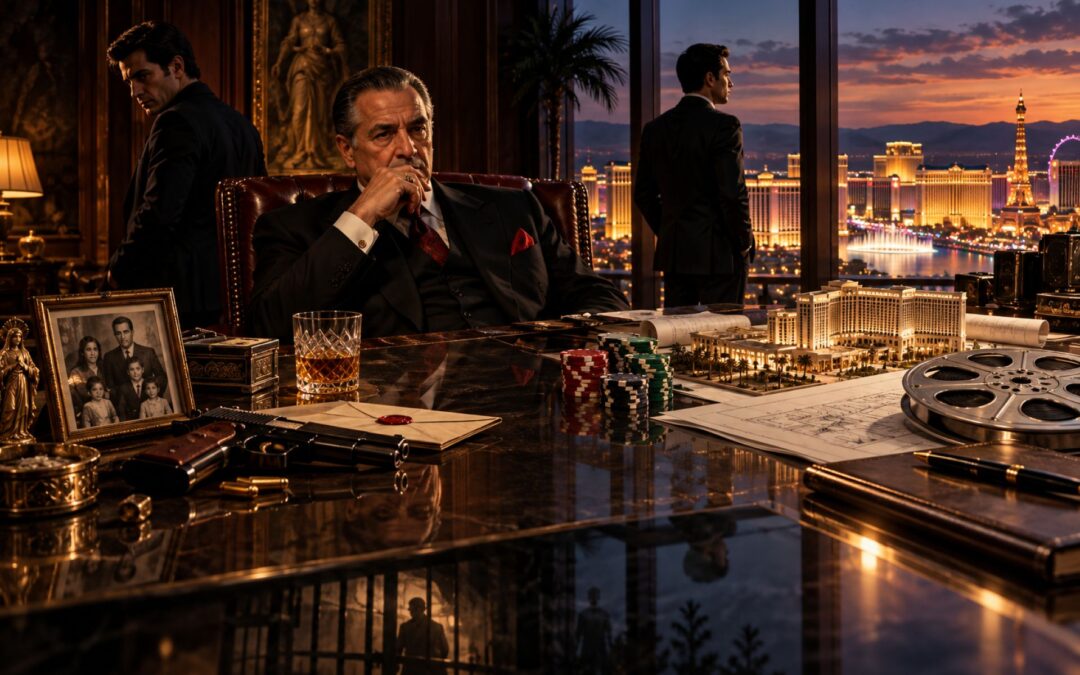
Mario Puzo’s 1996 novel The Last Don returns to the world that made him famous—Mafia families, inherited loyalties, private systems of justice, and men who can move comfortably between affection and murder—but its central problem is different from the one that drives The Godfather. Don Domenico Clericuzio has already built his criminal empire. His final ambition is to make that empire unnecessary: he wants the wealth, influence, and protection accumulated through crime to survive while his descendants become respectable enough that they no longer need to live as criminals.
That ambition gives the novel its unusual shape. The Last Don moves among an old Mafia dynasty in Quogue, casino power in Las Vegas, studio politics in Hollywood, police corruption, political patronage, family trauma, romantic obsession, and the long consequences of a massacre committed before much of the main story begins. Cross De Lena appears to be the obvious protagonist—a Mafia-trained killer who becomes rich enough to imagine leaving the Family—but the deeper narrative belongs just as much to Domenico, whose strategy reaches across generations.
Spoiler warning: This article explains the entire novel, including Pippi De Lena’s murder, the Santadio history, the deaths of Dante Clericuzio and Jim Losey, Cross’s fate, and Domenico’s final revelation.
The central question is not simply whether Cross can escape the Mafia. It is whether criminal power can ever be converted into legitimate power without carrying its violence forward, and whether children born into a family governed by blood, obligation, secrecy, and revenge can truly choose a different life. Puzo’s answer is deliberately uneasy: the Clericuzios may succeed in becoming respectable, but their escape from violence requires one final use of the very methods they claim to be leaving behind.

The Clericuzio Plan Begins in Quogue
The novel opens in 1965 at the Clericuzio estate in Quogue, New York, during a Palm Sunday christening. Don Domenico Clericuzio presides over the baptism of two infants, Dante Clericuzio and Croccifixio “Cross” De Lena, whose adult lives will eventually determine the Family’s future. The ceremony looks domestic and religious, but the guests reveal the true scale of Domenico’s world: Mafia leaders, trusted killers, businessmen, political intermediaries, casino operators, and men such as Alfred Gronevelt and David Redfellow, whose wealth allows criminal relationships to merge almost invisibly into legitimate enterprise.
The christening takes place only a year after a devastating war between the Clericuzio and Santadio families. The Clericuzios have won, but victory has left psychological damage inside Domenico’s own household. His daughter Rose Marie, Dante’s mother, remains unstable and emotionally scarred by what happened. Her strange gratitude toward Pippi De Lena, one of Domenico’s most formidable soldiers, suggests that the official family version of the conflict conceals a more intimate history.
Domenico is already thinking past the world that made him powerful. He does not want his sons and grandchildren running illegal gambling operations, enforcing debts, or committing murders forever. His sons Giorgio, Vincent, and Petie can occupy increasingly insulated or legitimate roles, while men such as Pippi continue handling the dangerous work necessary to protect the transition. The family’s future, as Domenico imagines it, lies in money, influence, political connections, casinos, banking, and businesses that can survive without requiring every new generation to become professional criminals.
That ambition is more sophisticated than a simple decision to “go legitimate.” Domenico understands that legality and power are separate things. The Clericuzios have accumulated wealth because they could enforce promises outside the law, punish betrayal, protect allies, corrupt officials, and intervene where ordinary institutions failed or refused to act. If their descendants are to live legitimately, they must somehow retain the benefits of that system while gradually discarding the violence that sustained it.
The two babies at the christening embody the problem. Cross is the son of Pippi De Lena, one of the Family’s most reliable instruments of violence, yet Cross will grow into a man unusually capable of operating inside legitimate businesses. Dante is Domenico’s grandson and therefore carries the most prestigious Clericuzio blood, but he also carries the blood of the destroyed Santadio family. The novel does not immediately explain why that matters. Instead, it allows the unanswered history of the Santadio war to remain beneath the surface until the consequences become unavoidable.
Hollywood, Las Vegas, and the Next Generation
After establishing the old generation’s plan, Puzo jumps forward and disperses the story across Hollywood, Las Vegas, and the younger Clericuzio generation. What initially looks like a collection of separate plots gradually becomes one system: a threatened actress creates a crisis for a film studio; that crisis draws Cross into Hollywood; Cross’s intervention exposes how much power he now holds independently of his family; and the resulting business relationships give Domenico another possible route toward the legitimate future he has been planning since the christening.
Boz Skannet’s Attack and Athena Aquitane’s Fear
Athena Aquitane is one of Hollywood’s biggest stars when her estranged husband, Boz Skannet, confronts her at the Academy Awards. He appears to throw acid in her face, an attack calculated to destroy the beauty on which much of her public identity and professional value depends. The liquid turns out to be water, but the gesture is more frightening than reassuring: Boz has demonstrated that he can reach her whenever he chooses, and he wants her to understand that the next attack might be real.
Athena continues through the ceremony and wins the Academy Award for Best Actress, an act that immediately establishes one of the contradictions Puzo will repeatedly exploit. Publicly she is powerful, successful, glamorous, and celebrated. Privately she is a woman who has spent years trying to escape a violent man and who understands that fame, money, bodyguards, and professional importance do not automatically make her safe.
The history of her marriage explains why Boz’s threat has such force. Athena had married him young, before becoming the star she is in the present narrative. Their relationship deteriorated into abuse, intimidation, and fear, with Boz’s violence extending beyond Athena herself. The most devastating incident involves their infant daughter Bethany, whom Boz deliberately allows to fall. Bethany survives but is left profoundly disabled, and the combination of her daughter’s condition, Athena’s guilt, and Boz’s cruelty permanently shapes Athena’s understanding of intimacy.
Athena eventually escapes and builds a film career, but she keeps crucial parts of her private life hidden. Bethany lives in specialized care, and Athena’s position as a glamorous movie star depends partly on maintaining a public identity that does not reveal the grief and responsibility occupying so much of her emotional life. Boz therefore represents more than an abusive former husband. He is a person who knows the hidden structure of her life and can threaten both her physical safety and the identity she has built after leaving him.
His return creates an immediate financial crisis because Athena refuses to continue working on Messalina, an enormously expensive production being prepared as a major studio release. For Athena, the refusal is an act of survival. For LoddStone Studios, it is a business disaster. The same person can therefore be understood simultaneously as a terrified woman, an irreplaceable artist, and a piece of capital on which millions of dollars depend.
That contradiction defines the Hollywood sections of The Last Don. Eli Marrion, Bobby Bantz, producer Skippy Deere, director Dita Tommey, Athena’s agent Melo Stuart, and security figures such as Andrew Pollard may genuinely care about her at different moments, but their professional world trains them to translate every personal crisis into money, scheduling, insurance, ownership, publicity, and leverage. Hollywood does not need the Mafia’s guns to reduce people to assets because contracts and investment can perform a different form of coercion.
Cross De Lena Inherits the Xanadu
While Athena’s crisis unfolds in Hollywood, Cross De Lena is established in Las Vegas as a man who has already moved farther from conventional Mafia life than his father ever did. His great mentor is Alfred Gronevelt, the aging casino owner who taught him to understand gambling not as glamour but as mathematics applied to human weakness. Gronevelt’s world depends on odds, percentages, appetite, vanity, and the certainty that enough people will eventually make decisions against their own interests.
Gronevelt also teaches Cross about emotional discipline. The casino can survive because it does not need to beat every gambler; it merely needs the probabilities to work over time. Personal relationships are more dangerous because affection introduces variables that cannot be calculated so neatly. Gronevelt’s skepticism about romantic love becomes important later, when Cross begins making decisions for Athena that cannot be justified purely as business.
When Gronevelt dies, Cross inherits a major interest in the Xanadu. The inheritance changes his position inside the Clericuzio world because his wealth is no longer merely a favor granted by the Family. He now controls a legitimate, profitable enterprise that gives him an independent economic base and makes it conceivable that he could eventually live without depending on Domenico’s criminal organization.
The Xanadu also represents a crucial middle ground between criminal and respectable power. Gambling is legal in Las Vegas, but the casino world shares many features with the Clericuzio organization: strict control of territory, careful management of reputation, knowledge of human weakness, privileged treatment for valuable clients, private rooms inaccessible to ordinary people, and elaborate systems for ensuring that obligations are remembered. Cross can therefore move from Mafia life into casino life without having to become an entirely different person.
Claudia De Lena, Ernest Vail, and the Hollywood Machine
Cross’s sister Claudia has taken the opposite path from her brother. Where Cross stayed near Pippi and the Family, Claudia built a life in Hollywood and tried to define herself through writing and filmmaking. She does not completely escape her origins—no one in The Last Don ever does—but she has consciously sought a world in which influence comes from creativity, money, personality, and professional alliances rather than from the ability to order someone killed.
Her early ambition is literary. She wants to be a novelist, and the writer Ernest Vail becomes important both personally and professionally. Vail is capable of cruelty, but his severe criticism of Claudia’s early work helps force her toward a more realistic understanding of her talent and of the entertainment industry. Their affair further entangles artistic mentorship, sex, ambition, affection, and exploitation, patterns that recur throughout the Hollywood half of the novel.
Vail himself becomes one of Puzo’s most bitter comic examples of supposedly legitimate coercion. He once created fictional material whose rights became far more valuable than he had anticipated, but his contract leaves him unable to regain control while he is alive. The legal agreement is perfectly respectable, yet its consequences make him feel dispossessed of his own creation. Because certain rights can return to his heirs after his death, suicide gradually appears to him as the only remaining form of leverage.
Claudia’s relationship to Hollywood is therefore complicated from the beginning. She recognizes that the film industry is preferable to her father’s world in important ways: disputes are normally settled with money rather than bullets, and people can reinvent themselves without bloodline determining everything. Yet she also learns that studio authority, contracts, access, sexual bargaining, career dependence, and ownership can trap people as effectively as more openly violent institutions.
Her relationship with Pippi reflects the cost of her attempted escape. Claudia loves Cross but has spent much of her adult life trying not to become part of her father’s criminal world. When Athena’s situation becomes desperate, Claudia therefore resists the obvious solution: asking Cross for help. She knows that Cross can solve problems Hollywood cannot, but she also understands what kind of methods may become available once he is invited inside.
The Clericuzio Family History and Cross’s Inheritance
The novel’s long backward movement into the Clericuzio and De Lena histories explains why Cross and Claudia respond so differently to the same inheritance. Domenico’s worldview is rooted in an older Sicilian understanding of family, feud, loyalty, and protection. Fascist repression, migration, distrust of official institutions, and the experience of building power in America reinforce his conviction that families survive because they protect themselves rather than because governments reliably protect them.
Pippi De Lena becomes one of the purest products of this system. He is charismatic, physically impressive, affectionate toward his children, loyal to Domenico, and capable of extreme violence without needing to think of himself as cruel. Pippi’s moral universe divides people less according to legality than according to loyalty, obligation, and threat. He can sincerely love his family while carrying out killings because he does not experience those roles as contradictory.
His wife Nalene Jessup does. Nalene wants education, respectability, and a life in which her children do not need to understand murder as part of ordinary family business. Their marriage deteriorates because the disagreement is not about one criminal act but about incompatible realities. Pippi believes his work provides protection and status; Nalene believes the same work contaminates the family life it supposedly protects.
Claudia aligns emotionally with her mother and seeks distance. Cross makes the more disturbing choice of remaining close to Pippi. His decision is not simply adolescent fascination with a powerful father. Cross understands enough about Pippi to fear what might happen if the separation between his parents becomes hostile, and staying close gives him some ability to watch, mediate, and protect Nalene and Claudia.
That choice binds Cross to Pippi’s world before Cross is old enough to create his own. Las Vegas, Gronevelt, and the Xanadu eventually give him alternatives, but his deepest emotional education comes from a father who combines warmth with professional killing. The contradiction will define Cross’s adult life: he genuinely wants something more peaceful than the Clericuzio system, yet many of the skills that make independence possible were acquired through that system.
Cross Makes His Bones
Cross’s adult moral position cannot be understood unless the novel’s account of his initiation is taken seriously. By the time he becomes the wealthy casino owner who meets Athena, he is not an innocent relative trapped on the edge of organized crime. He has already killed for the Clericuzio family and accepted the logic under which private power can correct outcomes that the Family considers intolerable.
Pippi prepares him for that role through an explicit philosophy of power. In Pippi’s view, people can live on their own terms only when they possess enough power to resist those who would impose other terms upon them. Violence is one form of that power, but Pippi treats it as a practical instrument rather than a theatrical performance. The best violence is simple, controlled, purposeful, and difficult to trace.
The case that initiates Cross begins with Governor Walter Wavven, a politician whose relationship with the Clericuzios demonstrates how the Family embeds itself in legitimate institutions. Wavven’s daughter Marcy is murdered by her boyfriend, playwright Theo Tatoski. Tatoski avoids conventional punishment through a temporary-insanity defense, leaving Wavven with a result that the legal system recognizes but that he cannot emotionally accept.
The Clericuzios can provide a different kind of justice. Cross participates in Tatoski’s murder and thereby becomes what the Family calls a “Little Hammer,” one of the younger men who can be trusted with lethal assignments. The killing matters because it destroys any easy distinction between Cross and Pippi. Cross may later prefer legal business, love Athena, and resent the Family’s control, but he has knowingly participated in the system’s central act: deciding that its own judgment can override the judgment of the state.
At the same time, the novel develops the difference between Cross and Dante. Both young men inherit the Clericuzio world, and both are capable of violence. Cross, however, absorbs Pippi’s belief that violence should serve a disciplined objective. Dante increasingly enjoys violence as an expression of anger, ego, appetite, and personal domination.
That difference is crucial to Domenico. A Mafia family that cannot restrain its own killers eventually becomes vulnerable not only to law enforcement but to internal chaos. Dante’s murders and impulsive behavior reveal that he may possess the ruthlessness required to rule without possessing the patience or strategic intelligence that made Domenico successful.
The larger political project reinforces the distinction between short-term criminal opportunity and long-term institutional power. The Clericuzios hope to benefit from an expansion of legalized gambling, which could convert expertise and capital accumulated in illegal gambling into enormous legitimate profits. Domenico therefore becomes increasingly intolerant of criminal acts that might endanger public or political acceptance of gambling, even when those acts would make money in the short term.
Cross’s initiation consequently places him between generations. He has proved that he can kill when the Family requires it, but Gronevelt and the Xanadu are teaching him that lasting power can also come from ownership, probability, regulation, and wealth. Dante, by contrast, is moving in the opposite direction, toward an identity in which violence becomes increasingly personal. Domenico’s problem is no longer simply how to defeat external enemies; it is how to prevent his own bloodline from carrying the worst habits of the old order into the future.
Cross Takes on Hollywood—and Boz Skannet
When Hollywood’s ordinary mechanisms fail to make Athena feel safe enough to finish Messalina, Claudia and Skippy Deere reluctantly bring Cross into the crisis. His intervention initially looks like a side plot driven by attraction, but it becomes the point where the novel’s worlds merge. Cross discovers that Hollywood offers enormous legitimate opportunities, while the Clericuzio family discovers that Cross’s independent business instincts may serve Domenico’s long-term plan.
The Messalina Deal
Cross is attracted to Athena almost immediately, but he cannot present that attraction to his family as a sufficient reason for becoming involved. The Clericuzios understand business, obligation, and strategic advantage far better than romantic impulse. Cross therefore turns the problem into a transaction.
LoddStone has invested heavily in Messalina, and Athena’s refusal to work places the production in danger. Rather than simply threatening her into returning—a solution that would make him little better than Boz—Cross proposes taking financial control of the endangered project. If the studio wants to eliminate its risk, he is willing to assume it.
The deal gives Cross a legitimate reason to enter Hollywood while also exposing the limits of the industry’s supposed power. Eli Marrion and Bobby Bantz can control careers, contracts, budgets, and distribution, but they cannot simply order Athena to stop being afraid. Cross possesses access to a form of power they do not: the ability to remove Boz from the world entirely.
That possibility is exactly what makes his relationship with Athena morally complicated. Cross wants to protect her, and unlike Boz he does not wish to dominate or humiliate her. Yet he is prepared to achieve her safety through methods that Athena herself has not authorized and that the law would define as murder.
Big Tim, Dante, and the Clericuzio Enforcement System
Before the operation against Boz is completed, the novel demonstrates how the Clericuzios evaluate violence through the case of Big Tim “the Rustler” Snedden. Big Tim devises a plan involving the Super Bowl that could produce an enormous gambling profit. From a narrow criminal perspective, it looks like exactly the kind of opportunity an organized crime family might exploit.
Domenico rejects it because his objectives have changed. The Family wants gambling to become more respectable and politically acceptable, not more visibly corrupt. A spectacular fixed event could create money immediately while damaging the larger project of integrating gambling into legitimate national business. Big Tim’s clever scheme therefore becomes, from Domenico’s perspective, a strategic threat.
Cross tries to plead for him, demonstrating again that Cross is less emotionally comfortable with Family executions than Pippi is. Domenico remains unmoved. Once a person threatens the long-term survival of the organization, personal affection becomes secondary to institutional necessity.
Dante participates in Big Tim’s death but turns the operation into something more theatrical and sadistic than required. His behavior confirms Pippi’s growing unease. The problem is not simply that Dante kills; killing is part of the world Pippi himself helped build. The problem is that Dante does not reliably subordinate killing to a larger purpose.
The same section of the novel reveals the specialized infrastructure behind Clericuzio power. Leonard Sossa can create convincing documents and identities. Andrew Pollard supplies intelligence and security. Lia Vazzi possesses the experience, discretion, and loyalty of an old Sicilian professional. The Family’s strength comes not from one invincible killer but from an ecosystem of people who can gather information, move money, falsify identities, control environments, and remove evidence.
Cross quietly assembles this machinery for a personal purpose. He needs Boz neutralized without exposing Athena, himself, or the Clericuzio family to public scrutiny. What the studio cannot achieve through contracts or security, Cross prepares to achieve through covert coercion.
The Elimination of Boz Skannet
The operation against Boz is designed to isolate him completely. False identities, controlled movement, and the Hunting Lodge allow Cross’s people to move Boz outside the spaces in which ordinary law, celebrity publicity, or Hollywood security could interfere. Lia Vazzi helps turn the abduction into a disciplined exercise rather than the kind of uncontrolled revenge Dante would prefer.
Boz is psychologically and physically dominated until he can be incorporated into the cover story prepared for his disappearance. The aim is not merely to kill him but to make the death tell a plausible story that points away from Athena and Cross. By the time Boz is dead, the circumstances can be interpreted as suicide rather than as a carefully planned execution.
Athena is therefore freed from the immediate threat. Messalina can resume, the studio can protect its investment, and Cross has solved a problem that lawyers, bodyguards, police, and executives could not solve. On the most practical level, the intervention works.
Its moral cost cannot be separated from its success. Cross’s romance with Athena becomes possible because he has used the criminal powers from which he eventually hopes to escape. His tenderness toward her does not erase the fact that he has privately decided who deserves to die, just as his desire for a legitimate future does not erase the killing through which that future has been secured.
Love, Money, and the Fracturing Family
The middle of The Last Don broadens the conflict rather than narrowing it. Cross becomes more emotionally committed to Athena at precisely the moment his ties to the Clericuzio family are becoming harder to sustain, while Hollywood’s financial battles create new opportunities for Domenico’s legitimacy strategy. At the same time, the unresolved Santadio past finally erupts into the present through the murder of Pippi.
Cross and Athena: Bethany and the Price of Trust
Athena does not accept the official account of Boz’s death without suspicion. She knew him too well to find suicide entirely convincing, and Cross’s sudden ability to make her problem disappear is impossible to ignore. Their relationship therefore begins with a gap between what Athena can infer and what Cross is willing to tell her.
That gap matters because Cross represents both safety and danger. He treats Athena with a patience and respect absent from her marriage to Boz, but the source of his protective power is precisely what she cannot fully examine. To trust Cross, Athena must accept that part of his world remains inaccessible to her.
Her revelation about Bethany raises the stakes of that trust. Bethany is not simply a piece of tragic backstory. Athena’s life has been structured around the knowledge that her daughter requires care, that Boz contributed to her condition, and that Athena herself has tried to keep motherhood separate from the glamorous public identity on which her career depends.
Cross initially encounters Bethany’s reality with discomfort. The moment exposes the difference between loving an idealized movie star and accepting the obligations embedded in another person’s life. Athena is not merely offering him romance; she is asking, implicitly, whether he can accept a family structure in which disability, dependence, guilt, and long-term responsibility cannot be solved by money or violence.
Cross gradually does move toward that acceptance. In doing so, he begins to imagine a form of family utterly different from the Clericuzio model. Domenico’s family protects through power and retaliation. Athena’s relationship with Bethany requires endurance without control, because no act of dominance can transform Bethany into the child Athena once imagined.
This is one reason Cross’s relationship with Athena is more important than a conventional crime-novel romance. Loving her means accepting vulnerability rather than eliminating it. Gronevelt taught Cross that emotional attachment creates risks that cannot be reduced to percentages, and Athena becomes the person for whom Cross is willing to accept those risks.
Eli Marrion, Ernest Vail, and the Battle for Hollywood
Hollywood is undergoing its own succession crisis. Eli Marrion once possessed immense authority within LoddStone, but physical decline makes the limits of institutional power impossible to ignore. A man may rule a studio, shape careers, command money, and decide which stories reach millions of people, yet none of those powers protects him from mortality.
Marrion’s decline also reveals how dependent promises are on the people who enforce them. When Bobby Bantz becomes more powerful, commitments that once seemed secure can suddenly become negotiable. Hollywood’s rules may be legal, but the people with enough institutional leverage still determine how those rules operate in practice.
Ernest Vail’s story reaches its bleak conclusion within this environment. Vail has spent years trapped by a deal that transferred valuable rights while leaving him with little control over his own creation. Legal ownership has produced an outcome he experiences as theft even though no conventional theft occurred.
Death becomes his final negotiating instrument. Vail engineers his own death so that contractual provisions benefiting his heirs can take effect. The act is tragic because a creative person has concluded that he is economically more useful to his family dead than alive, and comic in Puzo’s dark Hollywood register because even suicide becomes a business strategy.
Molly Flanders is then able to use the altered legal position to obtain better terms for Vail’s estate. The sequence deliberately echoes the Mafia plot without simply equating the two institutions. The Clericuzios enforce obligations with the threat of violence; Hollywood enforces ownership through contracts, capital, and access. Both worlds reward people who understand where leverage actually resides.
David Redfellow and the Plan to Buy LoddStone
The Clericuzio family’s effort to profit from expanded legalized gambling encounters political resistance. Their connections can influence senators and governors, but they cannot make every obstacle disappear. Cross recognizes the dangerous logic that would follow if the Family treated every political barrier as it treats a disobedient criminal associate. There are enemies even Domenico cannot murder without destroying the legitimacy he hopes to achieve.
This failure makes David Redfellow increasingly important. Redfellow represents a version of successful transformation that Domenico wants for the next generation. He once operated close to some of the most dangerous areas of organized crime, but he has remade himself as an international banker and businessman whose power can function through respectable institutions.
Rather than responding to Bobby Bantz’s maneuvering with a threat, Redfellow proposes a more modern answer: acquire influence over LoddStone through finance. Ownership can achieve what intimidation cannot. Once a criminal fortune becomes capital capable of purchasing legitimate corporations, the distinction between the Family’s old power and its new power becomes harder to locate.
This is a major development in Domenico’s plan. Hollywood is no longer merely the place where Claudia works or where Cross fell in love with Athena. It can become another institutional home for Clericuzio wealth, allowing younger family members to exercise influence without needing to know how to order a killing.
Pippi De Lena’s Murder and Cross’s Investigation
Pippi, meanwhile, has begun imagining a softer ending to his own life. Age has not transformed him into an innocent man, but it has made domestic stability more attractive. He intends to marry again and appears ready to exchange some of the restless movement of his earlier life for personal comfort.
He never reaches that future. Dante ambushes and shoots him, catching a man who has survived countless dangerous situations because Pippi does not initially treat Dante as the enemy he has become. The murder is therefore possible not because Dante is a more experienced killer but because family trust creates an opening that an outsider would never receive.
Pippi’s final recognition connects his death to the history everyone has kept from Cross. Dante is not merely Domenico’s grandson. He is also the child of Rose Marie and therefore the descendant of the Santadio family destroyed in the earlier war. In dying, Pippi understands that the violence of the previous generation has returned through the bloodline everyone hoped would absorb it.
For Cross, the murder destroys the possibility of simply choosing Athena and walking away. Pippi was both his father and the person who trained him into violence. Whatever Cross may think of the Clericuzio system, he cannot emotionally process Pippi’s death as an ordinary crime that can be left to police.
Claudia returns for the funeral despite the distance she built between herself and her father. Her grief captures the contradiction Pippi embodied for both children: a man can be a loving father and still create reasons for his children to fear, reject, or morally condemn the life he represents. Death does not resolve that contradiction.
Cross begins investigating privately. Detective Jim Losey’s position becomes increasingly suspicious, particularly when apparently heroic or convenient police narratives fail to fit what Cross knows about the people involved. The trail passes through small-time criminal Phil Sharkey and gradually exposes relationships suggesting that Pippi’s murder was not a random underworld attack.
Lia Vazzi becomes one of Cross’s most important allies. Lia belongs to the old violent world, but unlike Dante he is disciplined by loyalty and professional caution. As Cross follows the evidence, Lia handles dangers that could expose their investigation or place Cross at risk.
Eventually Cross reaches the question everyone else has avoided. If Dante killed Pippi, why would Domenico’s own grandson want the death of one of the Family’s most loyal soldiers? The answer can only lie in the Santadio war, and Cross forces the older generation to tell him what really happened.
The Santadio Secret
The Santadio history is not merely explanatory flashback. It is the hidden mechanism that makes the present plot intelligible. Once Cross learns it, Pippi’s murder stops looking like an isolated betrayal and becomes the latest stage of a family conflict that Domenico thought he had ended through overwhelming force.
What Really Happened in the Santadio War
Rose Marie had married Jimmy Santadio, linking the Clericuzio and Santadio families not only through alliance but through blood. The marriage should theoretically have reduced hostility between the two groups. Instead, it ensured that any future conflict would divide Rose Marie’s loyalties in the most intimate possible way.
The relationship between the families deteriorated into violence. Silvio Clericuzio became involved in the escalating dispute and was killed by members of the Santadio family. For Domenico, the murder demanded more than a proportional response because allowing such an attack to go unanswered would advertise weakness to every rival who depended on fear of Clericuzio retaliation.
The counterattack was annihilating. Rather than simply killing the men directly responsible for Silvio’s death, the Clericuzios destroyed the Santadio family’s power through a coordinated massacre. Pippi was one of the important instruments of that revenge.
From the perspective of Mafia strategy, the response succeeded. The Santadios ceased to exist as a rival force, and the Clericuzios emerged dominant. From the perspective of Rose Marie, however, her own family had destroyed the family into which she had married.
Her psychological collapse is therefore rooted in an impossible division of identity. She belongs to the victorious Clericuzios, yet the victory includes the slaughter of people connected to her husband and to her son’s paternal heritage. The Family can eliminate enemies physically, but it cannot eliminate the meaning of what happened for the surviving woman who must continue living among the victors.
Dante inherits that unresolved contradiction. In family ceremonies he is a Clericuzio grandson, a possible future heir to the dynasty. In the hidden history transmitted through Rose Marie, he is also a Santadio descendant living among the people responsible for destroying his father’s family.
For Cross, the story immediately transforms the danger. If Dante’s killing of Pippi is revenge for the Santadio massacre, Pippi may only be the first target. Cross is Pippi’s son and an increasingly powerful rival within the same family structure. Domenico himself is the architect of the original retaliation.
How Rose Marie Made Dante an Heir to Revenge
Dante does not discover the Santadio story as an adult through calm historical explanation. He grows up receiving it through Rose Marie’s unstable memories and emotional episodes. The result is not a balanced account of a Mafia war but a private mythology of grievance in which the men celebrated by the Clericuzios are also the destroyers of his paternal family.
This background helps explain Dante without absolving him. The novel gives him a genuine inherited grievance, but it also shows that revenge merges with other elements of his character: ambition, sadism, resentment, impulsiveness, sexual aggression, and a desire to dominate. Pippi’s murder serves a family vendetta, but Dante also wants more authority and sees Cross as an obstacle.
That combination is what makes Dante so dangerous to Domenico’s long-term plan. A man motivated solely by revenge might eventually exhaust his list of enemies. Dante’s appetite for power would survive the revenge. If he became the dominant figure in the next generation, the Clericuzios would not be transitioning away from criminal violence; they would be placing their fortune in the hands of someone who enjoys the old methods more than the strategic purposes those methods were supposed to serve.
Jim Losey gives Dante access to a different institution. Losey is a police officer, but his willingness to manipulate investigations and cooperate with criminals undermines any simple division between lawful authority and Mafia authority. Dante can use a badge and official narratives the same way the Family uses political influence, forged identities, and controlled witnesses.
The alliance also makes Cross’s position more precarious. He is no longer investigating only a cousin with a private grievance. He is confronting a murderer who can exploit both family access and compromised law enforcement.
Cross and Lia Prepare for War
Cross and Lia gradually accept that the normal Clericuzio hierarchy cannot solve the problem for them. If Cross openly accuses Dante without sufficient proof, he risks challenging Domenico’s grandson inside a family whose authority depends on strict rules. If he waits, Dante may kill him first.
Lia helps close loose ends around the investigation, including people whose knowledge could expose what Cross has learned. His participation matters because Lia is not acting as an impulsive avenger. He understands that Dante’s alliance with Losey has turned the situation into a threat requiring the same professional discipline that once made the Clericuzios formidable.
Cross decides that Dante and Losey must be removed together. The logic is grimly familiar: once ordinary structures appear incapable of producing a safe outcome, Cross returns to the private justice he learned from Pippi. The difference is that he will now use it against his own family.
He also understands that Domenico will almost certainly recognize what happened. Cross is not planning a deception clever enough to fool the Don forever; he is planning to survive the immediate threat and accept whatever judgment follows. That recognition makes the coming confrontation not only an act of revenge but a declaration that Cross’s loyalty to the Family has reached its limit.
The Xanadu Trap
The climax brings nearly every major world in the novel into the same physical space. Messalina has been completed, Hollywood arrives in Las Vegas to celebrate, Cross controls the Xanadu environment, Dante and Losey believe they can exploit the occasion, and the hidden Santadio conflict finally becomes open violence. The casino that gave Cross economic independence also becomes the place where he must use his inherited criminal skills one last time to defend that independence.
Steve Stallings and the End of Messalina
Before the central confrontation, Puzo pauses for the death of actor Steve Stallings. Stallings has completed his work on Messalina while recognizing that age is eroding the sexual appeal and professional status on which much of his life has depended. His identity has been built around being desired, watched, celebrated, and paid to embody a particular kind of masculinity.
A self-destructive night ends with his sudden death from a cerebral aneurysm. Hollywood’s response rapidly converts a private death into an industrial problem involving publicity, reputation, and the fact that the footage required for the film has already been obtained. The person dies; the product survives.
The episode may look detachable from the Mafia climax, but it reinforces the novel’s institutional view of human beings. Studios, like criminal organizations, continue after individual members disappear. Grief exists, but the machine also asks what has been lost financially, what has already been secured, and how the public story should be managed.
The Wrap Party
The Messalina celebration at the Xanadu brings the film world into territory Cross understands completely. Actors, producers, executives, and celebrities enter an environment designed around privileged access and controlled privacy. The Xanadu’s Villas are especially important because they allow wealthy guests to feel removed from ordinary scrutiny.
Cross uses that privacy differently. He understands the security arrangements, movement patterns, staff access, and physical vulnerabilities of the property. What looks to guests like luxury can therefore become a controlled tactical environment.
Dante arrives believing Cross can be isolated. His ambitions now extend beyond revenge for Pippi’s role in the Santadio massacre. Cross’s wealth, independence, casino ownership, and relationship with the wider Clericuzio structure make him a rival whose removal would leave Dante with greater room to dominate the next generation.
Losey also sees opportunity. His corruption has carried him beyond the boundaries of ordinary police work, and association with Dante promises access to power unavailable through his official position alone. The alliance rests on the same mistake both men make repeatedly: they assume their ability to manipulate institutions means they can control every environment they enter.
At the Xanadu, Cross controls the environment.
The Deaths of Jim Losey and Dante
Losey is dealt with first. His status as a police officer makes him especially dangerous because any confrontation that leaves conventional evidence could turn the full machinery of law enforcement against Cross. The operation therefore requires disappearance rather than a public killing.
Once Losey has been removed, Dante moves toward the confrontation he has been anticipating. He expects to kill Cross and complete the elimination of the most important obstacle between himself and greater control of the Family’s western interests. His confidence reflects both his contempt for Cross’s supposed softness and his inability to understand that Cross’s desire for a different life never meant he had forgotten how to kill.
Cross anticipates him. The resulting confrontation ends with Dante dead, and the meaning of the act extends beyond self-defense. Cross has avenged Pippi, prevented his own murder, eliminated the man most likely to drag the Clericuzio future back toward uncontrolled violence, and committed the ultimate internal offense of killing the Don’s grandson without permission.
The bodies are removed, and the Villa is burned so that physical evidence disappears with the controlled environment in which the killings occurred. The destruction reverses the normal symbolism of the Xanadu. A space designed for privacy and luxury becomes an instrument of concealment, showing how easily respectable wealth can shelter acts that belong to Cross’s criminal inheritance.
The plan succeeds operationally, but Cross never assumes it will free him from consequences. Domenico’s authority does not depend on forensic proof. The Don knows his people, understands motive, and can reconstruct a decision from its results.
The Don’s Judgment
While the criminal climax settles one succession problem, Hollywood undergoes another. Bobby Bantz becomes engulfed in a sexual scandal, creating new instability at LoddStone. Skippy Deere and the people around the studio respond with the mixture of opportunism, damage control, and narrative manipulation that has characterized the industry throughout the novel.
The financial strategy begun through Redfellow now becomes increasingly important. Rather than remaining outsiders who occasionally pressure Hollywood, the Clericuzios can convert capital and connections into legitimate institutional influence. Claudia’s place in that transformed structure suggests what Domenico has wanted all along: descendants exercising real power without needing Pippi’s profession.
Cross, however, must return to Quogue and face the Don. Domenico does not need Cross to confess. He tells him that he is responsible for Dante’s death, and Cross explains the chain of reasoning that led him there.
Pippi could only have been surprised by someone he trusted. Losey’s activities pointed toward a cover-up. The Santadio history supplied Dante with a motive powerful enough to explain an attack within the Family. Dante’s own behavior and the growing threat to Cross completed the picture.
None of this makes Cross’s action permissible under the Family’s rules. If individual members can kill relatives whenever they believe they have sufficient justification, Domenico’s authority collapses into the same chaos he has spent his life preventing. Cross therefore has to be punished even if Dante’s death is strategically useful.
Domenico takes a substantial portion of Cross’s interest in the Xanadu, cutting into the independent fortune that made Cross difficult to control. Lia is separated from Cross and sent back to Sicily. Most importantly, Cross is formally removed from the Family’s active structure, while Domenico forbids further revenge for Dante.
On the surface, Cross has survived by accepting punishment. He has lost wealth and an old protector, but he has gained what he increasingly wanted: a life outside Clericuzio authority. Only the epilogue reveals that the judgment was also the final move in a plan larger than Cross understood.
The Epilogue: Cross Escapes and the Don Reveals His Plan
Cross reunites with Athena in Nice, but Puzo does not give them a simplistic romantic ending in which every obstacle disappears. Athena remains committed to Bethany and understands that caring for her daughter will shape the coming years. She cannot become merely Cross’s beautiful reward for surviving the Family war.
Cross accepts that reality. His imagined future now includes Athena, Bethany, marriage, possible children, and responsibilities that cannot be enforced through fear. It is a significant change for a man raised among people who solved vulnerability by eliminating threats.
The emotional resolution therefore depends less on whether Cross has become morally pure than on what kind of obligations he chooses next. He cannot undo Tatoski, Boz, Dante, or the other violence in which he participated. What he can do is stop treating the Family’s needs as the highest authority governing his future.
Puzo then returns to Domenico, and the final perspective changes the meaning of the climax. The Don had understood more about Pippi’s death and Dante’s danger than Cross realized. He knew that the unresolved Santadio history had produced a grandson capable of destroying the transition Domenico had spent decades arranging.
The difficulty was not simply identifying Dante as a threat. Domenico’s authority rested on a family code that made openly ordering the murder of his own grandson almost impossible. A Don who could arbitrarily kill his blood heir would weaken the principle of family loyalty that justified his own rule.
Pippi’s murder changed the situation. Domenico could not formally commission Dante’s death, but he could make sure Cross possessed the information necessary to understand what was happening. By revealing the Santadio history and allowing Cross enough freedom to act, Domenico created conditions under which the two younger men would resolve the conflict themselves.
Cross consequently believed he was acting against the Family’s interests when he killed Dante, but his action also served Domenico’s deepest strategic purpose. Dante, the descendant most likely to perpetuate uncontrolled criminal violence, was removed. Cross, the descendant capable of living legitimately but still tied too closely to the Family, was pushed outside the organization. The old enforcement structure could begin contracting without leaving an unstable heir at its center.
Domenico’s punishment of Cross also preserves the appearance and logic of authority. Cross cannot kill the Don’s grandson and simply be rewarded. By taking part of his casino interest, separating him from Lia, and formally excluding him from the Family, Domenico demonstrates that the code still has consequences while simultaneously giving Cross the freedom that benefits the long-term transition.
The Don has therefore completed the project announced at the christening. His descendants can enter banking, gambling, entertainment, and other legitimate institutions while the criminal infrastructure that built their fortune becomes less necessary. The victory is real, but it is not clean: Domenico uses manipulation, secrecy, and another cycle of killing to create a future in which his descendants may no longer need those methods.
That contradiction is the key to The Last Don. Domenico does not transcend the world of the Mafia. He uses its logic perfectly one final time so that the people who come after him will not have to be Dons themselves.
The World of The Last Don: Quogue, Vegas, Hollywood, and Sicily
The novel’s settings function less like backgrounds than like different models of institutional power. Quogue, Las Vegas, Hollywood, political offices, police departments, and the remembered Sicilian world all have distinct rules, but Puzo repeatedly places them beside one another to show how people acquire leverage, protect insiders, punish threats, and control public narratives.
Quogue is the most openly dynastic environment. Domenico rules through blood, reputation, history, fear, and the ability to mediate disputes that ordinary institutions either cannot settle or cannot settle quickly enough. The Family’s authority is personal rather than bureaucratic, which makes loyalty extremely powerful but also makes succession dangerous. A corporation can replace an executive through formal procedure; a Mafia dynasty must worry about resentment among sons, nephews, grandchildren, and soldiers whose identities are bound to personal allegiance.
The Bronx and the wider criminal network supply the operational foundation beneath that authority. Forgers, killers, intermediaries, informants, politicians, police, and local associates allow the Family to act at a distance. Puzo’s Mafia is therefore not simply a group of gunmen. It resembles an alternative state capable of gathering intelligence, creating identities, enforcing contracts, protecting allies, and imposing punishment.
Las Vegas offers Cross a legal version of concentrated power. The Xanadu makes money through gambling, hospitality, privacy, entertainment, and mathematical advantage rather than extortion. Yet Gronevelt’s philosophy resembles Domenico’s in one important respect: both men distrust sentiment when it interferes with calculation.
The casino depends on understanding that individuals are unpredictable while large patterns can be managed. A single gambler may win, but the house survives because the structure favors it. Domenico’s long-term strategy works similarly. He cannot control every emotional choice made by Rose Marie, Pippi, Cross, or Dante, but he tries to construct a family system resilient enough to survive their individual disruptions.
Hollywood introduces a more theatrical kind of power. Careers depend on access to producers, agents, directors, financiers, executives, and publicity. Stars can appear more powerful than studio heads because the public recognizes their faces, yet a production can turn those same stars into assets whose illnesses, relationships, sexuality, scandals, and deaths become financial calculations.
Ernest Vail’s contract shows how coercion can operate without obvious illegality. No gun is pointed at him, but ownership structures leave him feeling powerless over his own creation. Athena’s crisis demonstrates the reverse situation: she possesses wealth and fame but cannot rely on the industry’s machinery to eliminate a threat that falls partly outside business logic.
Sicily, meanwhile, is less a fully explored geographical setting than the historical and mythological source of the Clericuzio worldview. Stories of vendetta, distrust of government, Fascist oppression, family survival, and private justice provide characters with an explanation for why institutions like the Mafia emerged and why loyalty to family can feel more reliable than loyalty to the state.
Puzo’s most provocative move is to place these systems beside one another. Hollywood executives trade favors and careers; politicians trade access; police officers can trade authority; casinos trade privilege and credit; bankers trade capital; Mafiosi trade protection and fear. The parallel is real, but the novel does not justify treating the institutions as morally identical. A studio contract, however exploitative, is not the same act as murder, and a corrupt police officer does not make all public law equivalent to Mafia rule.
What the comparison does establish is that legitimacy alone does not eliminate power relationships. Domenico’s genius is recognizing that if power can be transferred into institutions where ownership and influence perform some of the work once performed by violence, his descendants can become respectable without becoming powerless. The novel’s moral unease comes from the fact that the fortune financing this transformation was created and protected through the very violence respectability is supposed to leave behind.
Character Analysis
The Last Don has a large cast, but its central characters form a tightly connected generational pattern. Domenico builds the system, Pippi enforces it, Cross inherits both its benefits and its moral burden, Dante embodies its unresolved violence, while Athena and Claudia offer Cross two different images of life beyond traditional Clericuzio identity. The strongest characters are therefore not isolated psychological portraits; they become most interesting through the positions they occupy within the Family’s transition.
Cross De Lena
Cross is designed around contradiction. He is capable of affection, loyalty, patience, financial intelligence, and genuine tenderness, but he is also a trained killer who accepts private violence as a legitimate tool long after he begins imagining himself outside Mafia life. Puzo never supplies a clean moment in which Cross becomes a good man.
His childhood choice to remain close to Pippi establishes the pattern. Cross does not simply embrace his father or simply reject his mother. He stays partly because he believes proximity to Pippi may allow him to protect Nalene and Claudia, which means his first movement toward the criminal world is already tied to a desire to protect people he loves.
His initiation completes the compromise. Killing Tatoski is not an accident, an act of immediate self-defense, or something forced upon him at gunpoint. Cross accepts the Family’s logic and participates in an execution because the legal outcome has been judged unacceptable by powerful allies.
Gronevelt and the Xanadu then give Cross a legitimate identity that does not require abandoning everything he learned from the Family. He is good at reading people, evaluating risks, protecting valuable relationships, and thinking beyond immediate profit. The casino converts those skills into wealth without requiring routine criminal enforcement.
Athena exposes the emotional limitation in that transformation. Cross initially approaches her partly as a problem he can solve. The Boz situation invites exactly the kind of response in which his skills excel: identify the threat, isolate it, remove it, control the story. Bethany presents a problem of an entirely different kind because she cannot be “fixed” by force, leverage, or money.
Cross’s willingness to accept Athena’s daughter therefore matters more than a conventional declaration of love would. He begins accepting a life in which caring for someone may mean living permanently with circumstances he cannot control. That is a radical change for a man shaped by Domenico, Pippi, and Gronevelt.
Pippi’s murder proves that Cross has not escaped the older identity. His grief turns quickly into investigation and revenge, and when he believes Dante intends to kill him, Cross does not seek safety by withdrawing. He builds a better trap.
Even his killing of Dante resists simple moral classification. Dante is responsible for Pippi’s murder and is preparing further violence. Cross’s action protects his own life and removes a genuine threat. At the same time, Cross has again decided privately that killing is the appropriate solution, confirming that his desire for legitimacy has not erased the moral habits through which he was raised.
His development is therefore less a redemption arc than an exit arc. Cross does not become innocent. He gains enough distance, wealth, emotional attachment, and disillusionment to stop wanting the Clericuzio system to define the rest of his life.
Don Domenico Clericuzio
Domenico is the novel’s most important strategist and, by the epilogue, arguably its most important character. Unlike crime bosses who equate survival with permanent expansion, he understands that the form of power that built the Clericuzio empire may eventually become the greatest threat to its descendants.
His legitimacy project demonstrates extraordinary long-range thinking. Domenico does not expect the family to erase its criminal origins in a single generation. He instead spreads power across businesses, political alliances, casinos, banking relationships, and respectable careers so that each generation can depend less on direct criminal enforcement.
He also understands that institutions outlast individual soldiers. Pippi is invaluable, but Domenico does not dream of producing endless new Pippis. A legitimate banking interest, casino, or studio can transmit wealth more securely than a network dependent on men willing to commit murder.
The paradox is that Domenico cannot build this future without behaving like a Don. He makes decisions over life and death, protects corrupt arrangements, destroys rival families, manipulates his descendants, and ultimately allows Cross to remove Dante. The project may reduce future violence, but it is financed by past violence and completed through present violence.
His relationship with Dante reveals the limit of personal affection. Dante is his grandson and heir by blood, but Domenico eventually recognizes that preserving Dante may destroy everything the Family has become. A weaker patriarch might deny the danger because of family sentiment; a crueler one might simply order the grandson killed. Domenico instead constructs a situation in which Cross acts without a direct command.
That solution is strategically brilliant and morally evasive. Domenico obtains the outcome he wants while maintaining the principle that he did not openly sentence his grandson to death. The distinction matters inside the code he governs, even if it matters far less from an outside moral perspective.
The title therefore belongs to him in a precise sense. Domenico is “the last Don” not because organized crime vanishes after his death but because his greatest achievement is to make his particular form of dynastic criminal rule unnecessary for those who inherit the fortune.
Dante Clericuzio
Dante is easy to reduce to the novel’s villain because his cruelty, impulsiveness, and ambition make him far less sympathetic than Cross. The Santadio history complicates that role by giving his violence an inherited logic. He is the biological meeting point of two families whose conflict was supposedly settled through massacre.
Rose Marie’s trauma gives him a second family history beneath the official Clericuzio story. Publicly he belongs to the victors. Privately he grows up hearing that those victors slaughtered his paternal relatives.
That history does not determine everything Dante becomes. Puzo repeatedly shows him taking pleasure in aggression, behaving recklessly, and treating violence as a form of personal expression rather than disciplined necessity. His behavior with women and subordinates reinforces the sense that his problem is broader than legitimate revenge.
His conflict with Cross therefore operates on multiple levels. Cross is Pippi’s son and thus connected directly to the Santadio massacre. He is also wealthier, more independent, better disciplined, and more trusted as a businessman. Cross embodies the future Domenico wants, while Dante embodies the danger that old criminal habits will survive inside the next generation.
Dante’s tragedy is that his grievance is not imaginary. The Clericuzios really did commit the massacre whose consequences shaped Rose Marie. What makes him dangerous is the way that grievance fuses with ambition and sadism until revenge becomes indistinguishable from a general appetite for domination.
Pippi De Lena and Rose Marie
Pippi is one of Puzo’s most successful embodiments of the novel’s moral tension because his warmth and brutality are both genuine. He loves his children and can inspire affection, loyalty, and admiration. He is also a professional killer whose actions destroy other families.
His relationship with Nalene shows why those traits cannot be reconciled merely by insisting that everything is done “for the family.” Nalene understands that the violence Pippi performs to secure their status also creates the environment from which she wants to protect the children. Pippi cannot see the contradiction with equal clarity because loyalty to Domenico has become part of his identity.
Cross and Claudia inherit different responses to him. Cross remains close enough to learn Pippi’s skills and philosophy. Claudia creates emotional distance, yet his death still wounds her because moral rejection cannot simply erase a parental bond.
Rose Marie represents the other side of Pippi’s violence. Where Pippi can place a massacre inside the logic of Family duty, Rose Marie must live with its human consequences. Her psychological instability is bound to an event that the victorious Clericuzios would prefer to treat as completed history.
Her relationship with Dante turns memory into inheritance. Because the Family does not openly process the Santadio violence, its meaning returns through private trauma. Rose Marie becomes the channel through which an apparently defeated enemy survives inside the Clericuzio bloodline.
Athena Aquitane and Bethany
Athena initially appears to belong to a different novel: she is a movie star threatened by an abusive husband while Mafia heirs fight over family power. Her connection to the central themes becomes clearer once her relationship with Bethany is fully visible.
Athena understands powerlessness despite fame. She has money, professional importance, public admiration, and access to security, but none of those things prevented Boz from terrorizing her. Her fear therefore exposes the limits of legitimate status.
Her secrecy around Bethany reflects more than embarrassment. Athena is carrying grief, responsibility, and guilt within an industry built around appearances. The gap between her public image and private life mirrors the novel’s broader interest in legitimacy: respectable surfaces can conceal pain and compromised histories just as legitimate businesses can conceal criminal capital.
Bethany also changes what Cross must decide. He cannot simply rescue Athena and expect a conventional glamorous future. Loving Athena means accepting her continuing responsibility to a daughter whose needs will not disappear.
That makes their relationship one of the few areas in the novel where obligation is not enforced by fear, money, or blood revenge. Athena’s devotion to Bethany can be painful and imperfect, but it is not a transaction. Cross’s willingness to enter that relationship suggests that he is becoming capable of a form of family loyalty different from the one Domenico taught him.
Claudia De Lena
Claudia is the clearest alternative trajectory among Pippi’s children. She seeks legitimacy not through casinos or financial power but through culture, writing, and Hollywood. Her distance from Pippi is therefore both moral and aspirational.
Yet Hollywood prevents Claudia from constructing an easy contrast between criminal corruption and artistic purity. Her career teaches her about sexual bargaining, institutional dependence, ego, ownership, and the compromises required to turn creativity into a profession. She escapes her father’s world only to discover another system governed by powerful gatekeepers.
Her relationship with Ernest Vail deepens that understanding. Vail’s talent, bitterness, contractual entrapment, and eventual suicide reveal how destructive a legal institution can become without resembling the Mafia in any literal sense.
Claudia’s eventual position within LoddStone also fulfills part of Domenico’s dream. A descendant of Pippi can exercise real authority in a legitimate corporation instead of through criminal enforcement. The fact that this opportunity is partly enabled by Clericuzio capital keeps the achievement morally ambiguous.
The Supporting Power Brokers
Alfred Gronevelt functions as Cross’s second father, teaching him a legitimate version of strategic thinking. His casino philosophy replaces the Family’s language of honor with probability and self-interest, yet both systems value emotional control and accurate judgment of human weakness.
Lia Vazzi represents the older criminal code at its most disciplined. He is lethal without Dante’s vanity and loyal without Pippi’s emotional centrality. His exile after the climax marks the separation Cross must make from the operational machinery of his old life.
David Redfellow demonstrates what Domenico wants successful transformation to look like. He carries a dangerous past into international finance and shows that wealth can preserve power after overt criminality becomes unnecessary.
Ernest Vail provides a darker mirror. He has no Mafia army, but he is trapped by legal ownership structures until death becomes his only leverage. Eli Marrion, Bobby Bantz, and Skippy Deere represent different versions of Hollywood authority: the aging ruler, the ambitious successor, and the adaptable operator who survives by understanding that personality, sex, money, art, and publicity are inseparable.
Nalene, meanwhile, is essential despite spending less time at the center of the action. She articulates the cost of Pippi’s belief that providing materially for a family is enough to justify the methods through which the provision occurs. Her rejection of that logic is one of the earliest pressures pushing Cross and Claudia toward lives their father never imagined for himself.
Relationships That Drive the Novel
Cross and Pippi have the most important parent-child relationship in the narrative because love and criminal apprenticeship are inseparable within it. Pippi gives Cross protection, knowledge, confidence, and access to Gronevelt’s world, but he also teaches his son how to kill and how to understand private violence as rational problem-solving. Cross cannot reject the Mafia without confronting the fact that some of the qualities he values in himself came through his father.
Cross and Dante form the central generational rivalry. Both are Clericuzio heirs, both possess the capacity for violence, and both have reasons to distrust the future being arranged around them. The difference is that Cross increasingly wants power to make independence possible, while Dante increasingly wants power as domination. Their final conflict therefore decides not merely who survives but which version of the younger generation will remain compatible with Domenico’s long-term plan.
Cross and Athena create a different test. Their relationship begins because Cross uses Mafia power to solve a threat that legitimate institutions cannot solve, which means their romance is compromised from the beginning. Yet Athena also draws Cross toward a life built on voluntary obligation, especially through Bethany. She cannot guarantee him security, simplicity, or control, and choosing her means accepting exactly the vulnerabilities that Gronevelt taught him to avoid.
Domenico and Cross are connected by mutual recognition more than emotional intimacy. Domenico sees that Cross is capable enough to survive outside the traditional structure, while Cross understands that the Don’s intelligence makes open rebellion extraordinarily dangerous. The epilogue reveals that Domenico ultimately uses Cross’s very desire for independence as an instrument of family strategy.
Domenico and Dante embody the cruelest version of family loyalty. Dante is blood, but he is also a threat to the continuation of everything Domenico has built. The Don’s solution exposes the limit of his own ideology: when loyalty to one family member endangers the Family as an institution, he chooses the institution.
Pippi and Nalene offer an earlier version of the same conflict between love and incompatible moral worlds. Their marriage fails because affection cannot erase the consequences of Pippi’s profession. Claudia’s estrangement from Pippi extends that conflict into the next generation, even though his death proves that rejection and love can coexist.
Rose Marie and Dante show how trauma can become inheritance when a family refuses to integrate its own history honestly. She does not simply tell him facts about the Santadio massacre; her instability communicates grievance emotionally. Dante grows up inside a wound that precedes his own conscious choices.
Athena and Bethany finally provide the novel’s least transactional model of obligation. Their relationship contains pain, guilt, difficulty, and imperfection, but it is not based on what Bethany can offer in return. Cross’s willingness to enter that family structure suggests why Athena matters to his development beyond romance: she confronts him with a loyalty that cannot be reduced to power.
Major Themes
The central themes of The Last Don emerge from the tension between the Clericuzios’ enormous success and Domenico’s desire to ensure that his descendants no longer need to live as he did. The novel repeatedly asks whether institutions can change their moral nature simply by changing their legal form, whether violence ever truly ends when its beneficiaries retain the rewards, and how much freedom individuals possess inside identities inherited from their families.
Legitimacy Without Innocence
Domenico’s project depends on a crucial distinction between legitimacy and innocence. He does not expect to make the Clericuzio fortune morally pure. He wants to make it legally secure, socially respectable, and institutionally durable.
The casino, banking, political, and Hollywood plots all serve this objective. Wealth first acquired and protected through criminal power can be invested in enterprises whose profits no longer require murder. Children can become executives, financiers, or investors instead of soldiers.
Yet the origin of the money does not disappear. Nor does the transition occur peacefully. Pippi is murdered because of old violence, Cross kills Dante and Losey, and Domenico manipulates the crisis to remove an heir who threatens the future.
The novel therefore refuses the simple idea that “going legitimate” automatically produces moral redemption. The Clericuzios may successfully change what they do, but they cannot change the historical fact of how their power was created. Respectability becomes a social achievement rather than proof of innocence.
Family Loyalty Versus Justice
The Clericuzios justify much of their power through the claim that family protection is more reliable than public justice. Wavven’s grievance over Tatoski is the clearest example. The legal system produces an outcome he experiences as intolerable, and the Family supplies the punishment the state did not.
From inside the Clericuzio worldview, such intervention looks like justice corrected by power. From outside it, the same act is murder ordered because wealthy and connected people reject a lawful verdict. Puzo allows the emotional appeal of private justice to remain visible while also showing how easily it becomes arbitrary.
The Santadio massacre exposes the same contradiction on a larger scale. Domenico understands the annihilation of a rival family as necessary protection and retaliation. Rose Marie experiences the same event as a catastrophe that destroys part of her own family and eventually poisons her son’s identity.
Dante’s revenge then repeats the logic. If the Clericuzios were justified in avenging their dead through mass killing, why should Dante not understand himself as justified in avenging the Santadios? The Family’s moral code cannot answer that question consistently without admitting that “justice” often means the victory of whichever family possesses greater power.
Power, Money, and Institutional Corruption
Puzo is fascinated by the ways power survives changes in form. The Mafia uses violence because it operates partly outside formal institutions, but Hollywood, politics, banking, policing, and casinos possess their own mechanisms of leverage.
Jim Losey corrupts police authority by turning the credibility of a badge into private advantage. Politicians accept support and provide access. Studio executives can determine careers and ownership. Casino operators can grant credit, privacy, and privilege. Bankers can move capital across boundaries that gunmen cannot cross.
Domenico’s strategic insight is that money can eventually perform some of the work violence once performed. If the Family owns institutions, influences politicians, and controls capital, it does not need to resolve every dispute with a killer.
The danger is that the resulting respectability can conceal rather than correct the underlying concentration of power. The Last Don repeatedly asks the reader to notice that legality tells us something important about an institution, but not everything about how power operates inside it.
Love as Risk and Escape
Gronevelt’s worldview treats romantic attachment as a dangerous surrender of control. Cross initially embodies that discipline. He is comfortable with money, strategy, loyalty, and carefully measured risk because those systems allow him to remain in command.
Athena disrupts that pattern because loving her cannot be separated from accepting uncertainty. Cross can kill Boz, but he cannot erase Athena’s memories. He can become rich, but he cannot make Bethany’s condition disappear. He can leave the Family, but he cannot guarantee that ordinary domestic life will be painless.
The relationship therefore offers escape from the Mafia only because it demands a different relationship to vulnerability. Cross must learn that not every danger can or should be eliminated.
This distinguishes Athena from a simple romantic reward. She represents a future in which Cross’s strength is measured less by his capacity to control outcomes than by his willingness to remain committed when control is impossible.
Inheritance, Revenge, and the Burden of Blood
The Clericuzios think in generations. Domenico accumulates wealth for descendants he hopes will live differently, Pippi trains Cross in skills that Cross later wants to stop using, and Rose Marie passes Santadio grievance to Dante without ever creating a stable framework through which he might process it.
Blood therefore carries both privilege and debt. Cross inherits access to the Xanadu and the protection of powerful men, but he also inherits Pippi’s enemies and obligations. Dante inherits the status of Domenico’s grandson while also inheriting a murdered paternal family.
The tragedy of the Santadio conflict lies precisely in Domenico’s belief that physical victory can end a family war. The Santadios disappear as an organization, yet their history survives inside Dante. Violence proves capable of destroying people without destroying memory.
The climax only partially breaks that cycle. Dante dies, and Domenico forbids retaliation, preventing another immediate round of revenge. But the peace is achieved because the Don still possesses enough authority to declare where vengeance must stop.
Fate, Choice, and Puzo’s Fatalism
Characters in The Last Don often speak as if blood, upbringing, appetite, and human nature determine behavior. The Mafia mythology surrounding family inheritance encourages this fatalism: sons resemble fathers, old grievances return, and violence appears almost hereditary.
The plot complicates that idea because the major characters repeatedly make different choices despite shared backgrounds. Cross and Dante both grow up near Clericuzio power but become different kinds of men. Claudia and Cross are siblings yet choose radically different relationships to Pippi’s world.
Dante’s Santadio inheritance therefore explains rather than predetermines his revenge. Puzo gives him reasons to hate Pippi, but Dante also chooses ambition, cruelty, and alliance with Losey. Cross’s upbringing explains his ability to kill, but he eventually chooses to leave rather than become the next Pippi.
Domenico’s final success depends on believing that institutions can change faster than blood. He does not attempt to purify his descendants’ nature; he tries to build circumstances in which criminal talents become less necessary. The novel’s fatalism is therefore real but incomplete. People inherit pressures, histories, and capacities, yet the future still depends on what they do with them.
Symbols and Motifs
Puzo does not construct The Last Don around a dense symbolic system in the manner of a highly compressed literary novel, but several recurring images and forms of language deepen the story. The most important motifs connect sacred ritual, gambling, controlled private space, performance, and the gap between public stories and hidden realities.
Christening, Communion, and Confirmation
Opening the novel with a christening gives the Clericuzio succession the language and imagery of sacred family continuity. Two babies enter a religious community at the same moment they are being positioned within a criminal dynasty. The innocence of baptism contrasts sharply with the histories adults have already prepared for them.
The Family’s use of quasi-sacramental language for stages of criminal initiation strengthens the parallel. Terms associated with religious membership are repurposed to describe entry into a system of loyalty and violence.
This imagery does not simply announce that the Mafia is “like a religion.” It shows how the Clericuzios create their own moral universe, complete with rites, obligations, hierarchy, confession-like secrecy, inherited identity, and punishments for betrayal. The system feels legitimate to insiders because it supplies a structure of belonging larger than individual desire.
Cross’s eventual departure is therefore more difficult than quitting a job. He is leaving an institution that has defined kinship, morality, protection, and adulthood since childhood.
The Xanadu Villas and the Logic of Gambling
The Xanadu embodies Cross’s ambiguous freedom. It is a legitimate business and the source of his independent wealth, yet it is also a world built on controlled appetite. Gronevelt’s central insight is that the house does not need certainty in every individual case because it owns the structure within which probability operates.
Cross increasingly applies the same logic to other problems. He cannot know how every person will behave, but he tries to control environments tightly enough that the range of possible outcomes narrows.
The private Villas intensify this symbolism. For wealthy guests they represent privilege, secrecy, luxury, and escape from ordinary scrutiny. For Cross they become spaces that can be managed operationally.
The climax turns that privilege into danger. Because the Villa is private and controlled, it becomes the ideal site for killings that must disappear. Burning it afterward destroys not only evidence but the illusion that legitimate luxury and criminal violence occupy separate worlds.
Water, Disappearance, and Erased Evidence
Water appears at several moments associated with threat, access, and uncertainty. Boz’s apparent acid attack uses water as a terrifying imitation of permanent violence, proving that a harmless substance can carry the meaning of a future attack. His efforts to reach Athena also exploit environments where ordinary security boundaries become harder to control.
The motif should not be overstated into a single master symbol, but it fits a broader pattern in which appearances are deliberately manipulated. A liquid that looks like acid is water; a murder is made to look like suicide; a disappearance is made to produce an official story different from the hidden reality.
Puzo’s criminal world depends less on making violence invisible than on making alternative explanations plausible enough for institutions to accept. Evidence is destroyed, identities are altered, and stories are prepared for people who were not present.
Movies, Performance, and Manufactured Reality
Hollywood turns performance into an industry, but nearly every institution in The Last Don performs. Athena performs publicly while concealing Bethany and her fear of Boz. Studio executives perform confidence while calculating risk. Politicians perform independence while maintaining relationships with powerful donors and intermediaries.
The Mafia performs legitimacy. Cross’s operations produce staged narratives in which killings can resemble suicides or disappearances. Losey uses police credibility to construct official stories that obscure private corruption.
The connection between Hollywood and organized crime is therefore strongest at the level of narrative control. Both worlds understand that public reality is partly determined by which version of an event reaches the audience.
Domenico’s final maneuver is itself a form of narrative construction. Cross experiences Dante’s death as his own act of rebellion and survival. Domenico understands the same act as a development he helped make possible. The epilogue forces the reader to reinterpret the story after learning who possessed the broader narrative frame.
Narrative Structure, Prose, and Satire
The Last Don is structurally expansive rather than tight. Puzo frequently interrupts present action to provide long biographies, family histories, professional backstories, and institutional explanations. Characters who initially appear secondary can receive substantial narrative attention before the main plot returns.
This technique creates both the novel’s scale and some of its unevenness. The Vail material, for example, could be removed from a bare synopsis of Cross versus Dante, yet doing so would weaken the novel’s broader argument about legitimate power, ownership, and Hollywood. Puzo is interested not only in what happens next but in building a social world large enough to make the Mafia one institution among several.
The omniscient narration allows him to move freely among those environments. Readers enter Cross’s strategic thinking, Athena’s fear, Dante’s grievance, Claudia’s ambition, Pippi’s confidence, Domenico’s plans, and the anxieties of Hollywood executives without being restricted to a single consciousness.
That freedom supports the delayed revelation at the center of the book. Puzo gives enough information about Rose Marie, Dante, Pippi, and the old family war to create unease while withholding the complete Santadio history until Cross needs it. The delay turns the past into an active mystery rather than passive background.
The epilogue repeats the technique at a higher level. Readers may believe they understand the climax after Cross kills Dante and faces Domenico, but the return to the Don’s perspective reveals that the apparent rebel and the patriarch were never operating with equal information. The final revelation does not change who killed whom; it changes the strategic meaning of those killings.
Puzo’s prose is generally direct, confident, and heavily interested in generalizations about human nature. Characters and narrators frequently convert experience into maxims about power, love, money, sex, ambition, and loyalty. At its best, this style gives the novel the quality of a worldly storyteller explaining how hidden systems actually work.
At its weakest, the same tendency can flatten people into types. Women may become examples of sexual power, executives examples of greed, actors examples of vanity, and Mafiosi examples of honor or treachery. The novel’s large cast encourages rapid characterization through memorable traits, but psychological subtlety varies considerably.
The tonal mixture is equally broad. Scenes of murder can sit near comic Hollywood sexual politics, family melodrama, business negotiation, romantic confession, and satirical descriptions of celebrity behavior. Puzo does not attempt to maintain the severity of a tragic crime novel throughout.
Hollywood benefits most from this satirical flexibility. Skippy Deere’s adaptability, Ernest Vail’s contractual nightmare, aging stars protecting their desirability, executives converting crises into balance-sheet problems, and the industry’s ability to continue after death give the sections an exaggerated but coherent comic energy.
The cost is pacing. Readers primarily interested in Cross, Pippi, Dante, and Domenico may experience the long Hollywood digressions as interruptions. Readers who accept the broader institutional design are more likely to see those digressions as part of the point: Puzo is not simply writing about who controls a Mafia family but about how power migrates into respectable American institutions.
Ending Explained: Why Domenico Is the Last Don
The literal ending is straightforward. Cross discovers that Dante murdered Pippi, kills Dante and Losey at the Xanadu, survives Domenico’s judgment, loses part of his casino interest, is separated from Lia, and leaves the active Clericuzio structure. He then reunites with Athena and accepts a future that includes Bethany.
The deeper ending depends on what Domenico knew. Pippi’s murder allows the Don to recognize that Dante has become the internal threat he feared. Dante is not simply taking revenge for the Santadios; he possesses the ambition and appetite to carry violent Mafia rule into another generation.
Domenico cannot easily order his grandson’s murder. His authority rests partly on the idea that the Family protects its own blood. If the Don can execute Dante merely because Dante has become inconvenient, the moral distinction between disciplined family rule and arbitrary tyranny disappears even inside the Clericuzios’ own code.
Cross provides a solution because he possesses both motive and capacity. Pippi is his father, the Santadio history gives him an explanation for the murder, and Dante’s threat gives him a reason to act before formal Family procedure can restrain him.
Domenico’s crucial intervention is information. By telling Cross the hidden history, he gives him the missing piece required to reconstruct Dante’s motive. The Don does not need to issue an explicit command because he understands what Cross is likely to do once the truth becomes clear.
The result solves several problems simultaneously. Dante disappears, removing the most dangerous heir. Cross commits an unauthorized act that justifies formally separating him from the Family. Cross’s independent business skills and desire for legitimacy can therefore continue outside direct Clericuzio control.
Domenico’s punishment remains necessary because the Family’s rules must survive the event. Cross cannot kill a grandson of the Don and simply be congratulated. Taking part of the Xanadu interest reasserts Domenico’s authority, while Lia’s exile prevents Cross from leaving with one of the old organization’s most capable killers at his side.
The prohibition on further revenge is equally important. The Don has seen what happens when one killing becomes a hereditary obligation. Ending retaliation for Dante is an attempt to stop the cycle at the moment it has produced the outcome Domenico needs.
Cross’s freedom is therefore genuine but not entirely self-created. He chooses to kill Dante, chooses Athena, and chooses a life beyond the Family. Yet Domenico arranges conditions that make those choices serve the Clericuzio transition.
This is why Domenico is the “last Don” in the fullest sense. The title does not mean that criminal organizations simply vanish or that his descendants become morally pure. It means that he intends to be the last member of his dynasty who must rule through the full traditional machinery of Mafia authority.
His sons and grandchildren can inherit capital instead of territory, corporations instead of crews, political connections instead of street enforcement, and respectable positions instead of criminal titles. They may remain powerful, privileged, and morally compromised, but they will no longer need a Don in Domenico’s form.
The irony is that he accomplishes this transition through the old methods. Secrecy, manipulation, private justice, and lethal conflict make the respectable future possible. Domenico’s final victory therefore proves both the strength and the moral failure of his system: he knows how to end the dynasty of Dons because he understands the logic of being a Don better than anyone else.
Critical Review: What The Last Don Achieves
The Last Don works best when judged as a sprawling commercial crime saga rather than as an attempt to duplicate The Godfather scene by scene. Its ambition is broader and messier: Puzo wants to connect Mafia succession, casinos, Hollywood, political influence, police corruption, sexual power, family trauma, and corporate ownership within one narrative about the migration of power from criminal to legitimate institutions.
That scale produces some of the novel’s strongest effects and some of its clearest weaknesses. The plot is often ingenious, but not every character receives equal psychological depth. The institutional satire can be sharp, but the parallels occasionally become too broad. The book’s energy comes partly from the same excess that makes it uneven.
What Works Best
The strongest element is the long-term plot architecture linking Domenico, Pippi, Cross, Dante, Rose Marie, and the Santadios. The christening appears initially to establish a family dynasty; by the ending it has become the starting point for a story about whether that dynasty can survive its own buried violence.
Pippi’s murder is particularly effective because it transforms earlier material rather than simply generating a new conflict. Rose Marie’s instability, Dante’s temperament, Pippi’s history, and the unexplained Santadio war suddenly acquire causal force. A secondary family mystery becomes the engine of the climax.
The final Domenico revelation works for the same reason. It does not depend on discovering that an entirely unknown villain secretly controlled everything. The revelation concerns information, motive, and strategic intent already present in the story. Readers know Cross killed Dante; what changes is their understanding of why Domenico allowed the situation to develop.
Cross is also an effective protagonist precisely because he remains compromised. A cleaner redemption story would be easier to admire but less consistent with the book’s world. Cross wants out while continuing to use the skills and moral shortcuts that make escape possible.
The Hollywood material gives The Last Don much of its individual identity. The book would be more streamlined without Ernest Vail, Marrion, Bantz, Deere, Stallings, and the internal politics of Messalina, but it would also become a more conventional Mafia revenge story. Hollywood gives Puzo another arena in which ownership, loyalty, sex, public image, and institutional leverage can be compared with the forms of power Cross already understands.
That expansiveness was visible in contemporary reception. Publishers Weekly’s review emphasized the novel’s movement through New York, Las Vegas, and Hollywood and treated Puzo’s command of manipulation, violence, and large-scale storytelling as major strengths. The pleasure of the book frequently comes from watching apparently separate systems click together.
Puzo is especially good at making institutions feel personal. The Xanadu is not merely a casino; it is Gronevelt’s philosophy made physical. LoddStone is not merely a studio; it becomes a hierarchy of people whose ambitions determine what ownership means in practice. The Clericuzio Family is not merely “the Mafia”; it is a governing structure built from Domenico’s memories, values, compromises, and fears.
The book also possesses substantial entertainment value. Puzo knows how to create anticipation around meetings, bargains, betrayals, threats, and reversals. Even when the reader can predict that a dangerous character is unlikely to survive, the interest often lies in how the situation will be engineered and what the killing will mean for the larger system.
Where the Novel Falters
The greatest weakness is that Cross’s desire to leave the Mafia is sometimes more structurally necessary than psychologically gradual. The novel establishes reasons for his independence—Gronevelt, casino wealth, Athena, discomfort with Family control—but the inner process through which he becomes willing to break permanently from the Clericuzios receives less sustained attention than the intricate external plot enabling the break.
That concern appeared in a contemporary Los Angeles Times review, which admired Puzo’s ability to tell an entertaining story while questioning the motivational development behind Cross’s movement away from the Mafia. The criticism remains persuasive because the plot often knows where Cross is going before his emotional life has completely demonstrated why he must go there.
The large cast also creates uneven characterization. Domenico, Cross, Pippi, Dante, Athena, and Claudia have meaningful contradictions, but some supporting figures exist mainly as vivid embodiments of a profession, appetite, or social type. Puzo’s gift for quick, memorable characterization sometimes becomes caricature when a figure needs to carry only one institutional function.
The Hollywood digressions create a similar trade-off. Vail’s story is thematically important, and the studio politics strengthen the legitimacy argument, but they can slow the criminal narrative for readers primarily invested in Pippi’s murder and the Santadio conflict. Puzo often prefers abundance to economy.
His generalizations about human nature can also become overconfident. Men and women are sometimes sorted into sweeping categories of ambition, sexuality, vanity, loyalty, or appetite. The effect suits Puzo’s worldly narrative voice, but it can make the novel sound less like an exploration of particular people and more like a collection of hard-boiled rules about how people supposedly behave.
The book’s treatment of organized crime remains another limitation. Puzo shows murders, corruption, manipulation, damaged families, and the consequences of vendetta, yet the Clericuzios are often granted a coherence and loyalty that legitimate institutions lack. Readers may therefore experience the Mafia family as morally attractive even when its acts are horrifying.
That tension is partly intentional; Puzo is interested in why such systems command loyalty. Still, the contrast can romanticize Mafia paternalism by making private criminal authority seem emotionally comprehensible while public institutions appear hypocritical, corrupt, or ineffective. The Santadio history provides the strongest corrective because it shows what “family protection” looks like from the perspective of a surviving family member whose relatives were annihilated.
The novel also contains occasional factual and institutional looseness. The Los Angeles Times review noted factual errors even while praising Puzo’s storytelling, and that distinction is useful. The Last Don is persuasive as a constructed world of power relationships without always being reliable as documentary explanation of Hollywood, criminal law, policing, or organized crime.
What Has Aged Well—and Poorly
The novel’s institutional concerns have aged remarkably well. Puzo’s interest in creators losing control of valuable intellectual property, corporations monetizing celebrity, wealthy people obtaining access unavailable to ordinary citizens, police authority being converted into personal leverage, and criminal wealth entering legitimate businesses remains understandable to contemporary readers.
Ernest Vail’s story is especially durable because the underlying question has not become obsolete: who controls creative work once it enters an industrial system? The details belong to Puzo’s Hollywood, but the conflict between creators and institutions still feels recognizable.
The treatment of public image has also aged well. Athena’s carefully managed celebrity identity, the studio’s response to scandal, the preservation of Messalina after personal tragedy, and the repeated construction of plausible official narratives anticipate a media environment in which reputation can become an asset requiring constant management.
The family-trauma material likewise remains powerful. Domenico believes a war can end when the enemy has been defeated physically. Rose Marie and Dante demonstrate that violence can continue through memory, identity, silence, and unresolved grief long after the original combatants are gone.
Other elements have aged more poorly. Women are frequently filtered through a strongly sexualizing male perspective, even when they occupy important roles. Physical attractiveness can dominate introductions, and the narration often turns sexual behavior into a shorthand for character.
Some attitudes toward gender, sexuality, disability, and psychological disturbance are also unmistakably products of the novel’s period and of Puzo’s particular voice. Bethany remains important to Athena’s development, but the language surrounding disability can sometimes make her function more as a burden, test, or emotional fact in other people’s lives than as a fully imagined person.
The treatment of sexual aggression can shift too quickly between genuine menace and entertainment-world cynicism. Boz’s abuse is taken seriously, but other episodes involving coercion, exploitation, or predatory behavior can be absorbed into Puzo’s broad comic view of Hollywood sexuality in ways that are more uncomfortable for a contemporary reader.
Dante’s psychological instability and Rose Marie’s trauma also invite caution. The novel sometimes uses mental disturbance as part of the explanation for dangerous behavior without maintaining clear distinctions between trauma, illness, cruelty, and criminal choice. Its strongest moments resist determinism; its weaker moments allow damaged psychology to become a convenient shorthand.
None of this requires judging a 1996 novel for failing to use contemporary terminology. The more useful question is whether these assumptions narrow the people being portrayed. Sometimes they do, particularly when women, disabled characters, or sexually unconventional characters are treated more as narrative types than as fully independent consciousnesses.
Who Will Get the Most From It
Readers who enjoy sprawling crime sagas are the clearest audience. The Last Don rewards patience with interlocking families, long histories, shifting business interests, buried motives, and a climax whose full meaning depends on events established hundreds of pages earlier.
Readers who liked The Godfather for its combination of family drama and institutional power will recognize Puzo’s interests immediately, but they should not expect Corleone characters or a disguised continuation of that plot. The Last Don is most satisfying when approached as a separate experiment in what happens after a criminal dynasty has already become rich enough to seek respectability.
The novel is also unusually suited to readers interested in Hollywood and Las Vegas settings. Film production, casino culture, agents, studios, publicity, private gambling spaces, and financial maneuvering occupy too much of the book to be dismissed as decoration.
Readers who prefer compact thrillers may struggle. Puzo is willing to interrupt his main plot for biographies, industry stories, sexual anecdotes, and institutional explanation because his conception of the novel is panoramic rather than minimalist.
Readers looking for psychological realism of the most subtle kind may also find the characterization uneven. Puzo excels at motive, appetite, role, power, and memorable behavior; he is less consistently interested in the minute interior development through which a character might slowly change.
Finally, readers highly sensitive to dated gender politics, sexual objectification, or romanticized depictions of Mafia honor should know that those elements are substantial rather than incidental. They coexist with serious criticism of violence but are part of the novel’s texture.
Is The Last Don Still Worth Reading?
The Last Don does not reproduce the extraordinary cultural impact or compact mythic force of The Godfather, and it is weaker when its sprawling confidence substitutes a memorable type for a fully developed person. Its view of sex and gender can feel dated, its treatment of Mafia paternalism sometimes becomes too seductive, and Cross’s psychological journey toward leaving the Family is not always developed as thoroughly as the machinery that enables his escape.
Yet reducing the novel to a lesser repetition of Puzo’s most famous work misses what makes it distinctive. The Godfather is centrally concerned with the inheritance and consolidation of criminal power; The Last Don asks what happens once that power has become so successful that its owners would rather preserve the fortune than preserve the criminal form that created it.
That shift gives the novel its strongest idea. Domenico is not trying to build another generation of Dons. He is trying to convert violence into capital, capital into institutional power, and institutional power into a form his descendants can inherit without needing men like Pippi.
Cross and Dante become the human test of that project. Cross is compromised but adaptable: he can kill, yet he increasingly wants a life in which killing is unnecessary. Dante carries both the grievance created by the old regime and the appetite to perpetuate its worst habits. Their conflict determines whether the Clericuzio future will become more legitimate or simply reproduce the past under a younger ruler.
Athena and Bethany give Cross’s departure emotional meaning beyond business. Cross does not escape by finding a world without obligations. He chooses a different kind of obligation—one based less on blood revenge and dominance than on accepting another person’s vulnerability.
The ending is what ultimately gives the novel enough structural intelligence to justify its sprawl. Domenico’s final revelation connects the christening, the Santadio war, Pippi’s death, Dante’s ambition, Cross’s rebellion, and the Family’s investments into one long strategy. It also prevents the transition from feeling morally comforting.
Domenico has succeeded, but he has succeeded as a Don. His final achievement is not repentance. It is the recognition that the most durable form of power is one that no longer looks like the power through which it was originally obtained.
That is why The Last Don remains worth reading for readers drawn to large crime sagas, dynastic families, Hollywood intrigue, Las Vegas, and morally compromised characters. Its limitations are real, but so is the scale of its design. The title’s deepest irony is that Domenico becomes the last Don not by destroying the Clericuzio legacy, but by transforming that legacy so completely that the people who inherit his power will no longer need to rule the way he did.
Last Updated on September 24, 2026 by Aseem Gupta