
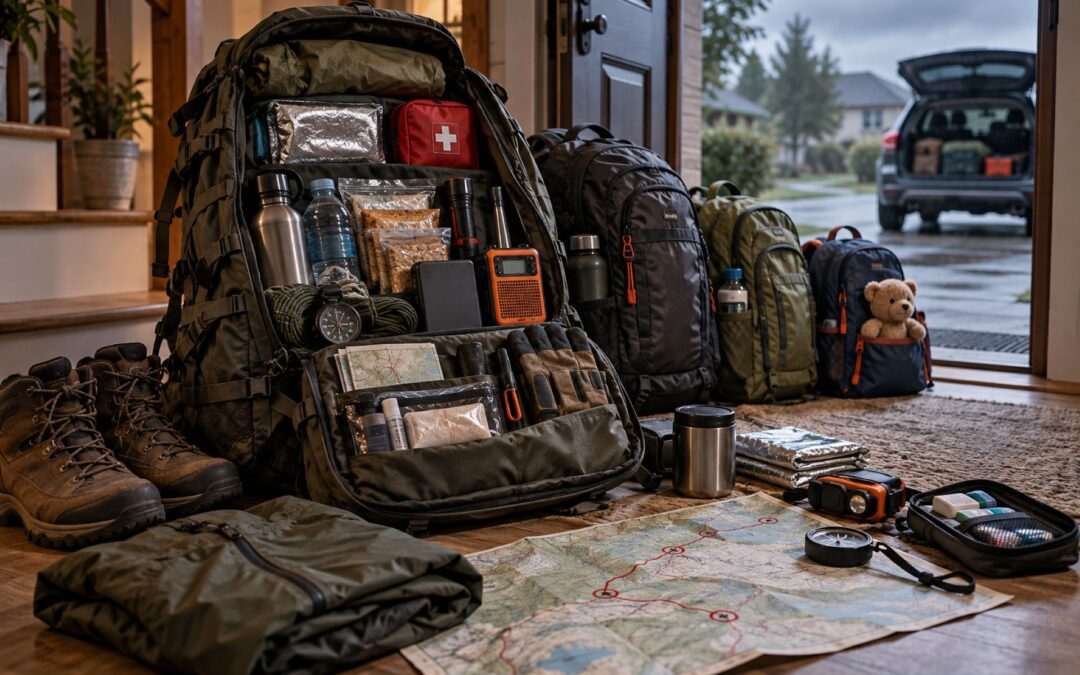
Zac Lasson’s Build a Brilliant Bug Out Bag and Beyond! is a short emergency-preparedness manual built around a simple problem: many people decide they should prepare for disasters, discover an intimidating world of equipment and advice, and then fail to prepare at all. Lasson’s answer is to narrow the task. Instead of beginning with a complete survival system, he asks the reader to assemble a portable kit capable of supporting each member of a family for roughly 72 hours after an evacuation.
Published in 2013, the book is best understood as one prepper explaining the system his own family uses rather than as an official emergency-management handbook. That distinction matters because much of its underlying logic remains useful—plan before a crisis, distribute loads sensibly, build redundancy, learn how equipment works, and rehearse the plan—but several specific recommendations are dated, overly categorical, or too dependent on Lasson’s circumstances to copy unchanged. Its continuing value lies less in providing a definitive shopping list than in showing how a collection of gear can become a functioning family evacuation plan.
What Kind of Book Is Build a Brilliant Bug Out Bag and Beyond!?
Lasson writes primarily for beginners who have encountered the idea of “prepping” but do not know where to start. He describes preparedness broadly enough to include natural disasters, pandemics, economic breakdown, social disorder, and other events that might interrupt normal services or make remaining at home unsafe. Rather than attempting to prepare the reader for every possible scenario at once, he chooses the bug-out bag as a manageable first project: something concrete that can be assembled, tested, improved, and kept ready.
That narrow focus shapes the entire book. This is not a detailed wilderness-survival manual, a medical reference, or a guide to building a long-term retreat. Lasson assumes that readers may eventually pursue those subjects elsewhere, but here he concentrates on the first few days after leaving home and on the equipment that can reasonably be carried. The book therefore moves from the decision to evacuate, through destinations and bags, into specific categories such as water, food, clothing, medicine, shelter, tools, and caches, before ending with training, fitness, and practice.
The author’s family serves as his working model throughout. His wife, teenage son, and younger daughter receive different loads and sometimes different equipment according to age, strength, preferences, and likely needs. The resulting advice is more concrete than an abstract checklist because readers can see why a stronger family member carries a shared tent or stove while a child carries less, but it also creates one of the book’s limitations: a system designed around one able-bodied household can easily sound more universal than it is.
Lasson’s prose reinforces the beginner orientation. He is conversational, practical, occasionally humorous, and impatient with the idea that preparedness has to begin with an enormous collection of specialist knowledge. The method is essentially incremental: build something useful now, understand it, test it, and continue improving from there.
Complete Summary: Building a 72-Hour Bug-Out System
The book develops its system in a logical sequence rather than merely presenting a master inventory. Lasson first asks why a family might leave home and where it would go, because those decisions determine what must be carried. He then builds outward from the individual backpack to clothing, navigation, food, water, medicine, shelter, tools, caches, physical capability, and finally rehearsal.
That progression matters because many of his recommendations solve problems created by earlier ones. Water is essential but heavy, so some of it must be pre-positioned. Shared equipment is useful but burdensome, so stronger family members carry more. A compass or GPS is valuable only if someone knows how to use it, which leads naturally from equipment ownership to training.
When to Leave and Where to Go
Lasson defines “bugging out” in straightforward terms: leaving home for somewhere safer when remaining has become dangerous. He imagines circumstances ranging from natural disasters that damage homes and infrastructure to severe social disruption in which normal public services and order deteriorate. The precise cause matters less to his system than the practical consequence—the household reaches a point at which staying is judged less safe than leaving.
The book therefore begins with destinations rather than gear. Lasson does not assume that every emergency leads to the same place, because a location suitable for one disaster may be unreachable or unsafe during another. His family has a principal long-term destination that can normally be reached by vehicle, but he also identifies nearer locations that could be reached on foot if a localized disaster forced them out of the house without requiring a prolonged relocation.
He takes redundancy further by selecting possible destinations in different directions. If flooding, fire, damaged roads, civil disorder, or another hazard blocks the preferred route, a family that has considered only one destination may discover that its plan disappears at the same moment it becomes necessary. Lasson also identifies intermediate wooded locations where the family could stop if a journey normally completed by car had to be made on foot over several days.
This is one of the book’s most durable planning ideas, although Lasson’s broad rule for deciding when to leave needs qualification. Evacuation is not automatically safer than remaining indoors; the correct response depends on the hazard. Current Ready.gov preparedness guidance distinguishes between situations requiring evacuation and those in which sheltering in place is preferable, while emphasizing attention to local emergency instructions.
Within Lasson’s own system, however, destinations are the foundation. A bug-out bag is not imagined as a magical backpack that allows indefinite wandering. It is equipment intended to help the family move from an unsafe starting point toward a safer known location.
The Bag, Belt, Clothing, Navigation, and Family Redundancy
Once destinations exist, Lasson defines the bug-out bag itself as a portable collection of supplies intended to support one person for approximately 72 hours. Every member of the family has a bag, but Lasson rejects the idea that everyone should carry an identical load. Age, strength, health, and physical capacity determine how much each person can reasonably carry, while shared equipment can be assigned to stronger members.
His argument for packing in advance is illustrated by a simple exercise: imagine having only a few minutes to collect everything needed before leaving. Under pressure, people forget ordinary necessities as well as specialist equipment, and a hurried household may waste precious time searching for items scattered across different rooms. A completed bag changes the problem from “What do we need?” to “Pick it up and leave.”
The backpack must also be genuinely portable. Lasson favors sturdy waterproof hiking packs, particularly framed designs, but the broader point is more important than his preference for a particular construction. A bag filled with impressive equipment is a failure if its owner cannot comfortably carry it over the distance the evacuation plan may require, so he urges readers to load their bags and physically test them rather than estimate carrying ability from the sofa.
Lasson’s system extends beyond the backpack. Each family member has a utility belt containing items that may be needed immediately or retained if the main pack is lost: water, a whistle, a glow stick, and a knife are among his choices. Waterproof outer clothing carries emergency identification and medical information along with basic navigation materials, helping ensure that essential information remains with the person rather than buried in luggage.
Navigation receives more attention than simply adding a compass to a checklist. Lasson uses maps, compasses, and a handheld GPS loaded with relevant destinations, but repeatedly stresses that such devices are worthless if their owners have never learned to use them. A GPS can fail, batteries can run down, and electronic navigation does not eliminate the need to understand the route.
Ordinary mobile phones remain part of the system as well. Lasson notes that his family members use different providers, which gives them some communication redundancy if one network works while another does not. The technology itself has aged since 2013, but the underlying principle is sound: do not assume that one communication method or one infrastructure provider will always remain available.
Footwear and clothing worn at the moment of departure receive similar attention. Lasson wants broken-in hiking boots rather than footwear being used for the first time during a crisis, and he keeps practical walking clothes ready. High-energy snacks are accessible without opening the main food supply, while gloves provide protection for manual work.
Some of the book’s most revealing examples involve items that are not strictly survival necessities. Lasson allows his daughter to include a stuffed toy because its comfort may justify its modest weight, while rejecting his son’s attempt to pack a laptop because its burden is harder to justify. His wife’s dry shampoo becomes another illustration of his willingness to accommodate personal preferences when they contribute to morale without seriously compromising mobility.
The lesson is not that every reader needs the same comfort objects. Lasson is showing that a realistic kit belongs to a particular person rather than to an imaginary survivalist. Psychological comfort, familiarity, hygiene, and morale can matter during a frightening evacuation, provided the person packing them understands that every extra item has a weight and space cost.
Even a supposedly waterproof backpack is given another layer of protection. Lasson lines the interior with a heavy plastic refuse sack so important contents have additional protection against rain or immersion. The redundancy is characteristic of the whole system: important functions should not depend on one barrier, one route, one tool, or one person whenever a practical backup exists.
Before departure, Lasson also recommends that family members drink stored water so they begin travel well hydrated rather than immediately consuming what they must carry. It is a small example of the book’s larger tendency to think of supplies dynamically. What matters is not simply whether water is present but how it will be used over the course of movement.
One item in Lasson’s personal preparations requires especially careful framing. He discusses hoping to retrieve a handgun from secure storage if circumstances allow. He does not establish a firearm as a universal bug-out requirement, and it should not be read as one; it is part of his household’s particular arrangements, just as other readers will have different legal, practical, and safety considerations.
Water, Food, Medical Supplies, Hygiene, and Shelter
Water is both the most essential supply in the book and the clearest demonstration of the carrying problem. Lasson works with a minimum of roughly two litres per person per day and suggests that a person walking may need closer to three, quickly creating a load too heavy for some family members to carry for three days. His solution is not to pretend the weight disappears but to divide the problem among carried water, purification methods, and larger reserves stored at planned destinations.
Each family member therefore carries some water on the belt and more inside the backpack, while additional supplies are cached ahead of time. Water-purification tablets provide another layer of contingency if safe stored water is unavailable. In conceptual terms, this is one of the strongest sections in the book because it makes visible the conflict between self-sufficiency and mobility: every additional litre improves reserves while simultaneously making travel harder.
Food is approached through the same weight-conscious logic. Lasson prefers calorie-dense foods that survive storage and require little space, including survival bars, dehydrated meals, freeze-dried breakfasts, nuts, raisins, jerky, dried fruit, biscuits, and flapjack-style foods. The exact menu is less important than the design criteria: a three-day supply must provide enough energy without turning each backpack into an immovable pantry.
Some meals require hot water, which could appear inefficient when water is already scarce. Lasson accepts the trade-off because that water is consumed as part of the meal rather than discarded, and he values the psychological benefit of hot food and drinks as well as their caloric role. Tea, coffee, or hot chocolate can provide warmth and familiarity, especially during an uncomfortable night outdoors.
Cooking equipment is not duplicated in every bag. Compact stoves and fuel are carried by selected family members, along with utensils and insulated mugs. This reinforces the distinction between individual essentials, which Lasson wants distributed widely, and group equipment, which can be divided according to physical capability.
Canned food is deliberately excluded from the carried packs because the packaging adds too much weight. Lasson later uses canned goods in caches, where portability is no longer the governing constraint. The same item can therefore be unsuitable in one part of the system and useful in another, which is a recurring feature of the book’s thinking.
Clothing follows a layering strategy rather than attempting to pack a separate outfit for every possible condition. Each person carries spare underwear and trousers, additional socks, a shirt, thinner and thicker insulating layers, wool socks, and a warm hat. In warmer conditions Lasson adds sun protection such as a sun hat, sunglasses, and sunscreen rather than assuming that warm-weather travel eliminates the need for insulation after sunset.
He also uses compression or vacuum packing to reduce the volume of spare clothing. Families with growing children must periodically revisit those packages because a carefully prepared emergency kit is useless if the stored clothes no longer fit. That seemingly mundane observation introduces a major principle that runs through the rest of the book: preparedness deteriorates when it is not maintained.
Medical preparation receives more serious treatment. Lasson gives each family member access to a first-aid kit, although adults may carry more comprehensive versions, and he supplements those kits with ordinary pain relief, anti-diarrheal medication, required prescription medicines, and several days of multivitamins. Particularly important medications receive a larger reserve, with Lasson aiming for roughly seven days when possible.
The value he places on medical training is more important than the precise contents of any commercial kit. A pouch full of dressings and unfamiliar equipment cannot automatically turn an untrained person into a competent first aider, so his family takes first-aid courses and refreshes those skills. This is one of several places where the book moves beyond consumerism: purchasing supplies is only one stage of preparation.
One medical passage has aged much less well. Lasson suggests being “creative” about obtaining stronger prescription pain medication while simultaneously warning readers not to break the law. That is neither necessary to his broader method nor sound general medical guidance, and readers should not treat it as a contemporary preparedness recommendation.
The personal-hygiene section deliberately focuses on ordinary needs that dramatic survival checklists can overlook. Lasson includes toilet paper protected from moisture, soap, toothbrushes and toothpaste, towels, moist wipes, hand sanitizer, menstrual products, and plastic bin liners. The larger point is that sanitation continues to matter during an emergency, especially when ordinary bathrooms, running water, and waste systems may not be available.
Shelter is distributed across the family rather than duplicated for each person. Lasson’s household carries two lightweight two-person tents, with the heavier shared items assigned to stronger members, and everyone has an individual sleeping bag packed compactly. Foil emergency blankets provide another lightweight layer of contingency.
The combined effect of these chapters is more sophisticated than the checklist format initially suggests. Food depends on water and sometimes fuel; water depends on carrying capacity and resupply; medicine depends on personal health requirements; clothing depends on season and body size; tents depend on load distribution. Lasson’s bag is therefore not really one bag but a household logistics system in miniature.
Tools, Cash, Caches, Training, and Practice
The remaining equipment expands the system’s redundancy. Lasson includes both conventional battery-powered lighting and alternatives that can function without disposable batteries, along with spare batteries where needed. Fire-starting equipment, multi-tools, signal flares, an emergency radio, paracord, duct tape, and rope are intended to cover common needs such as illumination, repairs, signaling, information, and improvisation.
The radio is especially important because emergency preparedness depends partly on obtaining information after the original plan has begun. Conditions can change, routes may close, and instructions from authorities may make an earlier destination inappropriate. A radio with more than one way of being powered therefore fits Lasson’s general preference for avoiding single points of failure.
Money receives the same treatment. Cash is divided among members of the household, while the adults carry larger amounts, reducing the chance that losing one wallet eliminates the family’s entire reserve. Lasson also keeps access to credit on the assumption that some emergencies will disrupt local routines without completely destroying the financial system.
He mentions additional possibilities, including sewing materials, spare glasses, and bleach that might be useful for water treatment. These are not all given equal status, and several require more qualification than the book provides. Bleach in particular cannot responsibly be treated as a generic purification ingredient without knowing the product concentration, contamination type, and correct treatment method.
The cache system is Lasson’s most distinctive answer to the limits of backpacking. Instead of forcing every desirable item into a 72-hour pack, he pre-positions sealed supplies at several planned safe locations. These caches contain items such as canned food, drink supplies, blankets, batteries, foam sleeping mats, fire-making materials, toiletries, books, and playing cards.
The inclusion of books and games is revealing. Once the problem shifts from carrying everything on foot to reaching a stored reserve, Lasson is willing to prepare not only for survival but also for waiting, discomfort, and morale. The cache therefore expands what the household can possess without expanding what it must carry.
Water is also stored near planned destinations and periodically rotated. This reinforces the idea that a cache is not a buried time capsule that can be forgotten indefinitely. Food, water, batteries, clothing, and other perishable or degradable supplies create maintenance obligations.
Caches also expose how personal the system is. A household needs lawful, reliable access to suitable locations; containers must survive local environmental conditions; supplies must remain retrievable after the disaster that supposedly requires them; and the family must be able to find the sites. For Lasson, caches make the rest of his plan workable, but they cannot simply be assumed to make sense for every reader.
The final practical chapter turns from possessions to capability. Readers should know what every tool is for before they depend on it, maintain enough physical fitness to travel with their actual packs, learn first aid and useful survival skills, and obtain appropriate training for any specialized equipment they choose to carry. If someone chooses to possess a firearm, Lasson likewise stresses training rather than treating ownership itself as competence.
The book ends where effective preparedness probably should: with rehearsal. Lasson wants families to conduct practice runs so that routes, bags, physical capacity, equipment, and individual responsibilities can be tested before anything important depends on them. A rehearsal exposes mistakes that a beautifully organized checklist cannot—packs that are too heavy, shoes that hurt, equipment nobody can operate, missing items, routes that take longer than expected, and family members who do not understand the plan.
His closing message to beginners is therefore not to continue reading indefinitely. Build the system, finish the bags, learn the equipment, and practice. Although the book is marketed around the object called a bug-out bag, its conclusion quietly establishes that the object is only useful when embedded in a functioning plan.
The Preparedness Framework Behind Lasson’s Checklist
Lasson never presents a named theoretical framework, but the complete book reveals a coherent set of principles. The first is portability. Every desirable item competes against the family’s ability to move, so usefulness cannot be evaluated independently of weight, bulk, and the strength of the person carrying it.
That principle explains why Lasson repeatedly distinguishes between personal essentials and shared equipment. Individual water, identification, navigation aids, whistles, medication, and basic supplies reduce the consequences of separation, whereas tents, stoves, and other heavier group equipment can be divided among stronger family members. Distribution is therefore not just a packing convenience; it is a way of balancing independence with cooperation.
The second principle is redundancy. Lasson imagines failures occurring at several levels at once: a road may be blocked, a GPS may stop working, batteries may run out, one communications provider may fail, a bag may become separated from its owner, or the family may be forced to walk instead of drive. His response is rarely to find one perfect solution. He prefers backup destinations, multiple navigation methods, more than one light source, supplies kept on the body as well as in the bag, and equipment distributed across people.
Redundancy has costs, however, and the book implicitly acknowledges them. Every backup adds weight or complexity, which creates the need for a third principle: pre-positioning. Caches move some supplies from the traveller to the destination, allowing the household to possess more than it can transport at once.
The water chapters demonstrate how these principles interact. A complete three-day reserve is heavy, especially for a child, so Lasson does not simply increase backpack capacity until the problem disappears. He carries what is practical, gives family members purification options, and stores additional water at locations they expect to reach.
Personalization is equally important. Lasson’s daughter does not carry the same weight as her teenage brother, different people receive different group responsibilities, comfort items are judged individually, medication depends on personal health, and clothing must fit the actual person using it. The system works because it is organized around a household rather than because everyone buys the same standardized kit.
That personal quality also reveals why readers should resist copying the inventory mechanically. The purpose of Lasson’s examples is best understood as demonstrating questions a family should answer: Who can carry shared shelter? Who requires medication? What will children realistically manage? What conditions exist along likely routes? Which comfort item genuinely matters? A useful kit emerges from those answers rather than from mimicking every object in someone else’s backpack.
Maintenance forms another layer of the framework. Children grow out of clothes, stored water needs attention, food ages, batteries deteriorate, medications expire, routes change, and family circumstances evolve. A kit assembled once and ignored for years can create a comforting illusion of preparedness while quietly becoming unusable.
Finally, the book places skill and rehearsal above equipment without always saying so explicitly. Navigation tools require navigation knowledge; first-aid kits require first-aid knowledge; heavy packs require fitness; routes require familiarity; and family members need to know what is expected of them. The more specialized the equipment becomes, the more important prior practice becomes.
This is the book’s strongest conceptual contribution. Lasson begins with the simplest possible beginner project—a bag—but ultimately shows that emergency readiness is a relationship among equipment, people, destinations, skills, maintenance, and practice. The gear matters because those other pieces give it a purpose.
Evidence, Assumptions, and Blind Spots
The same personal specificity that makes Lasson’s advice readable also limits its authority. Most recommendations are grounded in his own reasoning and household arrangements rather than in cited emergency-management research, medical guidance, or comparative evidence. That does not make them useless, but it means readers should distinguish between “this is how one prepared family organizes the problem” and “this is an established requirement.”
The household itself carries important assumptions. Lasson’s system is built around family members who can walk meaningful distances, carry backpacks, use conventional hiking equipment, learn navigation, and potentially sleep outdoors. Families involving infants, elderly relatives, mobility impairments, chronic medical needs, sensory disabilities, or dependency on powered medical equipment may require a substantially different plan.
Pets receive similarly little attention, despite the practical difficulty of evacuating animals and carrying their food, water, restraints, medication, and documents. Parents of very young children would also face needs that do not appear in Lasson’s model, including diapers, formula or feeding supplies, child carriers, and considerably different load distribution. The book’s brevity helps beginners start, but brevity inevitably means some households are barely represented.
Its geography is another assumption. Lasson has access to multiple outdoor locations and believes hidden caches can be established near them. Readers living in dense cities, rented accommodation, arid regions, flood zones, areas with strict land-access rules, or places where outdoor overnight travel would be impractical cannot simply transplant that system.
Financial assumptions are present as well. Quality hiking packs, boots, tents, sleeping bags, GPS devices, radios, stoves, multiple first-aid kits, stored food, caches, and duplicated equipment can become expensive. Lasson’s incremental approach partly reduces that barrier, but the book does not devote much attention to building a system under severe budget constraints or to distinguishing the truly indispensable from the merely desirable.
The largest conceptual blind spot is probably the breadth of Lasson’s evacuation rule. His attention is naturally concentrated on leaving because he is writing about bug-out bags, but emergency planning also requires knowing when not to leave. Fires, chemical incidents, storms, public violence, contaminated outdoor air, flooding, and other hazards can require very different responses, and official instructions may favor sheltering in place rather than immediate movement.
Communication planning is also less developed than equipment planning. Lasson thinks intelligently about phones and network redundancy, but contemporary emergency planning generally places more emphasis on predetermined contacts, reunification points, out-of-area communication, and what family members should do if they are separated when the emergency begins. A family emergency communication plan addresses a different problem from carrying a phone: who contacts whom, where people meet, and what happens when household members cannot immediately return home.
That omission highlights an important distinction between equipment redundancy and organizational redundancy. Three phones may improve the chance of establishing a connection, but they do not answer where a child should go if school closes while the parents are elsewhere, which relative should serve as the external contact, or how long people should wait at one meeting location before shifting to another. A mature emergency plan needs both communications hardware and agreed behavior.
The book’s 72-hour horizon is similarly useful but incomplete. A three-day portable supply is a manageable target and remains a mainstream evacuation concept, but some disruptions last much longer, while others require only hours away from home. Lasson’s caches are partly intended to extend the family beyond those first days, yet the transition from short-term evacuation to prolonged displacement is not developed into a complete long-duration system.
None of these blind spots destroys the book’s project because Lasson never claims to provide a comprehensive emergency-management curriculum. They do, however, define the boundaries within which his advice is most useful. The book works best as a starting architecture that must be adapted to the household, hazard, location, laws, medical circumstances, and current official guidance of the reader.
What Holds Up—and What Needs Updating
A preparedness book written in 2013 should not be evaluated solely by whether every product, number, or technological assumption remains current. The more useful question is which underlying recommendations still align with modern emergency guidance and which details now require correction or stronger qualification.
On that standard, Lasson’s record is mixed but respectable. Much of the architecture remains recognizable in contemporary preparedness advice, while several specific statements demonstrate the danger of treating a personal survival manual as an authoritative technical reference.
Advice That Still Aligns With Current Preparedness Guidance
The central idea of keeping an easy-to-carry evacuation supply remains mainstream. Current American Red Cross survival-kit guidance still recommends a three-day supply for evacuation and includes many of the same categories Lasson emphasizes: water, non-perishable food, flashlights, radios, spare batteries, first aid, medication, multi-purpose tools, sanitation items, important documents, cash, emergency blankets, maps, sturdy clothing, and household-specific supplies.
His emphasis on medication is particularly sound in principle. The Red Cross recommends maintaining a seven-day supply of medications and necessary medical items where possible, closely matching Lasson’s desire to carry more than three days of truly essential regular medicine. His insistence on first-aid training rather than merely owning a kit also remains sensible because equipment cannot substitute for competence.
The book’s destination planning holds up well too. Thinking about several possible destinations, alternative routes, and what happens if travel by car becomes impossible is more robust than assuming a household will always follow one ideal path. Lasson’s intermediate stopping points are especially useful as an illustration of breaking an unrealistic journey into achievable stages.
His distribution logic also remains practical. A household with multiple people can divide shared equipment according to physical ability while ensuring that crucial personal items—identification, medication, weather protection, basic water, signaling equipment—stay with the people who require them. The principle matters more than reproducing Lasson’s exact assignment of tents, stoves, or tools.
Comfort items are another unexpectedly modern aspect of his approach. Preparedness is often imagined as purely physical survival, but disasters involve frightened children, exhausted adults, waiting, uncertainty, and disrupted routines. A lightweight toy, familiar game, or other modest comfort object can be reasonable when its psychological value justifies its burden.
Lasson’s repeated insistence on practice may be the most valuable recommendation in the entire book. Plans that exist only on paper conceal assumptions about walking speed, carrying capacity, footwear, navigation, communication, and equipment. A rehearsal makes those assumptions observable and correctable.
Finally, his preference for redundancy survives technological change. The particular devices used in 2013 may age, but the principle of avoiding dependence on one route, one power source, one communications channel, or one piece of equipment remains useful. Good preparedness is not the elimination of failure; it is reducing the number of failures that can collapse the whole plan.
Advice That Is Outdated, Overconfident, or Too Personal to Copy
Water is the clearest place where readers should not copy Lasson’s numbers without checking current guidance. His discussion centers on roughly two litres per person per day as a minimum and around three litres for someone walking, but present emergency-kit guidance generally plans for considerably more total water because the supply must cover more than drinking alone. The Red Cross recommends one gallon per person per day for evacuation supplies, while the CDC’s current emergency-water storage guidance likewise recommends at least one gallon per person per day for three days.
That does not mean a hiker must literally carry the entire official household allowance on their back. It means Lasson’s carrying calculation and a household’s total emergency-water requirement are different questions. His instinct to combine carried water, purification, and pre-positioned reserves is useful, but readers should begin with current water requirements and then solve the resulting logistics rather than treating his litre figure as a universal safety standard.
Water treatment requires similar caution. Lasson mentions purification tablets and briefly includes bleach among possible additional supplies, but chemical disinfection cannot responsibly be reduced to “have some bleach.” Concentration, water condition, contamination type, dosage, and contact time matter, and some chemical contamination cannot be made safe through ordinary disinfection at all. The CDC’s guidance on making water safe during an emergency provides the kind of precise instructions that a modern reader should follow rather than improvising from a casual reference in a prepper book.
The cache chapter contains the book’s most obvious factual overstatement when Lasson says canned food effectively lasts forever. It does not. USDA shelf-stable food guidance gives much shorter quality windows—generally around 12 to 18 months for high-acid canned products and roughly two to five years for many low-acid canned foods—while emphasizing proper storage and rejection of damaged containers.
The broader cache concept has limitations even when the food is properly maintained. Buried or remotely stored equipment must remain dry, legal, secure, accessible, and reachable after the same disaster that caused the evacuation. A wildfire, flood, road closure, property sale, construction project, theft, wildlife damage, or simple loss of access can defeat the plan.
Lasson’s broad evacuation language also deserves restraint. Fear for family safety is an important warning signal, but not every dangerous situation is improved by going outside or travelling. The correct response may be immediate evacuation, sheltering in place, moving to a designated public shelter, or following another hazard-specific instruction.
Several equipment recommendations are similarly better understood as personal preferences than requirements. A framed hiking backpack may work very well for Lasson, but there is no universal reason every emergency bag must use that specific design. Likewise, knives, flares, specialized outdoor tools, and other equipment vary greatly in usefulness according to location, skill, legality, and the actual emergency plan.
His firearm references belong in the same category. The book describes Lasson’s own arrangements rather than establishing a general preparedness necessity. Readers should not infer that a firearm is required to have a competent bug-out plan, and anyone who lawfully owns specialized equipment has responsibilities around storage, training, and local rules that lie beyond this book’s scope.
The suggestion about acquiring stronger prescription pain medication is more problematic because it crosses from preference into medical risk. Essential prescribed medicines should be discussed with appropriate medical professionals and managed legally; vague creativity around obtaining additional controlled medication is not a recommendation that should be carried forward from the 2013 text.
Technology has also changed the shape of a practical emergency kit. Lasson sensibly includes mobile phones, GPS, radios, and spare power for equipment, but a contemporary system would normally think more explicitly about charging phones and other devices, portable battery capacity, stored digital and paper copies of important information, and how communications work during prolonged power failure. The exact technological solution will continue changing, which is another reason principles are more durable than product lists.
Modern preparedness guidance is also more explicit about household differences than Lasson’s model. Pets, infants, disability-related equipment, assistive technology, chronic medical conditions, dietary restrictions, and other needs can materially change both the contents and the feasibility of an evacuation plan. The correct bag is therefore not the bag Lasson describes; it is the bag that supports the people who will actually carry and depend on it.
This does not make the book obsolete. It changes how it should be read. Lasson remains useful when he prompts the reader to solve preparedness problems, but he is much less reliable when a personal solution is interpreted as a universal technical standard.
Style, Organization, and Usefulness as a Beginner Manual
Lasson’s writing style is one reason the book succeeds at its limited purpose. He sounds like an enthusiast showing a newcomer what his family actually does rather than an institution issuing a formal preparedness manual. The prose moves quickly, explanations remain concrete, and personal examples prevent the checklists from becoming completely abstract.
The short topical chapters also suit the subject. A reader can understand one category—water, clothing, medical supplies, caches—before moving to another, while the checklists at the ends of equipment sections make the book easy to revisit during assembly. The structure mirrors the way many beginners actually build a kit: one category at a time rather than through a single large theoretical system.
Humor and domestic detail make the book less intimidating. The stuffed toy, dry shampoo, rejected laptop, disagreements about what deserves pack space, and unequal distribution of family equipment remind readers that emergency planning takes place in ordinary households populated by people with preferences and limitations. That human element is more persuasive than pretending everyone will suddenly behave like a professional expedition team during a disaster.
The cost of that informality is precision. Lasson offers few sources, sometimes moves from personal judgment to broad recommendation without enough distinction, and occasionally uses categorical wording where careful qualification would be safer. The book also contains the kinds of loose editing and minor errors that reinforce its identity as a short practical guide rather than a polished technical reference.
Its compression is therefore both its greatest stylistic strength and its largest weakness. Beginners can finish the book quickly and emerge with a clear project, but technical subjects such as water treatment, medicine, evacuation decisions, storage life, and hazard-specific behavior need more detail than its format provides. When Lasson stays at the level of planning principles, brevity makes him effective; when he makes safety-sensitive factual claims, brevity can become underqualification.
The book is also more useful when read sequentially than when reduced to a downloadable checklist. A bare inventory would preserve the nouns while losing the reasoning that gives them meaning. Knowing that Lasson carries several navigation tools matters less than understanding why he refuses to let one device become a single point of failure.
That distinction explains why Build a Brilliant Bug Out Bag and Beyond! still has something to offer despite the abundance of newer preparedness resources. Its contribution is not the originality of any one piece of gear. It is the accessible demonstration of how to think through a small family system from departure to destination.
Critical Review: Is the Book Still Worth Reading?
Judged on its stated purpose, Build a Brilliant Bug Out Bag and Beyond! works surprisingly well. Lasson sets out to help a beginner stop being overwhelmed and complete a concrete first preparedness project, and the book is short, direct, practical, and sufficiently detailed to make that project feel achievable. Readers are not left with slogans about self-reliance; they can see how one family has organized destinations, backpacks, shared equipment, water, food, clothing, medicine, shelter, money, caches, training, and rehearsal.
Its strongest contribution is therefore behavioral rather than technical. The book converts preparedness from an undefined ambition into a series of decisions. Where will you go? What can each person carry? What must remain with them if separated from the main pack? What supplies are too heavy to transport? Which items require training? When were the stored water, clothes, medicine, and food last checked? Has anyone actually walked the route carrying the pack?
Those questions retain value because they expose the difference between owning emergency equipment and having a functioning emergency system. A cupboard full of supplies may help during a shelter-in-place situation but does not automatically create an evacuation plan, just as a fully loaded backpack does not automatically create navigation ability, physical fitness, or family coordination. Lasson understands that connection better than the book’s gear-focused title might suggest.
The family-centered approach is another genuine strength. He does not imagine everyone carrying identical packs or possessing identical abilities. Shared loads are distributed, children’s limitations are recognized, comfort has a legitimate place, and personal medication or clothing must reflect the actual person using the kit.
The most important limitation is that Lasson often fails to mark clearly where personal practice ends and general guidance begins. His system contains many sensible ideas, but sensible ideas acquire an undeserved aura of authority when numerical water requirements, food-storage claims, medication suggestions, or evacuation rules are stated without sourcing. That problem has become more visible as the book has aged because readers can now compare those claims with current institutional guidance.
Its evidence base is correspondingly thin. Lasson is persuasive when explaining the reasoning behind his family’s decisions, but he does not build an evidence-driven case for why readers in different climates, countries, household structures, medical situations, or hazard environments should make identical choices. The result is practical experience presented with more universality than it can support.
Some readers may also find the equipment emphasis expensive or unnecessarily elaborate. A GPS plus maps and compass, several types of lighting, hiking gear, stoves, tents, specialized tools, caches, multiple first-aid kits, and duplicated equipment can create the impression that preparedness requires substantial consumption. Lasson partially counters this by prioritizing learning and practice, but the book could have distinguished more aggressively between essential capabilities and optional upgrades.
The caches are a good example of both the book’s imagination and its narrowness. As a solution to carrying limits they make excellent logistical sense: heavy or bulky supplies waiting at a planned destination can dramatically reduce what must be moved on foot. As general advice they are much weaker because many people do not have secure access to suitable locations, and a disaster may make those locations inaccessible precisely when they are needed.
The 72-hour model has similar strengths and weaknesses. It gives beginners a finite target and remains consistent with the idea of maintaining a portable evacuation supply for several days. Yet anyone treating 72 hours as the endpoint rather than the first layer of preparedness risks being badly underprepared for prolonged power outages, displacement, disrupted water systems, or disasters in which returning home quickly is impossible.
Lasson is strongest whenever he emphasizes adaptability. Multiple destinations, shared loads, backups, personalization, training, maintenance, and rehearsal all acknowledge that emergencies resist perfect prediction. He is weakest whenever his own solution to an uncertain problem is presented as if it were the obvious solution for everyone.
The book has also aged better conceptually than technologically. Phones, GPS devices, lighting, charging, emergency communications, and other equipment will continue changing, so any fixed gear list inevitably becomes dated. Principles such as keeping backup navigation, ensuring power redundancy, storing essential information in more than one form, and practicing without assuming perfect connectivity are much more durable.
As writing, the book is accessible rather than authoritative. Its informality lowers the barrier to entry and gives the reader a sense that assembling a useful emergency kit is possible without first becoming an expert. The trade-off is uneven precision, loose editing, occasional overstatement, and the absence of the sourcing one would expect from advice touching medicine, water safety, or emergency decision-making.
That means the ideal reader in 2026 is not someone looking for a single manual to follow without verification. A beginner who wants to understand the logic of portable family preparedness can still learn a great deal from Lasson, especially if every safety-sensitive detail is checked against current guidance from relevant local authorities, emergency-management agencies, medical professionals, and public-health sources. More experienced preppers are less likely to encounter genuinely new ideas, although they may still find the book useful as a compact audit of their own arrangements.
Readers who need comprehensive disaster planning should look beyond it. The book does not fully address shelter-in-place strategy, communications and reunification planning, long-term displacement, disability and access needs, infants, pets, detailed medical contingencies, hazard-specific decisions, or the many legal and geographical differences that affect real evacuation plans. Those omissions are understandable in a deliberately short guide, but they prevent it from functioning as the definitive emergency-preparedness reference its more dramatic subtitle might imply.
Its flaws therefore damage its authority more than its central project. Lasson promised beginners an achievable way into preparedness, and the book still delivers that. The problem comes only when an accessible first step is mistaken for a complete final answer.
The fairest way to read Build a Brilliant Bug Out Bag and Beyond! today is as a worked example of preparedness thinking. Lasson demonstrates how one family converts vague concern into destinations, portable supplies, distributed responsibilities, backups, pre-positioned resources, training, and rehearsal. Copying his exact bags would miss the point, because the most useful lesson is the process by which those bags were designed.
That is also why the book remains worth reading despite its age and inaccuracies. Its best advice is not that every reader needs Lasson’s particular backpack, knife, cache, stove, or quantity of supplies; it is that emergency preparation has to be designed around real people, real routes, real physical limits, and equipment they actually know how to use. The reader should keep that framework, update the details, and treat current authoritative guidance—not a 2013 personal checklist—as the final word on safety.
Last Updated on October 5, 2026 by Aseem Gupta