
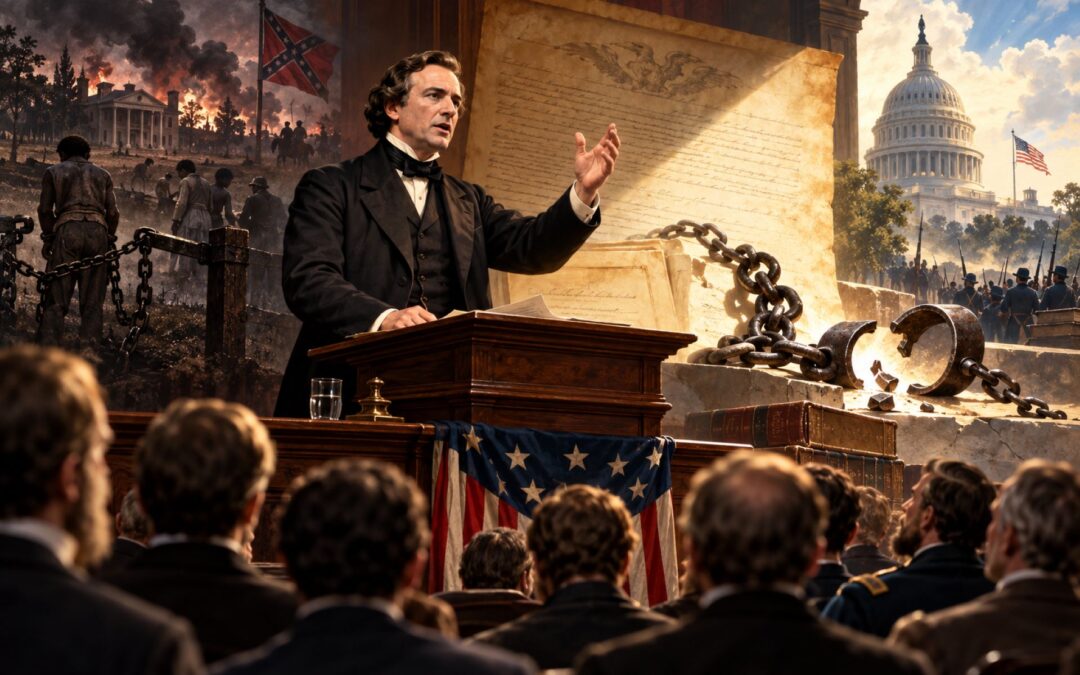
On February 3, 1863, Cassius Marcellus Clay addressed the Law Department of the University of Albany at one of the most consequential moments of the American Civil War. The final Emancipation Proclamation had taken effect only a month earlier, the constitutional status of secession remained fiercely disputed, the federal government’s wartime suspension of habeas corpus was still controversial, and nobody yet knew what kind of Union would emerge if the rebellion were defeated. Clay’s speech, preserved in an 1863 printed pamphlet held by the Library of Congress, attempts to answer all of those questions through one connected theory of republican government.
Clay was a Kentucky antislavery politician rather than an outside observer of the sectional conflict. He had also served as an American diplomat in Russia and would soon return there, a career documented by the U.S. Department of State’s Office of the Historian. Those experiences help explain the unusual range of the speech: constitutional law, natural rights, military necessity, abolition, comparative emancipation, international relations, political economy, and religious language all appear within a relatively short pamphlet.
The speech’s central idea is that the Civil War cannot be understood merely as a struggle to restore the political arrangement that existed before 1861. Clay argues that legitimate republican law must rest upon justice; that secession is unconstitutional; that the national government possesses the right to preserve itself; that emancipation is lawful as a measure of war and just as an expression of natural liberty; and that slavery itself has made the old sectional Union politically unstable. His argument is often powerful, sometimes prescient, and occasionally far more confident than the law or evidence allows. It is also internally contradictory: Clay can declare human freedom a natural right while simultaneously imagining Black citizenship as conditional and Black labor as potentially subject to coercion.
What Cassius M. Clay Argues: Complete Speech Summary
Clay structures the speech as a sequence of challenges and answers. He begins with first principles, moves into responsibility for the Civil War, rejects constitutional secession, distinguishes lawful government from revolutionary resistance, defends extraordinary presidential power, and then turns to emancipation. From there the argument widens into natural rights, comparative evidence, the future of freed people, foreign relations, slavery in loyal states, and finally the kind of Union that should replace the antebellum settlement.
That progression matters because Clay does not initially present emancipation as an isolated moral demand. He builds toward it. By the time he reaches slavery directly, he has already argued that the Union is constitutionally sovereign, that rebellion threatens legitimate government, and that wartime necessity can justify exceptional national action.
Law, Republican Government, and Who Caused the War
Clay opens with a philosophical claim about political survival. Nations do not achieve permanent greatness through military brilliance, imperial ambition, or chance, he argues, but through knowledge and virtue. He invokes Montesquieu’s distinction between the principles animating monarchies and republics, then goes further: any lasting government must ultimately rest on what is true and right.
From that starting point, Clay links justice, liberty, and law. The Constitution’s purpose of establishing justice is not separate from its protection of liberty, because liberty without justice becomes meaningless. Law, properly understood, is therefore not whatever power happens to command. It is an expression of legitimate relationships grounded in justice. This distinction later becomes essential to his treatment of slavery, because he will argue that an institution can possess legal protections while still contradicting the higher principles that make republican law legitimate.
Clay then identifies himself with the Union, Constitution, laws, and Republican Party. He regrets that party division continues during a national emergency, but he insists that Republicans cannot simply abandon political organization while their opponents blame them for the conflict. His position is uncompromising: he will judge political allegiance according to whether it supports or opposes the nation.
The first major charge he confronts is that Republicans caused the Civil War by violating the constitutional rights of slave states. Critics pointed particularly to Northern resistance to fugitive-slave enforcement and to personal-liberty laws that obstructed the recovery of escaped enslaved people. Clay temporarily grants the accusation for the sake of argument. Even if Northern citizens or governments violated constitutional duties, he says, injury under a constitutional system does not establish a right to destroy that system. The remedy for political wrongdoing is legal reform and majority rule, not armed withdrawal by a dissatisfied minority.
He then turns the accusation around. Northern violations, in Clay’s presentation, were exceptional; slave-state violations of constitutional liberty were systematic. He points to restrictions on speech, assembly, legal access, and antislavery expression, arguing that slaveholding societies protected slavery even when doing so required suppressing rights that supposedly belonged to American citizens. His example of South Carolina’s hostility toward Massachusetts representatives seeking legal redress serves a larger purpose: the South cannot credibly accuse Republicans of constitutional faithlessness, he argues, while slaveholding states themselves repeatedly subordinated constitutional principles to the defense of slavery.
Clay also attacks the idea that secession was forced upon an excluded or powerless region. Slaveholding interests, he observes, had exercised enormous influence over the presidency, Congress, the Senate, the courts, and national policy. The rebellion therefore cannot be represented as a desperate last resort by a people unable to obtain political influence through constitutional institutions.
That interpretation of the war was partisan, but slavery’s centrality to secession is not simply Clay’s retrospective accusation. The surviving declarations explaining the causes of secession repeatedly identify the preservation of slavery, slave property, and the political order surrounding them as fundamental grievances. Clay’s rhetoric is polemical, but his central claim that the slave system lay at the heart of disunion has substantial support in the seceding states’ own explanations.
Why Secession Has No Constitutional Right
Having argued that Republican wrongdoing did not justify rebellion, Clay asks the more fundamental question: does a state possess a constitutional right to secede at all? His answer is an emphatic no.
The argument begins with the difference between a confederation and a government. The United States had already experienced a confederation under the Articles of Confederation, Clay argues, and that arrangement failed because the central authority lacked sufficient power to act directly and effectively. The Constitution was created precisely to form a stronger political union. Its opening language speaks in the name of “We the People,” not as a temporary contract among independent sovereign governments that remain free to leave whenever they choose.
Clay reinforces that point by cataloguing powers entrusted to the national government. Congress regulates interstate and foreign commerce, establishes uniform rules of naturalization, taxes, borrows, coins money, maintains armed forces, declares war, governs bankruptcy, creates post offices, and exercises other functions that sovereign states ordinarily exercise. At the same time, the Constitution expressly prohibits states from making treaties, coining money, waging independent wars except under narrow conditions, and exercising other sovereign powers without federal permission.
The Supremacy Clause becomes the strongest textual support for his position. If the Constitution, federal laws made under it, and treaties are the supreme law of the land even when state constitutions conflict with them, Clay reasons, then states cannot simultaneously possess an unrestricted sovereign authority to destroy the federal relationship itself. The constitutional structure gives them important powers but does not leave them as fully independent nations.
Clay then appeals to prominent constitutional interpreters. Joseph Story, John Marshall, and Daniel Webster all serve as authorities for the proposition that the Constitution derives from the American people rather than from a revocable treaty among state governments. Webster’s nationalist constitutional argument is particularly compatible with Clay’s own position: the federal government is not simply an agent of sovereign states but a government created by and responsible to the people.
From these premises Clay reaches a severe conclusion. Secession has no warrant in the Constitution; armed secession is therefore rebellion, and those who organize or assist it are committing treason. He does not treat the conflict as a lawful separation followed by international war. It remains, at the constitutional level, an insurrection against a continuing national government.
Revolution, Union, and National Self-Preservation
Clay anticipates the obvious reply. Even if the Constitution contains no legal right of secession, the American political tradition itself recognizes a natural right of revolution. The Declaration of Independence is founded on the possibility that people may justly overthrow a government that becomes destructive of their rights.
Clay accepts that principle rather than denying it. His strategy is to distinguish a constitutional right from a revolutionary right and then argue that the Confederate cause fails even under revolutionary theory. Revolution, in his view, is justified when the oppressed resist an oppressive power. Slaveholding political interests, however, had exercised extensive influence over the American government before the war. A politically powerful class attempting to preserve human bondage cannot easily claim the moral status of an oppressed people overthrowing tyranny.
He also argues that the right of revolution cannot exist without a corresponding right of national self-preservation. A political community whose members may rebel under extraordinary circumstances must also possess the right to resist destruction. Clay invokes John Locke’s emphasis on majority consent and Emer de Vattel’s treatment of national preservation to argue that the Union may lawfully defend itself against forcible dissolution.
Edmund Burke supplies another dimension. Political society, Clay suggests through Burke, is more than a commercial arrangement that can be dissolved whenever immediate interests shift. It connects generations and preserves institutions, obligations, knowledge, and inherited political achievements. The Union is therefore not merely a bargain among currently living parties. It is an intergenerational political inheritance.
This section converts Clay’s nationalism into more than constitutional textualism. Even if the Confederate states could escape his constitutional argument by appealing to revolution, he insists that revolution itself must be morally justified. In his view, a rebellion led by slaveholding power cannot claim the moral authority of resistance to oppression while the national government retains its own right to survive.
Habeas Corpus and Presidential War Power
Clay next turns from the legitimacy of the Union to the methods used to defend it. The most important issue is the suspension of habeas corpus, one of the defining constitutional controversies of the Lincoln administration.
The Constitution allows the privilege of the writ to be suspended when rebellion or invasion makes suspension necessary for public safety. The difficult question was who possessed the authority to decide and act: Congress or the President. Clay acknowledges that respected legal authorities had not provided an answer satisfying everyone. He therefore relies heavily on constitutional structure, historical precedent, and functional reasoning.
His argument begins with enforcement. Congress makes laws, but the executive must carry them into effect. The President is commander in chief, charged with faithfully executing the laws and sworn to preserve, protect, and defend the Constitution. If rebellion creates an emergency requiring temporary suspension of ordinary legal protections, Clay reasons, the official actually responsible for suppressing rebellion must possess the necessary authority to respond.
He also challenges arguments based on the Suspension Clause’s placement in Article I. Merely locating the clause among provisions associated with Congress does not prove, in Clay’s view, that only Congress may act. He compares the language with other constitutional prohibitions whose practical application plainly constrains executive action as well as legislative action. The textual location alone therefore cannot settle the question.
Clay invokes precedent as well. He cites episodes involving Thomas Jefferson and Andrew Jackson to suggest that American political practice has sometimes accepted extraordinary executive action during threats to national security. He also appeals to constitutional drafting history, arguing that changes in wording may indicate that the framers intentionally refrained from assigning the suspending power exclusively to Congress.
The most striking aspect of the section, however, is how far Clay is willing to go. He does not accuse Lincoln of excessive repression. He complains that the administration has not acted harshly enough against prominent traitors and suggests that leading enemies of the Union might justly receive summary military punishment. The rhetoric reveals the danger inside his constitutional nationalism: once national preservation becomes the overriding principle, procedural protections can appear secondary whenever Clay regards the emergency as sufficiently grave.
The Emancipation Proclamation: Legality, Justice, and Expediency
With the Union’s legitimacy and wartime powers defended, Clay turns to emancipation. He begins with the September 22, 1862 preliminary proclamation, which had announced that enslaved people in areas remaining in rebellion would be declared free on January 1, 1863. By the time Clay spoke, Lincoln had already issued the final proclamation.
Clay interprets Democratic opposition to emancipation as more than a constitutional objection. He sees slavery as one of the foundations of Democratic political power, especially through the historical alliance between Southern slaveholders and Northern Democrats. The destruction of slavery therefore threatens not only a labor system but a national political coalition.
His defense of emancipation’s legality does not rest primarily on a claim that the federal government possesses an unlimited peacetime authority to abolish slavery everywhere. Instead, he invokes the laws of war. Confederate forces had been treated as belligerents for practical purposes, foreign governments had recognized their belligerent status, prisoners were exchanged, and the war was being fought according to rules applying to organized military conflict.
From that premise, Clay argues that a belligerent may weaken an enemy by depriving it of resources that sustain resistance. Slave labor supported the Confederate economy and war effort. If enslaved people are understood as persons held unjustly, liberation restores their natural freedom; if Confederate slaveholders insist upon classifying them as property, then enemy property useful to the war effort can be seized, neutralized, or deprived of military value. Clay uses the slave system’s own legal logic against its defenders.
He then separates legality from justice. A measure can be legally available under the laws of war without being morally right, so Clay turns to natural law. Human beings, he argues, possess a natural right to personal liberty. He invokes Roman law, Montesquieu, the French revolutionary tradition, and the Declaration of Independence to support the principle that slavery violates an elementary right of human beings to themselves.
For Clay, this principle is so fundamental that prolonged philosophical debate almost seems insulting. The institution requires one person to claim ownership over another person’s body, labor, movement, family, and future. Whatever compromises positive law may have made with slavery, natural justice does not transform that domination into a legitimate human relationship.
The next question is practical. Opponents of immediate emancipation often warned that liberation would destroy production, provoke racial violence, destabilize society, or leave freed people unable to function outside slavery. Clay therefore turns from jurisprudence to comparative evidence.
His principal authority is the French abolitionist Augustin Cochin, whose work on the results of emancipation had recently appeared in English translation. Clay presents emancipation in the British West Indies and elsewhere as evidence that freedom produces families, property ownership, education, religious development, productive labor, and social order rather than collapse. The empirical claim is sweeping: immediate emancipation succeeds, while gradual transition merely prolongs conflict and preserves the interests resisting abolition.
He cites several countries and colonial systems to reinforce the pattern. Britain attempted apprenticeship after abolition before terminating the system earlier than originally planned; France experienced abolition, restoration, and eventual permanent abolition; other European powers also moved away from slavery. Clay concludes that warnings about mass violence are better understood as products of oppression than as consequences of freedom. Where emancipation is followed by disorder, he argues, responsibility lies primarily with the slave system and those resisting liberation.
The sequence of this section is deliberate. Emancipation is first defended as legally available in wartime, then as morally required by natural justice, and finally as practically workable. Clay wants the policy to survive every major category of objection: constitutional, ethical, economic, social, and military.
Freed People, Loyal Slave States, and Foreign Relations
Clay’s discussion of what should happen after emancipation reveals the limits of his egalitarianism. He proposes that formerly enslaved people remain on the lands where they have worked and become wage laborers. He supports schools, churches, paid employment, and eventual civil and political rights.
Yet the language becomes paternalistic precisely where his natural-right theory might seem to demand the clearest equality. Clay suggests that freed people could be compelled to labor if ordinary wages did not sufficiently induce work, even while insisting they should be paid. He also says civil and political rights should be extended as Black Americans prove themselves worthy of them.
The contradiction is substantial. Clay has just argued that liberty is a natural human right and that racial slavery violates the fundamental ownership every person has over himself. But when discussing full political membership, he makes equality conditional upon a test of worthiness that white citizens generally did not have to pass. His antislavery position is radical relative to defenders of bondage but still shaped by nineteenth-century assumptions about racial hierarchy and tutelage.
At the same time, Clay explicitly rejects theological defenses of permanent racial slavery. He refuses the idea that God has condemned any race to bondage and ridicules the contradiction in arguments that slavery supposedly “civilizes” Africans while emancipation supposedly releases a population incapable of civilization. His answer is to recognize Black people as human beings and judge individuals according to conduct rather than presumed racial destiny.
He also predicts economic benefits from free labor. Ending unpaid slave labor, he argues, will dignify work, expand consumption, increase commerce, and eliminate an economic system that degrades both enslaved people and free workers. His confidence outruns what he can prove, but the larger argument is important: slavery is not simply an injustice inflicted upon enslaved people; it corrupts labor and political economy more broadly.
Clay then connects emancipation to foreign affairs. European aristocratic governments may dislike American republicanism, but European liberal opinion, he argues, sympathizes with emancipation. A Union openly fighting slavery becomes harder for Britain or other powers to oppose without appearing to support slaveholding rebellion.
Russia occupies a special place in Clay’s imagination. Having served there diplomatically, he praises Alexander II for emancipating millions of Russian serfs and presents Russia as a likely friend of the Union. Yet Clay ultimately warns against depending on foreign governments. International sympathy may help, but the republic must survive through its own political unity and military power.
His treatment of slavery in loyal states is more constitutionally restrained than his rhetoric elsewhere. Clay does not claim that the President’s war power allows immediate abolition wherever slavery exists. In states such as his native Kentucky that remained within the Union, he accepts that slavery continues under state authority unless changed through lawful political processes.
He therefore supports compensated emancipation for loyal slaveholders willing to accept it. The distinction illustrates how his argument works: emancipation in rebellious territory derives from military necessity and belligerent power, whereas abolition in loyal states requires different constitutional mechanisms. Clay’s moral hostility to slavery does not lead him to pretend that the same legal authority applies everywhere.
Why the “Union as It Was” Must End
The final movement of the speech goes beyond defending Lincoln. Clay asks what victory should actually restore.
Democratic critics could demand “the Union as it was,” meaning the constitutional and political order that existed before secession. Clay rejects the slogan because he regards the old arrangement itself as unstable. Freedom and slavery, in his analysis, are not merely different labor systems capable of peaceful coexistence. They generate opposing forms of society.
Liberty distributes political rights more broadly; slavery concentrates power. Liberty encourages education; slavery requires ignorance among those held in bondage. Liberty dignifies free labor; slavery makes labor a mark of subordination. Liberty relies on law and consent; slavery ultimately relies on force. Clay extends the comparison to property, religion, commerce, social development, and government itself.
The antebellum Union therefore contained a contradiction that political compromise could manage but never eliminate. Disputes over territories, fugitive slaves, political representation, national policy, and western expansion were not accidental irritants surrounding an otherwise stable system. They followed from two incompatible social orders struggling to shape the future of the same republic.
Clay turns briefly to comparative history, pointing to federations and political unions that he believes were weakened when fundamentally incompatible political systems were combined. Germany, Switzerland, Holland, ancient Greece, and other examples appear in rapid succession. The comparisons are not always historically rigorous, but they reinforce his governing idea that political union requires more than a written compact; it requires enough common institutional principle to prevent one part of the system from undermining another.
The peroration abandons the comparatively dry language of constitutional interpretation. Clay recalls earlier efforts to restrain slavery peacefully and the repeated insistence that the time for decisive action had not arrived. Before the war, reformers were told to wait; during the war, they were still told to wait.
He then points to the war’s human destruction—dead soldiers, impoverished families, ruined fields, exhausted wealth, widows, and children—as evidence that postponement has produced catastrophe rather than peace. Religious language intensifies the conclusion. Providence, in Clay’s interpretation, has transformed the crisis into an opportunity and obligation to execute justice.
That allows him to redefine emancipation one final time. It is unquestionably a war measure because it weakens the rebellion, but it is more important as a peace measure because slavery has made durable national peace impossible. The speech ends where it began: justice is not an optional moral ornament added to government after order has been secured. For Clay, justice is the condition under which legitimate and lasting political order becomes possible.
The Historical Moment Behind the Speech
The date of Clay’s address is essential to understanding its urgency. February 3, 1863 was not a moment when the constitutional and military consequences of the Civil War were already known. The Union still faced years of fighting, emancipation had only just become an explicit federal military policy across designated rebellious territory, and the long-term constitutional destruction of slavery had not yet been secured.
Lincoln had issued the Preliminary Emancipation Proclamation on September 22, 1862, warning that enslaved people in states or parts of states remaining in rebellion on January 1 would be declared free. The final Emancipation Proclamation took effect on January 1, 1863, only thirty-three days before Clay spoke. It applied specifically to areas designated as being in rebellion rather than abolishing slavery throughout the entire United States, and Lincoln expressly presented it as an exercise of wartime commander-in-chief authority.
Clay’s distinction between rebellious territory and loyal slave states therefore mirrors a genuine feature of administration policy. The proclamation was not equivalent to the Thirteenth Amendment, which would later constitutionally abolish slavery throughout the country. In February 1863, emancipation remained tied to war powers, territorial distinctions, military enforcement, and the still-uncertain outcome of the conflict.
The dispute over habeas corpus was similarly unresolved. Lincoln had already authorized suspensions during the rebellion, while Chief Justice Roger Taney’s decision in Ex parte Merryman had challenged unilateral presidential authority. Congress did not enact its broad statutory authorization concerning habeas corpus until March 3, 1863, a month after Clay’s speech. Readers looking for the larger military and political sequence can place these controversies within the broader history of the American Civil War.
Clay’s timing also explains his tone. He is not writing constitutional history after the Union’s survival has been assured. He is trying to shape opinion while the republic’s future remains uncertain. Arguments that can look obvious in retrospect—slavery’s relationship to secession, the impossibility of restoring the old sectional settlement unchanged, or the importance of emancipation to Union strategy—were still politically contested propositions when he presented them.
Clay’s Constitutional Theory of the Civil War
The constitutional sections form the intellectual spine of the speech. Clay’s reasoning is nationalist: sovereignty ultimately belongs to the American people organized under the Constitution, not to states retaining an unlimited power to destroy the Union. From that premise follow his rejection of unilateral secession, his expansive understanding of national self-preservation, and his willingness to accept unusually strong executive action during rebellion.
The strengths and weaknesses of the argument become clearer when its three major questions are separated. Clay is strongest when describing the structure of the Union and the relationship between secession and constitutional supremacy. His claims about unilateral presidential power are more difficult, while the legal case for emancipation depends on a wartime theory whose force was real but whose boundaries were still disputed.
Secession and Federal Sovereignty
Clay’s constitutional nationalism rests on a recognizable theory of the American founding. The Constitution replaced a weak confederation with a government capable of acting directly upon individuals, exercising sovereign national powers, and overriding conflicting state law within its constitutional sphere. The appeal to “We the People,” the enumeration of federal powers, the restrictions imposed on states, and the Supremacy Clause all reinforce that interpretation.
Later constitutional doctrine gave important support to the result Clay defended. In Texas v. White, decided in 1869, the Supreme Court characterized the Union as indissoluble through unilateral state action and treated Texas’s purported secession as legally ineffective. That does not mean Clay was simply repeating settled law in 1863; the case came six years later, after Union victory had transformed the constitutional landscape. It does mean that his nationalist interpretation ultimately became deeply embedded in postwar constitutional doctrine.
His argument also benefits from separating constitutional secession from revolution. A people may claim a moral right to overthrow an oppressive government without claiming that the existing constitution itself gives them permission to do so. Revolution is, by definition, an appeal beyond ordinary legal authority. Clay sees that distinction clearly.
Where he becomes more polemical is in his attempt to dispose entirely of the revolutionary claim. Slaveholding interests possessed enormous political power, and the protection of slavery was fundamental to secession. Yet a full theory of revolution cannot be reduced simply to whether the rebelling faction had previously held influence in the central government. Clay is strongest in showing that Confederate secession was not constitutionally authorized; his moral rejection of the rebellion rests additionally on judgments about slavery and political legitimacy.
His historical interpretation of responsibility is nevertheless substantially strengthened by secessionists themselves. The secession declarations repeatedly focus on slavery, slave property, fugitive slaves, and the perceived threat posed by antislavery politics. Clay’s partisan language can exaggerate individual points, but the broader contention that slave power rather than an abstract theory of neutral states’ rights drove the rupture is difficult to separate from the primary record.
Habeas Corpus and Executive Power
Clay’s habeas corpus argument is the most constitutionally aggressive part of the speech. He interprets presidential responsibilities during rebellion as implying authority to suspend the privilege of the writ when public safety requires it. His functional case is easy to understand: the executive commands the armed forces and must respond quickly to insurrection, whereas Congress may not always be positioned to make immediate operational decisions.
The textual difficulty is equally obvious. The Suspension Clause appears in Article I, the portion of the Constitution principally concerned with Congress, and Chief Justice Taney had argued in Ex parte Merryman that suspension belonged to the legislature rather than the President acting alone. Clay knows that placement is being used against Lincoln and attempts to show that constitutional structure cannot be resolved mechanically by article number.
His appeal to presidential duty also raises a deeper constitutional question. A President sworn to preserve, protect, and defend the Constitution cannot plausibly fulfill that oath by allowing the constitutional system itself to collapse. Yet the same oath cannot automatically create powers that the Constitution withholds. The problem is therefore not whether emergencies matter, but how emergency necessity interacts with divided constitutional authority.
The Constitution Annotated’s treatment of the Suspension Clause reflects the enduring complexity of the issue. Lincoln’s actions generated serious contemporary objections, and Congress eventually provided statutory authorization in March 1863. That later intervention makes Clay’s insistence that the constitutional answer was already obvious look too confident.
More troubling than the legal overconfidence is Clay’s punitive rhetoric. His complaint that leading traitors deserved more drastic military punishment shows how quickly a doctrine of national self-preservation can slide from emergency authority toward disregard for legal process. The same speech that begins by insisting that liberty depends on law sometimes treats procedural restraint as an impediment when Clay’s enemies are involved.
That contradiction does not invalidate his concern about national survival. It does, however, expose the unresolved problem at the heart of emergency government: constitutional regimes must possess enough power to survive genuine rebellion without allowing emergency itself to become a general justification for setting constitutional limits aside.
Emancipation as Military Necessity
Clay’s legal defense of emancipation is narrower and more sophisticated than a simple claim that moral evil automatically creates federal jurisdiction. He accepts that ordinary constitutional authority over slavery differs according to place and circumstance. His strongest legal argument concerns territory actively controlled by or supporting the rebellion.
The final Emancipation Proclamation itself invoked Lincoln’s authority as commander in chief and described emancipation as a necessary war measure. Clay takes that wartime rationale seriously. If slave labor sustains Confederate agriculture, logistics, fortifications, and the broader economy supporting armed resistance, then freeing enslaved people weakens an enemy’s capacity to continue the war.
His person-or-property argument is rhetorically effective because it traps the proslavery position inside its own categories. If enslaved people are persons, their claim to freedom remains morally intelligible; if Confederate law insists they are property, then the laws of war permit interference with enemy property when militarily necessary. Either way, slaveholders cannot demand that the Union preserve their control over enslaved labor while simultaneously waging war against the Union.
Yet wartime emancipation and permanent nationwide abolition are not identical constitutional propositions. Clay sometimes allows moral justice, military necessity, and ultimate national policy to blur together. Lincoln’s proclamation itself was geographically limited, while constitutional abolition across loyal as well as rebellious states ultimately required the Thirteenth Amendment.
That distinction actually strengthens the most careful parts of Clay’s speech. He recognizes that slavery in loyal Kentucky does not fall under exactly the same wartime authority as slavery within Confederate territory. His support for compensated emancipation there demonstrates that even an uncompromising antislavery argument can acknowledge jurisdictional limits.
The legal theory of emancipation is therefore one of the speech’s strongest sections when read in context. Clay does not prove that presidential war powers are unlimited, nor does he solve every constitutional objection. He does explain why emancipation could be understood as connected directly to the military destruction of a rebellion whose economic and social structure depended heavily upon enslaved labor.
Slavery, Liberty, Race, and Republican Government
Clay’s deepest philosophical claim is that slavery and republican liberty are not merely competing policies. They are rival systems of social order. One is built on personal independence, law, citizenship, and compensated labor; the other places human beings under private domination and therefore requires political structures capable of protecting that domination.
This explains why Clay refuses to separate slavery from broader constitutional questions. A society committed to slavery must control speech about slavery, regulate movement, defend the recovery of escaped people, restrict the rights of free Black people, maintain racial hierarchy, and ensure that political institutions continue protecting slave property. In his interpretation, slavery’s influence therefore spreads outward from the plantation into law, elections, interstate relations, territorial policy, and national government.
Free labor becomes part of his republican alternative. Labor performed by free people for wages is not merely economically different from slavery; it carries a different moral status. Clay believes slavery degrades labor by associating productive work with bondage, while freedom makes labor compatible with citizenship and personal dignity.
His argument anticipates the larger postwar question of whether emancipation means only the absence of legal ownership or requires meaningful access to education, property, political participation, family autonomy, and economic independence. Clay clearly understands that legal liberation alone is incomplete. He wants schools and churches, paid work, social development, and eventually political inclusion.
Yet this is also where the speech’s most important contradiction appears. Clay repeatedly presents liberty as a natural right that belongs to human beings by virtue of their humanity. If that is true, political and civil equality cannot easily depend on whether a racial group first proves itself worthy in the judgment of another group.
His proposal that freed people might be compelled to work is even more revealing. He rejects slavery because one person should not possess another, but he remains willing to imagine coercive labor policies imposed on people newly released from slavery. Paying wages makes such a system different from chattel bondage, but it does not resolve the problem of compelled labor.
The contradiction should not be hidden by treating Clay either as a modern racial egalitarian or merely as another racist politician indistinguishable from defenders of slavery. Both descriptions flatten the historical reality. He was an unusually forceful white antislavery politician who rejected racial slavery, denied theological claims of inherent Black servitude, supported education and eventual political rights, and simultaneously retained paternalistic assumptions about who was prepared for citizenship and how freedom should be disciplined.
That combination matters because emancipation itself did not settle the meaning of freedom. After slavery, Americans still had to decide whether Black people would receive full citizenship, voting rights, independent control of labor, protection from coercion, equal access to public institutions, and meaningful legal protection. Clay’s speech stands at the beginning of that larger transformation rather than at its completion.
His political philosophy therefore contains both a radical insight and a limitation. The radical insight is that slavery corrupts the entire republic and cannot remain politically quarantined. The limitation is that Clay does not apply his own natural-right logic consistently enough when the discussion moves from destroying slavery to constructing racial equality.
Evidence, History, and the Problem of Overstatement
Clay wants emancipation to appear not only righteous but empirically vindicated. That ambition gives the speech unusual breadth, because he searches other countries, colonial systems, constitutional authorities, political federations, and diplomatic relationships for evidence supporting his case. It also creates some of his most vulnerable arguments.
The problem is not that historical comparison is illegitimate. On the contrary, comparisons with previous emancipations were directly relevant to contemporary fears about labor, violence, production, and social collapse. The difficulty is Clay’s tendency to turn complicated cases into universal demonstrations of propositions he already believes.
Emancipation Abroad as Evidence
Clay’s major empirical source is Augustin Cochin’s The Results of Emancipation. He uses Cochin’s discussion of post-emancipation societies to argue that freedom strengthens family formation, property ownership, education, religion, production, and social order. The argumentative purpose is clear: proslavery warnings about emancipation should be tested against places where emancipation has actually occurred.
That is a strong instinct. If opponents claim immediate freedom will inevitably cause economic catastrophe or racial violence, comparative experience is more valuable than speculation alone. Clay’s weakness lies in presenting a selective and simplified record as if it establishes a universal law.
His account of British emancipation illustrates the problem. Clay correctly understands that Britain abolished slavery in the 1830s, introduced an apprenticeship system, and ended apprenticeship earlier than originally planned. But his figure for compensation is inaccurate: the UK Parliament’s history of West Indian emancipation identifies a £20 million compensation fund, not the £40 million figure Clay gives.
More importantly, the end of legal slavery did not transform the British Caribbean into a frictionless free-labor success story. Former slaveholders retained enormous economic and political power, disputes over wages and land continued, and colonial governments attempted to control labor in new ways. Clay is right that emancipation did not automatically produce the apocalyptic collapse predicted by slavery’s defenders, but that is not the same as proving that every post-emancipation outcome was straightforwardly successful.
His French chronology is also unreliable. Clay associates abolition with the revolutionary era but misstates important dates. The French National Assembly’s history of abolition identifies the first abolition by the National Convention in 1794, Napoleon’s restoration of slavery in 1802, and definitive abolition in 1848. Clay’s broader point—that France’s experience involved abolition, restoration, resistance, and eventual permanent emancipation—remains recognizable, but the details matter when he is presenting history as empirical proof.
His claim that gradual emancipation “always” fails while immediate emancipation succeeds is therefore much too categorical. Different systems operated under different political institutions, labor markets, land arrangements, racial hierarchies, compensation schemes, and colonial structures. The comparative record can support the proposition that immediate legal freedom is possible without inevitable social destruction; it cannot support every economic and political conclusion Clay draws from it.
This does not make the section useless. In fact, it reveals something important about abolitionist argument in 1863. Advocates of emancipation were not arguing only from abstract morality. They were also trying to defeat practical objections by showing that free societies could survive and that formerly enslaved people could form families, work, acquire property, learn, worship, and participate in organized social life.
Clay’s strongest empirical conclusion is therefore the narrowest one: the existence of slavery cannot be justified by claiming that freedom itself is impossible. His weaker conclusion is that comparative experience proves almost every social, economic, and political consequence of immediate emancipation will be beneficial.
Foreign Relations and Historical Analogies
Clay’s diplomatic argument follows the same pattern. He sees emancipation as a way of changing the international meaning of the Civil War. A struggle presented only as an internal constitutional conflict might allow foreign observers to view Union and Confederacy as rival national projects; a Union openly committed to emancipation gains a stronger connection to liberal and antislavery opinion abroad.
That insight is plausible and historically important. Emancipation did affect the moral and diplomatic framing of the Union cause, particularly in societies where antislavery movements had substantial public influence. Clay’s own diplomatic experience makes his attention to European opinion more than a rhetorical ornament.
His enthusiasm for Russia requires more caution. Clay admired Alexander II’s emancipation of the serfs and interpreted Russian-American relations through shared strategic interests. Those observations illuminate his worldview, but his praise of Russia as a natural partner should not be confused with a simple alliance of liberal democracies. Imperial Russia remained an autocratic state, and geopolitical friendship with the United States did not make its political system analogous to Clay’s republican ideal.
The historical-federation examples are even looser. Germany, Holland, Switzerland, ancient Greek confederacies, and other political formations become illustrations of a general principle: unions containing incompatible institutions are unstable. The idea is intellectually suggestive, but the cases differ so dramatically in period, constitutional structure, religion, class organization, territorial arrangements, and state formation that they cannot function as controlled evidence for the American crisis.
These examples work better as rhetoric than as comparative political science. They give listeners the impression that history repeatedly confirms Clay’s position, but the analogy usually operates at a high level of abstraction. Political heterogeneity becomes the common feature, while the differences between the cases receive little attention.
The pattern recurs throughout the speech. Clay is often insightful when identifying a mechanism, such as the way slavery generates political conflict or the way emancipation changes the diplomatic meaning of the war. He becomes less reliable when he converts those insights into sweeping historical laws.
Style, Structure, and Rhetorical Strategy
The speech is more carefully organized than its heated tone initially suggests. Clay uses a forensic structure suited to an audience connected with legal education: he states an objection, grants enough of it to clarify the dispute, identifies the governing principle, cites constitutional or historical authority, and then turns the argument against his opponents.
That method is visible from the beginning. Republicans violated Southern rights, critics say; Clay replies that legal injury does not authorize rebellion and that slave states themselves systematically violated constitutional rights. States retain sovereignty, opponents say; Clay inventories federal powers and the Supremacy Clause. Lincoln violated habeas corpus, critics say; Clay argues from executive duty and emergency function. Emancipation is unconstitutional, unjust, and dangerous, critics say; Clay answers those objections separately through war powers, natural rights, and comparative evidence.
The accumulation of authorities serves both substantive and rhetorical purposes. Montesquieu, Locke, Vattel, Burke, Story, Marshall, Webster, Justinian, and others create the impression that Clay’s position belongs to a long tradition of political and legal thought rather than to a temporary Republican program. The citations also suit his immediate audience, allowing him to present abolition as a proposition that jurisprudence can defend rather than merely a humanitarian impulse.
At times, however, authority substitutes for analysis. Clay quotes or invokes major thinkers whose ideas arose in very different contexts and assumes their prestige transfers easily to his conclusions. Vattel can support the rights of belligerents, Burke the continuity of political community, and Locke majority government, but none of those references by itself resolves the specific constitutional questions of the American Civil War.
Antithesis is another defining device. Liberty and slavery become total opposites: one produces law, education, commerce, dignity, and civilization; the other produces force, ignorance, monopoly, degradation, and barbarism. The technique makes the concluding argument memorable because it transforms a complex sectional crisis into a contest between incompatible principles.
Its weakness is simplification. Free societies can violate liberty, and slave societies can contain institutions not reducible to slavery alone. Clay is writing political oratory, not neutral sociology, and his oppositions are designed to compel moral choice rather than catalogue complexity.
Partisan invective regularly sharpens into hostility. Democratic critics are not simply mistaken; they become accomplices of slave power or treason. Confederate leaders are not merely constitutional opponents; they are enemies of law, humanity, and national existence. The intensity reflects wartime circumstances, but it narrows Clay’s ability to distinguish between different kinds of opposition to administration policy.
The speech’s most striking structural transformation occurs near the end. It begins like a constitutional argument and finishes almost like a sermon. Legal clauses and judicial authorities give way to ruined homes, grieving families, dead soldiers, providence, sin, justice, and peace.
That shift is not accidental. Clay’s entire argument has been moving toward the proposition announced at the beginning: law survives only when grounded in justice. Once he has defended emancipation constitutionally and practically, he returns to the moral foundation beneath those arguments and asks what national suffering means if the country still refuses to confront slavery.
The peroration therefore gives emotional form to the speech’s architecture. The Civil War is not merely proof that political compromise has broken down; for Clay, it is the catastrophic consequence of postponing justice. The final insistence that emancipation is ultimately a peace measure converts abolition from a policy of military destruction into a theory of national reconstruction.
Critical Review: What the Speech Achieves and Where It Fails
Clay’s 1863 Albany speech is most impressive as a work of synthesis. In a relatively short text, he connects constitutional sovereignty, the causes of secession, the right of revolution, wartime executive power, habeas corpus, emancipation, natural law, economic policy, racial citizenship, international relations, and the future structure of the Union. These subjects do not appear as unrelated talking points; they form a cumulative case.
Its strongest contribution is the recognition that the war cannot be solved simply by restoring the political arrangement that preceded it. Clay understands that slavery is not an isolated local institution protected behind state boundaries. It has shaped national parties, constitutional disputes, territorial expansion, labor systems, racial hierarchy, and the balance of political power. If those structures remain unchanged, victory over Confederate armies alone cannot resolve the conflict that produced secession.
That insight gives the slogan “the Union as it was” its central importance. For Clay, nostalgia is not a political solution. The antebellum settlement had already generated recurring conflict over fugitive slaves, western territories, federal power, sectional representation, and the status of slavery. Reconstructing the same equilibrium would preserve the conditions that made disunion possible.
His treatment of slavery’s relationship to secession has aged especially well. The speech is openly partisan, but the primary explanations issued by seceding states themselves strongly support the claim that slavery and fears for its future were central to the crisis. Clay’s basic historical diagnosis is therefore considerably stronger than later attempts to treat slavery as peripheral to disunion.
His constitutional argument against unilateral secession is also substantial. The distinction between the Articles of Confederation and the Constitution, the national powers created in 1787, restrictions imposed upon the states, popular-sovereignty language, and federal supremacy all provide serious grounds for rejecting the idea that each state remained a fully sovereign party free to depart whenever it chose. Later constitutional doctrine would largely adopt the conclusion Clay defended.
He is also effective when distinguishing secession from revolution. A government may deny that its constitution permits separation while still accepting that human beings possess a moral right to resist genuine tyranny. That distinction prevents constitutional interpretation from being confused with political philosophy.
The emancipation argument demonstrates similar sophistication. Clay does not rely exclusively on moral outrage. He considers constitutional jurisdiction, military necessity, belligerent rights, practical consequences, international opinion, and different treatment for loyal states. His willingness to distinguish what the federal government may do in Kentucky from what it may do against an armed Confederacy is especially important because it shows that his antislavery commitment does not automatically erase every constitutional boundary.
The moral argument itself remains forceful. Clay reduces slavery to the fundamental question of whether human beings possess a right to themselves. That formulation cuts through many nineteenth-century arguments about paternalism, racial capacity, property, and gradualism. Once slavery is recognized as coercive ownership of human beings, the burden shifts dramatically onto those claiming that law should preserve it.
The speech’s greatest legal weakness is Clay’s tendency to present disputed constitutional questions as though they have already been conclusively solved. His treatment of habeas corpus is the clearest example. Functional arguments for emergency executive authority deserve consideration, but they do not establish that constitutional structure places the suspending power unquestionably in presidential hands.
His rhetoric makes the weakness more serious because he shows little anxiety about the dangers of concentrated emergency power. A constitutional defender should be concerned both about rebellion and about what governments may do while suppressing rebellion. Clay’s willingness to contemplate summary punishment for leading enemies demonstrates how an argument from necessity can become impatient with the legal protections that republican government is supposed to defend.
The evidence supporting emancipation’s practical benefits is similarly uneven. Clay deserves credit for refusing to debate policy entirely through predictions and racial stereotypes. Comparative experience matters. But the errors in his British compensation figure, mistakes in French chronology, selective treatment of post-emancipation societies, and categorical dismissal of gradual approaches weaken his claim to have demonstrated a universal historical rule.
His comparative political history is often even more superficial. Ancient federations and nineteenth-century European states provide analogies, not proofs. The suggestion that political unions require sufficient institutional compatibility is worth considering, but the examples are too different to establish the proposition as cleanly as Clay implies.
The most consequential limitation is his conception of racial freedom. Clay’s denunciation of slavery is genuine and often uncompromising, yet he does not consistently follow its logic into unconditional equal citizenship. His suggestion that Black Americans should receive political rights only after proving themselves worthy imposes a racial test that contradicts his own claim that republican liberty rests on equal civil principles.
The possibility of compelled labor after emancipation is even harder to reconcile with his natural-right theory. Clay recognizes that slavery is wrong because people are entitled to themselves, but he remains willing to imagine government coercing the labor of people just released from private coercion. The proposal reveals how easily antislavery politics could stop short of a fully developed doctrine of individual autonomy.
These limitations matter, but they do not erase the speech’s historical significance. In early 1863, Clay is already thinking beyond military reunion toward a transformed republic. He understands that emancipation changes the war’s purpose, the Union’s moral identity, its international position, and the political settlement that must follow victory.
The speech also remains valuable because its contradictions are historically instructive. A reader can watch one form of American political thought moving from opposition to slave power toward broader ideas of freedom without yet reaching the egalitarian conclusions that Reconstruction would force into national debate. Clay stands between antislavery constitutional nationalism and a more complete theory of equal citizenship.
As political oratory, the work is energetic and often compelling. The objection-and-rebuttal structure gives it momentum, the legal references suit the audience, and the final movement from jurisprudence to moral catastrophe provides a strong emotional resolution. Its excesses—repetition, sweeping historical claims, partisan denunciation, and rhetorical certainty—are real, but they are also characteristic of a speech intended to persuade during civil war rather than a detached constitutional treatise.
Readers interested primarily in modern constitutional doctrine will find Clay unreliable if treated as an authority whose claims can simply be adopted. Readers interested in the Civil War, abolition, Lincoln-era executive power, nineteenth-century republicanism, or the intellectual transition from Union preservation to emancipation will find the speech far more rewarding. Its value lies in showing how those ideas could be made to support one another at the precise moment when the war itself was changing meaning.
The fairest judgment is therefore neither that Clay produced a definitive constitutional solution nor that his pamphlet is merely an obsolete partisan speech. He identified several of the central questions the United States would have to resolve: whether the Union was indissoluble, how far national power could expand during rebellion, whether emancipation was compatible with constitutional government, what freedom required after slavery, and whether the prewar political order could simply be rebuilt.
His best answer is also his final one. The war measure and the peace measure cannot ultimately be separated if the institution helping to sustain the rebellion is also the institution that made stable political union impossible. Clay’s belief that destroying slavery was necessary for a durable peace captured a transformation already underway in 1863: preservation of the Union was becoming inseparable from changing what the Union would be.
That does not make Clay’s own conception of freedom complete. His paternalism toward Black citizenship and labor shows how much further American political thought still had to travel. Yet precisely because the speech combines constitutional nationalism, abolitionist moral argument, wartime necessity, and unresolved racial hierarchy, it deserves to be read as more than a historical curiosity.
It is a valuable record of a country beginning to understand that ending a rebellion and resolving the causes of the rebellion were different tasks. Clay believed the second required something the antebellum Union had repeatedly postponed: a political order in which slavery could no longer determine the boundaries of law, citizenship, and national power.
Last Updated on October 5, 2026 by Aseem Gupta