
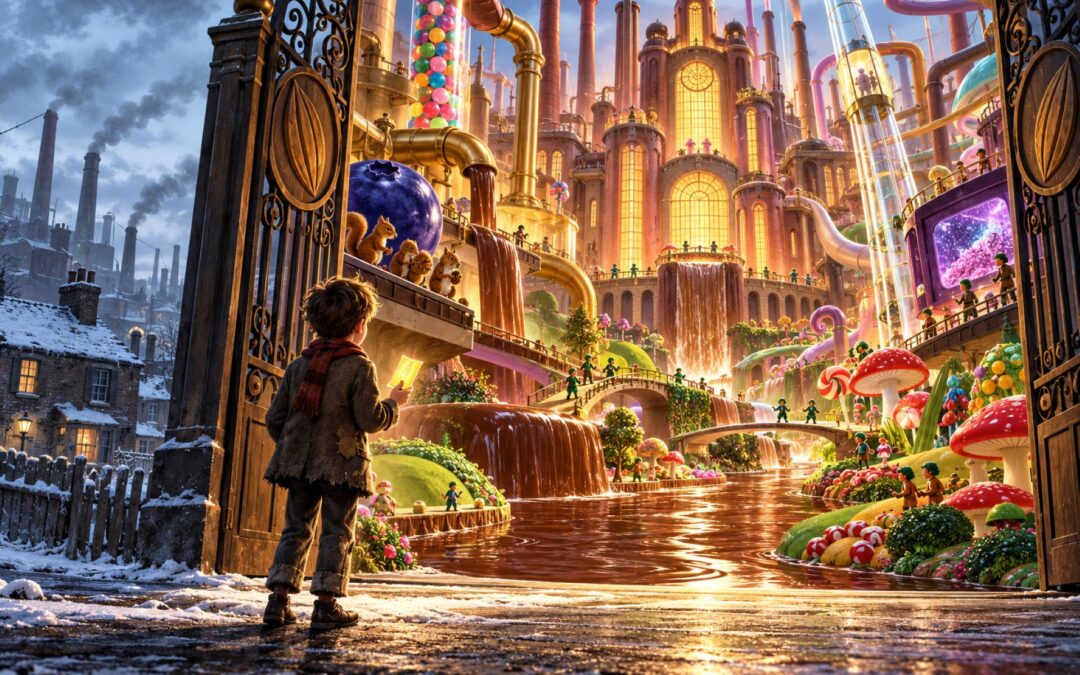
Roald Dahl’s Charlie and the Chocolate Factory begins with a child who can barely get enough to eat and ends with that child inheriting a place of apparently limitless abundance. Between those two extremes lies one of children’s literature’s most memorable fantasy environments: Willy Wonka’s secret factory, filled with edible landscapes, impossible machines, experimental sweets, dangerous inventions, and a succession of children whose dominant habits become the mechanisms of their downfall.
This article follows the complete 1964 text supplied here, published by Alfred A. Knopf and illustrated by Joseph Schindelman. The edition identifies Knopf as publisher and gives a 1964 copyright date, consistent with the book’s original American publication. A corresponding WorldCat bibliographic record for the 1964 Knopf edition also records Dahl and Schindelman in those roles.
The distinction matters because the Oompa-Loompas in this original version differ significantly from those in later editions. The plot summary below therefore follows the supplied text rather than silently substituting revised material. Full spoilers follow, including the fates of all five children and the ending.

Complete Plot Summary of Charlie and the Chocolate Factory
Dahl divides the novel into 30 short chapters, beginning with Charlie’s impoverished home life, moving through the worldwide Golden Ticket hunt, and devoting roughly the second half of the book to the factory tour and its escalating accidents. The structure is simple enough for a child to follow, but carefully staged: each early chapter increases Charlie’s desire to enter Wonka’s world, while each later section tests what happens when desire becomes impossible to control.
Charlie’s Poverty, Wonka’s Mystery, and the Golden Ticket Hunt
Charlie Bucket lives with six adults in a tiny wooden house on the edge of a large town. His parents sleep with him on mattresses on the floor, while his four elderly grandparents—Grandpa Joe, Grandma Josephine, Grandpa George, and Grandma Georgina—share the family’s only bed. The house has only two rooms, and the family cannot afford either more space or another bed.
Mr. Bucket is the family’s sole wage earner. He works at a toothpaste factory screwing caps onto tubes, but his pay is so poor that the family lives on meals such as bread and margarine, potatoes and cabbage, and cabbage soup. Charlie’s parents sometimes sacrifice portions of their own food for him, yet he remains constantly hungry.
Chocolate is therefore not an everyday treat for Charlie. He receives one bar on his birthday each year, and because it is so precious, he makes it last for weeks by taking tiny bites. His desire is intensified by the fact that Willy Wonka’s enormous chocolate factory stands within sight of his home. On the way to and from school Charlie passes the gates, smells melting chocolate in the air, and longs to know what lies inside.
Much of what Charlie initially knows about Wonka comes through Grandpa Joe. During Charlie’s evening visits to the grandparents’ room, Joe describes Wonka as an inventor capable of apparently impossible feats: sweets that behave in extraordinary ways, chocolates unlike anyone else’s, and products that seem to violate ordinary physical rules. The stories transform the factory from a workplace into a legendary realm before Charlie ever enters it.
Grandpa Joe also tells Charlie about Prince Pondicherry, who once commissioned Wonka to build an entire palace from chocolate. Wonka warns him that the palace will eventually melt, but the prince insists on living in it rather than eating it. When hot weather comes, the building collapses into a lake of melted chocolate around him. The story is a miniature version of the novel’s larger comic logic: someone is given a warning, assumes ordinary consequences can be ignored, and discovers otherwise.
The factory itself is surrounded by a greater mystery. Years earlier, rival confectioners including Fickelgruber, Prodnose, and Slugworth had planted spies among Wonka’s employees and stolen secret recipes. Wonka responded by dismissing his entire workforce and closing the factory. After a long silence, the chimneys began smoking and the machinery started again, yet the gates remained locked and no ordinary workers were ever seen entering or leaving.
Only small shadows sometimes appeared behind the windows. Finished sweets continued to emerge, more extraordinary than before, but no one knew who was making them. The mystery gives Wonka’s factory the atmosphere of an enchanted fortress while retaining the language of industrial secrecy and commercial competition.
Then Wonka changes everything by announcing the Golden Ticket contest. Five tickets have been hidden beneath the wrappers of Wonka chocolate bars somewhere in the world. Each child who finds one will receive a personal tour of the factory and a lifetime supply of chocolate and sweets.
The announcement produces a global buying frenzy. People begin purchasing chocolate in absurd quantities, and the ticket hunt becomes a satire of consumer behavior almost immediately. Grandpa Joe is thrilled by the possibility, but Charlie understands the economic problem: a child who receives one bar a year does not have the same practical chance as someone who can buy dozens every day. Grandpa George says as much when he points out that wealthier children can simply keep purchasing bars.
The first winner is Augustus Gloop, a boy whose life revolves around eating. His mother explains his constant consumption as though it were evidence of good health rather than lack of restraint. Augustus becomes a local celebrity, and his success only intensifies worldwide buying.
The second ticket goes to Veruca Salt. Her wealthy father does not leave the matter to ordinary luck. He buys enormous quantities of Wonka bars, transports them to his peanut factory, and orders his workers to stop shelling peanuts and spend their time opening wrappers. After days of labor, one worker finds a ticket, which Mr. Salt takes home to Veruca. Charlie, listening to the account, immediately senses that something about this method is unfair.
Veruca’s introduction establishes her defining pattern. She wants something, demands it, and expects her father to reorganize the world until she receives it. Mr. Salt treats surrender to her demands as a means of restoring domestic peace. Dahl therefore prepares her eventual punishment long before she reaches the factory.
Charlie’s Failed Chances and the Last Golden Ticket
Charlie’s birthday gives him his first direct chance. His entire family gathers anxiously while he opens his one Wonka bar, all of them trying to manage their expectations while secretly hoping for the impossible. There is no Golden Ticket.
What follows matters more to Charlie’s characterization than the disappointment itself. He does not throw a tantrum, resent the winners, or hoard the chocolate. He offers to share his single birthday present with his family. They refuse because they know how rare the treat is for him, but the offer establishes the contrast Dahl will later use throughout the factory tour: Charlie wants intensely without automatically assuming that wanting creates entitlement.
Soon the third and fourth winners are announced. Violet Beauregarde is an obsessive gum chewer who treats chewing as competition. She boasts about records, takes pride in irritating other people, and has temporarily switched from gum to chocolate only to improve her chances of winning.
Mike Teavee is similarly defined through a single overwhelming habit. He spends his time absorbed in television, particularly violent gangster programs, and regards the reporters who arrive to interview him as an interruption. He is clever and verbally aggressive, but his attention is almost entirely captured by the screen.
With only one ticket left, Grandpa Joe makes a private attempt to alter Charlie’s odds. He produces a hidden ten-cent coin and sends Charlie to buy another Wonka bar. The two open it together in secret, stretching out the suspense until the ordinary chocolate underneath becomes obvious. Instead of collapsing into despair, they eventually laugh at themselves.
Then the family’s poverty becomes much worse. Severe winter weather arrives, and Mr. Bucket loses his job when the toothpaste factory closes. He can find only occasional work shoveling snow, and the Buckets’ already inadequate meals shrink further. Charlie grows visibly thinner and changes his daily routine to conserve energy, walking slowly, avoiding play, and resting whenever possible.
His behavior during this crisis reinforces what the birthday scene suggested. Other family members try to give him part of their food, but he refuses to deprive them. Charlie’s goodness is therefore not established by cheerful slogans about obedience; it appears through small decisions made while he is genuinely hungry.
One afternoon, returning from school in the snow, Charlie notices something partly buried in the gutter. It is a dollar bill. He looks around for an owner and, finding none, thinks first of food. He decides he will buy one chocolate bar immediately because he is starving and take the remaining money home to his mother.
Inside a shop, he buys a Wonka bar and devours it almost uncontrollably. The moment is important because Dahl does not portray Charlie as someone without appetite. When he is starving and suddenly has access to rich food, he eats desperately. Self-control in the novel is not the absence of desire.
With nine dimes remaining, Charlie allows himself one more bar. He opens it and sees a flash of gold. The shopkeeper realizes at once that Charlie has found the fifth and final Golden Ticket, and the shop fills with people trying to see him. Some envy him; adults begin offering increasing amounts of money for the ticket. The shopkeeper intervenes, protects Charlie from the crowd, and tells him to take it straight home.
The victory is miraculous in emotional effect but random in mechanism. Charlie has not magically earned a winning wrapper through virtue. He happens to find money, happens to buy the relevant bar, and happens to find the ticket on his second purchase. Dahl lets extraordinary luck rescue him from circumstances in which wealth had overwhelmingly favored other competitors.
At the Bucket house, the news transforms Grandpa Joe. The old man who has spent years in bed becomes so excited that he gets up and dances. The family reads the instructions on the ticket and discovers that the visit will take place immediately. Because each child may bring one or two accompanying adults depending on the ticket’s instructions and practical arrangements, Charlie ultimately takes Grandpa Joe.
The choice is emotionally natural. Joe is the person who made Wonka real to Charlie before Charlie ever met him, who shared his hope when nobody else thought winning likely, and who spent his secret savings on one last attempt. Their visit therefore becomes both Charlie’s adventure and Grandpa Joe’s return to a kind of childhood excitement.
The Factory Opens and Augustus Is Eliminated
On the morning of the tour, the five winning children and their families assemble outside Wonka’s gates while a crowd gathers to watch. Charlie’s thinness and poor clothing make the social contrast visible. Augustus, Veruca, Violet, and Mike arrive with families capable of satisfying or enabling their habits; Charlie arrives from a household that has recently been close to starvation.
Then Willy Wonka appears. After thirteen chapters in which he has existed mainly through rumor, products, newspaper announcements, and Grandpa Joe’s stories, he finally becomes a physical presence. He is small, energetic, elaborately dressed, intensely observant, and almost incapable of remaining still.
Wonka leads the group into the factory and quickly downward. The heat increases because, he explains, the workers require a warmer climate. The transition prepares the visitors for the Chocolate Room, the first enormous revelation of the factory’s inner world.
The room is not merely a production floor. It is an edible landscape. A river of hot chocolate runs through green country under the factory; a waterfall churns the liquid to improve its texture; grass and flowers can be eaten; enormous pipes descend into the river to carry chocolate elsewhere in the plant. The effect is to erase the distinction between natural environment and industrial manufacturing.
Across the river the visitors see very small people. Wonka identifies them as the Oompa-Loompas, the mysterious workforce whose shadows had been seen through the windows. In the original 1964 text used here, they are described as African “pygmies” whom Wonka says he discovered living in desperate conditions and brought to his factory, where he supplies the cacao beans they crave in exchange for their work. This material was revised in later editions and requires separate analysis rather than being treated as a neutral piece of fantasy world-building.
Veruca’s immediate reaction is revealing. She does not wonder who the Oompa-Loompas are or how they live; she tells her father that she wants one and expects him to obtain one for her. The scene compresses her broader attitude toward wealth into a single moment: living beings enter her imagination primarily as things that can be possessed.
Augustus creates the first crisis. Ignoring Wonka’s warning and his parents’ calls, he kneels at the chocolate river and begins drinking directly from it. Wonka objects partly because Augustus is contaminating the product, but Augustus continues until he falls into the river.
The current carries him toward one of the great pipes. He is sucked into it, becomes stuck, then shoots upward toward the room where the chocolate will be turned into fudge. Wonka sends Augustus’s parents after him with Oompa-Loompa assistance while insisting that the boy will not be allowed to become part of the confectionery.
The Oompa-Loompas then sing about Augustus. Their song turns the accident into judgment, describing his eating as the outward expression of a larger moral ugliness. This establishes the recurring structure of the tour: a child is given access to a fantastic temptation, Wonka warns against some action, the child’s defining habit overwhelms the warning, the factory transforms that habit into physical consequence, and the Oompa-Loompas interpret what happened in rhyme.
The survivors continue by boat along the chocolate river. Oompa-Loompas paddle through dark tunnels as Wonka rushes the group past further rooms and possibilities. The journey reinforces the sense that the factory cannot be mapped according to ordinary architectural rules. Every corridor promises another impossible product, and Wonka always seems more interested in the next invention than in processing the danger just left behind.
The Inventing Room and Violet’s Transformation
The Inventing Room exposes another side of Wonka’s operation. Here his products are not finished magical objects but experiments that may behave unpredictably. Everlasting Gobstoppers are designed for children with little pocket money: they can be sucked indefinitely without shrinking away. Hair Toffee is supposed to stimulate hair growth, but an Oompa-Loompa who has tested it has grown hair on an absurd scale.
That detail introduces an uncomfortable element beneath the comedy. Wonka does not merely employ the Oompa-Loompas to manufacture products; he also uses them as testers for inventions that can produce dramatic bodily effects. The book presents such experimentation as part of the factory’s eccentricity, but it contributes to the ethical ambiguity surrounding Wonka.
The next machine creates what appears to be an entire three-course meal condensed into a single stick of chewing gum. Wonka explains the idea with characteristic pride: someone could chew the gum and experience successive flavors corresponding to a meal without having to cook or eat ordinary food. The invention, however, is unfinished.
Violet immediately wants it. For her, the existence of a new kind of gum and the possibility of being the first person to chew it are more powerful than Wonka’s repeated warnings. He explicitly tells her not to put it in her mouth because the dessert stage has not been perfected.
She ignores him. At first the experiment appears successful. Violet reports the sensations of the meal as the gum changes flavor. Then the dessert course arrives, and her skin begins changing color.
She turns violet and expands into a gigantic blueberry. Her body becomes the literal end point of her inability to stop chewing something she has been told is dangerous. Wonka orders Oompa-Loompas to roll her away to the Juicing Room, where she must be squeezed back toward her normal form.
Their song again provides a moral commentary, this time attacking compulsive gum chewing and the unpleasant behavior associated with it. As with Augustus, the punishment is not simply “bad child suffers.” Violet’s particular obsession determines the exact form of the catastrophe.
The group moves on through corridors filled with further inventions, many of which are encountered only through signs, glimpses, or Wonka’s explanations. These brief episodes are important to the factory’s scale: Dahl makes it feel larger than the plot requires by implying hundreds of wonders beyond the rooms the visitors actually explore.
One comic stop involves square candies that “look round.” Mike and the others interpret the phrase geometrically and challenge Wonka because the sweets are visibly square. Wonka means that they have faces and turn their eyes to look around them. The exchange demonstrates one of his favorite forms of control: language itself bends to his chosen interpretation, and anyone who insists on common sense finds themselves arguing inside Wonka’s private logic.
Veruca, Mike, and the Final Eliminations
The next major stop is the Nut Room, where trained squirrels sit on stools and expertly open walnuts. Wonka explains that squirrels can remove the nuts whole in a way that machines or workers cannot reproduce. The same squirrels also tap each walnut to determine whether it is good or rotten.
Veruca decides that she wants one. Her father attempts his familiar response—asking about buying one—but Wonka refuses to sell the squirrels. Veruca therefore announces that she will take one herself.
She enters the room despite Wonka’s warning. The squirrels swarm her, hold her down, and perform the same testing procedure they use on walnuts. After tapping her head, they decide that she is a “bad nut” and push her down the garbage chute.
Mr. and Mrs. Salt rush after her and also disappear down the chute. This time the Oompa-Loompa song does more than condemn the child. It directly assigns responsibility to the parents, arguing that a spoiled child cannot have created her own upbringing. The tour’s moral system therefore becomes more complicated: adults who repeatedly surrender to a child’s demands are part of the problem the factory is punishing.
Only Charlie and Mike remain. Wonka moves the reduced party into the Great Glass Elevator, a transparent vehicle that can travel not merely up and down but in multiple directions through the factory. It provides both transport and another demonstration that the building follows rules Wonka alone fully understands.
They reach the Television-Chocolate Room, a starkly different space dominated by powerful equipment. Wonka explains a process analogous to television broadcasting: a giant chocolate bar is broken into countless particles, transmitted through the air, reassembled on a screen, and physically removed at the receiving end. The drawback is that the transmitted bar emerges much smaller than the original.
Mike immediately sees the implication. If chocolate can be transmitted, he asks, why not a person?
Wonka warns him against trying. Mike pays no attention. He treats the invention as a technological challenge to be conquered and rushes into position so that the enormous camera can transmit him.
The process works in the most literal way possible. Mike appears on the television screen and can be removed from the set, but he is now tiny. His parents are horrified, while he remains fascinated by what has happened and initially takes pride in having become the first human being sent by television.
Wonka proposes putting Mike through machinery used for stretching chewing gum in an attempt to restore his height. The Oompa-Loompas take him away and deliver their longest moral song, which broadens the attack from Mike personally to television itself. Their argument is that the screen renders children passive and displaces reading, imagination, and the rich inner worlds once provided by books.
At this point Charlie has not defeated anyone. He has not solved puzzles, sabotaged rivals, or passed an explicit test. He has simply moved through the factory without allowing any particular temptation to overwhelm his judgment. That difference becomes decisive.
Charlie Wins the Factory
After Mike leaves, Wonka casually asks how many children remain. Grandpa Joe points out that there is only Charlie. Wonka responds with sudden excitement and tells Charlie that this means he has won.
The moment changes the apparent purpose of the tour. Until now the children seemed to be lucky visitors receiving a once-in-a-lifetime glimpse of the factory. Wonka’s reaction reveals that their continued presence mattered competitively: one child was expected to remain.
Wonka brings Charlie and Grandpa Joe into the Great Glass Elevator and selects a control marked “UP AND OUT.” The elevator accelerates vertically, smashes through the factory roof, and rises into the sky. For the first time, the factory’s sealed interior opens back onto the ordinary world.
Before explaining Charlie’s prize, Wonka shows him what has happened to the other children. Augustus is alive but has been squeezed thin by the pipe. Violet has been restored to approximately her original shape but remains purple. Veruca and her parents emerge covered in rubbish. Mike has been stretched into an extraordinarily tall, thin figure. The punishments are grotesque and lasting, but none of the children has died.
Each also receives the promised lifetime supply of sweets. Wonka therefore keeps the literal terms of the Golden Ticket offer even after their accidents. He is punishing them within his moral theatre, but he is not cancelling the advertised reward.
Then he takes Charlie high above the town and asks whether Charlie loves the factory. Charlie says that he thinks it is the most wonderful place in the world. Wonka responds by revealing the true prize: when Charlie is old enough, the entire factory will belong to him.
Wonka explains that he is older than he appears, has no children of his own, and needs someone to succeed him. He has no interest in handing the factory to an adult professional because, in his view, a grown-up will resist his instructions and attempt to impose independent methods. He wanted a “good,” sensible, loving child who could learn the secrets while Wonka was still alive.
The Golden Ticket scheme was therefore also a concealed succession process. Wonka invited five children and intended to choose the one he liked best at the end. Charlie’s inheritance is not the automatic magical consequence of finding the ticket; it is a second selection made by Wonka after watching the children inside the factory.
Wonka then insists that Charlie’s entire family must move into the factory. When Charlie explains that three grandparents have been in bed for years and cannot simply travel, Wonka treats the obstacle as irrelevant. He pilots the Glass Elevator to the Bucket house and crashes straight through the roof into the grandparents’ bedroom.
The terrified family initially thinks disaster has struck. Charlie and Grandpa Joe explain what has happened, but the remaining grandparents refuse to leave their bed. Wonka solves that problem by pushing the bed into the elevator with them still in it.
The novel ends by reversing its opening circumstances almost completely. At the beginning, seven people are trapped in a tiny house with almost no food. At the end, the whole family is being carried toward the greatest food-producing fantasy space in the story, which Charlie will one day own. The final concern voiced by Grandma Josephine is whether there will be anything to eat when they arrive; Charlie, knowing what waits inside, can finally laugh at the question.
Setting and World-Building: Scarcity Outside, Abundance Inside
The power of Wonka’s factory depends on the world outside it. Dahl spends enough time establishing cold rooms, inadequate meals, low wages, unemployment, and hunger that the factory does not feel merely colorful when Charlie enters it. It feels like the physical opposite of his life.
The Bucket house is defined by shortage. There is too little space, too little heat, too little food, one bed for four grandparents, and only one wage earner even before Mr. Bucket loses his job. Chocolate belongs to the world of shop windows and wealthy consumers rather than Charlie’s daily life.
Wonka’s factory reverses every one of those conditions. Space seems limitless. Food is not rationed but built into the landscape. A river consists entirely of chocolate; grass is edible; experimental sweets promise inexhaustibility; enormous machines exist for the pleasure of transforming sugar into things no one had previously imagined.
The contrast is not simply poverty versus wealth. Outside, the ordinary industrial world appears limited and vulnerable: Mr. Bucket’s repetitive factory job can disappear, wages do not meet basic needs, and competing manufacturers steal rather than invent. Inside, Wonka seems to have abolished ordinary scarcity through imagination, secrecy, technology, and total ownership.
That abundance is also unsettling. Everything belongs to Wonka. He determines who enters, who works, what experiments occur, which products are safe enough for the public, where people may go, and what happens when someone disobeys. The factory is simultaneously playground, laboratory, workplace, kingdom, and courtroom.
Its geography reinforces that authority because no visitor can navigate it independently. Wonka rushes through corridors, leads people underground, moves them along a river, transfers them into a multidirectional elevator, and continually reveals rooms whose existence nobody could have predicted. The architecture behaves less like a realistic building than an extension of his mind.
Dahl strengthens the illusion by showing only fragments. Readers encounter a handful of major rooms, but doors and signs imply countless other inventions beyond the narrative route. The factory therefore feels larger than the number of pages devoted to it. It becomes a world rather than a sequence of sets.
Magic and technology are never cleanly separated. Some inventions use tubes, cameras, engines, laboratory procedures, or production lines; others behave according to fairy-tale nonsense. Wonka treats both categories with equal seriousness, which prevents the reader from needing a scientific explanation for every impossibility.
That blend is central to the book’s distinctive atmosphere. The factory feels industrial enough for questions about workers, secrecy, competition, products, and experiments to matter, but magical enough that a chocolate waterfall, meal gum, transmitting television, or glass elevator can exist without breaking the story. Dahl gets the benefits of both worlds while remaining accountable to neither realism nor conventional magic systems.
Character Analysis: Charlie Bucket, Willy Wonka, Grandpa Joe, and the Tour Party
Dahl does not aim for equal psychological complexity across the cast. Charlie and Wonka carry most of the emotional and imaginative weight, Grandpa Joe acts as Charlie’s bridge into the fantasy, and the four rival children are deliberately heightened caricatures whose names, speech, parents, habits, and eventual transformations all point toward a single dominant flaw. The simplicity is functional, though it also creates some of the novel’s limitations.
The families matter almost as much as the children because Dahl repeatedly connects behavior with upbringing. Charlie’s household is materially deprived but emotionally generous, while the other parents tend to excuse, celebrate, or surrender to the habits that later cause trouble inside the factory.
Charlie Bucket
Charlie is not interesting because he lacks desire. He is interesting because he wants things desperately and still recognizes that other people exist. His hunger for chocolate is physical, his curiosity about the factory is enormous, and the ticket means more to him than it does to children who can buy endless bars.
His restraint is therefore meaningful rather than effortless. When he receives chocolate, he prolongs it instead of consuming it immediately. When his birthday bar contains no ticket, he offers to share it. When the family begins starving, he refuses food taken from other people’s portions.
The scene in which he devours the first bar purchased with the found dollar proves that this should not be mistaken for saintly indifference to appetite. Charlie is ravenous and eats with almost uncontrolled intensity once food is available. Dahl allows him ordinary bodily hunger while distinguishing need from habitual excess.
Inside the factory Charlie is relatively passive. He asks questions, marvels, listens, and follows instructions, but he does not undergo a complicated internal transformation. Readers who expect the protagonist to drive the action may find that he sometimes functions more as a stable moral reference point than as an active hero.
That stability is deliberate. Augustus, Violet, Veruca, and Mike enter the factory already dominated by appetites that the environment amplifies. Charlie’s defining quality is that fascination does not eliminate his awareness of limits.
His moral position is clearest when he responds to the altered children with concern rather than triumph. He does not delight in Augustus’s compression, Violet’s color, Veruca’s rubbish, or Mike’s stretched body. The narration and Wonka can be severe, but Charlie himself remains comparatively compassionate.
The reward therefore feels emotionally satisfying even if the mechanism of obtaining the Golden Ticket was random. Charlie’s luck gives him entry; his behavior persuades Wonka that he is a suitable heir. Those are different stages, and the distinction prevents the story from becoming a simple claim that virtue causes good fortune.
Willy Wonka
Willy Wonka is the novel’s most compelling and unstable figure. He is inventor, entrepreneur, magician, entertainer, employer, guide, trickster, judge, and future mentor at once. Almost every major feature of the factory reflects his personality: brilliant, impatient, funny, secretive, dangerous, and unwilling to accept ordinary constraints.
His appeal comes first from invention. Wonka can imagine products that turn consumption into fantasy: sweets that last indefinitely, gum containing a meal, edible landscapes, confectionery transported through television, and innumerable other creations. He does not merely manufacture better chocolate; he reconceives what a sweet can be.
He also understands performance. The Golden Ticket contest turns the reopening of the factory into a worldwide spectacle. His entrance is theatrical, his explanations are full of misdirection and verbal play, and he often treats disaster as though it were another act in the tour.
That reaction to danger is where his charm becomes morally ambiguous. Wonka usually warns the children before they make the choices that cause their accidents, so their actions are not random attacks by a malicious host. Yet he also appears strikingly unsurprised when things go wrong, quickly redirects endangered children toward specialized rooms, and often treats frightened parents with comic impatience.
The book never firmly proves that he has engineered the exact accidents in advance. It is safer to say that he anticipates human foolishness, understands the factory’s dangers far better than his guests, and seems confident that his systems can deal with the consequences.
His ethical authority is therefore different from Charlie’s. Charlie is kind because he voluntarily considers other people. Wonka possesses power and decides what counts as acceptable behavior inside his world. The fact that the plot ultimately rewards his judgments does not make every judgment automatically correct.
The succession revelation sharpens that ambiguity. Wonka does not want the most experienced engineer, manager, scientist, or confectioner. He explicitly prefers a child because he believes an adult will challenge his methods instead of learning them exactly.
That motive can be read sympathetically. Wonka wants someone imaginative enough to inherit a unique world without immediately flattening it into ordinary corporate logic. Charlie’s openness, affection, patience, and capacity for wonder make him an obvious candidate.
It can also be read less comfortably. Wonka is searching not only for goodness but for teachability and obedience. He wants an heir who will absorb his secrets and preserve his system rather than contest his authority, which means the happy ending contains an element of control alongside generosity.
Grandpa Joe and the Bucket Family
Grandpa Joe is the emotional hinge between Charlie’s ordinary life and Wonka’s fantasy. Before the factory opens, Joe supplies the stories. He turns Wonka from a distant manufacturer into a legend and gives Charlie a vocabulary for imagining what might lie behind the gates.
His relationship with Charlie is playful in a way the rest of the impoverished household cannot always afford to be. The secret ten-cent gamble is irrational from a strictly economic perspective, but it gives Charlie companionship in hope rather than a lecture about impossibility.
When Charlie wins, Joe’s sudden physical revival is intentionally fairy-tale-like. Dahl is not building a realistic medical account of a bedridden ninety-six-year-old. He is showing excitement itself restoring movement to the adult who most fully shares Charlie’s capacity for wonder.
The rest of the Bucket family is less individually developed, but collectively important. Their defining pattern is mutual sacrifice. Charlie’s parents give up food for him; Charlie refuses to take it; everyone saves for his annual chocolate bar; the grandparents treat his evening presence as the brightest part of their day.
That atmosphere contrasts with the other families. The Buckets cannot satisfy every desire, so affection is not expressed primarily through buying things. Dahl risks romanticizing poverty if that contrast is pushed too far, because deprivation itself is never beneficial to Charlie. The family is loving despite poverty, not because starvation teaches superior values.
The ending properly resolves that distinction. Charlie is not told that hardship has been good for him and should continue. Wonka removes the family from material deprivation altogether.
Augustus, Violet, Veruca, Mike, and Their Parents
Augustus Gloop is appetite reduced to caricature. His mother explains his relentless eating rather than setting limits on it, and Augustus barely seems interested in the factory except as a source of food. The chocolate river therefore becomes a perfect temptation because it turns an entire environment into something consumable.
His punishment literalizes excess by forcing his body through an industrial food system. The comedy is memorable, but its dependence on disgust at fatness is also one of the book’s least subtle features. Dahl often moves from criticizing behavior to ridiculing physical appearance without maintaining much distinction between them.
Violet Beauregarde represents another kind of appetite: competition. She wants records, novelty, and superiority. Gum matters not merely because she enjoys chewing it but because she can turn chewing into achievement and identity.
Her parents do little to interrupt this behavior. Her mother occasionally objects, but Violet dismisses her publicly. When Wonka presents unfinished gum, the possibility of being first is stronger than caution, and her transformation into a blueberry converts competitive consumption into physical absurdity.
Veruca Salt is perhaps the clearest of the four because the novel makes her parents part of the diagnosis. She has learned that sufficient screaming produces results. Mr. Salt’s extraordinary resources allow him to reinforce that lesson on an industrial scale, first by mobilizing employees to find the Golden Ticket and later by trying to purchase whatever Veruca demands.
The Nut Room turns the logic back on her. Veruca treats the squirrels as purchasable objects; they assess her instead. The “bad nut” judgment transforms the spoiled consumer into the commodity being inspected.
Mike Teavee is slightly different because he is not primarily greedy for food or possessions. He is captivated by technology and mediated entertainment. He interrupts other people, imitates television violence, and becomes obsessed with Wonka’s transmitting apparatus as soon as he understands its possibilities.
His intelligence is genuine. He perceives an application Wonka has not yet demonstrated and correctly reasons that a human body might be transmitted. The problem is that insight immediately becomes action, without patience for Wonka’s warning or concern about risk.
Dahl therefore does not construct four identical cases of “naughtiness.” Augustus cannot stop consuming, Violet cannot resist competitive novelty, Veruca cannot tolerate being denied ownership, and Mike cannot resist converting technological possibility into personal experiment. What unites them is not one vice but a pattern in which desire becomes so dominant that warning loses meaning.
The Oompa-Loompas: Moral Chorus, Workforce, and the Book’s Most Serious Ethical Problem
The Oompa-Loompas perform so many narrative functions that treating them merely as comic singers misses a large part of the book’s machinery. They make Wonka’s secret factory possible, operate equipment, transport injured visitors, conduct parts of the manufacturing process, participate in experiments, and emerge after each child’s accident to interpret the event through song.
Their songs function almost like a chorus in drama. They summarize the behavior that produced each disaster and convert physical comedy into moral argument. Through them, Dahl tells readers how the factory wants each punishment understood.
That does not mean their judgments must be accepted as objective truth. The Oompa-Loompas exist inside Wonka’s system and usually reinforce Wonka’s moral authority. Their songs are part of the story’s rhetoric, not an independent philosophical court.
The supplied 1964 text creates a more difficult problem. Here Wonka describes the Oompa-Loompas as African “pygmies” whom he discovers in a remote jungle, relocates to his factory, and compensates largely through access to cacao. Later editions changed their origins and appearance after criticism of the racial and colonial implications of the original portrayal.
The publication history and significance of those changes have been examined directly in scholarship on the racial and colonial history of the Oompa-Loompa revisions. That history matters because the revision was not merely cosmetic. Moving the Oompa-Loompas from an explicitly African racialized context to the fictional Loompaland altered the frame through which their relationship with Wonka could be read.
Calling them straightforwardly “slaves” goes beyond what the text explicitly says. Wonka calls them workers, describes an agreement, and says they receive cacao and chocolate. The novel presents their arrival as rescue from starvation and portrays them as cheerful participants in factory life.
Yet the power imbalance is impossible to ignore. Wonka discovers a vulnerable population, transports the whole community into a factory he completely owns, provides the commodity on which they are portrayed as obsessively dependent, uses them as labor, and in some cases allows experimental products to be tested on them. They appear to possess very little independent authority within the system.
The original racial context intensifies that imbalance. A white European industrialist bringing thousands of diminutive African people into a private factory to work for food carries colonial associations regardless of whether Dahl intended readers to construct a systematic political allegory from them.
Veruca’s immediate demand to own an Oompa-Loompa makes the problem especially visible. The story presents her request as another example of monstrous entitlement, but it becomes possible precisely because the Oompa-Loompas have already been introduced in language that allows wealthy outsiders to talk about acquiring and transporting them.
Their role as product testers raises another question. Wonka’s Hair Toffee anecdote reveals an Oompa-Loompa experiencing extreme bodily effects from an unfinished invention. The tone is comic, but the episode shows that the workers absorb some of the danger generated by Wonka’s experimentation before products reach consumers.
None of this erases the imaginative function the Oompa-Loompas perform. Their songs are memorable, their presence makes the factory stranger, and their ability to appear whenever Wonka needs machinery operated or chaos managed contributes greatly to the story’s pace. The problem is that the original version ties those narrative conveniences to a racialized labor fantasy in a way modern readers should not pretend is neutral.
Later revision makes the element less overtly racial but does not remove every question about Wonka’s paternalistic authority. The strongest reading therefore avoids two extremes. It neither dismisses the problem because the book is a children’s fantasy nor reduces the entire novel to one political interpretation.
Themes and Social Ideas
The novel’s moral architecture is more interesting when the four punished children are treated as variations rather than as interchangeable examples of “bad behavior.” Charlie’s restraint matters, but Dahl is also interested in parenting, wealth, consumption, media, imagination, and what happens when powerful desires encounter no effective limits.
These themes repeatedly overlap. Veruca’s entitlement is inseparable from her father’s money; Mike’s media obsession is inseparable from adult anxieties about television; Augustus’s appetite is reinforced by parental excuses; and Wonka’s own authority complicates any simple claim that obedience is always morally superior.
Hunger, Desire, and Self-Control
Food dominates the novel from its opening pages, but Dahl distinguishes several kinds of wanting. Charlie is genuinely hungry. Augustus continually eats despite already having abundance. Violet turns consumption into a competitive identity. Veruca wants possession itself. Mike consumes entertainment rather than sweets.
This distinction matters because the story is not actually against appetite. Charlie loves chocolate so intensely that merely smelling the factory torments him, and his excitement at entering Wonka’s world is never treated as a flaw. The fantasy depends on readers wanting the sweets and inventions with him.
What Dahl condemns is appetite that becomes sovereign. Augustus cannot leave the river alone even after being warned. Violet cannot allow unfinished gum to exist without proving she can chew it. Veruca cannot see something desirable without converting desire into a demand for ownership. Mike cannot encounter a remarkable invention without immediately using himself as its test case.
Charlie’s self-control is therefore relational. He still wants things, but wanting does not cancel his awareness of consequences or other people. He can delay gratification, share, listen, and distinguish opportunity from entitlement.
The factory turns this difference into spectacle. Each punished child encounters a temptation perfectly adapted to an existing habit, so the accidents feel like physical extensions of personality. The punishment is exaggerated, but the cause-and-effect pattern is unusually clear.
There is an uncomfortable edge to that moral clarity. The novel sometimes slides from criticizing excess to enjoying humiliation. Augustus’s body in particular becomes an object of ridicule, which makes the anti-gluttony message harder to separate from mockery of fatness.
Parenting, Discipline, and Responsibility
The losing children arrive with adults who have already failed to establish effective boundaries. Mrs. Gloop explains Augustus’s eating. Mr. and Mrs. Beauregarde have little control over Violet. Mr. Salt treats Veruca’s tantrums as problems to solve by satisfying them. Mike’s parents appear unable to compete with television for his attention.
Veruca’s episode makes the point explicit. The Oompa-Loompa song does not stop at describing her as spoiled; it asks who allowed her to become that way and answers that her parents did. Their fall down the chute turns parental responsibility into physical participation in the punishment.
The Buckets provide the counterexample, but their parenting is not built around stern lectures. Charlie grows up in a household where resources are shared, sacrifices are visible, and other people’s needs cannot easily be ignored. His habits emerge partly from living in a family that depends on mutual consideration.
Dahl’s moral model is severe but not simply authoritarian. The parents who indulge everything are criticised more heavily than parents who impose limits. The book assumes that love without boundaries can become a form of harm.
At the same time, the story tends to simplify causation. Real children are not merely products of one parental mistake, and behavior is rarely as neatly attributable as the Oompa-Loompa songs suggest. Dahl chooses the clarity of fable over psychological complexity.
That is appropriate to the form up to a point. These families are designed to be instantly legible rather than sociologically realistic. Problems arise only when the book’s comic certainties are mistaken for universal theories of parenting.
Wealth, Consumerism, Fairness, and Chance
The Golden Ticket contest appears to offer equal luck to every child in the world, but Dahl immediately exposes how unequal the practical opportunities are. A wealthy family can purchase hundreds or thousands of bars. Charlie normally receives one per year.
Veruca Salt’s ticket is the clearest example. Her father converts wealth and control of labor directly into more chances, buying huge stocks and ordering employees to open them. The ticket remains technically random, but economic power overwhelms the spirit of equal opportunity.
The contest is also a brilliant piece of marketing. Grandpa Joe recognizes that Wonka will sell extraordinary amounts of chocolate because every wrapper now carries the possibility of access to a hidden world. The world’s frantic response turns consumption into gambling.
Dahl enjoys the absurdity of that frenzy. Adults behave as irrationally as children, people chase rumours and false tickets, and money pours into Wonka products. The novel’s satire therefore extends beyond the four young winners.
Yet the story is not straightforwardly anti-capitalist. Wonka remains an admired private industrialist, and Charlie’s ultimate reward is ownership of the largest, most extraordinary factory in the story. The book criticizes greed and consumer madness while celebrating inventive enterprise.
Its treatment of chance is similarly double-edged. Charlie does not get the ticket because a moral universe secretly manipulates the wrapper. He is extraordinarily lucky. The novel acknowledges that merit and opportunity are different things.
Only after chance gives Charlie access does character become decisive. This makes the ending more interesting than a simple statement that good people automatically receive rewards. Fortune opens the door; Charlie’s conduct influences what happens once he enters.
Childhood, Adulthood, Media, and Imagination
Wonka’s relationship with children is contradictory. He is often impatient with them, exposes them to danger, and mocks their worst habits, yet ultimately insists that a child is the only kind of person capable of inheriting his work. Childhood is both what he tests and what he values.
His distrust of adults is rooted partly in imagination. The factory operates through possibilities that ordinary reason would reject: edible landscapes, everlasting sweets, meals in gum, television that transports matter. Charlie responds primarily with wonder, while many adults respond with fear, argument, commercial calculation, or demands.
Mike Teavee creates a more specific confrontation between imagination and media. Dahl depicts him as a child whose attention has been colonized by television, especially by repetitive violent entertainment. He does not merely watch; he uses the medium as a model for how to speak, think, and fantasize.
The Oompa-Loompa song after his accident expands this into a direct attack on television itself. Its preferred alternative is reading. Books are presented as active generators of inner worlds, while television is presented as passive stimulation that fills attention without developing imagination.
The argument is deliberately sweeping and historically situated. It would be too much to convert it into a timeless claim that screens necessarily destroy imagination. The important point within the novel is that Mike’s relationship to television has become exclusive enough to crowd out curiosity about almost everything else.
There is also a productive irony here. Charlie and the Chocolate Factory is itself trying to do exactly what the song praises books for doing: make a child imagine impossible spaces, bizarre creatures, tastes, transformations, machines, and dangers through words.
Symbols and Motifs: Chocolate, Golden Tickets, Transformations, and the Glass Elevator
Chocolate changes meaning as Charlie’s circumstances change. At first it represents luxury so distant that a single bar must last weeks. After the Golden Ticket announcement, it becomes both food and lottery mechanism. Inside the factory, it becomes landscape, industry, fantasy, temptation, and eventually Charlie’s future livelihood.
That progression prevents chocolate from serving as a single fixed symbol. It represents desire, but desire can be painful, joyful, excessive, creative, commercial, or sustaining depending on context. The same substance that tortures starving Charlie with its smell becomes the foundation of his escape from poverty.
The Golden Ticket works similarly as both object and threshold. Economically it stimulates sales. Emotionally it represents hope. Socially it turns unknown children into celebrities. Narratively it opens a gate that had remained closed for years.
Gold also invites comparison with value itself. Charlie initially treats his annual chocolate as though it were precious treasure; later a literal golden object becomes more valuable than the chocolate surrounding it because it grants access to Wonka’s hidden world. The ticket converts consumption into possibility.
Gates, doors, pipes, corridors, and elevators repeatedly organize the story around crossing boundaries. The factory gate separates ordinary town life from Wonka’s private domain. Interior doors reveal spaces with new rules. Pipes move both food and Augustus. The television screen becomes a border between material reality and transmitted image.
Bodies are another recurring site of transformation. Augustus is compressed, Violet expands and changes color, Veruca is classified like a defective nut, and Mike is miniaturized and then overstretched. Their bodies become exaggerated visual representations of the habits that brought them into danger.
The transformations are comic but also disciplinary. Instead of merely being told they are wrong, the children leave the factory physically marked by their encounters. Dahl makes moral consequence visible.
The Oompa-Loompa songs perform a related function through language. Each accident could remain chaotic slapstick, but the song organizes it into a lesson. Rhythm and rhyme make the punishment memorable and give the factory an almost ritual structure.
Finally, the Great Glass Elevator reverses the factory’s secrecy. For most of the novel, Wonka’s world is enclosed behind walls, gates, and underground spaces. Once Charlie becomes the sole remaining child, the elevator breaks through the roof and carries him into the open sky.
That movement has obvious narrative significance even without treating it as an elaborate symbol. Charlie is no longer merely an outsider allowed temporary access. The boundary has been broken because his relationship to the factory is about to become permanent.
Style and Narrative Structure: How Dahl Makes the Morality Tale Move
Dahl’s prose is designed to be heard as much as read. The narrator addresses the reader directly, exaggerates shamelessly, turns ordinary descriptions into jokes, and uses repetition to control suspense. The book often sounds like a storyteller performing for children rather than an invisible literary narrator arranging polished scenes from a distance.
The opening chapters demonstrate that technique clearly. Charlie’s poverty is genuinely serious, but the language remains energetic enough to prevent the book from settling into social realism. Once Wonka enters the story, the prose becomes increasingly elastic because his world rewards invention over plausibility.
Names are part of the comedy. Gloop, Salt, Beauregarde, Teavee, Fickelgruber, Prodnose, Slugworth, Whipple-Scrumptious Fudgemallow Delight, Everlasting Gobstoppers, and innumerable other labels turn sound itself into entertainment. Some names characterize immediately; others exist mainly because saying them is pleasurable.
Lists perform a similar function. Wonka rarely introduces one strange sweet when ten will do. Dahl piles inventions on top of one another until abundance becomes a comic rhythm.
That abundance is carefully controlled by the chapter structure. Most chapters are short, and many end by introducing a mystery, accident, room, or impending consequence. The resulting pace is rapid without requiring a conventionally complicated plot.
The novel’s broad architecture is remarkably clean. First comes deprivation and longing. Then comes the contest and improbable victory. The factory tour becomes a sequence of temptation-and-elimination episodes. Finally the apparently episodic middle is reinterpreted as a selection process when Wonka announces Charlie’s inheritance.
The four elimination sequences create repetition without exact duplication. Each child has already been introduced through a habit before arriving. Each later encounters a factory feature that perfectly activates that habit. Each ignores warning. Each suffers a bodily consequence. Each receives a song.
Because readers learn the pattern after Augustus, suspense changes. The question is no longer whether the remaining children are in danger but how their established traits will interact with Wonka’s inventions. The pleasure comes from variation within expectation.
Dahl’s songs intensify that pattern while temporarily changing the book’s form. They exaggerate the moral message beyond what prose conversation alone would sustain, allowing gleeful severity to become part of the entertainment.
That tonal mixture—wonder, cruelty, affection, disgust, fear, absurdity—is central to Dahl’s style. He is willing to frighten children, mock adults, punish young characters grotesquely, and then move quickly back to comedy. Readers who respond to him often enjoy precisely that refusal to make children’s fiction gentle.
The same technique can age poorly when ridicule attaches too strongly to bodies or identities rather than choices. Dahl’s instinct for exaggeration gives the novel its energy but rarely pauses for subtle distinctions once a target has been selected.
The imaginative connection between Dahl and chocolate also has a real biographical basis worth keeping in proportion. As a schoolboy at Repton, he encountered chocolate samples connected with Cadbury product testing, an experience recorded in Repton School’s account of Dahl’s school years and chocolate tasting. That background helps explain why secret experimental confectionery could become such fertile imaginative material, but the novel works because Dahl transforms the idea rather than merely reproducing childhood memory.
His most effective stylistic achievement is therefore not any individual invention. It is the creation of a narrative voice in which absurd inventions feel inevitable. Once readers accept Wonka, the factory can continually become stranger without requiring the book to rebuild credibility every time.
Ending Explained: Why Wonka Chooses Charlie
Charlie’s final victory has two separate causes that are easy to collapse into one. He finds the Golden Ticket because of chance. He receives the factory because Wonka decides, after observing the five children, that Charlie is the one he wants as successor.
Wonka makes that distinction explicit when only Charlie remains. His apparent tour has concealed another purpose: he is old, has no children, and needs someone to inherit the factory. He deliberately invited children because he does not trust an adult successor to listen and learn rather than impose independent methods.
This retroactively changes the entire day. The other children were not merely unfortunate tourists who happened to leave one by one. Wonka expected the visit to produce a preferred child by the end, even if the text does not prove that he planned each exact accident.
Charlie succeeds partly through what he does not do. He does not drink from the river, chew unfinished gum, enter a forbidden room to seize an animal, or transmit himself through experimental machinery. He listens when Wonka says something is dangerous.
But obedience alone does not fully explain the choice. Wonka describes the desired successor as good, sensible, and loving. Charlie’s generosity toward his family, concern for the injured children, and capacity for wonder all fit that description more deeply than mere rule-following.
The ending is therefore a fairy-tale reward for character, but one filtered through Wonka’s preferences. He is not an impersonal moral universe. He is a powerful owner choosing an heir according to the qualities he values.
That qualification matters because Wonka specifically wants a child who will learn his ways. A grown-up, he argues, would try to change things. The same statement that celebrates childhood openness can also sound like a demand for compliance.
Charlie may be especially attractive to Wonka because he combines two qualities the factory requires: he is receptive enough to be taught and imaginative enough to love what is being preserved. Dahl does not show whether an older Charlie will eventually question Wonka, change the factory, or govern differently.
The material reward is enormous, but its emotional meaning is broader than wealth. Charlie can rescue his entire family from hunger, cold, unemployment, and overcrowding. His first concern after receiving the factory is not leaving them behind but bringing them with him.
Wonka agrees immediately. The factory will not separate Charlie from the relationships that helped define him. Instead, it absorbs the entire Bucket family.
The ending also completes the book’s spatial pattern. Charlie begins outside the gates, smelling chocolate he cannot afford. He ends above the town in Wonka’s Glass Elevator, looking down on the house he is about to leave because the factory itself will become his home.
The violent comedy of smashing through the Bucket roof prevents the resolution from becoming sentimental. Wonka improves the family’s circumstances in exactly the way he does everything else: magnificently, recklessly, and with little respect for ordinary procedure.
That is why the ending works so well. Charlie’s reward is emotionally simple, but the person giving it remains complicated.
Critical Review: What the Book Achieves and Where It Fails
Charlie and the Chocolate Factory is extraordinarily efficient. Dahl constructs a fantasy world that feels vast, gives it a clear moral architecture, creates several instantly recognizable characters, delivers repeated comic set pieces, and resolves the entire story in a relatively short novel without making the experience feel slight.
The greatest achievement is the relationship between Charlie’s poverty and the factory’s abundance. Without the opening chapters, the Chocolate Room would still be imaginative, but it would not carry the same emotional force. Dahl makes readers understand what chocolate means to a child who receives one bar a year before opening the doors to a river of it.
The Golden Ticket structure is equally effective. It gives the novel a first-half engine independent of the factory tour, allowing anticipation to accumulate. By the time Wonka appears, he has been built into a legend through stories, inventions, corporate rivalry, secrecy, rumours, and a global contest.
The tour then uses repetition with unusual discipline. Augustus, Violet, Veruca, and Mike are not random victims. Their introductory chapters contain the behavioral material needed for their later accidents, so the second half repeatedly pays off information planted earlier.
This design gives the book a strong read-aloud quality. Children can predict that trouble is coming while remaining uncertain about its form. Dahl lets them feel clever for recognizing the pattern without making the outcomes obvious.
Wonka himself is another major strength. A simpler book might have made him either a benevolent magician or a frightening eccentric. Dahl allows him to be both at once.
That ambiguity keeps adults interested after the basic moral scheme has become obvious. Wonka creates wonders, keeps promises, recognizes Charlie’s goodness, and rescues the Bucket family from poverty. He is also dismissive of danger, uses workers in experiments, ridicules injured children, controls an entire hidden population and industrial world, and wants a successor who will follow his methods.
The novel is less successful when its delight in caricature removes too much distinction between behavior and body. Augustus is not merely criticized for gluttony; his fatness becomes part of the joke. Violet’s physical transformation and Mike’s stretching are fantastic consequences of choices, but Augustus’s description often invites disgust before he has done anything inside the factory.
Modern readers may reasonably find that cruelty uncomfortable. It is possible to defend grotesque exaggeration as central to Dahl’s comic method without pretending every target of the exaggeration has aged equally well.
The same is true of the punishments generally. Children are endangered in highly physical ways, and the Oompa-Loompa songs respond with little sympathy. That severity is part of the book’s appeal for readers who enjoy older fairy-tale logic, where foolishness can produce spectacular consequences rather than mild corrective conversations.
Yet the moral system is not consistently proportional. Violet chewing forbidden gum, for example, is foolish, but permanent discoloration would be an extreme real-world consequence. Dahl depends on cartoon physics to keep the punishment pleasurable rather than horrifying.
Veruca’s episode is morally sharper because the story recognizes parental responsibility. The Oompa-Loompa song explicitly refuses to treat the child as self-created. That insight gives the book more depth than a simple catalogue of wicked children getting what they deserve.
Mike’s episode is intellectually interesting for a different reason. The critique of television is excessive if treated literally, but the broader concern about passive attention, compulsive media use, and displacement of reading remains recognizable. What has aged is the certainty with which television itself is treated as the problem.
The original Oompa-Loompa material presents the most substantial ethical limitation. Unlike a joke about gum or television, it draws on racial and colonial imagery with a real historical burden. Dahl later revised that conception, but revision is part of the work’s history rather than a reason to erase what the 1964 text actually contained.
That problem does not require pretending the Oompa-Loompas have no imaginative value. Their songs, timing, labor, comic presence, and role in the factory are central to the novel’s form. Good criticism can hold both facts together.
Character depth is another limitation, though a less damaging one. Augustus, Violet, Veruca, and Mike are types more than developing personalities. Even Charlie changes little internally because his function is to remain decent while other people expose themselves.
For realist fiction, that would be a major weakness. For a compact morality tale built from caricature, it is often an advantage. Dahl sacrifices psychological nuance for speed, clarity, comedy, and memorable contrast.
Charlie himself can seem bland beside Wonka and the four spectacular losers. His most important qualities are restraint, kindness, loyalty, and wonder, none of which produce the same verbal fireworks as entitlement or obsession. The emotional groundwork of the poverty chapters is what prevents him from disappearing.
The book’s prose remains a major source of durability. Product names are fun to say, descriptions move quickly, direct address creates intimacy, and the factory generates images that are difficult to forget after a single reading. The linguistic energy is not ornamental; it is part of the world-building.
Dahl also understands that children’s fantasy benefits from rules without requiring a complete system. Wonka’s inventions have just enough explanation to invite curiosity, then move before scrutiny becomes destructive. The result is a world that feels coherent emotionally even when its physics are ridiculous.
The ending is satisfying because it solves the problem established on the first pages rather than merely awarding a trophy. Charlie does not receive another box of chocolates and return to starvation. He gains a future, a home, food security, and the ability to bring his family with him.
Wonka’s succession plan also gives the plot retrospective unity. The tour that looked episodic turns out to have been a process of selection. That revelation is simple, but structurally efficient.
For younger readers, the book remains especially effective if they enjoy macabre humor, verbal nonsense, impossible inventions, and stories in which bad choices produce spectacular consequences. Adults reading alongside them may find more ambiguity than the moral songs initially suggest, particularly around Wonka’s power, the class dynamics of the contest, and the Oompa-Loompas.
Readers who dislike ridicule based on bodies, severe punishment comedy, or the original racial material may find significant parts difficult. Those objections should not be dismissed as an inability to understand fantasy. They arise from real choices in the text.
The fairest overall judgment is that Charlie and the Chocolate Factory remains a brilliantly constructed children’s fantasy whose imagination is larger than its length. Its strongest inventions still feel exuberant, its narrative architecture is unusually clean, and Charlie’s movement from hunger to inheritance retains genuine emotional force.
Its weaknesses also matter. Dahl’s comic cruelty occasionally overwhelms his moral distinctions, several characters are little more than exaggerated habits, Wonka’s authority deserves more scrutiny than the story itself gives it, and the original Oompa-Loompa conception is genuinely troubling.
Those qualities can coexist. A book does not need to be ethically spotless to remain artistically important, and artistic importance does not require readers to excuse what has aged badly.
Charlie and the Chocolate Factory is still worth reading because Dahl creates a fantasy that children can understand immediately and adults can continue questioning afterward. Its apparent lesson—that a good child wins while four bad children fail—is only the beginning. Beneath it is a stranger story about hunger and plenty, luck and merit, parenting and appetite, imagination and control, and an extraordinary factory whose wonders are inseparable from the unsettling man who owns it.
Charlie’s victory ultimately works because it resolves the most concrete problem the book ever gave him. He began as a hungry child looking through windows and gates at a world he could not enter. By the final pages, he is no longer being offered a temporary visit to that world: he and the people he loves are going to live there, and one day it will be his.
Last Updated on October 5, 2026 by Aseem Gupta