
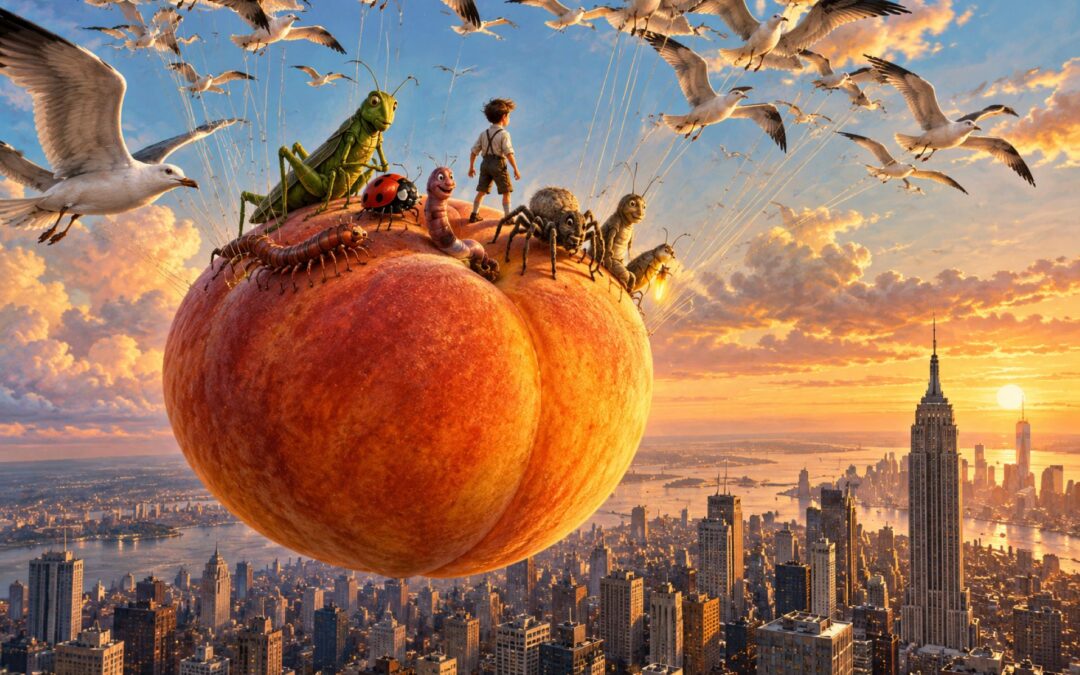
Roald Dahl’s James and the Giant Peach begins with one of the simplest fantasies in children’s literature: an unhappy boy escapes his cruel guardians inside an impossibly large peach. What makes the novel last, however, is not the peach itself but the transformation that takes place inside and around it. James Henry Trotter begins as a bereaved child who has lost his parents, his home, his friends, his freedom, and almost every opportunity to make decisions for himself. By the time the peach reaches New York, the same child has become the person his companions trust to think through danger, organise their efforts, and speak for them to an unfamiliar world.
The novel was first published by Alfred A. Knopf in 1961. This article follows the 2007 Puffin ebook edition illustrated by Quentin Blake, which preserves the pre-2022 text rather than silently combining it with later editorial revisions. Penguin subsequently announced a Roald Dahl Classic Collection based on the pre-revision texts, making that distinction worth stating when discussing language that has since been altered in some Puffin editions.
Spoiler warning: this article covers the complete plot of James and the Giant Peach, including the deaths of Aunt Sponge and Aunt Spiker, the journey to New York, and the ending.

James and the Giant Peach: Complete Plot Summary
The novel consists of 39 short numbered chapters, but its story falls naturally into a few larger movements. James first has to escape the human world that has imprisoned him; he then has to learn how to live among his strange new companions; finally, the group must survive a journey in which James gradually stops being the frightened child whom events happen to and becomes the person capable of deciding what should happen next.
James’s Life with Aunt Sponge and Aunt Spiker
James Henry Trotter’s earliest childhood is happy. He lives with his mother and father in a house beside the sea, where he can play with other children, run on the beach, and enjoy the ocean. That life ends abruptly when his parents travel to London and are killed by an escaped rhinoceros. Dahl presents the event with characteristic grotesque speed, but the emotional consequence is serious: James, only four years old, suddenly finds himself alone.
His seaside home is sold, and James is sent to live with his two aunts, Sponge and Spiker, in a ramshackle house on top of a high hill in southern England. They are cruel, lazy, selfish, and physically abusive. They deprive him of toys, books, friends, ordinary outings, and almost every form of affection. His bedroom is compared to a prison cell, and the comparison fits his larger existence: he is not allowed to leave the hilltop, and his aunts threaten severe punishment if he even tries.
The geography intensifies his misery because James can see the world he cannot enter. From the garden he can look across fields and woods, and on clear days he can even see the distant area where his old home stood and the strip of ocean beyond it. The garden itself is barren except for some laurels and an ancient peach tree that has never produced fruit. The boy who once had sea, beach, friends, and parents now lives in a place where even the only fruit tree appears sterile.
Three years pass. At seven, James is still being treated as unpaid labour. One blazing summer day, his aunts sit drinking lemonade while forcing him to chop wood with a heavy blunt chopper. Thinking about other children playing and about his own former life by the sea, James finally breaks down and asks whether they could go to the seaside just once. Sponge and Spiker respond with abuse rather than sympathy, and Spiker threatens to beat him later.
James runs to the far end of the garden and hides behind the laurel bushes to cry. His despair matters because the magic that follows does not simply interrupt a normal life; it enters at the moment when James has become unable to imagine any ordinary escape from the life imposed upon him.
The Green Magic and the Giant Peach
Behind the bushes, James encounters a tiny, strange old man dressed in dark green. The man carries a paper bag filled with thousands of brilliant green objects that look like crystals or grains but appear to be alive. He tells James that these objects possess extraordinary powers and can transform his life if he uses them correctly.
James is instructed to mix the green things into water, add hairs from his own head, and drink the resulting mixture. The man predicts that extraordinary changes will follow. He also gives James an important warning: if the green objects escape before James drinks them, they will transfer their magic to whatever living thing they encounter first, whether animal, insect, or plant.
For the first time since his parents died, James believes that something might change. He runs toward the house intending to prepare the mixture secretly, but while passing beneath the old peach tree he slips. The bag bursts open, and the green objects scatter into the soil. James desperately tries to recover them, but they wriggle downward faster than he can grab them.
The loss devastates him. He knows that below the ground are the peach tree’s roots as well as worms, centipedes, spiders, and other creatures, and he remembers the old man’s warning. Before he can think much further, his aunts order him back to work. James assumes that his one chance of escape has vanished.
Then Aunt Spiker notices something impossible: a peach has appeared on the barren tree.
At first the aunts simply want to eat it. Before James can climb up to pick it, however, the fruit begins growing visibly. It expands from the size of an ordinary peach to a melon, then to something enormous, eventually becoming almost as tall and wide as a small house. James watches with wonder, while Sponge and Spiker quickly shift from appetite to greed. Where James sees beauty and mystery, they see an asset they can exploit.
By the next day the giant peach has become a public sensation. Sponge and Spiker fence it off and charge visitors admission to see it. Crowds climb the hill, reporters and photographers arrive, and the aunts enjoy the money and attention. James receives none of the benefit. They hide him away because they regard him as an embarrassment and later force him to clean the rubbish left by visitors while denying him food.
When darkness falls and James is finally alone in the garden, the peach seems different from the commercial exhibit his aunts have created during the day. He approaches it and discovers an opening near its base. The hole leads into a tunnel through the peach’s soft flesh, and James crawls inward, eating as he goes.
The tunnel reaches the enormous stone at the centre. There James finds a door.
When he opens it, he enters a room and discovers that he is not alone. Strange voices say that they have been waiting for him.
Inside the Peach and the Escape from the Hill
The inhabitants of the peach initially look terrifying to James because they are familiar garden creatures enlarged to approximately human scale. He sees an Old-Green-Grasshopper, a huge Miss Spider, a scarlet Ladybird, an Earthworm, a Centipede, a Silkworm, and eventually a Glow-worm. Their enormous bodies transform ordinary insects into apparent monsters.
James’s first misunderstanding reveals one of the novel’s recurring patterns. The creatures complain that they are hungry and look toward him, leading James to believe they intend to eat him. Instead, they laugh at the idea. Ladybird reassures him that he is one of them now, while Grasshopper explains that they have been waiting for him.
The initial fear disappears quickly because the insects behave very differently from Sponge and Spiker. Their relationships are noisy, teasing, and sometimes argumentative, particularly between Centipede and Earthworm, but they offer James what his aunts never do: welcome, conversation, humour, practical assistance, and a place within a group. James helps Centipede remove his many boots, and the creatures explain that the mysterious green objects entered the soil and transformed them just as they transformed the peach.
Each companion immediately begins to acquire an individual personality. Centipede is boastful and mischievous, Earthworm pessimistic and easily irritated, Ladybird kind, Grasshopper dignified, and Miss Spider helpful despite James’s initial unease around her. Miss Spider spins hammocks so everyone can sleep, while Glow-worm provides illumination. Before James falls asleep, he already realises that the creatures who looked frightening are actually friendly.
The next morning brings another transformation. The companions intend to leave the hill forever.
Centipede climbs to the top of the peach and uses his powerful jaws to cut through the thick stem connecting it to the tree. Because the garden slopes toward the edge of the hill, everyone knows that once the stem breaks the peach will roll away. Nobody knows where it will go, but uncertainty is preferable to remaining under Sponge and Spiker.
Outside, the aunts are preparing to make another day’s fortune from paying visitors. The newly freed peach crashes through its enclosure and begins rolling directly toward them. Sponge and Spiker try to run but become entangled with each other while each thinks primarily about saving herself. The giant peach rolls over both women and crushes them flat.
The scene is brutal, but Dahl treats it according to grotesque fairy-tale logic rather than realistic tragedy. The aunts, who have spent years threatening and hurting a powerless child, are abruptly removed by the magical object they attempted to appropriate for themselves. James does not engineer their deaths, but the story presents their destruction as comic punishment rather than a moral dilemma.
The peach then rolls out of the garden and accelerates downhill. Inside, James and the insects are thrown violently around the room while furniture and Centipede’s boots fly in every direction. Outside, the peach crosses roads and fields, scatters animals, crashes through buildings and a village, and continues toward the coast.
Eventually it reaches the cliffs. Rather than stopping, it launches into the air and falls into the sea.
For a few moments it sinks, then rises again and floats.
The travellers recover from the violent journey and create a way to climb to the top. When they emerge, they discover that they are no longer in England at all in any practical sense. Wind and current have already carried the floating peach away from land, leaving them apparently stranded in the Atlantic.
Sharks, Seagulls, and James Takes Command
At first the sea appears to have exchanged one danger for another. Earthworm immediately predicts disaster, and several companions worry that they will starve. James points out the obvious solution: they are travelling inside an enormous piece of food. They can eat the peach itself, which contains enough flesh to sustain them for a very long time.
The discovery produces a temporary mood of relief. The ocean is calm, the peach is abundant, and the group enjoys its strange floating home. The peace ends when dark fins begin circling them.
The fins belong to sharks.
Soon the sharks attack the peach, biting pieces from it. The companions realise that even if the sharks are interested primarily in the fruit, they will eventually destroy the vessel on which everyone is standing. Panic spreads. This is the first major crisis in which the group cannot simply allow magic or momentum to determine what happens next.
James begins thinking.
He notices seagulls flying overhead and develops an apparently ridiculous plan. If enough gulls could be attached to the peach, their combined lifting power might carry it out of the sea. The problem is catching them. James proposes using Earthworm as bait because seagulls eat worms, while Miss Spider and Silkworm can produce the strong thread necessary to tether each bird.
The others are sceptical, and Earthworm has an especially obvious reason to object. James nevertheless works through the plan carefully enough that the group accepts it. More importantly, he begins assigning responsibilities. Spider and Silkworm must spin continuously, Earthworm must allow himself to be used as bait, and the others must help manage the operation.
At this point James becomes more than another passenger. The companions begin treating him as their captain.
The plan is both absurd and methodical. Earthworm is positioned where passing gulls will dive toward him. Each time a gull approaches, James pulls Earthworm to safety and loops a strand of silk around the bird before it can escape. The process must be repeated again and again, with Earthworm repeatedly enduring the terror of almost being eaten while Spider and Silkworm produce thread below.
Eventually 502 seagulls are attached to the peach.
The cumulative lift works. The peach rises out of the water, leaving the sharks below, and the travellers become airborne. James has not defeated danger by discovering another magical object. The original magic created the circumstances, but the escape from the sharks depends on observation, knowledge of animal behaviour, the biological abilities of his companions, and a plan that coordinates all of them.
The group later passes over the ocean liner Queen Mary. People aboard see the impossible object in the sky and misinterpret it as a threatening weapon. The travellers themselves remain delighted because they know they have survived.
That contrast—between what strange creatures appear to be from a distance and what they actually are—will become even more important when the peach reaches New York.
The Journey Through the Clouds
Once the immediate shark crisis has passed, the voyage becomes more episodic, allowing Dahl to expand both the personalities of the insects and the fantasy world surrounding them. One of the first pauses concerns Old-Green-Grasshopper, who demonstrates his music and explains how grasshoppers produce sound. James listens with genuine curiosity rather than disgust.
The conversation broadens into a discussion of creatures people commonly dislike. Earthworm insists that gardeners value him because his tunnels help the soil. Ladybird explains her usefulness. Miss Spider protests the way humans kill spiders without considering what they do, and her complaint becomes personal when she tells James that Aunt Sponge killed her father by flushing him down a bathtub drain.
These scenes deepen an idea first introduced when James entered the peach. The creatures who look revolting or frightening to a human child turn out to have complex abilities and useful roles. The insects are still comic characters, and Dahl does not turn the story into a scientific treatise, but curiosity repeatedly replaces instinctive disgust.
Centipede remains the most disruptive member of the group. He sings comic songs, boasts, provokes Earthworm, and turns almost every situation into performance. His recklessness leads to genuine danger when he falls from the peach into the ocean.
James responds immediately. He has Silkworm produce a strong line, secures himself with it, and dives from the airborne peach to rescue Centipede. The episode develops James beyond the leadership he showed during the seagull operation. In the shark crisis, he proved intellectually resourceful; now he willingly places himself in physical danger for one of his friends.
As night falls, the peach approaches an extraordinary new environment made from enormous clouds. The travellers discover Cloud-Men performing the physical labour behind weather. They see figures constructing hailstones, manufacturing snow, producing thunder, creating frost and wind, and working with the materials from which storms seem to be made.
Dahl never tries to turn this into a coherent scientific cosmology. The pleasure lies in literalising weather as industrial production. Natural phenomena that appear mysterious from the ground become the result of workers, machines, tools, funnels, drums, and improvised labour in the sky.
Predictably, Centipede cannot pass quietly through this world. After the travellers encounter Cloud-Men making hailstones, he insults them. The Cloud-Men retaliate by throwing their icy ammunition at the peach. The resulting barrage damages the fruit and creates another dangerous confrontation that would have been avoidable if Centipede possessed more self-control.
A later encounter is even stranger. The travellers discover Cloud-Men constructing an enormous rainbow and lowering it toward Earth. The peach collides with the structure, breaking part of it and tangling the lines connected to the seagulls. A furious Cloud-Man comes toward them, and Centipede cuts the relevant silk line to remove the threat.
The Cloud-Men retaliate again. During the chaos Centipede becomes coated in thick purple paint associated with the rainbow-making operation. The paint begins hardening, creating a problem that the others do not know how to solve.
Once again, apparent disaster reverses direction. The group later encounters the machinery that releases rain, and a huge downpour drenches the peach. The water is frightening in its volume, but it also washes the paint from Centipede. A threat becomes a rescue.
Throughout the night, the peach moves past more weather-making operations. The travellers glimpse machinery for snow, thunder, frost, wind, cyclones, and tornadoes, as well as what appears to be a Cloud-Men settlement. They also encounter an enormous unidentified flying creature before dawn.
By this stage the journey has moved very far from the geographical reality of crossing the Atlantic. Dahl has transformed the sky into a second adventure world where weather possesses the same mixture of familiar fact and absurd imagination that the insects themselves embody.
Eventually the horizon begins to brighten.
Morning reveals land.
New York, the Fall, and the End of the Journey
When daylight arrives, the travellers look down and see an enormous city. The buildings are unlike anything they recognise from England, but James understands what they are seeing: skyscrapers. The peach has crossed the Atlantic and reached America.
The city is New York.
Having escaped the ocean, James now has to solve the opposite problem: how to get down from the sky. His proposal is straightforward. Centipede can bite through the silken tethers one at a time, releasing individual seagulls until the remaining birds can no longer hold the peach at its present altitude. If they proceed gradually, they should descend gently.
Far below, New York interprets the peach very differently. People see an enormous unidentified sphere floating above Manhattan and assume it is a bomb. Sirens sound, broadcasts are interrupted, citizens flee toward shelters and subway stations, and officials prepare for catastrophe.
The reaction repeats the Queen Mary episode on a much larger scale. Nobody on the ground has enough information to understand what they are seeing, so the unknown object becomes a threat. Later the giant insects will provoke the same response when they appear.
James’s descent plan initially works. Centipede cuts several strings, and the peach begins to lose altitude. Then an ordinary passenger aeroplane passes dangerously close and slices through every remaining silk line at once.
The seagulls fly free.
The peach falls.
There is no clever solution this time. James admits that he cannot save them. The inhabitants cling to the stem while the peach plummets toward Manhattan and people below prepare for what they believe will be an enormous explosion.
Then chance intervenes in the most extravagant way possible. The falling peach lands directly on the pointed spire of the Empire State Building. The spike penetrates the fruit and holds it in place above the city.
Once people realise that the object is not a bomb, fear turns to fascination. Police officers and firefighters climb the building to investigate. Their anxiety returns when Centipede appears over the side because, at human scale, his gigantic insect body looks monstrous.
Other companions appear, provoking similarly frightened reactions. James finally presents himself and explains that the supposed monsters are his friends. He introduces them through a long comic poem that combines exaggeration with praise, repeatedly emphasising qualities that make the creatures useful or admirable rather than terrifying.
The social transformation happens rapidly. Instead of being attacked, James and his companions are welcomed. They are brought down safely, and James tells astonished officials how they travelled across the Atlantic.
The travellers become celebrities.
New York’s mayor welcomes them, and the city organises a ticker-tape parade. The giant peach is removed from the Empire State Building and placed on a truck so it can be carried through the streets behind James and his friends.
During the parade, children begin running after the peach. James, who once spent years forbidden to play with other children, decides that they should be allowed to eat it. More and more young people join until thousands are sharing the enormous fruit. By the end of the procession, the peach itself has disappeared, leaving only its great stone.
That stone becomes James’s permanent home in Central Park.
His companions also make lives in America. Centipede enters the shoe business, Earthworm becomes associated with advertisements for beauty products, Miss Spider and Silkworm go into thread production, Glow-worm finds an appropriately luminous occupation, and Old-Green-Grasshopper joins the New York Symphony Orchestra. Ladybird marries the head of the fire department, neatly answering an anxiety she has carried about her home and children.
James’s final transformation is the most important. The child who once had nobody to play with now receives children from everywhere. His insect friends visit him, and his home becomes a place other people actively want to enter.
Because his visitors constantly ask to hear the story of his journey, James eventually writes it down.
The book ends by revealing that James and the Giant Peach is the book he has supposedly written.
Setting and Fantasy World
The settings in James and the Giant Peach are not elaborate in the world-building sense associated with epic fantasy. Dahl provides no map of a magical kingdom, no history of the Cloud-Men, and no attempt to explain the old man’s magic. Instead, setting works structurally: each environment changes what James can do and who he is allowed to become.
The hilltop is the clearest example. Physically, it offers enormous views. James can see miles of countryside and, at the horizon, the sea connected with his lost childhood. Socially, however, it is a prison. The wider the view, the more painful his confinement becomes because freedom remains visible but inaccessible.
The peach reverses that arrangement. From outside, it is a grotesquely enlarged fruit and then a commercial attraction owned by Sponge and Spiker. Inside, it becomes James’s first genuinely welcoming domestic space since his parents died. Its inhabitants are visually frightening, but the room inside the stone contains beds, conversation, music, jokes, arguments, and eventually trust.
The ocean expands James’s world again. Water initially represents the childhood he lost: his happiest memories are connected to the seaside. When he returns to it inside the peach, however, the sea is no longer safe and familiar but enormous, hungry, and dangerous. James therefore does not simply recover the past; he enters a new version of the world in which he must act for himself.
The cloud realm moves even further from ordinary reality. Weather is transformed into physical production, with hail, rain, thunder, snow, wind, and rainbows being manufactured by strange workers. The sequence is imaginative rather than systematic, and judging it as failed scientific world-building would miss the joke. Dahl’s method is to take processes a child cannot see and turn them into comic machinery that can be visualised.
New York then changes the scale one final time. James leaves environments in which he and his companions are effectively alone and enters a city of millions. Their problem is no longer simply survival but interpretation: how can beings who look monstrous persuade a human society that they are not monsters? The novel ends when the public world that first fears them becomes the place where James finally belongs.
Characters in James and the Giant Peach
Dahl does not build his cast according to psychological realism. Sponge and Spiker are grotesque villains, several insects are defined by strong comic traits, and even James develops through action more than introspection. Within those conventions, however, the characters perform distinct roles, and the best of them become memorable because their personalities affect how the group survives.
James Henry Trotter
James begins with almost no control over his own existence. His parents’ deaths happen without warning, adults sell his home, and his aunts dictate where he lives, what work he performs, whether he can leave the garden, and even whether he can speak without punishment. His early passivity is therefore not a personality defect so much as the condition imposed upon him.
The first important quality James retains is curiosity. He listens to the strange old man, follows the green objects into the logic of their possible effects, enters the mysterious hole in the peach, and gradually becomes interested rather than horrified by the enlarged insects. Curiosity is what makes him capable of accepting a world that Sponge and Spiker would experience only in terms of appetite or profit.
His major development occurs when curiosity becomes practical intelligence. During the shark attack, the adults and adult-like insects panic, while James observes the resources around him and combines them. Seagulls can provide lift, Earthworm can attract them, and Spider and Silkworm can provide thread. None of those facts solves the problem alone; leadership consists of seeing how separate capacities can work together.
The other companions explicitly begin following his orders during this sequence. That transition matters because James has previously lived under arbitrary authority. He does not reproduce Sponge and Spiker’s model of power. He gives instructions because the group faces a shared danger and because his plan depends on everyone’s contribution.
His rescue of Centipede extends this development. James is not merely the clever child who thinks while others panic. When Centipede falls into the sea, James risks his own body to save him. Intelligence, courage, and loyalty begin reinforcing one another.
By the time the peach reaches New York, James has become the group’s natural interpreter as well as its strategist. He recognises the city, develops the descent plan, and later speaks to frightened police and firefighters on behalf of companions they mistake for monsters. His leadership has expanded from managing a practical operation to mediating between communities.
James’s ending should not be overstated as psychological recovery from grief. The novel never seriously explores whether losing his parents has been emotionally resolved, and critical work on James as an orphan figure offers more complex ways to think about what fantasy does with that absence. What the story clearly does resolve is James’s social and practical powerlessness: he ends with a home, friends, visitors, independence, and ownership of his own story.
The Insect Companions
Old-Green-Grasshopper is among the most stable members of the group. He is courteous, musically accomplished, and more measured than Centipede or Earthworm. His explanations of grasshopper music also make him part of the book’s recurring movement from disgust toward curiosity, because the apparently strange insect body becomes a source of artistry and knowledge.
Centipede is almost his opposite. He is boastful, quarrelsome, reckless, theatrical, obsessed with his boots, and delighted by his reputation as a pest. Much of the novel’s comic energy comes from his arguments with Earthworm and his songs, but his impulsiveness repeatedly creates problems, particularly with the Cloud-Men. He can be exhausting, yet the book also makes him lovable enough that James’s immediate willingness to dive after him feels emotionally credible.
Earthworm is the group pessimist. He expects drowning, starvation, sharks, and various other disasters, and he frequently serves as a comic counterweight to Centipede’s swagger. His fearfulness does not make him useless: the seagull plan depends on his willingness to become bait, meaning the character who most expects catastrophe must perform one of the journey’s most frightening jobs.
Ladybird provides the warmest emotional presence. She is one of the first creatures to reassure James that he is safe, and her gentleness helps make the peach interior feel like a home rather than another dangerous enclosure. Her final marriage to the head of the fire department is a comic fulfilment of her longstanding anxiety associated with the nursery rhyme about ladybirds and burning houses.
Miss Spider similarly complicates appearances. James initially sees an enormous spider as terrifying, but she uses her silk to make beds, contributes directly to the escape from the sharks, and speaks about the violence spiders suffer because people fear them. Her revelation that Aunt Sponge killed her father also creates a direct connection between James’s human abusers and the nonhuman companions who have suffered because of them.
Silkworm has less personality but enormous practical importance. Much of her role consists of producing the thread without which the seagull plan and later rescues would fail. Glow-worm is also more functional than psychologically developed, supplying literal light inside the peach and contributing to the comic ecology of the group.
The unequal depth is noticeable. Centipede, Earthworm, Grasshopper, Ladybird, and Miss Spider can be recognised almost instantly from the way they speak and react, while Silkworm and Glow-worm remain closer to useful character devices. For a short children’s adventure built around an ensemble, however, Dahl creates enough differentiation that the group rarely feels like a collection of interchangeable magical insects.
Aunt Sponge, Aunt Spiker, and the Mysterious Old Man
Aunt Sponge and Aunt Spiker are not complex antagonists. Their cruelty is immediate, excessive, and almost entirely unqualified. Sponge is associated with appetite, laziness, and vanity; Spiker with sharpness, aggression, and control. Both exploit James and then exploit the peach the moment it becomes profitable.
Their physical descriptions deliberately convert character into caricature, repeatedly linking unpleasant bodies with unpleasant morality. That technique creates vivid villains for young readers but is also one of the elements that has aged least comfortably. Dahl wants the aunts to be funny as well as frightening, yet much of that comedy depends on ridicule of size, shape, and ugliness rather than simply their abusive behaviour.
Their deaths belong to fairy-tale rather than realist morality. The peach crushes them almost immediately after escaping their ownership, and the novel never asks James to mourn them or experience guilt. The punishment is disproportionate if judged as realistic justice, but the book operates in the tradition of grotesque children’s tales in which monstrous adults receive spectacular consequences.
The mysterious old man functions very differently. He is the catalyst who places escape within reach, but Dahl refuses to explain who he is, where his magic comes from, or why he chooses James. Trying to identify him as a literal wizard, psychological projection, or symbolic father figure would require more certainty than the novel provides. His narrative role is enough: he introduces transformative possibility, and then the consequences pass beyond his control when James drops the bag.
Relationships, Friendship, and Chosen Family
The emotional architecture of the novel is built on replacement without exact substitution. James loses a loving biological family at the beginning, but the insects do not simply become new versions of his mother and father. Instead, they form a strange social unit in which affection, teasing, shared labour, argument, dependence, and practical loyalty gradually create a different kind of family.
This begins before James has done anything to earn their trust. When he enters the peach, the creatures tell him they have been waiting for him and reassure him that he belongs among them. That unconditional welcome contrasts sharply with Sponge and Spiker, who treat family obligation as licence for domination. James’s first experience of the insects is therefore important not because they are polite—they often are not—but because their roughness exists within acceptance rather than rejection.
Ladybird most clearly supplies emotional reassurance. Grasshopper offers a gentler form of authority based on knowledge and dignity. Centipede behaves more like a troublesome sibling or friend, while Earthworm’s complaints give the group a constant source of friction that never threatens its fundamental unity.
James’s relationship with the whole group changes as the journey continues. Initially, he is the newcomer whom others comfort. During the shark crisis, they begin relying on his judgment; during the rescue of Centipede, his loyalty becomes active; during the approach to New York, they simply assume that James will know how to solve the next problem.
That shift does not make the others passive. James can create the seagull plan only because Earthworm, Miss Spider, and Silkworm possess abilities he lacks. Cooperation is therefore more important than individual heroism. James becomes a leader by recognising other people’s capacities and coordinating them, not by becoming magically self-sufficient.
The ending preserves these relationships instead of dissolving them once James reaches human society. His insect friends establish separate careers but continue visiting him in Central Park. Home is no longer defined by living permanently with the same people; it is a stable place from which relationships can continue freely.
Major Themes and Ideas
The book’s themes are straightforward enough for children to experience through adventure, but they are more interconnected than a simple moral such as “believe in yourself.” James does gain confidence, yet his transformation depends just as much on finding other people, becoming curious about what initially frightens him, and learning that intelligence is most powerful when joined to cooperation.
Loneliness, Belonging, and Home
Loneliness is the novel’s deepest emotional problem. James’s misery with Sponge and Spiker involves physical labour and abuse, but Dahl repeatedly emphasises the absence of other children, affection, conversation, play, and freedom. James does not merely want to escape punishment; he wants a social life.
That makes the peach more than transportation. Its interior is the first space in years where James is surrounded by beings who want him there. The insects argue constantly, but those arguments themselves are signs of community because everyone is allowed to speak and remain part of the group.
The meaning of home consequently changes. James begins with a real seaside home associated with his parents, then receives a house with his aunts that never becomes home in an emotional sense. He finally ends inside the peach stone in Central Park, an objectively bizarre residence that nevertheless functions as home because it combines independence, safety, memory, friendship, and welcome.
The conclusion does not restore what James lost. His parents do not return, and the story does not pretend his original family can be replaced exactly. Instead, it imagines the creation of a life in which loss no longer means permanent isolation.
Child Agency, Courage, and Adult Authority
The opening chapters establish one of Dahl’s characteristic inversions: adults possess legal and physical authority while lacking moral worth, whereas a child who initially possesses almost no power becomes increasingly competent. Sponge and Spiker control James because they can, not because they deserve obedience.
The journey gradually separates authority from age. James’s companions are older or adult-like creatures, but they repeatedly look to him when danger demands clear thought. His plan against the sharks is accepted because it makes sense, and his instructions are followed because they serve the group rather than his ego.
This is different from the aunts’ authority. They issue commands to make James work, punish him, or keep him invisible. James gives orders only when collective survival requires coordination, and he remains dependent on the abilities of others.
Dahl repeatedly enjoyed stories in which children possess forms of intelligence adults underestimate, a broader tendency discussed in Margaret Talbot’s profile of Roald Dahl’s subversive approach to childhood and adult power. James and the Giant Peach makes the pattern especially clear because James’s growth can be measured by who gets to make decisions at each stage of the story.
Courage also changes meaning. James does not become fearless. He is frightened by the insects, sharks, Cloud-Men, falling peach, and other dangers. What changes is his ability to act while fear exists, whether that means inventing the seagull scheme or diving after Centipede.
Appearance, Prejudice, and the Value of “Pests”
James’s first sight of the enlarged insects creates a deliberate visual shock. A spider, centipede, earthworm, or grasshopper at human scale seems monstrous, and James briefly assumes that the creatures may eat him. The story then spends much of its middle section dismantling that first impression.
Miss Spider is particularly important because spiders are associated with fear even at normal size. She is nevertheless among the gentlest and most useful characters, making hammocks and spinning the silk required for survival. Her complaint about humans killing spiders gives the theme an explicit voice.
Earthworm and Ladybird similarly explain that creatures dismissed as unattractive or insignificant can be valuable within an ecosystem. Grasshopper turns an insect body into a musical instrument. Even Centipede proudly complicates the idea because he identifies himself as a pest while remaining a loyal friend.
The same pattern reaches a social climax in New York. Police and firefighters see gigantic insects and prepare for violence because the bodies in front of them fit the category of monsters. James has to translate appearance into character, explaining who his friends actually are before the humans can respond differently.
The theme is therefore broader than “do not judge a book by its cover.” Dahl repeatedly asks what happens when fear becomes classification. Once something has been labelled ugly, disgusting, dangerous, or worthless, people stop looking closely enough to discover what it does or who it is.
Curiosity, Cooperation, and Wonder
Curiosity is James’s most important intellectual trait. Even before he becomes a leader, he is willing to approach the unknown. He listens to the old man, enters the peach, asks questions about the insects, and engages with Grasshopper’s explanations rather than treating them as irrelevant interruptions.
The novel rewards that habit because useful knowledge often hides inside things that look ridiculous. The seagull solution requires knowledge about what birds eat, what Earthworm can endure, and what Spider and Silkworm can produce. James’s intelligence is synthetic: he notices relationships between facts.
The natural-history conversations work similarly. Dahl embeds real observations about insect behaviour within an impossible fantasy. The distinction is not always scientifically precise, and the book is not a biology lesson, but the effect is to make ordinary creatures newly interesting.
Cooperation turns curiosity into action. James does not possess silk, wings, extraordinary jaws, or Grasshopper’s music. His strength lies in understanding that a group with different abilities can solve problems no member could solve alone.
Wonder is therefore not passive amazement. James begins by staring at the giant peach because it is beautiful, but the novel gradually converts wonder into participation. The magical world becomes most useful when he asks what can be done within it.
Cruelty, Comic Justice, and the Logic of Dahl’s Fairy Tale
Violence appears throughout James and the Giant Peach, often in forms that would be disturbing if the book presented them realistically. James’s parents are eaten by a rhinoceros, his aunts beat him, Miss Spider describes the killing of family members, sharks tear at the peach, Cloud-Men attack the travellers, and Sponge and Spiker are flattened to death.
Dahl controls the emotional effect primarily through tone. Some violence, especially James’s abuse, is meant to establish genuine misery. Other violence is exaggerated until it becomes grotesque comedy. The difference is not moral consistency so much as fairy-tale positioning: sympathetic characters suffer dangers from which they can escape, while characters marked as cruel may receive spectacular punishment.
The deaths of Sponge and Spiker are the clearest example. Realistic ethics would require questions about proportionality, trauma, and James’s response. The novel instead treats their destruction almost like the removal of a curse. Once the peach rolls over them, the narrative does not look back.
Eve Tal’s scholarly reading of the novel as a self-conscious modern or post-modern fairy tale is useful here because Dahl repeatedly borrows fairy-tale machinery while making the machinery conspicuously absurd. The magical benefactor appears without explanation, cruel guardians are grotesquely punished, the child crosses an impossible world, and the final condition reverses the opening one.
That tradition explains the violence without making every choice beyond criticism. Readers can recognise why the punishment feels satisfying within the story while also noticing how readily Dahl converts humiliation, bodily ugliness, and destruction into entertainment.
Symbols and Motifs
The giant peach is the novel’s central image, but its meaning changes repeatedly. At first it represents the unpredictable consequence of magic: James fails to drink the green mixture, yet something transformative happens anyway. To Sponge and Spiker, the peach becomes property and a source of money. To James, it becomes escape.
Once the journey begins, the peach acquires more roles. It is vehicle, house, food supply, shield, and shared resource. The travellers literally survive by consuming the object that carries them, so their refuge is never permanent in its original form.
That impermanence becomes important in New York. The peach does not end as a sacred object preserved forever. James allows thousands of children to eat it. The magical fruit that began as private escape becomes communal abundance.
The stone remains after the flesh is gone. Because a stone is the peach’s hard centre and the place where James first met his companions, converting it into his permanent house makes the ending structurally elegant. The temporary vehicle disappears, but its durable core becomes home.
The ocean has a similarly changing function. It first belongs to James’s memories of childhood happiness. When the peach returns him to the sea, however, it is not a restoration of innocence; the Atlantic is dangerous and requires him to become more capable. The story uses the familiar place from his past as the setting for a new identity.
Scale is another recurring motif. James begins as a small child controlled by physically larger adults. Magic makes ordinary insects enormous and turns an ordinary fruit into something capable of crushing houses, crossing an ocean, and stopping a city. The transformation of scale destabilises the normal hierarchy in which James is powerless.
Food and eating recur in both comic and threatening forms. James’s parents are eaten by a rhinoceros; James briefly fears the insects will eat him; sharks eat the peach; the travellers eat the peach to survive; and finally New York’s children consume the remaining fruit. Eating can mean destruction, survival, hospitality, or celebration depending on who controls the act.
Silk and thread carry an especially practical symbolism. The threads produced by creatures people might dismiss as insignificant literally hold the group’s survival together. They connect peach to seagulls, James to the group during Centipede’s rescue, and the characters’ different abilities into one functioning system.
Songs and rhymes also recur whenever emotion becomes too large or absurd for ordinary conversation. Characters sing about food, danger, the aunts, insects, and one another. The verse keeps the novel close to oral storytelling and allows cruelty, fear, boasting, and celebration to be exaggerated into performance.
Style, Structure, and Narrative Voice
Dahl writes James and the Giant Peach as a book meant to move quickly and sound good aloud. The narrator speaks directly to the reader, exaggerates freely, uses repeated words for rhythm, and frequently frames events as though an excited storyteller were leaning closer to make the next impossibility more vivid.
That voice establishes the novel’s rules very early. James’s parents are killed in an absurdly specific catastrophe, yet the narrator immediately combines horror with comic understatement. Sponge and Spiker are described through extravagant physical comparisons rather than subtle observation. The effect tells readers that emotional truths may be serious even when literal events are wildly distorted.
Dahl’s prose relies heavily on escalation. The peach does not simply grow; it grows past each plausible size into another. The voyage does not encounter one danger; sharks lead to flight, flight leads to Cloud-Men, Cloud-Men lead to New York, and New York leads to an apparent bombing crisis. Each episode tries to exceed the scale of the previous one.
The 39 short chapters support that momentum. Many end on a new problem, revelation, or abrupt change, making the book especially effective for serial or read-aloud reading. The structure rarely asks readers to remain inside long stretches of introspection.
Embedded songs interrupt the prose without stopping the story’s energy. Centipede in particular uses verse as a form of self-performance, while James’s long introduction of his companions in New York turns social explanation into a public show. The rhymes are frequently ridiculous, but their excess belongs to the same aesthetic as giant fruit and weather factories.
The book also mixes fantasy with fragments of natural history. Grasshopper explains his music; Earthworm and Ladybird discuss usefulness; Spider describes silk and human hostility. These passages momentarily invite children to look more closely at actual insects before returning to impossible events.
The Cloud-Men episodes reveal both the attraction and limitation of Dahl’s episodic structure. As individual inventions, hailstone makers, rainbow workers, thunder drums, and weather factories are memorable. Because the sequence repeatedly introduces a strange object, provokes danger, and escapes it, the middle can feel looser than the tightly motivated shark episode.
The final chapter gives the novel a more self-conscious structure than its simple plot might suggest. James writes down his adventures because children keep asking him to tell the story, and the narrator identifies that book with the one the reader has just completed. The device turns the entire novel into James’s retrospective act of authorship.
That ending strengthens the fairy-tale pattern identified in Eve Tal’s analysis of the novel’s form. James does not merely receive a happy ending inside the story. He gains enough control over his experience to transform it into a story for others.
The Ending Explained
Literally, the ending gives almost every traveller an occupation that exaggerates some established characteristic. Centipede, with his endless concern for boots, enters the shoe business. Earthworm’s smooth pink body becomes useful in advertising beauty products. Spider and Silkworm commercialise their thread-making abilities, while Glow-worm is given a job connected to illumination.
Old-Green-Grasshopper joins the New York Symphony Orchestra, turning the musical talent he demonstrated during the journey into a public vocation. Ladybird marries the head of the fire department, providing a comic answer to the traditional anxiety associated with her nursery-rhyme identity. The careers are jokes rather than realistic futures, but each joke rewards readers for remembering how the characters behaved earlier.
James receives something more significant than a career. The giant peach stone is placed in Central Park and converted into his house. Because the interior of that stone was where he first found his new community, his final home physically contains the memory of the journey that ended his isolation.
The location matters too. Sponge and Spiker’s house was remote despite its huge view, and they used that isolation to keep James away from other children. Central Park places him at the centre of a vast city where people can visit freely.
The children who come to see him complete one of the novel’s cleanest reversals. Early in the book, James thinks painfully about other children playing while he is forced to work. At the end, children come from far and wide specifically to spend time with him.
The consumption of the peach strengthens the reversal rather than diminishing it. James does not preserve the magical fruit as private property in the manner of his aunts. He allows children to share it until only the stone remains. Sponge and Spiker saw the peach and immediately asked how they could profit from excluding people; James ends the journey by turning it into something thousands can enjoy.
The final authorship reveal completes a different transformation. For most of the opening, James is someone adults describe with insulting names and commands. He has almost no control over the story being told about him. By the final page, he is the storyteller.
That does not make the whole adventure imaginary. Nothing in the text requires the interpretation that James invented his companions as a psychological coping fantasy. The metafictional ending works perfectly well at face value: within the novel’s world, James survives the adventure and later writes it down.
Its deeper significance lies in ownership. The boy who began with other people controlling his home, movement, labour, and identity ends by deciding how his own experience will be preserved. The peach carried him out of captivity, but storytelling is what makes that escape permanent.
Critical Review: What James and the Giant Peach Achieves—and Where It Shows Its Age
The greatest strength of James and the Giant Peach is the efficiency with which Dahl joins emotional structure to fantasy spectacle. A giant fruit crossing the Atlantic could easily have been nothing more than a sequence of whimsical set pieces. Instead, most of the adventure can be measured against James’s opening condition: every new stage gives him something the hilltop denied him.
The plot is especially effective in the first half. The opening misery is established quickly but forcefully, the magical old man arrives at exactly the point when James’s situation feels intolerable, and the accidental loss of the green objects gives the magic an element of unpredictability. The peach’s growth then builds anticipation before the tunnel converts an external marvel into a secret interior world.
The insect ensemble is another major success. Dahl does not develop every character equally, but he gives enough of them distinctive speech patterns and temperaments to produce a convincing group dynamic. Centipede and Earthworm can generate comedy almost automatically, while Ladybird and Grasshopper prevent the peach from becoming nothing but noise.
James’s development is simple but satisfying because it is shown through decisions. He does not suddenly announce that he has become brave. Readers watch him identify the food supply, design the seagull scheme, organise his companions, rescue Centipede, propose the New York descent, and speak for the insects after landing.
The seagull episode is probably the novel’s strongest adventure sequence because it integrates nearly every important feature of the book. The danger is visually clear, the solution is absurd but internally understandable, the insects’ biological abilities matter, Earthworm has to overcome fear, and James’s intelligence becomes leadership. The scene shows why cooperation rather than magic alone drives the successful parts of the journey.
Dahl’s language remains another reason the book works. The prose is built for voice, using exaggerated comparisons, repetitions, comic insults, lists, songs, and sudden changes in scale. Even readers who remember little of the precise plot often remember the sensation of the storytelling.
The balance between fear and comedy is also unusually confident. The book contains bereavement, child abuse, predatory sharks, violent weather, falling from the sky, and death, but it rarely becomes oppressive. Dahl uses absurdity to let young readers encounter danger while maintaining the expectation that ingenuity and narrative momentum will carry the sympathetic characters through it.
That approach has limits. Sponge and Spiker are effective fairy-tale villains but almost entirely one-dimensional. Because they possess no redeeming quality or psychological complexity, their cruelty becomes repetitive once the story has established it.
The insect companions also vary considerably in depth. Centipede, Earthworm, Grasshopper, Ladybird, and Miss Spider feel like characters with recognisable temperaments, while Silkworm and Glow-worm remain mainly bundles of useful abilities. The imbalance does not damage the story, but the ensemble is less psychologically rich than its size initially suggests.
The Cloud-Men material is imaginative but structurally looser. The weather factories produce some of Dahl’s most memorable visual inventions, yet the sequence can feel like a series of escalating sketches rather than a necessary stage in James’s development. The shark crisis changes James’s status within the group; several cloud episodes mostly create new danger and spectacle.
Coincidence also does substantial work. The peach crosses the Atlantic overnight, an aeroplane severs exactly the strings needed to create the final fall, and the fruit lands precisely on the Empire State Building spire. A realist adventure would collapse under such conveniences, but Dahl’s fairy-tale logic is so explicit that demanding physical probability would miss the form he has chosen.
More legitimately uncomfortable are some of the book’s habits of ridicule. Physical appearance is repeatedly used as moral shorthand, especially with Aunt Sponge and Aunt Spiker. Sponge’s fatness and Spiker’s thinness are not merely described; their bodies become part of the joke proving that they are grotesque people.
That technique is difficult to separate entirely from Dahl’s broader comic method because he exaggerates almost every body in the book. Nevertheless, modern readers may reasonably distinguish between fantastically enlarging an insect and treating a human body shape as evidence of ugliness or bad character.
Some expressions in the pre-2022 text also reflect an older style of casual caricature. The later controversy over Dahl’s edited texts should not be allowed to replace evaluation of the novel itself, but the existence of different versions matters because readers may encounter wording that differs from this edition. Penguin’s decision to keep pre-revision versions available through its Classic Collection makes it possible to discuss those differences without pretending there is now only one stable modern text.
The novel’s treatment of cruel punishment may divide readers as well. Sponge and Spiker are unquestionably abusive, and their removal is emotionally liberating for James, but the book takes enthusiastic pleasure in flattening them. That is consistent with Dahl’s fairy-tale morality, where wicked adults often receive exaggerated physical punishment, yet consistency with a genre does not require every reader to enjoy it.
Recent scholarship has also pushed against treating James’s story as a perfectly universal model of childhood empowerment. Diana Sandars, for example, offers a contemporary critical reading that questions how agency, mobility, and the supposedly universal child are constructed in Dahl’s fiction. Such a reading does not invalidate the emotional clarity of James’s escape, but it is a useful reminder that the freedom represented by movement through the world is shaped by assumptions the book itself does not examine.
Even with those limitations, James and the Giant Peach remains remarkably coherent beneath its chaos. Its wildest images—giant insects, hundreds of tethered seagulls, Cloud-Men manufacturing weather, a peach on the Empire State Building—are not random decorations around James. They create situations in which a child who begins powerless can practise curiosity, judgment, cooperation, loyalty, and eventually public confidence.
The book’s greatest achievement is therefore not its originality of premise alone. Dahl makes the fantasy answer an emotional need that has been present since the first chapter. James requires escape, but escape by itself would only remove him from Sponge and Spiker. What he actually acquires is a community and the capacity to function within it.
The novel is less successful when its appetite for exaggeration overwhelms nuance. Its villains are almost entirely caricatures, some companions remain functional rather than developed, and its comedy occasionally depends on assumptions about bodies and difference that feel considerably more dated than the central story. Readers who dislike Dahl’s mixture of cruelty and glee may find those elements impossible to separate from the charm.
For readers comfortable with that style, however, the book still works exceptionally well as children’s fantasy. It is fast, strange, funny, occasionally frightening, and unusually suited to being read aloud. More importantly, its ending earns its happiness by reversing the precise conditions with which the story began.
James does not end where he started, only with nicer guardians. He ends with a home he can open to others, friends who visit by choice, a city that knows who he is, and children arriving every day instead of remaining forever beyond a garden fence.
That is why James and the Giant Peach remains worth reading. Its magic may begin with mysterious green objects and an impossible fruit, but the more durable fantasy is that a lonely child can move from a life defined by other people’s cruelty into one defined by friendship, usefulness, curiosity, and authorship. The peach carries James across an ocean; the real journey is from being trapped inside somebody else’s world to becoming the person who can tell his own story.
Last Updated on October 5, 2026 by Aseem Gupta