
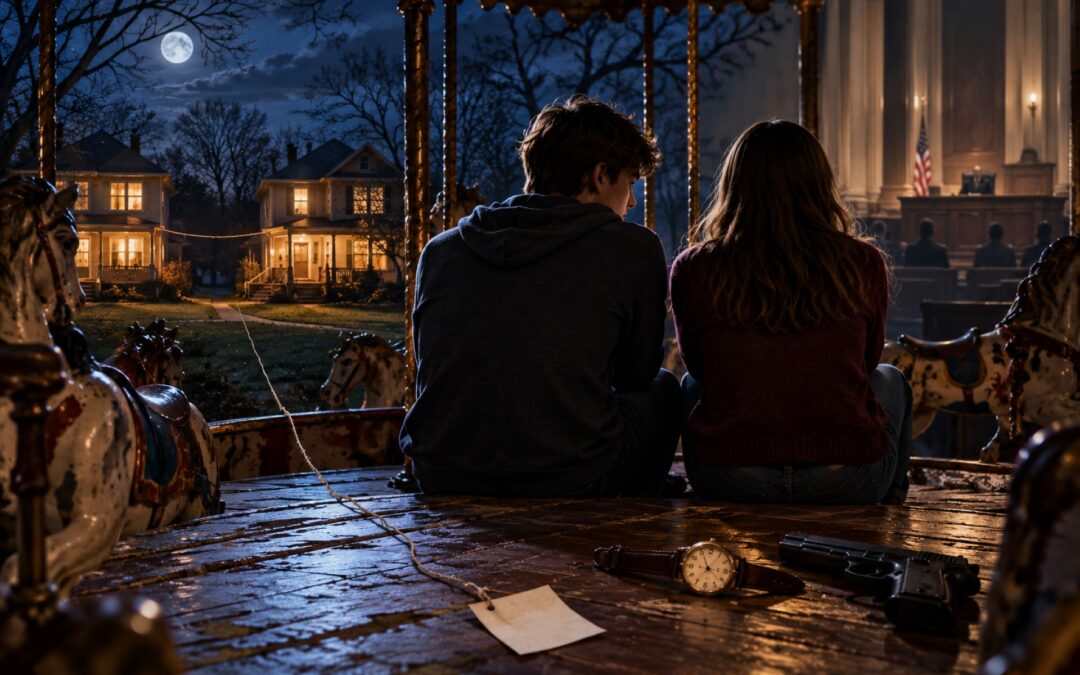
Jodi Picoult’s The Pact: A Love Story begins with the sort of event that appears to demand a simple answer. Seventeen-year-old Emily Gold has been shot in the head, eighteen-year-old Christopher Harte was beside her when it happened, and the gun belonged to Chris’s father. Chris says that Emily wanted them to die together, but almost every new fact makes his story harder to interpret. What initially looks like a question of murder versus suicide gradually becomes a much more difficult question about how well people can know those closest to them, what love obliges a person to do when someone is in danger, and whether legal innocence can coexist with devastating moral responsibility.
The tragedy matters because Chris and Emily are not merely teenage lovers. Their parents became close friends before either child was born, the two families grew up almost as one household, and everyone around them treated Chris and Emily’s eventual romance as the natural completion of a story that had been unfolding since infancy. Chris experiences that continuity as certainty. Emily increasingly experiences it as a future that has already been written for her.
Picoult later described the premise on her official page for The Pact as a reversal of the Romeo and Juliet pattern: instead of hostile families trying to keep two young people apart, two loving families are so delighted by the relationship that their expectations become part of the pressure surrounding it. She also explains that the surviving teenager changed during her research, allowing the physically larger Chris to become both the survivor of Emily’s death and the obvious target of a murder investigation. That structural choice gives the novel its central tension: Chris can love Emily sincerely, fail her catastrophically, and still not fit neatly into the role of murderer.
Spoiler and content warning: This article reveals the entire novel, including Emily’s death, childhood sexual assault, self-harm, pregnancy and attempted abortion, suicidal intent, Chris’s imprisonment and trial, the circumstances of the shooting, the verdict, and the epilogue.

The Pact: Complete Plot Summary
Picoult tells the story through two timelines. The sections labeled “Now” begin with Emily’s death in November 1997 and move forward through the investigation, Chris’s imprisonment, and his trial in May 1998. The sections labeled “Then” begin before Chris and Emily are born and move steadily toward the same night in November 1997. The effect is crucial: the reader repeatedly learns information that changes the meaning of events already seen.
Part I: The Boy Next Door — From Childhood Bond to Murder Charge
The novel opens on the night Emily dies. Chris and Emily are together after leaving their families’ usual Friday-night gathering, and a gunshot brings the long friendship between the Hartes and Golds into a new reality. Emily has been shot in the head. Chris is alive but injured, having struck his head after the gun discharged.
The adults first encounter the event as a medical emergency rather than a crime. James Harte, Chris’s father and a doctor, is accustomed to thinking through crises in professional terms. Gus Harte, Chris’s mother, reacts more instinctively, focusing on her son and on the impossibility of imagining that he could deliberately harm Emily. Melanie and Michael Gold must confront the much harder fact that their daughter is dead. Within hours, four adults who have shared holidays, meals, children, routines, and emotional lives begin separating according to which version of the tragedy they need to believe.
Detective Anne-Marie Marrone soon learns that Chris’s account is not straightforward. He says Emily wanted a suicide pact. According to him, they had two bullets and intended to die together, but after Emily was shot he lost consciousness before he could kill himself. That explanation initially frames Chris as another victim of the night’s events, yet the physical evidence complicates it. Emily’s wound does not immediately look like an uncomplicated self-inflicted gunshot, and Chris was physically close enough to the weapon to become the obvious alternative suspect.
The novel then moves back to 1979, before either teenager is born. Melanie and Michael Gold move next door to Gus and James Harte in Bainbridge, New Hampshire. Gus and Melanie are both pregnant, and proximity rapidly becomes friendship. They share the anxieties of pregnancy and early motherhood until the households begin functioning less like neighbors than extensions of one another.
Chris is born first and Emily soon afterward. Gus is present during Emily’s birth when Michael is unavailable, an early sign of how completely the families’ boundaries will blur. From infancy, Chris and Emily are treated almost as a matched pair. Their parents watch them grow together, and what begins as convenience and affection gradually hardens into a family story: Chris and Emily belong together.
The friendship seems idyllic in childhood, but Picoult plants disturbing parallels long before the teenagers’ crisis. In one important episode, the Hartes’ dog Charlie becomes seriously ill with diabetes. Michael, a veterinarian, recommends euthanasia. James instead takes the dog hunting and shoots him himself, believing that ending Charlie’s suffering personally is a more honest and compassionate act than outsourcing it.
Gus is horrified. The scene matters well beyond the death of a family pet because it introduces a moral question the novel will later make much more extreme: can love ever justify taking responsibility for another being’s death when that death is understood as relief from suffering? James’s action and Chris’s later behavior are not equivalent, but the novel deliberately makes them rhyme.
Another childhood scene establishes Chris’s instinctive role as Emily’s protector. While the children are near water, Emily slips in. Chris immediately jumps after her even though he is not a strong enough swimmer to rescue her safely. Emily is actually capable of standing, while Chris nearly drowns trying to save her.
The incident reveals something admirable and dangerous in Chris at the same time. His first response to Emily’s apparent danger is action, not assessment. He loves her, assumes responsibility for her, and places himself inside the crisis before understanding what the crisis requires. That pattern will become disastrous when Emily’s suffering can no longer be solved through a straightforward rescue.
Back in November 1997, Chris is questioned in the hospital. He maintains that Emily wanted the suicide pact, while his parents and the Golds begin processing the event in radically different ways. Chris desperately wants to attend Emily’s funeral and has to be restrained when he attempts to leave psychiatric care. Michael visits him but cannot obtain a complete explanation.
The investigation meanwhile becomes increasingly dangerous for Chris. Forensic details make investigators question whether Emily could have fired the gun herself in the manner suggested by the scene. More importantly, the autopsy reveals that Emily was pregnant. The pregnancy creates a possible motive the police had not previously possessed: perhaps Chris learned Emily was carrying his child and killed her.
That theory is especially destructive because it turns the most intimate parts of Chris and Emily’s relationship into evidence. What their parents regarded as the perfect teenage romance now becomes potentially relevant to motive, secrecy, sexual history, and violence.
The past continues moving forward. In 1989, when Chris and Emily are children, their relationship contains the privacy typical of two children who have grown up almost like siblings. They share secrets and curiosities, and Chris even reads Emily’s diary, where he finds his own name appearing repeatedly. During an outing to McDonald’s, a dare leads Emily into the men’s restroom.
At this point, the novel does not explain the full significance of what happens there. Emily later allows Chris to believe nothing consequential occurred. The omission becomes one of the book’s most important acts of delayed revelation: Chris believes he has known Emily almost completely since infancy, yet one of the defining experiences of her inner life happens while he is nearby and remains hidden from him for years.
The narrative jumps forward to December 1993, when Chris and Emily are entering adolescence. During a family ski trip, Chris hunts with James and shoots a hare. Instead of feeling pride, he is sickened by the animal’s death. The moment complicates any simple idea that Chris is comfortable with violence merely because he grows up around guns.
Later, Chris and Emily drink alcohol. When the adults discover it, Emily allows Chris to shoulder the blame. Angry and impulsive, Chris pushes her toward a ski run that is beyond her comfort level. Emily falls and breaks her leg.
Chris is overwhelmed by guilt. The accident becomes another foundation of his protector identity: after being partly responsible for hurting Emily, he resolves that he will protect her from harm in the future. Like the near-drowning episode, the vow initially looks loving. The tragedy is that Chris will eventually interpret protection so personally and absolutely that he refuses to involve people better equipped to protect her.
By New Year’s Eve, their relationship crosses from childhood companionship into romance. Chris and Emily kiss. James understands what is happening, and there is little adult resistance because the development confirms what both families have long imagined. To the parents, romance does not disrupt the family arrangement; it perfects it.
The “Now” timeline grows increasingly adversarial. Prosecutor Barrie Delaney and Marrone begin treating the shooting as possible homicide. The Hartes hire defense attorney Jordan McAfee, whose role becomes increasingly important as evidence accumulates against Chris.
Chris returns to school, but ordinary life has become impossible. Emily’s memorial and the constant attention around him intensify his grief. During therapy with psychiatrist Dr. Emanuel Feinstein, Chris finally admits an important contradiction in his original story: he never genuinely intended to kill himself.
He had brought the gun because Emily wanted it, but he believed he would ultimately stop her. The “suicide pact” was therefore not an agreement in the sense Chris first implied. Emily intended to die. Chris intended to remain with her long enough to prevent it.
That revelation makes his decision to participate far more disturbing. Chris was not another suicidal teenager swept into a mutual plan. He believed Emily was in mortal danger, had access to adults and professional help, and nevertheless chose to handle the situation himself.
Another piece of evidence makes Emily’s intentions seem even less clear. A jeweler reveals that she had ordered an engraved watch for Chris’s eighteenth birthday, something that can be read as future-oriented behavior. The gift does not prove that Emily was not suicidal, but it complicates the clean narrative demanded by both prosecution and defense.
The first part ends when Chris’s world changes from suspicion to prosecution. Barrie obtains a murder indictment. On Chris’s eighteenth birthday, instead of crossing peacefully into adulthood, he is arrested for Emily’s murder.
Part II: The Girl Next Door — Emily’s Hidden Life and Chris’s Imprisonment
The second part shifts the emotional center of the book. Chris remains central, but the past now reveals more of what Emily kept hidden from him and from her parents. At the same time, the “Now” sections show Chris losing the protected identity he had possessed in Bainbridge and becoming a defendant inside a system that has no reason to treat his family’s version of him as authoritative.
Chris is booked, arraigned, and denied bail. He pleads not guilty and enters jail. Gus initially behaves as though Jordan McAfee should be able to restore order quickly, but the machinery of criminal prosecution is indifferent to maternal certainty. Chris may be the child she knows, but to the state he is an adult charged with murder.
Melanie moves in the opposite direction. Her grief increasingly needs Chris to be guilty. The more intolerable Emily’s hidden life becomes, the more emotionally useful it is to imagine an external cause for her death. A murdered daughter can remain the daughter Melanie thought she knew; a suicidal daughter forces her to confront how much of Emily’s life existed beyond parental awareness.
The “Then” timeline moves to April 1996, when the apparently perfect Chris-Emily romance is already unstable. Emily loves Chris, but she is increasingly uncomfortable with the sexual expectations attached to being his girlfriend. She pulls away and considers ending the relationship.
Chris responds by dating Donna DeFelice. He sleeps with Donna, but the experience confirms rather than dissolves his attachment to Emily. Emily becomes jealous, and in a disturbing act of self-harm she cuts Chris’s initials into her wrist.
They reconcile, but the reconciliation does not solve the deeper asymmetry between them. Chris interprets their bond as evidence that they are supposed to be together. Emily feels attachment, jealousy, fear, desire for closeness, and discomfort with romance at the same time. Those feelings are not contradictions to be solved so much as signs that her identity cannot be reduced to being Chris’s destined partner.
Chris’s experience in jail meanwhile becomes its own education. He learns quickly that survival depends on reading hierarchies and understanding unspoken rules. When a cigarette is planted among his belongings, he refuses to implicate Hector and accepts punishment rather than becoming known as someone who informs on other inmates.
That decision leads to solitary confinement and damages his chances of obtaining easier treatment. It also shows that Chris’s loyalty is not confined to Emily. He repeatedly treats loyalty as an absolute principle, even when obeying it harms him.
His cellmate Steve Vernon becomes an important parallel. Steve is awaiting trial in connection with the death of his infant son, and his story introduces another disputed case in which love, guilt, responsibility, and death cannot be separated cleanly. Chris’s proximity to Steve forces him to confront the emotional landscape of a person accused of causing the death of someone he loved.
The past then returns to one of Emily’s deepest secrets. In May 1996, the novel finally explains the significance of the McDonald’s episode from years earlier. When Emily was nine, a male employee trapped and sexually assaulted her in the men’s restroom.
She never told Chris. She never told her parents. The assault becomes part of a private history that no one around her understands, even as its effects emerge later in her discomfort with sexual touch.
Picoult does not present Emily as someone who simply stops loving Chris because of the assault. That distinction matters. Emily’s emotional bond with him remains powerful, but physical intimacy can trigger fear and dissociation in ways Chris does not understand. He experiences distance as a problem in the relationship; Emily experiences part of the relationship through a body that carries memories he cannot see.
Back in the present, Chris gives Gus another important piece of the truth. He tells her that the double-suicide story was not literally accurate because he never intended to die. He believed he could accompany Emily into the situation and stop her when the decisive moment arrived.
Jordan and his investigator Selena Damascus begin constructing the defense around the difference between Emily’s intentions and Chris’s. Their task is difficult because Chris’s first account already contained misleading information, and every lie told in an emotionally understandable attempt to protect Emily or himself can look like consciousness of guilt.
The pregnancy becomes increasingly important. Jordan tells Chris that Emily was pregnant, and his shock supports his claim that he did not know. That fact matters because the prosecution’s most obvious motive depends on Chris having learned about the pregnancy and wanting to escape its consequences.
Melanie discovers evidence that could support Chris. Emily’s hidden diary indicates that Chris did not know about the pregnancy. Instead of preserving it, Melanie burns the diary and other possessions.
Her decision is one of the most revealing actions in the novel. She is not simply destroying evidence in the abstract; she is destroying a version of Emily that conflicts with the story she needs to believe. If Chris did not know about the pregnancy, the murder theory becomes less emotionally secure, and Emily’s secrecy becomes harder to deny.
The diary therefore becomes more than a legal object. It represents inaccessible interiority. Emily had a private self all along, but when that private self threatens the adults’ explanations, one of the few surviving records of it is deliberately destroyed.
The past moves into September 1997. Emily discovers she is pregnant. Rather than telling Chris, she begins trying to solve the problem alone.
She contacts Planned Parenthood, gathers information, schedules an abortion, and secretly obtains money. Her secrecy is rooted partly in fear of Chris’s reaction. Emily believes that if Chris learns about the pregnancy, he will respond by proposing a more permanent version of the future everyone has already assumed for them: marriage, family, and lifelong continuity.
To Chris, such a response would likely feel loving and responsible. To Emily, it would make an already predetermined life even harder to escape.
She goes to the abortion appointment, but the procedure triggers traumatic memories of the childhood assault. Physical contact from the male doctor becomes intolerable, and Emily panics and leaves before the abortion can be completed.
Other options exist in principle, but Emily is no longer processing her circumstances as a series of ordinary choices. She is increasingly trapped inside a sense that every available future belongs to someone else: Chris, the baby, her parents, the families, or the assumptions that have accumulated around her since childhood.
Her suicidal thinking becomes more explicit. The novel links that despair with recurring images of water, weapons, silence, and escape, though none of those symbols should be mistaken for a complete clinical explanation of why she wants to die.
The Christmas 1997 “Now” section shows how many secondary lives the case is damaging. Chris remains in jail. The Hartes struggle around his absence. Kate, Chris’s younger sister, finally erupts because the family’s entire emotional world now revolves around him.
Her anger exposes a pattern that has existed in quieter form for years. Chris and Emily’s special status has always organized the adults around them. Once tragedy occurs, that attention becomes so overwhelming that another child can practically disappear inside the same household.
Selena continues investigating Emily’s final months. Teachers describe changes in her behavior and artwork. Her art has become darker, and those images appear to offer access to the distress she concealed verbally.
Chris’s own schoolwork complicates the pregnancy issue. He had written strongly against abortion, which helps explain why Emily might have feared telling him even if he would not have reacted violently. The evidence points not toward a simple murder motive but toward an emotional environment in which Emily imagined that disclosure would produce more pressure rather than relief.
The Planned Parenthood counselor also reports that Emily spoke as though the baby’s father were effectively absent from the decision. That statement does not mean Chris had abandoned her. It demonstrates how thoroughly Emily had isolated herself from him psychologically while continuing the relationship outwardly.
The families fracture further. James receives professional recognition while emotionally withdrawing from the chaos at home. Gus increasingly turns to Michael, whose grief differs from Melanie’s certainty. Michael, unlike his wife, begins accepting that Chris may not have murdered Emily.
That shared uncertainty brings Gus and Michael closer. Their connection will later cross boundaries, creating another relationship in which proximity, grief, loyalty, and need become difficult to disentangle.
By the end of Part II, the murder case has become weaker in some respects and more morally troubling in others. Chris apparently did not know Emily was pregnant, removing the prosecution’s cleanest motive. Yet the reader now knows that Emily was deeply suicidal, that Chris had been central to her emotional life, and that something about his response to her crisis still led both teenagers into a secluded place with a loaded gun.
Part III: The Truth — Trial, Confession, Verdict, and Epilogue
Part III brings both timelines toward the same event. The past is now only weeks away from Emily’s death, while the present is approaching the trial that will decide whether Chris is legally responsible for murder. The closer the timelines come, the less useful the original categories become.
In February 1998, the lawyers fight over what the jury will be permitted to hear. Chris refuses a plea arrangement and insists on going to trial. That choice suggests that he needs something more than freedom: he needs the official accusation of murder contested.
At home, the consequences of prolonged grief are becoming harder to contain. Gus and Michael’s emotional intimacy develops into physical attraction. Their behavior is not presented as an equivalent of Chris and Emily’s relationship, but it repeats one of the novel’s patterns: people in pain seek refuge in the person who seems to understand them most completely, then discover that closeness has consequences beyond the immediate moment.
James eventually visits Chris. Father and son begin repairing a relationship that had been badly damaged by James’s withdrawal and by Chris’s use of his father’s gun. James cannot undo the chain of decisions that brought Chris to jail, but the visit restores part of the parental connection Chris has lost.
Steve Vernon becomes even more significant when he attempts suicide. Chris intervenes and saves him. The act is cruelly ironic because Chris can recognize and stop another person’s immediate suicide attempt inside prison, yet he failed to respond effectively when Emily told him she wanted to die.
The “Then” timeline reaches October 1997, when Emily finally tells Chris explicitly that she wants to die. His first response is poor. He initially dismisses or laughs off the statement because it is too far outside his understanding of her to process immediately.
Once he realizes she is serious, he tries to resist the idea. Emily, however, refuses to explain all the reasons behind her despair. She does not tell him about every part of the assault, pregnancy, abortion attempt, or sense of entrapment that the reader has now seen.
Chris makes the central mistake of the novel at this point. He decides not to tell Gus, James, Melanie, Michael, a doctor, therapist, teacher, or another adult. Instead, he decides that he can remain close enough to Emily to control the situation himself.
He plans to pretend to cooperate with her suicide plan because he believes openly refusing her would cause her to exclude him and attempt suicide alone. If he agrees, he tells himself, he can accompany her until the final moment and then prevent the death.
That reasoning contains a genuine fear but a disastrous assumption. Chris understands that Emily is at immediate risk, yet he treats access to her as more important than outside intervention. He turns a medical and psychological emergency into a private test of love.
To make his plan possible, he steals James’s .45-caliber pistol and takes two bullets. He does not intend to use one on himself, but by bringing the gun he transforms Emily’s suicidal fantasy into a physically executable situation.
The “Now” timeline reaches May 1998 and the murder trial begins. Barrie Delaney presents a comprehensible prosecutorial story: Emily was pregnant, Chris was the father, the relationship had become complicated, and Chris killed her. The physical evidence surrounding the gun and Chris’s inconsistent statements strengthen that narrative.
Jordan’s defense must show that the same facts can support a different story. Emily was suicidal. Chris loved her. He did not know about the pregnancy. His presence with the weapon can be explained by terrible judgment rather than murderous intent.
Witnesses reconstruct the weeks before Emily’s death. The jeweler’s testimony about the birthday watch complicates any simplistic claim that suicidal people cannot make future-oriented plans. Teachers and family members describe Emily as outwardly functional, while other evidence indicates private distress.
Melanie testifies with confidence that Emily would never have killed herself. Cross-examination exposes the weakness beneath that certainty. Melanie did not know her daughter was pregnant. She did not know about the assault. She did not know the extent of Emily’s suicidal thinking.
The point is not that Melanie failed to love her daughter. It is that love did not grant her total access to Emily’s interior life.
The “Then” timeline reaches November 7, 1997, the final day. Emily moves through ordinary family space while hiding the extraordinary decision she has already made. The objects and routines around her belong to a future she no longer expects to inhabit.
She leaves with Chris. They eventually arrive at the carousel, a location that carries associations of childhood and repetition. There, alcohol, memory, sex, fear, tenderness, and death become inseparable.
Chris still believes the evening can end differently. His fatal strategy depends on postponement: stay with Emily, keep her talking, remain physically present, and eventually stop her. Yet every step he takes to preserve access also brings them closer to the act he claims to be preventing.
The trial continues in the “Now” timeline. The defense challenges the apparent certainty of the physical evidence. Emergency medical treatment may have affected some gunshot-residue evidence. Experts discuss suicide, depression, and the ways severe distress can remain hidden from families.
Emily’s artwork becomes part of the case. The defense uses it to argue that her inner life contained fear and possible trauma that her parents did not understand. Barrie challenges how confidently an expert can translate ambiguous images into factual psychological conclusions.
That challenge remains important even beyond the novel. A later systematic review of controlled research into projective drawings found that individual drawing signs and projective scoring systems did not have adequate empirical support for reliably identifying sexual or physical abuse. Emily’s art is meaningful within the novel because the reader already knows her history; it should not be treated as though a drawing could independently diagnose that history in real life.
Other witnesses deepen rather than simplify the case. The Planned Parenthood counselor confirms Emily’s pregnancy and her attempt to obtain an abortion. Teachers reveal aspects of Emily and Chris that their families did not see. Psychological testimony supports the possibility that a suicidal teenager could conceal severe distress behind ordinary behavior.
The defense therefore does not need to prove that every sign had one meaning. It needs to make the prosecution’s certainty impossible.
Outside court, Steve Vernon dies by suicide. His death intensifies Chris’s confrontation with the limits of rescue. He saved Steve once, but saving someone in one moment does not give permanent control over that person’s future.
Gus visits Chris, and he finally says what appears to destroy the defense: he shot Emily. The admission seems definitive because it cuts through the euphemism of a suicide pact. Chris was not merely nearby.
He then decides to testify. He prevents Gus from giving testimony that might protect him and takes the stand himself, forcing the case to confront what happened rather than preserving a strategically useful ambiguity.
The past now reaches the final seconds at the carousel. Emily initially cannot pull the trigger herself. Chris leaves briefly and returns, hoping the interruption may change her resolve. It does not.
Eventually, he takes the gun. He places it against Emily’s head.
That action is the moral point from which the novel cannot retreat. Chris has crossed from misguided participation into direct physical involvement. Whatever happens mechanically afterward, he has done something that cannot be made safe simply by calling it love.
Yet the final physical event remains ambiguous. Emily places her hand over Chris’s hand and urges him to act. Both are engaged with the weapon when it fires.
Chris collapses after the shot and strikes his head. Between the shared hand position, trauma, and his loss of consciousness, he cannot later establish with certainty whose pressure caused the trigger to move at the decisive instant.
At trial, Jordan makes that distinction central. Chris’s statement that he “shot” Emily describes his undeniable involvement but does not necessarily prove the precise mechanism required by the prosecution’s murder theory.
Barrie responds with the strongest case against him. Chris obtained the weapon. He lied about intending to kill himself. He concealed Emily’s suicidal crisis. He placed the gun against her head. His later uncertainty does not erase those actions.
The jury nevertheless operates under a narrower standard than moral judgment. It must decide whether the prosecution has proved murder beyond a reasonable doubt.
The evidence does not produce that certainty. Chris did not know about the pregnancy, weakening motive. Emily’s suicidality is established. The physical reconstruction does not eliminate her involvement with the trigger. Some forensic evidence is less conclusive than it first appeared.
Chris is found not guilty.
The verdict does not restore the old family structure or return him psychologically to the boy who lived next door to Emily. He carries prison habits into freedom. Confinement has altered his relationship to space, air, and ordinary life.
He also begins to experience anger toward Emily. That emotion is important because it breaks the idealized version of their love. Chris can grieve her, love her, resent her, and recognize what she left him to carry at the same time.
The Golds move away. The physical arrangement that once symbolized the families’ perfect intimacy is broken, and the adults do not simply reconcile because a jury acquitted Chris.
In the epilogue, Chris returns to the childhood communication system that once connected the houses. He finds a message whose paper is blank. Perhaps Emily never wrote anything on it. Perhaps something was written and faded.
The distinction cannot be recovered.
That final uncertainty is the novel’s most appropriate ending. Chris has spent months inside competing attempts to produce a definitive explanation of Emily: suicidal girl, pregnant teenager, traumatized child, beloved daughter, devoted girlfriend, secretive artist, murder victim. The blank page refuses one final authoritative statement from her.
He has to live without it.
Bainbridge, the Two Houses, and the World the Families Build
The Pact does not rely on elaborate world-building, but its physical and social setting is indispensable. Bainbridge is defined less by public institutions than by the two neighboring houses occupied by the Golds and Hartes. Before the shooting, the families experience proximity as abundance: children move between homes, parents share routines, dinners blend into one another, and emotional boundaries feel unnecessary because everyone assumes affection makes those boundaries safe.
That environment shapes Chris and Emily before either is capable of choosing it. Their identities are formed inside a family system that repeatedly pairs them together. The arrangement is not overtly coercive. No parent orders Emily to marry Chris, and no one forbids either teenager from having an independent life. The pressure instead comes from accumulated expectation: hundreds of small moments in which their closeness is noticed, celebrated, and interpreted as destiny.
The physical path between the houses therefore has emotional significance. It turns two homes into something resembling a shared compound. Movement from one household to the other is easy enough that privacy becomes unusual rather than assumed.
Emily’s secrecy develops inside that apparent openness. She can live next door to Chris, see him constantly, be loved by four adults who believe they know her intimately, and still conceal the assault, pregnancy, abortion attempt, and suicidality. The closeness of the environment makes that gap more unsettling than it would be in a visibly fragmented family.
The novel’s later settings are increasingly institutional. The hospital receives the consequences of the shooting. Psychiatric care receives Chris’s traumatized first account. Police investigation converts memory into evidence. Jail reduces Chris from a cherished son to an inmate. The courtroom turns private family experiences into competing public narratives.
Those settings matter because the adults have spent most of the novel trusting private knowledge. They believe that because they know the children personally, they understand what happened. Institutions demand something different: records, testimony, physical evidence, procedures, and standards of proof.
Chris experiences the contrast most violently in jail. At home, his identity has been overdetermined by intimacy. He is James and Gus’s son, Kate’s brother, Emily’s lifelong companion, the boy next door. In custody, those identities have almost no protective power.
The prison also removes his assumption that he can control danger through loyalty. Rules are opaque, power is distributed differently, and refusing to inform on another inmate carries consequences that his family cannot prevent. Chris continues behaving according to a personal code even when the surrounding institution recognizes no obligation to reward it.
The courtroom is more complicated. Unlike prison, it allows competing identities back into the story, but only through evidence. Melanie can say who she believes Emily was, Michael can admit what he did not know, experts can interpret behavior, and Chris can describe his intentions. None of them receives the authority to settle the case simply by loving the people involved.
The changing settings therefore trace the collapse of the families’ original worldview. The two houses represent the belief that intimacy creates knowledge and safety. The prison and courtroom represent a world in which knowledge must be proved and safety has already failed.
Chris and Emily: Character Analysis of a Relationship That Becomes a Trap
Chris and Emily are easy to flatten because the plot invites opposing simplifications. One version makes Chris a devoted boyfriend destroyed by Emily’s suicide. Another makes him a controlling young man whose actions culminate in her death. Emily can likewise be reduced either to a tragic victim or to an unknowable girl whose secrecy absolves everyone around her.
Neither simplification fits the novel. Chris and Emily love each other, but they do not experience that love in the same way. Their relationship becomes tragic because the emotional structure that gives Chris certainty increasingly deprives Emily of a sense of possibility.
Emily Gold: Trauma, Perfectionism, Secrecy, and the Need for Escape
Emily’s most important characteristic is the distance between how completely others think they know her and how much of her life she keeps private. To Gus and Melanie, she is part of a familiar family story. To Chris, she is the person who has been beside him almost since birth. To teachers and friends, she remains functional enough that her inner crisis can be missed.
Her artistic identity offers one route into what she cannot say directly. Emily can place fear, darkness, distortion, and emotional violence into images without converting them into explanation. That makes the art meaningful to the reader, who knows what happened to her, but it does not make the artwork a diagnostic code.
The childhood sexual assault is one of the clearest examples of how private her experience can remain. Chris is close enough to be part of the circumstances surrounding the McDonald’s visit, yet Emily tells him nothing meaningful afterward. Years later, he still does not understand why sexual intimacy can make her afraid.
That concealment is psychologically important without making the assault a complete explanation of Emily’s suicide. The novel also gives her conflict over romantic identity, family expectation, perfectionism, pregnancy, bodily autonomy, and the imagined consequences of disclosure. Reducing her death to the assault would erase the very complexity the novel spends hundreds of pages constructing.
Emily’s relationship with Chris is particularly difficult because she genuinely loves him. If she simply stopped caring about him, leaving would be easier. Instead, the person associated with safety, childhood, affection, and belonging also becomes connected to a future she increasingly does not want.
Her discomfort with sex reveals the distinction. Chris often experiences physical intimacy as confirmation of an already secure bond. Emily’s body can respond with memories and fear that do not match the emotional affection she still feels for him.
The episode with Donna intensifies that conflict. When Chris dates and sleeps with someone else, Emily becomes jealous enough to injure herself by cutting his initials into her wrist. Her reaction shows that she is not emotionally detached from him.
At the same time, her jealousy does not prove that the relationship is healthy or desired in every dimension. A person can fear losing someone while also feeling trapped by the form the relationship has taken.
The pregnancy makes that trap feel literal. Emily’s fear is not primarily that Chris will abandon her. In some ways, she fears the opposite.
She believes Chris will respond by becoming even more committed. He may imagine marriage, parenthood, and preservation of the relationship as the responsible response. That expected loyalty is terrifying because the future would close around her more completely.
Her attempt to obtain an abortion is therefore connected to control. She tries to make a decision privately because telling Chris would involve him in a way she does not want. When the procedure triggers memories of the assault and she cannot continue, one of the few paths she has imagined toward regaining control closes.
The novel does not portray suicide as the logical solution to those circumstances. It portrays Emily as someone whose ability to imagine alternatives has narrowed catastrophically. Her thinking becomes organized around escape rather than problem-solving.
That distinction matters ethically. Pregnancy can end in different ways. Relationships can end. Parents can be disappointed. Trauma can be treated. None of those facts means Emily experiences them as emotionally available options.
Her secrecy deepens the danger because every person who might challenge her narrowed perception is kept outside it. Chris eventually learns that she wants to die, but even he receives only part of the explanation.
Emily’s final agency is intentionally difficult to interpret. She wants to die and persists after Chris attempts delay. Yet when the actual moment arrives, she struggles to pull the trigger herself.
Her hand over Chris’s does not simply transfer responsibility back to her. It shows how completely the boundaries between their choices have collapsed. Emily recruits Chris into an act that should never have become their private shared decision.
The blank note in the epilogue protects Emily from one final simplification. She cannot return after death to explain herself perfectly. Her parents, Chris, the lawyers, and the reader are left with evidence rather than total access.
That unknowability is not an excuse to stop interpreting her. It is the condition under which interpretation must remain modest.
Christopher Harte: Love, Protection, Complicity, and Moral Blindness
Chris is most interesting when the novel refuses to make love and wrongdoing opposites. He clearly loves Emily. His childhood behavior, grief after her death, refusal to abandon her, and later emotional collapse all make that difficult to doubt.
The tragedy is that his model of love is organized around protection. From childhood, he repeatedly responds to Emily’s vulnerability by trying to take responsibility for it himself. He jumps into water to rescue her without first recognizing that she can stand while he is the one who may drown.
After the ski accident, guilt strengthens that instinct. Chris has harmed Emily through anger and recklessness, so he responds by promising himself that he will not allow harm to reach her again.
That promise feels morally admirable as long as the threats are ordinary. It becomes dangerous when Chris begins assuming that love gives him unique authority over Emily’s crisis.
When Emily says she wants to die, Chris correctly recognizes that refusing her openly may cause her to exclude him. His fear is not irrational. A suicidal person who feels controlled or exposed may withdraw further.
The catastrophic step is what he does with that fear. Instead of remaining emotionally available while bringing in responsible adults or professionals, he treats outside intervention as incompatible with staying close to her.
That decision reveals his moral blindness. Chris believes the choice is between betraying Emily and protecting her personally. He fails to see that telling someone may be precisely what protection requires.
His theft of James’s gun is therefore the decisive failure before the shooting itself. He tells himself the weapon is necessary because Emily expects a suicide pact, but bringing it changes the situation from fantasy into executable reality.
The two bullets make the contradiction even sharper. Chris does not intend to use the second one on himself. The pact is already a performance designed to keep Emily close enough for him to intervene.
In other words, Chris knows enough to deceive Emily for what he believes is her own good, but not enough to refuse participation in the mechanism she plans to use to die.
That is why the strongest criticism raised in Publishers Weekly’s contemporary review remains difficult to dismiss: the novel places a heavy burden on the credibility of an intelligent teenager surrounded by parents, doctors, teachers, and other adults who never seeks meaningful outside help after learning that Emily is suicidal. Chris’s decision is psychologically understandable as adolescent overconfidence and possessive loyalty, but the plot requires that misunderstanding to persist despite extraordinary danger.
His behavior after the shooting is similarly mixed. Chris’s initial story protects the idea of a mutual pact even though he never intended to die. That lie makes him look guiltier, but it also reflects his continued entanglement with Emily’s wishes.
He remains unwilling to fully separate his own agency from hers. Even after her death, he is partly preserving the emotional structure in which what Emily wanted governs what he is allowed to say.
Prison strips some of that idealism away. Chris learns that loyalty can become a trap, that people can suffer despite being loved, and that private codes do not control institutional outcomes. His refusal to inform on Hector demonstrates the persistence of the same tendency that shaped his relationship with Emily.
Steve Vernon’s suicide becomes especially important because Chris succeeds once in stopping Steve and still cannot save him permanently. Rescue is revealed as contingent rather than absolute. One intervention can matter enormously without conferring control over another person’s future.
By the time Chris admits that he shot Emily, he is moving toward a less defensive account of himself. He no longer wants the clean innocence offered by saying only that Emily killed herself.
His testimony is powerful because he accepts facts that make him morally vulnerable. He brought the gun. He held it against Emily’s head. He participated physically in the final moment.
The uncertainty concerns the exact trigger movement, not whether he bears responsibility for creating the conditions in which the shot occurred.
The acquittal therefore should not be read as the novel declaring Chris innocent in every meaningful sense. He is not convicted of murder because the prosecution cannot eliminate reasonable doubt.
His moral position is much less comfortable. He loved Emily, tried to keep access to her, wanted ultimately to save her, and made a sequence of decisions that placed a loaded gun against her head.
Those facts can all be true simultaneously.
From Sibling-Like Friendship to Romance: Why Their Love Is Unequal
The central relationship is unusual because romance does not introduce intimacy into Chris and Emily’s lives. It changes the meaning of an intimacy that already exists.
They grow up more like members of one extended household than conventional neighbors. Their parents have memories of them together before either child can remember anything independently. Shared history is not something they create as a couple; it precedes them.
Chris therefore experiences romance as confirmation. Falling in love with Emily seems to reveal the meaning that had been implicit in their childhood all along.
Emily’s experience becomes more complicated. Romance takes a relationship that once offered unconditional belonging and attaches sexual expectations, future expectations, and an increasingly fixed adult identity to it.
That imbalance explains why their love can be mutual without being symmetrical. Chris asks, in effect, how a relationship this deep could possibly end. Emily increasingly asks how she can discover who she is if everyone already knows what her future is supposed to be.
Picoult’s description of the premise as an “anti-Romeo and Juliet” story is useful because the problem is not prohibition. The families do not deny the relationship; they celebrate it. Their approval removes one obvious conflict while creating a subtler pressure.
No parent needs to threaten Emily. She already understands how delighted everyone is by the idea of Chris and Emily remaining together.
The pregnancy intensifies that asymmetry. Emily assumes that Chris will respond to crisis by holding tighter to the relationship. His likely loyalty becomes part of what she fears.
That does not make Chris malicious. It shows why intentions are insufficient for understanding the relationship.
The same act can mean opposite things depending on position. To Chris, promising permanence is reassurance. To Emily, permanence increasingly resembles confinement.
This asymmetry also helps explain why the novel’s title is more complicated than the literal suicide pact. The Hartes and Golds have been making informal pacts around Chris and Emily for years: assumptions about family, closeness, future, loyalty, and mutual responsibility.
The fatal pact at the carousel grows inside those earlier, more socially acceptable ones.
The Parents: Grief, Projection, and the Collapse of the Gold–Harte Family
The adults are not merely witnesses to the teenagers’ tragedy. Their friendship, expectations, blind spots, and responses to grief form a second version of the novel’s central question: does loving a child deeply mean knowing that child accurately?
The four parents answer differently once the shared family mythology collapses. Gus responds through loyalty, James through withdrawal, Melanie through blame, and Michael through uncertainty. None escapes the consequences of discovering that the children possessed inner lives outside parental supervision.
Gus and James Harte
Gus’s defining instinct is protection. She believes in Chris with almost absolute force, and that confidence initially looks like the healthiest response among the adults because he is facing a murder charge before the full story is known.
Her loyalty becomes more complicated as evidence accumulates. Gus repeatedly assumes that because she loves Chris and knows his character, certain interpretations must be impossible. The novel gradually teaches her that moral love does not produce evidentiary certainty.
Her fierce focus on Chris also has consequences for Kate. The younger child must eventually force the family to see that Chris’s crisis has absorbed nearly every emotional resource in the household.
Kate’s anger prevents Gus from being idealized simply as the perfect protective mother. Devotion to one endangered child can become neglect of another.
James reacts almost oppositely. He turns toward professional competence and emotional withdrawal. His medical identity gives him a world in which expertise still functions and problems still have procedures.
The contrast with the family crisis is stark. James can manage patients and receive professional recognition while remaining unable to control what is happening to his son.
His earlier killing of Charlie becomes especially uncomfortable in retrospect. James believed that ending the dog’s suffering personally was an act of responsibility and mercy.
The novel does not say that Chris merely imitates his father. Chris’s situation is radically different because Emily is a human being in psychological crisis whose wish to die must not be treated as equivalent to a terminally ill animal’s suffering.
The parallel matters because both situations ask what happens when a person who loves someone decides that love gives him authority over the boundary between suffering and death.
James’s eventual visit to Chris is therefore important. He has to return not as a doctor who can solve the problem but as a father whose son has made terrible choices and still needs him.
That movement from judgment and avoidance toward relationship is modest but significant. Unlike the early family mythology, it does not require pretending everything is understandable.
Melanie and Michael Gold
Melanie’s grief is the most openly destructive because she needs certainty. The idea that Emily wanted to die is almost impossible for her to accept, and Chris offers a psychologically easier explanation.
If Chris murdered Emily, Melanie can preserve a version of her daughter who was fundamentally as she appeared to be. Emily’s hidden pregnancy, sexual trauma, attempted abortion, self-harm, and suicidality threaten that version.
Her destruction of the diary is therefore one of the most revealing moral failures in the novel. The diary could help the defense by showing that Chris did not know about the pregnancy.
For Melanie, however, its danger is not merely legal. It contains proof that Emily possessed a private narrative her mother did not know.
Burning it becomes an attempt to regain control over the dead. Melanie cannot change Emily’s actions, but she can destroy evidence that contradicts the story she prefers.
The act also reverses the ordinary moral expectation surrounding truth. As a grieving mother, Melanie understandably wants justice for Emily. Yet her need for a particular version of justice causes her to eliminate evidence.
Michael responds differently. His professional background as a veterinarian does not give him special insight into Emily’s psychology, and unlike Melanie he becomes increasingly willing to admit uncertainty.
That willingness eventually allows him to testify in Chris’s favor even though Chris was physically involved in his daughter’s death. Michael’s position is emotionally brutal because accepting reasonable doubt about Chris also means accepting painful truths about Emily.
He becomes the parent most willing to say, in effect, that love did not give him complete knowledge of his own child.
That admission is one of the novel’s most mature ideas. Parents can be attentive, affectionate, involved, and still fail to know crucial aspects of a teenager’s interior world.
The point is not that parents are powerless. It is that intimacy should produce curiosity and humility rather than certainty.
Gus and Michael: The Adult Mirror of Chris and Emily
Gus and Michael grow closer because each occupies a position the other’s spouse cannot fully share. Gus needs someone who understands that Chris may not be a murderer. Michael needs someone who can tolerate uncertainty about Emily.
Their emotional dependence eventually becomes physical attraction. The development risks feeling melodramatic, but it serves a thematic purpose: the adults are also capable of confusing shared pain with a uniquely privileged connection.
Their relationship mirrors Chris and Emily’s only in a limited sense. Both involve people whose families are already deeply entangled, and both show how emotional need can erode boundaries.
The crucial difference is that Gus and Michael are adults with established marriages and greater responsibility for the consequences of crossing those boundaries. Their actions therefore should not be used to excuse the teenagers.
Instead, the subplot prevents the parental generation from occupying a morally superior position. The adults who once assumed they understood love, loyalty, and family stability discover that grief can make their own choices contradictory.
Major Themes: Truth, Love, Parental Pressure, and Responsibility
The murder trial gives The Pact a formal question—did Chris murder Emily?—but the novel keeps expanding beyond it. Every major relationship turns on a different version of knowledge, responsibility, and interpretation.
The book’s strongest themes work because they overlap without becoming identical. The same scenes that reveal Emily’s secrecy also expose parental assumptions; the same actions that demonstrate Chris’s love also establish his culpability; the same evidence that creates legal doubt leaves moral judgment unsettled.
How Well Can We Know the People We Love?
Picoult identifies this as one of the novel’s governing concerns on her official discussion of The Pact. The Hartes and Golds have spent nearly two decades accumulating reasons to believe that intimacy produces knowledge.
The story systematically dismantles that assumption.
Melanie believes she knows Emily well enough to say suicide is impossible. She does not know Emily has been assaulted, is pregnant, has attempted to arrange an abortion, or wants to die.
Chris knows more than anyone else but still knows less than he thinks. Emily tells him she wants to die, yet he does not know about the pregnancy or the full relationship between her sexual discomfort and childhood trauma.
Gus believes she knows Chris well enough to treat murder as inconceivable. She eventually has to confront the fact that he physically held the gun against Emily’s head.
The courtroom exists because private certainty has failed. Each side assembles fragments—medical evidence, behavior, memories, objects, art, testimony—and constructs a story from them.
That process resembles what the families have been doing all along. The difference is that a trial exposes interpretation as interpretation.
Melanie’s destruction of the diary is particularly important because it shows that people do not always want more knowledge. Sometimes they want a coherent story badly enough to destroy evidence that threatens it.
The final blank note makes the theme permanent. There is no last document in which Emily resolves every contradiction. Chris cannot recover a final explanation because the person whose mind everyone has been interpreting is dead.
The mature response, the novel suggests, is not cynical relativism. Some facts are knowable. Emily was pregnant. She was suicidal. Chris brought the gun. Both had their hands involved in the final moment.
What remains uncertain is the complete interior meaning of those facts. Love gives access, but not ownership of another consciousness.
Love, Promises, and the Duty to Say No
The most ethically challenging theme in The Pact is the difference between accompanying someone in pain and cooperating with destructive wishes.
Chris believes loyalty means remaining with Emily under conditions she will accept. His fear is that if he rejects the suicide plan outright, she will hide from him and die alone.
That fear gives his decision emotional logic. It does not make the decision safe.
The novel repeatedly prepares this problem through earlier rescue scenes. Chris jumps into water because Emily appears to be in danger. He vows to protect her after contributing to the ski accident.
Each time, his identity becomes more firmly attached to being the person who keeps Emily safe.
The final crisis reveals the flaw in that identity. A protector who believes he must personally solve everything can become dangerous precisely because he refuses to surrender control to people better equipped to intervene.
Chris’s love also makes refusal feel like betrayal. Emily asks him to accept her desire to die as real. He fears that dismissing her wish means failing to understand her.
But taking suffering seriously does not require obeying every conclusion reached by a suffering person. In the novel’s moral universe, this is the line Chris cannot see clearly enough.
The Charlie episode makes that problem deliberately uncomfortable. James ends an animal’s suffering through death and understands the act as mercy.
Chris later faces a human being who says continued life is intolerable. If he treats Emily’s judgment as morally sufficient because he loves and respects her, he effectively imports the mercy-killing logic into a situation where its assumptions do not hold.
Emily’s crisis demands resistance as well as compassion. Love may require staying close, but it also requires involving others, tolerating anger, breaking confidences, and risking the relationship itself when someone’s life is at stake.
Steve’s suicide reinforces the limits of personal rescue. Chris saves him once and cannot guarantee his survival indefinitely. That does not make the rescue meaningless.
It shows that responsibility has boundaries. Chris’s mistake with Emily is not merely failing to save her; it is believing that he alone should manage the danger.
Parental Expectations and Family Enmeshment
The Hartes and Golds create a loving environment, but love becomes pressure when adults repeatedly treat one possible future as inevitable.
From infancy, Chris and Emily are paired in family memory. Their closeness is convenient, charming, and eventually romantic.
Because the parents approve, no dramatic prohibition forces the teenagers to define the relationship against opposition. That absence of conflict initially seems healthy. Yet it also makes the relationship part of the family structure rather than purely a private choice.
Chris thrives under that arrangement because it aligns with what he wants. The family’s story validates his own sense that Emily belongs permanently in his life.
Emily increasingly experiences the same story as a narrowing of alternatives. Ending the relationship would not simply mean breaking up with a boyfriend. It would disrupt the emotional architecture connecting two households.
That pressure helps explain why pregnancy terrifies her in a particular way. She imagines Chris responding exactly as the adults would likely hope: through commitment, marriage, and preservation of the family bond.
The tragedy is that the healthy-sounding option from one perspective becomes imprisonment from another.
The parents do not intend this pressure. That is precisely why the novel’s treatment is more interesting than a story about overtly controlling adults.
Expectation can become coercive without anyone issuing commands. A future repeated often enough can begin to feel like an obligation.
Emily’s secrecy becomes one method of preserving private agency. She cannot easily stop the adults from imagining her future, but she can withhold information that would allow them to intervene in it.
The cost is enormous. Secrecy protects autonomy until the problems being hidden become too dangerous to manage alone.
Secrecy, Trauma, Shame, and the Search for Control
Emily’s secrets are not all the same. The assault involves shame, fear, and a child’s inability to make sense of what happened. The pregnancy involves anticipated consequences. The abortion attempt involves bodily autonomy and trauma. Suicidal thinking involves a private logic that has narrowed until escape feels more imaginable than disclosure.
Treating those experiences as one causal chain would be too simple. The novel instead shows how separate pressures can accumulate inside a person who increasingly avoids asking others for help.
The childhood assault matters because it changes Emily’s relationship to her body and to sexual contact. It also establishes the habit of carrying unbearable information alone.
Her art becomes one partial outlet, but symbolic expression is not the same as communication that another person can reliably understand. The courtroom’s attempt to decode the drawings demonstrates the temptation to read hidden suffering retrospectively as though the signs had always been obvious.
Her self-harm after Chris’s relationship with Donna likewise should not be reduced to romance. It shows an inability to manage emotional pain safely, but it does not provide a complete explanation of her later suicide.
The pregnancy introduces a different form of control. Emily attempts to solve the problem without Chris because telling him would bring another person into a decision she wants to make privately.
When the abortion becomes impossible for her to complete in that moment, the conflict between bodily autonomy and traumatic memory becomes acute. An option that exists legally and practically does not feel psychologically available.
Suicide then appears within the novel as an attempt to end not one isolated problem but the entire structure of perceived obligation. That does not make death a rational answer. It shows how Emily’s thinking has become catastrophically constricted.
The article’s central caution must remain clear: the novel gives readers a network of contributing experiences, not a scientifically proven explanation of why one individual dies by suicide. Trauma, pregnancy, relationship pressure, perfectionism, secrecy, and depression cannot be converted into a deterministic formula.
Legal Truth, Moral Truth, and Reasonable Doubt
The trial is compelling because legal truth and moral truth operate under different standards.
The prosecution must prove a specific criminal proposition. Barrie does not have to explain every detail of Chris and Emily’s relationship; she has to convince the jury beyond a reasonable doubt that Chris murdered Emily.
The defense has an easier evidentiary burden. Jordan does not need to prove Chris acted wisely, ethically, or even innocently in the broadest sense. He needs to show that the prosecution’s version is not the only reasonable interpretation of the evidence.
That distinction becomes decisive when motive collapses. Emily’s pregnancy initially gives the state a simple reason for murder.
Once evidence indicates that Chris did not know she was pregnant, the theory becomes much less secure.
Physical evidence is similarly vulnerable to competing explanations. Chris’s proximity to the gun is undeniable. His involvement in the shooting is undeniable.
What is less certain is whether he intentionally fired the fatal shot as an act of murder or whether Emily’s hand contributed to the trigger movement during the shared final act.
Reasonable doubt does not answer the larger moral question. Chris’s acquittal means the jury is not convinced of murder to the required standard.
It does not mean bringing a loaded gun to a suicidal teenager was acceptable. It does not mean secrecy was protective. It does not mean putting the weapon against Emily’s head was morally neutral.
The novel’s refusal to merge those judgments is one of its greatest strengths.
A lesser courtroom novel might treat “not guilty” as vindication. The Pact treats it as the end of one institutional question and the beginning of a lifetime of less answerable ones.
Symbols and Motifs: Guns, Water, the Carousel, Art, and the Blank Note
Picoult uses recurring objects and situations to connect childhood events with the final tragedy. These motifs are most effective when read as patterns rather than one-to-one codes. They deepen the novel because their meanings change as Chris and Emily grow older.
The gun is the most obvious recurring object, but its meaning begins before the shooting. James’s relationship with hunting associates firearms with adulthood, control, death, and the belief that killing can sometimes end suffering. Chris’s revulsion after killing the hare demonstrates that he does not naturally share his father’s comfort with the act.
When Chris later steals James’s pistol, the weapon carries those earlier associations into a radically different context. It becomes both a practical instrument and a symbol of borrowed authority. Chris takes an adult tool connected to his father’s decisions and uses it to manage a crisis he has decided not to reveal to adults.
The animals surrounding those scenes deepen the pattern. Charlie’s death presents killing as mercy. The hare presents killing as something Chris finds physically and morally disturbing.
Emily’s death cannot be reduced to either precedent, but the earlier incidents prepare the reader to ask what happens when compassion, control, violence, and relief from suffering become confused.
Water carries a related but different meaning. In childhood, Chris nearly drowns while trying to save Emily from a danger he has misread. She can stand; he cannot manage the rescue he launches.
That scene becomes almost a miniature version of the entire tragedy. Chris recognizes vulnerability, acts immediately, assumes responsibility, and nearly destroys himself because he has misunderstood both Emily’s position and his own capacity.
Emily’s later associations with drowning make water a symbol of escape as well as rescue. Chris becomes a stronger swimmer over time, but physical competence cannot solve the emotional crisis that finally confronts him.
The carousel is among the novel’s most effective locations because it merges childhood and death. A carousel evokes repetition, circular motion, and childhood pleasure. Placing the final crisis there transforms those associations without erasing them.
Chris and Emily’s relationship has itself been circling through the same family story since infancy. At the carousel, the childhood narrative that was supposed to guarantee a shared future becomes the setting in which Emily attempts to end hers.
Emily’s artwork serves as a record of emotional material she cannot verbalize. Darker images and disturbing motifs become meaningful because the reader already knows about the assault, pregnancy, and suicidality.
The courtroom also exposes the danger of treating artistic symbolism as a transparent psychological test. A later systematic review of projective drawings found insufficient empirical support for using individual graphic signs or projective scoring systems as reliable indicators that a child had experienced sexual or physical abuse. The novel is strongest when Emily’s art functions as literary expression rather than clinical proof.
The engraved watch creates a different interpretive problem. A birthday gift appears to point toward a future Emily expected to share with Chris.
Its evidentiary value is therefore emotionally powerful but not decisive. Human beings can plan future events while also experiencing suicidal thoughts. The watch complicates a simple chronology of intention rather than disproving despair.
The diary symbolizes something more direct: private knowledge. Unlike the artwork, it contains Emily’s own record of parts of her life.
Melanie’s destruction of it is therefore symbolically devastating. A mother who cannot bear the idea that her daughter was unknowable literally burns one of the strongest remaining records of that unknown self.
The two houses and the path between them embody intimacy without sufficient boundaries. As children, Chris and Emily can communicate easily and move between families almost without friction.
After the tragedy, that physical closeness becomes impossible to sustain because the emotional meanings attached to each house have split.
Windows and open air gain importance after Chris leaves prison. Confinement has taught his body to experience space differently. Freedom is not restored simply because the door opens.
The aftermath therefore resists the sentimental idea that acquittal returns Chris to normal life. The legal system releases him, but prison has become part of his nervous system and memory.
Finally, the tin-can communication line and blank note gather almost all the major themes into one image. The childhood system once promised direct communication between the houses. By the epilogue, the message cannot be read.
Perhaps no words were ever there. Perhaps they faded.
The image refuses to distinguish between absence and lost meaning because, for Chris, the practical result is the same. Emily cannot provide one final explanation capable of settling every argument made about her.
The novel ends by replacing interpretation with humility.
How The Pact Is Written: The “Now/Then” Structure, Perspective, and Suspense
The Pact is written in accessible, emotionally direct prose, but its most important technical achievement lies in structure. The novel does not conceal the fact of Emily’s death. It withholds the meaning of that death.
Picoult accomplishes this through two timelines, rotating focalization, and a steady conversion of private memories into legal evidence. The reader repeatedly forms a judgment, receives new information, and is forced to reconsider what the earlier facts meant.
Two Timelines Moving Toward One Gunshot
The “Now” sections move forward from November 1997 toward Chris’s trial in May 1998. The “Then” sections begin in 1979 and move progressively toward November 7, 1997.
That structure creates two different kinds of suspense. The present asks what the legal system will decide. The past asks what actually happened inside the relationship before Emily died.
Because the past begins before the teenagers’ births, the reader first understands the shooting as the destruction of an unusually close family system. Only gradually does the narrative reveal that the apparent closeness contained blind spots from the beginning.
The childhood episodes are therefore not decorative flashbacks. Each becomes evidence for later interpretation.
Chris’s near-drowning establishes his rescue instinct. Charlie’s death introduces mercy and killing. The ski accident produces his protection vow. The McDonald’s episode contains a hidden trauma whose meaning is not revealed until years later.
The timelines also control sympathy. Early in the novel, Chris’s grief makes a straightforward murder theory emotionally difficult to accept. The pregnancy then creates suspicion. Emily’s hidden trauma creates a new explanation for her distress.
Chris’s admission that he never intended suicide makes his original story more deceptive. His final testimony makes him more responsible while also increasing legal doubt.
The novel therefore uses chronology to prevent moral comfort. Information rarely moves the reader toward a cleaner conclusion; it makes the existing one less sufficient.
Rotating Viewpoints and Controlled Withholding
Although Chris and Emily anchor the novel, Picoult moves through the perspectives of parents, investigators, lawyers, and others. The shifts allow the reader to see how different people construct reality from partial evidence.
Melanie sees Chris through grief. Gus sees him through maternal loyalty. Marrone sees a suspicious physical scene. Barrie sees a prosecutable homicide. Jordan sees alternative explanations.
None of these perspectives is entirely false. Their limitation is incompleteness.
Emily’s viewpoint is especially important because the novel withholds it strategically. The reader initially experiences her largely through the people who survive her.
When the narrative finally reveals the assault, pregnancy, abortion attempt, and suicidal thinking from her side, earlier scenes change meaning without becoming meaningless. Chris’s confusion about sex was real; it was simply uninformed.
Controlled withholding creates the novel’s mystery without requiring an implausible secret culprit. The hidden information exists inside the characters rather than outside the story.
Picoult’s own account of the novel’s development helps explain the strategy. She says that police research caused her to rethink which teenager survived, because the physically larger surviving boyfriend would naturally fall under suspicion. That decision, described in her account of how The Pact developed, lets the same relationship function simultaneously as emotional history and criminal evidence.
The courtroom then makes that narrative mechanism explicit. Lawyers do what the novel has been doing all along: select facts, arrange chronology, assign motives, and ask the audience to infer a coherent story.
The reader becomes a kind of parallel juror, though with access to scenes the actual jury never sees.
Domestic Tragedy Meets Legal Thriller
The novel begins as a family tragedy with a mystery attached. By the second half, prison procedure, investigation, expert testimony, cross-examination, and trial strategy increasingly take over the plot.
That generic shift could have made the book feel divided, but it largely works because the courtroom conflict grows directly from the family conflict. The legal case is not a separate story imposed on the domestic one; it is what happens when private certainty must survive public scrutiny.
The strongest courtroom scenes exploit differences between emotional plausibility and proof. Melanie can sincerely believe Emily would never commit suicide, but cross-examination reveals how much of Emily’s life she did not know.
Chris can truthfully say he participated in the shooting, but the exact legal meaning of that participation still has to be established.
Cross-examination is particularly suited to Picoult’s themes because it separates assumptions from evidence. Statements that sound emotionally decisive are broken into narrower claims.
That technique gives the final third considerable momentum. The reader already knows more about Emily than the jury, yet still cannot reduce the shooting to a mechanically simple event.
The combination of domestic fiction and legal thriller also exposes one of the novel’s limitations. Some psychological material has to carry both emotional and evidentiary weight, and the evidentiary claims can become more confident than the underlying science warrants.
Nevertheless, the courtroom remains effective as fiction because Picoult understands that the deepest suspense is not whether a surprise witness will appear. It is whether any institutional verdict can answer a tragedy whose moral dimensions exceed the charge.
The Ending Explained: Who Pulled the Trigger—and What Does “Not Guilty” Mean?
The ending is deliberately easier to misunderstand than the plot initially suggests. Chris’s acquittal does not mean the novel reveals that Emily secretly shot herself while Chris stood helplessly aside. Nor does Chris’s admission that he shot Emily mean the novel ultimately confirms a straightforward murder.
The literal sequence is more disturbing because it lies between those positions.
Emily goes to the carousel intending to die. Chris accompanies her with James’s gun because he believes he can remain inside the plan long enough to stop it.
Emily initially cannot fire the weapon herself. Chris leaves briefly and returns, but her determination remains.
Eventually, Chris takes the gun and places it against her head.
At that point, his involvement is not abstract. He is physically holding the weapon in the position from which Emily dies.
Emily then puts her hand over his hand and urges him to act. The gun discharges while both are engaged with it.
Chris collapses afterward and hits his head. Trauma and unconsciousness further complicate his ability to reconstruct the precise instant of firing.
That is why his later statement that he shot Emily is both true and incomplete. In ordinary moral language, Chris undeniably participates in the shooting.
In the narrower forensic sense required by the trial, he cannot say with certainty whether his finger alone, Emily’s pressure over his hand, or some combined movement caused the trigger to break.
Jordan uses that distinction to establish reasonable doubt. The defense does not need the jury to admire Chris’s actions. It needs the jury to reject certainty that he intentionally murdered Emily.
Several pieces of evidence support that rejection. Chris did not know Emily was pregnant, undermining the prosecution’s strongest motive. Emily had explicitly expressed suicidal intent. She had attempted to obtain an abortion and was concealing significant distress.
The final physical interaction also gives her an active role in the discharge.
The jury therefore finds Chris not guilty.
Legally, the verdict is coherent within the novel because the state has not eliminated reasonable alternative interpretations of the fatal shot.
Morally, the verdict settles much less. Chris knew Emily wanted to die. He concealed that fact. He stole a gun. He brought ammunition. He participated in the suicide plan rather than exposing it. He ultimately held the weapon against her head.
None of those choices becomes harmless because the jury cannot prove murder.
The novel’s real achievement is allowing legal and moral responsibility to separate without pretending they are unrelated. Chris is not necessarily a murderer under the state’s burden of proof.
He is still a person who made catastrophic choices with foreseeable consequences.
Emily’s responsibility also remains real. She wants to die, involves Chris, rejects his efforts to redirect the night, places her hand over his, and participates in the final moment.
Acknowledging that agency does not mean blaming her for Chris’s decisions. It means refusing to turn her into a passive object simply because she is the person who dies.
The ending therefore creates shared agency without equal responsibility. Emily is suicidal and asks Chris to participate. Chris is not suicidal and has a wider range of choices available to him.
That asymmetry matters.
One of those choices was to break the secrecy. He could have told parents, professionals, police, teachers, or another adult. He could have refused to provide the gun. He could have accepted Emily’s anger as the cost of intervention.
The fact that none of those actions guaranteed survival does not make them equivalent to what he actually did.
Modern research on suicidality also supports caution about treating close relationships as mechanically causal. A 2026 systematic review and meta-analysis examining social transmission of suicidality found associations between exposure to suicidal thoughts or behaviors among close peers and an individual’s own suicidality, with stronger associations in close relationships. Such findings support taking social influence seriously, but they do not establish a simple contagion mechanism capable of explaining any individual case, and they do not excuse unsafe participation in another person’s suicidal plan.
Chris’s survival after the verdict confirms that acquittal is not restoration. Prison has changed him. The old houses no longer form one family. The Golds move away.
He has also begun feeling anger toward Emily, an emotion the younger Chris might have considered disloyal. That anger is psychologically significant because it allows him to stop treating love as an obligation to idealize her.
He can finally recognize that Emily placed an unbearable burden on him even while accepting that he made his own choices.
The blank note in the epilogue completes the ending. Chris’s childhood communication line once seemed to guarantee connection between the two houses.
Now it delivers no recoverable meaning.
Whether the paper was always blank or the writing disappeared cannot be established. The problem resembles the trial itself: different histories could produce the same surviving evidence.
The difference is that Chris no longer insists on solving the mystery.
That acceptance is his final development. He began the novel believing that closeness to Emily gave him enough knowledge to save her personally. He ends it recognizing that some parts of another person remain inaccessible even after years of love, investigation, memory, and testimony.
Critical Review: What The Pact Achieves and Where It Falters
The Pact works best when read as a family tragedy and moral-legal suspense novel rather than as a clinically definitive account of adolescent suicide. Its strongest achievement is structural: Picoult creates suspense not by hiding the identity of a killer but by repeatedly changing what known facts mean.
The reader knows almost immediately that Emily is dead, Chris survived, and a gun was involved. The novel still sustains uncertainty because motive, intention, memory, and responsibility remain unstable.
The alternating “Now/Then” structure is central to that success. Many novels that rely heavily on flashback use the past mainly to explain present behavior. Picoult makes the relationship more dynamic.
Each historical section revises the case being built in the present. The childhood rescue scenes make Chris’s later behavior emotionally legible. Emily’s assault changes the meaning of her sexual discomfort. The pregnancy changes the apparent motive. Chris’s admission that he never intended to die changes the meaning of the pact.
The eventual convergence of the timelines therefore feels earned. Readers do not simply wait to discover what happened. They watch earlier interpretations collapse.
The courtroom sections are another major strength. The legal framework creates a disciplined way to expose the distinction between sincerity and knowledge.
Melanie is completely sincere when she insists Emily would not kill herself. Her certainty becomes less credible once the defense demonstrates how much she did not know.
Chris is sincere when he says he loved Emily and intended to save her. That sincerity does not make his choices sensible or safe.
The novel is also strong on differentiated grief. Gus, James, Melanie, and Michael do not react as interchangeable grieving parents.
Gus becomes protective. James withdraws. Melanie needs blame. Michael becomes uncertain.
Those differences prevent the family drama from becoming merely a vehicle for the courtroom plot. The adults continue changing even after the central mystery has become public.
Melanie is arguably the most difficult parent to like, but her behavior is psychologically important. Burning the diary is indefensible, yet it grows from a recognizable need to protect a coherent memory of Emily.
Picoult is willing to show grief producing ethically ugly choices rather than automatically making bereaved characters wiser or kinder.
Chris is likewise most compelling because the book does not require readers to choose between devotion and culpability. He is neither a secret monster nor an innocent observer.
He loves Emily and disastrously misunderstands what loving her requires.
That ambiguity gives the book more durability than a straightforward courtroom twist would have provided. The central question after the verdict is not “Did he get away with murder?” but “What kind of responsibility remains when criminal guilt cannot be proved?”
Emily is more uneven. The novel devotes substantial effort to reconstructing her interior life, yet because she dies at the beginning, much of her character is organized retrospectively around explaining the death.
The assault, sexual discomfort, self-harm, family expectations, pregnancy, failed abortion, depression, secrecy, and suicide all become part of the reader’s causal map.
That density gives Emily complexity but also creates one of the book’s weaknesses: her despair can feel overengineered. So many explanatory pressures accumulate that the architecture becomes visible.
The problem is not that any individual factor is implausible. It is that their convergence sometimes resembles a novelist assembling sufficient causes rather than a life unfolding without design.
The same issue affects Chris’s behavior. Publishers Weekly’s original review praised much of the novel’s suspense and later courtroom material but questioned the credibility of Chris never seeking meaningful help once he understood that Emily was seriously suicidal. That remains the book’s most important plausibility problem.
The plot requires Chris to believe simultaneously that Emily is in mortal danger and that he should keep the danger secret while supplying the mechanism she plans to use.
Adolescents can certainly make irrational decisions, especially under intense emotional pressure. Chris is also unusually invested in being Emily’s protector and in preserving her trust.
Even so, the narrative has to work hard to keep every available adult outside the crisis long enough for the final scene to occur.
That weakness does not destroy the novel because Chris’s mistake is thematically coherent. The book has been showing since childhood that he responds to Emily’s danger by inserting himself personally into the rescue.
His fatal decision is therefore an extreme version of an established pattern rather than an arbitrary plot device.
A second limitation is occasional melodrama. The Gus-Michael attraction, Melanie’s destruction of the diary, Steve Vernon’s parallel tragedy, the pregnancy revelation, the assault history, and multiple symbolic echoes all concentrate around the central case.
Individually, many of these elements work. Collectively, they can make the novel feel highly engineered.
Readers who prefer restrained psychological realism may become conscious of the machinery.
Yet Picoult often turns that same density into effective thematic repetition. Charlie’s death, the hare, the drowning, the ski accident, Steve’s suicide attempt, and Emily’s shooting are not merely sensational events.
Together they create a sustained inquiry into protection, suffering, intervention, and the danger of assuming another person’s life is yours to manage.
The quality of the prose is less striking than the quality of the structure. Picoult writes clearly, efficiently, and emotionally. The style is designed to keep readers moving through evidence and relationships rather than to call attention to individual sentences.
That accessibility suits the book’s hybrid form. Dense or highly stylized prose might have interfered with the constant shifts between domestic scenes, psychological revelation, prison, and courtroom testimony.
At times, however, emotional emphasis can become obvious. Symbols arrive with enough repetition that the reader rarely needs to search for the connection.
The book sometimes trusts its structure more than subtlety.
The courtroom psychology has also aged unevenly. Emily’s drawings are dramatically useful because they externalize distress the adults did not recognize.
Treating those images as strong forensic indicators of specific trauma is much more questionable. The systematic review of projective drawing research cited earlier found inadequate empirical support for that kind of diagnostic certainty.
To Picoult’s credit, the novel does not allow expert interpretation to pass completely unchallenged. Barrie’s cross-examination exposes how easy it is to take ambiguous symbols and retrofit them to a known history.
That tension improves the book. Emily’s art can remain artistically meaningful without becoming a scientific instrument.
The treatment of suicide is similarly strongest when the novel stays with uncertainty. Emily’s outward competence does not invalidate her despair, and the adults’ inability to detect it does not automatically make them negligent.
The book understands that severe suffering can be hidden inside ordinary routines.
It is less successful whenever courtroom explanation makes suicidality sound too neatly classifiable. The novel’s own plot is actually richer than those explanations because Emily’s motives never collapse into one diagnosis.
Contemporary critical reception captured this tension. Kirkus’s original review responded more positively to the novel’s emotional power, guilt, mystery construction, and trial scenes, while Publishers Weekly admired much of the prison and courtroom material but remained more skeptical about plausibility.
Both reactions make sense because the qualities are connected. The novel is emotionally forceful partly because it pushes its characters into extreme situations. The same extremity occasionally exposes the machinery required to get them there.
The ending is perhaps the clearest reason the book survives its weaker elements. Picoult could have resolved the plot by proving Chris innocent in the broadest sense.
Instead, she gives him a legal acquittal while leaving him morally altered, psychologically traumatized, and unable to restore the two-family world in which he grew up.
The distinction is intellectually stronger than simple vindication. Chris did not necessarily commit murder as charged, but he cannot leave court with the comforting belief that everything happened beyond his control.
Emily likewise remains neither pure victim nor villain. Her suicidality is real, her suffering is serious, and her decision to involve Chris creates consequences for him that survive her death.
The novel refuses the idea that acknowledging her agency means judging her suffering as illegitimate.
That refusal gives the title its final complexity. The “pact” is not merely the supposed double suicide. It encompasses the private understandings that accumulate around love: childhood promises, family expectations, romantic permanence, secrecy, protection, and the belief that loyalty requires agreement.
The tragedy emerges when those promises become more important than the freedom to say no.
For readers primarily seeking an accurate psychological guide to suicidal adolescents, The Pact should not be treated as one. Fiction organizes experience differently from clinical research, and some of the novel’s evidentiary claims require qualification.
For readers interested in morally ambiguous family drama, courtroom suspense, and novels that repeatedly destabilize easy judgments, however, it remains effective.
Its strongest contribution is not a theory of why teenagers die by suicide. It is an exploration of what survivors do with incomplete knowledge after a death has already shattered the stories they believed about one another.
The book’s most important limitation is that it occasionally sacrifices psychological restraint to dramatic construction. Chris’s refusal to seek help strains credibility, Emily carries a dense accumulation of explanatory trauma, and some secondary plotlines amplify themes so neatly that the author’s design becomes visible.
Those weaknesses matter, but they do not destroy the central project.
What has aged best is the novel’s suspicion of certainty. Parents do not know everything because they are parents. Lovers do not know everything because they have shared a lifetime. Experts cannot extract unquestionable truth from every symbol. Juries can determine legal guilt without resolving the moral meaning of an event.
What has aged less well is the confidence attached to some psychological interpretation and the degree to which Emily’s despair is assembled from recognizable dramatic causes.
The fairest judgment is therefore that The Pact is a flawed but unusually durable moral suspense novel. Its plot occasionally requires more contrivance than its realism can comfortably absorb, yet the structure, family dynamics, courtroom tension, and unresolved ethical questions continue to justify the book’s ambition.
The final blank message explains why.
After police work, therapy, family memory, expert testimony, courtroom argument, confession, acquittal, and months of grief, Chris still cannot obtain one definitive statement from Emily that tells him what everything meant. The novel does not solve that absence because solving it would betray its central insight.
Chris’s mistake was not loving Emily too much. It was believing that closeness gave him enough knowledge and authority to manage her life-and-death crisis alone.
By the end, he has lost that certainty. What remains is more painful but more truthful: love can make another person deeply known without ever making that person completely knowable.
That is why The Pact remains worth reading despite its contrivances. Its courtroom mystery is compelling, but the verdict is not its final answer. The deeper resolution comes when Chris stops demanding that Emily’s silence become something he can control and learns to live with the blank space she left behind.
Last Updated on October 6, 2026 by Aseem Gupta