
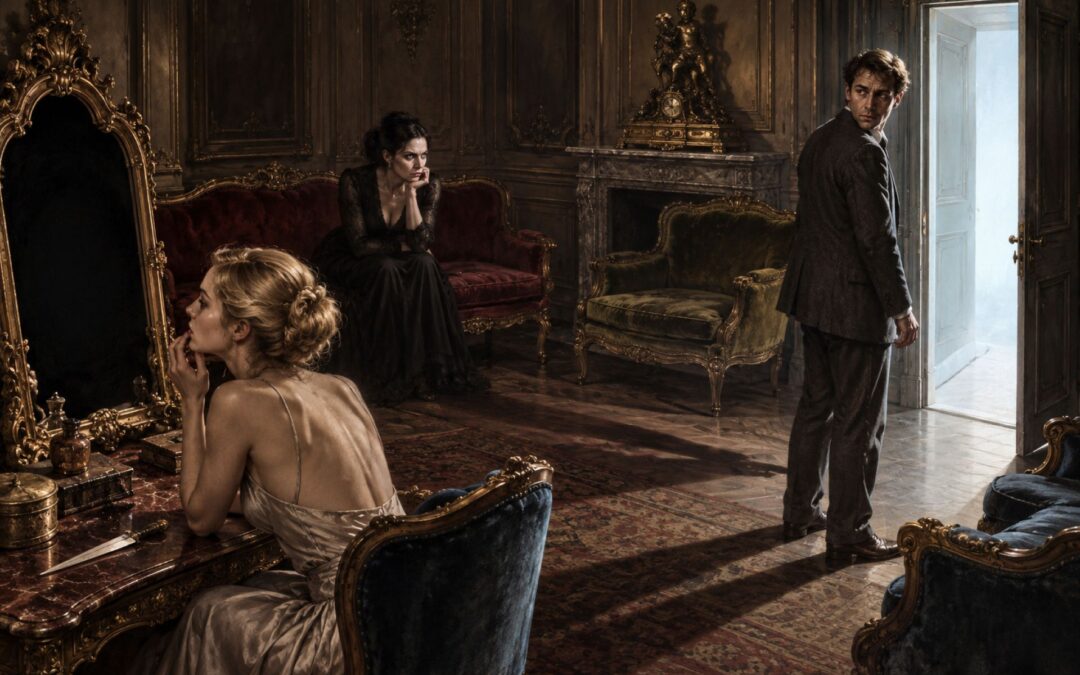
Jean-Paul Sartre’s No Exit begins with a familiar expectation of hell and then removes almost everything conventionally associated with it. There are no flames, demons, racks, or instruments of torture. Instead, three dead people are placed together in a respectable but unpleasant Second Empire drawing room where they cannot sleep, cannot escape one another’s presence, and cannot control how the others see them.
First performed in Paris in 1944 and published by Gallimard in 1945, as documented in the Bibliothèque nationale de France catalogue, Huis clos—usually known in English as No Exit—is a one-act play whose compact setting contains a surprisingly elaborate psychological machine. Sartre gradually reveals that Joseph Garcin, Inez Serrano, and Estelle Rigault do not merely happen to share a room. Each possesses exactly the kind of need that another person can frustrate, and each tries to turn another free human consciousness into something controllable: a mirror, a lover, an admirer, a judge, or a source of moral absolution.
The result is much richer than the slogan for which the play is famous. “Hell is other people” does not simply mean that other human beings are irritating or that solitude is preferable to companionship. In No Exit, hell emerges when people become dependent on other people’s judgments for the identities they want to possess while simultaneously trying to dominate how those judgments are formed.
Spoiler warning: This article explains the complete play, including every major revelation and the ending.

No Exit: The Complete Plot
No Exit consists of one continuous act rather than conventional chapters or multiple acts. Its drama develops through a sequence of arrivals, failed alliances, confessions, revelations, and reversals that gradually expose why these particular three people have been placed together.
Garcin Arrives in a Hell Without Torture
Joseph Garcin enters a Second Empire drawing room accompanied by a Valet. He already knows that he is dead and appears to understand that he has arrived in some kind of afterlife, but what unsettles him is how ordinary the room seems. He expects the traditional machinery of damnation—racks, red-hot pincers, and other instruments of physical torture—but the Valet treats such expectations as naïve.
The room is furnished with heavy sofas and an ugly bronze ornament. There are no mirrors and no windows. Garcin notices the absence of familiar objects such as a toothbrush and bed, and the Valet gradually makes him understand why: the normal bodily routines of life no longer matter. More disturbingly, there is no sleep. The lights remain on continuously, and Garcin realizes that he will never experience the small interruptions that sleep, darkness, or even blinking once provided.
This is his first glimpse of what his punishment may involve. Garcin describes the horror of consciousness without interruption. During life, even a troubled person can sleep and temporarily escape himself; here, there will be no such break. He will remain awake indefinitely with his own mind.
He also tests the physical limits of the room. There is a bell that theoretically summons the Valet, but it does not work reliably. There is a door, but it appears locked. The bronze ornament cannot easily be moved. A paper knife lies in the room even though there are no books requiring one.
Once the Valet leaves, Garcin tries the bell repeatedly and then pounds on the door. Nothing happens. He becomes calm only when the door suddenly opens again—not to release him, but to admit another occupant.
Inez and Estelle Complete the Triangle
The second arrival is Inez Serrano. Her first concern is not Garcin but a woman named Florence. When Inez sees Garcin instead, she assumes that he must be the torturer assigned to her.
Garcin is offended and insists that he is merely another condemned person. Inez explains that he looks frightened, which is why she mistook him for a torturer; she knows what frightened people look like because she has often watched herself in a mirror. Even before the nature of the room becomes clear, Inez is unusually attentive to the relationship between fear, appearance, and self-observation.
Garcin tries to establish a civilized arrangement. He suggests that the two of them remain courteous, give one another space, and avoid unnecessary conflict. Inez immediately resists. She notices the nervous movements of his mouth and tells him that even his face intrudes on her because they are no longer alone.
The third occupant, Estelle Rigault, then arrives with the Valet. Seeing Garcin with his face partly covered, she momentarily thinks he may be someone she knew who had been horribly disfigured. Once she realizes her mistake, the three introduce themselves.
Their attitudes toward death are revealing. Inez bluntly acknowledges what has happened. Estelle dislikes crude words such as “dead” and prefers to call them “absentees,” as though elegant vocabulary could soften reality. She has died of pneumonia only recently. Inez says she died because of gas. Garcin was executed by firing squad.
For a time, all three can still see scenes from Earth. Garcin watches his wife outside the barracks associated with his execution. Estelle observes her funeral. These visions allow them to see how life continues without them, but they are powerless to intervene.
Estelle soon asks the question that drives the next phase of the play: why have precisely these three people been placed together? Garcin prefers to believe it is an accident of administration. Inez rejects that possibility. The furniture, colors, temperature, and arrangement of the room seem too carefully chosen. More importantly, their personalities have been matched too precisely.
Inez asks why each of them is in hell.
Estelle initially claims there must have been some administrative mistake. She tells a polished story about being orphaned young, sacrificing herself by marrying an older wealthy man so she could support her brother, and later meeting a younger man whom she loved but refusing to run away with him. Her version presents her as dutiful and unlucky rather than guilty.
Garcin offers an equally flattering explanation. He says he ran a pacifist newspaper and was executed because he remained faithful to his principles during wartime. Estelle readily treats him as heroic.
Inez refuses to participate in their self-justification. She tells them that people are not sent to hell by mistake. All three, she insists, have caused suffering.
She then understands the room’s design. There is no official torturer because none is necessary. Each of the three occupants will function as the torturer of the other two.
The Silence Plan Fails and Inez Becomes Estelle’s Mirror
Garcin believes he can defeat this arrangement through discipline. If the three occupants simply ignore one another, he argues, they cannot become one another’s punishment. Each person should remain in a separate corner, say nothing, and focus inward.
Inez agrees. Estelle reluctantly agrees as well.
The plan almost immediately collapses.
Estelle needs a mirror. During her life she surrounded herself with mirrors and watched herself while talking to other people. Seeing her own reflection helped her feel real and allowed her to monitor how she appeared. In hell, however, there are no mirrors.
Without one, Estelle becomes anxious about whether her lipstick is properly applied. More deeply, she begins to feel uncertain of her own existence when she cannot see herself from the outside.
Inez offers to become her mirror.
She invites Estelle to look into her eyes and promises to describe what she sees. The offer gives Inez immediate power. Estelle cannot independently verify whether Inez is telling the truth. Inez briefly pretends there is an ugly blemish on Estelle’s face simply to demonstrate how easily a human mirror can lie.
The episode exposes a fundamental problem that will control the rest of the play. A physical mirror reflects without desire, resentment, or intention. A human consciousness does not. The moment Estelle depends on another person to reflect her back to herself, that reflection becomes unstable because the other person has motives of her own.
Inez’s motive is attraction. She desires Estelle and tries to turn the mirror relationship into intimacy. Estelle, however, is uncomfortable with Inez’s desire and remains preoccupied with whether Garcin is looking at her. She wants male attention because male desire plays a central role in the identity she wants to maintain.
Garcin tries to continue ignoring both women, but Inez forces him to recognize that the strategy is impossible. Another person’s presence cannot simply be erased by refusing to speak. She hears him moving and breathing. She feels his attention even when it is withheld. His silence becomes as intrusive as speech.
The three cannot create separate private worlds inside the same room.
Garcin therefore abandons the experiment. If they cannot ignore one another, he decides, they should at least become completely honest about why they have been condemned.
The Confessions: What Garcin, Inez, and Estelle Did
Garcin goes first and immediately revises his heroic story.
His political actions may have contributed to his execution, but he admits that he treated his wife with sustained cruelty. For years he came home drunk after sleeping with other women. His wife rarely protested, which seems to have made his cruelty easier rather than restraining it. He deliberately exploited her passivity because he enjoyed making her suffer.
At one point he brought another woman into their home and effectively forced his wife to tolerate the humiliation. His wife even served coffee to Garcin and his lover the next morning.
Garcin insists that he does not regret what he did, but his manner reveals a more complicated relationship to his past. He despised his wife’s submissiveness while depending on her admiration. He wants to see himself as strong, but much of his behavior consisted of inflicting pain on someone who would not fight back.
Inez’s confession is different because she makes fewer attempts to beautify herself.
She had been living with her cousin and his wife, Florence. Over time Inez became increasingly irritated by her cousin and attracted to Florence. She gradually inserted herself into Florence’s emotional life and persuaded her to see the world through Inez’s eyes.
The cousin later died after being struck by a tram. Inez repeatedly told Florence that the two women had effectively killed him together. Their relationship became psychologically destructive, with Inez deliberately intensifying Florence’s guilt and dependence.
Inez describes cruelty almost as a condition of her own existence. She needs to make someone else suffer in order to feel fully alive. When alone, she feels herself diminish.
Eventually Florence responded in the most final way possible. One night, while Inez slept, Florence turned on the gas and returned to bed. Both women died.
Inez recognizes that this is not a noble story. She does not claim innocence and does not expect pity.
Estelle continues resisting confession longer than either of them. Garcin and Inez force her to explain the man with the damaged face whom she feared seeing when she first entered the room.
The truth is much darker than her earlier story.
Estelle had an affair with a younger man named Roger. She became pregnant, although she did not want a child. To conceal the pregnancy, she went to Switzerland for several months. Roger accompanied her and was delighted when she gave birth to a daughter.
Estelle was not.
Soon after the birth, she took the baby onto a balcony overlooking a lake. In front of Roger, she tied a heavy stone to the child and threw her into the water. Roger watched helplessly as the ripples spread across the lake.
Estelle returned to Paris and resumed her life. Roger later killed himself.
Even after recounting the infanticide, Estelle frames Roger’s suicide mainly as an inconvenient or excessive reaction. Her denial is not simply about concealing facts from others. She seems to require an image of herself in which those facts do not define her.
With all three histories exposed, Garcin begins to understand the precision of their arrangement. They are not merely guilty people imprisoned together. Their emotional needs interlock.
Each person has become indispensable to another person’s suffering.
Earth Disappears and Garcin’s Cowardice Takes Over
Although the three are dead, they initially retain glimpses of the world they have left. These connections gradually vanish, which makes the room increasingly self-contained.
Inez sees that her former room has been rented to new occupants. Strangers move into the space where her earthly life unfolded. Eventually she loses the ability to see or hear what happens there.
Estelle watches a more painful scene involving her friend Olga and a young man named Peter. Peter had admired Estelle and described her in idealizing language. Estelle does not really love him, but his admiration helped sustain the image she wanted of herself.
Olga takes Peter dancing and begins telling him the truth about Estelle, including her affair with Roger, the pregnancy, and the child’s death. Estelle becomes frantic because she realizes she can no longer control the version of herself that Peter carries.
Her distress is revealing. She wants to remain alive inside Peter’s image of her as pure, beautiful, and desirable. Once he knows what she did, that reflection changes beyond her control.
Eventually Estelle loses contact with the scene. Earth recedes completely.
She turns toward Garcin and asks him to hold her.
Inez watches with jealousy. Estelle wants Garcin because he is a man; Inez wants Estelle; Garcin initially seems distracted from both of them by a different concern.
His former colleagues on Earth are discussing him.
The full truth about Garcin’s execution now emerges. He did not simply remain in place and allow himself to be shot for refusing military service. He took a train toward the frontier, intending to escape to Mexico and establish a pacifist newspaper there. He was caught before he could complete the plan.
His problem is not merely that he fled. It is that he cannot determine why he fled.
Garcin insists that he had principles and had carefully thought through his actions. He wanted to make a political stand. But Inez presses him on the question he fears: were those really his motives, or were they arguments constructed after fear had already decided what he would do?
Garcin has asked himself the same question repeatedly. While imprisoned before his execution, he examined his motives obsessively. He hoped that the manner of his death would settle the issue. If he faced the firing squad bravely, he believed, then courage at the end would prove that he had not been a coward.
But he admits that his death was not courageous enough to give him certainty.
Now his former colleagues are deciding the question for him. They regard him as a coward, and because Garcin is dead, he cannot return to Earth and perform some new action that might overturn their verdict. His reputation is passing out of his control.
His wife has also died, removing another person who might have carried a different version of him.
Garcin turns to Estelle in desperation. If one person believes absolutely that he was courageous, perhaps that person’s judgment can outweigh all the others.
Estelle says what he wants to hear. She tells him that she could love him and that she does not regard him as a coward.
For a moment, Garcin thinks this might save him.
Inez destroys the illusion.
She points out that Estelle does not truly care whether Garcin was courageous. Estelle wants a man who desires her. If calling him heroic will produce that desire, she will call him heroic. Her reassurance therefore has no authority because Garcin does not believe she has seriously judged him.
He cannot accept praise merely because it is favorable. He needs judgment from someone whose intelligence and honesty he respects.
That person is Inez.
The Door Opens, but Garcin Refuses to Leave
Garcin finally reaches the point where he can no longer tolerate the psychological pressure of the room. He pounds on the door and demands release.
He says he would prefer the traditional tortures he expected when he first arrived. Fire, physical mutilation, racks, and instruments of pain would be easier to endure than the ceaseless mental pressure of being watched, judged, and interpreted by people he cannot control.
Then the impossible happens.
The door opens.
For the first time, Garcin appears physically free to leave.
Inez invites him to go.
He does not.
The decision reveals the true nature of his imprisonment. Garcin explains that he must remain because of Inez. She understands cowardice, shame, cruelty, fear, and self-deception. Unlike Estelle, she understands the moral question that torments him.
Precisely because Inez is intelligent enough to judge him seriously, her judgment matters.
Garcin therefore wants to convince her that he is not a coward.
He tries to argue that a life cannot fairly be reduced to one action. He had always tried to be courageous, he says. He deliberately chose difficult paths. Surely a man who consistently willed himself toward courage cannot become a coward simply because of a single moment of flight.
Inez answers with a harsher philosophy. Whatever Garcin imagined himself to be, she argues, his life is now complete. A person is ultimately what that person actually did.
Garcin responds that he died too soon. He could have performed other actions that proved what kind of man he really was.
But everyone dies at some point. His future possibilities have ended. There will be no new earthly action that settles the question.
Inez realizes how completely Garcin now depends on her. She cannot be physically forced into changing her judgment. He can threaten her, but he cannot seize her thoughts with his hands. He must persuade her.
Estelle attempts to provide Garcin with an alternative. She urges him to kiss her and use their intimacy to hurt Inez. Garcin briefly participates, but Inez refuses to disappear into the background. She narrates what she sees and turns herself into an entire imaginary audience watching and condemning him.
Garcin finally understands.
Looking at the bronze ornament he noticed when he first arrived, he recognizes why the room required no physical torturer. Nothing had been forgotten. The real instruments of punishment were already present.
The others’ eyes are enough.
This is the moment in which he reaches the play’s most famous conclusion: “Hell is—other people!”
Estelle still thinks she can solve the immediate problem by getting rid of Inez. She grabs the paper knife and stabs her repeatedly.
Nothing happens.
Inez is already dead. A knife cannot kill her again.
The uselessness of the paper knife completes the play’s rejection of physical violence as a solution. Garcin cannot destroy Inez’s judgment, Estelle cannot eliminate Inez’s gaze, and Inez cannot force Estelle to desire her.
The three realize that this arrangement will continue indefinitely.
After a long silence, Garcin accepts that they are still together and that the conflict will resume.
The Room: How Sartre Builds Hell Without Physical Torture
The room in No Exit is sparse enough to seem almost theatrically neutral, yet nearly every restriction built into it serves the same purpose: it denies the characters ordinary forms of withdrawal. Sartre does not construct a detailed supernatural universe with elaborate rules. He creates only as much afterlife machinery as the psychological experiment requires.
Permanent light is among the most important features. Garcin quickly understands that there will be no sleep and therefore no unconscious interval during which he can cease thinking about himself or the others. Even blinking becomes symbolically significant to him because it represents the tiny moments of darkness that once interrupted perception. Hell means uninterrupted awareness.
The absence of mirrors performs a related function. A normal mirror offers an impersonal reflection. Estelle can look at herself without negotiating with another consciousness. Once mirrors disappear, however, she must rely on someone else to tell her how she appears, and that person brings desire, jealousy, cruelty, and interpretation into the act of reflection.
The door initially seems to represent the most obvious form of imprisonment. As long as it remains locked, the audience can imagine that the characters are trapped mainly because external authority prevents them from leaving. The later opening of the door destroys that explanation. Garcin’s imprisonment survives even after physical confinement temporarily disappears.
The bell performs a smaller version of the same trick. It suggests that there may be an administration outside the room capable of responding, but it functions inconsistently. The characters cannot organize their existence around reliable intervention from elsewhere.
Even the furniture contributes to the punishment. The Second Empire décor is not terrifying in the conventional sense. It is ordinary, tasteless, respectable, and socially recognizable. Hell arrives in the form of a bourgeois drawing room rather than a volcanic landscape, which makes the central horror interpersonal instead of spectacular.
Sartre also keeps the metaphysics deliberately incomplete. The audience never receives a systematic explanation of who designed the room, what authority governs it, or why every rule works as it does. That absence is not a flaw in the dramatic design. The room is less a theological map of the afterlife than an environment engineered to make privacy, unconsciousness, and control over one’s own image impossible.
Garcin, Inez, and Estelle: Character Analysis
The three permanent occupants of the room are not interchangeable examples of selfishness. Each has a different strategy for turning other people into instruments of self-definition, and each is vulnerable to a different kind of judgment. Their punishment works because those strategies collide.
Garcin: Cowardice, Cruelty, and the Need for a Verdict
Garcin initially appears the most reflective member of the trio. He wants to understand the room, control his behavior, and prevent interpersonal conflict. He proposes silence, introspection, and mutual courtesy because he believes rational discipline can preserve some private independence.
His past complicates that self-image. Garcin repeatedly presents himself as principled, yet his treatment of his wife shows a pattern of cruelty toward someone unable or unwilling to resist him. He humiliates her through infidelity and exploits the admiration she continues to feel for him.
This matters because Garcin’s central obsession is masculinity and courage. He wants to believe he is a strong man who acts according to principle. Much of his private history, however, contains behavior that allowed him to feel powerful without confronting an equal opponent.
His wartime flight exposes the contradiction directly. Garcin may genuinely have held pacifist convictions. Nothing in the play requires the conclusion that every political principle he professed was fraudulent. The problem is that he cannot know whether principle actually motivated his decisive action.
He tries to solve that uncertainty by turning courage into a permanent identity. If he is essentially courageous, then his flight can be interpreted as principled. If he is essentially a coward, the same act becomes evidence of fear.
Inez refuses that form of reasoning. She repeatedly drags him back from identity to behavior.
Garcin’s tragedy is therefore not simply that other people accuse him unfairly. It is that he wants another person to deliver a final verdict that resolves a question he cannot settle from inside himself. Once he recognizes Inez as an intelligent and unsentimental judge, he becomes dependent on her.
That dependence explains the ending more clearly than any supernatural barrier does. Garcin is offered the possibility of walking through an open door but refuses because escape would mean leaving Inez unconvinced.
His freedom becomes subordinate to his need for a verdict.
Inez: Lucidity, Cruelty, and the Power of the Gaze
Inez is the character who most quickly understands what the room is designed to do. She rejects the fantasy of administrative error, recognizes that there is no need for an official torturer, and sees through the flattering stories told by Garcin and Estelle.
Her lucidity does not make her morally superior.
Inez openly describes herself as cruel. In her relationship with Florence, she deliberately sought emotional control and seems almost energized by another person’s suffering. She understands that she requires other people as intensely as Garcin and Estelle do, even if she is more honest about the dependence.
Her desire for Estelle is central to the dramatic triangle. Inez wants Estelle to see herself through Inez’s eyes, which is why becoming Estelle’s “mirror” is so important. She is not merely offering visual information; she is trying to become the consciousness through which Estelle understands herself.
Yet Inez cannot force Estelle to value that reflection.
Estelle wants to be desired by men. Inez can admire her, describe her beauty, and offer intimacy, but Estelle does not grant Inez’s desire the same validating power she grants Garcin’s. That refusal turns Inez’s perceptiveness into another source of suffering.
Inez therefore occupies an unusual position. She understands the game better than the others, but understanding does not place her outside it. She can diagnose dependency while remaining dependent herself.
This distinction also matters when discussing her sexuality. Inez is a lesbian woman, and her attraction to Estelle is structurally essential because it creates one side of the triangle. But her cruelty is established by her manipulation of Florence and her willingness to exploit weakness. The play should not be interpreted as though homosexuality itself were her offense or punishment.
Estelle: Appearance, Desire, and Denial
Estelle initially seems the least philosophical member of the trio. She cares about furniture, clothes, lipstick, social manners, and whether others find her attractive. Yet these concerns are not superficial distractions from the play’s deeper themes. They are her route into them.
Estelle experiences herself through appearance.
Her dependence on mirrors makes this explicit. She does not merely enjoy checking her appearance; she becomes existentially unsettled when she cannot see herself. A reflected image helps her stabilize a version of herself that feels more trustworthy than private consciousness.
Other people serve the same function.
Peter’s admiration mattered because he saw Estelle as delicate, beautiful, and pure. When Olga tells him about Roger, the pregnancy, and the baby, Estelle experiences the destruction of that image almost as another death.
Her relationship with Garcin follows the same logic. She wants him to desire her because male desire confirms the femininity and attractiveness she wants to possess as stable facts.
Her denial of responsibility is correspondingly extreme. She murders her infant daughter in front of Roger, yet initially claims not to understand why she has been sent to hell. Even when the truth emerges, she continues to frame Roger’s suicide as an excessive reaction rather than confronting the full significance of her own action.
Estelle therefore demonstrates a particularly radical form of dependence on external appearance. If others continue to see her as beautiful and desirable, she can momentarily avoid being the person who drowned her child.
That strategy collapses in hell because the available observers already know what she did.
The Valet and the Absent Living
The Valet appears only briefly, but his calm professionalism establishes the strange bureaucratic normality of the afterlife. He answers practical questions while refusing to explain the larger system. His ordinariness makes the room more disturbing because damnation has become administrative rather than spectacular.
The offstage living and recently dead characters perform a different function. Garcin’s wife represents the admiration he exploited and later loses. Gomez and the newspaper colleagues become the public judgment Garcin cannot answer. Florence embodies both Inez’s desire and her cruelty. Roger becomes the witness to Estelle’s most horrifying act, while Peter carries the idealized image of Estelle that she desperately wants to preserve.
These people need not appear physically onstage because their power lies in being remembered, imagined, or observed from a distance. Each helps demonstrate that identity in No Exit is never purely private. Even absent people continue to participate in how the dead understand themselves until those earthly connections finally disappear.
Why the Triangle Cannot Stabilize: Desire, Judgment, and Dependence
The architecture of No Exit becomes clearest when the three relationships are considered together. Inez wants Estelle, Estelle wants Garcin, and Garcin ultimately needs Inez. The desires do not form reciprocal couples; they circulate.
If Estelle returned Inez’s desire, Garcin might become irrelevant to them. If Garcin believed Estelle’s moral judgment, Inez might become irrelevant to him. If Inez accepted Garcin’s preferred interpretation of himself, he might be able to leave her judgment behind.
None of those conditions occurs.
Estelle wants Garcin because he is a man whose desire can confirm her attractiveness. She cannot accept Inez as an adequate substitute because the source of recognition matters to her. Inez’s admiration is therefore simultaneously intense and insufficient.
Garcin has the opposite problem with Estelle. She is willing to praise him, but precisely because she cares so little about courage, her approval becomes worthless. He wants a judge, not merely an admirer.
Inez supplies the seriousness Estelle lacks. She understands fear, shame, cruelty, motive, and self-deception, which makes her judgment credible to Garcin. Unfortunately for him, her judgment is hostile.
Every attempted alliance therefore preserves the excluded third. When Garcin and Estelle move toward physical intimacy, Inez continues watching. When Inez attempts to create a private relation with Estelle, Estelle remains concerned with Garcin. When Garcin seeks Inez’s recognition, Estelle tries to distract him through desire.
This makes the room more than a collection of incompatible personalities. It is a self-sustaining system in which every person requires another free consciousness while simultaneously resenting that consciousness for remaining free.
None of them wants merely to be seen.
Each wants to control the seeing.
Existentialism in No Exit: The Look, Bad Faith, Freedom, and Responsibility
No Exit is often treated as if Sartre converted a philosophy textbook into dialogue, but the play works better when the philosophy is allowed to emerge from the dramatic situation. The concepts associated with Sartre clarify why the room functions as it does, but the characters remain dramatic personalities rather than simple labels.
Sartre’s philosophical concerns also differ in important ways from those associated with Albert Camus. Readers who know Camus’s The Stranger will recognize a shared twentieth-century concern with meaning, responsibility, and human existence, but No Exit is especially focused on interpersonal consciousness: what happens when another person’s gaze becomes part of how we experience ourselves.
The Look and Being-for-Others
The most useful philosophical framework for understanding No Exit is Sartre’s idea that another person changes the structure of my experience simply by perceiving me. The Stanford Encyclopedia of Philosophy’s discussion of existentialism connects Sartrean interpersonal conflict with No Exit and explains the broader problem of becoming an object within another person’s world.
The point is not that another person magically creates my entire identity. It is that the other person possesses a perspective on me that I cannot fully control.
Estelle experiences this problem through beauty. She can privately think she is attractive, but she wants to know how she appears from outside herself. A mirror once provided an apparently neutral answer. In hell, she has only other people.
Inez offers exactly what Estelle needs and therefore immediately gains power.
Garcin’s version is moral rather than aesthetic. He wants to know whether he is brave. His own belief does not satisfy him because he suspects that self-interpretation can be dishonest. He therefore searches for an external consciousness whose judgment he trusts.
The other person becomes dangerous because that consciousness remains free to reach a conclusion different from the one he wants.
This is why physical violence cannot solve the central problem. Garcin could overpower Inez’s body, but he cannot reach into her mind and force her judgment to change. Estelle can stab Inez, but she cannot destroy the consciousness that sees her.
The other person’s freedom is precisely what makes the desired validation valuable and impossible to guarantee.
Bad Faith and the Stories the Characters Tell About Themselves
Bad faith in Sartrean philosophy is more complicated than ordinary lying. A liar usually knows the truth and deliberately tells something else to another person. Bad faith involves a person participating in a distorted interpretation of himself, often by trying to become a fixed identity that removes uncomfortable freedom, ambiguity, or responsibility.
All three main characters construct such identities.
Estelle wants to be the beautiful and desirable woman reflected in admiring eyes. The facts of the murdered child and Roger’s suicide threaten that identity, so she initially behaves as though those events somehow fail to explain her presence in hell.
Garcin wants to be a courageous man. Instead of treating courage as something repeatedly established through actions, he wants courage to become an essence that determines the meaning of ambiguous behavior. If he “is” courageous, then his flight must have been principled.
Inez is less self-deceptive than either of them. She openly acknowledges her cruelty and understands the interpersonal trap. Yet even she tries to use Estelle as an object that can satisfy her desire and confirm her importance.
The play therefore does not divide neatly into two deluded characters and one enlightened philosopher. Inez’s insight gives her power, but insight alone does not transform the way she relates to others.
Freedom, Action, and the Fixed Life
One of the most difficult tensions in No Exit concerns the relationship between freedom and finality.
The characters are dead. Their earthly lives are complete, which means they cannot perform new actions in the world that revise what those lives amounted to. Garcin can no longer return to his colleagues and demonstrate courage through some future decision.
This gives Inez’s argument enormous force. Garcin wants to be evaluated according to what he intended to become. She insists that the available evidence is his completed life.
Yet Sartre avoids making the characters completely passive.
The open door is crucial because it introduces a new choice after death. Garcin is physically capable of leaving the room, at least at that moment, but decides not to leave.
His freedom has not disappeared. He uses it badly.
The decision also prevents the ending from becoming a simple deterministic punishment in which supernatural authorities control everything. Hell works partly because the characters continue reproducing its logic themselves.
Garcin could walk away from Inez’s judgment. He refuses because he values being vindicated by her more than he values leaving.
The room therefore combines real constraints with self-sustaining choices. The dead cannot change the earthly past, but they can still reveal what they value through their present actions.
What “Hell Is Other People” Actually Means
The line “Hell is other people” has become so famous that it is often detached from the play that gives it meaning. Read casually, it can sound like a cynical joke about irritating neighbors, difficult families, or the general unpleasantness of social life.
That interpretation is too broad.
The hell of No Exit arises from a particular kind of relationship. Garcin, Inez, and Estelle repeatedly try to establish themselves through another person’s gaze while refusing to accept the other person as an independent consciousness whose response cannot be controlled.
Estelle wants Garcin to reflect desirability back to her.
Garcin wants Inez to reflect courage back to him.
Inez wants Estelle to accept the identity and desire Inez offers her.
Each therefore needs another person while resenting that person’s independence.
The resulting conflict is not equivalent to the claim that every relationship is necessarily infernal. A useful corrective appears in Réseau Canopé’s discussion of Sartre, freedom, and relations with others, which emphasizes that the famous line should not be reduced to a declaration that all human contact is intrinsically unbearable.
That qualification matters because Sartre’s problem is relational structure, not mere proximity. Other people become hell when another consciousness is treated as both indispensable and controllable—when someone needs a free judgment but simultaneously demands that the judgment produce a predetermined answer.
There are also serious competing interpretations of how literally the audience should understand the apparent metaphysics of punishment. Philosopher Jonathan Webber’s discussion, “There Is Something About Inez”, challenges overly simple assumptions about what the play’s setup proves philosophically.
Such interpretations do not erase the central dramatic fact. Whatever the ultimate metaphysical status of the room, Garcin’s refusal to leave shows that his dependence on another person’s judgment has become more binding than the physical door.
Mirrors, Eyes, Light, the Door, and the Paper Knife
The recurring objects and sensory conditions in No Exit reinforce its central conflicts, but they should not be treated as a code in which every item possesses one fixed allegorical meaning. Some motifs are strongly integrated into the action; others gain significance mainly through their dramatic placement.
Mirrors and Eyes
Mirrors form the play’s most important symbolic network.
Estelle once surrounded herself with mirrors and used them to monitor herself while speaking. Reflection allowed her to see herself as others might see her while still keeping the process under her own control.
Hell removes that protection.
When Inez becomes Estelle’s mirror, reflection becomes interpersonal. Estelle is no longer dealing with glass but with a consciousness capable of attraction, dishonesty, jealousy, and cruelty.
Eyes therefore replace mirrors.
Inez can see Estelle in a way Estelle cannot see herself. Garcin wants Estelle and later Inez to look at him in particular ways. Inez promises that she will continue watching even when Garcin wants privacy.
The eye becomes both confirmation and threat.
The deeper problem is that a human gaze cannot be made neutral. Estelle wants accurate reassurance about her beauty, Garcin wants authoritative reassurance about his courage, and both discover that another person’s perception arrives with motives of its own.
Light, Sleep, and Perpetual Exposure
The permanent light prevents physical darkness, but its importance is psychological. Garcin immediately notices that without sleep there will be no interruption in awareness.
Life once contained pauses.
A person could sleep, wake, become distracted, leave a room, or temporarily escape another person’s presence. The afterlife strips away those intervals.
Hell is therefore not simply intense pain. It is continuity without respite.
Inez intensifies that condition by refusing Garcin the fantasy that he can create mental privacy through silence. Even if nobody speaks, each person remains perceptible to the others.
Permanent light and permanent company serve the same dramatic purpose: nothing can be switched off.
The Door and the Bell
The bell and the door represent two possible forms of external escape.
The bell suggests assistance from outside the room, but it is unreliable. Sometimes it may work; sometimes it does not. The characters cannot build a dependable relationship with whatever administration exists beyond the walls.
The door initially seems more absolute. It is locked, and therefore the characters appear to be physically imprisoned.
Its eventual opening is one of the play’s most important reversals because it removes the simplest explanation of their condition.
If Garcin remained only because supernatural force prevented him from leaving, then the room would still be an ordinary prison with philosophical decoration. When the door opens and he stays, imprisonment becomes partly voluntary.
He would rather remain and attempt to conquer Inez’s judgment than walk away while she still thinks him a coward.
The open door therefore reveals how thoroughly the external prison has been internalized.
The Bronze Ornament and the Paper Knife
The bronze ornament appears near the beginning and returns at the moment of Garcin’s final recognition. He notices it because it is heavy, ugly, unavoidable, and apparently useless. It becomes part of the fixed environment against which his thoughts repeatedly move.
At the end, Garcin is again looking toward the bronze object when he realizes the design of the room. Its significance does not require an elaborate hidden allegory. Its dramatic power comes partly from continuity: something that seemed merely tasteless when he arrived remains present when he finally understands where he is.
The paper knife has a more explicit structural function.
When Garcin first notices it, the object seems absurd because there are no books. Much later, Estelle uses it to stab Inez.
The weapon turns out to be just as useless as Garcin initially suspected, though for a different reason. Inez has already died.
Physical violence cannot remove the gaze.
The object that might belong to a conventional murder scene therefore becomes evidence that conventional physical solutions no longer apply.
How No Exit Is Written: One Room, One Act, Endless Repetition
The dramatic power of No Exit depends heavily on compression. Sartre requires one room, four onstage characters, and only three permanent occupants to construct a complete system of desire, guilt, judgment, and dependence.
The one-act form prevents escape not only for the characters but also for the audience. There are no large changes of scenery or separate narrative strands. The pressure accumulates in a single environment.
Most exposition arrives through conflict rather than neutral narration. The audience learns about Garcin’s wife because Inez pushes him beyond his political self-description. Estelle’s infanticide emerges because Garcin and Inez interrogate her. Garcin’s desertion becomes fully visible only when his need for reassurance forces him to reveal more.
Confession therefore does not simply provide backstory. Each disclosure changes the balance of power in the room.
The play also allows Earth to remain dramatically present without ever leaving the set. Characters describe what they can still see happening below. These visions perform several functions at once: they reveal what each character values, show the living world continuing without them, and gradually remove their remaining external sources of identity.
Dark comedy keeps the claustrophobia from becoming monotonous. Estelle worries about furniture while already dead. The expected torture chamber resembles a drawing room. The paper knife is used against someone who cannot die. The absurdity intensifies rather than weakens the horror because the characters repeatedly apply ordinary social habits to an impossible condition.
The structure is also circular. At the beginning, Garcin expects torture and searches the room for the instrument that will cause it. At the end, he realizes that the instrument was present all along in the form of the other two occupants.
Even the audience participates indirectly in this design. We watch characters who are tormented by being watched. Garcin fears an invisible crowd judging him, while an actual theatre audience sits beyond the stage doing exactly that. Sartre does not need to state this relationship explicitly for the staging to make it available.
English-speaking readers should also distinguish Sartre’s dramatic construction from the specific texture of any translation. The widely circulated English version associated with Stuart Gilbert sometimes contains diction that now feels period-specific. Scholarship on the play’s performance and translation history, including a Cambridge Theatre Research International discussion of Huis clos, helps separate the enduring structure of the play from the historical sound of a particular English rendering.
What has not aged is the efficiency of the dramatic mechanism. Almost nothing can be removed without weakening the structure. Mirrors matter because Estelle needs reflection. Inez matters because Garcin needs credible judgment. Estelle matters because Inez needs desired reciprocity. The door matters because its opening proves that the final prison cannot be explained by architecture alone.
The play does not progress toward liberation.
It progresses toward perfect understanding of why liberation keeps failing.
The Ending Explained: Why Garcin Refuses the Open Door
The ending of No Exit is often summarized through the famous line alone, but the decisive event occurs slightly earlier: the door opens, and Garcin chooses not to leave.
Literally, he has been given the opportunity he demanded. He has just said that he would prefer physical torture to remaining with Inez and Estelle. When the barrier disappears, however, he stays.
His reason is Inez.
Garcin does not need affection from her. He needs a verdict.
Estelle is willing to give him the answer he wants, but her answer has no value because she has not seriously considered the question. Courage is irrelevant to her. She wants Garcin’s body and attention, so she will say whatever helps her keep them.
Inez is different. Garcin recognizes that she understands the moral vocabulary at stake. She understands cowardice because she understands fear, shame, cruelty, and self-deception.
That makes her judgment painful but authoritative.
Garcin therefore remains in the room to convert an enemy.
If he can make Inez sincerely believe that he is courageous, he thinks, he will finally possess the identity he has been trying to secure.
But his project contains a contradiction. Inez’s judgment would matter only if it remained genuinely hers. If he could simply command or coerce her into praising him, the praise would become as worthless as Estelle’s.
Garcin therefore needs Inez to be free enough to judge him honestly and simultaneously needs that free judgment to arrive at the answer he has already chosen.
That is the trap.
Inez understands it immediately and exploits it. Garcin can threaten her, but he cannot strangle a thought. Physical strength gives him no control over her conclusion.
This is also why Estelle’s final attack on Inez matters. Estelle tries to solve the triangle physically by removing the unwanted observer. She stabs Inez, only to rediscover the obvious fact that everyone in the room is already dead.
The problem is not Inez’s vulnerable body.
The problem is the consciousness that judges.
The famous declaration that hell is other people therefore arrives after Sartre has eliminated every simpler explanation. Hell is not merely a locked door, because the door opens. It is not physical pain, because Garcin explicitly prefers physical torture. It is not ignorance, because the characters eventually understand what is happening. It is not even merely guilt about the past, because their suffering depends on how another person interprets that past.
Garcin’s hell is that he needs the judgment of someone he cannot control.
Estelle’s hell is that she needs a desired reflection she cannot secure.
Inez’s hell is that she needs reciprocated desire from someone who rejects her.
The three know all of this by the end.
Knowledge changes nothing because none of them changes the structure of what they want.
The final attempted stabbing proves that the old methods cannot work. The open door proves that physical escape is insufficient. The continuation after both discoveries proves that awareness by itself is not freedom.
This is why the ending is so bleak.
The characters are not merely trapped with one another.
They continue choosing the terms on which the others remain necessary.
Critical Review: Why No Exit Still Works—and Where It Narrows
The great achievement of No Exit is its dramatic economy. Sartre takes a philosophical problem that could easily become abstract—the dependence of selfhood on other people’s judgments—and gives it concrete theatrical form through a room, three personalities, and a handful of objects.
The premise is simple enough to understand immediately, but the relationships become progressively more intricate. Garcin needs Inez precisely because she dislikes him. Estelle needs Garcin because his gender matters to the kind of validation she wants. Inez needs Estelle even though she knows that wanting Estelle gives Estelle power over her.
That triangular design is stronger than the famous slogan because it demonstrates rather than merely declares the underlying idea.
The mirror scene is especially effective. Sartre could have explained philosophically that another person’s consciousness is not equivalent to a neutral reflecting surface. Instead, Estelle asks Inez to function as a mirror, and Inez immediately reveals why the substitution is dangerous. She can lie. She can desire. She can withhold reassurance. The philosophical problem becomes visible through ordinary dramatic behavior.
The open door is an even greater accomplishment.
Until that moment, the audience can attribute the characters’ misery to supernatural imprisonment. Opening the door forces a new interpretation. Garcin stays because leaving would not solve the question controlling him.
The reversal transforms an intellectual claim about dependency into a choice performed onstage.
The characterization is more complicated. Garcin, Inez, and Estelle possess recognizable psychological needs, but each is also unusually concentrated around a philosophical problem. Garcin wants moral validation, Estelle wants reflected desirability, and Inez wants power through lucid perception and possessive desire.
This concentration gives the play extraordinary clarity.
It can also make the characters feel schematic.
The confessions occasionally reveal the pressure of the one-act form. Entire earthly lives must enter the room through dialogue, so conversations sometimes carry more exposition than naturalistic speech normally would. The device works because the disclosures are adversarial, but the machinery is visible.
Inez is probably the most dramatically successful of the three because her self-awareness prevents her from becoming merely a hypocrite exposed by the plot. She knows that she is cruel. She knows that Estelle is her weakness. She understands that everyone is trapped.
Yet she cannot convert understanding into freedom.
Garcin develops through a different kind of contradiction. His desire to be courageous is not necessarily fraudulent. He may genuinely value courage and political principle. His failure lies in demanding a final identity that exempts him from the ambiguity of his actions.
The play is strongest when it refuses to settle the question too easily. Was Garcin fundamentally a coward? His flight is evidence, but the drama is more interesting because he wants an ontological answer where perhaps only a history of actions exists.
Estelle is deliberately less introspective, but she should not be dismissed as merely vain. Her obsession with beauty reveals one of the play’s clearest forms of dependence. She has organized her sense of existence around being visible and desired.
Her infanticide makes her morally horrifying, yet the more philosophically important feature is how quickly she tries to keep that action from becoming part of the identity reflected back to her.
The portrayal of Inez also creates a legitimate historical difficulty. She is a lesbian character whose desire is intertwined with manipulation and cruelty. A modern reading should acknowledge how easily that combination can participate in damaging stereotypes.
At the same time, reducing Inez to a stereotype would flatten the play in the opposite direction. Her sexuality is not presented as a sufficient explanation of her damnation. Her cruelty, manipulation of Florence, and willingness to exploit others provide independent moral grounds for judging her behavior.
Translation further complicates stylistic evaluation. Readers encountering older English versions may find some expressions dated, melodramatic, or socially distant. Those features should not automatically be treated as limitations of Sartre’s original French.
What survives translation exceptionally well is structure.
The play also contains a philosophical tension that cannot simply be wished away. Sartrean existentialism is strongly associated with freedom and responsibility, yet the dead characters appear trapped inside completed lives and increasingly fixed reputations.
The open door partly resolves that tension.
Garcin cannot rewrite his earthly past, but he can still choose whether to leave. He chooses dependence.
That decision suggests that hell is not the total abolition of freedom. It is partly the continuing misuse of whatever freedom remains.
The play’s narrowness is therefore both its limitation and its artistic strength. There is little world-building beyond what the room requires. Secondary characters exist mostly through memories and judgments. The protagonists have almost no opportunity to display ordinary generosity, curiosity, humor, work, friendship, or sustained tenderness.
Sartre has deliberately removed the broad texture of life because he wants to isolate a mechanism.
Readers looking for naturalistic fullness may find the result severe.
Readers willing to accept the experiment receive one of modern drama’s most efficient philosophical constructions.
Its continuing relevance is easy to understand without forcing an artificial modernization onto it. Garcin, Inez, and Estelle are obsessed with how they appear to others, whether other people believe their preferred self-descriptions, and whether reputation can become more powerful than private conviction.
Those questions remain recognizable in any culture where identity is socially negotiated.
The temptation to translate No Exit directly into a lesson about social media would be too simplistic. Sartre’s problem is broader and older. Human beings have always depended partly on other people for recognition, testimony, love, reputation, and social meaning.
What the play asks is what happens when that dependence becomes absolute.
Its most famous sentence has probably harmed as well as helped its reputation. “Hell is other people” is memorable enough to make the play seem simpler than it is.
Read in context, the line is not an adolescent declaration that everyone else is unbearable.
It is the endpoint of an argument dramatized through action: another person can become hell when I make that person responsible for delivering an identity I cannot establish alone, while refusing to accept that the other remains free to see me differently.
That is why No Exit still deserves to be read rather than merely quoted.
Its plot is small, its room is cramped, and its cast is tiny, but the play turns those restrictions into precision. Sartre creates a hell in which nobody needs to be burned, beaten, or physically mutilated because each person arrives carrying exactly the need another person can frustrate forever.
For readers interested in modern drama, existential philosophy, moral psychology, or the unstable relationship between private identity and public judgment, No Exit remains essential. Its characters do not discover that escape is impossible; they discover something more disturbing—that even when an exit appears, they may still prefer the struggle to control another person’s judgment over the freedom of walking away.
Last Updated on October 12, 2026 by Aseem Gupta