
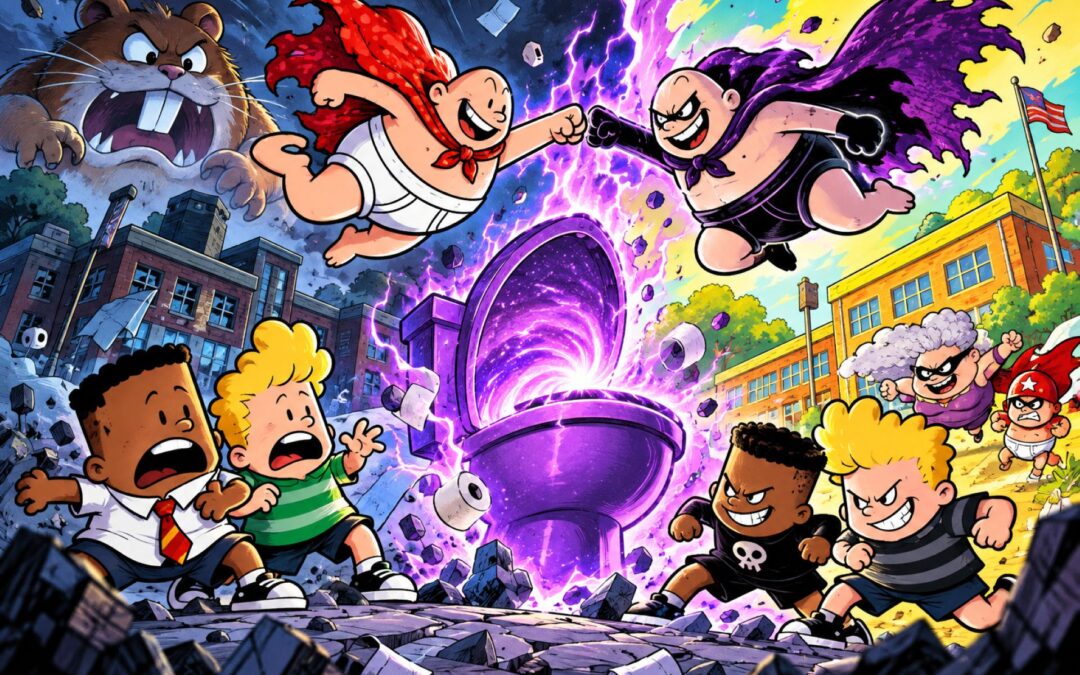
What happens when two mischievous boys enter a parallel universe where their terrible teachers are suddenly kind, their familiar enemies are harmless, and the most dangerous people in school are evil versions of themselves? That is the premise of Captain Underpants and the Preposterous Plight of the Purple Potty People, the eighth book in Dav Pilkey’s illustrated children’s series. First published in 2006, the novel combines alternate realities, hypnotised animals, gigantic monsters, duelling superheroes, and an unexpected rescue by two elderly relatives.
Beneath its deliberately ridiculous humour, the story explores an interesting distinction: George Beard and Harold Hutchins enjoy causing trouble, but their pranks are different from the cruelty practised by their alternate-universe counterparts. The boys must confront distorted versions of themselves while navigating a world where appearances, identities, and expectations continually reverse. Pilkey develops this premise through short chapters, cartoon illustrations, comics created by the protagonists, and interactive Flip-E-Rama action sequences.
The novel is also an unusually self-aware children’s adventure. Its narrator jokes about storytelling conventions, openly acknowledges improbable developments, and repeatedly builds dramatic expectations only to overturn them. The resulting adventure depends as much on its narrative form and illustrations as on its plot.
Spoiler warning: This article covers the complete story, including the defeat of the Purple Potty People, the appearance of Boxer Boy and Great-Granny Girdle, and the final cliffhanger involving Tippy Tinkletrousers.

How the Purple Potty Creates a Backwards World
The story begins with an illustrated recap of George Beard, Harold Hutchins, and their extraordinary history with Captain Underpants. George and Harold are fourth-grade friends who love playing practical jokes and creating comic books. Their greatest creation is Captain Underpants, a ridiculous superhero wearing little more than underwear and a cape.
Unfortunately, Captain Underpants is not merely a fictional character. George and Harold previously hypnotised their unpleasant school principal, Mr. Krupp, into believing that he was the superhero they had invented. Whenever someone snaps their fingers, Mr. Krupp transforms into Captain Underpants, and water changes him back into his ordinary identity. Subsequent adventures have also given Captain Underpants genuine superpowers, making his transformations considerably more dangerous.
The recap establishes another unusual part of the boys’ lives: their pets, Sulu the hamster and Crackers the pterodactyl. These extraordinary animals have accompanied George and Harold through earlier adventures and become essential to their escape from danger.
The immediate predicament follows the events of the preceding novel, in which the boys acquired and misused a machine called the Purple Potty. Created by their classmate Melvin Sneedly, the machine allows travel through time. George and Harold have made a mistake involving its operation on consecutive days, producing an unexpected journey rather than the trip they intended.
Instead of arriving in the prehistoric past, they find themselves back at Jerome Horwitz Elementary School. At first, the setting appears familiar, but almost everything about the school is strangely improved.
The school librarian welcomes children who want to read. This is particularly astonishing because the librarian George and Harold know is generally hostile toward books and reading. The alternate librarian’s enthusiastic attitude during Banned Books Week establishes the first unmistakable sign that they have entered a very different environment.
The differences continue throughout the school. Teachers behave compassionately, the cafeteria serves genuinely enjoyable food, and the adults seem interested in helping children instead of punishing them. Even Melvin, normally an irritatingly intelligent rival, behaves with surprising foolishness.
These developments make sense only when contrasted with the ordinary school established at the beginning of the novel. In George and Harold’s world, Mr. Krupp is a miserable authoritarian who seems to regard children’s happiness as something requiring punishment. His colleagues are similarly unpleasant, and George and Harold’s practical jokes have become their principal method of resisting the adults who dominate their school lives.
The alternate school initially appears to offer everything the boys might want. Its teachers are friendly, its students seem comfortable, and the atmosphere is considerably more welcoming than the one they have left behind.
George gradually recognises a pattern. People who are unpleasant in his universe behave kindly here, while familiar personalities appear to have been reversed. The boys have not simply travelled to a different time; they have entered a parallel universe where the moral characteristics of familiar people are often inverted.
Harold responds to the situation with jokes about how implausible their adventure has become. The narrator participates in this humour, refusing to pretend that the elaborate dimensional explanation makes conventional scientific sense.
However, the discovery becomes much less entertaining when George and Harold encounter two boys who look exactly like them.
These counterparts are not friendly reflections. They are wicked versions of George and Harold, apparently possessing the same imagination and enthusiasm for comic books but using their abilities for malicious purposes.
The contrast introduces the story’s central conflict. In the ordinary universe, two mischievous children struggle against cruel adults. In the alternate universe, the adults are generally kind, but two children have become the principal source of cruelty.
The boys quickly realise that their apparent holiday in a better world may be considerably more dangerous than their familiar life at school.
Evil Twins, Captain Blunderpants, and the Kidnapped Pets
George and Harold decide that remaining in the parallel universe is too dangerous. Their immediate plan is to return to the Purple Potty and escape before their evil counterparts discover them.
Unfortunately, the situation has already become complicated.
Before exploring the alternate school, George and Harold concealed Crackers and Sulu in a locker. When they return, the pets are missing. The boys discover evidence that their evil doubles have taken the animals, turning what might have been a straightforward escape into a rescue mission.
Their counterparts have also left behind a comic book. Its title, The Preposterous Plight of Captain Blunderpants, introduces the parallel universe’s version of Captain Underpants.
The embedded comic reveals that Evil George and Evil Harold have created their own superhero. However, whereas the original boys invented a ridiculous but fundamentally well-intentioned champion, their counterparts have created a villain.
The alternate version of Mr. Krupp is naturally a pleasant and accommodating principal. The evil twins exploit his agreeable disposition and use hypnosis to transform him into Captain Blunderpants, a criminal counterpart to Captain Underpants.
Like the original superhero, Captain Blunderpants possesses an extraordinary costume and operates according to bizarre transformation rules. His villains’ origin story involves an absurd chain of events and the acquisition of genuine superpowers through a mishap involving pizza.
More importantly, he can be controlled through the same basic mechanism as Captain Underpants. Snapping fingers and exposure to water change him between his superhero identity and his ordinary principal’s personality.
This similarity becomes crucial later because it gives George and Harold a way to defeat an enemy who would otherwise be overwhelmingly powerful.
The comic also reveals something about the evil twins’ personalities. They possess the creativity and visual imagination associated with the real George and Harold, but their inventions serve selfish and destructive purposes. Rather than creating a character who rescues people, they have manufactured someone who can steal things and intimidate others on their behalf.
The contrast between the two Captain characters is therefore not merely a joke about names or costumes. It reveals how the same imaginative act can produce dramatically different consequences depending on the intentions behind it.
Meanwhile, George and Harold discover where their pets have been taken. Their evil counterparts have brought Crackers and Sulu to an alternate version of their familiar tree house.
The boys attempt to recover the animals, but the evil twins have already begun exploiting another characteristic of the Captain Underpants universe: hypnosis.
They hypnotise both pets and attempt to transform them into obedient instruments of wrongdoing. Sulu becomes aggressive toward his original owners, creating a particularly disturbing development because he has previously been their loyal companion.
The threatened attack forces George and Harold to confront a problem they cannot solve through ordinary practical jokes. They cannot simply fight Sulu without harming an animal they love, and abandoning him would mean leaving their friend under the control of the evil twins.
Crackers, however, does not respond in the same way. When the boys are threatened, the pterodactyl intervenes and rescues them.
His actions provide the first major escape from the evil twins’ immediate control. Carrying the boys away, Crackers allows them to flee the tree house and reach the Purple Potty.
Yet their escape remains incomplete because Sulu has not been rescued. George and Harold must retreat while knowing that their hamster is still under the influence of the villains.
The evil twins and the alternate Mr. Krupp pursue them, and the attempted escape becomes a chaotic struggle around the dimensional machine.
The Purple Potty malfunctions as the characters attempt to use it, producing another unexpected consequence. Instead of carrying only George, Harold, and Crackers back to their original world, the machine also transports the pursuing villains.
The boys have escaped the alternate universe, but they have accidentally brought its greatest threats home with them.
This reversal establishes the novel’s larger pattern. Each apparent solution creates another problem, and every escape from danger introduces an opportunity for the villains to become even more troublesome.
Escape, Return, and the Purple Potty Invasion
George and Harold emerge from the Purple Potty inside the familiar surroundings of their original school. The difference between the two universes becomes immediately apparent.
The friendly atmosphere has vanished. The ordinary school is once again unpleasant, and the adults behave with their usual hostility toward children.
Ordinarily, this environment would be something George and Harold wanted to escape. After discovering the dangers concealed within the apparently wonderful alternate world, however, even their miserable school feels reassuringly familiar.
Their relief does not last.
The evil twins have followed them into the original universe, bringing Evil Sulu and the alternate Mr. Krupp with them. Rather than being frightened by their displacement, the villains recognise that this new world offers additional opportunities for mischief and criminal behaviour.
The alternate principal is especially useful to them. His ordinary personality is friendly and cooperative, but the twins can transform him into Captain Blunderpants whenever they need a powerful accomplice.
Using the transformation rules established in their comic, the villains turn Nice Mr. Krupp into his superhero identity. Captain Blunderpants is now free to cause trouble in the original universe, where his evil conduct can be combined with the twins’ knowledge of George and Harold’s surroundings.
The situation also creates the possibility of a confrontation between two nearly identical superheroes. Captain Underpants and Captain Blunderpants have comparable powers and transformation mechanisms, but they operate on opposite sides of the conflict.
George and Harold realise that they must recover Sulu, defeat their counterparts, and send the intruders back to their own universe.
They begin collecting equipment that might help them accomplish these goals. Their supplies include a Hypno-Ring, Super Power Juice, and other extraordinary devices accumulated through earlier adventures.
The preparation reflects the familiar structure of a Captain Underpants story. Rather than relying solely on their superhero, the boys attempt to develop a practical plan using their knowledge of bizarre inventions and the vulnerabilities of their enemies.
However, an unexpected obstacle interrupts their preparations.
George’s father insists that the boys participate in a family dinner celebrating Grandparents Day. The gathering is an ordinary family obligation, apparently unrelated to the danger threatening their world.
George and Harold are frustrated because they regard the rescue of Sulu as considerably more urgent than spending an evening with relatives.
The interruption initially appears to be another joke about adults failing to understand children’s priorities. In narrative terms, however, it establishes the circumstances for the book’s most surprising intervention.
The equipment George and Harold have collected, particularly the Super Power Juice, will have consequences they do not anticipate.
Super Supper and the Adventures of Boxer Boy and Great-Granny Girdle
At the family gathering, George and Harold find themselves surrounded by relatives who have no idea that a group of dangerous visitors from another universe is threatening their ordinary lives.
Among those attending are Harold’s grandfather and George’s great-grandmother. The two elderly relatives are affectionate toward the boys and interested in their creative activities.
George and Harold have prepared a comic book featuring them as superheroes. The story is titled The Adventures of Boxer Boy and Great-Granny Girdle, and it imagines the elderly pair acquiring extraordinary abilities and rescuing other grandparents from exploitation.
The embedded comic begins with a strange commercial enterprise designed to replace ordinary grandparents with robotic substitutes.
These mechanical grandparents, known as Robo-Geezers, represent a grotesque version of technological convenience. They allow families to obtain artificial elderly relatives while discarding the actual people who have become inconvenient.
The original grandparents are consequently displaced and forced into miserable conditions. The villains responsible for this arrangement treat the elderly as disposable objects rather than individuals deserving affection and respect.
The narrative exaggerates these ideas into absurd science-fiction comedy, complete with ridiculous inventions and cartoonish cruelty.
The heroic transformation occurs when the elderly protagonists acquire superpowers through unusual sweets. Harold’s grandfather becomes Boxer Boy, while George’s great-grandmother assumes the identity of Great-Granny Girdle.
Their names and costumes deliberately transform ordinary items associated with old age into the equipment of superhero adventure.
Boxer Boy uses his exaggerated physical abilities and elderly-themed accessories to fight the robotic enemies. Great-Granny Girdle similarly converts an apparently unthreatening older woman’s appearance into the disguise of a powerful fighter.
Together, they defeat the Robo-Geezers and liberate the imprisoned grandparents.
The comic follows a recognisable superhero formula: an injustice creates a need for intervention, apparently powerless individuals acquire extraordinary abilities, and the transformed heroes defeat an oppressive enemy.
What makes the story distinctive is the choice of protagonists. Instead of presenting youth, muscularity, and conventional attractiveness as requirements for heroism, the boys imagine their elderly relatives performing spectacular feats of courage and strength.
The premise also contains an affectionate joke about the relationship between grandparents and grandchildren. George and Harold may find aspects of their relatives embarrassing, but they are willing to imagine them as heroes rather than burdens.
Back at the actual dinner, however, something important has happened without the boys understanding its significance.
Their grandfather and great-grandmother have consumed a drink they believe to be ordinary juice. In reality, it is the Super Power Juice that George and Harold had collected during their preparations.
The apparent accident provides a link between the fictional comic and the main adventure.
At this stage, the characters do not fully understand what has occurred. The dinner eventually ends, and George and Harold return their attention to the threat posed by their alternate-universe counterparts.
The reader has nevertheless been given the information necessary to understand the unexpected rescue that will occur later.
Pilkey has temporarily interrupted the main adventure to tell another story, but the interruption is not entirely independent. The superhero identities imagined in the comic, the real relatives attending dinner, and the accidentally consumed drink are all elements of a carefully prepared narrative payoff.
Giant Sulu, Captain Underpants, and the Rainstorm
While George and Harold are occupied with their family gathering, their evil counterparts continue exploring the original universe.
The twins discover a machine called the Goosy-Grow 4000, which can enlarge living things. Like many of the inventions in the Captain Underpants series, its extraordinary abilities are matched by its potential for disastrous misuse.
The villains initially enlarge Evil Sulu through an accident. However, they quickly recognise that the enlarged hamster can be useful to them.
They increase his size even further, transforming him into an enormous monster capable of terrorising the surrounding city.
The change is particularly dangerous because Sulu remains under the effects of the villains’ hypnosis. He is no longer simply a familiar pet who has been stolen from his owners; he has become a gigantic weapon serving people who actively enjoy causing harm.
The evil twins intend to use the hamster as a distraction while they pursue their own criminal activities.
Their plan works because an enormous hamster wandering through a city naturally attracts considerable attention. Sulu crashes into George’s backyard and begins creating chaos, forcing the protagonists to respond immediately.
George and Harold recognise that the monster is their own pet, although his enormous size and hostile behaviour make him almost unrecognisable.
They also understand that the evil twins have gained access to dangerous technology and are now capable of threatening far more people than the pupils and teachers at school.
The boys attempt to use the equipment they collected earlier. Unfortunately, the Super Power Juice is missing.
This absence eliminates one possible solution and prepares another connection to the interrupted family dinner.
With their supplies proving unreliable, George and Harold decide to summon Captain Underpants.
They use the familiar finger-snap transformation, changing their principal from the unpleasant Mr. Krupp into the enthusiastic superhero.
Captain Underpants immediately embraces the opportunity to fight the gigantic hamster. As usual, his confidence far exceeds his strategic understanding, but his genuine superpowers make him capable of confronting a monster that ordinary people cannot safely approach.
The ensuing battle is presented partly through Flip-E-Rama, Pilkey’s interactive illustration technique in which readers rapidly flip between paired images to create the illusion of movement.
The fight turns a series of exaggerated blows into a miniature animated action scene. It is not designed to offer realistic combat or subtle choreography. Instead, its appeal comes from the sheer absurdity of an underwear-clad superhero battling an enormous hypnotised hamster.
Captain Underpants eventually knocks the monster unconscious, producing what appears to be an important victory.
Unfortunately, the conflict has not ended.
The evil twins and Captain Blunderpants arrive after robbing a bank. Their entrance creates the prospect of a confrontation between the original superhero and his malicious counterpart.
Both heroes possess spectacular powers. Both are absurdly dressed. Both have been created through hypnosis involving different versions of Mr. Krupp.
The narrative encourages readers to anticipate a tremendous battle between them.
George and Harold, however, recognise that they already know how to defeat Captain Blunderpants.
Instead of allowing the fight to develop, George snaps his fingers and transforms the evil superhero back into Nice Mr. Krupp.
The anticipated showdown ends almost immediately.
This deliberately anticlimactic moment is one of the novel’s clearest examples of self-aware humour. Pilkey builds excitement through the prospect of a conventional superhero battle, then resolves it through a simple rule already established in the embedded comic.
The boys temporarily gain control of the villains, and the situation once again appears manageable.
The apparent victory proves fragile because the two superheroes share another transformation rule.
Rain begins to fall.
For Captain Underpants, water restores the ordinary Mr. Krupp, removing the boys’ most powerful ally from the battle. Unfortunately, the same rain also transforms Nice Mr. Krupp back into Captain Blunderpants.
The balance of power reverses in an instant.
George and Harold are now left with their ordinary hostile principal instead of a superhero protector, while their enemies once again possess an exceptionally dangerous champion.
The shared rules that initially allowed the boys to defeat Blunderpants have become a disadvantage because the weather affects both characters.
The boys escape with Crackers and return to their tree house, hoping to obtain another invention that can change the situation.
There they locate the Shrinky-Pig 2000, a device capable of reducing the size of its target.
They plan to use the machine against the villains and possibly restore Sulu from his monstrous condition. Unfortunately, Captain Blunderpants catches up with them before they can execute their plan.
The evil twins gain control of the shrinking device, threatening George and Harold with the consequences of their own intended solution.
By this point, the boys have exhausted several familiar strategies. They have tried collecting useful equipment, summoning Captain Underpants, exploiting hypnosis, and escaping through superior mobility.
Each method has either failed or produced a temporary advantage that the villains have subsequently reversed.
The novel brings the protagonists to a situation in which they no longer appear capable of rescuing themselves.
The solution arrives from the least expected direction.
The Grandparents’ Rescue and the Final Cleanup
Just as George and Harold face defeat, Harold’s grandfather and George’s great-grandmother arrive to confront Captain Blunderpants.
The evil superhero has little reason to regard two elderly relatives as serious opponents. They seem physically incapable of threatening someone with extraordinary powers, and their appearance is inconsistent with conventional superhero imagery.
However, their ordinary appearance conceals an extraordinary transformation.
The relatives have unknowingly consumed the Super Power Juice during dinner. As a result, they possess the extraordinary abilities that George and Harold had originally hoped to use during their rescue mission.
Inspired by the comic book the boys created about them, the elderly pair assume the superhero identities of Boxer Boy and Great-Granny Girdle.
Their transformation establishes that the comic’s ridiculous premise has effectively become part of the main adventure.
The details of their costumes and fighting techniques deliberately preserve the comic’s eccentric humour. Rather than abandoning the exaggerated characteristics associated with their age, they incorporate them into their superhero identities.
Their everyday accessories become weapons, their unconventional costumes become symbols of heroic confidence, and their devotion to their grandchildren provides the immediate reason for intervention.
Boxer Boy and Great-Granny Girdle attack Captain Blunderpants through another Flip-E-Rama sequence.
Their exaggerated movements allow readers to participate in the spectacle of two supposedly harmless grandparents overpowering a powerful villain.
The scene works partly because it contradicts the expectations established by the preceding conflict. George and Harold’s familiar protector has been neutralised, their equipment has been captured, and the evil doubles believe they have won.
Yet the one event that appeared irrelevant to the adventure—the family dinner—has created the means of their rescue.
The confrontation also demonstrates the difference between the heroes and the villains. The grandparents use their powers to protect their grandchildren, while the evil twins have consistently used their creations to control and harm others.
As the battle continues, George recognises what happened to the missing Super Power Juice. The explanation connects the earlier dinner scene to the grandparents’ present abilities and removes the mystery surrounding the misplaced drink.
The twins still possess the Shrinky-Pig 2000, but Harold discovers an opportunity to exploit their confidence.
Rather than attempting to overpower them, he tricks them into turning the shrinking machine around.
The villains consequently activate the device in the wrong direction and shrink themselves to an extremely small size.
Their defeat is appropriate to their personalities. They have relied on intimidation, deception, and superior equipment throughout the story, only to become victims of their own willingness to use a dangerous invention without thinking carefully about the consequences.
A further Flip-E-Rama sequence supplies their slapstick punishment, reducing the once-threatening evil twins to figures of physical comedy.
With Captain Blunderpants defeated and the twins neutralised, the protagonists finally regain control of the situation.
The grandparents celebrate their victory, but their behaviour produces another surprise.
Boxer Boy and Great-Granny Girdle express romantic affection for each other, much to the disgust of George and Harold.
The reaction is consistent with the novel’s treatment of childhood expectations. The boys can enthusiastically imagine their elderly relatives as spectacular superheroes, but the possibility that those relatives might have romantic feelings is apparently much harder for them to accept.
Their discomfort provides a final comic reversal after the grandparents’ unexpected display of heroism.
Despite the victory, important practical problems remain.
Sulu is still enormous, the alternate-universe visitors must be returned to their own world, and the Purple Potty adventure cannot be considered finished until its consequences have been reversed.
The book handles these remaining tasks with extraordinary speed.
George and Harold use the shrinking machine to restore Sulu to his ordinary size, returning their pet to the familiar condition he occupied before the villains exploited him.
The story compresses this development into an extremely brief illustrated sequence, treating what could have been an elaborate technical problem as something requiring almost no additional explanation.
A similarly abbreviated sequence sends the alternate-universe visitors back through the Purple Potty.
The abruptness is deliberate. Pilkey has already devoted considerable space to the escalating danger and the grandparents’ rescue, so the narrative turns the remaining cleanup into another joke about storytelling.
Instead of providing a lengthy account of returning every character, managing the machines, and restoring normal conditions, the book resolves these issues almost immediately.
For George and Harold, the outcome appears successful.
Their pets have been rescued, the dangerous doubles have been defeated, and the visitors from the backwards universe are no longer threatening their home.
The adventure also produces an unexpected personal victory: their elderly relatives have proven themselves capable of extraordinary heroism, even though the boys find the resulting romance embarrassing.
However, the novel has one final reversal prepared.
The Ending Explained: False Victory and Tippy Tinkletrousers
The closing chapters begin with George and Harold apparently free from danger. Sulu has been restored, the evil twins have been removed, and the destructive consequences of the Purple Potty malfunction seem to have been corrected.
Harold celebrates the successful conclusion of their adventure, expressing confidence that nothing terrible will happen next.
George is less optimistic. His experience with previous disasters has taught him that such assurances are usually followed by another catastrophe.
His suspicion proves justified almost immediately.
Police officers arrive and arrest the boys for the bank robbery committed by their evil counterparts. Because the criminals looked exactly like George and Harold, the ordinary children are now being blamed for an offence they did not commit.
This development provides a final consequence of the parallel-universe premise. The evil doubles have returned home, but the results of their actions remain in the original world.
The boys’ victory over their counterparts has therefore failed to protect them from mistaken identity and the consequences of the twins’ crimes.
The situation worsens when another familiar enemy appears.
Professor Poopypants, a villain from an earlier adventure, returns in an enormous robotic pair of trousers. He announces that he now wishes to be known as Tippy Tinkletrousers.
The absurdity of his new name does not make him harmless. He carries a weapon capable of freezing people and uses it against the police officers who laugh at him.
His arrival interrupts the attempted arrest and establishes a new threat directed at George and Harold.
The novel ends without resolving their confrontation with Tippy.
The Purple Potty adventure itself has reached a practical conclusion: the alternate villains have been defeated, Sulu has been rescued, and the visitors have been sent home. Yet the consequences of the twins’ bank robbery and the appearance of another villain prevent the protagonists from enjoying a secure ending.
The final reversal also continues a running joke about Harold’s tendency to celebrate too early. His confidence that the adventure has ended becomes the signal that something else is about to go wrong.
Structurally, the ending serves two purposes. It completes the principal storyline while creating a cliffhanger that leads into the next Captain Underpants book.
The appearance of Tippy Tinkletrousers should therefore be understood as the beginning of another conflict rather than an unexplained part of the Purple Potty villains’ plan.
Pilkey deliberately denies the boys a conventional conclusion in which every problem disappears. The novel’s immediate danger has been overcome, but the larger comic world remains unstable, unpredictable, and capable of producing another catastrophe at any moment.
The Two Worlds and the Rules of the Story
The alternate universe is the novel’s most important setting because it allows Pilkey to reverse familiar relationships without completely changing the surrounding world.
Jerome Horwitz Elementary remains recognisable in both realities. Its basic institutional structure, familiar personalities, and everyday routines provide continuity, but the behaviour of the people occupying those roles changes dramatically.
In the ordinary universe, the school is dominated by hostile authority figures. Mr. Krupp resents children, the teachers frequently appear indifferent to their wellbeing, and George and Harold use practical jokes to resist an environment that gives them little control over their lives.
The alternate school reverses those expectations. Its principal is kind, its teachers are welcoming, and its facilities appear designed to meet children’s needs.
The familiar school consequently becomes a place of possibility rather than an institution organised around punishment.
However, the alternate universe is not an uncomplicated paradise.
Its most dangerous inhabitants are Evil George and Evil Harold, who possess the creativity of the protagonists without their compassion. The kind adults cannot entirely prevent the twins from behaving cruelly, and their willingness to exploit Nice Mr. Krupp demonstrates how friendliness can become a vulnerability when confronted by malicious people.
The differences between the two settings create an interesting contradiction. The original world has unpleasant adults and fundamentally decent children, while the alternate world has pleasant adults and dangerous children.
This reversal allows the story to separate personal morality from familiar appearances and social roles.
A principal is not automatically admirable because he occupies a position of authority, and children are not automatically innocent simply because they are young. The decisive distinction lies in what individuals choose to do with the opportunities and abilities available to them.
The Purple Potty itself provides the mechanism that connects the worlds, but Pilkey does not attempt to construct a scientifically rigorous explanation of dimensional travel.
The machine exists primarily to create narrative possibilities. Its malfunction brings the protagonists into an inverted reality, and its subsequent operation allows villains from that reality to invade their ordinary surroundings.
Other inventions follow the same general principle. The Goosy-Grow creates a giant hamster, the Shrinky-Pig reduces the size of its targets, and the Super Power Juice transforms seemingly ordinary people into superheroes.
These devices have identifiable functions, but the novel is less concerned with their engineering than with their consequences.
The rules governing Captain Underpants and Captain Blunderpants are especially important. Their finger-snap and water transformations provide both solutions and complications, demonstrating that a consistent comic rule can generate several different reversals.
The novel’s world-building is therefore functional rather than encyclopedic. Readers are given enough information to understand what the devices do and why particular events follow, without being asked to believe that the story operates according to realistic physical laws.
Its internal logic is the logic of comic invention: extraordinary things are possible, familiar rules create unexpected problems, and the narrative repeatedly exploits the gap between what characters expect and what actually happens.
George, Harold, and Their Evil Doubles
George Beard and Harold Hutchins have always occupied an unusual position within their school. Their teachers regard them as troublemakers, but the stories consistently present their imagination, loyalty, and resourcefulness as admirable qualities.
Both boys enjoy practical jokes, write and illustrate comic books, and frequently ignore the wishes of adults. Their behaviour is not always responsible, but it is usually driven by amusement, curiosity, or the desire to challenge unreasonable authority.
The eighth novel gives those qualities a new context by introducing two characters who possess similar talents but lack the protagonists’ moral restraint.
George often functions as the more immediately analytical member of the partnership. He notices the pattern of reversals in the alternate universe and recognises the significance of the evil twins’ comic.
His ability to interpret situations helps the boys identify both dangers and opportunities. However, he is not an infallible strategist, and the pair’s reliance on unstable inventions frequently causes complications that neither of them can anticipate.
Harold contributes enthusiasm, creativity, and practical ingenuity. His comic-book imagination is inseparable from George’s, and their success usually depends on cooperation rather than individual brilliance.
He also has a recurring tendency to believe that an apparent victory means the danger has permanently disappeared.
The final chapters exploit this optimism when Harold confidently declares the adventure finished shortly before the police arrive.
Nevertheless, he is not simply the foolish member of the partnership. His deception involving the Shrinky-Pig demonstrates that he can recognise how an enemy’s overconfidence might be exploited.
The boys’ friendship is particularly important during the episode involving their pets.
They could have abandoned Sulu after he was hypnotised, especially once he became dangerous. Instead, they continue to regard him as a friend whose behaviour has been manipulated by others.
Their refusal to stop caring about him establishes a moral boundary between the original protagonists and their evil counterparts.
The alternate twins possess many of the boys’ outward characteristics. They resemble them physically, create their own comics, understand unusual inventions, and approach life with a comparable appetite for excitement.
Their intentions, however, are different.
They kidnap animals, use hypnosis to compel obedience, manipulate a trusting principal, steal money, and create a gigantic monster to distract people from their crimes.
Their imagination is directed toward domination rather than freedom.
This difference prevents the novel from equating all rule-breaking with evil. George and Harold may annoy teachers and cause disorder, but their creative activities generally aim at entertainment or rescue rather than the deliberate suffering of others.
The distinction is not absolute. The protagonists can be careless, and their experiments with dangerous equipment sometimes create serious problems. However, when those problems threaten people or animals they care about, they attempt to correct the damage.
Their evil doubles display little comparable concern for consequences.
The alternative characters are not developed through elaborate backgrounds or psychological revelations. Pilkey does not explain why they became malicious, nor does he construct an intricate account of their private motivations.
Their narrative function is to externalise the contrast between playful rebellion and genuine cruelty.
As a literary device, the doubles are effective precisely because they are recognisable but distorted versions of the protagonists. Readers do not need extensive explanations of their personalities to understand what makes them threatening.
The confrontation also forces George and Harold to face the consequences of someone else using their ingenuity without their values.
Their greatest qualities—imagination, friendship, and cleverness—become frightening when those qualities are separated from empathy.
Captain Underpants, Captain Blunderpants, and the Other Characters
The relationship between Mr. Krupp and Captain Underpants remains one of the series’ central comic devices.
As Mr. Krupp, the principal is hostile, controlling, and resentful of children’s enjoyment. As Captain Underpants, he becomes enthusiastic, courageous, and willing to confront extraordinary danger.
The transformation radically changes his behaviour without changing the basic identity of the person involved.
This contrast has always produced humour because the superhero’s exaggerated confidence and ridiculous appearance are difficult to reconcile with the ordinary principal’s personality.
The eighth novel expands the joke by introducing another version of Mr. Krupp.
Nice Mr. Krupp is a friendly principal who behaves kindly toward children. His superhero counterpart, Captain Blunderpants, is nevertheless a villain who serves the evil twins.
The inversion creates a symmetrical relationship between the two worlds.
The ordinary universe contains a cruel principal who transforms into a benevolent superhero. The alternate universe contains a benevolent principal who transforms into a malicious superhero.
This construction complicates the assumption that someone’s everyday personality necessarily determines the morality of their extraordinary alter ego.
It also creates an unusual narrative advantage. George and Harold already understand the transformation rules governing Captain Underpants, and the evil twins’ comic reveals that Captain Blunderpants operates according to the same mechanisms.
The heroes can therefore use knowledge rather than strength to defeat the villain, although the rainstorm demonstrates how easily this apparent advantage can be reversed.
Captain Blunderpants is not a psychologically complex antagonist. Like Captain Underpants, he functions through exaggeration, simple motivations, and absurd physical spectacle.
His effectiveness comes from the relationship between his powers, his resemblance to the original superhero, and the vulnerabilities produced by his transformation rules.
The two pets provide a different emotional dimension.
Crackers is the dependable rescuer whose loyalty remains intact when the boys are threatened. His ability to carry George and Harold away from danger repeatedly turns him into a means of escape as well as a companion.
Sulu has a more complicated function because the villains transform him into an unwilling enemy.
The hypnosis removes his freedom to behave as he ordinarily would, while the enlarging machine gives his manipulated behaviour catastrophic physical consequences.
The boys’ desire to rescue rather than punish him reinforces the importance of distinguishing intention from externally controlled behaviour.
The grandparents introduce another contrast between appearance and capability.
Harold’s grandfather and George’s great-grandmother initially occupy ordinary family roles. They are older relatives who attend a dinner, receive a homemade comic, and appear disconnected from the dangerous adventure taking place elsewhere.
Their transformation into Boxer Boy and Great-Granny Girdle reveals capacities that neither the villains nor the protagonists anticipated.
The elderly pair also provide an affectionate example of intergenerational loyalty. Their reason for intervening is not a grand ideological mission or personal ambition, but their determination to protect their grandchildren.
Their romantic relationship complicates George and Harold’s perception of them even further. The boys admire their heroic achievements but are embarrassed by the possibility of elderly romance, suggesting that their imaginative acceptance of older people has limits of its own.
The surrounding adults remain intentionally broad comic types.
George’s father represents the authority of family obligations when he interrupts the rescue preparations. The alternate teachers demonstrate how the familiar school could function differently, while the reversed version of Melvin contributes to the atmosphere of comic instability.
These characters are not designed for deep psychological study. Their value lies in the contrasts they introduce and the ways their behaviour affects George and Harold’s freedom to act.
Taken together, the cast demonstrates the story’s repeated rejection of appearances as reliable guides to character. A friendly principal can become a villain, an intimidating principal can become a hero, loyal pets can be forced into dangerous behaviour, and elderly relatives can turn out to be the most powerful rescuers available.
Themes: Authority, Goodness, Friendship, and Creative Power
The most important theme in the novel is the difference between mischief and malice.
George and Harold regularly disobey adults, create disruptive comics, and organise practical jokes. Their teachers regard this behaviour as evidence that they are bad children, but the story challenges the assumption that obedience is the only meaningful measure of goodness.
The evil twins provide the decisive contrast.
They share the protagonists’ creativity and interest in breaking rules, but their actions are intended to harm, exploit, and control others.
The distinction suggests that ethical character depends less on whether someone follows instructions than on whether their behaviour respects the wellbeing of other people.
This theme connects directly to the novel’s treatment of authority.
The original school is dominated by adults who possess institutional power but frequently demonstrate little wisdom or compassion. Their official positions give them the ability to punish children, yet the narrative rarely presents their decisions as morally justified.
The alternate school shows that the same institutional roles can be occupied by kinder individuals.
Mr. Krupp’s position as principal does not require him to be cruel, because his parallel counterpart demonstrates that a different personality can occupy the same office.
The difference makes the original school’s hostility appear like a failure of its adults rather than an unavoidable feature of education.
However, the parallel universe also shows that kindness alone cannot eliminate wrongdoing. Its agreeable teachers coexist with the dangerous activities of Evil George and Evil Harold.
The story therefore presents goodness and authority as separate qualities. Adults can be cruel or compassionate, and children can be imaginative helpers or malicious manipulators.
Friendship provides another central measure of character.
George and Harold remain loyal to each other when their situation becomes dangerous, cooperating through setbacks and sharing responsibility for their decisions.
Their treatment of Crackers and Sulu expands that loyalty beyond their immediate friendship.
When Sulu is hypnotised into attacking them, the boys understand that his behaviour does not reflect his ordinary character. They continue attempting to rescue him because they regard him as a companion who has been deprived of control over his actions.
Crackers responds with comparable loyalty by protecting the boys from danger.
The story consequently distinguishes genuine relationships from the coercive control practised by the villains. The evil twins use hypnosis to force obedience, while the protagonists rely on affection, cooperation, and mutual trust.
Creative power is equally important.
Both sets of boys write comics, invent stories, and understand how extraordinary devices can be used. Their creativity does not automatically make them good, because the evil twins demonstrate that imagination can serve harmful purposes.
Nevertheless, George and Harold’s ability to create stories repeatedly contributes to their success.
The Captain Blunderpants comic teaches them about their opponent’s weaknesses, while their own grandparents comic unexpectedly prepares the identities of their rescuers.
The boundary between imaginative play and practical action becomes increasingly unstable.
Something invented for amusement can become a model for behaviour, and a ridiculous fictional possibility can acquire consequences in the world beyond the comic page.
This does not mean the book literally argues that imagination possesses unlimited transformative power. Its events remain firmly within the exaggerated logic of children’s fantasy.
Rather, the narrative celebrates the capacity of creative thinking to produce possibilities that ordinary expectations would overlook.
The treatment of grandparents develops a related theme about recognising value in people who appear powerless.
The elderly pair are initially treated as loving but ordinary relatives, and the protagonists do not expect them to play an important role in the adventure.
Their transformation overturns conventional associations between physical strength, youth, and heroism.
The embedded Robo-Geezer comic pushes this reversal further by imagining a world in which older people are discarded when they cease to be convenient.
Boxer Boy and Great-Granny Girdle respond by demonstrating that the supposedly obsolete generation remains capable of decisive action.
The story approaches this subject through affectionate absurdity rather than serious social criticism, but the underlying reversal is clear.
Several recurring objects and situations reinforce these themes.
The Purple Potty represents the disruption of familiar expectations because it carries the protagonists into a world where identities and moral relationships have been inverted.
The finger-snap and water transformations repeatedly demonstrate the instability of power. A mighty superhero can become an ordinary principal through a simple gesture or a change in weather.
Comic books symbolise imagination’s ability to challenge established reality, while the ridiculous costumes of the superheroes undermine the assumption that heroism requires an impressive appearance.
Underwear, girdles, and similar everyday objects become elements of extraordinary identities.
Finally, the repeated collapse of apparent victories establishes unpredictability as a governing principle of the story.
The protagonists repeatedly believe they have solved their problems, only for another consequence of their adventure to emerge.
The final arrest and Tippy Tinkletrousers cliffhanger extend this pattern beyond the central conflict, reminding readers that the Captain Underpants universe operates through continuing disruption rather than permanent stability.
Comics, Flip-E-Rama, and Self-Aware Storytelling
The novel’s visual construction is essential to its identity. Although it contains conventional prose narration, substantial parts of the story are communicated through illustrations, child-created comics, and interactive page sequences.
Pilkey does not simply use pictures to decorate events already explained in words. His illustrations often carry the humour, establish the visual absurdity of characters, and control the speed at which readers experience action.
The drawings generally employ bold outlines, exaggerated facial expressions, and deliberately uncomplicated designs.
This simplicity makes the characters immediately recognisable and allows the pages to communicate emotion and movement without relying on elaborate description.
The novel also contains several comic-book sequences operating inside the larger narrative.
The opening comic recalls the origin of Captain Underpants and establishes information that readers need to understand the unusual transformations and supporting characters.
The Captain Blunderpants comic introduces the alternate superhero, reveals how the evil twins created him, and explains a weakness that will later become important.
The Boxer Boy and Great-Granny Girdle comic performs a different function. It presents an apparently independent adventure that becomes relevant when the grandparents acquire powers in the main story.
These sequences introduce changes in visual style and narrative perspective.
Within the main novel, readers follow George and Harold through an externally narrated adventure. Within the embedded comics, they encounter stories created by the boys themselves.
The comic inserts therefore allow the protagonists to become storytellers as well as characters.
This relationship is particularly interesting when the fictional superheroes influence the surrounding narrative. Captain Blunderpants becomes an actual threat, while Boxer Boy and Great-Granny Girdle become actual rescuers.
The comic form is not merely an interruption of the prose story; it helps produce the circumstances that determine the outcome.
Flip-E-Rama provides another distinctive technique.
The device uses paired illustrations that readers rapidly flip between to create the appearance of animated movement.
Its action sequences transform reading into a physical activity, giving readers a small degree of control over the speed and repetition of the depicted battle.
The technique is especially appropriate to Captain Underpants because the fights are intended to be funny rather than realistic. Rapidly alternating drawings can communicate exaggerated collisions, impossible movements, and absurd physical consequences more effectively than lengthy prose descriptions.
The novel uses several such sequences during the conflict with giant Sulu and Captain Blunderpants, making visual spectacle an integral part of its pacing.
Pilkey has explained in an interview about his approach to making reading enjoyable that he deliberately employed short chapters, illustrations, comics, and Flip-O-Rama sequences to engage children, particularly readers who find conventional books difficult.
That approach is visible throughout the eighth novel.
Its chapters are short, and the illustrations frequently interrupt the prose before a sequence becomes visually monotonous. Some passages move quickly through conventional narration, while others allow the drawings to communicate the central event.
The result is a book that provides frequent moments of progress and accomplishment without requiring the reader to negotiate long stretches of uninterrupted prose.
The narrative voice is similarly designed for immediacy.
The narrator regularly addresses readers directly, makes jokes about adult behaviour, introduces exaggerated terminology, and refuses to maintain the serious tone that might ordinarily accompany dangerous events.
A seemingly scientific explanation can collapse into nonsense, while an anticipated dramatic showdown may end before it properly begins.
This humour makes the narrator an active participant in the entertainment.
Rather than hiding the construction of the story, Pilkey frequently calls attention to it.
Harold’s jokes about the implausibility of the parallel universe and the narrator’s deliberate anticlimaxes invite readers to recognise familiar storytelling conventions.
The novel understands that readers may anticipate a complicated superhero battle, a lengthy technical explanation, or a satisfying conclusion. It then sometimes refuses to provide those things in the expected form.
The extremely brief chapters that resolve Sulu’s enormous size and return the visitors to their own universe illustrate this method.
A more conventional adventure might devote several chapters to repairing the remaining damage. Pilkey instead compresses the cleanup into visual jokes, suggesting that the story has already spent enough time on its central conflict.
This technique can make the pacing feel uneven, but it also prevents the narrative from becoming excessively solemn.
The prose itself favours directness, repetition, exaggerated description, and intentionally ridiculous names.
Much of the verbal humour depends on the contrast between grand storytelling language and childish subject matter. Important conflicts receive elaborate titles even when their immediate resolution involves something as simple as snapping fingers or reversing a machine.
The combination of prose, drawings, comics, animation, and direct narration produces a storytelling style that continually reminds readers of the pleasure of invention.
Its literary ambitions are different from those of a realistic children’s novel. Rather than relying on subtle character psychology or detailed descriptive prose, Pilkey creates an experience built around speed, recognisable personalities, visual participation, and comic surprise.
Critical Review: What Works, What Doesn’t, and Who Should Read It
Captain Underpants and the Preposterous Plight of the Purple Potty People succeeds most convincingly as an inventive comic adventure that expands the familiar elements of its series without abandoning the style that makes those elements entertaining.
The parallel-universe premise is particularly effective because it provides an immediate source of contrast.
Readers familiar with the ordinary school can recognise how strange the alternate world has become, while newcomers can understand the humour through the exaggerated difference between cruel and compassionate adults.
The reversal also creates a more substantial conflict than another confrontation with a conventionally wicked teacher.
By introducing evil versions of George and Harold, Pilkey makes the protagonists’ familiar characteristics part of the problem.
Their intelligence, imagination, and love of mischief become threatening when those qualities appear in characters without compassion.
This gives the story a clear moral distinction without requiring an explicitly instructional tone.
The evil twins are also valuable because they create consequences that cannot be solved merely by defeating one villain.
Their kidnapping of the pets introduces a personal obligation, their manipulation of Captain Blunderpants produces a dangerous opponent, and their bank robbery eventually results in the protagonists’ mistaken arrest.
The antagonists therefore influence the story before, during, and after their physical defeat.
However, they are more effective as a concept than as fully developed characters.
Their malicious personalities are established almost entirely through behaviour, and the novel offers little explanation for why their imagination has become so destructive.
Readers looking for complex villains or emotional development will find relatively little material beneath the deliberately exaggerated characterisation.
For the book’s intended audience and comic purpose, this limitation is unlikely to be especially damaging. The doubles need to be recognisable, threatening, and sufficiently clever to challenge the protagonists; they do not need elaborate psychological histories to fulfil those functions.
Captain Blunderpants is similarly effective as a parody rather than a distinctive personality.
His greatest contribution lies in the symmetry between his powers and those of Captain Underpants.
The shared transformation rules allow the novel to produce reversals that feel connected to information established earlier, even when the surrounding events remain fantastically improbable.
The rainstorm is an especially successful example.
The boys’ clever exploitation of Blunderpants’ vulnerability appears to resolve the threat, but the weather immediately reverses both transformations.
The same rule that created a solution creates another problem.
This is stronger narrative construction than simply introducing an entirely new danger without preparation.
The novel’s most satisfying development, however, is the intervention of Boxer Boy and Great-Granny Girdle.
The family dinner initially appears to delay the main adventure, while the grandparents’ comic seems to function primarily as an entertaining digression.
The later revelation that the elderly relatives have consumed the missing Super Power Juice connects those elements to the climax.
Their rescue is surprising because the protagonists have concentrated on conventional superhero solutions and technological equipment.
The apparent irrelevance of the dinner makes the grandparents’ arrival feel unexpected, while the earlier comic ensures that their identities have already been introduced.
This is the book’s clearest example of a comic interruption becoming an effective narrative setup.
It also gives the grandparents a more important role than their initial appearances suggest.
Their affection for the boys provides a simple motivation for their intervention, while their powers challenge the villains’ assumption that elderly people must be helpless.
The premise remains ridiculous, but the underlying action is coherent within the book’s emotional logic.
The embedded comics are another major strength.
They allow the narrative to change pace, introduce important information, and preserve the illusion that George and Harold are genuinely contributing their own stories to the larger adventure.
The Captain Blunderpants comic supplies practical knowledge, whereas the grandparents’ adventure establishes a model that later becomes real.
Both have consequences beyond their immediate entertainment value.
Flip-E-Rama is equally successful as a device for reader engagement, although its appeal depends on the format in which the book is encountered.
In a physical edition, readers can animate the drawings by flipping the pages. Digital reproductions may preserve the illustrations without recreating the same effortless physical interaction.
That difference illustrates why the series’ original material format is part of its artistic identity rather than an incidental feature.
The novel is also particularly accessible.
Its short chapters, frequent illustrations, straightforward conflict, and rapid changes in action make it approachable for children who might find dense prose intimidating.
The visual humour allows readers to understand and enjoy events even when they do not attend equally closely to every written detail.
For developing readers, this combination can provide the satisfaction of completing a substantial adventure while retaining the immediate pleasures of cartoons and comics.
The novel’s humour is nevertheless likely to divide audiences.
Many jokes depend on bathroom language, deliberately foolish names, physical embarrassment, and absurd bodily associations.
Readers who enjoy those conventions may find the relentless silliness liberating, while others may find the repetition exhausting.
The humour also varies in originality. Some reversals are genuinely clever, particularly the contrast between the two superheroes and the unexpected intervention of the grandparents. Other jokes rely primarily on exaggerated terminology or familiar cartoon behaviour.
The portrayal of adults is another limitation.
Most teachers in the ordinary universe are consistently unpleasant, and the narrative rarely offers them meaningful complexity.
The alternate universe demonstrates that adults can behave kindly, but its reversal is so comprehensive that both groups often remain caricatures.
This approach effectively supports the series’ child-centred perspective, yet it leaves relatively little room for more nuanced relationships between pupils and educators.
The treatment of old age also involves a mixture of affection and stereotypes.
The grandparents become capable and heroic, but their costumes, accessories, and romantic relationship are presented through jokes that depend on conventional assumptions about elderly people.
The overall effect is more affectionate than contemptuous, although individual readers may respond differently to the humour.
In terms of plot construction, the novel relies heavily on coincidences and convenient devices.
The Purple Potty causes dimensional trouble, the Goosy-Grow creates a gigantic monster, the Super Power Juice unexpectedly transforms the grandparents, and the Shrinky-Pig allows the villains to be defeated through a trick.
The sheer number of extraordinary inventions can make the narrative feel less like a carefully constrained adventure and more like a series of opportunities for escalating absurdity.
Yet this is also part of Pilkey’s chosen method.
The machines and transformations are not intended to support realistic scientific reasoning. They function as comic mechanisms that allow characters to create problems, reverse expectations, and discover unconventional solutions.
The more significant question is whether the book prepares its important reversals well enough for readers to experience them as satisfying.
On that measure, the results are mixed but generally successful.
The parallel-world rules and Captain Blunderpants’ vulnerabilities are established before they become decisive. The grandparents’ comic and the missing juice similarly prepare the major rescue.
The final cleanup is less satisfying as conventional storytelling.
The giant hamster is restored, the visitors are sent away, and several practical problems disappear with remarkable speed.
Readers who enjoy the detailed mechanics of an adventure’s resolution may find the abbreviated ending disappointing.
However, the sudden compression is clearly part of the book’s humour. The narrative deliberately spends its energy on the conflict and the surprise rescue rather than extending the aftermath into a technical exercise.
The final cliffhanger is more debatable.
The appearance of Tippy Tinkletrousers provides another outrageous surprise and reinforces the series’ refusal to let George and Harold enjoy uninterrupted peace.
At the same time, it prevents the book from feeling completely self-contained.
Readers who want every danger resolved within a single volume may be frustrated by the sudden arrival of another villain. Those accustomed to the series’ continuing adventures are more likely to enjoy the promise of another catastrophe.
The book’s dependence on earlier instalments also affects accessibility at the level of story continuity.
The opening comic explains important background information, but the Purple Potty malfunction, extraordinary pets, and various inventions are more immediately meaningful to readers familiar with previous adventures.
The eighth instalment can still be followed independently, but it is best experienced after the seventh book.
Its most lasting achievement is the confidence with which it treats comic storytelling as a legitimate form of reading pleasure.
Pilkey does not apologise for the drawings, interruptions, ridiculous names, or deliberately childish humour. He uses them to create a fast-moving adventure in which the reader’s imagination and physical interaction with the pages are central to the experience.
That approach gives the novel value beyond the specific absurdities of its plot.
It demonstrates how an illustrated children’s book can combine accessible language, energetic visual storytelling, memorable characters, and recurring narrative rules without becoming either overly instructional or unnecessarily complicated.
The central conflict also has enough substance to support the humour.
The difference between George and Harold and their evil doubles is clear, the grandparents’ unexpected courage provides an effective climax, and the repeated transformations create a satisfying pattern of reversals.
The novel is less successful when judged by standards of psychological depth, scientific consistency, or carefully measured realism, but those are not the qualities it primarily attempts to provide.
For children who enjoy outrageous comedy, superheroes, comics, and adventures in which seemingly powerless characters defeat intimidating opponents, this is an entertaining and inventive instalment.
It may be especially appealing to readers who prefer illustrations and short chapters to lengthy blocks of prose.
Readers seeking restrained humour, complex characterisation, or a complete ending independent of the surrounding series may find it less rewarding.
Overall, The Preposterous Plight of the Purple Potty People is a strong example of Dav Pilkey’s particular approach to children’s fiction: wildly imaginative, deliberately undignified, visually engaging, and more carefully constructed than its apparently chaotic surface might suggest.
Its greatest strength is the way it uses an inverted universe and an unexpected pair of elderly superheroes to make familiar series conventions feel surprising again. Its principal weakness is that the resulting adventure remains dependent on exaggerated caricatures, convenient inventions, and abrupt resolutions.
Those limitations rarely undermine its central purpose, which is to make reading feel energetic, participatory, and fun.
Ultimately, Captain Underpants and the Preposterous Plight of the Purple Potty People is a story about the possibilities and consequences of imagination. George and Harold confront villains who possess their creativity without their compassion, and they survive through friendship, ingenuity, and help from people nobody expected to become heroes. The result is an adventure that combines extravagant silliness with an accessible distinction between having the freedom to create trouble and choosing to harm others.
The book is best suited to younger readers who enjoy illustrated comedy and are already familiar with the Captain Underpants universe, particularly the events of Book 7. Its abrupt resolution and cliffhanger make it less effective as a completely independent story, but its imaginative premise, interactive artwork, and unexpected grandparents make it a memorable instalment in the continuing series.
Last Updated on October 15, 2026 by Aseem Gupta