
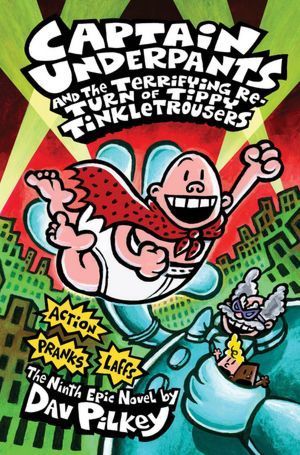
Captain Underpants and the Terrifying Return of Tippy Tinkletrousers is the ninth novel in Dav Pilkey’s illustrated children’s series, published by Scholastic in 2012. Despite its title, the book is less concerned with the return of a familiar supervillain than with the origins of George Beard and Harold Hutchins’ friendship. Through a combination of childhood adventures, elaborate pranks, time travel, and apocalyptic comedy, Pilkey explains how two mischievous kindergarteners became the creative partners responsible for inventing Captain Underpants.
The story begins with Tippy Tinkletrousers escaping prison in a gigantic robotic suit, but much of the novel takes place five years earlier, when George and Harold first meet and confront a group of older bullies led by Kipper Krupp. Their campaign against Kipper becomes increasingly inventive, eventually producing an elaborate supernatural hoax involving a fictional character called Wedgie Magee. What initially appears to be a successful victory against bullying becomes something far more consequential when Tippy’s interference changes the past and creates a future without Captain Underpants.
As the ninth installment in Scholastic’s Captain Underpants series, the novel combines familiar slapstick humor and cartoon action with an unusually complicated narrative structure. It is simultaneously an origin story, an extended comedy about resistance to bullying, and a time-travel adventure about the unintended consequences of changing history.
Spoiler warning: This article covers the complete story, including both versions of the ending, the fate of the principal characters, and the unresolved cliffhanger.
The Prison Escape and the Banana Cream Pie Paradox
The novel opens by returning to the events surrounding the previous Captain Underpants adventure. George Beard and Harold Hutchins have found themselves in trouble with the authorities because of crimes committed by their evil counterparts. Although the boys know they are innocent, the police are unwilling to accept an explanation involving alternate versions of themselves. Their predicament places them in juvenile detention, while their principal, Mr. Krupp, also becomes entangled in the consequences of the earlier adventure.
The situation grows considerably more dangerous when Tippy Tinkletrousers returns. Formerly known as Professor Pippy P. Poopypants, Tippy is a brilliant but vindictive scientist whose inventions are frequently as ridiculous as they are destructive. His newest creation is an enormous robotic suit shaped around a gigantic pair of trousers, equipped with advanced weaponry and mechanisms capable of manipulating time.
Before continuing the confrontation, Pilkey introduces an important explanation of time-travel paradoxes. The example involves a scientist whose journey into the past interferes with the history of a banana tree. Because the tree eventually supplies the bananas needed to make a cream pie, changing its history threatens the sequence of events that made the scientist’s original circumstances possible.
The Banana Cream Pie Paradox is intentionally absurd, but the idea behind it is straightforward. Events depend on earlier events, and changing something in the past may remove the conditions that produced the present. An apparently insignificant action can therefore generate consequences far beyond anything the time traveler anticipated.
This principle establishes the logic of the novel’s conclusion. Tippy does not initially intend to rewrite the entire history of Captain Underpants, but his actions eventually threaten the existence of the superhero himself.
The narrative then revisits the circumstances that led to the characters’ imprisonment. George and Harold have been accused of a bank robbery committed by their evil counterparts, and their attempts to explain the situation are dismissed. Meanwhile, Mr. Krupp experiences the unpleasant reality of prison life, where his usual ability to command and intimidate children offers little advantage.
For a principal who normally exercises almost unlimited authority over his pupils, imprisonment creates an ironic reversal. Krupp is forced to obey rules established by people who possess greater power than he does. The institution resembles his school in its emphasis on discipline and obedience, but he is now the person being controlled.
Tippy, who is also imprisoned, approaches incarceration differently. Instead of accepting his circumstances, he begins engineering an escape. He takes advantage of the prison workshop and the vanity of Warden Gordon Bordon Schmorden, disguising an extraordinary mechanical project as a magnificent tribute to the prison administrator.
The project is supposedly a statue, but its true purpose becomes obvious during the unveiling. Tippy has constructed a colossal robotic suit that allows him to escape confinement and overpower the people responsible for guarding him.
His enormous mechanical trousers are equipped with the Freezy-Beam 4000, a weapon capable of freezing its targets. The device gives Tippy tremendous destructive power, although his elaborate technology also introduces weaknesses that his enemies can exploit.
After escaping, Tippy turns his attention to George and Harold. He seeks them at the juvenile detention facility and uses Mr. Krupp to draw them into another confrontation.
The boys possess one extraordinary advantage: their principal can become Captain Underpants. Through the strange powers established earlier in the series, snapping their fingers transforms the authoritarian school principal into the enthusiastic, underwear-clad superhero they inadvertently created.
Captain Underpants has immense confidence and extraordinary abilities, but his understanding of danger is rarely matched by his judgment. He approaches Tippy’s gigantic machine with the same fearless enthusiasm that characterizes his other adventures, even though his costume consists primarily of underwear and a cape.
The confrontation rapidly becomes a contest between brute superhero strength and technological sophistication. Tippy attacks with the Freezy-Beam 4000 while Captain Underpants evades the machine’s weapons and attempts to destroy it.
Tippy’s machinery ultimately contributes to his downfall. During the battle, the Freezy-Beam accidentally freezes the robot’s own legs, compromising its mobility. Captain Underpants takes advantage of the malfunction and tears apart the upper portion of the enormous suit.
For Tippy, the destruction of his machine creates an immediate crisis. He cannot continue fighting in its damaged condition, but he still possesses the technological means to escape through time.
He activates the remaining time-travel mechanism and disappears into the past, traveling approximately five years backward.
This decision appears to be an emergency retreat rather than the beginning of a carefully planned historical intervention. Tippy’s immediate objective is survival, not the deliberate prevention of Captain Underpants’ creation.
Nevertheless, the reader has already been introduced to the danger of changing events that occurred long before the present. The Banana Cream Pie Paradox has established that history can be disrupted by a single unexpected interference.
Instead of following Tippy immediately, the narrative makes a dramatic change in setting and focus. It moves backward to the beginning of George and Harold’s friendship, revealing the childhood history that Tippy is about to disrupt.
George and Harold’s First Meeting and the Birth of Dog Man
The main flashback begins approximately five years before the familiar adventures of Captain Underpants. George Beard and Harold Hutchins are not yet the inseparable fourth-grade troublemakers readers know from the series. They are young kindergarten students who have not even become friends.
Harold begins this part of the story in a vulnerable position. He is shy, lonely, and uncertain about finding companions at school. His anxiety is intensified by the presence of older children who enjoy intimidating younger pupils.
The most troublesome of these children is Kipper Krupp, the nephew of Principal Benjamin Krupp. Kipper and his three companions—Bugg, Loogie, and Finkstein—use their greater age and physical strength to terrorize kindergarten students, steal their money, and establish themselves as the school’s unofficial rulers.
Harold has little reason to believe that the adults will protect him. Kipper’s relationship with the principal gives the gang an additional advantage, since the person responsible for maintaining order is inclined to protect his nephew.
George Beard arrives under different circumstances. His family has recently moved from Michigan to Ohio, making him the new child at school. His mother wants him to make a good impression and insists that he wear a tie for his first day.
George dislikes the tie, but the uncomfortable accessory eventually becomes surprisingly useful. More importantly, his first day reveals a personality that contrasts sharply with Harold’s uncertainty.
Where Harold is inclined to avoid trouble, George is confident, mischievous, and unusually quick at recognizing opportunities. He does not particularly respect authority merely because it belongs to an older child or adult. When he encounters unfairness, his instinct is to challenge it rather than quietly endure it.
The boys’ first significant encounter occurs when George discovers Harold being harassed by Kipper and his friends near a gas station. The bullies have the advantage of numbers and experience, while Harold is unable to defend himself effectively.
The situation is made worse by Billy Bill, the unpleasant gas-station owner, who encourages the older boys rather than intervening to protect their victim. His behavior demonstrates that the bullying problem extends beyond the children themselves. Adults who should discourage cruelty sometimes tolerate or even reward it.
George responds through a characteristic combination of observation and mischief. He notices a sign advertising a free brake inspection and changes its wording so that it appears to advertise free bra inspections instead.
The altered sign attracts attention and provokes angry reactions from customers. By turning an ordinary commercial message into an embarrassing misunderstanding, George creates a distraction that disrupts the confrontation.
The incident establishes a technique that will recur throughout the book. George does not ordinarily defeat a stronger opponent by becoming physically stronger. Instead, he notices how people interpret signs, situations, and appearances, then manipulates those interpretations to change their behavior.
The confrontation with Kipper soon becomes physical. George uses the tie his mother insisted he wear against the older bully, turning an unwanted symbol of respectable school behavior into an improvised means of resistance.
Pilkey presents the resulting action through Flip-O-Rama, his interactive illustration technique in which readers rapidly flip between pages to create the appearance of movement. The exaggerated cartoon violence makes the confrontation energetic and absurd rather than conventionally realistic.
George’s intervention matters because he protects Harold before the two boys have developed a personal relationship. He is not defending a longstanding friend or someone who can offer him a reward. He simply recognizes that an older bully is mistreating a younger child and refuses to accept it.
Unfortunately, the school’s disciplinary system does not reward George’s behavior.
Principal Krupp becomes involved and sides with his nephew, treating George and Harold as the troublemakers rather than addressing Kipper’s bullying. The boys receive detention, while the older students escape the consequences they deserve.
This decision reinforces the injustice at the center of the kindergarten narrative. Kipper already enjoys physical and social power over the younger pupils, and the principal’s favoritism gives him institutional protection as well.
For George and Harold, however, the detention produces an unexpectedly positive result.
Forced to spend time together, they begin talking and discover that they share an enthusiasm for imaginary stories and ridiculous humor. Their personalities are different, but their interests complement each other.
George enjoys inventing characters, situations, and adventures. Harold enjoys drawing and has an instinctive enthusiasm for turning stories into pictures. Together, they recognize that their separate interests could become a collaborative activity.
Their friendship develops not merely because George rescued Harold but because they discover a shared creative identity. They are both attracted to absurdity, both enjoy making people laugh, and both are willing to imagine possibilities that the adults around them would probably dismiss.
The immediate result is their first collaborative comic, The Adventures of Dog Man.
The comic introduces a dog-themed crime-fighting hero through drawings, jokes, deliberately imperfect spelling, and exaggerated action. Its rough construction reflects the fact that it is supposedly the work of two young children, but its energy also reveals how enthusiastically George and Harold approach storytelling.
Pilkey allows readers to experience their creation directly instead of merely informing them that the boys made a comic. The embedded story changes the book’s visual style, presenting George and Harold’s imaginative world as a recognizable piece of the larger narrative.
This is an important moment in the fictional history of both characters. The boys have not yet created Captain Underpants, but the creative partnership that will eventually produce him now exists.
Their friendship also provides an alternative to the social system represented by Kipper and his gang. Kipper’s relationships depend on domination, intimidation, and maintaining his position above others. George and Harold discover companionship through cooperation and a shared pleasure in creation.
The contrast will become increasingly important as the boys begin planning their response to the bullies. Their ability to work together gives them an advantage that neither would possess independently.
The War Against Kipper Krupp Begins
Although George has demonstrated that Kipper can be challenged, the confrontation does not solve the larger problem. Kipper and his companions continue intimidating younger pupils, stealing their money, and relying on their superior position in the school hierarchy.
George and Harold recognize that another spontaneous confrontation will probably accomplish little. The bullies are older, physically stronger, and protected by Principal Krupp. To change the situation, the younger boys need a strategy that does not depend on winning an ordinary fight.
They begin studying Kipper’s habits and looking for weaknesses in his routine.
One of the most important discoveries concerns his school locker. Kipper uses it to store possessions and money taken from younger children. Because the locker is secured with a padlock, he assumes that its contents are safely under his control.
George and Harold realize that the lock itself offers an opportunity. By obtaining a matching padlock, they can replace Kipper’s lock without making the substitution immediately obvious.
Their plan depends on preparation, observation, and timing. The boys must understand when Kipper uses his locker, how he expects its contents to be arranged, and how to interfere without revealing that they are responsible.
This is the beginning of a sustained campaign rather than an isolated practical joke.
The boys’ first major operation involves removing stolen money and replacing it with a friendship-bracelet kit. When Kipper discovers the unexpected object, he reacts with fury.
The prank is effective because it attacks Kipper’s carefully maintained image. His reputation depends on appearing frightening, tough, and superior to other children. The idea that he might possess an innocent craft activity threatens to make him ridiculous in front of the very companions whose admiration he values.
Kipper’s friends find the situation amusing, and their laughter weakens his authority within the gang. The embarrassment becomes almost as threatening to him as the disappearance of the stolen money.
George and Harold continue exploiting this vulnerability.
Through additional manipulation of Kipper’s locker, they introduce dresses and other objects designed to contradict his preferred image. They also use misleading messages to suggest that the strange possessions reveal interests he has been concealing.
Kipper reacts with increasingly exaggerated anger, but his inability to explain the appearances makes him look even more ridiculous. Each furious denial encourages his companions to laugh harder.
The boys are not merely stealing or replacing objects. They are constructing situations in which Kipper’s own reactions intensify his humiliation.
This becomes one of the campaign’s defining characteristics. George and Harold understand that they cannot reliably overpower Kipper, but they can create circumstances that make his aggression work against him.
An additional element enters the scheme when the mysterious name Wedgie Magee begins circulating around the school.
The name suggests an unseen figure responsible for humiliating the bullies. At first, the incidents might appear to be ordinary pranks, but their repetition and increasingly strange character create the possibility of a larger explanation.
Kipper and his companions do not respond identically. Their confidence begins to weaken as the mysterious interference continues, and the distinction between the group’s aggressive public image and its underlying insecurity becomes increasingly obvious.
George and Harold exploit the uncertainty by developing the idea of Wedgie Magee further.
The locker remains central to their operation, but the pranks grow more elaborate. The boys use carefully selected objects and messages to suggest that Kipper’s belongings are being mysteriously transformed or replaced.
Kipper becomes obsessed with discovering who is responsible. His anger eventually leads him to destroy some of the dolls placed in his locker, but the destruction does not solve the problem.
Instead, he begins examining the practical circumstances more carefully.
The decisive change occurs when Kipper notices evidence that someone has been interfering with his padlock. He realizes that the apparently impossible changes inside his locker may have been achieved through a straightforward substitution.
This discovery threatens George and Harold’s entire method.
Kipper responds by obtaining a stronger combination padlock, preventing the younger boys from continuing their original approach. His response shows that he is not entirely incapable of reasoning through a problem. Once he stops reacting purely through anger, he can recognize and obstruct at least part of their strategy.
The development forces George and Harold to rethink their plans.
Meanwhile, Kipper’s behavior toward the kindergarten children continues. He and his companions seize pizzas that George and Harold have arranged for the younger pupils, demonstrating that they remain willing to steal from children who cannot defend themselves.
The theft also creates an opportunity for retaliation.
George and Harold now understand several important things about their opponents. Kipper is sensitive to humiliation, his companions are susceptible to fear, and the group repeatedly acts without considering the possibility that its victims might be preparing a response.
Their next phase will combine these weaknesses into a more ambitious deception.
The conflict has also changed in character. What began as an attempt to recover stolen money and embarrass an individual bully is becoming a campaign to convince the entire gang that an invisible force is punishing it.
The boys are gradually replacing physical confrontation with psychological manipulation. Their greatest weapon is no longer the padlock trick itself but their ability to make Kipper and his friends believe a story.
The Curse of Wedgie Magee and the Final Prank
After Kipper discovers the padlock substitution, George and Harold need a new approach that does not depend on secretly opening his locker.
They decide to intensify the supernatural explanation already developing around Wedgie Magee. Instead of merely placing embarrassing objects among Kipper’s belongings, they begin staging events that appear to have no ordinary human explanation.
One of their first new tricks involves shaving cream.
The boys arrange for white foam to appear inside the bullies’ lockers, creating the impression that some mysterious substance has materialized there. They encourage the idea that it might be ectoplasm, the fictional residue supposedly associated with ghosts.
The prank is strengthened by the reactions of other pupils, including school cheerleaders, who help turn the strange sight into a subject of wider attention. What might otherwise have remained a private embarrassment becomes part of the school’s shared gossip.
For a short time, the incident appears to support the growing legend of Wedgie Magee.
Principal Krupp, however, proves capable of understanding the trick. He recognizes the substance as shaving cream and identifies how it could have been introduced through the lockers’ ventilation openings.
His explanation destroys the mystery surrounding this particular incident, demonstrating that George and Harold’s plans are not invulnerable. Their inventions depend on people accepting appearances without examining the evidence too closely.
The boys respond by developing their fictional creation more systematically.
They write and illustrate a comic called The Curse of Wedgie Magee, presenting the supposedly supernatural figure as though he has an established history and recognizable methods of punishment.
This is a significant escalation because it gives the earlier incidents a single explanatory framework. The strange clothing, mysterious substances, and unpleasant physical sensations are no longer separate accidents. Within the invented mythology, they become signs of a curse directed against bullies.
The comic also provides instructions for escaping the curse.
According to the story, those responsible for mistreating others must make amends and abandon their bullying behavior. George and Harold therefore design a supernatural threat that offers the victims of their deception a specific path toward redemption.
This combination of fear and moral instruction is central to the scheme. The boys are not simply trying to terrify Kipper and his friends indefinitely. They want the gang to change its behavior, return what it has stolen, and stop exploiting younger children.
Nevertheless, their methods become increasingly uncomfortable.
When Kipper and his companions steal another batch of pizzas, they discover that the food has been prepared with extremely hot ghost chili peppers. Despite warnings about the spiciness, the bullies eat the pizzas and suffer an intense reaction.
The incident sends them to the school nurse and gives George and Harold an opportunity to continue their preparations.
The prank works through the same weakness that has characterized Kipper’s behavior throughout the story. He assumes that anything belonging to younger children is available for him to seize, without considering that the apparent prize might contain something unpleasant.
His own bullying therefore brings about his punishment.
George and Harold follow the pizza incident with another carefully prepared attack on the bullies’ comfort. They replace the gang’s deodorant with extremely spicy jalapeño cream cheese.
The resulting burning discomfort reinforces the mythology of Wedgie Magee. By combining the unpleasant effects of the spicy pizzas and deodorant with their invented supernatural explanation, the boys encourage the bullies to interpret physical sensations as evidence of an escalating curse.
The strategy depends on the growing relationship between experience and belief.
If the gang encountered any one of these events independently, it might recognize the incident as an ordinary prank. But once the children believe that Wedgie Magee is responsible, each new embarrassment or painful surprise appears to confirm the existence of the fictional figure.
George and Harold are exploiting the tendency to interpret new experiences through an explanation that already seems convincing.
Their comic becomes especially important in this process. It establishes a recognizable pattern of supernatural punishment and tells the bullies what the pattern supposedly means.
The fictional rules are not real, but the consequences of believing them are real. Kipper and his friends become increasingly frightened, and their behavior changes in response to an enemy who exists only through George and Harold’s imagination.
The campaign reaches its climax during a violent thunderstorm.
George and Harold prepare a physical appearance for Wedgie Magee, constructing an enormous-looking figure using stilts, oversized clothing, and concealed equipment. The disguise is deliberately designed to resemble the supernatural character described in their comic.
The storm provides an ideal setting for the deception. Darkness, thunder, lightning, and an interruption of the electricity all make the surroundings frightening and reduce the likelihood that the bullies will examine the apparition carefully.
The boys also use concealed communication equipment to make the supposed ghost seem more convincing.
When Kipper and his companions encounter the enormous figure, their accumulated fear overwhelms them. They have already been primed by the locker incidents, embarrassing possessions, invented curse, spicy food, and apparent supernatural punishments.
Consequently, the final apparition does not arrive as an unexplained spectacle. It seems to confirm everything they have gradually come to believe.
The bullies flee in terror, apparently convinced that Wedgie Magee is real.
From George and Harold’s perspective, their elaborate plan has succeeded. They have frightened children who routinely frightened others and have created a reason for the gang to stop bullying younger pupils.
The apparent victory also demonstrates the extraordinary power of their partnership. George supplies much of the scheming and storytelling, while Harold’s imagination and artistic abilities help turn the fictional supernatural figure into a convincing presence.
Their work as comic creators and their activities as pranksters have become almost indistinguishable.
The story of Wedgie Magee illustrates the same creative principle as their earlier Dog Man comic, but with a more unsettling consequence. Instead of producing a fictional character for entertainment, George and Harold have produced a character that other people believe exists.
That distinction becomes crucial when Tippy Tinkletrousers unexpectedly returns to the narrative.
The Two Endings and the Ruined Future
The novel initially provides the sort of happy ending its kindergarten story appears to have earned.
After their terrifying encounter with Wedgie Magee, Kipper and his companions abandon their bullying. They return the money they have taken from younger children and begin treating their former victims with greater consideration.
George and Harold observe the change and conclude that their elaborate scheme has achieved its intended purpose. The invented curse no longer needs to continue because the bullies appear to have learned their lesson.
In this version of events, the boys’ creative resistance succeeds without permanently destroying their opponents. Kipper and his friends have been frightened into reforming, and the younger children can enjoy school without the same constant intimidation.
George and Harold’s first great adventure therefore ends as a story about friendship, ingenuity, and the possibility of correcting cruel behavior.
However, Pilkey then reveals that this desirable outcome belongs to the history that should have occurred.
The opening time-travel sequence has already introduced an intervention capable of changing the past. Tippy’s escape from Captain Underpants has sent him backward to precisely the period in which the kindergarten story unfolds.
As a result, the happy ending is not the final version of events.
In the altered timeline, Tippy materializes during the thunderstorm while Kipper and his companions are fleeing from the supposedly supernatural Wedgie Magee.
The timing is disastrous.
The bullies have just encountered an enormous, terrifying figure resembling the character from George and Harold’s comic. They are already convinced that something supernatural is pursuing them.
Tippy then appears in his gigantic robotic trousers, creating a spectacle that resembles the invented curse far more convincingly than anything George and Harold could have constructed.
The boys interpret his appearance through the fear that has been building throughout the preceding chapters.
What might otherwise have seemed like an extraordinary machine becomes, in their minds, horrifying confirmation of the supernatural threat. The experience is so overwhelming that the four bullies suffer a severe psychological breakdown.
The consequences extend far beyond the failure of George and Harold’s intended resolution.
The authorities eventually hold Principal Krupp responsible for the incident involving his nephew and the other children. He loses his job at Jerome Horwitz Elementary School.
This dismissal becomes the most consequential event in the book.
In the familiar history of the series, George and Harold eventually invent Captain Underpants as a fictional comic-book superhero. Their principal later becomes the living embodiment of that character through hypnosis and a series of extraordinary circumstances.
Without Mr. Krupp remaining at the school, the chain of events leading to that transformation never occurs.
Captain Underpants is therefore absent from the altered timeline.
Tippy does not initially understand what his accidental intervention has accomplished. After escaping into the past, he attempts to return to a future resembling the one he left.
Instead, he discovers a devastated Earth.
The world has experienced catastrophic attacks from enemies that Captain Underpants previously defeated. Without the superhero’s interventions, disasters that were prevented in the original timeline have been allowed to unfold.
A surviving child explains some of these events, including the destruction of the Moon, attacks by Talking Toilets, and the emergence of enormous zombie nerds.
For readers familiar with the earlier books, these catastrophes are recognizable distortions of previous adventures. The villains and threats are not entirely new; what has changed is the absence of the hero who once stopped them.
For readers encountering the series for the first time, the essential point remains understandable. The world has been destroyed because events that once ended in victory now occur without the person capable of preventing disaster.
Tippy gradually realizes that his appearance during the kindergarten incident indirectly caused this catastrophe.
His arrival terrified Kipper and his gang, their breakdown led to Krupp’s dismissal, and the dismissal prevented George and Harold from creating the superhero who would later save the world.
The scientist’s attempt to escape danger has produced a far greater danger.
Recognizing his responsibility, Tippy concludes that he must travel back into the past again and restore the original chain of events.
For the first time in this part of the story, his scientific ingenuity is directed toward correcting a disaster rather than pursuing revenge or personal advantage.
Unfortunately, he does not immediately succeed.
Before Tippy can repair the timeline, enormous zombie nerds confront him. The creatures apparently crush him, leaving his fate uncertain and the damaged world without an obvious means of restoration.
The book ends at this unresolved moment.
The happy conclusion to George and Harold’s kindergarten adventure has been replaced by a catastrophic future in which their superhero never existed. Tippy has recognized the problem but has apparently been defeated before he can solve it.
The story therefore closes as the first half of a larger time-travel conflict rather than a self-contained victory. Its final revelation is that the ordinary childhood experiences of George and Harold have consequences extending far beyond the schoolyard.
The School, the Town, and the Rules of Power
Most of The Terrifying Return of Tippy Tinkletrousers unfolds within an exaggerated version of ordinary American childhood. Its principal setting is Jerome Horwitz Elementary School in Piqua, Ohio, where familiar features such as lockers, playgrounds, classrooms, and detention become the setting for unusually elaborate conflicts.
The school is not presented as a carefully realistic institution. It is a cartoon world in which adult authority is frequently irrational, bullies enjoy implausible freedom, and children have enough independence to execute plans that would be difficult to accomplish in an ordinary elementary school.
Nevertheless, the social structure underlying the comedy is recognizable.
Older children possess power over younger pupils because they are bigger, stronger, and more experienced. Kipper and his companions exploit this advantage through intimidation and theft, turning ordinary school routines into opportunities for domination.
Principal Krupp should provide a counterweight to this hierarchy. Instead, his favoritism toward Kipper allows it to continue.
The principal’s conduct creates a difference between formal authority and moral legitimacy. Krupp has the official power to punish students, but he repeatedly uses that power unfairly. George and Harold lack institutional authority, yet their recognition of the bullying problem is more ethically sound than the principal’s response.
This inversion of adult and child judgment is central to the Captain Underpants world.
The gas-station episode extends the problem beyond school grounds. Billy Bill’s willingness to encourage the older bullies suggests that adult age and social position do not necessarily produce responsible behavior.
Similarly, the prison sequences exaggerate the resemblance between education and incarceration. Both environments are organized through rules, punishment, surveillance, and enforced obedience, although the novel treats these comparisons through absurdity rather than realistic institutional criticism.
Mr. Krupp experiences the irony particularly sharply. At school, he expects children to submit to his authority without complaint. In prison, he becomes subject to the commands of people who wield power over him.
The novel also moves between two different kinds of world-building.
The kindergarten story operates largely through recognizable materials: locks, disguises, signs, school food, comics, and homemade equipment. George and Harold’s successes emerge from turning ordinary objects into unexpected tools.
The framing adventure, by contrast, belongs to a world of intelligent inventions, transforming principals, time machines, monstrous enemies, and global catastrophes.
Pilkey does not insist on realistic explanations for these extraordinary elements. The fictional world follows the loose logic of superhero cartoons, where imaginative possibilities regularly override physical plausibility.
What unites the two settings is the relationship between imagination and action. George and Harold construct a convincing supernatural threat using ordinary objects, while the larger superhero world makes similarly ridiculous inventions and identities literally real.
The transition from school comedy to planetary disaster is therefore less arbitrary than it initially appears. Both depend on people creating or responding to extraordinary stories.
George and Harold: Friendship, Creativity, and Courage
George Beard and Harold Hutchins are the emotional center of the novel. Their friendship gives meaning to the prolonged kindergarten flashback and explains why the creation of Captain Underpants becomes possible.
The boys share an enthusiasm for jokes, comics, and mischief, but their personalities are not identical.
George is confident, observant, and inclined toward immediate action. When he encounters Kipper bullying Harold, he does not simply seek adult assistance or accept that older children control the situation. He changes the circumstances through an improvised prank and then confronts the bully directly.
His behavior establishes a pattern that continues throughout the story. George is especially skilled at recognizing how other people interpret situations and then turning those interpretations against them.
The gas-station sign is a simple example. Changing a few words produces a dramatic reaction because customers misunderstand the advertised service.
The campaign against Kipper develops the same talent on a larger scale. George and Harold understand that the bully’s self-image depends on appearing tough, so they introduce objects and messages that make his companions question that image.
George’s intelligence is therefore practical and theatrical. He does not merely solve problems; he creates situations in which other people behave predictably because of what they believe.
This talent has limitations. His willingness to manipulate others sometimes leads him toward excessively cruel or humiliating tactics, even when his objective is to protect vulnerable children.
Harold begins from a more uncertain emotional position.
He is lonely, intimidated by older pupils, and less inclined to challenge injustice through direct confrontation. George’s defense of him is important because it provides an experience of loyalty at a moment when he has little reason to feel secure.
Harold’s development becomes particularly visible through the boys’ artistic partnership.
He enjoys drawing, and his talent gives shape to George’s imaginative stories. Their first Dog Man comic allows him to contribute something George cannot produce in precisely the same way.
The collaboration gives Harold a sense of belonging based on his own abilities rather than on physical courage or social status.
As their friendship strengthens, his confidence grows. He becomes an active participant in the anti-bullying campaign, helping design and execute increasingly ambitious schemes.
The boys’ complementary abilities are crucial to their success.
George often supplies strategic thinking, narrative inventions, and opportunities for deception. Harold helps turn their ideas into recognizable images, characters, and convincing visual objects.
Neither contribution is merely decorative. The Wedgie Magee scheme depends on both the underlying story and its visual presentation.
Their friendship also differs fundamentally from the relationships within Kipper’s gang.
Kipper maintains his position through intimidation. His companions laugh at his humiliation because their loyalty depends partly on his continued ability to appear superior.
George and Harold’s relationship develops through mutual enjoyment and cooperation. They do not need one another to appear weak in order to feel strong themselves.
This distinction explains why their partnership becomes a source of genuine creativity while Kipper’s group gradually becomes unstable.
At the same time, the novel does not present its protagonists as conventionally obedient or morally flawless children. They break rules, deceive people, and deliberately cause embarrassment.
Their sympathetic status comes primarily from the reasons behind their rebellion and from the loyalty they display toward each other and younger victims of bullying.
The book’s strongest characterization arises from this combination of admirable and troublesome qualities. George and Harold are imaginative defenders of other children, but they also enjoy mischief for its own sake.
Their friendship matters because it creates a durable partnership capable of developing well beyond the events of kindergarten. The first Dog Man comic is not simply a charming childhood accomplishment; it marks the beginning of the shared imaginative life from which Captain Underpants eventually emerges.
Kipper, the Bullies, and the Failure of Adult Authority
Kipper Krupp serves as the principal antagonist of the kindergarten narrative. Unlike Tippy Tinkletrousers, he does not possess extraordinary inventions or supernatural powers. His influence comes from advantages available within the ordinary school environment.
He is older than the children he victimizes, physically intimidating, and supported by a group of companions. He also enjoys the protection of his uncle, Principal Krupp.
These advantages allow Kipper to behave as though ordinary rules do not apply to him.
Stealing money from younger pupils is not merely a way of acquiring possessions. It demonstrates his ability to take what he wants without expecting meaningful resistance.
His companions reinforce this authority by participating in the intimidation and treating his leadership as normal.
However, the locker pranks reveal an important weakness in Kipper’s personality.
His confidence depends on maintaining an image of toughness before other people. When George and Harold plant friendship bracelets, dolls, dresses, and misleading messages in his locker, they undermine that image without challenging him through physical force.
Kipper’s fury exposes how dependent he is on his companions’ opinions.
He cannot easily ignore their laughter because public embarrassment threatens his position as leader. His repeated attempts to reassert authority only make him appear more insecure.
Bugg, Loogie, and Finkstein are less extensively characterized than Kipper, but their responses are important to the gang’s development. They begin as willing accomplices and gradually become witnesses to their leader’s humiliation.
Their laughter initially intensifies Kipper’s embarrassment. Later, as the supposed supernatural incidents accumulate, the entire group becomes increasingly frightened.
The difference matters because George and Harold ultimately target the gang’s shared sense of invulnerability, not merely Kipper’s personal pride.
The boys’ reactions also reveal that the bullies are themselves susceptible to the fear they inflict on others.
They have become accustomed to controlling younger children through intimidation, but they are poorly equipped to respond when they believe a much more powerful figure is targeting them.
Principal Krupp’s conduct makes the conflict possible.
He is responsible for maintaining order and protecting students, yet his relationship with Kipper repeatedly compromises his judgment. The detention imposed on George and Harold after the initial confrontation illustrates this failure clearly.
Rather than investigating why a younger child needed defending, Krupp treats the challenge to Kipper as a disciplinary problem.
His behavior creates an environment in which ordinary appeals to fairness appear ineffective. George and Harold therefore decide that their only realistic option is to solve the problem themselves.
The book does not explore Krupp’s psychological motivations in great depth. He belongs to a tradition of exaggerated authoritarian adults in children’s comedy, characterized by anger, arbitrary punishment, and hostility toward youthful imagination.
Nevertheless, his importance extends beyond his role as an obstacle.
When the altered timeline removes him from Jerome Horwitz Elementary, the result is not simply liberation from an unpleasant principal. It prevents the creation of Captain Underpants and eventually contributes to the destruction of the world.
This outcome creates an unusual tension between Krupp’s individual character and his narrative importance. His behavior as principal is often reprehensible, but his continued presence becomes indispensable to the larger fictional history.
The story’s two endings also produce different outcomes for Kipper and his companions.
In the intended ending, fear leads the bullies to stop harming younger children. They return stolen money and begin behaving more responsibly, suggesting that their conduct can change.
In the altered ending, the intervention of Tippy’s giant machine produces a much more devastating psychological reaction. Instead of being reformed through an extraordinary experience, the boys are traumatized by something they cannot comprehend.
This distinction complicates the story’s treatment of punishment. The original plan seems designed to produce behavioral change, while the accidental final result demonstrates how intimidation can exceed the intentions of those who set it in motion.
Tippy, Mr. Krupp, and the Missing Superhero
Tippy Tinkletrousers initially appears to be the novel’s central antagonist, but his role is structurally unusual. He dominates the opening adventure, disappears during the extended kindergarten flashback, and returns near the conclusion as the unwitting cause of a much larger catastrophe.
His intelligence is extraordinary. He can construct immense robotic machinery, develop destructive weapons, and manipulate time itself.
However, his technical brilliance is not matched by an equivalent capacity for sound judgment.
His escape from prison depends on exploiting the warden’s vanity, and his gigantic Robo-Suit demonstrates considerable engineering ability. Yet the same machine becomes vulnerable to its own weaponry during the fight with Captain Underpants.
Tippy’s inventions repeatedly create opportunities for disaster because they magnify the consequences of his impulsive decisions.
His time-travel escape is the clearest example. He possesses a technology capable of changing history but uses it primarily to evade an immediate defeat.
The resulting catastrophe demonstrates the difference between controlling a machine and understanding all the consequences of its operation.
Tippy’s realization in the ruined future marks a significant change in his role.
He discovers that his own interference indirectly prevented Captain Underpants from existing, allowing earlier villains to devastate the planet. For a brief moment, he becomes the only character who recognizes the problem and possesses the technological means to correct it.
The antagonist is therefore pushed toward a potentially heroic responsibility. His motives remain complicated, but he understands that restoring the original timeline has become necessary.
Mr. Krupp occupies an equally paradoxical position.
As Benjamin Krupp, he is an authoritarian principal whose ordinary personality frequently places him in conflict with George and Harold. As Captain Underpants, he becomes a fearless superhero willing to confront threats that endanger everyone.
The transformation is comic partly because the two identities seem so incompatible.
Krupp’s ordinary behavior is dominated by rules, anger, and punishment. Captain Underpants is enthusiastic, impulsive, and unconcerned with respectable appearances.
Yet both identities depend on the same person remaining in George and Harold’s lives.
The book’s ending makes this dependence unexpectedly important. Removing Krupp from school prevents the conditions that lead to his superhero transformation.
The result is not a straightforward argument that Krupp’s cruelty is necessary or admirable. Rather, the story dramatizes how the presence of an imperfect person can become part of a larger sequence of events whose consequences are impossible to anticipate fully.
Captain Underpants himself appears for relatively little of the novel, but his absence becomes the central fact of the ending.
The superhero’s importance is ultimately established not by another spectacular victory but by showing what happens when he is never created.
Bullying, Justice, Revenge, and Gender Stereotypes
Bullying is the most obvious social concern in The Terrifying Return of Tippy Tinkletrousers, but the book’s treatment of it is more complicated than a simple story in which courageous children defeat cruel classmates.
George and Harold confront a genuinely unfair situation. Kipper and his companions steal from younger pupils, intimidate children who cannot defend themselves, and benefit from the principal’s favoritism.
The boys initially respond because ordinary authority has failed to protect the victims.
Their campaign therefore begins with a recognizable moral justification. They want to stop older children from abusing their power and make school safer for those who are frightened of attending it.
The problem lies in how they pursue that objective.
Rather than simply recovering stolen property or exposing the bullies’ behavior, George and Harold develop an increasingly elaborate campaign of public humiliation and psychological intimidation.
Some of their pranks operate by making Kipper appear interested in activities conventionally associated with girls.
Friendship bracelets, dresses, and dolls are presented as embarrassing possessions because Kipper fears being perceived as insufficiently masculine. The intended joke depends on the assumption that a supposedly tough boy will feel ashamed if his friends believe he enjoys these things.
This creates a contradiction within the novel’s broader celebration of difference.
George and Harold are sympathetic partly because they refuse to conform to conventional expectations of respectable behavior. Their creativity and unusual interests make them appealing protagonists.
Yet several of their pranks rely on making another child’s unconventional interests appear humiliating.
The Common Sense Media review of Book 9 identifies this tension, noting the book’s imaginative humor and pro-friendship message while expressing concern about jokes that treat traditionally feminine interests as embarrassing for boys.
It is possible to understand why these jokes work within the immediate story without accepting their implications.
George and Harold are exploiting Kipper’s own rigid ideas about masculinity. His embarrassment arises because he believes certain interests are beneath him and worries that his friends will ridicule him.
From that perspective, the boys are exposing the insecurity behind his aggressive performance of toughness.
However, the surrounding humor does not consistently distinguish between mocking Kipper’s prejudice and inviting readers to laugh at the supposedly embarrassing activities themselves.
That ambiguity is a meaningful weakness, particularly in a book that otherwise celebrates children who refuse to behave as others expect.
The question of retaliation becomes more significant as the campaign escalates.
The shaving-cream trick is relatively harmless, while the extremely spicy food and deodorant sabotage deliberately produce physical discomfort. The Wedgie Magee hoax uses accumulated fear to pressure the gang into changing its behavior.
Within the exaggerated conventions of children’s comedy, these developments are designed to be ridiculous rather than realistically disturbing. Their physical consequences follow cartoon logic, and the targets are portrayed as sufficiently unpleasant that readers are encouraged to enjoy their embarrassment.
Nevertheless, the central ethical question remains legitimate: does cruelty become acceptable when directed at someone who has behaved cruelly?
The novel’s intended happy ending offers one possible answer.
Kipper and his companions return stolen money and stop bullying younger children. If these changes were durable, George and Harold’s scheme would have succeeded in producing a more just school environment.
Yet the method depends primarily on fear rather than understanding.
The bullies appear to change because they believe an overwhelming supernatural power will punish them if they continue their behavior. The story does not establish that they have fully understood the experiences of their victims or developed lasting empathy.
The altered ending makes the problem even more visible.
When Tippy’s unexpected appearance intensifies the supernatural illusion beyond anything George and Harold planned, the children suffer a severe breakdown. Fear no longer produces a neat moral correction; it produces a disaster.
Although the ending’s primary function is to create a time-travel paradox, it also demonstrates how intimidation can produce consequences far beyond its intended purpose.
The book is therefore strongest when read as a celebration of solidarity and imagination rather than as a reliable guide to handling bullying.
George and Harold’s decision to defend vulnerable children is admirable. Their loyalty, creativity, and refusal to accept unfair authority give the story emotional force.
Their methods, however, should not be confused with a comprehensive or consistently defensible ethical approach. The novel’s cartoon violence and exaggerated situations remain entertainment, not practical instructions for resolving school conflicts.
Time Travel, the Paradox, and the Meaning of the Ending
The novel’s time-travel structure gives its extended kindergarten story a significance that is not fully apparent until the final chapters.
At first, the two narrative strands appear loosely connected. Tippy’s escape into the past interrupts a conventional superhero confrontation, after which the story spends a considerable amount of time explaining how George and Harold became friends.
The kindergarten episodes are entertaining and character-building, but the reader does not initially know why their exact sequence matters to the fate of the world.
The ending reveals that the flashback is not merely background information. It is the section of history that Tippy accidentally changes.
The causal chain begins with the altered confrontation during the thunderstorm.
George and Harold create a fictional supernatural figure to frighten Kipper and his companions. In the intended history, the deception leads the bullies to abandon their behavior and allows the school to continue operating with Mr. Krupp as principal.
Tippy’s unexpected arrival intensifies the experience beyond the boys’ design.
The psychological consequences for the bullies lead to Krupp’s dismissal. Because he is no longer principal, the circumstances that eventually turn him into Captain Underpants do not occur.
Without Captain Underpants, the villains defeated in earlier adventures are able to cause catastrophic destruction.
The sequence illustrates the principle established through the Banana Cream Pie Paradox. The past contains events whose importance cannot be judged solely by their apparent scale at the moment they happen.
A school principal’s employment might seem insignificant compared with the survival of the planet. Yet within the book’s fictional history, that employment becomes one of the conditions required for a superhero to exist.
The connection also changes the meaning of George and Harold’s friendship.
Their first meeting might initially seem like a pleasant origin story explaining why two familiar characters work together. By the ending, their partnership has become one of the essential foundations of the world’s eventual survival.
The creation of Dog Man is important for a similar reason. It demonstrates that the boys’ shared imagination has begun developing into the creative relationship that will eventually produce Captain Underpants.
The story therefore suggests that enormous consequences can emerge from small acts of kindness, companionship, and invention.
However, it does not establish a philosophical theory of destiny.
The ending can be interpreted as demonstrating the importance of particular historical events, but it does not prove that every occurrence is predetermined or that George and Harold were consciously destined to create a world-saving hero.
Indeed, much of the comedy depends on accident, coincidence, and unintended consequences.
Tippy accidentally freezes his own machine, retreats into a different period, arrives at precisely the wrong moment, and discovers the enormous consequences of an intervention he never intended to make.
The novel’s causality is deliberately exaggerated. Its purpose is not to offer a scientifically consistent account of temporal mechanics but to create a coherent comic explanation for a wildly disproportionate outcome.
The two endings are also essential to the reader’s experience.
The first offers emotional satisfaction. Kipper and his gang apparently reform, the younger children become safer, and George and Harold’s ingenuity seems to have achieved something positive.
The second takes that satisfaction away.
By revealing that Tippy’s intervention replaces the happy ending, Pilkey turns what seemed to be a completed childhood adventure into the cause of an enormous catastrophe.
The reader must reinterpret the earlier events not because they were unimportant, but because their particular outcome has become the decisive issue.
The apocalyptic future also offers a reversal of the series’ ordinary narrative pattern.
Usually, Captain Underpants confronts bizarre enemies and prevents them from achieving their destructive objectives. Those victories may appear inevitable because the series repeatedly restores order through superhero intervention.
The altered timeline removes that assumption.
The earlier threats remain dangerous when Captain Underpants is absent, suggesting that his comic appearance should not obscure the importance of his actions.
This is why the novel’s title character can remain largely absent from the central story while becoming indispensable to its meaning.
The final cliffhanger leaves the historical contradiction unresolved.
Tippy understands that something has gone wrong and attempts to correct it, but the giant zombie nerds apparently defeat him before he can restore events. The book therefore ends with knowledge of the problem rather than a solution.
The ending’s effectiveness depends on the reader recognizing the contrast between the ordinary beginnings of a friendship and the extraordinary consequences of its later development.
Dog Man, Wedgie Magee, and the Book’s Recurring Motifs
Two fictional creations occupy particularly important places in the kindergarten narrative: Dog Man and Wedgie Magee.
Both originate in George and Harold’s imagination, but they serve different purposes.
Dog Man emerges when the boys first discover that they can make comics together. He represents the pleasure of creating something collaboratively, combining George’s enthusiasm for storytelling with Harold’s ability to illustrate their ideas.
The comic’s deliberately childish style reinforces its fictional authorship. Readers are meant to recognize that the story has supposedly been created by kindergarten children who care more about excitement and invention than polished spelling or professional presentation.
The Dog Man comic also establishes a pattern that later becomes fundamental to the series. George and Harold invent characters who perform impossible heroic actions, creating imaginative alternatives to the unpleasant realities of school.
Wedgie Magee develops from the same creative partnership but has a different relationship with the outside world.
Instead of existing only within a comic intended to entertain, Wedgie Magee becomes the center of a coordinated deception. George and Harold invent his supposed history, create visual representations of him, and arrange events that make other children believe he exists.
The distinction illustrates two functions of storytelling.
Dog Man demonstrates how fiction can create enjoyment and companionship. Wedgie Magee demonstrates how fiction can shape people’s beliefs and behavior.
The second creation also exposes a danger inherent in imaginative manipulation. When people accept a fictional explanation as reality, they may act upon it with unexpected intensity.
Tippy’s arrival provides the ultimate example. The bullies’ belief in Wedgie Magee determines how they interpret the gigantic robotic trousers, producing consequences that George and Harold could never have anticipated.
Clothing becomes another recurring element of the book’s comedy.
George’s tie begins as an unwanted accessory imposed by his mother but becomes useful during his first confrontation with Kipper. Its function changes from enforcing conventional respectability to supporting an act of resistance.
The dresses and other objects planted in Kipper’s locker are similarly used to manipulate social expectations. Their comic effect depends on the gap between what Kipper wants others to believe about him and what the planted objects seem to suggest.
The giant trousers worn by Tippy and the underwear associated with Captain Underpants bring this clothing imagery into the superhero narrative.
Ordinary garments are repeatedly transformed into instruments of power, embarrassment, disguise, or apparent supernatural danger. This does not make every item of clothing a carefully developed literary symbol, but it creates a consistent visual language appropriate to a series built around an underwear-clad hero.
Locks and lockers also carry a practical significance.
Kipper assumes that his padlocked locker gives him control over the objects inside. George and Harold undermine that control by replacing the lock, making the supposedly secure space vulnerable to manipulation.
The locker episodes therefore dramatize the conflict between physical authority and imaginative ingenuity.
A more powerful bully can control a space through ownership and intimidation, but the younger boys can challenge that control by understanding how the security mechanism works.
Finally, the recurring contrast between appearances and reality unites the entire book.
The prison statue is actually a giant robot. Mr. Krupp can become a superhero. Wedgie Magee is an invented ghost presented as real. An apparently successful happy ending turns out to belong to a timeline that Tippy’s arrival has destroyed.
Pilkey repeatedly encourages readers to question the initial explanation of a situation, then reveals an absurd alternative.
This pattern provides much of the humor while supporting the book’s larger interest in imagination, deception, and unexpected consequences.
Illustration, Embedded Comics, and Flip-O-Rama
Dav Pilkey’s storytelling depends on the relationship between writing and illustration. The Terrifying Return of Tippy Tinkletrousers would lose a substantial part of its identity if reduced to ordinary prose.
The illustrations do more than decorate the action. They establish character expressions, exaggerate physical movement, create visual jokes, and communicate developments that would require much longer descriptions in conventional fiction.
This is particularly important during scenes of slapstick violence or elaborate practical jokes.
Pilkey often uses exaggerated faces, body positions, and objects to make the emotional stakes immediately apparent. Readers can recognize Kipper’s fury, the bullies’ fear, or the absurdity of Tippy’s machinery without needing extensive psychological explanation.
The visual style is deliberately accessible rather than elaborate. Characters are drawn with exaggerated features and simple expressions, allowing readers to identify their emotions quickly.
This simplicity supports the rapid rhythm of the comedy.
The book also incorporates comics supposedly created by George and Harold themselves. These embedded stories use a rougher visual style, deliberately imperfect writing, and enthusiastic exaggeration.
Their appearance changes the relationship between author and reader.
Instead of simply observing fictional children who enjoy making comics, readers encounter examples of the children’s supposed creative work. This makes the partnership between George and Harold more tangible.
The Dog Man comic provides a direct demonstration of their imagination, while the Wedgie Magee comic becomes an object that influences events within the main story.
The embedded comics therefore serve different narrative functions. One establishes the boys’ collaborative identity; the other becomes an instrument in their campaign against bullying.
Flip-O-Rama introduces another kind of interaction.
By rapidly flipping between paired illustrations, readers can create the illusion of animated movement. Pilkey uses the technique to present energetic confrontations and exaggerated cartoon action.
The result is both a joke and an invitation to participate physically in the reading experience.
Rather than treating the book as a sequence of static pages, Flip-O-Rama asks readers to manipulate the pages to complete the illusion.
This technique is particularly effective for developing readers because it interrupts extended passages of prose with an activity that produces an immediate visual reward.
However, the book’s accessibility should not be confused with a lack of narrative sophistication.
Pilkey uses interruptions, flashbacks, alternative endings, and changes in visual format to control how readers understand events.
The extended movement into the past is especially significant. Instead of immediately resolving Tippy’s escape, the novel changes the apparent subject of the story and spends most of its length exploring George and Harold’s origins.
The final chapters then reveal why that material was necessary.
This construction allows the narrative to function on two levels. Younger readers can enjoy individual pranks and comic illustrations, while more experienced readers can recognize the connections between the different timelines.
Pilkey’s prose also contributes to the book’s accessibility. The language is conversational, the humor is direct, and the narrator frequently draws attention to the absurdity of events.
Chapter titles are themselves part of the comedy, sometimes announcing outrageous developments or parodying the conventions of adventure storytelling.
The book’s illustrations and interruptions can occasionally slow the forward movement of the central conflict, particularly for readers who want Tippy’s adventure to resume quickly. Yet those same features distinguish it from a conventional prose narrative.
The original black-and-white edition also reinforces the impression that the characters’ comics belong naturally within the larger illustrated book.
Ultimately, the interaction between text and image is not an optional embellishment. It is fundamental to how Pilkey establishes humor, character, pacing, and the relationship between fictional storytelling and events within the novel.
Critical Review: What Works and What Doesn’t
Captain Underpants and the Terrifying Return of Tippy Tinkletrousers is one of the more structurally inventive installments in Dav Pilkey’s series. Its greatest achievement is the way it connects a seemingly self-contained childhood adventure with a much larger superhero mythology.
The book initially promises the return of an established villain, but its emotional center lies elsewhere.
By spending most of the narrative on George and Harold’s first meeting, Pilkey gives their friendship a history that helps explain their behavior throughout the series.
They are not simply two boys who enjoy making trouble. They are children whose different talents bring them together and whose experiences of unfairness encourage them to challenge the authority of older pupils and adults.
The extended origin story also provides an effective explanation for their creative partnership.
George’s storytelling instincts and Harold’s artistic abilities are demonstrated through their first comic rather than merely described. Their subsequent anti-bullying campaign shows the same collaborative imagination applied to practical situations.
This connection between storytelling and action is one of the book’s most satisfying features.
The Wedgie Magee scheme provides the clearest example of Pilkey’s inventiveness.
Each prank has an immediate comic effect, but the incidents gradually accumulate into a larger fictional mythology. The boys construct an imaginary character whose supposed existence changes how the bullies interpret their experiences.
The campaign also has a recognizable progression.
The initial locker substitutions are relatively simple. Kipper eventually discovers the method and takes precautions, forcing George and Harold to develop new tactics. The boys respond through more elaborate staging, fabricated supernatural evidence, spicy food, disguised equipment, and the final apparition.
The escalation helps prevent the pranks from becoming entirely disconnected episodes.
However, the sequence is long enough that repetition becomes a legitimate concern.
Several incidents depend on broadly similar patterns: George and Harold prepare a trick, Kipper reacts furiously, his friends laugh or become frightened, and the boys plan another escalation.
The increasing complexity of the pranks provides variety, but the underlying comic rhythm remains recognizable.
Readers who enjoy Pilkey’s particular style may find the repetition entertaining because it allows them to anticipate another humiliation. Others may feel that the middle section takes more time than necessary to establish the eventual victory over the bullies.
This disagreement appears in the book’s contemporary reception.
The Publishers Weekly review praised Pilkey’s continued inventiveness and recognized the kindergarten story as an effective development of the series rather than merely another repetition of its established formula.
The Kirkus Reviews assessment was considerably less enthusiastic, questioning the length of the installment and finding its familiar villain and anti-bullying material less original.
Both perspectives identify genuine features of the novel.
The kindergarten episodes provide the book with an emotional and narrative foundation, but they also occupy so much space that the advertised confrontation with Tippy becomes secondary for most of the reading experience.
This creates an unusual relationship between title and content.
A reader expecting a sustained battle between Captain Underpants and Tippy Tinkletrousers may be surprised to encounter a long flashback about kindergarten bullying.
Tippy’s presence is essential to the framing story and the ending, yet he is absent from the novel’s principal action for an extended period.
The choice can be defended because the ending gives the flashback retroactive importance. Nevertheless, the structure depends on readers remaining interested in George and Harold’s childhood while the central time-travel conflict is suspended.
The success of that gamble depends partly on how much the reader enjoys the protagonists themselves.
For those invested in their friendship, the flashback is the book’s greatest strength. For those primarily interested in superhero battles, it may feel like a prolonged diversion.
The character development is effective within the conventions of children’s comic fiction, although it remains deliberately broad.
George is confident, inventive, and mischievous. Harold is initially more vulnerable, with his artistic interests providing an important source of identity. Their friendship emerges convincingly because the narrative shows them discovering shared pleasures and complementary abilities.
Neither character undergoes an elaborate psychological transformation, but that is not the standard by which this kind of story should be judged.
The important achievement is that their friendship feels earned through specific experiences.
Kipper is less nuanced. He is primarily a bully whose authority depends on intimidation and his relationship with the principal.
His insecurities become visible through the pranks, but the novel offers limited understanding of why he behaves cruelly.
This simplicity makes him an effective comic antagonist, though it restricts the emotional depth of the anti-bullying storyline.
The same limitation applies to his companions, who operate largely as members of a group rather than fully independent personalities.
Mr. Krupp benefits from the novel’s structural irony.
His ordinary behavior is often unpleasant, and his favoritism toward Kipper makes him responsible for much of the kindergarten conflict. Yet his eventual role as Captain Underpants becomes indispensable to the world’s survival.
The ending turns the principal into a surprisingly important figure without attempting to redeem his everyday personality.
Tippy is also more interesting as a cause of catastrophe than as a psychologically developed villain.
His scientific brilliance, vanity, and recklessness produce spectacular events. The ruined future briefly requires him to understand and attempt to correct the consequences of his actions.
Although this movement is relatively short, it makes him more than a conventional antagonist who simply wants revenge.
The book’s treatment of bullying is both one of its strengths and its most important ethical limitation.
Its central sympathy is clearly directed toward vulnerable children. George and Harold recognize cruelty that adults ignore, support one another, and attempt to change an unfair situation.
For young readers who have experienced intimidation or social exclusion, that sympathetic perspective may be reassuring and enjoyable.
Pilkey also makes imagination a form of power. The boys succeed not because they become stronger than their opponents, but because they can cooperate, plan, and create convincing stories.
This is an appealing alternative to narratives in which bullying is solved primarily through physical dominance.
However, the boys’ tactics complicate the message.
Public humiliation, psychological fear, and the deliberate use of embarrassing stereotypes become their principal weapons. Some jokes rely on the assumption that boys should feel ashamed of interests associated with girls.
That dependence on conventional gender expectations sits awkwardly beside the series’ broader enthusiasm for individuality and unusual interests.
The problem is not that fictional children must always behave perfectly. George and Harold’s willingness to break rules is part of their appeal, and moral ambiguity can be productive even in children’s comedy.
The limitation is that the narrative sometimes encourages the reader to enjoy humiliation without sufficiently distinguishing between justified resistance and the repetition of bullying behavior.
The intended happy ending partially addresses this concern by showing Kipper and his friends apparently changing their conduct.
They return stolen money and stop victimizing younger children, suggesting that the ultimate objective is reform rather than permanent punishment.
Yet their transformation is produced largely through terror, and the novel provides little evidence of genuine understanding or empathy.
The altered ending pushes the consequences of fear to an extreme, although its primary purpose is to trigger the time-travel catastrophe.
These concerns do not erase the value of the story’s anti-bullying message, but they prevent it from serving as a consistently persuasive moral argument.
The novel is most successful when it demonstrates the importance of companionship, resourcefulness, and refusing to accept unfair treatment.
Its greatest formal strength lies in the time-travel construction.
The opening introduces the dangers of altering the past, but the story initially makes the kindergarten flashback appear to be a separate adventure.
The apparently happy ending then gives readers a complete and emotionally satisfying resolution before revealing that this outcome has been erased.
The twist forces the reader to reconsider everything that has happened.
George and Harold’s friendship is no longer simply an enjoyable piece of character background. It is part of the historical sequence that eventually produces a superhero capable of preventing world-ending disasters.
The ruined future is especially effective because it draws on established threats from earlier books.
Instead of introducing a completely unrelated catastrophe, Pilkey imagines familiar villains succeeding in a history where Captain Underpants never existed.
This approach gives the disaster a clear causal explanation within the series’ absurd logic.
It also demonstrates how an apparently ridiculous protagonist can become important through the consequences of his absence.
The ending is not entirely satisfying as a standalone resolution.
Tippy recognizes the problem but is apparently defeated before he can fix it. Readers are left with a destroyed world, a missing superhero, and an unresolved time-travel disaster.
The cliffhanger creates strong curiosity about the next installment, but it also means that the ninth book does not fully conclude the larger conflict it introduces.
That weakness is partly offset by the original kindergarten storyline, which offers a substantial narrative of its own. Even though the happy ending is overturned, the reader has learned how George and Harold became friends and how their early creative partnership developed.
The story therefore provides character history while postponing the resolution of its speculative plot.
The prose and illustrations remain central to its entertainment value.
Pilkey’s conversational narration, exaggerated drawings, absurd names, and embedded comics create a distinctive reading experience that can be enjoyed without demanding sustained concentration on dense descriptive prose.
The Flip-O-Rama sequences add physical play to the act of reading, while the comics supposedly created by George and Harold encourage readers to view drawing and storytelling as activities they might attempt themselves.
This is particularly valuable for readers who enjoy visual narratives or find conventional prose-heavy books intimidating.
The book does not need elaborate language to demonstrate narrative skill. Its craftsmanship appears instead through comic timing, visual structure, recurring motifs, and the connection between apparently unrelated events.
Nevertheless, its style is intentionally broad.
Readers who dislike bathroom humor, exaggerated violence, relentless silliness, or deliberately childish jokes are unlikely to be converted by this installment.
The same qualities that make the series accessible and energetic can also limit its appeal to those seeking subtle characterization or restrained comedy.
The original book’s continuing value lies in its combination of accessible storytelling with an unusually ambitious narrative arrangement.
Its characters are simple enough for young readers to recognize quickly, but the story surrounding them involves alternative outcomes, causal relationships, and the reinterpretation of earlier events.
The best parts reward attention without abandoning the series’ characteristic absurdity.
For children who already enjoy Captain Underpants, Book 9 adds meaningful background to the protagonists’ friendship and changes the perceived importance of their familiar adventures.
It can also appeal to readers who enjoy humorous school stories, homemade comics, cartoon action, and imaginative victories over intimidating opponents.
New readers can understand the central kindergarten story, although familiarity with the previous books makes the altered future and returning villains more rewarding.
The most significant weakness is not the reliance on ridiculous jokes or improbable events. Those are deliberate features of the genre.
Rather, it is the unevenness between the book’s admirable celebration of individuality and its occasional reliance on humiliation rooted in social stereotypes.
Its length and repetitive middle section are more conventional storytelling weaknesses, while its unresolved ending is a deliberate but potentially frustrating structural choice.
On balance, The Terrifying Return of Tippy Tinkletrousers is an inventive and entertaining entry that succeeds especially well as an origin story for George and Harold. Its time-travel framing gives the extended childhood adventure a larger purpose, even if the bullying plot is ethically inconsistent and the advertised villain spends much of the novel outside the central action.
The book demonstrates that accessible children’s comedy can sustain more complicated storytelling than its deliberately silly surface suggests.
What ultimately makes the ninth Captain Underpants novel memorable is not Tippy’s immense robotic trousers or the destruction of the altered future. It is the discovery that George and Harold’s friendship, beginning with one child defending another and growing through their shared love of comics, becomes the foundation of something much larger.
The novel is worth reading for its energetic humor, inventive visual storytelling, and unusually consequential origin narrative. Its weaknesses deserve acknowledgment, particularly in its treatment of humiliation and gender expectations, but they do not erase its central achievement: transforming an ordinary childhood friendship into the beginning of an extraordinary fictional history.
Last Updated on October 15, 2026 by Aseem Gupta