

Andy Weir’s Project Hail Mary, published by Ballantine Books in 2021, begins with a man waking inside a spacecraft without knowing his name, his location, or why two other people are lying dead nearby. As he struggles to reconstruct his identity, he discovers that he is light-years from Earth, aboard a vessel sent to investigate a biological catastrophe threatening the Sun. He has no surviving human companions, no apparent means of returning home, and only his scientific knowledge to help him complete a mission he cannot remember accepting.
The novel combines an interstellar survival mystery with detailed scientific problem-solving (reminiscent of The Martian), an unusual first-contact story, and a character whose understanding of himself changes as his memory returns. What begins as a desperate attempt to save humanity gradually becomes a story about friendship between two intelligent beings whose bodies, senses, and civilizations are profoundly different. The most important discovery is eventually about Grace himself: the circumstances that placed him aboard the spacecraft are very different from what he initially believes.
Spoiler Warning: This article contains the complete plot of Project Hail Mary, including its major revelations, scientific discoveries, character developments, and ending.
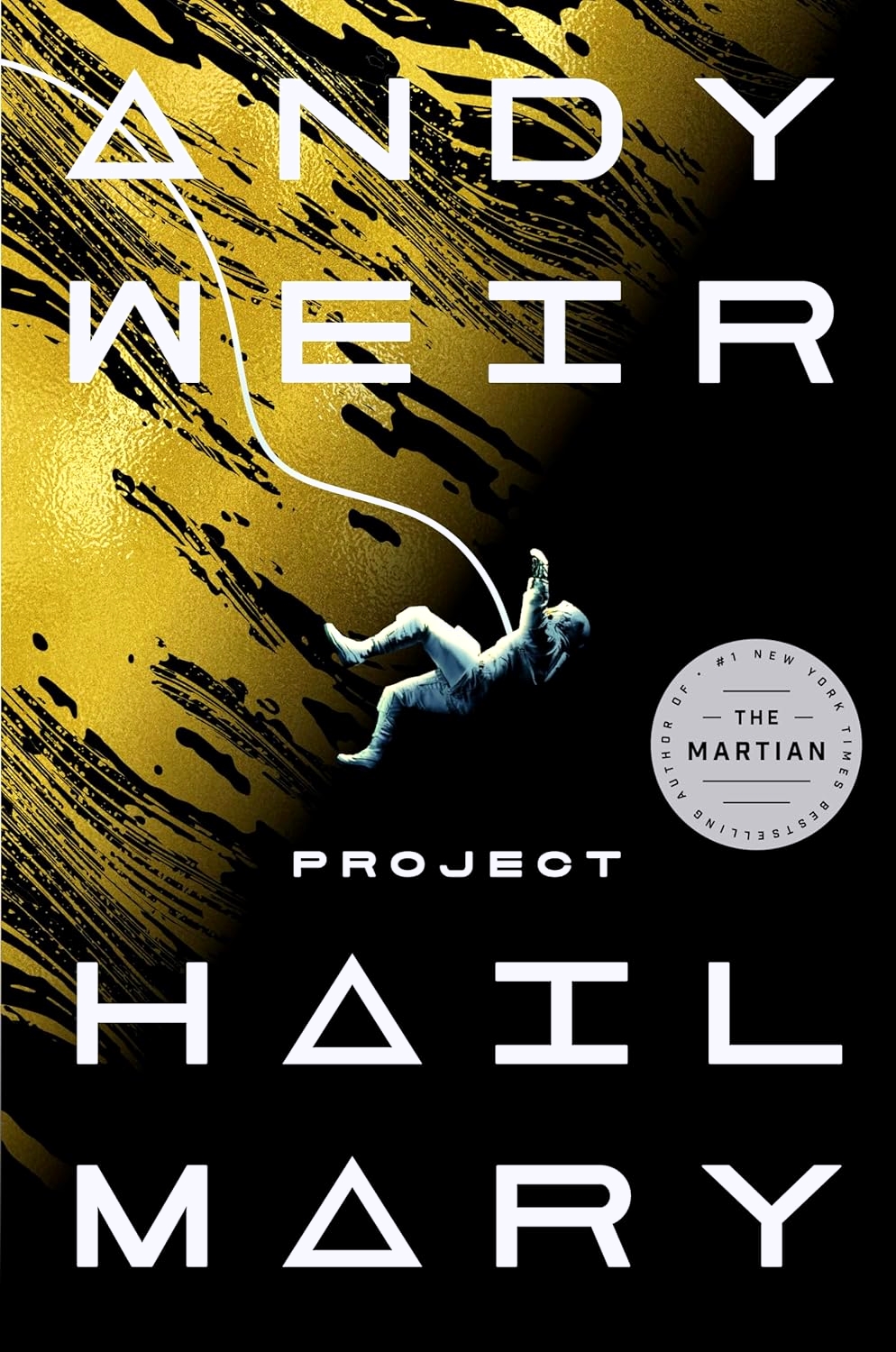
The Awakening, the Petrova Line, and the One-Way Mission
Ryland Grace regains consciousness in an unfamiliar medical compartment, surrounded by machinery and attended by robotic arms. A computerized voice asks him simple questions, but he cannot answer them reliably. His muscles have weakened from prolonged inactivity, his memory is almost completely absent, and two people occupy neighboring medical beds. Both are dead, leaving him as the apparent sole survivor of an unknown expedition.
As Grace gradually regains the ability to move, he investigates his surroundings with the instincts of a scientist. The machinery indicates that he has spent a considerable period in an induced coma, but the more immediate puzzle is gravity. Objects fall much faster than they should on Earth. He measures their acceleration using simple experiments, considers whether the spacecraft might be rotating to produce artificial gravity, and begins ruling out explanations. The process establishes a pattern that will continue throughout the novel: Grace cannot solve a problem by wishing for information, but he can measure what is available, test hypotheses, and revise his conclusions.
His damaged memory begins returning in fragments. He recalls being a middle-school science teacher who once worked as a molecular biologist. His academic career ended badly after he published a controversial argument challenging conventional assumptions about the chemical requirements for extraterrestrial life. Rather than continue fighting for professional acceptance, he found satisfaction teaching children, whose curiosity mattered more to him than academic prestige.
One recovered memory concerns a strange astronomical phenomenon discovered by scientist Irina Petrova. Observations have identified an unusual infrared emission stretching between the Sun and Venus, subsequently called the Petrova Line. The phenomenon is accompanied by evidence that the Sun is losing energy at a rate with potentially catastrophic implications for Earth’s climate.
The problem becomes more urgent when the Japanese solar probe Amaterasu provides information suggesting that the Petrova Line is associated with previously unknown biological material. An international effort called Project ArcLight retrieves samples from the region around Venus, and the resulting research reveals something unprecedented: a microscopic extraterrestrial organism apparently capable of surviving in conditions that should destroy conventional life.
Grace’s forgotten Earth-based experiences gradually reveal how he became involved. Eva Stratt, a formidable administrator given extraordinary international authority to manage the crisis, recruits him because of his unconventional thinking about alien biology. He is brought into a secure research facility and given access to the microorganism collected by ArcLight. His job is to determine how it functions, why it travels between the Sun and Venus, and whether humanity can control it.
The organism is eventually named Astrophage, meaning a star-eating life-form. Its behavior is unlike anything previously encountered. It can absorb enormous amounts of energy, withstand extreme conditions, and convert stored energy into propulsion. Its cellular membrane possesses extraordinary properties that make it resistant to radiation and allow it to contain processes far beyond ordinary biological chemistry.
Grace’s investigations also reveal that Astrophage reproduces through a cycle involving the Sun and Venus. It gathers energy at the Sun, travels toward Venus, where conditions provide materials necessary for reproduction, and eventually returns toward the Sun. The growing population absorbs an increasing proportion of solar energy. Although the Sun itself is not being physically consumed in the ordinary sense, the organism intercepts energy that would otherwise sustain Earth.
This presents humanity with a terrifying timetable. Even a relatively small reduction in the Sun’s effective output could disrupt agriculture, alter weather systems, produce devastating food shortages, and trigger political instability. A colder Earth would create consequences far beyond the inconvenience of falling temperatures. Civilization depends upon the reliable production and distribution of food, and those systems are vulnerable to climatic disruption.
Astronomical observations make the problem even more disturbing. Astrophage appears to be spreading between nearby stars, producing a growing network of infected systems. One star, however, stands out: Tau Ceti. Despite apparently being exposed to the organism, it has not suffered the same reduction in brightness. Humanity therefore has a possible lead. Something about Tau Ceti’s environment may prevent Astrophage from multiplying uncontrollably.
The difficulty is reaching another star. Conventional spacecraft propulsion is inadequate for an expedition that must produce useful results within humanity’s remaining time. The discovery of Astrophage, however, also offers a solution. Its astonishing energy density makes it an extraordinarily powerful fuel, and human engineers develop a propulsion system capable of accelerating a spacecraft to a significant fraction of the speed of light.
Grace’s memories introduce Dimitri Komorov, whose engineering work helps transform Astrophage into a practical interstellar propulsion source. The resulting spin drive uses the organism’s controlled release of energy to generate thrust. The project also requires a massive effort to breed sufficient quantities of Astrophage, construct a specialized spacecraft, and prepare a crew capable of surviving years in transit.
Meanwhile, Grace explores the vessel on which he has awakened. He discovers the command compartment, extensive scientific equipment, and engineering systems built for a long-distance mission. His recovered name enables him to gain access to previously locked controls. The ship is called the Hail Mary, an appropriate name for an expedition undertaken because humanity has almost no other hope.
The two dead astronauts are Commander Yáo Li-Jie and engineer Olesya Ilyukhina. Grace has lost the companions who were supposed to operate the ship with him. After determining that they cannot be revived, he gives their bodies a space burial, an experience that underscores his isolation. Whatever the mission was intended to accomplish, he must now attempt it without the people responsible for much of the spacecraft’s operation.
The ship also contains four small automated probes called Beetles. These are designed to return information to Earth after the mission reaches its destination. Their presence reveals a crucial fact: the Hail Mary was not intended to carry its crew home. Its fuel reserves and mission architecture were calculated for a one-way journey, with the Beetles serving as the means of transmitting the findings.
Grace initially tries to understand how he could have accepted such an assignment. His returning memories appear to suggest that he volunteered to sacrifice his life, although he cannot yet recover the circumstances of that decision. The uncertainty becomes increasingly important as the novel continues.
His observations of the star outside the spacecraft provide another decisive clue. By examining the star’s apparent rotation and comparing it with what he knows about the Sun, Grace realizes that the star cannot be the one around which Earth orbits. He is in a different solar system, confirming the scale of his displacement.
Further calculations and observations establish that he has reached Tau Ceti. His task is to investigate why this star appears to resist Astrophage, discover a solution that humanity can reproduce, and transmit the findings before his supplies or life run out.
He begins studying the system’s planets and the local Petrova Line, looking for evidence that might explain the star’s unusual behavior. Then he detects an object that radically changes the mission. Another spacecraft is operating in the Tau Ceti system, and its design could not plausibly have originated on Earth.
Grace has discovered evidence of a technological civilization beyond humanity. The lone survivor of a human expedition is about to make first contact with an extraterrestrial intelligence.
First Contact and the Making of a Shared Language
The second spacecraft is considerably larger than the Hail Mary and has an unusual geometry that Grace struggles to interpret. He names it the Blip-A, initially treating the object as an engineering puzzle rather than assuming anything about the beings responsible for it. Its propulsion system appears to resemble his own in using Astrophage, suggesting that its builders have independently discovered the organism’s potential as a spacecraft fuel.
Grace faces an immediate problem: there is no established method for communicating with an extraterrestrial vessel. He cannot assume that its crew can receive radio transmissions, interpret human languages, or recognize familiar scientific symbols. He therefore begins with a physical signal that should be observable to anyone monitoring his spacecraft.
Using controlled flashes from his engine, he sends a simple pattern. The alien vessel responds in kind. This reciprocal exchange establishes that its occupants have recognized the attempt at communication and are willing to participate.
The aliens next launch a small container toward the Hail Mary. Grace performs a spacewalk to retrieve it, cautiously examining the object before opening it. The container is extraordinarily hot and carries a strong ammonia smell, providing the first evidence that the unknown beings inhabit environmental conditions very different from those required by humans.
Inside, Grace discovers carefully constructed models representing astronomical objects and the Petrova Line. Their purpose becomes apparent through comparison with his own knowledge of the surrounding stellar systems. The aliens are showing him where they came from and why they have traveled to Tau Ceti.
Their home star is 40 Eridani, which Grace recognizes from Earth’s astronomical catalogues. The message also indicates that their star is suffering from Astrophage. These extraterrestrial travelers are not merely visiting Tau Ceti out of curiosity. They have been sent to investigate the same crisis threatening humanity.
Grace constructs a reply identifying the Sun and Earth’s own stellar system. Because the two parties lack a common language, the exchange depends upon spatial relationships, physical models, and the assumption that an intelligent technological civilization can recognize astronomical information. Their first meaningful communication is therefore scientific.
The Blip-A subsequently proposes connecting the vessels through a physical tunnel. Grace must decide whether accepting such contact is safe. He knows almost nothing about the alien crew, and even an unintended exchange of atmospheric gases or biological material could be fatal.
The aliens construct an elaborate tunnel using a remarkably strong, translucent substance that Grace calls xenonite. The material appears capable of withstanding extreme temperature and pressure differences, making it ideal for connecting incompatible environments. Grace studies its construction and discovers that the tunnel includes a barrier separating his breathable atmosphere from the alien atmosphere.
He enters the human-compatible portion of the structure and investigates the dividing wall. The encounter is still limited to the exchange of objects and signals, but the alien spacecraft is now physically connected to his own.
Then someone knocks from the opposite side of the barrier.
Grace knocks back, and the two parties begin experimenting with direct communication. When they finally arrange a transparent window between their environments, Grace sees the extraterrestrial being for the first time.
The alien has five limbs arranged around a compact, rocklike body. Its external structures resemble mineralized plates, giving it an appearance that Grace loosely compares to a spider. It has no recognizable face or eyes, and its movement is unlike that of any human or familiar terrestrial animal.
Grace names the creature Rocky, a reference to both its appearance and its mineralized body. Naming provides him with a way to relate to an unfamiliar intelligence, although Rocky’s own language and social identity are considerably more complex.
The first encounters reveal that Rocky’s environmental requirements are incompatible with human life. He breathes an ammonia-rich atmosphere at high pressure and temperature. Conditions comfortable for Grace could kill Rocky, while the conditions required by Rocky would be deadly to Grace. The xenonite divider is therefore indispensable: it allows them to interact without exposing either to the other’s environment.
The two begin with practical demonstrations. They compare substances, construct models of atoms, identify atmospheric components, and establish elementary mathematical relationships. Their different number systems create an initial obstacle. Humans ordinarily use base ten, while Eridian mathematics uses base six, reflecting a cultural development independent of Earth’s numerical conventions.
Grace also discovers that Rocky perceives the world without vision. Rocky appears largely uninterested in printed symbols and visible markings, leading Grace to investigate how he observes his surroundings. Through experiments, he concludes that Rocky relies on sound-based perception, using an extraordinarily sophisticated ability to interpret reflected acoustic information.
This sensory difference fundamentally changes the communication problem. A diagram that seems obvious to Grace may mean nothing to Rocky, while patterns of sound can convey information that Grace cannot naturally interpret.
Rocky’s speech consists of musical tones and chords, with meaning encoded in frequency relationships and other acoustic features. Grace uses the Hail Mary’s computers and audio equipment to record these sounds, analyze their structure, and build a translation system. Each successful exchange adds vocabulary to a growing database.
The process is gradual. Grace and Rocky demonstrate objects, associate them with sounds, repeat exchanges, and correct misunderstandings. Mathematical concepts are especially useful because both civilizations have developed sophisticated scientific reasoning, but the translation of ordinary experience proves more difficult.
Their discussions increasingly reveal the different paths taken by their civilizations. Rocky possesses extraordinary practical engineering skills and can perform complex mathematical calculations without electronic assistance. Grace, meanwhile, relies on computers, instruments, and a body of accumulated human scientific knowledge.
A major breakthrough occurs when they understand that both civilizations face the same solar catastrophe. Rocky’s homeworld, Erid, depends upon a star being dimmed by Astrophage. He has traveled to Tau Ceti in the hope of discovering why this system has avoided the consequences afflicting his own.
Like Grace, Rocky has lost his crewmates. He has been stranded near Tau Ceti for a considerable time, unable to complete the mission and unwilling to abandon the only possible lead that might save his people.
Their common circumstances give the relationship an emotional dimension that scientific communication alone could not provide. Each is the only surviving member of an interstellar expedition, separated from home by unimaginable distances and confronted with a problem that seems beyond any individual’s abilities.
Their biological differences create new personal habits. Rocky does not sleep in the human manner, and he becomes fascinated by Grace’s need to enter a prolonged state of unconsciousness. Watching over Grace while he sleeps becomes a practice of care rather than merely an observational curiosity.
Grace, who initially experiences Rocky as an extraordinary scientific discovery, begins treating him as a companion. Their conversations acquire humor and informality. The translation software is still imperfect, but the two develop sufficient familiarity to recognize one another’s intentions and emotional states.
The encounter also changes Grace’s understanding of his mission. He had expected to investigate Tau Ceti alone, send the results home, and die. Instead, he has found another person facing the same problem, with access to different technologies and experiences. Their best chance of saving their civilizations now lies in cooperation.
Two Civilizations, One Scientific Problem
Grace’s recovered memories continue revealing the scale of Earth’s response to Astrophage. The discovery of an interstellar fuel does not automatically provide humanity with a working spacecraft. Astrophage must be bred in quantities far beyond anything a conventional laboratory could produce, and the energy required for large-scale production is itself enormous.
Robert Redell, a specialist with experience in energy production, proposes an ambitious solution involving vast infrastructure in the Sahara Desert. By exploiting the region’s solar energy potential, humanity can construct enormous Astrophage-breeding facilities capable of supplying the mission’s fuel. What began as a biological research problem becomes a project involving land, energy, industrial engineering, political authority, and global coordination.
The scheme illustrates the extraordinary nature of Project Hail Mary. Humanity must undertake an interstellar mission without possessing an established interstellar civilization. It must build the necessary technological infrastructure almost from scratch, using the very organism that threatens its survival as the basis for its propulsion system.
The emergency also affects Earth’s climate policy. Climatologist François Leclerc explains that a sustained reduction in solar energy will produce severe cooling, crop failures, and potentially enormous mortality. Even if humanity eventually develops a cure, the planet must survive the years required to discover and implement it.
Stratt responds with an extreme proposal intended to delay the cooling. She arranges for a destructive intervention in Antarctica that will release methane trapped beneath the ice. Because methane is a potent greenhouse gas, the resulting atmospheric changes might temporarily counteract the loss of solar heating.
The operation is environmentally catastrophic in ordinary circumstances. It damages a vast region, contributes to sea-level rise, and deliberately alters the atmosphere through a process that humanity cannot easily reverse. Grace is horrified by the implications, but Leclerc’s projections indicate that the alternative may involve even greater suffering.
Stratt’s actions establish an ethical pattern that will become central later. She is willing to cause severe, immediate harm when she believes the long-term survival of humanity requires it. The novel does not portray her as indifferent to consequences; rather, her conviction about the scale of the coming catastrophe leads her to accept actions that would otherwise be unthinkable.
In the Tau Ceti system, Grace and Rocky begin discovering how differently their civilizations have developed.
The Eridians possess extraordinarily advanced materials engineering. Xenonite can be manufactured and shaped into structures that withstand extreme environmental pressures, and Rocky can use his tools to fabricate complex devices with remarkable speed. His ability to make practical objects from available materials repeatedly astonishes Grace.
Humanity, by contrast, has developed sophisticated electronic computers and a scientific understanding of physical phenomena that the Eridians have not independently discovered. Rocky’s civilization has not developed an equivalent tradition of digital computing, partly because Eridians are unusually capable of performing difficult calculations mentally.
Rocky’s ignorance of radiation is especially consequential. Erid’s dense atmosphere and other environmental conditions shield its inhabitants from forms of radiation that are significant dangers for human space travelers. Eridian civilization consequently developed without the same practical need to understand those hazards.
Grace eventually realizes that Rocky’s crewmates died because the Blip-A lacked adequate radiation protection. The deaths were not caused by inferior intelligence or negligence in any ordinary sense. Their civilization had encountered an unfamiliar physical danger that human space science already understood.
Grace can therefore provide knowledge that Rocky lacks, while Rocky possesses engineering capabilities Grace could never reproduce with the equipment available to him.
Their cooperation becomes practical when Rocky begins transferring workshop equipment into the Hail Mary. Specialized xenonite enclosures allow him to work inside a human spacecraft while maintaining the atmospheric conditions he needs. He becomes an active laboratory partner rather than a distant figure communicating through a wall.
Their conversations also reveal important aspects of Eridian life. Rocky has a mate who remains on Erid, and Grace learns that Eridians have much longer lifespans than humans. Their biological cycles, reproduction, and social habits differ significantly from those familiar on Earth.
These revelations give Rocky a personal history and a specific reason to care about the mission’s outcome. He is trying to save a society containing people he loves, not merely solving an abstract scientific mystery.
Grace also discovers that Rocky has significantly more Astrophage fuel than the Hail Mary requires for its own remaining operations. This is partly because Eridian mission planners did not account for relativistic time dilation in the same way human scientists did. Their calculations overestimated the journey’s effective fuel requirements.
Rocky is willing to share the surplus. Suddenly, Grace may be able to complete the Tau Ceti investigation and return to Earth instead of dying aboard the spacecraft.
The unexpected prospect of survival changes the emotional stakes of the mission. Grace can now imagine a future beyond transmitting information through the Beetles. His cooperation with Rocky has transformed an apparently irreversible sacrifice into a potentially survivable expedition.
The two turn their attention toward a planet in the Tau Ceti system that Grace calls Adrian, a name connected to Rocky’s mate. They suspect that conditions on this planet may explain why Astrophage has not devastated Tau Ceti.
Their initial investigations focus on the organisms living in the planet’s environment and on the relationship between Astrophage and its apparent habitat. Grace and Rocky approach the question through sampling, observation, and comparison with the organism’s behavior in their home systems.
A striking result emerges. Astrophage populations associated with Adrian do not behave as expected. The numbers suggest that something is destroying the organisms before they can reproduce without limit.
The two scientists begin considering the possibility of a predator. On Earth, populations of microorganisms are constrained by competition, predation, environmental limitations, and other ecological relationships. A similar process might explain why Astrophage remains controlled in the Tau Ceti system.
The hypothesis offers the first plausible way to save both Earth and Erid. Rather than finding a physical characteristic that makes Tau Ceti immune, Grace and Rocky may have discovered that a local life-form keeps the dangerous microorganism in check.
Their successful collaboration produces a small but memorable social ritual. Grace introduces Rocky to the human fist-bump, and Rocky responds through the barrier separating their atmospheres. The gesture becomes their shared expression of accomplishment.
At this point, the central scientific problem has changed. They no longer need simply to understand why Tau Ceti remains bright. They need to isolate the organism responsible, determine whether it can survive elsewhere, and devise a way to deliver it safely to two different stellar systems.
The Mission to Adrian and the Search for Taumoeba
The possibility of a natural predator creates an immediate practical difficulty. Grace and Rocky cannot simply descend to Adrian’s surface and collect microorganisms. The planet’s environment is hostile to them, and their spacecraft are not designed to land on it.
They therefore develop an elaborate atmospheric sampling plan. Using xenonite’s extraordinary strength, Rocky constructs a long chain that can lower a collection apparatus into Adrian’s atmosphere while the Hail Mary remains at a safer altitude. The arrangement requires careful calculations involving orbital velocity, atmospheric drag, gravitational forces, and the strength of the connecting structure.
Grace uses his knowledge of orbital mechanics and spacecraft control, while Rocky supplies materials and fabrication techniques unavailable to human engineering. Neither could implement the plan as effectively without the other.
Before the operation, another discovery highlights the scientific differences between their civilizations. Rocky has never properly understood relativistic time dilation. He has assumed that travel time and distance behave according to familiar Newtonian expectations, even at velocities approaching the speed of light.
Grace explains that time passes differently for objects traveling at extremely high speeds relative to one another. The distinction has major consequences for calculating an interstellar journey, including the amount of time experienced by the travelers and the fuel required for their mission.
Rocky initially struggles to accept the explanation, but calculations and observations eventually convince him. His willingness to revise his understanding reinforces the basis of their partnership: scientific conclusions must answer to evidence, regardless of which civilization produces them.
The sampling operation itself is dangerous. The chain must descend into the atmosphere and retrieve material without causing an uncontrollable interaction between the spacecraft and the planet’s atmospheric forces. Grace monitors the vessel’s movement and adjusts its propulsion while Rocky manages the specialized equipment.
The operation succeeds in collecting material, but the attempt to recover the apparatus produces a severe emergency. The spacecraft experiences dangerous forces, and damage to its systems creates uncontrolled motion. The rotating structure and changing gravitational conditions threaten Grace’s ability to move and place both characters in immediate danger.
Rocky intervenes to protect Grace, exposing himself to physical conditions that are potentially fatal to an Eridian. The rescue demonstrates the extent of his attachment to his human partner. His decision is made under extreme pressure, with little opportunity to calculate whether he will survive.
Grace is forced to overcome his own physical limitations to help Rocky. Touching Rocky’s body is hazardous because of the temperature difference between their environments, and the damaged spacecraft complicates movement and emergency response.
A breach involving Rocky’s atmosphere exposes Grace to ammonia, further threatening his survival. The Hail Mary’s medical equipment becomes essential as he struggles to regain control of the situation and restore the ship’s basic functionality.
Rocky is left unconscious and severely injured. Grace attempts to provide care despite knowing little about Eridian physiology. He must rely on observation, instruments, and limited information about his friend’s biology rather than established medical procedures.
The sequence is significant because the two scientists have moved beyond a relationship based on useful expertise. Rocky has risked his life for Grace, and Grace now undertakes dangerous work to keep Rocky alive.
Grace also manages to preserve the material collected from Adrian. The sample represents their best opportunity to discover the organism responsible for Tau Ceti’s unusual condition. Even amid the repairs and medical emergency, the scientific investigation must continue.
Eventually, Rocky begins recovering. Their relief is accompanied by renewed attention to the sample, which Grace examines using the Hail Mary’s laboratory equipment.
The sample contains an organism capable of consuming Astrophage. Grace names it Taumoeba, identifying it as a microorganism whose feeding behavior may explain the limited Astrophage population around Tau Ceti.
This is the breakthrough the mission was designed to find. Astrophage is no longer an uncontrollable threat without any known natural enemy. The discovery suggests that biological predation could be used to reduce its populations around the Sun and Erid’s star.
Yet finding Taumoeba does not automatically provide a usable solution. The organism has evolved under the environmental conditions of the Tau Ceti system, and there is no guarantee that it can survive where Astrophage reproduces in the other systems.
Grace and Rocky identify two different targets. In the Solar System, Astrophage reproduces in the environment associated with Venus. Around 40 Eridani, the comparable breeding location is a planet Grace calls Threeworld.
The conditions differ in important ways, particularly in atmospheric chemistry. Taumoeba must therefore be cultivated and tested against the specific environments it would encounter after delivery.
While this work begins, Grace’s recovered Earth memories reveal the human cost of the expedition. The original astronauts understood that they were embarking on a mission from which they would probably never return. They had been asked to consider how they wished to die after completing their work, a grim acknowledgment of the one-way design.
The memories also explain the deaths of Martin DuBois and Annie Shapiro, two scientists originally selected for the mission. A laboratory accident involving Astrophage killed them shortly before departure. Their deaths created an urgent need to replace critical scientific expertise on the spacecraft.
Back at Tau Ceti, the discovery of Taumoeba creates a second disaster. The organism escapes the intended laboratory environment and reaches the Hail Mary’s Astrophage fuel supply.
Astrophage is not merely an object of investigation. It powers the spacecraft’s engines and electrical systems. When Taumoeba consumes it, the ship begins losing its energy source.
Lights and other systems fail, leaving Grace and Rocky to diagnose the problem under increasingly dangerous conditions. Their discovery of the predator has jeopardized their ability to return to the Blip-A, transport the solution, or even keep essential equipment functioning.
The crisis reveals how interconnected the ship’s systems are. Fuel contamination affects propulsion, electrical power, environmental control, and access to the instruments required for further experimentation. A biological problem becomes an engineering emergency.
Rocky proposes using some of the Beetle probes as improvised propulsion devices. Grace calculates how the modified probes can provide the thrust needed to maneuver the damaged ship toward the larger alien vessel. The plan relies on the Beetles’ compact propulsion capabilities, Rocky’s fabrication skills, and Grace’s mathematical understanding of the required maneuvers.
This temporary solution allows the mission to continue, but it also demonstrates the fragility of their position. They have found the possible cure for two civilizations, yet an uncontrolled release of that cure could destroy the technology needed to deliver it.
The Forced Astronaut and the Nitrogen-Resistant Cure
As Grace’s recovered memories approach the launch of Project Hail Mary, they finally expose the truth behind his presence aboard the spacecraft.
The deaths of DuBois and Shapiro leave the mission without the scientific personnel required to investigate Tau Ceti. With little time remaining before launch, Stratt must find someone capable of replacing the lost expertise and surviving the spacecraft’s coma-based travel system.
Grace possesses an unusually important genetic characteristic that makes him suitable for the induced coma. He also has extensive knowledge of Astrophage, having helped discover and investigate its fundamental properties.
Stratt concludes that he is the best available replacement and orders him to join the expedition.
Grace refuses.
He understands that the journey is effectively a death sentence. The mission’s success may save billions of people, but the thought of sacrificing his own life terrifies him. He is unwilling to accept the assignment, even after Stratt reminds him of the catastrophic consequences awaiting Earth.
Stratt does not accept his refusal. Using the extraordinary powers granted to her during the emergency, she has him detained and sedated. She arranges for him to be placed aboard the Hail Mary without his consent, including the use of treatment intended to interfere with his memory.
The revelation fundamentally changes Grace’s understanding of his situation. He had assumed that his presence aboard the ship reflected an act of voluntary heroism. He now remembers that he was frightened and unwilling, and that Stratt deprived him of the ability to make the decision for himself.
His scientific accomplishments during the mission remain real, but the image of himself as a brave volunteer collapses. He must accept that the version of his past he reconstructed from incomplete memories was mistaken.
The recovery is emotionally painful because Grace has already demonstrated exceptional competence and loyalty. He has survived alone, worked through seemingly impossible technical difficulties, formed a genuine friendship with Rocky, and risked his life to rescue him. Yet none of those actions erases his original refusal.
The novel allows the contradiction to remain. Grace is capable of courage and deeply afraid of dying. He can behave admirably under one set of circumstances while failing to meet his own moral expectations under another.
Meanwhile, the experiments with Taumoeba continue producing frustrating results. Grace and Rocky attempt to cultivate the organism under conditions resembling Venus and Threeworld, but the colonies repeatedly die.
The failure raises the possibility that their discovery cannot be transported into the environments where it is needed. Finding a predator is useless if it cannot survive long enough to attack Astrophage in another planetary system.
The breakthrough comes when Rocky notices that Taumoeba has already survived in an environment where the scientists did not expect it to thrive. The organisms’ behavior during the fuel-contamination crisis provides evidence that their environmental tolerance may be broader than the initial experiments suggested.
Grace reexamines the atmospheric differences among Adrian, Venus, and Threeworld. Through controlled testing, the two identify nitrogen as the critical limiting factor.
Rather than searching for a completely different organism, Grace proposes adapting the existing Taumoeba population through selective breeding.
The method depends upon ordinary evolutionary principles. A population contains variation, and some individuals may tolerate slightly higher nitrogen concentrations than others. By exposing successive generations to carefully controlled conditions, Grace can preserve the organisms that survive and use them to produce the next generation.
He gradually increases the nitrogen concentration, allowing the population to adapt over repeated breeding cycles. The process is painstaking because moving too quickly can kill the entire culture, while proceeding too cautiously wastes precious time and resources.
The experiment eventually succeeds. Grace and Rocky produce Taumoeba strains capable of surviving the atmospheric conditions associated with both Venus and Threeworld.
The discovery gives them a practical biological intervention. By introducing the adapted predators where Astrophage reproduces, humanity and the Eridians may be able to reduce the organism’s population and prevent further catastrophic dimming of their stars.
Their remaining work involves ensuring that the cultures survive transportation. The microbes must be contained in suitable environments, protected from dangerous conditions, and delivered with sufficient information for scientists at the destinations to reproduce the results.
Grace prepares the Beetles to carry the necessary research and biological samples toward Earth. Rocky makes corresponding preparations for the Eridian mission.
The two also undertake extensive spacecraft repairs and sterilization procedures. The earlier Taumoeba contamination has shown that the organism is dangerous inside an Astrophage-powered vessel. They must ensure that their engines and fuel reserves will remain usable during their separate return journeys.
Rocky’s fuel surplus allows Grace to refuel the Hail Mary and undertake a return trip that had never been part of the original human mission. For the first time since awakening, Grace can realistically anticipate reaching Earth alive.
Their separation is emotionally difficult. The two have spent an extended period working, arguing, joking, solving problems, and protecting one another. Their scientific collaboration has become the most important personal relationship in Grace’s life.
They exchange information and gifts before preparing to travel to their respective homeworlds. The friendship has also changed the meaning of the mission for both of them. Neither is simply a representative of a civilization anymore; each is leaving behind someone whose continued existence matters personally.
Grace watches Rocky depart and sets the Hail Mary on a course for Earth. The scientific problem appears solved, the necessary information is on its way home, and the doomed astronaut has gained an unexpected possibility of survival.
The Return Journey, Rocky’s Rescue, and Grace’s New Home
Grace’s final major Earth memories reinforce the desperation under which Stratt made her decisions. She believed that the reduction in solar energy would cause enormous agricultural losses, international conflict, famine, and social collapse. Her determination to send Grace arose from the conviction that the mission was necessary regardless of the suffering imposed on individual participants.
Remembering this explanation does not eliminate the injustice of what she did. Grace understands the stakes more clearly than almost anyone, but he also knows that Stratt denied him the right to decide whether he would sacrifice himself.
His return journey initially seems to offer a resolution to both problems. He possesses the means to save humanity and enough fuel to attempt to return home. With Rocky traveling toward Erid, the two civilizations may soon receive the biological solution they need.
Then Grace notices that something is wrong with his fuel supply.
Signs of dead Astrophage lead him to the conclusion that Taumoeba has escaped containment again. Despite the sterilization procedures and precautions taken before departure, the organism has reached material it was never supposed to contact.
The discovery threatens the Hail Mary’s propulsion and power. If Taumoeba spreads through the fuel, Grace may lose the means of returning home. Worse, the same problem could affect Rocky’s spacecraft if the organism escapes its own containment system.
Grace begins another investigation. He isolates vulnerable equipment, alters atmospheric conditions, and uses nitrogen-rich environments to kill exposed Taumoeba. He must protect himself from the conditions used for sterilization while avoiding damage to essential spacecraft systems.
He then examines the likely pathways through which the organism could have traveled. The containment system had been designed around the properties of xenonite, which appeared impermeable and extraordinarily resistant to physical and chemical damage.
Experiments eventually reveal a disturbing possibility. The adapted Taumoeba population has acquired an ability to pass through xenonite.
The discovery follows from the selective-breeding process that made the microorganisms useful. The scientists deliberately selected for nitrogen resistance, but biological populations do not evolve according to human intentions. Other traits can become associated with survival during selection, and a population may acquire unexpected capabilities as its characteristics change.
The organisms that were originally unable to penetrate xenonite can now escape through a material assumed to be completely secure.
For Grace, the consequences are serious but manageable because parts of the Hail Mary use other materials and can be protected through carefully designed barriers. Rocky faces a much greater danger. Eridian spacecraft construction relies heavily upon xenonite, including its fuel containment systems.
If the modified Taumoeba has reached the Blip-A’s fuel, it could consume the Astrophage necessary for Rocky’s return journey.
Grace checks the direction in which Rocky departed and realizes that his friend’s engine activity has disappeared. The most likely explanation is that the Blip-A has suffered the same contamination crisis, leaving Rocky stranded in interstellar space.
Grace now faces a decision with far greater moral significance than the original mission assignment.
He can continue toward Earth with the information and resources necessary to save humanity. This is what the mission was created to accomplish, and he has already endured extraordinary danger to reach this point.
Alternatively, he can turn around and attempt to rescue Rocky. Doing so will consume precious fuel and supplies, and the journey may leave him unable to reach Earth. The rescue also carries the possibility that Rocky’s damaged vessel cannot be repaired.
Grace understands these consequences. Unlike his original recruitment, nobody is ordering him to make this choice. Stratt is not present, and no institution has the power to compel him. He is free to prioritize his own survival and the return to his homeworld.
He chooses Rocky.
Before reversing course, Grace launches the Beetle probes toward Earth, sending the research and biological samples that humanity needs. By doing so, he separates his responsibility to humanity from his decision to save his friend. Earth’s best chance of survival no longer depends upon Grace personally returning home.
He then redirects the Hail Mary toward the region where Rocky is likely to be stranded.
Finding the Blip-A is extremely difficult. The two spacecraft have traveled enormous distances, and Rocky’s ship is no longer producing its ordinary propulsion signature. Grace must use calculations, assumptions about the other vessel’s trajectory, and the available observational equipment to locate it.
He devises a search strategy using the Petrovascope and other instruments to detect the faint signs that might distinguish the stranded ship from the surrounding darkness. The problem requires the same kind of disciplined experimentation that helped him survive his awakening, but the stakes have become personal.
Eventually, he locates the Blip-A and maneuvers close enough to reconnect with Rocky.
Their reunion is a powerful emotional moment because both recognize how unlikely the rescue was. Rocky had been left in a position from which he could not reasonably expect help. Grace’s arrival proves that their relationship has survived the separation and that Grace has knowingly accepted serious personal risk for his friend.
The technical problem is not completely resolved by the reunion. They can arrange for the two spacecraft to travel toward Erid, but Grace lacks the resources necessary for an ordinary human return journey. In particular, he does not have enough suitable food to sustain himself over the extended period required.
Grace and Rocky consider another biological solution. Taumoeba contains materials that Grace’s body can potentially digest, making it a possible emergency food source. Living on such an improvised diet is dangerous, but it may provide enough calories to keep him alive until they reach Erid.
The possibility is far from comfortable. Grace is accepting prolonged isolation from humanity, uncertain nutrition, the physical effects of an alien destination, and a future in which he may never see Earth again.
Years later, the final chapter reveals that Grace survived.
He lives on Erid, inside an enclosed habitat constructed by the Eridians to reproduce the atmospheric and environmental conditions he requires. His hosts have devoted substantial scientific and engineering resources to keeping him alive.
The initial years were difficult. Although Taumoeba provided calories, it did not provide balanced nutrition. Grace suffered serious deficiencies and illnesses until Eridian scientists developed methods of supplying the vitamins and other nutrients needed by a human body.
They eventually learned to produce a more satisfactory diet, drawing upon the scientific information Grace brought from Earth. They even developed the ability to grow human muscle tissue from Grace’s own cells, allowing him to eat laboratory-grown meat despite the absence of ordinary terrestrial animals.
Grace jokingly calls these meals meburgers, acknowledging the peculiar fact that he is eating meat grown from his own tissue.
His life on Erid is physically difficult. The planet’s high gravity puts considerable strain on his aging body, and he has developed mobility problems that require a cane. Because of relativistic travel and the time spent away from Earth, his chronological age is also difficult to describe using a simple Earth-based calculation.
Nevertheless, he is alive, cared for, and surrounded by a civilization that recognizes the importance of his contribution.
Eridian society has organized specialized groups of scientists and engineers to support him. Their collective methods of investigation, including large collaborative gatherings called thrums, have helped develop the technologies and biological knowledge necessary for his survival.
Grace remains close to Rocky, who continues living with his mate. Their friendship has endured the passage of years, and they communicate with increasing fluency. The two no longer need the awkward translation process that characterized their first meetings.
One day, Rocky brings extraordinary news. Astronomical observations indicate that the Sun has returned to its previous brightness.
The recovery strongly suggests that the Beetles successfully delivered Grace’s information and Taumoeba samples to Earth and that humanity implemented the biological solution. Astrophage has apparently been reduced to a population that no longer threatens the Sun’s effective output.
For Grace, the confirmation carries enormous emotional weight. He has spent years without knowing whether Earth survived or whether the sacrifice of the Hail Mary crew accomplished anything. He now has evidence that humanity received the solution and used it successfully.
Yet the news does not tell him everything. He does not know how many people died before the cure was implemented, whether political systems survived intact, or how societies adapted to the years of climatic danger.
Rocky asks whether Grace now wishes to return home. The Eridians have offered to prepare the Hail Mary for another journey, supplying fuel and provisions if he decides to leave.
Grace does not make a final decision. He is older, the journey would be long and solitary, and he has established meaningful relationships on Erid. Earth remains his place of origin, but it is no longer the only world in which he belongs.
The final scene reveals what Grace now does with his life. He enters a specially constructed classroom where young Eridians are waiting for their science lesson.
Using an instrument that allows him to communicate in their musical language, he begins teaching them. His question concerns the speed of light, and the students eagerly respond.
The ending returns Grace to the vocation he cherished before the crisis. He is no longer an isolated academic, a coerced astronaut, or a solitary survivor struggling to remember his name. He is a teacher again, surrounded by students whose curiosity gives his life daily purpose.
Astrophage, Taumoeba, and the Science of Survival
The scientific structure of Project Hail Mary begins with an invented biological mechanism and builds much of the novel’s action around its consequences. Astrophage is a fictional microorganism, but Weir attempts to give it recognizable biological behavior: it acquires energy, reproduces, responds to environmental conditions, and interacts with other organisms.
Its most extraordinary property is its ability to convert energy into mass and reverse that process with remarkable efficiency. Einstein’s mass–energy relationship establishes that mass and energy are related, but it does not provide organisms with the ability to manipulate that relationship in the manner Astrophage does. The novel introduces speculative quantum-level properties to make the fictional mechanism possible.
Astrophage stores tremendous amounts of energy by creating and containing particles associated with neutrino processes. Its membrane possesses extraordinary interaction properties that allow these mechanisms to operate without destroying the cell. When Astrophage releases the stored energy, it produces radiation that can be harnessed for propulsion.
The organism’s energy density makes the spin drive possible. Instead of carrying enormous quantities of conventional chemical fuel, the Hail Mary uses Astrophage as an extremely concentrated energy source. This permits sustained acceleration over interstellar distances and makes a journey to Tau Ceti feasible within the novel’s timeline.
The same biological properties also make Astrophage dangerous. Its solar feeding cycle removes energy that would otherwise reach Earth, and its reproductive behavior creates the potential for exponential population growth. As more organisms reproduce, they capture a greater proportion of stellar energy, increasing the scale of the threat.
Weir has explained in his discussion of the science behind Project Hail Mary that he prefers to introduce a limited fictional exception to established physics and then reason consistently from that exception. Astrophage’s peculiar quantum behavior provides the speculative foundation from which the propulsion system, radiation shielding, and much of the mission’s engineering follow.
This approach is a major source of the novel’s intellectual appeal. The reader does not have to accept every technical detail as real science, but the invented mechanism produces a sequence of problems that can be investigated using familiar scientific methods.
For example, Grace’s investigation of Astrophage’s breeding cycle depends upon controlled observation and the isolation of relevant environmental conditions. He needs to distinguish what the organism does from the conditions under which it does it. His experiments provide answers that affect both the global emergency and the engineering of the spacecraft.
Relativity operates differently in the novel. Its underlying principles are established science rather than an invented exception. Grace’s understanding of time dilation explains why a spacecraft traveling at an appreciable fraction of light speed experiences time differently from observers in another reference frame.
Rocky’s failure to account properly for relativistic travel creates an important practical consequence: his ship carries more fuel than necessary. This excess makes Grace’s potential return to Earth possible, linking an abstract physical concept directly to the story’s moral climax.
The Hail Mary’s artificial gravity provides another example. Rather than introducing a fictional gravity generator, the spacecraft uses rotation to produce acceleration experienced by its occupants. The distinction allows Weir to use known mechanics to support the ship’s laboratory design and the characters’ physical activities.
Taumoeba introduces a different kind of scientific reasoning. The organism is a predator of Astrophage, and its discovery reframes the cosmic emergency as an ecological imbalance.
The problem is no longer to destroy Astrophage through brute force. It is to introduce a biological relationship that reduces its population in the places where it reproduces.
This is an elegant development because it connects the solution to the original threat. Astrophage spreads biologically, so humanity attempts to control it biologically. The cure depends upon understanding life as part of an ecological system rather than simply treating the organism as a technological obstacle.
The selective-breeding experiments are especially effective. Grace and Rocky cannot design an ideal Taumoeba from nothing. They work with existing biological variation, repeatedly exposing populations to conditions that favor particular traits.
The emergence of xenonite permeability introduces an unintended consequence. The same adapted population that can survive nitrogen-rich atmospheres also acquires a dangerous ability to penetrate containment materials. Evolution has not produced exactly the organism the scientists wanted; it has produced organisms whose characteristics reflect the conditions under which they survived.
This is among the novel’s strongest uses of scientific reasoning because a solution creates a new problem through a mechanism related to the solution itself. The final emergency is not an unrelated catastrophe inserted merely to prolong the plot.
There are nevertheless limits to the scientific realism. The remarkable properties of Astrophage and xenonite remain fictional, and their convenience sometimes exceeds the explanatory rigor applied to ordinary physics. Weir’s central achievement is therefore better described as internally disciplined scientific speculation than as a demonstration of technologies that could actually exist.
Erid, Adrian, and the Biology of an Alien Civilization
The extraterrestrial worlds of Project Hail Mary matter because their environmental conditions shape biology, technology, and culture. Erid is not simply an alternative version of Earth populated by unfamiliar-looking humans. Its inhabitants have developed under physical conditions that produce a substantially different way of experiencing and manipulating the world.
Erid’s high gravity places unusual demands upon the bodies of its inhabitants. Its atmosphere differs from Earth’s in pressure, temperature, and chemical composition. The conditions comfortable for Rocky would be lethal to Grace, making direct physical companionship impossible without substantial environmental engineering.
Rocky’s body reflects those conditions. His mineralized external structure, five-limbed movement, and ammonia-based biological processes contrast sharply with human anatomy. He also experiences the world primarily through sound, using an extraordinarily refined acoustic sense instead of eyesight.
This sensory difference creates one of the novel’s most interesting forms of world-building. Humans have constructed much of their civilization around visual information, including writing, maps, diagrams, screens, and photographs. Eridian knowledge developed without the same dependence upon light and visible surfaces.
For Rocky, the shapes, textures, and acoustic properties of objects carry information that Grace cannot naturally perceive. Conversely, Grace can use visual instruments to observe stars and other phenomena that Rocky’s civilization must understand through indirect measurements.
The difference extends into technology. Eridians possess advanced materials engineering, most conspicuously xenonite, but their civilization has not followed humanity’s path toward electronic computing. Their exceptional mental calculation abilities reduce the practical pressure that led humans to develop computational devices.
They have also encountered fewer reasons to investigate particular forms of radiation because Erid’s environment protects them from those phenomena. This omission proves fatal to Rocky’s original crewmates when they travel beyond the protective conditions of their homeworld.
These differences make the encounter more credible than a simple comparison between a primitive species and an advanced one. Humanity and Erid have developed different areas of expertise because their needs and environments differ.
Xenonite is perhaps the most conspicuous technological invention. Its strength, manufacturability, and resistance to environmental extremes allow Rocky to build structures that Grace’s equipment could not reproduce. The material makes possible the docking tunnel, specialized life-support enclosures, the Adrian sampling apparatus, and numerous emergency repairs.
Its versatility also demonstrates the limits of Weir’s world-building. The story gives detailed attention to many engineering consequences of xenonite but offers relatively little fundamental explanation of why the material possesses such extraordinary properties. It is an imaginative device that solves multiple narrative problems.
Adrian serves a different function. Whereas Erid allows Weir to imagine a civilization that developed under unfamiliar conditions, Adrian provides an ecological explanation for the Astrophage catastrophe.
Its biosphere contains Taumoeba, the predator that helps keep Astrophage populations under control. The planet demonstrates that the same microorganism can be devastating in one environment and comparatively manageable in another because its ecological relationships differ.
The novel also introduces the possibility of a common biological ancestry linking Earth, Erid, and the organisms associated with the Tau Ceti system. Through discussions of panspermia, Grace and Rocky consider whether ancient biological material spread between worlds and eventually gave rise to different biospheres.
This hypothesis helps explain why the organisms share enough biochemical characteristics to make their interactions plausible within the story. It also introduces the possibility that life may be considerably more widespread than humanity previously assumed.
Weir does not establish panspermia as a fact about the real universe. Within the novel, however, it provides a useful explanation for the biological relationships that allow Grace and Rocky to solve their shared problem.
The setting’s greatest achievement is its connection to action. The atmospheric barrier affects communication, Erid’s radiation shielding explains a tragedy, Rocky’s sensory system creates translation problems, xenonite makes collaboration possible, and Adrian’s ecology supplies the central solution.
The alien environments are therefore more than decorative descriptions. They determine what the characters can know, how they can act, and why cooperation becomes necessary.
Ryland Grace: From Reluctance to Chosen Sacrifice
Ryland Grace is an unusual protagonist because his intellectual competence is established long before his moral character becomes clear. From the opening chapter, he displays an impressive ability to reason under pressure. He wakes without memory, recognizes that he lacks essential information, and immediately begins conducting experiments to understand his surroundings.
His scientific ability is genuine, but his personality is less conventionally heroic. He is anxious, socially isolated, uncomfortable with authority, and often more confident discussing physical mechanisms than confronting emotional or ethical problems.
His past as an academic scientist provides important context. After publishing controversial work, he experienced professional rejection and retreated from the research career he had originally pursued. His decision to become a teacher reflects both disappointment and a genuine attachment to helping children understand the world.
Teaching gives Grace a place where his curiosity becomes useful without requiring him to compete for status among other scientists. He enjoys demonstrating concepts, posing questions, and watching students discover answers for themselves. This part of his identity survives even when his memories of the mission are incomplete.
His interactions with Stratt reveal another dimension. He is frequently intimidated by her authority but remains willing to question her decisions, particularly when scientific uncertainty or ethical concerns are involved. His independence is intellectual more consistently than it is personal.
The amnesia initially allows Grace and the reader to construct an appealing interpretation of his character. A man who wakes aboard a one-way spacecraft sent to save humanity appears to have accepted extraordinary sacrifice. His presence seems to be evidence of courage.
That assumption is gradually reinforced by his behavior. He continues working after discovering his crewmates are dead, confronts dangerous engineering problems, communicates with an alien intelligence, and risks his life during the Adrian emergency.
The final Earth memories expose the weakness in the original interpretation. Grace did not willingly accept the one-way mission. He refused because he was terrified of dying, and Stratt forced him aboard.
This revelation is powerful because it does not invalidate his later accomplishments. Grace really did solve difficult problems and save Rocky during the mission. The error lies in assuming that courage in one situation automatically proves courage in another.
Grace’s fear also becomes more understandable when considered against his personal circumstances. He has no established heroic identity or strong ideological commitment to martyrdom. He is a teacher who values his ordinary life and does not want to surrender it.
The decision to rescue Rocky provides a direct comparison with his earlier refusal. By then, Grace understands the risks and knows that reversing course may prevent him from returning to Earth. Nobody is deceiving him about the consequences, and nobody has the power to force him.
He nevertheless makes the choice because Rocky’s survival matters to him.
The difference is not that Grace has become fearless. He has acquired a relationship and a responsibility powerful enough to influence how he acts despite his fear.
This distinction prevents his development from becoming a simple morality tale in which cowardice disappears through exposure to danger. His transformation emerges from experience, affection, and the recognition that someone else’s life may depend upon him.
Grace’s characterization has limitations. His humor, scientific enthusiasm, and tendency to narrate his own mistakes remain remarkably consistent across the novel, sometimes making his psychological reactions more predictable than his circumstances would suggest. His past relationships outside the mission are also comparatively thinly developed.
Nevertheless, the combination of technical ability and moral hesitation makes him more interesting than a protagonist whose courage is never seriously in doubt. His intelligence can solve a vast range of external problems, but it cannot decide for him what he should value.
The final classroom scene completes his development without requiring him to become a fundamentally different person. Grace remains curious, playful, scientifically knowledgeable, and devoted to teaching. What changes is his understanding of where those qualities belong and what responsibilities can grow out of them.
Rocky: Intelligence, Vulnerability, and Companionship
Rocky enters the novel as an almost incomprehensible physical presence. Grace sees a five-limbed creature enclosed behind a barrier, hears unfamiliar musical sounds, and struggles to discover how the alien perceives objects or communicates information.
Yet Rocky gradually becomes one of the book’s most clearly recognizable personalities. He is extraordinarily capable, impatient with inefficient solutions, fascinated by Grace’s unfamiliar habits, and willing to challenge assumptions when the evidence contradicts them.
His engineering ability makes him indispensable. He constructs the xenonite tunnel, develops specialized life-support arrangements, fabricates scientific equipment, and repeatedly produces practical solutions to problems that human technology cannot address.
He is also capable of substantial intellectual flexibility. When Grace introduces unfamiliar ideas, Rocky does not always accept them immediately, but he engages with demonstrations and calculations until he can judge whether the ideas are correct.
The discussion of relativity illustrates this quality. Rocky finds the concept difficult because it contradicts assumptions embedded in his civilization’s calculations. Once the evidence persuades him, however, he incorporates the new understanding into their work.
His relationship with Grace is shaped by their differences as much as their similarities. Rocky is puzzled by human sleep, eating habits, and dependence upon visual information. Grace is equally unsettled by aspects of Eridian anatomy, digestion, and communication.
Their conversations are often funny because neither initially understands which of the other’s behaviors are ordinary. The humor arises from practical misunderstandings rather than from making Rocky appear foolish.
Rocky’s personal circumstances also give him an independent emotional life. He has lost his entire crew, spent years isolated near Tau Ceti, and remains devoted to his mate on Erid. His willingness to continue the mission reflects obligations that existed before he encountered Grace.
His decision to rescue Grace during the Adrian emergency is especially important. Rocky understands that entering an unsuitable environment may kill him, but he acts because his friend is in danger.
The event establishes reciprocity. Grace does not merely benefit from Rocky’s technical assistance; he becomes the recipient of an extraordinary personal sacrifice.
When Grace later turns around to rescue the stranded Blip-A, the action completes a pattern of mutual care that has developed through shared work and repeated danger.
Rocky’s vulnerability is necessary to this characterization. He is much stronger than Grace in some respects and possesses advanced technological knowledge, but he cannot survive in human conditions, cannot interpret every danger of interstellar space, and cannot solve the entire Astrophage problem alone.
These limitations prevent him from becoming an omnipotent alien whose main function is to rescue the protagonist whenever the plot requires it.
There is still a question about how easily Rocky becomes emotionally intelligible to a human reader. His devotion, humor, curiosity, and friendship closely resemble recognizable human qualities. This makes him appealing but also reduces some of the psychological strangeness one might expect from a genuinely extraterrestrial intelligence.
Weir accepts that trade-off because Rocky is central to the novel’s emotional purpose. The reader must understand why Grace comes to value him enough to abandon his own return journey.
Rocky’s characterization succeeds because the affection between the two characters develops through accumulated behavior. His loyalty is demonstrated before it becomes a defining feature of their relationship, and his engineering competence remains important even after the friendship becomes emotionally central.
Eva Stratt and the Ethics of Saving Humanity
Eva Stratt is the most morally complicated human character in Project Hail Mary. She possesses extraordinary administrative authority during the Astrophage crisis and uses it to coordinate scientific research, international cooperation, resource allocation, and the construction of an interstellar spacecraft.
Her effectiveness is undeniable. The emergency requires institutions and nations to act on timescales far shorter than those ordinarily associated with international research projects. Stratt forces decisions, removes bureaucratic obstacles, and redirects enormous resources toward the survival of humanity.
Her methods, however, repeatedly challenge ordinary ethical and legal boundaries. She treats political sovereignty, institutional procedures, and individual objections as secondary considerations when they interfere with the mission.
The Antarctic intervention is an important example. Releasing greenhouse gases through a deliberately destructive operation would ordinarily be condemned as an extreme environmental crime. Stratt accepts the consequences because she believes the temporary warming may prevent an even greater catastrophe.
Her reasoning is consequentialist: she judges decisions primarily by the scale of their expected outcomes. If an action causes severe harm but prevents the deaths of billions, she is willing to consider it justified.
The difficulty is that predictions about future consequences involve uncertainty. Scientists can model climatic change and agricultural collapse, but they cannot know every political, ecological, and human outcome of a decision made under unprecedented conditions.
Stratt responds to this uncertainty by acting decisively rather than postponing action until she possesses complete information. That attitude contributes to the success of Project Hail Mary, but it also concentrates enormous power in a single person.
Her treatment of Grace is the clearest example of the dangers involved. She identifies him as uniquely valuable to the mission and concludes that humanity cannot afford to respect his refusal.
From her perspective, the moral arithmetic is overwhelming. One person’s autonomy is being weighed against the possible survival of civilization.
Yet the fact that the stakes are enormous does not make Grace’s consent meaningless. Stratt imprisons him, removes his freedom, and subjects him to a treatment intended to interfere with his memory. She effectively turns him into a resource to be deployed according to her judgment.
The novel’s later success does not establish that the coercion was morally harmless. Grace eventually saves humanity and chooses to rescue Rocky, but those outcomes do not retroactively transform his original forced recruitment into voluntary sacrifice.
Stratt is compelling because she cannot be dismissed as merely cruel or incompetent. She understands the catastrophe, recognizes the human cost of failure, and accepts personal responsibility for decisions that others are unwilling to make.
The novel nonetheless leaves an uncomfortable question about the legitimacy of emergency power. If a leader possesses the capacity to accomplish something indispensable, how much authority should that leader be permitted to exercise over individuals?
Stratt’s actions give the story a political and ethical dimension that extends beyond the scientific adventure. The rescue of humanity may depend upon a person who is extraordinarily effective at making decisions that remain deeply troubling.
The People Who Made Project Hail Mary Possible
Although Grace dominates the narration, the expedition is possible only because many other people contribute specialized knowledge, resources, and labor. The Earth flashbacks repeatedly demonstrate that the mission could never have been accomplished by a single scientific genius operating independently.
Commander Yáo Li-Jie represents the leadership and operational discipline required to conduct the spacecraft’s journey. As commander, he is responsible for coordinating an expedition whose crew understands that returning home is not part of the plan. His death before Grace awakens deprives the protagonist of that expertise and immediately makes the mission more difficult.
Olesya Ilyukhina, the ship’s engineer, represents the technical knowledge needed to maintain the Hail Mary’s complex systems. Her personality emerges through remembered interactions, but her most important narrative function is to reveal the loss Grace has suffered. He must learn to operate machinery that was never intended to be managed by a single surviving scientist.
Martin DuBois and Annie Shapiro are particularly consequential because their deaths create the circumstances that bring Grace aboard. They belong to the group of specialists preparing for the mission, and their fatal laboratory accident leaves Stratt with little time to replace essential scientific personnel.
Dimitri Komorov contributes to the development of Astrophage propulsion. His work makes it possible to transform a biological energy source into the engineering basis of interstellar travel.
Robert Redell supplies another indispensable contribution through his proposal for large-scale Astrophage production. Without a method of breeding enormous quantities of the organism, the propulsion system would remain an interesting scientific possibility rather than a usable technology.
François Leclerc brings the consequences of the solar catastrophe into focus. His climate projections explain why the mission must be launched quickly and why Stratt considers environmental interventions that would otherwise be unacceptable.
Dr. Lokken, Dr. Lamai, Steve Hatch, and other specialists help establish the spacecraft’s laboratory systems, medical arrangements, mission architecture, and automated return probes. Their work demonstrates how much accumulated expertise lies behind the apparently simple problem of sending a spacecraft to another star.
These characters are not developed with equal psychological depth. Many appear primarily when their particular expertise becomes relevant to Grace’s memories or the ongoing mission.
That limitation is partly a consequence of the novel’s structure. The focus remains tightly attached to Grace, while the flashbacks introduce human characters in connection with the mysteries he is trying to solve.
The supporting cast is therefore effective at communicating the scale and complexity of Project Hail Mary, even when individual personalities remain less memorable than their contributions.
Memory, Identity, and the Meaning of Courage
Grace’s amnesia is initially a narrative device for controlling information. He does not remember his name, location, mission, or recent history, so the reader must discover the answers alongside him.
This arrangement allows Weir to turn exposition into investigation. Details about astrophysics, engineering, and international politics enter the story as answers to questions arising in Grace’s immediate circumstances.
Yet the amnesia eventually becomes more important than a method of creating suspense. It affects Grace’s understanding of his moral identity.
When he discovers that he is aboard a one-way mission, he assumes that his earlier self must have volunteered. The conclusion appears reasonable because he can see the scale of the catastrophe and the importance of his assignment.
He builds a version of himself around that assumption. He imagines that he is the kind of person who accepted death to protect billions of others.
The recovered memory of Stratt’s coercion exposes the danger of constructing identity from incomplete evidence. Grace possesses information about what he is doing but not about the circumstances under which he began doing it.
His courage therefore cannot be understood solely through the fact that he is aboard the spacecraft. The moral significance of sacrifice depends partly upon whether it was chosen.
The distinction becomes central in the final crisis. When Grace discovers that Rocky is stranded, he has recovered the essential truth about his own past. He knows that he previously refused a fatal mission and that he is deeply afraid of dying.
His decision to rescue Rocky is made with that knowledge rather than in ignorance of it.
The contrast suggests that courage does not require a person to possess a permanently fearless character. It can emerge from a particular relationship, responsibility, or decision.
Grace’s earlier refusal remains part of his history. The novel does not erase it or demonstrate that his fear was imaginary. His later choice reveals that his character is capable of development beyond the limits of his previous actions.
There is also a question about the ethical implications of the memory treatment itself. Stratt does not merely force Grace aboard the ship; she also interferes with his ability to understand what has been done to him.
The treatment creates a protagonist who can temporarily function without confronting the full psychological consequences of his coercion. As a narrative mechanism, this is convenient. As an ethical circumstance, it is disturbing.
Weir uses the revelation effectively because it arrives after the reader has developed considerable respect for Grace. The discovery complicates that respect rather than destroying it.
By the time Grace rescues Rocky, the reader has witnessed enough of his behavior to understand why the decision matters. He acts freely in a way his earlier self could not.
Friendship, Communication, and Cooperation Across Species
The relationship between Grace and Rocky is unusual because it develops before the two can communicate fluently. Their first exchanges involve flashes of propulsion light, physical models, mathematical demonstrations, and carefully constructed barriers between incompatible atmospheres.
Each successful interaction requires both participants to recognize that the other is attempting to convey information. Their understanding grows through practical experiments rather than through an instantly available universal translator.
The early process has a natural connection to scientific investigation. Grace does not know what Rocky’s sounds mean, so he records them, associates them with observable circumstances, and tests whether the resulting interpretations predict subsequent behavior.
Rocky performs comparable acts of interpretation. He must learn that Grace relies upon visual information, that human communication uses speech and writing differently, and that human bodily habits carry meanings unfamiliar to Eridians.
Their first common language is therefore a collection of demonstrated relationships. Mathematics, physical objects, and astronomical models provide a basis for identifying shared concepts.
As the vocabulary expands, the relationship becomes personal. The two begin expressing preferences, frustration, concern, humor, and affection. Rocky’s watchfulness during Grace’s sleep becomes a form of care, while Grace’s efforts to protect Rocky after the Adrian accident show that their relationship has consequences beyond intellectual interest.
The fist-bump condenses this development into a simple gesture. It begins as a human expression of shared achievement and becomes meaningful to Rocky through repetition and emotional association.
The two characters also learn that understanding does not require eliminating every difference. They continue living in separate atmospheric conditions, using different sensory systems, and approaching problems through distinct technological traditions.
Their cooperation succeeds because those differences provide complementary capabilities. Grace’s instruments and scientific knowledge compensate for Rocky’s unfamiliarity with certain phenomena, while Rocky’s materials engineering and practical skills solve problems that Grace cannot address alone.
The relationship is less convincing when judged against the full complexity of human language acquisition and cultural interpretation. In the Ars Technica analysis of the novel’s language science, the ease of establishing communication between radically different intelligences receives critical scrutiny.
The objection is meaningful. Sharing mathematics and scientific curiosity does not necessarily imply that two species will organize experience through comparable concepts, emotions, social assumptions, or linguistic structures.
Grace’s rapid development of a highly functional translation system also depends upon extraordinary circumstances. He has advanced computational tools, Rocky is unusually cooperative, and both are motivated by an immediate survival problem.
Weir largely resolves the difficulty through the characters’ shared intelligence and willingness to learn. Their early technical communication is plausible within the novel’s assumptions, while their later conversational familiarity requires more generosity from the reader.
The narrative benefits substantially from that choice. A more realistic depiction of profound linguistic incompatibility might have produced an intellectually challenging story, but it would have made the close friendship much harder to develop within the available narrative.
The deeper achievement lies in the way cooperation changes the characters’ obligations. Each initially seeks to protect an entire civilization, yet the relationship teaches them to value the survival of one particular person from another world.
The rescue decisions demonstrate that their friendship has become independent of the practical mission. Grace does not return for Rocky because doing so advances Earth’s interests. He returns because Rocky is his friend.
The Patterns of Light, Barriers, and Belonging
Several recurring objects and situations acquire significance through their changing roles in the story. The most obvious is light, which begins as the subject of the astronomical catastrophe and remains connected to survival throughout the novel.
The Petrova Line is a visible consequence of Astrophage’s movement and an indication that something is wrong with the Sun. Later, light also becomes a means of communication and observation, allowing Grace to signal the Blip-A and detect information that helps him locate Rocky.
This relationship is complicated by Rocky’s lack of vision. Light is essential to the survival of both civilizations, but the Eridians do not experience it as humans do. The contrast emphasizes that physical reality can be shared even when the organisms interpreting it possess radically different senses.
The xenonite barrier also changes meaning over the course of the story. Initially, it represents an apparently insurmountable biological separation: Grace and Rocky cannot safely occupy the same atmosphere. As they communicate and cooperate, the barrier becomes the structure that allows their relationship to develop.
The repeated fist-bump gives this separation a personal dimension. Their bodies remain physically divided, yet a simple gesture against the barrier becomes a recognizable expression of affection and shared accomplishment.
The Beetles carry a different significance. Their original function is to transmit scientific information after the crew dies, embodying the distinction between an individual’s survival and the continuation of collective knowledge. When Grace sends them toward Earth before rescuing Rocky, they make it possible for him to fulfill his responsibility to humanity while acting on his responsibility to his friend.
The classroom scenes create the novel’s most satisfying structural connection. Grace begins as a teacher whose professional life is devoted to answering questions and encouraging curiosity. He ends as a teacher on another world, using a new language to introduce young Eridians to scientific ideas.
The final classroom does not erase his experiences, but it confirms that the occupation he loved remains meaningful after everything else about his life has changed.
How the Flashbacks and Humor Shape the Story
Project Hail Mary uses a first-person narrative divided between Grace’s immediate experiences in space and memories of events on Earth. The technique allows Weir to reveal the scale of the catastrophe while keeping the reader attached to the central mystery of how Grace arrived aboard the spacecraft.
The present-day sections are shaped by urgency. Grace must interpret unfamiliar machinery, repair damaged systems, develop scientific explanations, and respond to unexpected dangers. These scenes often proceed through observation, hypothesis, experiment, failure, and revision.
The Earth memories provide the information necessary to understand those problems. They explain Astrophage, the origin of the mission, the spacecraft’s design, and the people responsible for its construction.
The two timelines also create a form of dramatic tension. The reader observes the consequences of decisions before learning exactly how they were made. Grace’s awakening with two dead crewmates, for instance, is understood long before the full circumstances of crew selection and mission preparation become clear.
Weir has discussed his use of flashbacks in Project Hail Mary, explaining that he wanted them to answer questions already occupying the reader’s attention rather than interrupting the action with unrelated background. He also wanted the Earth-based characters to remain present throughout a story that would otherwise leave them behind after the spacecraft launched.
The technique generally succeeds because the remembered scenes contribute new information with immediate relevance. The reader has a reason to care about the next recollection, even when it temporarily interrupts a dangerous situation aboard the Hail Mary.
The final revelation about Grace’s forced participation gives the structure its strongest justification. If the story had been told chronologically, the reader would have known from the beginning that Grace did not volunteer. By delaying the information, Weir allows the reader to adopt Grace’s mistaken interpretation of himself before confronting the truth.
The approach is effective but dependent upon a convenient premise. Grace’s memory returns in a sequence that frequently supplies information just when the plot needs it. The treatment that produces this condition is not explained with the same rigor as the novel’s engineering mechanisms.
The narration’s other defining feature is Grace’s informal humor. He describes frightening situations through jokes, exaggeration, scientific curiosity, and occasional frustration with his own limitations. Even while facing catastrophic danger, he often reacts with the conversational energy of a teacher presenting a difficult experiment.
This style makes technical passages approachable. Grace frequently explains what he is attempting to calculate and why the answer matters, allowing readers without specialist training to follow the logic.
The dialogue with Rocky adds another source of humor. Rocky’s translated speech has distinctive grammatical patterns, and his literal interpretation of human behavior produces misunderstandings that become increasingly affectionate.
The humor also has limitations. Grace’s voice remains consistently recognizable even during moments of extreme danger or grief, which can make his emotional range seem narrower than his circumstances warrant. Some jokes reduce tension just when the narrative might benefit from sustained seriousness.
The repeated sequence of problem, explanation, improvisation, and solution can also become predictable. Weir’s strongest variations occur when the solution produces an unexpected cost or forces Grace to confront something beyond engineering.
The book’s pacing benefits from the steady alternation between action and explanation, although some scientific passages are considerably more detailed than others. The prose is functional and conversational rather than especially lyrical. Its principal achievement is clarity: readers can usually understand what Grace is trying to do and why it is difficult.
What the Ending on Erid Really Resolves
The ending resolves the immediate scientific crisis by showing that Grace and Rocky successfully identified a biological method of controlling Astrophage. The recovered brightness of the Sun indicates that humanity received and implemented the information transmitted by the Beetles.
It also confirms that Rocky survived his final crisis and returned to Erid. The rescue succeeded despite the damaged spacecraft, fuel contamination, and severe limitations on Grace’s own supplies.
These outcomes give the novel a hopeful conclusion, but they do not establish that every consequence of the catastrophe has disappeared. Grace never receives a complete report from Earth. He does not know whether millions died during the period of reduced solar output or how human societies survived the years before the cure took effect.
The return of sunlight is evidence of a scientific victory, not proof that the emergency imposed no lasting damage.
Grace’s personal outcome is similarly complicated. He survives on Erid, but his life is shaped by medical difficulty, isolation from humanity, and the physical strain of living in a higher-gravity environment.
The Eridians provide extraordinary assistance, developing specialized nutrition and a protected habitat for him. Their commitment reflects both gratitude and scientific interest, but the relationships Grace forms are more important than material comfort alone.
He has effectively become an immigrant to a civilization that cannot naturally share his atmosphere or bodily experience. His continued existence depends upon technological accommodation and the willingness of another society to support him.
The ending does not portray this as a flawless substitute for Earth. Grace misses the possibility of knowing what happened to humanity, and he remains uncertain about whether he should return.
The Hail Mary could be prepared for another interstellar journey, but the prospect is difficult. Grace has aged, developed physical problems, and established a life with friends who care about him.
His hesitation is understandable. Returning to Earth would restore contact with his original civilization, but it would also mean leaving the world where he has spent years building relationships and discovering a new sense of purpose.
The deeper resolution concerns his moral development. Grace’s original mission was imposed upon him, making his presence aboard the spacecraft an uncertain measure of courage. His decision to rescue Rocky was voluntary, made with full awareness of the danger and without any assurance of survival.
The rescue therefore provides a morally meaningful choice that the original mission could not.
There is an interesting tension in the fact that Grace survives his sacrifice. The novel allows him to make a potentially fatal decision and then rewards him with continued life, friendship, and a new vocation.
This may soften the consequences of his choice. A tragic ending would have made the cost unmistakable, while the actual conclusion permits readers to experience the emotional satisfaction of sacrifice without permanent loss of the protagonist.
Yet the decision’s moral significance does not depend upon Grace actually dying. At the moment he turns around, he has no guarantee that he can reach Rocky, feed himself, or survive on Erid. His willingness to accept those uncertainties distinguishes the decision from his earlier refusal.
The closing classroom scene also reframes the meaning of success. Grace does not finish the novel as a celebrated hero welcomed back to Earth. He returns to the ordinary work that gave him satisfaction before the catastrophe.
His students are now young Eridians rather than human children. The language, environment, and scientific background have changed, but the relationship between teacher and curious student remains familiar.
The final scene suggests that Grace’s identity is neither completely determined by his past failure nor entirely defined by his greatest act of courage. He remains a person whose deepest satisfaction comes from understanding the world and helping others understand it.
Where Project Hail Mary Succeeds
The greatest strength of Project Hail Mary is the way Andy Weir turns scientific problem-solving into narrative action. The explanations rarely exist solely to decorate the setting. They determine what the characters can attempt, what goes wrong, and how the story advances.
Grace’s early experiments provide a particularly effective introduction to this approach. His calculation of gravity, investigation of spacecraft systems, and interpretation of the surrounding star gradually transform confusion into understanding.
The reader participates in the process because the questions are concrete. Instead of being told that Grace is brilliant, we observe him collecting information, considering explanations, and testing his assumptions.
The Astrophage concept supports a similarly effective chain of developments. A microorganism threatens the Sun, but its energy-storage properties make interstellar travel possible. The expedition discovers a predator, but that predator threatens the ship’s fuel. Selective breeding produces a usable biological intervention, but the resulting organism acquires an unexpected ability that endangers Rocky.
These connections give the plot a satisfying degree of internal logic. Solutions are frequently followed by consequences derived from the same mechanisms, creating the impression of a scientific investigation unfolding through discovery rather than a succession of unrelated adventures.
The first-contact story is another major achievement. Rocky’s unfamiliar body, environmental requirements, and sensory system make the initial encounter memorable, while the gradual construction of a shared language gives the relationship a practical foundation.
The decision to make Grace and Rocky complementary rather than technologically hierarchical is particularly effective. Neither possesses every answer, and both encounter areas of knowledge in which the other civilization has developed further.
This structure prevents their cooperation from becoming one-sided. Rocky is not simply a mysterious alien who provides supernatural solutions, and Grace is not a human savior teaching a less advanced species how to survive.
Their friendship also develops through action. They collaborate on experiments, monitor one another’s safety, exchange jokes, and undertake increasingly serious sacrifices. The emotional attachment becomes credible because the narrative gives it repeated opportunities to develop.
Rocky’s rescue of Grace during the Adrian emergency and Grace’s final decision to rescue Rocky are the clearest expressions of this reciprocity.
The novel’s structural design deserves praise as well. The alternating timelines allow the reader to understand the scientific emergency without losing the mystery surrounding Grace’s identity.
The final revelation about his recruitment changes the significance of his apparent heroism. It introduces a serious ethical complication at a point when the reader already understands the magnitude of what Grace has accomplished.
Stratt contributes additional complexity. Her actions force the novel to confront the uncomfortable possibility that an effective response to catastrophe may involve decisions that are morally difficult to defend.
The ending combines these strands successfully. The scientific problem reaches a plausible resolution within the invented rules, the friendship receives an emotionally satisfying conclusion, and Grace’s final decision gives his character development a clear expression.
The last classroom scene is particularly well chosen. It connects the conclusion to Grace’s life before the mission without requiring an elaborate explanation of what he has learned.
The result is an unusually accessible science-fiction adventure that offers both the intellectual satisfaction of solving technical puzzles and the emotional satisfaction of watching a relationship develop under extraordinary circumstances.
Where Its Science and Storytelling Strain Credibility
The same methods that make Project Hail Mary entertaining also produce several important weaknesses. Weir’s commitment to elaborate scientific problem-solving can make the story dependent upon convenient circumstances, while his emphasis on technical ingenuity sometimes limits the depth of characterization and institutional realism.
The first issue concerns the scientific foundations. Astrophage’s energy-storage mechanism requires speculative properties that have no established biological or physical equivalent. Xenonite is similarly extraordinary, providing remarkable strength and adaptability without a comparable explanation of its underlying structure.
Inventing new physics is not inherently a flaw in science fiction. The relevant question is whether the invention supports consistent consequences and whether the story becomes too dependent upon its convenience.
Weir is generally disciplined about the consequences of Astrophage. Its energy density, reproductive behavior, and vulnerability to Taumoeba create a coherent set of problems. Xenonite is less rigorously constrained, functioning as an exceptionally useful material whenever Rocky needs to construct a difficult apparatus or solve a structural challenge.
The novel also relies upon a highly convenient concentration of expertise. Grace possesses knowledge across biology, chemistry, physics, engineering, mathematics, and computer programming, allowing him to solve problems far beyond the specialization of an ordinary scientist.
His background justifies some of this breadth, and the Hail Mary contains extensive reference materials. Nevertheless, the repeated expectation that one person can perform so many demanding tasks under extreme pressure stretches plausibility.
The design of the mission raises additional questions. In Mary Robinette Kowal’s critical review for The Washington Post, she challenges several aspects of the novel’s operational logic and characterization, arguing that situations often seem arranged to demonstrate Grace’s ingenuity rather than arising from fully convincing procedures.
The criticism is worth taking seriously. An interstellar mission of such importance would ordinarily depend upon extensive redundancy, contingency planning, and clearly defined procedures. Some of Grace’s emergencies appear more plausible as opportunities for improvisation than as failures of a carefully designed scientific expedition.
The deaths of the other crew members make Grace’s isolation dramatically effective, but the ship’s subsequent dependence upon his extraordinary versatility creates a sustained plausibility problem. The novel asks readers to accept that a mission involving the fate of humanity can function through a series of improvised repairs performed by one surviving researcher.
The amnesia mechanism is another convenience. It creates an effective mystery and supports the two-timeline structure, but the treatment’s consequences align remarkably well with the narrative’s need to reveal information gradually.
Grace remembers technical concepts, personal experiences, and mission details in a sequence that frequently corresponds to the next problem he must solve. The result is entertaining, but the selective timing can feel more like a controlled storytelling device than a psychologically convincing medical condition.
The first-contact narrative presents a different challenge. Grace and Rocky establish a shared language with impressive speed, despite differences in sensory perception, biology, and civilization.
Their initial reliance upon mathematics and physical demonstrations is persuasive within the fictional situation. More difficult is the rapid development of language capable of conveying subtle emotion, humor, social expectations, and complex scientific reasoning.
Language is deeply connected to perception, culture, and cognitive organization. Two species might recognize the same physical law without dividing experience into comparable concepts or expressing relationships through mutually translatable grammar.
Weir largely bypasses these difficulties through Grace’s translation software and Rocky’s exceptional intelligence. The result supports the story’s emotional purpose, but readers interested in rigorous speculation about alien cognition may find the process insufficiently challenging.
Characterization also varies considerably in quality. Rocky is memorable and emotionally engaging, but several human characters are developed primarily through their professional functions.
Yáo and Ilyukhina have recognizable personalities, yet their deaths occur before the primary narrative begins, limiting their opportunity for sustained development. The scientists introduced through the Earth flashbacks often appear when their expertise is necessary and recede after supplying the relevant information.
Grace himself can seem more like a consistently entertaining scientific narrator than a fully unpredictable person. His jokes, casual commentary, and enthusiasm for problem-solving remain recognizable across many situations, including moments that might reasonably produce more profound changes in tone.
The book’s treatment of female characters also deserves consideration. Stratt possesses enormous authority and intellectual force, and Ilyukhina and Shapiro occupy technically demanding roles. Yet the narrative gives comparatively little attention to the interior lives or independent development of these women.
The problem is less an absolute absence of capable female characters than an imbalance of narrative attention. Grace and Rocky receive sustained emotional development, while many other figures exist primarily to explain circumstances surrounding the mission.
Stratt is the major exception, but even her characterization is heavily shaped by the question of whether her extraordinary powers and coercive decisions can be justified.
The novel also reduces some political and social complexity through its emergency premise. International institutions, governments, and scientific communities cooperate under Stratt’s direction at extraordinary speed. Although the catastrophe helps explain this cooperation, the treatment often emphasizes technical coordination over the competing interests and social conflicts that such a project would generate.
The Antarctic intervention illustrates this limitation. The operation raises enormous questions about environmental damage, consent, international law, and long-term consequences, but the narrative gives greater attention to its immediate justification than to the societies affected by it.
Pacing can become repetitive as well. The story repeatedly introduces a technical problem, follows Grace through several calculations or experiments, produces a breakthrough, and then reveals another difficulty.
Many of these sequences are enjoyable, particularly when the scientific mechanism itself is interesting. Others could have been shorter without substantially reducing the reader’s understanding.
The ending invites a final criticism. Grace’s decision to rescue Rocky appears to involve the possible sacrifice of his life and his return to Earth. The revelation that he survives and builds a meaningful life on Erid provides emotional satisfaction but reduces the lasting cost of the decision.
That choice is defensible because Grace genuinely does not know he will survive when he turns around. Still, the narrative rewards him with friendship, scientific accomplishment, and a new home, producing a more comforting resolution than its earlier moral dilemma might have suggested.
These limitations do not invalidate the novel’s central achievements. They clarify what kind of science fiction Weir has written. Project Hail Mary prioritizes intellectual entertainment, technical ingenuity, suspense, and accessible emotional connection over strict realism in every dimension of science, language, institutions, and psychology.
Who Should Read Project Hail Mary?
Project Hail Mary is an especially rewarding novel for readers who enjoy science fiction built around practical problems and carefully explained attempts to solve them. Its experiments, engineering challenges, biological discoveries, and interstellar mysteries provide a sustained sense of intellectual participation without demanding advanced scientific training.
Readers who appreciated the survival problem-solving of The Martian will recognize Weir’s enthusiasm for using scientific knowledge as the basis of action. Project Hail Mary, however, adds a more substantial emotional relationship through Rocky and gives its protagonist a moral conflict that extends beyond the immediate challenge of staying alive.
The book is also an appealing choice for readers interested in first-contact fiction, particularly stories that approach extraterrestrial intelligence through communication, shared investigation, and the development of trust rather than military confrontation.
Its conversational prose and humorous narration make it accessible, though readers who prefer psychologically subtle characterization or stylistically ambitious literary fiction may find the voice too informal. Those who expect rigorous treatment of alien language, scientific institutions, and every engineering detail may also be frustrated by the novel’s convenient assumptions.
The central friendship remains the book’s most important achievement. Grace and Rocky begin with incompatible environments and no shared language, but their scientific work gradually creates the conditions for mutual understanding and personal loyalty. When Grace finally chooses to rescue Rocky, the decision has weight because the novel has shown how that relationship developed.
The scientific plot is ingenious, the first-contact narrative is memorable, and the ending completes Grace’s development without erasing the uncertainty of his earlier choices. Its weaknesses are real, particularly in the convenience of some mechanisms and the limited depth of several secondary characters, but they do not overwhelm the qualities that make the story work.
Project Hail Mary is worth reading for anyone who enjoys intellectually playful, emotionally engaging science fiction. Its lasting appeal comes from the connection it establishes between understanding the universe and taking responsibility for another living being, expressed through the concrete decisions of two unlikely friends trying to save their worlds.
Last Updated on October 15, 2026 by Aseem Gupta