

George Orwell’s 1984, originally published as Nineteen Eighty-Four in 1949, imagines a society in which the government controls not only what people do but also what they remember, believe, and are permitted to regard as true. Set in a future London ruled by an all-powerful political organisation known as the Party, the novel follows Winston Smith, an ordinary government employee who begins questioning the system he helps maintain.
Winston lives under constant surveillance, works at a ministry that falsifies historical records, and inhabits a society where independent thought is treated as a crime. His rebellion begins with an attempt to preserve his private memories and eventually develops into a forbidden relationship and a search for organised political resistance. What makes his story disturbing is that the Party wants more than obedience. It seeks to eliminate the possibility that an individual might possess an independent understanding of reality.
Orwell combines a personal tragedy with an examination of propaganda, language, political violence, social control, and the destruction of human relationships. The novel’s fictional institutions have become part of everyday political vocabulary, but its significance extends beyond familiar concepts such as Big Brother and thoughtcrime. Its deepest questions concern whether truth can survive systematic manipulation, whether love can resist coercion, and what remains of an individual when even private convictions become vulnerable to political power.
Spoiler warning: This article covers the complete novel, including all major revelations, Winston’s fate, and the ending. It also examines the appendix, The Principles of Newspeak, and provides a detailed literary analysis and critical review.
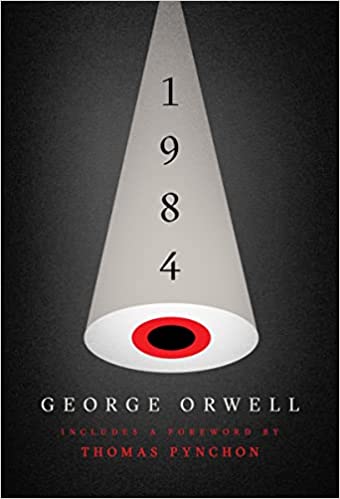
1984: Complete Plot Summary
1984 is divided into three parts that trace Winston Smith’s progression from private dissatisfaction to attempted rebellion and eventual psychological defeat. Part One introduces Oceania and Winston’s growing awareness of its contradictions. Part Two develops his relationship with Julia and his apparent involvement with an underground resistance movement, while Part Three follows his imprisonment, torture, and transformation.
The story unfolds primarily through Winston’s experiences, so readers encounter the political system through what he sees, remembers, fears, and gradually learns. This restricted perspective is important because the Party controls most public information, making it difficult to establish which accounts of history and politics are reliable.
Part One: Winston’s Rebellion Begins
The novel opens in London, now part of Airstrip One, a province of the superstate Oceania. Winston Smith, a thirty-nine-year-old member of the Outer Party, returns to his apartment in Victory Mansions on a cold April day. The building is deteriorating, the electricity is unreliable, and the smell of boiled cabbage fills the corridors. A giant poster bearing the face of Big Brother reminds residents that they are constantly being watched.
Inside Winston’s apartment is a telescreen, a device that simultaneously broadcasts propaganda and monitors the people within its range. Party members cannot ordinarily turn their telescreens off, and even a suspicious expression may attract attention. Winston has discovered a small alcove where he can sit outside the device’s direct field of vision, although he cannot be certain that his activities remain undetected.
He uses this limited privacy to begin writing in a diary purchased from an old-fashioned shop. Owning and writing in such a book is not explicitly identified as a particular statutory offence, but the act expresses precisely the kind of independent thinking that the Party punishes. Winston knows that the discovery of his diary could lead to imprisonment, torture, or death.
As he begins writing, Winston recalls the Two Minutes Hate, a compulsory ritual in which Party members watch propaganda attacking Emmanuel Goldstein, the supposed leader of an underground opposition organisation called the Brotherhood. Goldstein is presented as a traitor responsible for nearly everything threatening Oceania. The spectacle transforms fear and resentment into collective hatred, allowing the Party to direct public emotion toward a designated enemy.
During the ritual, Winston notices O’Brien, an intelligent and imposing member of the Inner Party. He feels an inexplicable affinity with him and imagines that O’Brien may secretly share his hostility toward the regime. Winston also notices a dark-haired young woman wearing the sash of the Junior Anti-Sex League. He dislikes and fears her, suspecting that her apparent enthusiasm for Party discipline might conceal a willingness to report him.
Winston’s diary becomes an increasingly open expression of rebellion. He writes denunciations of Big Brother and reflects on the fact that the Party might destroy him for thoughts he has never spoken publicly. In Oceania, thinking against the Party is known as thoughtcrime, and the Thought Police exist to detect and eliminate it.
A knock at the door interrupts him, but the visitor is only Mrs Parsons, a neighbour who needs help repairing her blocked kitchen sink. Winston enters her apartment and encounters her two children, enthusiastic members of the Spies, a Party organisation that trains young people to recognise and report suspicious behaviour.
The children play at accusing Winston of political crimes and are excited by the prospect of watching public executions. Their behaviour reveals how thoroughly the Party has penetrated family life. Children are encouraged to place political loyalty above affection for their parents, turning homes into another environment of surveillance.
Winston’s own past is difficult to reconstruct. He remembers fragments of his childhood, including his mother and younger sister, both of whom disappeared when he was young. In a dream, he sees them sinking away from him, as though they have sacrificed themselves so he might survive. He also dreams of a beautiful, sunlit landscape he calls the Golden Country.
The dreams bring together two experiences largely absent from Winston’s present life: unconditional love and a natural world untouched by political regimentation. They also reinforce his suspicion that human relationships were once different. Winston believes that people previously possessed loyalties and emotions that the Party has systematically weakened.
His attempts to remember history are complicated by his professional work at the Ministry of Truth. The Ministry’s name is ironic because its principal function is to manufacture information that supports the Party’s current claims.
Winston works in the Records Department, where he alters old newspaper articles, speeches, production figures, and official announcements. Whenever a past prediction proves inaccurate or a political figure becomes inconvenient, the records must be changed so that the Party appears never to have been wrong.
He receives instructions through pneumatic tubes, dictates replacements into a speakwrite, and deposits superseded documents into memory holes leading to furnaces. Once the old material is destroyed, only the revised account remains accessible.
One assignment requires Winston to remove a reference to a disgraced Party official. Instead of merely deleting the passage, he invents Comrade Ogilvy, a fictional hero supposedly devoted to Big Brother from childhood. Winston creates an exemplary biography, including military service and patriotic sacrifice, for a man who never existed.
The episode reveals the Ministry’s deeper significance. Winston is not simply concealing historical events; he is helping create an alternative past. Once the fabricated account becomes part of the official archive, future readers may have no way to distinguish Ogilvy from an actual historical person.
At work, Winston encounters several colleagues who represent different forms of accommodation to Party life. Syme, an intelligent specialist working on the Eleventh Edition of the Newspeak Dictionary, is particularly important.
Newspeak is the language being developed to replace traditional English, known in Oceania as Oldspeak. Syme explains enthusiastically that its purpose is to reduce vocabulary and eliminate unnecessary distinctions. By removing words associated with forbidden ideas, the Party hopes to make independent or rebellious thought increasingly difficult.
Syme understands the political implications of this project and appears genuinely delighted by them. Winston nevertheless suspects that Syme is too intelligent and too willing to speak openly about the Party’s methods to remain safe. His intelligence gives him an unusually clear understanding of the regime, but that same understanding could make him dangerous.
Another colleague, Tom Parsons, represents a different kind of Party member. He is energetic, unquestioningly patriotic, and deeply involved in collective political activities. Unlike Winston, Parsons seems almost incapable of recognising contradictions in official propaganda.
The contrast between Syme and Parsons demonstrates that the Party can command loyalty from very different personalities. Intellectual sophistication does not necessarily produce resistance, while political enthusiasm does not guarantee safety.
Winston’s dissatisfaction also extends to his personal life. He recalls his failed marriage to Katharine, a woman who accepted Party doctrine so completely that she treated sexual intercourse as an unpleasant obligation required for producing children.
Their marriage contained little affection or pleasure, and they eventually separated after failing to have a child. Divorce is not permitted, but separation is tolerated under certain circumstances. Winston’s memories of Katharine illustrate how the Party attempts to regulate even the most intimate aspects of personal relationships.
He also remembers an encounter with an elderly prostitute, an experience that left him disgusted with himself. These recollections reveal his loneliness, frustrated desire, and longing for forms of human connection that cannot easily exist within the Party’s ideology.
As Winston reflects on Oceania’s political structure, he concludes that hope may lie with the proles, the ordinary working population who constitute approximately eighty-five percent of society. Unlike Party members, they experience less systematic ideological supervision in many aspects of everyday life.
The proles are generally poor, poorly educated, and absorbed in work, entertainment, family obligations, and small material concerns. Winston recognises that their numbers would give them enormous potential power if they became politically conscious. Yet he cannot imagine how such consciousness could develop without the knowledge and organisation necessary to challenge the regime.
His frustration is intensified by a memory from his work. Years earlier, he briefly possessed a photograph proving that three former Party leaders—Jones, Aaronson, and Rutherford—had been falsely accused of treason.
The men had publicly confessed to participating in an enemy conspiracy at a particular time and place, but the photograph showed them attending a Party function elsewhere during the period in question. Winston recognised that the confessions could not be true.
Terrified by the implications, he destroyed the photograph. Although he remembers what it demonstrated, he can no longer produce evidence capable of establishing the truth independently of his recollection.
This incident crystallises his central conflict with the Party. Winston understands that if every external record can be altered and every witness intimidated, a government may become capable of making falsehood appear indistinguishable from fact.
Seeking evidence of a different past, Winston visits a prole neighbourhood and questions an elderly man in a pub. He hopes to learn whether ordinary people were genuinely better or worse off before the Revolution.
The conversation proves disappointing. The old man remembers isolated incidents, manners, clothing, and personal grievances, but cannot provide a coherent comparison between the previous political order and the present. His recollections are sincere but too fragmentary to resolve Winston’s questions.
Winston then returns to the second-hand shop where he purchased his diary. Its proprietor, Mr Charrington, seems unusually sympathetic to old objects, forgotten customs, and the surviving fragments of pre-Revolutionary London.
Winston buys a glass paperweight containing a piece of coral. The object has no practical value, but he finds it beautiful precisely because it appears to belong to a vanished world. It represents something preserved from the past that has not been reduced to its usefulness for the Party.
Charrington also shows Winston a furnished room above the shop. The room contains an old-fashioned bed, pictures, and other objects that recall an earlier domestic existence. Most significantly, Winston sees no telescreen.
Charrington shares fragments of a traditional nursery rhyme about London’s churches, giving Winston another tantalising connection to a history he cannot fully recover.
After leaving the shop, Winston encounters the dark-haired woman from the Ministry and becomes convinced that she is following him. He fears she may be an agent of the Thought Police and briefly considers attacking her before she can report him.
Part One ends with Winston increasingly conscious of his opposition but almost entirely powerless to act upon it. He possesses private memories, a diary, and a few surviving objects from the past, yet none can protect him against an organisation that appears capable of controlling both public history and private life.
Part Two: Love, Conspiracy, and Betrayal
Part Two begins with a sudden reversal of Winston’s expectations. The dark-haired woman falls near him in a corridor at the Ministry of Truth and secretly passes him a folded note.
When Winston manages to read it, he discovers that the message expresses her love for him. The woman he suspected of being an informant has instead made an extraordinary declaration of personal interest.
Winston is initially overwhelmed. His feelings shift from suspicion to hope, but acting on the message is dangerous. The Ministry provides few opportunities for private communication, and unusual behaviour could attract immediate attention.
Through brief exchanges concealed within public routines, they arrange to meet. Their first conversation takes place amid a crowded demonstration, where the noise and movement of the crowd provide temporary cover.
The woman directs Winston to a secluded location in the countryside. When he arrives, he discovers that her name is Julia and that she has considerable experience evading Party restrictions.
The countryside resembles Winston’s Golden Country dream. Its trees, flowers, and relative silence contrast sharply with London’s decaying buildings, propaganda broadcasts, and telescreens.
A thrush sings nearby, apparently without any political purpose. For Winston, the bird’s spontaneous song embodies a freedom largely absent from Party-controlled life.
Julia removes her Anti-Sex League sash and reveals that her outward political obedience is deliberately deceptive. She participates in Party organisations because they provide a useful disguise, not because she accepts their ideology.
The two begin a sexual relationship. Winston interprets their intimacy as an act of political rebellion because the Party seeks to prevent emotional and sexual attachments from competing with loyalty to Big Brother.
Julia’s attitude is more practical. She dislikes the Party because it interferes with her pleasure and independence, but she is less interested in historical truth, political theory, or revolutionary organisation.
Over subsequent meetings, Winston and Julia gradually learn more about each other. Julia describes her work at the Ministry’s Fiction Department, where entertainment for the proles is produced through highly mechanised processes.
She explains how she has used apparently respectable Party activities to conceal previous relationships. Her experience makes her skilled at recognising opportunities for secrecy, arranging meetings, and avoiding suspicion.
Winston is fascinated by her defiance, but the differences between them remain substantial. He wants to understand how Oceania came into existence and whether its account of the world is false. Julia is primarily concerned with finding ways to live privately despite its restrictions.
When Winston raises questions about the war and political history, Julia is often indifferent. She suspects that much official information is fabricated but sees little value in determining precisely which claims are true.
This difference matters because their relationship contains two forms of resistance. Winston seeks an independent understanding of reality, while Julia attempts to recover a sphere of personal experience beyond ideological supervision.
Eventually Winston takes a more dangerous step by renting the room above Mr Charrington’s shop. The room appears to offer something neither lover can obtain in ordinary Party accommodation: a private domestic space.
Julia brings real coffee, sugar, bread, and other scarce items acquired through unofficial channels. She wears cosmetics and changes her appearance, transforming herself from an anonymous Party worker into a woman expressing her individuality.
Their meetings begin to resemble an ordinary relationship. They eat together, talk, make love, and imagine temporarily escaping the world outside.
The glass paperweight becomes particularly important to Winston. He sees its enclosed piece of coral as something preserved within a small, protected universe, much as he imagines himself and Julia living inside the rented room.
Yet signs of danger remain. Winston discovers a rat in the room and reacts with intense fear. Julia comforts him, unaware that this particular terror will later become the means of his final psychological defeat.
Elsewhere, the Party’s machinery continues operating. Syme disappears from the Ministry and is eventually erased from public records, confirming Winston’s expectation that his intelligence would make him vulnerable.
The preparations for Hate Week intensify. Workers must help produce propaganda, demonstrations, decorations, and public celebrations designed to direct the population’s emotions toward Oceania’s designated enemy.
Winston and Julia continue meeting despite the increasing political excitement. Their private relationship gives Winston a feeling of happiness that changes his experience of everyday life, although it also creates a growing dependence on the apparent safety of their secret room.
One night Winston dreams about his mother and recalls a painful incident from childhood. His family had been living through severe shortages, and his mother possessed a small quantity of chocolate to divide between him and his younger sister.
Driven by hunger and selfishness, Winston took more than his share, seized his sister’s portion, and ran away. When he returned, his mother and sister had disappeared.
He does not know precisely what happened to them, but the memory fills him with guilt. His mother’s devotion appears to belong to an earlier moral world in which love and sacrifice possessed value independent of political calculation.
Discussing this memory with Julia leads to a conversation about betrayal. Both accept that they will probably be caught and tortured. They believe the Party may force them to confess their actions, but they insist that it cannot make them stop loving each other.
For Winston, this distinction is fundamental. Even if the Party controls everything people say and do, he hopes that genuine feelings can survive internally.
Meanwhile, his fascination with O’Brien deepens. One day O’Brien approaches him at the Ministry and mentions the Newspeak Dictionary, apparently offering Winston an opportunity to obtain an advance copy.
O’Brien gives Winston his home address. Because such an exchange is unusual between members of different Party ranks, Winston interprets it as a coded invitation.
He becomes convinced that O’Brien belongs to the Brotherhood, the underground movement allegedly led by Emmanuel Goldstein. The possibility of organised resistance is emotionally powerful because it suggests that Winston’s isolation may have been an illusion.
Winston and Julia eventually visit O’Brien’s luxurious apartment. The contrast with their own living conditions is striking: the Inner Party enjoys spacious accommodation, personal servants, superior food, and privileges unavailable to ordinary Party members.
O’Brien demonstrates that he can temporarily turn off his telescreen. The gesture appears to confirm Winston’s belief that they can speak freely.
He then declares that he belongs to the Brotherhood and invites them to join its struggle against Big Brother. O’Brien questions them about their willingness to undertake dangerous and morally troubling actions.
They agree that they would lie, spread disease, commit murder, and perform other destructive acts if necessary for the rebellion. Their willingness demonstrates the desperation and moral compromises that can arise when ordinary political resistance appears impossible.
However, when O’Brien asks whether they would agree never to see each other again, Julia refuses and Winston supports her. Their relationship remains the one loyalty they are unwilling to surrender.
O’Brien promises Winston a copy of The Theory and Practice of Oligarchical Collectivism, a forbidden book supposedly written by Goldstein. Winston leaves believing that he has entered a genuine revolutionary conspiracy.
Soon afterward, Hate Week reaches its climax. Oceania has been portrayed as fighting Eurasia while allied with Eastasia, but during a major public speech the official enemy suddenly changes.
Without acknowledging any contradiction, the Party now insists that Oceania has always been at war with Eastasia and has always been allied with Eurasia.
The population immediately accepts the revised position. Propaganda displays attacking the former enemy must be replaced, and Winston’s department undertakes an exhausting programme of historical revision.
For days, the Ministry of Truth works to eliminate evidence of the previous account. Speeches, newspaper reports, military announcements, and other documents are rewritten to reflect the newly declared history.
The incident demonstrates the extraordinary practical consequences of doublethink. Party members must participate in changing the records while also accepting that no change has occurred.
Once the emergency work is completed, Winston returns to the rented room and begins reading Goldstein’s book, which has been delivered through the promised clandestine arrangements.
The text offers a systematic explanation of Oceania’s political order. It argues that human societies have repeatedly been divided into three groups: the High, who possess power; the Middle, who seek to replace them; and the Low, who suffer under both.
According to this theory, revolutions often change the membership of the ruling class without permanently eliminating hierarchy. The Middle may mobilise the Low through promises of equality, but once successful, they establish a new ruling group.
Goldstein’s book explains that the rulers of Oceania seek to prevent even this recurring cycle. Their objective is not merely to maintain power temporarily but to construct a society in which their hierarchy cannot be overturned.
Perpetual war is central to this arrangement. Oceania, Eurasia, and Eastasia are described as enormous superstates whose military struggles continue indefinitely without fundamentally changing the balance of power.
The wars absorb resources that might otherwise improve living standards. By directing production toward destruction, the ruling elite can maintain economic scarcity without abandoning industrial organisation.
Goldstein’s theory suggests that widespread prosperity would threaten the class hierarchy by making education, leisure, and independent thought more accessible. Continuous war therefore serves a domestic political purpose beyond any conventional military objective.
The book also explains the importance of ideological control. The Party’s manipulation of records, use of doublethink, and regulation of information help maintain a population unable to establish an independent standard against which political claims can be tested.
Winston finds the explanation persuasive because it gives intellectual form to much of what he already suspects. Nevertheless, it does not fully resolve his deepest question.
He believes he now understands many mechanisms by which the Party maintains power, but he still wants to know why it pursues domination so relentlessly.
Julia is less interested in the book’s theoretical arguments. While Winston reads, she falls asleep, reinforcing the difference between their approaches to resistance.
Later, Winston and Julia look toward the courtyard below the room, where a prole woman hangs washing and sings while continuing her everyday work.
Winston is struck by her vitality and imagines that the ordinary people outside the Party may preserve something human that the regime cannot completely destroy. He and Julia contemplate their probable fate while remaining attached to the hope represented by the proles.
Then a hidden voice interrupts them.
The room has contained a concealed telescreen all along, positioned behind a picture on the wall. Winston and Julia discover that their conversations and activities have been monitored.
The Thought Police enter. Julia is struck and removed, the glass paperweight is smashed, and the room’s illusion of safety collapses instantly.
Mr Charrington reveals his true identity as a member of the Thought Police. His harmless appearance, interest in history, and apparent sympathy were components of an elaborate trap.
The betrayal also transforms the meaning of O’Brien’s invitation. Winston’s supposed path toward organised resistance has brought him directly into the regime’s power.
Part Two concludes with Winston’s private rebellion destroyed. The rented room, the apparent Brotherhood, and the objects that seemed to connect him with the past have all proved incapable of protecting him.
Part Three: The Ministry of Love and Winston’s Defeat
Winston awakens as a prisoner in the Ministry of Love, the institution responsible for political repression, interrogation, and psychological conditioning.
The building’s interior is designed to eliminate ordinary distinctions between time and place. Bright artificial lighting makes it impossible to identify the hour, while telescreens monitor the prisoners continuously.
Winston is exhausted, hungry, frightened, and uncertain about what will happen next. He encounters prisoners detained for offences ranging from political suspicion to seemingly minor deviations from official expectations.
One prisoner is Ampleforth, a poet who has been imprisoned because of an issue arising from the treatment of a literary text. His presence illustrates how even technical or artistic work can become politically dangerous when language is subjected to ideological supervision.
Winston also encounters Parsons, his previously enthusiastic neighbour. Parsons has been arrested after his daughter reported him for speaking against Big Brother while asleep.
Parsons remains devoted to the Party despite his imprisonment. Rather than questioning the system, he regards the possibility of his own unconscious disloyalty as a genuine offence and feels grateful that it has been discovered.
This encounter confirms the full implications of the children’s earlier training. The Party has successfully made denunciation appear more important than family loyalty, and even its most obedient supporters cannot rely on innocence for protection.
Winston observes the terror produced by the mention of Room 101. Prisoners confronted with the possibility of being sent there become desperate, suggesting that it contains something worse than ordinary imprisonment or execution.
Eventually O’Brien enters the cell. Winston initially struggles to reconcile his expectations with the reality that O’Brien is participating in his captivity.
O’Brien reveals that he has always been associated with the Party’s machinery of repression. Winston’s belief that he represented an independent opposition was part of a calculated deception.
The interrogation process begins with physical violence. Winston is beaten and humiliated until pain becomes the central organising fact of his existence.
He experiences the terrible ease with which torture can force a person to say things he does not believe. Under extreme suffering, he becomes willing to confess to crimes he never committed simply to obtain relief.
The process, however, is not confined to extracting confessions. O’Brien personally supervises a programme intended to dismantle Winston’s capacity for independent judgment.
O’Brien insists that the Party does not merely need Winston to repeat its assertions. It needs him to accept them without retaining a hidden private conviction that they are false.
One of their central disputes concerns mathematics and objective reality. Winston believes that basic truths remain true regardless of political authority.
O’Brien uses pain and psychological pressure to demonstrate that Winston can be compelled to accept a different answer when the Party demands it. His objective is to make Winston surrender the belief that reality possesses standards independent of political control.
The interrogation returns to the photograph of Jones, Aaronson, and Rutherford. Winston remembers possessing documentary evidence that their confessions were false.
O’Brien briefly presents the photograph before destroying it, then challenges Winston’s ability to establish that it ever existed. The scene brings the novel’s central problem to its most concentrated form: a person may know that evidence once existed yet become unable to prove its existence when every accessible record and witness is controlled.
O’Brien also explains that the Party has been watching Winston for years. His diary, relationships, and apparently private acts have unfolded within a system far more comprehensive than he realised.
Winston learns that the book attributed to Goldstein was produced with the participation of Party authorities, including O’Brien himself. This revelation complicates its status as a reliable explanation of the political system.
Although much of the book’s analysis may describe Oceania accurately, it is no longer possible to regard it as independent evidence supplied by an authentic resistance movement.
O’Brien proceeds to explain the Party’s philosophy of power. Unlike movements that justify dictatorship as a temporary means of creating a more desirable society, the rulers of Oceania openly seek domination as their final objective.
In O’Brien’s account, the Party does not pursue power to establish equality, prosperity, peace, or collective happiness. It values the capacity to command, control, punish, and transform other human beings.
His vision of the future is a world in which all personal loyalties outside the Party are destroyed. Family attachment, romantic love, friendship, artistic independence, and private moral judgment are to be eliminated or made subordinate to political authority.
O’Brien argues that power becomes most complete when it controls the inner life. A prisoner who publicly submits while privately maintaining an independent conviction has not yet been fully conquered.
Winston resists this explanation by appealing to humanity, memory, and the possibility that the Party’s system must eventually encounter some limit. O’Brien rejects his arguments and attempts to demonstrate that Winston has already been reduced to physical and psychological helplessness.
At one point he forces Winston to confront his own appearance in a mirror. Winston sees how imprisonment has damaged his body, making visible the destruction that the Party has inflicted.
O’Brien claims that Winston represents a defeated remnant of independent humanity. The scene turns the struggle between political power and personal resistance into something intensely physical.
Over time, Winston’s treatment changes. He receives food, medical attention, and opportunities to recover some of his strength.
He begins practising the beliefs demanded by his interrogators. Instead of automatically rejecting Party propositions, he trains himself to accept them and suppress the mental habits that previously led him to question official claims.
The rehabilitation appears increasingly successful. Winston becomes more willing to acknowledge the Party’s authority over facts, logic, and political reality.
Yet the process remains incomplete. He still possesses emotional memories of Julia and retains feelings that he has not fully surrendered.
During one period of sleep or involuntary reflection, he reveals his continuing love for her. This demonstrates that his intellectual conditioning has not entirely destroyed his previous loyalties.
O’Brien recognises the remaining resistance and orders Winston to be taken to Room 101.
The room’s function is to expose each prisoner to the particular thing they find most unbearable. For Winston, that fear is rats.
O’Brien presents a cage containing hungry rats and explains the mechanism by which they can be brought against Winston’s face. Winston’s terror overwhelms his remaining capacity for conscious resistance.
He desperately begs for the punishment to be inflicted on Julia instead.
This is the decisive act of betrayal. Winston had previously believed that the Party might force him to confess his relationship but could not make him stop loving Julia.
In Room 101, his instinct for survival overcomes the loyalty that he had regarded as his final defence against political control. He does not merely admit their relationship or provide information under torture; he genuinely desires that Julia should suffer instead of him.
The Party has found a way to turn his strongest emotional attachment into something he is willing to sacrifice.
After this final conditioning, Winston is eventually released.
He now spends much of his time at the Chestnut Tree Café, drinking Victory Gin, listening to telescreen announcements, and occupying himself with chess and minor activities.
His circumstances have changed, and he no longer works in the Records Department as before. He has some form of inconsequential employment, but he appears largely detached from meaningful personal or political ambitions.
Winston encounters Julia again. Both have been physically and psychologically altered by their experiences.
Julia admits that she betrayed him, and Winston acknowledges that he betrayed her. Their conversation reveals that something essential has disappeared from their relationship.
They no longer feel the intimacy or devotion that once made them willing to risk their lives together. Their physical encounter is awkward and emotionally empty, demonstrating that the Party’s victory has extended beyond their public behaviour.
Winston returns to the café and continues following official military reports. Oceania’s ongoing war remains the centre of public political life.
At one point he experiences a memory of his childhood, including an apparently happy moment with his mother and sister. Rather than allowing the memory to threaten his restored loyalty, he dismisses it as unreliable.
When the telescreen announces a major military victory in Africa, Winston is swept into an emotional identification with Oceania’s triumph.
The novel ends with his complete surrender to Big Brother. He no longer experiences the Party’s leader as the object of his hatred and resistance but as someone he loves.
Orwell does not explicitly depict Winston being executed. The conclusion instead presents the destruction of his independent political and emotional identity.
The Party has achieved what it wanted: Winston’s external compliance has become an internal transformation.
The Principles of Newspeak: What the Appendix Explains
The appendix, The Principles of Newspeak, provides a systematic explanation of Oceania’s planned official language. Although it follows the narrative rather than participating directly in Winston’s story, it is essential to understanding the Party’s ambition to control thought.
Newspeak is designed to replace Oldspeak, the ordinary English language that people in Oceania still largely use during the events of 1984. The Party expects Newspeak to become the exclusive language of the population by approximately 2050, after successive dictionaries have eliminated words and meanings considered unnecessary or politically dangerous.
The fundamental purpose of Newspeak is different from that of most languages. Ordinary languages generally accumulate expressions that allow speakers to communicate a growing range of experiences, discoveries, and ideas. Newspeak is intended to reduce that range.
The Party believes that rebellious thoughts become more difficult to formulate when the vocabulary necessary to express them no longer exists. It therefore seeks not simply to discourage forbidden ideas but to eliminate linguistic distinctions that might support them.
For example, a word corresponding to freedom might survive in a limited physical sense, such as describing an object free from dirt. Its meanings associated with political independence, intellectual liberty, or individual rights would disappear.
The appendix divides Newspeak vocabulary into three principal categories.
The A vocabulary contains words required for ordinary practical activities. These include actions such as eating, walking, working, or handling common objects.
Its grammar is deliberately simplified. Irregular verb forms are removed, and words are transformed through predictable combinations of prefixes and suffixes.
Instead of maintaining separate terms for every degree of approval or disapproval, Newspeak uses formations such as ungood, plusgood, and doubleplusgood. These constructions reduce the number of independent words available to speakers.
The A vocabulary is intended to communicate simple, concrete meanings. It is not designed to support complex philosophical reflection, literary expression, or political debate.
The B vocabulary is explicitly ideological. It consists largely of compound words associated with political institutions, approved attitudes, and forms of conduct.
Terms such as goodthink, crimethink, thinkpol, and Minipax compress complicated political concepts into short expressions. Their purpose is not merely linguistic efficiency. They are designed to carry ideological associations that encourage the speaker to accept the Party’s judgments automatically.
Goodthink expresses political orthodoxy, while crimethink identifies forbidden thinking. The terms reduce complex distinctions to categories already marked as acceptable or unacceptable.
Other expressions conceal disturbing realities behind reassuring labels. Joycamp, for instance, refers to a forced-labour camp, while Minipax, the abbreviated Ministry of Peace, represents an institution responsible for warfare.
The appendix also explains duckspeak, a term associated with speech that emerges almost mechanically, without genuine independent reflection. When the speaker expresses Party orthodoxy, the ability to repeat approved ideas automatically is treated as a virtue.
Newspeak’s designers prefer short, easily pronounced words that evoke as few associations as possible. They want political language to become increasingly automatic, reducing the opportunity for reflective thought.
The C vocabulary contains scientific and technical terminology. It allows specialists to perform necessary tasks within restricted fields of knowledge.
However, scientific vocabulary is divided into narrow professional categories, preventing specialists from easily developing a wider understanding of science as an independent method of inquiry.
The appendix makes clear that the language has no general concept corresponding to science as a habit of rational investigation. Technical expertise may remain useful, but autonomous intellectual questioning is incompatible with the Party’s goals.
The final portion of the appendix considers the consequences of Newspeak’s eventual dominance.
Historical literature would become increasingly inaccessible because many older concepts could no longer be translated accurately. Political ideas associated with equality, freedom, rights, and independent government would lack corresponding expressions.
The appendix illustrates this difficulty through a passage from the American Declaration of Independence. Its political meaning cannot survive translation into a language deliberately constructed to exclude the assumptions on which it depends.
Classical authors and earlier literature are therefore subjected to ideological rewriting. Their works may retain familiar names and outward prestige, but the ideas expressed within them are altered to conform to Party doctrine.
Once the original texts disappear, the population may lose not only knowledge of the past but also the conceptual resources needed to recognise that alternative political arrangements were ever possible.
The appendix is particularly disturbing because its project extends beyond censorship. Censorship suppresses expressions that people might otherwise understand. Newspeak attempts to create a future in which certain expressions and the ideas behind them cannot readily be conceived at all.
Its detached explanatory voice also introduces an interpretive uncertainty. The text describes the language programme from a perspective that appears separate from the immediate narrative, sometimes treating features of Oceania as historical phenomena. This has encouraged speculation that the Party’s dominance may not be permanent, but the appendix does not explicitly establish such an outcome.
Oceania’s World: Government, Class, and Daily Life
The society of 1984 is organised around political surveillance, economic scarcity, historical manipulation, and rigid hierarchy. Orwell creates this world through institutional descriptions, everyday routines, physical surroundings, and Winston’s gradual discoveries rather than presenting it only as an abstract political theory.
Oceania is described as one of three enormous superstates, alongside Eurasia and Eastasia. It includes the Americas, Britain, Australasia, and other territories, while London functions as part of Airstrip One.
The exact political history of these territories remains uncertain because Winston receives his information through sources subject to Party manipulation. Nevertheless, the novel presents Oceania as a society dominated by Ingsoc, the ideology officially identified with English Socialism.
Its government is headed symbolically by Big Brother, whose face appears on posters, telescreens, and propaganda materials. The population is encouraged to imagine him as an all-knowing protector, although his actual existence as a living individual is never independently established.
The Party is organised into a sharply stratified hierarchy. At the top is the Inner Party, the small ruling elite that possesses the greatest political authority and enjoys significant material privileges.
Below it is the Outer Party, whose members perform administrative, technical, and intellectual work. Winston belongs to this group, which receives stricter ideological supervision than the ordinary population.
At the bottom are the proles, who constitute the overwhelming majority of society but remain largely excluded from political power. Their lives revolve around work, family, entertainment, poverty, and the struggle to obtain ordinary necessities.
The system depends on this division. The Inner Party governs, the Outer Party maintains its institutions, and the proles supply much of the labour required for the economy.
Oceania’s four principal ministries embody its governing methods.
The Ministry of Truth controls information, entertainment, education, and historical records. Its purpose is to maintain the Party’s account of reality by eliminating contradictions between current claims and previous evidence.
The Ministry of Peace conducts warfare, despite its reassuring name. The Ministry of Plenty manages economic affairs and publishes claims of expanding production, even as ordinary citizens experience shortages.
The Ministry of Love operates the mechanisms of repression, interrogation, and punishment. Its name conceals an institution associated with terror and the destruction of personal independence.
These names are not incidental jokes. They embody the Party’s ability to make language publicly affirm the opposite of observable experience.
Everyday life is equally important to the novel’s atmosphere. Winston’s apartment is uncomfortable, the streets are decaying, and basic consumer products are frequently unpleasant or difficult to obtain.
Victory Gin, Victory Cigarettes, synthetic food, rationed supplies, and unreliable infrastructure demonstrate that the regime’s claims of increasing prosperity are disconnected from ordinary experience.
Shortages also reinforce dependency. People absorbed in obtaining basic necessities have less time, privacy, and confidence to pursue political questions.
Surveillance is pervasive but not evenly distributed. Party members live under continuous scrutiny through telescreens, workplace monitoring, organised activities, and the threat of denunciation.
The proles generally experience less direct supervision of their private routines, partly because the Party considers them politically insignificant. Their relative freedom, however, coexists with poverty, limited education, manipulated entertainment, and exclusion from political participation.
Public rituals reinforce ideological unity. The Two Minutes Hate and Hate Week convert individual anger into collective political emotion, while changing enemies provide an endless source of anxiety and patriotic excitement.
The Party also organises childhood education and youth activities so that political loyalty develops before independent judgment. The Spies encourage children to report suspicious behaviour, while mass organisations absorb time that might otherwise be spent in private relationships.
One of Oceania’s most important features is the disappearance of any dependable boundary between public and private life. A person’s words, facial expressions, friendships, sexual conduct, memories, and dreams may all become politically significant.
Orwell’s world is effective because its repression does not appear only in spectacular scenes of violence. It exists in broken elevators, unpleasant meals, suspicious neighbours, mandatory celebrations, altered newspapers, and the routine humiliation of ordinary citizens.
The result is a political order that restricts the conditions under which independent thought and personal loyalty might develop.
Character Analysis: Winston, Julia, O’Brien, and Others
The characters in 1984 represent different relationships to political power, but they are not all merely allegorical figures. Orwell uses their personalities, weaknesses, desires, and conflicting beliefs to show how a totalitarian society influences individual behaviour.
The three central characters form a particularly important contrast. Winston searches for truth, Julia seeks private freedom, and O’Brien works to demonstrate the Party’s unlimited authority over both.
Winston Smith
Winston Smith is an unusually vulnerable protagonist. He is physically frail, often ill or uncomfortable, socially isolated, and deeply uncertain about his past. Unlike a conventional revolutionary hero, he possesses neither organisational power nor the confidence necessary to imagine a realistic political victory.
His dissatisfaction begins with the contradictions he encounters in ordinary life. He knows that his department rewrites history, remembers evidence of official deception, and recognises the emotional manipulation behind Party rituals.
Yet his knowledge is incomplete. He cannot independently establish many historical facts and frequently struggles to distinguish his memories from the stories the Party has imposed on society.
Winston’s desire for truth is therefore intertwined with a desire for personal continuity. He wants to believe that his childhood existed as he remembers it, that the dead once mattered, and that the past cannot be erased simply because official records have changed.
His longing also has an emotional dimension. The memory of his mother, his fascination with old objects, and his attachment to the rented room express a desire for forms of loyalty and beauty that the Party has not entirely subordinated to politics.
Winston’s relationship with Julia briefly transforms him. He discovers companionship, sensual pleasure, trust, and the possibility of a life organised around something other than fear.
However, he often interprets Julia through his own political needs. He wants her sexual defiance to represent an organised attack on the Party, even though her motivations are more personal and practical.
He also possesses contradictions that prevent him from becoming an idealised defender of humanity. His desperation makes him willing to endorse morally troubling acts in the supposed service of revolution.
His earlier treatment of his mother and sister reveals selfishness and guilt, while his attitudes toward women sometimes combine attraction, resentment, and suspicion.
These flaws matter because Winston’s value as a character does not depend on exceptional moral virtue. His rebellion originates in recognisably human needs for truth, affection, dignity, and freedom.
His greatest weakness is his tendency to project hope onto people and objects that appear to confirm his beliefs. He convinces himself that O’Brien understands him, that Charrington represents a surviving connection with the past, and that the rented room offers genuine safety.
These assumptions contribute directly to his downfall. Winston’s tragedy is not simply that he opposes a stronger enemy; it is that his need for meaning and connection helps expose him to manipulation.
By the ending, his mental and emotional independence has been destroyed. His fate makes the novel’s political warning more disturbing because the protagonist does not remain internally heroic despite his defeat.
Julia
Julia offers a different response to totalitarianism. She is younger than Winston, physically energetic, socially resourceful, and skilled at presenting the appearance of political conformity.
Her participation in the Junior Anti-Sex League and other Party activities is strategic. She understands that a reputation for orthodoxy can create opportunities for private disobedience.
Unlike Winston, Julia is not particularly interested in recovering historical truth. She assumes that much of the Party’s account of the world is false, but she rarely pursues the implications through systematic political reasoning.
Her resistance centres on pleasure, bodily autonomy, and personal choice. She wants experiences that belong to her rather than to the political organisation governing her life.
This makes her a significant counterpoint to Winston. Where he searches for intellectual freedom, she practises forms of independence within whatever opportunities are available.
Julia also possesses practical intelligence that Winston often lacks. She knows how to arrange clandestine meetings, use public crowds as cover, obtain scarce goods, and maintain a convincing institutional disguise.
However, her political detachment limits the ambitions of her rebellion. She can violate Party rules without possessing a coherent plan for challenging the system that produces them.
Her willingness to accept or ignore contradictory political information also raises a difficult question: can a person remain genuinely free while surrendering any serious interest in the truth?
Orwell’s portrayal of Julia is not without limitations. Much of her character is filtered through Winston’s perspective, and her independent emotional life remains less fully developed than his.
Her role in the story is frequently associated with sexuality and the recovery of private pleasure. Although she demonstrates intelligence and courage, readers receive relatively little access to her thoughts outside the relationship.
Nevertheless, Julia is more than a romantic symbol. She shows that resistance need not begin with abstract political theory and that authoritarian systems can be challenged through ordinary human desires they seek to regulate.
Her final condition demonstrates the limits of that resistance when the state possesses the means to inflict personalised psychological terror.
O’Brien
O’Brien is the novel’s most intellectually formidable character. His social position, personal authority, and apparent understanding of Winston make him seem capable of offering an alternative to the Party’s public ideology.
Winston initially regards him as a potential ally because O’Brien appears thoughtful and less mechanically enthusiastic than ordinary Party members. Their apparent affinity is important because Winston interprets intelligence and emotional recognition as possible evidence of shared dissent.
O’Brien exploits this assumption. He allows Winston to believe that an organised resistance movement exists and that he has been invited to join it.
His apartment, personal manner, and willingness to discuss forbidden subjects create an atmosphere of exceptional trust. The later revelation that he works for the Party turns these details into evidence of deliberate manipulation.
O’Brien’s relationship with Winston combines ideological conviction, intellectual domination, and psychological cruelty. He understands Winston’s desire for truth and uses that understanding to dismantle his independence.
Unlike a crude interrogator interested only in confessions, O’Brien wants the prisoner to accept the Party’s authority internally. His methods combine physical pain, philosophical argument, emotional manipulation, and carefully controlled rewards.
He is particularly disturbing because he does not conceal the brutality of the system. He describes its ambition to dominate human beings without pretending that the ultimate objective is their happiness.
His claims, however, should not automatically be accepted as objective descriptions of reality. O’Brien is a powerful representative of the Party, but his statements are also part of an interrogation designed to destroy Winston’s resistance.
His apparent confidence that the Party can rule forever may reveal ideological certainty rather than proven political knowledge.
As a literary character, O’Brien functions partly as a psychological antagonist and partly as the principal voice of the regime’s political philosophy. His intellectual clarity makes the final confrontation compelling, although his role as the expositor of totalitarian ideology can sometimes reduce his psychological ambiguity.
The Supporting Characters and Uncertain Figures
Several supporting characters reveal aspects of Oceania that cannot be explained through Winston, Julia, and O’Brien alone.
Syme is an enthusiastic intellectual who understands the political purpose of Newspeak. His eventual disappearance shows that the Party’s demand for orthodoxy does not necessarily protect knowledgeable supporters. Intelligence becomes dangerous when it makes people too conscious of the system’s mechanisms.
Tom Parsons represents ordinary political conformity. He genuinely loves Party activities and sees himself as a loyal citizen, yet his daughter’s denunciation demonstrates that unquestioning devotion provides no guarantee of safety.
Mrs Parsons and the Parsons children reveal the destructive effects of ideological education on family relationships. The children’s political enthusiasm transforms ordinary domestic life into an environment of suspicion and intimidation.
Mr Charrington embodies deceptive nostalgia. His shop and rented room appear to preserve an older world of private property, beauty, and memory, but their eventual exposure as instruments of surveillance shows how the Party can manipulate the desire to escape its control.
Katharine, Winston’s estranged wife, demonstrates the internalisation of political doctrine within marriage and sexuality. Her character is presented primarily through Winston’s memories, limiting how fully readers can assess her independently.
Winston’s mother and sister represent a lost emotional world. Their disappearance, combined with Winston’s childhood guilt, makes them central to his belief that authentic love and sacrifice once existed outside political calculation.
The singing prole woman represents ordinary human continuity. Her physical vitality, domestic labour, and apparently unselfconscious singing contrast with the Party’s artificial language and organised emotional rituals.
Emmanuel Goldstein is represented as the supposed enemy of the regime and leader of the Brotherhood. His book offers an extensive political explanation, but the narrative never establishes that the public figure described by Party propaganda corresponds to an independent revolutionary leader.
Big Brother similarly functions as the personification of Party authority. His image is everywhere, but the story does not conclusively establish whether he exists as an individual in the manner the population is encouraged to believe.
The uncertainty surrounding these figures is essential. Their political functions are clear even when their personal identities remain unverifiable.
Winston and Julia: Love, Loyalty, and Betrayal
The relationship between Winston and Julia is the emotional centre of 1984. It develops from suspicion into intimacy and ultimately becomes the means through which the Party demonstrates its ability to destroy independent personal loyalties.
Initially, Winston sees Julia as a threat. Her Anti-Sex League sash and apparent conformity make him suspect that she may be watching him on behalf of the Thought Police.
Her secret declaration of love completely changes their relationship. In a society where spontaneous private emotion is dangerous, the note offers Winston something he has almost ceased to expect: affection that appears to exist independently of political authority.
Their first encounter in the countryside establishes a temporary alternative to Oceania’s organised life. The natural surroundings, spontaneous birdsong, and physical intimacy contrast with the surveillance, deprivation, and compulsory ideological performances of London.
The relationship also gives Winston a different understanding of rebellion. He recognises that the Party’s hostility to sexual pleasure is connected to its broader attempt to prevent loyalties that might compete with devotion to Big Brother.
Julia, however, does not experience their affair in precisely the same way. She values the relationship because it offers happiness, independence, and opportunities to evade restrictions.
Winston hopes that private love might become the beginning of political resistance. Julia is more interested in preserving a small personal world within the system.
Their differences do not prevent genuine affection. Instead, they show that people can oppose oppression for different reasons without sharing a complete political worldview.
The rented room intensifies their attachment by allowing them to imitate ordinary domestic life. They enjoy real food, personal conversation, sexual intimacy, and the illusion that time can temporarily proceed outside the Party’s control.
The paperweight becomes Winston’s image of this protected existence. He imagines their relationship as something enclosed and preserved, much like the coral suspended within the glass.
Yet the security is false. Charrington’s room has been monitored from the beginning, and the couple’s apparent independence exists within a trap designed by the regime.
The most important development occurs when Winston and Julia discuss what torture might accomplish. They believe that physical coercion can force them to confess or denounce each other, but that their actual feelings will remain beyond the Party’s reach.
This confidence rests on a distinction between external obedience and internal loyalty. They accept that the body may be controlled while hoping that genuine attachment possesses a final independence.
Room 101 destroys that hope. Winston’s terror of rats becomes so overwhelming that he desperately wishes Julia to suffer instead of him.
His betrayal is not merely the disclosure of information. The Party succeeds in making his desire for self-preservation overpower the loyalty that he believed defined his relationship.
Their final meeting confirms the emotional consequence. They have both betrayed one another, and the attachment that once sustained them has disappeared.
The tragedy therefore extends beyond separation or death. Orwell depicts a political system that can exploit the body’s vulnerability to destroy the feelings through which individuals experience themselves as connected to other people.
Truth, Memory, and the Control of Language
The struggle over truth is one of 1984’s central philosophical concerns. Orwell imagines a political system that seeks to eliminate any reliable standard of reality independent of the ruling organisation.
The Ministry of Truth provides the most concrete demonstration of this project. Winston’s department alters historical documents so that the Party’s current position always appears consistent with the past.
If production targets are missed, the previous predictions are revised. If an official disappears, references to that person are removed. If Oceania changes enemies, earlier reports are rewritten to suggest that the new conflict has always existed.
This process differs from ordinary political dishonesty because it attempts to destroy the evidence necessary to expose deception. The Party does not merely tell false stories; it systematically removes alternative accounts from the public record.
Winston’s invention of Comrade Ogilvy demonstrates how completely the relationship between evidence and history can be inverted. A fictional individual acquires an official biography, while actual people can be eliminated from historical documentation.
The photograph of Jones, Aaronson, and Rutherford reveals the opposite possibility. It briefly provides evidence that an official confession was false.
When Winston destroys the photograph, he loses the material proof supporting his recollection. The historical event does not thereby change, but his ability to establish what happened becomes precarious.
This distinction is crucial. The Party can alter documents and manipulate memory, but whether it can literally alter the past is a philosophical question the novel deliberately places under pressure.
Doublethink is the mental practice that allows Party members to maintain incompatible beliefs while accepting each as orthodox when required.
A person involved in revising historical records must know enough about the previous version to change it. Yet afterward, that person is expected to accept the revised account as though no alteration occurred.
The sudden reversal of Oceania’s enemy during Hate Week provides a large-scale example. The population must abandon its previous beliefs without acknowledging that it has changed them.
Doublethink therefore combines conscious deception with the suppression of awareness that deception is occurring. It makes the Party’s contradictions psychologically manageable for those who serve it.
Newspeak extends this control into the structure of language. By eliminating politically dangerous meanings and reducing the vocabulary available to speakers, the Party hopes to make alternative ideas increasingly difficult to formulate.
A society without usable expressions for political equality, intellectual freedom, or independent rights may find it harder to communicate the distinctions on which those ideas depend.
Orwell’s interest in this connection predates the novel. In his essay Politics and the English Language, he examines how political language can obscure reality, disguise violence, and encourage habitual rather than careful thinking.
Newspeak represents an extreme fictional development of those concerns. Its vocabulary is deliberately engineered to encourage conformity and reduce reflection.
However, the novel’s linguistic theory should not be treated as a settled scientific demonstration that eliminating a word necessarily makes its associated idea impossible to imagine. Human thinking can involve images, experiences, and distinctions that are not always dependent on a particular vocabulary.
Orwell’s broader warning remains powerful even without accepting the strongest form of linguistic determinism. Political institutions can influence which ideas are readily discussed, which distinctions are socially recognised, and which experiences can be communicated without punishment.
O’Brien’s interrogation pushes the conflict beyond language into the nature of reality itself.
Winston maintains that certain propositions remain true whether or not the Party accepts them. O’Brien insists that reality exists through the mind and that the Party can determine what its members are required to perceive and believe.
The struggle over elementary arithmetic makes the disagreement concrete. Winston’s conviction that mathematical truths cannot be altered by political power becomes a target for physical and psychological coercion.
O’Brien wants Winston not merely to pretend agreement but to abandon the distinction between externally established truth and politically imposed belief.
The novel does not require readers to accept O’Brien’s philosophical claims. In fact, the very cruelty required to impose them suggests that reality resists the Party’s assertions in ways the regime cannot simply wish away.
A person must be tortured precisely because independent perceptions and memories continue to exist.
The deeper problem is that truth may become politically powerless when its evidence cannot survive and its witnesses cannot speak safely. The existence of an independent fact does not guarantee that society will possess the institutions, records, and freedoms needed to establish it.
For Winston, this is not an abstract intellectual issue. His ability to remember the past and trust his own judgment is inseparable from his understanding of who he is.
When the Party succeeds in making him distrust those faculties, it destroys the foundations of his independent identity.
Perpetual War, Class Hierarchy, and Power
Goldstein’s book supplies the novel’s most systematic explanation of Oceania’s political and economic structure. Although its authority becomes uncertain after O’Brien reveals his involvement in its production, its analysis clarifies many mechanisms already visible in Winston’s everyday life.
The book begins from a recurring pattern of hierarchy. Human societies repeatedly contain ruling groups, ambitious groups seeking to replace them, and subordinate populations excluded from power.
The High want to retain their position, the Middle want to become the High, and the Low generally want an end to the conditions that keep them subordinate.
Political upheavals often occur when the Middle mobilise the Low through promises of liberation or equality. Once the previous rulers have been overthrown, however, the victorious leadership may establish a new hierarchy.
Goldstein’s explanation suggests that the Party’s historical ambition is to prevent this recurring process from producing another revolutionary transformation.
Its rulers seek a permanent system in which the subordinate classes cannot acquire the resources, knowledge, or organisation necessary to challenge the elite.
Perpetual war is central to this project.
Oceania, Eurasia, and Eastasia are described as enormous political blocs whose conflicts continue without decisive victory. Each possesses a sufficiently large territory, population, and productive capacity to maintain itself.
The struggle is not presented as an ordinary war intended to secure a final peace. Its continuing existence is politically useful because it absorbs economic resources and directs public attention toward an external enemy.
Goldstein’s theory holds that modern industrial production could potentially provide greater material comfort than ruling elites wish to permit.
If ordinary citizens enjoyed sufficient prosperity, education, and leisure, they might become more capable of questioning established political arrangements. Economic abundance could weaken the distinctions that sustain the hierarchy.
War offers a means of consuming the surplus without distributing its benefits widely.
Weapons, military infrastructure, destruction, and endless preparation allow productive activity to continue while preventing the population from receiving the full rewards of its labour.
Scarcity also encourages obedience. Citizens struggling with basic needs are easier to distract through promises of security, national survival, and eventual military victory.
The ideological role of war is equally important. A permanent external enemy creates an atmosphere in which sacrifice appears necessary and dissent can be portrayed as betrayal.
Hate Week demonstrates how war becomes a political ritual. The population’s emotions are mobilised through slogans, demonstrations, and manufactured hatred rather than independent knowledge of the conflict.
The sudden change of enemy reveals that the identity of the opponent matters less than the continuing need for opposition itself.
Yet the geopolitical claims presented within the novel remain uncertain. Winston cannot independently investigate the other superstates, and the book supposedly written by Goldstein has been compromised by O’Brien’s account of its production.
The safest interpretation is therefore that perpetual war functions as a central mechanism of Oceania’s political order as described within the narrative, without treating every detail of the regime’s official world history as independently verified.
Goldstein’s analysis explains how hierarchy is maintained, but O’Brien provides a more disturbing account of why the Party seeks domination.
O’Brien rejects the suggestion that dictatorship is merely a temporary method for producing social welfare. He insists that the ability to exercise power is itself the Party’s ultimate objective.
This claim changes the novel’s political argument. If rulers seek power only as a means to prosperity, justice, or security, their failures may be criticised by reference to those stated goals.
A system that explicitly values domination for its own sake cannot be challenged in the same way. Suffering and humiliation cease to be embarrassing consequences of political failure and become demonstrations of power.
The novel’s political context should not be reduced to a rejection of socialism. Orwell identified with democratic socialism and opposed authoritarian movements that destroyed freedom in the name of political ideals. His commitments are explained in Why I Write and explored in the Open University’s account of Orwell and socialism.
Orwell’s target is the concentration of power in institutions capable of placing themselves beyond criticism, evidence, and accountability.
The novel also raises a serious question about the Party’s confidence in its own permanence. Systems that rely on falsified information, fear, economic deprivation, and rigid hierarchy may possess internal weaknesses that their rulers refuse to recognise.
O’Brien’s assertion that such power can last forever is part of the ideology Winston confronts, not a historical fact established by the narrative.
Sex, Family, Fear, and the Body
One of 1984’s most disturbing insights is that political control cannot be understood solely through laws, institutions, or public propaganda. The Party also attempts to regulate the emotions and bodily experiences through which people develop loyalties outside the state.
Sexuality is a particularly important target. The regime discourages sexual pleasure among Party members and promotes a view of intercourse as a duty associated with reproduction.
Winston’s marriage to Katharine reveals the consequences. Katharine accepts official sexual ideology so completely that their physical relationship contains little spontaneity, affection, or mutual desire.
Their marriage illustrates how political authority can reshape the meaning of an intimate relationship without necessarily supervising every physical act.
The Junior Anti-Sex League extends this principle into organised social life. Its members publicly demonstrate ideological purity, reinforcing the expectation that sexuality should be controlled and subordinated to collective political values.
Julia’s use of the League’s sash as a disguise reveals the gap between outward conformity and private conduct. She understands that institutions intended to enforce obedience can sometimes be exploited by people willing to imitate their approved behaviour.
For Winston, their relationship demonstrates that desire can become a form of resistance when political power attempts to monopolise emotional energy.
The Party’s hostility to independent attachments also explains its treatment of families.
Children are encouraged to report their parents, while spouses are expected to place political duty above affection. The result is a society in which intimate relationships cannot provide a dependable refuge from political authority.
Parsons’s arrest after his daughter’s denunciation is the clearest example. His sincere loyalty cannot prevent him from becoming vulnerable to the very practices he has encouraged.
The memory of Winston’s mother offers an emotional contrast. She represents a form of sacrifice based on love rather than political calculation or personal advantage.
Winston associates her disappearance with a moral world in which people could remain loyal to one another even when that loyalty offered no practical benefit.
This memory helps explain why his betrayal of Julia becomes more significant than an ordinary confession. The Party’s ambition is not satisfied by controlling his actions; it seeks to transform the instincts and attachments that might motivate independent action.
Fear is the instrument through which that transformation finally occurs.
Ordinary surveillance encourages people to regulate their expressions and behaviour. Public hatred redirects aggression toward official enemies, while the threat of arrest encourages political caution.
Torture operates at a more fundamental level. It overwhelms the prisoner’s capacity for reflection by making immediate relief from suffering seem more important than any principle.
O’Brien understands that bodily pain can destroy the distance between what a person believes and what they are willing to say. He then attempts to extend that destruction into the prisoner’s convictions.
Room 101 represents the most personalised application of this method. The fear used against Winston is not a generic punishment but the specific horror he finds impossible to endure.
His terror of rats is powerful because it reaches beneath his deliberate political commitments. Under that pressure, the instinct for survival overwhelms his conscious loyalty to Julia.
The scene reveals both the Party’s cruelty and the vulnerability of human agency under extreme coercion.
It does not prove that love is inherently meaningless or that moral convictions are always false. Instead, it shows how a sufficiently powerful institution may exploit the body’s capacity for suffering to force a person into actions that contradict their deepest commitments.
This distinction preserves the tragedy of Winston’s betrayal. The novel does not present him as someone whose love was never genuine; it portrays the horrifying conditions under which genuine love can be destroyed.
Freedom, Individuality, and the Possibility of Hope
Freedom in 1984 is not limited to the ability to vote, travel, speak publicly, or choose a political representative. Orwell presents it as a broader condition involving independent judgment, personal memory, emotional attachment, and the ability to distinguish one’s own experiences from the demands of authority.
Winston’s first rebellion is therefore intellectual and private. Writing in a diary allows him to formulate thoughts that the Party does not authorise.
The diary does not threaten the regime through its practical political influence. Its significance lies in the fact that Winston attempts to preserve an account of himself and his experiences beyond institutional control.
His commitment to objective truth expresses a related form of freedom. He believes that some facts remain true even when political authority denies them.
Without such a distinction, disagreement loses its foundation. A person may be unable to challenge power if the institution being challenged also possesses exclusive authority to determine what counts as evidence.
Julia represents freedom from another direction. She values pleasure, personal choice, and the capacity to maintain experiences that the Party cannot legitimately claim as its own.
Her resistance suggests that freedom must be lived as well as argued. An individual may understand political oppression intellectually while still lacking opportunities for affection, happiness, or self-expression.
Yet her indifference to historical and political inquiry also reveals the limitations of purely private defiance. Enjoying forbidden experiences does not automatically undermine the institutions that make those experiences dangerous.
The novel repeatedly explores the possibility that ordinary human life might survive outside the Party’s most concentrated forms of control.
Winston’s fascination with the proles emerges from this hope. Their large population, relative distance from systematic ideological training, and continuing family life suggest resources of human experience that the Party has not fully absorbed.
The singing woman beneath the rented room becomes particularly important because she appears capable of expressing ordinary feeling without consciously participating in a political performance.
However, the proles are not presented as an organised revolutionary force. Their poverty, limited access to reliable information, and political disengagement make collective resistance difficult.
Winston’s hope is therefore based more on their potential than on evidence that a revolution is approaching.
The same distinction applies to the Brotherhood. Winston desperately wants organised opposition to exist, but his apparent recruitment turns out to be part of the Party’s trap.
His desire for hope becomes one of the weaknesses O’Brien exploits.
By the conclusion, Winston’s personal resistance has failed completely. The narrative offers no successful escape, surviving revolutionary network, or final moment of inner defiance.
Yet the fate of Winston should not automatically be equated with the ultimate fate of every person in Oceania.
Orwell presents the defeat of one individual inside an apparently overwhelming political system. He does not provide a complete history proving that such a system can never change.
The appendix complicates the matter further because its explanatory perspective appears removed from Winston’s immediate circumstances. Whether this suggests a future beyond Ingsoc remains uncertain, but the possibility prevents readers from treating O’Brien’s claims of eternal rule as an unquestionable historical conclusion.
The novel’s bleakness is therefore most convincing when understood as a warning about what organised power might accomplish under extreme conditions, rather than as proof that all resistance is inevitably futile.
Its moral force depends partly on the recognition that truth, love, and independent thought are worth defending even though Winston cannot preserve them.
Symbols and Motifs in 1984
Orwell uses recurring objects, places, images, and phrases to connect Winston’s emotional experiences with the novel’s political questions. These symbols are effective because their meanings develop through the story rather than remaining fixed illustrations of abstract concepts.
The glass paperweight containing coral is one of the most important symbols. Winston purchases it because it belongs to an older world and possesses beauty without any obvious practical purpose.
Its enclosed coral evokes preservation, continuity, and the possibility that fragments of the past might survive beyond the Party’s control. When Winston and Julia begin meeting in the rented room, he imagines their private life as something similarly protected within a small, separate universe.
The paperweight’s destruction during their arrest therefore marks more than the loss of an attractive object. Its shattered glass exposes the fragility of Winston’s belief that the past and his relationship can remain safely enclosed.
The diary represents independent memory and personal testimony. Winston uses it to establish an account of his experience that does not depend on official records.
Unlike the Ministry’s constantly revised documents, the diary preserves his thoughts at the moment he experiences them. Its danger lies in the possibility of an enduring personal record outside the Party’s authority.
The rented room above Charrington’s shop develops a related meaning. Its old furniture, bed, pictures, and apparent absence of a telescreen suggest an earlier form of domestic privacy.
For Winston and Julia, it becomes a temporary home. They can eat together, speak intimately, and behave like people whose emotional lives belong to themselves.
The discovery of the hidden telescreen reverses this meaning. The room was not a surviving refuge but a carefully constructed instrument of surveillance and entrapment.
Its transformation reveals that even the desire for privacy can be manipulated by a regime that understands its citizens’ emotional weaknesses.
The nursery rhyme about London’s churches symbolises broken historical continuity. Charrington’s fragments suggest that traditional culture survives in incomplete memories and expressions whose original meanings are no longer widely understood.
The rhyme initially appears charming and harmless, offering Winston another connection to the past. By the time of the arrest, its associations have become sinister because Charrington’s apparent guardianship of cultural memory is revealed as deception.
The Golden Country represents a world outside political regimentation. Winston first encounters it in dreams and later recognises its resemblance to the countryside where he meets Julia.
Its natural beauty suggests spontaneity, physical freedom, and a form of existence not organised around ideological obligation. The setting becomes especially important because it is associated with Winston’s first experience of intimacy with Julia.
The thrush’s song reinforces this association. Winston is struck by the bird’s seemingly purposeless expression, which contrasts with the Party’s expectation that language, work, and emotion must serve political objectives.
The bird does not sing to deliver propaganda, demonstrate loyalty, or fulfil an official duty. Its spontaneous behaviour represents the kind of unregulated expression that Oceania attempts to suppress.
The prole woman’s singing carries a related but more social meaning. Her songs are products of a manipulated entertainment culture, yet her vigorous, unselfconscious performance suggests that ordinary human feeling can exist within imperfect conditions.
Winston sees in her a continuity of life associated with labour, sexuality, family, and the possibility of future generations. She becomes an image of humanity surviving beyond the Party’s immediate political concerns.
However, her presence does not prove that the proles will overthrow the regime. She represents possibility and endurance rather than an established revolutionary destiny.
Rats undergo one of the novel’s most disturbing symbolic developments. Their first appearance in the rented room exposes Winston’s deep fear and briefly interrupts the lovers’ sense of safety.
In Room 101, that fear becomes a precisely targeted instrument of psychological domination. The rats represent not merely disgust or physical danger but the terrifying capacity of political power to exploit an individual’s most intimate vulnerabilities.
Room 101 itself symbolises the destruction of personal resistance through individualised terror. Its significance lies in the fact that different people may encounter different horrors there.
The Party does not need one universal punishment when it can discover what a particular prisoner finds unbearable. Room 101 is therefore an emblem of coercion adapted to the individual rather than imposed indiscriminately.
The Chestnut Tree Café represents the aftermath of political defeat. Earlier references to disgraced Party figures establish its association with people who have been broken and returned to public life.
When Winston sits there after his release, the setting suggests a form of existence emptied of meaningful independence. The café is not simply a place of physical survival; it becomes the environment in which his emotional surrender is completed.
Big Brother’s face symbolises the personalisation of political authority. Although the Party is an extensive institutional system, its ideology presents power through the reassuring and threatening image of an apparently omnipresent individual.
The face gives citizens an object for love, gratitude, fear, and loyalty. Its political effectiveness does not depend on readers knowing whether Big Brother exists as the public image suggests.
The Party’s slogans embody the destruction of ordinary logical distinctions. Their contradictory formulations make intellectual submission part of everyday political language.
Similarly, the dispute over elementary arithmetic becomes a recurring expression of the conflict between independent reality and political assertion.
Together, these symbols trace Winston’s movement from memory and hope toward exposure and surrender. The objects associated with freedom, continuity, and intimacy are gradually reinterpreted through the Party’s power, while the images of fear and ideological domination become increasingly central.
Orwell’s Narrative Style and Dystopian Structure
1984 is written in a close third-person perspective that remains largely restricted to Winston Smith’s experiences. This narrative choice is crucial because it prevents readers from obtaining a secure understanding of Oceania that Winston himself does not possess.
The reader learns about the Party through his daily work, personal memories, observations, suspicions, and conversations. Because Winston’s knowledge is incomplete, the political system remains partly mysterious even when its institutions are described in considerable detail.
His uncertainty also makes the novel’s themes more immediate. Questions about historical truth are not presented only as philosophical puzzles; they emerge from a character who cannot establish whether his own memories are reliable.
Orwell’s prose is generally direct, concrete, and unsentimental. The opening descriptions of decaying buildings, unpleasant smells, unreliable equipment, and poor-quality consumer products create a physically convincing atmosphere of exhaustion and neglect.
These ordinary details prevent Oceania from becoming merely an abstract model of dictatorship. The political system is experienced through the body as much as through ideas.
The contrast between public language and material conditions also creates persistent irony. Victory Mansions is uncomfortable, the Ministry of Truth manufactures falsehoods, and the Ministry of Love conducts torture.
Orwell repeatedly exposes the relationship between ideological language and its concealed reality by placing official names beside the conditions they describe.
The novel’s structure moves through three increasingly restrictive environments.
Part One is dominated by Winston’s everyday life in London and his initial attempts to understand his situation. The narrative develops through work routines, dreams, memories, and small acts of disobedience.
Part Two temporarily expands his world. The countryside, rented room, Julia’s company, and O’Brien’s apparent invitation suggest that meaningful alternatives to Party life might exist.
Part Three drastically contracts the setting. Winston enters a prison in which light, time, physical movement, food, information, and pain are controlled by his interrogators.
This structural narrowing mirrors the destruction of his independence. As the physical world becomes smaller, the Party attempts to occupy an ever-larger portion of his mental life.
Dreams and childhood memories provide an important counterpoint to the official world. They connect Winston with experiences that cannot initially be organised into the Party’s approved historical narrative.
However, Orwell does not present memory as perfectly reliable. Winston’s recollections are incomplete, emotionally charged, and vulnerable to doubt.
The effect is to make independent truth both necessary and difficult to establish.
One distinctive feature of the novel is its extensive use of political exposition. Goldstein’s book interrupts the action with a systematic explanation of class hierarchy, perpetual war, and ideological control.
This material slows the narrative, but it also transforms the novel from a story about individual repression into a broader investigation of political systems.
The reader receives a theory explaining why the apparently irrational features of Oceania might serve deliberate institutional purposes.
The later revelation that O’Brien participated in producing Goldstein’s text complicates this exposition. What first appears to be an independent explanation becomes another document whose political origin is uncertain.
O’Brien’s interrogations provide a different form of intellectual exposition. Rather than presenting an organised treatise, Orwell dramatises a philosophical dispute through the interaction between a torturer and his prisoner.
The resulting dialogue is intense because every disagreement carries immediate physical consequences. Winston’s effort to preserve objective truth is not merely an academic debate when his survival depends on submission.
Yet this method also creates a literary limitation. O’Brien sometimes speaks less like a psychologically ambiguous person and more like an exceptionally articulate representative of the regime’s governing philosophy.
His clarity strengthens the novel’s conceptual force but can reduce the realism of ordinary conversation.
The appendix introduces another formal shift. After Winston’s personal tragedy, Orwell provides a detached account of Newspeak’s construction, grammar, and intended political consequences.
This movement from narrative to explanatory prose reinforces the idea that Winston’s experience belongs to a larger institutional system. It also introduces uncertainty about the relationship between the fictional narrator’s perspective and the future of Oceania.
The combination of direct storytelling, political satire, philosophical argument, and documentary explanation reflects Orwell’s stated ambition to connect literary creation with political purpose.
In Why I Write, he describes the relationship between his political commitments and his literary work. 1984 demonstrates how closely these ambitions could be integrated, even when the balance between fiction and explanation becomes uneven.
The novel also belongs to the tradition of dystopian literature, where imagined societies reveal dangerous tendencies within existing institutions or ideologies.
Its fictional future should not be evaluated primarily as a literal prediction. The dystopian setting concentrates mechanisms of repression to make their consequences visible.
The novel’s unusual achievement is that its imagined political order operates simultaneously as a setting, a psychological environment, and an argument about power.
1984 Ending Explained: Did the Party Win?
The ending of 1984 is devastating because Winston does not simply lose a political struggle or suffer punishment for rebellion. He undergoes a transformation that destroys the independent beliefs and loyalties that originally made resistance possible.
The decisive event occurs in Room 101, when his terror of rats overwhelms his determination to remain emotionally faithful to Julia.
Winston had believed that torture might force him to confess but could never make him genuinely stop loving her. His willingness to sacrifice Julia under extreme fear destroys that conviction.
The significance lies in the emotional reality of the betrayal. He does not merely provide information about Julia to satisfy an interrogator. He wants the threatened suffering transferred from himself to her.
After his release, their final meeting confirms the consequences. Both acknowledge betrayal, but neither experiences the intimacy that once defined their relationship.
The Party has successfully broken an attachment that the lovers believed existed beyond political control.
Winston’s return to ordinary public life also reveals the nature of his defeat. He has not become a surviving revolutionary whose private convictions remain intact beneath outward obedience.
His habits, responses, and emotional associations have changed. He is no longer committed to independently establishing truth or maintaining opposition to Big Brother.
At the Chestnut Tree Café, he listens to official announcements and eventually experiences Oceania’s reported military success as a personal emotional victory.
The closing transformation is therefore more important than the question of physical survival. Winston comes to love the figure whose power he once regarded as intolerable.
The Party has achieved an internal victory, not simply an external one.
This conclusion also clarifies O’Brien’s earlier distinction between obedience and conversion. The regime does not consider an individual fully defeated while private hatred or dissent continues.
It seeks to make political submission indistinguishable from personal conviction.
Winston’s fate suggests that psychological coercion can destroy even the private identity through which a person resists public oppression.
However, the novel does not explicitly portray his execution at the end. References to the Party’s methods and the fate of political prisoners may suggest that death remains possible, but the literal closing scene presents Winston alive and psychologically transformed.
The ending also does not establish that Oceania will rule forever. O’Brien repeatedly claims that the Party’s system is permanent, but those claims express its ideology and ambitions.
The reader witnesses Winston’s defeat, not a complete account of Oceania’s future.
The appendix introduces a further complication. Its explanatory treatment of Newspeak appears to adopt a perspective distinct from Winston’s immediate experience, and some readers interpret its retrospective language as evidence that the Party’s linguistic project is being described from a later period.
The Open University’s discussion of the novel’s publication and political interpretation helps contextualise why the appendix and Orwell’s stated intentions matter to readings of the book’s apparently hopeless conclusion.
Still, the appendix does not explicitly narrate the fall of Ingsoc. It is therefore more accurate to regard its perspective as an interpretive ambiguity than as proof of an eventual liberation.
A related question concerns whether Winston’s final surrender makes the novel excessively pessimistic.
Orwell offers almost no emotional consolation within the narrative. Winston loses his political independence, his relationship, his trust in memory, and his capacity to sustain private opposition.
Yet the reader does not have to accept the Party’s values simply because Winston finally does. The horrifying nature of his transformation depends on the reader continuing to recognise the value of precisely those things he has lost.
The novel’s ending is therefore both a depiction of defeat and an appeal to the moral judgment of someone standing outside the fictional system.
The Party wins against Winston. Whether its power could remain permanently secure is a different question that the novel leaves unresolved.
Critical Review of 1984: Achievements and Limitations
1984 deserves evaluation both as a work of fiction and as a political and philosophical investigation. Its cultural influence is immense, but familiarity with its terminology can make it easy to overlook the literary choices that produce its emotional and intellectual force.
The fairest assessment must consider what Orwell accomplishes exceptionally well alongside the elements that are less convincing as storytelling, characterisation, and political explanation.
What the Novel Does Exceptionally Well
The novel’s greatest achievement is the construction of a political system in which apparently separate mechanisms of repression reinforce one another.
Surveillance encourages self-censorship, historical manipulation undermines independent knowledge, Newspeak attempts to restrict thought, propaganda directs public emotion, and torture destroys remaining private resistance.
These mechanisms are not simply listed as characteristics of a frightening society. Orwell demonstrates how they operate through Winston’s work, relationships, memories, fears, and eventual imprisonment.
This integration gives the novel unusual explanatory power. Readers can understand why controlling public information would strengthen political authority and how the destruction of private trust could make collective resistance more difficult.
The Ministry of Truth is especially effective because its methods are bureaucratic rather than spectacular. Winston’s daily work consists of administrative adjustments, replacement documents, and routine calculations about official claims.
The horror emerges from recognising that ordinary institutional procedures can become mechanisms for destroying public access to reality.
Orwell’s account of doublethink is similarly memorable. The concept captures a form of political consciousness in which contradictions are not merely tolerated but actively incorporated into institutional loyalty.
Newspeak extends the argument into language itself. Whether or not its strongest assumptions about linguistic control are fully persuasive, the appendix provides a distinctive and internally coherent account of how a regime might attempt to engineer conformity through vocabulary and expression.
The novel’s atmosphere is another major strength. Orwell makes Oceania feel exhausting before he makes it explicitly terrifying.
Broken buildings, stale smells, shortages, poor food, propaganda broadcasts, and compulsory activities establish a society in which ordinary life is physically unpleasant and psychologically oppressive.
This environment gives the later scenes of torture greater force because they emerge from a world already organised around humiliation and dependency.
The plot also uses the reader’s desire for hope effectively. Julia’s note, the Golden Country, the rented room, and O’Brien’s apparent sympathy suggest possible alternatives to Winston’s isolation.
Each development appears to expand the space available for independent life, making its eventual destruction increasingly painful.
The revelation of Charrington’s identity is particularly effective because it retroactively transforms many earlier details. What seemed to be evidence of surviving private culture becomes evidence of carefully planned surveillance.
Orwell’s treatment of Winston’s relationship with Julia also gives emotional substance to the political argument. The lovers’ belief that their feelings can survive coercion provides a standard against which the Party’s success can finally be measured.
Without this relationship, the novel’s conclusion might amount to an abstract victory for authoritarian doctrine. With it, readers see the destruction of something intimate and recognisably human.
The ending is powerful because it refuses the conventional satisfaction of heroic resistance. Winston does not die while preserving his beliefs or escape to lead a future revolution.
His defeat is more complete and therefore more disturbing.
The novel’s cultural influence is also inseparable from its literary achievement. Expressions such as Big Brother, thoughtcrime, doublethink, and Newspeak remain widely recognisable because Orwell gives complex political mechanisms concise, memorable forms.
These concepts continue to provide useful language for discussing propaganda, institutional dishonesty, political conformity, and threats to independent judgment.
The novel was recognised early as a major work about modern dictatorship. The Guardian’s 1949 review illustrates the seriousness with which contemporary readers responded to Orwell’s account of political oppression.
Its continuing significance does not depend on every political prediction being fulfilled. The novel endures because it identifies relationships between power, information, language, and human vulnerability that remain intelligible beyond its original historical context.
Where the Novel Is Less Convincing
The most significant literary limitation is the relative thinness of some characterisation.
Winston possesses a complex inner life, but many secondary characters are defined primarily by the aspect of Party society they represent.
Syme illustrates intellectual orthodoxy, Parsons embodies unquestioning loyalty, Katharine represents sexual conformity, and Charrington becomes an instrument of betrayal.
These characters are effective within Orwell’s political design, but they rarely acquire the psychological independence that would make them equally convincing in a more character-driven novel.
Julia presents a more complicated case. She is resourceful, courageous, and capable of resisting the Party through practical ingenuity, yet much of her significance is determined by Winston’s perception of her.
Her motivations beyond pleasure, secrecy, and the relationship receive limited development, while her eventual suffering is largely understood through its effect on Winston.
This imbalance has encouraged criticism of Orwell’s treatment of female characters and the narrowness of the emotional perspectives available within the novel.
Ben Pimlott’s critical introduction to Nineteen Eighty-Four offers a useful perspective on these problems, including the novel’s characterisation and the relationship between its literary and political ambitions.
The proles present another limitation. They are essential to Winston’s hope and constitute most of Oceania’s population, but their lives receive relatively little independent attention.
The reader encounters them primarily through Winston’s observations, and their political possibilities remain more theoretical than dramatically developed.
This reflects the novel’s restricted narrative perspective, but it also means that the majority of the society is only partially represented.
The plot occasionally relies on characters functioning as clear instruments of the political argument. O’Brien’s role as ideological interrogator is dramatically effective, but his extensive philosophical explanations sometimes make him resemble the personification of a theory rather than a psychologically unpredictable human being.
The same issue appears in Goldstein’s book. Its lengthy discussion of hierarchy, war, economics, and political control supplies essential intellectual content, but it significantly slows the action.
Readers expecting a continuously developing narrative may find the extended exposition demanding.
However, this is not necessarily a simple failure of craft. Orwell deliberately gives the reader a systematic account of the political structure before subjecting its apparent authority to doubt.
The material is important to the novel’s central project, even if its placement creates a substantial interruption in narrative momentum.
Another possible weakness concerns the plausibility of Oceania’s long-term stability.
The Party appears capable of controlling an enormous population through surveillance, coercion, economic management, historical falsification, and ideological discipline.
Yet its reliance on manufactured information creates questions about whether rulers can maintain reliable technical, military, and administrative decision-making while systematically destroying independent standards of truth.
The novel also gives limited attention to the practical organisation required to maintain surveillance and political control at such a scale.
These omissions matter if 1984 is judged as a fully realistic prediction of future political institutions. They are less damaging if the novel is understood as dystopian satire that concentrates authoritarian tendencies to expose their consequences.
The credibility of the regime’s absolute permanence is also uncertain. O’Brien asserts that the Party has escaped historical patterns of political change, but the narrative offers no independent demonstration that its system can survive every possible crisis.
His philosophical confidence may reveal the ruling elite’s ideological arrogance as much as its actual invulnerability.
The novel’s emotional severity creates another difficulty. Winston’s final destruction leaves almost no narrative space for successful solidarity, moral recovery, or organised political change.
Some readers may find this uncompromising conclusion appropriate to the novel’s warning, while others may regard it as a narrowing of the range of human responses to oppression.
A further interpretive concern arises from the temptation to treat Oceania as a universal model of every oppressive society. Real political systems differ considerably in their institutions, economic arrangements, methods of repression, and internal contradictions.
Orwell’s fictional system is deliberately extreme, and careless application of its concepts can obscure the distinctions necessary for accurate political understanding.
This limitation belongs partly to how readers use the novel rather than to the narrative itself. Nevertheless, its memorable terminology makes such simplification especially tempting.
Despite these criticisms, the central achievement remains intact.
The novel’s schematic elements serve a coherent artistic purpose, its exposition develops an unusually complete fictional political system, and its bleak ending follows logically from the psychological conflict Orwell constructs.
1984 may not offer the richest supporting characters or the most subtle interpersonal realism in twentieth-century fiction, but few novels integrate political ideas, institutional mechanisms, psychological terror, and narrative tragedy with comparable force.
Its strongest qualities are conceptual precision, atmosphere, structural unity, and the ability to make abstract threats to freedom emotionally comprehensible.
Is 1984 Still Worth Reading?
1984 remains worth reading because its central questions extend beyond the political circumstances in which Orwell wrote it. The novel asks how people can distinguish truth from organised falsehood, how institutions manipulate public memory, and what happens when political authority attempts to replace individual judgment.
These questions retain importance wherever access to information, freedom of expression, historical evidence, and institutional accountability become contested.
The book is particularly valuable for readers interested in the relationship between propaganda and power. Its description of the Ministry of Truth demonstrates how the manipulation of records can weaken society’s ability to evaluate official claims.
Its account of doublethink also offers a way to examine the psychological processes through which individuals accommodate contradictions within political or organisational systems.
Newspeak encourages reflection on the influence of public language. The novel shows why euphemisms, restricted terminology, and emotionally charged labels can shape what people notice, discuss, and question.
At the same time, modern readers should resist turning every instance of surveillance, propaganda, or misleading language into an exact equivalent of Orwell’s fictional regime.
Contemporary technologies, governments, media systems, and social institutions differ substantially from one another and from the political arrangement imagined in the novel.
The most useful approach is to treat 1984 as a framework for asking careful questions rather than a ready-made explanation of every political controversy.
Readers interested in political fiction will find an exceptionally influential example of how an imagined society can expose mechanisms of domination.
Those interested in philosophy and psychology will encounter challenging questions about truth, memory, personal identity, coercion, and the relationship between belief and behaviour.
Readers interested in history and political institutions will benefit from considering the novel alongside Orwell’s experiences of ideological conflict, wartime propaganda, and twentieth-century authoritarianism.
For students of literature, the novel offers rich material for examining dystopian structure, narrative perspective, symbolism, political satire, and the relationship between exposition and dramatic action.
The book is less likely to satisfy readers seeking optimistic conclusions, complex social worlds populated by equally developed characters, or consistently fast-paced entertainment.
Its extended theoretical passages require patience, while the scenes of torture and psychological destruction can be deeply unsettling.
Those qualities, however, are closely connected to Orwell’s purpose. He wants readers to experience a world in which ordinary moral expectations provide no reliable protection against organised power.
The novel’s most important achievement is not predicting a particular technology or political event. It is showing how freedom depends on conditions that can be damaged gradually: trustworthy evidence, independent language, private relationships, personal memory, and the possibility of questioning authority.
Its continuing value lies in encouraging readers to recognise those conditions before they disappear.
1984 is therefore best approached not as an infallible prophecy but as a powerful literary warning. It remains essential reading for anyone seeking to understand how political systems can threaten both public truth and private humanity.
Orwell’s novel begins with a man attempting to preserve his own memories and ends with that man accepting the authority he once resisted. Between those moments, it constructs a disturbing account of how institutions can manipulate evidence, restrict language, exploit fear, and turn personal relationships into instruments of control.
The tragedy of Winston Smith does not establish that freedom is impossible or that oppressive systems must survive forever. It demonstrates what may be lost when individuals no longer possess the means to defend independent judgment and human attachment. The lasting power of 1984 comes from making those losses visible, understandable, and difficult to dismiss.
Last Updated on October 9, 2026 by Aseem Gupta