
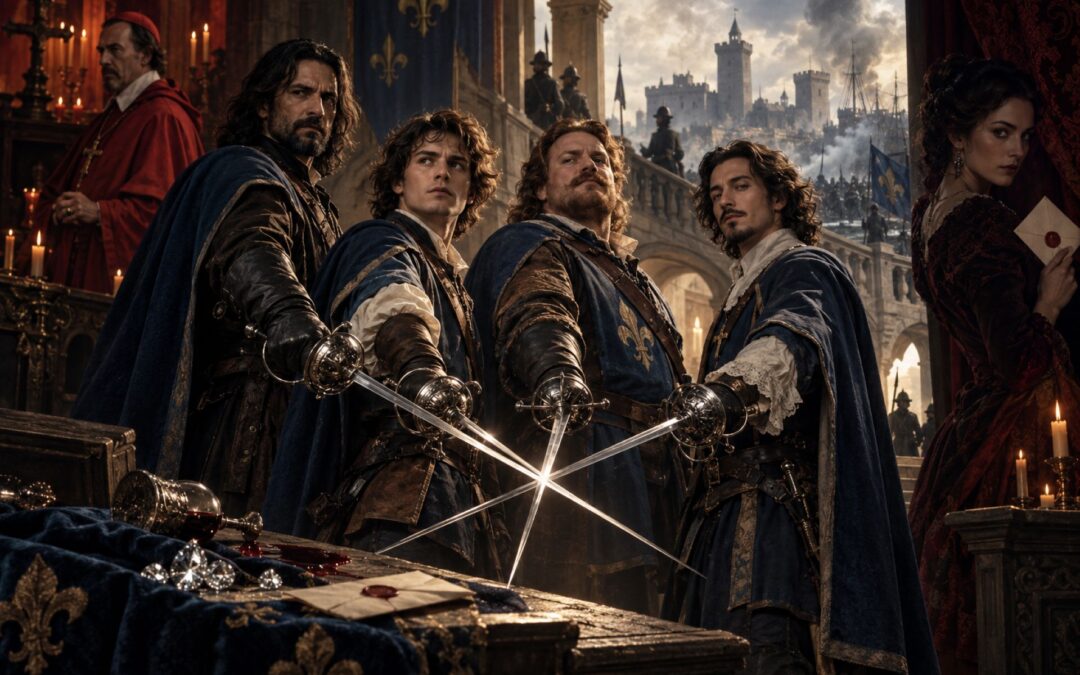
Alexandre Dumas’s The Three Musketeers is so thoroughly embedded in popular culture that many readers know its imagery before they know its story. They know the plumed hats, crossed swords, reckless duels, and famous ideal of comradeship. They may know d’Artagnan as the eager fourth member of a legendary trio, Cardinal Richelieu as a scheming villain, and Milady de Winter as a beautiful assassin. Yet the complete novel is considerably stranger, darker, funnier, and more morally unstable than that simplified memory suggests.
The difference matters because The Three Musketeers has circulated in countless abridgments, children’s editions, stage versions, films, television adaptations, and rewritten translations. This article treats Dumas’s full 1844 novel rather than any adaptation or shortened retelling, using Richard Pevear’s Penguin Classics translation as the modern English edition anchor while following the complete narrative architecture of the original work. What begins as the comic career adventure of an ambitious young Gascon eventually becomes a story of royal scandal, espionage, religious war, sexual deception, psychological manipulation, assassination, revenge, extrajudicial punishment, and political compromise.
Spoiler warning: this article covers the complete novel, including every major revelation, death, and the ending.
The central paradox of the book is that d’Artagnan succeeds magnificently while losing almost everything that once defined success for him. He arrives in Paris dreaming of glory, friendship, love, and advancement. He ends with rank and recognition, but Constance is dead, Milady has been executed after a morally troubling private tribunal, and the four companions whose brotherhood seemed indestructible are already moving toward separate lives. Dumas gives the reader the exhilaration of heroic adventure while gradually revealing how much that heroic world depends upon money, patronage, deception, violence, and the ability to survive inside institutions more powerful than any individual.

Book and Edition Context: What Version of The Three Musketeers Is This Article About?
The Three Musketeers first appeared in 1844, serialized in the Paris newspaper Le Siècle before being issued in book form. The Bibliothèque nationale de France’s record of the original 1844 edition identifies the first book publication by Baudry in Paris and preserves the bibliographic connection to the novel’s newspaper serialization. That serialized origin helps explain the book’s unusual combination of size and speed. Dumas repeatedly builds chapters around confrontations, discoveries, narrow escapes, comic complications, promises of future danger, and reversals designed to make the reader continue.
The novel is credited to Alexandre Dumas, though his production method during this period involved important collaboration with Auguste Maquet. The Bibliothèque nationale de France’s discussion of Dumas and Auguste Maquet describes Maquet as a major behind-the-scenes collaborator who contributed plots and material to works published under Dumas’s name. That collaboration should neither be erased nor inflated into the claim that Dumas had little to do with his own novels. The voice, theatricality, pacing, transformations of source material, and finished literary identity belong to the Dumas enterprise as readers encountered it.
Dumas also plays a deliberate game with the idea that he is merely recovering history. In the Author’s Preface, he presents the novel through a mock-scholarly chain of discovery, referring to supposed memoirs and manuscript evidence connected to d’Artagnan and the Comte de la Fère. Behind this fiction lay a genuine earlier source tradition, especially Gatien de Courtilz de Sandras’s Mémoires de M. d’Artagnan, an early pseudo-memoir that supplied Dumas with names, situations, and the raw material from which he constructed his swashbuckling world. The preface therefore does two things at once: it borrows authority from history while warning attentive readers that Dumas intends to transform history freely.
That freedom is fundamental to the novel. Louis XIII, Anne of Austria, Cardinal Richelieu, George Villiers, Duke of Buckingham, and the siege of La Rochelle all belong to seventeenth-century history, but Dumas reorganizes motives, relationships, timelines, and causes to serve suspense. The result is historical fiction in the strongest popular sense: the real past gives the story weight and danger, while private conspiracies make enormous political events emotionally legible.
Edition choice matters because the English-language history of The Three Musketeers includes shortened and softened versions. Some editions remove material, compress episodes, or translate sexual and political content more cautiously than a modern reader might expect. Pevear’s Penguin translation provides a useful contemporary anchor because it restores the feel of a full adult novel rather than presenting the story as primarily a juvenile adventure. The underlying architecture, however, remains Dumas’s complete sequence: an Author’s Preface, sixty-seven chapters, and an Epilogue.
The Three Musketeers is also the beginning of a larger d’Artagnan cycle. It is followed by Twenty Years After and then The Vicomte de Bragelonne, a massive continuation whose final portion is often published in English under the title The Man in the Iron Mask. None of that later material is necessary to understand this novel’s ending, but the series context clarifies one important point: Dumas deliberately ends the first book with movement rather than stasis. The four friends do not remain forever frozen in the perfect brotherhood of popular iconography.
The Complete Plot of The Three Musketeers
Dumas’s plot is best understood as a chain of adventures rather than a single continuous conspiracy. One problem repeatedly creates the conditions for the next: d’Artagnan’s pride leads him to the Musketeers, his friendship with them draws him into court intrigue, that intrigue brings Milady into his life, Milady’s personal hatred converges with Richelieu’s political schemes, and those schemes eventually lead to Buckingham’s murder, Constance’s death, Milady’s execution, and d’Artagnan’s promotion. The novel’s extraordinary momentum comes from Dumas’s ability to make each apparent resolution generate a new danger.
D’Artagnan Arrives in Paris and Finds His Three Companions
The story begins in 1625 with a young Gascon leaving home for Paris. D’Artagnan is poor, proud, energetic, and convinced that courage can compensate for almost every disadvantage. His father gives him advice about honor, courage, and deference to the king and Cardinal only when necessary, along with a letter of introduction to Monsieur de Tréville, captain of the King’s Musketeers. He also gives him an unfortunate yellow horse whose comic appearance immediately undercuts d’Artagnan’s heroic self-image.
At Meung, d’Artagnan notices a mysterious gentleman laughing at the horse. His inability to tolerate mockery turns a trivial insult into a confrontation. The stranger is far more experienced, and d’Artagnan is beaten. During his recovery he sees the man speaking with an elegant woman in a carriage, a woman whom the stranger calls Milady. The encounter seems incidental, but Dumas has introduced the two figures who will eventually become the central enemies of d’Artagnan’s story: Rochefort and Milady de Winter.
The young Gascon discovers that his letter to Tréville has disappeared, probably taken during the confrontation, but he continues to Paris. Tréville’s headquarters overwhelms him. The captain’s antechamber is filled with swordsmen, arguments, boasts, stories, servants, and young men seeking advancement. Dumas uses the scene to introduce the social world d’Artagnan wants to enter: military prestige depends not only on bravery but on personal networks, reputation, patronage, and the ability to survive constant quarrels.
Athos, Porthos, and Aramis emerge before they become d’Artagnan’s friends. Athos has the gravity of a born aristocrat and carries himself with an authority that does not depend on wealth. Porthos is enormous, flamboyant, vain, and preoccupied with appearance. Aramis is elegant, secretive, cultivated, and forever claiming that he intends to abandon the sword for the Church even though his romantic entanglements continually postpone that vocation.
Tréville receives d’Artagnan kindly but cannot simply appoint him a Musketeer. D’Artagnan has courage but lacks the necessary record. During the interview, however, he suddenly sees the man from Meung outside and rushes away to pursue him. In doing so, he creates one of the novel’s most famous comic sequences. He crashes into Athos’s injured shoulder and accepts a challenge to duel. He becomes entangled in Porthos’s baldric and exposes the less impressive part of the equipment beneath Porthos’s magnificent exterior, provoking a second challenge. He then accidentally involves Aramis in an embarrassing episode concerning a handkerchief associated with a woman, producing a third duel.
D’Artagnan therefore reaches Paris hoping to join the Musketeers and within hours has arranged to fight three of the most formidable among them. He appears at the appointed place to meet Athos, only to discover that Porthos and Aramis are Athos’s seconds and that all three realize they have independently challenged the same young man. D’Artagnan is willing to fight despite the absurdity of the situation, which immediately wins a degree of respect.
The duel is interrupted by Cardinal Richelieu’s Guards, who are enforcing the royal prohibition against dueling. Rather than allow Athos, Porthos, and Aramis to be arrested, d’Artagnan joins them against the Cardinal’s men. The resulting fight transforms the social geometry of the book. D’Artagnan ceases to be three men’s prospective opponent and becomes their comrade because he chooses their side at personal risk.
The victory creates a political problem. Louis XIII officially condemns dueling, but he also enjoys the rivalry between his Musketeers and Richelieu’s Guards. Tréville protects his men through his access to the king, and d’Artagnan’s bravery attracts favorable notice. He still cannot become a Musketeer immediately, but he enters the orbit from which promotion may eventually come.
Dumas then slows down enough to show how these supposedly glamorous men actually live. The four possess servants, debts, improvised arrangements, lovers, ambitions, and private secrets. D’Artagnan employs the loyal Planchet. Athos has the silent and obedient Grimaud. Porthos has Mousqueton, while Aramis has Bazin, whose piety makes him hope his master will finally embrace the religious life. Heroic identity in Dumas is never purely spiritual. A Musketeer must eat, dress, maintain a horse, obtain equipment, cultivate patrons, and somehow pay for a lifestyle that often exceeds his income.
Constance, Buckingham, and the Diamond Studs
D’Artagnan’s first major adventure begins not with a battlefield but with his landlord. Monsieur Bonacieux, a middle-aged mercer, tells him that his wife Constance has been abducted. Constance serves close to Queen Anne of Austria, which means her disappearance may be connected to court politics. The description of one of her abductors immediately interests d’Artagnan because it resembles the man from Meung.
The Musketeers agree to help. Their friendship is still new, but the principle that one man’s quarrel becomes the others’ quarrel is already functioning. Bonacieux is soon arrested, and his apartment becomes part of a police trap. Authorities use the location to intercept people connected with Constance, revealing that Richelieu’s agents are monitoring the Queen’s household and searching for evidence of disloyalty or adultery.
Constance escapes custody and returns to the apartment, only to find herself endangered again. D’Artagnan intervenes and rescues her. He quickly falls in love, though his passion contains the same speed and confidence he brings to dueling. Constance likes and trusts him, but her immediate concern is not romance. She is carrying out a secret service for the Queen.
D’Artagnan follows the mystery far enough to discover that Constance is arranging a clandestine meeting between Anne of Austria and George Villiers, Duke of Buckingham. Buckingham has entered France secretly because of his devotion to Anne. Dumas treats their relationship as emotionally real and politically explosive. Whether or not every implication reflects history is beside the point inside the novel: Richelieu can exploit the appearance of adultery even if he cannot prove its full reality.
Constance escorts Buckingham through Paris and ultimately to the Queen. Anne and Buckingham meet privately. She urges him to leave because his presence places her in danger, but the meeting establishes the depth of their attachment. Buckingham possesses a set of diamond studs that Louis XIII had given Anne. She had earlier given them to Buckingham as a token of affection, an act that now creates exactly the kind of evidence Richelieu needs.
Bonacieux, meanwhile, proves the opposite of the heroic husband. Under interrogation he is frightened, vain, easily manipulated, and susceptible to the flattering suggestion that he can serve powerful men. Richelieu’s network converts him into an informer. Constance therefore cannot safely trust her own husband, and her dependence on d’Artagnan increases.
Rochefort reports to Richelieu about Buckingham’s movements, and the Cardinal recognizes a devastating opportunity. If Louis orders Anne to appear publicly wearing the diamond studs, her inability to produce them can expose the private gift. Richelieu does not need to prove every detail of a sexual affair; he needs only to create a situation in which the Queen cannot explain the missing royal jewels without humiliation.
Richelieu encourages Louis’s jealousy and suspicion. The Queen’s apartments are searched for correspondence, and although politically compromising material can be found, decisive proof remains elusive. Richelieu therefore persuades the king to arrange a ball at which Anne will be expected to wear the studs.
Constance learns of the danger and needs someone capable of reaching England quickly. Bonacieux would be useless even if he were loyal. D’Artagnan is young, reckless, deeply in love with her, and eager for adventure. He accepts the mission without hesitation.
The problem is not simply riding to London. Richelieu’s network can place obstacles across the route, so d’Artagnan recruits Athos, Porthos, and Aramis. Their plan is simple in concept: four men begin together so that at least one may survive the traps intended to stop them. The resulting journey becomes one of Dumas’s great action sequences because the group is gradually stripped away.
Porthos becomes trapped in a local dispute and must stay behind. Aramis is wounded and unable to continue. Athos becomes involved in a confrontation at an inn and effectively removes himself from the race. Each loss increases the pressure on d’Artagnan, who continues with Planchet until he reaches the Channel and crosses into England.
Buckingham receives him and understands the danger immediately. He goes to recover the studs and discovers that two are missing. Milady, acting for Richelieu, has managed to steal them. Richelieu expects Anne to appear with an incomplete set and expose herself in front of the court.
Buckingham reacts with the immense resources of a favorite and statesman. He prevents ships from leaving until replacement studs can be made, then commissions a jeweler to reproduce the missing pieces. D’Artagnan is sent back toward France with what appears to be a complete set.
At the Ballet of La Merlaison, Richelieu believes he has engineered the Queen’s public defeat. Anne appears wearing the diamonds. The Cardinal gives Louis the two stolen studs, expecting the king to discover that his wife’s set is incomplete. Instead, because Buckingham has replaced the missing pieces, the Queen possesses more diamonds than Richelieu expects. The trap collapses into ambiguity, and Anne escapes humiliation.
D’Artagnan receives the Queen’s gratitude and, more importantly to him, hopes for Constance’s affection. The episode establishes his value as a secret agent despite his lack of official rank. It also demonstrates Dumas’s central method: private romance and international politics can be made indistinguishable because the same jewel, letter, bedroom, or messenger may decide both.
Constance Disappears and Milady Is Unmasked
The successful recovery of the diamond studs does not produce the romantic ending d’Artagnan expects. A message promises him a rendezvous with Constance, but the circumstances feel suspicious. Planchet is uneasy, and d’Artagnan arrives at the appointed place only to find signs of violence. Constance has disappeared again.
Instead of moving directly into a rescue, Dumas returns d’Artagnan to the practical consequences of the England mission. His companions were scattered along the route and must be recovered. These chapters create some of the novel’s funniest material while deepening the characters and setting up later revelations.
Porthos has been living through a comic crisis of pride and money. His glamorous self-presentation depends heavily on an older and financially useful mistress, Madame Coquenard, whose household proves considerably less luxurious than he likes to imply. Dumas uses Porthos’s attempts to secure equipment as social comedy, showing that aristocratic style and military heroism require cash from somewhere.
Aramis’s situation is equally revealing. Wounded and romantically discouraged, he announces that he is ready to renounce the world and become a priest. He turns toward theology with apparent seriousness, but the arrival of a message connected to his aristocratic mistress immediately rearranges his spiritual priorities. His religious vocation is not entirely false, but neither is it independent of disappointment, romance, status, and mood.
Athos supplies the crucial revelation. D’Artagnan finds him after a bizarre episode in which he has effectively barricaded himself in an inn cellar. In the course of drinking and talking, Athos tells a story about a nobleman who fell in love with a beautiful young woman, married her, and later discovered that she bore the fleur-de-lis brand associated with criminal punishment. Horrified, the nobleman hanged her and believed her dead.
Athos initially presents the story at a distance, but d’Artagnan understands that the nobleman is Athos himself. The disclosure explains the older Musketeer’s melancholy, drinking, emotional detachment, and aristocratic contempt. It also introduces a woman who appears to belong to Athos’s past without yet connecting her explicitly to Milady.
The companions reunite and return to Paris, where the glamour of their successful service gives way to the economics of war. Military campaigning is approaching, and they need horses, equipment, uniforms, weapons, and money. Each man improvises differently. Porthos negotiates with Madame Coquenard. Aramis receives discreet assistance through his romantic connections. D’Artagnan gambles and maneuvers. Athos maintains his disdain for financial calculation but cannot escape material necessity.
These episodes may initially seem like comic delays, but they serve a larger purpose. Dumas continually reminds the reader that heroic identity is expensive. The world of honor rests on servants, lovers, creditors, patrons, jewelry, horses, and sometimes outright manipulation. D’Artagnan’s development is therefore not only martial; he is learning how the social machinery beneath glory operates.
Milady then returns to the center of the story. D’Artagnan encounters her in Paris and recognizes her connection to earlier events without yet understanding her full history. She is involved in a dispute with Lord de Winter, her brother-in-law. D’Artagnan interferes, and a duel follows between French and English gentlemen.
The Frenchmen win, but d’Artagnan spares Lord de Winter. That act gains him access to Milady’s social world. He is physically fascinated by her even though he has reason to distrust her, and the novel’s tone changes. The romantic pursuit of Constance had been idealized; d’Artagnan’s interest in Milady is competitive, erotic, dangerous, and increasingly dishonest.
Milady’s maid Kitty becomes the intermediary. Kitty is in love with d’Artagnan and reveals that Milady herself is interested in the Comte de Wardes. D’Artagnan does not respond to Kitty’s affection with the loyalty he demands from his friends. Instead, he uses her access to Milady’s private correspondence and begins manipulating the situation for his own desire and revenge.
He intercepts and forges letters in the identity of de Wardes. The scheme eventually leads to one of the novel’s most ethically troubling episodes. In darkness, d’Artagnan enters Milady’s bedroom while allowing her to believe that he is de Wardes. They have sex under that false identity. Whatever comic or adventurous tone surrounds the episode in Dumas’s narrative, the deception is substantial and cannot be reduced to a charming seduction.
Milady gives the supposed de Wardes a sapphire ring. When d’Artagnan later shows the ring to Athos, the older man recognizes it as connected to the wife he believed dead. The coincidence begins collapsing previously separate mysteries into one.
D’Artagnan continues his game. Milady, believing de Wardes has rejected her, turns toward d’Artagnan and offers herself more directly while expecting him to help her take revenge. D’Artagnan’s vanity and anger lead him to reveal the deception rather than withdraw safely.
Milady’s response is immediate and violent. During the confrontation d’Artagnan sees the fleur-de-lis branded on her shoulder. The revelation completes the connection: Milady is the woman Athos married and attempted to kill years earlier. The mysterious agent who stole the diamond studs, the woman d’Artagnan has deceived sexually, and Athos’s supposedly dead wife are all the same person.
This discovery changes Milady’s function in the novel. She is no longer merely Richelieu’s capable operative. D’Artagnan has humiliated her personally, Athos represents a violent past she thought she had escaped, and both men now possess knowledge capable of destroying her social identity. Her conflict with the Musketeers becomes a private war.
D’Artagnan tells Athos everything. Athos recognizes the ring and confirms the identity. The men move Kitty to relative safety because her involvement places her at risk. The sapphire can also be converted into practical resources, once again demonstrating Dumas’s habit of making supposedly romantic objects circulate as economic tools.
Milady begins retaliating. D’Artagnan receives warnings, notices suspicious movements, and survives an atmosphere of growing threat. The Cardinal then summons him, producing one of the novel’s most important political encounters.
D’Artagnan expects hostility. Richelieu instead demonstrates detailed knowledge of his actions and offers him a position in the Cardinal’s Guards. The offer is not sentimental. Richelieu recognizes talent and understands that a brave, adaptable young man can be more useful as a subordinate than as an enemy.
D’Artagnan refuses because accepting would mean abandoning the loyalties that have defined his rise. Richelieu does not destroy him. The scene therefore complicates the popular image of the Cardinal as a simple villain. He is dangerous, manipulative, and willing to use assassination, but he also possesses a statesman’s capacity to recognize ability and absorb opposition.
The Siege of La Rochelle and the Plot Against Buckingham
The novel now expands from court intrigue into war. France is engaged in the siege of La Rochelle, a major Huguenot stronghold. The historical setting gives Dumas a battlefield on which his private conspiracies can continue under the cover of national conflict.
D’Artagnan reaches the front and soon discovers that Milady’s vengeance has followed him. Attempts are made on his life, and the danger no longer resembles the relatively theatrical obstacles placed in the way of the diamond mission. Milady has reason to want him dead, and she is willing to use poison, hired killers, and political protection.
The most chilling attempt involves wine. A supply supposedly sent by the Musketeers reaches d’Artagnan, but another man drinks from it and dies. The episode confirms that Milady is no longer merely threatening him. She is actively trying to murder him, and her reach extends into the military camp.
Athos, Porthos, and Aramis remain connected to the Cardinal’s movements because Richelieu himself is operating near the siege. At the Red Dovecot, the Musketeers manage to overhear an important conversation through the architecture of the inn. Richelieu is giving Milady instructions connected to Buckingham.
Buckingham is not only Anne’s lover in the novel but a political enemy whose actions affect the war around La Rochelle. Richelieu wants him neutralized. He sends Milady to England with authority to act against him, effectively converting the private enemy of d’Artagnan and Athos into an instrument of French state policy.
The Musketeers also learn that Constance remains endangered. Their personal and political problems have now become inseparable. If Milady succeeds in England, Buckingham may die; if she turns her attention back toward France, Constance may become a target.
Richelieu gives Milady a signed authorization protecting actions undertaken for the interests of France. The document will ultimately become one of the most important objects in the novel because its political meaning changes according to who possesses it.
Before Milady can leave, Athos confronts her privately. The scene brings their marriage out of the realm of reminiscence and into the present. Milady believed her former husband either irrelevant or dead to her; Athos confronts her with knowledge of her identity and the threat of renewed violence. He forces her to surrender Richelieu’s written authorization.
The encounter is often framed as Athos triumphing over an evil woman, but it is morally more unstable than that. Milady has committed serious crimes and is preparing more. Yet Athos is also the husband who once tried to hang her after discovering her brand, and his authority in the confrontation depends less on law than on superior force and social power.
The four friends must decide what to do with the information they have learned. Discussing a secret plan inside Richelieu’s military world is dangerous, so Athos proposes an absurdly heroic solution. They will occupy an exposed position at the Bastion Saint-Gervais and eat breakfast under enemy fire, using the battlefield itself as the place where surveillance is least likely.
The famous bastion episode combines everything Dumas does best. It is comic because the men treat lethal danger as a wager. It is spectacular because they repel repeated attacks. It deepens their legend because fellow soldiers watch them remain at the position with astonishing confidence. Most importantly, it allows them to hold a strategic council while performing the very kind of reckless courage for which they will be celebrated.
They decide that Buckingham and Lord de Winter must be warned about Milady. They also need to protect Constance. Messages are arranged, servants are enlisted, and Athos’s previously private history becomes relevant to all four companions because they must understand why Milady is uniquely dangerous.
The entire sequence reveals a paradox in their celebrated brotherhood. They are magnificently loyal, resourceful, and brave, yet they are also conducting an unofficial intelligence operation inside a national war. Their private moral code repeatedly authorizes them to act beyond normal chains of command. Dumas celebrates this freedom, but the story will eventually expose its darker consequences.
Milady, Felton, and the Assassination of Buckingham
Milady reaches England, but the Musketeers’ warning arrives in time for Lord de Winter to intercept her. He knows enough about her history and ambitions to treat her as a mortal threat. Instead of allowing her free movement, he imprisons her under guard and intends to remove her from England.
For one of the few times in the novel, Milady seems genuinely trapped. She is watched, confined, surrounded by men who distrust her, and deprived of the normal social freedom through which she manipulates people. Lord de Winter believes he has solved the problem by placing her under the care of John Felton, a disciplined young officer whose Puritan austerity appears to make him resistant to seduction.
Milady does not immediately attempt a conventional escape. She studies Felton.
The distinction is crucial. The chapters covering her captivity slow the external action and turn the novel into psychological combat. Milady’s chief weapon is her ability to identify what another person most needs to believe about himself and then construct a performance that confirms that belief.
Felton is serious, religious, suspicious of corruption, and devoted to a moral universe in which worldly power may disguise wickedness. Milady realizes that overt flirtation would fail. She therefore creates the opposite persona: persecuted innocence, spiritual suffering, chastity, martyrdom, and religious sympathy.
On the first stages of captivity, she tests him. She watches his responses to de Winter’s language and behavior. When he resists her beauty, she does not abandon the attempt; she changes the emotional field.
She begins presenting herself as a woman imprisoned not because she is dangerous but because powerful men need to silence her. De Winter’s open contempt helps her because every harsh word can be converted into evidence for the story she is constructing. The more confidently he treats her as evil, the more easily she can make Felton imagine that he is witnessing the persecution of someone powerless.
Milady deepens the performance by staging despair. She invokes religious feeling, presents herself as prepared for death, and turns self-destruction into apparent proof of sincerity. Felton’s duty as a guard gradually conflicts with his developing belief that protecting her might be a higher moral obligation.
The story she tells is deliberately designed for him. She claims that she has suffered sexual persecution and abuse at the hands of a powerful aristocrat. She takes the physical evidence most dangerous to her—the fleur-de-lis branded on her shoulder—and gives it an entirely different meaning. Instead of proving criminal punishment, it becomes part of her invented history of victimization.
Finally she identifies the central persecutor as Buckingham.
For Felton, already living within a religious and political culture hostile to Buckingham, the accusation is psychologically explosive. Milady does not need to create every resentment from nothing. She gives existing beliefs a personal object and transforms general hatred into a sacred obligation.
Lord de Winter eventually understands that Felton is changing, but recognition comes too late. He tries to separate the officer from Milady. Felton returns, helps her escape through the window, and commits himself to confronting Buckingham.
Milady’s triumph is complete because she does not need to perform the murder herself. She has turned another person’s conscience into her weapon.
Felton goes to Portsmouth and gains access to Buckingham. In Dumas’s version of events, his religious and moral outrage has been redirected toward the Duke by Milady’s invented story. He stabs Buckingham and is captured.
Milady does not remain to share his fate. She escapes by ship while Felton faces the consequences of the action she engineered. Buckingham dies still emotionally attached to Anne, and a political mission that Richelieu assigned to Milady succeeds despite the Musketeers’ attempts to stop it.
The episode is a striking example of how Dumas converts history into private drama. The historical John Felton did assassinate Buckingham, but the novel’s explanation is fictional. Historical scholarship on John Felton and the assassination of Buckingham instead places his act within a world of military grievance, anti-Buckingham political culture, personal disappointment, and contested ideas of public virtue. Milady is Dumas’s brilliant fictional mechanism for transforming that complicated history into one terrifying chain of manipulation.
Béthune, Constance’s Death, Milady’s Trial, and the Final Promotion
News of Buckingham’s death returns to France, but d’Artagnan’s immediate concern is Constance. The political plot has succeeded in England; the personal plot is still unresolved. The friends obtain information pointing toward the Carmelite convent at Béthune, where Constance has been placed for safety.
Milady reaches the convent before them.
Constance does not recognize her enemy. She knows that powerful forces have pursued her, but she has no reason to understand that the elegant woman who approaches her is connected to the diamond-stud conspiracy, Athos’s past, d’Artagnan’s sexual deception, Richelieu’s secret mission, or Buckingham’s death. Milady therefore does what she has done repeatedly: she constructs the identity most useful for the audience before her.
She presents herself as a friend and gradually obtains information. Constance reveals that d’Artagnan is coming for her. What should have been the moment of reunion instead gives Milady knowledge of the approaching threat.
Rochefort appears and exchanges information with Milady. The two figures introduced around the beginning of the novel are now connected at the end of the conspiracy. Buckingham is dead, d’Artagnan remains alive, and Constance is within Milady’s reach.
Milady attempts to move Constance away before the Musketeers arrive. When circumstances make a clean escape impossible, she uses poison. Constance drinks and begins dying just as rescue approaches.
D’Artagnan arrives in time to see the woman he loves but too late to save her.
Constance’s death fundamentally changes the emotional balance of the ending. Throughout the novel, d’Artagnan has converted danger into opportunity. A duel produces friendship. A royal conspiracy produces prestige. A failed journey still leads him to London. Even injuries, debts, and political threats are usually survivable through wit and loyalty. Constance is different. No improvisation reverses the poisoning, and no heroic intervention restores the romantic future he expected.
Milady escapes, but the four companions now pursue her without any intention of returning her to ordinary legal authorities. Athos assumes command. Planchet and other helpers assist in tracing her movements toward Armentières. Athos also secretly recruits a mysterious man in a red cloak.
The man is the executioner of Lille, and his presence prepares the revelation that Milady’s history extends beyond what Athos previously told d’Artagnan. The pursuers capture Milady and organize what they call a trial.
The tribunal consists not of representatives of the state but of people who have personal grievances against the accused or close relationships with those grievances. D’Artagnan accuses her in connection with Constance and attempted murders. Lord de Winter represents the deaths and schemes connected to his family. Athos brings the authority of her former husband. The executioner adds another story from Milady’s past involving his brother, the origin of her criminal condemnation, and the fleur-de-lis brand.
Milady is confronted with a cumulative record of manipulation, betrayal, poisoning, attempted murder, and assassination. Dumas gives the scene the form of judgment, and within the novel’s moral universe the assembled men believe that ordinary law cannot adequately reach her.
Yet Milady also recognizes the weakness in their legitimacy. She demands lawful authority and challenges their right to sentence her. Her objection is not enough to erase her crimes, but it is enough to make the episode ethically difficult. The men are victim, witness, prosecutor, judge, and executioner within the same private system.
The sentence has effectively been decided before the proceeding begins.
Milady is taken toward the river. The executioner carries out the punishment and decapitates her. Her body is disposed of, ending a character who has become so powerful within the narrative that the story must gather nearly all of its surviving protagonists to destroy her.
The execution does not produce uncomplicated relief. Constance remains dead. Buckingham remains dead. Felton has ruined himself. Athos has confronted his past but not transcended it. D’Artagnan has participated in a killing that no public court authorized.
Soon afterward, Rochefort arrests d’Artagnan and brings him before Richelieu. The young man appears to be in extraordinary danger because he has interfered repeatedly with the Cardinal’s agents, opposed Milady’s mission, and participated in her death.
D’Artagnan explains what happened. Richelieu then asks what authority he had for such actions.
D’Artagnan produces the signed authorization that Athos took from Milady.
The document was originally intended to protect Milady for actions undertaken in the interests of France. It now protects the man who helped kill her. The irony is perfect because political authority proves transferable once reduced to paper.
Richelieu could still destroy d’Artagnan if he wished, but he does something more interesting. He recognizes him. The Cardinal sees courage, intelligence, loyalty, adaptability, and political usefulness. Instead of punishing him, he gives him a lieutenant’s commission.
D’Artagnan has obtained the advancement he wanted from the beginning, but the moment is radically different from the dream with which he left Gascony. He has not become successful by defeating the political system. He has become valuable enough for the system to absorb him.
D’Artagnan offers the commission to Athos, Porthos, and Aramis in turn. Each refuses for reasons consistent with his own character and trajectory. D’Artagnan therefore accepts it.
The Epilogue completes what many simplified retellings omit. La Rochelle eventually capitulates. D’Artagnan assumes his new military role. Porthos leaves service and marries Madame Coquenard, converting his long relationship with money and display into domestic security. Aramis moves closer to the religious life he has repeatedly postponed. Athos serves under d’Artagnan for a time before withdrawing.
Even Rochefort undergoes a transformation in d’Artagnan’s world. He and d’Artagnan continue fighting, but repeated conflict eventually becomes friendship. Bonacieux disappears after attracting the Cardinal’s suspicion and attention.
The four legendary companions survive, but their youthful unity does not. The novel ends with success, separation, and the recognition that the brotherhood which seemed capable of defeating anything cannot stop time.
Setting and Historical World: France, England, the Court, and La Rochelle
Dumas places the story in a recognizably historical Europe but converts institutions into sources of adventure. France under Louis XIII contains overlapping structures of authority: the king, the Cardinal, aristocratic households, military companies, local officials, Church institutions, courts, police, and patronage networks. Characters survive not by following one stable chain of command but by knowing whose protection matters at a particular moment.
The rivalry between the King’s Musketeers and Cardinal Richelieu’s Guards dramatizes this fractured environment. Both bodies ultimately belong to the same monarchy, yet Dumas turns their rivalry into an almost tribal competition. A forbidden duel can become politically useful because Louis enjoys seeing his men embarrass Richelieu’s. Personal courage therefore acquires value through faction.
Patronage is equally important. D’Artagnan’s father sends him to Tréville because individual talent requires a sponsor. Tréville protects his men through access to Louis. Richelieu recruits, promotes, threatens, and pardons according to political usefulness. Buckingham can mobilize enormous resources in England. Even romantic relationships function as networks of money and influence.
The court surrounding Anne of Austria adds another layer. Private desire is politically dangerous because queens and royal favorites do not possess fully private lives. A gift of jewelry can become evidence. A love letter can become intelligence. A secret meeting can threaten diplomatic relations. Dumas exploits this condition relentlessly, turning bedrooms, wardrobes, and personal servants into extensions of state politics.
Richelieu’s role deserves particular caution because Dumas’s portrayal became more culturally influential than many historical accounts. The Cardinal is often imagined through precisely the kind of cold, omniscient manipulation that the novel popularized, but scholarly interpretations of Cardinal Richelieu are far more complicated than the fictional supervillain image. Historically, Richelieu was a minister operating within the difficult problems of royal consolidation, European rivalry, noble power, religious division, and war. Dumas simplifies those forces by giving them a face.
The siege of La Rochelle is another example of real history functioning as narrative scaffolding. La Rochelle was an important Huguenot stronghold, and the conflict around it belonged to the larger struggle over Protestant political autonomy and royal authority in France. The historical background to the siege of La Rochelle includes Buckingham’s failed intervention, the Île de Ré campaign, and Richelieu’s determination to break La Rochelle’s political independence.
Dumas does not write a military history of the siege. He uses the siege as a pressure chamber. It places Richelieu, d’Artagnan, the Musketeers, messengers, soldiers, and international politics within the same dangerous geography. The Bastion Saint-Gervais episode can therefore feel both absurdly theatrical and historically plausible within the novel’s world: men perform aristocratic courage under fire while privately discussing espionage.
The material life of this setting matters almost as much as its formal politics. Horses determine speed. Inns determine vulnerability. Servants carry intelligence. Letters take time to travel and can be intercepted. A lack of equipment can prevent a man from campaigning no matter how brave he is. Dumas’s seventeenth century is therefore built not only from kings and cardinals but from roads, food, debt, clothing, weapons, rooms, locks, wine, jewelry, and paper.
That materiality is one reason the world feels convincing even when the historical causation is not. Dumas may reorganize major events for drama, but he continually gives his characters practical problems. They need money, transport, lodging, clothing, protection, and trustworthy messengers. Adventure acquires credibility because someone always has to pay for the horse.
Character Analysis
The novel is famous for four friends, yet its characters are not evenly distributed. D’Artagnan is the dynamic center, Athos possesses the greatest moral and psychological gravity among the Musketeers, and Milady gradually becomes powerful enough to dominate entire sequences without the heroes present. Porthos and Aramis remain essential to the ensemble, but Dumas uses them more frequently for contrast, comedy, and social texture.
D’Artagnan
D’Artagnan begins as energy before he becomes judgment. His pride is so immediate that he is willing to fight over laughter directed at a horse. He arrives in Paris with almost no money, no rank, little experience, and complete faith that courage will open doors.
What makes him successful is how quickly he learns. He does not lose his recklessness, but he adds observation, deception, negotiation, patience, and social intelligence. He learns how Tréville uses access to the king, how Richelieu gathers information, how women and servants circulate intelligence, how letters can manipulate people, and how loyalty can create a network stronger than money.
His courage is genuine. D’Artagnan does not merely exploit others while remaining safe. He fights skilled opponents, travels through danger, enters conspiracies whose failure could destroy him, and repeatedly risks his life for friends. His willingness to continue alone toward England after the others fall away demonstrates that he can convert youthful bravado into sustained determination.
Yet his admirable qualities coexist with serious selfishness. His treatment of Kitty is exploitative. He uses her love to gain access to Milady’s correspondence. More troublingly, his impersonation of de Wardes allows him to have sex with Milady under false identity. Dumas may frame the episode through intrigue, jealousy, and comic daring, but modern readers need not confuse narrative charisma with ethical innocence.
D’Artagnan also possesses an ability to move between moral systems. He can sincerely love Constance while deceiving Milady. He can defy Richelieu while understanding the Cardinal’s power. He can participate in Milady’s private execution and then use Richelieu’s own authorization to defend that act. This adaptability is precisely why Richelieu values him.
The ending completes his education. D’Artagnan does not overthrow the powerful or escape politics. He becomes an officer because he has demonstrated that he can operate inside a world where courage alone is insufficient. His final success depends upon loyalty, improvisation, ruthlessness, intelligence, and the ability to recognize power without surrendering entirely to it.
Athos, Porthos, and Aramis
Athos is the most authoritative of the three original Musketeers because his authority appears innate. He is poor in practical terms but aristocratic in bearing. He rarely boasts, often drinks, speaks with restraint, and possesses a melancholy that distinguishes him sharply from Porthos’s display and Aramis’s social elegance.
His history with Milady explains part of that melancholy but also exposes the violence beneath his nobility. Discovering the fleur-de-lis brand on his wife, he attempts to hang her. Dumas presents his horror as understandable within an aristocratic code of honor, but the act reveals the danger of a moral system in which a husband assumes the right to investigate, condemn, and execute. That pattern returns at Milady’s final tribunal.
Athos nevertheless becomes d’Artagnan’s most important mentor. He possesses strategic intelligence, emotional self-control in moments of crisis, and the ability to understand Richelieu as a political actor rather than merely an enemy. At the Bastion Saint-Gervais and during the final pursuit of Milady, he repeatedly becomes the planner.
Porthos provides a different form of vitality. He is physically impressive, theatrical, vain, and deeply concerned with the appearance of wealth. His relationship with Madame Coquenard exposes the financial arrangements beneath his style, but Dumas does not reduce him to hypocrisy. Porthos genuinely enjoys grandeur, food, clothing, horses, and the pleasures of status. His eventual marriage suits the practical direction of his desires.
Aramis is defined by divided vocation. He wants the elegance and danger of a Musketeer while continually imagining a future in the Church. His theological seriousness rises when romance disappoints him and falls when aristocratic love returns. The contradiction is comic, but it is not entirely insincere. The Epilogue shows that the clerical identity has always been more than a temporary joke.
Porthos and Aramis are less psychologically deep than Athos, but the imbalance helps the ensemble. The quartet works because each man provides a different answer to what gentlemanly life should look like: Athos offers aristocratic gravity, Porthos social display, Aramis spiritual and romantic ambiguity, and d’Artagnan upward mobility.
Milady de Winter
Milady is the novel’s most formidable antagonist and, after d’Artagnan, arguably its most dynamic character. She survives through intelligence, beauty, adaptability, secrecy, acting ability, and an extraordinary understanding of other people’s weaknesses. When one method fails, she changes method.
Her power is easiest to appreciate during the Felton sequence. She is physically confined and has almost no conventional resources, yet she identifies the psychological structure of the man guarding her and rebuilds herself to fit it. She does not simply seduce him. She lets him believe that rescuing her proves his own moral purity.
The same adaptive intelligence appears throughout the book. She can move through aristocratic society, perform vulnerability, exploit male desire, steal the Queen’s diamonds, carry out Richelieu’s political missions, manipulate correspondence, use poison, and transform criminal evidence into a story of martyrdom. Her danger lies not in one supernatural ability but in her capacity to interpret social situations faster than almost everyone around her.
Milady is also unquestionably responsible for grave violence. She attempts to murder d’Artagnan. She engineers Buckingham’s assassination by manipulating Felton. She poisons Constance. Lord de Winter believes she poses a lethal threat to him. The executioner’s testimony further expands the record of crimes associated with her past.
Recognizing those crimes should not end the analysis. Dumas constructs Milady within a strongly gendered moral system. Her beauty, sexuality, mobility between identities, and capacity to manipulate men make her especially threatening because they violate the roles expected of women in the world surrounding her. Male characters also deceive, kill, seduce, duel, and manipulate, but the narrative does not always condemn those actions with equal intensity.
D’Artagnan’s sexual deception of her is one example. Athos’s attempted hanging is another. The final private tribunal claims the authority to punish Milady while being composed primarily of men personally involved in the conflict. None of these facts makes Milady innocent. They make the moral architecture surrounding her punishment unstable.
That instability is part of why Milady remains so powerful as a literary character. A simple villain would become smaller as the heroes understood her. Milady becomes larger. The more the novel reveals, the more personal histories, political schemes, sexual grievances, class anxieties, religious passions, and ideas of justice converge around her.
Cardinal Richelieu, Rochefort, and the Machinery of Power
Richelieu initially occupies the familiar position of the distant mastermind. His Guards oppose the Musketeers, his agents watch the Queen, Rochefort appears wherever secret information is moving, and Milady executes dangerous missions on his behalf. He seems to represent an organized machinery of surveillance against the heroes’ freer world of friendship.
Dumas gradually complicates that opposition. Richelieu has something the younger characters often lack: an ability to separate personal irritation from political usefulness. He can dislike d’Artagnan’s interference while admiring his ability. He can employ Milady because she is useful without mistaking usefulness for virtue.
His offer to d’Artagnan before the final crisis prepares the ending. Richelieu sees what Tréville saw in more limited form: the Gascon has exceptional potential. When d’Artagnan later appears before him after Milady’s death, the Cardinal evaluates the situation not according to wounded pride but according to power, evidence, and utility.
Rochefort functions as Richelieu’s mobile extension. He is the man from Meung, a recurring rival, courier, observer, and agent. Yet even he does not remain permanently trapped in the role of villain. His eventual friendship with d’Artagnan after repeated duels fits the novel’s larger pattern in which worthy enemies can become comrades once personal courage has been sufficiently demonstrated.
The political world is therefore less morally binary than the iconography of Musketeers versus Cardinal’s men suggests. Richelieu can authorize assassination and still recognize merit. D’Artagnan can oppose him and still become part of the order he represents. The novel ends not with the destruction of power but with the hero’s incorporation into it.
Constance Bonacieux, Queen Anne, Buckingham, and the Supporting Romantic World
Constance is essential to the plot but thinner as a psychological character than d’Artagnan, Athos, or Milady. She is brave enough to serve the Queen in dangerous circumstances, resourceful enough to resist her compromised husband, and capable of trusting d’Artagnan with an extraordinarily risky mission. Yet Dumas uses her mainly as the emotional and moral opposite of Milady.
That contrast has limitations. Constance is associated with loyalty, tenderness, vulnerability, and legitimate love, while Milady is associated with sexuality, disguise, danger, and illegitimate power. The distinction gives the plot emotional clarity but restricts Constance’s complexity.
Queen Anne occupies a similar position within the romantic-political structure. Her relationship with Buckingham creates the diamond crisis, but Dumas presents her primarily through secrecy, danger, royal vulnerability, and divided loyalty. Her private affections become politically explosive because she cannot separate herself from the crown she represents.
Buckingham is grander and more theatrical. He behaves with the extravagant confidence of a man whose wealth and political position allow private feeling to reshape public action. His ability to close ports and reproduce missing diamonds turns romantic devotion into state capacity.
Their relationship is important less because the novel proves a historical love affair than because Dumas uses it to collapse the distinction between personal and political motives. Richelieu does not need to care whether love is noble. He cares that love creates leverage.
Relationships: Brotherhood, Romance, Rivalry, and Betrayal
The four-man friendship is the emotional structure most associated with the novel, and Dumas earns its power by showing it through repeated action. D’Artagnan does not become their friend because they discover compatible personalities. He becomes their friend because he chooses to fight beside them when arrest would have been safer.
From that point onward, loyalty becomes transferable. If one man has a quarrel, the others help. If one is missing, the others search. If one learns dangerous information, the group reorganizes around it. Their friendship is practical before it becomes sentimental.
D’Artagnan and Athos develop the deepest individual bond within the quartet. Athos recognizes the younger man’s potential, while d’Artagnan responds to Athos’s dignity and mystery. Their relationship resembles mentorship, though d’Artagnan eventually exceeds Athos in professional ascent.
The bond also carries moral danger. D’Artagnan trusts Athos’s judgment so strongly that when the older man takes command of the Milady pursuit, private revenge can acquire the aura of legitimate justice. Brotherhood strengthens the heroes because it creates trust, but the same trust reduces the possibility that someone inside the group will challenge its collective moral certainty.
D’Artagnan’s relationship with Constance belongs to the novel’s romantic register. He idealizes her quickly, protects her, accepts risks for her, and imagines reunion as the reward waiting beyond adventure. Her death therefore destroys not only a person he loves but a model of the life he thought heroic success would produce.
His relationship with Milady is entirely different. Desire is tangled with suspicion, rivalry, revenge, deception, and power. Both manipulate identities, though not with equal consequences. D’Artagnan wants access to her; Milady wants control over men who can be turned into instruments.
Athos and Milady are bound by the most violent relationship in the novel. Their marriage carries secrecy, judgment, attempted execution, survival, hatred, and mutual recognition. Athos sees her as a return of the past he believed he had destroyed; Milady sees him as a man who once claimed the authority to kill her and now threatens to do so again.
Anne and Buckingham represent love operating at the level of states. Their private attachment gives Richelieu opportunities because neither can act as an ordinary lover. Gifts and meetings become diplomatic evidence, and emotional decisions produce public consequences.
Milady and Felton invert the idea of trust. The Musketeers build loyalty through shared risk, while Milady manufactures loyalty through psychological performance. Felton believes he sees her more truly than the people condemning her, but that sense of privileged insight is exactly what she creates.
Richelieu and d’Artagnan provide the novel’s most surprising relationship. They oppose each other without becoming reducible to hatred. By the end, each recognizes something valuable in the other: d’Artagnan understands the Cardinal’s power, and Richelieu recognizes the Gascon’s potential.
The novel’s relationships therefore create nearly every major event. Political institutions matter, but people act because they love, resent, trust, fear, desire, admire, or owe one another. Dumas turns history into adventure by making networks of emotion carry the force of armies.
Major Themes and Ideas
Dumas rarely stops the action to argue abstractly. His ideas emerge from contradictions inside the story: honorable men break laws, loyal friends deceive outsiders, religious conviction becomes a weapon, political villains behave pragmatically, and a woman guilty of murder can still be subjected to an illegitimate form of judgment. The themes matter because the plot repeatedly refuses to keep virtues and vices in separate characters.
Friendship, Loyalty, and “All for One”
The ideal associated with the Musketeers is not merely friendship in the modern sense of emotional closeness. It is a practical alliance in which individual danger becomes collective danger. The group’s strength comes from knowing that commitment will survive inconvenience.
D’Artagnan proves himself through precisely that principle when he fights beside the three men who were preparing to duel him. Later the companions divide during the journey to England so that the mission can continue. They recover one another, lend money and horses, share secrets, defend reputations, and accept risks that provide no obvious personal reward.
The loyalty is strongest when conventional institutions are unreliable. Constance cannot trust her husband. Anne cannot trust the public machinery of court. D’Artagnan cannot rely on formal legal protection. The Musketeers therefore create a miniature institution of their own.
That autonomy explains both the beauty and the danger of their code. Friendship protects them from corrupt or hostile systems, but it also allows them to believe that collective loyalty can substitute for public legitimacy. The same solidarity that saves the Queen eventually supports Milady’s private execution.
The Epilogue adds a quieter complication. Their brotherhood is real, but it is not permanent in form. Careers, marriage, religion, retirement, and age pull the men apart. Dumas does not invalidate friendship by acknowledging separation; he makes it part of adulthood.
Honor, Law, and Vigilante Justice
The novel’s heroes live by honor more consistently than by law. Duels are prohibited, yet refusing a challenge may be more shameful than violating royal commands. Private promises matter more than formal obligations. Insults demand personal settlement.
This code produces spectacular courage. It also produces absurdity. D’Artagnan is willing to fight three men in one afternoon because pride has made retreat unimaginable. The Bastion Saint-Gervais breakfast turns danger into proof of masculine reputation.
Athos embodies the nobility and violence of the system. His aristocratic restraint makes him seem morally superior to louder characters, yet his response to discovering his wife’s criminal brand is to attempt an execution himself. The novel initially encourages readers to accept his authority because of his dignity, but dignity does not make private killing lawful.
Milady’s final tribunal pushes the tension to its limit. The assembled accusers possess substantial evidence that she has caused deaths and attempted murders. Their fear that ordinary mechanisms will fail is understandable.
Nevertheless, they lack impartiality and lawful jurisdiction. Milady is judged by people who hate her, have fought her, or have suffered through her actions. The procedure gives vengeance the language of justice.
Dumas does not fully resolve the contradiction because his adventure world depends upon private action. The heroes are compelling precisely because they can act when institutions cannot. Yet once that freedom reaches execution, the reader must decide whether honor has corrected failed law or merely replaced law with a stronger faction.
Ambition, Rank, Money, and Social Mobility
D’Artagnan’s story is a career story as much as an adventure. He begins as an obscure provincial with a letter of introduction and ends as a lieutenant. His rise gives the novel a powerful upward trajectory.
He does not advance through birth alone. Athos possesses nobler origins, but d’Artagnan possesses greater hunger. He accepts risk, learns quickly, creates opportunities, and makes himself useful to men with power.
That meritocratic energy is always constrained by patronage. Tréville matters because he has access to the king. Richelieu matters because he can create or destroy careers. Military reputation becomes valuable only when someone positioned above the hero recognizes it.
Money repeatedly exposes the material foundation of prestige. The Musketeers may talk about honor, but war requires equipment. Horses cost money. Clothing signifies rank. Servants need support. Porthos’s relationship with Madame Coquenard becomes comic because his magnificent appearance depends on economic arrangements he would prefer not to advertise.
The theme therefore complicates aristocratic glamour. Heroism may be spiritual in aspiration, but it must be financed. Dumas understands that careers are built through a mixture of merit, performance, networks, wealth, luck, and political usefulness.
Power, Statecraft, and Personal Loyalty
The book contains no single stable political loyalty. The Musketeers serve the king, yet they repeatedly act in the interests of the Queen against the Cardinal. Richelieu serves the monarchy while often opposing the king’s personal preferences. Buckingham mixes national policy with private desire.
Dumas turns this instability into plot. A character may be loyal to France, to Louis, to Anne, to Richelieu, to Buckingham, to a lover, to a friend, and to personal honor in different combinations. Those loyalties can easily conflict.
Richelieu practices the harshest form of statecraft because he treats people as instruments when necessary. Milady is useful because she can perform actions conventional diplomacy cannot acknowledge. Rochefort is useful because intelligence requires mobility and secrecy.
Yet the Cardinal’s pragmatism also gives him a flexibility the heroes sometimes lack. He can recognize that d’Artagnan is valuable despite having opposed him. In the end, state power absorbs individual talent.
The famous conflict between Musketeers and Cardinal therefore never becomes revolution. D’Artagnan does not discover that all hierarchy is corrupt. He discovers how hierarchy operates and learns to rise within it.
Gender, Desire, Deception, and Double Standards
Gender is one of the novel’s most difficult subjects because Dumas creates an extraordinarily powerful woman while surrounding her with assumptions that make female power itself threatening. Milady is intelligent, mobile, sexually autonomous, deceptive, and capable of acting within political networks normally dominated by men. Those qualities help make her memorable, but the narrative repeatedly associates them with monstrosity.
Her actual crimes are serious enough that critique should not depend on pretending otherwise. She uses poison, engineers murder, attempts revenge killings, manipulates Felton into assassinating Buckingham, and kills Constance.
The difficulty lies in how male conduct is evaluated beside hers. D’Artagnan deceives Milady sexually by impersonating another man. He uses Kitty’s love for his own purposes. Athos attempts to hang his wife when he discovers her brand. The final tribunal denies Milady an impartial legal process.
Male deception often appears as cleverness, while Milady’s deception becomes proof of almost demonic nature. Male violence can be absorbed into codes of honor, while Milady’s violence seems to confirm that she exists outside moral society. The asymmetry does not erase differences in scale or intention, but it matters.
Constance represents the opposite model of femininity. She is loyal, tender, politically useful to the Queen, romantically faithful, and comparatively powerless. Milady survives by refusing powerlessness.
That opposition helps explain why the two women’s final encounter is so symbolically charged. Constance embodies the future d’Artagnan wants; Milady embodies the disruptive force that has repeatedly escaped male control. When Milady kills Constance, the novel prepares readers to desire vengeance.
A modern reading can preserve the horror of Constance’s murder while still asking what kind of justice follows. That double vision makes the novel more interesting, not less.
Religion, Fatality, and Providence
Religion enters the novel through very different characters. Aramis treats clerical life as both genuine vocation and alternative career. His spiritual aspirations compete with romance, status, and military camaraderie.
Felton’s religion is more dangerous because Milady learns to inhabit its language. His seriousness makes him believe he is resistant to ordinary corruption, which becomes precisely the vulnerability she exploits. She performs martyrdom because martyrdom speaks to his moral imagination more effectively than seduction would.
The later chapters also increasingly invoke fatality. Milady appears to the heroes as a force that repeatedly returns after apparent defeat. Athos believed he had killed her once; she survives. D’Artagnan exposes her; she retaliates. Lord de Winter imprisons her; she escapes. Buckingham is warned; he still dies.
The final execution can therefore seem like the restoration of moral order through fate. Yet because the execution is humanly organized, Dumas never completely separates providence from vengeance. The characters believe themselves instruments of justice, but readers are free to question whether conviction proves authority.
Symbols and Motifs: Diamonds, the Fleur-de-Lis, Letters, Disguises, Horses, and Wine
The diamond studs are the novel’s clearest example of a private object acquiring public power. Anne gives them as a token of affection. Richelieu turns their absence into a political trap. Milady steals two as an act of espionage. Buckingham reproduces them through money and authority. Their meaning changes according to who controls them.
The fleur-de-lis brand works in the opposite direction. Instead of a beautiful private gift becoming political evidence, it is a hidden mark of punishment that repeatedly destroys identity. Athos interprets it as proof that his wife is not who he thought she was. D’Artagnan uses it to identify Milady. Milady, however, demonstrates the instability of symbols by giving Felton a completely false explanation for the same mark.
Letters are even more important because they continually create reality. A letter of introduction begins d’Artagnan’s journey. Secret messages organize the Queen’s affairs. Forged correspondence allows d’Artagnan to impersonate de Wardes. Written warnings move across national borders. Richelieu’s signed authorization ultimately protects d’Artagnan because possession of the document changes its political function.
Names operate similarly. Athos, Porthos, Aramis, Milady, Rochefort, and de Wardes exist within a culture of titles, aliases, and concealed origins. Identity is something other people believe about you until evidence forces revision.
Horses and equipment recur as comic reminders that adventure is material. D’Artagnan’s ridiculous yellow horse embarrasses him at the beginning. Later, superior mounts determine whether missions can continue. Uniforms and equipment separate heroic appearance from financial reality.
Food and wine shift between fellowship and danger. The Musketeers’ meals create scenes of camaraderie and comedy, while poisoned wine turns the same structure of hospitality into attempted murder. Even the breakfast at Bastion Saint-Gervais transforms eating into a theatrical performance of courage.
Dumas rarely treats these objects as static allegories. Their power comes from circulation. Diamonds, letters, rings, horses, warrants, wine, and brands change meaning because different characters seize them, hide them, forge them, interpret them, or use them against one another.
Style and Narrative Construction: How Serialization Creates Speed and Suspense
The original serialized publication of The Three Musketeers helps explain the novel’s architecture. Dumas writes in episodes that generate immediate satisfaction while preserving larger uncertainty. A chapter may contain a duel, a disappearance, a revelation, a comic reversal, or a narrow escape, yet the resolution usually exposes another problem.
Dialogue carries enormous weight. Characters explain, threaten, flirt, lie, bargain, joke, interrogate, and reveal themselves through speech. This keeps exposition active because information usually arrives through confrontation rather than static description.
Dumas also understands the power of entrances. Rochefort repeatedly appears at moments when d’Artagnan almost reaches him. Milady’s presence transforms rooms. Richelieu can dominate a scene before he speaks because everyone understands what his attention means.
Coincidence is part of the novel’s machinery rather than an accidental weakness. D’Artagnan happens to encounter people whose private histories intersect in extraordinarily useful ways. Athos’s former wife becomes Richelieu’s agent. The sapphire ring travels between characters. Felton becomes Milady’s guard. Constance ends up in the same path Milady must cross.
A more realistic novel might collapse under that density of convergence. Dumas turns it into pleasure because every coincidence tightens previously separate strands. The reader is rewarded for remembering earlier details.
Comedy prevents the machinery from becoming exhausting. Porthos’s finances, Aramis’s religious hesitation, servants’ reactions, failed horses, hungry soldiers, and social vanity continually interrupt conspiracy. The book can therefore move from political danger to domestic farce without abandoning its central momentum.
The tonal shift in the second half is especially important. Early violence often feels competitive and theatrical. Men duel, insult one another, drink, recover, and continue. Once Milady’s private war intensifies, violence becomes less reversible. Poison kills. Buckingham dies. Constance dies. Milady is executed.
The captivity chapters demonstrate Dumas’s flexibility. Almost all physical movement stops, yet suspense increases because Milady’s mind becomes the battlefield. The reader watches her observe Felton, test interpretations, adjust tactics, construct narratives, and gradually take control of the man assigned to control her.
That sequence also reveals how theatrical Dumas’s fiction can be. Milady effectively writes and performs a role tailored to one spectator. Felton responds as both audience and participant until the performance reorganizes his reality.
The Author’s Preface extends that theatricality to the novel itself. Dumas pretends to recover documents from history while actually constructing an intensely artificial adventure. The reader is invited to enjoy both illusions at once: this feels like history, and it is gloriously invented.
The price of serialization is occasional repetition and expansion. Some subplots last longer than strict structural efficiency requires. Messages travel, characters explain plans, equipment must be secured, and minor complications delay climaxes.
Yet those apparent delays often create the texture that makes the novel memorable. A purely streamlined version would preserve the diamond studs, Milady, and the ending while losing Porthos’s dinners, Aramis’s theology, Athos’s drinking, servants’ loyalties, and the economics of heroism. Dumas’s excess is therefore both a weakness and part of his method.
The Ending Explained: Why D’Artagnan Wins and Still Feels He Has Lost
On the simplest level, the ending fulfills d’Artagnan’s original ambition. He wanted advancement in the military world of Paris, and Richelieu gives him a lieutenant’s commission. The poor young Gascon who arrived with a letter and a ridiculous horse has become an officer.
Emotionally, however, the ending is constructed as loss.
Constance is dead. The love d’Artagnan imagined as the private reward for his adventures disappears just before it can become a stable future. His achievement therefore cannot restore the life he expected to have.
Milady’s execution offers vengeance but not recovery. Her death cannot undo Buckingham’s assassination or Constance’s poisoning. It cannot return Felton to the life he destroyed under her influence. It cannot erase Athos’s past.
The tribunal also complicates the heroes’ moral victory. Milady has committed crimes deserving punishment, but the men who judge her are personally invested in the outcome. Their certainty gives the episode emotional force, not necessarily legal legitimacy.
Richelieu’s response then overturns the expected political climax. A more conventional adventure might end with the heroes exposing the villainous minister and receiving royal honors. Dumas instead allows Richelieu to remain powerful, intelligent, and capable of evaluating what happened without sentimental outrage.
The signed authorization is the instrument of that reversal. Richelieu gave it to Milady to protect actions undertaken for France. Athos stole it. D’Artagnan produces it as authority for actions that included killing Richelieu’s own agent. Political power becomes almost absurdly portable once condensed into a signature.
Richelieu could insist that the document does not apply. He does not, because his judgment is larger than literal paperwork. He sees that d’Artagnan survived conspiracies, resisted intimidation, commanded loyalty, fought well, and repeatedly demonstrated initiative.
The promotion therefore represents recognition by the very machinery d’Artagnan spent much of the novel resisting. His maturation is not a rejection of hierarchy but an ability to navigate hierarchy without being crushed by it.
The friends’ refusal of the commission matters just as much. D’Artagnan offers it because the brotherhood has taught him to share fortune. Athos, Porthos, and Aramis decline because their futures point elsewhere.
The Epilogue makes the separation explicit. Porthos turns toward money and marriage. Aramis turns toward the Church. Athos eventually withdraws. D’Artagnan continues his career.
This is why the ending feels richer than a simple victory. D’Artagnan acquires the title he wanted while discovering that success cannot preserve the exact world in which he learned to deserve it.
The movement also changes the meaning of “all for one.” Brotherhood remains true as an ethical memory even when the friends no longer occupy the same room, regiment, or future. Dumas allows comradeship to be permanent in significance without pretending that youth itself can be permanent.
Critical Review: What The Three Musketeers Does Brilliantly—and What Has Aged Poorly
The greatest achievement of The Three Musketeers is narrative propulsion. Dumas can sustain an exceptionally long novel while making individual episodes feel immediate. He understands that suspense is not produced only by uncertainty about the final outcome; it is produced by constantly changing the nature of the problem.
The diamond-stud sequence demonstrates the method perfectly. A secret love affair becomes a missing-object problem. The missing objects become a travel race. The travel race becomes attrition as the companions fall away. London becomes a second race against Milady’s theft. The final ball turns physical recovery into social performance.
Milady’s storyline is even stronger. She begins as a mysterious political operative, becomes d’Artagnan’s erotic obsession, turns out to be Athos’s former wife, evolves into a personal enemy, resumes her role as Richelieu’s agent, and finally dominates the psychological thriller of Felton’s conversion. Few adventure villains are allowed to transform the genre of the book around themselves.
Athos is nearly as important to the novel’s lasting power. His reserve and melancholy give the ensemble emotional depth that Porthos and Aramis alone could not supply. He embodies the aristocratic code at its most attractive and its most disturbing, which makes him more interesting than a straightforward wise mentor.
D’Artagnan works because Dumas does not make him morally pure. He is vain, impulsive, courageous, observant, loyal, competitive, manipulative, and ambitious. He becomes more capable without becoming perfectly good.
The comedy is another major strength. Without it, the novel’s conspiracies would become oppressively mechanical. Porthos’s financial maneuvers and Aramis’s changing vocation make the characters inhabit a world where even legendary swordsmen must worry about dinner.
The novel’s historical-fiction method remains remarkably effective despite its liberties. Richelieu, Buckingham, Anne, La Rochelle, religious conflict, and court politics provide enormous scale, while fictional intrigues give the scale personal urgency. The reader may not learn exact history, but the reader feels the pressure of living in a world where personal access to a minister or monarch can decide a life.
That effectiveness should not be mistaken for historical accuracy. Dumas’s Richelieu helped cement a cultural image of the Cardinal as sinister manipulator, yet historical scholarship on Richelieu presents a far more complicated statesman. Similarly, the historical Felton’s assassination of Buckingham cannot be responsibly explained through Milady’s fictional manipulation.
The episodic structure can also become excessive. Some financial and travel sequences delay the central conspiracies. Messages, detours, equipment problems, and repeated near-misses can feel more expansive than necessary to readers accustomed to tightly plotted modern thrillers.
Porthos and Aramis are comparatively limited characters in this first novel. Both are memorable, but much of their characterization remains organized around recurring traits: vanity for Porthos, religious-romantic oscillation for Aramis. Athos and Milady receive far more psychological depth.
Constance is a greater limitation. She is crucial to d’Artagnan’s emotional life, but the novel does not develop her inner world proportionately to her narrative importance. Her goodness often functions structurally as the opposite of Milady’s danger.
The gender politics are harder to excuse as merely historical flavor. Milady’s crimes justify fear, but the narrative repeatedly connects her threat to sexual autonomy, concealed identity, and power over men. Athos’s attempted killing of his wife is treated with a degree of moral sympathy that a modern reader may find profoundly uncomfortable.
D’Artagnan’s conduct deserves equal scrutiny. His impersonation of de Wardes in Milady’s bedroom is sexual deception, whatever adventurous tone surrounds it. His use of Kitty is callous.
These problems do not make the novel unreadable. They change what responsible admiration should look like. A reader can recognize that Dumas produced one of literature’s most exhilarating adventure structures without accepting every judgment his narrative invites.
Milady’s final execution is where those tensions become unavoidable. She is guilty of murder and attempted murder, but her accusers create their own court. The scene is dramatically satisfying because Dumas has prepared the reader to want her stopped. It is ethically unsettling because the heroes’ belief in their own honor becomes sufficient authority for death.
That instability may actually improve the book’s lasting interest. A simpler novel would assure us that good men defeated an evil woman. The Three Musketeers gives enough contradictory material to make that conclusion uncomfortable.
The novel has also aged better in its treatment of friendship than in its treatment of gender. The Musketeers’ loyalty remains attractive because it is shown through action rather than sentimental speeches. Their willingness to risk themselves for one another gives the story emotional weight beneath its theatrical violence.
Its prose architecture also remains accessible. Dumas favors scenes, dialogue, movement, and visible conflict. Even when the historical context is unfamiliar, the immediate question inside a chapter is usually clear.
For readers who know only adaptations, the complete novel can therefore be surprising in several directions. It is funnier than expected, longer and more digressive, more adult in its sexual politics, more brutal in its later sections, and much less dependent on Richelieu as a conventional villain.
Its strongest contribution remains the fusion of ensemble chemistry with serial suspense. Dumas understands that individual heroes can become monotonous, while a group allows constant rearrangement. D’Artagnan can learn from Athos, mock Porthos, collaborate with Aramis, rely on Planchet, fear Milady, love Constance, and negotiate with Richelieu without ever existing in a narrative vacuum.
The most important limitation is that the novel’s heroic code sometimes asks the reader to admire conduct that becomes much harder to defend once stripped of charisma. Duels, deception, patriarchal authority, and private vengeance are often exhilarating because Dumas makes the men performing them attractive.
That limitation does not destroy the central project because Dumas’s central project is adventure, not moral instruction. What makes the novel last is that the adventure is rich enough to generate questions beyond the author’s immediate judgments.
The book remains a major achievement of popular narrative art: fast despite its size, funny despite its deaths, politically expansive despite its intimate intrigues, and memorable because its characters seem capable of generating another story simply by entering a room.
Is The Three Musketeers Still Worth Reading?
Yes, especially in a complete modern translation.
Readers looking for a short, tightly controlled novel may find its episodic structure demanding. Those who dislike coincidence, theatrical plotting, serial digressions, or morally compromised protagonists may also struggle with it. Abridgments can make the story faster, but they often remove precisely the material that explains why the novel is more than a string of sword fights.
What survives most powerfully is Dumas’s understanding of narrative pleasure. He knows how to make friendship feel active, how to turn a missing jewel into international suspense, how to make a breakfast under enemy fire simultaneously ridiculous and heroic, and how to create a villain formidable enough to change the emotional temperature of the entire novel.
What modern readers should approach more critically is the moral confidence attached to male honor. D’Artagnan’s charm does not erase his sexual deception. Athos’s dignity does not justify attempted execution. Milady’s guilt does not automatically legitimize the private court that kills her.
Reading those contradictions instead of smoothing them away makes the novel stronger. The book becomes not merely a celebration of four heroic friends but a portrait of young men learning to survive in a world where loyalty, ambition, desire, violence, and political power rarely align cleanly.
D’Artagnan gets what he wanted. He becomes an officer and wins recognition from the most formidable political intelligence in the story. Yet the cost of arriving there is large enough that victory no longer resembles the fantasy with which he began.
That combination of triumph and loss is why the complete novel remains worth reading. The Three Musketeers is still exhilarating as adventure, but its durability comes from something more complicated: beneath the swords, jokes, disguises, and galloping horses lies a story about how friendship creates power, how power compromises innocence, and how growing into the world often means discovering that success cannot preserve the world you loved while pursuing it.
Last Updated on September 9, 2026 by Aseem Gupta