
Reading Time: 49 Minutes
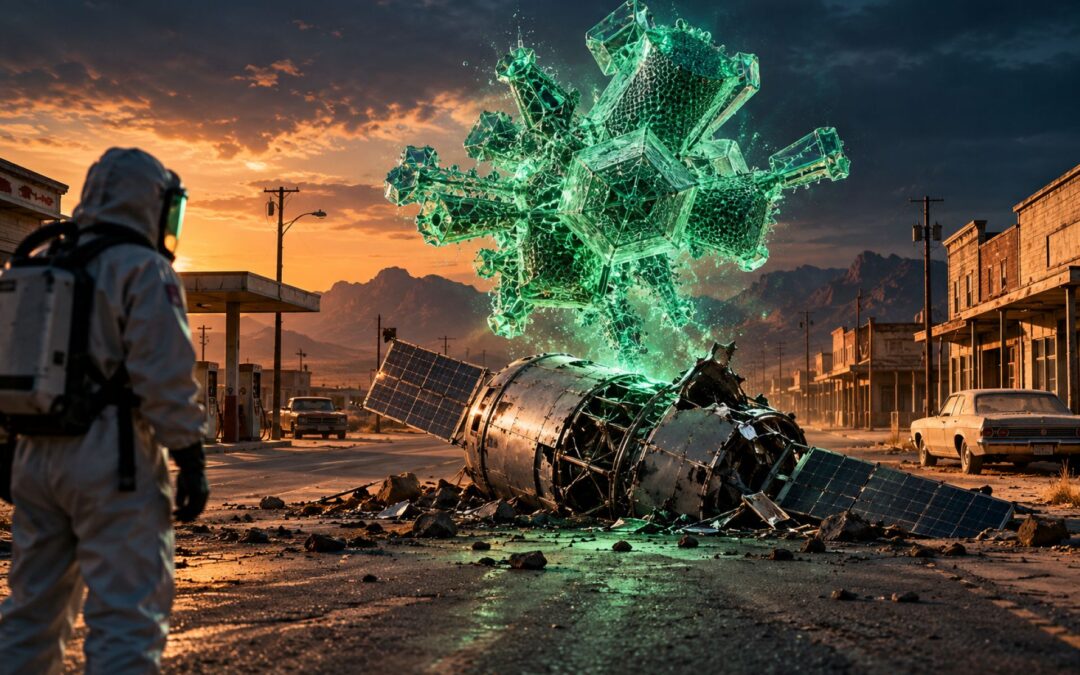
The Andromeda Strain, Michael Crichton’s 1969 science fiction novel, begins with a military satellite falling to Earth near a small Arizona town. Within hours, almost everyone in the town is dead. Two people survive, although they have seemingly nothing in common: an elderly man suffering from a bleeding ulcer and a two-month-old baby. Four scientists are assembled in a secret underground laboratory to discover what has happened before an unfamiliar organism can spread beyond their control.
Crichton approaches this premise through laboratory experiments, medical investigations, military communications, and technical procedures. The scientists are intelligent and exceptionally well equipped, but their instruments cannot always tell them what to look for, and their safeguards depend on assumptions they have never tested against the organism they encounter. The result is a thriller in which a microscopic discovery can be as consequential as a physical confrontation.
Published when space exploration and biological research were attracting increasing public attention, The Andromeda Strain helped establish Crichton’s reputation for turning complicated scientific possibilities into accessible suspense. Its fictional documents, experimental records, and detached narration make an extraordinary situation resemble the official investigation of an actual emergency.
Spoiler Warning: This article covers the complete plot of The Andromeda Strain, including the scientific explanation, the final emergency, and the epilogue.

The Dead Town and the Wildfire Alert
The story begins on a cold night in the Arizona desert. Lieutenant Roger Shawn and Private Crane have been sent to recover a satellite belonging to Project Scoop, a classified American military programme. The satellite has returned unexpectedly and is believed to have landed near Piedmont, an isolated settlement with a population of fewer than fifty people.
From a ridge overlooking the town, Shawn studies the buildings through binoculars. He sees no obvious activity, although the town appears intact. There is no evidence of a fire, explosion, or conventional disaster. The silence is unusual enough to make him uneasy, but he and Crane descend into Piedmont to investigate.
Hundreds of miles away at Vandenberg Air Force Base, Lieutenant Edgar Comroe monitors their radio transmissions from Scoop Mission Control. At first, the conversation concerns ordinary details of the recovery operation. The situation changes when Shawn and Crane begin encountering bodies.
People lie dead in the streets and buildings. There are no immediately recognisable signs of violence or a struggle that could explain the scale of the disaster. The recovery team also notices birds, suggesting that the town has been abandoned to scavengers.
Then the men observe something more disturbing. A person dressed in white is walking through Piedmont, apparently unharmed, stepping around the bodies. This survivor seems almost as inexplicable as the deaths themselves.
Before the soldiers can establish what has happened, their transmissions become confused and frightened. There is a scream, followed by an abrupt loss of radio contact. Mission Control cannot re-establish communication.
Comroe reports the incident to Major Arthur Manchek, an experienced officer who initially has little evidence on which to base a response. Two soldiers have disappeared, a satellite has fallen near a town, and the last radio reports suggest that numerous civilians are dead. Conventional explanations remain possible, but the combination of circumstances makes a biological emergency increasingly difficult to dismiss.
Manchek orders further investigation, including aerial reconnaissance and examination of photographs. The pictures confirm that Piedmont has suffered a widespread catastrophe. The analysis also identifies a living figure moving among the bodies.
The existence of a survivor complicates the situation. If an infectious agent has killed the population, why has it spared this person? If the deaths resulted from a chemical accident, what explains their extraordinary speed and apparent selectivity?
Manchek recognises that the incident may fall within the contingency planning of Project Wildfire, a secret programme designed to respond to extraterrestrial biological contamination. He declares an emergency despite lacking the usual authority and begins the procedure for activating Wildfire.
At midnight, he makes the telephone call that will summon a specialised team of scientists. What began as the recovery of a misplaced satellite has become a national emergency.
How Project Scoop Brought the Crisis to Earth
The Wildfire alert activates a system that has been prepared for precisely the possibility that appears to have materialised in Piedmont. Telephone networks, military aircraft, classified files, scientific personnel, and specialised facilities are brought into operation. Yet the emergency also forces the scientists to confront the purpose of the programme that sent the satellite into space.
Project Scoop was presented as an effort to collect biological material and other particles from the upper atmosphere. Its satellites were designed to pass through regions where unfamiliar microorganisms might exist, capture specimens, and return them for examination.
The scientific objective concealed a military interest. The programme had been developed within an environment of chemical and biological weapons research, and one reason for collecting unfamiliar organisms was the possibility that they could possess military value.
Jeremy Stone, a distinguished scientist involved in establishing Wildfire, learns more about the programme’s origins during the emergency. The connection between biological exploration and weapons development is particularly troubling because the catastrophe appears to have been created by the very activity intended to obtain useful biological discoveries.
The returning satellite, Scoop VII, has brought something down from the upper atmosphere. Whether the organism truly originated beyond Earth is not yet established, but its arrival in Piedmont provides the most plausible explanation for the town’s destruction.
The government had anticipated this general danger. Stone had previously argued that extraterrestrial exploration could expose humanity to organisms for which existing medical knowledge offered little protection. His warnings helped establish Wildfire as a scientific emergency-response operation.
Wildfire was designed around five specialists, but the emergency team is immediately compromised. Christian Kirke, a member of the planned group, has appendicitis and cannot participate. The four available scientists are Stone, Peter Leavitt, Charles Burton, and Mark Hall.
Stone provides scientific leadership and expertise in microorganisms. Leavitt contributes knowledge of microbiology and related biological systems. Burton is a pathologist whose experience will be essential for examining the effects of the unknown agent on living tissue. Hall is a physician and surgeon whose medical judgment initially seems less relevant than the laboratory expertise of the others.
While Hall is being recruited and transported toward Nevada, Stone and Burton fly to Piedmont to examine the disaster directly.
Their journey is dangerous because no one knows how the organism spreads. It might be transmitted through the air, through direct contact, or through some unfamiliar process. The scientists therefore wear elaborate protective suits and use a helicopter to approach the town.
The helicopter’s arrival also creates practical difficulties. Its movement disturbs dust and air, potentially spreading contaminated material. Even the act of investigation may alter the environment being investigated.
Stone and Burton descend into the town and begin examining the bodies.
Their first major discovery concerns the victims’ blood. When Burton opens a corpse, he finds that the blood has coagulated throughout the body. Instead of remaining fluid in the circulatory system, it has formed a solid mass.
This is an extraordinary finding. Normal blood clotting helps prevent excessive bleeding after an injury. In the victims of Piedmont, however, coagulation has occurred throughout the vascular system, apparently with devastating speed.
The scientists also encounter deaths that do not fit the same pattern.
Some residents appear to have killed themselves. Their actions include forms of suicide that would normally be physically difficult or psychologically inexplicable. One man apparently holds his head underwater until he dies. Another resident burns herself. A former soldier shoots himself while wearing his military uniform.
These scenes introduce a second possibility: the organism may affect the nervous system or behaviour as well as the blood.
Stone and Burton cannot yet determine whether the deaths represent two separate mechanisms or different manifestations of the same biological process. The apparent suicides are particularly unsettling because they suggest that exposure may change a person’s ability to think or control their actions.
The investigators eventually locate the satellite. Its presence confirms the connection between Scoop VII and the disaster, although it does not establish the precise mechanism of infection.
They also find the survivor seen by the recovery team.
Peter Jackson is an elderly man whose physical condition is poor. He is frightened, confused, and suspicious of the strangers entering the town. He believes they may have caused the deaths and requires reassurance before he will cooperate.
Jackson’s survival is difficult to explain. His age and medical condition would ordinarily suggest vulnerability rather than resistance to an unfamiliar infection.
Then the scientists discover a baby.
The infant is crying loudly and appears to have survived the catastrophe without the symptoms seen in the dead residents. The child is later identified as Jamie Ritter, approximately two months old.
The discovery transforms the investigation. Instead of facing only an unknown cause of death, the scientists now have two living examples of apparent resistance. Their task is to identify what these individuals possess—or what conditions exist inside their bodies—that the dead townspeople did not.
There is no obvious connection between them. Jackson is elderly, medically compromised, and suffering from an ulcer. The baby is young and appears healthy. Their ages, medical histories, and physical circumstances are radically different.
Stone and Burton arrange to recover the satellite and transport both survivors to Wildfire. The laboratory will allow a more complete investigation under controlled conditions.
Before leaving Piedmont, Stone also requests implementation of Directive 7–12.
The directive, called Cautery, provides for the destruction of a contaminated area with a nuclear weapon. The logic is that a sufficiently powerful explosion might eliminate an extraterrestrial organism before it spreads.
The decision, however, belongs to the government rather than the scientists.
The President postpones the nuclear strike, concerned about the consequences of detonating an atomic weapon on American territory and the uncertainties surrounding the emergency. Instead, the authorities establish a large exclusion zone around Piedmont.
At this stage, Stone’s desire for immediate destruction appears reasonable within the information available to him. The organism has killed a town, and there is no known treatment.
Later discoveries will show that detonating the bomb could have been a catastrophic mistake. The government’s delay, undertaken for political reasons rather than scientific ones, accidentally prevents an even greater biological danger.
Entering Wildfire: Five Levels of Containment
Mark Hall travels toward the Wildfire installation while studying the classified documents describing its design and operation.
The facility is located near Flatrock, Nevada, beneath a deliberately unremarkable surface installation. Its concealment is an important part of the security arrangement. A casual observer would have little reason to suspect that an elaborate biological research complex lies underground.
Wildfire is organised into five levels. The upper level provides access and initial facilities, while the lower levels impose increasingly severe restrictions and decontamination requirements.
The scientists cannot simply walk into the laboratory where the organism will be studied. They must descend through a carefully controlled sequence of examinations, disinfection treatments, sterilisation procedures, and security checks.
The protocols are physically demanding. They are designed to eliminate ordinary microorganisms carried on the scientists’ bodies and clothing, prevent accidental contamination, and ensure that material from the deepest levels cannot escape into the outside world.
The building contains automated laboratory equipment, computer systems, communications facilities, medical resources, controlled environments, and mechanical devices capable of manipulating dangerous samples without exposing the scientists directly.
Much of the laboratory’s work will be conducted through screens and remote-controlled instruments. These precautions reduce opportunities for direct contact but introduce dependence on machines, electronic systems, and the assumptions built into their operation.
Hall also learns that he has been selected for an unusual responsibility.
The Wildfire facility contains an automatic nuclear self-destruction device. If an organism escapes containment and contaminates the laboratory, the system is designed to detonate after a short countdown.
The intention is to eliminate the biological threat before it can spread through the surrounding environment.
There is, however, a mechanism for preventing the detonation. One scientist possesses the authority to insert a special key at a control station and cancel the countdown.
That scientist is Hall.
His selection is explained through the Odd Man Hypothesis, a theory developed from studies of decision-making under extreme pressure. According to the fictional research, unmarried men are more likely than other groups to choose correctly in certain life-or-death situations.
Hall is unmarried, making him the designated decision-maker. He initially finds the theory absurd and questions why marital status should determine such an important responsibility.
The arrangement also reveals a fundamental feature of Wildfire’s design. Its scientists have created elaborate safeguards on the assumption that an emergency will unfold in a predictable manner and that the designated decision-maker will be able to reach a functioning control station in time.
The automatic mechanism requires Hall to intervene if detonation is to be prevented. It does not require him to authorise destruction.
That distinction will become decisive.
Stone explains the system’s purpose and the danger of biological contamination. The scientists must balance two competing objectives: studying the organism long enough to understand it while preventing it from escaping.
The team begins its descent through the levels of Wildfire.
Their progress is slow because the protocols are intentionally inflexible. Even during an emergency, they must undergo procedures established years earlier. The building demands obedience to its systems before permitting scientific work.
The recovered Scoop satellite is transported toward the deepest laboratory, where it can be examined under maximum containment.
Jackson and the infant are also brought into the installation and placed in isolation facilities for medical observation.
As the scientists reach the lower levels, the narrative introduces another important security arrangement. Communications from the outside world are received through a monitoring system on an upper level. A teleprinter signals incoming messages with a bell, and personnel are supposed to notify the scientific team when important information arrives.
The arrangement seems routine. It is nevertheless another point at which information must pass successfully through a machine and a human procedure.
By the time the scientists begin their experiments, Wildfire appears to offer an extraordinary level of protection. Its complexity, however, has created many separate opportunities for failure.
Early Experiments and the Two Survivors
The scientists begin by reviewing possible explanations for the catastrophe.
They consider whether Scoop VII recovered an extraterrestrial organism, a terrestrial microorganism carried into the upper atmosphere, or some biological system that does not resemble familiar life.
The distinction matters because conventional microbiological assumptions may be misleading. An organism adapted to conditions radically different from those on Earth might require unusual nutrients, temperatures, pressures, or energy sources.
The team must therefore avoid designing experiments that assume the answer before the relevant evidence has been collected.
Their first task is to determine whether the satellite contains a living agent capable of reproducing the deaths seen in Piedmont.
Inside Level V, laboratory animals are exposed to material associated with the satellite. Rats and monkeys die with astonishing speed.
The experiments show that the deadly property is present in the recovered material and can operate under controlled laboratory conditions. The scientists no longer need to rely exclusively on the evidence from Piedmont.
They still do not know exactly what is killing the animals.
Burton conducts autopsies and studies the affected tissues. The most obvious abnormality is widespread intravascular coagulation, the clotting of blood inside the circulatory system.
The process is so extensive that blood-containing organs become abnormally firm. Yet microscopic examination reveals surprisingly little conventional tissue destruction.
This creates a puzzle. Many familiar infections produce inflammation, tissue damage, or identifiable cellular changes. The Andromeda agent appears capable of causing death before such reactions become prominent.
Burton investigates how the agent enters the body.
The circumstances in Piedmont suggest airborne transmission. If particles were inhaled, they could enter through the respiratory system and eventually reach the bloodstream.
He considers the possibility that the agent passes rapidly through the lungs or acts on blood components in a way that conventional anticoagulant treatment cannot prevent.
His experiments establish that ordinary anticoagulant drugs do not stop the lethal clotting reaction.
The result undermines a straightforward therapeutic approach. If the organism can overwhelm normal blood regulation, administering familiar drugs may be useless.
Burton also examines animals under differing experimental conditions. Some observations fail to receive the attention they deserve. In particular, the decision not to investigate certain animals as thoroughly as others contributes to the delay in recognising what matters about the organism.
The research is technically sophisticated, but a technically sound experiment is of limited value if its implications are overlooked.
Meanwhile, Hall investigates the two survivors.
Jackson is suffering from gastrointestinal bleeding associated with a longstanding ulcer. He requires medical care and blood transfusions, but the mysterious agent has apparently failed to kill him.
The infant, by contrast, displays no significant physical abnormality. The child cries repeatedly and responds to the unfamiliar environment as a baby ordinarily might.
Hall searches for a common physiological factor between them.
At first, the difference between the patients is more striking than any similarity. Jackson has suffered years of poor health, while the infant is too young to have developed a comparable medical history.
Hall continues examining Jackson and questioning him about his treatment.
Jackson reveals that he has used large quantities of aspirin for ulcer pain and has also consumed alcohol extracted from Sterno, a heating fuel containing dangerous substances.
Both details are medically important.
Aspirin can worsen gastrointestinal bleeding and influence the body’s chemistry when consumed excessively. Methanol and related substances can produce serious metabolic disturbances. Together, Jackson’s habits suggest that his blood chemistry may be substantially abnormal.
Hall recognises evidence of acidosis, a condition in which the body’s acid-base balance shifts toward excessive acidity.
Nevertheless, this discovery does not immediately solve the puzzle. If acidosis explains Jackson’s survival, why would a healthy infant survive the same organism?
The baby does not share Jackson’s ulcer, substance consumption, or chronic illness.
While Hall works with the patients, Stone and Leavitt examine the recovered satellite.
Using remotely controlled microscopes, they systematically scan its surface and interior. They discover a minute patch containing unusual material, including a green component that becomes the focus of further investigation.
The researchers resist the temptation to abandon their systematic examination as soon as they notice something interesting. They continue scanning, documenting the specimen’s position and comparing observations at different levels of magnification.
Eventually, they examine the green material more closely.
It appears to possess properties associated with a biological agent. Under appropriate conditions, it grows or reproduces.
The discovery provides the team with a specific target.
Instead of investigating an unknown hazard scattered throughout the satellite, they can begin studying an identifiable microscopic structure.
Stone and Leavitt establish cultures under different environmental conditions. They vary such factors as temperature, atmosphere, pressure, and available growth materials.
The objective is to determine what the organism requires and whether it behaves like known terrestrial microorganisms.
Yet its behaviour remains strange.
Certain observations suggest biological activity, while others challenge the conventional expectation that life depends on familiar cellular structures and chemical pathways.
The scientists are gradually forced to recognise that their model of the organism may be inadequate.
The team compares its findings during scheduled conferences.
These meetings are intended to bring together information from pathology, microbiology, medicine, microscopy, and other fields. Each scientist possesses knowledge that the others may not have.
The process should enable them to identify patterns across apparently unrelated observations.
Instead, the specialists often interpret evidence within their own fields. Information that might be decisive when combined with another scientist’s findings remains isolated.
The communication problem is compounded by a mundane mechanical defect.
A small fragment of paper becomes lodged between the bell and striker of the communications teleprinter. The machine continues receiving messages, but the warning bell no longer rings.
The fault is mechanical rather than electronic, so the facility’s routine computer checks do not identify it.
As a result, important external communications fail to reach the scientists when they are needed.
Crichton has now established two kinds of vulnerability. The researchers can misunderstand their experimental evidence, and the institution can fail to deliver information even when that information has already been obtained elsewhere.
Neither failure requires incompetence on a grand scale.
The Plane Crash and the Warnings No One Reads
While the scientists investigate in Wildfire, the military continues responding to the emergency outside.
The quarantine around Piedmont has not eliminated uncertainty about the extent of the danger. The government must decide whether the organism is spreading, whether surrounding populations are at risk, and whether Directive 7–12 should be implemented.
A military aircraft crashes after entering the area associated with the contamination.
The incident initially resembles a conventional aviation disaster. Investigators examine the wreckage for evidence of mechanical failure, structural damage, or another cause that might explain the loss.
The subsequent examination produces an unusual result.
Some synthetic materials have undergone abnormal chemical breakdown. The investigators identify a depolymerised polymer, material whose molecular structure has been disrupted.
The finding raises the possibility that the organism affects substances other than living tissue.
At Wildfire, the scientists are concentrating primarily on biological lethality. Their central question is how Andromeda kills humans and experimental animals.
The aircraft evidence points toward another kind of danger: the organism may interact with plastics or other manufactured materials.
This possibility has profound implications for containment. Wildfire depends on synthetic seals, protective materials, and engineered barriers. If Andromeda can alter those materials, the laboratory’s protective systems may themselves be vulnerable.
The information, however, does not reach the team promptly.
Inside Wildfire, research continues through demanding shifts of observation and testing.
The researchers become increasingly tired. They have been working within an artificial environment where ordinary distinctions between day and night are largely absent. Their routines are governed by experiments, computer results, and scheduled conferences.
Stone recognises that exhaustion threatens the quality of their judgments. Fatigue can cause people to overlook details, misunderstand results, or make avoidable mistakes.
The warning is sensible, but its usefulness is limited by the pressures already surrounding the investigation.
Leavitt also has a vulnerability that the others do not fully understand.
He suffers from epilepsy and has concealed the condition. Particular flashing lights can trigger a seizure, making the laboratory’s visual displays potentially dangerous to him.
His medical history is relevant to his fitness for work in Wildfire, yet he has withheld information that would have allowed the team to address the risk.
The concealed condition becomes another example of the gap between an institution’s formal procedures and the actual people expected to operate within them.
The communications failure is discovered during a conference.
The scientists learn that important messages have accumulated without attracting the attention of the monitoring personnel. Stone is alarmed that the system has failed to notify them of information coming from the government and military investigation.
He contacts Robertson, the President’s scientific adviser, and discovers that decisions about the nuclear response have been delayed.
The exchange exposes the friction between scientific recommendations and political authority.
Stone believes that rapid action may be essential. Robertson must navigate the President’s doubts about scientific judgment and the immense consequences of authorising a nuclear detonation.
Yet Stone himself lacks crucial information that will eventually prove his original recommendation dangerous.
The delayed communications do not merely deprive the team of useful updates. They prevent the scientists from seeing how their laboratory observations connect with events outside Wildfire.
One of the messages concerns the strange death of Arizona highway patrol officer Martin Willis.
Hall notices the accumulated messages but does not find the relevant item during his initial inspection.
The clue remains undiscovered until later.
By this point, the novel has established that a crisis can deteriorate even when separate individuals perform much of their work competently. Investigators collect evidence, scientists run tests, and officials make decisions, but the system fails to integrate the information into a timely understanding of the threat.
Andromeda’s Biology and the Spread of the Crisis
The investigation becomes more complicated as the team learns that Andromeda does not conform to established categories of life.
Stone and Leavitt subject the green material to increasingly sophisticated analysis. They examine its microscopic structure, chemical composition, and behaviour under varying environmental conditions.
The organism appears to possess an unusual architecture.
Conventional cells contain identifiable components with specialised functions. Under magnification, researchers expect to observe structures such as a membrane and internal organisation, even if the details vary among organisms.
Andromeda does not display the familiar arrangement.
Its structure appears extraordinarily uniform, closer in some respects to a crystalline organisation than to the cellular architecture of known life.
This does not mean that it is literally an ordinary crystal. It exhibits growth and other behaviour suggesting a biological or life-like system, but it does so without conforming to the scientists’ expectations.
The discovery forces them to reconsider how a living organism might be constructed.
Their investigations also raise questions about metabolism.
Terrestrial organisms generally rely on chemical reactions to obtain and use energy. Those reactions require particular substances and produce identifiable products.
Andromeda behaves as though it can utilise energy through unfamiliar mechanisms, possibly involving the direct interconversion of matter and energy.
The scientists begin to speculate that it functions almost like a microscopic reactor.
This possibility transforms their understanding of Directive 7–12.
A nuclear explosion releases an immense quantity of energy. If Andromeda can exploit that energy for growth, the proposed method of destroying it may instead provide ideal conditions for its reproduction.
Stone realises that the nuclear response must be prevented.
The measure that once appeared to offer humanity its best chance of stopping the organism could make the danger immeasurably worse.
The laboratory experiments also introduce a more speculative possibility.
Stone and Leavitt discuss the Messenger Theory, the idea that an advanced extraterrestrial civilisation might communicate by sending self-replicating biological structures through space.
Such an organism could theoretically survive a journey, reproduce under suitable conditions, and eventually develop into a more complicated structure capable of conveying information.
The theory offers an imaginative interpretation of Andromeda’s unusual organisation.
It remains conjecture.
The scientists do not discover an intelligible message or establish that the organism was deliberately engineered. The possibility matters because it encourages them to question whether Andromeda is merely a disease-causing microorganism or something serving a purpose they cannot yet recognise.
While Stone and Leavitt examine these broader questions, Hall continues his more immediate investigation of the survivors.
Jackson becomes increasingly useful as a source of information about Piedmont.
He recalls the satellite’s arrival and the events surrounding the disaster. His recollections help Hall reconstruct the sequence of exposure, abnormal behaviour, and death.
The account is imperfect, but it reinforces the importance of chronology.
The inhabitants were not all affected in precisely the same way, and the apparent suicides complicate any explanation based solely on instantaneous blood coagulation.
Hall and Burton examine the possible relationship between the vascular system and the nervous system.
If Andromeda produces microscopic changes in the circulation, it might influence behaviour through disturbances affecting the brain before the final lethal event.
The novel does not establish every neurological detail with the same certainty as the blood-clotting mechanism, but the unusual deaths demonstrate the scientists’ need to consider more than one manifestation of the organism.
Meanwhile, the aircraft wreckage is being reconstructed at Topeka.
Investigators identify damage to synthetic materials that cannot be explained easily by ordinary mechanical failure. The possibility of biological degradation becomes increasingly credible.
The discovery is significant because the aircraft’s fate may reflect a change in Andromeda itself.
Initially, the team has been studying an organism that kills exposed people rapidly. The new evidence suggests a form capable of damaging manufactured materials without necessarily causing the same immediate human deaths.
The scientists have not yet fully recognised what this means.
Hall also investigates Martin Willis, the highway patrol officer whose unusual death had been reported through the communications system.
Willis had diabetes and used insulin. His medical history included episodes in which inadequate control of the disease led to serious metabolic disturbance.
In particular, he had been vulnerable to ketoacidosis, a dangerous condition in which the body’s chemistry shifts toward excessive acidity.
Hall is struck by the connection to Jackson.
Jackson’s condition is associated with metabolic acidosis arising from his medical problems and substance consumption. Willis also experienced circumstances capable of producing acidosis.
Both men had been exposed to the broader emergency, yet their situations differ from the pattern of immediate death seen in Piedmont.
The growing relationship between acidity and survival provides Hall with a possible clue.
He still has to explain the baby.
The infant is healthy and has none of the medical conditions associated with acidosis. If excessive acidity prevents Andromeda from multiplying, why would a normal infant survive?
Hall begins reconsidering the problem in terms of the body’s ability to maintain acid-base balance.
Before he can complete that reasoning, an emergency occurs in Wildfire.
A containment seal in Burton’s laboratory fails.
The danger is immediate because Burton may have been exposed to the organism. He is isolated, and the others must decide whether he can be protected or treated before the infection becomes fatal.
Stone considers using pure oxygen in the laboratory because previous observations suggest that Andromeda does not thrive under certain oxygen conditions.
But Burton remains alive even before the protective measure is fully implemented.
That fact is crucial. If the original organism kills almost immediately, Burton’s continuing survival requires an explanation.
During the emergency, Leavitt suffers an epileptic seizure.
Hall treats him and recognises that the condition was known to Leavitt but had been concealed from the team. The episode removes Leavitt from effective participation at a moment when every scientist’s judgment is needed.
Burton, fearing death, asks whether he can be treated with Kalocin.
Kalocin is a fictional experimental antimicrobial drug described as extraordinarily powerful against a wide range of microorganisms.
Its apparent usefulness is accompanied by an extreme danger.
A drug capable of eliminating virtually all microorganisms could also destroy the beneficial microbial populations on which normal human health depends. Its use might create new biological problems rather than simply remove an infection.
Stone refuses to administer it.
The discussion reinforces the book’s suspicion of solutions that appear effective because they destroy biological complexity indiscriminately.
The most important clue, however, comes from Burton’s fear.
As the others try to calm him, Stone makes an observation about the effect of fear on breathing. Hall suddenly recognises the relationship between emotional distress, respiratory rate, blood chemistry, and the two survivors.
He returns to his laboratory to test the idea.
The Blood-pH Discovery and the Three-Minute Countdown
Hall’s breakthrough begins when he stops searching for a shared disease or physical characteristic between Jackson and the baby.
Instead, he considers whether they occupy different physiological extremes.
Jackson has metabolic acidosis. His blood chemistry is more acidic than normal because of his medical condition and the substances he has consumed.
The baby’s condition appears completely different.
The infant cries almost constantly, breathing rapidly in the process. Rapid breathing can remove carbon dioxide from the blood faster than the body produces it.
Because carbon dioxide participates in the chemical regulation of blood acidity, excessive loss of carbon dioxide can cause respiratory alkalosis, shifting the blood toward a more alkaline condition.
The apparent opposites suddenly become related.
Jackson’s blood is too acidic for ordinary physiological conditions. The baby’s crying makes its blood temporarily more alkaline.
Both conditions lie outside the normal range.
Hall realises that Andromeda may reproduce only within an exceptionally narrow range of blood pH.
If the organism requires a particular chemical environment, both excessive acidity and excessive alkalinity could prevent it from multiplying.
Hall tests the hypothesis.
Laboratory results show that the original form of Andromeda grows well only within a narrow pH interval, approximately 7.39 to 7.42.
Outside that range, growth is inhibited.
The explanation accounts for the two survivors without requiring them to possess the same medical condition.
Jackson survived because his disturbed metabolism produced acidosis. The infant survived because prolonged crying and rapid breathing produced alkalosis.
Willis’s diabetic history fits the same general pattern of metabolic disturbance.
The discovery is significant because it identifies an environmental requirement of the organism rather than a conventional immunity possessed by certain people.
The survivors are not protected by antibodies developed against Andromeda. Their blood chemistry makes them unsuitable hosts for its original lethal form.
Hall rushes to apply this understanding to Burton.
At first, the scientists are supplying Burton with pure oxygen. Hall orders the procedure stopped and tells Burton to breathe rapidly to produce respiratory alkalosis.
The reasoning is based on the original organism’s inability to multiply outside its narrow pH range.
Burton follows the instructions.
Yet another observation complicates the apparently successful solution. He has already survived longer than expected, and further investigation reveals that the agent involved in the laboratory emergency is no longer behaving like the original lethal organism.
Andromeda has mutated.
The new form is no longer producing the rapid fatal coagulation observed in Piedmont. Instead, it appears capable of attacking synthetic materials.
This explains the aircraft crash and the failure of the laboratory seals.
The original investigation had treated Andromeda principally as an infectious threat to living organisms. The mutation introduces a different danger: it can damage the materials on which the containment system depends.
The scientists now recognise why the laboratory’s protective barriers have begun failing.
The organism can degrade rubber gaskets and related synthetic components. It may pass through barriers that were designed on the assumption that those materials would remain chemically stable.
A new emergency follows.
Wildfire’s automated systems detect containment failure and initiate the nuclear self-destruction sequence.
The laboratory has been designed to destroy itself if the organism escapes its deepest containment area. The mechanism is automatic because the designers believed that human deliberation might take too long during a biological emergency.
But the scientists now know that nuclear energy could stimulate Andromeda’s growth.
The automatic explosion, intended as the final safeguard, may produce a disaster far worse than the original contamination.
Hall must stop it.
The system gives him three minutes.
He carries the cancellation key, but his location creates an unexpected problem. There is no accessible control station within his sealed sector of Level V.
The nearby routes to other areas are blocked by emergency isolation procedures.
The designers expected that the person holding the key would be able to reach a control station. They did not adequately account for a situation in which the safety system itself would prevent the designated operator from reaching one.
Hall identifies a possible escape route through the central service core of the building.
The core connects different levels and contains equipment, cables, and structural access points. It is not intended as an ordinary passageway.
Entering it presents another danger.
The facility has automatic defensive systems designed to prevent contaminated animals or other biological material from escaping through the service passages.
Those systems release ligamine, a fictional paralysing drug related in its action to curare, and include devices capable of firing drug-containing darts.
The drug threatens Hall’s ability to breathe by interfering with muscular function.
Nevertheless, remaining on Level V means allowing the nuclear detonation to occur.
Hall enters the central core and begins climbing.
The countdown continues as he moves through the structure. Mechanical announcements report the remaining time, while the building’s automated systems respond to his presence as a security breach.
He encounters the defensive measures and is exposed to ligamine. His muscles weaken, making movement increasingly difficult.
The emergency becomes a struggle between his determination to reach a control station and his body’s diminishing ability to function.
He continues upward and reaches a location where the key can be inserted.
With only seconds remaining, Hall manages to activate the cancellation mechanism.
The system announces that self-destruction has been cancelled.
Hall collapses.
The nuclear explosion has been prevented, but he is incapacitated by the drug. His survival now depends on whether he can receive treatment before the paralysis stops his breathing completely.
The climax resolves one aspect of the emergency through physical action rather than another elaborate scientific experiment.
Hall’s biological insight revealed why the original organism spared certain people. The same investigation revealed that the containment system’s planned nuclear response was dangerous.
But stopping that response requires him to overcome the very machinery designed to keep Wildfire safe.
The Last Day, the Escape, and the Final Spaceflight
Hall regains consciousness after being treated for the effects of ligamine.
He learns that his intervention succeeded. The nuclear device did not explode, and the laboratory remains intact.
Stone explains that Hall stopped the countdown with approximately thirty-four seconds remaining.
The danger had been even greater than Hall realised. The self-destruction sequence included the evacuation of air from Level V shortly before detonation to improve the nuclear device’s effectiveness.
Had the countdown continued, the laboratory’s occupants would have faced additional lethal consequences even before the explosion itself.
The scientists also report that the organism appears to have changed into a relatively harmless form.
The original Andromeda caused rapid death through catastrophic blood coagulation. The later form attacked synthetic materials. The organism now appears to have undergone further changes that reduce its immediate threat to human life.
Stone believes that Andromeda will eventually migrate toward the upper atmosphere, where environmental conditions may better suit it.
He reports that no new catastrophic outbreak has occurred during the immediate observation period.
The team can continue studying the specimens available at Wildfire. Their research has produced a better understanding of Andromeda’s unusual biological behaviour and capacity for mutation.
Stone is cautiously confident.
For him, the central achievement is that the scientists now understand much more about the organism than they did when the emergency began.
But that confidence is qualified by the very discoveries that made survival possible.
Andromeda has demonstrated an extraordinary ability to change its properties. Its original lethality was altered through mutation, and its capacity to damage manufactured materials was discovered only after a serious external accident and an internal containment failure.
The organism has not been eliminated from the environment.
Its future behaviour remains uncertain.
The epilogue moves beyond Wildfire to a later disaster involving Andros V, a crewed spacecraft destroyed during atmospheric re-entry.
The official explanation attributes the accident to failure of its heat shield, which includes synthetic materials.
Public concern focuses on engineering reliability, manufacturing, and the safety of the space programme.
Yet Jeremy Stone is included in the investigation.
His presence is suggestive because the reader has already encountered an organism capable of degrading synthetic materials and surviving in unusual atmospheric environments.
The novel does not explicitly demonstrate that Andromeda destroyed Andros V. It leaves that causal link unresolved.
Nevertheless, the arrangement of the evidence makes the implication difficult to ignore.
The scientific investigation that appeared to have brought the crisis under control may have explained only one stage in the organism’s continuing behaviour.
The story closes with the possibility that humanity remains exposed to processes it can observe and partially understand but cannot reliably govern.
The World of Project Wildfire: Secrecy, Risk, and Containment
Wildfire is one of the novel’s most important fictional creations because its architecture shapes nearly every stage of the investigation.
Its underground location, disguised entrance, controlled access, mechanical equipment, sterilisation procedures, and security arrangements establish an environment in which human activity is subordinated to containment protocols.
The laboratory is designed around a rational principle: any material suspected of carrying an extraterrestrial organism must be isolated from the broader environment until its properties are understood.
That principle remains sound. The difficulty lies in turning it into an operational system capable of responding to situations its designers did not anticipate.
The different levels of Wildfire embody increasing degrees of caution.
Scientists must undergo extensive preparation before reaching the most dangerous material. Remote manipulation reduces direct exposure, while specialised rooms allow experiments to take place without immediately threatening the rest of the facility.
The protocols also reveal how the institution defines safety.
Safety becomes a property of correct procedure. If personnel obey established rules and equipment functions according to its specifications, the system should prevent contamination.
Crichton’s story tests that assumption.
The teleprinter’s defective bell is an especially clear example. The communications network receives important information, yet a tiny paper fragment prevents a warning signal from sounding. The larger system works in a narrow technical sense, but it fails to deliver its intended benefit.
The nuclear cancellation arrangement creates a more consequential contradiction.
The designers select Hall because they believe his personal circumstances make him an unusually reliable decision-maker. They give him the responsibility of preventing detonation but fail to guarantee that he will have access to the mechanism necessary to exercise that responsibility.
The barrier between sectors, intended to stop biological contamination, also prevents him from reaching a control station.
The building’s defensive system then treats his attempt to save it as an unauthorised escape.
Each mechanism behaves according to its assigned function. The combination becomes deadly.
Wildfire’s institutional environment is inseparable from the secrecy surrounding Scoop.
The satellite programme is publicly associated with scientific collection, but its concealed military purpose changes the ethical meaning of the mission.
The government has accepted the possibility of biological contamination partly because unfamiliar organisms might offer strategic advantages.
The risk is not imposed by the townspeople who suffer its consequences. It originates in a classified programme whose objectives and precautions are controlled by a relatively small group of military and scientific officials.
The political controversy surrounding Directive 7–12 develops this problem.
Stone’s initial recommendation is to destroy Piedmont with a nuclear weapon. The President hesitates, partly because the consequences of such an action extend far beyond the scientific assessment.
The novel later reveals that the scientific recommendation itself was dangerous.
This does not establish that political hesitation is generally superior to scientific expertise. It demonstrates that no participant possesses complete information and that an irreversible decision can be disastrous when based on an incorrect model of the threat.
Crichton’s speculative system drew on genuine concerns about contamination during space exploration. Around the time of the novel’s publication, NASA implemented precautions for returning Apollo astronauts and lunar material. The agency’s historical account of Apollo 11 quarantine procedures provides a real-world contrast to Wildfire’s fictional emergency.
Planetary protection remains a significant consideration in space research. NASA’s Jet Propulsion Laboratory describes mission-specific planetary protection measures intended to reduce contamination of other worlds and, when necessary, protect Earth from returned extraterrestrial material.
The distinction is important: Wildfire’s architecture, extreme procedures, and nuclear contingency are fictional. They should not be mistaken for a description of actual contemporary requirements.
Their literary purpose is to dramatise a genuine difficulty in risk management.
A system intended to contain unknown biological material must operate before scientists fully understand that material. Its designers can prepare for known hazards, but they cannot guarantee that unfamiliar life will respect the categories on which the safeguards depend.
The Scientists, the Survivors, and Their Competing Ways of Thinking
Crichton’s characters are defined largely by their professional responsibilities and intellectual methods. Their personalities matter, but the novel devotes more attention to how they examine evidence, respond to pressure, and exercise authority than to their private emotional lives.
This approach suits the documentary structure. It allows the investigation to remain central while making the characters’ different forms of expertise essential to the plot.
Jeremy Stone and Mark Hall: Expertise, Authority, and the Odd Man
Jeremy Stone occupies the position of scientific authority.
He is highly accomplished, intellectually confident, and accustomed to directing sophisticated research. His reputation helps explain why the government turns to him when the emergency begins.
Stone also understands that biological dangers may be fundamentally different from familiar technological threats.
His earlier advocacy for Wildfire shows considerable foresight. He recognised the possibility that space exploration might introduce an unfamiliar organism before the disaster occurred.
Yet foresight is not the same as infallibility.
Stone supports the nuclear destruction of Piedmont when he believes the organism must be eliminated immediately. Later, his own research shows that this could have supplied Andromeda with energy for rapid growth.
His judgment is reasonable within an incomplete understanding of the organism, but it is still wrong.
Stone’s strength is his commitment to investigation. He takes unusual evidence seriously and encourages consideration of possibilities that conventional biology might overlook.
His weakness is a tendency to regard superior scientific knowledge and institutional preparation as sufficient foundations for control.
The ending preserves this tension. Stone remains confident that understanding the organism’s mutation is the most important accomplishment, even though its future behaviour remains uncertain.
Mark Hall approaches the crisis differently.
He has medical expertise, but his role initially appears less intellectually prestigious than the laboratory specialisations represented by Stone and Leavitt.
Hall is also skeptical of the Odd Man Hypothesis.
He does not accept that being unmarried automatically makes him exceptionally reliable under pressure. His reaction establishes an independent attitude toward institutional authority.
His principal contribution comes from clinical reasoning.
While other scientists examine the organism directly, Hall studies the people who survived exposure.
He initially struggles with the problem because Jackson and the baby have no obvious common medical feature.
The breakthrough occurs when he abandons the assumption that survival must reflect a shared characteristic.
Instead, he recognises that opposite physiological conditions can produce the same biological result.
Jackson’s acidosis and the baby’s alkalosis both prevent growth of the original organism.
This deduction illustrates the value of reasoning from apparently contradictory evidence.
Hall’s final action gives him an additional role as the person who prevents the laboratory’s destruction.
His physical struggle through the central core is more conventional thriller heroism than the preceding scientific investigation, but it follows directly from the earlier explanation of Wildfire’s design.
He succeeds partly because he refuses to treat the facility’s stated limitations as absolute.
The relationship between Stone and Hall therefore establishes two complementary but competing forms of intelligence.
Stone represents theoretical scientific authority and the ability to organise complex research. Hall represents clinical observation, practical judgment, and willingness to reconsider an apparently obvious conclusion.
Neither operates without error, and neither could have resolved the complete crisis alone.
Peter Leavitt and Charles Burton: Specialisation Under Pressure
Peter Leavitt is central to the identification of Andromeda and the investigation of its unusual structure.
His scientific imagination allows him to consider biological possibilities that conventional assumptions might exclude.
He participates in the microscopic examination of the satellite and helps investigate the organism’s chemical composition, growth, and potential significance.
His interest in speculative explanations, including the Messenger Theory, expands the investigation beyond familiar infectious-disease models.
But Leavitt’s strength also has limits.
His work demands concentration, and the team’s technical investigations can become detached from immediate practical questions. Experiments generate enormous quantities of information, not all of which are interpreted quickly enough.
Leavitt also conceals his epilepsy.
His reluctance to disclose the condition is understandable as a fear that it might threaten his professional role, but the consequences are serious in a high-security laboratory.
When flashing equipment triggers a seizure, the team loses an important scientist during an escalating emergency.
The incident shows how personal vulnerability can defeat procedural assumptions that treat experts primarily as functional components of a system.
Charles Burton contributes a different form of expertise.
As a pathologist, he focuses on physical evidence from the dead. His autopsies reveal the catastrophic blood coagulation associated with the original organism.
Burton’s experiments establish important facts about transmission and the failure of conventional anticoagulant treatment.
His work is careful in many respects, but the investigation also reveals omissions. Certain experimental results are not followed through, and his approach initially remains tied to familiar mechanisms of disease.
His experience becomes more personal when the containment seal fails.
Burton moves from examining dead animals to facing the possibility that he will become another victim.
His fear matters because it changes the way he breathes, supplying part of the physiological context for Hall’s discovery.
The novel places the pathologist in a situation where the body he must understand is suddenly his own.
His request for Kalocin also introduces an ethical conflict between individual survival and the possible consequences of using an extremely powerful antimicrobial agent.
Burton wants to live, but Stone refuses to take a risk that might create broader biological harm.
Their disagreement cannot be reduced to a simple distinction between courage and cowardice.
It reflects the difference between the needs of an endangered individual and the responsibilities of scientists attempting to prevent a wider catastrophe.
Manchek, Jackson, and Ritter: The People Who Change the Investigation
Arthur Manchek has no opportunity to solve the microbiological mystery, but his decisions are indispensable.
He recognises that the loss of the recovery team cannot be treated as an ordinary military incident. His willingness to declare an emergency before receiving full authorisation enables the Wildfire response to begin.
The decision is significant because it occurs under uncertainty.
Manchek does not possess the evidence necessary to explain the deaths, yet he understands that waiting for certainty may make intervention impossible.
He represents a form of practical institutional judgment different from the laboratory reasoning of Stone and Hall.
Peter Jackson is more complicated than he first appears.
His advanced age, ulcer, bleeding, alcohol consumption, and excessive aspirin use make him seem like an unlikely survivor.
Those same conditions, however, have altered his internal chemistry in a way that prevents the original organism from reproducing.
Jackson does not know that his medical problems have protected him.
His survival is accidental, not the result of deliberate treatment or unusual personal resistance.
His recollections of Piedmont also provide evidence about the outbreak’s chronology and behavioural effects.
Jamie Ritter, the infant, has a similarly important role without possessing any understanding of the crisis.
The baby’s persistent crying seems at first like an ordinary inconvenience. It eventually becomes the decisive clue that allows Hall to understand how an otherwise healthy person could survive.
Because crying changes respiratory behaviour, it can alter blood chemistry.
The infant’s survival and Jackson’s survival are linked by the environmental conditions they create within their bodies.
Crichton uses the two characters to make a scientific point about evidence.
The feature that matters is not always the most conspicuous similarity between observed cases. Sometimes apparently opposite conditions reveal the same underlying rule.
These survivors have limited psychological development, but their importance to the mystery is considerable. Without them, the researchers might continue investigating Andromeda’s lethality without identifying its dependence on blood chemistry.
What Is the Andromeda Strain? Life, Chemistry, and Mutation
Andromeda is an unfamiliar microscopic organism whose properties challenge the scientific categories available to the researchers.
Its most important characteristic is that it changes.
The organism recovered from Scoop VII initially appears capable of killing exposed humans and laboratory animals through catastrophic blood coagulation.
Later, its behaviour changes, producing forms that are less directly lethal but capable of damaging synthetic materials.
This distinction is essential to understanding the novel.
The original Andromeda appears to enter the body through the respiratory system. Once established, it triggers rapid and widespread coagulation within the circulatory system.
The resulting deaths occur too quickly for ordinary infectious-disease patterns to provide a satisfactory explanation.
Some human victims also display severe behavioural abnormalities, suggesting that the organism’s effects extend beyond the straightforward blockage of blood vessels.
The researchers’ medical investigation identifies one decisive constraint on the original form.
It can reproduce effectively only within a narrow pH range.
The pH scale measures acidity and alkalinity. Lower values indicate greater acidity, while higher values indicate greater alkalinity.
Human blood ordinarily maintains a tightly regulated pH. Significant departures from its normal range can be dangerous.
In Crichton’s fictional biological model, those departures also make the environment unsuitable for the original Andromeda organism.
Jackson’s acidosis and the infant’s respiratory alkalosis therefore interrupt its capacity to multiply.
This explanation is elegant because the organism’s vulnerability emerges from the same investigation that establishes its extraordinary danger.
Crichton also gives Andromeda a structure unlike familiar terrestrial cells.
The scientists discover an unusually uniform organisation that raises doubts about the need for conventional cellular components.
Its energy metabolism appears equally unusual.
Rather than depending on ordinary biochemical processes, Andromeda seems capable of exploiting energy and matter through mechanisms that resemble theoretical physical processes more than known microbial physiology.
These properties give the organism a powerful fictional advantage.
The scientists cannot reliably predict its behaviour by comparing it with familiar bacteria, fungi, or viruses.
The novel consequently raises the question of what should count as life.
Is reproduction sufficient? Must an organism possess a particular chemical composition? Does life require recognisable internal structures? Could a self-organising system based on unfamiliar chemistry fulfil functions associated with biology?
Such questions remain relevant to scientific discussions of extraterrestrial life. NASA’s explanation of what life requires and how scientists search for it beyond Earth illustrates why definitions developed from terrestrial organisms may not exhaust every possible biological system.
That scientific uncertainty does not establish that Andromeda’s mechanisms are physically or biologically realistic.
Its unusual matter-energy metabolism, extremely rapid lethal effects, and capacity for dramatic mutation are speculative inventions.
The pH range reported in the novel is a property of Crichton’s original fictional organism under the conditions studied. It should not be mistaken for evidence about the growth requirements of real extraterrestrial life.
The later mutation introduces another important distinction.
An organism can cease being directly pathogenic while remaining dangerous.
The form that attacks rubber gaskets and synthetic materials may no longer cause immediate human death, but it threatens aircraft, protective equipment, and containment systems.
A biological hazard need not operate exclusively through infection to produce catastrophic consequences.
Crichton’s fictional organism also demonstrates how rapidly a scientific explanation can become incomplete.
The researchers eventually understand why the original form killed most of Piedmont and spared two survivors. They do not thereby establish that every future form will possess the same biological requirements.
In this respect, Andromeda functions as a moving scientific target.
Each discovery improves the investigators’ understanding of one observed condition while revealing that the organism’s range of possible behaviour is wider than previously believed.
Themes of Human Error, Scientific Uncertainty, and Biological Warfare
A major theme of The Andromeda Strain is the difference between possessing scientific intelligence and exercising dependable control over complex events.
The Wildfire team contains experts capable of sophisticated experiments and difficult deductions.
Their failure is not that they lack knowledge.
They repeatedly struggle because the information necessary for a correct decision is incomplete, scattered across different specialties, or interpreted through assumptions that later prove unreliable.
Burton understands pathology, but his early examination does not reveal the full significance of the organism’s interaction with blood chemistry.
Stone and Leavitt understand microbial analysis, but they become absorbed in complex examinations while overlooking results that might have altered their understanding sooner.
Hall possesses the medical knowledge necessary to identify the survivors’ physiological relationship, yet he initially searches for a shared abnormality rather than a shared consequence of opposite conditions.
The characters’ mistakes are credible because each arises from a particular way of approaching the problem.
Scientific specialisation is another important theme.
The researchers are individually talented, but the central mystery cannot be solved within a single discipline.
The organism’s structure requires microscopic and biochemical analysis. Its lethality requires pathology. The survivors require clinical medicine. Its effect on aircraft and laboratory seals requires an understanding of materials.
No one field supplies the complete explanation.
The conferences are intended to integrate these forms of knowledge, but the transfer is imperfect.
The scientists sometimes possess the correct evidence without appreciating its importance.
This makes the narrative unusually attentive to the process of evaluation.
Gathering more data does not automatically produce better judgment. Researchers must recognise which observations belong together and which assumptions require revision.
The novel also examines the danger of technological overconfidence.
Wildfire has been built to prevent contamination through automation, redundancy, separation, and strict procedures.
But the systems were designed by people who made assumptions about the biological hazard and the circumstances under which the equipment would operate.
The teleprinter’s disabled bell demonstrates how a minor mechanical problem can defeat an elaborate communications arrangement.
The missing access to a nuclear cancellation station demonstrates how different safety provisions can interfere with one another.
The use of ligamine in the central core turns a security measure into a threat against the person trying to prevent disaster.
The automatic nuclear detonation presents the most serious example.
It is designed as a safeguard against biological escape, yet Andromeda’s unusual metabolism makes nuclear energy potentially useful to its growth.
The same mechanism that is supposed to eliminate the danger may magnify it.
This pattern was central to Crichton’s own understanding of the novel. In his discussion of technological crises and the origins of The Andromeda Strain, he explained his interest in disasters that cannot necessarily be reversed through superior leadership or technical intelligence once they have begun.
That account helps clarify why the scientists never achieve a conventional victory over Andromeda.
They prevent one disaster, but the organism’s changing behaviour eventually determines the immediate course of the biological emergency.
The theme does not make scientific inquiry worthless.
Without the scientists, no one would understand the cause of the deaths in Piedmont, recognise the danger of a nuclear detonation, or discover the original organism’s growth requirements.
Their work produces essential knowledge.
What the novel questions is the assumption that knowledge automatically produces mastery.
This tension also shapes the political dimension.
Project Scoop is tied to military interest in biological weapons.
The government is willing to investigate unfamiliar organisms partly because they might possess strategic value. That objective exposes civilians to risks they have neither approved nor understood.
The disaster in Piedmont is therefore connected to secrecy and the pursuit of military advantage.
The decision to deploy a nuclear weapon would extend the consequences of that secrecy even further.
Stone’s scientific recommendation and the President’s political hesitation expose the difficulty of distributing authority during an unprecedented emergency.
Scientists understand particular technical risks better than political leaders, but their knowledge may still be incomplete.
Political leaders must consider broader consequences but may lack the expertise necessary to evaluate a biological threat.
The novel does not establish a perfectly reliable authority capable of reconciling these difficulties.
Its institutions are staffed by people whose decisions are shaped by incomplete information, organisational responsibility, personal judgment, and competing priorities.
The fictional drug Kalocin develops a related concern at the biological level.
A treatment powerful enough to destroy practically every microorganism may also destroy beneficial biological relationships.
The supposed solution can create a new vulnerability because normal life depends on interacting systems, not isolated components.
This extends the novel’s broader understanding of technological intervention.
An action that succeeds at its immediate objective may produce consequences elsewhere in the system.
The scientists’ responsibility is therefore more demanding than finding something capable of destroying a threat. They must understand what their proposed intervention will do under conditions that may not yet be fully known.
Documents, Diagrams, and the Illusion of a True Story
The Andromeda Strain derives much of its distinctive atmosphere from its documentary presentation.
Rather than narrating the catastrophe exclusively through the immediate experiences of the characters, Crichton adopts the voice of someone reconstructing an earlier scientific emergency.
The novel resembles an investigation based on confidential reports, interviews, laboratory records, and government documents.
Its acknowledgments, references, diagrams, technical tables, and procedural descriptions reinforce the impression of an official account.
The reader encounters the story through a form ordinarily associated with factual explanation.
Crichton has described how this method emerged during the novel’s development. His editor, Robert Gottlieb, encouraged a complete rewrite that would make the story resemble convincing nonfiction. Crichton subsequently studied factual science writing and developed the cool, detached style that became central to the book.
The result is especially effective because the narrator often appears to possess more information than the characters had at the time of the events.
The narrative can describe an observation and then indicate that its importance was not recognised until later.
That retrospective perspective creates dramatic irony.
Readers become aware that a mistake is developing before the scientists understand its consequences.
Crichton repeatedly uses this technique when discussing experiments that receive insufficient attention or communications that fail to reach the team.
The narrator’s knowledge also allows the book to shift among locations without adopting an ordinary character’s limited perspective.
The story moves from Vandenberg to Piedmont, from military command structures to the Nevada laboratory, and from the scientists’ experiments to the investigation of the aircraft crash.
These transitions preserve the sense that the emergency involves a network of institutions rather than a single enclosed group.
The five-day structure gives this material a clear progression.
The opening day establishes the catastrophe. The next moves the response into operation. The middle of the novel concentrates on experiments and accumulating evidence. The fourth day brings scientific discoveries and the consequences of earlier oversights together. The final day offers immediate resolution before the epilogue reopens the larger question.
Crichton’s use of diagrams and records also affects the pacing.
A schematic of the laboratory explains why access is restricted and how a later emergency might unfold. Scientific tables present findings that appear objective even when the researchers’ interpretations are incomplete.
Computer readouts and technical descriptions encourage readers to approach the mystery as something that can be solved by examining evidence.
This gives the novel a different kind of suspense from one based primarily on pursuit, violence, or personal danger.
The reader waits for the scientists to interpret results.
A change in a laboratory observation can carry the significance that a physical confrontation might possess in another thriller.
The method has limitations.
Extended explanations of equipment, procedures, and scientific theories sometimes slow the action. The retrospective narrator can also reduce emotional immediacy by describing terrible events with the detachment of an official report.
The book’s scientific apparatus is not equivalent to scientific verification, either.
Its fictional references and documentary framing are literary devices. They should not be treated as proof that the emergency occurred or that the invented biological mechanisms were established by actual research.
Their achievement lies in making a speculative story feel methodical and plausible.
This approach became a defining part of Crichton’s later fiction, although the particular density of the documentary presentation remains one of the distinguishing features of The Andromeda Strain.
Why the Ending Refuses to Promise Safety
The ending resolves the immediate danger without resolving the larger biological problem.
Hall prevents the nuclear explosion, survives the effects of ligamine, and helps the team understand why the original organism killed most exposed people.
The scientists also establish that Andromeda has mutated into forms with different properties.
These are genuine accomplishments.
Nevertheless, none of them proves that Andromeda has been eliminated.
The change from a rapidly lethal organism to a less dangerous form occurs through biological processes rather than through a treatment or containment method developed by the scientists.
The researchers understand aspects of what has happened, but they do not control the mutations.
Stone’s final confidence is therefore ambiguous.
His insistence on the importance of understanding is consistent with his scientific character. Knowledge has allowed the team to avoid a disastrous nuclear response and interpret previously inexplicable events.
Yet his confidence also resembles the attitude that caused earlier mistakes.
The scientists repeatedly believed they understood enough to act, only to discover that the organism possessed properties they had not anticipated.
The epilogue turns that uncertainty into a final narrative challenge.
The destruction of Andros V is officially attributed to a heat-shield failure.
The spacecraft’s synthetic materials recall the form of Andromeda that attacked aircraft and laboratory seals.
Stone’s presence on the investigative committee strengthens the suggestion that the official engineering explanation may be incomplete.
The connection remains implied rather than definitively demonstrated.
That restraint is important because it preserves the novel’s central uncertainty.
Human investigators can recognise patterns and suspect relationships, but they may lack the evidence required to establish an explanation.
The ending has also generated substantial criticism.
In a Science Friday discussion of The Andromeda Strain, participants objected that the organism’s mutation seems to remove the central threat without the scientists truly defeating it. Their discussion also revisited Christopher Lehmann-Haupt’s dissatisfied contemporary review.
The objection identifies a genuine narrative weakness.
The novel builds an elaborate investigation around an extraordinarily dangerous organism. Readers may reasonably expect the scientists’ discoveries to produce a more decisive solution.
Instead, the original threat becomes less lethal through a development the characters do not cause.
From the perspective of a conventional suspense plot, this can feel unsatisfying.
The alternative interpretation is that the apparent failure of heroic resolution is essential to Crichton’s point.
Nature does not necessarily provide a dramatic confrontation in which human intelligence establishes permanent control.
Andromeda changes because of its own biological possibilities, not because the scientists have earned a victory over it.
The strongest reading acknowledges both features.
The ending is thematically coherent but less dramatically satisfying than the investigation that precedes it.
Hall’s intervention supplies a tense human climax, while the organism’s changing behaviour prevents that climax from becoming a complete solution.
The final disaster suggests that the real crisis may have moved beyond the boundaries of the original investigation.
How Well The Andromeda Strain Works as a Technothriller
The Andromeda Strain succeeds most convincingly as a novel about scientific investigation under extraordinary pressure.
Its strongest feature is the organisation of the mystery.
Crichton begins with an apparently inexplicable event, establishes a series of competing hypotheses, introduces evidence through different specialists, and gradually reveals the biological mechanism behind the catastrophe.
The investigation is unusually satisfying because important conclusions depend on details introduced well before their significance becomes apparent.
Jackson’s ulcer, substance consumption, and blood chemistry initially seem like complications of his individual medical condition.
The baby’s persistent crying appears to be an ordinary behavioural detail.
Willis’s diabetes enters the narrative through an external investigation.
When Hall discovers the relationship among these clues, the explanation connects observations from several different parts of the story.
The deduction feels earned because the necessary evidence has already been established.
Crichton also understands that scientific work can create suspense without constant physical danger.
The meticulous examination of the satellite, the discovery of green material, the animal experiments, and the analysis of unusual growth conditions all generate interest through the expectation of a consequential finding.
The reader is encouraged to think alongside the scientists.
This approach was central to the novel’s original reception. The contemporary review in Kirkus Reviews emphasised the immediacy and fascinating procedural detail of Crichton’s account.
The elaborate Wildfire facility is another major achievement.
Its descending levels, sterilisation procedures, electronic controls, and security measures create a distinctive setting that serves the plot.
The building’s design is not merely atmospheric background.
Its rules determine the scientists’ movements, restrict communication, and eventually create the conditions of the climactic emergency.
The final countdown works because the reader already understands why Hall possesses the key, why the nuclear device must be stopped, and why the protective architecture makes that task difficult.
This is a strong example of suspense developing from established narrative mechanics.
The documentary style also contributes substantially to the book’s effectiveness.
Crichton’s detached narration makes the emergency feel systematic and credible. Technical descriptions, diagrams, and fictional records suggest that the reader is examining evidence from an actual investigation.
The approach gives the novel a seriousness that distinguishes it from more sensational accounts of extraterrestrial infection.
Its weaknesses emerge from many of the same choices.
The characters are generally more convincing as specialists than as fully developed individuals.
Stone, Hall, Leavitt, and Burton possess recognisable differences in temperament and judgment, but their personal histories remain secondary to their scientific roles.
The reader understands how they work more thoroughly than how they experience the crisis emotionally.
This is partly appropriate to a story presented as a retrospective investigation. A documentary account would naturally concentrate on professional actions rather than intimate psychological development.
Nevertheless, the limited characterisation reduces the emotional impact of the catastrophe.
Piedmont’s dead are mostly presented as evidence. The scientists study the victims’ bodies and behaviour, but the novel provides little sustained attention to the lives that have been destroyed.
Jackson and the infant are memorable because of their scientific significance, not because Crichton develops them into complex personal figures.
The narrow distribution of authority also reflects the novel’s period.
The central scientific team consists of male specialists, while women are largely confined to supporting positions or appear through the institution’s technological presentation.
This limits the range of perspectives within the investigation and contributes to the book’s dated social atmosphere.
The Odd Man Hypothesis is particularly questionable.
The fictional statistical reasoning assigns considerable predictive power to marital status and sex when selecting an individual for an extraordinary decision-making responsibility.
The theory is useful to the plot because it establishes Hall’s authority over the nuclear cancellation mechanism.
As an account of how reliable decision-makers should actually be selected, however, it is unconvincing.
The hypothesis also exposes how easily an institution can turn a statistical claim into a rigid operational rule without accounting adequately for context.
The scientific material presents a different limitation.
Crichton’s descriptions are often lucid and imaginative, but the organism’s capabilities require extraordinary assumptions.
Andromeda’s unusual metabolism, rapid physiological effects, crystalline structure, and dramatic mutation do not amount to a scientifically demonstrated model of extraterrestrial life.
Some mechanisms are developed primarily to satisfy the needs of the thriller.
The novel remains most persuasive when it follows the scientists’ reasoning within its fictional premises, rather than when those premises are judged as realistic biological predictions.
Its technical exposition can also become excessive.
Detailed explanations of laboratory equipment and procedure occasionally interrupt the urgency of the emergency.
Readers interested in scientific methodology may enjoy these passages, while those seeking continuous action may find them burdensome.
The effect is uneven rather than uniformly detrimental.
The same patience with technical detail that sometimes slows the novel also allows the later discoveries and containment failures to carry considerable force.
The ending remains its most significant structural weakness.
The investigation creates expectations of a scientifically demonstrated solution. Hall’s blood-pH discovery seems capable of fulfilling that promise.
But the organism’s mutation changes the nature of the problem.
The immediate biological threat becomes less lethal through a process outside the investigators’ direct control, and the final resolution does not fully answer how humanity might protect itself against later forms.
This weakens the satisfaction of the scientific mystery even as it strengthens the novel’s argument about uncertainty.
The epilogue partially compensates by refusing to treat the apparent resolution as final.
The suggestion that Andromeda may be connected to a later spacecraft disaster restores the larger threat and prevents the story from ending in simple reassurance.
Yet the epilogue does not entirely resolve the feeling that the original plot has sidestepped a more demanding solution.
The book’s historical importance is considerable.
Crichton helped popularise a form of thriller in which scientific research, technological systems, and institutional processes generate the narrative conflict.
He did not invent the technical or science-based thriller. Earlier works had already explored the consequences of nuclear technology, military decision-making, and complex political systems.
His achievement was to make biological investigation and scientific procedure the main dramatic material of a widely influential popular novel.
That achievement remains visible decades later.
The book’s technologies, computer interfaces, and assumptions about future scientific systems sometimes feel dated, but its interest in biological risk, emerging technologies, information failures, and institutional overconfidence remains intelligible.
The most durable element is not any particular imagined machine or biological discovery.
It is the way Crichton constructs danger from the interaction of specialised knowledge, incomplete evidence, and systems intended to provide safety.
Who Should Read The Andromeda Strain Today?
The Andromeda Strain is especially rewarding for readers who enjoy mysteries built around evidence, experiments, and logical deduction. Its most memorable scenes involve scientists trying to understand an unfamiliar organism through observations that initially appear unrelated.
Readers interested in biological science, medical investigations, technology, and institutional emergencies will find much to appreciate. The novel offers a detailed fictional laboratory environment and a carefully organised sequence of discoveries that makes scientific reasoning central to the experience.
It is less suited to readers who place the greatest importance on psychologically complex characters, intimate relationships, or emotionally expansive prose. Crichton’s detached narration keeps the emphasis on the emergency and its investigation, and his characters seldom acquire the interior depth found in more character-driven fiction.
Readers who require a complete and decisive resolution may also find the ending frustrating. The organism’s changing behaviour reduces the immediate threat without providing the conventional victory that the preceding investigation appears to promise.
Even so, that unresolved quality is integral to the novel’s identity.
The scientists learn a great deal about Andromeda. They explain the original deaths, identify the physiological conditions associated with survival, discover dangerous consequences of mutation, and prevent an automatic nuclear response from escalating the catastrophe.
Those achievements matter, but they do not establish that the organism has been mastered.
The final spacecraft disaster suggests that the system of investigation remains incomplete and that the consequences of an initial technological decision may extend far beyond the circumstances in which it was made.
The Andromeda Strain remains worth reading because its strongest suspense comes from the difficulty of reaching dependable conclusions under pressure. Crichton makes readers understand why an observation matters, how a hypothesis becomes plausible, and how seemingly minor failures can overturn an elaborate plan.
Its characterisation and resolution are imperfect, but its central method is remarkably effective. The novel makes scientific uncertainty dramatic without abandoning the process of scientific inquiry, and its final ambiguity preserves the distinction between understanding a dangerous phenomenon and possessing the power to control it.
Last Updated on October 9, 2026 by Aseem Gupta