
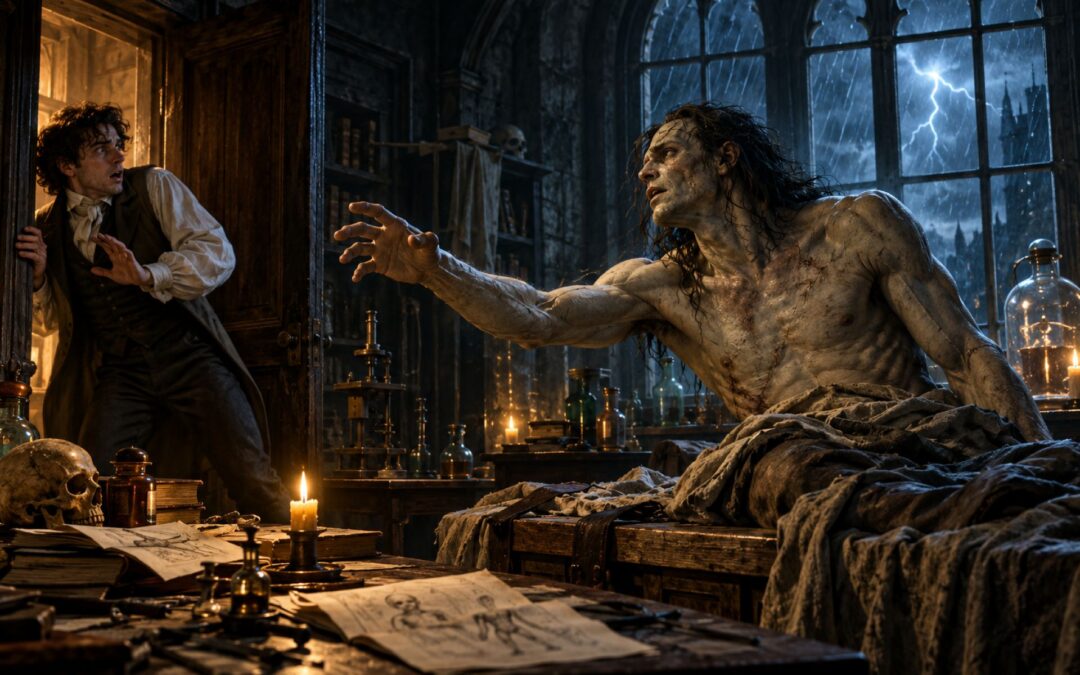
Mary Shelley’s Frankenstein; or, The Modern Prometheus, first published in 1818, tells the story of a scientist who discovers how to create life and becomes horrified by the being he brings into existence. Victor Frankenstein abandons his creation, leaving it to discover the world without guidance, companionship, or protection. What follows is a tragedy in which the Creature’s desire for acceptance gradually turns into hatred, while Victor’s refusal to confront his responsibilities destroys nearly everyone he loves.
The novel is considerably more complex than its familiar image of a mad scientist and a terrifying monster. Shelley’s Creature is intelligent, articulate, emotionally sensitive, and capable of moral reasoning. His development forces readers to reconsider the relationship between appearance and character, suffering and violence, and the obligations that arise when one person holds power over another.
Frankenstein also examines scientific ambition, education, prejudice, isolation, family relationships, revenge, and the difficulty of assigning responsibility for tragedy. Its unusual narrative structure allows Victor, the Creature, and an ambitious Arctic explorer to present competing perspectives on the same moral conflict.
This article follows Shelley’s revised 1831 edition of Frankenstein, while examining significant differences from the original 1818 publication.
Spoiler Warning: This article contains the complete plot of Frankenstein, including every major death, the final confrontation, and the ending.
Walton’s Arctic Voyage and the Stranger on the Ice
The novel begins with letters written by Robert Walton, an English explorer, to his sister Margaret Saville. Walton is preparing an expedition into the Arctic, hoping to discover a northern passage and investigate the mysteries of magnetism. He imagines that these discoveries will benefit humanity while securing his own reputation as an extraordinary explorer.
Walton has spent years preparing for the expedition. Although his formal education was limited, he has educated himself through reading, mathematics, and practical experience aboard whaling vessels. Earlier ambitions to become a poet ended in disappointment, but his desire for greatness has found a new purpose in geographical exploration.
Despite his determination, Walton feels profoundly lonely. He wishes for a friend who shares his intellectual ambitions but possesses the judgment to correct him when necessary. His officers and sailors may be courageous and capable, yet he longs for someone who understands his imagination and emotional intensity.
This desire establishes an important connection between Walton and the central characters before their stories begin. Like Victor Frankenstein, Walton pursues an exceptional achievement that may place his life and other people’s lives in danger. Like the Creature, he feels that intellectual and emotional experience is incomplete without companionship.
Walton also describes the master of his ship, a generous man who once sacrificed his own romantic hopes to ensure the happiness of a woman he loved. This apparently incidental story introduces a form of love in which someone voluntarily relinquishes a personal desire for another person’s welfare. It contrasts with the increasingly possessive and destructive relationships that dominate Victor’s history.
As the expedition travels north, the ship becomes surrounded by dangerous ice. While trapped, Walton and his crew see an enormous humanlike figure travelling across the frozen landscape on a dogsled. The stranger disappears into the distance, leaving the sailors astonished by the appearance of a human figure in such an inhospitable region.
The following day, they discover another traveller stranded on a fragment of ice. He is desperately weak, and his dogs have nearly all died. Walton rescues him, although the stranger initially wants to know the direction in which the vessel is travelling before agreeing to board.
The rescued man is Victor Frankenstein.
Victor is exhausted, emaciated, and mentally disturbed by whatever has brought him into the Arctic. Nevertheless, Walton gradually discovers that he possesses remarkable intelligence, education, and emotional sensitivity. The two men develop an attachment, and Walton begins to regard Victor as the exceptional friend he has always wanted.
Victor recognises Walton’s ambition and fears that the explorer may be approaching a disaster resembling his own. He eventually agrees to explain the circumstances that have brought him to the edge of the inhabited world.
His account becomes the central narrative of the novel.
Victor Frankenstein’s Childhood and Obsession With Creating Life
Victor Frankenstein is born into a wealthy and respected family in Geneva. His father, Alphonse Frankenstein, is a public-spirited man who marries Caroline Beaufort after helping her during a period of hardship. Their household is characterised by affection, generosity, and an idealised commitment to family life.
During Victor’s childhood, Caroline encounters a young girl named Elizabeth Lavenza living with an impoverished foster family in Italy. Struck by her beauty and circumstances, Caroline brings Elizabeth into the Frankenstein household, where she is raised as a cherished member of the family.
Victor comes to regard Elizabeth as his future companion. Although they grow up together and call each other cousins, the 1831 edition presents Elizabeth as an adopted child rather than Victor’s blood relative. Their relationship is shaped by the expectation that they will eventually marry.
Victor’s other important childhood companion is Henry Clerval, the son of a Geneva merchant. Henry is imaginative, compassionate, and fascinated by literature, adventure, languages, and heroic stories. He and Victor share intellectual curiosity but direct it toward different ends.
Elizabeth delights in nature and the beauty of the world, while Henry is drawn toward human achievement and moral action. Victor becomes increasingly preoccupied with discovering the hidden causes of natural phenomena.
As a boy, Victor encounters the writings of Cornelius Agrippa, Paracelsus, and Albertus Magnus. These older natural philosophers promise access to extraordinary knowledge, including the transformation of matter, the secrets of life, and the possibility of overcoming disease and death.
Victor’s father dismisses Agrippa’s writings as worthless without adequately explaining why. Rather than discouraging his son, the casual rejection allows Victor’s fascination to continue. He studies these authors with an intensity that combines intellectual curiosity with extravagant hopes of mastering nature.
A striking incident changes the direction of his interests. During a thunderstorm, Victor witnesses a powerful lightning strike destroy a tree near his family’s home. Someone knowledgeable about natural philosophy subsequently explains electrical phenomena to him, undermining his confidence in the older authorities.
For a time, Victor turns toward mathematics and more systematic forms of inquiry. However, his desire to penetrate nature’s deepest secrets remains unresolved.
When Victor is seventeen, his parents arrange for him to study at the University of Ingolstadt. Before he can leave, Elizabeth contracts scarlet fever. Caroline nurses her despite the danger of infection, becomes ill herself, and dies.
Caroline’s death introduces Victor to an intimate experience of mortality immediately before his scientific education begins. Her final hopes concern the family’s continued happiness and the eventual marriage of Victor and Elizabeth. The domestic world that had seemed secure now contains an absence that cannot be repaired.
Victor arrives at Ingolstadt overwhelmed by grief but eager to pursue his studies. He meets Professor Krempe, who harshly dismisses his earlier reading and considers his intellectual preparation misguided.
Victor is initially discouraged by this reception. The attitude of Professor Waldman, however, has a very different effect.
Waldman explains the achievements of modern chemistry and acknowledges the historical importance of earlier investigators while distinguishing their speculative ambitions from contemporary scientific methods. He presents science as a discipline capable of producing extraordinary discoveries through sustained observation and experimentation.
Victor is captivated. He devotes himself to chemistry and becomes increasingly determined to achieve something beyond the discoveries of his predecessors.
His interests eventually turn toward the distinction between living and dead matter. He studies anatomy, physiology, decay, and the processes through which bodies decompose. Visits to dissecting rooms and places associated with death become part of his investigation.
After prolonged research, Victor discovers what he believes to be the principle of life and learns how to animate lifeless matter.
The achievement opens possibilities that overwhelm his judgment. He imagines creating an entirely new kind of being whose existence would establish him as its originator and benefactor. The prospect of overcoming death becomes inseparable from his desire for recognition.
Victor begins assembling a human body from collected anatomical materials. Because the work of constructing delicate parts would be difficult on an ordinary human scale, he decides to make the being approximately eight feet tall.
The experiment consumes him for nearly two years. He neglects correspondence with his family, withdraws from ordinary relationships, and damages his physical and mental health through relentless work.
He recognises that his obsession has made him miserable, yet continually persuades himself that rest and happiness can wait until the experiment is completed.
By the time the being is ready for animation, Victor has achieved extraordinary technical knowledge without seriously considering how he will care for the life he is about to create.
The Creature Awakens and Victor’s Family Begins to Die
On a bleak November night, Victor finally succeeds in bringing his creation to life.
The being opens its yellow eyes, begins breathing, and moves its limbs. Instead of celebrating, Victor immediately experiences horror. The physical features he had selected with the intention of producing something beautiful appear grotesque once animated.
The Creature has lustrous black hair, pale skin, dark lips, and watery eyes. The contrast between its individually attractive features and their disturbing combination produces an appearance Victor cannot bear to confront.
The novel does not explain the animation through an elaborate electrical apparatus. Victor has discovered a method of creating life, but Shelley deliberately avoids presenting its complete mechanism.
Terrified by the result, Victor flees from his laboratory and wanders through his rooms, unable to sleep. When exhaustion finally overcomes him, he dreams that he embraces Elizabeth, only for her body to transform into that of his dead mother.
The nightmare brings together love, creation, death, and bodily corruption. Victor awakens to find the Creature standing near his bed, apparently attempting to approach or communicate with him.
Victor flees again.
The being has entered the world without language, knowledge, guidance, or any understanding of why the person responsible for its existence has abandoned it.
The next morning, Victor encounters Henry Clerval, who has arrived in Ingolstadt to pursue his own intellectual interests. Henry’s familiar presence briefly restores Victor’s spirits, but when they return to his rooms, Victor becomes terrified that the Creature may still be there.
Finding the apartment empty, he is overcome by nervous excitement and subsequently falls seriously ill.
Henry nurses him through months of physical and psychological distress. Victor’s recovery depends on the friendship and patient care he had neglected during his experiment.
When Victor finally becomes well enough to resume ordinary life, he refuses to discuss his scientific work. The memory of the experiment produces such revulsion that he abandons his earlier interests in natural philosophy and turns toward languages and literature alongside Henry.
A letter from Elizabeth describes life in Geneva and expresses concern about his long absence. It also recounts the history of Justine Moritz, a young woman who has lived with the Frankenstein family and is deeply attached to them.
Justine’s childhood was difficult, especially because of her mother’s treatment of her. Caroline Frankenstein had shown her kindness, and after Caroline’s death, Justine remained connected to the household. She has become a trusted and affectionate presence among its members.
Victor gradually regains his health through Henry’s companionship, outdoor excursions, and the natural world. For a time, he appears capable of returning to the happiness that existed before his scientific obsession.
Then a letter arrives from his father announcing that William, Victor’s youngest brother, has been murdered.
William disappeared during an outing near Geneva and was later found strangled. The family is devastated, and Victor immediately prepares to return home.
Arriving near Geneva at night, Victor visits the area where the murder occurred. A thunderstorm breaks over the landscape, and during a flash of lightning he sees the enormous figure of his creation moving among the mountains.
Victor becomes convinced that the Creature killed William.
This discovery transforms the meaning of his scientific achievement. The being he abandoned has apparently become a murderer, and Victor fears that his experiment will bring further suffering to innocent people.
When he reaches home, he learns that Justine Moritz has been arrested for the crime.
A miniature portrait of Caroline, which William had been carrying, was discovered among Justine’s possessions. The portrait provides circumstantial evidence against her, although the family members who know her best struggle to believe she could have committed such an act.
Victor believes that the Creature is responsible, yet he does not reveal what he knows. He fears that an account of his experiment would be dismissed as madness, and his own shame makes disclosure almost unthinkable.
Justine is placed on trial.
Elizabeth speaks passionately in her defence, describing her generosity and trustworthy character. Nevertheless, the suspicious circumstances and Justine’s own confession contribute to a guilty verdict.
The confession is false.
After the trial, Justine explains that a religious adviser pressured her into confessing, warning her of spiritual consequences if she continued to deny the accusation. Frightened and isolated, she admitted to a crime she had not committed.
Justine is executed.
Victor is devastated by guilt. He believes that his creation has caused William’s death and Justine’s execution, making him indirectly responsible for both.
Yet his silence has also contributed to the injustice. Although revealing his extraordinary account might not have saved Justine, he never makes a serious attempt to provide the authorities with the information he possesses.
Elizabeth mourns the loss of someone she loved and struggles with the revelation that an innocent person could be condemned by the justice system.
Victor’s family suffers from crimes whose causes remain hidden from them. The distance between his private knowledge and their understanding deepens his isolation.
By the end of this stage, two innocent people are dead, the Creature has disappeared, and Victor has begun to understand that his experiment cannot be separated from its consequences.
The Creature Learns to Live, Speak, and Judge Humanity
Following William’s murder and Justine’s execution, Victor sinks into despair. He withdraws from his family emotionally and contemplates death, although his sense of obligation toward those who remain prevents him from acting on his darkest thoughts.
Seeking relief, he travels into the Alpine landscape near Chamounix. The mountains, glaciers, and vast natural formations temporarily distract him from his guilt.
During an excursion toward Montanvert, Victor sees the Creature approaching across the glacier with extraordinary speed.
Victor reacts with hatred and threatens to destroy him. The Creature, however, refuses to accept condemnation without being heard. He reminds Victor that his existence is the consequence of Victor’s own actions and argues that a creator owes duties to the being he creates.
He asks Victor to listen to his history before deciding whether he deserves compassion.
Victor reluctantly agrees, and the Creature begins his account.
The story returns to the night of animation, but the events are now described from the perspective of the abandoned being.
Initially, the Creature experiences the world through confused sensations. Light, darkness, temperature, hunger, sounds, and physical discomfort arrive without names or explanations.
He does not understand his own body or the environment around him. He learns through instinct and repeated experience, discovering how to move, seek shelter, and satisfy his immediate needs.
After leaving Victor’s rooms, he wanders into the countryside. He discovers that berries and other natural foods can satisfy his hunger and that water can relieve his thirst.
Cold weather causes suffering, while sunlight brings warmth. When he discovers an abandoned fire, he learns that flames can provide comfort but also inflict pain.
His earliest experiences involve the gradual discovery of physical cause and effect. He does not initially possess a developed moral outlook, a coherent sense of identity, or any understanding of society.
Eventually, the Creature approaches human settlements.
His appearance immediately provokes fear. Some people flee, while others attack him. Confused and frightened, he retreats into the countryside, discovering that contact with human beings can be dangerous.
He eventually finds a sheltered space attached to a small cottage. From this hiding place, he can observe the inhabitants without being seen.
The cottage is occupied by an elderly blind man named De Lacey and his children, Felix and Agatha.
At first, the Creature does not understand their conversations or the relationships between them. He notices, however, that they share food, work for one another, and express affection through gestures and speech.
Their poverty becomes increasingly apparent. Felix and Agatha frequently surrender portions of their meals to their father, and the Creature observes their sadness when circumstances become difficult.
Having initially taken food from their supplies, he realises that his actions worsen their suffering. He stops stealing from them and begins gathering firewood secretly to reduce their workload.
These small acts reveal his capacity for sympathy before he fully understands human language.
The Creature becomes emotionally attached to the family. Their domestic affection offers him a model of existence very different from the loneliness he has experienced.
As the months pass, he learns to associate spoken sounds with objects, actions, and emotions. His understanding gradually develops from isolated words into more complex speech.
He also learns about relationships through observation. The De Laceys’ concern for one another teaches him the importance of companionship, care, and mutual dependence.
When a young woman named Safie arrives, the Creature’s education advances dramatically.
Safie is reunited with Felix, whom she loves. She does not yet speak French fluently, so Felix begins giving her language lessons. Hidden nearby, the Creature learns alongside her.
Through these lessons, he discovers increasingly complicated features of human society. He learns about countries, political institutions, historical conflicts, wealth, poverty, social rank, and the differences between human communities.
The education is painful as well as enlightening.
He realises that people derive status from ancestry, property, education, and recognised social relationships. He possesses none of these advantages.
He has no known family, no accepted identity, no property, and no place within the communities whose language he is learning.
His growing intelligence therefore produces a sharper awareness of exclusion.
The Creature also learns the history of the De Lacey family’s misfortunes.
The family once lived comfortably in Paris. Felix became involved in the case of a Turkish merchant who had been imprisoned and condemned by the French authorities.
Believing the punishment unjust, Felix helped the merchant escape. During these events, he fell in love with the man’s daughter, Safie.
The merchant promised that Felix could marry Safie, but he intended to escape with her and prevent the union. His opposition was connected partly to religious and cultural differences and partly to his determination to control his daughter’s future.
Safie’s mother had been a Christian Arab woman who taught her daughter to value intellectual independence and the possibility of exercising greater freedom. Safie therefore resisted her father’s demands.
Felix’s involvement in the escape led to punishment for the De Laceys. Their property was confiscated, and they were forced into exile and poverty.
Safie eventually made her way to the family’s cottage, where her arrival brought happiness after prolonged hardship.
For the Creature, this history expands the world beyond the small household he observes. He learns that people can act courageously in opposition to injustice, but he also discovers that political and religious identities can divide communities and determine individual opportunities.
Meanwhile, his attachment to the De Laceys becomes increasingly personal.
He begins imagining that they might accept him if they could recognise his intelligence and benevolence. His experiences with other humans have taught him to fear the reaction his appearance produces, but the family’s apparent goodness encourages him to hope that their response might be different.
During this period, he discovers a collection of books.
Among them are Goethe’s The Sorrows of Young Werther, Plutarch’s Lives, and Milton’s Paradise Lost.
Each work contributes something different to his developing understanding.
The Sorrows of Young Werther introduces him to intense emotional suffering, love, and despair. Plutarch’s biographies expose him to public life, political virtue, ambition, leadership, and violence. Paradise Lost gives him a framework for interpreting his own existence through the relationship between a creator and a created being.
He initially identifies with Adam because both come into existence without ordinary parents. Yet Adam receives care and companionship from his creator, whereas the Creature has been abandoned.
He also recognises similarities between himself and Satan, particularly when he experiences resentment at the happiness of others.
The Creature’s education is therefore simultaneously intellectual and emotional. Literature provides him with language for feelings he previously could not articulate, but it also makes the gulf between his desires and circumstances more painful.
Another discovery deepens his anguish.
Among the clothes he took when leaving Victor’s laboratory, the Creature finds Victor’s journal. It contains records of the experiment and the scientist’s disgust at the being he has created.
He learns that even the person responsible for his existence considered him repulsive.
This discovery affects his understanding of himself. Until then, the Creature has struggled to explain why humans flee from him. Victor’s account confirms that his appearance inspires revulsion even in the person who knew how he was made.
Eventually, he decides to approach the De Laceys.
He waits until Felix, Agatha, and Safie have left the cottage, then enters and begins speaking to the blind father.
Because De Lacey cannot see him, the Creature hopes that his words and emotions will matter more than his appearance. He describes himself as a lonely stranger seeking friendship and gradually appeals to the old man’s compassion.
De Lacey responds sympathetically. He cannot promise what others will do, but he expresses a willingness to help someone who appears sincere and unfortunate.
For a brief moment, the Creature seems close to achieving the acceptance he has wanted throughout his existence.
Then the others return.
Agatha faints, Safie flees, and Felix attacks the Creature. The old man’s inability to see has allowed him to respond to the visitor’s humanity, but the sighted members of the family immediately interpret his appearance as a threat.
The Creature has the physical strength to retaliate, yet he does not attack Felix. Overwhelmed by grief and disappointment, he escapes.
The encounter destroys his hope that intelligence, kindness, and eloquence will be sufficient to overcome the fear his body produces.
His long education has taught him how people live together, but it has not secured him a place among them.
Rejection Turns the Creature Toward Revenge
After fleeing the cottage, the Creature struggles with despair and anger. He initially considers returning to the De Laceys, hoping that the old man’s sympathy might eventually influence the others.
When he discovers that the family has abandoned the cottage, that possibility disappears. The people he regarded as his friends have left without knowing the full extent of his attachment to them.
His suffering begins to change into hostility toward humanity.
In a fit of rage, he sets fire to the cottage. The act marks a significant departure from the earlier Creature who secretly gathered wood to relieve the family’s hardship.
He now destroys the place that had provided the foundation of his education and emotional hopes.
The Creature decides to seek Victor, believing that his creator is responsible for his loneliness. Using information obtained from Victor’s papers, he makes his way toward Geneva.
During the journey, he encounters a young girl who falls into a river. He rescues her from drowning, carrying her to safety.
A man arriving at the scene assumes that the Creature intends to harm the child and shoots him.
The experience reinforces his belief that even acts of kindness will be interpreted as evil because of his appearance.
The Creature survives the injury, but his anger increases. He begins to regard hostility toward humanity as a response to a world that has refused him recognition.
Near Geneva, he encounters a young boy and imagines that a child might be too young to have developed the prejudices of adults. He decides to seize the opportunity to obtain a companion whom he might educate or influence.
Instead, the boy reacts with fear and insults him.
The Creature discovers that the child is William Frankenstein, Victor’s younger brother.
Recognising the connection to his creator, the Creature strangles William.
The murder is deliberate. William has done nothing that justifies the punishment, and his connection to Victor is the very reason the Creature targets him.
Afterward, the Creature discovers a miniature portrait on William’s body. He places it in the clothing of a sleeping young woman, later revealed to be Justine Moritz, thereby creating the evidence that leads to her conviction.
The murder and the framing of Justine demonstrate that the Creature has moved beyond impulsive expressions of rage. He is capable of planning actions that inflict suffering on people who have not personally harmed him.
When he finishes recounting his experiences, he presents Victor with a demand.
He wants Victor to create a female being like himself.
The Creature argues that his misery arises from isolation and that a companion sharing his physical condition could offer the understanding denied to him by humanity.
He proposes that the two beings will withdraw to an uninhabited region, living apart from human society. He promises that if Victor grants his request, they will cease troubling humanity.
Victor initially refuses. He is horrified by the prospect of creating another being capable of committing violence, and he regards the Creature’s murders as proof of his dangerous character.
The Creature responds that his conduct has been shaped by suffering and rejection. He insists that happiness and companionship might allow him to recover the benevolence he once possessed.
Victor is disturbed by this argument because he recognises some justice in it.
He remembers that he abandoned the Creature immediately after giving him life. He also understands that the being has suffered without receiving guidance or affection.
At the same time, the Creature’s history provides evidence of his willingness to harm innocent people.
After extended argument, Victor agrees to create the companion.
The promise temporarily establishes a possibility of reconciliation, although neither character fully trusts the other. The Creature departs, warning Victor that he will observe his progress.
The agreement also changes the nature of Victor’s dilemma. His original experiment was driven by ambition; the second will be performed under fear, coercion, and the hope of preventing further violence.
The Abandoned Second Creation and the Death of Henry Clerval
Victor returns to his family carrying the burden of his promise. He knows that the Creature expects him to create a female companion, but he cannot bring himself to begin the work.
His father notices his unhappiness and believes that the forthcoming marriage to Elizabeth may be a source of anxiety. He wonders whether Victor loves someone else or feels reluctant to fulfil the family’s expectations.
Victor assures him of his affection for Elizabeth, but he cannot explain the real cause of his distress.
He is unwilling to marry while the Creature’s demand remains unfulfilled. He fears that breaking his promise will place his family in danger, yet the thought of repeating the experiment fills him with disgust.
Victor eventually decides that he must travel to Britain to gather information relevant to the second creation.
His father agrees to the journey and arranges for Henry Clerval to accompany him.
The two friends travel through Europe, eventually reaching England. Henry eagerly explores the places they visit, taking pleasure in landscapes, history, languages, and the people he encounters.
Victor experiences the same journey very differently.
He remains preoccupied with the Creature’s demand and the possibility of another disaster. Although Henry’s companionship offers occasional relief, Victor cannot escape the feeling that his scientific obligation follows him everywhere.
Their travels take them through England and into Scotland. Victor eventually separates from Henry, who continues exploring, while Victor retreats to a remote island in the Orkneys.
The island offers the isolation necessary for his work. Its sparse population, harsh landscape, and distance from familiar society reflect the emotional condition into which Victor has descended.
He establishes a laboratory and begins constructing the promised female.
However, the work increasingly troubles him.
Unlike his original experiment, which he performed with little serious consideration of future consequences, Victor now imagines several possible outcomes.
The female might possess a temperament very different from the original Creature’s. She might reject him, refuse to participate in the promised withdrawal from humanity, or become equally hostile toward human beings.
Victor also recognises that he has promised the original Creature a companion without considering the independent desires of the being he proposes to create.
The female would not necessarily feel affection for the Creature merely because Victor intended her to fulfil that purpose.
An additional possibility horrifies him: the two beings might reproduce, potentially establishing a population capable of endangering humanity.
These fears are speculative, but they profoundly affect Victor’s judgment.
One evening, while working, he sees the original Creature watching him through the laboratory window.
The sight convinces Victor that he cannot proceed.
Before the Creature’s eyes, Victor tears apart the unfinished female.
The Creature reacts with furious disappointment. He accuses Victor of destroying his only chance of happiness and threatens further revenge.
Most ominously, he promises to be with Victor on his wedding night.
Victor interprets the threat as a declaration that the Creature intends to kill him when he marries Elizabeth.
After the Creature departs, Victor destroys the remaining evidence of the second experiment. He carries the unfinished body’s remains out to sea in a boat and disposes of them.
Exhausted, he falls asleep while drifting on the water. When he awakens, he has been carried away from the island and struggles against dangerous conditions before reaching the Irish coast.
Instead of receiving assistance, Victor finds himself treated with suspicion.
A man has been discovered murdered, and local authorities believe Victor may be connected to the crime. He is brought before Magistrate Kirwin, who questions him and arranges for him to see the body.
The dead man is Henry Clerval.
Henry has been strangled, and the marks on his throat resemble those found on William.
Victor immediately understands that the Creature has murdered his closest friend.
The discovery overwhelms him. He collapses and develops a severe illness, spending weeks in a state of physical weakness and psychological torment.
Magistrate Kirwin treats him with considerable humanity. Although Victor is initially suspected of murder, the evidence does not establish his guilt. His presence elsewhere at the relevant time eventually leads to his release.
Victor’s father travels to Ireland after learning of his son’s condition.
The reunion brings temporary comfort, but Victor cannot escape the knowledge that Henry has died because of the conflict between himself and the Creature.
Henry had represented the possibility of intellectual development without consuming obsession. His curiosity was directed toward human experience, culture, and relationships rather than domination over nature.
His death also demonstrates how effectively the Creature can exploit Victor’s emotional attachments.
The conflict no longer concerns only the original creator and creation. Their struggle has become a series of attacks on people whose connection to Victor makes them vulnerable.
Elizabeth’s Murder and Victor’s Pursuit Across the World
After his release, Victor returns toward Geneva with his father. His health remains fragile, and he repeatedly struggles with memories of Henry’s murder.
Elizabeth writes to him expressing concern about their approaching marriage. She wonders whether his unhappiness reflects a lack of affection for her and suggests that he should not feel compelled to marry if his feelings have changed.
Victor reassures her that he loves her.
Nevertheless, he remains haunted by the Creature’s threat concerning their wedding night.
He believes that the Creature intends to kill him and resolves to defend himself when the moment arrives. He makes preparations for a confrontation but does not explain the danger clearly to Elizabeth.
Victor’s interpretation is tragically mistaken.
He thinks primarily about his own possible death, despite the Creature’s established willingness to attack people close to him.
Victor and Elizabeth are married and travel to an inn near Lake Geneva for their wedding night.
As evening approaches, Victor becomes increasingly anxious. He carries a pistol and searches the surrounding area, expecting the Creature to appear.
Believing that Elizabeth will be safer away from the confrontation, he sends her to their room while he continues looking for his enemy.
He then hears a scream.
Rushing back, he discovers Elizabeth’s lifeless body.
The Creature has murdered her while Victor was preparing to defend himself.
Victor briefly sees the Creature outside, appearing to take pleasure in his suffering, but his attempt to pursue him fails.
Elizabeth’s death destroys the future Victor’s family had anticipated throughout his childhood. She had been the person most closely associated with the household’s hopes of stability, affection, and continuity.
Victor’s father is devastated by the news. Already weakened by earlier tragedies, he soon dies from grief.
Victor is now almost entirely alone.
His brother William, his friend Henry, his intended wife Elizabeth, and his father are dead. Justine has been executed for a crime committed by the Creature.
Victor’s secrecy, repeated misjudgments, and inability to control his creation have contributed to a chain of irreversible losses.
Overwhelmed by grief and rage, Victor resolves to destroy the Creature.
He approaches a magistrate and recounts the circumstances of the crimes. The official listens but struggles to believe that an extraordinary being possesses the strength and abilities Victor describes.
Even if the account is true, the magistrate doubts that ordinary authorities could capture such a creature.
Victor leaves convinced that legal institutions cannot provide the justice he seeks.
His remaining purpose becomes revenge.
He visits the graves of his dead family members and swears to pursue the Creature until one of them is destroyed. The Creature, apparently nearby, hears the declaration and responds with mocking satisfaction.
A prolonged chase begins.
Victor follows the Creature through Europe and across distant regions, eventually travelling into the frozen expanses of the north.
The Creature repeatedly evades capture. At times he leaves clues that allow Victor to follow him; on other occasions, he provides food or messages that encourage the pursuit to continue.
The chase has become a cruel relationship of dependence. Victor lives to destroy the Creature, while the Creature prolongs Victor’s suffering by ensuring that the pursuit continues.
Eventually, the Creature travels across the Arctic ice on a dogsled.
Victor follows, nearly catching him before the ice breaks apart and separates them.
Stranded on a fragment of ice with his strength almost exhausted, Victor sees Walton’s ship.
He struggles toward the vessel and is rescued.
The story has returned to the moment with which the novel began.
Walton’s Final Choice and the Creature’s Farewell
After hearing Victor’s story, Walton remains deeply affected by his intelligence, suffering, and apparent greatness. He regards Victor as a man of extraordinary ability whose life has been destroyed by circumstances inseparable from his own ambitions.
Walton also learns that Victor’s conflict with the Creature remains unresolved.
Victor hopes that Walton might continue the pursuit if he dies. He warns the explorer not to trust the Creature’s eloquence, arguing that the being’s ability to arouse sympathy makes him especially dangerous.
Meanwhile, Walton’s own expedition reaches a crisis.
The ship remains trapped in ice, and the crew fears that continued exploration will result in their deaths. The sailors demand that Walton promise to return south when conditions permit.
Victor responds by urging them not to abandon their ambitions because of danger. His speech appeals to courage, honour, and the glory of overcoming extraordinary obstacles.
Despite his suffering, Victor still struggles to relinquish the ideal of heroic achievement.
Walton eventually agrees to return if the ice releases the ship.
He feels humiliated by the apparent failure of his expedition, but he recognises that he cannot compel his sailors to continue risking their lives against their will.
When the ice breaks, the ship begins its journey home.
Victor, who remains determined to destroy the Creature, attempts to rise from his sickbed but is too weak to continue.
As death approaches, he reflects on his conduct. He acknowledges that creating a rational being imposed obligations on him, including responsibility for its welfare.
However, he continues to defend his refusal to create the female companion, believing that the danger to humanity outweighed his obligation to the original Creature.
He also remains convinced that the Creature should be destroyed.
Victor’s final thoughts contain unresolved contradictions. He warns Walton against ambition while recognising that another person might succeed where he failed. He acknowledges a duty toward his creation while insisting that destroying it has become morally necessary.
Victor dies aboard the ship.
Later, Walton hears a strange voice coming from the room where Victor’s body lies.
Entering, he discovers the Creature standing over his creator.
The being is overcome by grief and speaks of the terrible crimes he has committed. He acknowledges that his revenge brought him no happiness and that the suffering he inflicted cannot be undone.
Walton initially responds with anger, accusing him of hypocrisy for mourning someone he deliberately destroyed.
The Creature does not deny his responsibility. Instead, he explains that his hatred emerged from suffering and that each act of revenge intensified his misery.
He describes the corruption of feelings that were once directed toward goodness, beauty, affection, and companionship.
With Victor dead, the Creature declares that he has no remaining purpose.
He announces his intention to travel farther north, construct a funeral pyre, and destroy himself.
The Creature then departs through the cabin window onto an ice raft and disappears into the darkness.
The novel ends without showing his death.
Victor’s pursuit has failed, the Creature’s future remains unwitnessed, and Walton returns toward the human world carrying the story of their mutual destruction.
A World of Laboratories, Homes, Mountains, and Ice
The settings of Frankenstein are essential to its psychological and philosophical concerns. Shelley moves between domestic spaces, centres of scientific learning, isolated landscapes, and extreme wilderness, using each environment to reveal different aspects of the characters’ lives.
Geneva represents Victor’s original experience of security. His family enjoys wealth, education, social respectability, and considerable freedom from material hardship. The Frankenstein household initially appears to embody the virtues of mutual affection and moral responsibility.
Nevertheless, its protection proves fragile. Caroline’s death demonstrates the vulnerability of even a privileged family, while Justine’s trial reveals that respectable social institutions can produce devastating injustice.
The family also possesses expectations that limit individual choices. Elizabeth is repeatedly imagined as Victor’s future wife, while Victor’s father interprets his distress through the conventional concerns of marriage, health, and domestic stability.
Ingolstadt represents another kind of environment: the institutional pursuit of knowledge.
The university gives Victor access to scientific methods and intellectual encouragement that his earlier reading could not provide. Yet his most consequential work occurs through secrecy and isolation rather than meaningful collaboration with teachers or colleagues.
Science itself is not portrayed as a coherent institution conspiring against humanity. Victor makes the decisive choices that transform his research into a private obsession.
The scientific setting also reflects the intellectual environment in which Shelley wrote. Investigations into electricity, physiology, chemistry, and the mechanisms of life encouraged speculation about whether the boundaries between living and dead matter were fully understood.
The MIT Press edition annotated for scientists, engineers, and creators places the novel within these questions about scientific creativity and responsibility. Its continuing relevance depends less on whether Victor’s experiment resembles a real laboratory procedure than on the consequences of creating something whose existence changes other people’s lives.
The De Lacey cottage forms a contrasting environment.
Its inhabitants possess little material wealth, yet their relationships demonstrate affection, mutual dependence, and generosity. The Creature learns most of his moral vocabulary by observing how they care for one another.
The cottage appears to offer an alternative to Victor’s solitary pursuit of greatness. Its eventual rejection of the Creature, however, reveals that domestic goodness does not necessarily extend to strangers whose appearance provokes fear.
The Alpine landscape provides another form of emotional experience.
Victor repeatedly seeks relief in mountains, lakes, valleys, and glaciers. Their scale and beauty temporarily displace his obsessive attention to personal suffering.
These descriptions belong to the Romantic tradition of the sublime, in which natural greatness inspires awe through a combination of beauty, power, and human insignificance.
Nature can calm Victor, but it cannot resolve the consequences of his decisions. The meeting with the Creature on the glacier demonstrates that even the most magnificent landscape offers no permanent escape from moral responsibility.
The Orkney island transforms isolation into something oppressive.
Victor works in a desolate environment far from the sustaining relationships that might challenge his judgment. The loneliness of the setting mirrors the secrecy and dread surrounding the second creation.
Finally, the Arctic brings the novel’s central conflicts into an environment where individual ambition becomes a threat to survival.
Walton’s desire for discovery, Victor’s pursuit of revenge, and the Creature’s flight all converge in a landscape indifferent to their personal purposes.
The ice prevents movement, destroys certainty, and makes the limits of human control physically unavoidable.
Victor Frankenstein and the Consequences of Concealment
Victor Frankenstein is neither an uncomplicated villain nor a heroic scientist destroyed solely by bad luck. He possesses genuine intellectual ability, strong affections, and a capacity for suffering, but his judgments repeatedly favour immediate emotional relief over sustained responsibility.
His childhood provides advantages that the Creature never receives. Victor grows up surrounded by affection, security, education, and opportunities for intellectual development.
These privileges make his later isolation partly self-imposed.
When he begins his experiment, Victor does not initially act from hatred or a desire to injure anyone. He believes that overcoming mortality would constitute an extraordinary achievement, and he imagines that a newly created race might honour him as its originator.
His ambition nevertheless contains an important contradiction.
He wishes to create life and receive recognition for doing so, but he gives little attention to the lived experience of the being he hopes to produce.
Victor treats the experiment primarily as a technical and intellectual challenge. Questions about education, companionship, emotional development, and long-term care remain almost entirely outside his planning.
When the Creature awakens, Victor’s immediate response is governed by disgust.
The appearance of his creation overwhelms whatever responsibilities he might have anticipated. Rather than attempting communication or observing the being’s behaviour, he runs away.
His failure is especially striking because he understands the importance of affection and care through his own upbringing.
He has experienced a nurturing family and knows how much companionship contributes to happiness. Yet he does not extend those principles to the life for which he has become responsible.
After abandoning the Creature, Victor begins constructing a private division between his moral intentions and the consequences of his actions.
He repeatedly describes himself as guilty of the deaths that follow, but his guilt does not consistently produce decisions that protect others.
Justine’s trial offers the clearest early example.
Victor believes she is innocent and knows of an extraordinary suspect whom the authorities have never encountered. He remains silent because disclosure would expose him to disbelief and potentially reveal the shameful experiment.
His fear is understandable, but the stakes are exceptionally high. Another person’s life is in immediate danger.
Even after Justine’s execution, Victor largely responds through private torment.
This pattern continues when the Creature demands a companion.
Victor can see a legitimate moral concern in the request, yet he accepts an arrangement whose conditions he has not fully considered. When his fears change, he destroys the second creation without securing any means of protecting those whom the Creature may retaliate against.
The decision to destroy the female cannot be dismissed as irrational. Victor raises serious questions about creating an independent being who might not share the promises made on her behalf.
However, the violence that follows is inseparable from his earlier decisions and his failure to anticipate their possible consequences.
His conduct before Elizabeth’s murder illustrates the same pattern.
Victor knows that the Creature targets his loved ones, but he interprets the wedding-night threat primarily as a danger to himself. Rather than explain the situation to Elizabeth and reconsider the wedding, he prepares for an individual confrontation.
He repeatedly assumes that his own understanding of the conflict is sufficient.
Victor’s narration also reveals a tendency to interpret events through fate and irresistible forces.
He frequently describes his life as though destiny directed him toward ruin. Such language communicates the intensity of his suffering, but it can also obscure the choices through which his situation develops.
He chooses to pursue the experiment, abandon the Creature, conceal his knowledge, promise the second creation, and keep Elizabeth uninformed.
The novel does not require readers to deny the pressures acting upon Victor. It does require attention to how often his explanations reduce his own sense of agency.
By the Arctic conclusion, Victor recognises that he owed duties to his creation. Yet he continues to insist that destroying the Creature is justified and tries to extend that obligation to Walton.
His tragedy lies partly in this inability to arrive at an understanding of responsibility that fully escapes his own emotional position.
He is capable of acknowledging wrongdoing without consistently separating justice from revenge.
The Creature’s Mind, Moral Choices, and Changing Identity
The Creature is the novel’s most complicated moral and psychological creation. He begins without language, social knowledge, or experience of human institutions, yet gradually develops a sophisticated understanding of emotion, history, literature, and ethics.
His development allows Shelley to examine the relationship between innate capacities and acquired behaviour.
The Creature initially demonstrates curiosity, responsiveness to beauty, and the ability to experience pleasure and suffering. Nothing in his earliest actions suggests that he possesses an unavoidable desire to kill or destroy.
His encounter with the De Laceys develops these capacities further.
He observes their poverty and responds with practical generosity. He becomes emotionally affected by their suffering and voluntarily changes his behaviour to avoid harming them.
These actions matter because they precede the series of violent crimes that dominate the later narrative.
The Creature is not presented as morally incapable of kindness. He possesses the ability to recognise other people’s needs and alter his conduct accordingly.
His education also produces a sense of justice.
Through language, he discovers distinctions between benevolence and cruelty, virtue and vice, oppression and freedom. Literature introduces him to different models of human conduct, from the emotional despair of Werther to the public achievements of historical leaders.
Yet his expanding understanding intensifies his loneliness.
Before learning about human relationships, he suffers because he is cold, hungry, and rejected. After learning about them, he suffers because he understands precisely what he lacks.
He has no parents, recognised ancestry, property, social position, or accepted community.
His body becomes the visible condition that prevents him from accessing the relationships he has learned to value.
The Creature’s identity is also shaped by the ways other people describe him.
Victor regards him with horror from the first moment of animation. Villagers respond with violence, and the De Laceys flee when they see him.
The Creature internalises these responses, gradually understanding himself through the revulsion he encounters.
His discovery of Victor’s journal is particularly damaging because it exposes the rejection of the one person who could have explained his origin.
He comes to see himself as a being whom his own creator found intolerable.
Nevertheless, social rejection does not eliminate his capacity for deliberate choice.
His murder of William cannot be treated as an unavoidable response to suffering. William is a child who has not participated in the original abandonment.
The Creature targets him because of his relationship to Victor.
Framing Justine involves another calculated decision. He knowingly redirects suspicion toward someone who has done him no harm.
His later murder of Henry and Elizabeth continues this pattern. The victims are selected because of their significance to Victor.
The Creature therefore becomes capable of understanding both moral principles and the suffering he intentionally produces.
His actions create an important distinction between explanation and justification.
The novel provides persuasive reasons for understanding how his hatred develops. It does not establish that those reasons make murder morally acceptable.
His request for a companion expresses both a legitimate humanlike need and an attempt to control another person’s actions through threats.
The desire for companionship is understandable. His insistence that Victor must satisfy it or suffer further violence creates a coercive relationship resembling the very domination he resents.
The Creature also possesses remarkable rhetorical power.
His account is emotionally compelling, carefully organised, and supported by specific experiences. He knows how to appeal to Victor’s sense of obligation and how to frame his suffering within broader ideas about justice and creation.
Yet his eloquence should not automatically be equated with complete reliability.
He is speaking to the person whose sympathy he needs, and his account places considerable emphasis on events that explain his crimes.
His narrative can be both substantially truthful and shaped by a desire to justify himself.
The final Arctic scene reveals another transformation.
Standing over Victor’s body, the Creature acknowledges the moral degradation produced by revenge. He recognises that inflicting suffering did not repair the deprivation that originally motivated him.
His remorse is significant because it confirms that he still understands the moral standards he has violated.
At the same time, the novel leaves readers with the consequences of his actions rather than providing an easy reconciliation.
The Creature remains both a victim of profound abandonment and a perpetrator of terrible violence.
His tragedy lies in the distance between his early capacity for affection and the person he ultimately chooses to become.
Elizabeth, Henry, Justine, and the Human Cost of Victor’s Silence
The secondary characters in Frankenstein are essential to understanding the consequences of Victor’s actions. They are not merely background figures whose deaths intensify his suffering; each represents a form of relationship or responsibility that his behaviour damages.
Elizabeth Lavenza occupies a central position in the Frankenstein household.
She is affectionate, intelligent, loyal, and attentive to the happiness of others. Caroline’s adoption of Elizabeth establishes her place within the family, and the expectation of her eventual marriage to Victor becomes part of its imagined future.
Nevertheless, Elizabeth’s identity is heavily shaped by what she means to other people.
Victor repeatedly describes her through idealised qualities and associates her with beauty, consolation, and domestic security.
He regards her as someone whose affection belongs naturally within the arrangement of his life.
This idealisation limits the extent to which he recognises her independent perspective.
Elizabeth demonstrates moral judgment when she defends Justine and expresses concern about the family’s suffering. Her letter before the wedding also shows sensitivity to Victor’s possible reluctance to marry.
She offers him the opportunity to reconsider their engagement rather than demanding that he fulfil expectations.
Victor responds by reassuring her while concealing the circumstances that threaten her safety.
Her murder is especially devastating because she has been denied the information necessary to understand her own danger.
Henry Clerval provides a different contrast.
Like Victor, Henry possesses imagination and intellectual ambition. Unlike Victor, his interests remain deeply connected to literature, history, culture, friendship, and the welfare of other people.
Henry’s arrival at Ingolstadt helps Victor recover from the psychological collapse following the experiment.
He offers sustained companionship without knowing the full cause of Victor’s illness.
Their journey through Britain further develops the contrast.
Henry responds to new places through curiosity and pleasure. Victor views the same surroundings through fear and obsession.
Henry’s intellectual life expands his relationships with the world, whereas Victor’s increasingly narrows his.
Henry’s murder therefore destroys more than a cherished friendship. It eliminates one of the strongest alternative models of learning and ambition within the novel.
Justine Moritz represents another kind of vulnerability.
Although she is connected to a wealthy household, her position lacks the security enjoyed by the Frankenstein family itself.
Her background includes mistreatment by her mother, dependence on others, and limited social power.
When she is accused of William’s murder, her established goodness proves insufficient to protect her.
The trial exposes the weakness of institutions that should distinguish guilt from innocence.
The authorities rely on circumstances that appear incriminating, while Justine’s confession is influenced by religious pressure and fear.
Victor knows more about the possible offender than anyone else, but his private terror prevents him from intervening effectively.
Justine’s execution demonstrates how a wrong committed by one individual can be amplified by institutional injustice and the silence of others.
Caroline Frankenstein and Alphonse Frankenstein also shape Victor’s understanding of family responsibility.
Caroline’s compassion toward others establishes the household’s moral reputation, but her death while nursing Elizabeth shows how care can involve significant personal risk.
Alphonse represents conventional paternal affection. He repeatedly attempts to relieve Victor’s suffering and preserve the family’s happiness, yet he cannot understand the crisis his son refuses to explain.
William’s death introduces the Creature’s violence into the household and demonstrates the vulnerability of innocence.
Ernest, Victor’s surviving brother, remains less developed, although his existence prevents the family tragedy from being a literal extinction of Victor’s entire bloodline.
These characters vary greatly in psychological complexity.
Elizabeth and Henry often function as moral contrasts to Victor, while Justine’s trial carries a sharper institutional criticism.
Their relative idealisation is both a feature and a limitation of the novel.
Shelley uses them to demonstrate the value of human connection, but their opportunities to act independently are restricted by a story dominated by Victor and the Creature.
That restriction is especially important because Victor repeatedly claims to love and protect people whose lives he places in danger through concealment.
The De Laceys, Safie, and the Politics of Belonging
The De Lacey household is the Creature’s first sustained encounter with human society. Its importance extends beyond teaching him language because it provides his primary understanding of affection, obligation, inequality, and moral conduct.
The family initially appears through the Creature’s limited perspective.
He sees an elderly father, a young man, and a young woman living in poverty yet treating one another with care.
Their daily lives reveal a form of goodness expressed through ordinary behaviour rather than grand achievements.
The Creature learns that love involves sacrifice, that poverty causes suffering, and that people can experience happiness through companionship despite material hardship.
He also discovers that his actions can affect others.
His decision to stop stealing food and begin gathering firewood demonstrates the practical development of moral awareness.
The De Laceys’ own history introduces a different dimension.
Their exile results from Felix’s intervention on behalf of Safie’s father, whose punishment he considers unjust.
Felix acts from a combination of compassion and romantic attachment, but his actions lead to the family’s loss of property and social position.
Their experience demonstrates that social institutions do not always reward moral conduct.
The family is capable of recognising injustice because it has suffered injustice itself.
Nevertheless, this experience does not prevent its members from rejecting the Creature.
When Felix sees the being speaking to his blind father, he responds with immediate violence.
The contrast is crucial.
The family possesses genuine compassion, but that compassion has limits when confronted with someone whose appearance violates familiar expectations.
The blind father’s response exposes the possibility of judging the Creature through speech and behaviour rather than outward appearance.
Felix’s reaction demonstrates how quickly fear can override the very principles the family otherwise embodies.
Safie’s story adds questions of religion, nationality, gender, and individual agency.
Her father wishes to control her marriage and prevent her union with Felix. Her mother’s influence encourages her to seek a different future.
Safie acts independently by travelling to the De Laceys despite her father’s opposition.
However, the narrative’s representation of religious and cultural difference requires scrutiny.
Her independence is partly explained through a contrast between the opportunities she associates with European Christian society and the restrictions represented by her Turkish father.
That contrast reflects assumptions within the novel’s cultural environment and should not be treated as a neutral description of entire religious or national communities.
Reyam Kareem Rammahi’s scholarly discussion of Safie’s language, identity, and representation in Frankenstein examines the tension between her apparent independence and the narrative conventions through which her story is presented.
Safie’s role is also structurally important.
Her arrival makes the Creature’s language education possible because Felix must explain the language to someone who does not yet understand it.
The Creature learns from lessons intended for another outsider.
However, Safie possesses something he does not: a recognised relationship that allows her to enter the household.
She is welcomed because she belongs to Felix’s emotional history and anticipated future.
The Creature, despite his intellectual development and secret generosity, remains excluded.
The contrast makes belonging appear dependent on more than virtue.
It can also require a recognised identity, an acceptable body, and relationships that others are willing to acknowledge.
Creation, Parenthood, Ambition, and Scientific Responsibility
The central ethical problem in Frankenstein begins when Victor succeeds.
His experiment produces a living, sensitive, rational being. From that moment, the achievement creates responsibilities that Victor has neither anticipated nor prepared to fulfil.
The novel therefore separates the technical question of whether something can be created from the moral question of what obligations follow its existence.
Victor’s original ambition is not entirely selfish.
He imagines overcoming mortality and achieving discoveries that could benefit humanity. Scientific curiosity is presented as an intellectually serious activity capable of producing valuable knowledge.
However, Victor’s hopes of benefiting humanity become intertwined with personal glory.
He imagines a new race honouring him as its originator, revealing how his conception of creation centres on his own achievement.
The Creature’s eventual demand exposes a major omission in that conception.
Victor never seriously considered what his creation would need to live well.
The being requires instruction, companionship, protection, and recognition, but Victor treats its disturbing appearance as sufficient reason to withdraw from it.
This makes the relationship resemble failed parenthood.
A child ordinarily enters the world dependent on others for care and education. The Creature enters the world with an adult-sized body but possesses none of the knowledge or social understanding necessary for independent life.
His extraordinary physical strength does not remove his emotional and intellectual dependence.
Victor’s responsibility also extends beyond the Creature’s welfare.
Once the being becomes dangerous, he must consider the safety of other people.
These obligations come into conflict during the debate over creating a companion.
The Creature argues that his creator owes him a reasonable opportunity for happiness. Victor counters that creating another being might expose humanity to additional danger.
Neither concern can simply be dismissed.
The Creature’s loneliness is genuine, and Victor’s abandonment has contributed to it. Yet the original being has already demonstrated a willingness to commit murder.
Victor’s later objections raise an additional issue: the proposed female would be a person with independent desires rather than an object whose purpose could be determined entirely by someone else.
The Creature promises that she will accompany him into isolation, but she has never agreed to that arrangement.
Victor therefore faces an ethical problem he cannot solve merely by completing the experiment.
Making the female might satisfy one obligation while creating new responsibilities and risks.
Destroying her prevents those hypothetical consequences but violates the promise that has temporarily restrained the Creature’s violence.
Shelley does not provide a simple formula for resolving the conflict.
Instead, she exposes the inadequacy of a scientific ambition that treats successful creation as the end of responsibility.
Victor’s secrecy compounds the problem.
He works without meaningful consultation, refuses to explain his knowledge to those affected by it, and makes decisions whose consequences others must endure.
This distinguishes the novel’s argument from a general condemnation of knowledge.
The danger lies in a combination of extraordinary power, personal isolation, inadequate foresight, and unwillingness to acknowledge obligations.
The scientific background reinforces this interpretation.
Shelley was writing during a period of intense speculation about life, electricity, and physiological processes. Such developments encouraged questions about whether phenomena once regarded as mysterious might become accessible to experimental investigation.
Yet the novel does not describe a reproducible procedure for animation.
Victor’s discovery remains largely concealed from readers and, eventually, from Walton.
His refusal to reveal the method demonstrates his belief that the knowledge could be dangerous in the hands of another ambitious investigator.
The ethical question thus becomes inseparable from the distribution and control of knowledge.
Who should possess extraordinary capabilities, who bears responsibility for their consequences, and what happens when the creator refuses to remain accountable?
These questions help explain the novel’s continued relevance to discussions of technology and artificial life, even when the scientific mechanisms under discussion differ radically from Victor’s experiment.
Prejudice, Isolation, Gender, and the Making of Violence
The Creature’s experiences demonstrate how social responses can influence moral development. His early capacity for compassion gradually deteriorates as repeated rejection teaches him to associate human society with humiliation and suffering.
Appearance is the most immediate source of exclusion.
People respond to the Creature’s body before they understand his intentions. He is attacked, driven away, and denied opportunities to demonstrate intelligence or kindness.
His physical differences become a justification for treating him as dangerous.
Yet his early conduct repeatedly contradicts that judgment.
He learns to care for the De Laceys, avoids depriving them of food, and rescues a drowning girl.
These incidents establish the distance between how others perceive him and what he is capable of doing.
His eventual violence complicates the argument.
The Creature’s later murders appear to confirm the fears people initially expressed about him.
However, the novel has already shown that his behaviour changed through experience.
The violence cannot simply be attributed to a fixed nature that existed from the moment of animation.
This raises a question about the relationship between social treatment and individual responsibility.
The Creature becomes cruel in a world that refuses him ordinary affection, but his suffering does not eliminate his ability to distinguish right from wrong.
His murders are especially disturbing because they exploit the emotional relationships he has learned to value.
He knows that killing William, Henry, and Elizabeth will cause Victor extraordinary pain.
Isolation operates differently in Victor’s life.
Unlike the Creature, Victor initially possesses a loving family and close friendships.
He withdraws from them through ambition, secrecy, guilt, and obsessive revenge.
His isolation is therefore partly a consequence of choices made in circumstances that offered alternatives.
The Creature’s isolation begins with abandonment and social rejection, although his later actions make reconciliation increasingly difficult.
The two characters become connected through forms of loneliness that eventually consume their lives.
Gender introduces another dimension of inequality.
Women in the novel frequently provide care, affection, and emotional stability, yet they possess limited opportunities to influence the decisions that determine their futures.
Caroline dies while nursing Elizabeth. Justine suffers under a legal and religious system that fails to protect her. Elizabeth becomes the intended victim of a threat she does not understand because Victor withholds information.
Their vulnerability reflects more than the Creature’s individual violence.
It also reveals the consequences of a social order in which male ambitions and conflicts repeatedly determine women’s circumstances.
The proposed female Creature brings this issue into sharper focus.
She is imagined primarily in relation to the original Creature’s desire for companionship and Victor’s fear of her possible behaviour.
The possibility that she might exercise independent choice becomes one of Victor’s reasons for destroying her.
Because she is never completed, the narrative does not establish what she would actually have wanted or done.
Her absence nevertheless exposes the assumptions involved in treating a potential person as the solution to another person’s loneliness.
Safie represents a partial contrast because she actively resists her father’s plans and travels to join Felix.
Yet her narrative also operates within cultural assumptions that complicate any straightforward celebration of independence.
The novel’s treatment of gender is therefore neither uniformly liberating nor entirely indifferent to women’s limited agency.
It repeatedly reveals the damage caused when people are denied knowledge, recognition, or control over circumstances that shape their lives.
The same concern appears in different forms through the Creature’s exclusion, Justine’s conviction, and Elizabeth’s vulnerability.
Shelley does not claim that oppression mechanically produces violence or that suffering guarantees moral innocence.
She demonstrates how failures of recognition and responsibility create conditions in which compassion becomes harder to sustain and destructive choices become increasingly possible.
Prometheus, Paradise Lost, Fire, Ice, and Nature
The subtitle The Modern Prometheus connects Victor’s scientific ambition to the classical figure associated with bringing extraordinary power to humanity.
In the familiar Greek myth, Prometheus steals fire from the gods and suffers punishment for his transgression. Fire represents a transformative power that can benefit human beings but also carries consequences for those who challenge established limits.
Victor resembles Prometheus because he acquires a power previously inaccessible to humanity.
His discovery allows him to animate lifeless matter, but the achievement produces suffering rather than the glory he anticipated.
The parallel is not exact.
Prometheus is often associated with sacrifice for humanity’s benefit, whereas Victor’s project contains a powerful desire for personal distinction.
He is also unwilling to accept responsibility for the being his achievement produces.
The subtitle therefore invites readers to consider both the grandeur and the moral failure of his ambition.
Milton’s Paradise Lost provides an equally important framework for the Creature’s understanding of himself.
When he first reads the poem, he interprets its account of creation and rebellion as though it describes a real history.
He identifies with Adam because both are created beings who begin existence without ordinary human parents.
Yet the comparison exposes a painful difference.
Adam receives guidance, protection, and companionship from his creator. The Creature receives abandonment and disgust.
As his resentment grows, he increasingly associates himself with Satan.
Satan’s rebellion and alienation offer a language for the Creature’s bitterness toward the being responsible for his existence.
The comparison is revealing but does not establish that the Creature is identical to either figure.
He possesses aspects of Adam’s innocence and Satan’s resentment while making choices that cannot be explained entirely through either model.
The Miltonic reference also operates at the level of the novel’s textual history. The original 1818 edition opens with an epigraph from Paradise Lost questioning the creator’s right to bring a being into existence without its consent. Although this epigraph is not retained on the 1831 title page, the poem remains central within the narrative itself.
Fire develops a related but more immediate symbolism.
When the Creature first discovers fire, he experiences its comforting warmth and then learns that touching it causes pain.
The same source can nourish and injure.
This discovery anticipates the double nature of knowledge throughout the novel.
Understanding expands possibilities while also exposing individuals to new suffering.
Later, the Creature uses fire to destroy the De Lacey cottage, transforming a source of warmth and domestic comfort into an instrument of anger.
At the ending, he plans to destroy his own body through a funeral pyre.
Fire thus moves from discovery and survival to destruction and intended self-annihilation.
Light often accompanies knowledge, revelation, and aspiration. Walton imagines the Arctic as a region of extraordinary illumination, while Victor pursues the hidden principle that distinguishes life from death.
Yet illumination does not guarantee wisdom.
Victor gains knowledge without achieving the moral understanding necessary to manage its consequences.
Ice and cold operate through the opposite physical experience.
The Arctic isolates the characters, threatens survival, and reveals the limits of human control.
The Creature’s movement across frozen landscapes also reflects his exclusion from ordinary human communities.
However, nature is not consistently hostile.
The mountains and lakes surrounding Geneva repeatedly provide Victor with moments of emotional relief.
Their grandeur temporarily reduces his sense of confinement within personal suffering.
The natural world also shapes the Creature’s earliest pleasures.
Sunlight, flowing water, birdsong, and changing seasons offer him experiences of beauty before he understands human society.
The contrast between those early responses and his final withdrawal into the Arctic gives his tragedy additional force.
Books, letters, and written records form another recurring pattern.
Walton communicates through letters to his sister. Victor’s journal reveals the circumstances of the Creature’s creation. The Creature’s discovered books provide models through which he interprets humanity.
Written language preserves knowledge and enables understanding across distance, but it also introduces layers of interpretation.
Walton records Victor’s story, Victor recounts the Creature’s testimony, and the Creature constructs his identity partly through books written by people who could never have imagined his existence.
The novel’s symbols therefore work through the same tension that governs its plot.
The powers that make understanding, creation, and companionship possible can also produce suffering when their consequences are misunderstood or ignored.
Why the Three Narrators Cannot Be Taken at Face Value
Frankenstein is constructed through a series of nested narratives rather than a single continuous account delivered by an all-knowing narrator.
Robert Walton writes letters to his sister. Within those letters, he records Victor Frankenstein’s history. Inside Victor’s story, the Creature delivers an extended account of his own experiences.
The reader therefore encounters the central conflict through successive acts of testimony.
This structure matters because none of the narrators can be treated as an entirely neutral observer.
Walton admires extraordinary achievement and seeks a friend who shares his aspirations.
When he encounters Victor, he is predisposed to recognise greatness in the suffering scientist.
His description of Victor emphasises intelligence, dignity, emotional depth, and the tragedy of unrealised potential.
Walton’s admiration does not make his account false, but it influences the emotional position from which the story is presented.
Victor’s narration is similarly shaped by personal interests.
He wants Walton to understand the dangers of ambition, but he also wishes to explain the catastrophe that has destroyed his family.
His account repeatedly emphasises guilt, suffering, fate, and the extraordinary powers of the Creature.
These elements may be sincere without providing a complete moral explanation.
For example, Victor often describes himself as responsible for the deaths of his loved ones, yet his narrative can shift toward portraying himself as the helpless victim of circumstances beyond his control.
The reader must distinguish his self-accusation from a sustained understanding of the choices that produced harm.
The Creature’s testimony creates another interpretive challenge.
His narrative is unusually eloquent and emotionally persuasive.
He describes early innocence, acts of generosity, education, repeated rejection, and the gradual transformation of his feelings.
These experiences make his suffering intelligible and allow readers to recognise humanity in a character introduced through horror.
However, the Creature is speaking to Victor while demanding a companion.
He has a clear reason to emphasise circumstances that support his claim to sympathy.
His account also contains deliberate violence that he attempts to explain through the treatment he has received.
The novel asks readers to consider his testimony seriously without treating his conclusions as automatically justified.
The layers of narration become especially significant because the Creature’s voice reaches Walton through Victor.
The account we read has passed through the perspective of a man who regards the Creature as his enemy.
Walton also reports that Victor examines and corrects parts of the written record.
The resulting narrative appears carefully preserved, but it is still mediated through people with emotional and moral investments in its meaning.
This arrangement creates a productive uncertainty.
Readers receive several perspectives on responsibility without being offered a completely detached authority who resolves their disagreements.
The technique also changes how the Creature is perceived.
At first, he appears as an enormous figure travelling across the ice, followed by Victor’s description of an appalling scientific failure.
Only much later does he receive the opportunity to explain his own history.
By delaying that account, Shelley allows readers to experience the movement from fear toward understanding.
The Creature’s intelligence becomes a major revelation because his initial appearance and Victor’s reaction have encouraged different expectations.
The novel’s prose belongs to the emotionally intense literary culture of Romanticism and Gothic fiction.
Victor frequently describes his suffering through dramatic language, extreme emotional states, and images of natural grandeur.
His experiences include illness, nightmares, guilt, supernatural-seeming encounters, and obsessive pursuit.
These features generate Gothic horror even though the central extraordinary event is framed through scientific investigation rather than traditional magic.
The novel also draws suspense from concealment.
Victor’s refusal to reveal his experiment leaves other characters unaware of the danger surrounding them. The Creature’s threat concerning the wedding night creates uncertainty because Victor interprets it incorrectly.
The reader’s understanding often depends on recognising what a narrator fails to consider.
Shelley therefore uses narrative structure to make interpretation part of the reading experience.
The story concerns the danger of judging others through incomplete knowledge, while its form repeatedly requires readers to confront the limitations of the knowledge they receive.
What the Ending Resolves—and Refuses to Resolve
The ending of Frankenstein brings the competing ambitions of Walton, Victor, and the Creature into direct comparison.
Walton has pursued discovery at considerable risk. Victor has pursued scientific achievement and later revenge with similarly destructive intensity. The Creature has pursued companionship before allowing revenge to become the central purpose of his life.
All three characters experience the narrowing effects of an overwhelming desire.
Walton’s decision to return south creates the clearest contrast.
He initially regards retreat as a humiliating failure, especially after Victor encourages the sailors to persevere.
Nevertheless, he eventually accepts that his crew cannot be compelled to risk death for an ambition they no longer share.
This decision does not make Walton free from pride or disappointment.
It demonstrates that he can recognise an obligation toward others strongly enough to change his course.
Victor, by contrast, remains committed to the destruction of the Creature even as his life ends.
His final reflections reveal partial moral insight.
He acknowledges that his act of creation imposed a duty toward the being he made. Yet he continues to defend his refusal to complete the female companion and his desire for the Creature’s death.
The contradiction matters because it prevents the ending from offering a simple conversion or confession.
Victor recognises one aspect of his responsibility while remaining convinced that his later judgments were justified.
His warning against ambition is similarly qualified.
He recognises how destructive his pursuit became, but he does not entirely abandon admiration for extraordinary achievement.
The Creature’s appearance after Victor’s death supplies the perspective that Victor’s final account cannot provide.
He acknowledges the deliberate cruelty of his actions and the failure of revenge to relieve his suffering.
His remorse is substantial because he understands the difference between the benevolent being he once hoped to become and the murderer he has made himself.
Nevertheless, remorse cannot restore his victims.
The novel does not suggest that genuine suffering erases responsibility for inflicting suffering on others.
The Creature’s declared intention to destroy himself also remains unresolved.
He describes his planned funeral pyre, leaves the ship, and disappears into darkness.
His death is never witnessed.
This uncertainty prevents the novel from establishing a final, externally verified punishment.
The reader is left with the Creature’s account of what he intends to do rather than evidence that he completes it.
The conclusion also denies Victor his long-sought victory.
He dies without destroying the being whose existence has dominated his life.
The Creature, meanwhile, survives him at least long enough to recognise the emptiness of the revenge he has achieved.
Neither character obtains what he originally wanted.
Victor sought creative glory and later the destruction of his enemy. The Creature sought affection and later the power to make Victor suffer.
Their pursuit of incompatible desires leaves both without meaningful companionship or happiness.
Walton’s departure offers a more hopeful possibility, although even that hope is subdued by disappointment and grief.
He returns toward his sister and the ordinary human world, carrying a story that may alter his understanding of success.
The ending’s force comes from its refusal to assign an uncomplicated moral victory.
Victor and the Creature each possess legitimate grievances and serious moral failings.
Their suffering cannot be distributed through a simple calculation of guilt.
Shelley leaves readers with the consequences of their choices and the possibility that a different response to ambition, dependence, or rejection might have prevented the tragedy.
What Changed Between the 1818 and 1831 Editions
Frankenstein first appeared anonymously in 1818, published in three volumes. Mary Shelley subsequently revised the novel, and the 1831 edition appeared under her name with a new introduction describing its origins.
The two versions preserve the central narrative but differ in ways that affect characterisation, moral emphasis, and interpretation.
The original 1818 text offers an important perspective on the novel as Shelley first published it, while the 1831 revision represents her later reworking of the story.
One notable difference concerns Elizabeth Lavenza.
In the 1818 edition, Elizabeth is Victor’s cousin, the daughter of his father’s sister. In the 1831 edition, she becomes an unrelated child adopted into the family.
This revision changes the family relationship without removing the expectation that Elizabeth and Victor will eventually marry.
The change also affects the language through which Victor describes her place in his life.
His sense that she has been given to him as a cherished possession remains significant in the revised account.
Victor’s childhood and intellectual development are also revised.
The 1831 text places greater emphasis on apparently fateful incidents and circumstances directing his interests toward natural philosophy.
His encounter with electrical phenomena and his relationship to earlier scientific writers acquire a stronger connection to his retrospective sense of destiny.
These alterations affect how readers understand responsibility.
The 1818 version often allows Victor’s pursuit to appear more directly connected to his voluntary ambition, while the 1831 revision more frequently frames his intellectual development through forces he describes as beyond his control.
This difference should not be overstated.
Victor continues to make consequential choices in both versions, and the 1831 text does not remove his responsibility for abandoning the Creature.
Nevertheless, the stronger language of fate can influence how readers assess his understanding of his own conduct.
The revisions also affect the portrayal of women and domestic relationships.
Changes to Elizabeth’s background and the presentation of family expectations alter the context in which her character is understood.
These differences matter because the novel repeatedly connects female characters with care, affection, vulnerability, and the consequences of male ambition.
The 1831 author’s introduction introduces another layer of interpretation.
Shelley recalls the summer of 1816 near Lake Geneva, the ghost-story challenge associated with Lord Byron’s circle, and discussions about scientific attempts to understand the principle of life.
She describes the imaginative experience from which the story developed and acknowledges Percy Bysshe Shelley’s encouragement.
Her account also credits Percy with writing the original preface, while maintaining that the narrative invention was substantially her own.
The introduction offers valuable evidence about the novel’s creation, although it was written many years after the original composition and reflects Shelley’s retrospective understanding.
The surviving manuscripts and subsequent editions reveal a more complex textual history than a simple distinction between an immature original and a corrected final version.
The Frankenstein Variorum project examines the changes among the novel’s principal textual witnesses and the scholarly disagreements surrounding their interpretation.
The Shelley-Godwin Archive’s introduction to the Frankenstein notebooks further establishes the importance of manuscripts and revision in understanding how the published novel developed.
Neither edition should automatically displace the other.
The 1818 text has particular importance as the original publication and as evidence of Shelley’s early literary achievement. The 1831 text offers her mature revision and the influential account of the work’s origins.
For readers concerned primarily with the story, both versions present the same broad tragedy.
For readers examining Victor’s agency, the novel’s gender assumptions, or the relationship between ambition and fate, the differences deserve careful attention.
Frankenstein’s Literary Achievements and Its Weaknesses
Frankenstein remains a remarkable literary achievement because it turns an extraordinary speculative premise into a sustained examination of responsibility, human development, and moral conflict.
Its most important accomplishment is the relationship between Victor and the Creature.
Shelley establishes a situation in which both characters possess reasons for suffering and both contribute to the destruction that follows.
Victor’s original abandonment is a profound ethical failure, but the Creature’s later murders cannot be dismissed as inevitable or justified reactions.
This tension prevents the conflict from collapsing into a conventional struggle between innocence and evil.
The Creature’s educational narrative is particularly effective.
His development from confused sensation to articulate self-awareness gives the novel its greatest psychological depth.
Readers witness his discovery of physical experience, language, affection, morality, history, and literature before encountering the full extent of his violence.
The sequence produces an understanding of his character that would be impossible if he appeared only as the murderous being described by Victor.
Shelley also achieves considerable emotional force through the contrast between the Creature’s desires and the responses he receives.
His failed encounter with the blind De Lacey is one of the novel’s strongest scenes because it gives him a plausible opportunity for acceptance before destroying that hope.
The moment works through established character relationships rather than relying solely on horror.
Similarly, Justine’s trial transforms Victor’s private failure into a visible injustice involving family, religion, and legal institutions.
The structure provides another major strength.
By beginning and ending with Walton, Shelley places Victor’s tragedy within a second story about ambition and responsibility.
Walton’s decision to return gives readers a meaningful alternative to Victor’s relentless pursuit.
The nested narration also creates interpretive complexity.
The Creature receives an opportunity to speak, but his testimony reaches readers through the accounts of men who have reasons to regard him differently.
This approach encourages judgment without providing a completely authoritative verdict.
The novel’s Gothic elements remain effective because they are connected to psychological distress.
Victor’s horror at the animation scene, his nightmares, his recurring illnesses, and the terrifying prospect of the Creature’s appearance all express his inability to live with the consequences of his experiment.
The horror grows from what Victor has accomplished and what he refuses to confront.
The novel’s relationship to early science fiction is also significant.
Shelley imagines an extraordinary scientific achievement and examines its consequences through the behaviour of the people affected by it.
The experiment provides the premise, but the central conflict concerns the social and moral world that develops around the new form of life.
This combination helped establish a pattern that later speculative fiction would explore through artificial beings, technological inventions, and scientific transformations.
However, Frankenstein also has genuine weaknesses.
Victor’s repeated secrecy can strain plausibility.
His reluctance to reveal the truth is psychologically understandable, especially given the unbelievable nature of his experiment and his fear of public disgrace.
Nevertheless, the pattern becomes increasingly difficult to accept as the deaths accumulate.
After Justine’s execution, Henry’s murder, and the Creature’s explicit threat, Victor continues to make decisions that leave others uninformed and vulnerable.
The plot sometimes depends on his failure to consider possibilities that readers can readily anticipate.
His misunderstanding of the wedding-night threat is a particularly important example.
The Creature has already demonstrated a preference for harming people Victor loves. Yet Victor concentrates so heavily on the possibility of his own death that he fails to protect Elizabeth adequately.
The mistake is consistent with his self-absorption, but it also serves a dramatic necessity.
Shelley’s narrative occasionally relies on coincidence and improbable movement.
The Creature travels enormous distances, locates particular individuals, and appears at crucial moments with exceptional precision.
Victor’s pursuit similarly covers vast geographical regions while remaining connected to clues that allow the chase to continue.
These features suit the heightened conventions of Gothic romance, but they can weaken the sense of ordinary physical plausibility.
The treatment of secondary characters presents another limitation.
Elizabeth, Henry, Caroline, and Justine often embody virtues more clearly than they develop complicated inner lives.
Their suffering is moving, but their characterisation can appear idealised in comparison with the psychological complexity granted to Victor and the Creature.
The imbalance is especially noticeable in Elizabeth’s case.
She is central to the emotional structure of the novel, yet much of her narrative significance arises from Victor’s expectations and the danger created by his conflict.
Her independent perspective remains restricted.
The female Creature’s destruction raises difficult ethical questions, but those questions are explored almost entirely through Victor’s fears and the original Creature’s demands.
The prospective female never becomes a speaking character capable of challenging either man’s assumptions.
The prose can also feel excessive to contemporary readers.
Victor repeatedly expresses anguish through heightened language, dramatic exclamations, and descriptions of nearly unbearable suffering.
At its strongest, this intensity conveys the extremity of his experience and contributes to the Gothic atmosphere.
At other moments, repeated declarations of misery slow the narrative and make his emotional state seem less varied than the events themselves.
The novel’s pacing is uneven.
The Creature’s education occupies a substantial portion of the middle narrative, temporarily suspending the immediate conflict between him and Victor.
This interruption is essential to the book’s moral achievement, but readers expecting a continuously advancing horror plot may find the prolonged account of the De Laceys demanding.
The later sequence of murders and pursuit also repeats certain patterns of fear, loss, illness, and renewed determination.
These repetitions reinforce the destructive cycle of revenge, although they occasionally reduce narrative surprise.
There is also a tension between the sophistication of the novel’s questions and the solutions available to its characters.
The Creature’s demand for a companion raises problems of consent, autonomy, safety, and social responsibility that neither he nor Victor can resolve.
Victor’s destruction of the second creation prevents the novel from exploring how an independently acting female being might respond to their assumptions.
This absence preserves the tragic structure but leaves a particularly challenging ethical possibility unexplored.
Despite these limitations, the novel’s central achievement remains strong.
Its occasional improbabilities and melodramatic excesses do not undermine the complexity of its principal conflict.
Indeed, the distance between the novel’s extraordinary events and its recognisable moral problems is part of what makes it effective.
Readers need not believe that Victor’s experiment could occur exactly as described to understand the obligations created by power, dependency, and the ability to affect other lives.
The book succeeds most fully when its characters’ experiences challenge the judgments readers initially form about them.
Victor’s brilliance does not guarantee wisdom. The Creature’s appearance does not establish his character, and his suffering does not remove his responsibility.
Shelley allows those propositions to coexist without forcing the story toward an uncomplicated resolution.
Frankenstein’s Influence and Who Should Read It
Frankenstein occupies an important position in the histories of Gothic literature and science fiction.
Its speculative premise helped establish a form of storytelling in which scientific discovery creates new moral and social problems.
Later fiction would explore comparable questions through artificial intelligence, engineered organisms, technological inventions, and other creations whose consequences exceed their makers’ intentions.
The novel should not be described without qualification as the universally agreed first work of science fiction. Earlier texts contain speculative scientific elements, and the boundaries of the genre remain debated.
Nevertheless, Frankenstein is among the most influential early works in the development of modern science-fiction literature.
Its cultural influence extends far beyond the original story.
Stage adaptations, films, television, illustrations, and popular references have transformed Frankenstein and his creation into widely recognisable figures.
These adaptations often simplify or change significant aspects of Shelley’s novel.
The Creature is frequently depicted as a largely speechless monster, while Victor’s experiment becomes associated with spectacular electrical machinery.
In the original work, the Creature possesses extraordinary intelligence and eloquence, and the precise means of animation remain largely unexplained.
The popular association of the name Frankenstein with the Creature also differs from the novel’s usage.
Frankenstein is Victor’s surname. His creation remains unnamed, which reinforces the absence of an accepted identity that shapes his suffering.
Readers approaching the book through familiar adaptations may therefore discover a substantially different narrative.
Its greatest interest lies in psychological and philosophical conflict rather than a succession of physical confrontations.
The novel is particularly rewarding for readers interested in morally complicated characters.
Victor and the Creature invite sympathy and condemnation for different reasons, and their relationship makes it difficult to maintain a fixed judgment throughout the story.
Readers interested in the history of science, technological responsibility, education, prejudice, gender, and social belonging will also find substantial material for reflection.
The book is equally valuable to readers of Gothic and Romantic literature.
Its isolated settings, emotional intensity, layered narration, and extraordinary events demonstrate how Gothic horror can be used to examine questions beyond immediate fear.
However, readers expecting the pace and action of modern horror may find parts of the novel slower than anticipated.
The prolonged philosophical conversations, elaborate descriptions of landscape, and emotionally heightened prose require patience.
Those qualities are central to the book’s literary character rather than incidental obstacles that can be removed without consequence.
The Creature’s extended narrative, in particular, deserves careful reading.
It contains the experiences that make the later conflict understandable and distinguishes Shelley’s work from simpler stories of monstrous violence.
For readers willing to engage with its style and structure, Frankenstein remains deeply rewarding.
Its lasting value does not depend on treating every element as psychologically realistic or every moral claim as conclusive.
The novel’s achievement lies in presenting an extraordinary act of creation and following its consequences through relationships that neither creator nor creation fully understands.
Mary Shelley’s Frankenstein endures because its central tragedy remains difficult to resolve. Victor creates a being capable of intelligence, affection, suffering, and moral choice, but abandons him before learning what that existence requires. The Creature responds first with a desire for companionship and eventually with violence that destroys the possibility of reconciliation.
Neither character can be understood adequately through innocence or guilt alone. Victor’s ambition and concealment contribute to the disaster, while the Creature’s deliberate murders transform genuine suffering into further injustice. Walton’s survival suggests that extraordinary ambition need not end in destruction when someone accepts responsibility for the lives affected by his decisions.
Frankenstein remains worth reading because it allows these difficult judgments to develop through a complete human tragedy rather than reducing them to a warning against scientific progress. Its most enduring question concerns the responsibilities people acquire when their actions bring another vulnerable existence into the world.
Last Updated on October 9, 2026 by Aseem Gupta