
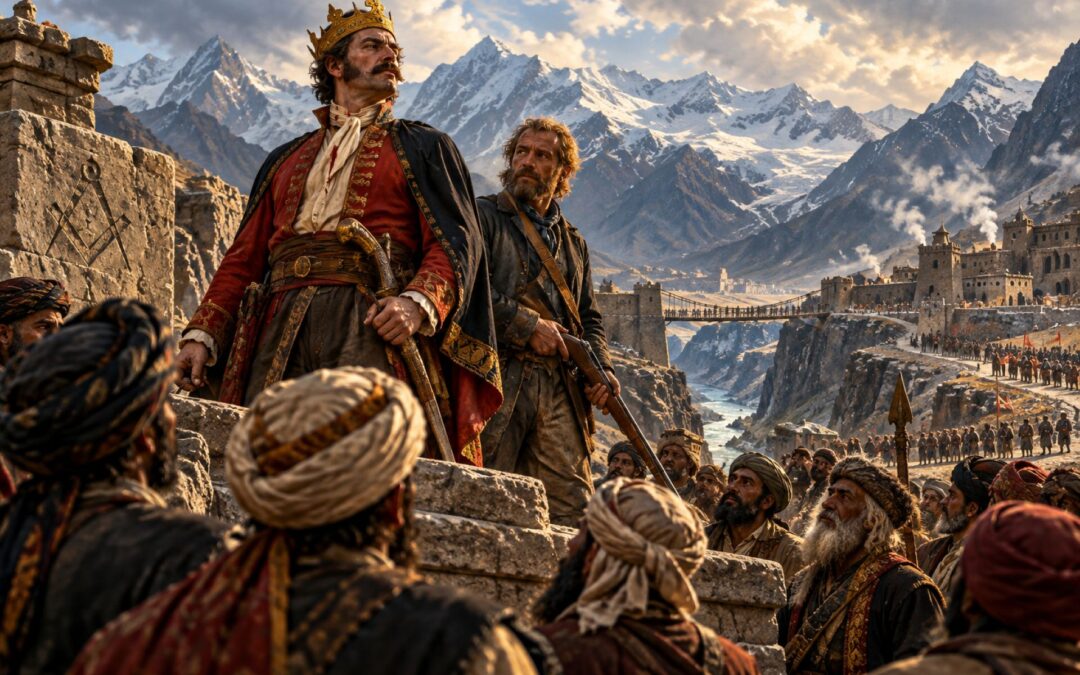
Rudyard Kipling’s The Man Who Would Be King begins almost like a comic tale about two irresponsible British drifters and expands into something far stranger: a story about two men who cross the frontier of British India, conquer part of an isolated mountain country, construct a government, turn themselves into sacred kings, and then destroy everything by believing too completely in the authority they have manufactured. First published in 1888 in The Phantom Rickshaw and Other Eerie Tales, the fifth volume of Kipling’s Indian Railway Library, and later collected in Wee Willie Winkie and Other Stories, it is one of the works most closely associated with Kipling’s early Indian fiction, as the Kipling Society’s publication history records.
The story works because Daniel Dravot and Peachey Carnehan are simultaneously ridiculous, capable, brutal, loyal, imaginative and dangerously self-confident. Their kingdom is neither a pure fraud nor a legitimate state. They really do defeat enemies, organize soldiers, settle disputes, improve agriculture, establish councils and begin building a political order, but all of it rests on superior weapons, deception, racial assumptions and a religious fiction that cannot survive contact with Dravot’s ordinary human body.
Spoiler warning: This article covers the complete story, including Dravot’s death, Carnehan’s crucifixion and return, and the final mystery surrounding Dravot’s severed head and crown.

The Man Who Would Be King: Complete Plot Summary
Kipling does not begin in Kafiristan. He first establishes the strange social position of his protagonists inside British India and the equally important position of the unnamed journalist who later records their story. That outer frame matters because the central adventure reaches the reader not as an omniscient account, but as testimony passed from damaged survivor to journalist.
From Railway Loafers to Gentlemen at Large
The story opens with the Masonic-sounding principle, “Brother to a Prince and fellow to a beggar if he be found worthy.” The unnamed narrator, a journalist working in India, says that he has often been fellow to beggars but once came unexpectedly close to brotherhood with a man who nearly became a genuine king. He then traces the beginning of that experience to an uncomfortable railway journey from Ajmir toward Mhow.
In an Intermediate-class carriage he meets a large, talkative English wanderer who has spent years moving through the empire, surviving by whatever work or scheme becomes available. This man is Peachey Taliaferro Carnehan, although the narrator does not yet know his name. Carnehan belongs to what the narrator calls the politics of “Loaferdom”: the underside of imperial society occupied by white men who possess the privileges of being British but lack respectable positions within the colonial establishment.
Carnehan is trying to conduct another dubious scheme. He wants a message delivered to a red-bearded associate who will pass through Marwar Junction. Because he lacks the money and freedom to arrange it himself, he asks the narrator to intercept the man and say that Carnehan has “gone South for the week.” Their conversation contains several coded expressions recognizable to Freemasons, and the narrator agrees to help partly because he understands the fraternal appeal behind them.
At Marwar Junction the narrator finds the second man exactly as described: large, red-bearded and sleeping in a second-class carriage. This is Daniel Dravot. The narrator delivers Carnehan’s message and moves on, but he soon discovers enough about the pair’s activities to become worried. They have been exploiting princely states by pretending to have influence with newspapers and threatening inconvenient publicity unless local rulers reward them.
The narrator therefore warns the authorities about them. It is an important early indication of the story’s moral ambiguity. He feels a Masonic obligation toward the men and later helps them extensively, but he also recognizes that their energy, intelligence and lack of restraint make them dangerous.
Some time later, on an oppressively hot night at the newspaper office, Carnehan and Dravot appear together. Far from resenting the narrator’s interference, they want his advice. They have decided that British India is no longer useful to men of their kind because the government has already occupied all the profitable political space. Wherever they turn, officials prevent them from simply seizing opportunities for themselves.
Their solution is to leave the reach of British authority and become rulers somewhere else.
The Contract and the Road to Kafiristan
Dravot and Carnehan have chosen Kafiristan, a remote mountain region beyond Afghanistan, as their destination. Their plan sounds insane but is based on a recognizable political calculation. They expect to find divided communities already fighting one another, attach themselves to one local ruler, train his men in European military methods, help him defeat his rivals, remove him when convenient and then take control themselves.
The narrator tries to explain how little reliable information exists about the country. That uncertainty encourages rather than discourages them. They spend hours studying maps, an encyclopedia, geographical accounts and works by travelers such as Wood, Bellew and Raverty. Their reasoning is blunt: the more fragmented the country, the easier it may be for two outsiders with superior weapons and military knowledge to manipulate its conflicts.
They have also written a contract. The spelling is poor and the document is comic in appearance, but its principles govern the whole story. First, they will become kings together. Second, while the matter is being settled they will avoid liquor and women. Third, they will behave with dignity and discretion, and if one gets into trouble the other will remain with him.
Carnehan thinks the third article is almost unnecessary because their Masonic obligations already require mutual assistance. That confidence becomes crucial later. The political kingdom will collapse, but the promise that one man will not abandon the other survives almost to the end.
The following day, the narrator visits the serai and initially appears to encounter a mad holy man covered in rags and ribbons, accompanied by a servant and camels loaded with cheap toys. The holy man is Dravot in disguise, while Carnehan plays his attendant. Dravot’s years of wandering have taught him enough languages, gestures and social habits to make the disguise convincing even to the traders around him.
Hidden beneath the toys are twenty Martini-Henry rifles and ammunition. The two men have invested virtually everything they possess in weapons, animals and supplies. They intend to join a caravan through Afghanistan, leave it near the frontier and strike into Kafiristan.
Before they part, the narrator gives Dravot a small compass from his watch-chain as a token of brotherhood. The gift is practical, but it also becomes part of the story’s Masonic pattern: an instrument associated with orientation and measured limits goes with a man whose ambitions will eventually lose all proportion.
News later reaches the narrator that a bizarre holy man has passed safely through Peshawar with a caravan. Dravot and Carnehan have crossed beyond the effective border of the world the narrator knows.
Two years pass.
Then, during another suffocating night at the newspaper office, a mutilated figure crawls toward the narrator. His body is bent, his hands are scarred and his mind shifts unpredictably between clarity and confusion. The narrator eventually recognizes him as Peachey Carnehan.
Carnehan insists that their absurd plan succeeded.
They really did become kings.
Conquest and the Making of Two Kings
Carnehan’s account begins with the journey beyond the caravan route. Dravot and Carnehan leave before Jagdallak and attempt to move into increasingly difficult mountain country. They abandon their camels when the terrain becomes impossible, take the rifles and ammunition, acquire mules through violence and continue into a region of cold, steep passes and unstable mountains.
Their first major opportunity appears in a broad valley where they see two groups of local men fighting with bows and arrows. Dravot immediately understands what the rifles can do to the existing military balance. He chooses the smaller group, opens fire on its enemies at a distance they cannot match and turns what would have been a local skirmish into a demonstration of incomprehensible technological superiority.
The men they have helped are initially uncertain whether the strangers are friends. Dravot responds with the mixture of violence, theatre and confidence that will define his rule. He intimidates them, shakes hands with them, makes them carry the boxes and enters their village behaving as if his authority already exists.
He also adapts quickly to local religion. When he encounters a stone idol called Imbra, he does not denounce it or expose himself as an outsider. He salutes it, makes gestures suggesting that he understands its importance and accepts food only from figures who appear to possess religious or political authority.
The performance works. Dravot and Carnehan have arrived with almost no legitimate claim, but Dravot understands that legitimacy can sometimes be created by acting as though recognition has already been granted.
Soon another village attacks. The two men again use their rifles to decisive effect and then intervene in the dispute between the communities. The conflict involves, among other things, a woman taken from one village by the other. Dravot returns her, counts the dead, performs an improvised ritual over them and then physically marks a territorial boundary between the villages.
His orders encourage the inhabitants to cultivate the land rather than continue fighting. He appoints priests to judge disputes and threatens punishment if the peace fails. What begins as armed interference is therefore followed almost immediately by government.
Dravot and Carnehan recruit local men, teach them British drill and begin creating a small army. Carnehan is particularly important in this process. He is less imaginative than Dravot but more suited to routine military organization, and he becomes the practical commander behind their expanding power.
Their rifles remain the foundation of that power. They can shoot opponents before matchlocks, bows or other local weapons are effective, and demonstrations of long-range fire turn military technology into psychological authority. Chiefs who might otherwise resist them can see that a small disciplined force equipped with better firearms may determine the outcome of an entire local war.
The two adventurers gradually separate to expand their influence. Carnehan helps one allied chief defeat an enemy settlement, leaves representatives behind and begins teaching soldiers. Dravot moves into other valleys, wins more followers and, crucially, learns more of the local language.
They also begin dealing with the ordinary requirements of rule. Carnehan reports disputes over land, problems between villages, agricultural needs and people who require somewhere to settle. The men order cultivation, redistribute unused land and create rudimentary systems of adjudication.
Their kingdom is therefore not simply based on villagers mistaking two Europeans for supernatural beings. Before that belief becomes decisive, Dravot and Carnehan have already established themselves through military victories, dispute settlement, practical organization and the promise of peace.
Dravot proves particularly gifted at politics. He cultivates chiefs and priests, listens to complaints and creates relationships with influential figures. Where Carnehan and the army are feared, Dravot becomes genuinely popular.
Months after their arrival, he returns from a campaign wearing a heavy gold crown and accompanied by an enormous following. He tells Carnehan that their enterprise has entered a new phase.
They are no longer merely successful conquerors. They are going to become sacred rulers.
Freemasonry, Godhood and the Dream of an Empire
Dravot announces that he has presented himself as a descendant of Alexander the Great and that Carnehan is his divine brother. The claim fits existing European fantasies about the region’s inhabitants being descendants of ancient armies, but Dravot’s real breakthrough comes from something even stranger.
Billy Fish, the name the adventurers give one powerful local chief, responds to a Masonic handshake.
Carnehan tests him further. Billy Fish appears familiar with practices resembling the lower degrees of Freemasonry, while the priests and other chiefs know related signs but apparently lack the higher secret of the Master Mason. Dravot instantly sees the political possibilities.
Carnehan protests that opening a Masonic lodge without proper authority would violate Masonic law. Dravot does not deny this. He simply treats the violation as a “master-stroke of policy.” If Masonic ritual can confirm their privileged religious status, legal regularity becomes irrelevant to him.
They turn the temple of Imbra into an improvised lodge, construct ceremonial arrangements and have Masonic aprons made. During the ritual, an old priest unexpectedly overturns the stone serving as Dravot’s chair and reveals a symbol beneath it resembling the Master’s Mark on Dravot’s apron.
The coincidence transforms an audacious political performance into apparent revelation.
The priests fall before him. Dravot responds by declaring himself Grand Master of Freemasonry in Kafiristan by the authority of his own hand and Carnehan’s assistance. Chiefs and high priests are initiated into the higher degree, but only selectively, allowing the two kings to create an elite structure in which access to sacred knowledge depends on them.
The kingdom now possesses several reinforcing kinds of authority. Rifles prove that the rulers are militarily powerful. Their victories show that alliance with them is useful. Their administration demonstrates competence. The Masonic discovery seems to prove that their authority is ancient and sacred.
Dravot then moves from conquest to nation-building. Chiefs are told to supply men for a frontier guard, soldiers are drilled and local wars are discouraged. Carnehan helps with ploughing, supervises villages and has rope bridges thrown across ravines. Dravot hears legal complaints, consults priests and chiefs and creates councils for war and civil government.
Carnehan is sent toward Ghorband with men and turquoise to acquire additional firearms. Through bribery and trade he secures more than a hundred locally made Martini rifles, Kohat jezails and ammunition. Back in the kingdom, he trains hundreds of men in drill and weapons handling.
This expansion changes Dravot’s imagination. His original plan involved finding a small country, becoming king and eventually taking wealth from it. Now he believes he can create a major state.
He dreams of weapons workshops and factories. He imagines a census revealing millions of inhabitants and hundreds of thousands of potential soldiers. Because he admires the appearance and fighting qualities of the people, he decides that they are somehow essentially English—perhaps descendants of Alexander, perhaps one of the Lost Tribes, perhaps another branch of the racial world to which he believes he belongs.
The racial fantasy allows him to imagine Kafiristan not as a foreign society he has conquered but as raw material for an English-style empire.
His ambitions become global. He imagines his army threatening Russia if Russia advances toward India. He plans to ask the British Viceroy for experienced Englishmen to help administer the country. He wants official permission from the Masonic Grand Lodge to regularize what he has already done. Eventually, he imagines dealing with the Viceroy as an equal and kneeling before Queen Victoria only to be raised as “Sir Daniel Dravot.”
The important change is psychological as much as political. Dravot is no longer pretending to be a ruler because pretending is useful. He has accumulated enough evidence of his success that the difference between performance and identity begins to disappear in his own mind.
That transformation produces the decision that destroys him.
The Broken Contract and the Collapse of the Kingdom
As winter approaches, Dravot admits that the kingdom is becoming too large for two men to administer. Yet instead of reducing his ambitions, he wants to secure them permanently. He decides that he needs a wife.
Carnehan immediately reminds him of the contract. Avoiding women was one of the conditions they established precisely because personal appetite could interfere with the work of becoming kings.
Dravot replies that the contract governed them only while the kingdom was being established. They are already kings, so he considers its restriction expired.
At first his reasoning is not merely sexual. He wants a queen who can bear a son and create a dynasty. If she comes from a powerful tribe, marriage will produce political kinship. A local wife could also tell him what people really think about their rulers.
The argument therefore reveals both Dravot’s political intelligence and his entitlement. He recognizes that his state needs deeper social roots, but assumes that a woman can simply be selected and incorporated into his system because he is king.
Carnehan remains deeply uneasy. He knows how fragile their position is and senses that Dravot is violating the discipline that made their success possible. Dravot refuses to listen.
The chiefs and priests react strangely when he raises the subject. Billy Fish eventually explains why. The people believe Dravot is a god or devil, not an ordinary man. A human woman cannot simply marry a divine being, and stories exist of girls who join supernatural husbands and disappear.
Carnehan immediately sees the trap. The religious fiction has become politically indispensable. Admitting that they are merely men could destroy their authority, but maintaining divinity makes an ordinary royal marriage impossible.
The priests begin preparing a young woman for the ceremony. Carnehan hears her crying. She is not entering the marriage willingly; she believes contact with Dravot may kill her.
Billy Fish warns that the situation is dangerous and promises that, whether Dravot is man, god or devil, he personally will remain loyal. Carnehan again begs Dravot to abandon the plan.
Dravot refuses.
The chiefs, priests, soldiers and Billy Fish’s men assemble. The young woman is brought forward pale with terror and covered in ornaments. Dravot looks at her, decides that she is suitable and reaches for her.
She bites his neck.
Dravot’s hand comes away covered in blood.
The political meaning is instantaneous. Gods do not bleed like men. The priests shout that he is “neither god nor devil but a man,” and the entire structure of sacred legitimacy collapses in seconds.
Carnehan attempts to command the army he trained, but those soldiers no longer recognize the same hierarchy. A force created to stabilize Dravot’s kingdom becomes part of the rebellion against him. Billy Fish and his men remain loyal, but they are badly outnumbered.
The survivors flee down the valley under gunfire and falling stones. Dravot reacts first with rage. He still calls himself king, blames Carnehan for failing to control the army and fantasizes about returning to destroy the valley.
The rebellion spreads faster than they can retreat. Runners carry the news that the supposed gods are merely mortal, and the belief that once amplified their authority now amplifies its destruction.
When a bullet strikes Dravot in the leg and he sees the enemy using rifles his own regime helped introduce, his thinking clears. He finally acknowledges that his ambition has brought the disaster upon them.
He tells Billy Fish to leave and urges Carnehan to go with him. Carnehan refuses. Whatever Dravot has done, their contract and friendship remain. Billy Fish likewise refuses to abandon them, saying simply that he is a chief.
They walk together toward the hostile force.
Billy Fish is killed immediately after their capture. Dravot and Carnehan are taken through the snow to a rope bridge over a ravine. Before Dravot dies, he apologizes to Carnehan for bringing him into the catastrophe.
Carnehan forgives him fully.
Dravot then walks to the middle of the bridge and tells his captors to cut it. The ropes are severed, and the man who built bridges as part of his kingdom falls from one into the ravine below, still wearing his crown.
Carnehan receives a different punishment. He is crucified between pine trees with wooden pegs driven through his hands and feet.
He does not die.
His survival overturns the religious logic once again. Dravot bled and was exposed as an ordinary man; Carnehan survives an execution that should have killed him and is therefore treated as possessing something more than ordinary humanity. His captors take him down, feed him and eventually release him.
They also give him Dravot’s severed head as a warning and memorial.
Carnehan spends roughly a year making his way back toward British India, physically destroyed and psychologically haunted. In his damaged memory, Dravot seems to accompany him, encouraging him onward just as he once encouraged him toward Kafiristan.
Peachey’s Return and the Last Mystery
Back in the newspaper office, Carnehan reaches the end of his account and produces what seems to be impossible proof. From a bag he removes the dried severed head of Daniel Dravot, still recognizable by its red beard, and places the heavy gold crown on it.
The narrator recognizes the man he once met at Marwar Junction.
Carnehan himself is destitute, yet he has refused to sell the crown even though it is valuable. Whatever it once represented politically, it has become inseparable from Dravot and from the experience that destroyed them both.
Carnehan leaves the office despite the narrator’s concern. Later that day the narrator finds him wandering bareheaded beneath the intense sun, singing a Christian hymn about the Son of Man going to war to gain a golden crown.
The song transforms the story’s images one final time. Dravot sought a literal crown through conquest. Carnehan has survived something resembling crucifixion. Sacred language, imperial ambition and physical suffering have become almost impossible to separate.
The narrator brings Carnehan to a missionary so that he can eventually be transferred to an asylum. Carnehan no longer recognizes him properly.
Two days later, the narrator learns that Carnehan has died after suffering sunstroke.
He asks whether anything was found among the dead man’s possessions. The superintendent knows of nothing.
Dravot’s severed head is gone.
The crown is gone.
Kipling closes with the deceptively calm sentence: “And there the matter rests.”
Kafiristan, British India and the Frontier World
The geography of The Man Who Would Be King is essential because Dravot and Carnehan could not attempt their scheme inside the ordinary structures of British India. At the beginning, they complain that the colonial government has occupied political life so thoroughly that freelance adventurers can no longer seize their own opportunities. Their journey toward Kafiristan is therefore a journey away from bureaucracy, law and regular imperial hierarchy into a frontier where information is uncertain and power can be improvised.
Kipling makes British India itself feel densely connected. Railways move journalists, soldiers, vagabonds and messages across the country; telegraphs collapse distances; political officers watch princely states; newspapers can damage reputations; caravans connect India to Afghanistan and Central Asia. Dravot and Carnehan are marginal within this system, but they understand how it works because they have spent years moving through its lower levels.
Kafiristan represents the opposite condition. The narrator tells them that reliable information is scarce, and the Kipling Society’s detailed textual notes identify many of the real nineteenth-century geographical and military works that Kipling places in the newspaper office. The men turn that imperfect knowledge into strategy. A country Europeans barely understand becomes attractive precisely because official power and reliable observation are weak there.
Historical Kafiristan was not simply Kipling’s invention. It referred to a culturally diverse region of the Hindu Kush whose non-Muslim communities fascinated nineteenth-century travelers and imperial observers. As the Encyclopaedia Iranica account of Nuristan explains, the Afghan Kafir populations retained distinctive pre-Islamic religious traditions until Amir ʿAbd-al-Raḥmān’s conquest in the 1890s, after which the region was forcibly Islamized and became known as Nuristan.
That history is important precisely because Kipling’s Kafiristan should not be mistaken for ethnography. The fictional valleys, Masonic practices, political arrangements and convenient legends of European ancestry belong to the story’s imaginative construction. Kipling takes a real place whose isolation made it mysterious to many British readers and transforms it into a setting where imperial habits can be exaggerated until their underlying mechanisms become visible.
The physical landscape also disciplines the adventure. Mountains destroy ordinary transport, cold replaces the oppressive heat of the Indian frame, valleys separate communities and rope bridges become essential infrastructure. The same terrain that protects the new kings from outside interference also makes their political system vulnerable to rumor: once the news of Dravot’s mortality passes from valley to valley, escape becomes almost impossible.
This frontier is therefore not empty space waiting for two men to rule it. It already contains chiefs, priests, feuds, settlements, agricultural systems, religious beliefs and alliances. Dravot’s achievement lies partly in recognizing those structures and manipulating them, while his ultimate failure comes from assuming that manipulating a society means fully understanding it.
Daniel Dravot, Peachey Carnehan and the People Around Them
The story’s political ideas matter because Kipling attaches them to unusually vivid characters. Dravot and Carnehan are not abstract representatives of empire who happen to carry rifles; they are two socially marginal men whose temperaments fit together well enough to produce an extraordinary partnership and badly enough to produce catastrophe.
Their supporting characters receive much less interiority, especially the Kafirs and the prospective bride, but several still play decisive roles in exposing what the two adventurers understand and what they fail to understand.
Daniel Dravot
Daniel Dravot is the story’s engine. From the beginning he possesses the quality that eventually makes him king: he can enter an uncertain situation and behave as if he already knows what everyone else should do. His disguise as a mad holy man works because he commits to it completely; his first encounter with the Kafirs works because he behaves like a ruler before anyone has formally recognized him.
That confidence is backed by genuine ability. Dravot learns languages, studies local politics, cultivates priests and chiefs, hears disputes, creates councils and understands that permanent rule requires more than winning battles. His people apparently come to like him, not merely fear him. He is also capable of imagining institutions beyond the immediate needs of conquest, including bridges, armies, administration, diplomatic relationships and succession.
This competence prevents the story from becoming a simple fable in which an incompetent fool receives predictable punishment. Dravot’s kingdom is dangerous precisely because much of it works.
His central flaw is that success destroys the caution that originally made success possible. At first he knows that he is exploiting appearances. He invents divine ancestry and uses Masonic ritual because they are politically useful. Eventually he treats his own constructed identity as though it gives him unlimited rights.
The marriage decision reveals the shift. Dravot has a sensible political reason for wanting a queen and heir, but he no longer accepts the possibility that his subjects can impose conditions upon him. When chiefs hesitate, he responds by listing everything he has done for the country, as though public works and military protection give him ownership of people’s bodies as well as their political obedience.
His behavior toward the prospective bride is particularly revealing. She is plainly terrified, yet her reluctance scarcely registers as meaningful to him. A king who has become skilled at interpreting councils, wars and alliances fails to recognize the most immediate human refusal in front of him.
Dravot nevertheless regains a measure of moral dignity after the kingdom collapses. Initially he rages and blames Carnehan, but the bullet wound and the sight of the opposing army force him into clarity. He acknowledges that his own “nonsense” caused the disaster, tries to save his companions and apologizes to Carnehan before dying.
His final walk onto the rope bridge is therefore not a restoration of kingship but an acceptance of mortality. Once the myth is gone, Dravot can at least die without pretending to be something other than a man.
Peachey Carnehan
Peachey is less charismatic and less imaginative than Dravot, but he is indispensable to the enterprise. He organizes soldiers, teaches drill, supervises agricultural and territorial matters, purchases weapons and handles routine work that Dravot increasingly delegates as his ambitions expand.
He is also the more cautious partner. He repeatedly recognizes limits that Dravot wants to ignore, especially when the marriage plan emerges. His warnings are not based on modern respect for women or local sovereignty; Peachey shares many of Dravot’s prejudices. What he possesses is a practical instinct for danger.
His loyalty, however, is stronger than his caution. Even after Dravot’s decision destroys the kingdom, Carnehan does not use his earlier warnings to justify abandoning him. When Dravot offers him a chance to leave with Billy Fish, he refuses. The third clause of their contract becomes the one part of their political project that survives its collapse.
Carnehan’s later condition complicates everything the reader knows about Kafiristan. His hands physically bear the marks of crucifixion, and he possesses Dravot’s head and crown, yet he is traumatized, confused and prone to shifts in identity and memory. Sometimes he speaks of himself in the third person, as though “Peachey” were another man who died in the mountains.
That damage does not make him a liar. It means that truth reaches the reader through a consciousness that has been physically and psychologically shattered by what it experienced.
The Journalist-Narrator
The unnamed journalist occupies a revealing position between respectable imperial society and the two “Gentlemen at Large.” He has employment, access to information and connections to authority, but he travels through many of the same spaces and understands the same Masonic language.
He helps Dravot and Carnehan even after warning officials about them. He supplies maps and reference works, gives Dravot the compass and takes their ambitions seriously enough to discuss the practical obstacles. He is therefore neither simply their accomplice nor a detached observer.
His newspaper profession matters because the story repeatedly connects knowledge with authority. He collects information, interprets political events and turns experience into a written account. Albert D. Pionke’s study of knowledge and imperial authority in The Man Who Would Be King is especially useful for understanding how maps, reports, journalism and storytelling participate in the same broader problem: who gets to describe a territory, classify its inhabitants and convert knowledge into power.
The narrator’s final role is even more important. Once Carnehan dies and the physical evidence disappears, the journalist becomes the sole surviving custodian of the story. The man who began by transferring a coded message between two vagabonds ends by transferring their entire impossible kingdom to the reader.
He resembles Kipling in occupation and setting, but treating him as simply “Kipling” would erase the deliberate narrative distance created by the fiction. He is a constructed witness whose reliability matters independently of the author’s biography.
Billy Fish, the Priests and the Prospective Bride
Most of Kafiristan reaches the reader through Carnehan’s vocabulary and perceptions, which means its inhabitants rarely receive the psychological detail given to Dravot and Peachey. Even within that limitation, several figures exercise decisive agency.
Billy Fish begins as one of the chiefs absorbed into the new political system, but he becomes something more than a follower. His Masonic recognition helps transform Dravot’s kingship, and his loyalty later proves independent of belief in Dravot’s divinity. When the divine fiction collapses, Billy does not suddenly become obedient to the priests or the victorious side. He remains because he has chosen a political and personal allegiance.
His final declaration—he stays because he is a chief—quietly rivals the Englishmen’s elaborate contract. Billy does not require Dravot to be a god in order to keep faith with him.
The priests occupy a different position. They first help authenticate the kings because the Masonic coincidence seems to confirm existing sacred expectations. Once Dravot bleeds, however, they become the most effective force in destroying him. Their behavior demonstrates that religion in the story is not merely superstition waiting to be exploited by Europeans; it is an independent system of authority whose rules Dravot never fully controls.
The prospective bride receives the least narrative space and has no developed individual identity, which is one of the story’s most obvious limitations. Yet the action ultimately turns on her refusal. Everyone around her discusses what her marriage means for kingship, religion, dynastic politics and tribal alliances, while she herself is terrified.
Her bite is both self-defense and political revelation. The men who have spent months building armies, councils and sacred ceremonies are defeated by a young woman refusing physical possession.
Dravot and Carnehan’s Brotherhood
The emotional center of the story is not actually kingship but the relationship between Dravot and Carnehan. Their contract formalizes a partnership that already exists through years of shared wandering and Masonic fraternity.
At first the two are equals. Dravot’s greater charisma gradually produces an imbalance: he becomes king in the strongest sense, while Carnehan functions more as commander, administrator and lieutenant. Carnehan notices that Dravot is forming plans beyond his understanding but accepts the division because Dravot never publicly humiliates him.
Their largest conflict concerns marriage. Carnehan knows Dravot is breaking the logic of their original agreement, while Dravot believes success has freed him from it. The disagreement might have destroyed a weaker friendship, especially after Carnehan’s warning proves correct.
Instead, the political contract becomes morally real only after the political project fails. Dravot finally admits responsibility and tries to release Carnehan from obligation. Carnehan refuses to leave.
Their last exchange before Dravot’s death is therefore more important than any royal ceremony. Dravot asks forgiveness; Carnehan gives it. Their kingdom has lost its army, councils, religious authority, territory and subjects, but the promise that one man will stay with the other remains intact.
That does not make their brotherhood morally pure. Their friendship is embedded in a male colonial world that often treats outsiders as instruments and women as dangers or possessions. Yet Kipling gives it genuine emotional weight, making loyalty the one form of authority that cannot simply be manufactured by superior weapons.
Empire, Knowledge and the Performance of Power
One of the most striking features of The Man Who Would Be King is how carefully Kipling explains the mechanics of conquest. Dravot and Carnehan do not become kings because the Kafirs are portrayed as passively waiting for Europeans to rule them. They succeed because they combine several different kinds of advantage and reinforce each one with the others.
Their first advantage is information. Before leaving India, they study maps, travelers’ accounts, encyclopedic material and reports about local peoples. Much of that information is uncertain, but it gives them enough of a framework to formulate a route and recognize political fragmentation as opportunity.
The newspaper office is therefore almost as important to the conquest as the rifles. Dravot and Carnehan convert accumulated imperial knowledge into an independent political project. The official empire gathers information in order to administer territory; the two loafers borrow that information to create an unofficial empire of their own.
Their second advantage is military technology. Twenty Martini-Henry rifles allow two men to intervene in battles before local opponents can respond effectively. Long-range shooting creates a dramatic imbalance of force and, just as importantly, produces awe. What looks supernatural at first often has a material explanation.
Yet Kipling does not suggest that guns are sufficient. The men recruit followers, train them, create discipline, acquire additional weapons and incorporate local chiefs. Military superiority becomes durable only when it is converted into institutions.
Dravot is especially adept at that conversion. He settles disputes rather than merely punishing enemies, involves priests in judgment, creates councils, improves bridges and encourages agriculture. These activities make his rule useful to some of the people he governs.
That usefulness creates the story’s most uncomfortable political complication. A violent and illegitimate conqueror can still be an effective administrator. Kipling does not erase the contradiction by making Dravot wholly monstrous or wholly benevolent.
The kingdom also demonstrates how authority becomes performance. Dravot wears a crown, stages councils, occupies sacred space, speaks with certainty and constructs ceremonies that make his rule appear older and more natural than it is. Once enough chiefs, soldiers and priests act as though he is king, kingship becomes a practical fact.
The danger arrives when performance stops being consciously strategic. Early Dravot manipulates political symbols. Later Dravot believes that his achievements entitle him to whatever a king wants.
This distinction is central to the story’s imperial implications. Dravot’s private conquest exaggerates the confidence of formal colonial rule: outsiders arrive armed with knowledge and technology, interpret local division as an invitation to intervene, impose administrative structures and then cite the success of those structures as proof of their right to rule.
Kipling does not reduce British India to Dravot’s kingdom, and the story should not be flattened into a one-to-one allegory. The official empire appears more organized, restrained and legally conscious than Dravot’s adventure. Yet the resemblance is strong enough to be unsettling because his methods are recognizable versions of imperial methods stripped of institutional respectability.
His greatest political error is assuming that competent government creates unlimited legitimacy. Roads, rifles, courts and peace can make people obey a ruler without making every claim that ruler advances acceptable. Dravot confuses successful administration with possession of the society itself.
The marriage crisis proves the distinction. He has enough power to order armies, but not enough understanding to redefine the boundary between god and man inside the religious order supporting his crown.
Freemasonry, Religion and Manufactured Divinity
Freemasonry is woven through the story from its first sentence and cannot be treated as decorative background. The opening ideal of brotherhood across social rank, the coded language between strangers, Carnehan’s confidence that a Mason would never abandon another Mason, the narrator’s compass and the later lodge in Kafiristan all connect private fraternity with political authority.
The Kipling Society’s notes on the story’s Masonic references clarify an important irony: Dravot’s self-appointment as Grand Master is not legitimate Masonic procedure. Carnehan explicitly knows this and objects. The man who invokes an ethical order of fraternity turns that order into another instrument of personal sovereignty.
The discovery of Masonic-like signs among the Kafirs is fantastic rather than historical. Within the story, however, it gives Dravot something his guns cannot provide: a claim to sacred continuity.
Before that discovery, he is an unusually successful foreign warlord. After it, he can present himself as a figure whose authority appears to have been anticipated by the people’s own religious symbols.
The scene involving the hidden Master’s Mark is especially important because Dravot does not create the decisive sign. It is revealed beneath the stone by a priest. Chance therefore produces the evidence that allows his fraud to feel, even to him, like destiny.
From that moment, religion does more than legitimize power. It changes what power means.
The chiefs and priests do not merely obey the strongest gunman; they increasingly understand Dravot within a sacred cosmology. His knowledge of the supposedly lost Masonic sign proves, to them, that he belongs to a category beyond ordinary humanity.
Lucas Kwong’s discussion of Masonic universalism and religious difference in the story helps illuminate the paradox. Freemasonry appears to offer a universal fraternity capable of crossing racial, religious and political boundaries, but Dravot does not use that fraternity to encounter others as equals. He turns shared signs into proof that he should stand above them.
The result is a corrupted version of the story’s opening law. “Brother to a Prince and fellow to a beggar” suggests that fraternity can cut across rank. Dravot instead uses fraternity to establish rank.
The priests’ later revolt is therefore more than revenge by deceived subjects. Dravot has built authority by claiming a place inside their sacred system without understanding its limits. Once blood proves that his body contradicts the divine category assigned to him, the priesthood has a theological reason to reject his entire rule.
Religion thus creates his most powerful legitimacy and his most complete vulnerability. A military defeat might have cost him a valley. The collapse of sacred belief costs him the meaning of kingship itself.
Race, Gender and the Colonial Hierarchy
Modern readers cannot understand The Man Who Would Be King fully without confronting its racial imagination. The story includes derogatory language, stereotypes and assumptions about hierarchy that are inseparable from its late-Victorian colonial setting. Some of these attitudes belong explicitly to Dravot and Carnehan, but the narrative world does not consistently distance itself from all of them.
Dravot’s reasoning about the Kafirs shows how racial ideology can adapt itself to admiration. He sees people who are fair-skinned, physically impressive, militarily promising and politically useful. Instead of allowing those qualities to challenge his hierarchy, he decides they must somehow be related to the English.
He reaches for legends of Alexander’s descendants and the Lost Tribes. Their resemblance to Europeans becomes, in his imagination, an explanation for why they seem capable of becoming his ideal subjects.
This is not genuine respect because it recognizes value only by incorporating the Kafirs into Dravot’s racial identity. He can admire them without questioning the assumption that Englishness is the measure of civilization.
The historical mythology should not be mistaken for fact. Legends connecting populations in the Hindu Kush with Alexander’s soldiers circulated in nineteenth-century European writing, but the story turns those speculative associations into part of Dravot’s self-justifying fantasy.
At the same time, Kipling does not present every Kafir as an inert stereotype. Billy Fish possesses loyalty and independent judgment. The priests understand the logic of their religious authority and act decisively when Dravot violates it. Villages have their own rivalries, customs and political interests before the adventurers arrive.
The deeper limitation is structural: almost everything about the country is filtered through British men. Local people rarely receive the sustained interiority that Dravot and Carnehan receive, which means Kafiristan often functions as the arena in which European character and imperial behavior are tested.
The gender hierarchy is even narrower. Dravot and Carnehan’s contract places “women” beside liquor as a category of dangerous temptation to be avoided while serious work is underway. Both men repeatedly talk about women as sources of trouble, physical comfort or sexual possession.
Dravot’s plan to marry contains a more serious political logic, but that logic is itself possessive. He wants a wife who will produce an heir, bind him to a powerful tribe and provide private political intelligence. The prospective queen is imagined as another institution the king can acquire.
Her actual response destroys the fantasy. She does not behave as dynastic material. She is terrified, resists physical contact and bites him hard enough to draw blood.
The scene is easy to misread if the woman is treated merely as the instrument of Dravot’s downfall. Dravot creates the crisis himself by insisting on a marriage that both religious authorities and the woman resist. The bite does not arbitrarily ruin a successful king; it reveals the limit he refused to acknowledge.
Kipling nevertheless gives the woman almost no voice beyond fear and physical resistance. Her decisive importance therefore coexists with severe narrative marginalization.
The story can expose Dravot’s entitlement without possessing a modern theory of consent, just as it can expose the absurdity of imperial self-coronation while remaining shaped by imperial assumptions. That tension is one of the central reasons the story continues to invite argument rather than yielding a simple political message.
Crowns, Blood, Rifles and Other Symbols
The story’s recurring objects gain meaning because they change function as the plot changes. The crown, for example, begins as the obvious object of Dravot’s ambition. Once he actually possesses one, it becomes evidence that the fantasy has acquired institutional reality.
Dravot eventually handles the crown almost as a piece of political equipment. He wears it during councils, weighs it while dismissing Carnehan’s objections and imagines eventually surrendering it ceremonially to Queen Victoria in exchange for recognition. The object represents sovereignty, but also his growing belief that he can move between improvised kingship and official imperial honor as though the two were naturally compatible.
After his death, the crown acquires a completely different meaning. Carnehan carries it back with Dravot’s severed head and refuses to sell it despite extreme poverty. Royal insignia has become a private relic.
Placed on the dried head, the crown creates the story’s most grotesque visual statement: the magnificence of kingship sits literally on death.
Blood works in the opposite direction. Dravot has accumulated complex signs of authority—armies, councils, ritual, titles, crowns and myths—but one simple physical fact destroys them. The bride’s bite exposes blood and therefore mortality.
The point is not that the Kafirs irrationally forget his achievements. The divine claim is one of the supports holding those achievements together. Once its central premise is disproved, every other institution becomes vulnerable at once.
The rifles are equally important because they reveal the material machinery beneath apparent miracles. Early victories look almost supernatural to opponents who cannot answer long-range gunfire. Dravot can perform divinity only because superior weapons first make extraordinary power credible.
Later, those same weapons spread through the country. Carnehan imports more rifles and trains a larger army. When rebellion begins, Dravot faces men armed through his own state-building project.
His technological advantage has become an institution, and institutions cannot always be recalled by the person who created them.
Maps and books work similarly. They look passive, but the conquest begins in the newspaper office when the men convert information into action. The knowledge collected by explorers, soldiers and imperial observers becomes part of a private plan for sovereignty.
The contract symbolizes a different kind of limit. It is an attempt at self-government before government of others. Dravot and Carnehan understand that ambition requires discipline, so they prohibit the appetites most likely to distract them and promise mutual loyalty.
The tragedy begins when Dravot decides success has released him from the contract. He can still enforce laws on an entire country but no longer accepts the law he imposed upon himself.
The compass given by the narrator develops the same irony. A device designed to orient a traveler accompanies men who become progressively less capable of orienting their ambition within moral or political limits.
Bridges acquire perhaps the most elegant structural symbolism. Carnehan describes building rope bridges as part of the practical work of connecting the new kingdom. Dravot, the organizer of roads and communications, eventually dies when one of those essential mountain structures becomes an instrument of execution.
The closing hymn gathers several of these images into a final disturbing pattern. Carnehan sings of the Son of Man going forth to war to gain a golden crown. After Dravot’s conquest, crowned death and Carnehan’s crucifixion, the religious imagery sounds simultaneously sacred, militaristic, absurd and tragic.
Kipling does not reduce these objects to one fixed allegorical dictionary. Their force comes from movement: tools become symbols, symbols become institutions, institutions become traps, and royal objects end as evidence that cannot even be preserved.
Frame Narrative, Voice and the Problem of Truth
Kipling could have told the story directly: two adventurers enter Kafiristan, establish a kingdom and are overthrown. Instead, he places the entire adventure inside an elaborate sequence of meetings, messages, memories and testimony.
That structure delays Kafiristan substantially, but the delay performs important work. Before the reader hears anything miraculous, the narrator encounters Dravot and Carnehan in ordinary colonial settings. We see their appearance, speech, schemes and practical intelligence firsthand.
When the impossible story later begins, its protagonists have already been authenticated as real men within the fictional world.
The outer narrator’s profession strengthens that effect. He is a newspaper man accustomed to reports, telegrams, political information and verification. His world is built around facts arriving from elsewhere.
Carnehan’s return disrupts that professional relationship to truth. The most astonishing news of the narrator’s life arrives not through telegraph wires or official correspondence but through a broken man crawling into the office.
Richard Ambrosini’s analysis of the story’s elaborate frame and shifting narrative authority is particularly helpful here because the frame does more than make the adventure plausible. It continually reminds readers that the account is being reconstructed.
Carnehan is not an invisible storyteller. The narrator interrupts him, watches his physical symptoms, gives him whisky, tries to keep his attention fixed and sometimes loses the thread when Carnehan’s mind wanders.
The language of the embedded story reinforces that presence. Carnehan’s grammar, pronunciation and repeated habits of speech distinguish his voice sharply from the journalist’s more controlled narration. He tells a magnificent imperial adventure in the idiom of a battered working-class vagabond.
That contrast prevents the story from acquiring the polished authority of official colonial history. The supposed emperor’s commander-in-chief narrates the kingdom like a man remembering a railway job, a drinking companion or a brawl.
Trauma also destabilizes chronology and identity. Carnehan sometimes speaks of himself as though he were another person, especially when approaching the most painful events. He remembers extraordinary details but also admits that his head no longer works properly.
A simplistic reading might therefore conclude that the adventure is hallucinated. The text does not support such certainty.
The narrator sees the physical scars in Carnehan’s hands. More importantly, Carnehan produces Dravot’s head and crown, and the narrator says he recognizes the dead man from Marwar Junction.
For a brief moment, the story seems to provide exactly the evidence a skeptical journalist would require.
Then the evidence disappears.
After Carnehan’s death, neither head nor crown can be found among his possessions. The final mystery reopens everything that seemed settled.
Several possibilities remain available. Carnehan may have told a substantially true story distorted by trauma. The narrator may have witnessed an object whose later disappearance has an ordinary but unknown explanation. The entire account may occupy the border between factual testimony and legend deliberately cultivated by the narrator.
What matters is that Kipling refuses to provide a final external authority who settles the question for the reader. The story ends with journalism becoming folklore.
That uncertainty also changes the meaning of the title. Dravot is not “the man who became king.” He is the man who would be king: the phrase can suggest intention, pretension, destiny and incompleteness at the same time.
The Ending Explained
The literal ending is clear even if its evidentiary status is not. Dravot’s political authority collapses after the bride makes him bleed. He is captured, accepts responsibility, reconciles with Carnehan and dies when his captors cut the rope bridge beneath him.
Carnehan is crucified but survives. His survival produces one final grotesque inversion of their earlier theology: Dravot’s bleeding proved that he was only human, while Peachey’s refusal to die under crucifixion makes his captors regard him as more divine than the former king.
They release him and give him Dravot’s head. Carnehan carries both the head and the crown back to India despite hunger, physical disability and mental disintegration. His loyalty therefore continues after the contract has lost every practical meaning.
The severed head initially appears to close the gap between adventure and fact. The narrator knew Dravot before the journey and recognizes him afterward. If the identification is accepted, the central claim—that the two men reached Kafiristan and suffered some extraordinary catastrophe—has material support.
The disappearance of the relics after Carnehan’s death prevents that verification from becoming absolute. The ending does not prove that Carnehan invented his story; it removes the possibility of proving the story to anyone beyond the narrator.
That distinction matters. If Kipling wanted to reveal that the kingdom was merely a hallucination, the physical evidence would be an unnecessarily elaborate detour. Instead, the head and crown appear, convince the narrator, and then vanish before the narrative closes.
The final line, “And there the matter rests,” is therefore deeply ironic. Almost nothing rests. Dravot’s political project has ended, Carnehan is dead and the material evidence is gone, but interpretive uncertainty has become permanent.
On a thematic level, the ending reduces every grand claim to the body. Dravot imagined armies, empires, dynasties, diplomacy with the Viceroy and recognition by Queen Victoria. What returns to India is a damaged survivor carrying a dead head beneath a gold crown.
Yet the ending is not simply a punishment for ambition. Dravot’s late acceptance of blame and Carnehan’s refusal to abandon him give the catastrophe emotional weight beyond moral arithmetic. The men lose their kingdom, but their loyalty survives long enough to complicate any easy satisfaction in their downfall.
Critical Review: Why the Story Endures and What Has Aged Badly
The Man Who Would Be King remains powerful first because it accomplishes an extraordinary amount in a relatively short space. Kipling begins with railway comedy and colonial lowlife, shifts into improbable adventure, develops a credible miniature state, turns its institutions into a study of political legitimacy and then ends in grotesque tragedy and epistemological uncertainty.
The movement should feel absurd, yet the story is carefully engineered to make each stage plausible on its own terms. Dravot and Carnehan do not simply announce that they are kings and receive crowns. Kipling shows the weapons, logistical planning, local conflicts, military training, alliances, administrative work and symbolic accidents that make kingship possible.
That attention to process gives the fantastic premise unusual weight. Even readers who reject the literal probability of two men conquering Kafiristan can understand the political logic by which influence becomes authority and authority becomes myth.
The characterization is equally important. Dravot could easily have become a one-dimensional warning against hubris, but Kipling gives him enough talent to make his rise convincing. He is brave, adaptable, charismatic and often effective as a ruler.
His downfall is therefore connected to his strengths. The same confidence that allows him to create order from uncertainty eventually convinces him that uncertainty no longer applies to him.
Carnehan is less spectacular but arguably more moving. His practical competence keeps the project operating, while his loyalty gives the story its human center. By the time he reaches the newspaper office, imperial adventure has been stripped of glamour and converted into damaged hands, confusion, grief and a bag containing a dead friend’s head.
The narrative technique is another major achievement. The outer frame can seem long before the main adventure begins, and Kingsley Amis famously regarded its elaboration as pretentious rather than profound; the Kipling Society’s survey of the story’s critical reception records both severe criticism and claims that the story is among Kipling’s masterpieces. The frame nevertheless earns its place because almost every major idea in the story depends upon mediation, evidence and uncertain knowledge.
Without the journalist, Carnehan would simply tell an adventure. With him, the reader must constantly ask how extraordinary experience becomes credible narrative.
Kipling’s prose also moves between registers with remarkable control. The narrator’s educated irony differs from Carnehan’s rough oral voice, while Dravot’s speeches expand as his political imagination expands. Humor remains present even in scenes that later become sinister, which makes the tragedy feel like the corruption of an adventure rather than a completely separate mode.
The story’s strongest political quality is its refusal to make imperial authority entirely noble or entirely fraudulent. Dravot’s rule begins through violence and deception, but he genuinely reduces conflict and creates institutions. The fact that he can govern effectively does not make his conquest legitimate, yet the story is more interesting because effectiveness cannot simply be denied.
At the same time, readers should resist treating every contradiction as evidence that Kipling secretly condemns imperialism. The story is deeply embedded in colonial ways of seeing. Its world takes European mobility and intervention for granted in ways modern readers should notice rather than excuse.
The racial language has aged badly and can be jarring even when clearly attributed to the characters. Dravot and Carnehan repeatedly classify peoples through crude hierarchies, and Dravot’s admiration for the Kafirs becomes a theory that they must somehow be related to Englishmen. Other populations are dismissed more contemptuously.
This material can expose the protagonists’ worldview while also reproducing the vocabulary and assumptions of the imperial culture that produced the story. Both facts can be true.
The representation of Kafiristan is similarly limited. Kipling gives the country enough social structure for the plot to work, but most individual Kafirs remain defined through the needs of the English protagonists. Billy Fish is memorable partly because he is one of the few characters allowed to emerge distinctly from that collective background.
The woman who bites Dravot exposes an even greater limitation. Her resistance is the decisive action of the story, yet she receives almost no individual identity. Men discuss her as queen, tribal connection, theological problem and source of danger before she ever reaches Dravot.
Modern readers can recognize the bite as resistance to coercion, but the story itself remains far more interested in what her act means for the men’s kingdom than in what Dravot’s demand means for her.
Those limitations do not erase the story’s achievement, but neither should its literary achievement be used to neutralize them. The fairest evaluation is that The Man Who Would Be King is both a brilliant piece of imperial-era fiction and a work whose imaginative range is constrained by the hierarchies it examines.
Its central political insight remains exceptionally strong. Dravot’s kingdom collapses not because every part of it was fake, but because one essential fiction was treated as unlimited truth. Guns, administration, councils and public works create real forms of power. They cannot make a man a god.
The story also understands something durable about rulers who begin believing their own propaganda. Dravot initially knows that Alexander, divine status and Masonic authority are tools. Once he starts acting as though those stories describe his actual entitlement, he loses the ability to recognize boundaries.
The bride’s bite matters because reality enters through the smallest possible opening. An elaborate ideological structure is contradicted by blood.
The ending preserves the story from becoming too tidy. If Dravot simply died and Carnehan returned to confirm the moral, the tale could end as a conventional warning against overreaching. Instead, Kipling gives the reader Dravot’s head, apparently proves the impossible and then removes the proof.
The result is a story about political myth that itself becomes a myth before our eyes.
Is The Man Who Would Be King Worth Reading Today?
Yes. The Man Who Would Be King remains worth reading because its adventure plot and its political questions still work together rather than competing for attention. It can be enjoyed as a fast, strange story of two audacious men attempting something impossible, but its real durability comes from how seriously Kipling follows the consequences of that premise.
Dravot and Carnehan discover that power can be built from surprisingly ordinary materials: weapons, information, confidence, alliances, ritual, bureaucracy and stories people agree to believe. Their achievement is impressive enough that Dravot eventually mistakes the machinery of authority for proof that authority has no limits.
That mistake turns a successful king back into an ordinary bleeding man.
Modern readers should approach the story with awareness of its colonial racism, its limited presentation of Kafir society and its deeply male-centered treatment of women. Those problems are not incidental blemishes, but neither do they exhaust the work. Reading the story critically means allowing its artistic intelligence and historical limitations to remain visible at the same time.
What survives most strongly is the relationship between political performance and human reality. Dravot constructs an empire, but the crown cannot make his body divine. Carnehan loses everything except loyalty and memory, only for even the physical evidence of those memories to disappear.
By the final sentence, the kingdom is gone, both kings are dead and no object remains that could prove the full story. What does remain is the tale itself: a report that has become legend, about men who discovered how easily kingship could be created and how quickly one drop of blood could reveal what it had always been made of.
Last Updated on October 7, 2026 by Aseem Gupta