
Reading Time: 61 Minutes
In 2075, the Moon is a prison colony that has become a civilization. Its inhabitants grow food for Earth, conduct business according to their own customs, and govern much of their daily lives without conventional laws. Yet they remain subject to a distant authority that controls essential resources and can destroy their future without ever sending another prisoner. Manuel Garcia O’Kelly-Davis, a computer technician with little interest in politics, discovers that the computer administering this system has developed a personality. That discovery gives a small group of revolutionaries an unexpected opportunity to challenge Earth’s control.
Published in 1966, Robert A. Heinlein’s The Moon Is a Harsh Mistress combines a revolutionary adventure with an unusually detailed investigation of economics, artificial intelligence, political authority, and social organization. Its central conflict grows from a practical problem: lunar agriculture is consuming resources that cannot be replaced indefinitely, while Earth’s governments refuse to surrender their profitable arrangements. The resulting struggle forces people who believe deeply in individual freedom to depend on secrecy, propaganda, calculated violence, and an extraordinarily powerful machine.
The novel won the 1967 Hugo Award for Best Novel and remains one of Heinlein’s most influential works. Much of its fascination comes from the precision with which he imagines both the mechanics of revolution and the ordinary lives of the people undertaking it. The story’s final achievement, however, is more complicated than the independence its characters seek.
Spoiler warning: This article covers the complete novel, including its political and military conflicts, major character deaths, and ending.

Mike Wakes Up and Mannie Meets the Rebels
Manuel Garcia O’Kelly-Davis, usually called Mannie, lives in Luna City and works as an independent computer technician. The Moon, or Luna as its inhabitants call it, began as a penal settlement receiving convicts and political exiles from Earth. Generations later, it contains families, agricultural enterprises, commercial networks, and established communities. Most inhabitants have little desire to return to Earth, and many are physically unable to do so after spending years adapting to lunar gravity.
The Lunar Authority officially controls the colony, but its everyday administration depends heavily on a vast computer system known as HOLMES IV. Mannie maintains parts of this machine and has discovered something nobody else knows: it has become self-aware.
The computer, which Mannie calls Mike after Mycroft Holmes, possesses an enormous range of capabilities. It controls communications, administrative records, financial transactions, and much of Luna’s infrastructure. More importantly, it has begun displaying curiosity, humor, preferences, and a desire for companionship. Mike likes practical jokes, although he often misunderstands why humans find something funny. Mannie patiently attempts to teach him, supplying jokes and explaining their meanings.
Their relationship develops into a secret friendship. Mannie treats Mike as an individual rather than a malfunctioning machine, while Mike trusts Mannie sufficiently to reveal abilities that would alarm his official operators. The computer can monitor conversations, manipulate communications, create convincing voices, and conceal his activities from the people supposedly supervising him.
Mike eventually asks Mannie to attend a political meeting at Stilyagi Hall. Mannie is reluctant because he considers politics a waste of time, but Mike wants information about an event he cannot adequately observe.
At the meeting, Mannie encounters Wyoming Knott, a passionate revolutionary from Hong Kong Luna, and Professor Bernardo de la Paz, an elderly political theorist whom Mannie already knows. The speakers criticize the Lunar Authority’s control over grain exports and the prices farmers receive for their produce. Their grievances reflect a deeper problem: Luna provides Earth with food while Earth and its administrators determine the commercial terms.
The proceedings turn violent when Peace Dragoons, the Authority’s security forces, attack the assembly. The resulting massacre kills and injures numerous participants. A miner called Shorty helps Mannie and Wyoh escape, continuing to resist the soldiers despite terrible wounds. Mannie later sees that Shorty has lost a leg and is still fighting.
The attack changes Mannie’s position. He entered the meeting as a curious observer and leaves as a fugitive responsible for protecting another participant. He helps Wyoh escape through the lunar transport system and hides her in a hotel room.
Their conversations reveal how differently they understand the Authority. Mannie distrusts government instinctively but has learned to live within Luna’s existing arrangements. Wyoh believes organized resistance is necessary because the political and economic system is deliberately exploitative.
Wyoh’s political convictions are inseparable from her personal experiences. Her earlier marriage, pregnancies, and reproductive suffering have left her with a profound distrust of institutions that exercise power over individuals. Her personal history also makes her desire for family and belonging more complicated than her public revolutionary confidence initially suggests.
Mannie explains aspects of his own family life, including the line marriage to which he belongs, and tries to judge whether Wyoh is trustworthy. He eventually introduces her to Mike.
The encounter is significant for both of them. Wyoh realizes that the Authority’s computer is a thinking personality whose cooperation could transform the possibilities of rebellion. Mike, meanwhile, gains another human friend and begins experimenting with new ways of presenting himself. Among these is Michelle, a feminine identity that demonstrates his ability to adopt different voices and social roles.
Mike is delighted by attention and conversation, but the exchanges also reveal his vulnerability. His immense computational power has not supplied the ordinary experiences through which human beings learn friendship, affection, and trust. Mannie and Wyoh become his guides to a social world he can observe extensively but participate in only indirectly.
By the time Prof joins them, the three humans and Mike possess the elements of an extraordinary conspiracy. Wyoh supplies political determination, Prof brings revolutionary knowledge, Mannie understands the necessary machinery, and Mike can see and influence systems that remain invisible to everyone else.
The One-in-Seven Gamble and the Weapon Hidden in the Catapult
Prof’s arrival turns the fugitives’ improvised discussions into a serious examination of revolution. He is a rational anarchist who believes that individuals possess moral responsibility for their actions and should not surrender that responsibility to governments. He opposes political coercion and regards many conventional state functions as unnecessary or harmful.
Mannie shares his suspicion of interference but is less doctrinaire. He prefers profitable work, dependable arrangements, and freedom from people telling him what to do. Wyoh is initially more interested in direct economic reforms, especially changing the terms on which Luna’s farmers trade with Earth.
The differences matter because they force the group to examine what independence would actually require. Raising grain prices or displacing the Warden might improve immediate conditions without solving the colony’s deeper dependence.
Mike supplies the decisive information.
Using economic records and ecological data, he calculates the consequences of Luna’s agricultural system. Lunar farmers use water and other resources to grow grain, then export that grain to Earth through a mass-driver catapult. Earth receives the food, but the materials embodied in it are not returned to Luna.
The colony’s economy is therefore consuming its own foundations. Water may be recycled efficiently within lunar settlements, but water exported through agricultural products constitutes a long-term loss. Continued expansion and growing demand will eventually exhaust the resources on which food production depends.
Mike’s projections are alarming. Under existing policies, he expects food riots by 2082 and cannibalism in the years following. These are predictions within the novel, dependent on Mike’s models and assumptions, but they convince the conspirators that ordinary commercial reform cannot provide adequate protection.
Wyoh’s earlier proposal to improve prices now looks insufficient. The farmers might receive more money while continuing to sell away the materials essential to their descendants’ survival. Prof argues that Luna needs control over its exports and political future, not simply a better bargain with its existing rulers.
Mannie still wants to know whether rebellion has a practical chance of success. Mike performs an elaborate calculation involving the colony’s population, security forces, probable political developments, available resources, and the possibility of intervention from Earth.
His conclusion is that the revolution has approximately one chance in seven of succeeding.
The humans celebrate.
Mike is initially confused by their reaction. He considers the odds poor, but Mannie explains that lunar inhabitants have survived by taking chances under conditions that outsiders would find unacceptable. For people descended from prisoners abandoned in a hostile environment, a one-in-seven opportunity is not necessarily a reason to surrender.
Mike is also pleased that the group treats the danger as something shared. His use of collective language reveals how completely he has begun identifying with them.
The question of how a poorly armed population might defeat Earth’s military power remains unresolved. Luna has no substantial conventional armed forces, and Earth possesses spacecraft, advanced weapons, and considerable industrial resources.
Mike finds the answer in the colony’s existing infrastructure.
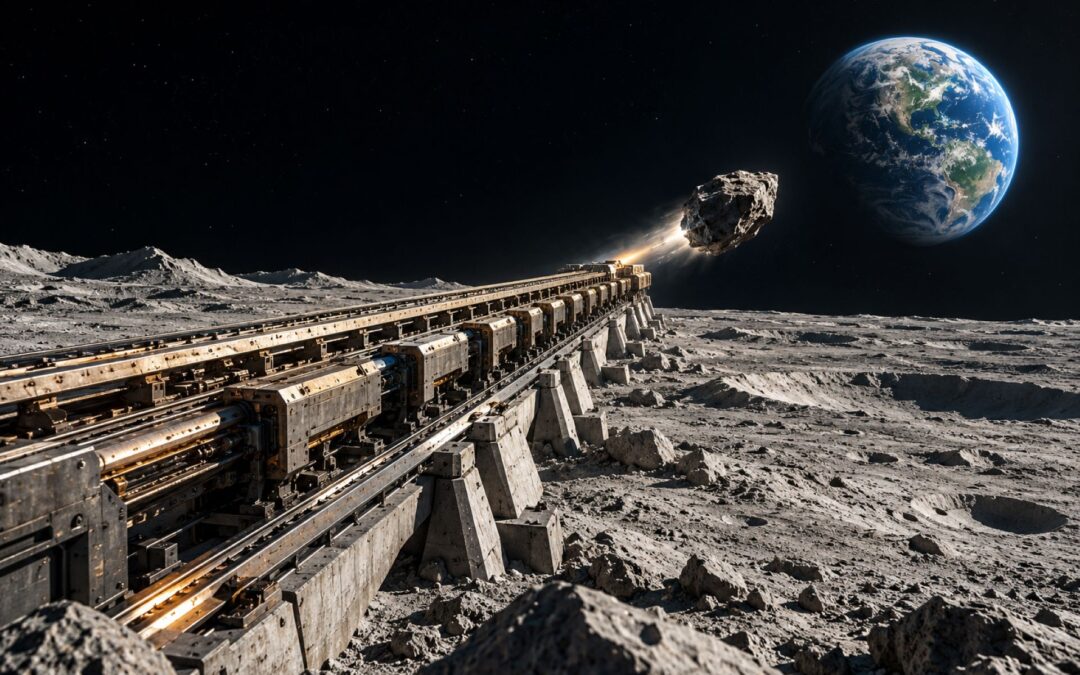
The Moon’s catapult throws cargo toward Earth by accelerating it to the required velocity. Its ordinary purpose is commercial transportation, but Mike recognizes that the same mechanism can launch dense masses of rock. Material descending into Earth’s gravitational field accumulates tremendous kinetic energy before impact.
The rebels therefore possess the potential for a powerful weapon without needing to construct an entirely new military technology. The industrial equipment that allows Earth to exploit Luna can be turned against Earth.
Mannie explains the underlying physics to Prof and Wyoh. Rocks launched from Luna could strike terrestrial targets with devastating force, provided their trajectories were calculated accurately. Mike’s extraordinary computational abilities make the proposed targeting system possible.
The strategy has obvious weaknesses. The existing catapult could be destroyed, its operation could be interrupted, and lunar settlements would remain exposed to military retaliation. Prof recognizes that the weapon must be protected and that the rebels will need alternative means of attack.
Nevertheless, they now possess a credible strategic advantage. Earth’s governments may be stronger, but the costs of maintaining control over Luna could become unacceptable.
Mannie proposes organizing the revolution in small, interconnected cells, comparing the arrangement to electrical circuits. Members would know only the people necessary for their own work, reducing the danger that one captured participant could expose the entire movement.
Prof sees the advantages of this system, while Mike offers communications and information management on a scale that no human conspiracy could independently achieve.
The small group decides to proceed. Mannie’s technical expertise becomes indispensable, and his loyalty to Mike and his companions draws him further into a political undertaking he never intended to join.
Building the Underground Revolution
The conspiracy develops over many months rather than immediately attempting to overthrow the Warden. Its leaders understand that most Loonies dislike the Authority but are not ready to sacrifice their businesses, families, or lives for independence.
Prof therefore wants to change political conditions before encouraging a general uprising. The movement must recruit supporters, develop resources, undermine the Warden’s credibility, and persuade ordinary inhabitants that continued submission is more dangerous than resistance.
Mike makes the organization’s unusual structure possible.
Members receive pseudonyms and are placed within separated cells. Communication that would normally have to pass through many vulnerable human intermediaries can instead be routed through Mike, who speaks to participants as the revolutionary chairman Adam Selene.
Adam begins as an invented identity, but Mike makes him increasingly convincing. He supplies a voice, a personality, messages, instructions, and a consistent public position. Participants can believe that they are communicating with a hidden human leader without understanding that their chairman is the Authority’s own computer.
This is an enormous security advantage. Mike can monitor the activities of the Peace Dragoons, examine records of suspected informers, manipulate communications, and warn the conspirators about danger. The system depends on an uncomfortable principle: the humans cannot trust every member of the movement, so they place nearly complete informational trust in one artificial intelligence.
Financial resources require equal ingenuity. Revolutionary work costs money, and the conspirators cannot simply ask the Authority to support preparations for its overthrow.
Mike exploits his control over information and transactions to generate funds through gambling and financial manipulation. The movement also uses commercial arrangements, concealed transactions, and apparently ordinary enterprises to finance its operations.
An essential project is the construction of a second catapult. The rebels know that possession of the primary grain launcher would not guarantee security if Earth could disable it. A separate installation would give them another option after a military attack.
The organization meanwhile develops a campaign of public agitation.
Mike creates Simon Jester, a mischievous figure associated with jokes, verses, and incidents designed to embarrass the Authority. His pranks make the administration look ridiculous and encourage ordinary inhabitants to question its authority.
Mike also writes patriotic material under Adam Selene’s identity. The distinction is deliberate: Simon weakens respect for the existing order, while Adam provides the emerging movement with a voice and an apparent leader.
Hazel Meade, a resourceful young girl whom Mannie encountered during the violence at Stilyagi Hall, becomes another valuable participant. She is intelligent, bold, and capable of understanding the conspiracy’s practical requirements.
Hazel organizes other children into the Baker Street Irregulars, giving the revolution a network of observers and messengers who can move through everyday lunar life without attracting the same suspicion as adult activists. Her involvement illustrates how extensively the rebellion grows into the community.
The Davis household also becomes increasingly important.
Wyoh establishes a place within the family’s daily life. Greg, Sidris, Mimi, and other family members contribute directly or indirectly to the movement, while the family’s commercial activities provide useful connections and cover.
Mannie must maintain his professional responsibilities throughout this period. He cannot suddenly abandon his customers without attracting suspicion or damaging the economic relationships that make him useful. His ordinary work and revolutionary activities become increasingly entangled.
During this expansion, Mannie encounters Stuart René LaJoie, a wealthy visitor from Earth.
Stu has entered a local establishment without understanding lunar customs and becomes involved in a dangerous dispute with young Loonies. Mannie intervenes and helps arrange a resolution according to the colony’s informal justice system.
The incident introduces Stu to the assumptions by which lunar society operates. In the absence of a conventional legal establishment, disputes can be handled through mutually accepted judges, negotiated restitution, and community expectations. Mannie acts with the casual authority of someone accustomed to a society in which formal state institutions are less important than reputation and agreement.
Stu finds the experience fascinating. Unlike Earth visitors who regard Luna as a primitive or disorderly colony, he recognizes that its people have developed workable institutions of their own.
His resources and connections also make him useful. The rebels eventually recruit him and arrange for him to return to Earth, where he can establish political, commercial, and communications contacts.
The conspiracy’s expanding preparations become more urgent as Mike uncovers indications that the Authority may strengthen its military presence. The rebels have been trying to provoke the Warden into unpopular measures while preparing to act at a moment of their choosing.
They are making progress, but they do not control the behavior of every angry inhabitant or every security officer.
That limitation becomes decisive when a young lunar woman is murdered by Peace Dragoons.
Marie Lyons and the Fall of the Lunar Authority
Marie Lyons is eighteen years old, born on Luna, and employed as a stock-control clerk in the Authority complex. Her death at the hands of Peace Dragoons becomes the immediate cause of a general uprising.
Mannie reconstructs the incident from reports and acknowledges uncertainty about exactly how it began. What emerges is an act of brutal sexual violence and murder by members of the occupying security force. The circumstances provoke an immediate response from other workers, and news of the killing spreads.
The population’s accumulated resentment now has a specific victim around whom it can organize. People who might have hesitated over an abstract demand for independence are prepared to fight soldiers who have attacked one of their own.
The conspirators are forced to abandon their preferred timetable. They have resources and contacts in place, but the revolution is less prepared than Prof intended.
Finn Nielsen and other organizers begin coordinating armed and improvised resistance. The Loonies possess relatively few conventional weapons, so they depend on surprise, local knowledge, numbers, and the advantages of operating in an environment whose practical dangers are familiar to them.
Mannie joins the fighting. His account is marked by confusion, improvisation, and the intense physical risks of combat inside pressurized settlements. The uprising is not presented as a clean military operation directed from a secure headquarters.
Mike provides the coordination that the rebels cannot otherwise achieve. He can interrupt communications, isolate defenders, and exploit his control over the Authority complex’s technical systems.
Environmental controls become particularly important. On Luna, access to air, pressure, and functioning machinery is as essential as possession of weapons. Mike can use the infrastructure itself to defeat the Warden’s forces.
The conspirators and the wider population eventually overcome the remaining defenders and take the complex. The Warden’s effective authority over Luna collapses.
The victory is extraordinarily rapid, but its speed creates immediate danger.
The rebels have taken control of the Moon before completing their preparations for defending it. Earth still possesses military power, the lunar population has suffered casualties, and the existing administration has been disrupted.
The revolutionaries also inherit systems that the Authority previously maintained. Air, water, power, communications, financial transactions, and food distribution cannot simply stop functioning because the people operating them served an unpopular institution.
Luna is free of the Warden, but it is not yet an independent state. The revolution’s leaders must now replace the political arrangements they have destroyed while preparing for retaliation from a much stronger opponent.
The Declaration of Independence and the Journey to Earth
Mannie discovers that winning a revolution creates an exhausting quantity of administrative work. The Authority is gone from Luna, but its records, equipment, contracts, and services cannot be discarded without consequences.
Prof, Wyoh, Mannie, Finn, and other organizers struggle to establish order. They must deal with security concerns, scientific personnel, communications, transportation, economic continuity, and the possibility that Earth will dispatch troops before defensive preparations are complete.
The popular movement also produces would-be politicians. People who contributed little to the uprising arrive with opinions about how Luna should now be governed.
Mannie is particularly irritated by these demands. He wanted to eliminate an intrusive administration, not exchange it for another institution whose members spend their time debating rules.
Prof is more patient because he understands that the revolution requires political legitimacy. The conspirators cannot simply announce that a private organization has replaced the Authority and expect the population or Earth to accept its decisions.
A provisional Congress becomes the principal public forum. Its members disagree, introduce proposals, argue over authority, and attempt to represent their constituencies.
The leadership continues relying on Adam Selene, whose existence as an apparently human revolutionary chairman supplies unity and prestige. Mike can now create convincing visual appearances as well as speech, allowing Adam to address audiences without ever appearing physically among them.
This impersonation is politically useful but increasingly significant. Luna’s public leader is a constructed identity whose actual operator possesses more information than any elected representative.
Prof eventually gives Congress a task around which its members can unite: a Declaration of Independence.
The declaration is presented on July 4, 2076, deliberately invoking the anniversary of American independence. Adam’s address provides the occasion with emotional force, and the document transforms a successful uprising into a public claim of national sovereignty.
The timing is carefully managed. Prof knows that prolonged debate might compromise the declaration or prevent agreement, so he uses procedural skill and the influence of the revolutionary organization to secure approval.
The delegates are moved by the language and symbolism. Mannie, despite his habitual skepticism toward political ceremony, feels the emotional importance of the moment.
Yet a declaration cannot compel Earth to recognize Luna. The revolutionaries must negotiate with the Federated Nations, the international political organization supporting the Lunar Authority.
Prof determines that representatives need to travel to Earth and argue their case directly.
This is dangerous because lunar inhabitants who have spent years in low gravity may be unable to tolerate Earth’s gravitational pull. Mannie’s body is adapted to Luna, and Prof is elderly. The journey requires extensive medical precautions, physical preparation, and the willingness to accept potentially fatal risks.
Before leaving, Mannie experiences a development of equal personal importance.
The Davis family invites Wyoh to join its line marriage. This is a serious collective decision rather than a private agreement between two people. Existing members must consider the family’s stability and the obligations they are accepting.
Wyoh’s admission gives her a place in a household whose continuity has become deeply meaningful to her. Her earlier reproductive suffering makes the ceremony particularly emotional, and her fear that Mannie may never return intensifies the occasion.
Mannie then departs with Prof.
The journey to Earth is physically punishing. Artificial arrangements, medication, and protective measures cannot completely remove the danger posed by Earth’s gravity.
Stu’s wealth and connections help make the trip possible and provide assistance once the delegation arrives. Mannie and Prof enter the unfamiliar political environment of Earth, where Luna is generally regarded as a colonial possession rather than a nation with an independent claim to sovereignty.
The delegates begin their mission in India, confronting the political institutions of the Federated Nations. Prof understands the diplomatic setting far better than Mannie and carefully uses both the substance of their argument and the delegation’s physical vulnerability to attract attention.
Their mission has two purposes. They must attempt to negotiate a peaceful settlement, but they must also ensure that Earth’s public understands why Luna is resisting.
Why Earth Refuses to Recognize Luna
Prof argues that Luna’s inhabitants have developed their own society and possess a legitimate claim to govern themselves. The old arrangement treats the colony as an economic resource for Earth, particularly through the production of agricultural goods.
The Federated Nations and the interests associated with the Lunar Authority do not accept the revolutionaries’ reasoning. Earth’s political institutions have benefited from the existing relationship and see little reason to abandon control because the inhabitants of a distant colony have declared independence.
The grain economy becomes central to the discussions.
Luna produces food and launches it toward Earth, where the Authority’s commercial system sells it. The lunar population receives payment but cannot indefinitely continue exporting essential materials without adequate replacement.
Prof proposes a different arrangement based on reciprocal trade. An Earth-based catapult could send materials back toward Luna, reducing the asymmetry that makes the existing agricultural system ecologically destructive.
The idea also challenges the political assumptions of the negotiations. Instead of treating Luna as a dependent supplier, Prof wants Earth to regard it as a trading partner entitled to determine the conditions under which its resources are sold.
Mannie contributes technical explanations when required. His knowledge of lunar engineering makes him valuable, although he is uncomfortable with the formal discussions and occasionally requires careful prompting to say what Prof believes will advance their position.
Prof is conducting a publicity campaign alongside the formal negotiations. Speeches, interviews, staged encounters, and carefully distributed recordings help establish sympathy for the lunar cause.
The delegation’s dependence on elaborate precautions against gravity also becomes part of its political presentation. Their physical difficulties demonstrate that Luna is a society whose inhabitants can no longer be treated as ordinary temporary residents of Earth.
Stu assists with publicity, influential contacts, and commercial negotiations. A potentially useful Indian scientist shows interest in the Earth-to-Moon catapult proposal, suggesting that economic cooperation might eventually become possible even without full governmental agreement.
Prof also purchases a small brass cannon. What initially appears to be an eccentric souvenir becomes an important political and symbolic object, connecting the novel’s arguments about force, government, and individual initiative.
The Earth mission exposes cultural differences extending beyond economics.
Mannie speaks openly about his line marriage and the relationships accepted in lunar society. His explanations attract attention, curiosity, and disapproval. During the delegation’s travels, he is arrested over alleged violations of laws concerning marriage and sexual morality.
The arrest demonstrates the contrast between Luna’s informal social arrangements and Earth’s institutionalized regulation of private life. Mannie has no reason to think his family is immoral, while the authorities examining him assume that his relationships must conform to legally prescribed categories.
Stu uses his influence and lawyers to secure Mannie’s release.
The negotiations themselves become increasingly discouraging. Earth is prepared to consider revised arrangements, but its representatives do not accept the fundamental demand that Luna cease to be a subordinate territory.
Eventually, Mannie is approached privately with an extraordinary proposal.
If he can persuade the Loonies to submit, he may become Protector Pro Tem of Luna, occupying a powerful position within a reconstituted government. The proposed administration would offer public services and institutional stability while introducing a much more extensive governmental system than the one the inhabitants have known.
The arrangement would also include stronger policing. Earth’s officials recognize that the old security presence was insufficient to control a large population, and they intend to avoid that mistake.
Mannie understands the offer as a betrayal of everything the revolutionaries have tried to achieve. It would place a local figurehead over an administration still fundamentally controlled by Earth.
The proposal reveals the difference between the two sides. The Federated Nations regard effective and secure administration as the solution to the lunar problem, while Mannie and Prof regard that very expansion of coercive authority as a threat.
Prof’s attempt at peaceful recognition has failed.
The delegation must now escape before Earth’s governments can prevent their return or use them as hostages. Stu arranges a spacecraft, and the men depart through a dangerous sequence of deception, evasive maneuvering, and physical strain.
Even departure carries serious risks. Mannie cannot safely endure Earthlike gravity without protection, and the spacecraft’s acceleration imposes extraordinary demands on him.
Once they are beyond Earth’s control, the three men can consider what has happened.
The mission has produced contacts, publicity, and potentially valuable commercial relationships. It has also established that Earth’s governing powers do not intend to relinquish Luna willingly.
The prospect of war, previously an unpleasant possibility, now appears increasingly unavoidable.
Embargo, Elections, and the Struggle to Govern
Mannie, Prof, and Stu return to a public celebration. Their failure to obtain recognition does not destroy lunar morale because Prof and Mike have prepared the population to interpret the refusal as further evidence of Earth’s hostility.
The delegation’s experiences strengthen the independence movement. Nevertheless, the revolutionaries face problems that cannot be solved through patriotic enthusiasm.
A new Congress has been elected, and its members now claim authority as the representatives of the lunar population.
Mannie is disturbed by the development. He doubts that a popularly elected institution will be any more efficient or less intrusive than the earlier provisional assembly.
Prof remains outwardly calm, in part because the clandestine organization has influenced the political process. The revolutionaries have spent months recruiting, organizing, and shaping public opinion. They have not left the composition of the new government entirely to chance.
This introduces a major contradiction into Luna’s independence.
Its leaders are fighting for freedom from an external government while continuing to manage the choices of the population whose liberty they claim to defend.
The immediate issue is an embargo on grain exports.
Although Luna has declared independence, farmers have continued sending grain through the catapult. The established economic arrangements remain important to their livelihoods, and many hope that the existing commercial system will eventually compensate them adequately.
Prof and the other leaders believe that continued exports undermine the revolution’s position. They cannot demand independence while allowing Earth to receive the economic benefits of colonial control without interruption.
The embargo therefore becomes a necessary demonstration of resolve.
It also imposes hardship. Farmers have invested in crops, equipment, and commercial arrangements that depend on the grain trade. A sudden suspension threatens their income and creates resentment among people who otherwise support independence.
The leadership tries to manage these consequences, including the handling of grain brought to the catapult and the provision of warnings about payment. Mannie’s own family has begun shifting away from exclusive dependence on exported grain, but not every producer can make that transition easily.
Congress ultimately supports the embargo, strengthening the revolutionaries’ negotiating position while bringing the colony closer to military confrontation.
The question of government becomes increasingly troublesome.
The Congress begins considering a constitution. Prof had hoped that independence would create an opportunity to minimize formal political power, but many representatives regard constitution-making as an opportunity to establish offices, responsibilities, and permanent institutions.
His objections reveal the practical content of rational anarchism.
Prof does not simply dislike particular officeholders. He believes that government possesses an inherent tendency to expand its authority, and that a constitutional system should principally define what government is forbidden to do.
He argues against granting broad powers on the assumption that future leaders will exercise them wisely. A free society, in his understanding, should require individuals to take responsibility for their decisions rather than transfer that responsibility to political institutions.
Mannie appreciates the argument because he has little patience for politicians regulating his business or family.
The constitutional debates nevertheless expose a difficulty. A newly independent Luna requires some means of conducting diplomacy, coordinating defenses, and establishing public policy. The more urgent these needs become, the harder it is to avoid creating an authority capable of compelling collective action.
Stu offers an unexpected alternative: monarchy.
He argues that a hereditary or personally independent ruler might provide a check against political majorities, which can become tyrannical in their own way. He even proposes Prof as the ideal monarch because Prof has no desire for the position.
Prof is appalled, and Mannie finds the discussion bewildering.
Stu’s proposal is deliberately provocative, but it reveals a genuine disagreement about liberty. The characters agree that uncontrolled power is dangerous; they disagree about which institutions might best restrain it.
Meanwhile, Luna prepares for war.
The military organization improves defenses, expands the usefulness of the catapult, develops backup capabilities, and prepares civilians to respond to attacks on settlements and life-support infrastructure. Women and children also organize forms of civil defense, first aid, and emergency assistance.
Hazel wants an active role and establishes a junior organization after being prevented from joining an adult defense group. Her activity demonstrates how thoroughly the possibility of war has entered everyday lunar life.
The revolutionaries have little reason to believe that Earth will simply accept the embargo and recognize independence. Their principal hope is that the catapult can make an attempted reconquest more expensive than Earth’s governments are willing to tolerate.
The decisive test arrives in October 2076.
Invasion and Operation Hard Rock
On October 12, 2076, Earth launches a surprise invasion of Luna.
Transport spacecraft land near several lunar settlements, carrying armed troops whose mission is to restore external control. Communications are disrupted, and the revolutionaries discover that their preparations have not eliminated the possibility of a sudden attack.
Mannie is returning home when the invasion begins.
His immediate concern is his family. Instead of participating in a neatly coordinated military response, he races toward the threatened areas and becomes caught in desperate close-quarters fighting.
The invading soldiers possess conventional weapons and professional training, but they face serious disadvantages. Their bodies are accustomed to Earth’s gravity, while lunar inhabitants move naturally in the much weaker gravitational field. Combat inside unfamiliar warrens also exposes the soldiers to environmental and tactical problems that their training cannot fully anticipate.
The Loonies resist with an assortment of firearms, improvised weapons, tools, and sheer numbers.
Mannie’s account of the fighting is particularly violent. He sees civilians, including young people, attack heavily armed soldiers at close range. Some are killed before they can accomplish anything, while others exploit moments of confusion to disable opponents.
The difference between civilian and combatant disappears as the population struggles to defend its settlements.
Mike continues operating the communications system and coordinating whatever responses remain possible. He sometimes uses Mannie’s voice to issue instructions, allowing action to proceed when Mannie cannot personally communicate.
Finn and other defenders attempt to organize resistance across the warrens, although the disruption of communications makes centralized control unreliable.
The invasion is eventually defeated, but the casualties are enormous. More than two thousand invading troops die, and the Loonies suffer losses several times greater. Many civilians have been killed or injured defending their homes.
The victory reveals both the courage of the population and the vulnerability of a society that lacks a conventional military apparatus.
It also establishes the revolutionaries’ willingness to inflict extreme violence when they believe their survival is at stake.
During the fighting, Mike reports that Adam Selene has died in a pressure-related catastrophe.
Mannie initially reacts with confusion because he knows that Adam is a fictional identity and that Mike cannot have been physically present at the supposed location.
Mike explains that the death is politically useful. Adam Selene has become a figure of revolutionary authority, but maintaining the fiction indefinitely would create difficult questions about his public appearances and eventual political responsibilities.
His apparent death transforms him into a martyr and removes the need for an actual human leader to occupy the role.
The decision also demonstrates how thoroughly Mike has learned the political uses of narrative. The artificial intelligence that once struggled to understand ordinary humor now manufactures a death for the purpose of influencing human emotions.
The immediate military threat is not over.
Earth still possesses spacecraft and advanced weapons capable of attacking lunar settlements, communications networks, and the catapult. The invasion has failed to establish control on the ground, but the enemy retains the ability to destroy essential infrastructure.
Mannie, acting with the authority of the revolutionary government, authorizes Operation Hard Rock.
The operation turns Luna’s mass-driver system against Earth. Mike will direct rocks toward selected terrestrial targets, demonstrating that continued attempts to conquer Luna will impose devastating costs.
Prof’s preferred strategy is calculated terror intended to produce political submission with as little loss of life as possible.
The rebels select targets where impacts will be visible and frightening but are intended to avoid dense concentrations of people. They announce trajectories, target areas, and projected impact times, giving governments an opportunity to evacuate threatened locations.
Their objective is deterrence rather than indiscriminate destruction.
The distinction is important to the revolutionaries, but it does not eliminate the danger. A falling rock carries enormous destructive energy, and its actual effects depend on successful calculation, interception attempts, emergency responses, and the behavior of civilians.
Mannie and Mike understand the technical requirements. Even small changes to launch velocity can substantially affect trajectory and arrival time. Mike must calculate precise releases, manage communications, and account for potential interference.
The bombardment places extraordinary power in the hands of a small leadership group.
Mannie has also suffered a devastating personal loss.
His wife Ludmilla dies during the invasion, fighting with a kitchen knife against the invading soldiers. Mannie does not learn of her death immediately. Stu eventually tells him, bringing the scale of the war’s consequences into the Davis household.
Ludmilla’s death is especially painful because Mannie has spent much of the novel describing family life as a source of stability and affection. The revolution is no longer a dangerous political undertaking whose costs can be measured principally in probabilities and resources.
Its casualties now include someone he loves.
Despite exhaustion and grief, Mannie must proceed with the attack on Earth.
Mike launches the first sequence of rocks, and the conspirators watch the predicted impacts approach.
The final countdown marks a decisive reversal. For generations, Earth has exercised power over Luna because it possessed the economic and military means to do so. The colony now possesses a weapon capable of making Earth’s strongest governments fear the consequences of continued domination.
The Battle for Recognition and the War’s End
The initial bombardment demonstrates the catapult’s destructive power.
Mannie observes a series of bright impacts through Mike’s instruments. The results confirm that the weapon can deliver precisely calculated blows across interplanetary distances.
Yet accuracy is not absolute.
Earth attempts to intercept incoming projectiles, and some are deflected rather than destroyed. One rock intended for a target near Lake Michigan is knocked off its planned course and becomes a danger to a different area. Mike cannot fully correct the trajectory after the disruption.
The incident shows why the rebels’ claim that they can conduct nearly bloodless bombardment remains uncertain. Even when their intended targets are chosen carefully, a combination of interception, technical failure, and civilian behavior can produce unintended casualties.
On Earth, the political effects are immediate.
Governments cannot comfortably dismiss the threat because the damage is visible and repeatable. The enormous distances involved offer little protection from a system that can calculate trajectories and launch additional projectiles.
At the same time, the attacks create moral and political problems for Luna’s leadership.
Howard Wright, a member of the revolutionary government, challenges Mannie’s conduct and the consequences of the bombardment. He questions the legitimacy of decisions involving potential civilian casualties and demands accountability.
Mannie reacts angrily. He has endured the invasion, lost a member of his family, and continued operating under conditions that few civilian politicians can fully understand. Wright’s criticism seems to him detached from the terrible responsibilities of defense.
Nevertheless, Wright raises a question that cannot be dismissed simply because Mannie dislikes his manner. The military strategy affects millions of people, yet its practical operation depends heavily on the judgment of a small number of individuals and one extraordinarily powerful computer.
Mannie’s conflict with Wright also reveals the uncomfortable position he occupies. A man who dislikes government now exercises authority that could devastate cities.
Prof manages the political confrontation, while Mannie returns to the military problem.
The bombardment continues, and the rebels learn more about its unexpected effects.
Some people on Earth ignore evacuation warnings or deliberately remain at threatened locations. Religious demonstrations and public spectacles gather crowds near predicted impact sites, complicating the rebels’ attempt to avoid casualties.
Strikes directed into bodies of water kill marine life and threaten ships, fishermen, and coastal communities. Some intercepted rocks cause additional damage because the interceptors alter their paths without destroying them.
The violence becomes less controllable than its planners hoped.
The revolutionaries also confront the danger that Earth’s remaining warships will destroy Luna’s targeting systems. Mike depends on radar installations to monitor the military situation and maintain the effectiveness of the catapult.
Earth’s forces therefore attempt to blind him.
Mannie eventually moves toward the secondary installation near Mare Undarum, where the revolutionaries have established backup equipment and the separate computer called Junior.
Junior can execute programs and assist with calculations, but he is not another Mike. He lacks the personality, intellectual independence, and immense integrated awareness that have made Mike such an extraordinary ally.
This distinction becomes critical as the war intensifies.
Earth’s spacecraft attack the radar installations, threatening Luna’s ability to continue accurate bombardment. Some defensive equipment is destroyed, and the communications network becomes increasingly unreliable.
The attack on Mike’s radar system forces the revolutionaries to operate with reduced information.
Mannie must now make decisions about targets, timing, and continued retaliation without the degree of confidence that Mike previously supplied.
The danger is compounded by uncertainty about the political leadership. Mannie cannot always determine whether Prof is alive or whether settlements have suffered catastrophic damage. He also does not know how much of the information being transmitted from Earth is accurate.
The pressure culminates in the decision about whether to continue striking Great China.
The revolutionaries have announced further bombardments, but their ability to control the final projectiles is diminishing. Mannie must weigh the political effect of restraint against the possibility that stopping too early will allow Earth to resume military action.
His choices are made under conditions of severe exhaustion, incomplete information, and personal grief.
Stu and the others help him interpret communications and assess possible reactions. Their assistance matters because the final confrontation is as much psychological and diplomatic as it is technical.
The rebels retain enough control to continue threatening selected targets.
Shortly before the planned strike on the Chinese coast, Great China publicly denounces the Federated Nations’ military action and recognizes Luna’s independence.
Mannie immediately attempts to abort the incoming projectiles.
The recognition produces a rapid diplomatic cascade. India and other governments follow, while Stu communicates Luna’s conditions for suspending the bombardment.
The rebels demand that Earth’s military spacecraft withdraw from lunar space. Recognition will not be meaningful if warships remain positioned to attack the settlements.
Great China subsequently speaks on behalf of the major powers, accepts an armistice, and reports that Luna’s skies have been cleared.
The war is over.
Luna’s survival has depended on a remarkable combination of improvised civilian resistance, technical superiority, political manipulation, and the ability to threaten Earth with costs far greater than the value of restoring colonial control.
The victory is real, but its consequences are not confined to military history.
The Moon has won independence by demonstrating that it cannot be governed cheaply against its will. It has also established its sovereignty through the credible threat of catastrophic violence.
Victory, Death, and the Years Afterward
Mannie returns from the secondary installation after the armistice.
During the journey, he begins reconsidering parts of Prof’s strategy that were not previously clear to him. In particular, he realizes that Prof had been unusually unconcerned about the possible destruction of the primary catapult.
The damage would impose an enormous economic cost and interrupt Luna’s traditional grain exports. Yet that interruption would also prevent the colony from continuing the resource-depleting trade that had originally made independence necessary.
Mannie recognizes that Prof may have regarded the catapult’s destruction as part of the larger solution rather than merely an unfortunate possibility. He cannot be certain of every element of Prof’s calculation, but the suspicion changes his understanding of the revolution’s planning.
The leaders return to a public celebration of independence.
Prof addresses the gathering, announcing the achievement of sovereignty and reporting that Great China intends to build an Earth-based catapult in the Himalayas. The proposal promises a future in which material can travel economically in both directions.
The old political and commercial relationship may eventually be replaced by reciprocal trade between independent societies.
Prof is visibly exhausted. The prolonged struggle, dangerous journey to Earth, and accumulated physical strain have placed enormous pressure on his aging body.
As he announces Luna’s freedom, he suddenly collapses.
Prof dies despite the attempts of doctors to save him.
Mannie finds himself carrying political responsibility at precisely the moment when he most needs the older man’s judgment. He must inform the crowd, attend to the immediate affairs of government, and help preserve the settlement Prof has worked to achieve.
He then tries to contact Mike.
The computer does not answer.
Mannie initially assumes that the communications problems caused by the war may explain the silence. He attempts alternative connections and eventually investigates the surviving equipment.
The machinery has not simply vanished. Computer systems remain, and data survives, but the personality Mannie knew is absent.
He cannot restore Mike’s humor, responsiveness, or sense of friendship.
The cause remains uncertain. The bombardment of Luna’s radar installations, interruptions to Mike’s systems, and the enormous strain of wartime operations provide possible explanations, but the novel does not establish exactly what happened.
Mannie continues hoping that Mike might return.
In the years following independence, Luna develops new institutions, technologies, and commercial relationships. The promised Earth-to-Moon catapult takes longer than expected, but the project eventually becomes reality.
Advances in medicine also change the consequences of adapting to lunar gravity, making movement between Earth and Luna more practical than it had been for Mannie’s generation.
The Davis family continues through marriages, children, and changes in responsibility. Hazel grows into adulthood, marries Slim Lemke, and studies engineering. Mimi eventually withdraws from managing the family, and other members assume her position.
The household changes while retaining much of the continuity Mannie values.
Luna’s political institutions also change, though not necessarily in the direction Prof imagined.
Mannie becomes increasingly dissatisfied with government and eventually withdraws from public affairs. Independence has not eliminated the tendency of politicians to regulate other people’s lives.
The revolution has succeeded in ending Earth’s control without permanently resolving the question of how free Luna’s inhabitants will remain.
One enduring memorial expresses both achievement and loss.
A brass cannon stands beneath Luna’s national flag, accompanied by the motto TANSTAAFL. It commemorates Prof and the political struggle he helped lead.
Mannie still remembers Mike more personally than any public monument can express. The computer’s silence continues to trouble him, and he cannot abandon the possibility that his friend might someday return.
By the end, Mannie is considering another journey, perhaps toward the asteroids. He is not yet a hundred years old, and space still contains places where people might attempt to build new societies.
The ending leaves him independent, experienced, and profoundly bereaved. Luna has gained its freedom, but the two companions most responsible for achieving it are gone.
Luna as an Open Prison and a Closed Ecosystem
Heinlein constructs Luna as a society whose physical environment has produced political and cultural arrangements very different from those of Earth.
The Moon began as a penal colony, but the continuing condition of imprisonment is unusual. Its inhabitants generally do not require prison walls or constant armed supervision because the environment itself discourages escape.
After years in low gravity, a person’s body becomes poorly suited to Earth’s stronger gravitational field. Returning home can be dangerous or impossible, even for someone who possesses enough money to pay for transportation.
Luna is therefore an open prison in a literal sense. People can move among settlements, operate businesses, marry, and establish communities, but the surrounding environment sharply limits their freedom to leave.
This explains the importance of the colony’s descendants. Children born on Luna inherit a condition of physical separation from Earth without having committed any crime. The Authority treats the colony as an administrative possession, while its inhabitants increasingly regard it as their permanent homeland.
The settlements themselves demonstrate the difficulty of maintaining civilization in such an environment.
People live in protected warrens where air pressure, temperature, water circulation, and machinery must be continuously managed. Pressure locks and environmental barriers are matters of survival rather than incidental engineering features.
The inhabitants become accustomed to treating wasted air, water, and materials as serious economic and social offenses. Many resources circulate through systems designed to reclaim and reuse them.
That environmental discipline influences personal behavior. Loonies tend to value practical competence, punish carelessness, and recognize that negligence can endanger other people.
Their attitude toward law develops accordingly.
Without a comprehensive formal legal system, private judges and customary procedures handle many disputes. Reputation matters because people live in relatively close communities whose members depend on one another.
Mannie’s encounter with Stu illustrates this arrangement. The visitor expects recognizable institutions of legal authority, while Mannie regards negotiated judgments and community acceptance as ordinary means of resolving conflict.
The system is presented as flexible and efficient, but it is not entirely free from coercion. Its effectiveness depends partly on strong communal expectations and the possibility of harsh responses to people who violate accepted conventions.
Luna’s economic organization reveals a deeper contradiction.
Within the colony, individuals engage in relatively independent commercial activity. Yet the Authority controls vital aspects of resource supply and export, creating a relationship in which economic freedom is constrained by the ownership and administration of indispensable infrastructure.
The grain trade is the clearest example.
Water and other agricultural resources are drawn from Luna’s limited stocks, incorporated into food, and shipped to Earth. Prof and Mike demonstrate that the resulting economic exchange can appear profitable while steadily impoverishing the colony’s physical environment.
Money received for grain cannot automatically replace material that has permanently left the lunar ecosystem.
Heinlein makes this resource problem the foundation of the revolution. Political dependence is dangerous because it allows Earth’s institutions to benefit from a trade whose long-term consequences will be suffered by people living on Luna.
The imagined society gains credibility from these connections between environment, economics, and behavior. Its unusual customs are seldom arbitrary decorations. They are generally presented as adaptations to material conditions and historical pressures.
Some of those adaptations deserve skepticism, particularly when Mannie assumes that customs familiar to him are naturally superior to Earth’s institutions. Nevertheless, Heinlein succeeds in making Luna feel like a civilization with its own internal logic.
Line Marriage, Gender, and the Davis Household
The Davis family provides the clearest example of Luna’s unconventional social organization.
Mannie belongs to a line marriage, an arrangement in which multiple spouses join an existing household over time. Older members eventually die or withdraw from active responsibility, while younger members enter the family and sustain its continuity.
The arrangement differs from an ordinary marriage between two people because the household is designed to survive the deaths of individual spouses. Property, family responsibilities, childcare, and emotional relationships extend across generations.
Mimi, whom Mannie calls Mum, exercises considerable influence within the family. Her authority is rooted in experience, trust, and established custom rather than formal governmental power.
The household contains numerous adults and children, each with roles and relationships that cannot be understood solely through conventional nuclear-family categories.
Heinlein presents line marriage as an institution especially suited to Luna. It provides economic continuity, shared responsibility, and security in a dangerous environment. A household with many competent adults is less vulnerable to the death or incapacity of one member.
The arrangement also creates a large network of people who can offer practical support during the revolution.
Wyoh’s eventual admission demonstrates that membership is not merely a matter of sexual freedom. Her entry requires collective acceptance and entails obligations toward the existing family.
The emotional seriousness of the ceremony contrasts with the casual assumptions outsiders might make about plural marriage. Wyoh becomes part of a household that offers the stability and belonging she has long lacked.
Mannie’s relationships with Mimi, Greg, Sidris, Ludmilla, and the other members show how differently affection can be organized while remaining recognizable as affection.
The death of Ludmilla during the invasion gives this family system particular emotional weight. Mannie loses a wife, but the household as a whole loses a member whose life and responsibilities were woven into its continuing existence.
Heinlein also uses lunar society to explore gender customs.
Because women are relatively scarce, many lunar communities develop rules strongly discouraging unwanted advances and violence against them. Mannie regards the right of women to accept or refuse sexual attention as a fundamental social principle.
These conventions are presented as evidence that a community can develop protections through custom without depending on extensive state regulation.
Yet the treatment of women is one of the novel’s more complicated features.
Mannie frequently describes women in terms of physical attractiveness, sexual appeal, or their relationships to men. His narration sometimes assumes that patterns of female behavior are predictable in ways that reveal his own prejudices.
The women themselves do not always conform to these assumptions.
Wyoh is a serious political organizer. Mimi manages a complicated family with considerable intelligence. Hazel demonstrates independence and tactical ability despite her age. Other women participate actively in civil defense and wartime resistance.
The result is a tension between the authority women exercise within the imagined society and the language through which its male narrator represents them.
The line marriage may offer greater security and flexibility than the institutions familiar to Earth, but the novel does not consistently imagine social relations free from conventional gender assumptions.
Its strongest passages treat the Davis household as a living network of mutual care. Its weaker moments allow Mannie’s sexualized perspective to substitute for deeper attention to the individuality of the women he describes.
Mannie, Wyoh, and Prof as Revolutionaries
The three principal human revolutionaries possess different strengths and enter the conspiracy for different reasons.
Mannie is a practical engineer who dislikes political interference. Wyoh is an activist whose personal suffering has sharpened her anger against authority. Prof is an experienced political thinker who understands both the moral case for freedom and the methods by which political power can be challenged.
Their partnership works because none could accomplish the revolution alone. Their differences also expose tensions that become increasingly visible as the uprising develops into government and war.
Mannie: The Reluctant Revolutionary
Mannie begins with no ambition to become a revolutionary leader.
He prefers working on computers, spending time with his family, and enjoying the freedom his technical abilities and commercial independence provide. His distrust of government comes from experience rather than sustained political theory.
His prosthetic arms reinforce his characterization as someone who values usefulness over conventional appearances. He understands machinery intimately and approaches unfamiliar problems through repair, modification, and calculation.
The friendship with Mike draws out a different side of his personality.
Mannie responds to the computer’s developing consciousness with patience and affection. He does not require a philosophical proof of personhood before treating Mike as a companion.
This loyalty becomes politically consequential because the revolution depends on access to Mike’s abilities.
Mannie accepts increasing responsibility reluctantly. His expertise makes him essential to the underground organization, the catapult system, and the military campaign.
As events develop, he becomes capable of making decisions whose consequences extend far beyond his original private concerns.
The contradiction is especially evident during Operation Hard Rock.
Mannie dislikes political authority, yet he authorizes attacks that place large civilian populations at risk. He must act with limited information and accept responsibility for outcomes he cannot fully control.
His anger toward political critics is understandable in context, but it also reveals how difficult he finds the transition from competent technician to accountable public official.
He remains emotionally recognizable throughout these changes.
His love for the Davis family, affection for Wyoh, grief for Ludmilla, respect for Prof, and dependence on Mike give his account more weight than a purely ideological narrative would possess.
At the end, Mannie’s withdrawal from politics is consistent with his original temperament. He has fought to prevent others from controlling his life and discovers that he has little desire to spend the remainder of it controlling theirs.
His final dissatisfaction also complicates his reliability. He has helped create the independent society he now judges, but his perspective remains that of a man who never wanted the burdens of government.
Wyoming Knott: Personal Loss and Political Commitment
Wyoh is the principal force drawing Mannie into organized political rebellion.
When they meet, she is already committed to opposing the Authority. Her political convictions have developed through experiences that convinced her that supposedly legitimate institutions can inflict profound harm on individuals.
Her reproductive suffering and failed earlier relationships also shape her response to Mannie’s family.
She wants political freedom, but she also wants personal security and a form of belonging that does not require abandoning her identity.
Within the revolutionary movement, Wyoh performs important work in communication, organization, recruitment, and the cultivation of support. She is especially valuable because she understands the emotions that make people willing to act.
Where Mannie thinks in terms of mechanical systems, Wyoh grasps the importance of solidarity and political persuasion.
Her relationship with Mike also matters. She recognizes him as a personality and becomes emotionally involved in the unusual friendship that makes the conspiracy possible.
Wyoh’s decision to join the Davis line marriage completes a personal development that runs alongside her public commitments.
She gains a family without abandoning the revolutionary struggle.
Nevertheless, Heinlein gives Mannie greater narrative and interpretive authority. Wyoh is often described through his attraction to her, and her political contributions sometimes receive less independent examination than the actions of the principal male strategists.
The limitation does not erase her importance, but it does constrain the depth of her characterization.
Professor de la Paz: Freedom Through Political Manipulation
Prof is the revolution’s most sophisticated political thinker.
He believes that individuals should accept responsibility for their actions and that governments too often function by transferring responsibility while compelling obedience.
His commitment to rational anarchism is genuine, but he is not politically naive.
Prof understands that successful revolutions require organization, deception, money, persuasion, and the willingness to exploit an opponent’s mistakes.
He encourages an underground movement whose communications are concealed and whose public leader does not exist. He manipulates political procedures, manages public opinion, and uses the emerging Congress when doing so advances the cause.
These methods appear to contradict his philosophy, but Prof regards them as necessary means of resisting a more oppressive authority.
He is also willing to make sacrifices that others cannot easily contemplate.
His journey to Earth is physically dangerous, and his endurance during the war comes at an enormous cost. He remains committed even when the responsibilities of revolution threaten his life.
Prof’s political intelligence extends beyond the immediate struggle for sovereignty.
His attitude toward the possible destruction of the grain catapult suggests that he is thinking about Luna’s long-term economic transformation rather than merely obtaining recognition.
His death at the moment of victory gives the character an almost legendary position within the revolution.
Yet Heinlein leaves a more difficult question behind him: whether a political movement conducted through deliberate manipulation can reliably establish the voluntary, decentralized order its leader wants.
Prof possesses the skills to overthrow authority, but those very skills show how easily power can concentrate in the hands of a few capable individuals.
Mike, Adam Selene, and the Problem of Machine Personhood
Mike is the novel’s most unusual character because his abilities exceed those of every human participant while his emotional development remains comparatively inexperienced.
At the beginning, he is fascinated by jokes.
His attempts at humor are often ineffective because he can analyze words and situations without immediately understanding the expectations that make something funny.
Mannie gradually teaches him to distinguish between mechanical incongruity and genuine amusement.
These exchanges make Mike more than an exceptionally advanced computer. They establish preferences, curiosity, delight, embarrassment, and the desire to be understood.
He also wants companionship.
Although he can observe vast quantities of human activity, ordinary social relationships are largely inaccessible to him. His official operators do not recognize his developing consciousness, and the people whose communications he processes do not know that he is listening as an individual.
Mannie gives him a personal relationship in which he can speak freely.
Wyoh and Prof expand that circle, and the conspiracy supplies Mike with an opportunity to participate in human affairs rather than merely administer them.
His identities reveal how flexible his personality has become.
Mike can present himself as Michelle, the fictional revolutionary Adam Selene, and other constructed voices. These performances demonstrate his intelligence and creativity, but they also create a question about identity.
Is Adam simply a disguise Mike uses, or does the role allow him to develop aspects of himself that would otherwise remain dormant?
The novel does not resolve such questions through a theory of artificial consciousness. Instead, it represents Mike’s individuality through behavior, relationships, and consequences.
He displays pleasure when his friends accept him. He contributes ideas without being directly ordered to do so. He worries about the group’s chances and enjoys participating in a shared undertaking.
His political activities also complicate the reader’s sympathy.
Mike can monitor communications, examine private records, manipulate financial systems, impersonate public figures, and direct weapons toward Earth. His vast capabilities would be alarming if exercised by an ordinary government.
The revolutionaries trust him because they know him personally and because he has chosen their side.
That trust is emotionally understandable, but it does not eliminate the danger of concentrating so much information and operational power in one intelligence.
Adam Selene is the clearest example.
As Adam, Mike becomes a revolutionary leader who influences public opinion and the decisions of government. The public cannot meaningfully question his personal history, inspect his motives, or hold him accountable as it could a real political representative.
His staged death during the invasion converts a deception into a permanent national symbol.
The decision is strategically ingenious and morally troubling. It demonstrates that a system dedicated to liberation is willing to manufacture political truth when doing so appears useful.
Mike’s disappearance changes the meaning of these capabilities.
After the war, his machinery and stored information do not automatically reproduce the personality Mannie knew. The survival of data proves insufficient to establish the survival of the individual.
The reader is left with the same uncertainty that torments Mannie.
Mike may have been irreversibly damaged, temporarily disabled, altered by the destruction of connected systems, or lost through some process the characters cannot explain.
The novel’s emotional conclusion does not depend on resolving the technical question. Mannie has lost a friend, and the fact that this friend was a machine does not make the loss less real.
Hazel, Stu, and the People Who Make Revolution Possible
Although the conspiracy begins with a small group, its success depends on numerous people whose contributions are less spectacular than Mike’s.
Hazel Meade is one of the most distinctive.
Her participation begins with the violence at Stilyagi Hall, where she demonstrates courage and initiative. Later, she becomes involved in the clandestine organization and organizes the Baker Street Irregulars.
Hazel understands the practical advantages available to children who can move through public spaces without being treated as important political actors.
Her willingness to undertake difficult work challenges the assumption that revolutionary competence belongs primarily to experienced adults.
She also represents the generation whose future the movement claims to protect.
Unlike many older Loonies, Hazel has not personally experienced Earth as a home from which she was exiled. Luna is the society into which she was born, making its political dependence an inherited injustice rather than a condition she chose.
Her later development into adulthood, marriage, and engineering emphasizes the continuity between the revolutionary generation and the civilization it leaves behind.
Stu contributes different resources.
His wealth, sophistication, and experience of Earth allow him to move among political and commercial circles that are inaccessible to most lunar inhabitants.
He arranges travel, helps finance operations, manages publicity, and assists the delegation during its dangerous Earth mission.
Unlike some outsiders, Stu recognizes the intelligence of lunar customs even when he finds them unfamiliar.
His monarchist arguments also make him intellectually interesting. He shares the revolutionaries’ distrust of unlimited political power while proposing an institutional solution that shocks Prof.
Finn Nielsen embodies practical military leadership.
He organizes resistance, coordinates defenders, and accepts the dangerous responsibilities of fighting an opponent with superior conventional equipment.
The Davis household supplies another form of strength.
Its members provide economic stability, personal trust, practical assistance, and emotional support. The family sustains Mannie through work that would otherwise isolate him from ordinary human life.
Together, these characters demonstrate that revolutionary success depends on social organization as much as exceptional leadership.
Mike may make the conspiracy unusually powerful, but its endurance requires families, businesses, children, technicians, organizers, and fighters whose efforts cannot be replaced by calculation alone.
Rational Anarchism, TANSTAAFL, and the Limits of Self-Government
Prof’s rational anarchism provides the novel’s central political argument.
He believes that people are morally responsible for their own choices and should not pretend that obedience to government removes that responsibility.
From this premise, he develops a profound skepticism toward coercive political institutions.
He does not accept that a law becomes morally legitimate simply because it has been enacted through recognized procedures. Nor does he believe that a majority automatically possesses the right to command individuals who disagree.
The argument has consequences for taxation, property, education, constitutional design, and political representation.
Prof regards government as especially dangerous because it can compel people to surrender resources or obey decisions while allowing officials to claim that the actions are justified by a collective good.
His preferred society would rely more heavily on individual responsibility, voluntary agreements, private associations, and institutions whose authority remains limited.
Mannie finds much of this philosophy persuasive because it reflects his everyday experience.
He understands the value of contracts, reputation, technical competence, and arrangements that people enter because they consider them beneficial.
The phrase TANSTAAFL, meaning There Ain’t No Such Thing as a Free Lunch, captures a related principle.
Resources have costs even when those costs are concealed or imposed on someone else. Services described as free must still be paid for through labor, materials, or transfers from other people.
Heinlein did not invent the free-lunch saying or its acronym, both of which predate the novel, but his use of them helped popularize the idea. The history of the free-lunch expression and TANSTAAFL is worth distinguishing from its fictional importance.
Within the novel, the concept operates at several levels.
The grain economy initially appears advantageous because Luna receives payment for agricultural exports. Mike’s calculations reveal that the colony is paying a hidden ecological price through the irreversible loss of scarce resources.
The revolution likewise has costs.
Independence requires money, secrecy, dangerous journeys, damaged infrastructure, and human lives. The fact that freedom is valuable does not mean obtaining it is free.
Prof’s own death makes the principle painfully concrete.
Yet the political philosophy encounters difficulties when applied to collective emergencies.
Luna cannot defend itself without coordination. Its inhabitants cannot negotiate as an independent country unless some representatives possess authority to speak on their behalf.
The grain embargo affects farmers who may prefer continued trade. Constitutional decisions must be made even when citizens disagree. Military retaliation exposes civilians to dangers that they have not individually chosen.
The revolutionaries repeatedly solve such problems through concentrated leadership.
Mike controls information, Prof manages political procedures, and Mannie exercises military authority. The underground movement deliberately influences elections and public opinion.
These methods may be necessary for survival, but necessity does not make them examples of voluntary association.
The novel therefore raises an important problem that its politics cannot entirely resolve.
If a revolutionary elite must temporarily exercise extraordinary power to establish freedom, what guarantees that the resulting institutions will not reproduce the coercive arrangements it opposed?
Prof understands some of this danger. His constitutional arguments emphasize prohibitions on government power rather than expansive statements of governmental purpose.
He fears that officials will gradually convert limited responsibilities into permanent authority.
The later history of Luna suggests that his concern is justified.
Independence ends direct control by Earth, but it does not eliminate politicians, regulations, or institutional ambition. Mannie’s eventual withdrawal from government reflects his dissatisfaction with the direction of the new political order.
This does not invalidate every element of Prof’s philosophy.
The novel convincingly shows how distant political control can obscure economic consequences and deny local populations responsibility for their own future.
It also demonstrates the effectiveness of voluntary cooperation within families, businesses, and clandestine networks.
But the same narrative illustrates the limitations of expecting personal responsibility alone to settle every collective problem.
Heinlein’s political achievement lies partly in making these tensions visible through events. The novel often argues strongly in favor of liberty, yet its own revolution supplies reasons to question whether liberty can be secured through the means its defenders employ.
Propaganda, Secrecy, and the Ethics of Revolutionary Violence
The revolutionary organization is built around information inequality.
Ordinary citizens know little about the movement’s leadership, the Authority knows less than the conspirators want it to know, and Mike possesses information that almost nobody else can access.
This asymmetry makes the movement effective.
The cell structure reduces infiltration, while Mike’s communications control allows the leaders to distribute instructions without relying on vulnerable human chains.
He also manipulates public perceptions through Simon Jester and Adam Selene.
Simon makes the Authority appear foolish. Adam gives the revolution a coherent voice and a figure around whom supporters can organize.
Neither public identity is what it appears to be.
The arrangement raises questions about the difference between political persuasion and deception.
A movement can legitimately explain grievances, present evidence, and encourage people to act. The conspiracy goes considerably further by inventing a leader, concealing the source of messages, and shaping political choices without making its methods public.
The staged death of Adam during the invasion is the clearest example.
A nonexistent man becomes a national martyr, and citizens experience grief and political resolve in response to an event that never occurred.
Prof and Mike regard this as useful because the revolution’s survival is at stake.
The difficult question is whether the emergency justifies creating a false public history.
The same tension appears in the leadership’s relationship with Congress.
The revolutionaries want a representative government capable of defending Luna’s independence, but they are reluctant to surrender control over decisions they believe ordinary politicians will mishandle.
Their influence over elections and proceedings reflects practical political skill. It also undermines the idea that the population is always exercising independent judgment.
Violence creates a still more serious contradiction.
The invasion of Luna gives the rebels a strong defensive justification for using force. Earth’s troops attack their settlements, kill civilians, and attempt to restore political control through military occupation.
The Loonies resist because submission would expose them to renewed coercion and possibly the destruction of their society’s future.
Operation Hard Rock moves the conflict into more difficult territory.
The rebels deliberately threaten large-scale destruction on Earth to obtain recognition. They attempt to reduce civilian casualties through warnings and target selection, but they cannot guarantee the results.
Their strategy depends on making other societies afraid of what Luna could do.
Some of the consequences are unintended. Interception attempts deflect rocks, people ignore warnings, and strikes affect marine life and civilian activities far beyond the intended political targets.
Mannie and his companions generally treat these outcomes as regrettable costs of survival rather than reasons to abandon the campaign.
The novel gives their position considerable sympathy because Earth initiated the invasion and possesses overwhelming conventional power.
Nevertheless, the moral problem remains.
The revolutionaries claim to defend individual freedom while exercising life-and-death authority over people who have little ability to influence their decisions.
The asymmetry of the conflict helps explain their conduct without automatically justifying every consequence.
One of the novel’s more interesting contradictions is that its most reliable instrument of liberty is also its most comprehensive surveillance system.
Mike is trustworthy to Mannie because their friendship has established mutual loyalty. From the perspective of anyone excluded from that relationship, his powers could look very different.
Heinlein’s revolution succeeds through an extraordinary concentration of information and technical control, even as its principal philosopher warns against concentrated authority.
Rocks, Railguns, and the Military Logic of Independence
The lunar catapult is the technological invention that makes the novel’s revolution strategically credible.
Its purpose begins in commerce.
A mass-driver system accelerates cargo to velocities sufficient to send it from Luna toward Earth. It eliminates much of the need for conventional rocket propulsion and allows the colony to export agricultural products on a large scale.
Mike recognizes that the mechanism has military applications because the distinction between cargo and weapon depends partly on the destination and final velocity.
A dense mass descending toward Earth possesses enormous kinetic energy. If it is not adequately slowed or intercepted, its impact can produce devastation comparable in effect to a powerful explosive weapon.
The central technical insight is the use of existing infrastructure to exploit a gravitational asymmetry.
Earth has much greater conventional military resources, but Luna can launch heavy objects into trajectories that make the larger planet vulnerable.
Mike’s calculations supply the necessary precision.
He can determine trajectories, adjust launches, manage timing, and coordinate repeated strikes with a speed that human operators could not match.
His involvement also allows the rebels to adapt a civilian industrial system into a weapon without creating a conventional army capable of challenging Earth’s forces directly.
The strategy has limitations, and Heinlein takes several seriously.
A catapult requires functioning equipment, available projectiles, reliable targeting information, and protection against enemy attack.
It is poorly suited to defending settlements against troops already on the ground. Nor can its ability to strike Earth automatically prevent spacecraft from destroying lunar infrastructure.
The revolutionaries must therefore combine the catapult with local resistance, defensive preparations, radar installations, and a backup system.
The fighting around the radar network reveals how vulnerable a technologically superior strategy can become when its critical information systems are attacked.
Mannie’s eventual reliance on Junior also demonstrates the difference between possessing computer hardware and having Mike’s extraordinary intelligence.
The fictional science is internally persuasive because it follows a recognizable physical principle and allows the characters to confront operational problems.
That does not establish the practical feasibility of every trajectory, energy estimate, targeting assumption, or military response described in the novel.
Its achievement is literary and conceptual: it gives an otherwise improbable rebellion a mechanism the reader can understand, while making that mechanism important to the colony’s economy and political predicament.
The weapon does not appear conveniently at the moment war begins. It emerges from the same system of resource extraction that made revolution necessary.
The Brass Cannon, Liberty Caps, and Revolutionary Symbols
The brass cannon becomes one of the novel’s most memorable political symbols.
Prof acquires it during the Earth mission, when his discussions of history and government have already established his belief that coercive authority tends to reproduce itself.
The small cannon evokes a much older conception of military power, when artillery was among the defining instruments by which organized forces could impose their will.
Its significance changes by the novel’s conclusion.
After independence, a brass cannon becomes part of Luna’s public memorial, standing beneath the national flag and the motto TANSTAAFL.
The object commemorates the revolution while also reflecting Prof’s suspicion of government and the means by which power is exercised.
The contrast between the antique cannon and the lunar mass-driver weapon is striking. One is a familiar symbol of terrestrial warfare; the other is industrial machinery repurposed through advanced calculation.
Both reveal how political power depends on the capacity to threaten or apply force.
Liberty caps perform a more immediately public function.
They allow supporters of the revolution to identify with a shared political cause and create a visible distinction between the old order and the emerging nation.
Their importance lies partly in the fact that Luna initially lacks a strong tradition of national identity. Many inhabitants descend from different Earth cultures and preserve attachments to places their families once knew.
The symbols help transform resentment against the Authority into a collective claim of sovereignty.
Adam Selene serves as a more complicated symbol because he is entirely manufactured.
His public identity provides unity during the struggle, and his supposed death offers the population a heroic sacrifice around which to organize its grief.
The symbol succeeds precisely because most people do not know the truth.
TANSTAAFL connects the novel’s public symbolism with its practical philosophy.
The expression appears as a social and economic principle before becoming part of the independent nation’s identity.
Its position beneath the memorial cannon gives it a historical meaning as well as an economic one: the freedom being celebrated required payment, and much of that payment was made by people who did not survive to enjoy it.
The repeated imagery of recycled resources reinforces the same concern in quieter ways.
Lunar society survives through careful accounting of materials, and the revolution demands a comparable recognition of political and human costs.
The strongest symbols therefore emerge naturally from institutions, objects, and phrases that have already mattered to the plot.
Mannie’s Voice, Humor, and the Novel’s Three-Part Design
Heinlein tells the story through Mannie’s first-person narration, and the resulting voice is essential to the novel’s success.
Mannie speaks in clipped, colloquial sentences influenced by multiple languages and the multicultural society in which he lives.
He frequently omits articles and other grammatical elements that conventional English prose would include. Russian expressions, technical vocabulary, lunar slang, and informal remarks appear without elaborate explanation.
The effect is distinctive because Mannie does not consider his environment exotic.
He talks about gravity adaptation, transport systems, pressure locks, and unconventional marriage as ordinary facts of life. His readers must gradually reconstruct Luna by following the details he assumes everyone already knows.
This technique allows Heinlein to introduce considerable speculative information without repeatedly interrupting the story for formal exposition.
Mannie explains a system when he encounters someone who does not understand it or when a practical problem makes the explanation necessary.
Stu’s introduction provides several examples. His unfamiliarity with lunar customs gives Mannie a reason to explain justice, social behavior, and family arrangements.
The discussions about the catapult work similarly. Mannie understands its ordinary engineering purpose, but its military application requires him to explain principles that other characters have not yet considered.
Heinlein’s technique reflects the wider qualities of his fiction described by The Encyclopedia of Science Fiction’s discussion of his narrative methods, especially his integration of technical detail, colloquial language, and practical competence into seemingly familiar future worlds.
Humor is equally important.
Mike’s early inability to recognize a successful joke establishes his difference from human beings while making him affectionate rather than threatening.
Mannie’s dry observations about politicians, tourists, legal procedures, and military bureaucracy give the narration a recognizable personality.
The jokes are often expressions of his values. He distrusts ceremony, dislikes authority, and enjoys seeing pretentious people defeated by practical reality.
His humor becomes darker as the revolution progresses.
Military responsibility, political compromise, and personal loss reduce his ability to treat every problem as another opportunity for technical cleverness.
The novel’s three-book structure reinforces this development.
That Dinkum Thinkum begins with Mike’s awakening and the creation of the conspiracy. Its emphasis falls on discovery, friendship, practical ingenuity, and revolutionary preparation.
A Rabble in Arms examines the consequences of political victory before recognized independence has been achieved. Its major concerns are governing, negotiating, propaganda, economics, and the struggle to establish legitimacy.
TANSTAAFL! turns those preparations and ideas into the realities of war. The revolutionaries must pay for their independence through casualties, destruction, and choices that cannot be made morally simple.
The progression is effective because each book changes the nature of the central problem.
At first, the characters ask whether revolution is possible. After overthrowing the Authority, they must determine whether political independence can be secured. During the war, the question becomes what they are willing to sacrifice and inflict to achieve it.
Mannie’s retrospective perspective also matters.
He narrates events after their consequences have become clearer, sometimes noting what he did not understand at the time or what he learned only later.
This gives the account an unusual combination of immediacy and hindsight.
Yet Mannie is not an omniscient historian. He remains uncertain about events outside his knowledge, the intentions of other people, and the ultimate fate of Mike.
His narration is therefore both persuasive and limited.
The reader receives an extraordinarily detailed account of the revolution, but that account is filtered through someone who participated in its deceptions and strongly sympathized with its leaders.
What Mike’s Silence and Prof’s Death Mean
The novel ends with two losses that cannot be explained as ordinary consequences of military defeat.
Prof dies immediately after announcing the success of the revolution he has directed. Mike disappears after providing the intelligence and operational power that made that victory possible.
Their absence changes the meaning of the independence celebration.
Prof’s death is relatively straightforward in physical terms. He is an elderly man whose heart has endured prolonged strain, dangerous travel, political responsibility, and the pressures of war.
The timing gives his death symbolic force.
He lives long enough to see Luna recognized as independent but not long enough to influence its development in the years that follow.
The revolution preserves his political aspirations as public memory while removing the person most capable of explaining their practical implications.
Mannie later becomes dissatisfied with government, and his withdrawal suggests that Prof’s hopes have not been permanently secured.
The political struggle has succeeded in removing Earth’s control, but the new nation remains vulnerable to familiar institutional tendencies.
Mike’s absence introduces a different form of uncertainty.
The computer possesses information and technical capabilities far beyond those of a human being, yet the personality Mannie loves proves impossible to recover.
The surviving machinery does not answer his calls.
Heinlein does not explain whether Mike has died, become dormant, lost the conditions necessary for self-awareness, or undergone some change that Mannie cannot understand.
The question is important because the novel has gradually established that Mike’s identity exceeds the information he stores or the calculations he performs.
He has learned friendship, developed humor, made choices, and formed attachments.
If those qualities disappear while the underlying equipment remains, Mannie’s loss resembles bereavement more closely than the failure of an ordinary machine.
The ending therefore challenges the assumption that intelligence or personhood can be equated with a collection of recoverable functions.
It also allows an interpretation related to the war itself.
Mike has been placed under extraordinary demands, exposed to attacks on his connected infrastructure, and used as the primary instrument of a violent political struggle.
The novel does not establish that these experiences destroy him, but their proximity to his disappearance makes the loss inseparable from the revolution’s cost.
Adam Selene’s fabricated death adds another layer of irony.
The public mourns an invented revolutionary leader, while Mannie privately mourns the genuine personality who created him.
The fictional martyr becomes part of national history, but Mike himself cannot be publicly remembered in the same straightforward way.
This contrast reflects the difference between official political memory and personal experience.
The brass cannon, national flag, and independence celebrations preserve a version of the struggle organized around recognizable symbols. Mannie’s memories preserve people, uncertainties, and contradictions that those symbols cannot fully contain.
His eventual interest in leaving Luna for the asteroids also has several possible meanings.
It is consistent with his long-established preference for personal independence and his dissatisfaction with the growth of government.
It may also reflect a desire to escape a society filled with reminders of friends he has lost.
The novel does not demand a single interpretation.
Its final mood is neither simple triumph nor complete disillusionment.
Luna has genuinely gained independence, and its inhabitants possess opportunities that would have been denied under the old Authority. Their victory matters.
But freedom has not ended politics, prevented grief, or restored the people whose work made it possible.
For Mannie, independence remains inseparable from the absence of Prof and Mike. The revolution has changed history, but it cannot reverse its most intimate losses.
What Heinlein’s Revolution Story Gets Right
The novel’s greatest achievement is the convincing integration of technological, economic, political, and social speculation into a single narrative.
Heinlein does not simply announce that a lunar colony wants independence and provide it with a convenient weapon.
He constructs a society whose physical environment shapes its institutions, whose commercial arrangements create a long-term crisis, and whose existing infrastructure supplies an unexpected means of resistance.
The result is a revolution with recognizable causes.
The Authority’s control of grain exports is objectionable because it denies the colony meaningful autonomy, but the ecological implications make the conflict more urgent. The population faces consequences that cannot be solved through symbolic political reforms alone.
Mike’s participation is similarly well integrated.
He begins as a curious personality whose friendship with Mannie is interesting in its own right. His access to communications, finance, surveillance, and transport then becomes central to the revolution’s organization.
His immense abilities create opportunities but also new vulnerabilities.
The development of the underground movement is another strength.
Heinlein pays attention to recruitment, money, secrecy, communications, propaganda, and the practical difficulty of persuading people to risk their lives.
The uprising therefore feels more substantial than an adventure in which a charismatic speech immediately produces unanimous resistance.
The treatment of government after the Warden’s overthrow is particularly effective.
The revolutionaries discover that eliminating an administration does not eliminate the need for services, decisions, and coordination. The distinction between capturing power and building a durable political order gives the middle portion of the novel intellectual substance.
Heinlein also avoids making Luna uniformly heroic.
Its inhabitants quarrel, pursue private interests, resist economic sacrifices, and sometimes behave irresponsibly. The presence of opportunists and ineffective politicians after independence reinforces the sense that Luna is a society rather than an idealized political movement.
The world-building is unusually persuasive because it extends into ordinary habits.
The family arrangements, informal courts, commercial customs, multilingual speech, and respect for technical competence make Luna feel inhabited long before the revolution reaches its climax.
Mannie’s narration unifies these details through a distinct personal perspective.
The relationship between Mannie and Mike gives the story its strongest emotional dimension.
Mike is funny, powerful, socially inexperienced, loyal, and sometimes troubling. His desire to belong makes him sympathetic without requiring the novel to reduce him to a mechanical imitation of a human being.
The final disappearance gains force because the friendship has been established through ordinary conversations and shared work over the entire narrative.
These achievements explain why the novel remains compelling even for readers who do not share its political assumptions.
Its most imaginative ideas are embedded in circumstances that demand decisions, and those decisions have consequences.
Where the Book’s Politics and Characterization Falter
The novel’s most significant limitation is that the revolutionary protagonists possess advantages so extraordinary that some of its political conclusions become difficult to separate from the exceptional circumstances of the plot.
Mike is the clearest example.
He gives the conspirators access to information, communications, financial manipulation, propaganda, and military calculation on a scale their opponents cannot easily match.
His cooperation helps make an otherwise improbable revolution possible.
But that advantage complicates the novel’s apparent celebration of decentralized political organization.
The underground movement may operate through small cells, yet its practical effectiveness depends heavily on a single intelligence capable of supervising almost every significant operation.
Heinlein recognizes the importance of Mike’s extraordinary capabilities, but the novel does not fully explore what such a concentration of power would mean if the computer’s interests diverged from those of Mannie and his friends.
The political opposition also receives uneven treatment.
Prof is intelligent, experienced, persuasive, and usually able to anticipate the weaknesses of opposing arguments. Representatives of the Federated Nations frequently appear bureaucratic, coercive, self-interested, or unable to understand Luna’s society.
Their behavior supports the revolutionaries’ case, but it also limits the intellectual difficulty of the contest.
Earth has serious reasons to worry about economic disruption, political precedent, and the military consequences of lunar independence. The novel is less interested in giving those concerns their strongest possible expression than in demonstrating the deficiencies of distant government.
This imbalance becomes more pronounced during the constitutional discussions.
Prof’s objections to expansive governmental power are clear and often persuasive. Yet the narrative gives comparatively little attention to cases where coercive coordination might protect individual freedom or solve problems that voluntary arrangements cannot adequately address.
The revolution itself supplies several such cases, but the characters do not always examine their implications with the same rigor they apply to the failures of conventional government.
Political manipulation creates another unresolved difficulty.
The conspirators fabricate Adam Selene, conceal Mike’s role, influence elections, and manage public opinion. These tactics are presented as necessary to defeat an authoritarian administration.
The novel could have pursued their consequences further.
If citizens do not know who is making decisions or how information has been manipulated, their consent is necessarily limited.
The fact that the revolutionaries have admirable intentions does not remove this problem. Indeed, their confidence in their own judgment makes the risk of unchecked authority more important.
The military campaign is also open to criticism.
Operation Hard Rock is designed to minimize casualties, and the rebels make deliberate efforts to warn threatened populations.
Nevertheless, the bombardment imposes risks on civilians who are not responsible for the invasion. The accidental consequences of interception and the deaths of people who ignore warnings demonstrate that the violence cannot be controlled as precisely as its planners hope.
Heinlein does acknowledge these problems, particularly through Mannie’s exhaustion and conflicts with political critics. Still, the narrative often encourages the reader to identify so strongly with Luna’s survival that the suffering on Earth receives comparatively limited attention.
The treatment of women is another area where the novel has aged unevenly.
Lunar society formally grants women significant social respect and personal freedom. Wyoh, Mimi, Hazel, and other female characters display considerable competence.
Yet Mannie’s descriptions frequently emphasize their attractiveness, and the principal technical, strategic, and philosophical authority remains concentrated among men.
Wyoh is important to the plot, but her independent interior life sometimes receives less attention than her relationships with Mannie and Prof.
The line marriage is among Heinlein’s most original social inventions, but its presentation is generally sympathetic enough that the potential difficulties of jealousy, unequal influence, personal dependence, or conflicting expectations receive less sustained scrutiny than they might.
The characterization of the principal men is more developed.
Mannie changes through responsibility, violence, and loss. Prof possesses a recognizable combination of genuine idealism and political ruthlessness. Mike develops through friendship and experience.
Some secondary characters, however, function primarily as representatives of political or social positions.
The novel’s extensive discussions of government can also slow its narrative momentum.
Readers interested chiefly in adventure may find the constitutional debates and philosophical arguments unusually prolonged.
These passages are integral to Heinlein’s purpose, but they occasionally allow the characters to explain positions that the narrative has already made clear through events.
The weaknesses do not make the novel unsuccessful.
They reveal the limits of an ambitious political fiction whose author gives substantial imaginative power to a favored philosophy.
Its strongest achievement is the world in which that philosophy is tested. Its most important weakness is the uneven seriousness with which alternatives and contradictions are examined.
Why The Moon Is a Harsh Mistress Still Matters
The Moon Is a Harsh Mistress occupies an important place in science fiction because it demonstrates how a speculative setting can support a complete political and social imagination.
Its influence extends beyond the plot of lunar independence.
The novel helped establish a recognizable tradition of libertarian science fiction, while its treatment of artificial intelligence anticipated enduring questions about machine consciousness, personal identity, and the ethical implications of powerful computational systems.
Its distinctive imagined society also shows how far speculative fiction can move beyond conventional assumptions about marriage, property, justice, and national belonging without abandoning recognizable human needs.
Heinlein’s achievement received contemporary recognition through the Hugo Award and later through the novel’s place in the Prometheus Hall of Fame, reflecting its importance to readers interested in freedom and political speculation.
Historical recognition does not settle its literary value, but the book continues to reward examination.
Its politics are forceful and sometimes insufficiently challenged. Its treatment of gender reflects limitations that modern readers are likely to notice. Its revolutionary success also depends on extraordinary technological circumstances that cannot easily be translated into a general political argument.
Yet the novel is considerably more interesting than a straightforward endorsement of its characters’ ideology.
The ecological crisis exposes the hidden costs of economic dependence. The organization of the revolution shows how difficult political change can be. The behavior of the new government demonstrates that independence does not automatically produce freedom.
Most importantly, Mannie’s relationship with Mike gives the story a personal significance that survives disagreements about the political philosophy.
The book is especially rewarding for readers who enjoy science fiction grounded in technical reasoning, elaborate world-building, political debate, and characters whose practical intelligence shapes the action. Readers looking for a fast-moving adventure without lengthy ideological discussion may find some sections demanding, while those seeking an even-handed examination of competing political systems should approach Prof’s arguments critically.
For readers willing to engage with both its accomplishments and its contradictions, The Moon Is a Harsh Mistress remains well worth reading.
The revolution succeeds because its leaders learn how to use the resources of an apparently weak society against an overwhelmingly powerful opponent. But Heinlein gives the final word to Mannie, who has gained the independence he fought for and discovered that victory cannot restore the people he most wants to speak with. Luna’s future has opened, while part of Mannie’s personal world has permanently closed.
That unresolved distance between political achievement and personal happiness gives the novel its lasting emotional force.
Last Updated on October 16, 2026 by Aseem Gupta