
Reading Time: 59 Minutes
On August 12, 2022, Salman Rushdie walked onto a stage in Chautauqua, New York, expecting to discuss the importance of protecting writers whose lives were in danger. Within moments, a young man attacked him with a knife, inflicting life-threatening injuries that left the novelist permanently blind in his right eye and facing months of painful recovery. Rushdie had spent more than three decades living with the consequences of the death sentence issued against him following the publication of The Satanic Verses. At seventy-five, having rebuilt a relatively ordinary life, he found himself confronting the violence he believed had finally receded into history.
In Knife: Meditations After an Attempted Murder, published in 2024, Rushdie reconstructs the attack, his treatment and rehabilitation, and the difficult process of reclaiming his independence. Yet the memoir is equally concerned with the life that violence threatened to destroy. His marriage to the poet and novelist Rachel Eliza Griffiths, his relationships with family and friends, and his commitment to writing provide the emotional foundation for a story that repeatedly questions whether survival can ever amount to genuine recovery.
The resulting book combines unusually candid accounts of bodily injury with autobiography, literary reflection, political argument, and an imagined confrontation with the attacker. Its central tension lies between Rushdie’s desire to remain a private individual with a future of his own choosing and the public identity that the attack threatens to impose upon him once again.

The Chautauqua Attack and the Return of the Fatwa
On the morning of August 12, 2022, Rushdie arrived at the Chautauqua Institution to participate in a discussion with Henry Reese, who had helped establish Pittsburgh’s City of Asylum with his wife, Diane Samuels. Their organization provided refuge for writers endangered in their home countries, and the planned conversation would address America’s role in protecting threatened artists. The subject was particularly meaningful to Rushdie, whose own experience of persecution had made him an internationally recognizable advocate of literary freedom.
Shortly after he entered the amphitheatre, however, a young man dressed in black rushed toward him carrying a knife. Rushdie remembers noticing the approaching figure and realizing, with a mixture of shock and recognition, that the danger he had lived with for so long had finally materialized. He was astonished by the timing. More than thirty years had passed since the publication of The Satanic Verses, and he had come to believe that the controversy surrounding the novel belonged largely to his past.
The attacker repeatedly stabbed Rushdie as he stood onstage. The violence was so sudden that he made almost no effective attempt to defend himself. In retrospect, he questions why he did not run, fight, or respond with the instincts of self-preservation he might have expected to possess. His recollection is dominated by disbelief: ordinary reality seemed to have become incomprehensible before he could understand what was happening.
Rushdie suffered severe wounds to his face, neck, abdomen, chest, liver, left hand, and right eye. He remembers being struck around the jaw, fearing that his teeth had been damaged, and feeling the knife penetrate his body. As the attack continued, the distinction between his conscious perceptions and what he subsequently learned from others became increasingly important. Some details remain vivid, while others belong to a reconstruction assembled after his survival.
The event contained a cruel irony. Rushdie had traveled to Chautauqua to speak about creating safe places for persecuted writers, only to discover that the venue itself could not protect him. The organization dedicated to refuge had brought him together with Henry Reese, yet Reese was now risking his own life to prevent the assault from continuing.
Reese intervened despite being considerably older than the attacker. Other members of the audience and security personnel joined the effort to overpower and restrain the assailant. Rushdie later rejects the idea that Reese’s intervention was merely instinctive, recognizing the courage required to confront a violent young man carrying a knife.
As Rushdie lay bleeding on the stage, people gathered around him and attempted to keep him alive. He recalls the confusion of voices and the efforts of those who applied pressure to his wounds. His perceptions narrowed to immediate physical sensations and the terrible uncertainty of whether he would survive long enough to see his family again.
He was placed on a stretcher and taken by helicopter to UPMC Hamot hospital in Erie, Pennsylvania. Medical personnel faced the urgent task of treating multiple injuries, some of which threatened his life. Rushdie would later understand that the speed and skill of the emergency response, together with the intervention of bystanders, had been decisive.
The attack also changed the meaning of the preceding evening. Rushdie had spent a peaceful night at Chautauqua, surrounded by the apparent normality of a summer retreat. He remembers the moon, the natural surroundings, and a disturbing dream in which a gladiator attacked him with a spear.
The dream appears retrospectively prophetic, although Rushdie does not present it as evidence of supernatural foresight. Its significance comes from the strange way memory reorganizes ordinary details after catastrophe. An image that might otherwise have disappeared becomes inseparable from the violence that followed.
His reflections on the moon lead him through literature and cinema, including Georges Méliès’s celebrated image of a spacecraft striking the moon’s eye. After losing the sight of his own right eye, Rushdie finds that earlier image newly unsettling. The connection is one of the memoir’s first examples of his writerly imagination working upon an experience that initially seemed impossible to explain.
He also considers the place of knives in fiction and in his own literary history. The weapon is both an ordinary physical object and an instrument loaded with narrative associations. Rushdie had written about knives before, notably in Shalimar the Clown, but his acquaintance with violence had previously been largely imaginative.
The assault forces him to confront the distance between making violence part of a story and experiencing it as the victim.
The historical background is essential to understanding his reaction. The Satanic Verses appeared in 1988, provoking accusations of blasphemy and protests among some Muslims. In February 1989, Iran’s Ayatollah Ruhollah Khomeini issued a fatwa calling for Rushdie’s death, forcing the writer into years of extraordinary security arrangements and restricted movement.
Rushdie eventually rejected the prospect of living permanently as a protected figure. He resumed public appearances, social activities, and the everyday freedoms of a working novelist. By 2022, he had published numerous books since The Satanic Verses and was anticipating the release of Victory City. He considered himself entitled to be judged by the whole of his literary achievement rather than one controversy.
The attack threatened to undo that hard-won independence. A novel that had increasingly been encountered by younger readers as literature was suddenly returned to the centre of a struggle over blasphemy and violence. Rushdie insists that he does not intend to apologize for the book or resume defending its right to exist as though the argument had never been made.
This opening chapter therefore establishes two kinds of damage. The knife attacks Rushdie’s body, while the act itself threatens to imprison his public identity inside a story that he had spent decades trying to leave behind. His determination to prevent that second injury from becoming permanent will guide the rest of the memoir.
How Rushdie and Eliza Built a Life Together
Having reconstructed the attack, Rushdie makes a striking change of direction. Instead of continuing immediately with the hospital narrative, he returns to the beginning of his relationship with Rachel Eliza Griffiths. This interruption establishes what the reader needs to understand before encountering the aftermath: the life threatened in Chautauqua was, in Rushdie’s account, a particularly happy one.
The couple met in May 2017 during the PEN World Voices Festival in New York. Rushdie had helped establish the festival and was attending an event featuring the Syrian poet Adonis. Griffiths, an American poet and visual artist, was involved in presenting the English translation of Adonis’s work.
Rushdie traces their meeting through a long sequence of apparent coincidences. His earlier involvement with PEN, the creation of the festival, and the particular event that brought Griffiths to New York all become part of the circumstances that made their relationship possible. These connections introduce the memoir’s recurring fascination with chance and the difficulty of explaining why lives follow particular courses.
The decisive incident occurred after a festival gathering. Rushdie walked into a glass door, fell, and injured his face, creating a scene that he later remembers as resembling a romantic comedy. Griffiths helped him, and the accident produced an unexpected intimacy between two people who had only recently met.
Their conversation continued into the early morning, and an encounter that might otherwise have remained a brief social introduction became the beginning of a relationship.
Rushdie later notices the disturbing resemblance between this minor accident and the attack in Chautauqua. Both involve a fall, blood, broken glasses, and people bending over him in concern. Yet the outcomes could hardly be more different. One incident opens the way to love and renewed happiness; the other threatens to take those things away.
The memoir does not suggest that such parallels prove the existence of destiny. Rushdie’s interest lies in how the same physical details can acquire contrasting meanings depending on what follows them. The ordinary and extraordinary events of a life become intelligible through the stories people construct around them.
The relationship developed through shared conversation, literary work, and mutual attraction. Rushdie was already an internationally established novelist, while Griffiths had built an independent career as a poet, photographer, and writer. Her creative identity matters because their relationship is presented as a meeting between two artists rather than an arrangement in which one person exists simply to support the other.
Rushdie describes discovering her writing and learning about her longstanding ambition to produce fiction. He also considers the differences between their approaches to literary work. These details establish the intellectual companionship that accompanied their romantic attachment.
For much of their early relationship, they deliberately avoided turning their happiness into a public spectacle. Their families and friends knew about them, and they appeared together in ordinary social settings, but they did not seek publicity. They went to restaurants and the theatre, attended baseball games, and enjoyed the freedoms available to a couple living in New York.
This privacy was especially valuable to Rushdie because so much of his earlier life had been exposed to international attention. After the fatwa, the circumstances of his existence had become a matter of public discussion. With Eliza, he could preserve experiences that belonged primarily to the two of them.
Their growing happiness also led Rushdie to reconsider his complicated relationship with family. His childhood in Bombay had been marked by his father’s alcoholism, volatility, and emotional cruelty. These experiences contributed to a longstanding suspicion that family relationships were sources of instability rather than security.
His adult life had included marriages, divorces, separations, and periods of emotional difficulty. He had sometimes struggled to establish the enduring domestic happiness that other people appeared to take for granted. The relationship with Eliza gradually changed his understanding of what family life could provide.
Through his own children and relatives, together with Eliza’s family, Rushdie found himself participating in a broader network of affection and support. The change becomes particularly important after the attack, when these relationships help sustain both him and Eliza.
Rushdie also reflects on the difficulty of writing about happiness. Conflict, suffering, failure, and disappointment produce obvious dramatic movement, while contentment can seem resistant to narrative treatment. He recalls an abandoned fictional project in which he had attempted to write convincingly about happiness itself.
The problem becomes sharper during the COVID-19 pandemic. Rushdie and Eliza were fortunate to have one another and to enjoy relative security while illness, isolation, and death devastated communities around them. Their private happiness coexisted with a public catastrophe, producing gratitude alongside discomfort.
The couple became engaged in 2021. Rushdie describes the emotional significance of the proposal and Eliza’s response, along with their decision to marry privately in Wilmington, Delaware. Their wedding represented the consolidation of a relationship that had already become central to both their lives.
In the summer of 2022, they traveled in Italy and enjoyed what Rushdie remembers as an exceptionally happy period. Their future appeared open, and the couple had every reason to anticipate more years together. By the time he traveled to Chautauqua, Rushdie had acquired a sense of contentment that made the impending catastrophe especially difficult to comprehend.
The narrative then returns to August 12, but this time the events are experienced through Eliza’s perspective.
When news of the stabbing reached her, she had to determine where Rushdie had been taken, what had happened, and whether he was still alive. She contacted their agents, relatives, and friends while arranging to travel to Erie. The uncertainty was compounded by the absence of reliable information about the seriousness of his injuries.
The medical news was terrifying. Rushdie was undergoing emergency treatment for multiple wounds, and doctors warned that his chances of survival were dangerously uncertain. Eliza found herself confronting the possibility of losing her husband only a year after their marriage.
Rushdie’s sons were also affected. His eldest son, Zafar, received devastating updates while in England, and family recollections later conveyed the fear that Rushdie might die before they could speak to him again. When he eventually regained consciousness, the simple ability to recognize a voice and respond by moving his toes became a source of enormous relief.
The chapter concludes by bringing the emotional consequences of the attack into focus. Rushdie’s earlier physical injuries had unexpectedly brought him closer to Eliza, but the violence in Chautauqua threatened to separate them permanently. Their relationship gives the subsequent hospital narrative its most important personal stakes.
Emergency Surgery and the First Eighteen Days
When Rushdie regained consciousness in UPMC Hamot, he experienced extraordinary visual hallucinations. He imagined elaborate palaces and monumental buildings constructed entirely from letters, as though language had become the physical material of architecture. The structures recalled famous buildings from India, Spain, and elsewhere, combining magnificence with an unsettling sense of unreality.
Rushdie initially struggled to distinguish these visions from his actual surroundings. Even after opening his remaining functional eye, he continued to perceive the imagined buildings. Their appearance is particularly suggestive for a novelist whose professional life has depended upon transforming words into worlds.
His first clear physical awareness, however, was far less beautiful. He was connected to a ventilator, with a breathing tube extending into his throat. He later describes the sensation through an absurd comparison involving an armadillo, using humour to communicate how alien and uncomfortable the procedure felt.
Because he could not speak, communication depended on simple physical signals. Family members established that he could understand them and respond by moving his foot. The movement of his toes became confirmation that his brain was functioning and that the person they knew remained conscious within the severely injured body.
His family and friends had been warned to expect the worst. Eliza stayed close to him, while his children, sister Sameen, and other relatives tried to understand his condition. Rushdie’s recovery of consciousness was an immense relief, but it did not mean that the medical danger had passed.
The injuries were extensive. The attack had damaged his liver and abdomen, wounded his neck and chest, injured his face and mouth, and caused serious harm to his left hand. His right eye had suffered irreversible trauma.
Emergency surgery had saved his life, but further procedures and prolonged treatment were necessary. The memoir records the practical consequences of these injuries rather than treating the operation as the conclusion of a dramatic rescue.
One of the most difficult developments involved his right eye. Rushdie gradually learned that the damage was so severe that its vision could not be restored. Doctors needed to protect the injured structures and manage the aftermath, while he had to confront the permanent loss of an ability he had previously taken for granted.
His left eye also mattered profoundly because it was already affected by macular degeneration. The prospect of losing vision in his remaining functional eye made the injury especially frightening for a person whose life revolved around reading and writing.
Problems involving his mouth and tongue created further discomfort. During the assault and fall, he had sustained injuries that required treatment and affected ordinary functions such as speaking and eating. Even seemingly minor movements could become painful or exhausting.
Other medical complications emerged as recovery progressed. The doctors and nurses had to manage his breathing, mobility, damaged hand, internal injuries, and the everyday indignities of prolonged hospitalization. Rushdie began discovering how thoroughly serious injury could deprive a person of control over the body.
At the same time, his attitude toward survival remained strongly shaped by gratitude. He knew that he had been fortunate to receive rapid emergency care and that the people who intervened at Chautauqua had acted courageously. Doctors also explained that the attack might easily have proved fatal had the wounds been inflicted differently.
These explanations reinforced the role of chance in his survival. Rushdie does not portray himself as having overcome the attack through exceptional determination alone. Others had prevented the violence from continuing, surgeons had treated his injuries, and his body had endured circumstances that could have killed him.
Eliza soon began documenting the recovery with video and audio recordings. She obtained her camera equipment and started recording his appearance, progress, memories, and comments about the attack. The recordings were made while he was still physically fragile and often unable to appreciate how serious his condition appeared from outside.
Her project served several purposes. It preserved a record for a husband whose memory of the period would be incomplete, allowed her to express her own experience, and eventually created material that Rushdie could revisit. The importance of these recordings would become clearer months later, when he watched them after leaving the hospital.
His hospital days also included moments of comic relief. Friends and relatives tried to reassure him, and Rushdie occasionally responded with jokes or extravagant plans for a future that remained uncertain. The humour did not mean that he failed to recognize the seriousness of his condition; it was one of the ways he maintained a recognizable personality despite the circumstances.
The reaction outside the hospital became another significant part of the experience. Writers, artists, politicians, journalists, and readers expressed solidarity, and President Joe Biden issued a statement condemning the attack. Rushdie was deeply moved by the knowledge that people across the world were concerned for him.
A gathering outside the New York Public Library brought together literary figures who read from his work and expressed support. The event mattered personally because some of those taking part had known him for decades. It also demonstrated a changed public response compared with the hostility and equivocation he had encountered during the original controversy surrounding The Satanic Verses.
Rushdie was sufficiently encouraged to speak with Eliza about reclaiming their life together. Yet his progress remained incremental. He had to begin by sitting up, standing, and taking tentative steps, often with medical assistance.
A short walk along a hospital corridor became a considerable achievement. Nurses and security personnel encouraged him as he struggled with an activity that had recently required no conscious effort. Each modest improvement established that further recovery might be possible.
His sister Sameen visited, bringing memories of their shared childhood and family history into the hospital environment. The care she offered connected the present crisis to earlier experiences of looking after relatives. His sons’ visits and conversations similarly restored a sense of continuity between the damaged present and the life that preceded it.
Rushdie’s religious convictions did not change because he survived. Although the outcome might have encouraged another person to attribute survival to divine intervention, he continued to regard himself as an atheist. He saw no reason to interpret the event as proof of a supernatural purpose.
This distinction is central to his treatment of imagination and belief. Rushdie could experience extraordinary visions, appreciate religious imagery, and construct fantastic narratives without accepting the literal truth of supernatural explanations. His survival remained, in his understanding, the result of human action, medical expertise, chance, and the body’s uncertain capacity to heal.
By the end of his stay at Hamot, he was sufficiently stable to leave emergency hospital care and begin rehabilitation in New York. He had survived the immediate threat, recovered speech, and taken the first steps toward independence. What remained uncertain was how much of his previous physical capacity and everyday life he would be able to recover.
Rehabilitation, Old Wounds, and the Fight for Autonomy
Rushdie’s transfer to the Rusk Rehabilitation facility in New York initially felt like a homecoming. He was delighted to see the city again, even from the constrained position of a patient being transported to another medical institution. The familiar streets reminded him that the wider world had continued to exist beyond the hospital.
The relief was accompanied by a new realization. Survival had not returned him to normal life, and rehabilitation would require a sustained confrontation with pain, weakness, and dependency. He remained a patient whose days were organized around treatment rather than personal choice.
Several complications made the process particularly unpleasant. Rushdie experienced urinary difficulties that required medical intervention, including catheterization, and dealt with infection and medication-related problems. He describes these experiences without trying to make them dignified or aesthetically pleasing.
The discomfort was intensified by the loss of privacy involved in treatment. His body had become an object of continuous medical attention, and tasks once performed automatically required assistance or clinical decisions. The experience repeatedly challenged his sense of autonomy.
One of the most psychologically significant moments came when Rushdie finally examined his altered face in a mirror. He had known that the attack had injured him, but seeing the visible changes was different from hearing medical descriptions. His reflection confronted him with the fact that the assault had permanently marked his appearance.
The mirror prompts a return to his childhood and his troubled relationship with his father. Rushdie recalls growing up in Bombay in a household affected by alcoholism and emotional volatility. The violence of his father’s behaviour had made the family home an unstable place and contributed to Rushdie’s desire to build a life elsewhere.
After completing his education in England, he had chosen to remain there rather than return permanently to his family. That decision became an early form of independence, involving separation from a painful past and the construction of an adult identity.
He recognizes a parallel with the years following the fatwa. In that period, he had again been forced into a form of confinement, with security arrangements determining where he could live, travel, and appear. His eventual decision to resume public life had represented another effort to rebuild autonomy after circumstances beyond his control had threatened to remove it.
The attack in Chautauqua makes him reconsider that choice. Had he been irresponsible in attending public events without extraordinary protection? Should he have understood that the danger had never disappeared?
Rushdie’s answer is that a person should not be required to surrender ordinary freedom indefinitely because another person might choose violence. To accept that logic would give the threat itself permanent authority over the victim’s life. Nevertheless, the renewed need for security exposes the practical difficulty of sustaining such a principle.
The rehabilitation experience therefore becomes connected with earlier struggles over identity. As a child, Rushdie sought freedom from a destructive household; during the fatwa years, he sought freedom from imposed concealment; after the stabbing, he sought freedom from the physical limitations and fear produced by the attack.
His nights were often difficult. Disturbing dreams and anxieties revealed a psychological vulnerability that was not always visible during his more optimistic waking hours. He could reassure others, make jokes, and express determination while continuing to experience fear.
Physiotherapy demanded effort that occasionally felt disproportionate to the results. Therapists Rose and Faye helped him rebuild strength, mobility, and breathing capacity, encouraging him through exercises that exposed how much ordinary functioning he had lost. Rushdie learned to value improvements that would previously have seemed insignificant.
His damaged left hand presented additional problems. Nerve and tissue injuries affected movement and sensation, and medical professionals could not guarantee that normal function would return. The prospect was especially unsettling for someone accustomed to working independently with written language.
His continuing concern about his left eye was equally serious. Having already lost sight in the right eye, he feared that the pre-existing problems in the remaining eye might ultimately deprive him of vision altogether. Reading and writing were central to his professional life, and the uncertainty made the future difficult to imagine.
Family visits provided reassurance. His son Milan, his sister, and longstanding friends helped reconnect him with life outside the institution. His literary agent Andrew Wylie, who had supported him throughout the fatwa years, was another reminder of the continuity of relationships and work.
Still, public attention complicated the process. Journalists remained interested in his injuries and recovery, while security concerns shaped his movements. Even before regaining independence, Rushdie was again experiencing the burdens of being a public figure whose personal life attracted international scrutiny.
His impatience to leave grew as his condition improved. Each successful exercise and restored activity suggested that the next stage of recovery might take place outside the institution. Yet the doctors remained concerned about the practical risks of sending him home prematurely.
By late September 2022, Rushdie was ready to leave Rusk. He had regained enough mobility and strength to continue treatment outside the rehabilitation centre, although substantial physical problems remained unresolved. His departure marked a transition from institutional recovery toward a life in which he would have to manage medical treatment alongside ordinary living.
Homecoming, Medical Setbacks, and the Return of Ordinary Life
Rushdie’s departure from Rusk was arranged discreetly. The plan was to leave during the night, avoiding unnecessary attention, and travel through New York to a friend’s apartment on Mercer Street. The operation resembled a guarded escape more than an ordinary discharge, reflecting the security concerns that still surrounded him.
Arriving at the apartment brought an unexpected emotional development. Eliza, who had remained extraordinarily composed during his hospitalization and rehabilitation, began to release the fear and exhaustion she had suppressed. Once they were away from the medical institutions, the psychological strain of what had happened became impossible to contain.
Rushdie recognized that Eliza had been carrying responsibilities far beyond those of an ordinary spouse. She had coordinated medical communication, dealt with relatives and professionals, maintained hope, documented the recovery, and repeatedly faced the possibility that he would die. Her emotional collapse exposed a dimension of the attack that his own physical progress could not resolve.
Life outside the hospital was still dominated by appointments. Rushdie required continuing treatment for the injured hand, damaged eye, and other wounds, while medication and fatigue complicated his daily routine. The distance between formal discharge and genuine independence became increasingly clear.
Hand therapy was especially demanding. The stabbing had damaged structures necessary for movement and sensation, leaving Rushdie unable to use his left hand as before. He worked with a therapist named Monica and consulted a hand specialist about the likely extent of recovery.
Some medical predictions were discouraging. The damage appeared severe enough that certain movements might never return fully, and progress required repeated exercises that were often painful. Rushdie persisted, gradually regaining capabilities that exceeded some of the initial expectations.
The process did not produce a perfect restoration. His hand remained altered, and some limitations persisted. Nevertheless, the improvements expanded what he could do without assistance and reduced the dependence that had defined his hospital experience.
Another complication emerged when medical findings raised concern about possible prostate cancer. Having survived the stabbing, Rushdie was suddenly forced to contemplate the possibility of confronting a serious new illness unrelated to the attack. The anxiety was compounded by the exhaustion of the preceding months.
Further testing eventually established a less alarming explanation involving inflammation. The episode was an important reminder that recovering from one catastrophe did not exempt him from ordinary health risks. His body remained vulnerable to developments that could not be incorporated into a straightforward story of improvement.
The permanently damaged right eye presented another difficult decision. Specialists explained different approaches to managing the injury, including the possibility of removing the eye and fitting a prosthesis or using an artificial covering. Rushdie ultimately chose to retain the injured eye.
That decision reflected the emotional significance of a body part whose function had been lost. Even when vision could not return, the question of whether the eye should remain involved appearance, identity, and a sense of bodily continuity. It was not simply a matter of choosing between equivalent medical procedures.
The injuries to his face and mouth required further attention. Nerve damage affected parts of his lip, while problems involving speech, eating, and dental treatment continued. The ordinary act of holding a conversation or eating comfortably could become a reminder of the violence.
Recovery also depended on adjusting medication. Treatments prescribed to manage one problem sometimes contributed to another, and Rushdie had to work with his doctors to identify the causes of persistent symptoms. These setbacks made improvement uneven and occasionally frustrating.
Gradually, however, the wider world returned. Rushdie spent time with family members, visited friends, and resumed some social activities. He eventually returned to his own home, where ordinary domestic surroundings offered a powerful contrast to the unfamiliar routines of hospitals and rehabilitation centres.
His friendship with Martin Amis acquired particular poignancy during this period. Amis was seriously ill, and their conversations placed Rushdie’s unexpected survival beside another writer’s approaching death. Rushdie had escaped an apparently fatal attack, while his friend was confronting a disease that would ultimately prove incurable.
The contrast did not lead to a simple conclusion about who was fortunate. Rushdie was grateful to have survived but remained physically and emotionally damaged. His friend’s illness also made it difficult to regard continued life as a guarantee of future security.
Other literary relationships were similarly important. Rushdie’s professional and personal circles included writers who had known him through earlier decades of controversy and achievement. Their continued presence reminded him that his identity as a novelist had not disappeared because he could no longer function exactly as before.
He began thinking seriously about the return of his literary work. Victory City, completed before the attack, was approaching publication. The existence of a finished novel awaiting readers helped reconnect him with the creative life that the stabbing had interrupted.
A particularly disturbing moment arrived when Eliza showed him the recordings she had made during his hospital treatment. Rushdie saw images of himself that were much worse than his conscious memories had suggested. The damaged and vulnerable man on the screen was recognizably himself, yet seemed almost like someone else.
The videos revealed how much Eliza and the medical team had witnessed while he was sedated, medicated, or too ill to understand his circumstances fully. They also exposed the limits of autobiography based exclusively on personal recollection. To tell the story accurately, Rushdie would need evidence that came from outside his own memory.
The footage eventually helped motivate the couple’s decision to develop a documentary about the experience. What had initially been an attempt to preserve a private record acquired a broader artistic purpose. Rushdie also became increasingly aware that the written account he had resisted might be necessary.
This return of creative ambition did not end the medical problems or the fear. It did, however, establish that his future could once again include work chosen for its own sake. The injured body would remain part of his life, but it would not be the only subject around which that life was organized.
Four Imagined Conversations with the Attacker
The sixth chapter introduces the memoir’s most conspicuous formal experiment. Rushdie begins by recalling the stabbing of the Egyptian Nobel Prize-winning novelist Naguib Mahfouz in 1994. Mahfouz had been attacked by a religious extremist after years of controversy surrounding his fiction, and although he survived, his injuries permanently diminished his ability to write.
The comparison establishes both a historical precedent and an unsettling possibility. Surviving an attack does not necessarily mean regaining one’s previous creative capacities. For a writer, the loss of physical abilities can threaten the work through which life has acquired much of its meaning.
Rushdie then turns toward his own attacker, whom he identifies simply as A. Rather than describe a real meeting, he creates a series of four imaginary conversations. These encounters are explicit acts of literary invention, and their distinction from actual testimony is fundamental to understanding the chapter.
Rushdie did not possess reliable access to the attacker’s private thoughts. He had public statements, reported biographical details, information about the assault, and his own questions. The imagined dialogue allows him to arrange those materials into confrontations that reality had not provided.
The first conversation begins with the attacker’s accusation that Rushdie is dishonest or insincere. Rushdie questions what such an allegation could mean and why an alleged defect in character would justify murder. He challenges the movement from disapproval to condemnation and then from condemnation to physical violence.
The argument soon turns toward religious certainty. The imagined attacker believes that his understanding of religious truth authorizes him to judge Rushdie. Rushdie responds by questioning how any human being can be completely certain that a particular interpretation of sacred language is identical to divine truth.
This produces a discussion about revelation, transmission, translation, and interpretation. Rushdie asks whether words attributed to God necessarily arrive through human intermediaries and whether their meaning is determined by readers and authorities. He wants to demonstrate that religious texts, like other texts, require interpretation and can therefore be understood differently.
The imaginary attacker refuses to accept the implications. He continues to insist on the authority of a preferred religious teacher and treats Rushdie’s questions as further evidence of dishonesty. The exchange makes the difficulty of genuine intellectual communication a central feature of the scene.
Rushdie also draws attention to the modern technologies through which ideological certainty spreads. The imagined attacker’s relationship with online religious instruction suggests a world in which digital platforms can reinforce uncompromising beliefs rather than expose their adherents to disagreement. The contrast between modern media and older traditions of interpretive debate becomes part of Rushdie’s argument.
In the second conversation, he shifts from abstract ideas toward the attacker’s imagined personal history. He asks about family relationships, experiences in Lebanon, religious influences, and the development of hostility toward Rushdie. These exchanges draw on public information and speculation rather than direct knowledge of the man’s private experience.
Rushdie is particularly interested in the construction of an enemy. The attacker has encountered a version of the writer represented through ideological denunciation, and Rushdie attempts to show that this hostile image differs from an actual person with a family, history, and body. He invokes the possibility that the attacker has committed violence against an imagined identity rather than someone he genuinely understands.
The conversation reaches beyond Rushdie’s individual case. It examines how collective beliefs can make another person’s supposed wickedness appear self-evident and how that certainty can then be used to justify punishment. Rushdie presses the distinction between disliking another person’s ideas and acquiring the right to destroy that person.
The third encounter becomes more psychologically confrontational. Rushdie imagines asking about the attacker’s friendships, romantic life, isolation, masculinity, and desire for significance. He considers whether violence might offer someone who feels powerless an illusion of control or importance.
These speculations are among the chapter’s most ethically complicated features. Rushdie is attempting to understand a person who nearly murdered him, and his anger understandably shapes the questions. Yet the imagined answers cannot independently establish the attacker’s actual emotional or psychological history.
The dialogue also considers the apparent contradiction between seeking personal freedom and submitting to absolute ideological authority. Rushdie questions whether the attacker’s understanding of strength and obedience produces genuine independence or a deeper form of captivity.
Their exchange moves toward the moral value of life. Rushdie challenges the assumption that devotion to a religious or political cause gives an individual the right to take another person’s life. He refuses to accept that an abstract idea, however sincerely held, erases the humanity of its supposed opponents.
In the brief fourth encounter, the limits of the experiment become more apparent. The invented attacker resists being interrogated and questions the narrator’s power to hold him within an imaginary conversation. Rushdie, who has been physically powerless before this man, now controls the setting, the dialogue, and the ending.
That reversal is revealing. Writing allows Rushdie to place the attacker in a position where he must answer questions, but the author can never eliminate the fundamental uncertainty about what the real man thinks. The dialogue is therefore simultaneously an attempt at understanding and an exercise in narrative control.
The chapter eventually moves beyond the fictional exchanges toward the larger significance of art. Rushdie argues that literature deserves freedom to challenge inherited certainties and present the world in unfamiliar ways. He connects his experience with that of other writers and artists who have faced threats, censorship, or persecution.
He also questions the familiar claim that suffering makes people stronger. Through his discussion of Nietzsche and the idea of embracing one’s fate, Rushdie considers whether catastrophe necessarily improves a person’s character or provides some hidden benefit. His own experience gives him reason to doubt such easy consolation.
The chapter’s unresolved quality is essential. Rushdie has not established the attacker’s motives through a verified interview, and he has not defeated the possibility of future violence through argument. What he has done is convert the silent, terrifying encounter at Chautauqua into a situation in which the victim can question, challenge, and respond.
A Second Chance: Love, Work, and Freedom of Expression
Having survived the attack and imagined confronting its perpetrator, Rushdie faces a question that is less dramatic but more consequential for his daily existence: what should he do with the life that remains?
He begins by reconsidering Milan Kundera’s understanding of human life as something experienced only once, without an opportunity to revise earlier decisions. Rushdie had found this idea persuasive, but the attack unsettled his understanding of it. Having come close to death and survived, he felt as though he had received an unexpected additional portion of life.
The distinction matters because Rushdie does not believe that the experience automatically made him stronger or wiser. His injuries remained painful, his emotional condition uncertain, and his future subject to risks that no amount of positive thinking could remove. He was grateful to be alive without claiming that the catastrophe had improved him.
A poem by Raymond Carver helps him consider what an unexpected extension of life might mean. Carver had survived longer than originally expected after a cancer diagnosis, and his writing gave Rushdie a way of thinking about additional time without pretending that mortality had been overcome.
Rushdie begins identifying the things he most wants to preserve. His relationship with Eliza, contact with family and friends, the freedom to live outside institutional supervision, and the ability to write all become central. The second chance is valuable because it allows these particular activities to continue.
The publication of Victory City in February 2023 offers an important sign of renewed literary life. The novel had been completed before the stabbing, so its appearance demonstrates the continued existence of the writer Rushdie had been before the attack. Yet his injuries prevented him from participating in the ordinary promotion of the book.
Friends and fellow authors helped by discussing and presenting the novel publicly. Rushdie watched writers including Margaret Atwood and Neil Gaiman support his work, recognizing the importance of the literary community that had gathered around him. Their involvement also relieved him of responsibilities he was not physically ready to undertake.
Recovery continued to strain his marriage. Eliza had spent months in a condition of extraordinary emotional vigilance, managing practical problems and confronting her husband’s vulnerability. Eventually she explained that she needed time away from caregiving in order to attend to her own recovery.
Rushdie accepted that need. Her temporary withdrawal from the exhausting routines of his treatment did not represent a failure of loyalty, but an acknowledgment that the attack had injured their shared life in different ways. Love required recognizing the limits of what either partner could continue to endure.
Rushdie himself began psychological therapy. Physical rehabilitation had addressed movement, wounds, and medical complications, but it could not fully resolve nightmares, fear, anger, or the loss of ordinary confidence. His mental recovery developed at its own pace.
Writing about the attack was similarly difficult. The effort required him to revisit scenes and feelings that he might otherwise have avoided. Nevertheless, the act of organizing the experience offered a way to prevent it from remaining an uncontrolled presence in his thoughts.
A trip to London in March 2023 became another milestone. Rushdie wanted to see family and friends, but international travel required discussions about security that recalled his earlier years under protection. British authorities could not guarantee that danger had disappeared, even if they had no specific current threat to report.
He traveled nonetheless. The visit allowed him to reconnect with his children, relatives, and longstanding friends, and it demonstrated that his world could expand beyond the restricted geography of recovery. The journey also revealed the extent to which he had changed since some relatives had last seen him.
As ordinary activities returned, Rushdie developed a broader argument about public life. He reflected on the power of stories to shape the political realities people inhabit, from national identities to religious beliefs and ideological loyalties. Competing accounts of the world could become so incompatible that their adherents appeared to occupy different realities.
For a novelist, stories were the means through which imagination discovered possibilities. For political and religious movements, however, narratives could also become instruments of coercion. Rushdie argues that struggles over freedom therefore involve struggles over which descriptions of reality people are permitted to question.
He applies this concern to religion, maintaining a distinction between private belief and the political imposition of religious authority. He does not argue that every believer is a potential extremist or that personal faith itself is equivalent to violence. His objection is to the claim that religious conviction grants coercive power over other people’s speech, art, and lives.
Rushdie’s own atheism remains part of the argument. He sees no contradiction between respecting a person’s right to hold a belief and criticizing that belief’s claims or social consequences. Freedom of expression, in his understanding, must include the right to challenge ideas considered sacred by others.
The memoir then returns to the possibility of encountering the attacker in court. Rushdie recalls the playwright Samuel Beckett, who survived a stabbing in Paris in 1938 and later encountered the man who attacked him. The comparison makes Rushdie wonder whether meeting his own assailant might provide an opportunity for confrontation or understanding.
His lawyer explains possible legal developments, including trial arrangements, testimony, and the prospect of a negotiated plea. Rushdie is concerned about the length of any eventual sentence and the possibility that a relatively young attacker might someday be released. At the time of writing, however, no final judicial outcome had been reached.
Rushdie’s public return becomes more visible when he attends the PEN America gala in May 2023 and receives an award recognizing his courage. Appearing before the literary community is emotionally significant, particularly because he has spent so much of the preceding year struggling to resume ordinary activities.
The occasion is accompanied by reminders of mortality. Martin Amis dies, while other friends, including Hanif Kureishi and Paul Auster, confront serious medical crises. Rushdie’s gratitude for his own survival exists alongside grief and concern for people whose circumstances are not improving.
The chapter ends with legal uncertainty still unresolved. Possible sentencing outcomes and future hearings remain matters of speculation, and Rushdie has no control over the speed of the proceedings. He is forced to continue living while the official story of the attack moves forward at its own pace.
The Return to Chautauqua and the Meaning of Closure
The final chapter begins during the summer of 2023, when smoke from Canadian wildfires darkened the skies over New York and extreme heat affected parts of North America. Rushdie describes these unsettling environmental conditions while reflecting on the year that had passed since the stabbing. The surrounding world seemed filled with dangers that dwarfed his individual anger.
Time had changed his relationship with the attacker. He still recognized the seriousness of the violence, but the desire to confront the man directly had weakened. The attack no longer occupied his thoughts with the same intensity as it had immediately after his recovery.
Rushdie identifies several reasons for that change. Time had reduced the immediate force of his memories, psychological therapy had helped him address the continuing trauma, and the work of writing had given the experience a form he could examine. None of these developments erased the injuries or established that he had been completely healed.
The legal process continued slowly. Rushdie followed hearings and discussions about possible evidence, yet he increasingly questioned whether appearing in court would provide the personal satisfaction he had once imagined. He had previously considered addressing the attacker directly, but the prospect seemed less important as his own life regained substance.
What mattered more was the ability to proceed with ordinary activities without constantly measuring them against the violence. Rushdie increasingly wanted his future to be determined by work, relationships, and personal choice rather than the unresolved criminal proceedings.
He continued to struggle with the consequences of losing sight in his right eye. The injury affected his appearance and sense of physical completeness, while his concern about the remaining eye persisted. He searched literature and cultural history for ways to think about blindness, although such references offered neither medical solutions nor guarantees of emotional comfort.
José Saramago’s Blindness provided an unsettling fictional representation of a society transformed by the loss of sight. Rushdie also considered mythological figures such as Odin and the Cyclops, whose missing or altered eyes carry associations with sacrifice, wisdom, and power. These stories offered symbolic possibilities, but they could not eliminate the practical reality of his disability.
He found a more concrete example in the career of Mansur Ali Khan Pataudi, the Indian cricketer who continued playing after losing vision in one eye. Pataudi’s experience was encouraging because it demonstrated that a person could adapt to a severe visual limitation while remaining capable of exceptional accomplishment.
The question of identity became increasingly important. Rushdie had long distinguished between his private self and the public figure constructed through decades of controversy, admiration, hostility, and political debate. The attack threatened to restore the dominance of that public identity at the expense of the person who wanted to live an ordinary life.
He recognized that he could not control every narrative produced about him. The fatwa, the stabbing, and the political arguments surrounding them would remain part of his history. Nevertheless, he could decide whether to let those events define the whole of his future.
In September 2023, Rushdie and Eliza made the decision to return to Chautauqua. The journey would bring them back to the place where the attack had occurred, allowing them to confront a location associated with terror and uncertainty. It was especially important for Eliza, who had experienced the original event through frightening reports rather than firsthand observation.
They drove through the towns and countryside of western New York, passing the area where the attacker was imprisoned. The proximity of the prison reminded them that the man’s life and the legal proceedings continued independently of their own recovery.
At Chautauqua, they met representatives of the institution, including people who had been affected by the attack. The conversations were emotional. Those who had witnessed the violence still remembered the day intensely, and the return allowed Rushdie to recognize how widely the experience had affected others.
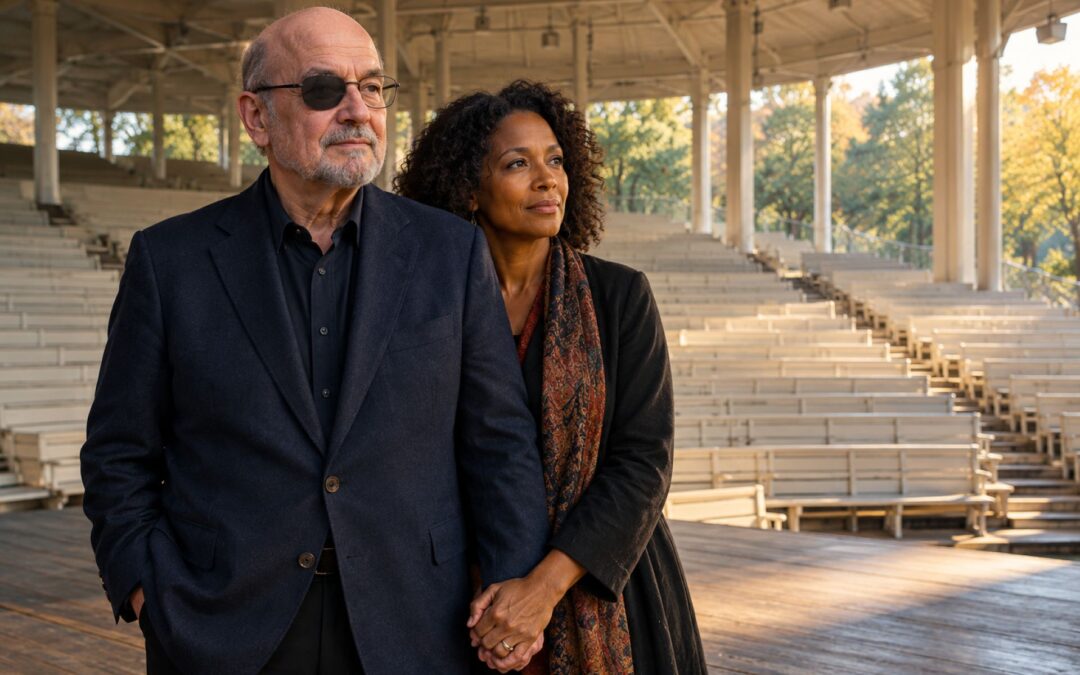
The couple then visited the amphitheatre. Rushdie walked through the sequence of events, explaining where he had been standing, where the attacker had approached, and how the intervention and emergency response had unfolded. The physical arrangement of the stage helped Eliza connect the accounts she had heard with the actual place.
The site had been transformed by the passage of time. Without the audience, the attacker, and the surrounding panic, it was once again an ordinary performance space. Yet the couple’s memories prevented it from becoming entirely innocent.
For Rushdie, returning allowed the place to acquire another experience beyond the attack. He could stand in the amphitheatre as a living person accompanied by his wife, rather than remaining permanently fixed in the image of a wounded victim lying on the stage.
Eliza also experienced relief. Seeing Rushdie there and observing the difference between his present condition and the events she had feared helped her confront a part of the trauma that had previously remained distant and incomplete.
Rushdie remembers wondering after the stabbing whether their happiness could survive such a severe blow. Standing together in Chautauqua, he recognizes that their relationship has endured, though it has been permanently changed. The earlier uncomplicated happiness cannot be recovered in precisely the same form.
The ending does not suggest that the couple have escaped the consequences of violence. Rushdie remains blind in one eye, physically altered, and aware that fear may continue to accompany their lives. Eliza’s memories and emotional burdens cannot be erased by a single visit.
What the return provides is a different kind of resolution. They have reclaimed the freedom to encounter the site of the attack together and to leave it on their own terms. Rushdie takes Eliza’s hand, and they decide to go home.
The final action is deliberately domestic. Instead of ending with a courtroom confrontation, a declaration of revenge, or an assertion of complete recovery, the memoir closes with the couple returning to the life they have managed to preserve.
The legal story continued after the period covered by the book. Hadi Matar was subsequently convicted of attempted murder and assault in New York state court and sentenced to twenty-five years in prison in May 2025. In July 2026, a federal jury also convicted Matar of terrorism-related offences. These developments belong to the history following the memoir’s publication, not to Rushdie’s experience at the time he wrote its conclusion.
The Two Angels and the Memoir’s Reversal of Direction
Rushdie divides Knife into two parts, identified with the angel of death and the angel of life. The arrangement establishes a broad narrative movement from the attempted destruction of his life to the effort to reclaim it. Yet the division is more complicated than a simple contrast between suffering and recovery.
The first part contains not only the violent attack and medical treatment, but also the story of Rushdie’s happiness with Eliza. By placing their relationship within the portion associated with death, Rushdie makes clear that the catastrophe matters because of what it threatens. The love story provides an emotional measure of the violence.
The second part begins after Rushdie has physically survived, but much of its content remains painful. He faces continued treatment, the possibility of further illness, psychological instability, security restrictions, and grief over friends who are suffering or dying. The angel of life therefore represents an opportunity rather than a guarantee of happiness.
The dedication to the people who saved Rushdie’s life reinforces the collective nature of survival. He does not present his continued existence as the achievement of a solitary heroic individual. The memoir repeatedly returns to the actions of rescuers, doctors, relatives, and friends whose efforts made his recovery possible.
An epigraph from Samuel Beckett frames catastrophe as something that permanently changes the person who experiences it. This idea helps explain the book’s refusal to end with a complete return to the past. Rushdie can recover independence without becoming identical to the person who walked onto the Chautauqua stage.
The chronological arrangement is also carefully controlled. The memoir opens with the attack, moves backward to the beginning of the relationship with Eliza, follows the recovery, and repeatedly returns to earlier experiences that illuminate present difficulties. These shifts allow Rushdie to distinguish between the immediate events and the personal history through which he interprets them.
His childhood, the fatwa years, and the stabbing become linked as experiences in which external circumstances threaten his autonomy. The comparison does not imply that they were equally severe. It demonstrates that the struggle to construct an independent identity has recurred throughout his life.
The final return to Chautauqua creates a formal relationship with the opening scene. Rushdie arrives at the same location twice, but the circumstances and his position within them are transformed. The opening journey ends with a loss of control; the final journey concludes with a voluntary departure.
This structural symmetry gives the memoir a satisfying shape without requiring Rushdie to claim that the injuries have disappeared. The danger is that such symmetry can make suffering appear more purposeful than it actually was. Rushdie largely avoids that problem by repeatedly acknowledging the role of chance and the permanence of some losses.
Eliza, Family, and the People Who Saved Rushdie
Rachel Eliza Griffiths is the memoir’s most important person besides Rushdie himself. The account of their relationship provides the emotional context for the attack, while her actions afterward demonstrate how profoundly violence can affect people who are not physically injured. She is present as a partner, writer, organizer, advocate, and fellow survivor of a traumatic period.
Rushdie’s representation of Eliza is especially effective when he describes her practical decisions. She gathers information, communicates with relatives and medical professionals, travels to the hospital, and helps maintain a record of his condition. Her activity contrasts with his enforced passivity, creating a relationship in which the person who ordinarily works through language must depend on someone else to speak and act on his behalf.
The recordings she makes are significant because they give her a partial authority over the story. Rushdie cannot remember everything that happened while he was critically ill, but Eliza can provide evidence of what he looked like and how he behaved. Her camera preserves experiences that his own consciousness could not fully register.
That does not mean the memoir entirely escapes Rushdie’s perspective. Eliza’s experience reaches readers through his narrative choices, supplemented by the words and images she shares with him. Her exhaustion and need for time away complicate the grateful portrait by revealing that caregiving imposed its own emotional costs.
The earlier account of their relationship helps prevent her from becoming merely a figure of selfless devotion. She has her own artistic ambitions, friendships, professional commitments, and relationship with her family. Rushdie’s admiration for her work suggests that their connection depends on creative and intellectual companionship as well as affection.
His relationship with his children is equally important. Zafar’s fear during the first days after the stabbing demonstrates how the possibility of a parent’s death can restore the helplessness of childhood, even when the child is an adult. Milan’s visits during rehabilitation and recovery provide another connection to ordinary family life.
Rushdie’s sister Sameen connects the crisis with their shared past. Her visits recall childhood experiences of family responsibility and reveal the continuity of relationships that existed long before the public controversy surrounding his books. The support offered by siblings and children complicates Rushdie’s earlier suspicion of family life.
His memories of his father introduce a contrasting pattern. The childhood household was associated with instability, fear, and emotional harm, while the family that gathers around him after the attack becomes a source of safety. The difference helps explain why his marriage to Eliza carries such personal significance.
Outside the family, Henry Reese and the Chautauqua rescuers occupy an exceptional position. Their actions are neither symbolic nor merely supportive. They physically intervened to stop an ongoing assault, placing themselves in danger at a moment when Rushdie could not protect himself.
The medical professionals perform a different kind of rescue. Surgeons prevent his immediate death, while nurses, physiotherapists, and specialists help him rebuild individual functions over many months. Rushdie’s treatment of these people is particularly attentive because he understands that survival depends on a long succession of decisions and acts of care.
His descriptions sometimes preserve their individuality through humour, conversation, or distinctive moments of encouragement. At other times, medical workers appear collectively as an essential network. The resulting portrait conveys the scale of dependence created by serious injury, even though many caregivers receive less psychological development than the central family members.
Literary friendships supply another form of continuity. Andrew Wylie’s loyalty reaches back to the fatwa years, while the support of writers participating in events for Rushdie and Victory City reminds him that his professional community remains intact.
Martin Amis, in particular, introduces a counterpoint to the survival narrative. Rushdie’s recovery occurs while his friend approaches death, complicating the temptation to imagine that the world has simply become safer or more benevolent. Their friendship gives the memoir a sharper understanding of mortality than an exclusively celebratory account might have achieved.
The strongest relationship writing in Knife is grounded in these particular experiences rather than declarations about love. Eliza’s exhaustion, a son’s emotional reaction, a rescuer’s intervention, or a therapist’s painstaking assistance communicates care more convincingly than general statements about its importance.
The Damaged Body, Trauma, and the Limits of Recovery
The physical account of the stabbing and its aftermath gives Knife much of its authority. Rushdie writes about injuries, procedures, and ordinary bodily functions with a degree of specificity that resists the convention of turning survival into an uncomplicated achievement. The damaged body remains visible throughout the memoir, even when the discussion moves into literary or philosophical territory.
One reason the medical passages are effective is their attention to the loss of autonomy. In the hospital, Rushdie cannot speak freely, walk without assistance, or control the treatment of his own body. His independence returns through small and sometimes humiliating steps rather than a single decisive recovery.
The ventilator, catheterization, treatment of the injured eye, and repeated hand exercises are all concrete manifestations of this dependence. They also reveal different aspects of suffering. Some procedures are frightening because their outcome is uncertain; others are distressing because they are painful, invasive, or exhausting.
The permanent loss of sight in the right eye is especially important because it cannot be integrated into a narrative of complete healing. Rushdie may learn to adapt, but no amount of determination restores what was destroyed. His continuing anxiety about the remaining eye makes that limitation more than a historical fact.
The hand injury similarly challenges the idea that recovery is equivalent to returning to the previous condition. Progress is measurable in regained movement and daily function, but the body retains traces of what happened. Rushdie can celebrate improvement without denying the difference between adaptation and restoration.
Psychological trauma operates differently. Rushdie experiences fear, disturbing dreams, anger, and depression even when his physical condition is improving. The fact that he can speak cheerfully or appear publicly does not establish that the attack has ceased to affect him.
His account of therapy is important because it places psychological recovery alongside medical treatment without pretending that they follow identical timelines. A wound may close while memories continue to produce distress. Conversely, the capacity to think about the attack without overwhelming anger may improve even though physical disability remains permanent.
Eliza’s experience adds another complication. Her emotional condition does not automatically improve whenever Rushdie reaches a medical milestone. She has her own memories of fearing his death, and her need to withdraw temporarily from caregiving demonstrates the limits of treating recovery as something belonging exclusively to the injured person.
Rushdie also resists the assumption that suffering necessarily produces personal growth. The proposition that adversity strengthens character becomes difficult to defend when confronted with permanent disability, medical uncertainty, and emotional exhaustion. Some people emerge from catastrophe with new capacities, while others are left with losses they would never have chosen.
This skepticism gives the memoir a more convincing emotional foundation than a straightforward inspirational account could provide. Rushdie does experience gratitude, renewed affection, and a stronger desire to use his remaining time well. He does not establish that the attack was necessary for those values to become meaningful.
There is nevertheless a tension between his refusal to find redemption in suffering and the memoir’s purposeful literary shape. By constructing a narrative that moves toward reconciliation with the site of the attack, Rushdie inevitably produces meaning from an event he considers senseless. The distinction is that the meaning comes from his response and interpretation, not from any moral justification for the violence itself.
The book’s most credible account of resilience lies in this difference. Recovery becomes the uneven process of learning to live with what has happened, supported by other people and by practical adaptations. It does not require the injured person to celebrate the catastrophe or pretend to be grateful for it.
The Knife, the Eye, and the Power of Storytelling
The knife gives the memoir its title and establishes its governing image. As the weapon used against Rushdie, it has a horrifying physical reality that resists metaphor. Yet Rushdie is also a novelist accustomed to examining how objects acquire meaning within stories, and he repeatedly considers the cultural and literary associations of knives.
The weapon appears in his reflections on earlier books and fictional violence, particularly Shalimar the Clown. These references expose the difference between representing a violent act and experiencing it bodily. What the imagination can describe in elaborate terms may become incomprehensible when it happens suddenly in ordinary life.
The knife also symbolizes the attempt to impose an ending. The attacker approaches Rushdie with a weapon capable of stopping his life and, by extension, his future writing. Rushdie’s survival allows him to continue the narrative beyond the point at which another person intended it to end.
The right eye provides a second major image. Rushdie recalls the moon and the cinematic image of a spacecraft striking its eye shortly before the attack. After losing his own sight, the earlier association becomes disturbingly significant.
He does not need to believe in prophecy for the parallel to matter. The significance lies in the way catastrophe changes memory, causing previously ordinary details to appear charged with meaning. His literary imagination registers these connections even while his rational judgment rejects supernatural explanations.
The eye’s practical importance remains equally strong. Rushdie fears further damage to his remaining vision and must make decisions about the appearance and treatment of the injured eye. Sight is both a physical capacity and a familiar literary metaphor, but the memoir does not allow the metaphor to replace the medical consequences.
Mirrors become another means of confronting altered identity. When Rushdie sees his damaged face during rehabilitation, he experiences the difference between knowing that he has been injured and recognizing those injuries in his own appearance. The mirror makes the violence visible as part of the person he now is.
Dreams similarly occupy an uncertain position between experience and interpretation. The gladiator dream precedes the stabbing, while nightmares afterward reveal the continuing influence of trauma. Rushdie uses them as evidence of the mind’s imaginative activity rather than as reliable messages from another realm.
Language itself becomes a recurring image. The hallucinated palaces constructed from letters are especially striking because they appear while Rushdie is temporarily unable to speak. His mind creates an architecture of words even as the damaged body prevents him from communicating normally.
The incident offers a symbolic account of the dependence of his identity on language. He has spent much of his life constructing fictional worlds, and the alphabet remains present even during a medical crisis. Yet the hallucination is also a symptom of an altered physical and neurological state, reminding readers that imagination does not exist separately from the vulnerable body.
Eliza’s recordings introduce a different medium of representation. The camera captures details that Rushdie cannot remember, producing an external version of events that challenges his sense of what he experienced. These images become part of the evidence from which he eventually constructs his written account.
The final return to Chautauqua completes the book’s most important spatial pattern. The amphitheatre initially represents violence, helplessness, and the interruption of an anticipated conversation. When Rushdie revisits it with Eliza, the same location becomes a place where they can acknowledge their suffering and exercise choice.
Home also changes meaning. During hospitalization, Rushdie’s desire to return home represents escape from institutional confinement. By the ending, home represents the continuing life he and Eliza have rebuilt together, even though that life remains marked by injury.
The memoir’s literary references sometimes accumulate rapidly, but the strongest motifs are those grounded in direct experience. The damaged eye, the mirror, Eliza’s camera, and the Chautauqua stage possess emotional force because readers understand the events that made them significant. Their larger meanings emerge from the narrative rather than being imposed upon it.
Freedom, Religious Certainty, and the Battle of Narratives
Rushdie’s arguments about freedom cannot be separated from his personal history. The fatwa issued after The Satanic Verses transformed him from a novelist into an internationally contested symbol. His books, religious beliefs, safety, and personal conduct became subjects of political and theological debate involving people who often knew little about his wider literary work.
The Chautauqua attack revived that public conflict. Rushdie understood the stabbing as violence connected with hostility toward his writing, but the memoir also reveals his frustration at being returned to a controversy he considered historically exhausted. He wanted his achievements after 1988 to matter as much as the single novel that had made him notorious.
His defence of artistic freedom begins with the claim that literature must be permitted to imagine possibilities and challenge inherited accounts of reality. Fiction can question authority, depict religious material unconventionally, or present ideas that readers find disturbing. A writer’s right to perform those acts does not depend upon everyone approving of the resulting work.
Rushdie distinguishes this freedom from a supposed right to avoid offense. Readers may dislike, criticize, or reject a book, just as writers may criticize religious or political beliefs. What cannot be justified is the conversion of disagreement into a licence to threaten or murder the person expressing the contested idea.
The imaginary conversations with A. dramatize that distinction. Rushdie challenges the assumption that calling another person dishonest, heretical, or offensive establishes a moral entitlement to attack him. His reasoning depends on the difference between evaluating a claim and destroying the person who makes it.
The discussion of sacred texts introduces a related problem. Rushdie argues that human understanding of religious language depends upon interpretation, even when believers regard the text itself as divinely authorized. Different readers, traditions, and teachers can assign different meanings to inherited words.
The imagined attacker resists this uncertainty, repeatedly appealing to a particular religious authority. Rushdie presents such certainty as dangerous when it becomes a justification for coercion. The central objection concerns the claim that one interpretation has the right to silence all others through force.
There are limits to what the dialogue proves. Rushdie’s imagined antagonist is constructed to express the certainty that the author wishes to challenge, and the philosophical contest is therefore unequal. Rushdie controls the questions, the answers, and the intellectual resources available to both participants.
That limitation does not invalidate the argument against violence. It does mean that the conversation should be understood as a literary demonstration of Rushdie’s position rather than conclusive evidence about the psychology or reasoning of his actual attacker.
Rushdie’s treatment of religion also requires careful distinction. He remains an atheist and can be sharply critical of religious doctrines. At the same time, his central political distinction is between individual belief and religious ideology that claims coercive authority in public life.
A person’s right to practice a religion, on this account, coexists with other people’s right to question its truth claims. Protecting believers from discrimination does not require exempting every religious idea from criticism. Nor does the wrongdoing of an extremist establish that all members of a religious community share that person’s commitments.
Rushdie extends his concern beyond organized religion. Political movements, nationalist ideologies, and authoritarian governments can also construct narratives in which dissenters become enemies and disagreement appears illegitimate. The problem is the concentration of interpretive authority and the attempt to turn one description of reality into an unquestionable command.
His phrase about a struggle among competing stories captures the wider concern. Human communities understand themselves through accounts of history, identity, belonging, and moral purpose. Those stories can support freedom and cooperation, but they can also authorize exclusion, persecution, and violence.
For Rushdie, literature offers an alternative because imaginative writing accommodates plurality. Novels can present incompatible perspectives, unreliable narrators, contradictory desires, and unresolved meanings without requiring that one final authority eliminate every competing interpretation.
This is a defensible account of an important literary possibility, although it should not be exaggerated into a guarantee. Fiction can also reinforce prejudice, promote dogma, or simplify the people it depicts. Artistic freedom permits a wide range of expression; it does not ensure that every work will be intellectually open-minded or morally admirable.
The memoir’s political reflections are strongest when tied to Rushdie’s actual experience of persecution and his refusal to surrender personal independence. They are less consistently persuasive when broad claims about society, religion, or contemporary political conflict appear without equally detailed examination. His firsthand experience gives the argument urgency, but not automatic authority over every adjacent subject.
The continuing relevance of Knife lies in the relationship between these questions. Violence against a writer harms a particular human being, but it may also attempt to establish the limits of what others are allowed to imagine, publish, or say. Rushdie’s response is to continue exercising the freedom the attacker sought to deny him.
Rushdie’s Narrative Voice, Structure, and Literary Allusions
Knife differs from the elaborate fictional worlds associated with much of Rushdie’s earlier work. Its narrative is comparatively direct, centered on identifiable events, named people, and the physical consequences of a real attack. Yet Rushdie’s literary habits remain visible in the movement between incident, association, memory, and interpretation.
The first-person voice alternates between vulnerability and control. Rushdie can be frightened, embarrassed, physically dependent, or uncertain about his memories, but he also remains an experienced storyteller capable of shaping those experiences into a coherent narrative. The tension between the suffering participant and the retrospective narrator gives the book much of its character.
Humour is especially important. Rushdie uses comic comparisons to describe uncomfortable procedures and occasionally presents himself as impatient, absurd, or self-conscious. These moments offer relief from the medical severity without suggesting that the injuries were minor.
His chronological method is flexible. The assault is followed by the relationship with Eliza, while rehabilitation prompts reflections on childhood and the fatwa years. Such movements are guided by psychological association rather than by the requirements of a continuous diary.
The result is a memoir that repeatedly places the present in dialogue with earlier periods of Rushdie’s life. His father’s behaviour helps explain his relationship with family, the fatwa years clarify the significance of security restrictions, and earlier literary work shapes his understanding of artistic survival.
The book also moves between different kinds of evidence. Rushdie possesses firsthand memories of certain moments, reconstructed accounts supplied by witnesses, medical explanations, and footage recorded by Eliza. These materials differ in reliability and perspective, and the memoir is often attentive to those differences.
The hallucinated buildings made of letters illustrate another feature of the narrative voice. Rushdie rarely allows an extraordinary experience to remain merely unusual. He associates it with literary production, cultural history, or a larger understanding of identity.
References to writers such as Beckett, Mahfouz, Kundera, Carver, Borges, and Saramago help him locate his experience within a wider literary tradition. Each author provides a different context: violence against writers, mortality, second chances, altered identity, or the loss of sight.
These associations can be illuminating because Rushdie has spent his life reading and writing. They make sense as part of his ordinary intellectual response to crisis. The reader understands why he turns toward books when trying to describe events that have disrupted his existence.
There are occasions, however, when the density of literary references interrupts the momentum of the physical narrative. A discussion that begins with an injury or emotional exchange may move rapidly into several external works, shifting attention away from the experience under examination. Readers less familiar with the references may find some of these passages more demanding than the memoir’s direct storytelling.
The chapter of imaginary conversations with A. introduces the sharpest formal change. Rushdie temporarily abandons the conventional expectations of memoir and writes a dramatic philosophical encounter. The technique allows him to ask questions that the documentary material cannot answer, while making the author’s control over the imagined setting unusually visible.
Its presence raises the larger issue of truth in autobiographical writing. Memoir promises a relationship with actual experience, but every memoir depends on selection, arrangement, interpretation, and imperfect recollection. Rushdie makes that problem especially clear by distinguishing his factual recollections and reconstruction from a dialogue he acknowledges inventing.
The book’s literary intelligence is therefore both a strength and a source of tension. Rushdie can transform frightening events into complex narrative material, but the urge to interpret them sometimes competes with the clarity of the events themselves. The most effective passages allow his imaginative associations to deepen an already concrete experience.
The Attacker as a Character Rushdie Refuses to Name
Rushdie’s decision to call the attacker A. is one of the memoir’s most consequential narrative choices. He refuses to give the man the ordinary prominence that would accompany repeated use of his name. This decision also allows Rushdie to emphasize the difference between the individual who attacked him and the ideological role that the attacker appears to have adopted.
The abbreviation produces a strange literary character. A. is unquestionably real as the perpetrator of the violence, but much of his interior life remains unavailable to the author. Rushdie knows what happened to his own body and has access to reported statements and information, yet he cannot independently establish everything the attacker thought or intended.
The imaginary interviews attempt to cross that boundary. By constructing a series of dialogues, Rushdie places A. in a position where he must answer questions about honesty, religion, authority, and human life. The person who once controlled the immediate physical encounter now appears inside a scene controlled by the writer.
This reversal has emotional significance. The real attack gave Rushdie little opportunity to respond, while the imagined conversations allow him to speak at length. They restore a form of agency by permitting him to challenge the assumptions he believes made the violence possible.
Yet the method also exposes a limitation. The imagined A. frequently embodies the intellectual weaknesses Rushdie wishes to criticize: unquestioning certainty, dependence on authority, hostility toward ambiguity, and an inability to distinguish moral disagreement from justified violence. Because Rushdie supplies both sides of the exchange, the resulting argument cannot test itself against an independently represented opponent.
The more personal questions are particularly vulnerable to criticism. Speculation about isolation, sexuality, friendship, masculinity, or emotional frustration may be psychologically plausible, but plausibility is not evidence. Rushdie’s position as the intended murder victim explains the anger behind these inquiries without making their conclusions verifiable.
The strongest part of the experiment is therefore its honesty about its fictional status. Rushdie makes clear that the dialogue is an imaginative attempt to confront what happened, rather than a recovered conversation or an objective psychological profile. The reader can evaluate its emotional and philosophical force without mistaking it for reportage.
By the memoir’s conclusion, Rushdie’s desire to encounter the attacker has diminished. The imagined conversations have given him an opportunity to challenge the ideology he associates with the assault, but they have not made further confrontation necessary. His attention shifts from the person who nearly ended his life to the life he still has.
This movement reinforces the book’s larger concern with narrative authority. A. succeeded in making himself part of Rushdie’s history, but Rushdie refuses to let him determine the whole of the story.
What Knife Achieves and Where It Falls Short
The strongest achievement of Knife is its representation of catastrophic injury without disguising the practical indignities of recovery. Rushdie’s medical descriptions are vivid because they remain attached to particular bodily functions, procedures, anxieties, and decisions. The ventilator, damaged hand, eye treatment, catheterization, and painful rehabilitation exercises give readers an understanding of survival that no general statement about courage could provide.
The hospital chapters are particularly effective in showing how quickly independence can disappear. Rushdie is a celebrated novelist accustomed to exercising considerable control through language, yet he cannot initially speak or move freely. His identity remains intact, but his ability to express and enact it depends on the assistance of other people.
This contrast gives the memoir an emotional depth that exceeds the significance of the public attack. The reader sees a person deprived of ordinary capacities and gradually recovering some of them through treatment, luck, and persistence. The process is difficult, uncertain, and frequently undignified, which makes the eventual improvements credible.
Rushdie’s willingness to describe humiliation and fear strengthens the account. He does not consistently appear admirable or composed. He experiences impatience, anger, uncertainty, depression, and moments in which his confidence exceeds his physical condition.
The result is a portrait of survival that resists the temptation to turn the author into an uncomplicated hero.
Eliza’s presence gives the memoir a second major strength. Their relationship is developed sufficiently before the attack for the reader to understand why its preservation matters. The account of their meeting, courtship, private marriage, and happiness establishes a life whose value cannot be measured exclusively through Rushdie’s public accomplishments.
The later caregiving scenes acquire force because the relationship already exists as something more than a response to disaster. Eliza has her own creative ambitions and emotional needs, while Rushdie must accept dependence from someone with whom he previously shared a more equal domestic life.
Her eventual exhaustion is especially important. It prevents the marriage from becoming a sentimental device in which love effortlessly overcomes every difficulty. Rushdie recognizes that she has suffered profoundly and that her recovery cannot be reduced to his own medical progress.
The memoir’s structure supports this emotional movement. By alternating the attack with the earlier love story and then proceeding through hospital care, rehabilitation, and homecoming, Rushdie allows readers to experience successive changes in the meaning of survival. Initially the central question is whether he will live; later it becomes what kind of life remains possible.
The final return to Chautauqua provides a convincing literary resolution because it grows out of that development. The couple return to the site of the assault together, confront its physical reality, and leave voluntarily. The scene demonstrates regained agency without pretending that disability, fear, or the past have disappeared.
Rushdie’s humour is another significant achievement. His comic descriptions of treatment, impatience, and personal embarrassment prevent the narrative from becoming relentlessly solemn. They also preserve the distinctive voice of a person whose identity has not been wholly determined by suffering.
The literary allusions enrich the memoir when they illuminate direct experience. The comparison with Naguib Mahfouz places the assault within a history of violence against writers, while Beckett offers another instance of survival after stabbing. Kundera and Carver help Rushdie consider the unexpected continuation of life, and Pataudi provides a concrete example of adapting to damaged vision.
These references also reveal how deeply literary culture structures Rushdie’s understanding of the world. He rarely encounters a major experience without discovering a connection to a novel, poem, philosophical idea, or earlier historical event. For a memoir written by a prominent novelist, that habit is more revealing than an attempt to imitate completely unadorned reportage would have been.
At the same time, the book is less consistently effective when it moves away from bodily and interpersonal detail into broad philosophical or political argument. Some discussions of religious certainty, public narratives, and contemporary politics rely heavily on Rushdie’s established convictions. Their conclusions are often understandable, but the supporting analysis is not always as patient or substantial as the descriptions of treatment and recovery.
This limitation becomes especially evident in the imaginary conversations with A. The chapter is ambitious and unusual, allowing Rushdie to confront the attacker on terms chosen by the victim rather than the perpetrator. It also foregrounds the power of writing to create a setting in which questions can be asked and arguments examined.
Yet the technique risks making the encounter too convenient. Because Rushdie invents the dialogue, his imagined opponent can be made to exhibit precisely the intellectual limitations Rushdie wishes to expose. The exchange may express the author’s position with force without genuinely investigating the strongest version of an opposing argument.
The passages dealing with the attacker’s imagined personal frustrations raise another problem. Rushdie speculates about emotional isolation, intimacy, and ideas of masculinity in an effort to understand the person who attacked him. These possibilities may be suggestive, but they remain conjectural, and the reader should not treat them as discoveries about the man’s actual life.
The experiment is nevertheless valuable because Rushdie does not conceal its imaginative nature. He openly presents the conversations as constructions, inviting readers to interpret them as part of his struggle with the assault rather than authenticated testimony. Their most persuasive function is emotional and literary: they give the injured writer a language of confrontation that physical violence had denied him.
Contemporary critical responses reflected some of these tensions. Admirers emphasized the memoir’s candour, humour, tenderness, and defence of artistic freedom, while more skeptical reviewers questioned aspects of Rushdie’s self-presentation and the effectiveness of his broader reflections. The disagreement is understandable because the book moves between forms that demand different kinds of judgment.
Its account of injury can be evaluated through specificity, clarity, and attention to remembered experience. Its relationship narrative depends on emotional complexity and credible characterization. Its philosophical claims, however, must also be judged by argumentative fairness and the strength of the reasoning offered.
Rushdie is at his most persuasive when he writes from the intersection of these forms without allowing one to overwhelm the others. The scene in which Eliza watches him struggle or the account of his damaged hand already contains implications about vulnerability, dependence, and freedom. Such implications become stronger when they arise from observed circumstances than when they are announced as general truths.
The memoir’s treatment of the past is similarly revealing. Rushdie’s childhood and the fatwa years provide useful context for his recurring desire to recover autonomy. Still, these passages inevitably reflect the perspective of a narrator examining earlier experiences through the emotional lens of a recent catastrophe. Their purpose is to explain his own understanding of those events, rather than supply a complete independent history of his family or public controversies.
The book also has an important limitation as a representation of the attacker. Rushdie is neither obliged nor necessarily equipped to provide a comprehensive psychological portrait of the person who tried to murder him. His decision to restrict the man’s identity is understandable, but the resulting character remains largely a figure through whom Rushdie examines ideological violence.
Readers seeking a detailed explanation of radicalization, extremist networks, or the full legal investigation will therefore need other sources. Knife is a memoir of what the attack meant for its victim, not an exhaustive investigative account of why the assailant acted.
This limitation becomes a strength when the book remains conscious of its own boundaries. Rushdie is most authoritative about the experiences he endured, the relationships he witnessed, and the memories and records available to him. His wider interpretations deserve consideration without being granted the same evidentiary status as those experiences.
The memoir’s relative brevity is another source of both effectiveness and constraint. Rushdie concentrates on a defined period and largely avoids the expansiveness of a complete autobiography. This gives the account urgency and prevents it from becoming a general survey of his literary career.
Some secondary figures and medical professionals consequently receive limited development, despite their importance. Their actions are vividly acknowledged, but Rushdie’s attention necessarily remains focused on his immediate experiences and closest relationships. The book’s emotional economy is strongest around Eliza, while some of the wider supporting cast appears mainly through decisive incidents.
The ending compensates for much of this selectivity by refusing a conventionally triumphant resolution. Rushdie cannot restore his lost vision, guarantee safety, or undo the emotional consequences for his wife and family. He can, however, return to a place associated with terror and leave it with a renewed sense of choice.
The question mark in the final chapter’s title is therefore well earned. Closure is presented as uncertain and perhaps impossible in any absolute sense. The couple’s happiness survives, but it does so in a damaged and altered form.
The book’s most enduring achievement is its ability to make that condition intelligible. Rushdie gives readers a detailed account of suffering without making suffering valuable in itself, and he shows why the continuation of ordinary life can matter more to a survivor than an imagined victory over an attacker.
Knife is consequently most successful as a literary memoir of vulnerability, love, and recovered agency. Its philosophical and political passages are not uniformly as penetrating as its personal testimony, but the tension between those modes is part of what makes the book distinctive. Rushdie writes as a wounded individual and as a public intellectual who cannot entirely separate his experiences from arguments about literature and freedom.
Who Should Read Knife and Why It Matters
Knife will be particularly valuable to readers interested in literary memoir, the life and work of Salman Rushdie, the experience of surviving violence, and the complicated relationship between physical recovery and psychological adaptation. Its detailed hospital and rehabilitation narratives provide an unusually concrete understanding of what happens after the immediate emergency has ended.
Readers familiar with The Satanic Verses or Joseph Anton will encounter a later stage in Rushdie’s struggle to reclaim a life independent of threats. Yet extensive prior knowledge of his writing is not necessary. The memoir supplies the central historical background and develops a personal narrative whose stakes are understandable without familiarity with his novels.
It will also interest readers concerned with freedom of expression and the responsibilities of literature in politically or religiously contested societies. Rushdie’s arguments are more valuable when treated as the considered convictions of a writer directly affected by censorship and violence than as an exhaustive philosophical theory. The book offers an important perspective, while leaving room for disagreement about particular claims.
Those seeking a neutral investigative account of the attack, a comprehensive biography, or a clinical guide to trauma recovery may find the memoir less satisfactory. Its emphasis is personal and literary, and its most experimental chapter openly substitutes an imagined encounter for a real one. It also contains distressing descriptions of stabbing, medical injuries, and painful treatment that some readers may prefer to avoid.
The memoir remains worth reading because it preserves the experience of a writer whose public significance might otherwise overshadow his human vulnerability. Its significance extends beyond the extraordinary circumstances of the attack, particularly in its account of dependence, the permanence of certain losses, and the effort to recover ordinary freedom.
In the final scene, Rushdie and Eliza return to the amphitheatre where their shared life nearly ended. They cannot undo what happened there, and the happiness they take away is more fragile than the happiness they possessed before the attack. Nevertheless, they leave together, returning to a home and future that still belong to them.
That ending brings the memoir’s central struggle into focus. The attacker succeeded in injuring Rushdie and changing the conditions of his life, but he did not gain permanent authority over how that life would be understood. Rushdie’s response is to preserve the reality of the damage while continuing to choose his work, his relationships, and the stories he wishes to tell. The achievement of Knife lies in making that continuation believable without pretending that survival has made the violence disappear.
Last Updated on October 16, 2026 by Aseem Gupta