
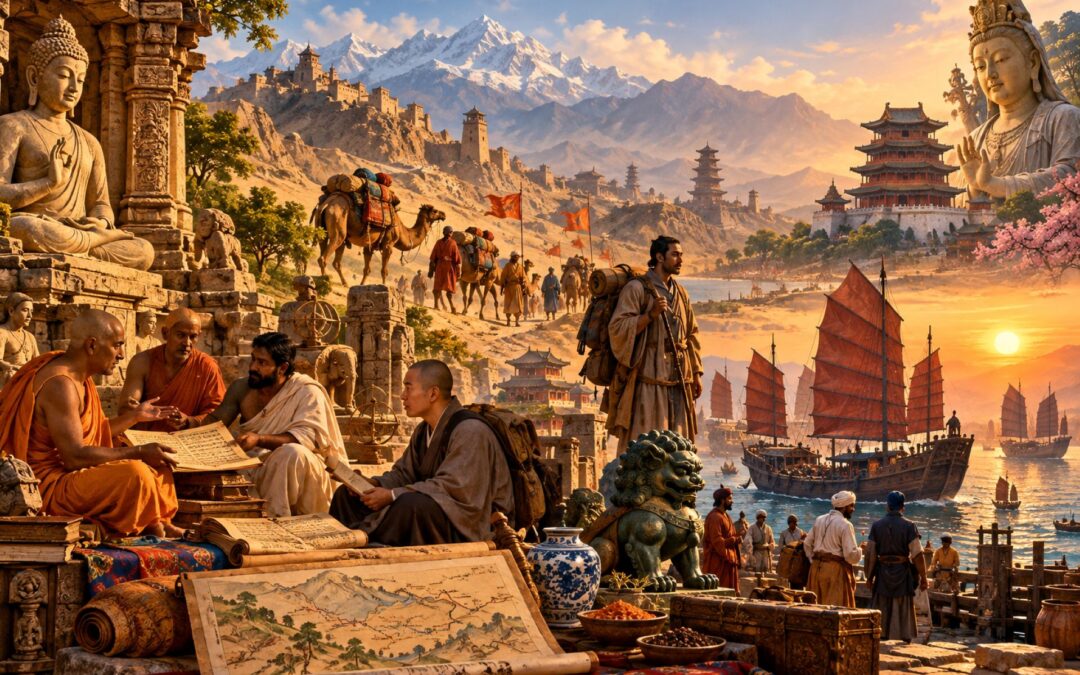
At the Kaiyuan Temple in Quanzhou, a historic port city on China’s southeastern coast, visitors can encounter stone carvings that seem to belong to a different religious world. Among the architectural remains associated with the temple are fragments bearing Hindu imagery, including sculptures connected with the worship of Shiva. These objects came from a Hindu temple established by a Tamil-speaking community during the thirteenth century, when Quanzhou was one of Asia’s great commercial centres. Their presence in a Chinese Buddhist setting preserves evidence of a much larger history.
For centuries, merchants from the Indian subcontinent travelled to Chinese ports, while Chinese pilgrims crossed mountains, deserts, and oceans to study in Indian monasteries. Buddhist scriptures were translated into Chinese, Indian astronomical knowledge entered imperial scholarship, and religious images took on new meanings as they moved between cultures. Ships carried silk, textiles, ceramics, medicines, aromatic substances, and religious objects through networks that connected India and China with Central Asia and Southeast Asia.
Yet this relationship cannot be described simply as one civilization borrowing from another. The Indian subcontinent and China were not unified nations with fixed borders throughout this period, and much of their interaction depended on societies located between them. Commercial interests, religious devotion, political ambition, and intellectual curiosity reinforced one another, although their relative importance changed over time.
The story of ancient and medieval India–China relations is therefore about more than the movement of people and goods. It reveals how civilizations can transform one another through sustained contact without surrendering their distinct identities, and how connections that began in particular historical circumstances can leave cultural consequences lasting for centuries.
The Routes That Connected India and China
The geographical distance between India and China created formidable obstacles to direct contact. The Himalayas and the Tibetan Plateau separated much of northern India from the Chinese heartland, while deserts, mountain ranges, forests, and powerful regional kingdoms complicated travel elsewhere. Nevertheless, the two regions were connected through several overlapping networks long before modern transportation made journeys between them comparatively straightforward.
The most famous of these were the Silk Roads, although the name can create a misleading impression of a single highway linking distant civilizations. In reality, the interconnected land and maritime routes documented by UNESCO formed a shifting system of commercial, diplomatic, and cultural connections. Merchants frequently travelled between regional markets rather than completing an uninterrupted journey from one end of Asia to the other. Goods might pass through several hands before reaching their eventual buyers.
One important set of overland routes connected northern China with the oasis settlements of the Tarim Basin and the wider commercial world of Central Asia. From these settlements, travellers could move toward Bactria, Gandhara, and the northwestern regions of the Indian subcontinent. These routes brought Chinese societies into contact with merchants, monks, translators, and rulers from many linguistic and religious backgrounds.
Central Asian communities played an essential role in maintaining these connections. Sogdian merchants, for example, became prominent participants in Eurasian commerce, while oasis kingdoms such as Kucha and Khotan developed important Buddhist institutions. These were not merely resting places for people travelling between India and China. They were active centres of commerce, scholarship, artistic production, and religious adaptation.
Other connections crossed or skirted the Himalayan world. Routes through Kashmir, Nepal, the western Himalayas, and regions associated with Tibet could link South Asian political and religious centres with territories farther north and east. Northeastern approaches also connected parts of the Indian subcontinent with the wider networks of mainland Southeast Asia. Their importance varied according to geography, political stability, local institutions, and the willingness of rulers to permit travel.
Crossing these regions was difficult and sometimes dangerous. Travellers faced extreme weather, inadequate supplies, unfamiliar languages, banditry, and the possibility that a change in political control would make a previously usable route inaccessible. Individual journeys could therefore take considerable time, but there was no single standard duration for travel between India and China. The route chosen, season, purpose of travel, and assistance received along the way all mattered.
Maritime routes eventually offered another means of linking the two regions. Ships travelling from the western and eastern coasts of India could cross the Bay of Bengal toward Sri Lanka, the Malay Peninsula, Sumatra, and other Southeast Asian ports. From there, interconnected routes extended through the Strait of Malacca and the South China Sea toward the Chinese coast.
The seasonal monsoon system made such journeys possible on a recurring basis. Sailors learned to exploit the changing direction of prevailing winds, planning departures and return voyages around conditions that could make one leg of a journey easier than another. Knowledge of winds, currents, coastal landmarks, and reliable stopping places was as important as the vessels themselves.
The sea did not eliminate the need for intermediaries. A merchant selling Indian textiles in a Southeast Asian port might deal with traders who subsequently carried those goods to China. Chinese ceramics could follow the reverse pattern, moving through regional markets before reaching South Asian consumers. Ports gained importance partly because they connected trading communities that specialized in different stretches of the journey.
The role of Southeast Asia is especially important. Historian Tansen Sen’s study of maritime Southeast Asia between South Asia and China emphasizes that regional societies shaped these networks through their own commercial activities, political institutions, and cultural relationships. They were not passive channels through which Indian or Chinese influence travelled.
These routes created a connected Asian world long before either modern India or modern China existed. Their significance lay not in permanently overcoming geography, but in allowing people to build institutions and relationships that made repeated journeys possible. Trade, religion, and diplomacy would gradually turn these routes into channels of lasting cultural transformation.
Merchants, Ports, and Communities Across the Seas
Commercial exchange did more than transport valuable objects between distant markets. It created incentives for merchants to establish relationships, learn foreign languages, understand unfamiliar customs, and sometimes settle permanently outside their places of origin. Over time, repeated visits could produce communities whose lives connected several societies rather than belonging exclusively to one.
The goods carried through these networks reflected the different economic strengths and consumer preferences of participating regions. Indian textiles, especially cotton fabrics, became important in maritime commerce, while spices, aromatic woods, medicinal substances, gemstones, and other valuable products circulated through Indian Ocean markets. China supplied silk, ceramics, and manufactured goods that could command considerable demand abroad.
Not every product originated in the country from which it was shipped. Southeast Asian forests supplied aromatic materials, island producers supplied spices, and merchants operating from Indian ports often traded commodities acquired elsewhere. Similarly, a cargo reaching India from a Chinese port might contain goods produced in several regions. Commercial geography was defined by redistribution as much as by production.
Successful maritime trade depended on infrastructure. Ports needed safe anchorage, storage facilities, supplies, customs arrangements, and markets where foreigners could exchange goods. Local authorities could benefit by collecting taxes, regulating transactions, or attracting merchants whose commercial activity increased the prosperity of their cities.
The dangers were equally significant. Storms, navigational errors, piracy, shipwrecks, and political conflict could destroy cargoes or interrupt established routes. Merchants reduced these risks through partnerships, trusted intermediaries, shared information, and relationships with rulers or port officials. Commercial cooperation did not eliminate uncertainty, but it made distant trade more manageable.
Chinese coastal cities became particularly important as overseas commerce expanded. Guangzhou had long-standing connections with foreign trading communities, while Quanzhou later developed into one of the leading maritime centres of the Song and Yuan periods. Muslim merchants, South Asian traders, Southeast Asian visitors, and people from other regions participated in these commercial environments.
Their presence should not be confused with an unrestricted multicultural society in the modern sense. Foreign communities operated within changing systems of taxation, official supervision, local custom, and imperial policy. Periods of commercial openness could coexist with suspicion, discrimination, political violence, or efforts to restrict overseas activity.
Nevertheless, some visitors established relationships substantial enough to leave traces in religious buildings, inscriptions, burial grounds, and other material remains. Such evidence is particularly valuable because it demonstrates that commercial contact sometimes involved families, communities, and religious institutions rather than temporary exchanges between passing ships.
Quanzhou offers one of the strongest examples of this history. A Tamil-speaking Hindu community established a temple dedicated to Shiva during the Yuan period, and an inscription dated to 1281 provides important evidence of its presence. The remains demonstrate that South Indian religious practices had reached the Chinese coast through maritime networks.
Historian Risha Lee’s study of the Indic carvings of Quanzhou and its South Indian community examines the architectural fragments and their significance. These sculptures reveal more than the importation of artistic designs. They point toward an organized community capable of supporting a religious institution in a foreign commercial city.
The survival of Hindu carvings at Kaiyuan Temple has occasionally encouraged misleading descriptions of a Buddhist establishment being converted into a Hindu shrine. The historical relationship was different. Architectural material associated with the Hindu temple was subsequently incorporated into the Buddhist temple complex, where some of the carvings remain visible.
This distinction matters because the site illustrates how buildings and religious objects could acquire new settings and meanings over time. The presence of a Shiva sculpture inside a later Buddhist architectural context does not mean that one institution had originally become the other. It reveals a more complicated history of settlement, construction, reuse, and changing religious communities.
The wider commercial importance of the city is documented in UNESCO’s account of Quanzhou’s maritime trading institutions and religious landscape. Its archaeological remains include evidence of extensive international commerce and diverse religious communities during the Song and Yuan periods. Quanzhou’s prosperity depended on its participation in economic networks extending far beyond the borders of successive Chinese states.
Movement also occurred in the opposite direction. Chinese merchants, sailors, and travellers participated in Indian Ocean networks that reached South Asian ports, although the surviving evidence does not always allow historians to distinguish temporary visitors from permanent residents. It would be misleading to assign precise population figures to Chinese communities in ancient Indian cities without adequate documentation.
What the evidence does establish is a commercial world sustained by repeated human contact. People who travelled for profit could carry religious beliefs, artistic preferences, technical knowledge, and personal relationships across the same routes. Merchants did not necessarily intend to transform distant civilizations, but the networks they maintained created opportunities for transformations that extended far beyond commerce.
How Buddhism Remade the Relationship Between India and China
Among the many ideas that travelled between India and China, Buddhism produced some of the deepest and most enduring changes. Its transmission transformed the religious landscape of China, encouraged large-scale translation projects, and inspired journeys that connected Chinese monasteries with sacred places and institutions across the Indian subcontinent.
Buddhism emerged in northern India during the first millennium BCE, within a religious and philosophical environment characterized by competing teachings, ascetic movements, and debates about suffering, liberation, and the nature of existence. Following the life of Gautama Buddha, communities of monks and lay supporters developed institutions devoted to preserving and transmitting his teachings. Royal patronage, merchant donations, and the activities of religious travellers helped extend Buddhism beyond its earliest centres.
These developments belonged to the wider religious and commercial history of the Indian subcontinent. Buddhist communities became established in regions connected with Central Asian trade, including Gandhara and territories governed at different times by Kushan rulers. Monasteries could receive support from merchants and political elites, while monks travelled through the same regional networks used for commercial exchange.
Buddhism began reaching China during the early centuries of the Common Era, although the precise circumstances of its introduction cannot be reconstructed from a single event. Later traditions associated its arrival with an Eastern Han emperor who supposedly dreamed of a golden figure and dispatched envoys westward in search of Buddhist teachings. This story became connected with the foundation of the White Horse Temple at Luoyang.
The legend has historical importance because it shows how later Chinese Buddhists explained the religion’s introduction and connected it with imperial authority. It should not, however, be treated as a fully documented account of Buddhism’s first arrival. The religion entered through several overlapping channels and developed gradually within communities that were already engaged in international exchange.
Central Asian intermediaries were crucial to this process. Buddhist teachers and translators from different regions brought scriptures, ritual practices, and philosophical ideas into Chinese-speaking environments. Their backgrounds were often multilingual and culturally mixed, making them particularly important in a tradition that depended on explaining unfamiliar concepts across linguistic boundaries.
The relationship between Buddhism and trade was mutually reinforcing. Merchants could support monasteries located along important routes, while Buddhist institutions provided places where travellers might encounter familiar religious communities and networks of patronage. The expansion of one could therefore strengthen the other, although the precise relationship varied across periods and regions.
As Buddhism became more firmly established in China, India acquired a special position in the Chinese Buddhist imagination. It was associated with the Buddha’s life, the origins of revered teachings, and sacred sites connected with enlightenment and monastic history. Chinese monks who sought authoritative scriptures or deeper religious instruction increasingly looked toward the Indian subcontinent.
This spiritual geography did not simply replace existing Chinese perceptions of the outside world. Traditional political and cultural ideas often placed the Chinese imperial centre in a privileged position, while Buddhist teachings encouraged believers to imagine a sacred world whose most important historical events had occurred elsewhere. These perspectives could create intellectual tensions, but Chinese responses were diverse rather than uniformly hostile to foreign religious authority.
Buddhism’s success depended substantially on adaptation. Chinese translators had to communicate ideas such as karma, rebirth, nirvana, emptiness, and liberation through a language whose philosophical vocabulary had developed in different circumstances. Familiar Chinese concepts sometimes helped explain unfamiliar teachings, but imperfect equivalences could also create misunderstandings that later scholars attempted to resolve.
Buddhist communities likewise encountered established expectations concerning family obligations, social relationships, and political authority. Monastic celibacy and withdrawal from ordinary family life could appear difficult to reconcile with Confucian ideals emphasizing filial responsibility and ancestor veneration. Chinese Buddhists developed explanations that presented religious practice as compatible with broader moral obligations, even when differences remained.
The religion became especially influential during centuries of political division following the collapse of the Han dynasty. Monastic institutions received patronage from rulers and wealthy families, while Buddhist sculpture, cave temples, and ritual establishments became important expressions of religious devotion and political legitimacy. The Northern Wei and other dynasties contributed to this expansion, though each operated within its own political circumstances.
Under the Tang, Buddhism became an important component of a remarkably international imperial culture. The court governed territories connected with Inner Asia, and its cities attracted scholars, merchants, diplomats, and religious specialists from many backgrounds. Buddhism flourished alongside Confucian and Daoist traditions, contributing to the broader cultural transformations explored in China’s dynastic history.
Yet Buddhist influence was neither uncontested nor permanent at every level. Chinese officials and intellectuals sometimes criticized monastic wealth, religious independence, foreign origins, or the economic privileges enjoyed by religious institutions. The Tang persecution of Buddhism in 845 demonstrated that imperial patronage could be reversed when political and ideological conditions changed.
Buddhism nevertheless survived these challenges and continued developing distinctly Chinese traditions. Schools such as Chan and Pure Land Buddhism emerged through sustained interpretation and practice, while Chinese religious communities increasingly generated their own teachers, texts, and institutional networks. A religion that had arrived through international contact had become an integral part of Chinese civilization.
This was not merely the transplantation of Indian Buddhism into a new geographical setting. Chinese practitioners transformed inherited doctrines through their own intellectual traditions, social expectations, and religious experiences. The relationship between India and China had consequently become one of creative adaptation rather than simple transmission.
Monks, Translators, and the Search for Knowledge
The spread of Buddhism generated an extraordinary demand for texts and trained religious specialists. Chinese communities wanted access to scriptures, philosophical explanations, ritual instructions, and authoritative interpretations of the Buddha’s teachings. Meeting that demand required sustained intellectual cooperation across languages and political boundaries.
Translation was especially difficult because Buddhist literature used concepts developed within Indian philosophical traditions. A literal rendering might fail to communicate the intended meaning, while an apparently familiar Chinese term could introduce associations absent from the original text. Translators therefore had to make decisions that shaped how generations of Chinese readers understood Buddhism.
One of the most influential figures in this history was Kumārajīva, a Buddhist scholar associated with the Central Asian kingdom of Kucha. His background reflected the cultural connections linking Indian religious learning with the oasis societies of Inner Asia. He acquired a reputation for exceptional scholarship and became involved in the political struggles of competing regional states.
Kumārajīva eventually reached Chang’an in the early fifth century, where he became the central figure in an important translation enterprise under the Later Qin. His work contributed to the transmission of major Mahayana Buddhist texts and helped establish terminology that influenced subsequent Chinese Buddhist thought.
His achievements were not simply the result of one scholar replacing Indian words with Chinese equivalents. Translation commonly involved teams in which specialists recited, explained, interpreted, recorded, revised, and discussed the meaning of scriptures. Chinese scholars and Buddhist monks participated alongside teachers familiar with the languages and traditions from which the texts originated.
These collaborations demonstrate how religious translation could become a major intellectual undertaking. Participants had to consider grammar, philosophical meaning, established terminology, and the expectations of their intended readers. The resulting texts did more than reproduce foreign teachings; they helped create the vocabulary through which Chinese Buddhism developed.
Kumārajīva’s political importance has sometimes been dramatized into a story of rulers waging wars simply to obtain one brilliant monk. His scholarly reputation certainly made him valuable to powerful patrons, and military events shaped his movements. Nevertheless, the broader conflicts involving the states of northern China and Central Asia cannot responsibly be reduced to a single attempt to capture a translator.
Other Chinese Buddhists decided that the best way to resolve problems in translation and religious practice was to travel toward the geographical origins of their faith. Their journeys were motivated by a desire to obtain more reliable scriptures, consult respected teachers, visit sacred sites, and understand monastic traditions that had developed outside China.
Faxian was among the earliest famous Chinese Buddhist pilgrims to undertake such a journey. Leaving China near the end of the fourth century, he travelled through Central Asia and into the Indian subcontinent, visiting religious communities and seeking texts associated with monastic discipline. His experiences offered Chinese readers valuable information about Buddhist institutions and the societies through which he travelled.
Faxian eventually returned by sea, demonstrating that religious journeys could combine overland and maritime routes. His surviving account describes temples, practices, places, and political conditions, although it must be read as the observations of a religious pilgrim rather than a comprehensive survey of Indian society.
The most celebrated Chinese pilgrim was Xuanzang, who travelled to India during the seventh century. His journey took him across Central Asia and through numerous political and cultural environments before he reached major Buddhist centres. He visited sacred sites, studied Buddhist philosophy, and developed relationships with scholars and rulers.
Xuanzang spent an important period at Nalanda, the celebrated monastic learning centre in present-day Bihar. Supported by successive patrons, Nalanda had developed into an institution where Buddhist philosophical traditions were taught and debated alongside subjects relevant to advanced scholarship, including logic, grammar, and other disciplines.
Its international connections were substantial. Students and teachers came from different parts of Asia, and Chinese pilgrims regarded it as an important destination for religious education. Nalanda’s reputation therefore illustrates how institutions in the Indian subcontinent could participate in networks of learning extending far beyond their immediate political surroundings.
However, the institution should not be described as a modern university with precisely documented departments, admission statistics, or a contemporary division between secular and religious students. Its curriculum, organization, and population changed over time, while much of the surviving information comes from religious and literary sources that require historical interpretation.
Xuanzang returned to China in 645 with a substantial collection of Buddhist texts and other materials. His subsequent translation work, supported by imperial patronage, became one of the most important contributions to Chinese Buddhist scholarship. His writings also preserved descriptions of Indian kingdoms, religious institutions, customs, and geography that remain significant to historians.
The value of his observations is considerable, but they were not neutral in every respect. Xuanzang was deeply committed to Buddhism and interested particularly in the people, institutions, and political circumstances relevant to his religious pursuits. His accounts therefore provide extraordinary evidence when interpreted alongside inscriptions, archaeology, Indian literary traditions, and other surviving records.
Another important pilgrim, Yijing, used the maritime networks connecting China with Southeast Asia and India. Departing during the seventh century, he travelled through Srivijaya and visited the Indian subcontinent, where he studied Buddhist texts and monastic practices. His accounts provide important testimony about the religious institutions and international networks of his time.
The different journeys of Faxian, Xuanzang, and Yijing demonstrate that Buddhist pilgrimage did not follow one fixed route. Travellers chose paths shaped by their destinations, political circumstances, practical resources, and the religious communities that could assist them. Their surviving writings reveal multiple connected Asian worlds rather than one uniform road between India and China.
Srivijaya was particularly important to Yijing’s experience because Buddhist learning had become established in parts of maritime Southeast Asia. A Chinese monk could obtain religious instruction and prepare for further study without immediately reaching India. This complicates any explanation that treats Southeast Asia merely as a geographical obstacle separating two great civilizations.
These travellers also carried knowledge in both directions. They brought accounts of Chinese religious practices and political conditions into contact with South Asian teachers while returning with scriptures, terminology, ritual knowledge, and descriptions of foreign societies. Their journeys generated intellectual relationships that continued through translation and correspondence long after the travellers had completed their voyages.
The records they produced remain important partly because they preserve observations that are not available from other sources. However, their greatest historical significance lies in the networks they reveal. Buddhist scholarship created a reason for people to undertake dangerous journeys, and the resulting institutions transformed how distant societies understood one another.
When Religion and Diplomacy Entered Imperial Politics
Religious exchange did not occur outside the political structures of medieval Asia. Rulers supported monasteries, welcomed foreign specialists, sponsored translations, and sometimes used Buddhist institutions to strengthen their authority. Monks and scholars could consequently become influential figures at imperial courts, where religious knowledge intersected with diplomacy and political ambition.
For Chinese rulers, foreign Buddhist specialists could offer forms of prestige that extended beyond ordinary scholarship. Their familiarity with authoritative texts and traditions associated with Buddhism’s sacred geography might strengthen the legitimacy of court-sponsored religious activities. The presence of respected teachers also demonstrated a ruler’s capacity to attract knowledge from distant regions.
Amoghavajra provides a particularly important example. Active during the eighth century, he became one of the leading figures associated with esoteric Buddhism in Tang China. His work involved translation, ritual practice, and the transmission of teachings that emphasized the religious significance of sacred formulas, images, and ceremonial procedures.
His influence extended into the highest levels of imperial society. The historical account of Amoghavajra’s Tang court patronage documents his connections with three emperors and the political importance of the rituals he performed. He illustrates how religious specialists could become valued participants in imperial institutions.
Such influence was especially meaningful during political crises. The Tang dynasty experienced enormous instability during the An Lushan Rebellion, which began in 755 and severely damaged imperial authority. Protective Buddhist rituals offered rulers and their supporters a way to express hopes for military success, political restoration, and the spiritual defence of the state.
Accounts of religious interventions during warfare sometimes attributed victories, the deaths of enemies, or the survival of rulers to the power of particular rituals. These claims reveal what contemporary believers thought religious practice could accomplish, but they do not establish that a ceremony physically caused a military event. The historical evidence supports Amoghavajra’s political and religious importance without requiring supernatural explanations.
Relations between Indian and Chinese political authorities could also involve formal diplomacy. Envoys, gifts, written communications, and religious delegations connected rulers who had interests extending beyond trade. These exchanges were not always consistent or peaceful, since political change in one region could alter the opportunities and dangers facing visitors from another.
The seventh-century relationship between the Tang court and the kingdom of Harsha in northern India provides an example. Harsha’s government participated in religious and diplomatic exchanges that became part of the broader context for Xuanzang’s travels. Chinese accounts also describe the activities of an envoy named Wang Xuance, whose later mission became entangled in political conflict following Harsha’s death.
Traditional narratives associate Wang Xuance with armed intervention involving forces drawn from neighbouring Himalayan regions. The surviving accounts support the existence of a significant diplomatic and military episode, but the precise sequence, scale, and political circumstances require caution. It should not be presented as a straightforward Chinese conquest of northern India.
Tibet added another major dimension to these relationships. The Tibetan Empire emerged as a formidable political power during the seventh century and competed with Tang China over influence in Inner Asia. Tibetan rulers also developed important religious and diplomatic connections with the Indian subcontinent, particularly through Buddhist institutions.
This meant that the Himalayan world was not merely a difficult geographical corridor between India and China. It contained political societies capable of shaping the movement of armies, religious specialists, trade, and diplomatic missions. Tibetan ambitions could disrupt established connections, but Tibetan patronage and scholarship also created new channels through which Indian Buddhist learning reached East Asia.
Political relations were further complicated by the absence of modern national boundaries. A monk born in a region now belonging to one country might serve at the court of a ruler whose territory crossed several present-day states. Similarly, dynastic diplomatic missions did not represent the continuous foreign policy of a single modern nation.
The relationship between India and China therefore cannot be reconstructed solely as a series of friendly visits or military confrontations. Political authorities sometimes encouraged exchanges for religious legitimacy, commercial advantage, or strategic reasons, while others viewed foreign influences with suspicion. Their decisions affected the routes and institutions through which people and ideas moved.
How Maritime Commerce Changed the Relationship
By the later centuries of the first millennium and the beginning of the second, the balance between religious and commercial connections was changing. Buddhism remained influential, and monastic institutions continued to matter, but maritime trade increasingly supported relationships that operated through broader commercial interests rather than requiring a shared Buddhist framework.
Historian Tansen Sen’s study of Buddhism, diplomacy, and trade between India and China emphasizes the importance of this historical transformation. Buddhist and commercial networks had been closely intertwined, but developments during the eleventh and twelfth centuries altered the character of long-distance exchange. Growing maritime commerce, changing merchant communities, and new economic opportunities became increasingly significant.
The economic development of Song China helped strengthen these connections. Expanding production, growing urban markets, and increased commercial activity created demand for imported commodities while making Chinese manufactured goods attractive to overseas buyers. Porcelain, silk, textiles, and other products circulated through increasingly extensive trading systems.
Merchant networks had also become more sophisticated. Regional ports connected exporters, importers, financiers, shipowners, and intermediaries operating across political boundaries. Transactions could involve several currencies, methods of accounting, arrangements for credit, and institutions capable of reducing the risks of exchange.
The Bay of Bengal formed an important part of this commercial geography. Southern Indian ports linked inland production centres with maritime routes leading toward Sri Lanka, mainland Southeast Asia, the Malay Peninsula, and the Indonesian archipelago. Tamil merchant associations participated in these networks, establishing relationships that could extend across several kingdoms.
South Indian merchant organizations were especially significant because they allowed trading activity to continue beyond the immediate reach of a particular ruler. Associations connected with names such as the Ainnurruvar operated within commercial and social environments that included local authorities, religious institutions, and foreign communities. Their activities show that regional commerce was not necessarily organized or controlled directly by imperial governments.
Srivijaya occupied a strategically important position within this system. Based in the maritime world of Sumatra and neighbouring regions, it developed influence over commercial routes connecting the Indian Ocean with the South China Sea. Its power depended in part on relationships with ports, coastal communities, and merchants travelling through the region.
Srivijaya was also an important Buddhist centre. Its religious institutions and commercial connections brought it into contact with communities across South and East Asia, demonstrating that the expansion of trade did not automatically replace earlier religious networks. Commercial and Buddhist interests could remain closely connected even as the overall economic system changed.
The Chola Empire emerged as another major participant in this environment. Its rulers controlled productive agricultural territories in southern India and possessed access to ports and merchant networks operating across the Bay of Bengal. Their military strength allowed them to intervene beyond the Indian subcontinent in ways that distinguished them from many other regional powers.
In 1025, Rajendra Chola I launched a major expedition against territories associated with Srivijaya. The campaign demonstrated the Cholas’ capacity to project military power across the sea, but its precise motivations remain debated. Commercial competition, political prestige, and regional strategic interests may all have contributed to the conflict.
The expedition should not be treated as proof that the Cholas permanently conquered the entire maritime trading system. Nor should accounts of their navy be embellished with unsupported descriptions of extraordinary weapons or precisely reconstructed battle tactics. The evidence for the campaign, its limits, and its wider implications belongs within the broader history of Chola expansion across the Bay of Bengal.
These developments also reveal how cooperation and conflict could coexist. South Indian rulers maintained religious and commercial relationships with Southeast Asian powers even when their interests later produced military confrontation. Religious differences alone do not adequately explain their political choices, and commercial rivalry did not prevent diplomatic or religious patronage.
Under the Yuan dynasty, the connections between China and the wider Indian Ocean continued developing within an empire linked to extensive Eurasian networks. Quanzhou became a major commercial centre where people from different religious and cultural backgrounds could participate in international trade. The Tamil Hindu remains discussed earlier belong to this environment of maritime mobility and settlement.
Muslim merchants played an increasingly important role in these networks, building on earlier Islamic commercial activity in the Indian Ocean. Their connections linked South Asia, Southeast Asia, China, the Persian Gulf, and other regions through relationships that did not depend on Buddhist religious affiliation. This expansion helps explain why maritime commerce could remain strong even as the religious geography of Asia changed.
Chinese imperial policy toward maritime activity also varied considerably. Some governments encouraged commerce and maintained institutions to regulate it, while others imposed restrictions in response to military concerns, fiscal pressures, or changing political priorities. It would be misleading to describe Chinese maritime history as a simple movement from openness toward permanent isolation.
The great voyages of Zheng He during the early fifteenth century illustrate the scale of maritime connections available to Ming China. His fleets travelled through Southeast Asian waters into the Indian Ocean, visiting South Asian ports and reaching destinations farther west. These expeditions combined diplomacy, imperial prestige, political objectives, and commercial exchange.
The eventual discontinuation of these state-sponsored voyages did not mean that Chinese merchants immediately abandoned overseas trade. Private commerce and regional maritime networks continued under changing political conditions. The distinction between imperial expeditions and ordinary commercial activity is essential to understanding what actually changed.
By this period, India–China interaction operated within an immense commercial environment involving many intermediaries. Buddhist monks still travelled and religious institutions remained influential, but merchants, sailors, port authorities, and political rulers increasingly sustained connections through diverse economic and diplomatic interests. The relationship had grown beyond its earlier dependence on particular religious networks without entirely abandoning them.
Astronomy, Medicine, and Technology Across Borders
Commerce and religion were not the only forms of exchange linking India and China. Scholars, physicians, artisans, and religious specialists also encountered techniques and systems of knowledge developed in unfamiliar intellectual traditions. Their interactions created opportunities for translation, comparison, selective borrowing, and further experimentation.
Astronomy offers one of the clearest examples. Both Indian and Chinese scholars developed sophisticated traditions of observing celestial phenomena, organizing calendars, and calculating the movements of heavenly bodies. These traditions had different historical foundations, but their practitioners became aware of foreign methods through expanding scholarly and religious networks.
Indian astronomical systems reached Chinese intellectual circles partly through specialists familiar with Sanskrit texts and mathematical procedures. One significant figure was Gautama Siddha, known in Chinese sources as Qutan Xida, who worked within the Tang astronomical establishment during the eighth century. His association with the adaptation and transmission of Indian astronomical material provides evidence of intellectual contact at a relatively technical level.
A scholarly examination of Indian nakṣatras and Chinese lunar stations during the Sui and Tang periods explores these exchanges and their limitations. Both cultures possessed systems for organizing the apparent movement of celestial bodies, and scholars had opportunities to compare or incorporate foreign material. Similarity between two astronomical traditions, however, does not automatically establish that one was copied directly from the other.
The significance of these exchanges lies partly in the institutional setting. Astronomical knowledge could be valuable to imperial governments responsible for official calendars and ritual observances, while Buddhist scholars might encounter celestial systems through religious texts and practices. Foreign expertise could consequently enter Chinese institutions through more than one channel.
Medicine provided another area of interaction. Physicians and religious specialists travelling through Asian commercial networks carried knowledge about medicinal plants, compounds, therapeutic practices, and ideas concerning the human body. Chinese courts and religious institutions sometimes showed interest in foreign remedies, including substances associated with India and other regions.
However, the transmission of medical knowledge is difficult to reconstruct when surviving accounts combine practical treatments, religious practices, stories of extraordinary cures, and claims about longevity. A reference to an Indian physician at a Chinese court does not establish that a complete Indian medical system was adopted. Individual techniques or substances might be examined, adapted, rejected, or reinterpreted within existing Chinese traditions.
Imperial interest in immortality illustrates the need for historical caution. Some rulers sought substances and practices believed capable of extending life, while religious specialists sometimes claimed access to exceptional knowledge. These beliefs can be studied as part of court culture without treating their promised effects as scientifically demonstrated.
Technological exchange likewise moved through complex pathways. Chinese silk, ceramics, papermaking techniques, and other manufactured products influenced markets and societies outside China, while Indian textiles, mathematical concepts, and specialized forms of knowledge travelled through different networks. The direction, timing, and mechanism of transmission varied considerably from one technology to another.
A product’s presence in a foreign market is not necessarily evidence that the technology required to manufacture it had also been transferred. Imported silk, for example, could circulate long before local producers mastered comparable production techniques. Knowledge might require trained craftspeople, specialized materials, institutional support, and repeated experimentation before it could be reproduced elsewhere.
These exchanges therefore demonstrate both connectivity and independence. Indian and Chinese scholars could learn from one another while maintaining substantial bodies of knowledge developed within their own intellectual traditions. Influence was neither automatic nor uniform, and the most important transformations often occurred when imported ideas were adapted to new practical and cultural environments.
Music, Deities, and Stories That Crossed Civilizations
Some of the most enduring consequences of India–China interaction appeared in religion, performance, visual culture, and literature. These forms of exchange are particularly revealing because their results were rarely simple copies of foreign models. Artistic and religious ideas acquired new meanings as they entered societies with their own beliefs, aesthetic preferences, and traditions of storytelling.
Music travelled through the same international networks that carried merchants and monks. Chinese imperial courts encountered performers and musical traditions associated with Central Asian kingdoms, including regions strongly influenced by Indian religious and artistic culture. These encounters contributed to the international character of elite performance traditions, especially during periods when Chinese courts maintained extensive contact with Inner Asia.
The Kuchean musician Sujiva, known in Chinese accounts as Sujipo, is associated with the transmission of musical knowledge during the sixth century. His reputation reflects the importance of Central Asian intermediaries in the movement of ideas that may have had connections with Indian musical theory. The details of these transmissions remain subjects of scholarly interpretation, and they should not be reduced to a claim that Chinese music was derived wholesale from an Indian system.
Religion produced even more visible transformations. Buddhist images and sacred figures travelled with scriptures, rituals, and devotional traditions, but their appearance could change substantially in different cultural environments. Artists working in China interpreted inherited religious concepts through established local practices and visual conventions.
Avalokiteśvara provides one of the most striking examples. In Indian Buddhist traditions, Avalokiteśvara is associated particularly with compassion and the compassionate response to suffering. The bodhisattva entered Chinese religious life through the transmission and translation of Buddhist teachings, eventually becoming widely revered under the name Guanyin.
Over time, Guanyin acquired artistic forms and devotional associations that differed from earlier Indian representations. Although early Chinese images frequently presented the figure with masculine or relatively ambiguous characteristics, feminine representations became increasingly important, particularly during the Song period and in later religious culture.
The transformation was neither instantaneous nor uniform. Multiple forms of Guanyin existed alongside one another, and different communities emphasized different aspects of the bodhisattva’s identity. The Ashmolean Museum’s account of Guanyin’s changing Chinese iconography demonstrates how imported Buddhist imagery became integrated into distinctive Chinese religious and artistic traditions.
This process should not be explained simply by claiming that South Indian sailors introduced a goddess who replaced an earlier male deity. Avalokiteśvara’s transformation developed through centuries of Chinese Buddhist interpretation, ritual practice, artistic production, and changing devotional expectations. The history of Guanyin illustrates cultural adaptation rather than straightforward substitution.
Other figures associated with Indian religious traditions also entered Chinese Buddhist environments. Deities originally connected with Hindu traditions could acquire roles as protectors or participants within Buddhist cosmology. Their names, appearances, and functions might change as Chinese practitioners incorporated them into existing systems of worship.
The movement of such figures was often indirect. A religious image associated with India might first be interpreted in a Central Asian Buddhist community before appearing in Chinese texts or temples. Its surviving form could therefore reflect several stages of artistic and religious transformation rather than a direct journey from one civilization to another.
The possible relationship between Hanuman and the Chinese Monkey King, Sun Wukong, is a particularly interesting but disputed example. Hanuman occupies a central position in the Indian Ramayana, while Sun Wukong became famous through the Chinese literary tradition most closely associated with Journey to the West. Both figures possess extraordinary abilities and participate in stories involving travel, danger, supernatural powers, and religious themes.
These similarities have encouraged scholars to investigate possible connections. Yet the Monkey King’s literary development also drew upon Chinese folklore, religious ideas, and traditions that evolved over long periods. It is therefore possible to discuss Indian influence as a hypothesis without asserting that Sun Wukong was simply a Chinese adaptation of Hanuman.
The distinction matters because cross-cultural influence does not necessarily require a single identifiable original. Similar narrative features can emerge through multiple pathways, while traditions that share particular motifs may develop very different meanings. Comparative evidence must therefore be evaluated alongside the historical circumstances through which stories could have travelled.
Bodhidharma offers another example of the difference between historical influence and later legend. Traditionally associated with the transmission and development of Chan Buddhism, Bodhidharma is remembered as a foreign monk active in China during the early medieval period. His historical identity and biography remain uncertain, and later accounts increasingly transformed him into a figure of extraordinary spiritual authority.
His association with Shaolin and the origins of Chinese martial arts became particularly prominent in later tradition. However, the claim that Bodhidharma personally invented Shaolin kung fu or introduced a complete martial system from India is not established by contemporary historical evidence. The connection between Chan Buddhism and Shaolin’s later martial identity developed through a more complicated institutional and legendary history.
These examples reveal why the cultural consequences of India–China contact cannot be reconstructed by looking only for similarities. Music, religious imagery, philosophical terminology, and stories moved through communities that actively reshaped what they received. Chinese artists did not merely reproduce Indian models, just as Indian religious traditions themselves had developed through centuries of debate, experimentation, and contact with neighbouring societies.
By the end of the medieval period, many of these influences had become so thoroughly integrated into Chinese culture that their foreign connections were no longer the defining feature of how people experienced them. Guanyin was part of Chinese religious life, translated Buddhist texts belonged to Chinese intellectual traditions, and Chan Buddhism had developed its own institutions and teachings. Cultural exchange had not erased differences between civilizations; it had created new traditions within them.
The Hindu carvings at Quanzhou offer a fitting reminder of how this history survives. A Tamil religious community once established a place of worship in a Chinese port, and parts of that building later entered a different religious setting. The objects remain recognizable as evidence of South Indian traditions, yet the circumstances of their survival belong equally to the history of China.
The ancient and medieval relationship between India and China was never a continuous partnership between two unchanging national entities. It developed through merchants seeking profitable markets, monks searching for authoritative teachings, rulers pursuing legitimacy, scholars exchanging knowledge, and communities adapting unfamiliar ideas. Central Asian and Southeast Asian societies were indispensable participants in that history, shaping the routes and institutions through which contact occurred.
What makes the relationship historically significant is not that one civilization can be credited with the achievements of another. Its significance lies in the ways people repeatedly transformed what they encountered, producing religious, intellectual, artistic, and commercial traditions that could not have taken exactly the same form in isolation. The carved stones at Quanzhou are one surviving expression of that larger process: evidence of distant worlds meeting, influencing one another, and leaving traces that continued to matter long after the original travellers were gone.
Last Updated on October 25, 2026 by Aseem Gupta