
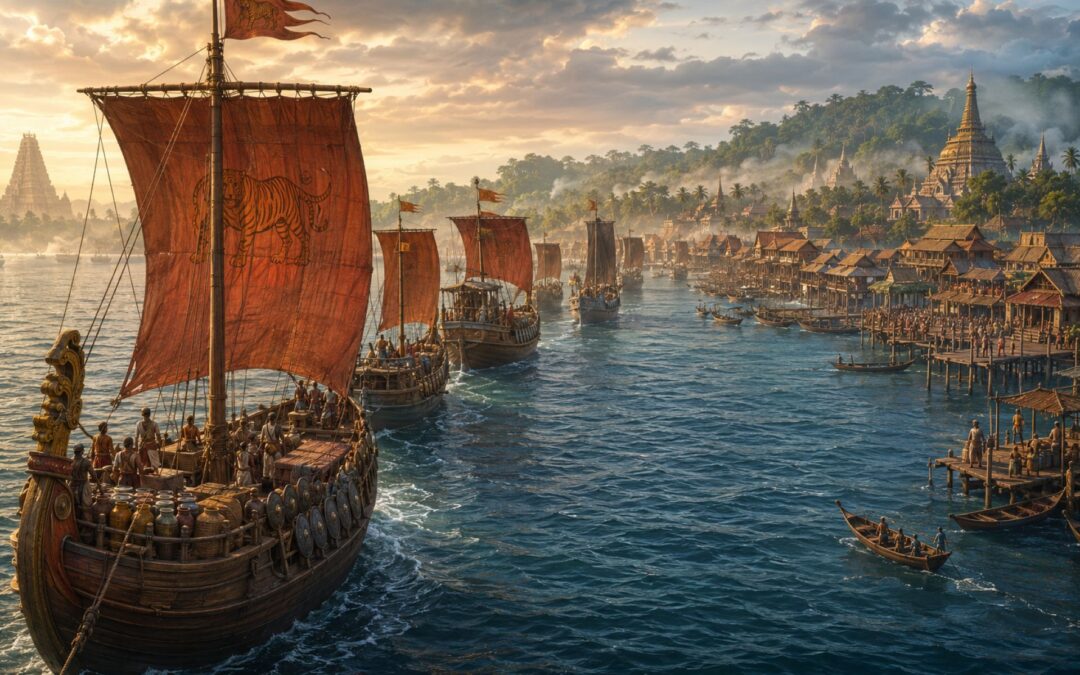
In 1025, an imperial force from southern India crossed the Bay of Bengal and attacked a chain of ports connected to Srivijaya, the dominant maritime power of Southeast Asia. The campaign reached across a commercial world linking the Tamil coast with Sumatra, the Malay Peninsula and China. Chola inscriptions claimed that a Southeast Asian ruler was captured and that prestigious treasures were carried back to India.
Even without embellishment, it was an astonishing feat.
Yet the Chola campaign is often narrated with more certainty than the evidence permits. Later accounts describe sophisticated battle plans, revolutionary naval technology and a century of Chola domination over Southeast Asia. The surviving records tell a more complicated story. They establish that Rajendra Chola I launched an ambitious maritime expedition and struck important centres within Srivijaya’s commercial network, but they reveal far less about the fleet’s route, its weapons, the battles it fought or Rajendra’s precise motives.
The distinction matters because the Chola achievement does not need mythology to appear impressive. It emerged from the interaction of agricultural wealth, temple-centred authority, imperial ambition, international commerce and merchant networks that stretched across the Indian Ocean.
Understanding the raid therefore requires more than recounting a naval attack. It requires explaining how the Cholas became powerful enough to launch it, why Srivijaya mattered to them and what the campaign changed without pretending that it created a permanent Chola empire in Southeast Asia.
How the Cholas Became an Imperial Power
The Cholas were not a new people when they emerged as one of medieval India’s great imperial dynasties. Tamil literature and inscriptions preserve references to earlier Chola rulers centuries before the empire reached its height. But the existence of an ancient lineage should not be confused with uninterrupted imperial power.
The medieval Chola ascendancy began in the ninth century, when Vijayalaya Chola took advantage of conflict between the Pallavas and Pandyas. Around the middle of the century, he seized Thanjavur from the Muttaraiyars, a regional ruling family operating within the wider Pallava political sphere. From that foothold in the Kaveri delta, Vijayalaya and his successors began constructing a more powerful territorial state.
The geography of the region gave them an exceptional foundation. The Kaveri River and its branches sustained one of southern India’s most productive agricultural zones. Control over this fertile landscape generated revenue, supported dense settlements and allowed rulers to finance temples, armies and administrative institutions.
The Chola heartland was also connected to the sea. Ports along the Coromandel Coast linked inland production with maritime commerce. Textiles, spices, precious stones and other goods moved through networks extending toward Sri Lanka, Southeast Asia, China and the western Indian Ocean.
Chola power was therefore neither exclusively agricultural nor exclusively maritime. The empire’s strength came from connecting the two.
Successive rulers expanded beyond the Kaveri delta, defeating rivals and absorbing territories across Tamil country. By the reign of Rajaraja Chola I, who ruled from 985 to 1014, the dynasty had become the dominant power in much of southern India.
Rajaraja campaigned against the Pandyas and Cheras, extended Chola influence along the western coast and conquered large parts of Sri Lanka. His reign also strengthened the institutions that enabled imperial expansion. Inscriptions record land surveys, revenue obligations, temple endowments and the decisions of local assemblies. Temples became religious centres, major landholders, employers and repositories of wealth.
These records reveal a sophisticated political order, but they should not be mistaken for evidence of a uniformly centralised modern state. Chola rulers relied on regional elites, village institutions, temple authorities and military subordinates whose interests did not always perfectly align with those of the court. Historians have consequently debated how directly the monarchy controlled everyday life across its territories.
Local assemblies could exercise real authority, particularly in prosperous settlements, but participation was restricted by property, status and other qualifications. They were not democratic councils in the modern sense. Nor can surviving revenue records prove that taxation was always fair or consistently administered.
What the inscriptions do show is that the Cholas became remarkably effective at mobilising resources across a large and varied political landscape.
Rajaraja’s son Rajendra Chola I inherited this expanding imperial machinery. Before becoming king in 1014, Rajendra had already commanded military campaigns alongside his father. Once on the throne, he continued the conquest of Sri Lanka, intervened in the eastern Deccan and fought the Western Chalukyas.
His most celebrated land campaign carried Chola armies northward toward the Ganges. Rajendra’s forces defeated several rulers along the way and returned with water from the sacred river. The expedition was commemorated in the name of a new capital, Gangaikondacholapuram—“the city of the Chola who conquered the Ganges.”
The capital and its great temple were not merely monuments to vanity. They translated military victory into sacred and political legitimacy. The architectural achievements associated with Rajaraja and Rajendra, now represented within UNESCO’s recognition of the Great Living Chola Temples, demonstrate how the dynasty used monumental building to present itself as both worldly and divinely sanctioned.
By the early eleventh century, the Cholas possessed extensive revenues, experienced commanders, access to coastal shipping and a political culture that rewarded distant conquest. Within the wider history of medieval India, they were unusual not because they alone participated in long-distance trade, but because they combined a powerful territorial base with the capacity to project organised violence far beyond the subcontinent.
That combination made the campaign of 1025 possible.
The Indian Ocean Economy Behind Chola Expansion
The Bay of Bengal was not a frontier separating India from Southeast Asia. It was a commercial highway.
For centuries, merchants had travelled between the ports of southern India, Sri Lanka, the Malay Peninsula, Sumatra and China. These eastern routes were part of a wider Indian Ocean system reaching westward toward the Persian Gulf, the Red Sea and the eastern coast of Africa.
Goods rarely moved from their point of origin to their final consumer in a single uninterrupted journey. Cargoes were assembled, divided, exchanged and re-exported through a chain of ports. Textile producers in southern India, spice-growing regions in Southeast Asia, Chinese manufacturers and merchants from the Arab and Persian worlds all participated in this interconnected economy.
By the eleventh century, expanding commerce with Song China made the eastern end of this system especially valuable. Chinese demand attracted merchants and diplomatic missions from across maritime Asia. Access to Chinese markets offered profit, prestige and political recognition.
South Indian ports were well placed to benefit. The Coromandel Coast connected productive inland regions to the Bay of Bengal, while Tamil commercial communities already possessed experience travelling between different kingdoms and linguistic worlds.
Srivijaya occupied an equally strategic position farther east.
Rather than resembling a modern nation-state with neatly defined borders, Srivijaya was a maritime political network associated at different times with centres in Sumatra and the Malay world. Its influence rested partly on its relationship with ports and sea lanes around the Strait of Malacca and nearby routes.
Ships travelling between the Indian Ocean and the South China Sea often passed through this region. Control over anchorages, supplies, customs arrangements and diplomatic relationships allowed local rulers to benefit from the movement of merchants.
Srivijaya was also a significant Buddhist centre. Monks, pilgrims and scholars travelled through its territories, linking Southeast Asian courts with religious institutions in India and China.
The Cholas and Srivijaya were therefore not inevitable enemies. Before the campaign of 1025, evidence points to cooperation between their ruling houses.
A Srivijayan ruler supported the construction of a Buddhist monastery at Nagapattinam on the Tamil coast. Chola grants connected with the institution indicate that political, commercial and religious relationships crossed the Bay of Bengal well before Rajendra’s fleet attacked Srivijayan centres.
This earlier cooperation is important because it prevents the conflict from being reduced to a timeless struggle between India and Southeast Asia, Hinduism and Buddhism, or two naturally hostile empires. The relationship changed within a dynamic commercial and diplomatic environment.
One of the most influential explanations for that change appears in Tansen Sen’s reconstruction of the Chola–Srivijaya–China triangle. Sen places the campaign within growing competition over access to Song China and the increasingly important maritime routes linking the Tamil coast to East Asia.
From this perspective, Srivijaya’s position within the commercial network could become a problem if it attempted to mediate, restrict or profit excessively from traffic between South India and China. Chola rulers and Tamil merchants would have preferred favourable access to eastern markets rather than dependence on a competing maritime power.
That does not mean the Cholas controlled the Maritime Silk Road. No single dynasty did. The ocean was populated by merchants, port authorities, sailors, local rulers, religious communities and competing political networks.
Nor is there evidence that new ships suddenly made traditional ports unnecessary. Maritime commerce remained dependent on seasonal winds, supplies, repairs, local knowledge and political protection. Even vessels capable of travelling long distances benefited from stopping at strategically located ports.
The conflict was therefore not a simple contest for ownership of the sea. It took place within a network in which rulers could influence trade by making particular routes and ports more profitable, safer or more politically accessible than others.
To understand how the Cholas operated within that world, it is necessary to look beyond kings and armies to the merchant organisations that connected distant markets.
The Merchant Guilds That Connected South India to Asia
Medieval South Indian merchants did not travel only as isolated individuals. Many belonged to associations that helped organise trade across long distances and political boundaries.
Among the best-known were the Ainnurruvar, often associated with the “Five Hundred” of Ayyavole, along with organisations such as Manigramam and Anjuvannam. Their exact structures changed over time and place, and these names did not always describe rigidly separate corporations. They were flexible commercial communities whose members could cooperate across regions, religions and languages.
Their inscriptions have been found in India and parts of Southeast Asia. These records preserve evidence of donations, commercial privileges, agreements and religious endowments. They demonstrate that South Indian merchant communities were active far beyond the political boundaries directly governed by the Chola court.
This mobility gave them influence.
Long-distance trade required capital, information and trust. Merchants needed to know when monsoon winds would change, which ports were secure, where particular goods could be sold and which officials expected payments. They depended on brokers, translators, shipowners, financiers and local partners.
Guild membership could help create a framework for these relationships. It offered merchants shared identities and reputational networks that travelled with them.
Some commercial groups also possessed armed protection or maintained relationships with fighting men. This was not unusual in a world where valuable goods moved through regions vulnerable to theft, political upheaval and local conflict. But references to armed merchants do not prove that guilds operated private navies capable of dictating imperial policy.
The strongest account of their importance comes from epigraphic research on South Indian merchant guilds, which traces their presence through inscriptions rather than later legends. This evidence shows extensive commercial reach, but it also reveals the danger of treating merchant organisations as a secret government behind the Chola throne.
The interests of merchants and rulers could overlap without being identical.
Merchants benefited from political stability, protected ports and favourable customs arrangements. Rulers benefited from commercial taxes, access to imported goods and the wealth generated by prosperous trading communities. Merchants could provide ships, credit, logistical knowledge or overseas contacts. Royal power could protect or promote their activities.
That relationship may help explain how Rajendra organised an expedition across the Bay of Bengal. Tamil merchants possessed knowledge of foreign ports and sailing conditions that would have been useful to any military force operating in Southeast Asia.
Yet no surviving evidence proves that the guilds demanded the war, financed it in return for commercial concessions or threatened Rajendra with support for his rivals. Such scenarios may sound plausible, but plausibility is not documentation.
The safest conclusion is that merchant networks formed part of the world that made Chola maritime expansion possible. They connected South India to distant markets, created communities abroad and gave rulers access to information and resources beyond their territorial frontiers.
They may also have had much to gain if Srivijaya’s position weakened. Whether their interests directly caused the campaign is another question.
Why Rajendra Chola Attacked Srivijaya
No surviving source records Rajendra Chola explaining why he ordered the campaign of 1025. The Chola inscriptions celebrate victory; they do not preserve minutes from a royal council or a declaration of war.
The causes must therefore be reconstructed from the political and commercial setting.
Economic rivalry provides the most persuasive framework, but it should not be treated as the sole explanation. Medieval rulers did not divide military action neatly into modern categories such as trade policy, national security and personal ambition. A single campaign could simultaneously seek wealth, prestige, strategic advantage and political submission.
Trade, China, and Commercial Rivalry
By the early eleventh century, Song China had become a major centre of demand within maritime Asia. Rulers who participated in diplomatic exchanges with the Song court could gain prestige as well as commercial opportunities.
Both the Cholas and Srivijaya sent missions to China. Their relationship with Chinese markets was therefore not merely a private concern of merchants. It was connected to court diplomacy and the international standing of rulers.
Srivijaya’s position near important routes gave it the ability to act as an intermediary. Ships moving through its sphere might pay customs duties, obtain provisions, negotiate protection or rely on local pilots. These activities generated revenue and influence.
From a Chola perspective, a powerful intermediary could be useful when relations were friendly and obstructive when they were not.
If Srivijaya attempted to channel trade through preferred ports, disadvantage Tamil merchants or represent itself as the principal commercial partner between the Indian Ocean and China, Chola interests could suffer. A successful attack on its ports might disrupt that position and demonstrate that Srivijaya could not monopolise access to the eastern seas.
This explanation fits the broader commercial context. The Cholas had already expanded along the coasts of southern India and into Sri Lanka. Their rulers presided over ports integrated into international trade, while Tamil merchant communities operated across the Bay of Bengal.
Weakening a rival maritime network could improve their bargaining position.
But the evidence does not establish a specific commercial offence. There is no surviving Chola document stating that Srivijaya imposed a particular tariff, seized a Tamil fleet or closed a named port to Chola merchants.
The phrase “trade war” can therefore be useful only as shorthand. It captures the economic competition surrounding the campaign, not a proven sequence of provocations.
Commercial rivalry remains the leading interpretation because it explains why a South Indian ruler would commit resources to striking a distant network of ports. It does not eliminate other motives.
Prestige, Plunder, and Regional Politics
Rajendra’s reign was defined by the public performance of conquest.
His northern campaign had reached the Ganges, and his new capital proclaimed that achievement in its name. Military victories strengthened his authority at home, demonstrated superiority over rivals and supported claims to universal kingship.
A successful attack across the Bay of Bengal would extend that performance to another direction. It would prove that Rajendra’s reach was not confined to the Indian mainland or Sri Lanka.
The objects highlighted in Chola records reinforce this interpretation. Triumphal inscriptions emphasised captured rulers, gates, jewels and other symbols of submission. Such trophies mattered because they transformed distant violence into visible proof of royal power.
Plunder was also an important objective in its own right. Ports accumulated valuable goods, precious metals and ceremonial objects. A rapid expedition could enrich the conqueror even without annexing territory.
The prestige of defeating Srivijaya may have been especially attractive because the two courts already knew one another through diplomacy and religious patronage. Attacking a recognised maritime ruler carried greater symbolic weight than raiding an obscure settlement.
Regional politics may also have shaped the choice of targets. Southeast Asia contained multiple competing rulers and port centres. The Cholas could exploit these rivalries, form temporary relationships and attack places whose position affected wider commercial networks.
What cannot be securely established is a simple alliance system in which a Hindu Chola–Angkor bloc fought a Buddhist Srivijaya–Tambralinga bloc. Political relationships rarely followed religious identity so neatly, and the evidence does not justify presenting such a coalition as the direct cause of the war.
Rajendra most likely acted from a combination of motives. Trade made Srivijaya strategically important. Plunder made its ports attractive. Prestige made victory valuable. Imperial ambition made the risk acceptable.
What Happened in the 1025 Campaign
The campaign is known primarily through Chola inscriptions designed to glorify Rajendra. These records establish that a major overseas operation occurred, but they are not narrative histories.
They list victories, captured objects and defeated places. They do not describe daily movements, commanders’ conversations, naval formations or the precise sequence of battles.
The most responsible reconstruction must begin with what the inscriptions say and stop where the evidence ends.
What the Inscriptions Record
Rajendra sent an armed force across the sea against places associated with the Srivijayan commercial world. The campaign appears to have struck multiple centres rather than concentrating on a single battlefield.
Chola records name Kadaram and several other locations whose modern identifications remain debated. Some are generally associated with the Malay Peninsula or Sumatra; others are more uncertain. The list suggests an assault on a network of strategically connected ports and political centres.
That pattern is significant.
A force seeking permanent territorial conquest would normally need to capture land, install administrators, secure supply lines and maintain garrisons. A force seeking to damage a maritime rival could instead strike several important ports, seize wealth and compel submission before returning home.
The inscriptions claim that Sangrama Vijayottunggavarman, a ruler associated with Srivijaya, was captured. They also celebrate the seizure of a ceremonial gateway and other treasures.
Such claims should be read critically because royal inscriptions magnified victory and minimised setbacks. Even so, the named ruler and spoils provide firmer evidence than later stories about the fleet’s manoeuvres.
The expedition necessarily required planning.
Troops, provisions, water and equipment had to be transported over great distances. Ships had to sail with the monsoon cycle, reach unfamiliar coasts and coordinate attacks. Navigators and merchants with knowledge of Southeast Asian waters may have contributed to the operation.
The campaign also required political intelligence. Rajendra’s court needed some understanding of which ports mattered, how they were connected and when they might be vulnerable.
The scale of that achievement is captured by the principal scholarly collection on the Chola naval expeditions, which brings together research on inscriptions, trade, ships, diplomacy and Southeast Asian geography. The volume also demonstrates how many basic questions remain unresolved.
Rajendra’s forces appear to have returned after achieving their immediate objectives. The campaign brought prestige and plunder to the Chola ruler and temporarily shattered the appearance of Srivijayan security.
That is enough to classify it as one of the most ambitious long-distance military operations conducted by an Indian dynasty.
What the Sources Do Not Tell Us
The inscriptions do not reveal the size or design of the Chola fleet. They do not identify a permanent naval bureaucracy comparable to that of a modern state. They do not preserve technical descriptions of specialised warships.
They also do not support a detailed two-fleet battle plan.
There is no reliable contemporary account of one Chola force distracting the Srivijayan fleet at the Strait of Malacca while another sailed around southern Sumatra. There is no secure evidence that Rajendra’s ships completed an unprecedented monsoon passage specifically because they possessed revolutionary hull technology.
Likewise, claims that Chinese and Arab shipbuilders created a Chola research programme, introduced watertight compartments or supplied the court with a mariner’s compass cannot presently be treated as established history.
The same applies to stories of Chola flamethrowers resembling Byzantine Greek fire. Dramatic weapons make for memorable storytelling, but the evidence does not justify placing them aboard Rajendra’s ships.
Nor do the sources describe a decisive fleet battle in enough detail to reconstruct a pincer movement or explain exactly how Srivijayan naval resistance collapsed.
This absence should not be filled with invention.
Medieval campaigns are often known through inscriptions that record the political outcome rather than the operational process. Historians can infer that the Cholas possessed ships, navigational knowledge and logistical capacity. They cannot transform those reasonable inferences into a cinematic battle scene.
Restraint does not diminish the campaign. Sailing an organised military force across the Bay of Bengal, striking several distant centres and returning with a captive ruler and prestigious spoils was already an extraordinary undertaking.
The unknown details should remain unknown.
What the Cholas Did—and Did Not—Control After 1025
The attack weakened Srivijaya and damaged the prestige of its ruling network. A maritime power whose influence depended partly on protecting ports and maintaining relationships had suffered a humiliating breach.
But humiliation was not the same as destruction.
Srivijayan and related Southeast Asian centres continued to appear in commercial and diplomatic records after 1025. Political authority shifted and reorganised, as it often did within maritime networks, but there is no evidence that the Cholas permanently annexed the whole region.
The campaign therefore should not be described as the moment when a centuries-old Southeast Asian empire simply ended and was replaced by Chola rule.
The Cholas did not create a clearly documented administrative system across Sumatra, the Malay Peninsula or Cambodia. No surviving evidence demonstrates that Rajendra divided Srivijayan territory into Chola provinces, collected regular taxes through imperial officials or maintained permanent garrisons throughout the region.
Later Chola rulers remained interested in Southeast Asian affairs, and subsequent interventions involving Kadaram suggest continuing political and commercial connections. Each episode, however, must be evaluated on its own evidence. They do not automatically prove a continuous century of occupation.
The distinction between state power and merchant presence is especially important.
Tamil merchants became increasingly visible in inscriptions and settlements across parts of Southeast Asia. Their temples, commercial agreements and community organisations reveal long-lasting connections with the region.
Yet a Tamil merchant living in Sumatra was not necessarily an agent of the Chola emperor. Commercial communities often operated under different rulers and adapted to local political conditions. Their presence can demonstrate mobility and cultural exchange without proving territorial control from Thanjavur or Gangaikondacholapuram.
The same caution applies to royal genealogies and later traditions.
Stories linking Southeast Asian dynasties directly to Chola princes may preserve memories of migration, marriage or cultural prestige. They cannot be accepted as literal political history without contemporary evidence. Claims that Rajendra married a captured Srivijayan princess or established lasting dynastic control through intermarriage remain uncertain.
The story of Sri Lumay, sometimes described as a Chola prince who defected from an expedition and founded a kingdom in Cebu, is even more problematic. It belongs to much later tradition and cannot serve as evidence for a Chola invasion of the Philippines.
The relationship between the Cholas and Southeast Asia after 1025 was therefore influential but uneven.
Military intervention opened one phase of that relationship, but diplomacy, religion and commerce continued alongside rivalry. The Buddhist connections represented by Nagapattinam did not disappear simply because the two courts had gone to war. Maritime communities could resume trade even when rulers remained suspicious of one another.
The Chola raid may have created opportunities for Tamil merchants by weakening parts of the Srivijayan network. It may also have encouraged the rise of alternative ports and political centres. But these changes were shaped by Southeast Asian rulers and merchants as much as by decisions made in the Chola court.
Calling the result “colonial” obscures more than it explains. European colonial empires later constructed fortified settlements, permanent bureaucracies and systems of territorial extraction across the Indian Ocean. The Chola expedition left no comparable structure.
Rajendra demonstrated the ability to punish a distant maritime rival. He did not create a South Indian colony spanning Southeast Asia.
The Chola Legacy Across the Bay of Bengal
The raid of 1025 matters because it reveals a side of medieval Indian history that disappears when the subcontinent is treated as an isolated landmass.
The Cholas belonged to an Indian Ocean world. Their wealth rested partly on the agricultural productivity of the Kaveri delta, but their ambitions extended through ports, merchant communities and diplomatic networks far beyond southern India.
Rajendra’s expedition combined those resources. It required the revenue of a territorial empire, the confidence of a dynasty accustomed to conquest, the knowledge of maritime routes and the existence of ships capable of transporting men and supplies across the Bay of Bengal.
Its significance does not depend on proving that the Cholas ruled Southeast Asia.
The campaign demonstrated that a South Indian ruler could intervene violently in the commercial politics of the eastern Indian Ocean. It exposed the vulnerability of a maritime network that had previously appeared secure. It also revealed how closely royal ambition was connected to the movement of merchants and goods.
The commercial relationships involved were larger than the Chola state itself.
Tamil merchant communities continued to operate abroad because they could negotiate with different rulers and establish local roots. Their survival did not require permanent Chola military protection. This adaptability helps explain why Tamil commercial and cultural traces endured even where Chola political control never existed.
The Cholas also left a more visible legacy within South India. Their temples, inscriptions, sculptures and cities preserve evidence of how imperial authority was imagined and organised. Gangaikondacholapuram embodied Rajendra’s claim to have carried Chola power from the Ganges to the sea.
Across the Bay of Bengal, the legacy was less a territorial empire than a deepening of connections already centuries old. Indian religions, languages, artistic forms and political ideas had reached Southeast Asia long before Rajendra. Local societies selected, transformed and combined these influences rather than simply receiving them from an imperial centre.
The Cholas participated in that exchange; they did not create it.
Their raid was one dramatic moment within a larger history of mobility between South and Southeast Asia. It was enabled by commercial relationships and followed by new patterns of trade, migration and political competition.
Removing unsupported stories makes the achievement clearer.
Rajendra did not need fire-breathing ships, a secret monsoon route or a century of colonial rule to demonstrate Chola power. The evidence that survives already shows a ruler capable of coordinating a long-distance assault on one of maritime Asia’s most important political networks.
That achievement arose from more than a navy. It rested on fertile land, temples, taxes, ambitious kings, mobile merchants and generations of contact across the sea.
The Cholas did not conquer Southeast Asia. They did something historically distinct and, in its own way, just as remarkable: they proved that an empire rooted in the Kaveri delta could intervene decisively in the politics of the wider Indian Ocean.
Their story is therefore not merely about a forgotten naval victory. It is about a medieval world in which India and Southeast Asia were connected by commerce, diplomacy, religion and war—and about an empire powerful enough to turn those connections into an instrument of conquest.
Last Updated on July 27, 2026 by Aseem Gupta