
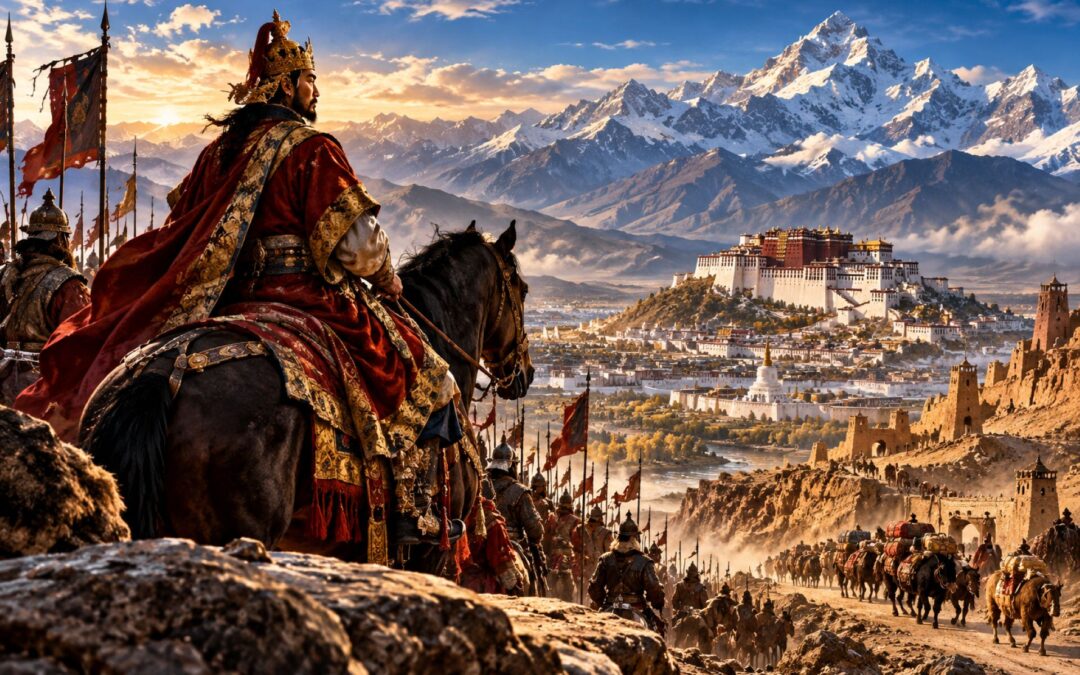
During the seventh century, a kingdom emerging from the Tibetan Plateau became one of Asia’s most formidable military powers. Its armies crossed mountain passes, conquered neighboring kingdoms, fought the Tang dynasty of China, and extended Tibetan influence into the wealthy oasis cities of Central Asia. Rulers in China and northern India increasingly had to reckon with an empire whose political heartland lay more than 3,000 metres above sea level.
This was a remarkable transformation. Before the rise of the Tibetan Empire, the plateau had been divided among competing rulers, clans, and regional powers. Within a few generations, the Yarlung dynasty had established a political system capable of raising armies, administering conquered territories, negotiating with distant courts, and competing for control of the trade routes connecting some of Eurasia’s richest civilizations.
The empire’s rise was not simply the achievement of a succession of warrior-kings. It depended on powerful aristocratic families, military organization, diplomatic marriages, administrative innovations, and relationships with the societies surrounding Tibet. Those same forces also generated rivalries within the ruling establishment, while the gradual arrival of Buddhism introduced another dimension to the struggle over imperial authority.
Understanding how Tibet became an empire therefore requires following two connected stories: the expansion of Tibetan power beyond the plateau and the changing political relationships that made such expansion possible.
The Yarlung Kings Bring the Clans Together
Before the emergence of a unified Tibetan state, the Tibetan Plateau contained numerous political communities whose rulers competed over territory, resources, and influence. Fertile river valleys supported agriculture and settlements, while surrounding mountains offered natural defensive positions. Fortified strongholds helped local elites protect their territories, and control of productive valleys could determine a ruler’s ability to support followers and military campaigns.
These communities were not necessarily isolated or permanently at war. Marriage alliances, trade, tribute, and shifting political loyalties connected them, while raiding and armed conflict formed part of the competition between rival rulers. The difficult geography of the plateau encouraged strong regional identities and made it challenging for any single dynasty to establish lasting authority.
Among these competing powers was the Yarlung dynasty, based in the region of the Yarlung Valley in southern Tibet. Later Tibetan traditions traced its ancestry to ancient kings endowed with sacred authority, presenting the dynasty as the legitimate ruling house of Tibet. Such genealogies reveal how Tibetan rulers and historians understood kingship, although their accounts of the earliest monarchs cannot always be confirmed through contemporary evidence.
The emerging dynasty’s ruler bore the title tsenpo, conventionally translated as king or emperor. The title carried substantial prestige, but its authority had to be translated into effective control over other aristocratic families. A claim to legitimate kingship meant little if regional chiefs could ignore royal demands or form alliances against the throne.
A decisive stage in this process occurred under Namri Songtsen, who ruled during the late sixth and early seventh centuries. Rather than relying exclusively on conquest, Namri strengthened his position through alliances with influential clan leaders and campaigns against neighboring rivals. By defeating competing political coalitions, he extended Yarlung influence over important parts of central Tibet and created the foundations of a larger kingdom.
The surviving accounts describe significant resistance to his expansion, including conflict with powerful local chiefs who had assembled alliances of their own. These struggles were more than personal rivalries. They reflected a larger contest over whether political authority would remain distributed among competing regional rulers or become concentrated under the Yarlung dynasty.
Namri’s successes did not eliminate those tensions. Later Tibetan historical traditions describe his death through poisoning, followed by renewed opposition to his family’s authority. Although the precise circumstances are difficult to establish, the succession appears to have exposed the fragility of the political structure he had assembled.
His successor, Songtsen Gampo, inherited both the advantages and the dangers of this expanding kingdom. Traditional accounts portray him as a remarkably young ruler who quickly confronted rebellious territories and enemies associated with his father’s death. His exact accession age and the details of these early confrontations remain uncertain, but the broader political challenge is clear: he had to turn his predecessor’s achievements into something more durable than a personal network of alliances.
That task would define the next stage of Tibetan history.
Songtsen Gampo Builds a Kingdom That Can Conquer
Songtsen Gampo, who ruled during the first half of the seventh century, became the central figure in Tibet’s transformation from a powerful regional kingdom into an expanding empire. His achievement was not merely to defeat rival rulers. He helped create a political system capable of mobilizing resources and projecting military power beyond the territories directly controlled by the Yarlung dynasty.
Establishing authority within the Tibetan heartland was the first requirement. Regional aristocrats commanded followers, possessed local influence, and maintained relationships that could either strengthen or undermine the king. Songtsen needed their cooperation to organize campaigns, but allowing powerful families complete independence would make the emerging monarchy vulnerable to fragmentation.
His government therefore developed mechanisms for organizing military service, supervising territory, and strengthening the relationship between local populations and the royal administration. Military and administrative districts helped mobilize men and resources across wider areas than traditional clan loyalties alone could sustain. The resulting system gave Tibet an increasingly effective way to raise armies and maintain political control.
This did not mean that Songtsen abolished the aristocracy or replaced older forms of authority with a completely centralized bureaucracy. Influential families continued to provide commanders, ministers, and administrators, while local political structures remained important in many regions. As studies of Tibetan imperial administration demonstrate, imperial rule depended on combining territorial organization with existing social and political relationships.
The system’s strength lay partly in this combination. Rather than requiring the royal household to manage every community directly, the expanding kingdom could draw upon established elites while placing them within a broader imperial framework. It also created opportunities for those same elites to accumulate considerable power, a development that would become especially important after Songtsen’s death.
With a stronger political base, the king turned toward neighboring territories. Among the most significant was Zhangzhung, a powerful kingdom associated with western Tibet whose territories occupied strategically important parts of the plateau. Its independence limited Yarlung expansion westward and complicated the kingdom’s relationships with the regions beyond the Himalayas.
Tibetan tradition preserves a dramatic account of Zhangzhung’s conquest. According to later narratives, Songtsen arranged the marriage of a Tibetan princess to the Zhangzhung ruler. Unhappy with her position, she reportedly supplied intelligence about the king’s movements, enabling Tibetan forces to ambush and kill him.
The story illustrates the importance later historians attached to marriage diplomacy, espionage, and royal strategy. Its precise details should not, however, be treated as independently established history. What matters for the larger political narrative is that Zhangzhung was brought under Yarlung authority, helping transform the balance of power across the plateau.
Songtsen’s ambitions also extended toward the eastern and northeastern regions, where Tibetan forces encountered the Azha, known in Chinese sources as the Tuyuhun, along with other communities occupying territories between Tibet and Tang China. These regions provided access to important frontier routes and created opportunities for both military expansion and diplomatic confrontation.
The geography of Tibet made such expansion strategically significant. Control over the western plateau improved access toward Kashmir and the western Himalayas, while influence in the east brought Tibetan armies closer to the frontiers of Chinese power. Southern connections offered routes toward Nepal and northern India.
Expansion therefore did more than enlarge the kingdom’s territory. It placed Tibet in direct contact with established networks of trade, diplomacy, religious exchange, and political competition. Songtsen’s successors would eventually exploit those connections on an even greater scale, but their ability to do so rested on the military and administrative foundations established during his reign.
Nepal, Writing, and the Making of an Imperial Court
Military power allowed the Tibetan kingdom to expand, but conquest alone could not provide everything an aspiring empire needed. Government also required reliable communication, knowledge of neighboring societies, diplomatic relationships, specialized skills, and institutions capable of supporting royal authority.
Lhasa developed into an important political and religious centre during this formative period. Its location in central Tibet connected the royal establishment with the heartland of Yarlung power, while the growth of religious foundations and court institutions helped increase its prominence. The development of an imperial centre reflected the monarchy’s growing ambitions beyond its original regional base.
One important relationship was with Nepal, whose position along the Himalayan routes connected Tibet with the political and commercial worlds of northern India. During the seventh century, the Nepalese ruler Narendradeva was displaced during a struggle for power and spent a period in exile under Tibetan protection. Tibetan military assistance subsequently helped him recover his kingdom.
The episode demonstrates how Songtsen could use military strength to influence political developments beyond the plateau without necessarily incorporating every neighboring kingdom into his empire. Tibetan involvement increased its influence over Nepalese affairs and strengthened relationships across the Himalayan region. Describing Nepal as a permanently absorbed Tibetan possession, however, would oversimplify a changing political relationship.
Nepalese craftsmen and cultural traditions also became associated with the early development of Tibetan Buddhist architecture. Later accounts connect these exchanges with important religious foundations in Lhasa, including the Jokhang Temple. The temple remains one of Tibet’s most significant religious sites, although particular stories concerning its foundation and early construction must be assessed alongside the development of later Buddhist traditions.
Princess Bhrikuti occupies a prominent place in those traditions. She is remembered as a Nepalese consort of Songtsen Gampo and an important patron of Buddhism, often associated with the establishment of religious images and temples. The historical evidence for her identity and activities is less secure than later accounts suggest, so her significance must be understood partly through the religious memory constructed around the early monarchy.
These connections belonged to a wider world of exchange between the civilizations of India and China, in which the Himalayan region was not simply an obstacle separating two powerful societies. Tibetan rulers could participate in networks involving merchants, religious specialists, physicians, craftsmen, diplomats, and scholars.
The development of a Tibetan writing system was another fundamental change. Earlier Tibetan societies possessed sophisticated political and oral traditions, but a growing imperial administration benefited from being able to record orders, agreements, legal decisions, and information about people and resources. Writing also created new possibilities for diplomacy and the transmission of religious and intellectual works.
Traditional Tibetan histories credit a minister named Thonmi Sambhota with travelling to India, studying Indian writing systems, and adapting them to create the Tibetan script. These narratives emphasize the importance of Indian models, but the surviving evidence does not confirm every detail of Thonmi’s biography or the story of a single inventor.
The Tibetan script developed through adaptation of Indic writing traditions to the requirements of the Tibetan language. Its emergence enabled the production of administrative documents and, eventually, a substantial literature. The importance of writing to imperial government is clearer than the precise circumstances surrounding its invention.
Later traditions also associate Songtsen with the introduction of laws inspired by Buddhist morality. However, the distinction between administrative developments during his reign and subsequent religious interpretations of his rule is essential. Historical reassessments of Tibetan royal lawgiving and its Buddhist interpretation caution against treating the fully developed image of Songtsen as a Buddhist lawgiver as a straightforward description of seventh-century government.
Religious and intellectual exchange was not limited to written texts. Tibetan historical accounts also describe the arrival of foreign physicians and the exchange of medical knowledge, including stories of scholars and medical specialists gathering at the Tibetan court. Such narratives reflect the court’s remembered openness to foreign expertise, although their individual details are not always independently verifiable.
Buddhism was beginning to establish a place among sections of the Tibetan aristocracy, but it had not yet displaced the ritual traditions already practiced across the plateau. Royal ceremonies, local religious specialists, ancestral practices, and other forms of belief continued to matter. The later image of Songtsen as Tibet’s first great Buddhist king should therefore be distinguished from the more limited and uneven religious changes that can be established for his lifetime.
By the middle of the seventh century, the Tibetan court had become more than the centre of a military coalition. It was developing the administrative, diplomatic, and cultural resources needed to participate in the politics of a much larger region.
The Marriage Alliance That Followed War with Tang China
The Tang dynasty, founded in China in 618, was one of the most powerful states in Eurasia. Its rulers pursued influence across Inner Asia, developed relationships with frontier kingdoms, and competed for control of the territories and routes connecting China with Central Asia.
Songtsen Gampo’s expanding kingdom increasingly came into contact with this political world. The two courts could benefit from diplomatic relations, but their ambitions also overlapped in the territories between the Tibetan Plateau and the Chinese heartland.
In 634, Songtsen sent an embassy to the Tang court at Chang’an. Diplomatic exchanges of this kind were central to relations between powerful states, allowing rulers to negotiate prestige, recognition, commerce, and political relationships. For the Tibetan king, contact with Tang China offered an opportunity to establish his position within the regional diplomatic order.
Marriage diplomacy soon became a source of conflict. Songtsen sought a bride from the Tang imperial family, an arrangement that would recognize Tibet’s importance and establish a prestigious connection between the ruling houses. The request was initially rejected, creating tensions that later Tibetan and Chinese accounts explained in somewhat different ways.
The dispute was closely connected to the position of the Azha or Tuyuhun kingdom, which occupied strategically important territories between Tibet and China. Its rulers had their own relationships with the Tang court, and competition over influence in the region intensified as Tibetan power expanded.
Songtsen’s forces campaigned against the Azha and other frontier communities before confronting Tang-controlled territory near Songzhou in 638. Tibetan accounts emphasize the strength of the Tibetan position, while Chinese records describe Tang resistance and a successful counterattack. The evidence therefore does not support the simple claim that Tibet effortlessly destroyed a Chinese army and forced an otherwise helpless emperor to surrender.
The military confrontation nevertheless demonstrated that the Tibetan kingdom was a serious participant in frontier politics. Neither side could treat relations with the other as a minor diplomatic matter. War and negotiation became closely connected, as they frequently were in the politics of imperial Asia.
Subsequent negotiations resulted in an agreement for a marriage involving the Tang imperial family. Princess Wencheng travelled to Tibet in 641 and became a consort of Songtsen Gampo, establishing one of the most celebrated relationships in Tibetan and Chinese historical memory.
Wencheng is frequently described as Emperor Taizong’s daughter, but this is inaccurate. She was a member of the Tang imperial clan rather than his biological daughter. The distinction matters because the marriage was part of a political arrangement involving imperial prestige, and later narratives often simplified or elevated her relationship with the emperor.
The marriage helped establish a period of improved diplomatic relations. It also provided a framework for exchanges involving court personnel, gifts, technologies, and cultural practices. Later traditions particularly emphasize Wencheng’s role in bringing Chinese religious images and knowledge to Tibet.
The importance of these narratives extends beyond the question of whether each individual gift or religious act can be verified. As historical scholarship on Princess Wencheng explains, the marriage acquired meanings in later accounts that went beyond the immediate diplomatic circumstances of the seventh century.
Tibetan Buddhist traditions remembered Wencheng and Bhrikuti as major contributors to the establishment of Buddhism. Chinese historical narratives also associated Wencheng with the transmission of cultural practices from China. These accounts reflect the ways subsequent generations used imperial marriage to explain Tibet’s place within wider religious and political worlds.
Songtsen’s marriages should not be mistaken for evidence that Tibet had become subordinate to either China or Nepal. Foreign marriage alliances were tools of royal diplomacy, and Tibetan rulers pursued their own strategic interests. Nor did the agreement create permanent peace between the two empires, whose competing ambitions would generate further conflict after Songtsen’s death.
The confrontation belonged to the broader history of Tang China’s imperial expansion and frontier relationships. By securing a recognized marriage alliance after military confrontation, Songtsen had demonstrated that Tibet could negotiate with one of the most powerful states of its age from a position of substantial regional influence.
An Empire Between India and China
Tibet’s location gave it an important position in the relationships connecting Tang China with the Indian subcontinent. Although mountains and high-altitude terrain made travel difficult, routes through Nepal, Kashmir, and neighboring Himalayan territories enabled the movement of envoys, merchants, religious specialists, and valuable goods.
These connections became especially important during the reign of Harsha, the ruler of a powerful northern Indian kingdom in the early seventh century. Harsha maintained diplomatic relations with Tang China, while Buddhist pilgrims and scholars travelled between the two regions. The Tibetan Plateau and its neighboring territories formed part of the political geography through which these exchanges could take place.
Songtsen Gampo’s growing influence allowed Tibet to participate in these relationships rather than remain merely a territory crossed by other states’ representatives. Its political connections with Nepal and its position near important Himalayan routes provided opportunities to influence diplomatic affairs beyond its immediate borders.
One of the most striking episodes occurred following Harsha’s death in the late 640s. His death created political uncertainty in northern India, where competing rulers struggled for control over territories previously associated with his kingdom. A Chinese mission led by Wang Xuance became involved in the resulting conflict.
Chinese historical accounts describe Wang’s mission encountering hostility from a ruler generally identified as Arunasva. Members of the embassy were reportedly killed or captured, while Wang escaped and sought assistance from neighboring political powers.
Wang obtained military support from Tibet and Nepal and returned with an armed force. The expedition defeated the opposing ruler, who was captured and subsequently presented at the Tang court. The exact numbers involved, the extent of Wang’s personal military command, and other details vary across the surviving accounts.
The episode is important partly because the political interests of the three participating powers were not identical. Tang China sought to respond to an attack upon its diplomatic representatives, while Tibetan involvement demonstrated the value of its military strength and relationships across the Himalayas. Nepalese participation reflected the political connections that had developed in the region.
The expedition did not amount to a Tibetan conquest of northern India. Rather, it illustrated how Tibet could intervene militarily in a dispute connected with Harsha’s kingdom and the political history of northern India.
The surviving Chinese accounts must also be interpreted carefully. As examined in research on Harsha’s diplomatic relations with Tang China, the chronology and details of the missions require comparison between different historical traditions, and claims about the size and command of the expedition cannot be accepted without qualification.
Tibet’s participation nevertheless enhanced its diplomatic standing. It showed that the Tibetan monarchy could offer meaningful assistance to a major imperial court while exercising influence across the difficult terrain separating China and India.
The final years of Songtsen’s reign also featured further exchanges with Tang China. Chinese records describe Tibetan requests involving specialized technologies and crafts, including knowledge associated with silkworm cultivation, wine production, and the manufacture of paper and ink. Such reports point to the prestige of technical expertise and the practical benefits rulers sought through diplomacy, although the precise extent to which each requested skill was successfully transferred is less clear.
For a government seeking to strengthen its administration and material resources, access to foreign specialists could be as important as military victory. Writing materials supported official records, while advanced production techniques and skilled craftsmen contributed to the resources available at court.
Songtsen Gampo died around 649 or 650, leaving behind a kingdom far more powerful than the one he had inherited. Tibet had developed relationships with China, Nepal, and northern India while extending its influence across substantial portions of the plateau.
Yet the political system he helped create still depended heavily on powerful aristocratic families. With the succession passing to another young member of the royal dynasty, the question of who actually exercised imperial authority became increasingly important.
The Gar Regents Take the Fight to the Silk Roads
Following Songtsen Gampo’s death, royal authority passed to his young grandson Mangtsong Mangtsen. Because the new tsenpo was a child, the practical responsibilities of government fell heavily upon influential ministers, especially members of the Gar family.
The most prominent was Gar Tongtsen, who had already played an important role in the previous reign. He was associated with Tibetan diplomacy, including the negotiations that helped secure Princess Wencheng’s marriage, and became one of the central figures in the administration of the expanding empire.
Gar Tongtsen’s position illustrates the importance of aristocratic families in Tibetan government. The tsenpo remained the source of royal legitimacy, but ministers and military commanders possessed the experience, followers, and organizational capacity needed to direct campaigns and supervise territories. When the monarch was young, the balance of practical power could shift even further toward these established families.
The Gar leadership continued the expansionist policies associated with Songtsen’s reign. Rather than concentrating exclusively on preserving the Tibetan heartland, it pursued influence across the northeastern frontier and the territories connecting Tibet with the commercial routes of Inner Asia.
One important objective was the Azha or Tuyuhun kingdom, whose strategic position had already made it a point of conflict between Tibet and Tang China. Tibetan campaigns culminated in the defeat of the kingdom’s independent ruling establishment during the 660s, significantly increasing Tibet’s influence over territories in and around the Qinghai region.
The conquest mattered because the Azha occupied routes linking the northeastern Tibetan Plateau with Chinese and Central Asian territories. Establishing control there improved the Tibetan army’s ability to move through the region and placed greater pressure on the Tang frontier.
However, incorporation into the empire did not necessarily mean the immediate disappearance of every local institution or ruling family. Tibetan administration could accommodate subordinate authorities and existing forms of organization while imposing military obligations, taxation, and other demands. The resulting relationships varied according to the circumstances of conquest and the ability of the imperial government to maintain control.
Gar Tongtsen died in 667, but his family continued to hold important military and political positions. His sons exercised considerable influence across the empire, directing campaigns and managing relationships with conquered territories. Their power was substantial, although the idea that they formally partitioned Tibet into independent personal kingdoms would exaggerate the nature of their authority.
Their greatest strategic opportunity lay farther north and west, along the trade networks known collectively as the Silk Roads. These routes were not a single highway carrying goods directly from China to the Mediterranean. They consisted of interconnected regional networks passing through deserts, mountain corridors, trading settlements, and politically contested territories.
Among the most valuable regions was the Tarim Basin, in present-day Xinjiang. Its oasis settlements supported agriculture and commerce within an otherwise difficult desert environment, allowing merchants and travellers to move between Central Asia, China, and regions farther west.
Cities such as Khotan and Kashgar were important because they connected these commercial routes with neighboring political and cultural worlds. Control over them offered access to trade, diplomatic influence, and strategically important positions from which armies could threaten or protect frontier communications.
The Tarim Basin was also a major centre of Buddhist culture. Monasteries, religious communities, artistic traditions, and written literature flourished in several oasis kingdoms. These institutions developed through relationships involving India, Iran, Central Asia, and China, making the region culturally significant as well as economically valuable.
Tang China had established a presence in the western regions through military garrisons and alliances with local rulers. Maintaining this influence required considerable resources because the oasis territories lay far from the Chinese political heartland and could be reached only through difficult frontier routes.
Tibet’s expansion challenged that system. Tibetan commanders sought alliances with regional powers, including Turkic groups, while pursuing military access through the western Himalayas and Central Asian corridors. These campaigns brought Tibetan forces into increasingly direct competition with Tang armies and the local authorities associated with Chinese influence.
During the late 660s and early 670s, Tibetan successes altered the balance of power in the Tarim Basin and the Qinghai frontier. The defeat of a major Tang force in the Qinghai region in 670 demonstrated the military strength of the expanding empire. Tibetan influence also increased in important oasis territories, threatening Chinese communications with regions farther west.
These developments were not the result of a single uninterrupted conquest that permanently placed all the Silk Roads under Tibetan control. Frontier power shifted repeatedly as armies advanced and withdrew, alliances changed, and regional rulers responded to the competing ambitions of the two empires.
The costs of maintaining distant territories were also substantial. Military success required supply networks, local cooperation, officials capable of collecting resources, and commanders who could respond to threats far from the Tibetan heartland. The empire’s expanding reach therefore created administrative challenges alongside new opportunities for revenue and influence.
Records from Khotan reveal another complication. Buddhist traditions from the oasis kingdom portrayed invading Tibetan forces as destructive, describing attacks on religious institutions, sacred monuments, and valuable property. Some accounts also present local figures attempting to protect monasteries and religious objects through negotiation or payment.
These narratives cannot be treated as neutral descriptions of every Tibetan campaign, but they preserve evidence of how invasion was remembered by communities affected by imperial warfare. They also challenge the assumption that Tibetan armies must have been motivated by a commitment to Buddhism simply because later Tibetan kings became celebrated religious patrons.
During this period, Buddhism remained unevenly established within Tibetan society. Some members of the royal establishment supported Buddhist institutions, but military commanders and soldiers did not necessarily share a unified religious outlook. Political and material objectives could outweigh any respect for the religious institutions of conquered territories.
This apparent contradiction is less surprising when Buddhism is understood as one developing element of Tibetan society rather than an identity already embraced throughout the empire. The same state could maintain Buddhist connections at court while its armies attacked Buddhist communities during territorial campaigns.
The struggle over the Silk Roads consequently transformed Tibet in several ways. It extended Tibetan political influence into regions of exceptional commercial and cultural importance, brought the empire into prolonged competition with Tang China, and increased the responsibilities entrusted to powerful military families.
These successes also changed the internal balance of power. The Gar commanders were indispensable to imperial expansion, but their control over armies and frontier administration increasingly made them capable of challenging the independence of the monarchy itself.
The Tsenpo Strikes Back: The Purge of the Gar Clan
By the late seventh century, the Gar family’s position had become a serious political problem for the royal dynasty. Its members had helped extend Tibetan authority across the plateau and into Inner Asia, but their military responsibilities also gave them influence that could rival the tsenpo’s own power.
The situation became especially important during the reign of Tridu Songtsen, who sought to strengthen royal authority after decades in which influential ministers had directed much of the empire’s political and military activity.
The conflict was not simply a dispute between an ambitious king and disloyal servants. It emerged from a structural weakness within the imperial system: the monarchy depended on aristocratic commanders to mobilize armies and govern distant regions, yet those commanders could develop independent political networks that made royal control difficult to enforce.
The Gar family remained deeply involved in the wars against Tang China. Its commanders exercised responsibility over strategically important territories, and their military reputations were closely associated with the expansion of Tibetan power.
Meanwhile, China’s political circumstances were changing. Wu Zetian, who eventually ruled as emperor in her own right, presided over efforts to strengthen Chinese power and recover influence in contested frontier regions. Tibetan and Tang armies continued to compete for control over important territories and routes.
The resulting military pressures complicated the Gar family’s position. Frontier commanders faced prolonged campaigns, shifting political alliances, and the challenge of maintaining armies operating far from the Tibetan political centre. Such responsibilities enhanced their importance, but they also kept them physically separated from the royal court.
Tridu Songtsen used these circumstances to reassert the authority of the tsenpo. Around 699, he moved decisively against leading members of the Gar family, eliminating important rivals and breaking the political network that had dominated much of the previous generation.
Later historical narratives describe a dramatic royal trap in which Gar relatives and supporters were invited to a hunting gathering and attacked. The episode captures the remembered ruthlessness of the confrontation, but its detailed staging should not be repeated as though every element were independently established.
What can be established more securely is that the royal government undertook a major purge and that the leading Gar commander, Gar Trinring, lost his position during the crisis. Faced with the collapse of his family’s political power, he died by suicide according to the historical accounts. Other members of the family or their followers subsequently entered Tang service.
The destruction of the Gar leadership represented an important victory for Tridu Songtsen. It demonstrated that the monarchy could still mobilize sufficient support to confront even the most powerful families in the empire.
Nevertheless, the purge did not eliminate Tibet’s dependence on aristocratic officials or solve every problem associated with governing an expanding state. The royal government still needed experienced commanders, administrators, and influential families to maintain authority across its territories.
The significance of the episode lies in the change it produced within the political establishment. For decades, the Gar family’s military achievements had made it central to the empire’s expansion. Its defeat restored greater initiative to the royal dynasty and confirmed that the struggle for authority within Tibet could be as consequential as warfare beyond its borders.
The tsenpo had reasserted himself as the central political figure, but the foundations of imperial legitimacy were continuing to change. During the following decades, Buddhism would become increasingly important to the relationships between rulers, court elites, and the broader society.
Buddhist Refugees, Epidemic, and the Next Imperial Turning Point
Buddhism had entered Tibet through connections with neighboring societies long before it acquired a central place in the kingdom’s political and religious institutions. Royal marriages, visiting religious specialists, foreign craftsmen, and the circulation of Buddhist texts all contributed to its growing presence.
Yet the religion’s development was uneven. Buddhist communities benefited from particular patrons at court, while other members of the ruling establishment maintained established ritual practices and political relationships with local religious authorities. Support for Buddhism was therefore not merely a matter of personal devotion; it could also affect competing networks of influence.
Princess Jincheng became an important figure in this history. A member of the Tang imperial family, she travelled to Tibet in 710 to marry into the royal dynasty and became associated with the religious and diplomatic exchanges linking Tibet and China.
Later Tibetan Buddhist narratives remember Jincheng as a prominent supporter of Buddhist monks, including religious specialists associated with Khotan. The stories describe foreign monks seeking refuge in Tibet during periods of hostility or insecurity elsewhere, and receiving support from the royal court.
The presence of these communities reflected the wider religious geography of Inner Asia. Buddhism was already established in several Central Asian kingdoms, and religious specialists moved between political territories in response to patronage, conflict, scholarly opportunities, and changes in local government.
Foreign monks could therefore arrive with valuable religious knowledge and institutional experience. Their presence also depended on protection from influential patrons, making them vulnerable when court relationships changed or when communities regarded them with suspicion.
Tibetan traditions connect one such episode with a serious epidemic, often described as smallpox. Accounts of the outbreak portray foreign religious communities being blamed for the disease, with hostility toward Buddhist monks intensifying during the crisis.
These narratives require particular caution. The fact that foreigners were accused of bringing disease does not establish that they actually introduced the infection. Nor does a later religious account necessarily preserve a medically reliable explanation of an epidemic whose original circumstances are incompletely documented.
The stories are nevertheless historically significant because they reveal how disease, social anxiety, and religious affiliation could become connected. When communities faced an unfamiliar or devastating outbreak, people associated with foreign customs and religious practices could become convenient targets for blame.
As historical analysis of quarantine and expulsion narratives in early Tibet demonstrates, Buddhist accounts of these events must be interpreted in the context of their later religious meanings rather than accepted uncritically as direct explanations of disease transmission.
Princess Jincheng died in 739, and traditions associate her death with the epidemic. Her loss also weakened an important source of court patronage for the foreign Buddhist communities described in the narratives.
Accounts of subsequent religious restrictions and the expulsion of monks suggest that support for Buddhism had become politically contested. The precise sequence of prohibitions and reversals is difficult to reconstruct, and later Buddhist histories often framed these events as a struggle between enlightened religious patrons and hostile ministers.
That framework captures the importance of religious conflict but can obscure the complexity of Tibetan society. Pre-Buddhist practices did not constitute one uniform system, and the political opponents of Buddhist patronage cannot automatically be understood as representatives of a single organized religious movement.
Court elites might resist Buddhist institutions for several reasons. Religious foundations could attract royal resources, strengthen the influence of foreign specialists, and alter established relationships between the throne and aristocratic families. Supporting Buddhism, in turn, could provide rulers with additional forms of religious legitimacy and connections to powerful intellectual traditions beyond Tibet.
These tensions developed during the reign of Tride Tsugtsen, also known in Tibetan traditions as Mes Agtsom. Although the empire remained militarily formidable, its political establishment continued to experience factional conflict and competition over royal authority.
Tride Tsugtsen died violently in the middle of the eighth century, around 755, amid court political struggles. His death created another succession crisis and placed a young ruler at the centre of a political system whose aristocratic factions and religious affiliations were far from settled.
That successor was Trisong Detsen, who would become one of the most important emperors in Tibetan history. His reign would bring a more sustained commitment to Buddhist institutions, religious scholarship, monastic organization, and the translation of Buddhist literature.
These later developments did not result from an immediate, uncomplicated declaration that transformed Tibet overnight. The establishment of Buddhism as a major royal institution developed through political decisions, religious patronage, the activities of foreign and Tibetan scholars, and negotiations with existing centres of authority.
Nor can Trisong’s support for Buddhism be explained solely as a calculated attempt to defeat political opponents. Religious conviction, dynastic legitimacy, intellectual exchange, and the changing organization of imperial power all formed part of the environment in which Buddhism acquired greater institutional importance.
The empire he inherited was the product of more than a century of transformation. Its rulers had established authority over competing highland communities, extended their influence across the Himalayas and Inner Asia, negotiated with powerful foreign courts, and confronted the dangers created by their own aristocratic commanders.
Tibet had entered the seventh century as a collection of competing political powers and emerged as an empire capable of shaping events far beyond the plateau. Its military reach was extraordinary, but that strength depended on administrative organization, alliances, skilled officials, and access to the economic and political networks of surrounding regions.
The rise of the Tibetan Empire was therefore not a simple progression from small kingdom to military greatness. It was the creation of an increasingly complex state whose success repeatedly altered the balance of power within its own ruling establishment.
By the time Trisong Detsen came to the throne, the struggle to establish Tibetan imperial power had given way to a new challenge: determining how that power would be exercised, legitimized, and sustained. The empire’s next phase would be shaped not only by armies and territorial ambitions, but by the growing influence of Buddhism on the institutions and identity of the Tibetan monarchy.
Last Updated on October 25, 2026 by Aseem Gupta