
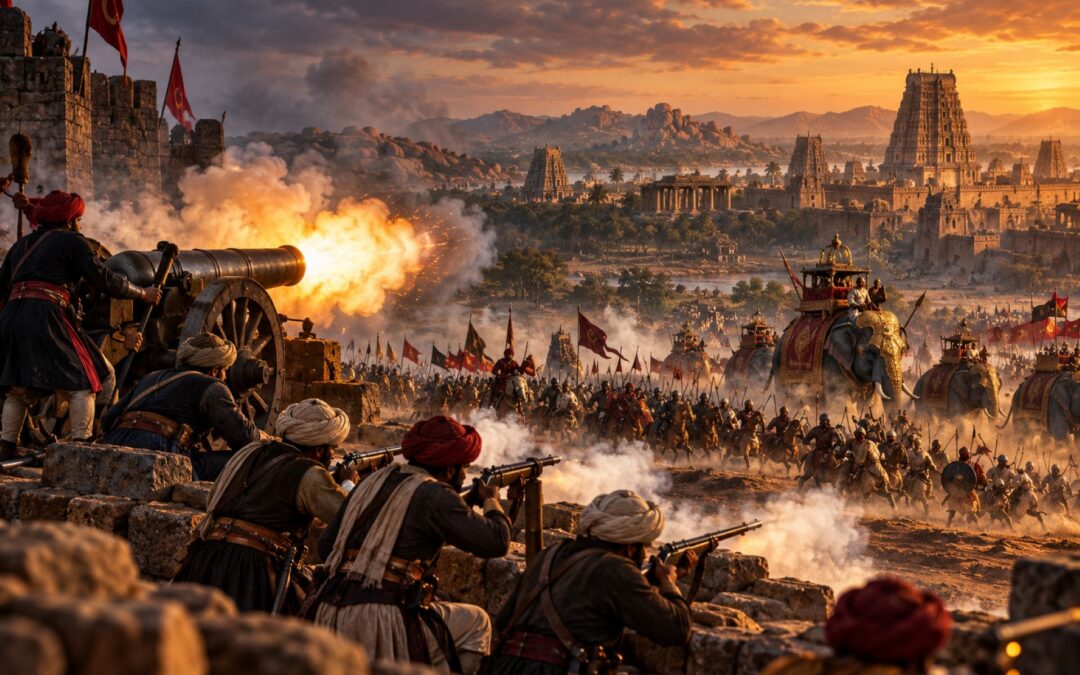
In 1520, the armies of the Vijayanagara Empire and the Bijapur Sultanate confronted each other over the strategically valuable fortress of Raichur. Bijapur possessed substantial artillery, including powerful cannons capable of inflicting devastating damage on approaching troops. Its ruler, Ismail Adil Shah, had good reason to believe that these weapons offered a military advantage against the enormous army commanded by Krishnadevaraya.
Yet Bijapur lost. Vijayanagara’s forces overcame their opponents in the field and eventually captured Raichur despite the firearms protecting its defences. Possessing powerful artillery had not been enough to secure victory.
Less than half a century later, the situation had changed dramatically. In 1565, a coalition of Deccan Sultanates defeated Vijayanagara at the Battle of Talikota, a confrontation in which artillery and military organization played important roles. The victorious armies subsequently devastated the imperial capital at Hampi, ending its position as the centre of southern India’s dominant imperial power.
What changed between these two battles was not simply the invention of a better weapon. Indian states were learning how to manufacture firearms, organize artillery, redesign fortifications and integrate new technologies with existing military forces. These developments influenced the distribution of political power, the resources governments needed to wage war and the ability of different rulers to survive military competition.
The gunpowder revolution in India was therefore much more than the arrival of guns and cannons. It was a transformation in how armies fought, how states organized military resources and how rulers adapted to an increasingly demanding technological environment.
How Gunpowder Reached the Indian Subcontinent
Gunpowder originated in China, where it was used in incendiary devices, rockets and other military technologies before the development of more sophisticated firearms. Knowledge of these weapons gradually spread through Asian commercial networks, military campaigns and exchanges between specialists serving different states.
The Indian subcontinent participated in these wider connections long before Europeans established a permanent military presence along its coasts. Its kingdoms maintained commercial and political relationships extending through Central Asia, Persia, the Arabian Peninsula and the Indian Ocean. These networks allowed military knowledge to circulate alongside horses, metals, textiles and other valuable commodities.
The earliest stages of gunpowder warfare must nevertheless be distinguished carefully. Rockets, explosive devices and incendiary weapons were not equivalent to guns that propelled projectiles through barrels. A military force familiar with one form of gunpowder technology did not necessarily possess the metallurgical knowledge, manufacturing infrastructure or tactical experience required to use another.
By the fifteenth century, cannon and other gunpowder weapons were becoming increasingly important in parts of the subcontinent. The Deccan, particularly the territories controlled by the Bahmani Sultanate and its southern rival Vijayanagara, developed into an important centre of military experimentation. Their rulers competed over fertile land, fortified settlements, commercial networks and strategically valuable routes connecting northern and southern India.
This rivalry encouraged the adoption of useful foreign technologies while also stimulating local innovation. The Bahmani Sultanate maintained connections with Persianate and Central Asian military traditions, while Vijayanagara recruited soldiers and specialists from different communities. Neither state operated in complete technological isolation from its neighbours.
Maritime commerce provided another route through which weapons and expertise circulated. South Indian ports connected inland kingdoms with merchants and specialists from across the Indian Ocean. Firearms, military equipment and the knowledge required to manufacture or operate them could move through these networks without depending entirely on formal diplomatic relationships.
The arrival of the Portuguese at the end of the fifteenth century intensified these exchanges, but it did not introduce an entirely unfamiliar concept of gunpowder warfare. Indian states were already incorporating artillery and firearms into their military systems.
The more important question was how effectively they could develop and employ these technologies.
The Weapons That Changed Indian Warfare
Gunpowder weapons did not constitute a single technological category. Different firearms served different military purposes, and their effectiveness depended on their size, construction, mobility and the tactical circumstances in which they were used.
The distinction between smaller firearms and heavy artillery was particularly important. A weapon capable of destroying masonry could be almost useless in a rapidly moving cavalry engagement, while a portable firearm might be highly effective against individual soldiers without posing much danger to a fortress wall.
Matchlock firearms became an increasingly significant part of Indian military equipment during the late medieval and early-modern periods. A matchlock used a slow-burning cord to ignite gunpowder inside the weapon, propelling a projectile down its barrel. Compared with a bow, it demanded different skills and less dependence on the physical strength developed through years of archery practice.
This did not mean that musketeers could become effective soldiers without training. Loading, maintaining, aiming and firing matchlocks required instruction and discipline, especially when large groups needed to coordinate their movements. Early firearms could also be slow to reload, unreliable in wet conditions and inaccurate beyond relatively short effective distances.
Their advantages nevertheless made them valuable. A firearm could deliver a forceful projectile against an armoured opponent, and properly organized groups of musketeers could threaten cavalry or infantry advancing across exposed ground.
Armies increasingly combined firearm-bearing soldiers with troops equipped for close combat. A gunner who had just fired could remain vulnerable while reloading, making protection from other soldiers important. The effectiveness of firearms therefore depended partly on their integration into the wider army.
Artillery presented a different set of possibilities. Heavy cannons and bombards could attack fortifications, damage defensive positions and create considerable psychological pressure during sieges. Their projectiles could break masonry or make particular positions dangerous for defenders attempting to resist an assault.
However, the largest guns were expensive, difficult to transport and demanding to operate. Moving them required labour, animals, suitable roads and careful planning. A cannon that could deliver an enormous projectile might also take considerable time to load and reposition.
Lighter artillery offered greater flexibility. Smaller guns could be mounted on defensive walls, positioned on carriages or attached to swivelling supports that permitted changes in direction. Such improvements made it easier to cover different approaches and respond to enemy movements.
Swivel guns were particularly useful where mobility and changing firing angles mattered. Rather than relying exclusively on enormous fixed cannon, commanders could deploy smaller pieces in positions that complemented larger artillery or supported troops operating in the field.
Indian military establishments eventually made use of animal-mounted firearms as well. Camel-mounted swivel guns, commonly associated with the term shaturnal, offered a means of transporting smaller weapons across terrain where heavier artillery would be cumbersome. Such arrangements were not necessarily characteristic of every fifteenth-century army, but they became part of the wider repertoire of Indian gunpowder warfare.
Gunpowder also affected siege operations through explosive mining. Engineers and specialist troops could attempt to undermine fortifications, place explosive charges near vulnerable sections and damage walls that would otherwise be difficult to breach. These methods demanded technical knowledge and considerable risk because attackers had to approach defended positions.
Rockets and other incendiary weapons continued to occupy a place alongside barrelled firearms. They could threaten enemy formations, spread confusion or support particular battlefield operations, although their effectiveness varied greatly with design and deployment.
Cannons also acquired an important anti-personnel role. They were not restricted to firing solid projectiles against stone walls. Smaller ammunition or multiple projectiles could be used to threaten concentrated soldiers, although spectacular accounts of artillery killing enormous numbers of men in a single volley should be treated cautiously.
One particularly important target was the war elephant. An elephant presented a large and potentially vulnerable target, while loud explosions, injuries and battlefield confusion could make maintaining control difficult. However, early cannon were not automatically accurate or mobile enough to neutralize elephant formations in every encounter.
The development of gunpowder warfare therefore created a diverse military environment rather than immediately replacing older weapons. Armies had to determine which technologies worked best against particular opponents and how those weapons could reinforce one another.
Goa, Foreign Specialists, and India’s Own Gun Foundries
Gunpowder technology depended on manufacturing capabilities as much as battlefield knowledge. A ruler could purchase an impressive cannon, but maintaining a reliable artillery establishment required metalworkers, gunsmiths, gunpowder producers, trained operators and workshops capable of supplying replacements.
By the beginning of the sixteenth century, Indian military production was already sufficiently developed to attract the attention of European observers. This was particularly evident along the western coast, where Indian, Middle Eastern and European commercial and military networks intersected.
When the Portuguese captured Goa from Bijapur in 1510, they encountered an established military infrastructure rather than a society unfamiliar with firearms. Portuguese accounts describe artillery, gunpowder, weapons and equipment associated with their manufacture. These descriptions provide important evidence that Indian rulers had developed substantial capabilities before the Portuguese conquest.
Goa was strategically valuable partly because it connected inland political powers with maritime trade. Control over such a port could affect the movement of horses, military supplies, specialists and other resources essential to warfare. The Portuguese themselves understood the value of combining fortified coastal bases with artillery and commercial influence.
Their arrival introduced additional opportunities for technological exchange. European soldiers, gunsmiths and military specialists sometimes entered the service of Indian rulers, while Asian craftsmen and experts interacted with the Portuguese establishment. Such relationships could involve employment, commercial incentives, military necessity or the movement of individuals between competing authorities.
Ottoman-connected specialists also contributed to military developments in the Indian Ocean and the Deccan. Conflicts involving the Portuguese and other regional powers brought trained gunners and technicians into environments where their skills were valuable. Some found opportunities to work within Indian military establishments and participate in the development of local artillery.
These exchanges should not be interpreted as evidence that Indian gunsmiths merely copied foreign weapons. Local craftsmen already possessed considerable experience in metalworking, and gun manufacture required adapting designs to available materials, established workshops and military requirements.
Different metals also affected production. Bronze and brass artillery could be costly because they required substantial quantities of suitable materials and skilled casting. Wrought iron offered alternative construction possibilities, although producing safe, reliable weapons still demanded knowledge and careful workmanship.
The development of iron gun barrels and improved manufacturing techniques could make certain firearms more accessible. However, these changes were gradual and uneven rather than a single technological breakthrough that immediately made artillery inexpensive everywhere.
Indian gunsmiths were capable of producing weapons that impressed foreign observers. Portuguese accounts associated with Afonso de Albuquerque contain favourable descriptions of local craftsmanship, although such assessments should be understood within the conventions and interests of their authors rather than treated as precise technical comparisons between every Indian and European gun.
The result was a process of mutual adaptation. Indian military production drew on indigenous expertise and knowledge arriving through several international networks. Some techniques were adopted, others modified, and new combinations emerged as rulers and craftsmen responded to particular military problems.
The gunpowder revolution was therefore not a straightforward transfer of superior European technology to passive Indian recipients. It involved multiple centres of production, continuous experimentation and interactions among people from different military traditions.
Why Guns Changed Forts and Battlefield Tactics
The growing effectiveness of artillery forced commanders to reconsider how armies approached fortified positions and how defenders protected them.
Traditional fortifications had generally been designed to resist attackers using ladders, siege engines, projectiles and direct assaults. High walls, towers, gateways and defensive barriers could make a stronghold difficult to capture, especially when protected by an adequate garrison and reliable supplies.
Gunpowder complicated these arrangements. Heavy artillery could concentrate force against selected points in a defensive wall, while smaller firearms increased the danger faced by attackers approaching exposed positions. Defenders and besiegers consequently had to reconsider the relationship between firepower, distance and physical protection.
One important problem involved the direction in which defensive weapons could fire. A cannon positioned behind a narrow opening might dominate the ground immediately in front of it but remain unable to attack an enemy moving close to the wall or approaching from an unexpected angle.
A defender could possess substantial firepower without being able to use it against every vulnerable approach. This was particularly dangerous when attacking troops found positions sheltered from the main line of fire.
Improved gun mounts, swivels and trunnions helped address these limitations. Trunnions are projections attached to a gun barrel that allow it to pivot on its mounting, making adjustments in elevation easier. Combined with suitable carriages or supporting structures, such mechanisms could improve the gunner’s ability to direct fire.
Changes to fortifications were equally important. Projecting bastions allowed defenders to fire along the faces of nearby walls rather than exclusively outward from behind them. This form of flanking fire made it more difficult for attackers to approach sections of a fortress while remaining protected from its guns.
Broad platforms, reinforced defensive positions and carefully arranged gunports could also improve the practical employment of artillery. The important issue was not simply whether a fort possessed cannons, but whether its architecture allowed those weapons to defend the approaches that mattered.
Historian Pushkar Sohoni’s research on the development of fortified strongholds in the Deccan helps explain how changes in warfare interacted with defensive architecture. Fortification was not a static medieval tradition suddenly made obsolete by gunpowder; military builders responded to changing threats through modifications in design and construction.
Such improvements were neither universal nor immediate. Some strongholds retained older defensive arrangements, while others incorporated artillery-compatible features in different ways. Geography, resources, local building traditions and the expected character of warfare influenced these decisions.
Open battle required comparable adaptations. Artillery could disrupt enemy formations before they reached close-combat distance, but its vulnerability made protection essential. Infantry and cavalry could shield guns from attackers, while commanders needed to coordinate firing with the movement of their own troops.
Cavalry remained valuable because speed and manoeuvrability could exploit disorder, threaten exposed gunners or attack positions before firearms were ready to fire again. Infantry remained essential for holding ground, protecting artillery and conducting assaults.
War elephants also continued to serve Indian armies despite their increasing exposure to gunpowder weapons. Their strength, carrying capacity and political significance remained useful, even when direct charges against prepared firearm-bearing troops became increasingly dangerous. The broader history of Indian war elephants demonstrates why their military role evolved rather than disappearing immediately with the arrival of guns.
Successful armies increasingly needed to coordinate different capabilities. Technology mattered, but its effectiveness depended on training, tactical organization, terrain and leadership.
Who Could Afford a Gunpowder Army?
The growing importance of firearms also created new financial and administrative demands.
Large military establishments had always required substantial resources. Rulers needed to recruit soldiers, acquire horses, maintain fortifications, transport supplies and reward commanders. Gunpowder weapons added specialized materials and manufacturing processes to these existing obligations.
Producing cannon required metal, fuel, skilled craftsmen and workshops. Gunpowder production depended on obtaining and preparing ingredients, including saltpetre, alongside charcoal and sulphur. These supplies had to be manufactured or purchased, stored, transported and delivered to military units.
Operating artillery created further expenses. Heavy guns needed transport animals, labourers, engineers and trained gunners. A large gun without sufficient ammunition, adequate transport or men capable of maintaining it represented an expensive asset of limited practical value.
States with extensive agricultural revenues, established trade connections and strong administrative systems could therefore enjoy advantages in sustaining gunpowder forces. Their governments could support permanent workshops, attract specialists and mobilize resources that smaller rivals might struggle to assemble.
This relationship encouraged some rulers to strengthen centralized control over military production and the supply of weapons. Imperial arsenals, court-sponsored craftsmen and the regulation of arms manufacture could make firearms part of a broader system of political authority.
The development was not entirely new. Indian kingdoms already relied on taxation, revenue assignments, military service and relationships with regional chiefs to support their armies. Gunpowder increased the importance of particular kinds of technical expertise and material supply within those existing structures.
It would nevertheless be misleading to claim that firearms inevitably destroyed the power of local elites or created uniformly centralized governments.
Smaller firearms could eventually be produced and distributed more widely than the largest artillery pieces. Local workshops, regional commanders and armed communities could acquire weapons independently of major imperial arsenals, although their opportunities varied according to the circumstances of each state.
This created a tension between the advantages of centralized military production and the political consequences of technological diffusion. A ruler might benefit from access to substantial artillery resources while also confronting opponents who could increasingly obtain firearms of their own.
The Mughal Empire provides examples of the connection between firearms, military authority and administration. Imperial rulers employed artillery specialists and maintained substantial military establishments, but their power depended on more than possessing an exclusive supply of guns. Regional forces, landholders and military entrepreneurs also participated in a wider environment in which firearms circulated.
Historian Iqtidar Alam Khan’s work on sixteenth-century Indian artillery emphasizes the need to understand indigenous technical developments alongside foreign influence. Studies of Mughal firearms likewise show that weapons belonged to complex institutions of recruitment, supply and military organization rather than functioning as independent instruments of political centralization.
The broader consequence was that military competition increasingly rewarded states capable of supporting both technological development and effective organization. Access to weapons was important, but sustainable access to skilled labour, revenue, materials and logistical infrastructure could be even more decisive.
This helps explain why military defeat sometimes encouraged further investment in artillery instead of abandonment of the technology.
Raichur in 1520: When Better Artillery Lost
The Battle of Raichur provides one of the clearest examples of the limitations of technological superiority in early-sixteenth-century Indian warfare.
Raichur stood in the disputed territory between the Krishna and Tungabhadra rivers, commonly known as the Raichur Doab. Its agricultural resources, fortified settlements and strategic location made it an enduring source of conflict between Vijayanagara and the Muslim-ruled states of the northern Deccan.
By 1520, Krishnadevaraya had established himself as one of Vijayanagara’s most successful rulers. His empire possessed extensive resources, powerful military forces and influence over much of southern India. Control of Raichur offered both practical advantages and an opportunity to demonstrate imperial authority.
His opponent was Ismail Adil Shah of Bijapur, whose state inherited important military and political traditions from the former Bahmani Sultanate. Bijapur had access to artillery and specialists associated with the Deccan’s expanding gunpowder warfare.
The campaign involved both a confrontation between armies and the difficult task of capturing a fortified position. This distinction matters because firearms operated differently in open battle and during a siege.
Bijapur’s artillery represented a serious threat to advancing troops. Heavy cannon could disrupt concentrated formations, while weapons positioned within Raichur’s defences made approaching the walls dangerous. Such advantages offered the possibility of inflicting substantial casualties before attackers could reach positions where their manpower became decisive.
Vijayanagara nevertheless possessed an enormous military establishment capable of sustaining an offensive. Its forces included cavalry, infantry and siege labourers, while its commanders could draw on substantial supplies and human resources.
The decisive battlefield encounters ended in Bijapur’s defeat. Chroniclers describe artillery fire, determined attacks and the exploitation of disorder within the defending army, although their accounts do not establish every movement or the exact sequence of firing and cavalry charges with certainty.
One interpretation emphasizes the difficulty of delivering successive artillery volleys quickly enough to stop an advancing enemy. Whether or not individual descriptions of the gunners’ mistakes are accurate in every detail, the general tactical problem was genuine: guns had to be loaded, positioned, protected and coordinated with other troops.
A commander who failed to integrate artillery into a coherent defensive system could lose its advantages. Opposing forces might exploit the intervals between volleys, attack vulnerable positions or disrupt the soldiers protecting the guns.
The subsequent siege exposed further limitations. Artillery mounted in fixed positions could threaten particular approaches without necessarily covering the entire base of a defensive wall. Attackers who identified such weaknesses could employ conventional siege labour even against fortifications equipped with gunpowder weapons.
Some accounts describe Portuguese marksmen assisting Vijayanagara during the campaign. Their participation illustrates how foreign specialists could enter Indian military service, but the victory cannot be explained simply by the presence of a small contingent of European soldiers.
Historian Richard M. Eaton examines these circumstances in his study of firearms, diplomacy and the Battle for Raichur in 1520. His treatment situates the campaign within the military and political connections of the early-sixteenth-century Deccan rather than reducing it to a contest between technologically advanced and backward armies.
Vijayanagara eventually captured Raichur, enhancing Krishnadevaraya’s prestige. The victory demonstrated the military effectiveness of a wealthy empire capable of combining conventional forces, siege operations and considerable organizational resources.
It did not prove that artillery was unimportant. Instead, it showed that the advantages created by new weapons could be lost through their ineffective employment.
The campaign also became part of the wider history of Vijayanagara’s rivalry with the Deccan Sultanates, in which territorial ambition, military competition and diplomatic relationships repeatedly influenced the balance of power.
For Bijapur, Raichur was a defeat that exposed problems requiring attention. The technological developments that followed would become important in the military transformation of the Deccan.
The Deccan’s Arms Race After Raichur
The decades following Raichur witnessed further changes in artillery, military expertise and defensive architecture among the states of the Deccan.
One important interpretation is that Bijapur and its neighbours learned from earlier failures and devoted increasing attention to improving the practical employment of firearms. Rather than treating the defeat of 1520 as proof that artillery was ineffective, their rulers continued developing the equipment and organization required to make it more useful.
Richard M. Eaton and Phillip B. Wagoner explore this transformation in their study of the military revolution in the Deccan, particularly the contrast between the campaigns of Raichur and Talikota.
Improvements to artillery mountings helped address the problems of limited firing angles. Guns capable of being adjusted more effectively could cover wider areas, respond to changing targets and support defensive positions that had previously suffered from dangerous blind spots.
Changes to fortifications complemented these developments. Projecting bastions, artillery platforms and defensive arrangements designed for flanking fire could make a stronghold more difficult to approach. A properly positioned gun did not necessarily need to destroy an attacking army to be effective; it could also prevent troops from safely reaching a vulnerable section of wall.
Military improvement extended beyond engineering. States needed men capable of operating new equipment, commanders who understood its tactical strengths and weaknesses, and systems that could move weapons and ammunition where they were required.
The Deccan Sultanates benefited from connections with skilled personnel operating across Persianate, Central Asian and Ottoman-influenced military networks. These relationships complemented established local expertise and helped sustain a wider environment of military innovation.
Vijayanagara also possessed firearms and incorporated gunpowder weapons into its military establishment. The distinction between it and its rivals should therefore not be represented as one between an army with guns and another without them.
The stronger argument concerns comparative adaptation. Some Deccan rulers appear to have devoted greater attention to integrating improved artillery, fortification design and specialized military practices into their establishments. Vijayanagara’s earlier victories and the continuing effectiveness of its conventional forces may have reduced the perceived urgency of certain changes, although the extent of that difference remains a subject of historical interpretation.
Nor did military technology develop independently of political circumstances. The successor states of the Bahmani Sultanate continued fighting one another, while Vijayanagara attempted to influence their rivalries through alliances, intervention and diplomacy.
The military balance that emerged by the 1560s therefore reflected both changing capabilities and changing relationships among the major powers of southern India.
Those developments converged at Talikota.
Talikota in 1565: Technology, Coalition and Collapse
In January 1565, Vijayanagara confronted a coalition formed by several Deccan Sultanates in a campaign conventionally associated with the Battle of Talikota, also connected with the area of Rakshasa-Tangadi.
The battle is often presented as a decisive demonstration of the advantages of improved gunpowder warfare. Artillery undoubtedly formed part of the confrontation, but understanding the result requires examining the political and military circumstances that brought the opposing armies together.
By the middle of the sixteenth century, Vijayanagara remained an immensely powerful state. Its rulers controlled extensive territories and possessed the resources to mobilize large forces. Its army included cavalry, infantry, war elephants and gunpowder weapons.
The empire’s dominant political figure, Aliya Rama Raya, had spent years intervening in the affairs of neighbouring Sultanates. He forged alliances with some rulers against others and attempted to preserve Vijayanagara’s influence over the divided Deccan.
These interventions had initially provided important strategic advantages. The Sultanates frequently competed with one another, limiting their ability to confront Vijayanagara collectively. However, repeated diplomatic and military interventions gradually encouraged some of its rivals to regard Rama Raya as a common threat.
By 1564, several Sultanates had formed an alliance against Vijayanagara. Their cooperation was exceptional because it temporarily brought together states with their own rivalries, ambitions and competing territorial claims.
This coalition changed the strategic balance before the armies met. Vijayanagara could no longer rely on the same degree of division among its principal opponents, while the Sultanates could combine experienced commanders, cavalry, infantry, artillery and military resources.
Their gunpowder capabilities were important. Accounts of the battle emphasize the use of artillery against advancing formations, while descriptions of the Sultanates’ deployment suggest an attempt to coordinate guns with supporting troops.
Some later narratives present highly elaborate arrangements involving multiple rows of cannons, protective chains and precisely organized volleys. These accounts are useful for understanding how chroniclers interpreted military effectiveness, but their exact numerical and tactical details cannot all be independently established.
The surviving evidence does not justify describing Talikota as a straightforward encounter between modern artillery and an army armed only with traditional weapons. Vijayanagara itself possessed substantial firepower and continued to employ a mixture of military technologies.
The effectiveness of the opposing armies depended on the coordination of those resources. Artillery could disrupt approaching troops, while cavalry and infantry exploited opportunities created by firepower, movement and battlefield confusion.
Leadership was another critical factor. Rama Raya occupied an unusually important position in Vijayanagara’s political and military system, making his personal fate consequential for the army’s cohesion.
During the battle, he was captured and executed. The circumstances of his capture and the precise sequence of events remain difficult to reconstruct, but his death became a decisive moment in the collapse of Vijayanagara’s resistance.
Accounts describing the use of cannon projectiles, including coins, to kill enormous numbers of soldiers or eliminate particular commanders should not be confused with securely established explanations of the battle. Such episodes reflect the dramatic traditions surrounding the conflict and require careful treatment.
Vijayanagara’s defeat emerged from the interaction of several conditions. The Sultanates had formed an effective coalition, developed substantial military capabilities and brought their forces together under circumstances favourable to a collective confrontation. Vijayanagara faced an exceptionally difficult political situation, while the loss of its dominant commander intensified the consequences of military failure.
The battle’s aftermath was devastating. Surviving members of Vijayanagara’s political elite attempted to preserve their authority, while the victorious forces advanced towards the imperial capital at Hampi.
The city had been one of the wealthiest and most impressive urban centres in southern India. Its temples, markets, palaces, defensive structures and extensive infrastructure reflected generations of imperial investment.
Following the defeat, Hampi suffered extensive destruction and plunder. Its role as the centre of Vijayanagara’s political and economic system ended, and the capital never recovered its former position.
It would nevertheless be inaccurate to say that the entire Vijayanagara Empire immediately ceased to exist. Successor rulers continued exercising authority from other centres, although the imperial system became progressively weaker and regional powers gained greater independence.
The Sultanates also did not permanently unite to govern all of Vijayanagara’s territories. Their coalition had been formed to confront a particular threat, and their separate political interests remained important after the campaign.
Talikota therefore illustrates the significance of gunpowder warfare without demonstrating that military technology alone determines historical outcomes. Artillery and tactical adaptation mattered, but their effectiveness operated within a much wider struggle involving diplomacy, political authority, military organization and leadership.
Was India’s Gunpowder Transformation a Military Revolution?
Historians have long debated whether the spread of firearms created a fundamental military revolution. The concept is often associated with European developments involving increasingly powerful artillery, new fortifications, larger standing armies and the administrative systems needed to finance warfare.
Applying the same framework to India raises important questions. Gunpowder undoubtedly changed military capabilities, but its adoption did not follow an identical pattern across different kingdoms or produce the same consequences everywhere.
One of the strongest arguments for describing these developments as revolutionary concerns the relationship between weapons and the institutions surrounding them. Artillery required new manufacturing skills, dependable supplies and specialized personnel. Fortifications had to respond to changing military threats, while commanders developed methods for coordinating guns with established forms of combat.
These changes could reinforce one another. More effective firearms encouraged alterations to defensive architecture, which in turn stimulated new approaches to siege warfare. The growing expense and complexity of military establishments increased the importance of fiscal administration, commercial connections and technical expertise.
Indian rulers actively participated in these developments rather than simply responding to innovations introduced from Europe. Their military establishments incorporated technologies circulating through several Asian networks and contributed their own manufacturing knowledge, tactical practices and adaptations.
Scott C. Levi’s study of Asia in the Gunpowder Revolution provides a useful comparative perspective. The wider history of Asian warfare makes it difficult to explain technological change as a single European process spreading unchanged to the rest of the world.
India’s experience also reveals the limitations of treating gunpowder as an automatic instrument of centralized power. Large states could benefit from expensive artillery and established manufacturing systems, but firearms could also circulate among regional elites and smaller military organizations. The consequences depended on existing institutions and political relationships.
Older forms of warfare did not disappear immediately. Cavalry remained essential for movement and battlefield exploitation, infantry continued holding and attacking positions, and elephants retained military, logistical and ceremonial roles. Gunpowder changed the conditions under which these forces operated without making them universally obsolete.
The contrast between Raichur and Talikota is particularly revealing. In 1520, Bijapur’s artillery advantage proved insufficient against an opponent capable of mobilizing substantial conventional forces and conducting a successful campaign. By 1565, several Deccan states had developed their military capabilities further and combined them within a coalition capable of defeating Vijayanagara.
Neither outcome can be explained by counting guns alone. Effective military power depended on how weapons were produced, supplied, positioned, protected and used in combination with other forces. It also depended on the political circumstances that determined whether armies fought separately or together.
The term military revolution is therefore useful when it directs attention towards a substantial transformation in military practice and organization. It becomes misleading when it suggests that every Indian state experienced an identical process, that European weapons were inherently superior, or that victory automatically belonged to the ruler with the most advanced artillery.
India’s gunpowder transformation was real, but its historical importance lies in the interaction between technological innovation and the societies that adopted it.
The experience of Raichur and Talikota captures that relationship. Bijapur could possess impressive artillery and still lose because its weapons did not secure the necessary battlefield advantage. Decades later, improvements in military organization and technology contributed to a coalition victory that reshaped the political landscape of southern India.
The difference was not that gunpowder suddenly became powerful in 1565. Its capabilities had been developing over generations, while rulers experimented with manufacturing, fortification, logistics and battlefield tactics. What changed was the ability of particular states to organize those capabilities effectively under the political circumstances they faced.
The gunpowder revolution in India consequently cannot be understood as a simple progression from bows and swords to muskets and cannons. It was a prolonged process in which technological knowledge, skilled labour, military organization, state resources and political judgment became increasingly interconnected.
Weapons altered what armies could accomplish, but they did not eliminate the importance of leadership, institutions or strategic decisions. India’s experience demonstrates that a military revolution is not merely a transformation in the tools of warfare. It is a transformation in the systems of power that make those tools effective.
Last Updated on October 25, 2026 by Aseem Gupta