
Reading Time: 27 Minutes
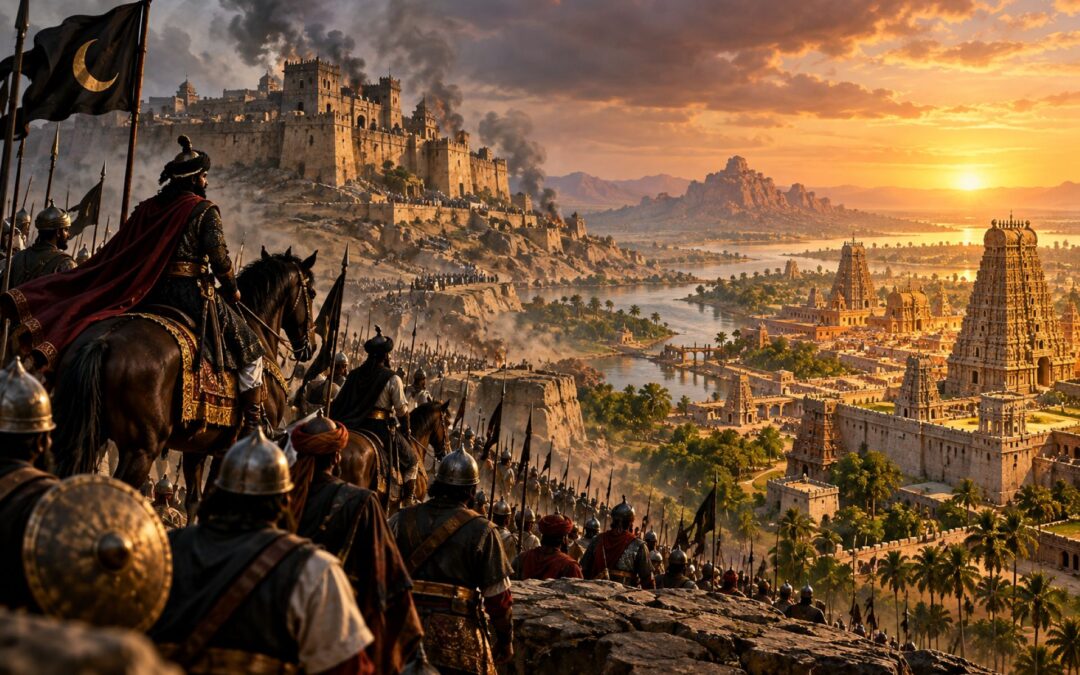
In 1296, Alauddin Khalji led a cavalry force deep into the Deccan Plateau and attacked Devagiri, the capital of the Yadava kingdom. The raid brought him extraordinary wealth and helped finance his seizure of the Delhi Sultanate’s throne. It also marked the beginning of a transformation that would fundamentally alter the political history of southern India.
Over the following decades, Delhi’s armies defeated or subordinated some of the most powerful kingdoms of the Deccan and the southern peninsula. The Yadavas, Kakatiyas, Hoysalas, and Pandyas faced military campaigns that disrupted their established political systems. Under Alauddin Khalji, the sultanate largely sought tribute and submission; under his successors, especially the Tughluqs, it increasingly attempted direct territorial government.
Yet conquering the Deccan proved easier than keeping it. The distances that separated Delhi from its southern possessions, the costs of military occupation, competing political loyalties, and ambitious experiments in centralisation strained the sultanate’s resources. As imperial authority weakened, local commanders and regional elites began turning Delhi’s own political and military institutions against it.
The outcome was not a simple restoration of the kingdoms that had existed before the invasions. By the middle of the fourteenth century, the Deccan had produced a different political order, dominated increasingly by new powers such as the Bahmani Sultanate and the Vijayanagara Empire.
The central paradox of Delhi’s southern expansion was that its military successes helped create the conditions for its political retreat. The sultanate broke an older balance of power, but the states that emerged from its collapse inherited many of the opportunities, institutions, and ambitions its conquests had introduced.
The Deccan Before Delhi’s Invasions
At the end of the thirteenth century, the Deccan was a politically divided but economically prosperous region. Its extensive plateau, fertile river valleys, fortified settlements, mineral resources, and commercial networks supported several competing royal houses. These kingdoms were not isolated states operating independently of one another; they were connected through warfare, diplomacy, marriage alliances, religious patronage, and trade.
The Yadavas controlled much of the northwestern Deccan from their capital at Devagiri, near present-day Chhatrapati Sambhajinagar in Maharashtra. Farther east, the Kakatiyas ruled a powerful Telugu-speaking kingdom centred on Warangal. The Hoysalas governed substantial territories in southern Karnataka from Dwarasamudra, now known as Halebidu, while the Pandyas remained an important force in Tamil country, where Madurai was a major centre of political and religious life.
These kingdoms competed for territory and influence, frequently drawing their armies into conflicts with neighbouring rulers. The Yadavas and Hoysalas fought over contested frontier regions, while the Hoysalas and Pandyas struggled for influence farther south. Smaller chiefs, warrior lineages, and subordinate authorities also exercised considerable local power, creating a political landscape in which alliances and rivalries could change rapidly.
The wealth of the Deccan made it an attractive destination for northern conquerors. Agricultural production generated substantial revenue, while merchants connected inland centres with ports on India’s eastern and western coasts. Precious stones, metals, textiles, horses, and other valuable commodities moved through commercial networks linking the peninsula to the Persian Gulf, the Arabian Sea, and the wider Indian Ocean.
Religious institutions were also important components of this economy. Temples and monasteries received grants, controlled property, supported artisans and scholars, and sometimes accumulated considerable wealth. Their political significance extended beyond religious practice because royal patronage of sacred institutions helped rulers establish legitimacy and relationships with influential local communities.
Devagiri was particularly attractive because of its wealth and strategic position between northern India and the southern peninsula. Control over the surrounding region could provide access to productive territories and routes leading toward the deeper Deccan. For a northern ruler seeking treasure or political submission, it offered considerable rewards.
However, the geography that made the region valuable also complicated conquest. An army marching south from Delhi had to cross enormous distances while supplying soldiers, cavalry, pack animals, and siege equipment. Monsoon conditions could disrupt movement, fortified capitals could withstand prolonged attacks, and local rulers understood roads, water sources, and seasonal conditions better than invading commanders.
The Deccan therefore presented two different military and political challenges. Defeating a regional king in battle might require a successful expedition, but maintaining permanent authority demanded garrisons, reliable communications, administrative officials, and the cooperation of local elites.
As historian Richard M. Eaton demonstrates in his social history of the Deccan, the region was shaped by movement between political, cultural, and social worlds rather than by rigidly separated civilisations. Delhi’s arrival became part of this longer process of migration, military competition, and institutional exchange.
The invasions belonged to the wider history of medieval India, but their consequences were particularly far-reaching in the Deccan. Over several decades, northern conquest would dismantle much of the political order that had governed the peninsula and create opportunities for entirely new rulers.
Alauddin Khalji’s Devagiri Raid and the Logic of Tribute
In 1296, Alauddin Khalji was an ambitious military commander and provincial governor serving under Sultan Jalaluddin Khalji, his uncle and father-in-law. Although he held an influential position within the Delhi Sultanate, he had ambitions that extended beyond provincial authority. To challenge his uncle successfully, Alauddin needed financial resources, loyal soldiers, political prestige, and the ability to reward influential supporters.
Devagiri offered an opportunity to acquire these advantages in a single expedition. Its wealth was widely recognised, but the Yadava kingdom lay beyond the regions that Delhi’s armies usually threatened. Alauddin calculated that a rapid march into the Deccan might catch its rulers unprepared and yield enough treasure to strengthen his political position.
His forces reached Yadava territory with relatively little opposition. King Ramachandra was reportedly disadvantaged because a substantial portion of his army, commanded by his son, had been engaged in operations farther south. With the main field forces absent, Devagiri faced an unexpected attack before its defenders could prepare for a prolonged confrontation.
Later chronicles embellished the episode with stories of tactical deception. One tradition describes Alauddin spreading rumours that a much larger army was approaching, encouraging the defenders to believe that resistance was hopeless. Such details should be treated cautiously because medieval accounts frequently dramatised the intelligence and daring of successful rulers.
The broader outcome is clear. Alauddin threatened the Yadava capital and compelled Ramachandra to negotiate a settlement that involved the surrender of considerable wealth. Treasure, precious metals, animals, and other valuable possessions were transferred to the invaders, providing Alauddin with resources far beyond those available from his existing provincial position.
The raid transformed his fortunes. Returning north with his spoils, Alauddin could reward followers, attract military support, and persuade political elites that his ambition was supported by exceptional military ability. He subsequently murdered Jalaluddin and seized the throne, establishing himself as sultan of Delhi.
The Devagiri campaign had therefore achieved more than a temporary victory over a distant kingdom. Its proceeds helped finance a change of government in northern India and demonstrated that the wealth of the Deccan could be used to reshape the political balance within the Delhi Sultanate itself.
Yet Alauddin did not attempt to incorporate the entire Yadava kingdom into Delhi’s administrative system. Ramachandra remained in power, subject to demands for tribute and acknowledgement of the sultan’s superiority. This arrangement reflected the distinction between compelling a ruler to submit and assuming responsibility for governing his territory.
Tribute offered many of the rewards of conquest without the full costs of occupation. A subordinate king could continue collecting revenue, administering justice, defending local settlements, and managing regional political relationships. Delhi could demand wealth and obedience while avoiding the expense of replacing an established government with unfamiliar officials and permanent military garrisons.
Such arrangements were not necessarily stable or peaceful. A tributary ruler might withhold payments, challenge Delhi’s demands, or seek opportunities to recover independence. Nevertheless, maintaining a subordinate monarch could be more practical than attempting to administer a distant and politically complicated region directly.
Alauddin also faced pressing threats closer to his capital. Rival nobles, internal rebellions, and the expense of sustaining a large cavalry army placed considerable demands on the sultanate. Repeated Mongol incursions across the northwestern frontier created an additional danger, forcing Delhi to devote substantial military resources to defending its core territories.
Directly annexing extensive southern territories would have increased those burdens. Garrisons needed to be supplied, officials supervised, and communications maintained over enormous distances. A ruler confronting serious external threats could not assume that new provinces would remain obedient simply because their armies had been defeated.
Alauddin’s initial policy therefore combined ambition with strategic restraint. He recognised the rewards available in the Deccan but relied primarily on tribute rather than attempting immediate, comprehensive territorial occupation.
This system would become the foundation of Delhi’s next great wave of southern expansion. Its effectiveness, however, depended on whether the sultanate could repeatedly compel distant rulers to honour their obligations.
Malik Kafur’s Campaigns Across the Deccan and Tamil Country
Delhi’s attempts to extend its influence beyond Devagiri initially encountered serious resistance. An early Khalji expedition against Warangal, the Kakatiya capital, failed to achieve its objectives. The surviving historical accounts do not establish every tactical detail, but the expedition demonstrated the difficulties of campaigning across unfamiliar territory while maintaining long-distance supply lines.
Warangal was a formidable fortified centre supported by an established regional state. Invading armies had to contend with difficult approaches, uncertain supplies, seasonal conditions, and defenders who understood the surrounding geography. Military superiority elsewhere did not guarantee that Delhi’s commanders could reproduce their successes against every southern kingdom.
The sultanate’s northern frontier also remained vulnerable. In 1303, Mongol forces threatened Delhi itself, exposing the danger of committing too many troops to distant campaigns while the capital remained insecure. Alauddin responded by strengthening fortifications, reorganising military resources, and maintaining forces capable of confronting future incursions.
These measures helped stabilise his position. Although the Mongol threat did not disappear permanently, Delhi developed greater freedom to pursue campaigns farther south. Alauddin could now send substantial forces into the Deccan without exposing his kingdom to the same immediate danger that had constrained earlier operations.
The commander who became most closely associated with this renewed expansion was Malik Kafur. Captured during the Khalji conquest of Gujarat, he entered Alauddin’s service as an enslaved man and rose rapidly through the military and court hierarchy. He acquired exceptional influence and became one of the sultan’s most trusted commanders.
Malik Kafur’s career illustrates an important feature of the Delhi Sultanate’s political system. Although enslavement involved coercion and profound inequality, individuals incorporated into elite military households could sometimes receive training, patronage, high office, and command over substantial forces. Access to the ruler and demonstrated military ability could provide opportunities for advancement that would otherwise have been unavailable.
Some chroniclers emphasised Malik Kafur’s appearance and his personal closeness to Alauddin. These descriptions were shaped by the political rivalries and moral assumptions of their authors, making confident conclusions about the precise nature of their relationship difficult. His historical importance rests more securely on his military leadership and his ability to transform victories into a network of subordinate kingdoms.
By the first decade of the fourteenth century, Ramachandra of Devagiri had become an unreliable tributary. Payments demanded by Delhi were not consistently forthcoming, and the Yadava kingdom appeared increasingly willing to assert its independence. Alauddin therefore sent Malik Kafur south to restore the sultanate’s authority.
The campaign succeeded in compelling Ramachandra’s submission. The Yadava king was taken to Delhi, where he formally acknowledged Alauddin’s supremacy, but the sultan did not permanently remove him from power. Instead, Ramachandra received favourable treatment and was restored as a subordinate ruler.
This decision proved strategically important. Ramachandra could provide Malik Kafur with access to local troops, military intelligence, supplies, guides, and established routes through the Deccan. The Yadava kingdom became a logistical partner rather than simply a defeated enemy whose territory had to be occupied by force.
The arrangement helped address the weaknesses exposed during Delhi’s earlier attempt against Warangal. Instead of advancing through difficult and unfamiliar routes without dependable regional assistance, the invading army could operate through territory controlled by a cooperative local ruler. Supply lines became more manageable, and the distance between the northern army and its intended target became less formidable.
In 1309, Malik Kafur advanced against the Kakatiyas, whose king, Prataparudra, ruled from Warangal. The campaign culminated in a siege that forced the Kakatiya ruler to negotiate. By 1310, Prataparudra had accepted tributary submission and surrendered considerable wealth while retaining his throne.
This was another example of Alauddin’s preference for indirect domination. Delhi gained treasure, prestige, and acknowledgement of political superiority without immediately assuming responsibility for governing the entire Kakatiya kingdom. Prataparudra remained a ruler with substantial local authority, although his position now depended partly on his relationship with the sultanate.
Later accounts sometimes associate the wealth obtained at Warangal with the Koh-i-Noor diamond. The identification cannot be established securely from the available evidence and should not be treated as a historical certainty. What matters for understanding the campaign is the scale of the resources transferred and the political relationship imposed on the defeated ruler.
Malik Kafur continued his advance into the southern peninsula. In 1311, his forces moved against the Hoysalas, whose ruler, Ballala III, governed from Dwarasamudra. The Hoysalas were involved in conflicts farther south, limiting their ability to concentrate military resources against the invading army.
Ballala eventually submitted and agreed to provide tribute, but he was permitted to retain substantial authority. As at Warangal, the settlement reflected Delhi’s preference for obtaining political submission and material rewards without immediately undertaking complete administrative replacement. This allowed Malik Kafur to continue his campaign rather than remain indefinitely in one conquered territory.
The expedition into Pandya territory produced a different result. Tamil country was affected by a succession struggle, and rival claimants had weakened the political unity of the Pandya kingdom. Delhi’s forces exploited these divisions, attacked wealthy centres, and carried away substantial quantities of treasure.
However, the invaders did not establish an enduring tributary arrangement comparable to those imposed on Ramachandra or Prataparudra. The absence of a dependable central ruler and the complexity of local politics made a stable settlement more difficult. Military raids could extract wealth without necessarily creating a government capable of delivering continued submission.
By the end of these campaigns, Delhi had demonstrated extraordinary military reach. Powerful rulers across the Deccan had been defeated, compelled to submit, or forced to surrender treasure. Wealth flowed northward, strengthening Alauddin’s treasury and helping finance the military establishment that sustained his authority.
Nevertheless, this apparent empire rested on a fragile political foundation. Its southern territories were not governed uniformly, and the relationship between Delhi and its subordinate kingdoms varied considerably. Some rulers supplied regular tribute, others had submitted only after military coercion, and regions such as Pandya country remained politically unsettled.
The system depended heavily on personal relationships and repeated displays of force. Ramachandra’s cooperation enabled further conquest, while Malik Kafur’s leadership allowed the sultanate to punish disobedience. If those relationships changed or Delhi lost the ability to intervene militarily, its influence could weaken rapidly.
The transition toward more direct government began when Yadava succession disputes threatened Delhi’s position once again. Malik Kafur returned to Devagiri, and the sultanate increasingly moved beyond extracting submission toward controlling territory.
That development represented a fundamental change. The tributary system had allowed Delhi to exercise power through regional monarchs, but annexation would make the sultanate responsible for governing the conquered lands itself.
From Tribute to Annexation: Devagiri, Warangal, and the Tughluqs
The movement from tribute toward annexation was neither immediate nor confined to a single ruler’s reign. It developed through successive rebellions, military interventions, and attempts to secure territories that had previously remained under subordinate royal houses.
After Ramachandra’s death, Yadava succession disputes undermined the political arrangement that had served Delhi so effectively. His successor was less willing to accept the sultanate’s demands, and Malik Kafur returned to Devagiri around 1313 to reassert imperial authority. The intervention marked an important stage in the destruction of independent Yadava rule and the extension of more direct Khalji control.
The process continued after Alauddin’s death in 1316. Delhi entered a violent succession struggle involving members of the royal family, military commanders, and competing court factions. Malik Kafur briefly dominated the government but was assassinated within months, and the Khalji dynasty became increasingly unstable.
The loss of strong central leadership weakened the relationships that had maintained Delhi’s southern influence. Tributary kingdoms had submitted because the sultanate possessed the military power and political determination to punish disobedience. When its rulers became absorbed in internal struggles, regional elites gained opportunities to challenge their obligations.
Devagiri consequently required renewed intervention. Under Sultan Mubarak Shah, Khalji forces reasserted control around 1317–1318, helping complete the process through which the former Yadava kingdom was brought into Delhi’s territorial structure. The distinction is important because the movement toward annexation began under the Khaljis rather than appearing for the first time with the Tughluq dynasty.
The Khalji regime itself did not survive for long. In 1320, Ghazi Malik seized power and founded the Tughluq dynasty, ruling as Ghiyath al-Din Tughluq. His government inherited a state that had acquired extensive territorial ambitions but still faced serious difficulties maintaining obedience across its distant possessions.
Warangal became an early test of the new dynasty’s authority. Prataparudra had previously accepted tributary submission under Alauddin, but the instability in Delhi encouraged efforts to regain independence. Ghiyath al-Din sent his son Ulugh Khan, the future Muhammad bin Tughluq, to bring the Kakatiya kingdom back under control.
The first Tughluq campaign against Warangal failed. Conflicting reports, tensions among commanders, and disorder within the invading army contributed to its collapse, forcing Ulugh Khan to withdraw. The episode again demonstrated that military campaigns in the Deccan could be undermined by problems of command and communication even before defenders achieved a decisive battlefield victory.
Ulugh Khan returned with another expedition in 1323. This time, Warangal fell, Prataparudra was captured, and the Kakatiya kingdom was dismantled. The defeated ruler died while being taken north, although the precise circumstances remain uncertain; later accounts associate his death with suicide near the Narmada River.
The conquest of Warangal differed substantially from the tribute settlement of 1310. Instead of leaving the Kakatiya monarchy in place, the Tughluqs attempted to incorporate its territories into their administrative system. Provincial officers, revenue officials, and military garrisons were expected to exercise authority previously centred on the Kakatiya court.
The Kakatiya collapse subsequently acquired considerable significance in Telugu historical memory. Later accounts interpreted the conquest through political and religious ideas that evolved after the event, sometimes presenting it as a straightforward confrontation between entire religious communities. Such retrospective narratives obscure the more complicated relationships that existed among rulers, warriors, administrators, and local elites during the original conflict.
Political alliances frequently crossed religious boundaries. Hindu chiefs could cooperate with the Delhi Sultanate when doing so served their interests, while Muslim commanders could enter the service of regional Hindu rulers. Resistance, collaboration, and shifting loyalty were shaped by political survival, local rivalries, patronage, and access to resources as well as religious identity.
The Tughluqs also intervened against Kampili, a smaller kingdom that had provided refuge to the rebel Baha al-Din Garshasp. The destruction of Kampili later became connected to traditions concerning the early careers of Harihara and Bukka, the founders associated with Vijayanagara. It was nevertheless a distinct episode and should not be confused with the simultaneous destruction of every southern kingdom.
The Hoysalas, for example, survived into the 1340s. Ballala III continued to pursue opportunities for territorial expansion and to negotiate or resist northern authority as circumstances changed. The old political order was being dismantled unevenly, with some dynasties disappearing, others adapting, and regional leaders taking advantage of weakened neighbours.
When Ulugh Khan became Sultan Muhammad bin Tughluq in 1325, he inherited an enormous imperial system. Delhi’s authority extended far beyond the territories traditionally governed from the capital, including provinces whose submission had been secured through several decades of southern campaigns.
Yet a directly administered province created obligations that tribute did not. Governors had to be appointed and supervised, soldiers paid, forts maintained, disputes resolved, and revenue collected and transferred. Roads and communications had to remain sufficiently secure for central orders to reach distant officials.
The sultanate also depended on the cooperation of local elites who understood the conquered territories. Officials appointed from Delhi could not govern effectively without relationships with landholders, warriors, merchants, and established administrative personnel. These groups possessed knowledge and resources that military conquest alone could not replace.
The transition from tributary domination to territorial government had therefore changed Delhi’s central problem. It no longer needed merely to compel distant rulers to pay; it had to sustain a political system across territories whose size, geography, and internal rivalries made continuous control exceptionally difficult.
Muhammad bin Tughluq would attempt to solve that problem through an ambitious experiment in imperial centralisation. His chosen solution placed the Deccan at the centre of the sultanate’s political future.
Muhammad bin Tughluq’s Daulatabad Experiment
Muhammad bin Tughluq inherited a state whose ambitions extended across much of the Indian subcontinent. His southern possessions brought substantial potential wealth, but governing them from Delhi presented serious difficulties. The capital lay far from the recently acquired territories of the Deccan, where provincial commanders controlled important forts, military forces, and revenue networks.
Devagiri offered an apparently attractive alternative. Located closer to the southern territories while remaining connected to major routes across western and central India, the city occupied a strategic position from which authority might be projected toward Gujarat, Telangana, Karnataka, the western coast, and Tamil country.
Muhammad bin Tughluq sought to establish a stronger political centre there, renaming Devagiri Daulatabad. The project became associated with the late 1320s and involved relocating significant sections of Delhi’s political and social establishment to the Deccan.
The decision is often portrayed as an inexplicable act of madness. According to this simplified account, the sultan suddenly ordered every inhabitant of Delhi to abandon the city and march south, only to reverse the entire process when his experiment failed. The available evidence supports a more complicated interpretation, although it does not diminish the suffering caused by the policy.
A major political establishment at Daulatabad could make geographical sense within Muhammad’s imperial ambitions. The Deccan occupied a more central position in relation to some of the sultanate’s widely separated provinces. Bringing influential households, administrators, soldiers, scholars, and religious figures south could strengthen the government’s presence in territories previously controlled from a considerable distance.
Relocation could also serve a political purpose. Provincial governors and military commanders often developed relationships with local elites that made them difficult to supervise. Establishing an influential imperial population closer to these officials offered a possible means of reinforcing loyalty and administrative control.
However, the project was implemented coercively and caused considerable disruption. Large numbers of people were compelled or strongly pressured to leave established homes, livelihoods, and social networks. The journey to the Deccan was demanding, and resettlement in an unfamiliar environment created further difficulties.
Families faced separation from property and established sources of income, while officials and merchants had to reconstruct relationships on which their work depended. Hardship, illness, and death became associated with the migration. Delhi lost politically and economically significant residents, while Daulatabad struggled to accommodate the relocated population.
The sources do not establish a reliable total for those who moved or demonstrate that every inhabitant of Delhi was permanently expelled. Some accounts were written by chroniclers deeply critical of Muhammad bin Tughluq and may emphasise the scale of his failures. Nevertheless, the extensive coercion and disruption associated with the project cannot reasonably be dismissed.
The sultan eventually reversed much of the relocation. Members of the political establishment returned north, and Delhi resumed its central importance. Yet the movement was not completely undone, as some migrants remained in the Deccan and contributed to the region’s changing social and cultural composition.
The consequences extended beyond the immediate hardship. The project demanded enormous organisational resources without producing a durable solution to the political problems it was intended to address. Officials and subjects experienced the disruptive effects of a government capable of issuing sweeping commands but unable to guarantee that those commands could be implemented successfully.
Daulatabad was also only one component of Muhammad bin Tughluq’s troubled reign. His government pursued ambitious military projects, experimented with currency, imposed demanding revenue measures, and attempted to expand or strengthen imperial control in several directions. These policies varied in their objectives and consequences, but their combined pressures contributed to fiscal strain, political resentment, and repeated rebellion.
The sultan was not simply an irrational ruler incapable of understanding government. His policies often addressed identifiable strategic or administrative problems, and his ambition reflected an unusually extensive conception of imperial authority. The difficulty lay in the relationship between those ambitions and the practical limits of the institutions available to execute them.
The Deccan made those limits particularly visible. Regional commanders possessed troops, forts, revenue sources, and relationships with powerful local families. They could administer territory on Delhi’s behalf, but their loyalty depended partly on the government’s ability to reward cooperation and punish disobedience.
As imperial crises multiplied, that capacity weakened. Commanders began questioning whether continued obedience was safer than independence, while local elites increasingly recognised opportunities to recover or enlarge their authority.
The Daulatabad experiment did not single-handedly destroy Delhi’s southern empire. Rather, it exposed the deeper contradiction within Muhammad bin Tughluq’s approach to government: he sought to centralise an enormous political system whose continued survival required extensive delegation, negotiation, and cooperation with regional powers.
When the sultanate’s authority began to fracture, the military and administrative structures established to govern the Deccan became resources that ambitious local leaders could turn against Delhi.
The Collapse of Delhi’s Authority in Southern India
The breakdown of Tughluq authority in the Deccan was not a single rebellion or an orderly withdrawal. It occurred through a succession of regional uprisings, provincial secessions, local military victories, and political realignments. Different territories escaped Delhi’s control at different times, and the resulting states did not necessarily share the same interests.
In Tamil country, officials associated with Delhi’s southern administration established the independent Madurai Sultanate during the 1330s. The new state emerged in a region already weakened by disputes among Pandya rulers and earlier northern campaigns. Its creation demonstrated that governors originally appointed to extend Delhi’s authority could become independent sovereigns when imperial control deteriorated.
Farther north, the former Kakatiya territories experienced renewed resistance. Telugu warrior lineages and regional chiefs, including those associated with the Musunuri Nayakas and the Reddi rulers, challenged Tughluq garrisons and recovered important centres. Warangal returned to local control during the broader resurgence of Telugu political authority in the 1330s.
These movements represented a significant reversal for Delhi, but they did not restore the Kakatiya kingdom in its earlier form. New leaders established competing centres of power, and regional alliances remained fluid. Military victory over a northern garrison did not eliminate rivalries among the local rulers who benefited from the retreat.
The same pattern appeared elsewhere. Provinces once incorporated into the sultanate’s administrative structure increasingly came under the control of governors, military officers, landed elites, and regional dynasties pursuing their own ambitions. Fortifications, military routes, and revenue networks previously used to maintain Delhi’s authority could now support independent governments.
The old political landscape had already changed too profoundly for a complete return to the thirteenth century. The Yadava and Kakatiya royal houses had been displaced, while the Hoysalas faced their own succession of military and territorial challenges before their final decline in the 1340s. Tamil politics remained divided, and the institutions that supported earlier kingdoms had been altered by conquest, occupation, and migration.
Some local leaders had served the sultanate and acquired new titles, military experience, administrative responsibilities, or control over revenue. Others had resisted Delhi but learned from its methods and political organisation. Both groups could use the weakening of imperial authority to establish new states.
Religion influenced the legitimacy and political language of many of these rulers, but it did not produce one unified coalition against Delhi. Local interests, territorial claims, dynastic rivalries, and opportunities for military advancement shaped alliances that frequently crossed religious and linguistic boundaries.
The central consequence of the rebellions was therefore not merely the loss of Delhi’s southern possessions. It was the redistribution of political authority among new groups that had emerged or gained strength during the decades of conquest.
Two states would become especially influential in the resulting order. In the northern Deccan, rebellious military elites created the Bahmani Sultanate. Farther south, the Sangama family established the foundations of the Vijayanagara Empire. Their origins differed, but both developed within a region transformed by the collapse of older kingdoms and the retreat of Tughluq power.
The Bahmani Sultanate Emerges from the Deccani Revolt
The Delhi Sultanate depended on provincial military commanders and officials to maintain its authority in the Deccan. These men, often described as amirs, commanded troops, supervised forts, collected revenue, and negotiated with local elites. Their power derived partly from imperial appointment, but effective administration also depended on their ability to establish relationships within the territories they governed.
Under Muhammad bin Tughluq, tensions between the central government and its southern officers increased. The sultan suspected powerful provincial commanders of disloyalty, while the commanders feared confiscation, punishment, and arbitrary removal. As rebellions multiplied, trust between the imperial centre and its regional servants deteriorated.
The conflict became particularly dangerous because the Deccani amirs already controlled many of the resources required to establish an independent state. They possessed military experience, access to soldiers, knowledge of local revenue systems, and relationships with landholders and regional chiefs. If they could unite behind a recognised leader, they might maintain a government without Delhi’s assistance.
Rebellions during the 1340s increasingly challenged the sultanate’s position. Delhi’s attempts to restore control faced the familiar difficulties of operating at a great distance while confronting crises elsewhere. Regional commanders gradually recognised that a lasting break might be preferable to continued involvement in an unstable imperial system.
The independence movement ultimately produced a new ruling coalition. Its most prominent leader was Zafar Khan, who adopted the royal title Alauddin Hasan Bahman Shah. In 1347, he emerged as the founding ruler of the Bahmani Sultanate, establishing a sovereign power in the Deccan.
Hasan Bahman Shah’s earlier life became the subject of competing traditions. He is commonly known as Hasan Gangu, a name sometimes explained through the claim that he had once served a Brahmin named Gangu. Other accounts offered different explanations of his family background and social origins.
As the biographical traditions discussed in Encyclopaedia Iranica’s account of Hasan Gangu indicate, these stories cannot all be accepted as straightforward historical fact. His ancestry is less securely established than his emergence as a leader during the struggle against Tughluq authority.
His political achievement was substantial. Rather than simply defeating an imperial army, the rebellious commanders had to create a coalition capable of surviving without the institutions of Delhi’s central government. They needed a sovereign ruler, stable military leadership, access to revenue, and agreements with regional elites whose cooperation could not be assumed.
The new Bahmani state established its principal political centre at Gulbarga, which became an important royal capital. Its position within the Deccan reflected the transition from a distant imperial province to a regionally rooted kingdom. The resources and relationships that sustained the government were increasingly organised around local conditions rather than obedience to Delhi.
The Bahmani Sultanate inherited many institutional practices associated with the northern sultanate. Persian administrative language and courtly conventions, military titles, systems of patronage, and traditions of royal authority remained influential. Yet these institutions operated within a region whose linguistic, cultural, and religious composition differed from that of Delhi’s core territories.
The state therefore depended on relationships among diverse communities. Military migrants, local landholders, merchants, administrators, and regional warriors all contributed to its political and economic foundations. Its rulers had to negotiate with influential groups whose cooperation was necessary for collecting revenue, maintaining armies, and administering territory.
The Bahmani Sultanate was consequently neither a simple continuation of Delhi under a different ruler nor a political order wholly detached from northern influence. It emerged through rebellion against Tughluq authority while retaining and adapting parts of the system that authority had introduced.
This combination of rejection and inheritance helps explain its durability. The rebel commanders did not have to invent every component of government from nothing; they could reorganise existing military, administrative, and revenue structures around a new sovereign.
The establishment of the Bahmani Sultanate marked a decisive stage in Delhi’s loss of the northern Deccan. It also created a powerful state whose ambitions would soon bring it into competition with another emerging kingdom farther south.
The Founding of Vijayanagara and the New Balance of Power
The rise of Vijayanagara occurred within the same political upheaval that produced the Bahmani Sultanate, but its origins remain more difficult to reconstruct than many traditional narratives suggest. The empire is conventionally associated with the brothers Harihara and Bukka, members of the Sangama family who established authority around the Tungabhadra River during the 1330s.
Later accounts connected the brothers to several different political traditions. Some associated them with the Kakatiya court at Warangal, while others linked them to Kampili or the Hoysala sphere of influence. These relationships may reflect successive stages in the brothers’ careers, but they could also represent later attempts to connect Vijayanagara’s founders with prestigious earlier royal houses.
The best-known foundation story describes Harihara and Bukka being captured during Delhi’s southern campaigns and taken north as prisoners. According to this tradition, they converted to Islam, entered the service of Muhammad bin Tughluq, and returned south as officials acting under his authority.
The narrative continues by describing their eventual break with Delhi and reconversion to Hinduism under the influence of the sage Vidyaranya. It presents Vijayanagara’s foundation as a religious and political restoration following the collapse of older southern kingdoms.
This account became influential in later historical memory, but its individual details cannot all be established from contemporary evidence. The precise sequence of capture, conversion, appointment, and reconversion remains disputed, as does the historical role attributed to Vidyaranya during the kingdom’s earliest phase.
Vijayanagara’s origins should therefore not be reduced to a single dramatic story about two brothers changing religious allegiance. What can be established more securely is that the Sangama family gained power in a frontier region transformed by the weakening of Kakatiya, Kampili, Hoysala, and Tughluq authority.
The Tungabhadra region provided an advantageous base for a new state. It contained important fortifications, productive agricultural lands, sacred centres, and routes connecting different parts of southern India. Control over these resources enabled ambitious leaders to build military strength while developing relationships with local communities and regional elites.
The conventional foundation date of Vijayanagara is 1336, although the political system that became the empire developed over time. Harihara and Bukka, together with other members of the Sangama family, gradually extended their authority through military campaigns, negotiations, alliances, and the incorporation of subordinate rulers.
The growth of their kingdom was closely connected to the disintegration of earlier political structures. Regions once governed by established dynasties were increasingly controlled by local chiefs or contested among rival military leaders. The Sangama rulers could expand by defeating competitors, securing strategic forts, and presenting themselves as legitimate successors to older forms of authority.
Religious patronage became an important component of this process. Vijayanagara’s rulers supported Hindu temples, Brahmin settlements, sacred institutions, and royal rituals that helped establish relationships with influential communities. These practices strengthened the dynasty’s legitimacy while connecting its authority to respected regional traditions.
However, Vijayanagara was not culturally or politically isolated from the sultanates that surrounded it. The kingdoms of the Deccan participated in overlapping networks of military service, trade, diplomacy, administration, and courtly culture. Political rivals could adopt useful institutions from one another without abandoning their religious identities.
Vijayanagara’s rulers employed military techniques and diplomatic practices that circulated throughout the region. They could recruit Muslim soldiers, interact with Persian-speaking administrators, maintain commercial relationships with states governed by Muslim dynasties, and borrow courtly conventions associated with Islamic sovereignty.
One revealing example is the royal title Hinduraya Suratrana, often interpreted as meaning “sultan among Hindu kings.” The title demonstrated how Vijayanagara’s rulers could express their sovereignty using political language associated with neighbouring sultanates while continuing to present themselves as patrons of Hindu institutions.
Phillip B. Wagoner’s study of dress, titles, and Islamic-associated political culture at Vijayanagara helps explain this interaction. The adoption of courtly forms associated with Islamicate kingship did not necessarily imply religious conversion or the abandonment of established Hindu traditions. It reflected the shared political environment in which rulers across the Deccan expressed authority and competed for legitimacy.
Vijayanagara’s expansion therefore involved both the preservation of regional traditions and adaptation to the military and political conditions produced by conquest. Its rulers drew upon the resources of the southern peninsula while participating in a wider world of institutions and ideas that crossed dynastic, linguistic, and religious boundaries.
The capital that developed near present-day Hampi eventually became one of the most remarkable urban centres of medieval India. Its later temples, markets, fortifications, irrigation systems, palatial spaces, and ceremonial complexes reflected the concentration of resources that Vijayanagara’s rulers could command. Yet that magnificence belonged to a longer process of imperial development rather than to a kingdom that appeared fully formed in one founding ceremony.
The emergence of Vijayanagara also created a new political relationship across the Deccan. The Bahmani Sultanate controlled an increasingly important northern sphere, while the Sangama rulers consolidated their authority farther south. Both states sought access to fertile territories, strategic forts, trade routes, and sources of military revenue.
Their ambitions brought them into competition over contested regions, particularly the strategically valuable territories between the Krishna and Tungabhadra rivers. The rivalry would become a defining feature of Deccan politics, but it was never simply a struggle between two culturally sealed or permanently hostile civilisations.
Both kingdoms inherited practices and opportunities from the earlier political order. Both absorbed regional elites and competed for the services of experienced soldiers, commanders, merchants, and officials. Religious differences mattered to their identities and systems of legitimacy, but territorial interests and political calculations frequently determined their alliances and conflicts.
Vijayanagara would eventually grow into one of southern India’s greatest imperial powers, with a history extending far beyond its fourteenth-century beginnings. Its subsequent expansion, political rivalries, cultural achievements, and eventual decline form part of Vijayanagara’s later rise and fall.
For the history of Delhi’s Deccan conquests, however, the significance of Vijayanagara lies in the circumstances of its creation. It emerged from the collapse of an older balance of power and the struggle to establish authority in territories that northern invasions had transformed.
The Delhi Sultanate’s armies had achieved victories that would have seemed extraordinary before Alauddin Khalji marched against Devagiri. Its commanders compelled powerful southern rulers to submit, extracted immense wealth, destroyed established dynasties, and attempted to administer territories extending deep into the peninsula. Yet the military capacity required to conquer those kingdoms did not guarantee the political resources necessary to govern them indefinitely.
Alauddin’s tributary arrangements had recognised some of these limitations by preserving local rulers and demanding obedience without constant occupation. The movement toward direct annexation increased Delhi’s territorial reach but also its obligations, while Muhammad bin Tughluq’s attempts at centralisation exposed the difficulties of controlling such an extensive and politically diverse empire.
When imperial authority weakened, the earlier political landscape could not simply be restored. The invasions had redistributed wealth and power, displaced royal families, moved people across regions, and spread military and administrative practices. The commanders and regional elites who inherited these arrangements were able to construct new states from institutions that Delhi had helped establish.
The Bahmani Sultanate and Vijayanagara arose through different political traditions, but both belonged to this transformed world. Delhi’s southern conquests had destroyed much of an existing order without successfully replacing it with a permanent imperial system. Its authority retreated, while the new political possibilities created by its expansion endured.
Last Updated on October 25, 2026 by Aseem Gupta