
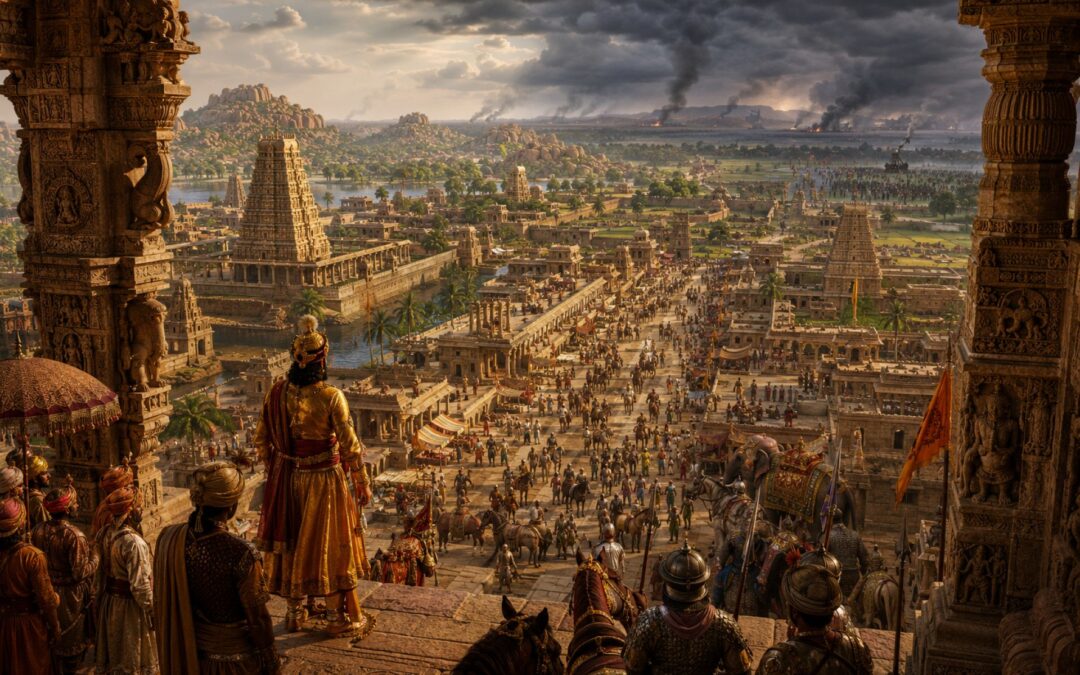
In the ruins of Hampi, the scale of the vanished city remains difficult to comprehend. Temple towers rise above boulder-strewn hills. Stone bazaars stretch towards sacred complexes. Aqueducts, reservoirs, roads, gateways and palace foundations reveal a capital built to command a vast territory—and to impress everyone who entered it.
After the Battle of Talikota in 1565, that capital was abandoned, looted and devastated. The catastrophe has often been treated as the simple ending of the Vijayanagara Empire: a great Hindu kingdom defeated in one decisive confrontation with the Muslim Sultanates of the Deccan.
The real history is more complicated.
Vijayanagara did not become powerful by remaining isolated from the world around it. Its rulers recruited soldiers and specialists from different regions and religious communities. They competed for imported horses, firearms and mobile military talent. They adopted elements of the Persianate court culture that shaped politics across the Deccan while continuing to draw legitimacy from temples, Sanskritic traditions and the regional cultures of southern India.
Nor was Talikota an inexplicable collapse caused by one act of betrayal. It was the culmination of dynastic instability, technological change and a dangerous political strategy that gradually convinced several rival Sultanates that Vijayanagara had become their common enemy.
The destruction of Hampi was a turning point, but it was not the instant end of the empire. To understand what was lost in 1565, it is first necessary to understand how Vijayanagara had become so formidable.
From Delhi’s Retreat to a New Deccan Empire
During the early fourteenth century, the political order of southern India was transformed by military expansion from the north. The armies of the Delhi Sultanate campaigned deep into the Deccan and beyond, weakening older powers, seizing tribute and attempting to impose authority over territories far from Delhi.
These conquests were disruptive, but Delhi’s ability to control the south remained limited. Distance, rebellion, administrative overreach and the difficulty of maintaining armies across such a large region gradually undermined its position. Muhammad bin Tughlaq’s ambitious policies intensified instability rather than producing lasting centralisation.
As Delhi’s grip weakened, regional rulers, commanders and political networks began constructing new centres of power. Vijayanagara emerged from this unsettled landscape.
The empire is conventionally said to have been founded in 1336 by the brothers Harihara and Bukka, the first rulers of the Sangama dynasty. The date is useful, although the formation of the state was probably a gradual process rather than a single, perfectly documented founding event.
The brothers’ origins remain disputed. Later traditions associated them with several earlier southern states and described a dramatic sequence in which they were captured by Delhi, converted to Islam and later returned to Hinduism under the guidance of the scholar Vidyaranya. These accounts became important to Vijayanagara’s historical memory, but they cannot be accepted in every detail as established fact.
What is clearer is that Harihara and Bukka built their power around the Tungabhadra River, in a landscape protected by hills, boulders and defensible crossings. Their early state absorbed territories once controlled by declining powers such as the Hoysalas and expanded into regions weakened by the retreat of Delhi’s authority.
This was not merely a military recovery. The new empire gained control of productive agricultural land, mineral resources, commercial routes and access to ports connected to the Indian Ocean. Its rulers established relationships with temple institutions, local warrior elites and regional administrators who could mobilise revenue and troops.
Vijayanagara also presented itself as a protector of sacred places and established royal traditions. Its kings used religious patronage to legitimise their authority, but they were not reviving a sealed or unchanged political world. They were building a new empire from the institutions, personnel and technologies available in a rapidly changing Deccan.
The empire’s rise formed part of the wider history of medieval India, in which regional states repeatedly emerged from the weakening of larger imperial systems. Vijayanagara was one of the most successful examples. Within a few decades, it had become a major power across southern India.
Its greatest rival was rising at almost exactly the same time.
The Bahmani Rivalry and the Fight for the Raichur Doab
In 1347, rebels against Delhi established the Bahmani Sultanate in the northern Deccan. Vijayanagara and the Bahmani state therefore shared similar political origins: both emerged from the breakdown of the Delhi Sultanate’s attempt to dominate the region.
Their rulers represented different religious and dynastic traditions, and religious legitimacy mattered to both. Yet their conflict cannot be explained simply as an endless war between Hinduism and Islam.
They fought because they were expanding states competing for the same strategic resources.
The most persistent focus of the rivalry was the Raichur Doab, the land between the Krishna and Tungabhadra rivers. Its fertile soil generated agricultural revenue, while its forts controlled routes between the northern and southern Deccan. Possession of Raichur and Mudgal provided both practical advantages and enormous symbolic prestige.
The frontier shifted repeatedly. Forts were captured, lost and recaptured. Victorious rulers demanded tribute, while defeated rulers waited for a more favourable moment to reverse the outcome.
Neither empire could permanently eliminate the other. Vijayanagara controlled more territory and possessed a large agrarian base, but the Bahmani Sultanate benefited from strong cavalry traditions, fortified cities and access to military specialists from the wider Islamic world.
Horses were especially important. The climate of much of India made it difficult to breed large numbers of high-quality warhorses, so Deccan rulers depended on imports from Arabia, Persia and Central Asia. Control of ports and merchant networks could therefore influence the balance of power on land.
The Bahmani court actively attracted soldiers, scholars, administrators and merchants from overseas. These immigrants, often described as afaqis or “westerners,” competed for influence with Muslims whose families had deeper roots in the Deccan. Their arrival enriched the Sultanate but also generated factional conflict.
Vijayanagara participated in many of the same networks. Muslim cavalrymen, archers, merchants and officers could serve Hindu rulers, just as Hindu commanders and administrators could serve Sultanate courts. Political allegiance often followed patronage, opportunity and family interest more readily than religious identity.
Diplomatic accommodation accompanied warfare. One tradition records that, after a Bahmani victory in the early fifteenth century, Sultan Firoz Shah married a Vijayanagara princess as part of a settlement. The details are filtered through later chronicles, but the episode reflects a political world in which rivalry, tribute, marriage and negotiation could coexist.
The frontier struggle taught Vijayanagara’s rulers an important lesson. Territorial size and wealth did not automatically produce military superiority. To compete with the Bahmani Sultanate, the empire would have to adapt its army, its court and its understanding of power.
That transformation became particularly visible under Deva Raya II.
Deva Raya II and the Reinvention of Vijayanagara
Deva Raya II, who ruled during the first half of the fifteenth century, inherited a rich empire that still struggled to convert its resources into consistent success on the battlefield.
The Bahmani Sultanate possessed skilled cavalry, mounted archers and access to experienced military personnel from across the Persianate world. Vijayanagara’s rulers could not afford to treat those capabilities as foreign practices that had no place in their own state.
Deva Raya expanded the recruitment of Muslim soldiers, especially cavalrymen and archers. Officers received land, titles and positions within the imperial system. The purpose was practical: Vijayanagara needed men who understood the weapons, horses and tactics shaping warfare in the Deccan.
This policy is sometimes described as the sudden opening of a previously closed Hindu kingdom. That exaggerates the contrast. Vijayanagara had never been completely isolated, and military labour had long crossed political and religious boundaries. Deva Raya’s achievement was to deepen and formalise those connections.
Factional struggles within the Bahmani Sultanate helped him. Tension between locally established Deccani elites and overseas migrants periodically drove talented men from one court to another. Vijayanagara could offer employment and patronage to soldiers and specialists who had lost favour elsewhere.
The empire’s adaptation extended beyond the battlefield. Vijayanagara’s rulers continued to patronise temples and present themselves through Hindu royal traditions, but they also adopted political forms associated with neighbouring Islamic courts.
Research into Islamicate influences at the Vijayanagara court has shown how clothing, titles, courtly etiquette and architecture crossed political boundaries. Rulers could wear garments associated with Sultanate elites, use Persian-derived political language and construct secular buildings with arches and domes without surrendering their religious identity.
This was not a story of one civilisation replacing another. It was a process of selective appropriation. Vijayanagara’s kings borrowed practices that strengthened their authority while continuing to anchor their rule in temples, sacred geography and the regional traditions of Karnataka, Andhra and Tamil country.
Under Deva Raya II, the empire expanded its influence and enhanced its reputation. Its armies campaigned against neighbouring states, while its court attracted scholars, poets, diplomats and religious figures.
The first great age of Vijayanagara was therefore built on a combination of continuity and adaptation. The empire remained recognisably rooted in southern Indian royal culture, but it became stronger by participating fully in the interconnected political world of the Deccan.
Nowhere was that success more visible than in the capital.
Hampi at the Height of the First Golden Age
Vijayanagara’s capital occupied a remarkable landscape along the Tungabhadra River. Granite hills and enormous boulder formations created natural barriers, while the river supplied water and connected the settlement to agricultural land.
The city was not organised as a compact urban centre enclosed by one wall. It spread across a large area of sacred sites, residential districts, agricultural fields, military positions, markets and royal compounds. Successive defensive enclosures incorporated cultivated land so that parts of the population and food supply could remain protected during a siege.
Roads and gateways guided movement through the city. Reservoirs, channels, wells and aqueducts carried water towards fields, gardens, workshops and elite buildings. The capital depended on extensive irrigation and on a hinterland capable of feeding residents, soldiers, animals, pilgrims and visiting merchants.
At its height, Hampi contained crowded bazaars, temple complexes, administrative spaces, elephant stables, residences and ceremonial platforms. Stone-lined market streets extended from major temples, tying commerce to religious and royal activity.
The city also reflected the empire’s international connections. Merchants brought horses, textiles, precious stones, metals and luxury goods through Indian Ocean networks. Diplomats and travellers arrived from courts far beyond southern India.
One of the most important visitors was the Persian envoy Abdur Razzaq, who reached Vijayanagara during the reign of Deva Raya II. In Abdur Razzaq’s account of Vijayanagara, the capital appeared as an almost incomparable city protected by successive fortifications and surrounded by fertile, carefully cultivated land.
His description conveys astonishment at the scale of the court, the city’s markets and the ruler’s authority. He also supplied enormous figures for the army, elephants and ports under imperial control.
Such numbers should not be treated as census data. Premodern travellers often used scale rhetorically, and they did not possess the administrative methods required to count vast urban populations or military establishments accurately. Their testimony is most valuable for what they observed directly: the density of activity, the abundance of goods, the defensive landscape and the impression of imperial wealth.
Hampi’s buildings also reveal a city shaped by several architectural traditions. Monumental temple complexes developed recognisably southern forms, including towering gateways, pillared halls and sculpted surfaces. Secular and courtly structures incorporated arches, domes, vaulted spaces and other elements associated with the architectural world of the Deccan Sultanates.
The result was not a random mixture. It was the visual language of an empire confident enough to absorb several traditions at once.
Hampi’s magnificence rested on more than royal taste. It depended on taxation, warfare, provincial tribute, temple networks, commercial exchange and the labour of thousands of people. Farmers produced the food. Artisans supplied weapons, textiles and luxury goods. Merchants connected the court to distant markets. Soldiers and officials consumed enormous quantities of revenue.
The capital represented the empire’s success, but it also revealed its dependence on a political system capable of moving resources towards the centre.
That system would soon come under severe strain.
How Dynastic Crisis Nearly Broke the Empire
The prestige of Deva Raya II could not solve the problem that haunted many hereditary states: the transfer of power.
Court politics became increasingly violent during the final years of the Sangama dynasty. One dramatic account describes an assassination attempt in which a royal prince invited nobles and officials to a banquet and attacked them as they arrived in separate groups. He then stabbed Deva Raya II and announced that he had killed the emperor.
Deva Raya survived long enough for the plot to fail, but the episode illustrates the fragility of the court. Personal rivalries were not confined to the palace. When succession became uncertain, provincial commanders, neighbouring states and court factions all gained opportunities to advance their interests.
The rulers who followed Deva Raya II struggled against pressure from several directions. The Bahmani Sultanate continued to contest the northern frontier, while the Gajapati rulers of Odisha expanded into territories claimed by Vijayanagara.
Strategic losses weakened the centre. Control of western ports mattered because the empire depended on imported horses. If access to those markets became uncertain, the army’s effectiveness could suffer.
At the same time, powerful provincial leaders became increasingly autonomous. Vijayanagara’s kings governed through military chiefs and regional authorities who controlled land, collected revenue and maintained troops. The system allowed rapid mobilisation, but it also meant that a weak ruler could not assume automatic obedience.
By the late fifteenth century, Saluva Narasimha, an influential commander, concluded that the Sangama dynasty could no longer preserve the empire. He seized the throne, establishing the Saluva dynasty.
His takeover was an act of ambition, but it was also an attempt to prevent imperial disintegration. Vijayanagara’s political institutions proved stronger than the ruling family. The empire could survive a change of dynasty because its provincial networks, armies, sacred institutions and revenue systems remained functional.
Yet the Saluva succession was no more secure. Narasimha died after a short reign, leaving young heirs under the protection of the powerful military figure Narasa Nayaka. The princes did not establish lasting control, and authority gradually passed into the hands of Narasa Nayaka’s family.
By the beginning of the sixteenth century, the Tuluva dynasty had replaced the Saluvas.
The transition had been violent and uncertain, but the empire had survived. Its next ruler would transform that survival into the most celebrated reign in Vijayanagara’s history.
Krishnadevaraya and the Empire at Its Peak
Krishnadevaraya ascended the throne in 1509. He inherited an empire that had endured dynastic upheaval but still possessed immense resources, formidable military networks and a capital capable of supporting imperial ambition.
His early reign was shaped by warfare. Vijayanagara faced pressure from the Gajapati kingdom of Odisha, from Deccan Sultanates to the north and from local powers whose loyalty could not be taken for granted.
Krishnadevaraya proved to be an energetic and effective campaigner. He restored imperial authority in contested regions, defeated rival forces and reinforced the position of the Tuluva dynasty. His victories gave the court a sense of confidence that had been missing during the previous decades.
Military success was only part of his reputation. Krishnadevaraya became known as a patron of literature and as an accomplished writer. His court supported work in Telugu, Kannada, Tamil and Sanskrit, reflecting the multilingual character of the empire.
He is most closely associated with Telugu literary culture, particularly through the poem Amuktamalyada. His reign later became remembered as a golden age in which royal power and artistic patronage reinforced each other.
Temple construction and renovation also expanded. Monumental projects strengthened ties between the crown, sacred centres and regional communities. Religious patronage was not separate from politics: it displayed royal generosity, created alliances and helped place the dynasty within respected traditions of kingship.
Foreign trade contributed to imperial wealth. Portuguese power was expanding along India’s western coast, and Vijayanagara interacted with Portuguese merchants who supplied horses, weapons and other goods. These relationships were commercial and strategic rather than expressions of permanent friendship.
The capital reached the height of its fame during this period. Modern estimates often place its population among the largest urban centres of the sixteenth-century world, but the exact number remains uncertain. What can be established is that visitors encountered an exceptionally extensive and active metropolis.
The most vivid surviving descriptions come from Portuguese observers. The surviving Portuguese accounts of Vijayanagara, including those associated with Domingo Paes and Fernão Nunes, describe broad roads, busy markets, extensive fortifications, irrigated fields and an imperial court surrounded by ceremony.
Paes admired Krishnadevaraya’s discipline and accessibility. His account portrays a ruler who exercised before dawn, attended to government and cultivated the image of an energetic warrior-king.
Such descriptions contributed to Krishnadevaraya’s later reputation as the ideal Vijayanagara monarch. Yet the prosperity of his court rested on constant military mobilisation and the extraction of resources from a vast territory. The splendour of Hampi cannot be separated from the campaigns that brought tribute, land and labour under imperial control.
Krishnadevaraya’s greatest victory would come at Raichur. It displayed the full strength of the empire—and revealed the increasingly dangerous military and diplomatic environment in which that strength had to operate.
Raichur and the Costs of Imperial Supremacy
By the early sixteenth century, the Bahmani Sultanate had fragmented. Its nominal ruler lost effective control as powerful provincial dynasties established the Sultanates of Bijapur, Ahmadnagar, Golconda, Bidar and Berar.
The division created opportunities for Vijayanagara. Instead of facing one large northern rival, the empire could exploit competition among several smaller states.
The Raichur Doab remained contested. In 1520, Krishnadevaraya launched a campaign against Bijapur to recover the fortress of Raichur. A dispute involving a merchant and money allegedly owed to Vijayanagara provided the immediate justification, although the deeper cause was the old struggle for the frontier.
Krishnadevaraya assembled an enormous army. Contemporary chronicles describe vast numbers of infantry, cavalry, elephants, camp followers and entertainers, but their precise figures cannot be verified. What matters is the scale of the mobilisation and the resources required to sustain it.
The defenders of Raichur possessed strong fortifications, while Bijapur’s army relied heavily on artillery. Cannon and matchlocks were becoming increasingly important in Deccan warfare, although they had not yet made cavalry, elephants or mass infantry irrelevant.
The battle demonstrated that possessing more firearms did not guarantee victory. Bijapur may have enjoyed an artillery advantage, but Vijayanagara’s army absorbed the attack and broke the opposing force through a combination of numbers, cavalry pressure and battlefield momentum.
Portuguese soldiers and marksmen appear in some accounts of the siege. Their presence reflected the growing role of foreign specialists and imported weapons, but they did not single-handedly win the campaign.
The most useful interpretation comes from Richard Eaton’s study of the Battle of Raichur, which places the conflict within the military transition towards cannon, matchlocks and mobile expertise. The battle belonged to a changing world in which rulers competed not only for territory but also for access to new weapons and the people capable of using them.
Raichur surrendered, and Krishnadevaraya emerged at the height of his power. The victory allowed Vijayanagara to claim superiority over Bijapur and strengthened the emperor’s prestige throughout the Deccan.
Yet the diplomatic aftermath was unusually humiliating. According to the surviving narrative, Krishnadevaraya demanded that the defeated Sultan personally submit and kiss his foot. The exact performance and wording are preserved through partisan chronicles, but the larger point is credible: Vijayanagara used the victory not merely to secure territory but to degrade its rival publicly.
Krishnadevaraya later advanced towards Bijapur when the Sultan failed to appear. The episode turned military success into lasting resentment.
The battle of 1520 therefore had two legacies. It confirmed Vijayanagara’s supremacy, but it also demonstrated how firearms were reshaping war and how aggressively the empire intended to use its dominance.
Krishnadevaraya died without securing a stable political future. After his reign, the empire’s formal rulers became weaker, and real authority passed to a man who believed he could control the Deccan by manipulating its divisions.
For many years, he succeeded.
Rama Raya and the Dangerous Game of Deccan Politics
Rama Raya rose through the Vijayanagara court during the first half of the sixteenth century. Connected to the royal family through marriage, he gradually became the dominant figure behind rulers who possessed the imperial title but not independent power.
His career illustrates the mobility of Deccan elites. Soldiers and administrators frequently crossed political boundaries, changing employers as opportunities shifted. Rama Raya himself operated in a world in which service, patronage and personal networks connected Vijayanagara to the Sultanates.
A scholarly examination of Rama Raya’s place in the Persianised Deccan challenges the idea that he ruled an isolated Hindu state confronting a permanently united Muslim bloc. The political system he dominated was far more fluid.
The Bahmani successor states fought one another constantly. Bijapur, Ahmadnagar, Golconda, Bidar and Berar competed for territory, influence and survival. Alliances formed and dissolved rapidly.
Rama Raya inserted Vijayanagara into these conflicts. He supported one Sultanate against another, demanded territory or tribute in return and then shifted sides when the balance changed.
The strategy was effective because no single Sultanate could easily challenge Vijayanagara alone. Each ruler feared his immediate neighbours, and alliance with Rama Raya could offer temporary protection or military advantage.
Vijayanagara forces therefore campaigned alongside Sultanate armies as often as they fought against them. Religious identity did not disappear, but it did not determine every coalition.
Rama Raya’s position became increasingly coercive. He intervened in succession disputes, imposed humiliating peace terms and used allied campaigns to strengthen Vijayanagara at the expense of enemies and partners alike.
During warfare in the northern Deccan, armies associated with his campaigns devastated rural areas and attacked religious buildings. Such destruction could express religious hostility, but temples and mosques were also centres of wealth, patronage and political legitimacy. Damaging them weakened the ruler who protected them.
The cumulative effect was more important than any single campaign. Sultanate rulers learned that an alliance with Vijayanagara could save them from one enemy while leaving them vulnerable to Rama Raya’s demands.
Bijapur had sometimes been his partner. Ahmadnagar and Golconda had also entered arrangements involving Vijayanagara. Yet Rama Raya’s territorial opportunism and willingness to humiliate defeated rulers gradually reduced the value of cooperation.
His diplomacy depended on keeping the Sultanates divided. Once they concluded that Vijayanagara itself had become the principal threat, the foundation of his strategy disappeared.
By 1564, several Deccan rulers were prepared to set aside their rivalries long enough to confront Rama Raya together. The resulting coalition was exceptional. It did not represent permanent Sultanate unity, and its members would resume fighting one another afterwards.
But for one campaign, they shared a strategic purpose.
They intended to break Vijayanagara’s dominance before Rama Raya could turn them against one another again.
Talikota and the Destruction of Hampi
The decisive campaign took place in early 1565. It is usually called the Battle of Talikota, although the fighting is also associated with Rakshasa-Tangadi and nearby locations.
Accounts provide enormous and contradictory army sizes. Vijayanagara probably possessed a numerical advantage, but exact totals cannot be established. The Deccan coalition brought experienced cavalry, artillery units and military specialists drawn from networks extending through Persia, Central Asia and the Ottoman world.
By this time, Deccan rulers had learned how to integrate firearms more effectively into field armies. Cannon could disrupt massed troops and hold an enemy at a distance, while cavalry exploited the resulting disorder.
Rama Raya, already an elderly man, personally directed the Vijayanagara force. His presence displayed confidence, but it also made the command structure vulnerable.
The battle’s exact sequence remains disputed. Later accounts embellished the confrontation with dramatic weapons and acts of betrayal. One tradition claims that a cannon fired heated copper coins towards Rama Raya. It is better treated as legend than evidence.
Another explanation focuses on the Gilani brothers, Muslim commanders serving Vijayanagara who had previously been connected to Bijapur. Some accounts claim that they defected or withdrew at a decisive moment.
Their conduct may have contributed to confusion, but it cannot carry the entire explanation. Vijayanagara’s army was not an otherwise invincible force defeated solely because two officers changed sides.
The coalition’s artillery, cavalry, coordination and command decisions mattered. So did Rama Raya’s exposed position.
At some point during the battle, he was captured. Accounts differ over whether he was pulled from his mount, overwhelmed in combat or seized after the lines began to collapse. He was killed and beheaded.
The sight or report of his death shattered the Vijayanagara command. Rama Raya had concentrated effective authority in his own hands, and the army struggled to recover once he disappeared.
The imperial forces broke. Survivors fled south while the royal household evacuated Hampi with whatever treasure and resources could be moved.
The road to the capital was open.
When the coalition forces entered Hampi, they encountered one of the wealthiest urban centres in India. Palaces, temples, markets, residences and storehouses offered immense opportunities for plunder.
The destruction was not completed in a single afternoon or even a few days. UNESCO’s account of the surviving monuments of Hampi describes pillaging that continued for roughly six months.
Royal and secular buildings suffered especially severe damage. Structures were stripped of valuable materials, burned or deliberately broken. Temples were looted and damaged, although the pattern of destruction varied across the enormous site.
Residents who had not escaped faced violence, enslavement and displacement. Commercial life collapsed. The networks that supplied the court disappeared, and the political reason for maintaining such a large capital no longer existed.
The coalition had won a great victory, but it did not occupy Hampi permanently or construct a new state from Vijayanagara’s territory. Its members divided gains, pursued their own interests and soon returned to rivalry.
Hampi, however, never recovered its position as an imperial metropolis.
The catastrophe destroyed the centre from which Vijayanagara’s power had been displayed and coordinated. Yet the empire itself had not vanished.
The Empire After Hampi and the Legacy of Vijayanagara
The distinction between the fall of Hampi and the end of the Vijayanagara Empire is essential.
Members of the royal family escaped the capital. Tirumala, Rama Raya’s brother, helped preserve the dynasty and moved the court south. Under the Aravidu rulers, imperial authority continued from new centres, beginning with Penukonda and later shifting towards places such as Chandragiri and Vellore.
The surviving state was weaker. It had lost prestige, territory, revenue and the administrative gravity created by Hampi. Provincial military chiefs became more independent, while regional Nayaka houses developed into powerful states of their own.
Vijayanagara’s rulers continued to claim imperial authority, patronise temples and intervene in southern politics, but they could no longer dominate the Deccan as Krishnadevaraya or Rama Raya had done.
Decline therefore occurred in stages. Talikota was the irreversible turning point, not the final date of the empire. The Aravidu state survived into the seventeenth century even as its effective power contracted and its former political system fragmented.
The empire’s influence also outlived its rulers.
Regional courts inherited Vijayanagara traditions of military organisation, royal ceremony and temple patronage. Architectural styles developed under imperial rule continued across southern India. Kannada, Telugu, Tamil and Sanskrit literary cultures retained works created or supported by Vijayanagara courts.
The empire also shaped the political geography of the south. States that emerged from its provincial structure carried forward its institutions while adapting them to new regional circumstances.
Hampi remains its most visible legacy. The city’s ruins are not merely monuments to a civilisation erased in one battle. They preserve evidence of how the empire actually worked: its sacred centres, irrigation systems, military defences, markets, royal spaces and cultural exchanges.
They also expose the weakness hidden inside imperial grandeur.
Vijayanagara became powerful because it mastered the competitive world of the Deccan. It recruited widely, adapted rapidly and used the rivalries of neighbouring states to its advantage. Under Deva Raya II and Krishnadevaraya, that flexibility created extraordinary strength.
Under Rama Raya, the same political system became dangerous. Intervention turned into domination. Victory produced humiliation. Former allies began to see the empire not as a useful partner but as a threat that none of them could safely confront alone.
Talikota did not destroy Vijayanagara because the empire had borrowed too much from its neighbours or failed to remain culturally isolated. It destroyed its capital because a state that had thrived on division finally provoked its rivals into temporary unity.
The empire survived the battle. The world centred on Hampi did not.
Last Updated on July 27, 2026 by Aseem Gupta